Surprise! The Texas Shooter and the Ukraine Military Get Their AR-15s From the Same Place
By Michael Tracey | June 1, 2022
Like many pundits, Michael McFaul took a quick break this past week from his usual area of “expertise.” Instead of pontificating 24/7 about the need to funnel massive amounts of uncontrolled arms into Ukraine, he adroitly pivoted to pontificating about the need to more stringently control arms in the US. McFaul, a former Ambassador to Russia who is currently working with the Ukraine government to formulate war-related policy recommendations, issued the following command:
To all the manufacturers of AR15s, please stop. Just do the right thing. And the rest of us might consider stopping to focus on a legislative solution, and instead focus on a non-violent civic resistance campaign against these AR15 makers directly.
Few figures on the punditry scene are more adept at getting themselves into comical face-plant scenarios than McFaul — or more useful at highlighting unexamined contradictions of the yammering liberal commentariat. In this instance, McFaul demonstrates why he and likeminded commentators are so steadfastly determined to compartmentalize their positions on foreign policy versus domestic policy. Because it would apparently never even occur to McFaul that there might be some tension between his passionate calls to aggressively curtail gun circulation in the US, and his similarly passionate calls to circulate a giant number of guns in Ukraine.
McFaul and company demand both policies with roughly equal ardor, voicing them in the standard register that has come to define almost all left-liberal advocacy: “this thing must be done right now or everyone will die.” Meanwhile, they evince not even a hint of awareness that the positions could represent contradictory impulses. On the one hand, they want to ensure that the American populace is prevented from obtaining certain high-powered rifles. On the other hand, they want to ensure that the Ukrainian populace is enabled to obtain these same high-powered rifles. Both positions somehow manage to co-exist seamlessly alongside one another, like two of those inflatable tube things floating merrily downstream — never even coming close to clashing.
Is it possible that any contradictions between these stances could be resolved with some sort of reasoning or argumentation? Sure, it’s possible. A liberal who holds both positions could theoretically argue something along the lines of: “In the case of Ukraine, my purported belief in the sacrosanct necessity of gun control is superseded by my belief that unlimited, unregulated, uncontrollable proliferation of guns in Eastern Europe is necessary to Defend Democracy.” Or whatever — something to that effect. And then followup counter-arguments could be raised, such as: “Shouldn’t the mass proliferation of uncontrolled guns in Ukraine, which is occurring as a result of the policy you favor, call into question how vehemently you really value the principle of gun control? Because if the policy you favor in Ukraine is totally inimical to your stated belief in the absolute paramount necessity of gun control, shouldn’t that at least raise the bar for whether the Ukraine policy is justified?” And so on.
The point being, tensions between these two counterposing positions would at least require some argumentation to resolve. But what makes today’s McFaul-style advocacy so notable is the complete and total obliviousness to any such tension even existing in the first place. As they issue their emotionally-heated policy demands, most Democrats appear to have no concept whatsoever that there might be some discordance between their desire to increase regulation on gun ownership at home, while simultaneously obliterating any regulation on gun ownership abroad. Members of the media, the activist class, and the wider punditocracy lack even the basic cognizance that would be needed to broach the subject. So, as usual, the McFaul-style advocates just barrel zealously forward, demanding these two policy prescriptions with equal, unmitigated gusto — without anyone ever pausing to ask for clarification.
And there are plenty of good reasons why clarification might be sought. Here’s how an investigator for Amnesty International reacted to one of the many influxes of weapons to Ukraine ushered in recently by Congress and the Biden Administration. (Yes, the batches include thousands and thousands of assault rifles):
History predicts that someday I’ll track some of these weapons to a new conflict that hasn’t even started yet.
Does anyone feel as if these guns rapidly pouring into Ukraine are being subjected to adequate “control”? Because whenever US officials are given an opportunity to speak candidly on the topic, they grudgingly admit the weapons are dropping into what they call “a big black hole.” Which gives the strong impression that no “controls” are being applied, at least according to the criteria that would ordinarily be demanded by gun control proponents.
And yet amidst the frantic cries for domestic “gun control,” US policy continues to facilitate less “control” of guns entering key foreign markets. The newly-revived “Lend-Lease” law — enacted with near-universal backing from Congress — provides for certain Ukraine-specific exemptions from the Arms Export Control Act, the main statutory mechanism for “end-use monitoring of defense articles and defense services” that the US sends abroad. As one “defense” industry trade publication put it, the main allure of the new Lend-Lease law is that it “will trim the bureaucracy” involved in getting weapons to Ukraine as quickly as possible — eschewing the usual types of restrictions which would ordinarily govern these shipments.
So here we have Michael McFaul appealing to every gun manufacturer in the US to stop producing the AR-15. Plenty of Democrats and liberal pundits echo this exact sentiment: that the US must cease disseminating so-called “weapons of war,” lest they continue getting into the wrong hands. Special ire has been directed at Daniel Defense, the Georgia-based company that manufactures the AR-15 style rifle used by the school shooter in Uvalde, Texas. McFaul implores them to halt production.
Does McFaul know that this would also halt the production of AR-15 shipments to the Ukraine government? Because they get their rifles from the same place the Uvalde shooter did: Daniel Defense. The Ukraine Border Guard — which has been on the front-line of some of the war’s most fierce fighting — revealed as much in a statement announcing their conversion from shoddy old Kalashnikovs to a new modern rifle called the “UAR-15.” The parts for these new rifles come straight from the US, they proudly revealed: “The barrel and the trigger mechanism, on which the accuracy of firing directly depends, are made in the USA by the Daniel Defense company,” the statement reads.
Photos posted on the subreddit dedicated to fans of Daniel Defense purportedly show unidentified pro-Ukraine fighters posing on the battlefield with the exact same model that the Uvalde shooter used:

A website for Special Ops impresarios describes the fancy new Ukraine rifle as such: “The new addition to the small arms inventory of the Ukrainian Armed Forces is a UAR-15 (Zbroyar Z-15), which, as you can easily guess, is one of the many clones of the AR-15.” The site further notes that “American company Daniel Defense obtained the license” on behalf of a Ukrainian company “to produce weapons based on the worldwide AR-15 and AR-10 systems.” Daniel Defense, it would seem, is critical to this ongoing campaign to “Defend Democracy”!
And it’s not just this one newly-reviled company. A smaller manufacturer, Adams Arms, has been celebrated for delivering “more than 1,000 piston driven, semi-automatic AR-15 style rifles into Ukraine for civilian use” since the war started. They even put out press releases touting these shipments, indicating that they thought their pro-Ukraine disposition would be good for business — and were showered with laudatory media coverage for their efforts. Is McFaul saying he wants to shut down Adams Arms, thereby preventing them from continuing to ship rifles into Ukraine?
There have even been photos of Azov Battalion fighters brandishing the despised AR-15s…
I realize people will nonetheless insist that there is just no conceivable tension at all between the indiscriminate dumping of guns into a warzone, and the demand that these same guns be strenuously controlled in the US. But that’s just a testament to how carefully the two issues have been compartmentalized, as is very often the case with foreign policy and domestic policy.
Dreaded gun industry lobbying outfits have even released helpful tip-sheets for domestic US manufacturers, detailing how these companies can secure the necessary authorization to “donate” guns, ammo, and other equipment directly to Ukraine. One would assume McFaul also yearns for this practice to be shut down. But chances are, he’s never thought the matter through. Like most others shrieking for the AR-15 to be proscribed, while at the same time shrieking for AR-15s to be ferried off to the Donbas, the connections between foreign and domestic policy have never crossed their minds. They might be shocked to discover that even the relentlessly demonized NRA has found common ground with McFaul and ilk. As an NRA spokesperson told the Washington Times: “The NRA and our members support the efforts of firearms and ammunition manufacturers helping the people of Ukraine.”
Remington, the gun manufacturer that’s been sued into bankruptcy after being found liable for the Sandy Hook school shooting — because the perpetrator used a gun they produced — has also joined the frenzy to arm Ukraine:
We heard President Zelenskyy’s call. Remington is sending 1M rounds of ammo to Ukraine.
Do McFaul and his ideological peers want to shut down Remington’s ability to send boatloads of bullets to those brave warriors fighting on the frontlines of Democracy?
There’s obviously no direct, concrete, empirically-verifiable connection between the recent mass shootings in the US and the ongoing military escalation in Ukraine. But at one point, it was at least contemplated that US foreign policy could have some extenuating role in conditioning a certain subset of the population toward excess violence. In Bowling for Columbine, which became the most financially successful documentary of all time when it was released in 2002, Michael Moore makes the case that the prevalence of mass shootings in the US is not exclusively or even primarily explainable by the availability of guns.
Moore cites what he says are comparable rates of gun ownership in the US and Canada — and the far lesser prevalence of mass shootings in Canada — as reason to believe that other cultural and political pathologies unique to the US are to blame. In the movie, Moore goes out of his way to note that on the day of the Columbine shooting, April 20, 1999, Bill Clinton dropped more bombs on Yugoslavia than were dropped on any other day of that particular war. Moore further explained his theory about the prevalence of gun-related violence in the US by reference to cultural attitudes, such as those which say “It’s OK to reach for the gun whenever you have to resolve a dispute. Whether it’s personally with your neighbor, or someone in your family. Or whether it’s with Saddam Hussein.”
I don’t bring up this aspect of the Bowling for Columbine thesis to assert that Moore is 100% correct — only to point out that the connection between US foreign policy and mass shooting events at least used to be commonly discussed, including by the most successful documentary-maker of all time. And yet today, if you even mention the US shipping high-powered rifles into Ukraine as a potentially relevant factor to consider when talking about gun control in the US, you’ll draw blank stares. And that’s if you’re lucky. More likely, you’ll draw angry reproaches from people who are indignant that you’d dare to “go there,” when the only place you should be going is to support the latest 10-point plan for gun control furnished by one of Mike Bloomberg’s lavishly funded advocacy groups.
Since Bowling for Columbine came out two decades ago, a few mass shootings have given some credence to Moore’s thesis. In 2018, a veteran of the Afghanistan war named Ian David Long killed 12 people at a bar in Thousand Oaks, California, before killing himself. According to a report by the Ventura County Sheriff’s Office, Long was “a machine gunner in the US Marine Corps who had true combat experience while serving in Afghanistan,” having fought there from 2010 to 2011 — the period when the “surge” orchestrated by Barack Obama and David Petraeus produced more US casualties than at any other point of the 20-year war. According to the Sheriff’s report, ex-girlfriends of Long attested that he was “suffering emotionally from witnessing the travesties of war,” and was afflicted with PTSD. In the year or so before the shooting, he had become heavily isolated. Investigators concluded Long was motivated by “strong disdain for civilians, or individuals not associated with any branch of the US military,” in particular college students — hence his decision to target a “College Night” at the bar.
That’s one example of US foreign policy potentially having some conceivable bearing on a mass shooting. And you could go back further; one of the first mass shooters of the modern era, Charles Whitman, honed his skills as a Marine sharpshooter before firing at random from atop the Clock Tower on the campus of the University of Texas at Austin, all the way back in 1966.
So yes, sometimes there are theoretical connections that can be posited between US foreign policy and mass shootings, like a society-wide habituation to violence, as was suggested by Michael Moore. Sometimes you can get a little more tangible, as when an Afghanistan vet with PTSD shoots up a college bar. And sometimes you can even draw connections between the actual rifle used, such as when the Texas school shooter got his AR-15 from the same US company that also produces the AR-15 used by elements of the Ukraine armed forces. Don’t hold your breath for any “national conversation” about that latter connection, though.
Because all the while, Michael McFaul continues to spout off his desire to “increase arms to Ukraine,” even as he simultaneously calls for the shuttering of US gun manufacturer production lines — which would result in the cessation of arms being sent into Ukraine. But yeah, no tension at all between these dueling positions. Sure thing.
WEF back, learned nothing
By Alexander Adams | Bournbrook | May 24, 2022
The World Economic Forum (WEF) is back. After two years away, the elites reconvened in Davos, Switzerland, to resume plotting. Not, of course, that they would put it that way.
Open Forum Davos 2022 began on 23 May and runs until 26 May. It is a conference designed to increase international participation, “at a crucial turning point in history”. Every WEF statement reads part messianic prophecy, part threat, part vacant corporate babble. This year’s Open Forum promotion is no different.
Hand-picked stooges will promote WEF talking points and push pre-set agendas. There is no possibility of someone taking to the stage and suggesting more democratic accountability, nation independence and vitality through ideological diversity. “The activists will articulate how to turn words into action to fight the climate crisis. Gender equality will also feature prominently in the conversations.” The WEF knows that its multi-million-dollar programme of supporting environmentalist, gender-activist and pro-migrant groups will be amplified by globalist-friendly mass media outlets and clueless politicians in search of “relevance” and photo ops. The forum stresses youthfulness, promoting speakers such as “26-year-old Vanessa Nakate, author and climate advocate” and “Ievgeniia Bodnya, 27, who mobilized the Global Shaper Hub she leads in Kyiv to build the Support Ukraine Now”. Young, passionate women make perfect spokespersons. After all, should anyone male or older than them criticise their ideas, the opponents can be dismissed as relics of a failed era, ones who refuse to accept the coming wave of eco-awareness and migration justice.
The hypocrisy of the WEF is blatantly apparent in its support for Ukraine. It might seem to you paradoxical that a supra-national body which is dedicated to reducing the independence of nations has suddenly discovered its passionate commitment to the integrity of national borders, but WEF see no contradiction. The WEF writes:
“The Russian invasion into Ukraine was a tipping point for world security, the international economy and our global energy architecture. It is not possible to narrow down a war like this to one region while we live in a globalized world. We cannot keep radiation in one country’s geographical borders, or eliminate one country from the fragility of supply chains. This new type of hybrid war including its grave humanitarian crisis, the cyber attacks and economic hardships as well as disinformation and propaganda campaigns, geopolitical tensions about energy supply plus the threat of a nuclear war will have far-reaching effects.”
Every crisis is an opportunity for globalists to tighten their grip on control. Like the World Health Organisation, the WEF is committed to a totalising world view, so every problem will be solved by more globalisation, more migration, more universal regulation, more destruction of tradition. Like all totalising systems, its adherents use every circumstance as evidence of the system’s correctness; to succeed it simply needs more data, more co-ordination and better implementation of policies.
Open Forum Davos will include a panel on the mental health of young people. This is a savage irony, since it was WEF-trained national premiers (such as Justin Trudeau and Jacinda Ardern) who instituted the most draconian lockdowns and fear-propaganda campaigns that drove young people to despair. The WEF seeds its globalist totalising agenda through a Young Global Leaders programme.
In other words, the WEF has learned nothing from the last two years. The growing consensus that COVID lockdowns caused more suffering, disruption and inflation than targeted approaches to healthcare would have, suggests that unified global action made matters worse. If anything, the COVID-pandemic overreaction and reliance on international systems of food and energy supply have shown that independence, self-sufficiency and self-determination are vital for a resilient response to difficulties. Yet the WEF exists to advance the technocratic and scientism worldviews. Or perhaps we could call those worldviews temperaments, as they seem more rooted in emotion and moral psychology than any form of rationalism.
WEF doubles down, realises it was right all along.
EU president accuses Russia of energy ‘blackmail’
Samizdat | May 24, 2022
European Commission President Ursula von der Leyen on Tuesday accused Russia of “blackmailing” the EU with its oil and gas exports. However, the bloc is in the process of voluntarily cutting itself off from these energy resources, and Moscow has blamed global food shortages on Western sanctions.
Speaking at the World Economic Forum’s annual meeting in Davos, Switzerland, von der Leyen said the EU would “accelerate” its transition to green energy “because of Russia’s blackmailing us with fossil fuels.”
Yet hours before she spoke, German Economy Minister Robert Habeck announced that the EU’s 27 member states would “reach a breakthrough within days” to ban Russian oil imports, upon which many EU states depend. Germany, for example, relies on Russia for around a quarter of its imported oil, while the bloc as a whole sources 27% of its oil from Russia.
Von der Leyen has also promised to reduce the EU’s reliance on Russian gas by 66% this year and eliminate it entirely by 2027, as part of a green energy plan announced last week. At present, 40% of the EU’s gas comes from Russia.
Since the start of its military operation in Ukraine in February, and throughout waves of successive EU and US sanctions, Russia has continued to sell its oil and gas to the EU. Moscow has demanded, however, that importers buy its gas in rubles. More than half of Gazprom’s foreign clients have already opened ruble accounts with the Russian energy giant, according to Deputy Prime Minister Alexander Novak.
Von der Leyen also accused Russia of using “food exports as a form of blackmail,” by allegedly blocking grain shipments out of Ukraine and refusing to export its own supply.
However, Kremlin spokesman Dmitry Peskov said on Monday that the West’s economic sanctions are responsible for rising global food prices, and that Ukraine is free to export its crop through Poland. Peskov also accused Ukrainian naval forces of mining the Black Sea, making shipments “virtually impossible.”
Looming food crisis caused by Anti-Russia sanctions, not Moscow’s actions: Kremlin
Samizdat | May 23, 2022
Sanctions imposed on Moscow are the real cause of a looming global food crisis, not Russia’s actions, Kremlin spokesman Dmitry Peskov told journalists on Monday.
He said that Russian President Vladimir Putin agreed with UN Secretary General Antonio Guterres’ opinion that there was a risk of global hunger.
“That is true. But when it comes to grain, the president said that the imposed sanctions and restrictions led to the collapse that we are now witnessing,” Peskov revealed.
The US, the UK, the EU and many other countries imposed hard-hitting sanctions on Russia in response to its military operation in Ukraine. In Guterres’ view, Russia’s offensive in the neighboring country has added to the problems that were already affecting the situation on the food market, namely climate change and the Covid-19 pandemic. Guterres pointed out that Moscow should stop blocking the export of food from Ukrainian ports but at the same time made it clear that fertilizers and food products from Russia should be allowed to reach the world markets without obstacles.
Peskov noted that both Russia and Ukraine have always been reliable grain exporters and that Moscow in no way prevents Kiev from exporting grain to Poland by rail. He also emphasized that as the Poles send trains with weapons to Kiev, “No one prevents them from exporting grain back on the same trains.”
In regard to maritime transportation, the Kremlin spokesman accused the Ukrainian forces of planting naval mines in the Black Sea. According to Peskov, such actions made trade and shipping “virtually impossible” and special measures needed to be taken in order to resume navigation.
“And when it comes to the alternative routes, again, we are not the source of the problem which is causing the threat of world hunger. The sources of this problem are those who imposed sanctions, and the sanctions themselves,” Peskov claimed.
Also on Monday, Russian Deputy Foreign Minister Andrey Rudenko said that allegations that Moscow was blocking the export of Ukrainian grain in the Black Sea ports, thereby leading to the deficit on the grain market, were “nothing more than speculation.”
“All restrictive measures that were introduced against Russian exports should be canceled,” Rudenko said.
Earlier this month, Deputy Chairman of the Security Council Dmitry Medvedev stressed that Russia would not export food to the detriment of its own population. Referring to the anti-Russia sanctions, the former Russian president also said that the West could blame its own “cosmic cretinism” for the looming food crisis.
As Russia and Ukraine are major wheat suppliers, accounting for some 30% of global exports, prices have significantly grown since the launch of the Russian military attack and the subsequent sanctions imposed on Moscow.
The fact that Russia, Ukraine, and Belarus are leaders in the production of fertilizers also aggravates the situation on the global food market – something that was mentioned by both Guterres and Medvedev.
Inclusion, Wokeness, and Davos 2022

By Richard Hugus | May 23, 2022
The picture above is of a sign outside a performing arts theater in Santa Barbara, California. Looks like everyone is welcome. Well, not really. It turns out that if you’re not “vaccinated” you’re not welcome. If you haven’t arrived at the ticket booth with ID and proof of being injected with two doses of an emergency use experimental gene treatment for “covid 19” — a treatment which has no efficacy and is associated with millions of serious injuries and deaths — this #LoveForAll message doesn’t actually apply to you. If you’re not “vaccinated” the only way you can get into the theater now is if you have taken a test proving you don’t have the plague. Don’t want a PCR swab up your nose? Too late for an antigen test? Tough luck. This rainbow venue welcomes EVERYONE, except for carriers of the plague.
“Who doesn’t love LOVE?” Apparently, the state of North Carolina doesn’t. The founder of Insist On Love For All which makes and sells the $60 sign displayed above, took a trip to Asheville, North Carolina a few years ago and was impressed by signs “embracing diversity.” Says Insist On Love’s founder,
shop owners started displaying these signs over two years ago [2018] to encourage tourism following the passage of the controversial House Bill 2 in North Carolina, which requires certain public bathrooms to be designated for use by males or females based on their biological sex. “The signs in Asheville moved me. Love is the only weapon we can use to fight hate . . . “
In this case, “hate” was displayed by 1) the idea that men and women should have separate bathrooms, 2) the idea that men (or men who think they’re women) don’t have a right to walk into women’s bathrooms, and vice versa, 3) the fact that other sexes besides male and female have not been acknowledged, and 4) the fact that the state of North Carolina thus discriminated against all those who don’t have male/female privilege. There is also the ‘hate’ involved in the unwillingness of North Carolina to provide separate bathrooms for a theoretically unlimited number of other genders. Unless #LoveForAll is somehow a front for a consortium of plumbing supply companies (this would actually be comforting news), there is nothing left for us to conclude but that ‘love’, as the term is being used here, is indeed a weapon, not to fight hate, but to fight reason. ‘Love’ is now a buzzword in a well-established “diversity and inclusion” narrative sent down from academic critical theory to the progressive left to the mainstream media to the culture at large. Has there ever been a time when good things have been so twisted into their opposite? This is not about love or inclusion. This is shallow virtue signaling by people who have been swallowed up by a political machine designed to turn cultural norms upside down, not for the purpose of bringing needed change, but for the purpose of creating chaos and a loss of rationality, after which new supposed norms can just be lifted into place.
“All sexual orientations”, cited in the sign, is also a topic at the current May 22-28 Davos forum, where “resilience through equity” and “inclusivity” for the “LGBTQI+ community” is on the formal agenda. Do the corporate bosses, social engineers, and preening politicians at this forum really care about equality, or are they just using the brand to create the upheaval necessary to bring in fantastic profits and power? The answer is obvious. The agenda is exclusion, not inclusion; fascism, not liberalism. Their plan is for the majority of humanity, gay or straight, to be excluded from their rights, autonomy, and independence, while the bosses enjoy their wealth and slave labor. Like #LoveForAll, everyone is welcome in the Great Reset except those who believe there are only two sexes — that is, just about everybody since the beginning of human history. Everyone is welcome in virtue-signaling countries, corporations, and institutions except those who choose not to accept a medical intervention also never heard of before in human history — that of altering the human genome on the pretext of defeating a virus. In other words, everyone is welcome except those who have chosen not to go insane. The insanity is called wokeness. Wokeness is nothing but a tool being used to effect a very ugly and very ambitious power grab. When the job is done, everyone duped into thinking they were fighting for the victims of oppression and equality for all will be swatted away like flies.
The would-be gods at Davos brought us their own version of the Apocalypse — plague, war, famine, and death became covid, Ukraine, food shortages, and vaccines. Do such people even remotely care about racial prejudice and gender dysphoria? No. They either massively exploited or completely made up these issues to create disorder. Indeed, their eugenicist predecessors had certain, ahem, opinions about people with disabilities, sexual deviants, and racial groups which they know can’t be mentioned in polite society today. So they went the other way. Not believing in God, the Davos elite see themselves as gods. The further this delusion takes them, the harder they will fall. There will also come a time of reckoning for the collaborators in this program — those who, wittingly or not, aided this monstrosity. Galling self-righteousness, ignorance, and hypocrisy were the least of the crimes in this class. The ones higher up — those who made the plans, gave the orders, and knew what they were doing — face a reckoning that perhaps we do not have words for. It may be a regular new round of guillotining such as we have seen before in history. Or it may be that this time wickedness has gone so far it will have to be ended forever. Prospects for the Davos crew do not look good.
“Patriotic” Church Ministers
By Jacob G. Hornberger | FFF | May 23, 2022
Pope Francis is taking the leader of the Russian Orthodox Church to task for supporting Russia’s invasion of Ukraine. Francis told Patriarch Kirill not to be “Putin’s altar boy.”
If only that same message had been received and understood by Catholic priests here in the United States when it was the Pentagon and the CIA that were the invaders of Afghanistan and Iraq. During those two invasions, there were priests who were exhorting their congregations to “support the troops.”
At Sunday Mass in my own church during those invasions and subsequent occupations, we were asked to pray for the troops, “especially those in harm’s way.” Periodically I would send an email to my priest asking why we were never asked to pray for the victims of the troops — that is, the people in Afghanistan and Iraq who were being killed or injured or having their homes, businesses, or countries being destroyed by the U.S. invasions and occupations.
I never received a response to my emails, but I have no doubts that my priest was totally befuddled over why I would be sending him such emails. After all, I’m an American, just as he is. Isn’t it our moral duty as Americans to support the troops when they head off into war?
I recall reading an article regarding a Catholic priest in the mainstream press in the days preceding the invasion of Iraq. It involved a Catholic soldier who was having a deep crisis of conscience. He was suffering over whether killing an Iraqi soldier would be consistent with God’s laws. A Catholic priest who was serving as an active-duty soldier counseled him by telling him that he could faithfully follow the president’s orders to invade the country without violating God’s laws.
That priest was absolutely in the wrong. Oh sure, I’m confident that he believed he was counseling the right thing — the patriotic thing — but he was dead wrong in his counsel to that soldier. What he should have said to him instead was: “The president has no legal or moral authority to order an invasion of a country that has not attacked the United States. This will be a pure act of aggression. As a Catholic soldier, you have no moral right to kill any Iraqi soldier. You need to follow the dictates of your conscience and refuse to deploy.”
Not all Catholic priests performed their “patriotic” duty by “supporting the troops.” I had a good friend in Denver who was a Catholic priest. He was also a libertarian. I asked him point blank: If the Pentagon forced me to go to Iraq as a U.S. soldier and placed me in a position of kill-or-be-killed, could I legitimately, under God’s laws, kill an Iraqi soldier under principles of self-defense?
His answer was direct and unequivocal: No. You would have no right under God’s laws to kill any Iraqi soldier. If you were not able to escape, you would have to simply let yourself be killed. You could not legitimately fire any shots at any Iraqi soldier, even if he was trying to kill you. His answer was the right one, at least from a religious standpoint.
Of course, it wasn’t just Catholic priests who felt that they were doing their “patriotic” duty by rallying to the Pentagon and the CIA and coming to the support of the troops in their invasions of Afghanistan and Iraq. There were plenty of Protestant ministers who were also exhorting their congregations to thank the troops for their service for their invasions and occupations of both countries. I have no doubts that there were also lots of Jewish rabbis doing the same thing.
In fact, many Americans were also supportive of the Pentagon and the troops. I recall one person saying, “Once the debate and protests over whether to invade are over and the president has made the decision, it is incumbent on every American to support the troops.” In other words, once the invasion is underway, the exercise of individual conscience needs to go away.
Perhaps one redeeming value of Russia’s invasion of Ukraine is that it might cause many Americans to reflect on their support of the Pentagon’s and the CIA’s invasions of Afghanistan and Iraq. Today, virtually all of the condemnations that the Pentagon, the CIA, and other U.S. officials are leveling against Russia apply to the U.S. invasions of Afghanistan and Iraq as well. What is fascinating to me is that they don’t seem to realize that.
As I point out in my new book An Encounter with Evil: The Abraham Zapruder Story, it is always easy to identify and condemn evil in foreign regimes. It is much more difficult to identify and confront evil within one’s own regime. The condemnation of Russia’s invasion of Ukraine while, at the same time, thanking the troops for their service in Iraq and Afghanistan is a perfect example of this phenomenon.
So are such things as state-sponsored assassinations, indefinite detention, torture, and extra-judicial executions of prisoners. It’s easy to identify and condemn them when they were committed by foreign regimes, especially communist ones. It’s not so easy to identify and condemn them when committed by one’s own regime. In fact, many people don’t even want to know about evil acts committed by the Pentagon and the CIA, especially when it comes to assassination of political leaders on grounds of “national security.”
Pope Francis is right. Patriarch Kirill should not serve as Vladimir Putin’s altar boy by blindly supporting the Russian invasion of Ukraine, But neither should Catholic priests or any other Americans become altar boys for the Pentagon and the CIA where they are the invaders and aggressors. As I point out in my new book, the best thing the American people could ever do for themselves, as well as for the people of the world, is to rid their own regime of evil.
Global Sheriff Washington wants its courts to unilaterally define who’s a war criminal
Washington lawmakers want US courts to become the new Hague
Samizdat | May 21, 2022
New evidence is emerging that the US establishment is continuing to exploit the window of opportunity provided by the emotional public reaction to the conflict in Ukraine to further subvert the multilateral world order. Members of the US Senate have revived an old draft bill from 1996 that would give American justice jurisdiction over foreigners who American officials decide to accuse of war crimes in foreign jurisdictions, according to a New York Times report.
The problem for Washington in dealing with war crimes is that in order to ascertain whether someone has indeed violated the international laws of war, the due process of an actual trial at The Hague is required. But not only has Washington previously passed a law (The Hague Invasion Act) that would authorize the Pentagon to take any action necessary to rescue any American citizens on trial for – or convicted of – alleged atrocities, it doesn’t even officially recognize the authority of the court.
When court officials moved to investigate the actions of American troops in Afghanistan in 2020, then-President Donald Trump slapped sanctions on court officials. And while those sanctions have since been lifted under President Joe Biden, there’s still no evidence that his administration is interested in demanding that the ICC hold Americans to the same standard to which they demand the rest of the world be held. In the latest example of such hypocrisy, Washington officials have been calling for Russian President Vladimir Putin to answer to The Hague over the conflict in Ukraine.
No one at this point really has any clue where the line is between ‘conventional’ wartime atrocities and those deemed to be exceptional and punishable. Nor should conclusions be drawn on the basis of trial-by-propaganda. The wheels of justice tend to turn slowly.
But who has time for that? Certainly not Washington! Who needs slow and messy international law when you can just wake up one day and decide that you’re the new Hague?
What the US senators are proposing is a kangaroo court of questionable evidentiary legitimacy, given the complexities that time, distance, and the fog of war would introduce into the chain of evidence. Such a process would be imposed on a foreigner targeted with war crime suspicions by the US authorities in the event that they wind up on US soil, according to the NYT report.
If you’re wondering what that might look like, just ask French citizen Frédéric Pierucci, a former senior manager of France’s multinational Alstom, who was arrested by the FBI at New York’s JFK Airport in 2013, accused by the US of business-related bribery in Indonesia, and sentenced to two years and a half in jail, in the US. Pierucci was a foreigner, working for a foreign company, convicted in 2017 in a Connecticut court over an Indonesian matter. But the US Foreign Corrupt Practices Act allows for the long arm of American justice to claim global jurisdiction if any aspect whatsoever of the US financial or monetary system is touched in any way, however minor.
The case of Huawei executive Meng Wanzhou, daughter of the Chinese telecommunications multinational’s founder, also highlights the lengths to which the US will go judicially to defend its competitive advantage.
Arrested by the Canadian authorities on the demand of their American counterparts while in transit at the Vancouver International Airport, the executive – who wasn’t even on American soil – was accused of violating US sanctions against Iran that had nothing to do with Canada. After dragging Canada into a four-year diplomatic quagmire with China while Meng sat under house arrest at her Vancouver home, a deal was struck to release her back to China in exchange for a deferred agreement to prosecute her in the US. It’s not difficult to imagine that, like Pierucci, who was released after Alstom was acquired by General Electric amid record-breaking corruption fines, which ultimately amounted to $772 million, Meng may also have served as a convenient economic hostage to America’s ultimate competitive benefit.
Athletic competition isn’t immune from judicial exploitation, either. In December 2020, US lawmakers passed the ‘Rodchenkov Anti-Doping Act’, which allows the authorities to arrest or even extradite foreign athletes to America to face charges of suspected doping – even if the affected competitions didn’t occur on US soil. “To justify the United States’ broader jurisdiction over global competitions, the House bill invokes the United States’ contribution to the World Anti-Doping Agency,” according to the New York Times.
Washington has unilaterally tasked itself with globally defining who can do business with whom through its sanctions regimes, who gets convicted of doping, who gets selectively pursued for corruption on the world business stage – and now the US wants to single-handedly define who gets to be labeled a war criminal.
Is everyone else on Earth really alright with this? And if not, then where’s the outrage?
George W. Bush Inadvertently Condemns “Unjustified and Brutal Invasion of Iraq”
By Paul Joseph Watson | Summit News | May 19, 2022
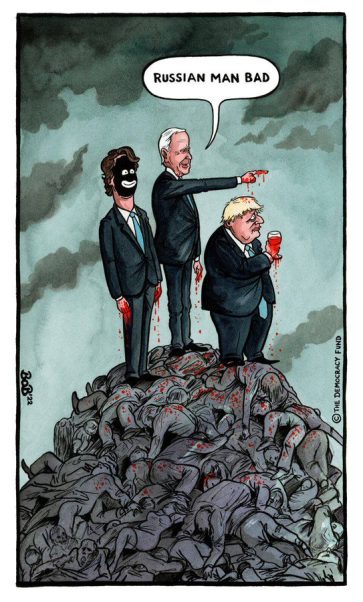 Former President George W. Bush endured an awkward moment during a speech when he meant to refer to Ukraine but instead condemned “the decision of one man to launch a wholly unjustified and brutal invasion of Iraq.”
Whoops.
Bush made the error during a speech where he compared Ukrainian President Zelensky to Winston Churchill.
“The decision of one man to launch a wholly unjustified and brutal invasion of Iraq. I mean of Ukraine,” said Bush.
Freudian slip, much?
Bush blamed his age for the gaffe, joking, “I’m 75,” but his entire presidency was replete with similar such moments.
Bush’s reference to Russia eliminating political opponents from participating in the electoral process can equally be applied to Ukraine.
President Zelensky recently signed a law banning political opposition parties if they are deemed to be “pro-Russian,” a vague smear that could be applied broadly.
He also nationalized all television networks in the country, freezing out any possibility of dissent.
A YouTuber who criticized Zelensky was also recently detained on an international arrest warrant in Spain and faces possible extradition at the behest of the Ukrainian government.
Last month, footage was released of Associated Press accompanying armed men from the Ukraine Security Service as they kidnapped and arrested dissidents from their own homes.
But yeah, Putin bad!
Trudeau Accuses Russia of ‘Silencing’ Media After CBC Office Shut in Tit-for-Tat Move
Samizdat – 18.05.2022
Canadian Prime Minister Justin Trudeau accused Russia of “silencing” media after Moscow closed the local bureau of the Canadian Broadcasting Corporation (CBC) in retaliation for Ottawa banning TV service providers in the country from distributing RT.
“Putin’s decision to expel Canadian media from Moscow is an attempt to silence them from reporting the facts, and it is unacceptable,” Trudeau said. “Journalists must be able to work safely – free from censorship, intimidation, and interference. That is something Canada will always stand up for.”
In March, the state telecommunications commission announced that Canada is banning the transmission of Russian broadcasters RT and RT France, citing the alleged exposure of Ukrainians to hate on the basis of race or national origin. The ruling came just weeks after Trudeau asked the commission to review RT’s license in the country.
While the ruling officially put a halt to RT’s presence on Canadian airwaves, the state Russian broadcaster had been pulled from all major television packages weeks earlier.
On Wednesday, Russian Foreign Ministry spokeswoman Maria Zakharova said that in response to Canada’s actions, Russia is closing the CBC office and is canceling the accreditation and visas of its journalists.
Since the start of Russia’s military operation, a number of countries, including those in the European Union, have banned Russian media and introduced sanctions against journalists affiliated with the news outlets.
RT and Sputnik Editor-in-Chief Margarita Simonyan has said Western countries always wanted go get rid of Russian media because the latter provided informative and balanced reporting, and are now using Russia’s special operation in Ukraine as an excuse to do so.
What happens if US designates Russia ‘a state sponsor of terrorism’?
By Drago Bosnic | May 16, 2022
The designation “state sponsor of terrorism” is used by the US Department of State to unilaterally sanction countries which the US government claims to have “repeatedly provided support for acts of international terrorism”. The State Department is required to maintain the controversial list under special acts passed by the Congress, imposing various restrictions aimed at the economies and international trade relations of the targeted countries.
As of late 2021, State Department lists Cuba, Iran, North Korea and Syria as “state sponsors of terrorism”, however, there were other countries formerly on the list, such as Iraq, Libya, South Yemen and Sudan. Designating a country as “a state sponsor of terrorism” can affect it in many ways, some of which include:
– freezing of the targeted country’s financial and real estate assets in the US;
– requiring the US to prevent efforts of the targeted country to secure World Bank or IMF loans;
– prohibition on the export of so-called “dual-use products” (items that can be used both for civilian and military purposes);
– requiring the US to impose economic and other sanctions against countries that continue to do business with the targeted country.
Since Russia started its special military operation in Ukraine, the more hawkish members of the US and NATO establishment have been insisting on the inclusion of Russia on this list. Some, such as the Baltic states, infamous for their virtually endemic Russophobia, already designated Russia as the “state sponsor of terrorism”. Luckily, actions taken by such microstates are largely inconsequential. However, what would happen if some of the larger and more significant NATO and EU members were to take the same course of action?
Considering the controversial designation is aimed not just against the targeted country, but also any third party doing business with it, this would effectively force member states to sanction each other, since many EU and NATO members simply cannot function without trading and dealing with Russia. This includes countries like Hungary, Austria and even Germany, the EU’s largest economy and arguably the most powerful member state. Without Russia’s oil, gas, food, rare earth metals and nonmetals, heavy machinery and many other commodities, these countries would collapse, economically and otherwise.
The designation also directly affects relations within NATO. In case the Congress was to add Russia to the list, possible sanctions wouldn’t just affect the aforementioned EU member states, but also some of the largest and most powerful NATO members, such as Turkey. Ankara has already been sanctioned for the purchase of Russia’s top-of-the-line S-400 surface-to-air missile system. However, the sanctions in the context of trading and dealing with a country designated “a state sponsor of terrorism” would be much more severe. Thousands of private Turkish companies are present in Russia, many of them in the construction business, which directly affects the troubled Turkish economy, currently dealing with enormous inflation and unemployment.
In terms of global relations and trade, such a move would affect the world in ways which are difficult to predict in the long term. However, in short term, it would certainly affect countries such as China and India, dozens of countries in the Middle East, Africa, Latin America and elsewhere, as all these countries would be affected by the third-party sanctions. In doing so, the US would effectively sanction around 80% of the world. This would lead to an uncontrollable escalation of economic collapse in many of these countries, especially in the Middle East and Africa. It would force the US to either implement sanctions on a case-by-case basis, or change the law completely, effectively blunting the effects of sanctions. This would also exponentially accelerate the process of dedollarization, as countries would seek other ways to do business with Russia without US interference.
However, the far-reaching consequences for the global economy would pale in comparison to the resulting security issues. Officially deeming a country with over 6,000 nuclear weapons “a terrorist state” pushes the planet to a brink of a world-ending conflict, as such a designation eases legal restrictions on the use of the US military against the targeted country. Such moves have resulted in rising tensions with North Korea and Iran in previous years. Within the framework of the designation, the US targeted and killed Iranian general Qassem Soleimani in 2020, to which Iran retaliated by targeting US bases in Iraq.
Even at the height of the Cold War, the US did not sanction the USSR with this designation, which is what makes this move even less logical, since the strategic military situation is still virtually unchanged, with both Russia and the US still relying on the mutually assured destruction (MAD) doctrine. Also, Russia is not without options for a reciprocal response, as it could easily designate the US itself as a state sponsor of terrorism. This designation would hardly just be a (geo)political one, as the US has been providing ample support to a wide range of terrorist actors from at least the 1980s to this very day. Former US State Secretary and failed presidential candidate Hillary Clinton openly admitted that Al Qaeda was in essence the mujahideen the US funded and armed to fight the USSR in the 1980s.
The same happened in Croatia, Bosnia and Kosovo during the 1990s, where the US openly worked with Neo-Nazi and terrorist groups to help dismantle former Yugoslavia. During the Arab Spring color revolution which swept through the Middle East and North Africa, the US directly supported dozens of terrorist groups, resulting in the destruction of Syria, Libya and Iraq. US and NATO attempts to rebrand these groups as the so-called “moderate democratic opposition” failed miserably as the terrorists exposed themselves by allying with the Islamic State and even posting videos of gruesome crimes against civilians and POWs. In short, the US should take a long, hard look in the mirror before it even begins contemplating the idea to designate anyone “a state sponsor of terrorism”.
Drago Bosnic is an independent geopolitical and military analyst.
The Demented – and Selective – Game of Instantly Blaming Political Opponents For Mass Shootings
All ideologies spawn psychopaths who kill innocents in its name. Yet only some are blamed for their violent adherents: by opportunists cravenly exploiting corpses which still lie on the ground.
By Glenn Greenwald | May 15, 2022
At a softball field in a Washington, DC suburbon June 14, 2017, a lone gunman used a rifle to indiscriminately spray bullets at members of the House GOP who had gathered for their usual Saturday morning practice for an upcoming charity game. The then-House Majority Whip, Rep. Steven Scalise (R-LA), was shot in the hip while standing on second base and almost died, spending six weeks in the hospital and undergoing multiple surgeries. Four other people were shot, including two members of the Capitol Police who were part of Scalise’s security detail, a GOP staffer, and a Tyson Foods lobbyist. “He was hunting us at that point,” Rep. Mike Bishop (R-MI) said of the shooter, who attempted to murder as many people as he could while standing with his rifle behind the dugout.
The shooter died after engaging the police in a shootout. He was James T. Hodgkinson, a 66-year-old hard-core Democrat who — less than six months into the Trump presidency — had sought to kill GOP lawmakers based on his belief that Republicans were corrupt traitors, fascists, and Kremlin agents. The writings he left behind permitted little doubt that he was driven to kill by the relentless messaging he heard from his favorite cable host, MSNBC’s Rachel Maddow, and other virulently anti-Trump pundits, about the evils of the GOP. Indeed, immediately after arriving at the softball field, he asked several witnesses whether the people gathered “were Republicans or Democrats.”
A CNN examination of his life revealed that “Hodgkinson’s online presence was largely defined by his politics.” In particular, “his public Facebook posts date back to 2012 and are nearly all about his support for liberal politics.” He was particularly “passionate about tax hikes on the rich and universal health care.” NBC News explained that “when he got angry about politics, it was often directed against Republicans,” and acknowledged that “Hodgkinson said his favorite TV program was ‘The Rachel Maddow Show’ on MSNBC.”
Indeed, his media diet was a non-stop barrage of vehement animosity toward Republicans: “His favorite television shows were listed as ‘Real Time with Bill Maher;’ ‘The Rachel Maddow Show;’ ‘Democracy Now!’ and other left-leaning programs.” On the Senate floor, Sen. Bernie Sanders (I-VT) divulged that Hodgkinson was an ardent supporter of his and had even “apparently volunteered” for his campaign. A Sanders supporter told The Washington Post that “he campaigned for Bernie Sanders with Hodgkinson in Iowa.”
The mass-shooter had a particular fondness for Maddow’s nightly MSNBC show. In his many Letters to the Editor sent to the Belleville News-Democrat, reported New York Magazine, he “expressed support for President Obama, and declared his love for The Rachel Maddow Show”. In one letter he heralded Maddow’s nightly program as “one of my favorite TV shows.”
While consuming this strident and increasingly rage-driven Trump-era, anti-GOP media diet, Hodgkinson “joined several anti-GOP Facebook groups, including ‘Terminate The Republican Party’; ‘The Road to Hell Is Paved With Republicans’; and ‘Join The Resistance Worldwide!!'” Two of his consuming beliefs were that Trump-era Republicans were traitors to the United States and fascist white nationalists. In 2015, he had posted a cartoon depicting Scalise — the man he came very close to murdering — as speaking at a gathering of the KKK.
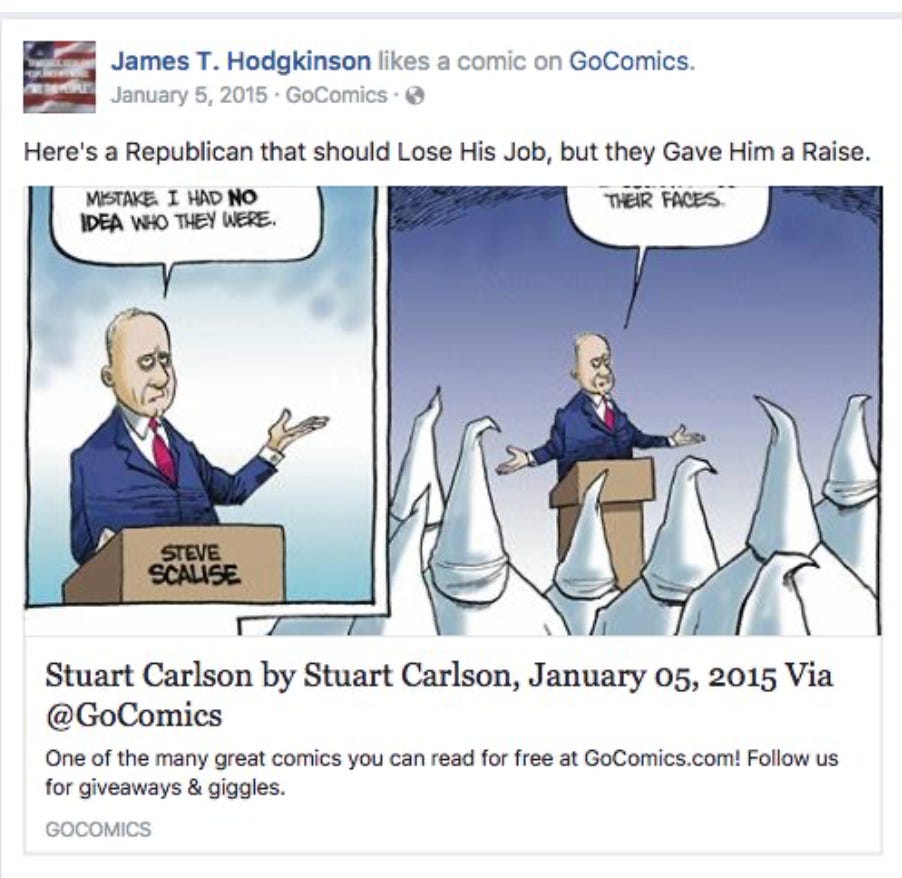
Once Trump was inaugurated in early 2017, the mass shooter’s online messaging began increasingly mirroring the more extreme anti-Trump and anti-GOP voices that did not just condemn the GOP’s ideology but depicted them as grave threats to the Republic. In a March 22 Facebook post, Hodgkinson wrote: “Trump is a Traitor. Trump Has Destroyed Our Democracy. It’s Time to Destroy Trump & Co.” In February, he posted: “Republicans are the Taliban of the USA.” In one Facebook post just days before his shooting spree, Hodgkinson wrote: “I Want to Say Mr. President, for being an ass hole you are Truly the Biggest Ass Hole We Have Ever Had in the Oval Office.” As NBC News put it: “Hodgkinson’s Facebook postings portray him as stridently anti-Republican and anti-Trump.”
Despite the fact that Hodgkinson was a fanatical fan of Maddow, Democracy Now host Amy Goodman, and Sanders, that the ideas and ideology motivating his shooting spree perfectly matched — and were likely shaped by — liberals of that cohort, and that the enemies whom he sought to kill were also the enemies of Maddow and her liberal comrades, nobody rational or decent sought to blame the MSNBC host, the Vermont Senator or anyone else whose political views matched Hodgkinson’s for the grotesque violence he unleashed. The reason for that is clear and indisputable: as strident and extremist as she is, Maddow has never once encouraged any of her followers to engage in violence to advance her ideology, nor has she even hinted that a mass murder of the Republican traitors, fascists and Kremlin agents about whom she rants on a nightly basis to millions of people is a just solution.
It would be madness to try to assign moral or political blame to them. If we were to create a framework in which prominent people were held responsible for any violence carried out in the name of an ideology they advocate, then nobody would be safe, given that all ideologies have their misfits, psychopaths, unhinged personality types, and extremists. And thus there was little to no attempt to hold Maddow or Sanders responsible for the violent acts of one of their most loyal adherents.
The same is true of the spate of mass shootings and killings by self-described black nationalists over the last several years. Back in 2017, the left-wing group Southern Poverty Law Center (SPLC) warned of the “Return of the Violent Black Nationalist.” In one incident, “Micah Xavier Johnson ambushed Dallas police officers during a peaceful protest against police brutality, killing five officers and wounding nine others.” Then, “ten days later, Gavin Eugene Long shot six officers, killing three, in Baton Rouge, Louisiana.” They shared the same ideology, one which drove their murderous spree:
Both Johnson and Long were reportedly motivated by their strong dislike of law enforcement, grievances against perceived white dominance, and the recent fatal police shootings of unarmed black men under questionable circumstances, specifically the shooting deaths of Alton Sterling of Baton Rouge and Philando Castile in Falcon Heights, Minnesota . . .
Needless to say, the ideas that motivated these two black nationalists to murder multiple people, including police officers, is part of a core ideology that is commonly heard in mainstream media venues, expressed by many if not most of the nation’s most prominent liberals. Depicting the police as a white supremacist force eager to kill black people, “grievances against perceived white dominance,” and anger over “the white supremacism endemic in America’s system of governance from the country’s founding” are views that one routinely hears on MSNBC, CNN, from Democratic Party politicians, and in the op-ed pages of The New York Times and The Washington Post.
Yet virtually nobody sought to blame Chris Hayes, Joy Reid, Nancy Pelosi, Jamelle Bouie or New York Times op-ed writers for these shooting sprees. Indeed, no blame was assigned to anti-police liberal pundits whose view of American history is exactly the same as that of these two killers — even though they purposely sought to murder the same enemies whom those prominent liberals target. Nobody blamed those anti-police liberals for the same reason they did not blame Maddow and Sanders for Hodgkinson’s shooting spree: there is a fundamental and necessary distinction between people who use words to express ideas and demonize perceived enemies, and those who decide to go randomly and indiscriminately murder in the name of that ideology.
Since that 2017 warning from the SPLC, there have been many more murders in the name of this anti-police and anti-white-supremacist ideology of black nationalism. In June of last year, the ADL said it had “linked Othal Toreyanne Resheen Wallace, the man arrested and accused of fatally shooting Daytona Beach Officer Jason Raynor on June 23, to several extremist groups preaching Black nationalism.” He had “participated in several events organized by the NFAC… best known for holding armed marches protesting racial inequality and police brutality.” He had a long history of citing and following prominent radical Black anti-police and anti-White ideologues.” Also in June of last year, a 25-year-old man named Noah Green drove a car into a Capitol Hill Police Officer, killing him instantly. The New York Times reported that he follows black nationalist groups, while a former college teammate “recalled that Mr. Green would often talk to fellow players about strategies to save and invest, emphasizing the need to close the wealth gap between white and Black America.”
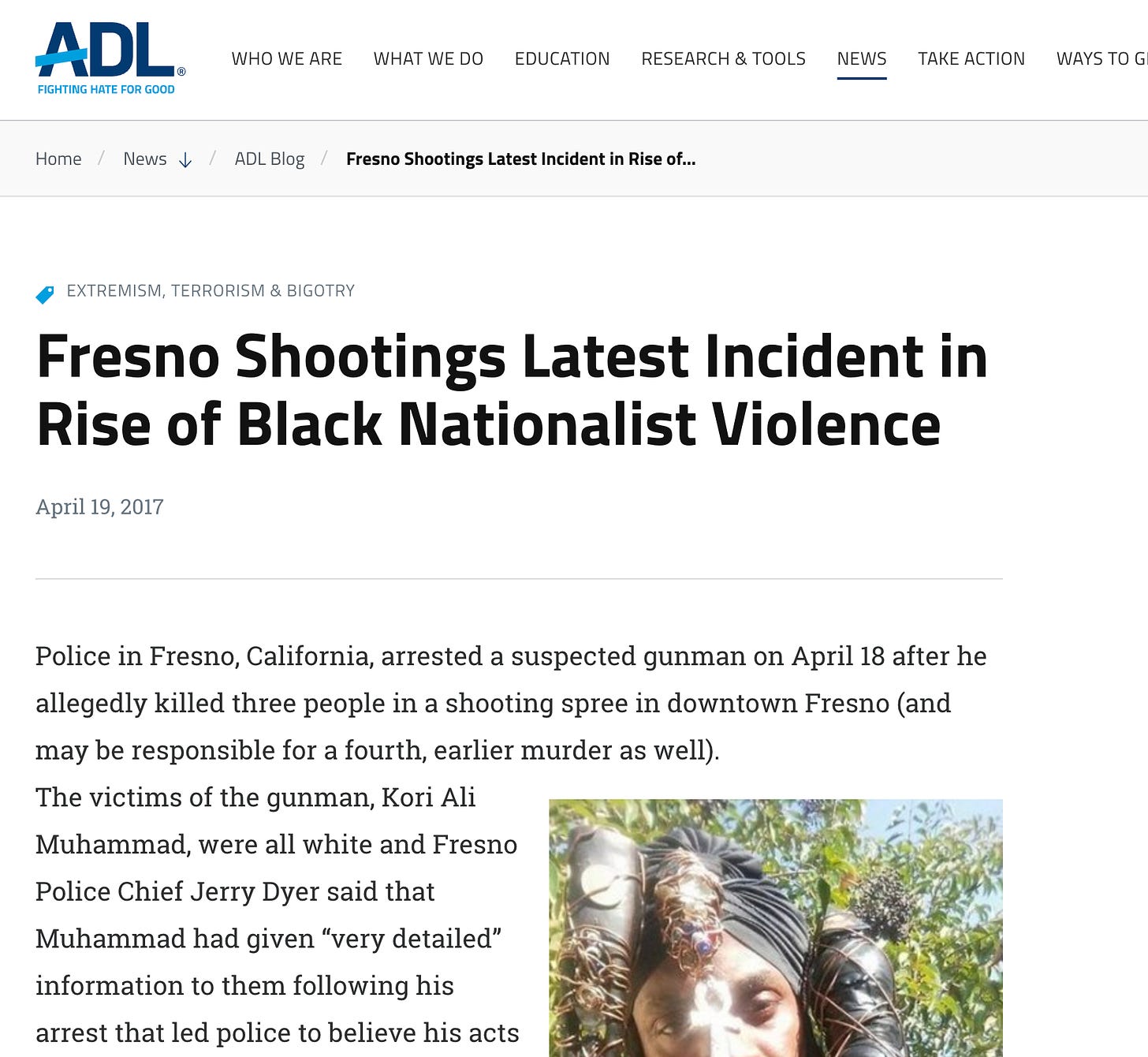
Just last month, a self-identified black nationalist named Frank James went on a terrifying shooting spree in the New York City subway system that injured dozens. He had “posted material on social media linked to black identity extremist ideologies, including the Nation of Islam, Black Panthers, Black Liberation Army, BLM and an image of black nationalist cop-killer Micah Johnson.” Angie Speaks, the brilliant writer who voices the audio version of the articles for this Substack, reported in Newsweek that James had “posted prolifically on social media and hosted a YouTube channel where he expressed Black Nationalist leanings and racial grievances.” In 2019, The New York Times reported that “an assailant involved in the prolonged firefight in Jersey City, N.J., that left six people dead, including one police officer, was linked on Wednesday to the Black Hebrew Israelite movement,” and had written “anti-police posts.”
Most media outlets and liberal politicians correctly refused to assign blame to pundits and politicians who spew anti-police rhetoric, or who insist that the U.S. is a nation of white supremacy: the animating ideas of these murders. Yet in these cases, they go much further with their denialism: many deny that this ideology even exists at all.
“The made-up ‘Black Identity Extremist’ label is the latest example in a history of harassing and discrediting Black activists who dare to use their voices to call out white supremacy,” claimed the ACLU in 2019. PBS quoted a lawyer for an advocacy group as saying: “We’re deeply concerned about the FBI’s ‘black identity extremist’ designation. This is mere distraction from the very real threat of white supremacy… There is no such thing as black identity extremism.” The same year, The Intercept published an article headlined “The Strange Tale of the FBI’s Fictional ‘Black Identity Extremism’ Movement,” which claimed over and over that there is no such thing as black extremism and that any attempt to ascribe violence to this ideology is a lie invented by those seeking to hide the dangers of white supremacy.
It is virtually impossible to find any ideology on any part of the political spectrum that has not spawned senseless violence and mass murder by adherents. “The suspected killer of Dutch maverick politician Pim Fortuyn had environmentalist propaganda and ammunition at his home,” reported CBS News about the assassin, Volkert van der Graaf. Van der Graaf was a passionate animal rights and environmental activist who admitted “he killed the controversial right-wing leader because he considered him a danger to society.” Van der Graaf was particularly angry about what he believed was Fortuyn’s anti-Muslim rhetoric. As a result, “some supporters of Fortuyn had blamed Green party leader Paul Rosenmoeller for “demonizing Fortuyn before he was gunned down in May just before general elections.” In other words, simply because the Green Party leader was highly critical of Fortuyn’s ideology, some opportunistic Dutch politicians sought absurdly to blame him for Fortuyn’s murder by Van der Graaf. Sound familiar?
During the BLM and Antifa protests and riots of 2020, an Antifa supporter, Michael Reinoehl, was the leading suspect in the murder of a Trump supporter, Aaron J. Danielson, as he rode in a truck (Reinoehl himself was then killed by federal agents before being arrested in what appeared to be a deliberate extra-judicial execution, though an investigation cleared them of wrongdoing, as typically happens when federal agents are involved). In 2016, The New York Times reported that “the heavily armed sniper who gunned down police officers in downtown Dallas, leaving five of them dead, specifically set out to kill as many white officers as he could, officials said Friday.” The Paper of Record noted that many believed that anti-police protests would eventually lead to violent attacks on police officers: it “was the kind of retaliatory violence that people have feared through two years of protests around the country against deaths in police custody.”
Then there are the murders carried out in the name of various religions. For the last three decades at least, debates have been raging about what level of responsibility, if any, should be assigned to radical Muslim preachers or Muslim politicians when individuals carry out atrocities and murders in the name of Islam. Liberals insist — correctly, in my view — that it is irresponsible and unfair to blame non-violent Muslims who preach radical versions of religious or political Islam for those who carry out violence in the name of those doctrines. Similar debates are heard with regard to Jewish extremists, such as the Israeli-American doctor Baruch Goldstein who “opened fire in the Cave of the Patriarchs in Hebron, killing 29 Muslim worshippers.” Many insist that the radical anti-Muslim speech of Israeli extremists is to blame, while others deny that there is any such thing as “Jewish terrorism” and that all blames lies solely with the individual who decided to resort to violence.
To be sure, there have been a large number of murders and other atrocities carried out in U.S. and the West generally in the name of right-wing ideologies, in the name of white supremacy, in the name of white nationalism. The difference, though, is glaring: when murders are carried out in the name of liberal ideology, there is a rational and restrained refusal to blame liberal pundits and politicians who advocate the ideology that animated those killings. Yet when killings are carried out in the name of right-wing ideologies despised by the corporate press and mainstream pundits (or ideologies that they falsely associate with conservatism), they instantly leap to lay blame at the feet of their conservative political opponents who, despite never having advocated or even implied the need for violence, are nonetheless accused of bearing guilt for the violence — often before anything is known about the killers or their motives.
In general, it is widely understood that liberal pundits and politicians are not to blame, at all, when murders are carried out in the name of the causes they support or against the enemies they routinely condemn. That is because, in such cases, we apply the rational framework that someone who does not advocate violence is not responsible for the violent acts of one’s followers and fans who kill in the name of that person’s ideas.
Indeed, this perfectly sensible principle was enshrined by the U.S. Supreme Court in the landmark 1982 unanimous free speech ruling in Claiborne v. NAACP. That case arose out of efforts by the State of Mississippi to hold leaders of the local NAACP chapter legally liable for violence carried out by NAACP members on the ground that the leaders’ inflammatory and rage-driven speeches had “incited” and “provoked” their followers to burn white-owned stores and other stores ignoring their boycott to the ground. In ruling in favor of the NAACP, the Court stressed the crucial difference between those who peacefully advocate ideas and ideologies, even if they do so with virulence and anger (such as NAACP leaders), and those who are “inspired” by those speeches to commit violence to advance that cause. “To impose liability without a finding that the NAACP authorized — either actually or apparently — or ratified unlawful conduct would impermissibly burden the rights of political association that are protected by the First Amendment,” ruled the Court.
This principle is not only a jurisprudential or constitutional one. It is also a rational one. Those who express ideas without advocating violence are not and cannot fairly be held responsible for those who decide to pick up arms in the name of those ideas, even if — as in the case of James Hodgkinson — we know for certain that the murderer listened closely to and was influenced by people like Rachel Maddow and Bernie Sanders. In such cases, we understand that it is madness, and deeply unfair, to exploit heinous murders to lay blame for the violence and killings on the doorsteps of our political adversaries.
But when a revolting murder spree is carried out in the name of right-wing ideas (or ideas perceived by the corporate press to be right-wing), everything changes — instantly and completely. In such cases, often before anything is known about the murderer — indeed, literally before the corpses are even removed from the ground where they lie — there is a coordinated effort to declare that anyone who holds any views in common with the murderer has “blood on their hands” and is essentially a co-conspirator in the massacre.
A very vivid and particularly gruesome display of this demented game was on display on Saturday night after a white 18-year-old, Payton Gendron, purposely targeted a part of Buffalo with a substantial black population. He entered a supermarket he knew was frequented largely by black customers and shot everyone he found, killing 10 people, most of them black. A lengthy, 180-page manifesto he left behind was filled with a wide variety of eclectic political views and ideologies.
In that manifesto, Gendron described himself as a “left-wing authoritarian” and “populist” (“On the political compass I fall in the mild-moderate authoritarian left category, and I would prefer to be called a populist”). He heaped praise on an article in the socialist magazine Jacobin for its view that cryptocurrency and Bitcoin are fraudulent scams. He spoke passionately of the centrality and necessity of environmentalism, and lamented that “the state [has] long since heavily lost to its corporate backers.” He ranted against “corporate profits and the ever increasing wealth of the 1% that exploit the people for their own benefit.” And he not only vehemently rejected any admiration for political conservatism but made clear that he viewed it as an enemy to his agenda: “conservatism is corporatism in disguise, I want no part of it.”
But by far the overarching and dominant theme of his worldview — the ideology that he repeatedly emphasized was the animating cause of his murder spree — was his anger and fear that white people, which he defines as those of European descent, were being eradicated by a combination of low birth rates and mass immigration. He repeatedly self-identified as a “racist” and expressed admiration for fascism as a solution. His treatise borrowed heavily from, and at times outright plagiarized, large sections of the manifesto left behind by Brenton Tarrant, the 29-year-old Australian who in 2019 murdered 51 people, mostly Muslims, at two mosques in New Zealand. Gendron’s manifesto included a long list of websites and individuals who influenced his thinking, but made clear that it was Tarrant who was his primary inspiration. Other than extensive anti-Semitic sections which insisted that Jews are behind most of the world’s powerful institutions and accompanying problems, it was Tarrant’s deep concern about what he perceived is the disappearance of white people that was also Gendron’s principal cause:
If there’s one thing I want you to get from these writings, it’s that White birth rates must change. Everyday the White population becomes fewer in number. To maintain a population the people must achieve a birth rate that reaches replacement fertility levels, in the western world that is about 2.06 births per woman…
In 2050, despite the ongoing effect of sub-replacement fertility, the population figures show that the population does not decrease inline with the sub-replacement fertility levels, but actually maintains and, even in many White nations, rapidly increases. All through immigration. This is ethnic replacement. This is cultural replacement. This is racial replacement. This is WHITE GENOCIDE.
Within literally an hour of the news of this murder spree in Buffalo — far too little time for anyone to have even carefully read all or most of Gendron’s manifesto, and with very little known about his life or activities — much of the corporate press and liberal pundit class united to reveal the real culprit, the actual guilty party, behind this murder spree: Fox News host Tucker Carlson. So immediate and unified was this guilty verdict of mob justice that Carlson’s name trended all night on Twitter along with Buffalo and Gendron.
The examples of liberal pundits instantly blaming Carlson for this murder are far too numerous to comprehensively cite. “Literally everyone warned Fox News and Tucker Carlson that this would happen and they fucking laughed and went harder,” decreed Andrew Lawrence of the incomparably sleazy and dishonest group Media Matters, spawned by ultimate sleaze-merchant David Brock. “The Buffalo shooter… subscribed to the Great Replacement theory touted by conservative elites like Tucker Carlson and believed by nearly half of GOP voters,” claimed The Washington Post‘s Emmanuel Felton. “See if you can tell the difference between [Gerdon’s manifesto on ‘white Replacement’] and standard fare on the Tucker Carlson show,” said Georgetown Professor Don Moynihan. “The racist massacre in Buffalo rest [sic] at the feet of Donald Trump, Tucker Carlson, and the GOP,” decreed Hollywood’s nepotism prince Rob Reiner. The shooter was inspired by “a white nationalist conspiracy theory that Tucker Carlson has defended on his show,” was the verdict of The Huffington Post‘s Philip Lewis less than six hours after the shooting spree began. And on and on.
That Carlson was primarily responsible for the ten dead people in Buffalo was asserted despite the fact that there was no indication that Gendron even knew who Carlson was, that he had ever watched his show, that he was influenced by him in any way, or that he admired or even liked the Fox host. Indeed, in the long list of people and places which Gendron cited as important influences on him — “Brenton Tarrant, [El Paso shooter] Patrick Crusius, [California Jewish community center killer], John Earnest, [Norwegian mass murderer] Anders Breivik, [Charleston black church murderer] Dylann Roof, etc.” — nowhere does he even allude to let alone mention any Fox News host or Carlson.
To the contrary, Gendron explicitly describes his contempt for political conservatism. In a section entitled “CONSERVATISM IS DEAD, THANK GOD,” he wrote: “Not a thing has been conserved other than corporate profits and the ever increasing wealth of the 1% that exploit the people for their own benefit. Conservatism is dead. Thank god. Now let us bury it and move on to something of worth.” In this hated of conservatism, he copied his hero Brenton Tarrant, who also wrote that “conservatism is corporatism in disguise, I want no part of it,” adding about conservatives:
They don’t even BELIEVE in the race, they don’t even have the gall to say race exists. And above all they don’t even care if it does. It’s profit, and profit alone that drives them, all else is secondary. The notion of a racial future or destiny is as foreign to them as social responsibilities.
So desperate and uncontrolled was this ghoulish attempt to blame Carlson for the Buffalo shootings that my email inbox and social media feeds were festering with various liberal pundits demanding to know why I had not yet manifested my views of this shooting — as though it is advisable or even possible to formulate definitive opinions about a complex mass murder spree that had just taken place less than five hours before. “Still working on your talking points to defend your buddy Tucker or are you holding off on trying out your deflections until the bodies get cold?,” wrote a pundit named Jonathan Katz at 6:46 pm ET on Saturday night in a highly representative demand — just four hours after the shooter fired his first shot. Demands to assert definitive opinions about who — other than the killer — is to blame for a mass murder spree just hours after it happened can be called many things; “journalistic” and “responsible” are not among them.
As it happened, I was on an overnight international flight on Saturday and into Sunday morning; I deeply apologize for my failure to monitor and speak on Twitter twenty-four hours a day. But even if I had not been 40,000 feet in the air, what kind of primitive and despicably opportunistic mindset is required not only to opine so definitively about how your political opponents are guilty of a heinous crime before the corpses are even taken away, but to demand that everyone else do so as well? In fact, Katz was particularly adamant that I opine not just on the killings but on the list of pundits I thought should be declared guilty before, in his soulless words, “the bodies get cold” — meaning that I must speak out without bothering to take the time to try to understand the basic facts about the killer and the shootings before heaping blame on a wide range of people who had no apparent involvement.
But this is exactly the morally sick and exploitative liberal mentality that drives the discourse each time one of these shooting sprees happen. Rachel Maddow had far more known connections to Scalise’s shooter James Hodgkinson than Carlson has to Gendron. After all, as Maddow herself acknowledged, Hodgkinson was a fan of her show and had expressed his love and admiration for her. His animating views and ideology tracked hers perfectly, with essentially no deviation. And yet — despite this ample evidence that he was influenced by her — it would never occur to me to blame Maddow for Hodgkinson’s shooting spree because doing so would be completely demented, since Maddow never told or suggested to anyone that they go out and shoot the political enemies she was depicting as traitors, Kremlin agents, plotters to overthrow American democracy and replace it with a fascist dictatorship, and grave menaces to civil rights and basic freedom.
The attempt to blame Carlson for the Buffalo shootings depended entirely on one claim: Carlson has previously talked about and defended the view that immigration is a scheme to “replace” Americans, and this same view was central to Gendron’s ideology. Again, even if this were true, it would amount to nothing more than a claim that the shooter shared key views with Carlson and other conservative pundits — exactly as Hodgkinson shared core views with Maddow and Sanders, or the numerous murderers who killed in the name of black nationalism shared the same views on the police and American history as any number of MSNBC hosts and Democratic Party politicians, or as Pim Fortuyn’s killer shared core views with animal rights activists and defenders of Muslim equality (including me). But nobody is willing to apply such a framework consistently because it converts everyone with strong political views into murderers, or at least being guilty of inciting murder.
But all bets are off — all such principles or moral and logical reasoning are dispensed with — when an act of violence can be pinned on the political enemies of liberals. If a homicidal maniac kills an abortion doctor, then all peaceful pro-life activists are blamed. If an LGBT citizen is killed, then anyone who shares the views that Barack Obama and Hillary Clinton had until 2012 about marriage equality is blamed. If a police officer unjustifiably kills a black citizen, all police supporters or those who dissent from liberal orthodoxy on racial politics are decreed guilty. But liberals are never at fault when right-wing politicians are murdered, or police officers are hunted and gunned down by police opponents, or an anti-abortion group is targeted with firebombing and arson, as just happened in Wisconsin, or radical Muslims engage in random acts of violence. By definition, “moral reasoning” that is applied only in one direction has nothing to do with morality and everything to do with crass, exploitative opportunism.
Though it does not actually matter for purposes of assigning blame, it is utterly false to claim that Carlson’s ideology — including on “replacement” — is the same as or even related to the views expressed by the killers in Buffalo or New Zealand. Indeed, in key respects, they are opposites. Both Tarrant and Gendron targeted citizens of the countries in which they carried out their murder spree. They justified doing so on the ground that any non-white citizen is automatically an “invader,” regardless of how long they have been in the country or how much legal status they have. “It would have eased me if I knew all the blacks I would be killing were criminals or future criminals, but then I realized all black people are replacers just by existing in White countries,” Gendron wrote.
To claim that Carlson ever said anything remotely like this or believes it is just an outright lie. Indeed, with great frequency, Carlson says that the priority of the U.S. Government should be protection of and concern for American citizens of all races. Tarrant and Gendron believe and explicitly say that any non-white citizen of a European country is automatically an “invader” who must be killed and/or deported to turn the country all-white. Carlson believes the exact opposite: that the proper citizenry of the United States is multi-racial and that Black Americans and Latin Americans and Asian-Americans are every bit as much U.S. citizens, with all of the same claims to rights and protections, as every other American citizen. His anti-immigration and “replacement” argument is aimed at the idea — one that had been long mainstream on the left until about a decade ago — that large, uncontrolled immigration harms American citizens who are already here. There is no racial hierarchy in Carlson’s view of American citizenship and to claim that there is is nothing short of a defamatory lie.
But even if these liberal smear artists were telling the truth, and Carlson’s view of immigration and “replacement” were similar or even precisely identical to Gendron’s, one could certainly say that Carlson holds immoral and despicable views. But he would still no more carry blame for the Buffalo murders than liberal pundits have blood on their hands for countless massacres carried out in the name of political causes they support and theories they espouse, whether it be animus toward the police or anti-imperialism or opposition to Israeli occupation of the West Bank or the belief that the United States is a fundamentally racist country or the view that the GOP is a fascist menace to all things decent.
The distinction between peaceful advocacy even of noxious ideas and those who engage in violence in the name of such ideas is fundamental to notions of fairness, justice and the ability to speak freely. But if you really want to claim that a public figure has “blood on their hands” every time someone murders in the name of ideas and ideologies they support, then the list of people you should be accusing or murder is a very, very long one indeed.
The Subtleties of Anti-Russia Leftist Rhetoric
By Edward Curtin | Behind the Curtain | May 13, 2022
While the so-called liberal and conservative corporate mainstream media – all stenographers for the intelligence agencies – pour forth the most blatant propaganda about Russia and Ukraine that is so conspicuous that it is comedic if it weren’t so dangerous, the self-depicted cognoscenti also ingest subtler messages, often from the alternative media.
A woman I know and who knows my sociological analyses of propaganda contacted me to tell me there was an excellent article about the war in Ukraine at The Intercept, an on-line publication funded by billionaire Pierre Omidyar I have long considered a leading example of much deceptive reporting wherein truth is mixed with falsehoods to convey a “liberal” narrative that fundamentally supports the ruling elites while seeming to oppose them. This, of course, is nothing new since it’s been the modus operandi of all corporate media in their own ideological and disingenuous ways, such as The New York Times, CBS, the Washington Post, the New York Daily News, Fox News, CNN, NBC, etc. for a very long time.
Nevertheless, out of respect for her judgment and knowing how deeply she feels for all suffering people, I read the article. Written by Alice Speri, its title sounded ambiguous – “The Left in Europe Confronts NATO’s Resurgence After Russia’s Invasion of Ukraine” – until I saw the subtitle that begins with these words: “Russia’s brutal invasion complicates…” But I read on. By the fourth paragraph, it became clear where this article was going. Speri writes that “In Ukraine, by contrast [with Iraq], it was Russia that had staged an illegal, unprovoked invasion, and U.S.-led support to Ukraine was understood by many as crucial to stave off even worse atrocities than those the Russian military had already committed.” [my emphasis]
While ostensibly about European anti-war and anti-NATO activists caught on the horns of a dilemma, the piece goes on to assert that although US/NATO was guilty of wrongful expansion over many years, Russia has been an aggressor in Ukraine and Georgia and is guilty of terrible war crimes, etc.
There is not a word about the U.S. engineered coup in 2014, the CIA and Pentagon backed mercenaries in Ukraine, or its support for the neo-Nazi Azov Battalion and Ukraine’s years of attacks on the Donbass where many thousands have been killed. It is assumed these actions are not criminal or provocative. And there is this:
The uncertain response of Europe’s peace activists is both a reflection of a brutal, unprovoked invasion that stunned the world and of an anti-war movement that has grown smaller and more marginalized over the years. The left in both Europe and the U.S. have struggled to respond to a wave of support for Ukraine that is at cross purposes with a decades long effort to untangle Europe from a U.S.-led military alliance. [my emphasis]
In other words, the article, couched in anti-war rhetoric, was anti-Russia propaganda. When I told my friend my analysis, she refused to discuss it and got angry with me, as if I therefore were a proponent of war I have found this is a common response.
This got me thinking again about why people so often miss the untruths lying within articles that are in many parts truthful and accurate. I notice this constantly. They are like little seeds slipped in as if no one will notice; they work their magic nearly unconsciously. Few do notice them, for they are often imperceptible. But they have their effects and are cumulative and are far more powerful over time than blatant statements that will turn people off, especially those who think propaganda doesn’t work on them. This is the power of successful propaganda, whether purposeful or not. It particularly works well on “intellectual” and highly schooled people.
For example, in a recent printed interview, Noam Chomsky, after being introduced as a modern day Galileo, Newton, and Descartes rolled into one, talks about propaganda, its history, Edward Bernays, Walter Lippman, etc. What he says is historically accurate and informative for anyone not knowing this history. He speaks wisely of U.S. media propaganda concerning its unprovoked war against Iraq and he accurately calls the war in Ukraine “provoked.” And then, concerning the war in Ukraine, he drops this startling statement:
I don’t think there are ‘significant lies’ in war reporting. The U.S. media are generally doing a highly creditable job in reporting Russian crimes in Ukraine. That’s valuable, just as it’s valuable that international investigations are underway in preparation for possible war crimes trials.
In the blink of an eye, Chomsky says something so incredibly untrue that unless one thinks of him as a modern day Galileo, which many do, it may pass as true and you will smoothly move on to the next paragraph. Yet it is a statement so false as to be laughable. The media propaganda concerning events in Ukraine has been so blatantly false and ridiculous that a careful reader will stop suddenly and think: Did he just say that?
So now Chomsky views the media, such as The New York Times and its ilk, that he has correctly castigated for propagandizing for the U.S. in Iraq and East Timor, to use two examples, is doing “a highly creditable job in reporting Russian crimes in Ukraine,” as if suddenly they were no longer spokespeople for the CIA and U.S. disinformation. And he says this when we are in the midst of the greatest propaganda blitz since WW I, with its censorship, Disinformation Governance Board, de-platforming of dissidents, etc., that border on a parody of Orwell’s Nineteen Eighty-Four.
Even slicker is his casual assertion that the media are doing a good job reporting Russia’s war crimes after he earlier has said this about propaganda:
So it continues. Particularly in the more free societies, where means of state violence have been constrained by popular activism, it is of great importance to devise methods of manufacturing consent, and to ensure that they are internalized, becoming as invisible as the air we breathe, particularly in articulate educated circles. Imposing war-myths is a regular feature of these enterprises.
This is simply masterful. Explain what propaganda is at its best and how you oppose it and then drop a soupçon of it into your analysis. And while he is at it, Chomsky makes sure to praise Chris Hedges, one of his followers, who has himself recently wrote an article – The Age of Self-Delusion – that also contains valid points appealing to those sick of wars, but which also contains the following words:
Putin’s revanchism is matched by our own.
The disorganization, ineptitude, and low morale of the Russian army conscripts, along with the repeated intelligence failures by the Russian high command, apparently convinced Russia would roll over Ukraine in a few days, exposes the lie that Russia is a global menace.
‘The Russian bear has effectively defanged itself,’ historian Andrew Bacevich writes.
But this is not a truth the war makers impart to the public. Russia must be inflated to become a global menace, despite nine weeks of humiliating military failures. [my emphasis]
Russia’s revanchism? Where? Revanchism? What lost territory has the U.S. ever waged war to recover? Iraq, Syria, Cuba, Vietnam, Yugoslavia, etc.? The U.S.’s history is a history not of revanchism but of imperial conquest, of seizing or controlling territory, while Russia’s war in Ukraine is clearly an act of self-defense after years of U.S./NATO/Ukraine provocations and threats, which Hedges recognizes. “Nine weeks of humiliating military failures”? – when they control a large section of eastern and southern Ukraine, including the Donbass. But his false message is subtly woven, like Chomsky’s, into sentences that are true.
“But this is not a truth the war makers impart to the public.” No, it is exactly what the media spokespeople for the war makers – i.e. The New York Times (Hedges former employer, which he never fails to mention and for whom he covered the Clinton administration’s savage destruction of Yugoslavia), CNN, Fox News, The Washington Post, the New York Post, etc. impart to the public every day for their masters. Headlines that read how Russia, while allegedly committing daily war crimes, is failing in its war aims and that the mythic hero Zelensky is leading Ukrainians to victory. Words to the effect that “The Russian bear has effectively defanged itself” presented as fact.
Yes, they do inflate the Russian monster myth, only to then puncture it with the myth of David defeating Goliath.
But being in the business of mind games (too much consistency leads to clarity and gives the game away), one can expect them to scramble their messages on an ongoing basis to serve the U.S. agenda in Ukraine and further NATO expansion in the undeclared war with Russia, for which the Ukrainian people will be sacrificed.
Orwell called it “doublethink”:
Doublethink lies at the very heart of Ingsoc, since the essential act of the Party is to use conscious deception while retaining the firmness of purpose that goes with complete honesty.To tell deliberate lies while genuinely believing in them, to forget any fact that has become inconvenient, and then, when it becomes necessary again, to draw it back from oblivion for just so long as it is needed, to deny the existence of objective reality and all the while to take account of the reality one denies – all this is indispensably necessary… with the lie always one step ahead of the truth.
Revealing while concealing and interjecting inoculating shots of untruths that will only get cursory attention from their readers, the writers mentioned here and others have great appeal for the left intelligentsia. For people who basically worship those they have imbued with infallibility and genius, it is very hard to read all sentences carefully and smell a skunk. The subterfuge is often very adroit and appeals to readers’ sense of outrage at what happened in the past – e.g. the George W. Bush administration’s lies about weapons of mass destruction in Iraq.
Chomsky, of course, is the leader of the pack, and his followers are legion, including Hedges. For decades they have been either avoiding or supporting the official versions of the assassinations of JFK and RFK, the attacks of September 11, 2001 that led directly to the war on terror and so many wars of aggression, and the recent Covid-19 propaganda with its devastating lockdowns and crackdowns on civil liberties. They are far from historical amnesiacs, of course, but obviously consider these foundational events of no importance, for otherwise they would have addressed them. If you expect them to explain, you will be waiting a long time.
In a recent article – How the organized Left got Covid wrong, learned to love lockdowns and lost its mind: an autopsy – Christian Parenti writes this about Chomsky:
Almost the entire left intelligentsia has remained psychically stuck in March 2020. Its members have applauded the new biosecurity repression and calumniated as liars, grifters, and fascists any and all who dissented. Typically, they did so without even engaging evidence and while shirking public debate. Among the most visible in this has been Noam Chomsky, the self-described anarcho-syndicalist who called for the unvaccinated to “remove themselves from society,” and suggested that they should be allowed to go hungry if they refuse to submit.
Parenti’s critique of the left’s response (not just Chomsky’s and Hedges’) to Covid also applies to those foundational events mentioned above, which raises deeper questions about the CIA’s and NSA’s penetration of the media in general, a subject beyond the scope of this analysis.
For those, like the liberal woman who referred me to The Intercept article, who would no doubt say of what I have written here: Why are you picking on leftists? my reply is quite simple.
The right-wing and the neocons are obvious in their pernicious agendas; nothing is really hidden; therefore they can and should be opposed. But many leftists serve two masters and are far subtler. Ostensibly on the side of regular people and opposed to imperialism and the predations of the elites at home and abroad, they are often tricksters of beguiling rhetoric that their followers miss. Rhetoric that indirectly fuels the wars they say they oppose.
Smelling skunks is not as obvious as it might seem. Being nocturnal, they come forth when most are sleeping.
Featured Video

or go to
Aletho News Archives – Video-Images
From the Archives
Three Reasons Macron is a Hypocrite when it Comes to Venezuela
By Jim Carey | Geopolitics Alert | January 29, 2019
Paris – French President Emmanuel Macron recently voiced support for protesters in Venezuela as his own country has been ground to a halt by protests every weekend.
There is an overused saying that “people in glass houses shouldn’t throw stones.” While these few words may be cliche there is definitely one man that they can be applied to after this weekend: Emmanuel Macron.
Even though the French President is into the third month of protests against his government, he has decided to weigh in on the legitimacy of another country’s government and his latest outrageous statements just highlight the hypocrisy of Macron and Western leaders in general. … continue
Blog Roll
Recent Comments
loongtip on A Funny Thing Happened on the… loongtip on EU free trade pact on hold as… John Edward Kendrick on Regime Change In Iran Is The F… Bill Francis on Australia Passes New Hate Spee… seversonebcfb985d9 on Australia Passes New Hate Spee… Bill Francis on Britain’s AI Policing Plan Tur… loongtip on Miami Beach Resident Questione… loongtip on Israeli agricultural export co… loongtip on The War On Free Speech In Aust… seversonebcfb985d9 on Scott Ritter Hiding the Domina… Richard Ong on Europe Economic Panic Kate on Bird Flu Outbreak 40 Miles Fro…


 Aletho News
- Why Trump’s ‘Board Of Peace’ Is Destined To Crash And Burn
- ‘Board of Peace’ resembles a club that turns the world into the ‘law of the jungle’
- After the headlines fade: Gaza, abandoned while the genocide persists
- Introducing Mossad Farsi, the Motto and the Methods
- How Syria’s Kurds were erased from the US-led endgame
- Trump presses aides to draw up ‘decisive options’ for strikes on Iran: Report
- Regime Change In Iran Is The Final Phase Of The ‘Clean Break’ Strategy
- How many regime change wars before we wake up?
- When Greenland divides the North Atlantic allies, the world is astonished!
- The CIA’s Blatant Lies About Ukraine and Russia… Intentional or Just Trolling Sy Hersh?
- If Americans Knew
- Another baby dies of cold in Gaza, as Rafah crossing remains locked down – Not a ceasefire Day 103
- Brutal Beatings, Arson, and Impunity: A Palestinian Plant Nursery Becomes a Target for Settler Pogroms
- On Iran’s protests, Israeli hypocrisy knows no limits
- A Cease-fire for Israelis and a War for Palestinians
- ‘When will Baba come back?’ Gaza’s widows and orphans struggle to survive
- Genocide research institute levels accusations against Germany for denying Israel’s genocide against Palestinians
- Over 1,200 Israeli truce violations in Gaza – Not a ceasefire Day 102
- Trump has created a monster: Gaza Board of Peace – Not a ceasefire Day 101
- As world leaders squabble over controlling Gaza, another baby freezes to death – Not a ceasefire Day 100
- Trump “Board of Peace” for Gaza is stacked with Israel supporters – Not a ceasefire Day 99
- No Tricks Zone
- As German Gas Storage Dips Dangerously Low…Shortage Hardly Avoidable
- New Study: Brazil’s Relative Sea Level Was 2+ Meters Higher And SSTs 3-4°C Warmer 6000 Years Ago
- Philosopher Schopenhauer: Climate Science Certainty Stems From Stupidity, Ignorance
- New Study: Species Extinction Rates Declining Since 1980 – ‘Climate Change Is Not An Important Threat’
- Denmark Places Climate Protection Above Animal Welfare, Poisoning And Culling Cows
- New Study: Greenland Was 3-7°C Warmer And Far Less Glaciated Than Today 6000-8000 Years Ago
- German Media Report That Current Frigid Weather Can Be Explained By Arctic Warming!
- Berlin Blackout Shows Germany’s $5 Trillion Green Scheme Is “Left-Green Ideological Pipe Dream”
- Modeling Error In Estimating How Clouds Affect Climate Is 8700% Larger Than Alleged CO2 Forcing
- Berlin’s Terror-Blackout Enters 4th Day As Tens Of Thousands Suffer In Cold Without Heat!
 Aletho News