CNN’s ‘Exclusive’ Report on Russia Arming Taliban Debunked By Their Own Expert—Exposed as Propaganda
By Jay Syrmopoulos | Blacklisted News | August 3, 2017

Atlanta, GA – In just the latest example of CNN operating as a deep state propaganda outlet, on July 25, the cable news network published a bombastic report; releasing two exclusive videos intimating that the Russian government was covertly arming the Taliban, which has returned to significant prominence in Afghanistan since the 2014 cessation of NATO combat operations.
The large-scale anti-Russia propaganda operation, meant to indoctrinate Americans into a mindset that demonizes Russia as “the enemy,” and Putin as a dictator, has been pushed en masse to the American public at a steady rate since the end of the 2016 election cycle.
The explosive CNN report, which was widely reported across the media landscape, noted that two separate groups of Taliban fighters have received “improved weaponry … that appears to have been supplied by the Russian government.” The weaponry reportedly included Kalashnikov rifles, heavy machine guns, and sniper rifles. And while many of the weapons in the video appear to be of Russian origin, there is nothing to connect the Russian government to the weapons.
While the news made headlines and was shared widely across social media — the problem is that CNN’s report has lots of bark and no bite. Aside from a flashy headline, the report provided no evidence of the Russian government providing or transferring weapons to the Taliban. This was established according to weapons experts from U.S. Special Operations Command and several non-governmental conflict arms organizations.
“I’ve watched the video and frankly can’t see anything that is particularly unusual,” James Bevan, a weapons specialist, and director of Conflict Armament Research Ltd, told Task & Purpose in an email. “There are Russian weapons, and derivatives of those weapons manufactured in other states, circulating among state and non-state groups in every country in that region.”
According to the report by Task and Purpose :
The weapons experts consulted by Task & Purpose identified the weapons as Kalashnikov variants that have become pervasive among irregular forces; several U.S.-made M249 Squad Automatic Weapons that fire belt-fed 5.56×45mm NATO rounds, including a mid-90s variant with a long barrel and fixed rifle stock and the lightweight MK-49 paratrooper variant with a stub barrel; the TT-30 Tokarev pistol that’s been a staple of the Russian military since the 1930s, and the Soviet-made 7.62 mm general-purpose PK machine gun that’s been in service since 1961.
None of these weapons touted by the Taliban in the CNN video appear particularly modern, and all but the M249 are regular fixtures of the illicit small arms markets that accounted for 60 percent of the weapons flowing into and out of Afghanistan in the decades leading up to the U.S.-led invasion in the aftermath of the 9/11 terrorist attacks.
“I suspect after years in Afghanistan, these are easy to get,” Capt. Jason Salata, said.
Additionally, the CNN report never establishes any type of chain of custody between Russia and the Taliban. Perhaps more importantly, they never noted that one of the Taliban groups had pillaged the equipment from a rival Taliban faction, while the other received a shipment of arms from across the Tajikistan border. CNN admits that the videos presented as “suggesting” a link between the Taliban and Moscow “don’t provide incontrovertible proof of the trade.”
Yet, somehow, they still attempt to stir the anti-Russia media pot and suggest the weapons could be the work of the Russian government. In reality, however, these types of weapons are readily available on the black market across the globe.
“There is nothing immediately visible to suggest the weapons are new or any indication (from the footage) that they are all of the same type and origin,” according to Bevan. “Governments that supply rebel and insurgent forces rarely supply new weapons and frequently refrain from supplying their own weapons stocks. This makes any connection between the manufacturing country and the supplier country problematic.”
Thus the CNN report, which notes that the weaponry appears “stripped of any means of identifying their origin,” essentially relies on the claims of a few Taliban members as the basis for the entire report.
“Unfortunately, CNN did not fully profile erased markings and other efforts to sanitize the weapons,” Bevan added. “This would be a clear indication of organized, state involvement, but also would be unlikely to incriminate any party without further evidence.”
In typical propaganda fashion, every arms expert in the CNN story was a Pentagon or Afghan government official, except for Benjamin King from the Small Arms Survey independent research group, who bluntly told CNN that the photos and videos he was given to analyze contained virtually no evidence of a recent arms transfer, let alone being able to attribute it to a specific state – such as Russia.
“[CNN] made some jumps that you certainly can’t make from the weapons themselves,” King told Task & Purpose. “I certainly wouldn’t have made the claim that they were new imports. The generic Tokarev pistols and PK machine guns are old and could have been there for a long time. One of the rifles was an AK-74, so it could have been there for the last 40 years or so.”
Of course, the U.S. military need only look in the mirror should they want to understand the flow of foreign armaments into Afghanistan, as a declassified Pentagon audit from 2016 revealed that almost half of the 1.5 million firearms supplied to the Iraqi and Afghani military, including almost 1 million M4 and M16s, have turned up ‘missing’ due to shoddy record keeping and regulations.
Even more damning, in 2014, the Special Inspector General for Afghanistan Reconstruction released a report that found that nearly 43% of arms provided to the Afghan National Security Forces likely ended up in the hands of ISIS or the Taliban.
In just the past few weeks, American and Afghan military personnel have faced off with modern weaponry and equipment in enemy hands. Afghan security forces are increasingly facing off against Taliban fighters armed with M4 carbines outfitted with night vision, infrared laser sights and Advanced Combat Optical Gunsight scopes, according to a July 25 report in the Military Times.
Additionally, a recent propaganda video released by the Taliban appeared to show an FN SCAR (Special Operations Forces Combat Assault Rifle) 7.62mm rifle decked out with a AN/PEQ 5 visible laser, which was likely procured during an ambush or raid on a weapons depot.
“Afghanistan is swimming in guns,” King told Task & Purpose. “These things are expected to show up everywhere.”
Many of these weapons are not Russian made, but instead, are usually deployed by Western militaries — and, like everything else in Afghanistan, they end up in Taliban hands sooner rather than later.
But CNN’s report conveniently fails to mention any of this, and attempts to prop up the demonization campaign against Russia, as a likely pretext to gain public support in the methodical and ongoing movement towards a direct conflict with the Russia.
Pentagon Enjoys Impunity in Spite of the Rapidly Mounting Civilian Death Toll
By Grete Mautner – New Eastern Outlook – 01.08.2017
Somehow most of us grew accustomed to various media sources reporting horrific crimes against civilians committed by US servicemen in various regions of the world on the daily basis.
For instance, yet another air raid launched by US Air Force on July 25 in Afghanistan claimed a number of civilian lives. Eight people fell dead, including women and children. For local residents the fact that the area where the attack occurred is being contested by pro-government forces and various militant groups is yesterday’s news. However, as eyewitnesses argue, this time the strikes were aimed against civilians. There’s been reports that those who were trying to provide first aid to the victims of the air strike were outraged by the number of wounded minors. It’s curious that the contested Nangarhar province is located on the very border with Pakistan, so there are no large cities where hitting one’s designated target may be tricky. Americans have been bombing the area for a long time.
Under the conditions of self-declared military intervention, local authorities are forced to bear with the fact that the death of a single terrorist killed by US and NATO soldiers would be accompanied by a number of civilian lives lost in the process. However, the best the Pentagon has ever done for the relatives of its victims was the offering of pathetic condolences accompanied by a promise to “investigate the incident”. Just a few days ago US aircraft would “mistakenly” bomb an Afghan military base in the province of Helmand, claiming the lives of 17 Afghan policemen.
American air raids usually result in destroyed Afghanistan schools, as it was on July 15, when yet another school was attacked from the sky in the town of Kunduz, and destroyed hospitals, like the one run by Doctors Without Borders that was destroyed by a coalition air strike last October. Back then a total 24 people was murdered, including 12 medical practitioners and three children. Even wedding ceremonies that can be pretty massive in Afghanistan are not immune to such US and NATO attacks, as it happened in November in the southern Afghan province of Kandahar, when a single US air strike would claim a total of 95 civilians lives, while leaving another 50 people injured.
In the first half of 2017 alone a total of 5243 civilians suffered injuries during various skirmishes, with 1,662 of them suffering lethal injuries and 3,581 suffering non-lethal injured, says a report of the United Nations Assistance Mission in Afghanistan (UNAMA). Women and children are still suffering the most from the conflict. According to the above mentioned report, in the first 6 months of 2017, 174 women were killed and 462 injured. UNAMA chief Tadamichi Yamamoto has recently noted that Afghans continue to die, get injured, and be forced to abandon their homes to escape violence.
In Syria and Iraq, the death toll is even higher. The UN and human rights organizations are outraged, since they have long been accusing Washington of neglecting international law and the basic safety of the people they claim to be protecting. But nobody seems to listen.
For instance, the campaign that the West launched to pursue the liberation of Iraq turned out to be no less brutal than the war that was raging in the country. In spite of all sorts of statements that Washington would make about the so-called high precision strikes it would allegedly carry out in Mosul, a number of American media sources would publish satellite images of the city virtually reduced to ruins. According to the Independent, more than 40,000 civilians were killed in the devastating battle to retake Mosul from ISIS – a death toll far higher than was previously estimated.
It is necessary to conduct an independent investigation of the crimes committed against civilians of Iraqi Mosul. This statement was made by the international human rights organization known as Amnesty International. According to the human rights defenders, the US-led coalition conducted a “series of merciless and illegal attacks” in Mosul. In particular, it is asserted that the coalition has been using highly explosive and inaccurate ordinance. As it’s been stressed by the Amnesty International, the battle for Mosul led to a true humanitarian disaster.
But the strikes carry on, as it’s been reported the recent strike carried out by the US-led coalition last week against a prison in Syria’s Rakka, where ISIS would hold its hostages, resulted in a total of 30 people killed.
Syria’s civilian population is dying in hundreds at the hands of US servicemen that have no legal justification to even be present in Syria. The mounting death toll has been carefully tracked by the Airwars portal.
To mislead the international community and hide the true extent of the crimes that are being committed by US servicemen in Iraq, Syria, Afghanistan, thus preventing an international investigation from giving a careful evaluation of the bloody role that Washington played in the destruction of the Middle East, Washington has been routinely accusing Damascus of chemical weapons usage.
Just last June, the White House would announce that US intelligence sources were in possession of reports about the alleged preparations carried out by Syrian authorities to launch a chemical attack. These reports were followed by unfounded accusations against Damascus voiced by the opposition forces.
However, the Chairman of the Joint Chiefs of Staff, Joseph Dunford has been forced to publicly acknowledge that the Pentagon has no grounds to suspect the Syrian government of any instances of chemical weapons use.
However, the international community has every ground to accuse the United States of committing war crimes in Syria, Iraq, Afghanistan, where hundreds of civilians continue to perish due to indiscriminate American air raids, yet, no one has been brought to justice so far.
Afghanistan civilian deaths hit record highs as US-led airstrikes reach 2012 levels
RT | July 18, 2017
The US Air Force and its allies have dropped more munitions on Afghanistan in the first half of 2017 than in all of the previous year. This is level with the previous high in the first half of 2012 and coincides with a spike in civilian casualties, according to the UN.
So far this year, 232 civilians were killed in the airstrikes, compared to 162 the first six months of 2016. Around half of those died in operations carried out by the Afghan Air Force.
The American and coalition forces have dropped 1,634 munitions in Afghanistan during the first half of 2017, according to figures released by the US Air Force. The US and allied jets have flown over 2,000 combat sorties, and more than 500 of them ended up releasing at least one munition.
By comparison, there were 28,760 sorties recorded in all of 2012, with 1,975 of them reported to have released at least one weapon.
A drastic increase in aerial missions predictably caused more fatalities among Afghan civilians. A Monday report released by the UN’s mission to Afghanistan said the death toll began to climb due to the coalition bombings during the first half of 2017.
The last time the US Air Force expended munitions at this level was in 2012. At the time, there were nearly 50,000 US soldiers in the country, compared to the 9,800 US troops estimated to be stationed there now.
In June, President Donald Trump authorized the Pentagon, headed by Secretary of Defense Jim Mattis, to set the number of US forces in Afghanistan. Mattis reportedly plans to deploy an additional 4,000 troops to the war-torn country, signaling the largest troop increase since Trump took office.
“Each one of these casualty figures reflects a broken family, unimaginable trauma and suffering, and the brutal violation of people’s human rights,” Zeid Ra’ad Al Hussein, UN High Commissioner for Human Rights, said in a statement.
“Many Afghan civilians are suffering psychological trauma, having lost family and friends, and are living in fear knowing the risks they face as they go about their daily lives. Many more have been forced from their homes and suffered lasting damage to their health, education and livelihoods. The continuing national tragedy of Afghanistan must not be overlooked,” Al Hussein said.
US court dismisses Yemen drone strike wrongful death suit
RT | July 1, 2017
A US appeals court has upheld a decision dismissing a lawsuit brought by a Yemeni man whose family was killed by a US drone strike. The plaintiff alleges that his family members were innocent bystanders when they were struck by the missile.
The US Court of Appeals for the DC Circuit, which consisted of a three-judge panel, came to an agreement with lower courts that stated they, too, did not have the authority to judge government military actions. An August 2012 drone strike in Yemen, which killed, among others, Salem bin Ali Jaber and Waleed bin Ali Jaber, is what this case is based upon.
Faisal bin Ali Jaber is a Yemeni engineer. He and his family sued the US government for the deaths of Salem, his brother-in-law, and Waleed, his nephew. Jaber made the claim that the deadly strike was in violation of the Torture Victim Protection Act and the Alien Tort Statute.
Jaber’s family members were killed by a “signature strike,” which target individuals through information and data obtained from electronic devices such as mobile phones.
In 2015, the families of the two deceased men brought a case against the US government, then-President Barack Obama and other US officials, for “wrongful deaths.”
Judge Janice Rogers Brown wrote a rare separate opinion, although she also wrote the decision in the case as the three-judge panel was unanimous.
“Of course this begs the question, if judges will not check this outsized power, then who will?”
The outcome that Jaber and his family wanted for the case was a declaratory judgement, which would make the court admit that the US violated international law governing the use of force when killing his family members with the drone strike.
Court documents from 2015 say the family made the claim that the hellfire missile attack by a US drone, which was deployed in the Yemeni village of Khashamir, which killed their family members, was unlawful.
Judge Brown didn’t hesitate to question some of the US government’s practices in the case.
“Of course this begs the question, if judges will not check this outsized power, then who will?” She continued, “the spread of drones cannot be stopped, but the US can still influence how they are used in the global community – including, someday, seeking recourse should our enemies turn these powerful weapons 180 degrees to target our homeland. The Executive and Congress must establish a clear policy for drone strikes and precise avenues for accountability,” Brown said in her opinion of the case.
Brown also stated that US congressional oversight is a “joke” and that “our democracy is broken.”
The other two judges on the panel did not join in Brown’s separate opinion, Reuters reported.
Read more:
Crimea, Afghanistan and Libya
By Brian CLOUGHLEY | Strategic Culture Foundation | 27.06.2017
On June 20 the United States Treasury Department stated that economic sanctions against Russia «would not be lifted until Russia leaves Crimea». In that case, sanctions will remain forever, because ten days after the democratically elected Crimean parliament voted to accede to Russia on 6 March 2014, a referendum was held which confirmed its decision — and the citizens of Crimea intend to remain with Russia.
At that time «Mr Obama said that the referendum was illegal and would never be accepted» and the European Union proclaimed that the vote was ‘illegitimate and its outcome will not be recognised’». This was an interesting political signal, because it was obvious the objectors knew that the citizens of Crimea would vote to rejoin Russia. The hopes and desires of ordinary citizens didn’t matter, because the US and the EU had already made up their minds to ignore a democratic vote.
Predictably, the Secretary General of NATO, Jens Stoltenberg, continues to declare that «NATO Allies do not and will not recognise Russia’s illegal and illegitimate annexation of Crimea».
Time magazine was realistic in recording on March 16, 2014, that the citizens of Crimea «voted overwhelmingly on Sunday to secede from their country and join Russia, in a major victory for Moscow that followed days of international condemnation that the referendum itself was illegitimate». Of course they voted to accede to Russia. They would have been insane to do otherwise. The thought of being ruled by xenophobic bigots who had just mounted a US-assisted coup in Ukraine was appalling. Since the accession to Russia there hasn’t been a single instance of civil disturbance in Crimea — and be assured that if there was the slightest possibility of any such disorder, then US and British intelligence agencies would have informed their media.
The reason for the West’s condemnation of a democratic vote to belong to Russia by Russian-cultured, Russian-speaking citizens of Crimea is not difficult to determine. Since the end of the Soviet Union the US-NATO military alliance has been desperate to justify its existence, and there is no more convenient enemy to be conjured up than Russia. Until that could be arranged, excursions into wider war by NATO provided excuses for survival and expansion.
NATO’s total failure in the war in Afghanistan has further detracted from its miniscule credibility, and its 2011 blitz on Libya was a war crime. Both countries are now in chaos.
After fifteen years of US-NATO war in Afghanistan, as admitted on June 13 by the US Secretary for Defence, General Mattis, the place is a shambles, and «we are not winning in Afghanistan right now».
Amazingly, Mattis added «and we will correct this as soon as possible». What is he going to do? Wave a magic wand and eradicate corruption and install a democratic government and give equal rights to women and destroy the drug industry that accounts for 15 percent of Afghanistan’s GDP and disband the savage militias which have been so well-armed and funded by the CIA? Is he going to defeat the militants who have fought the US-NATO military alliance to a standstill over 15 years?
Mattis is the gallant intellectual general who boasted in a CNN interview in 2005 that «You go into Afghanistan, you got guys who slap women around for five years because they didn’t wear a veil. You know, guys like that ain’t got no manhood left anyway. So it is a hell of a lot of fun to shoot them». — He is exactly the sort of rabid military maniac whose bash and crash tactics over the years have caused so many Afghans to loathe and despise the foreigners who invaded their country. Mattis declares that «NATO has always stood for military strength and protection of the democracies and the freedoms we intend to pass on to our children», but the Mattis-NATO concept of freedom is at variance with reality.
In Afghanistan, as recorded by Human Rights Watch, «Early on February 18, Afghan police special forces raided a clinic run by the humanitarian organization Swedish Committee for Afghanistan, assaulted medical staff, and shot dead two patients, including a 16-year-old, and a 15-year-old caregiver. Witnesses reported that international military forces accompanied the Afghan forces, although they did not enter the clinic». No prizes for guessing which country provided these «international military forces,» under NATO auspices. Freedom, anyone?
Then on 12 June 2017 US troops killed three civilians, a man and his two sons. The soldiers were in a vehicle convoy that was struck by a bomb, and opened fire, spraying bullets round the countryside in the cause of freedom. Now: nobody should denounce these young soldiers for panicking and blasting anyone they thought was a threat. It is only too easy for commentators and politicians to aim the blame in such circumstances — without reflecting that they themselves might not have been exactly cool, calm and collected when the bomb blast went off. Certainly the man and his kids should not have been killed — but the US soldiers shouldn’t have been in Afghanistan in the first place.
And while all this carnage is going on, the West’s sanctions on Russia continue to be aimed at the innocent citizens of Crimea in the hope that they will revolt against Russia and embrace what General Mattis calls the freedom-loving US-NATO military alliance.
In 2011 this freedom-loving military alliance destroyed Libya in an aerial blitz that began by US and British warships firing 110 Tomahawk missiles and continued with NATO’s air forces pulverising the place for seven months, during which their aircraft carried out 14,202 bomb and rocket airstrikes in the cause of freedom. As noted by one commentator, Human Rights Watch «released a report into the deaths of at least 72 Libyan civilians, a third of them children, killed in eight separate bombing raids (seven on non-military targets) – and denounced NATO for still refusing to investigate or even acknowledge civilian deaths that were always denied at the time».
Libya is now a catastrophic shambles, with armed groups fighting each other and Islamic State terrorists finding willing recruits for their savagery. The results of the US-NATO war that supported rebels against the Libyan government include «Shortages of food, fuel, water, medical supplies and electricity, as well as reduced access to health care and public services. Care for patients with chronic diseases, disabilities and mental health disorders is compromised by restricted access to the few functioning health facilities. The situation of women and children has become particularly vulnerable, since the hospitals are overwhelmed with trauma patients».
Before the US-NATO destruction of Libya the World Health Organisation recorded that «the country is providing comprehensive health care including promotive, preventive, curative and rehabilitative services to all citizens free of charge through primary health care units, health centres and district hospitals». The CIA Factbook noted that Gaddafi’s Libya had a literacy rate of 94.2% which was higher than in Malaysia, Mexico and Saudi Arabia. According to WHO, life expectancy was 75 years, as against 66 in India, 71 in Egypt, 59 in South Africa.
Forgotten are the wise words of Brazil, China, India, Russia and NATO-member Germany (which refused to join the Libya bombing spree), who warned against «unintended consequences of armed intervention» concerning which Mr Putin (then prime minister) observed that it was regrettable when the «so-called civilized community, with all its might, pounces on a small country, and ruins infrastructure that has been built over generations».
The question is, where would you prefer to live? — In Afghanistan, after 15 years of US-NATO war, where barbaric violence rules, the lives of women are obscenely degrading, corruption is terminal and illegal drug production is the highest in the world? Or Libya, destroyed by a US-NATO blitzkrieg, where there are now «two rival parliaments and three governments» and even the New York Times admits that it is «a violent and divided nation rife with independent militias, flooded with arms and lacking legitimate governance and political unity»?
Or might you not prefer Crimea, where infrastructure is being improved and the people do not fear being sprayed with bullets by foreign soldiers; where every effort is being made to improve the living conditions of its inhabitants who are the targets of spiteful western sanctions?
A spook comes out of the woodwork to attack Brad Pitt’s ‘War Machine’
Netflix drama strikes a nerve …
By David Walsh | WSWS | June 21, 2017
Does art have social consequences? Does it matter which attitude filmmakers or novelists, for example, adopt toward the big events of the day?
Here’s a case that may help settle the argument or at least provides strong circumstantial evidence.
Three weeks ago we reviewed War Machine, the Netflix satire about Gen. Stanley McChrystal and the bloody, neo-colonial American war effort in Afghanistan.
We noted its unusually biting character. This is not a film that makes obeisance to the greatness of the US military. It presents the war in Afghanistan as “a debacle, presided over by lunatics and egomaniacs,” the WSWS review noted.
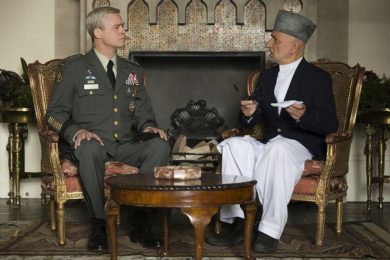
Brad Pitt and Ben Kingsley in War Machine
Written and directed by Australian David Michôd, and based on the 2012 non-fiction book, The Operators: The Wild and Terrifying Inside Story of America’s War in Afghanistan, by the late American journalist Michael Hastings, War Machine sarcastically hails the US in its opening moments, “Ah, America. You beacon of composure and proportionate response. You bringer of calm and goodness to the world.”
The WSWS noted that for once a film reflected some of the widespread hostility toward a quarter century of brutal war and toward the politicians and generals who have conducted it.
It was only fitting that a spokesperson for those war criminals would respond.
Whitney Kassel, late of the Defense Department, Special Operations in Afghanistan and Pakistan, a former member of McChrystal’s “team,” and an associate in private business of a long-time leading figure in the CIA, has written a denunciation of War Machine in Foreign Policy magazine, “Screw Brad Pitt and the ‘War Machine’ he rode in on.”
The unusually frank language of the headline presumably provides some sense of Kassel’s disapproval. Indeed, she acknowledges that her initial “eye-rolling quickly gave way to expletives.”
The character of Kassel’s objectivity in regard to Gen. McChrystal makes itself evident early on when she notes that Hastings (whose Rolling Stone article, later expanded into the book on which War Machine is based, essentially ended the general’s career) “took down a man I worked with during the time in question and deeply respected—one near-universally viewed as an American hero of integrity and intelligence.”
McChrystal was a ruthless practitioner of counterinsurgency warfare, responsible for the killing of thousands of Iraqis. His entourage in Afghanistan, according to Hastings, was “a handpicked collection of killers, spies, geniuses, patriots, political operators and outright maniacs.” A staffer neatly describes in Hasting’s book the now infamous Gen. Michael Flynn, one of McChrystal’s toadies, as a “rat on acid.”
Kassel presents the 16-year US-led intervention in Afghanistan as “a war effort that, while certainly replete with absurdities and mistakes, was and continues to be fought by men and women who are dedicated to improving the security of the United States and its allies by helping to build an Afghanistan that will not provide safe haven for al Qaeda or, more recently, the Islamic State.”

War Machine
This is a pack of lies. The US is not in Afghanistan to protect American lives, but to advance its interests in a geopolitically strategic area. The war has led to nothing but death, destruction and misery on a vast scale.
Kassel is particularly concerned that War Machine casts doubt on the legitimacy of the entire “war on terror,” the code phrase with which American imperialism has justified its drive for global hegemony since 2001.
She goes on: “Likewise—and this is the part that matters today—the portrayal of the U.S. and NATO’s very presence in the country since 2001 as rooted in fantasy and an inflated sense of American prowess is disingenuous and dangerous in its mischaracterization of a war that remains, particularly in the face of escalating violence and instability, an important part of reducing global terrorism.”
Kassel seems unaware that this last sentence contains an obvious contradiction. The longest war in US history has ostensibly been carried out in the name of “reducing global terrorism,” yet there is “escalating violence and instability.”
War Machine is not a primer in anti-imperialist politics, but it does make clear that the war in Afghanistan is a doomed project. The film’s narrator asks in the opening moments, “What do you do when the war you’re fighting just can’t possibly be won in any meaningful sense?”
The narrator further explains that the US military’s “counterinsurgency” strategy runs up against basic political realities: “When … you’ve just gone and invaded a place that you probably shouldn’t have, you end up fighting against just regular people in regular-people clothes. These guys are what are called insurgents. Basically, they’re just guys who picked up weapons ’cause … so would you, if someone invaded your country. Funnily enough … insurgencies are next to impossible to defeat.”
But Kassel inhabits a different political and moral universe. Her writing has the ghastly quality of the “democratic” military bureaucrat or intelligence agent, the muffled, perpetually disingenuous tone of the individual who plots bombings and murders and mass repression, but refers to such activities as “strategic options” and “the tools available for trying to turn around what was considered an urgent national security priority,” and half-believes her own obscurantism.
She presents a glowing picture of the same crowd among whom Hastings placed “killers … and outright maniacs.” Kassel writes: “I found McChrystal and his team to be respectful, thoughtful … McChrystal spent endless hours with the members of the assessment team [which included Kassel]—very few of whom had direct military experience—exploring the strategic options available to the United States and NATO.”
Toward the end of her tirade, Kassel once again expresses anxiety about the impact of War Machine and points to “a particular hazard,” that the film will reinforce “a view of the war in Afghanistan as this generation’s Vietnam, led by men … who care only about protecting their own egos and reputations, with no sense of the sacrifices inherent in war and no strategic vision or logic behind their decisions.”
She expresses nervousness about the “reworking” of the US approach to Afghanistan that Trump administration officials may be considering and asserts that “it is critical that they, and the American public to whom they report, understand how we got here, and the reasons why some elements of a counterinsurgency strategy may remain valid moving forward.”
Kassel, according to the Huffington Post, for whom she writes occasionally, “spent four years at the Office of the Secretary of Defense where she focused on Special Operations, Counterterrorism, and Pakistan policy. During this time she spent a year in Pakistan working for the Office of the Defense Representative and Special Operations Command Forward. She also served as the representative of the Secretary of Defense to General Stanley McChrystal’s Strategic Assessment Team in Afghanistan in 2009.”
This is someone up to her neck in imperialist violence and intrigue. At one point, Kassel served “as Assistant for Counterterrorism Policy in the Office of the Assistant Secretary of Defense for Special Operations, Low Intensity Conflict, and Interdependent Capabilities (ASD SO/LIC&IC) within the Office of the Under Secretary of Defense for Policy (OSD-Policy).”
Kassel, a Democratic Party supporter apparently, often tweets about women’s rights and racism—and Russian aggression! Of course, how could it be otherwise?
A special mention must be made of her association with the Arkin Group, the private intelligence firm, where she “served as a senior director focused on strategic analysis and risk management.”
A founding partner of the Arkin Group is Jack Devine, according to the company’s website, “a 32-year veteran of the Central Intelligence Agency (‘CIA’). Mr. Devine served as both Acting Director and Associate Director of CIA’s operations outside the United States from 1993-1995, where he had supervisory authority over thousands of CIA employees involved in sensitive missions throughout the world. In addition, he served as Chief of the Latin American Division from 1992-1993 and was the principal manager of the CIA’s sensitive projects in Latin America.”
In fact, Devine’s first foreign assignment was in Chile, where he arrived in August 1970. Even before being physically assigned there, he writes in his autobiography, Good Hunting: An American Spymaster’s Story, “I had worked the night shift for the Chile Task Force in Langley, synthesizing cables from Santiago into a morning intelligence report for the bosses.” Devine was present in Santiago in September 1973 when the Nixon administration and the CIA organized a coup, along with the Chilean military, that brought the brutal Pinochet dictatorship to power, which tortured and murdered tens of thousands of political opponents, trade unionists and young people.
The Arkin website also notes, “From 1985-1987, Mr. Devine headed the CIA’s Afghan Task Force, which successfully countered Soviet aggression in the region. In 1987, he was awarded the CIA’s Meritorious Officer Award for this accomplishment.”
In other words, Devine is one of the figures criminally responsible for arming and fomenting Islamic fundamentalism in Afghanistan as part of the effort to undermine the Soviet Union. In his own words, Devine moved “guns and ammunition across the border into Afghanistan,” aiding “the Afghan mujahideen and their determined opposition to the Soviet Union’s occupation of their country in the 1980s. I ran the last, and largest, cover operation of the Cold War.” The career of Osama bin Laden, Al Qaeda, the 9/11 terrorist attacks and ISIS itself all emerge, directly or indirectly, from this operation.
Devine and Kassel have co-authored numerous articles, including “Afghanistan: Withdrawal Lessons,” in the World Policy Journal, 2013. This cynical morsel of realpolitik offered advice to the Obama administration on the best policy to pursue “in protecting U.S. interests” in the region. “Robust covert action” remained high on the list. Should the Pakistani government, for example, turn down US aid, “we should respond with appropriate covert action. This would include paramilitary activities as well as psychological operations, propaganda, and political and economic influence.”
Devine also acknowledges Kassel’s assistance in the preparation of his autobiography.
Devine and Kassel continued to do at Arkin what they did at the CIA and the Defense Department, respectively, defend the interests of American corporate and financial interests.
The Arkin website, in its “Case Studies” section, offers the example of the work it did for an investor, “concerned about instability and uncertain about prospects for South African agriculture.” The firm “initiated a political risk analysis and market intelligence project, and also completed an investigation of political, legal, and regulatory events that could impact foreign investors, agriculture operations, and the industry of interest.” Arkin “uncovered no evidence indicating that South Africa’s leaders would reverse foreign investment-friendly policies.”
In Vietnam, Arkin assessed “the future of pro-privatization initiatives” and also laid out “incentives and road blocks associated with privatization and elucidated the process by which entities become eligible for consideration.”
This background has provided Ms. Kassel with the moral and intellectual high ground from which to criticize the anti-war satire, War Machine, which lifts the lid on the lethal madness of the US military and dares to call into question American foreign policy.
It is entirely to the film’s credit that it has provoked an angry response from this trusted agent of American imperialism.
Taliban says foreign troops must go before peace talks as US plans 4,000-strong surge
RT | June 23, 2017
In an annual address to followers, the Taliban’s leader warned against sending additional foreign troops to Afghanistan, saying that only after all foreign soldiers leave can peace be negotiated.
Maulvi Haibatullah Akhunzadah spoke on Friday on the occasion of the Eid al-Fitr festival, which ends the holy Muslim month of Ramadan. He reiterated that Afghanistan must be free of foreign occupation.
“The occupation is the main obstacle in the way of peace,” he said, referring to the presence of NATO troops in the country.
“The more they insist on maintaining the presence of their forces here or want a surge of their forces, the more regional sensitivity against them will intensify,” he added.
The remark apparently refers to reported US plans to deploy 4,000 additional troops to Afghanistan to support its crumbling national army. The majority of the force would be used in train and assist missions, but some would be involved in counterinsurgency operations, according to AP.
Akhunzadah insisted that peace negotiations with the government in Kabul would only be possible after “the occupation comes to an end,” adding that a “completely independent” Afghanistan would live under an Islamic law and distance itself from foreign players, neither supporting them nor allowing their interference.
“We don’t permit others to use the soil of Afghanistan against anyone,” he said.
He also urged Taliban fighters to avoid civilian casualties in their attacks on government forces.
The call comes a day after a truck bomb attack on a bank in Helmand province in which 34 people were killed, according to Afghan officials.
On one of its Twitter accounts, the Taliban claimed credit for the suicide bombing in the provincial capital Lashkar Gah, saying it had killed 73 members of the security forces, a figure that conflicts with the official report. Omar Zwak, spokesman for the provincial governor, acknowledged that there were police officers and national army soldiers among the victims, but insisted the majority of them were civilians, who wanted to withdraw money for Eid al-Fitr celebration.
The Taliban leader also boasted that the movement is winning more respect from “mainstream entities of the world.” The apparent attempt to bolster Taliban credibility came amid competition from rival extremist group Islamic State (IS, formerly ISIS/ISIL), which has been winning allegiance of some armed groups previously loyal to the Taliban.
Some nations, including Russia and China, voiced concern with IS gaining a foothold in Afghanistan.
ISIS Was “Allegedly” Behind the London Bridge Attacks, Who Is Behind ISIS?
By Michel Chossudovsky | Global Research | June 6, 2017
London’s tabloids have gone into high gear with vivid descriptions of the attacks and the tragic loss of life. Seven killed and 48 wounded.
“ISIS has claimed responsibility for the depraved attack in London Bridge as chilling video shows three jihadis calmly strolling past a pub while in the midst of the van and knife rampage that killed seven and critically injured 21.” ( The Sun, June 5, 2017)
ISIS has claimed responsibility, Is there a pattern?
Without exception, Al Qaeda or ISIS were allegedly behind the Paris, Brussels, Berlin, Manchester and London Bridge terror attacks, which served to spearhead a wave of Islamophobia across Western Europe, while also providing a pretext for the introduction of drastic police state measures:
“The twisted killers are seen calmly walking through Borough Market moments before they launched a stabbing attack on pubgoers while shouting “this is for Allah”, having already driven a van into crowds.” The Sun, June 5, 2017)
The statement of Prime Minister May (three days before the UK elections) points in the direction of an organized hate campaign against Muslims:
[The Manchester and London attacks] …are bound together by the single, evil ideology of Islamist extremism that preaches hatred, sows division, and promotes sectarianism. It is an ideology that claims our Western values of freedom, democracy and human rights are incompatible with the religion of Islam. It is an ideology that is a perversion of Islam and a perversion of the truth.
… It will only be defeated when we turn people’s minds away from this violence – and make them understand that our values – pluralistic, British values – are superior to anything offered by the preachers and supporters of hate. (emphasis added),
“Perversion of the Truth”? Lies, fabrications, omissions. What the British media in chorus fails to mention is that both ISIS and Al Qaeda are creations of US intelligence, recruited, trained and financed by the US and its allies including Saudi Arabia, Qatar, Turkey, Israel and Jordan.
The Islamic State (ISIS) was originally an Al Qaeda affiliated entity created by US intelligence with the support of Britain’s MI6, Israel’s Mossad, Pakistan’s Inter-Services Intelligence (ISI) and Saudi Arabia’s General Intelligence Presidency (GIP), Ri’āsat Al-Istikhbārāt Al-’Āmah ( رئاسة الاستخبارات العامة).
The origins of Al Qaeda date back to the Soviet-Afghan war. The Koranic schools in Afghanistan used to train Al Qaeda recruits were financed by the CIA, using textbooks published by the University of Nebraska. That’s where the “evil ideology of Islamist extremism” referred to by PM May originated: The “Global War on Terrorism” is a lie, “Islamic terrorism” is a product of US foreign policy which claims to be spreading “Western civilization”:
… the United States spent millions of dollars to supply Afghan schoolchildren with textbooks filled with violent images and militant Islamic teachings, part of covert attempts to spur resistance to the Soviet occupation.
The primers, which were filled with talk of jihad and featured drawings of guns, bullets, soldiers and mines, have served since then as the Afghan school system’s core curriculum. Even the Taliban used the American-produced books,..
Picture above is translated as follows: “Jihad – Often many different wars and conflicts arise among people, which cause material damages and loss of human life. If these wars and disputes occur among people for the sake of community, nation, territory, or even because of verbal differences, and for the sake of progress…”
This page is from a third-grade language arts textbook dating from the mujahidin period. A copy of the book was purchased new in Kabul in May 2000.

… Published in the dominant Afghan languages of Dari and Pashtun, the textbooks were developed in the early 1980s under an AID grant to the University of Nebraska -Omaha and its Center for Afghanistan Studies. The agency spent $ 51 million on the university’s education programs in Afghanistan from 1984 to 1994.” (Washington Post, 23 March 2002)
The ISIS is a terrorist paramilitary entity created by US intelligence. It has nothing to do with the tenets of Islam. The ISIS and Al Qaeda terrorists are the foot soldiers of the Western military alliance in Syria who are fighting a secular government. While America claims to be targeting the ISIS, in reality it is protecting the ISIS.
Britain’s Role in the “War on Terrorism”
There is evidence that British SAS Special Forces were dispatched to Syria in 2011 to integrate the ranks of the so-called moderate Al Qaeda rebels. Special Forces often hired through a private mercenary company on contract to NATO or the Pentagon were embedded within most paramilitary rebel formations, According to Elite UK Forces (the website of the SAS)
Reports from late November last year [2011] state that British Special forces have met up with members of the Free Syrian Army (FSA), the armed wing of the Syrian National Council. The apparent goal of this initial contact was to establish the rebel forces’ strength and to pave the way for any future training operations.
More recent reports have stated that British and French Special Forces have been actively training members of the FSA, from a base in Turkey. Some reports indicate that training is also taking place in locations in Libya and Northern Lebanon. British MI6 operatives and UKSF (SAS/SBS) personnel have reportedly been training the rebels in urban warfare as well as supplying them with arms and equipment. US CIA operatives and special forces are believed to be providing communications assistance to the rebels.
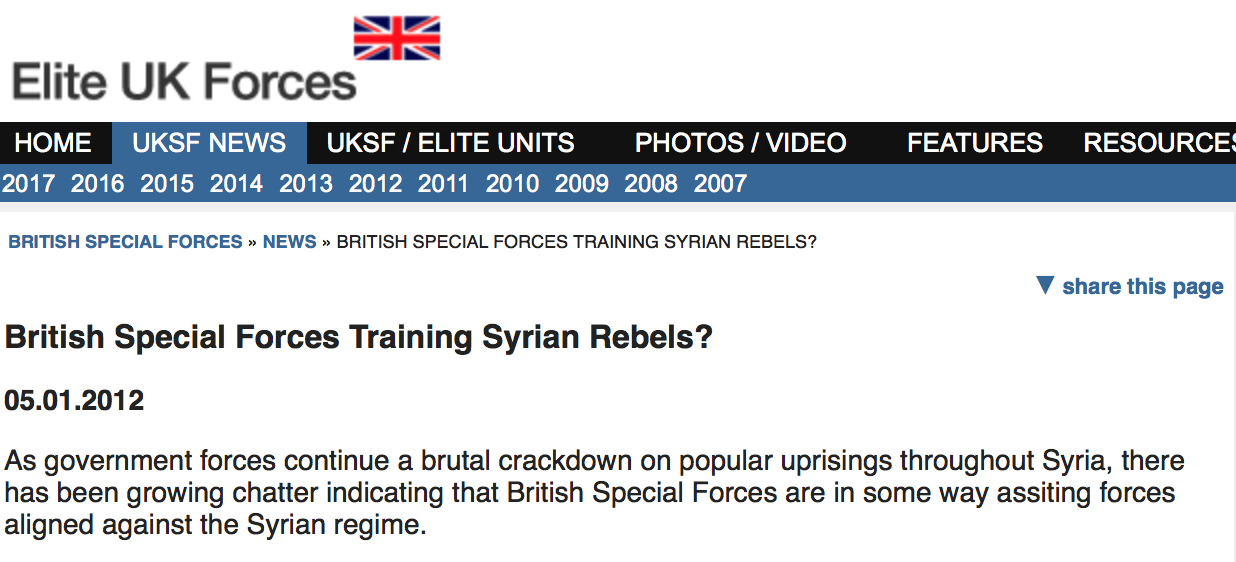
British MI6 were actively involved, collaborating with the CIA:
As the unrest and killings escalate in the troubled Arab state, agents from MI6 and the CIA are already in Syria assessing the situation, a security official has revealed.
Special forces are also talking to Syrian dissident soldiers [Al Qaeda].
They want to know about weapons and communications kit rebel forces will need if the Government decides to help.
“MI6 and the CIA are in Syria to infiltrate[rebel ranks] and get at the truth,” said the well-placed source.
“We have SAS and SBS not far away who want to know what is happening and are finding out what kit dissident soldiers [Al Qaeda] need.” Syria will be bloodiest yet, Daily Star, January 1, 2012 (emphasis added)
The air campaign launched by Obama in 2014, which had the full support of the United Kingdom, was intent upon destroying Syria and Iraq rather than “going after the terrorists”. There is ample evidence that the Islamic State is protected by the US-led coalition.
The inflow and delivery of weapons and supplies are coordinated by the Pentagon in liaison with America’s allies.
US military aid is channelled to Al Qaeda as well as to ISIS-Daesh.
The US has also used the illegal weapons market to channel vast amounts of weapons and military hardware to the Syrian “rebels”.
The State sponsors of ISIS-Al Qaeda are now heralded as the victims of ISIS-Al Qaeda, an absurd proposition. Those who are funded and supported by Western intelligence services are now said to be fighting back.
The ISIS nonetheless has a certain degree of independence in relation to its State sponsors. That is the nature of what is called an “intelligence asset”. But an “intelligence asset” is always on the radar of the intelligence services.
The British government through its intelligence services is known to have covertly supported several Al Qaeda affiliated entities including the Libya Islamic Fighting Group (LIFG) which was linked to the Manchester bombings.
The “Liberation” of Tripoli was carried out by “former” members of the Libya Islamic Fighting Group (LIFG), which is affiliated to Al Qaeda. These “former” Al Qaeda affiliated brigades constituted the backbone of the “pro-democracy” rebellion, which was supported by NATO.
Within the ranks of the LIFG rebels, US Navy SEALS, British SAS and French legionnaires disguised in civilian rebel garb, were reported to be behind major operations directed against key government buildings including Gadhafi’s Bab al-Aziziya compound in central Tripoli.
“Highly-trained [British Special Forces] units, known as ‘Smash’ teams for their prowess and destructive ability, have carried out secret reconnaissance missions to provide up-to-date information on the Libyan armed forces.” (SAS ‘Smash’ squads on the ground in Libya to mark targets for coalition jets, Daily Mirror, March 21, 2011)
And in the wake of NATO’s war Libya, these pro-democracy LIFG Al Qaeda affiliates have joined the ranks of the ISIS.
Washington’s Regime Change for Syria: Install the Islamic State
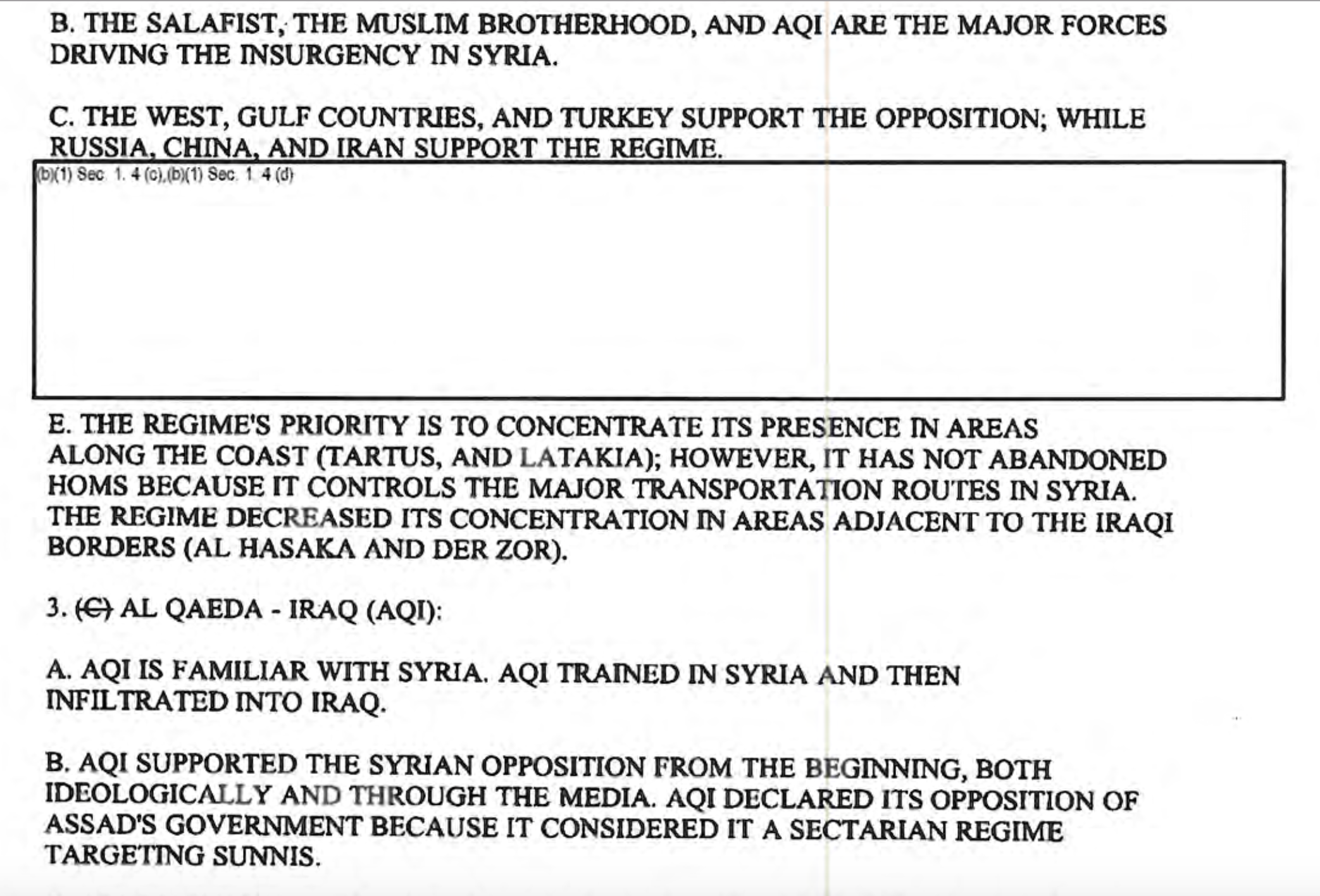
It is worth noting that the release of the Hillary Clinton email archive as well as leaked Pentagon documents confirm that the US and its allies are supportive of ISIS.
Moreover, a 7-page Defense Intelligence Agency (DIA) document dated August of 2012, points to US complicity in supporting the creation of an Islamic State.(Excerpt below)
Concluding Remarks
Despite the evidence, it is very difficult for people to accept the fact that their own government is supporting terrorism.
Most people will dispel this as an impossibility. But it is the forbidden truth.
The established consensus is that the role of a government is to protect its people. That myth has to be sustained.
The media’s role is to ensure that the truth does not trickle down to the broader public.
If that were to occur, the legitimacy of Western heads of State and heads of government would collapse like a house of cards.
The governments of the countries whose citizens are the victims of terror attacks are supporting ISIS-Daesh through their intelligence services.
Copyright © Prof Michel Chossudovsky, Global Research, 2017
Alleged Russia-Taliban Arms Link Disputed
By Jonathan Marshall | Consortium News | May 29, 2017
A tiny article from Reuters in late May quoted the director of the U.S. Defense Intelligence Agency as telling a Senate hearing, “I have not seen real physical evidence of weapons or money being transferred.” Marine Lt. Gen. Vincent Stewart was addressing widespread claims by top Pentagon officials of Russian arms flowing to the Taliban in Afghanistan.
By conceding the reports have no real substance, Stewart quietly called the bluff of military hardliners who are invoking the Russian menace to justify prolonging and escalating the longest and second-most-costly war in U.S. history. Stories of Russian military shipments to Afghanistan began last December, with a typical headline from the Washington Post: “Russia begins supplying weapons to Afghanistan, sides with Taliban.”
Down in the body of the story, however, it emerged that Moscow had agreed to ship 10,000 assault rifles not to the Taliban but to the Afghan government’s police force in Kabul. A Russian Foreign Ministry official said, “Russia has been consistently pursuing the policy of providing comprehensive assistance to Afghanistan in the establishment of a peaceful, independent, stable and self-sufficient state, free from terrorism and drugs.” Russia previously supplied helicopters and pilot training to Afghan forces, under a contract with the U.S. Department of Defense, which continued thanks to a special U.S. waiver on economic sanctions.
As to the Taliban, the Russian official said only that his government stood ready, in the interests of Afghanistan’s national reconciliation, to support “the possible weakening of the sanctions regime . . . against the Taliban, if it is not contrary to the national interests of Afghanistan.” He added that Russia shared the Taliban’s interest in defeating ISIS in Afghanistan.
Scapegoating the Russians
Starting in March, coincident with urgent requests by the U.S. commander in Afghanistan for thousands more troops to stem the Taliban’s military advances, senior Pentagon officers began blaming Russia for setbacks on the battlefield.
“I think it is fair to assume they may be providing some sort of support to [the Taliban] in terms of weapons or other things that may be there,” General Joseph Votel, chief of U.S. Central Command, told members of Congress.
Defense Secretary James Mattis chimed in with claims, paraphrased by NPR correspondent Tom Bowman, that “the Russians are providing some support, including maybe weapons to the Taliban.” Noting that the details were “murky,” Bowman added, “the commander in Afghanistan, General John Nicholson, thinks this is a way for the Russians just to undermine the U.S. and NATO.”
Staying on message, a spokesman for the NATO coalition in Afghanistan told the Los Angeles Times days later, “We know that actions by Russia in Afghanistan are meant to undermine the work of the United States and NATO to support the Afghan government.” The reporters then stated as fact, “It . . . represents another effort by [Russian President Vladimir] Putin to exert power globally while weakening the U.S.”
In late April, a “senior U.S. military official,” speaking on background, asserted that the Russians had “increased their supply of equipment and small arms to the Taliban over the past 18 months.” He said “the Russians have been sending weapons, including medium and heavy machine guns, to the Taliban under the guise that the materiel would be used to fight the Islamic State in eastern Afghanistan.”
Secretary Mattis, quoted in the same article, said menacingly, “we’re going to have to confront Russia where what they’re doing is contrary to international law or denying the sovereignty of other countries.”
Russian Denials
Russia, increasingly considered a “hostile power” by many Americans, won few converts by denying what it called “irresponsible accusations” based on “rumors and conjectures.” Its special envoy to Afghanistan branded the allegations of its arms transfers to the Taliban insurgents “absolute lies . . . aimed at justifying the failure of the U.S. military and politicians.”
But Russia’s credibility – even after months of strident and varied accusations from Western officials – could hardly have been lower than the Afghan sources quoted in U.S. news accounts to bolster the Pentagon’s claims. One notable example was the police chief of Uruzgan province, who spoke of Russian agents, “dressed in doctor’s uniforms,” infiltrating his region and “enticing people against the government, providing training and teaching how to assemble land mines.”
The rotten corruption of the Uruzgan provincial police has been attested to by no less than the commander of the Afghan army in that province. Police there abandoned the provincial capital last year, allowing Taliban forces to walk in unopposed — not because of Russian weapons but because senior officials had pocketed police pay for months at a time.
Similar claims against Russia came from the governor of Kunduz province, whose capital was overrun by Taliban forces last fall in what reporters described as a “seemingly easy re-entry” into the city after a similar Taliban incursion in 2015 was repelled by U.S. Special Forces. Other Afghan officials, and independent reporters, ascribed the Taliban’s easy victories to the local population’s grievances against the “mafia-like” elite who run the province.
Experts also blamed aid from Pakistan — not Russia — to the Taliban. Echoing their complaint, former U.S. Ambassador Zalmay Khalilzad said last year, “The issue of the U.S. inability to deal effectively with Pakistan, and the [Taliban] sanctuary problem in Pakistan, has been the mother of all problems for U.S.-Afghan relations and of Afghanistan to some degree since 9/11.”
Another big supplier of the Taliban is Saudi Arabia. An exposé by Carlotta Gall in the New York Times revealed that as a longtime ally of Pakistan, “Saudi Arabia has backed Islamabad’s promotion of the Taliban. Over the years, wealthy Saudi sheikhs and rich philanthropists have also stoked the war by privately financing the insurgents.”
How US Arms Taliban
Perhaps the biggest arms supplier of all to the Taliban is the U.S. taxpayer. The Taliban rake off hundreds of millions of dollars from extortion of U.S.-funded projects in the country. They also fill their armories with U.S.-made weapons. A Taliban commander told Bloomberg News that when he needs more weapons and fuel, he simply buys or steals them from his foe. “It’s simple and cheaper,” he said.
As journalist and book author Douglas Wissing observed recently, “U.S-enabled corruption lost the Afghan War. . . Corruption funds the enemy, with hundreds of millions of dollars skimmed from U.S. logistics and aid money. . . . Empowered and financed by this corruption, Taliban strength has grown at double-digit rates annually since 2005. Insurgents now control about 40 percent of the countryside, and are pressuring government centers across country, including increasingly besieged Kabul.”
In the past, Donald Trump was correct when he tweeted that the war in Afghanistan was a “total disaster” – although as President, he is reportedly considering a Pentagon plan to escalate the U.S. role, again.
Blaming the Russians for the war’s latest reversals may let our Afghan allies and our own military off the hook for losing this long war in slow motion, but it won’t change the outcome.
A NATO summit for the Donald Trump era
By M K Bhadrakumar | Indian Punchline | May 24, 2017
If the expectation was that US President Donald Trump would outline his strategy toward Afghanistan at the summit meeting of the North Atlantic Treaty Organization in Brussels (May 25-26), that might not be the case. Secretary-General Jens Stoltenberg in his customary pre-summit press conference at the alliance’s Headquarters, in fact, said the summit’s agenda will focuse on two issues: a) Stepping up of NATO’s contribution to the fight against terrorism. The NATO will not undertake combat missions and its role is to “deal with the root causes of terrorism, training local forces is one of the best tools we have”; and, b) “Burden sharing”, which meant meeting the pledge that the member countries had made in 2014 to stop the cuts in military budgets, and “gradually increase and move towards” spending 2% of GDP on defence within a decade.
This is essentially a summit to get acquainted with Trump. The US’ allies fervently hope that Trump will give decent burial to his famous description of NATO being “obsolete” and, in particular, pledge loyalty to Article V of the alliance’s charter on collective security. There is bound to be some unease because Trump can be very unpredictable.
Stoltenberg was circumspect about Afghanistan, saying,
- But the security situation remains challenging. We have recently completed our regular review of our training mission. And our military commanders have asked for a few thousand more troops. We are currently in the process of force generation and I expect final decisions to be taken next month.
It appears that Trump is yet to take a final decision on the US troop level in Afghanistan and/or his strategy toward the war.
Interestingly, during the Q&A, Stoltenberg distanced himself from the allegations in the US media (attributed to senior Pentagon commanders) that Russia has been giving covert support to Taliban to undermine the NATO operations. He said, “We have seen reports, but we haven’t seen fine proof of direct support of Russia to the Taliban.”
Importantly, Stoltenberg added, “We urge Russia to be part of an Afghan-led peace process” to reconcile the Taliban. This is a significant remark, because the NATO secretary-general usually takes his cue from Washington. Can this remark be taken as Stoltenberg’s premonition of some sort of US-Russia cooperation sailing into view over Afghanistan in a near term? It is a plausible assumption, if only because, below the radar, US-Russian cooperation over Syria at the military-to-military level is gaining momentum in the fight against ISIS. The US, it seems, is taking a leap of faith, finally.
Earlier today, addressing the upper house of the Russian parliament in Moscow, Defence Minister Sergey Shoigu made the stunning disclosure that the Russian and American militaries are engaged in discussions about the Syrian situation in a “round-the-clock mode” and are preparing a “joint project” on the hugely controversial southern zone of “deconfliction” where the competing interests of various external protagonists — Israel, Jordan, Iran, US and Hezbollah — threaten to bring the roof down. (See my earlier blog US, Iran run into each other in Syria.)
To quote Shoigu,
- We did not halt contacts and cooperation with them (Americans), this is also happening almost in a round-the-clock mode, we are talking with them during the day and the night, and we are meeting at different venues. A great work is underway with them. We would like it to be completed and presented as a project ready for implementation. But we are working with them and working, naturally, on the southern zone of de-escalation.
The “great work” in progress on Syria can stimulate similar cooperation in Afghanistan as well. Indeed, the US and NATO snubbed repeated Russian overtures over the years for cooperation in Afghanistan, including at the level of the Moscow-led Collective Security Treaty Organization. But Trump is perfectly capable of deciding that Russian help is useful and necessary in Afghanistan in the fight to defeat the ISIS and to bring the war to an end through a negotiated settlement with the Taliban.
By the way, Stoltenberg’s 48-minute press conference in Brussels today was free of any of his past rhetoric against Russia. It will be interesting to see what, if any, Trump will have to say tomorrow on “Russian aggression”, which had been the leitmotif of such high-level NATO events in the recent years during the Barack Obama administration. The video of Stoltenberg’s press conference is here.
Featured Video
US IRAN TALKS: Who Are the Crazy Ones Here? /Lt Col Daniel Davis
or go to
Aletho News Archives – Video-Images
From the Archives
Wartime internment camps in Australia
National Archives of Australia
World War I
During World War I, for security reasons the Australian Government pursued a comprehensive internment policy against enemy aliens living in Australia.
Initially only those born in countries at war with Australia were classed as enemy aliens, but later this was expanded to include people of enemy nations who were naturalised British subjects, Australian-born descendants of migrants born in enemy nations and others who were thought to pose a threat to Australia’s security.
Australia interned almost 7,000 people during World War I, of whom about 4,500 were enemy aliens and British nationals of German ancestry already resident in Australia.
Records of World War I internment camps
World War II
During World War II, Australian authorities established internment camps for three reasons – to prevent residents from assisting Australia’s enemies, to appease public opinion and to house overseas internees sent to Australia for the duration of the war.
Unlike World War I, the initial aim of internment during the later conflict was to identify and intern those who posed a particular threat to the safety or defence of the country. As the war progressed, however, this policy changed and Japanese residents were interned en masse. In the later years of the war, Germans and Italians were also interned on the basis of nationality, particularly those living in the north of Australia. In all, just over 20 per cent of all Italians resident in Australia were interned. … continue
Blog Roll
 Aletho News
- Diplomats slam US negotiators’ performance in Iran talks
- Trump Refuses Exit Ramp, War with Iran will Continue
- Trump Says US Naval Blockade in Strait of Hormuz Will Begin Shortly
- US, Iran end 21-hour talks without agreement
- US IRAN TALKS: Who Are the Crazy Ones Here? /Lt Col Daniel Davis
- Talks with the US end without a deal over excessive US demands: Iran
- Feeling Better, Getting Worse: How Psychiatric Drugs Create the Illusion They Cure
- ‘Nobody Told Me’: Former Mental Health Patient Calls Out Dangerous Side Effects of Psychiatric Drugs
- Dr. Abu-Sitta: Beirut ‘felt like a day in Shifa Hospital’
- Iran Has Won the War, It Will Be Up to the US to Secure the Peace: Mohammad Marandi
- If Americans Knew
- US-Iran ceasefire negotiations make zero progress – Daily Update
- Pro-Israel ‘Thinktanks’ and Individuals who Influence U.S. Foreign Policy
- Mearsheimer reveals how Israel dictates US policies on Iran, Gaza – video
- After killing 350+, Israel still has a “score to settle” with Lebanon before ceasefire – Daily Update
- Military aid to Israel emerges as the latest political litmus test for Democrats
- The only Palestinian children’s rights organization closes following years-long Israeli campaign against it
- ‘I Can’t Forget the Smell’: Lebanese Reel After Israel Kills Over 300 in Single Day
- DNC Shoots Down Resolutions Calling Out AIPAC and Limiting Arms to Israel
- TCN: Is Israel Blackmailing President Trump?
- Israel killed at least 303 Lebanese yesterday – who were they? Daily Update
- No Tricks Zone
- German Expert: Heat Dome Led To Record Temps In Western USA…Warmer In 1934, 1936
- New Study: No Linear Warming Or Glacier Retreat Along Northern Antarctic Peninsula Since 1980s
- An Inconvenient Tree: Uncovered In Alps… Europe Much Warmer Than Today 6000 Years Ago
- New Study Reports A 60% Slowdown In Greenland’s Ice Loss Rate In The Last Decade
- Low Intensity Tornado Wrecks Major Solar Farm, Creating A Potential Toxic Dump
- New Study Finds Warming Saves Lives…Cold Temperatures 12 Times More Deadly Than Excess Heat
- German Science Blog Accuses PIK Climate Institute Of Hallucinating Climate Tipping Points
- Devastating Assessment Of Comirnaty Vaccine By Former Senior Pfizer Europe Toxicologist
- New Study: CO2 Is ‘Effectively Negligible’ As An Explanatory Climate Change Factor Since 2000
- Former Pfizer Toxicologist Dr. Helmut Sterz Tells Bundestag Hearing Pfizer Vaccine Should Have Never Been Approved
 Aletho News