Reignite Democracy Australia – Senator Gerard Rennick
December 2, 2022
Australia to withdraw tens of thousands of Covid-19 fines
RT | November 29, 2022
The authorities in Australia’s largest state, New South Wales (NSW), have said that they will withdraw or refund tens of thousands of fines issued for violations of restrictions during the pandemic.
The move follows a defeat that the NSW government suffered in a court battle against free advocacy group Redfern Legal Centre on Tuesday.
The group launched a test case in July on behalf of three plaintiffs, arguing their fines of between AUS$1,000 ($673) to AUS$3,000 ($2,020) were invalid because the penalty notices didn’t describe the offense sufficiently.
“It’s not a big ask, if you’re going to fine someone for an offense, to set out what the offense is in the notice,” Katherine Richardson, the lawyer for the plaintiffs argued at the New South Wales Supreme Court, as cited by the Sydney Morning Herald.
The government’s lawyers have now conceded that the tickets really didn’t meet the legal requirements.
Shortly after the hearing, the Commissioner of Fines Administration said that 33,121 fines are going to be withdrawn, as they had been issued with similar wording to those of the plaintiffs’ notices.
Redfern Legal Centre has said on Twitter that the development was a “momentous win” for it.
However, the tax administration agency Revenue NSW insisted that the challenge had been on a “technical basis” and that the court ruling didn’t mean that offenses that led to the fines hadn’t been committed.
A full judgment in the case from presiding judge Dina Yehia is expected to be delivered next year.
The Australian Government Lied: Doctors are NOT covered by Government’s indemnity for Covid Injections
By Rhoda Wilson • The Exposé • November 27, 2022
Last week Elizabeth Hart wrote to Mark Butler, Australian Minister for Health and Aged Care, about the government misleading health practitioners who are administering Covid injections into believing they are covered by a government medical indemnity scheme. “It has now been confirmed by your department that health practitioners are not covered by a specific Covid-19 government medical indemnity scheme,” she wrote.
Elizabeth Hart is an independent researcher investigating the overuse of vaccine products and conflicts of interest in vaccination policy.
According to a response Hart received on 17 November from Nigel Murray – Assistant Secretary, MBS Policy and Specialist Services Branch – the government did not put in place a medical indemnity scheme for health professionals. Instead, Murray told Hart, “the former [Morrison] Government established the no-fault Scheme, which commenced operations on 13 December 2021.” Later in the same letter, he again confirmed the scheme did not exist:
“While a medical indemnity scheme for health professionals administering the Covid-19 vaccine was not established per se, the creation of the no-fault Scheme was intended to support increased participation by health professionals in the Covid-19 Vaccination roll-out.”
Hart informed Butler, the promise of “a medical indemnity scheme for health professionals administering the Covid-19 vaccine” probably did intend “to support increased participation by health professionals in the Covid-19 Vaccination roll-out”. But it turns out they are not personally protected by a government scheme. She explained to Butler:
In July 2021, the Morrison Government stated it was establishing a “fit-for-purpose Covid-19 vaccine medical indemnity scheme” to “support increased vaccination uptake by assuring Australians that health professionals, including GPs, nurses and pharmacists administering Covid vaccines as part of the Commonwealth vaccination program have appropriate indemnity coverage”, with a further announcement in August 2021 stating “The Morrison Government has finalised the details of the no-fault Covid-19 Vaccine Claim Scheme following extensive consultation with the peak medical, healthcare, business and insurance sectors to ensure a comprehensive National Scheme”, noting “It also ensure [sic] that health professionals administering vaccines will be able to continue with their crucial role in the vaccine roll out with assurance that the claims scheme will offer them protection”
But it now turns out health professionals are not personally protected by a specific Covid-19 medical indemnity scheme.
The letter from Nigel Murray also confirms: “Informed consent should be obtained for every Covid-19 vaccination, as per usual consent procedures for other vaccinations.”
Mark Butler, it appears health practitioners don’t have specific government medical indemnity re the Covid jab rollout, although they might think they do. They will have to look to their own medical indemnity insurance to protect them. And they should be obtaining informed consent for every Covid-19 jab…but is this actually happening?
What is the quality of information being provided to people, including parents of children, to enable them to properly evaluate the threat of SARS-CoV-2/Covid-19, and the risks and benefits of the multiple Covid jabs, in their own specific circumstances? Why are people of most ages and health status being called upon to have the Covid-19 jabs? Who is actually at serious risk with SARS-CoV-2/Covid-19? Does having repeated Covid jabs compromise the immune system and make people more vulnerable? Nigel Murray includes reference to the ‘Covid-19 vaccination – Patient resources’ webpage in his letter, but this webpage only includes information re Covid jabs for children, not for adults. Nigel Murray’s letter also includes a link to a ‘Consent form for Covid-19 vaccination’.
How does this information re Covid jabs referred to by Nigel Murray stack up in the ‘valid informed consent’ stakes? I would say not very well at all…
This is an extremely serious situation, Mark Butler – it’s highly likely ‘valid informed consent’ has not been properly obtained by many health practitioners before administering Covid-19 jabs.
The health practitioners inserting the needle must be warned they’re not protected by a specific government Covid medical indemnity scheme after all…and they need to consider the quality of the information they’re providing to people to gain their ‘valid informed consent’ to the jabs. They must also consider the impact of jab mandates – which pressure, coerce and manipulate people to submit to Covid jabs, in contravention of The Australian Immunisation Handbook, i.e., jab mandates inhibit a ‘voluntary’ decision.
Mark Butler, please advise what steps you are taking to address this matter.
This email is being circulated to other parties, including the response from your department.
Health practitioners, Covid jabs and ‘valid informed consent’ – a medical ethics disaster, Elizabeth Hart emails
As Dr. Mike Yeadon noted on his Telegram channel: “This has all the appearance of government throwing medical staff under the bus on liability & requirements for informed consent.”
Two days later, Hart forwarded her email trail with Butler to Kamran Abbasi, editor-in-chief of the British Medical Journal (“BMJ”), copying in numerous “people influential on international public health/vaccination policy via the scientific and medical establishment, and other parties.” People copied into her email included infamous modeller Neil Ferguson, UK’s Chief (Covid) Medical Adviser Chris Whitty, President of the Royal Society, and Oxford/AstraZeneca injection’s developers Adrian Hill and Sarah Gilbert.
The BMJ claims to be evidence-based and patient-centred and customer-focused – surely ensuring ‘valid informed consent’ before medical interventions, such as Covid jabs, should be foremost in your values?
Sadly, ‘valid informed consent’ appears to have been sacrificed during the grossly disproportionate and ill-targeted Covid debacle. This scandal is now unfolding in Australia.
FYI, please see [above] my response to Australian federal health minister Mark Butler, on the subject of health practitioners’ medical indemnity insurance for Covid-19 jab administration, and health practitioners’ obligation to obtain ‘informed consent’.
This information has major implications for health practitioners administering Covid-19 jabs in Australia – they need to know they’re not covered by a specific government Covid-19 medical indemnity scheme, and that they’re obligated to obtain informed consent before every Covid-19 jab.
But I strongly suspect many health practitioners have failed to obtain ‘valid informed consent’ before the Covid jabs. How have things gone so terribly wrong?
This is a very serious situation, Kamran Abbasi, at the heart of medical ethics. This should be a priority topic on the BMJ.
Covid-19 Vaccines in Pregnancy
How much do we really know about safety?
Health Advisory & Recovery Team | November 20, 2022
There are gaps in our knowledge about the risk from covid infection in pregnancy but even larger gaps regarding the risks of vaccination. What we do know, however, is that there have always been very good reasons to be cautious of giving medication in pregnancy.
How risky is SARS-CoV-2 infection during pregnancy?
Early in the pandemic, the fear was raised that Covid-19 was more severe during pregnancy. This would not be surprising, as that is true for any infection. There are several reasons for this. The immune system is relatively down-regulated in pregnancy (vital so that the mother does not reject the developing fetus which of course is 50% genetically ‘non-self’) making women more susceptible to infections. It is known that some viral infections, such as rubella and cytomegalovirus cause fetal abnormalities if caught early in pregnancy. In late pregnancy, respiratory infections are likely to be more problematic, as the diaphragm may be splinted by the growing uterus, making breathing shallower. Also any febrile illness may tip the mother into preterm labour. And finally there was the concern that passage of the virus across the placenta could infect the baby, as may be seen in untreated HIV infection.
Thus, there were good theoretical reasons to be concerned. On the other hand, Covid-19 severity was known to be highly related to older age groups and serious comorbidities whereas the majority of pregnant women will be young and healthy. In all, nine pregnant women died with Covid-19 between March and December 2020 from a total of 683,191 births that year. SARS-CoV-2 infections with the recent omicron variants are known to be much milder, including during pregnancy.
One problem with quantifying the risk of Covdi-19 in pregnancy arises from the routine testing – thus anyone admitted for obstetric reasons was tested and so hospitalisations in pregnancy will have all been counted as pregnant covid admissions where in reality many were admissions for pregnancy complications at a time of high SARS-CoV-2 prevalence.
Finally, the evidence that vaccination has reduced risk from covid in pregnant women is lacking.
What do we know about covid vaccine safety in pregnancy?
The honest answer to this is ‘very little’. All the randomised clinical trials have specifically excluded pregnant women. Indeed, participants in the trials had to affirm that they were not trying to become pregnant and that if sexually active they would take contraceptive precautions. These rules were also applied to potential fathers and an obligation to inform the trial investigators should pregnancy occur. Invariably, some participants in the trials did become pregnant but full information on the outcomes is not available.
It was known that Pfizer’s animal studies showed the lipid nanoparticles were detectable in the ovaries (see Table 4-2). Moreover, SARS-CoV-2 spike glycoprotein was found to share similarities with 27 human proteins that relate to egg production (oogenesis), uterine receptivity and placentation. It is also known that the pregnancy studies in rats involved a higher rate of pregnancy losses and fetal anomalies in the vaccine than the placebo arm, despite which, these limited studies were reported as showing no concerns. See this analysis of recently released Pfizer data.
A detailed open letter to the president of the RCOG highlights the lack of information and some worrying signals of potential harm. One such signal is the increase in neonatal deaths in Scotland. It has already been concluded that these deaths were not related to Covid-19 itself but, like the excess deaths in the whole population, the officials and the MSM are ‘baffled’. Oddly, no-one has looked at the effect of vaccination beyond 28 days. Public Health Scotland declared there was no “plausible link” to vaccination to justify investigation, adding, “the outcomes of such analysis, whilst being uninformative for public health decision making, had the potential to be used to harm vaccine confidence at this critical time.” Indeed, Professor Sarah Stock, expert in maternal and fetal medicine at the University of Edinburgh, commented in May 2022: “The numbers are really troubling, and I don’t think we know the reasons why yet” but “stressed the Covid vaccine, which studies have consistently shown to be safe in pregnancy, was not a factor”. Professor Richard Ennos, also from Edinburgh University, has written challenging her logic.
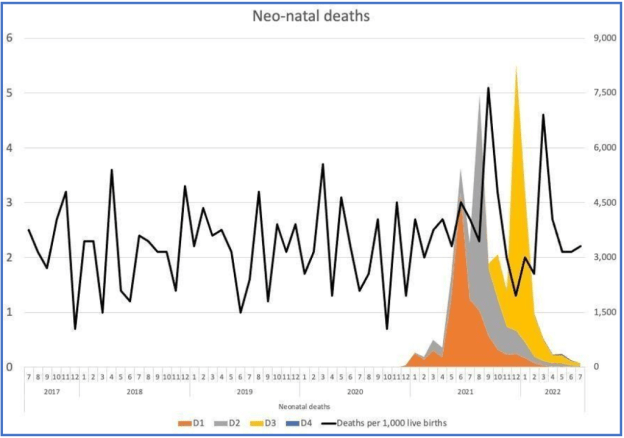
Figure 1: Scottish data on neonatal death rate per 1,000 live births per month (left axis) and doses given to pregnant women (right axis).
An inquiry has been launched in September 2022, but is likely to take 6-9 months – the temporal link to the vaccines would at least suggest a much more urgent need for investigation.
It is not only in the UK that concerns have been raised. Australia has had an extraordinary fall in live birth rate in the last two months of 2021 (2022 figures are not yet available). The results are so extreme that it must surely be some sort of reporting error. But Germany and Sweden have also seen a sharp drop in fertility rates in recent months which have been analysed here, looking a Covid-19 infections, unemployment rates and vaccination rates.
A hugely concerning peer-reviewed preprint has been published showing reduction in stem-cells from umbilical cord samples after Covid-19 infection but much more marked effects following vaccination. The paper has been reviewed here. These cells are an integral part of the newborn infants developing immune system.
Historical pharmaceutical catastrophes and cautions
The most widely known example of severe harm resulting from a drug used in pregnancy is Thalidomide. Launched in 1953 as a tranquiliser, the drug company was taken over the following year and it was relaunched in 1958 as an anti-sickness medication, despite undergoing no specific testing in pregnancy. Over the next 3 years, over 10,000 babies were born with severe limb defects and some also deaf or blind and many thousands are thought to have died. Women had trusted the authorities that all safety checks had been carried out, but sadly irreversible and catastrophic harm resulted before the drug was eventually withdrawn. It was the Thalidomide scandal which led to the setting up of the UK Yellow Card system.
The prescribing of diethylstilbestrol to pregnant women resulted in harm to female fetuses, which only became apparent when the exposed girls themselves reached adulthood. It took 30 years before the late cancer risks were fully recognised and the use of diethylstilboestrol in pregnancy was stopped. Similarly, sodium valproate, an effective anticonvulsant, when given in pregnancy can cause ‘fetal valproate syndrome’, with severe effects on cognitive function. Its teratogenic potential was known from animal studies prior to its launch in 1972, yet even as recently as 2020, women were still not fully informed. It is noteworthy that a BMJ letter in 1981 sounding caution came from a group in Finland – the same country who first noted narcolepsy in children following Pandemrix vaccination. The shortcomings of our healthcare system, described as “disjointed, siloed, unresponsive and defensive” are evident in the Cumberlege Review published July 2020 – ‘First Do No Harm’.
It is against this background that the British National Formulary has strict cautions on prescribing in pregnancy, stating:
“Drugs can have harmful effects on the embryo or fetus at any time during pregnancy. … Drugs should be prescribed in pregnancy only if the expected benefit to the mother is thought to be greater than the risk to the fetus, and all drugs should be avoided if possible during the first trimester. During the second and third trimesters drugs can affect the growth or functional development of the fetus, or they can have toxic effects on fetal tissues.”
“Not all the damaging effects of intrauterine exposure to drugs are obvious at birth, some may only manifest later in life. Such late-onset effects include malignancy, e.g. adenocarcinoma of the vagina after puberty in females exposed to diethylstilbestrol in the womb, and adverse effects on intellectual, social, and functional development.”
Most vitally the BNF reminds us, “Absence of information does not imply safety.”
We can only hope that in the case of the Covid-19 vaccines, this does not turn out to be prophetic.
Rishi Sunak’s hawkish antagonization of Beijing has not gone unnoticed
By Timur Fomenko | RT | November 23, 2022
Since the conclusion of China’s 20th Communist Party Congress, Xi Jinping has been on a diplomatic blitzkrieg. He’s met with leaders from countries all over the world, including the German chancellor, the French president and even US President Joe Biden himself. He’s keeping up the momentum as New Zealand’s Prime Minister Jacinda Ardern has received an invitation to visit Beijing. China believes that diplomacy is critical to prevent the US from isolating it.
But one important country has thus far been left on the sidelines – the United Kingdom. A meeting between Xi Jinping and British Prime Minister Rishi Sunak, scheduled at the UK’s request during the recent G20 summit, was cancelled. It came just as Sunak, at least superficially, softened his rhetoric on Beijing and sought to re-engage, after having portrayed himself as an ultra-hawk during the leadership contest at home. He even scrapped Liz Truss’s designation of Beijing as a “security threat” to his country.
But that hasn’t saved him from Beijing’s wrath. China is getting tough on Britain, in a similar way to how it did on Scott Morrison’s Australia. While the impasse with Canberra ended with the election of Antony Albanese as Prime Minister, who is more pragmatic in handling China ties, Beijing now sees London as the one playing the role of the “insufferable poodle” of the US, and will likely deliberately block engagement until it changes course.
Out of all allies of the United States, China is especially wary of what is known as “The Anglosphere” or the “Five Eyes” – That is Australia, Canada, New Zealand (although not these days) and the United Kingdom. These Anglophone countries, direct products of the British Empire, are the states which are most invested in American hegemony and closest to the United States in terms of ideology and worldview. While Continental European nations may to varying degrees differentiate themselves from the US, the Anglosphere nations are “true believers” in the US cause.
Hence, when the US invaded Iraq, it was the UK and Australia who answered the call, just to cite one instance. China therefore naturally sees members of the Five Eyes with geopolitical suspicion. Additionally, Beijing does not see them as truly “sovereign” countries or as equals to itself, but rather as US vassals. However, it has to balance this with the reality that all of these countries are critical economic and trade partners, due to their accumulated wealth and market influence. In which case, China’s geopolitical objective is not to treat these countries as adversaries, but to use a very explicit “carrot and stick” mode of diplomacy whereby it punishes them for “bad behaviour” in following the US too closely on the one hand, but rewards them for deeper bilateral engagement on the other.
And there is no more explicit example of this ongoing right now than the contrast between China deepening its engagement with New Zealand and shutting out the United Kingdom. When Beijing deems that a leader of an Anglosphere state, such as Scott Morrison of Australia, or Rishi Sunak of the UK, is too deeply following the United States, then there is absolutely no point in engaging them because the fundamental decisions are being made in Washington and not their respective capitals. The metric of right-wing populism, when these respective leaders are actively demonizing China for domestic political gain, is also a ‘naughty step’ offense. Only the US has the political privilege and power to be able to demonize Beijing, but still get engagement with it, hence why America is able to provoke China and never receive the reactions which smaller nations get from China.
This is how Beijing tries to “dilute” American power. The US itself is never confronted, but those who follow Washington too closely are. And on this, China has caught Sunak off guard. Beijing tolerated the government of Boris Johnson because he described himself as a “Sinophile” determined to improve ties with China. Sunak, however, used antagonism of China for partisan gain. The Prime Minister has since moderated his rhetoric and spoken about “keeping ties open,” believing that his spree of anti-China hyperbole, as well as a recent Ministerial visit to Taiwan, would simply be brushed off and that Beijing would welcome him with open arms. He was wrong, and Beijing is now showing that when it is not about the US, engagement with China is conditional on “good behaviour.”
China also recognizes the UK economy is weak, and as loath as London is to admit it, the UK needs ties with China. Inflation is surging, industrial unrest is picking up, chancellor Jeremy Hunt says the country is already in a state of recession. In which case, Beijing is exploiting these vulnerabilities and, similar to Australia, it will place a number of “demands” on Britain which will become pre-requisites to normalization again, which usually involve respecting Beijing’s position on Taiwan and not following the US agenda.
However, whether this works is another story. In the case of Australia, Scott Morrison’s government did not change course, and it simply became the case that China had to wait him out before re-engaging with his successor. That could very much be the case here too. Britain has ultimately made the choice to follow the US on China, even when those policies prove to be blatantly self-defeating, as is the case with the Newport Wafer Fab. Nonetheless, if Sunak is trying to be pragmatic, this should be a reality check for him.
The Alarming Rise of Mass Surveillance
By Dijana Dragomirovic | Australian Medical Network | November 17, 2022
In Australia, a team from the university of NSW (UNSW) has developed an AI-driven early warning detection system for epidemics, called EpiWatch. The system curates, prioritises and filters incoming global data to capture and detect early epidemic signals – essentially a risk analytic tool, which will help governments prioritise responses and stop early spread.
The UNSW EpiWatch team anticipates “many more pandemics will emerge, and are striving to provide an end-to-end solution that will help prevent the next pandemic and ensure health security for all”.
The recent pandemic which started in 2020 witnessed in many countries the fast mobilisation of a raft of Government responses that included social distancing, fines, lockdowns, imprisonment, mask wearing, contact tracing and PCR testing. We must also not forget the relentless and heavy-handed campaign to take a provisionally approved experimental mRNA therapy, mandates and proof of vaccine certificates in order to work, have surgery, see loved ones, marry, bury loved ones, study, shop, worship, play or travel.
While an early detection system may be a useful innovation, the omnipotent view that it will “ensure health security for all” is concerning. The epidemic system is one thing, what is more important to know is how and for what reasons politicians, global organisations such as the WHO, profit seeking companies, foundations, NGOs and powerful bureaucrats will use this information. Another vital component not factored into this equation is an individual’s health and human rights. In Australia many liberties were breached over the past three years and continues to be breached by government and business to this day. Case in point: there are thousands of healthy doctors and nurses willing to work, but cannot because vaccine mandates are still in force.
With the current global mindset held by the various dominating governmental and business superclass, AI systems such as EpiWatch may provide them with even more powers to enforce a complete surveillance state and it will be conveniently enforced under the guise of public health or public confidence in health and safety. Both surveillance systems and government responses are at a high risk of being deployed with very little investigation and debate.
History has demonstrated that new governmental powers obtained in times of crisis frequently outlast the initial danger. After 9/11, governments throughout the world hastened the powers of law enforcement, gave state departments and agencies broader capabilities with little accountability, increased distrust of and discrimination against vulnerable groups and systemised mass surveillance as a ‘necessary’ safety response to the 9/11 terrorist attacks.
The COVID-19 pandemic and the constant replay of restrictions, use of the military and police, locking down and restricting the movement of healthy individuals, shutting down industries and then ‘here are your freedoms back’ may now act as a catalyst for harms of this nature. In Australia, authorities and businesses took advantage of the public health emergency to enact intrusive surveillance and restrictions with almost zero checks and balances in place.
EpiWatch and other start-ups alike are willingly playing their part in a much larger surveillance ecosystem and are failing to incorporate clear privacy and mitigation tools against potential abuse of power by state and non-state actors.

Surveillance 21st Century Style
Today, security agencies, government ministers and bureaucracies are ushering in problematic digital technologies. What we do as a society next will determine the future of our health systems and laws, the safeguarding of our bodily integrity, privacy, national sovereignty and other fundamental liberties.
It is crucial for the public to consider and openly debate whether specific new surveillance techniques are desirable and necessary in a democratic society. Greater engagement is needed to reject exaggerated or unrealistic claims made by developers of high-tech AI, AR (Augmented Reality) or ML (Machine Learning), and pressure needs to be exerted on elected officials to control the bureaucracy, respect existing laws and enact laws with robust privacy and bodily autonomy protections. Nations are implored to take the initiative. However, only people, communities and global cooperation will be able to rein in present power excesses, imbalances and slow the ‘spread’ of the developing AI and digital surveillance state threatening to capture every person and nation.
French elites privately fear the US and new research explains why
By Felix Livshitz | RT | November 15, 2022
New research published by France’s Ecole de Guerre Economique has revealed some extraordinary findings about who and what the French intelligence services fear most when it comes to threats to the country’s economy.
The findings are based on extensive research and interviews with French intelligence experts, including representatives of spy agencies, and so reflect the positions and thinking of specialists in the under-researched field of economic warfare. Their collective view is very clear – 97 percent consider the US to be the foreign power that “most threatens” the “economic interests” of Paris.
Who is your true enemy?
The research was conducted to answer the question, “what will become of France in an increasingly exacerbated context of economic war?” This query has become increasingly urgent for the EU as Western sanctions on Moscow’s exports, in particular energy, have had a catastrophic effect on European countries, but have not had the predicted effect Russia. Nor have they hurt the US, the country pushing most aggressively for these measures.
Yet, the question is not being asked in other EU capitals. It is precisely the continent-wide failure, or unwillingness at least, to consider the “negative repercussions on the daily lives” of European citizens that inspired the Ecole de Guerre Economique report.
As the report’s lead author Christian Harbulot explains, ever since the end of World War II, France has “lived in a state of the unspoken,” as have other European countries.
At the conclusion of that conflict, “manifest fear” among French elites of the Communist Party taking power in France “strongly incited a part of the political class to place our security in the hands of the US, in particular by calling for the establishment of permanent military bases in France.”
“It goes without saying that everything has its price. The compensation for this aid from across the Atlantic was to make us enter into a state of global dependence – monetary, financial, technological – with regard to the US,” Harbulot says. And aside from 1958 – 1965 when General Charles de Gaulle attempted to increase the autonomy of Paris from Washington and NATO, French leaders have “fallen into line.”
This acceptance means aside from rare public scandals such as the sale of French assets to US companies, or Australia canceling its purchase of French-made submarines in favor of a controversial deal with the US and UK (AUKUS), there is little recognition – let alone discussion – in the mainstream as to how Washington exerts a significant degree of control over France’s economy, and therefore politics.
As a result, politicians and the public alike struggle to identify “who their enemy” truly is. “In spheres of power” across Europe, Harbulot says, “it is customary to keep this kind of problem silent,” and economic warfare remains an “underground confrontation which precedes, accompanies and then takes over from classic military conflicts.”
This in turn means any debate about “hostility or harmfulness” in Europe’s relations with Washington misses the underlying point that “the US seeks to ensure its supremacy over the world, without displaying itself as a traditional empire.”
The EU might have a trade surplus of 150 billion euros with the US, but the latter would never willingly allow this economic advantage to translate to “strategic autonomy” from it. And this gain is achieved against the constant backdrop of – and more than offset by – “strong geopolitical and military pressure” from the US at all times.
I spy with my Five Eyes
Harbulot believes the “state of the unspoken” to be even more pronounced in Germany, as Berlin “seeks to establish a new form of supremacy within Europe” based on its dependency on the US.
As France “is not in a phase of power building but rather in a search to preserve its power” – a “very different” state of affairs – this should mean the French can more easily recognize and admit to toxic dependency on Washington, and see it as a problem that must be resolved.
It is certainly hard to imagine such an illuminating and honest report being produced by a Berlin-based academic institute, despite the country being the most badly affected by anti-Russian sanctions. Some analysts have spoken of a possible deindustrialization of Germany, as its inability to power energy-intensive economic sectors has destroyed its 30-year-long trade surplus – maybe forever.
But aside from France’s “dependency” on Washington being different to that of Germany, Paris has other reasons for cultivating a “culture of economic combat,” and keeping very close track of the “foreign interests” that are harming the country’s economy and companies.
A US National Security Agency spying order sent to other members of the Five Eyes global spying network – Australia, Canada, New Zealand, and the UK – released by WikiLeaks, shows that since at least 2002 Washington has issued its English-speaking allies annual “information need” requests, seeking any and all information they can dig up on the economic activities of French companies, the economic and trade policies of France’s government, and the views of Paris on the yearly G8 and G20 summits.
Whatever is unearthed is shared with key US economic decision-makers and departments, including the Federal Reserve and Treasury, as well as intelligence agencies, such as the CIA. Another classified WikiLeaks release shows that the latter – between November 2011 and July 2012 – employed spies from across the Five Eyes (OREA) to infiltrate and monitor the campaigns of parties and candidates in France’s presidential election.
Washington was particularly worried about a Socialist Party victory, and so sought information on a variety of topics, “to prepare key US policymakers for the post-election French political landscape and the potential impact on US-France relations.” Of particular interest was “the presidential candidates’ views on the French economy, what current economic policies…they see as not working, and what policies… they promote to help boost France’s economic growth prospects[.]”
The CIA was also very interested in the “views and characterization” of the US on the part of presidential candidates, and any efforts by them and the parties they represented to “reach out to leaders of other countries,” including some of the states that form the Five Eyes network itself.
Naturally, those members would be unaware that their friends in Washington, and other Five Eyes capitals, would be spying on them while they spied on France.
It was clearly not for nothing that veteran US grand strategist and former Secretary of State Henry Kissinger once remarked, “to be an enemy of America can be dangerous, but to be a friend is fatal.”
Australia stonewalls torture prevention inspection – UN
Samizdat | October 23, 2022
The United Nations torture prevention body has suspended its tour of Australian detention facilities, citing local authorities’ efforts to put roadblocks in its way, according to the organization’s statement released on Sunday.
The UN Subcommittee on Prevention of Torture (SPT) noted that its delegation “has been prevented from visiting several places where people are detained” while lamenting “difficulties in carrying out a full visit at other locations.” Inspectors were not given all the information and documentation they had requested, the organization stated.
The SPT went on to accuse Australia of a “clear breach” of its obligations under the Optional Protocol to the Convention against Torture (OPCAT), adding that the inspection, which kicked off on October 16 and was supposed to run until October 27, was “compromised to such an extent that they had no other option but to suspend it”.
Initially, the SPT sought to assess situation on the ground and “examine the existing protection measures against torture” and other cruel treatment.
The UN body stopped the inspection after earlier this week its delegation was denied entry to a facility in the city of Queanbeyan in the state of New South Wales, eastern Australia.
According to local media reports, Queensland, another Australian state, also blocked visits to mental health facilities, citing local health legislation.
Explaining the decision to prevent UN inspectors from examining the Queanbeyan facility, Geoff Lee, New South Wales Minister for Corrections, argued that “the whole role of our jail system is to keep people safe” and protect them from criminals. “It’s not to allow people just to wander through at their leisure,” he added.
The official stance sparked a backlash from former Australian Prime Minister Malcolm Turnbull, who urged local authorities to “think carefully about the international company they are keeping” by blocking access to UN inspectors.
The Optional Protocol to the Convention against Torture, which has been ratified by 91 nations including Australia, obliges its members to allow SPT unannounced and unhindered visits to “all places where persons are deprived of their liberty” as well as to talk privately to them without witnesses.
Agree with Us or Hold your Tongue
BY RAMESH THAKUR | BROWNSTONE INSTITUTE | OCTOBER 19, 2022
Every crisis, they say, is an opportunity. Governments, health bureaucrats and drug regulators all over the world have exploited the Covid-19 crisis to grab power and gain control over our lives. Predictably, rather than to most people’s surprise, many are proving singularly resistant to relinquishing their extraordinary powers, instead extending the emergency and broadening its scope to embrace other issues.
Efforts to control the pandemic narrative began with a systematic suppression of any suggestion that it might have originated in a research lab of the Wuhan Institute of Virology, then moved on to denigrate, silence and smear critics of lockdowns, masks and vaccine efficacy and mandates.
Australia’s Amended Health Practitioner Regulation National Law
The latest iteration in Australia occurred on October 13 when the Queensland Parliament amended the Health Practitioner Regulation National Law Act to fundamentally reshape the relationship between doctors, patients and health regulators. As per an existing intergovernmental agreement, the Queensland change will be replicated in cascading legislative amendments in other states and territories to ensure a uniform National Law.
On February 22, Australian federal and state health ministers had approved the Health Practitioner Regulation National Law Amendment Bill. The updates to the guiding principles included “an increase in the regulatory responses available to protect public safety.” At best, this is vague and ambiguous.
At worst, it shifts the balance decisively from the individual-centric in liberal democracies to the collective safetyism of technocrats and experts, justifying restrictions on individual rights and agency for the greater good as determined by government agencies. Doctors will be prohibited from expressing their opinion and using their experience, training, education and knowledge of the patient, if this contradicts what the health bureaucrats say is in the interests of “public confidence in safety.” The latter will remote-control how doctors should approach treatment recommendations for patients.
There were several submissions arguing against various elements of the amendment. The Australian Medical Association queried what a “main guiding principle” means “in practice” and argued that the “concept of public confidence is not always clear cut.” The Royal Australian College of General Practitioners submitted that the amendments would imbalance the system even further away from the protection of patient safety and toward “the prosecution of practitioners,” to the detriment of doctors’ confidence in the National Law.
The most substantial submission came from the Australian Medical Professionals Society and the Nurses Professional Association of Australia representing more than 10,000 health professionals. They expressed concern that “the broad and discretionary nature of claims to ‘public safety and confidence’” can be abused “as a mechanism to enforce compliance with government directives.” On the one hand, these could be disconnected from science and evidence.
On the other, they could be used to control health practitioners in direct “conflict with their ethical duties and code of conduct obligations.” They weren’t confident that the provisions for public health and safety would in fact either “improve public protection from clinical misconduct” or “increase confidence in the public health system.” Instead the proposed powers would “serve to conveniently silence voices of expertise that wish to correct health authorities” and prove counterproductive by preventing “necessary information and communication from entering the public sphere.”
Everything done by health bureaucrats and regulators since March 2020, in the name of ensuring public safety and stopping disinformation, indicates we should fear the worst and would be naive to hope for the best. This includes psychological manipulation of emotions and feelings to nudge people into compliance with health directives.
Long-standing principles that have guided Australian doctors and ensured its health system is second to none will be undermined: the Hippocratic Oath’s duty of “Do no harm,” informed consent of the patient based on a harm-benefit evaluation of different treatment options, the risks associated with them in the best professional judgment of the doctor, and the sanctity of the doctor-patient relationship.
People’s faith in their GPs could collapse once they realize doctors are barred from questioning putative benefits or pointing to possible risks of recommended treatments. Instead, they must stay within the boundaries laid down by bureaucrats and regulators, the latter often subject to industry capture.
California has passed a similar law empowering the state’s medical board to revoke the license of physicians who express opinions “contradicted by contemporary scientific consensus to the standard of care.” Or, as helpfully translated by the New York Post sub-editors: “California makes it illegal for doctors to disagree with politicians.”
The Debate on the Harm-Benefit Balance of Covid Vaccines
For health bureaucrats and regulators, the latter often with compromising links to industry, to claim a monopoly on scientific truth is scandalous. The effort to shut down legitimate debates on pain of excommunication from the medical profession represents a clear and present danger to public health.
Having overturned a hundred years of science and policy orthodoxy on pandemic management with Covid, we are intent on revolutionizing the everyday practice of medicine by subordinating the professional judgment of doctors on the best treatment options for their patients, to the directives of bureaucrats and health regulators. With public esteem for politicians at all-time lows, this is not likely to inspire confidence in the health service.
Consider globally contested opinion on the benefit-harm balance of Covid vaccines for children. Their risk of severe illness or death from Covid is tiny, of serious adverse reactions is higher and the long-term effects are unknown. On October 7, Florida issued a press release recommending against mRNA Covid vaccines for 18–39 year-old males. Their analysis had found an 84 percent higher risk of cardiac-related death within 28 days of vaccination in this group. Over-60s have a 10 percent increased risk.
This complements Florida’s guidance on paediatric vaccine guidance issued in March which recommends against Covid vaccines for healthy under-18s. They note the limited risk to infants and children of severe illness due to Covid, the high prevalence of existing immunity among them, reduced vaccine efficacy and “higher than anticipated” severe adverse events, including myocarditis.
Florida thus joins Denmark, Norway and Sweden in ending vaccine recommendations for 12–17 year-olds and also, in two of these, for under 50s and 65s. Albeit contested, there is a substantial and growing body of scientific studies that support their skepticism toward the net benefits of Covid vaccines for infants, children and adolescents.
Florida’s guidance includes three recommendations that are directly relevant to Australia’s National Law:
- People are encouraged to discuss all potential vaccine benefits and risks with their health care provider.
- The risk associated with mRNA vaccination should be weighed against that with Covid infection.
- Doctors should inform patients of the possible cardiac complications that can arise after receiving an mRNA vaccine.
Yet Australia’s Therapeutic Goods Administration has approved vaccines for children aged 6 months-5 years. Meanwhile, many of the claims advanced in support of the vaccines – they stop infection and transmission and prevent severe illness and death – have had to be abandoned one after another but were never “fact-checked” by social media platforms, while the early critics of these claims were assessed by the self-styled fact-checkers to be spreading disinformation and promoting conspiracy theories – until they aren’t any longer.
Moreover, people who die inside 14 days of a vaccine dose are wrongly classified as “unvaccinated.” This distorts the statistics on the net harm-benefit balance to an indeterminate degree. In a particularly egregious example, an article in Nature on September 23 explained that the authors (1) had classified unvaccinated and single-dose vaccinated into the one catch-all category of unvaccinated, and (2) unvaccinated individuals with previous infection had been classified as “fully vaccinated” (Supplementary Table 2).
This in a study whose main objective was to assess the comparative susceptibility to infection by the Omicron variant of the vaccinated versus the unvaccinated within Danish households in December 2021. They concluded that the vaccinated are less susceptible. I can empathize with the reaction of Julian Conradson that after such analytical legerdemain in a leading peer-reviewed journal, “Academia Is Dead.” Little wonder that a poll by the Pew Research Center in February mapped falling confidence in medical scientists since 2020.
Examples of Off-Limits Topics
Examples of studies that doctors could not discuss without fear of investigation and repercussions include:
- In a new study in preprint that looked at 31 pre-vaccination national seroprevalence studies to estimate the infection fatality rate (IFR) stratified by age, John Ioannidis and his team found that the average IFR was 0.0003% at 0-19 years, 0.003% at 20-29 years, 0.011% at 30-39 years, and 0.035% at 40-49 years. The median for 0-59 year-olds was just 0.035%. These are well within and often lower than the seasonal flu range for the under-60s. The last sentence would be ruled out as disinformation, or misleading, or at the very least missing context.
- In the weekly report for August 14–20, NSW Health said: “The minority of the overall population who have not been vaccinated are significantly overrepresented among patients in hospitals and ICUs with Covid-19” (p. 2). Two pages later, the same report gives us the data for hospital and ICU admissions by vaccination status. The number of unvaccinated is exactly zero for both. Now, this makes it mathematically impossible for the unvaccinated to be “overrepresented” among hospital and ICU Covid patients. There is an important conceptual distinction between the statement on page 2 and the statistics in Table 1 two pages later. The first is part of public messaging by the health department of Covid vaccines being “safe and effective.” The second is actual data. The way I read the amended National Law, and therefore the way that some AHPRA (Australian Health Practitioner Regulation Agency) official could read it at some time in the future against any doctor, the latter must conform to the public message and not mention the actual data.
- Imagine a family of 45-year-old parents with three young children aged 5-12 who visit their family doctor to discuss vaccination for their kids and boosters for themselves, both to protect themselves and their parents in turn as they take the kids to spend quality time with grandparents. In the name of public safety, will Australian doctors have to promote the mRNA vaccines to children, boosters to grown-ups and be forbidden to mention advice to the contrary in Scandinavia and Florida? In New South Wales, of the 2,311 Covid-related deaths since May 22, only 3 have been under 20 and 34 under 50. Has any healthy under-20 died of Covid in Australia through the pandemic? If children are at virtually no risk and vaccines don’t stop transmission, why expose children to the risk of serious adverse events?
- What of the startling revelation that Pfizer had never tested its vaccines for transmissibility and therefore the entire vaccine passport requirement was built on a conspiracy of lies? In an NBC interview on February 26, 2021 Pfizer CEO Albert Bourla clearly says “there are a lot of indications right now that are telling us that there is a protection against transmission of the disease” provided by the vaccine. In a CBS interview on May, 26, 2021, Anthony Fauci said: “when you get vaccinated, you not only protect your own health, that of the family, but also you contribute to the community health by preventing the spread of the virus throughout the community … you become a dead end to the virus.” Australian data too confirm that while vaccines and boosters continue to provide protective benefits against severe disease and deaths, despite 95 percent adult vaccination they do not provide immunity against infection, hospitalization, ICU admission or even death (Figure 1).
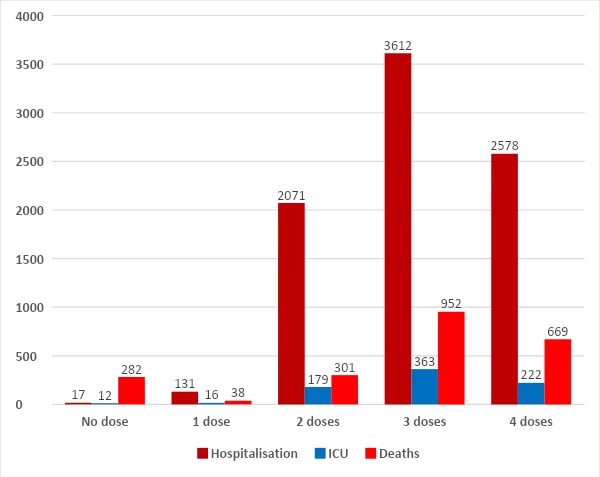
Figure 1: Covid-19 statistics for New South Wales (NSW) by vaccination status, May 22–October 10, 2022. Source: NSW Health, Weekly Surveillance Reports.
In an article on news.com.au, Frank Chung has done Australians a great service by compiling a list of statements from Australian ministers and health bureaucrats repeatedly stating their firm conviction that vaccines stop transmission. Michael Senger has done us all a service with a similar look back at the demonization of the unvaccinated by various public authorities, only too eagerly amplified by the media, and all predicated in the false belief that vaccines stop transmission.
For readers with an interest in Australia, Richard Kelly provides a review of many head-shaking edicts and enforcement actions – such as fining a delivery man for washing his van at an empty car wash at 1.15 a.m. and a teenage learner driver for going for a lesson with her mum – that were issued by public health officials. Their ignorance about the disease was exceeded only by their arrogance and hubris about their ability to control the behavior of a coronavirus. Would Australian doctors be at risk of deregistration for mentioning any of this?
Oliver May of News UNCUT wrote an open letter to 20 British news editors on October 12, asking them to explain why they had failed to run a story either on the powerful documentary on vaccine injuries called Safe and Effective: A Second Opinion, or on Dr. Aseem Malhotra’s painfully honest peer-reviewed study calling for a pause in Covid vaccination because of serious adverse events until all the raw data has been subjected to fully independent scrutiny. Both would be interesting to the public and both are very much in the public interest. We shouldn’t hold our breath for an answer. Maryland School of Pharmacy’s Peter Doshi, senior editor of the British Medical Journal, is right to call out the legacy media for their lack of balanced coverage of Covid vaccines.
Remarkably, the Pfizer admission has been studiously ignored by the Australian MSM. In case I had missed the coverage of the bombshell interview in the Australian media, I did a search on the website of ABC (Australia’s version of the BBC), Age, Australian and Sydney Morning Herald papers. I got zero hits for Robert Roos, the Dutch MEP who asked the question in the European Parliament of Pfizer director Janine Small, and for the latter who confessed to lack of testing for transmissibility. Fading trust in our principal institutions is contributing to the multipronged global crisis of democracy.
The lack of media interest and coverage means there is little pressure for public accountability. Absent that, there will not be any punishment meted out to ministers and bureaucrats for the extensive range of malfeasance in inflicting cruel and inhumane harms on millions of their citizens; no prospect of emotional closure for the people for the trauma they have suffered, including deaths of despair and desolation born of loneliness; delayed prospects of the masses shedding their sheer dread of a virus that for most healthy people under 70 or 65 is not really a severe illness; and a refusal to institute the most powerful deterrent of all for any repeats of public criminality on a grand scale.
Instead we can all look forward to endless cycles of rinse and repeat of surveillance, compulsion and coercion of the masses on the whims of their technocratic betters.
Ramesh Thakur, a Brownstone Institute Senior Scholar, is a former United Nations Assistant Secretary-General, and emeritus professor in the Crawford School of Public Policy, The Australian National University.
mRNA in your food
NSW fast tracks vaccines for cattle
The Naked Emperor’s Newsletter | October 19, 2022
The NSW Department of Primary Industries have partnered with the Queensland Government, the Federal Department of Agriculture, Fisheries and Forestry and Meat and Livestock Australia. These will be the first mRNA vaccines for these diseases and will be created by US biotech company, Tiba Biotech.
Deputy Premier and Minister for Regional NSW, Paul Toole wants to prepare for a potential outbreak and so has written to vaccine manufacturers to develop both vaccines by 1 August 2023.
Cattle are currently vaccinated for FMD using traditional live attenuated virus vaccines and there is no LSD vaccine in use in Australia. Therefore, Minister for Agriculture, Dugald Saunders, wants mRNA vaccines quickly because they are “cheaper and quicker to produce, highly effective and very safe.”
Except for there haven’t been any trials to see if these vaccines are highly effective and very safe because they haven’t been designed yet.
Meat and Livestock Australia managing director Jason Strong said “This type of vaccine technology may not require the longer testing and approval processes required for conventional vaccine development and importation as it does not use animal products”.
Sounds reassuring?
The NSW Government has spent 229 million Australian Dollars (144 million USD) on biosecurity so far this year.
I’ve said it before and I’ll say it again, mRNA technology is an exciting development but it is relatively new and needs far more extensive testing.
Fact checkers from last year said vaccinated Mothers didn’t have mRNA in their breast milk. Studies this year contradict those fact checks and say they do. Before mRNA is pumped into every animal on the planet, I want long term studies showing what happens to that mRNA, whether it transfers via milk and meat, how long it takes for the mRNA to degrade and most importantly how it interacts with humans if it passes to them.
For all we know, the mRNA could transfer to humans, where our cells start producing proteins from the FMD and LSD viruses.
It’s opening a whole can of worms to not test these things and to fast track approval is ridiculous.
Looks like I will be eating bugs after all!
Featured Video

Stanislav Krapivnik: Russia-Iran Cooperation & Escalation in Ukraine
or go to
Aletho News Archives – Video-Images
Frlom the Archives
A dark page from the CIA’s history: What was Project Artichoke, launched 74 years ago?
By Erkin Oncan | Strategic Culture Foundation | August 22, 2025
One of the most useful instruments hidden behind the U.S. empire’s rhetoric of “freedom and democracy” was the Central Intelligence Agency, founded on September 18, 1947, as the successor of the Office of Strategic Services (OSS).
Since its creation, the CIA has carried out countless inhumane operations: assassinations, coups, drug trafficking, support for terrorism, conspiracies. The list of its crimes is endless. But among the darkest and most inhumane chapters of its record lie the notorious “mind control” experiments. … continue
Blog Roll
 Aletho News
- Are the Jews indigenous to Palestine?
- Stanislav Krapivnik: Russia-Iran Cooperation & Escalation in Ukraine
- Indonesia suspends participation in Board of Peace following attack on Iran
- ‘Operation Epic Fury’ burns an estimated $5.82 billion in just 100 hours
- Zionism’s grip over the world: From Epstein to Greater Israel
- How Israel and the FBI manipulated assassination plots to goad Trump into Iran war
- Iranian Strikes Dispel the Illusion of US Security Umbrella
- US Boasts of Destroyed Iranian Launchers Lack Credibility – Ex-DoD Official
- Europe not in position to cooperate with US and Israel against Iran
- Iran Has ‘Broken the Myth’ of Israeli Military Power: Former Pakistani Envoy
- If Americans Knew
- US troops were told war on Iran was ‘all part of God’s divine plan’, watchdog alleges
- Trump wants to run the show in Iran, but doesn’t know what he’s doing – Not a ceasefire Day 147
- ‘Dirty Work’ :The truth about how Israel was founded
- Mass Expulsion in Lebanon as Israel Expands War: “We Don’t Know Where to Go”
- Lies, distortions, and propaganda: how the U.S. mainstream media coverage on Iran hides the truth
- Palestinians in Gaza fear famine returning as Israel cuts off food amid Iran war
- AIPAC, other pro-Israel groups enter midterms with $100 million to spend
- Iranian girls killed by ‘double-tap’ strikes on Minab school
- Bari Weiss Is Going Full ‘Propaganda-Palooza’ With the Iran War
- Inside the Pro-Israel Campaign to Stop ‘The Voice of Hind Rajab’ From Winning an Oscar
- No Tricks Zone
- Televised! Leading German Political Candidate Tells Schoolchildren CO2 Makes Sun Hotter!
- New Study: A Century Warming Of 1.1°C Is ‘Commonplace’ And ‘Not Unusual’ During This Interglacial
- New Study: ‘Internal Noise’ And Volcanic Forcing Can Trigger 10-15°C Warming Within Decades
- Glaciers Worldwide Are Suddendly Surging, Experts Blame Warming!
- Surprising Discovery: Sahara Is Greening…Billions Of Trees Where Once Thought To Be Barren
- New Research Reaffirms Clouds, Aerosols, And Surface Solar Radiation Are ‘Driving The Climate System’
- Germany: Electric Car Catches Fire At Charging Station, Sets Off Local “Inferno”, Widespread Damage
- New Study: Canada’s New Brunswick Was 1°C Warmer Than Today During The Medieval Warm Period
- Coal Power Back In Trend As Globe Tries To Keep Pace With Growing Demand For Power
- New Study: A 4°C Warmer Beaufort Sea Had ‘No Sea Ice’ 11,700 – 8200 Years Ago
 Aletho News