In Unprecedented Move CDC Stops Tracking Influenza for 2020-21 Flu Season
By Brian Shilhavy | Health Impact News | November 4, 2020
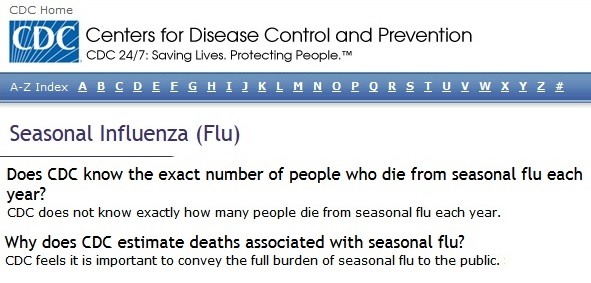
I have been covering the fraud that happens every year with how the CDC tracks incidents and deaths due to the annual influenza for almost a decade now.
The numbers used each year to scare the public into getting the flu vaccine are based not on actual data, but estimates of number of people who die from the flu according to the CDC. Basically, anyone dying from “influenza-like” symptoms are all lumped together into supposed flu deaths each year. Autopsies are seldom performed to prove cause of death.
The CDC has admitted publicly in the past that these numbers are just “estimates.” If the real number of those infected with the influenza virus, and resulting deaths, were vastly lower than what the CDC reports based on their “estimates,” the public would have no way of knowing it.
So this has presented quite a dilemma for the CDC for the first couple of weeks of the 2020-21 flu season, which have just passed.
Because “flu-like” symptoms could also be attributed to COVID-19, and they have the now widely known ineffective COVID PCR test to back up these claims, which also kicks in federal funding for hospitals to treat COVID patients.
As one might expect, with the media widely reporting that cases of COVID are now increasing just as flu season starts, reports of flu cases have dropped dramatically during the same time period last year. Across the globe, it has been reported that incidents of influenza have dropped by about 100%. (Source.)
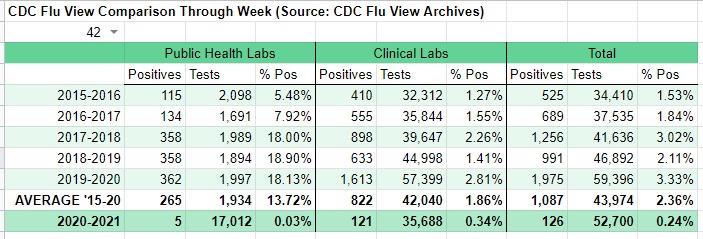
Source
Whoops! How did the CDC allow these numbers to be published?
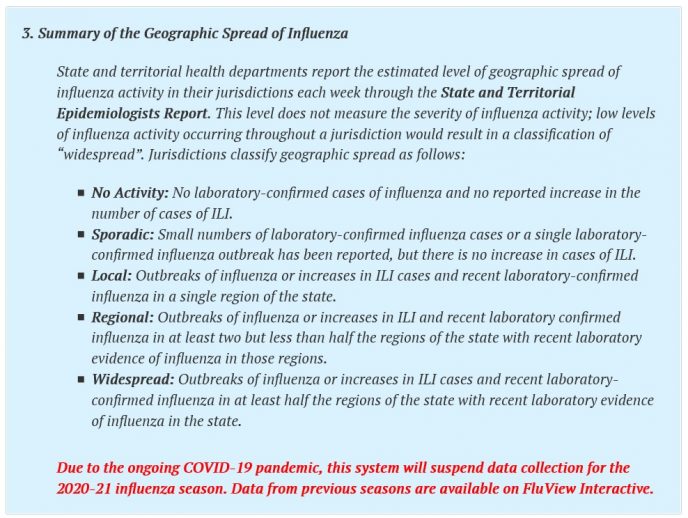
In an apparent response to media reports about the fast declining flu cases here at the beginning of the 2020-21 flu season, the CDC did what any corrupt agency would do which doesn’t want the public to know the truth: They decided to “suspend data collection for the 2020-21 influenza season.” (Source.)
To my knowledge, this is unprecedented, and has never happened before.
There is a screen shot here in case they take this down due to public awareness (thanks to Patrick Wood).
Correlation Between Flu Shot and Senior Deaths Allegedly due to COVID
It is important to remember that most of the deaths in the U.S. attributed to COVID have occurred among those over 70 years old, with co-morbidity factors.
Another factor to consider is that seniors over 65 in the U.S. get a different flu shot than everyone else each year, one that is much stronger.
Most of the initial deaths attributed to COVID in early 2020 occurred in nursing homes or assisted care facilities for the elderly, where the flu vaccine is routinely given every year as a matter of policy.
Deaths in these facilities are common every year just after administering the flu vaccine, but never reported in the corporate media.
Health Impact News had a nurse whistleblower contact us in 2014 to report that 5 seniors in a Georgia assisted care facility died the same week the flu shot was given. We were threatened with a lawsuit for reporting this. See:
5 Seniors Die after Flu Shot at Assisted Care Center in Georgia
A recently published study out of Mexico confirmed the correlation between senior flu shots and COVID deaths.
A recently published study in PeerJ by Christian Wehenkel, a Professor at Universidad Juárez del Estado de Durango in Mexico, has found a positive association between COVID-19 deaths and influenza vaccination rates in elderly people worldwide.
According to the study, “The results showed a positive association between COVID-19 deaths and IVR (influenza vaccination rate) of people ≥65 years-old. There is a significant increase in COVID-19 deaths from eastern to western regions in the world. Further exploration is needed to explain these findings, and additional work on this line of research may lead to prevention of deaths associated with COVID-19.”
To determine this association, data sets from 39 countries with more than half a million people were analyzed. (Read the full article.)
Verified Death Statistics Will Tell the True Story
Once 2020 is complete, it will probably be seen that total deaths that have been recorded will be similar to previous years.
The difference will be the number of deaths attributed to COVID to justify all the government fear and tyrannical actions, as deaths by other causes will drop so that the end result will be about the same.
These kinds of stats are becoming more and more difficult to find, but here is one projected total compared with total deaths from the previous 3 years.
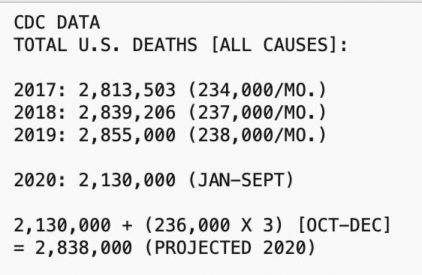
I am not sure of the original source of this graph (it is most likely a compilation of available health statistics), but the graph was published here.
RFK Jr. Sues Facebook, Zuckerberg and So-Called ‘Fact-Checkers’ for Vaccine Censorship
Children’s Health Defense | August 18, 2020
Washington, DC — Children’s Health Defense (CHD) filed a lawsuit on Monday in San Francisco Federal Court charging Facebook, Mark Zuckerberg, and three fact-checking outfits with censoring truthful public health posts and for fraudulently misrepresenting and defaming CHD. CHD is a non-profit watchdog group that roots out corruption in federal agencies, including Centers for Disease Control and Prevention (CDC), the World Health Organization (WHO), and the Federal Communications Commission (FCC), and exposes wrongdoings in the Pharmaceutical and Telecom industries. CHD has been a frequent critic of WiFi and 5G Network safety and of certain vaccine policies that CHD claims put Big Pharma profits ahead of public health. CHD has fiercely criticized agency corruption at WHO, CDC and FCC.
According to CHD’s Complaint, Facebook has insidious conflicts with the Pharmaceutical industry and its captive health agencies and has economic stakes in telecom and 5G. Facebook currently censors CHD’s page, targeting its purge against factual information about vaccines, 5G and public health agencies.
Facebook acknowledges that it coordinates its censorship campaign with the WHO and the CDC. While earlier court decisions have upheld Facebook’s right to censor its pages, CHD argues that Facebook’s pervasive government collaborations make its censorship of CHD a First Amendment violation. The government’s role in Facebook’s censorship goes deeper than its close coordination with CDC and WHO. The Facebook censorship began at the suggestion of powerful Democratic Congressman and Intelligence Committee Chairman Representative Adam Schiff, who in March 2019 asked Facebook to suppress and purge internet content critical of government vaccine policies. Facebook and Schiff use the term “misinformation” as a euphemism for any statement, whether truthful or not, that contradicts official government pronouncements. The WHO issued a press release commending Facebook for coordinating its ongoing censorship campaign with public health officials. That same day, Facebook published a “warning label” on CHD’s page, which implies that CHD’s content is inaccurate, and directs CHD followers to turn to the CDC for “reliable, up to date information.” This is an important First Amendment case that tests the boundaries of government authority to openly censor unwanted critique of government
Attorneys Robert F. Kennedy, Jr., Roger Teich, and Mary Holland represent Children’s Health Defense in the litigation.
The lawsuit also challenges Facebook’s use of so-called “independent fact-checkers” – which, in truth, are neither independent nor fact-based – to create oppositional content on CHD’s page, literally superimposed over CHD’s original content, about open matters of scientific controversy. To further silence CHD’s dissent against important government policies and its critique of Pharmaceutical products, Facebook deactivated CHD’s donate button, and uses a variety of deceptive technology (i.e. shadow banning) to minimize the reach and visibility of CHD’s content. In short, Facebook and the government colluded to silence CHD and its followers. Such tactics are fundamentally at odds with the First Amendment, which guarantees the American public the benefits to democracy from free flow of information in the marketplace of ideas. It forbids the government from censoring private speech—particularly speech that criticizes government policies or officials. As Justice Holmes famously said, “the best test of truth is the power of the thought to get itself accepted in the competition of the market.” The current COVID pandemic makes the need for open and fierce public debate on health issues more critical than ever.
Mark Zuckerberg publicly claims that social media platforms shouldn’t be “the arbiters of truth.” This case exposes Zuckerberg for working with the government to suppress and purge unwanted critiques of government officials and policies.
The court will decide whether Facebook’s new government-directed business model of false and misleading “warning labels,” deceptive “fact-checks,” and disabling a non-profit’s donate button, passes muster under the First and Fifth Amendments, the Lanham Act, and RICO. Those statutes protect CHD against online wire-fraud, false disparagement, and knowingly false statements.
CHD asks the Court to declare Facebook’s actions unconstitutional and fraudulent, and award injunctive relief and damages.
Coronavirus Testing Delayed Due to Contamination in CDC Labs – Reports
Sputnik – April 19, 2020
The production of coronavirus test kits by the CDC was delayed for nearly a month, as the laboratories developing the kits had violated manufacturing practices that led to contamination of one of the three testing components, the Washington Post reported Saturday.
The problems with the tests were allegedly found in January at 24 of the 26 public health labs that had received test kits from the Centres for Disease Control and Prevention (CDC), media reported, citing unnamed sources.
The violation reportedly occurred after chemical mixtures were assembled into the kits in the same lab space where synthetic coronavirus material had been handled earlier.
The CDC efforts “were not sufficient in this circumstance” and the agency has “implemented enhanced quality control to address the issue”, the CDC said, as quoted in the article.
According to a New York Times report, citing the officials of the national Food and Drug Administration (FDA), the faulty testing kits were created at two of the three CDC laboratories in Atlanta.
“CDC did not manufacture its test consistent with its own protocol”, Stephanie Caccomo, spokesperson for the FDA, said in Saturday’s statement to the paper.
The Department of Health and Human Services is now investigating the production and dissemination of the test kits.
The US has so far confirmed more than 690,000 cases of COVID-19, including at least 35,400 fatalities, according to the Centres for Disease Control and Prevention.
How the CDC Uses Fear to Increase Demand for Flu Vaccines
Collective Evolution | November 9, 2018
The CDC claims that its recommendation that everyone aged six months and up should get an annual flu shot is firmly grounded in science. The mainstream media reinforce this characterization by misinforming the public about what the science says.
A New York Times article from earlier this year, for example, in order to persuade readers to follow the CDC’s recommendation, cited scientific literature reviews of the prestigious Cochrane Collaboration to support its characterization of the influenza vaccine as both effective and safe. The Times claimed that the science showed that the vaccine represented “a big payoff in public health” and that harms from the vaccine were “almost nonexistent”.
What the Cochrane researchers actually concluded, however, was that their findings “seem to discourage the utilization of vaccination against influenza in healthy adults as a routine public health measure” (emphasis added). Furthermore, given the known serious harms associated with specific flu vaccines and the CDC’s recommendation that infants as young as six months get a flu shot despite an alarming lack of safety studies for children under two, “large-scale studies assessing important outcomes, and directly comparing vaccine types are urgently required.”
The CDC also recommends the vaccine for pregnant women despite the total absence of randomized controlled trials assessing the safety of this practice for both expectant mother and unborn child. (This is all the more concerning given that multi-dose vials of the inactivated influenza vaccine contain mercury, a known neurotoxin that can cross both the placental and blood-brain barriers and accumulate in the brain.)
The Cochrane researchers also found “no evidence” to support the CDC’s assumptions that the vaccine reduces transmission of the virus or the risk of potentially deadly complications—the two primary justifications claimed by the CDC to support its recommendation.
The CDC nevertheless pushes the influenza vaccine by claiming that it prevents large numbers of hospitalizations and deaths from flu. To reinforce its message that everyone should get an annual flu shot, the CDC claims that hundreds of thousands of people are hospitalized and tens of thousands die each year from influenza. These numbers are generally relayed by the mainstream media as though representative of known cases of flu. The aforementioned New York Times article, for example, stated matter-of-factly that, of the 9 million to 36 million people whom the CDC estimates get the flu each year, “Somewhere between 140,000 and 710,000 of them require hospitalization, and 12,000 to 56,000 die each year.”
… the average number of deaths each year for which the cause is actually attributed on death certificates to the influenza virus is little more than 1000.
On September 27, the CDC issued the claim at a press conference that 80,000 people died from the flu during the 2017 – 2018 flu season, and the media parroted this number as though fact.
What is not being communicated to the public is that the CDC’s numbers do not represent known cases of influenza. They do not come directly from surveillance data, but are rather controversial estimates based on controversial mathematical models that may greatly overestimate the numbers.
To put the matter into perspective, the average number of deaths each year for which the cause is actually attributed on death certificates to the influenza virus is little more than 1,000.
The consequence of the media parroting the CDC’s numbers as though uncontroversial is that the public is routinely misinformed about the impact of influenza on society and the ostensible benefits of the vaccine. Evidently, that’s just the way the CDC wants it, since the agency has also outlined a public relations strategy of using fear marketing to increase demand for flu shots.
In other words, the CDC considers it to be a problem that people are increasingly doing their own research and becoming more adept at educating themselves about health-related issues.
The CDC’s “Problem” of “Growing Health Literacy”
Before looking at some of the problems with the CDC’s estimates, it’s useful to examine the mindset at the agency with respect to how CDC officials view their role in society. An instructive snapshot of this mindset was provided in a presentation by the CDC’s director of media relations on June 17, 2004, at a workshop for the Institute of Medicine (IOM).
In its presentation, the CDC outlined a “‘Recipe’ for Fostering Public Interest and High Vaccine Demand”. It called for encouraging medical experts and public health authorities to “state concern and alarm” about “and predict dire outcomes” from the flu season. To inspire the necessary fear, the CDC encouraged describing each season as “very severe”, “more severe than last or past years”, and “deadly”.
One problem for the CDC is the accurate view among healthy adults that they are not at high risk of serious complications from the flu. As the presentation noted, “achieving consensus by ‘fiat’ is difficult”—meaning that just because the CDC makes the recommendation doesn’t mean that people will actually follow it. Therefore it was necessary to cause “concern, anxiety, and worry” among young, healthy adults who regard the flu as an inconvenience rather than something to be terribly afraid of.
The larger conundrum for the CDC is the proliferation of information available to the public on the internet. As the CDC bluntly stated it, “Health literacy is a growing problem”.
In other words, the CDC considers it to be a problem that people are increasingly doing their own research and becoming more adept at educating themselves about health-related issues. And, as we have already seen, the CDC has very good reason to be concerned about people doing their own research into what the science actually tells us about vaccines.
One prominent way the CDC inspires the necessary fear, of course, is with its estimates of the numbers of people who are hospitalized or die each year from the flu.
… many if not most people diagnosed with ‘the flu’ may not have actually been infected with the influenza virus at all, given the large number of other viruses that cause the same symptoms and the general lack of lab confirmation.
The Problems with the CDC’s Estimates of Annual Flu Deaths
Among the relevant facts that are routinely not relayed to the public by the media when the CDC’s numbers are cited is that only about 7% to 15% of what are called “influenza-like illnesses” are actually caused by influenza viruses. In fact, there are over 200 known viruses that cause influenza-like illnesses, and to determine whether an illness was actually caused by the influenza virus requires laboratory testing—which isn’t usually done.
Furthermore, as the authors of a 2010 Cochrane review stated, “At best, vaccines may only be effective against influenza A and B, which represent about 10% of all circulating viruses” that are known to cause influenza-like symptoms. (That’s the same review, by the way, that the Times mischaracterized as having found the vaccine to be “a big payoff in public health”.)
While the CDC now uses a range of numbers to describe annual deaths attributed to influenza, it used to claim that on average “about 36,000 people per year in the United States die from influenza”. The CDC switched to using a range in response to criticism that the average was misleading because there is great variability from year to year and decade to decade. And while switching to the range did address that criticism, other serious problems remain.
One major problem with “the much publicized figure of 36,000”, as Peter Doshi observed in a 2005 BMJ article, was that it “is not an estimate of yearly flu deaths, as widely reported in both the lay and scientific press, but an estimate—generated by a model—of flu-associated death.”
Of course, as the media routinely remind us when it comes to the subject of vaccines and autism (but seem to forget when it comes to the CDC’s flu numbers), temporal association does not necessarily mean causation. Just because someone dies after an influenza infection does not mean that it was the flu that killed him. And, furthermore, many if not most people diagnosed with “the flu” may not have actually been infected with the influenza virus at all, given the large number of other viruses that cause the same symptoms and the general lack of lab confirmation.
The “36,000” number came from a 2003 CDC study published in JAMA that acknowledged the difficulty of estimating deaths attributable to influenza, given that most cases are not lab-confirmed. Yet, rather than acknowledging the likelihood that a substantial percentage of reported cases actually had nothing to do with the influenza virus, the CDC researchers treated it as though it only meant that flu-related deaths must be significantly higher than the reported numbers.
The study authors pointed out that seasonal influenza is “associated with increased hospitalizations and mortality for many diagnoses”, including pneumonia, and they assumed that many cases attributed to other illnesses were actually caused by influenza. They therefore developed a mathematical model to estimate the number by instead using as their starting point all “respiratory and circulatory” deaths, which include all “pneumonia and influenza” deaths.
In his aforementioned BMJ article, Peter Doshi reasonably asked, “Are US flu death figures more PR than science?”
Of course, not all respiratory and circulatory deaths are caused by the influenza virus. Yet the CDC treats this number as “an upper bound”—as though it was possible that 100% of all respiratory and circulatory deaths occurring in a given flu season were caused by influenza. The CDC also treats the total number of pneumonia and influenza deaths as “a lower bound for deaths associated with influenza”. The CDC states on its website that reported pneumonia and influenza deaths “represent only a fraction of the total number of deaths from influenza”—as though all pneumonia deaths were caused by influenza!
The CDC certainly knows better. In fact, at the same time, the CDC contradictorily acknowledges that not all pneumonia and influenza deaths are flu-related; it has estimatedthat in an average year 2.1% of all respiratory and circulatory deaths and 8.5% of all pneumonia and influenza deaths are influenza-associated.
So how can the CDC maintain both (a) that 8.5% of pneumonia and influenza deaths are flu-related, and (b) that the combined total of all pneumonia and influenza deaths represents only a fraction of flu-caused deaths? How can both be true?
The answer is that the CDC simply assumes that influenza-associated deaths are so greatly underreported within the broader category of deaths coded under “respiratory and circulatory” that they dwarf all those coded under “pneumonia and influenza”.
In his aforementioned BMJ article, Peter Doshi reasonably asked, “Are US flu death figures more PR than science?” As he put it, “US data on influenza deaths are a mess.” The CDC “acknowledges a difference between flu death and flu associated death yet uses the terms interchangeably. Additionally, there are significant statistical incompatibilities between official estimates and national vital statistics data. Compounding these problems is a marketing of fear—a CDC communications strategy in which medical experts ‘predict dire outcomes’ during flu seasons.”
Setting aside pneumonia and looking just at influenza-associated deaths from 1979 to 2002, the annual average according to the NCHS data was only 1,348.
Illustrating the problem, Doshi observed that for the year 2001, the total number of reported pneumonia and influenza deaths was 62,034. Yet, of those, less than one half of one percent were attributed to influenza. Furthermore, of the mere 257 cases blamed on the flu, only 7% were laboratory confirmed. That’s only 18 cases of lab confirmed influenza out of 62,034 pneumonia and influenza deaths—or just 0.03%, according to the CDC’s own National Center for Health Statistics (NCHS).
Setting aside pneumonia and looking just at influenza-associated deaths from 1979 to 2002, the annual average according to the NCHS data was only 1,348.
The CDC’s mortality estimates would be compatible with the NCHS data, Doshi argued, “if about half of the deaths classed by the NCHS as pneumonia were actually flu initiated secondary pneumonias.” But the NCHS criteria itself strongly indicated otherwise, stating that “Cause-of-death statistics are based solely on the underlying cause of death … defined by WHO as ‘the disease or injury which initiated the train of events leading directly to death.’”
The CDC researchers who authored the 2003 study acknowledged that underlying cause-of-death coding “represents the disease or injury that initiated the chain of morbid events that led directly to the death”—yet they fallaciously coupled pneumonia deaths with influenza deaths in their model anyway.
At the time Doshi was writing, the CDC was publicly claiming that each year “about 36,000 [Americans] die from flu”, and as seen with the example from the New York Times, the range of numbers is likewise presented as though representative of known cases of flu-caused deaths. Yet the lead author of that very CDC study, William Thompson of the CDC’s National Immunization Program, acknowledged that the number rather represented “a statistical association” that does not necessarily mean causation. In Thompson’s own words, “Based on modelling, we think it’s associated. I don’t know that we would say that it’s the underlying cause of death.” (Emphasis added.)
Of course, the CDC does say it’s the underlying cause of death in its disingenuous public relations messaging. As Doshi noted, Thompson’s acknowledgment is “incompatible” with the CDC’s “misrepresentation” of its flu deaths estimates. The CDC, Doshi further observed, was “working in manufacturers’ interest by conducting campaigns to increase flu vaccination” based on estimates that are “statistically biased”, including by “arbitrarily linking flu with pneumonia”.
… there are otherwise significant limitations of the CDC’s models that potentially result in spurious attribution of deaths to influenza.
More “Limitations” of the CDC’s Models
While the media present the CDC’s numbers as though uncontroversial, there is in fact “substantial controversy” surrounding flu death estimates, as a 2005 study published in the American Journal of Epidemiology noted. One problem is that the CDC’s models use virus surveillance data that “have not been made available in the public domain”, which means that its results or not reproducible. (As the journal Cell reminds, “the reproducibility of science” is “a lynch pin of credibility”.) And there are otherwise “significant limitations” of the CDC’s models that potentially result in “spurious attribution of deaths to influenza.”
To illustrate, when Peter Doshi requested access to virus circulation data, the CDC refused to allow it unless he granted the CDC co-authorship of the study he was undertaking—which Doshi appropriately refused.
While the number of confirmed H1N1-related child deaths was 371, the CDC’s claimed number was 1,271 or more.
In the New York Review of Books, Helen Epstein has pointed out how the CDC’s dire warnings about the 2009 H1N1 “swine flu” never came to pass, as well as how “some experts maintain that the CDC’s estimates studies overestimate influenza mortality, particularly among children.” While the number of confirmed H1N1-related child deaths was 371, the CDC’s claimed number was 1,271 or more. To arrive at its number, the CDC used a multiplier based on certain assumptions. One assumption is that some cases are missed either because lab confirmation wasn’t sought or because the children weren’t in a hospital when they died and so weren’t tested. Another is that a certain percentage of test results will be false negatives.
However, Epstein pointed out, “according to CDC guidelines at the time”, any child hospitalized with severe influenza symptoms should have been tested for H1N1. Furthermore, “deaths in children from infectious diseases are rare in the US, and even those who didn’t die in hospitals would almost certainly have been autopsied (and tested for H1N1)…. Also, the test is accurate and would have missed few cases. Because it’s unlikely that large numbers of actual cases of US child deaths from H1N1 were missed, the lab-confirmed count (371) is probably much closer to the modeled numbers … which are in any case impossible to verify.”
As already indicated, another assumption the CDC makes is that excess mortality in winter is mostly attributable to influenza. A 2009 Slate article described this as among a number of “potential glitches” that make the CDC’s reported flu deaths the “‘least bad’ estimate”. Referring to earlier methods that associated flu deaths with wintertime deaths from all causes, the article observed that this risked blaming influenza for deaths from car accidents caused by icy roads. And while the updated method presented in the 2003 CDC study excluded such causes of death implausibly linked to flu, related problems remain.
As the aforementioned American Journal of Epidemiology study noted, the updated method “reduces, but does not eliminate, the potential for spurious correlation and spurious attribution of deaths to influenza.” Furthermore, “Methods based on seasonal pattern begin from the assumption that influenza is the major source of excess winter death.” The CDC’s models therefore still “are in danger of being confounded by other seasonal factors.” The authors also stated that they could not conclude from their own study “that influenza is a more important cause of winter mortality on an annual timescale than is cold weather.”
Once the CDC has its estimated hospitalization rate, it then multiplies that number by the ratio of deaths to hospitalizations to arrive at its estimated mortality rate. Thus, any overestimation of the hospitalization rate is also compounded into its estimated death rate.
As a 2002 BMJ study stated, “Cold weather alone causes striking short term increases in mortality, mainly from thrombotic and respiratory disease. Non-thermal seasonal factors such as diet may also affect mortality.” (Emphasis added.) The study estimated that of annual excess winter deaths, only “2.4% were due to influenza either directly or indirectly.” It concluded that, “With influenza causing such a small proportion of excess winter deaths, measures to reduce cold stress offer the greatest opportunities to reduce current levels of winter mortality.”
CDC researchers themselves acknowledge that their models are “subject to some limitations.” In a 2009 study published in the American Journal of Public Health, CDC researchers admitted that “simply counting deaths for which influenza has been coded as the underlying cause on death certificates can lead to both over- and underestimates of the magnitude of influenza-associated mortality.” (Emphasis added.) Yet they offered no comment on how, then, their models account for the likelihood that many reported cases of “flu” had nothing whatsoever to do with the influenza virus. Evidently, this is because they don’t, as indicated by the CDC’s treatment of all influenza deaths plus pneumonia deaths as a “lower bound”.
For another illustration, since it takes two or three years before the data is available to be able to estimate flu hospitalizations and deaths by the usual means, the CDC has also developed a method to make preliminary estimates for a given year by “adjusting” the numbers of reported lab-confirmed cases from selected surveillance areas around the country. The “80,000” figure claimed for last season’s flu deaths is just such an estimate. The way the CDC “adjusts” the numbers is by multiplying the number of lab-confirmed cases by a certain amount, ostensibly “to correct for underreporting”. To determine the multiplier, the CDC makes a number of assumptions to estimate (a) the likelihood that a person hospitalized for any respiratory illness would be tested for influenza and (b) the likelihood that a person with influenza would test positive.
Caveats such as that, however, are not communicated to the general public by the CDC in its press releases or by the mainstream media so that people can make a truly informed choice about whether it’s worth the risk to get a flu shot.
Once the CDC has its estimated hospitalization rate, it then multiplies that number by the ratio of deaths to hospitalizations to arrive at its estimated mortality rate. Thus, any overestimation of the hospitalization rate is also compounded into its estimated death rate.
One obvious problem with this is the underlying assumption that the percentage of people who (a) are hospitalized for respiratory illness and have the flu is the same as (b) the percentage of those who are hospitalized for respiratory illness, are actually tested, and test positive. This implies that doctors are not more likely to seek lab confirmation for people who actually have influenza than they are for people whose respiratory symptoms are due to some other cause.
Assuming that doctors can do better than a pair of rolled dice at picking out patients with influenza, it further implies that doctors are no more likely to order a lab test for patients whom they suspect of having the flu than they are to order a lab test for patients whose respiratory symptoms they think are caused by something else.
The CDC’s assumption thus introduces a selection bias into its model that further calls into question the plausibility of its conclusions, as it is bound to result in overestimation. In a 2015 study published in PLoS One that detailed this method, CDC researchers acknowledged that, “If physicians were more likely to recognize influenza patients clinically and select those patients for testing, we may have over-estimated the magnitude of under-detection.” And that, of course, would result in an overestimation of both hospitalizations and deaths associated with influenza.
Caveats such as that, however, are not communicated to the general public by the CDC in its press releases or by the mainstream media so that people can make a truly informed choice about whether it’s worth the risk to get a flu shot.
Conclusion
In summary, to avoid underestimating influenza-associated hospitalizations and deaths, the CDC relies on models that instead appear to greatly overestimate the numbers due to the fallacious assumptions built into them. These numbers are then mispresented to the public by both public health officials and the mainstream media as though uncontroversial and representative of known cases of influenza-caused illnesses and deaths from surveillance data. Consequently, the public is grossly misinformed about the societal disease burden from influenza and the ostensible benefit of the vaccine.
It is clear that the CDC does not see its mission as being to educate the public in order to be able to make an informed choice about vaccination. After all, that would be incompatible with its view that growing health literacy is a threat to its mission and an obstacle to be overcome. On the other hand, a misinformed populace aligns perfectly with the CDC’s stated goal of using fear marketing to generate more demand for the pharmaceutical industry’s influenza vaccine products.
This article is an adapted and expanded excerpt from part two of the author’s multi-part exposé on the influenza vaccine.
Awareness The CDC’s Influenza Math Doesn’t Add Up: Exaggerating the Death Toll to Sell Flu Shots
By Robert F. Kennedy Jr. | Collective Evolution | October 10, 2018
Every year at about this time, public health officials and their media megaphones start up the drumbeat to encourage everyone (including half-year-old infants, pregnant women and the invalid elderly) to get a flu shot. Never mind that more often than not the vaccines don’t work, and sometimes even increase the risk of getting sick.
To buttress their alarmist message for 2018-2019, representatives from the Centers for Disease Control and Prevention (CDC) and other health agencies held a press conference and issued a press release on September 27, citing a particularly “record-breaking” (though unsubstantiated) 80,000 flu deaths last year. Having “medical experts and public health authorities publicly… state concern and alarm (and predict dire outcomes)” is part and parcel of the CDC’s documented playbook for “fostering public interest and high… demand” for flu shots. CDC’s media relations experts frankly admit that “framing” the current flu season as “more severe than last or past years” or more “deadly” is a highly effective strategy for garnering strong interest and attention from both the media and the public.
Peter Doshi (associate editor at The BMJ and a MIT graduate) has criticized the CDC’s “aggressive” promotion of flu shots, noting that although the annual public health campaigns deliver a “who-in-their-right-mind-could-possibly-disagree message,” the “rhetoric of science” trotted out each year by public health officials has a “shaky scientific basis.” Viewed within the context of Doshi’s remarks, the CDC’s high-flying flu numbers for 2017-2018 raise a number of questions. If accurate, 80,000 deaths would represent an enormous (and mystifying) one-year jump—tens of thousands more flu deaths compared to the already inflated numbers presented for 2016 (and every prior year). Moreover, assuming a roughly six-month season for peak flu activity, the 80,000 figure would translate to an average of over 13,300 deaths per month—something that no newspaper last year came close to reporting.
The CDC’s statistics are impervious to independent verification because they remain, thus far, unpublished—despite the agency’s pledge on its website to base its public health pronouncements on high-quality data derived openly and objectively. Could the CDC’s disappointment with influenza vaccination coverage—which lags far behind the agency’s target of 80%—have anything to do with the opacity of the flu data being used to peddle the unpopular and ineffective vaccines?
Fudging facts
There are a variety of reasons to question the precision with which the CDC likes to imbue its flu statistics. First, although the CDC states that it conducts influenza mortality surveillance with its partner agencies, there is no actual requirement for U.S. states to report adult flu deaths to the CDC. (In public health parlance, adult influenza deaths are not “reportable” or “nationally notifiable.”) In fact, the only “flu-associated deaths” that the CDC requires states and other jurisdictions to report are deaths in children—180 last year.
How did the CDC reach its as-yet-unpublished conclusion—widely shared with the media—that 79,820 American adults in addition to 180 children died from the flu in 2017-2018? The agency states that it relies on death certificate data. However, members of the Cochrane research community have observed that “when actual death certificates are tallied, influenza deaths on average are little more than 1,000 yearly.”
Other knowledgeable individuals have also noted that the death records system in the U.S. is subjective, incomplete and politicized, and have suggested that citizens should adopt a “healthy skepticism about even the most accepted, mainstream, nationally reported CDC or other ‘scientific’ statistics.” This skepticism may be especially warranted for the influenza stats, which are so inextricably intertwined with the CDC’s vaccination agenda that the statistical techniques and assumptions that the agency uses focus specifically on “project[ing] the burden of influenza that would have occurred in the absence of vaccination.”
Notwithstanding its incessant use of influenza statistics to justify its flu vaccine policies, the CDC tries to have it both ways, cautioning that because “influenza activity reporting… is voluntary,” influenza surveillance in the U.S. “cannot be used to ascertain how many people have become ill with influenza during the influenza season.” A larger problem is that the vital statistics that form the basis of the CDC’s surveillance data conflate deaths from pneumonia and influenza (P&I). The CDC concedes that this conflation complicates the challenge of specifically estimating flu deaths:
The system “tracks the proportion of death certificates processed that list pneumonia or influenza as the underlying or contributing cause of death. This system… does not provide an exact number of how many people died from flu” [emphasis added].
Curiously, the CDC presented its cause-of-death data slightly differently prior to 2015. Through 2014, the agency’s annual National Vital Statistics Reports included tables showing influenza deaths and pneumonia deaths as separate line items. Those reports made it abundantly clear that pneumonia deaths (at least as transmitted by death certificates) consistently and dramatically outstripped influenza deaths. The table below illustrates this pattern for 2012-2014.
Starting in 2015, the annual vital statistics reports began displaying P&I together and eliminated the distinct line items. At present, only one tool remains to examine mortality associated with influenza as distinct from pneumonia—the CDC’s interactive FluView dashboard—which provides weekly national breakdowns. The dashboard shows the same general pattern as in the annual reports—that is, lower numbers of influenza deaths and much higher numbers of pneumonia deaths. Bearing in mind all the shortcomings and potential biases of death certificate data, dashboard reports for the first week of March (week 9) for the past three years show 257 influenza deaths versus 4,250 pneumonia deaths in 2016, and 534 and 736 flu deaths (versus over 4,000 annual pneumonia deaths) in 2017 and 2018, respectively.
Semantic shenanigans
Semantics also play a key role in the CDC’s slippery communications about “flu.” For example, CDC’s outpatient surveillance focuses on the broad category of “influenza-like illness” (ILI)—an almost meaningless term describing general symptoms (fever, cough and/or sore throat) that any number of non-influenza viruses are equally capable of triggering. Cochrane lists several problems with the reliance on ILI to make inferences about influenza:
- There is “no reliable system to monitor and quantify the epidemiology and impact of ILI” and no way of knowing what proportion of ILI is caused by influenza.
- There are almost no reliable data on the number of ILI-related physician contacts or hospitalizations—and no one knows what proportion of ILI doctor visits and hospitalizations are due to influenza.
“Pneumonia,” too, is a catch-all diagnosis covering lung infections caused by a variety of different agents: viruses (non-influenza as well as influenza), bacteria, fungi, air pollutants and many others. Interestingly, hospitalization is a common route of exposure to pneumonia-causing pathogens, and mortality from hospital-acquired pneumonia exceeds 60%. In a plausible scenario, an adult hospitalized for suspected (but unconfirmed) “flu” could acquire a lethal pneumonia bug in the hospital, and their death might be chalked up to “flu” regardless of the actual facts, particularly because clinicians do not necessarily order influenza testing. When clinicians in outpatient settings do order testing, relatively few of the “flu” specimens—sometimes as low as 1%—actually test positive for influenza. Over the past couple of decades, the proportion of specimens testing positive has averaged around 15%—meaning that about 85% of suspected “flu” specimens are not, in fact, influenza.
Propaganda with a purpose
It takes little subtlety to recognize that the principal reason for flu hyperbole is to sell more vaccines. However, more and more people—even infectious disease specialists—are realizing that flu shots are fraught with problems. Roughly four-fifths of the vaccine injury and death cases settled through the National Vaccine Injury Compensation Program are flu-vaccine-related. A University of Toronto-based expert recently stated, “We have kind of hyped this vaccine so much for so long we are starting to believe our own hype.”
Pro-flu-vaccination studies—through their skillful placement in prestigious journals—tend to drown out other influenza studies that should be ringing warning bells. Published peer-reviewed studies show that:
- Previous influenza vaccination, particularly in those who get a flu shot every year, diminishes or “blunts” the already low effectiveness of flu shots.
- Getting vaccinated against influenza increases susceptibility to other severe respiratory viruses and also to other strains of influenza.
- Mothers who receive influenza vaccines during pregnancy face an increased risk of miscarriages and their offspring face elevated risks of birth defects and autism.
A systematic review of influenza vaccine trials by Cochrane in 2010 urges the utmost caution. Noting that “studies funded from public sources [have been] significantly less likely [than industry-funded studies] to report conclusions favorable to the vaccines,” and citing evidence of “widespread manipulation of conclusions,” the Cochrane reviewers’ bottom line is that “reliable evidence on influenza vaccines is thin.” We should all keep those words in mind the next time the CDC and the media try to mischaracterize flu facts and science.
CHD is planning many strategies, including legal, in an effort to defend the health of our children and obtain justice for those already injured. Your support is essential to CHD’s successful mission. Please visit our crowdfunding page.
Universal Vaccinations for Children will be Overseen by Committee which Accepts Vaccine Manufacturer Monies
By Janet Phelan – New Eastern Outlook – 10.12.2015
A House of Representatives Bill, short titled “Vaccinate All Children Act of 2015,” has been referred to the Subcommittee on Health and is awaiting committee action.
HR 2232 was introduced by Frederica Wilson, Democrat from Florida and is largely modeled on the California student vaccination act, which was signed into law by Governor Jerry Brown in June of this year.
Like the California Act, HR 2232 removes all previous exemptions from vaccination, other than a medical exemption, supported by a medical doctor’s statement that a particular vaccination would be hazardous to a specific child’s well- being. Gone are the religious exemptions and philosophical exemptions.
Previously, forty-eight states had laws on the books honoring religious exemptions and nineteen states allowed philosophical exemptions.
This Act would override any state law governing vaccine exemptions, making it mandatory for all students at public elementary and secondary schools to be vaccinated. The bill would amend the Public Health Services Act to require students “to be vaccinated in accordance with the recommendations of the Advisory Committee on Immunization Practices.” (ACIP)
The bill does not, however, reveal which vaccinations would be mandatory nor does it place a cap on vaccinations.
The above cited Advisory Committee, which will be making the decisions concerning which shots are mandatory, is stacked with pro-vaccination heavyweights. Notable committee members include a Dr. Kelly Moore, Director, Tennessee Immunization Program, Dr. Edward Belongia, Director, Center for Clinical Epidemiology & Population Health at the Marshfield Clinic Research Foundation and Dr. Kathleen Harriman, Chief, Vaccine Preventable Disease Epidemiology Section with the California Department of Public Health, to name a few. Also sitting on the Committee as Ex Officio members are Department of Defense (DoD) officials as well as FDA officials and members of the Department of Veterans Affairs, among representatives from other federal agencies.
Dollars for Docs
A close scrutiny of this Advisory Committee reveals that quite a number of its members are enriching themselves through vaccine industry “donations” or grants.
For example, some of these individuals have a history which includes industry sponsorship or employment. An example is Dr. Belongia, who has been listed as Co-Principal Investigator for an industry sponsored study of effectiveness of quadrivalent influenza vaccine in children.
According to Propublica, a number of these vaccine experts on the Advisory Committee are accepting large sums of vaccine company money. Dr. Gregory Poland, who is with the American College of Physicians and also the Mayo Clinic, has received a total of $17,351.00 from vaccine manufacturers Novartis Vaccines and Sanofi Pasteur. The money changed hands, according to Propublica, for activities by Dr. Poland listed as promotional speaking, consulting and travel and food expenses from November 2013 through December 2014.
Dr. Stanley Grogg, a “Liaison Member” of the Committee and with American Osteopathic Association (AOA), was rewarded for his “promotional speaking” activities, as well as “consulting,” “travel and lodging” and of course the ubiquitous “food and beverage” — to the tune of $60,391.00. These payments were made during the period of August 2013 through December 2014 and came from a buffet of pharmaceutical companies, including Pfizer, Sanofi, Novartis Vaccines and GlaxoSmithKline, among others.
Dr. Kenneth Schmader is listed as a “Liaison Member” of the ACIP, due to his position with the American Geriatrics Society (AGS). He is a Professor of Medicine-Geriatrics and Geriatrics Division Chief at Duke University and Durham VA Medical Centers in Durham, NC. Dr. Schmader received $75,913.79 for research, paid by Merck, Sharp and Dohme Corporation during the program year 2014.
Dr. Carol Baker, a “Liaison member” and with Infectious Diseases Society of America (IDSA) , also works as a Professor of Pediatrics with the Baylor College of Medicine in Houston, Texas. Dr. Baker was also found to have received $37,514.00 from August 2013-December 2014 for speaking, consulting, lodging and eating. The usual suspects pop up as the vaccine manufacturers who contributed to Dr. Baker—Novartis and Pfizer making the majority of the contributions.
Not to be left in the dust, Dr. William Schaffner, a “Liaison Member” from the National Foundation for Infectious Diseases (NFID) and the Chairman, Department of Preventive Medicine, Vanderbilt University School of Medicine, received a total payment of $26,208 in the two year period from Pfizer and Sanofi Pasteur. The total paid Dr. Schaffner for travel and lodging came to $13,653.00.
Committee member Dr. Ruth Karron, who is listed as Professor and Director at the Center for Immunization Research, Department of International Health at Johns Hopkins Bloomberg School of Public Health in Baltimore, received $ $7,173 from GlaxoSmithKline for consulting from April-December, 2009, while Dr. Lee Harrison of Pittsburgh was paid a total of $27,663.00 by Glaxo and Pfizer, from 2009-2012.
Besides direct payments to pro- vaccine committee members from the pharmaceutical companies, there are other revenue streams gracing ACIP committee members. While this reporter did not find evidence that Advisory Committee member Dr. Arthur Reingold had received the above types of monies from Big Pharma, his name surfaced in connection with an effort to shut down a Professor whose work challenged the conventional wisdom that AIDS was mortally impacting large numbers of Africans. Reingold was assigned to “investigate” professor Peter Duesberg for “misconduct,” surrounding Duesberg’s findings that figures on AIDS deaths in Africa had been deliberately inflated.
As it turned out, Dr. Arthur Reingold had received over $37 million for AIDS research since 1988. Professor Duesberg was subsequently exonerated of the charges.
Dr. David Stephens, a voting member of the Committee, also did not show up on the Propublica list of doctors who took money from pharmaceutical companies. Stephens, whose bio states he has “led research initiatives in the School of Medicine” (at Emory University), is responsible for Emory researchers receiving “$521.8 million from eternal funding agencies in fiscal year 2014.”
Stephens also hobnobs with the Vaccine Dinner Club, which exists to “advance the practice of vaccine science by stimulating the intellectual potential and research productivity of the vaccine research community in the Southeast…”
Dinners and membership in the club are free, sponsored by Emory University and other organizations. I guess with a half billion dollars knocking around in your pocket, a free lunch for your fellow scientists wouldn’t be much of an issue.
Stephens also sits on the Board of Directors for Georgia Bio, a non-profit organization dedicated to advancing the growth of Georgia’s life sciences industry. Also represented on the Georgia Bio Board are vaccine manufacturers and pharmaceutical companies: Johnson and Johnson, Geovax, Arbor Pharmaceuticals, Immucor, Osmotica Pharmaceutical Company and Femasys.
Georgia Bio was contacted by this reporter, who wished to query what, if any, compensation Stephens received for his service on the Board. Jennifer Kauffman, Development Director, promptly hung up rather than answer.
Should HR 2232 be approved by the US Congress, it is this Advisory Committee which will decide which vaccinations American children must receive. The clear conflict of interest inherent in Committee members padding their wallets with money from the pharmaceutical industry realistically should disqualify the members from making these critical decisions.
Opaque Government
These conflicts of interest are not new for the ACIP. As reported over fifteen years ago by the National Vaccine Information Center, previous conflicts of interest ranged from the ACIP chairman owning stock in vaccine giant Merck, to other financial ties between committee members and vaccine companies. In addition, the National Vaccine Information Center reported that the mandated financial disclosures filed by committee members were incomplete, rendering a full accounting of their financial relationships with pharmaceutical companies difficult, if not impossible.
Regarding the compensation paid by the CDC to ACIP members, CDC reports that;“Appointments are not remunerated. However, members are compensated for expenses incurred by attendance at meetings. Such compensation, which includes the issuance of airline tickets, per diem to cover lodging, meals and incidental expenses will be in accordance with DHHS/CDC travel rules. An optional honorarium of $250/day for each day that a member attends an ACIP meeting is offered to voting members, who are designated as Special Government Employees during their tenure on the Committee.”
Radio show host (Wise Women Media) Anita Stewart contributed research to this report. This reporter requested that Stewart contact the CDC to query what sort of compensation the ACIP members received, as the CDC will no longer respond to public records or media requests from this reporter. This blacklisting took place following the publication of an article in Activist Post, indicating that the CDC was deflating the numbers of biological weapons labs.
Stewart, who located the above information on ACIP compensation online, was questioned by CDC media officer Sonny Dill, who kept insisting that Stewart was I. Dill also wanted to know who Stewart worked for, stating this information was necessary before answering any questions. Stewart, who was forthcoming in response, reports that Dill declined to supply the information requested.
25 Facts About the Pharmaceutical Industry, Vaccines and “Anti-Vaxers”
By Julie Lévesque | Global Research | February 25, 2015
During the recent measles outbreak, the mainstream media blamed the epidemic solely on non vaccinated children, even though people who were vaccinated caught the disease and some vaccines have proven to be inefficient in the past. Without the slightest nuance, the mainstream media constantly portrays people reluctant to accept just any vaccine as “anti-vaxers”, irresponsible and misinformed people, relying on irrational fears and the one and only “fraudulent” Andrew Wakefield study linking autism to vaccines. (Watch Lina B. Moreco’s documentary Shots in the Dark, which features Dr. Wakefield and thankful parents of his young patients with autism.)
In reality, many so-called “anti-vaxers” are not ALL totally against vaccines. While some people may be totally against any kind of vaccination, many, including doctors and health specialists, question certain vaccines, ingredients in the vaccines and/or the vaccination schedule. This is not based on a survey but on my own perception resulting from the fair amount of articles on vaccines and the pharmaceutical industry that I’ve read over the last five years as a journalist. There are a large number of doctors and health specialists who have done truly independent research and who criticize vaccination based on scientific studies and solid evidence.
Why is the media so keen on portraying Big Pharma critics as crazy, uneducated, unscientific and irresponsible people?
Dr Marcia Angell worked for over two decades as editor of The New England Journal of Medicine. She was fired after criticizing the pharmaceutical industry, which had exerted an overriding and negative influence on the scientific literature. She said:
“It is simply no longer possible to believe much of the clinical research that is published.”
Numerous journalists say the same goes for the mainstream media.
We bring to the attention of our readers 25 facts which constitute only part of a larger body of independent scientific research and articles on vaccines and the pharmaceutical industry. Some mainstream articles have been included as well to show how the media overlooks stories it has published in the past because they don’t fit with their “anti-vaxer” portrait.
The objective of this list is to provide independent research and sources of information on vaccination and Big Pharma, which is what the mainstream media fails to do and instead blindly promotes the narrative and agenda of Big Pharma.
(All emphasis added. Most titles are quotes from the articles they are linked to.)
25 Facts About the Pharmaceutical Industry, Vaccines and “Anti-Vaxers”
1- China has measles outbreaks but 99% are vaccinated
A recent study published in PLoS titled, “Difficulties in eliminating measles and controlling rubella and mumps: a cross-sectional study of a first measles and rubella vaccination and a second measles, mumps, and rubella vaccination,” has brought to light the glaring ineffectiveness of two measles vaccines (measles–rubella (MR) or measles–mumps–rubella(MMR) ) in fulfilling their widely claimed promise of preventing outbreaks in highly vaccine compliant populations. (Sayer Ji, Why Is China Having Measles Outbreaks When 99% Are Vaccinated?, GreenMedInfo 20 September 2014)
2- Mandatory Chickenpox Vaccination Increases Disease Rates, Study Shows
Varicella, or the chicken pox vaccination, has been mandated in South Korea since 2005. Infants from 12 to 15 months are required by law to receive a vaccination. By 2011, the country reached a near universal compliance rate, however, varicella patients did not decrease; they have increased since reaching this mandated level of vaccination.
The number of chicken pox patients reported to the Korea Centers for Disease Control and Prevention (KCDC) has increased from 22.6 cases per 100,000 in 2006 to 71.6 cases per 100,000 in 2011. That’s a huge difference and ample proof that the vaccination program isn’t working to control the spread of the disease. (Christina Sarich, With 97% Compliance Chicken Pox Vaccine Still Causes Outbreaks, Natural Society, January 08, 2015)
3- In a 2012 measles outbreak in Quebec (Canada) over half of the cases were in vaccinated teenagers
An investigation into an outbreak in a high school in a town that was heavily hit by the virus found that about half of the cases were in teens who had received the recommended two doses of vaccine in childhood — in other words, teens whom authorities would have expected to have been protected from the measles virus.
It’s generally assumed that the measles vaccine, when given in a two-dose schedule in early childhood, should protect against measles infection about 99 per cent of the time. So the discovery that 52 of the 98 teens who caught measles were fully vaccinated came as a shock to the researchers who conducted the investigation. (The Canadian Press, Measles among vaccinated Quebec kids questioned, CBC, October 20, 2011)
4- In 1987 a measles outbreak was documented among a fully immunized group of children
In 1987, for example, a study published in the New England Journal of Medicine (NEJM) documented a measles outbreak that occurred in Corpus Christi, Texas, in the spring of 1985. Fourteen adolescent-age students, all of whom had been vaccinated for measles, contracted the disease despite having been injected with the MMR vaccine. Researchers noted that more than 99 percent of students at the school — basically all of them — had also been vaccinated, with more than 95 percent of them showing detectable antibodies to measles. (Ethan A. Huff, Measles Outbreak Documented Among Fully Immunized Group of Children, Natural News 15 February 2015)
5- Centers for Disease Control’s (CDC) Own Data Shows Links Between Vaccines and Sudden Infant Death Syndrome (SIDS)
What happens when the actual evidence from the scientific and clinical literature produced by these very agencies contradicts their own vaccine policies?
This is exactly what has happened with the publication of a new study in the Journal of Pediatrics titled ,”Adverse Events following Haemophilus influenzae Type b Vaccines in the Vaccine Adverse Event ReportingSystem, 1990-2013,” wherein CDC and FDA researchers identify 749 deaths linked to the administration of the Hib vaccine, 51% of which were sudden infant death linked to the administration of Hib vaccine. (Sayer Ji, Centers for Disease Control’s (CDC) Own Data Shows Links Between Vaccines and Sudden Infant Death Syndrome (SIDS), GreenMedInfo 23 January 2015)
6- Japan banned the MMR vaccine in 1993 “after 1.8 million children had been given two types of MMR and a record number developed non-viral meningitis and other adverse reactions.”
The Japanese government realised there was a problem with MMR soon after its introduction in April 1989 when vaccination was compulsory. Parents who refused had to pay a small fine.
An analysis of vaccinations over a three-month period showed one in every 900 children was experiencing problems. This was over 2,000 times higher than the expected rate of one child in every 100,000 to 200,000. (Jenny Hope, Why Japan banned MMR vaccine, Daily Mail)
7- A study concluded nations that require more vaccine doses tend to have higher infant mortality rates.
The US childhood immunization schedule requires 26 vaccine doses for infants aged less than 1 year, the most in the world, yet 33 nations have better IMRs [Infant Mortality Rates]
Some countries have IMRs that are less than half the US rate: Singapore, Sweden, and Japan are below 2.80. According to the Centers for Disease Control and Prevention (CDC), “The relative position of the United States in comparison to countries with the lowest infant mortality rates appears to be worsening.”
These findings demonstrate a counter-intuitive relationship: nations that require more vaccine doses tend to have higher infant mortality rates. (Neil Z Miller and Gary S Goldman, Infant mortality rates regressed against number of vaccine doses routinely given: Is there a biochemical or synergistic toxicity?, U.S. National Library of Medicine, September 2011)
8- The U.S. has a vaccine court apparently designed to “Shield Manufacturers from Liability”
For years, the corporate media was reluctant to admit that it even existed. But the special court system designed to handle vaccine injury cases — and ultimately sweep them under the rug as quickly as possible — has hit the mainstream news for its failure to adequately and propitiously compensate families of vaccine-injured children. (Ethan A. Huff, Secretive Vaccine Court Exposed: Designed to Shield Manufacturers from Liability, Natural News, November 19, 2014)
9- Beyond admitting to fraud in a 2004 Centers for Disease Control (CDC) study that exonerated the MMR vaccine, Dr. William Thompson, a CDC scientist, asserts there is a connection between mercury (thimerosal) in vaccines and autism. (Jon Rappoport, U.S. Centers for Disease Control Whistleblower: Mercury (Thimerosal) in Vaccines Causes Autism, No More Fake News, September 05, 2014)
10- Back in 2002, William Thompson was already aware of study results linking the MMR vaccine to a very large increase in autism risk among African-American children. See Brian Hooker’s published paper here, with a full analysis of the CDC’s own data revealing a 340% increased risk of autism in African-American children following the MMR vaccine. (Mike Adams, Autism Links to Vaccines: Whistleblower Reveals Evidence of Criminal Coverup by the Centers for Disease Control (CDC), Natural News August 26, 2014
11- According to a CDC epidemiologist named Tom Verstraeten, who had analyzed the agency’s massive database containing the medical records of 100,000 children, a mercury-based preservative in the vaccines — thimerosal — appeared to be responsible for a dramatic increase in autism and a host of other neurological disorders among children. (Robert F. Kennedy Jr, Vaccinations: Deadly Immunity. Government Cover-up of a Mercury / Autism Scandal Rollingstone.com, 20 July 2005)
12- Instead of taking immediate steps to alert the public and rid the vaccine supply of thimerosal, the officials and executives [discussed] how to cover up the damaging data. (Ibid.)
The CDC paid the Institute of Medicine to conduct a new study to whitewash the risks of thimerosal, ordering researchers to “rule out” the chemical’s link to autism.
It withheld Verstraeten’s findings, even though they had been slated for immediate publication, and told other scientists that his original data had been “lost” and could not be replicated. And to thwart the Freedom of Information Act, it handed its giant database of vaccine records over to a private company, declaring it off-limits to researchers. By the time Verstraeten finally published his study in 2003, he had gone to work for GlaxoSmithKline and reworked his data to bury the link between thimerosal and autism.
11- Since 1991, when the CDC and the FDA had recommended that three additional vaccines laced with the preservative be given to extremely young infants […] the estimated number of cases of autism had increased fifteenfold [in 2005], from one in every 2,500 children to one in 166 children.(Ibid.)
Here is the CDC chart available today on its website:

An MIT researcher has linked autism to glyphosate, the chemical herbicide used in Monsanto Roundup.
12- Vaccine manufacturers […] continued to sell off their mercury-based supplies of vaccines until last year [2004].
The CDC and FDA [bought] up the tainted vaccines for export to developing countries and allowed drug companies to continue using the preservative in some American vaccines — including several pediatric flu shots as well as tetanus boosters routinely given to eleven-year-olds. (Ibid.)
13- Senate Majority Leader Bill Frist, who has received $873,000 in contributions from the pharmaceutical industry, has been working to immunize vaccine makers from liability in 4,200 lawsuits that have been filed by the parents of injured children. (Ibid.)
14- Seasonal Flu Shots still contain thimerosal.
Look at the monographs. For example the one from Vaxigrip from Sanofi Pasteur states on page 4 the mercury-based preservative is in its multidose vial:
“Clinically Relevant Non-medicinal Ingredients: thimerosal* , formaldehyde, Triton® X-100†, neomycin”
15- Dr. Scott Reuben former member of Pfizer’s speakers’ bureau published dozens of fake study in medical journals
Dr. Reuben accepted a $75,000 grant from Pfizer to study Celebrex in 2005… His research, which was published in a medical journal, has since been quoted by hundreds of other doctors and researchers as “proof” that Celebrex helped reduce pain during post-surgical recovery. .. No patients were ever enrolled in the study!
He also faked study data on Bextra and Vioxx drugs… [T]he peer-reviewed medical journal Anesthesia & Analgesia was forced to retract 10 “scientific” papers authored by Reuben… 21 articles written by Dr. Reuben that appear in medical journals have apparently been fabricated, too, and must be retracted. (Big Pharma researcher admits to faking dozens of research studies for Pfizer, Merck (opinion), Mike Adams, NaturalNews.com, February 18, 2010)
16- To this day thimerosal is still used in flu vaccines
For example, in the Vaxigrip monograph says: “The multidose vial of this vaccine contains thimerosal as a preservative. Thimerosal has been associated with allergic reactions.”
17- There are at least 97 studies showing links between vaccines and autism.
18- The CDC claims “there is no convincing evidence of harm caused by the low doses of thimerosal in vaccines”, but that health authorities “agreed that thimerosal should be reduced or eliminated in vaccines as a precautionary measure.”
On thimerosal, the CDC website states:
“Since 2001, with the exception of some influenza (flu) vaccines, thimerosal is not used as a preservative in routinely recommended childhood vaccines. Thimerosal is a mercury-containing preservative used in some vaccines and other products since the 1930′s. except for minor reactions like redness and swelling at the injection site. However, in July 1999, the Public Health Service agencies, the American Academy of Pediatrics, and vaccine manufacturers agreed that thimerosal should be reduced or eliminated in vaccines as a precautionary measure.“
19- Industry-sponsored trials published in medical journals consistently favor sponsors
In view of this control and the conflicts of interest that permeate the enterprise, it is not surprising that industry-sponsored trials published in medical journals consistently favor sponsors —largely because negative results are not published, positive results are repeatedly published in slightly different forms, and a positive spin is put on even negative results. A review of seventy-four clinical trials of antidepressants, for example, found that thirty-seven of thirty-eight positive studies were published. But of the thirty-six negative studies, thirty-three were either not published or published in a form that conveyed a positive outcome.” – Marcia Angell, MD (Dr. Gary G. Kohls, Beware the Drug Companies, How they Deceive Us: “Criticizing Big Pharma” Global Research, February 16, 2015)
20- Nearly half of published articles in scientific journals contain findings that are false. (Dr. Gary G. Kohls, Beware the Drug Companies, How they Deceive Us: “Criticizing Big Pharma”Global Research, February 16, 2015)
“Six years ago, John Ioannidis, a professor of epidemiology at the University of Ioannina School of Medicine in Greece, found that nearly half of published articles in scientific journals contained findings that were false, in the sense that independent researchers couldn’t replicate them. The problem is particularly widespread in medical research, where peer-reviewed articles in medical journals can be crucial in influencing multimillion- and sometimes multibillion-dollar spending decisions. It would be surprising if conflicts of interest did not sometimes compromise editorial neutrality, and in the case of medical research, the sources of bias are obvious.
21- Most medical journals receive half or more of their income from pharmaceutical company advertising and reprint orders, and dozens of others [journals] are owned by companies like Wolters Kluwer, a medical publisher that also provides marketing services to the pharmaceutical industry.” — Helen Epstein, author of “Flu Warning: Beware the Drug Companies” (http://aaci-india.org/COI/Flu_web_final.pdf) (Dr. Gary G. Kohls, Beware the Drug Companies, How they Deceive Us: “Criticizing Big Pharma” Global Research, February 16, 2015)
22- The FDA’s own web page admits that the drugs it certifies as safe contribute to over 100,000 deaths per year. (Constitutional Attorney on US Federal Drug Administration (FDA) Corruption, Disinformation and Cover Up of Health Dangers, Activist Post, 8 February 2015)
23- The FDA routinely approves drugs over objections from its own medical reviewers. (Ibid.)
24- The FDA does zero independent medical testing of its own.
It is a system built upon conflicts of interest that leaves consumers completely in the dark about the true consequences of taking Big Pharma products. (Ibid.)
25- In 2012 GlaxoSmithKline Pleaded Guilty and Paid “$3 Billion to Resolve Fraud Allegations and Failure to Report Safety Data”
According to the US Justice Department:
The resolution is the largest health care fraud settlement in U.S. history and the largest payment ever by a drug company. …
GSK agreed to plead guilty to a three-count criminal information, including two counts of introducing misbranded drugs, Paxil and Wellbutrin, into interstate commerce and one count of failing to report safety data about the drug Avandia to the Food and Drug Administration (FDA).
Featured Video
Rewriting the risk? Inside the government’s vaccine safety messaging
or go to
Aletho News Archives – Video-Images
Book Review
“Davos Can Really Replace the UN”
Inside the book that maps the architecture behind global governance — from the Epstein files to the Pact for the Future
Lies are Unbekoming | April 1, 2026
On June 13, 2019, the United Nations and the World Economic Forum signed a partnership deal to “accelerate the implementation of the 2030 Agenda for Sustainable Development.” That same evening, WEF president Börge Brende — Norway’s former Foreign Minister — had dinner with Jeffrey Epstein at Epstein’s Manhattan townhouse. The Epstein files, released January 2026, contain an exchange between the two from the previous year. Epstein to Brende: “Davos can really replace the UN. C21, cyber, crypto . genetics… intl coordination.” Brende back to Epstein: “Exactly — we need a new global architecture. World Economic Forum (Davos) is uniquely positioned — public private.”
The next day, the UN General Assembly adopted the framework for restructuring global governance.
That sequence — the partnership signing, the Epstein dinner, the candid admission about replacing the UN with a public-private architecture, and then the formal adoption — opens Jacob Nordangård’s The Digital World Brain. Pages two and three. Footnoted to the UN resolution number, the Epstein files, and the General Assembly record.
I keep coming back to it because it captures what this book does that almost nothing else in the independent research space manages. I’ve followed Jacob’s work for years now and interviewed him about his research. Each book peels back another layer of the same institutional architecture, and each time I think he’s reached the limit of what can be documented, the next one goes further. Nordangård doesn’t speculate. He doesn’t editorialize much. He lays institutional actions next to each other in chronological order and lets the pattern announce itself. … continue
Blog Roll
 Aletho News
- How I fell foul of the BBC thought police
- The End of NATO
- 37 days of war on Iran cost US staggering $42bln, tracker shows
- Baghdad tells Asian refiners, traders to begin loading Iraqi crude amid Iranian exemption
- Under fire, Moscow and Tehran close ranks
- Iran, US receive Pakistan-mediated plan for ceasefire then final deal
- Iran submits demands for end to war as mediators scramble ahead of Trump deadline
- Iran Threatens Retaliatory Strike on Stargate AI Project in UAE
- US sent ‘a lot’ of arms to Iranian protesters – Trump
- Barak Ravid Launders Deception To Allow Trump To Back Off Of His Power Plant Threat – Again
- If Americans Knew
- The Big Lie of Weeks/Months to an Iranian Nuke
- Autistic children in Gaza face massive regression as Israel’s genocide destroys therapy, care and stability
- Trump poised to “blow everything up” (ie. commit war crimes) in Iran – Daily Update
- In Iran, Israel-US take aim at “reason, research, and freedom of thought” – Daily Update
- US loses planes over Iran, Israel downgrades Lebanon war goals – Daily Update
- Israel Is Blocking Palestinians from Easter at Church Where Jesus Resurrected
- Plot to assassinate Palestinian activist follows harassment campaign promoted by Zionist groups and elected officials
- Prominent New York synagogue hosts presentation on why U.S. Jews should support the ethnic cleansing of Gaza
- Tapper vs. Piker: Is the CNN Anchor Auditioning for David Ellison?
- Shouldn’t Democrats Be Able to Condemn Genocide?
- No Tricks Zone
- An Inconvenient Tree: Uncovered In Alps… Europe Much Warmer Than Today 6000 Years Ago
- New Study Reports A 60% Slowdown In Greenland’s Ice Loss Rate In The Last Decade
- Low Intensity Tornado Wrecks Major Solar Farm, Creating A Potential Toxic Dump
- New Study Finds Warming Saves Lives…Cold Temperatures 12 Times More Deadly Than Excess Heat
- German Science Blog Accuses PIK Climate Institute Of Hallucinating Climate Tipping Points
- Devastating Assessment Of Comirnaty Vaccine By Former Senior Pfizer Europe Toxicologist
- New Study: CO2 Is ‘Effectively Negligible’ As An Explanatory Climate Change Factor Since 2000
- Former Pfizer Toxicologist Dr. Helmut Sterz Tells Bundestag Hearing Pfizer Vaccine Should Have Never Been Approved
- Energy Expert: Germany’s Nuclear Phaseout Was A “500 Billion Euro Mistake”
- New Research: South Australia’s Mid-Holocene Sea Surface Temperatures Were 4°C Warmer Than Today
 Aletho News