DOJ Bloodhounds on the Scent of John Brennan
By Ray McGovern – Consortium News – June 13, 2019
The New York Times Thursday morning has bad news for one of its favorite anonymous sources, former CIA Director John Brennan.
The Times reports that the Justice Department plans to interview senior CIA officers to focus on the allegation that Russian President Vladimir Putin ordered Russian intelligence to intervene in the 2016 election to help Donald J. Trump. DOJ investigators will be looking for evidence to support that remarkable claim that Special Counsel Robert Mueller’s final report failed to establish.
Despite the collusion conspiracy theory having been put to rest, many Americans, including members of Congress, right and left, continue to accept the evidence-impoverished, media-cum-“former-intelligence-officer” meme that the Kremlin interfered massively in the 2016 presidential election.
One cannot escape the analogy with the fraudulent evidence of weapons of mass destruction in Iraq. As in 2002 and 2003, when the mania for the invasion of Iraq mounted, Establishment media have simply regurgitated what intelligence sources like Brennan told them about Russia-gate.
No one batted an eye when Brennan told a House committee in 2018, “I don’t do evidence.”
Leak Not Hack
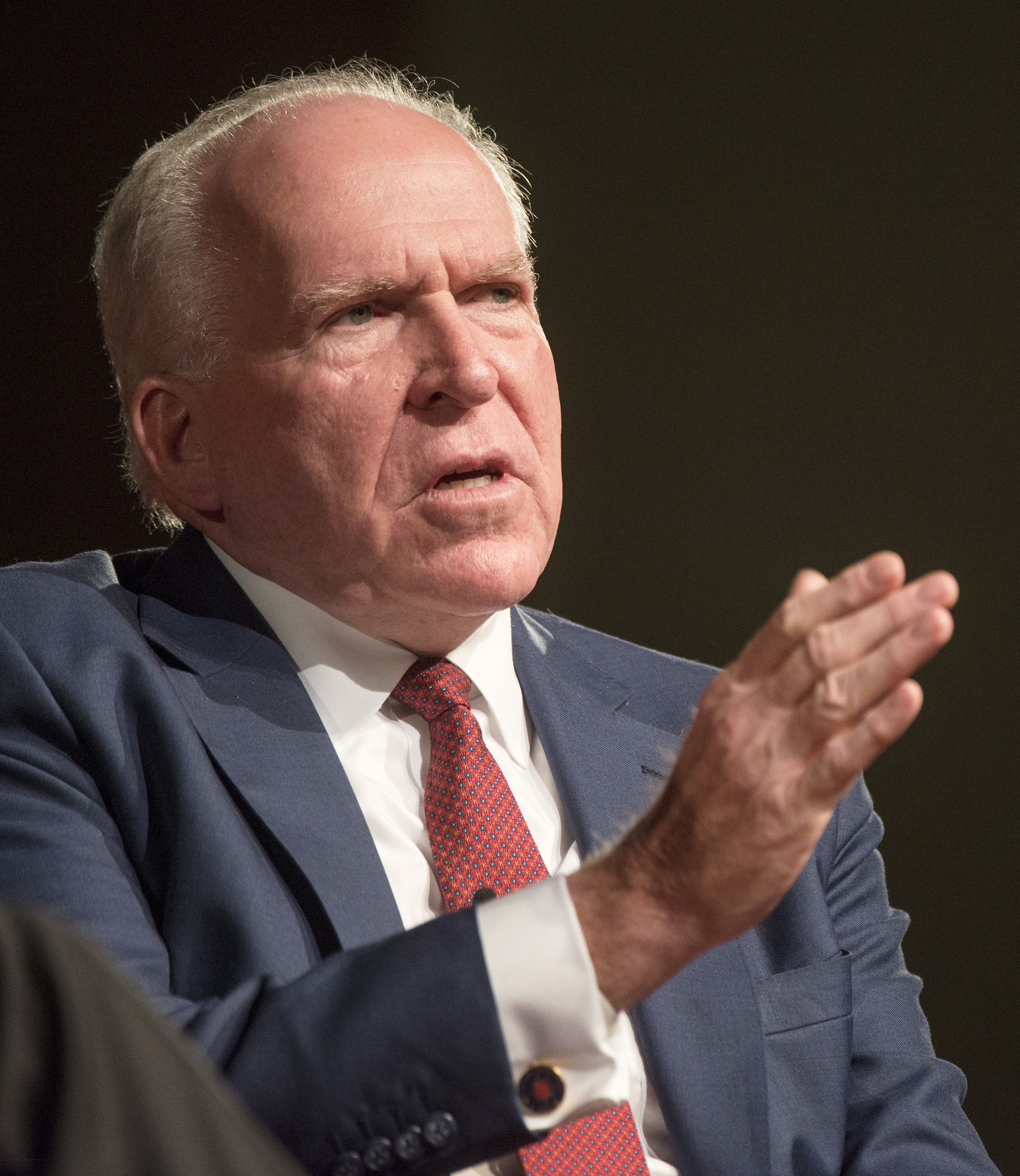
Brennan: Is the jig up? ( LBJ Library photo/ Jay Godwin)
As we Veteran Intelligence Professionals for Sanity have warned numerous times over the past two plus years, there is no reliable forensic evidence to support the story that Russia hacked into the DNC. Moreover, in a piece I wrote in May, “Orwellian Cloud Hovers Over Russia-gate,” I again noted that accumulating forensic evidence from metadata clearly points to an inside DNC job — a leak, not a hack, by Russia or anyone else.
So Brennan and his partners, FBI Director James Comey and National Intelligence Director James Clapper were making stuff up and feeding thin but explosive gruel to the hungry stenographers that pass today for Russiagate obsessed journalists.
Is the Jig Up?
With Justice Department investigators’ noses to the ground, it should be just a matter of time before they identify Brennan conclusively as fabricator-in-chief of the Russiagate story. Evidence, real evidence in this case, abounds, since the Brennan-Comey-Clapper gang of three were sure Hillary Clinton would become president. Consequently, they did not perform due diligence to hide their tracks.
Worse still, intelligence analysts tend to hang onto instructions and terms of reference handed down to them by people like Brennan and his top lieutenants. It will not be difficult for CIA analysts to come up with documents to support the excuse: “Brennan made me do it.”
The Times article today betrays some sympathy and worry over what may be in store for Brennan, one of its favorite sons and (anonymous) sources, as well as for those he suborned into making up stuff about the Russians.
The DOJ inquiry, says the Times, “has provoked anxiety in the ranks of the C.I.A., according to former officials. Senior agency officials have questioned why the C.I.A.’s analytical work should be subjected to a federal prosecutor’s scrutiny.” Attorney General William Barr is overseeing the review but has assigned the U.S. attorney in Connecticut, John Durham, to conduct it.
No Holds Barred
Barr is approaching this challenge with a resoluteness and a calm candor rarely seen in Washington — particularly when it comes to challenging those who run the intelligence agencies.
The big question, once again, is whether President Donald Trump will follow his customary practice of reining in subordinates at the last minute, lest they cross the vindictive and still powerful members of the Deep State.
Happily, at least for those interested in the truth, some of the authors of the rump, misnomered “Intelligence Community Assessment” commissioned by Obama, orchestrated by Brennan-Clapper-Comey, and published on January 6, 2017 will now be interviewed. The ICA is the document still widely cited as showing that the “entire intelligence community agreed” on the Russia-gate story, but this is far from the case. As Clapper has admitted, that “assessment” was drafted by “handpicked analysts” from just three of the 17 intelligence agencies — CIA, FBI, and NSA.
U.S. Attorney Durham would do well to also check with analysts in agencies — like the Defense Intelligence Agency and State Department Intelligence, as to why they believe they were excluded. The ICA on Russian interference is as inferior an example of intelligence analysis as I have ever seen. Since virtually all of the hoi aristoi and the media swear by it, I did an assessment of the Assessment on its second anniversary. I wrote:
“Under a media drumbeat of anti-Russian hysteria, credulous Americans were led to believe that Donald Trump owed his election victory to the president of Russia, whose “influence campaign” according to the Times quoting the intelligence report,helped “President-elect Trump’s election chances when possible by discrediting Secretary Clinton.”
Hard evidence supporting the media and political rhetoric has been as elusive as proof of weapons of mass destruction in Iraq in 2002-2003. This time, though, an alarming increase in the possibility of war with nuclear-armed Russia has ensued — whether by design, hubris, or rank stupidity. The possible consequences for the world are even more dire than 16 years of war and destruction in the Middle East. …
The Defense Intelligence Agency should have been included, particularly since it has considerable expertise on the G.R.U., the Russian military intelligence agency, which has been blamed for Russian hacking of the DNC emails. But DIA, too, has an independent streak and, in fact, is capable of reaching judgments Clapper would reject as anathema. Just one year before Clapper decided to do the rump “Intelligence Community Assessment,” DIA had formally blessed the following heterodox idea in its “December 2015 National Security Strategy”:
“The Kremlin is convinced the United States is laying the groundwork for regime change in Russia, a conviction further reinforced by the events in Ukraine. Moscow views the United States as the critical driver behind the crisis in Ukraine and believes that the overthrow of former Ukrainian President Yanukovych is the latest move in a long-established pattern of U.S.-orchestrated regime change efforts.”
Any further questions as to why the Defense Intelligence Agency was kept away from the ICA drafting table?
Ray McGovern works with Tell the Word, a publishing arm of the ecumenical Church of the Saviour in inner-city Washington. During his 27 years as a CIA analyst, he was Chief of the Soviet Foreign Policy Branch, and preparer/briefer of the President’s Daily Brief. He is co-founder of Veteran Intelligence Professionals for Sanity (VIPS).
MSM Mourns Death Of CIA-Backed Syrian Al-Qaeda/ISIS Ally

By Caitlin Johnstone | June 8, 2019
On Wednesday the alternative media outlet Southfront published an article titled “New Video Throws Light On Jaysh Al-Izza High-Tolerance To Al-Qaeda Ideology” about newly discovered footage showing the leader of a “rebel” faction in Syria cozying up with a militant who was wearing a badge of the official flag of ISIS.
“The video shows Jaysh al-Izza General Commander Major Jamil al-Saleh congratulating a group of his fighters on the occasion of Eid al-Fitr in a underground bunker,” Southfront reports. “One of the fighters greeted by Saleh was wearing a batch of the Islamic Black Standard with the Seal of Muhammad. This is a well-known symbol of al-Qaeda and the official flag of ISIS.”
Today, mass media outlets are mourning the death of a well-known Jaysh al-Izza fighter named Abdel-Basset al-Sarout with grief-stricken beatifications not seen since the death of war criminal John McCain. An Associated Press report which has been published by major news outlets like The New York Times, The Guardian, PBS and Bloomberg commemorates Sarout as a “Syrian soccer goalkeeper” who “won international titles representing his country”, as “the singer of the revolution”, and as “an icon among Syria’s opposition”.
Remember Major Jamil al-Saleh from two paragraphs ago? AP features his glowing eulogy in its write-up on Sarout’s death:
“He was both a popular figure, guiding the rebellion, and a military commander,” said Maj. Jamil al-Saleh, leader of Jaish al-Izza rebel group, in which Sarout was a commander. “His martyrdom will give us a push to continue down the path he chose and to which he offered his soul and blood as sacrifice.”
Other mainstream outlets like BBC, The Daily Beast and Al Jazeera have contributed their own fawning hagiographies of the late Jaysh al-Izza commander.
“Formed in 2013, Jaysh al-Izza was one of the first Free Syrian Army (FSA) groups in northern Syria to benefit from U.S. support through the CIA’s ‘Timber Sycamore’ train and equip program, which had been approved by then U.S. President Barack Obama,” Southfront reports in the aforementioned article. “The group received loads of weapons from the U.S. including Grad rockets, as well as Fagot and TOW anti-tank guided missiles (ATGMs).”
“Jaysh al-Izza received this support under the pretension of being a ‘moderate group’ led by a known Syrian Arab Army (SAA) defector, al-Saleh,” Southfront adds. “However, the group’s acts were not in line with these claims. Since its formation, Jaysh al-Izza has been deeply linked to al-Qaeda’s branch in Syria, the al-Nusra Front. The group became one of the main allies of al-Nusra when its changed its name to Hay’at Tahrir al-Sham (HTS) in 2017.”
“Western thought leaders are lionizing Abdel Baset al-Sarout who was killed fighting the Syrian army,” tweeted journalist Dan Cohen of the mass media response to Sarout’s death. “They conveniently omit that he fought in a militia allied with al-Qaeda and pledged allegiance to ISIS.”
Cohen linked to an excerpt from his mini-documentary The Syria Deception featuring footage of Sarout holding an ISIS flag, leading chants calling for the extermination of the Alawite minority in Syria, and announcing his allegiance to ISIS.
Other publicly available video footage includes a speech by Sarout urging cooperation between his own faction, ISIS and Jabhat al-Nusra (Al-Qaeda’s Syrian franchise), saying “we know that these two groups are not politicized and have the same goals as us, and are working for God.”
“God willing we will work with them shoulder-to-shoulder when we leave here,” Sarout has been translated as saying in the speech. “And we are not Christians or Shiaa to be scared of suicide belts and car bombs. We consider these things as strengths of ours, and God willing they will be just that. This message is to the Islamic State and our brothers in Jabhat al-Nusra, that when we come out of here we will all be one hand to fight Christians and not to have internal fights among ourselves. We want to take back all the lands that have been filthied by the regime, that were entered and taken over by Shiaas and apostates.”
This bloodthirsty terrorist warmongering was taken by the aforementioned AP hagiography and twisted into the single sentence, “He repeatedly denounced rebel infighting and called on Syrians to unite against government forces.”
The Atlantic’s Hassan Hassan framed Sarout’s unconscionable agendas as mere “flaws” which actually add to his inspiring and heroic story, tweeting, “Some individuals celebrated as heroes make you doubt all stories of heroes in history books. Others, like Abdulbasit Sarout, not inspire of but despite his flaws, make those stories highly plausible. He’s a true legend & his story is well documented. May his soul rest in peace.”
Yeah, come on, everybody’s got flaws. Some people suck at parallel parking, some people team up with ISIS and Al-Qaeda on genocidal extermination campaigns. We’ve all got our quirky little foibles.
We can expect more and more of these mass media distortions as Syria and its allies draw closer to recapturing Syrian land from the extremist forces which nearly succeeded in toppling Damascus just a few short years ago.
As these distortions pour in, keep this in mind: all of the violence that is still happening in Syria is the fault of the US and its allies, who helped extremist jihadist factions like Jaysh al-Izza overrun the nation to advance the preexisting goal of effecting regime change. The blame for all the death, suffering and chaos which ensues from a sovereign nation fighting to reclaim its land from these bloodthirsty factions rests solely on the government bodies which inflicted their dominance over the region in the first place.
You will see continuing melodramatic garment-rending from the US State Department and its mass media stenographers about “war crimes” and “human rights violations” as though the responsibility for this violence rests somewhere other than on the US-centralized power alliance, but they will be lying. What these warmongering propagandists are doing is exactly the same as paying a bunch of violent thugs to break into a home and murder its owner, then standing by and sounding the alarm about the way the homeowner chooses to fight off their assailants.
After it was discovered that the US and its allies armed actual, literal terrorist factions in Syria with the goal of effecting regime change, the only sane response would have been for the public to loudly and aggressively demand that all governments involved to take immediate action to completely rectify all damage done by this unforgivable war crime at any cost, and for there to be war crimes tribunals for every decision maker who was a part of it. Instead, because of propaganda circulated by the same mass media narrative management firms who are sanctifying the memory of Abdel-Basset al-Sarout today, the public remains asleep to the depravity of its rulers. This dynamic must change if we are to survive and thrive as a species.
Russia set to air TV series that reveals US role in Chernobyl nuclear disaster
Press TV – June 8, 2019
Russia is set to air a TV series based on the Chernobyl nuclear disaster that implicates the United States as playing a role in the worst nuclear accident in history.
Currently in post-production, the series by the Russian company NTV tells the story of the 1986 explosion that ripped through reactor Number 4 at the Chernobyl Nuclear Power Plant in the then Ukrainian Soviet Socialist Republic.
The explosion led to a huge radioactive leak, which permanently affected areas in places across three quarters of Europe. Thirty workers and firemen were killed in the immediate aftermath of the explosion and rescue operations. Most of them died of severe radiation-related illnesses.
The plot revolves around a CIA agent dispatched to Pripyat — the town inhabited by Chernobyl workers — to gather intelligence on the nuclear power plant.
The series will follow KGB officers in their attempts to hunt the espionage operation.
Director Aleksey Muradov said that his version, filmed in Belarus, will show “what really happened back then.”
“There is a theory that the Americans had infiltrated the Chernobyl nuclear power plant,” he said. “Many historians do not deny that on the day of the explosion an agent of the enemy’s intelligence services was present at the station.
This is while a five-part “Chernobyl” series produced by American premium cable and satellite television network HBO has recently triggered worldwide debate as some experts have challenged its credibility.
Russia’s most popular newspaper, Komsomolskaya Pravda (KP), has dismissed the show as “a caricature and not the truth.”
“If Anglo-Saxons film something about Russians, it definitely will not correspond to the truth,” said Russian journalist Anatoly Vasserman.
Russian newspaper The Moscow Times, also wrote this week that the HBO production was biased against the Soviet Union and provided a “caricature”’ of the nation.
People Who Support Internet Censorship Are Infantile Narcissists

By Caitlin Johnstone | June 7, 2019
As of this writing, journalist Ford Fischer is still completely demonetized on YouTube as the result of a new set of rules that were put in place because of some doofy Twitter drama between some unfunny asshole named Steven Crowder and some infantile narcissist who thinks the world revolves around his opinions named Carlos Maza. It remains an unknown if Fischer will ever be restored to an important source of income around which he has built his livelihood.
Fischer often covers white supremacist rallies and counter-protests, and his channel was demonetized within minutes of YouTube’s new rules against hate speech going into effect because some of his content, as you’d expect, includes white supremacists saying and doing white supremacist things. Maza, a Vox reporter who launched a viral Twitter campaign to have Crowder removed from YouTube for making homophobic and bigoted comments about him on his channel, expressed concern over Fischer’s financial censorship.
“What’s happening to Ford is fucking awful,” Maza tweeted yesterday. “He’s a good journalist doing important work. I don’t understand how YouTube is still so bad at this. How can they not differentiate between white supremacist content and good faith reporting on white supremacy?”
I say that Maza is an infantile narcissist who thinks the world revolves around his opinions because it genuinely seems to have surprised him that good people would get harmed in the crossfire of his censorship campaign.
I mean, what did he think was going to happen? Did he think some soulless, multibillion-dollar Silicon Valley corporation was going to display company-wide wisdom and woke insightfulness while implementing his agenda to censor obnoxious voices? Did he imagine that YouTube executives were going to sit down with him over a cup of coffee and go down a list with him to get his personal opinion of who should and should not be censored?
Think about it. How narcissistic do you have to be to assume that a vast corporation is going to use your exact personal perceptual filters while determining who should and should not be censored for oafish behavior? How incapable of understanding the existence of other points of view must you be to believe it’s reasonable to expect that a giant, sweeping censorship campaign will exercise surgical precision which aligns perfectly with your own exact personal values system? How arrogant and self-centered must you be to demand pro-censorship reforms throughout an enormous Google-owned platform, then whine that they’re not implementing your censorship desires correctly?
This is the same staggering degree of cloistered, dim-eyed narcissism that leads people to support Julian Assange’s persecution on the grounds that he’s “not a journalist”. These egocentric dolts sincerely seem to believe that the US government is going to prosecute Assange for unauthorized publications about US war crimes, then when it comes time to imprison the next Assange the US Attorney General is going to show up on their doorstep to ask them for their opinion as to whether the next target is or is not a real journalist. Obviously the power-serving agenda that you are helping to manufacture consent for is not going to be guided by your personal set of opinions, you fucking moron.
The fact that other people aren’t going to see and interpret information the same way as you do is something Carlos Maza and the thousands of people who’ve supported his pro-censorship campaign should have learned as small children. Understanding that the world doesn’t revolve around you and your wants and desires is a basic stage in childhood development. People who believe Silicon Valley tech giants can implement censorship in a way that is wise and beneficent are still basically toddlers in this respect. One wonders if they still interrupt their mother’s important conversations with demands for attention and apple juice.
Ford Fischer was not the first good guy to get caught in the crossfire of internet censorship, and he will not be the last. In addition to the way unexpected interpretations of what constitutes hate speech can lead to important voices losing their platforms or being unable to make a living doing what they do, the new rules appear to contain a troubling new escalation that could see skeptics of legitimate military false flags completely censored.
“Finally, we will remove content denying that well-documented violent events, like the Holocaust or the shooting at Sandy Hook Elementary, took place,” reads a single sentence in the official YouTube blog about its new rules.
The sentence appears almost as an aside, without any elaboration or further information added, and at first glance it reads innocuously enough. No Holocaust deniers or Sandy Hook false flag videos? Okay, got it. I personally am not a denier of either of those events, so this couldn’t possibly affect me personally, right?
Wrong. YouTube does not say that it will just be censoring Holocaust deniers and Sandy Hook shooting deniers, it says it will “remove content denying that well-documented violent events, like the Holocaust or the shooting at Sandy Hook Elementary, took place.”
So what does this mean? Where exactly is the line drawn? If you are not an infantilized narcissist, you will not assume that YouTube intends to implement this guideline in the same way you would. It is very possible that it will include skeptics of violent events which the entire political/media class agrees were perpetrated by enemies of the US-centralized power alliance, which just so happen to manufacture support for increased aggressions against those nations.
Would the new rules end up forbidding, for example, this excellent YouTube video animation explaining how a leaked OPCW report disputes the official narrative about an alleged chemical attack in Douma, Syria last year? If you are not making the assumption that YouTube will be implementing its censorship using your own personal values system, there is no reason to assume it wouldn’t. After all, the official narrative that dozens of civilians were killed by the Assad government dropping chlorine cylinders through rooftops is the mainstream consensus narrative maintained by all respected US officials and “authoritative” news outlets.
This is a perfect example of a very real possibility that could be a disastrous consequence of increased internet censorship. It is a known fact that the US government has an extensive history of using false flags to manufacture consent for war, from the USS Liberty to the Gulf of Tonkin to the false Nayirah testimony about removing babies from incubators to the WMD narrative in Iraq. These new rules could easily serve as a narrative control device preventing critical discussions about suspicious acts of violence which have already happened, and which happen in the future.
Consider the fact that Google, which owns YouTube, has had ties to the CIA and the NSA from its very inception, is known to have a cozy relationship with the NSA, and has served US intelligence community narrative control agendas by tweaking its algorithms to deliberately hide dissenting alternative media outlets. Consider this, then ask yourself this question: do you trust this company to make wise and beneficent distinctions when it comes to censoring public conversations?
In a corporatist system of government which draws no meaningful distinction between corporate power and state power, corporate censorship is state censorship. Only someone who believes that giant Silicon Valley corporations would implement censorship according to their own personal values system could ever support giving these oligarchic establishments that kind of power. And if you believe that, it’s because you never really grew up.
The New York Times Tries to Get Itself Out of the Duckgate Hole Using a Spade
By Rob Slane | The Blog Mire | June 5, 2019
A number of people, including myself, wrote to the New York Times journalist, Julian Barnes, to point out that the piece he and his colleague, Adam Goldman, published on 16th April 2019 about the CIA Director, Gina Haspel, contained a part which unwittingly showed that she had misled President Trump into expelling 60 Russian diplomats in March 2018. Here were the paragraphs of interest:
“During the discussion, Ms. Haspel, then deputy C.I.A. director, turned toward Mr. Trump. She outlined possible responses in a quiet but firm voice, then leaned forward and told the president that the “strong option” was to expel 60 diplomats.
To persuade Mr. Trump, according to people briefed on the conversation, officials including Ms. Haspel also tried to show him that Mr. Skripal and his daughter were not the only victims of Russia’s attack.
Ms. Haspel showed pictures the British government had supplied her of young children hospitalized after being sickened by the Novichok nerve agent that poisoned the Skripals. She then showed a photograph of ducks that British officials said were inadvertently killed by the sloppy work of the Russian operatives.
Ms. Haspel was not the first to use emotional images to appeal to the president, but pairing it with her hard-nosed realism proved effective: Mr. Trump fixated on the pictures of the sickened children and the dead ducks. At the end of the briefing, he embraced the strong option.
The outcome was an example, officials said, of how Ms. Haspel is one of the few people who can get Mr. Trump to shift position based on new information.”
I pointed out to the authors in an (unanswered) email that this was an extraordinary claim, because no children became sick due to poisoning by a toxic chemical, and nor did any ducks die. And so unless they were prepared to correct or retract their piece, there could only be two possibilities:
- Ms Haspel unwittingly showed false images to no less a person than the President of the United States, supplied to her by the British Government who knew them to be false, which persuaded him to embrace the “strong option”.
- Ms Haspel knowingly showed false images to no less a person than the President of the United States, which persuaded him to embrace the “strong option”.
It seems that the two journalists have not ignored mine and the many other emails they received about this issue, and they have today corrected their story. The paragraphs of interest now read as follows:
“During the discussion, Ms. Haspel, then deputy C.I.A. director, turned toward Mr. Trump. She outlined possible responses in a quiet but firm voice, then leaned forward and told the president that the “strong option” was to expel 60 diplomats.
To persuade Mr. Trump, according to people briefed on the conversation, officials including Ms. Haspel tried to demonstrate the dangers of using a nerve agent like Novichok in a populated area. Ms. Haspel showed pictures from other nerve agent attacks that showed their effects on people.
The British government had told Trump administration officials about early intelligence reports that said children were sickened and ducks were inadvertently killed by the sloppy work of the Russian operatives.
The information was based on early reporting, and Trump administration officials had requested more details about the children and ducks, a person familiar with the intelligence said, though Ms. Haspel did not present that information to the president. After this article was published, local health officials in Britain said that no children were harmed.
Ms. Haspel was not the first to use emotional appeals to the president. She and Mr. Pompeo showed Mr. Trump images of children sickened by chemical weapons attacks in Syria, in an earlier presentation. But Ms. Haspel’s strategy in the March briefing was to pair emotional appeals with her hard-nosed realism and it proved effective. At the end of the briefing, Mr. Trump embraced the strong option. [my emphasis]”
Below is Mr Barnes’s explanation on Twitter for the error and the correction:
“I made a significant error in my April 16 profile of Gina Haspel. It took a while to figure out where I went wrong. Initially, I reported that in March 2018, Gina Haspel, then the future CIA director, briefed President Trump about the Skirpal nerve agent attack, showing pictures of sickened children and dead ducks. That was wrong. There are—so far as we know—no pictures of dead ducks or sickened kids. Haspel did show pictures to Trump, but they were about the effects of nerve agents in general, they were not specific to the attack in the UK.
British officials did brief the Trump administration about early reports of dead ducks & sick children. Officials sought more info, believing such intel would be persuasive to Trump, who was skeptical of the proposed expulsion of 60 Russians in response to the attack. But Haspel did not brief the president on that intelligence.
Local UK health officials deny that any animals or children were sickened, as British officials pointed out soon after our story published. (In response to good reporting by @haynesdeborah, @guardian and others.) (link: https://www.theguardian.com/uk-news/2019/apr/18/no-children-ducks-harmed-novichok-attack-wiltshire-health-officials)
The intelligence about the ducks and children were based on an early intelligence report, according to people familiar with the matter. The intelligence was presented to the US in an effort to share all that was known, not to deceive the Trump administration. This correction was delayed because conducting the research to figure out what I got wrong, how I got it wrong and what was the correct information took time.
I regret the error and offer my apology. I strive to get information right the first time. That is what subscribers pay for. But when I get something wrong, I fix it.”
Here is my response on Twitter to Mr Barnes:
Dear Julian,
Thanks for taking the time to correct your report. However, it unfortunately raises just as many questions as the initial report.
Firstly, you say British officials briefed the Trump administration about early reports of dead ducks & sick children.
Really? Which early reports were these? There were none. The parents of the children who had tests to see if they had been contaminated were only contacted 2 weeks after the incident, and none of them was found to be ill. This is the first report on it, and it confirms the children were given the all clear. And there were never any dead ducks in Salisbury nor any reports of them.
Secondly, you say that “Officials sought more info, believing such intel would be persuasive to Trump, who was skeptical of the proposed expulsion of 60 Russians in response to the attack.” But the fact is that any further (truthful) info could not have persuaded Mr Trump, for the simple reason that no other people were harmed in Salisbury than the three people who were initially harmed. How, then, was he persuaded?
Thirdly, you presumably give the answer to the second point, when you say “Haspel did show pictures to Trump, but they were about the effects of nerve agents in general, they were not specific to the attack in the UK.” So in other words, Ms Haspel couldn’t show any pictures from Salisbury to persuade the sceptical Mr Trump, because there weren’t any to show. So she showed him pictures from other nerve agent attacks, which were presumably sufficiently bad to turn him from his scepticism, to expelling 60 diplomats. Even though nothing like that happened in Salisbury.
Thank you for clarifying that Ms Haspel did indeed wilfully mislead the President.”
Despite NYT’s correction, the question it poses is this: Which is worse:
- The deputy director of the CIA showing a sceptical President some fake pictures of dead ducks and sick children to persuade him to take the strongest action?
- Or the deputy director of the CIA, knowing full well that there weren’t any pictures of the effects of nerve agent on the population of Salisbury because only three people were ever affected, showing some pictures of actual nerve agent victims who were never anywhere near Salisbury to persuade him to take the strongest action?
The answer is they’re both as bad. In both scenarios, an utterly false picture of what happened in Salisbury was given to the sceptical President to twist his arm into taking action he didn’t want to take.
As they say, when in a hole, better stop digging.
Regime Change in Iran: Been There, Done That

By Philip Giraldi | American Free Press | May 27, 2019
The failed coup attempt in Caracas in early May brings to mind the techniques used by the Central Intelligence Agency (CIA) and British intelligence in Iran in 1953 to overthrow the Mohammad Mossadeq government. It is quite astonishing how that regime-change long-ago operation parallels what is currently taking place in Venezuela and also with regards to Iran yet again.
Mossadeq was the democratically elected prime minister of Iran beginning in 1951, serving in a government in which the Shah with limited authority was the head of state presiding over a parliamentary system. Iran was nominally independent at the time, but it was heavily influenced by the neighboring Soviet Union, which retained control over several Iranian provinces after the Second World War ended, and Great Britain, which exploited the country’s oil resources through the mechanism of the Anglo-Iranian Oil Company (AIOC), which was owned by the British government. When Mossadeq, frustrated by lack of progress in negotiations with the British over sharing of oil revenues, eventually declared that he would nationalize the AIOC, London and Washington conspired to remove him.
The new National Iranian Oil Company was immediately attacked by the British, who used the Royal Navy to block export of oil from Iran’s Abadan refinery. Ships carrying Iranian oil were stopped and boarded with their shipments confiscated as “stolen property” in light of the British government’s former ownership claim on the AIOC.
By mid-1952, Britain’s blockade of Iranian oil exports had badly hurt the Iranian economy, which eventually led to government bankruptcy. Meanwhile, the American CIA, which was initially ambivalent about what the proper role in the Anglo-Iranian conflict might be, joined British agents in supporting groups inside Iran that were hostile to Mossadeq. In the Majlis parliamentary election in the spring of 1952, Mossadeq faced serious opposition funded by the Anglo-Americans, and the election eventually was suspended. By early 1953, pro-communist and pro-Shah mobs supported and coordinated by the U.S. and Britain roamed the streets, sometimes fighting each other. Fearing a communist takeover and also under pressure from London, which was threatening to withdraw from the Korean War as a quid pro quo, President Dwight D. Eisenhower agreed to carry out a joint coup d’état.
Losing popular support due to a sinking economy, as early as August 1952 a struggling Mossadeq began ruling by emergency powers and started to jail opponents, which only aggravated the crisis. A rigged referendum to dissolve parliament and grant Mossadeq authority to govern by decree passed with 99.9% approval but led to accusations that the prime minister was seeking “total and dictatorial power.” The New York Times reported, “A plebiscite more fantastic and farcical than any ever held under Hitler or Stalin is now being staged in Iran by Premier Mossadeq in an effort to make himself unchallenged dictator of the country.” The move by Mossadeq also led to the first coup attempt, which was organized by the CIA.
On Aug. 15, 1953, Col. Nemathollah Nassiri, the commander of the Shah’s Imperial Guard, delivered to Mossadeq a decree from the Shah dismissing him. Mossadeq, who had been warned of the plot, had Nassiri arrested, and the Shah and his family fled into exile in Italy. The first coup thus ended with a whimper, but it was lessons learned for the second, better organized successful attempt which followed a few days later, Operation Ajax, coordinated by Kermit Roosevelt of the CIA.
Exploiting pro-Shah sentiment in the military, the CIA and the British turned to their stables of recruited army officers while also exploiting agents infiltrated into the communist party Tudeh, which rose to the occasion by launching mass demonstrations, to include looting and arson, which quickly alienated the public and also provided a pretext for Western support of the coup as it could be promoted as “anti-communist.” Efforts were also made to turn influential clerics against Mossadeq. The Iranian people blamed the government for all their woes and rioting soon led to the calling out of the army to restore order. The army did so and then had Mossadeq arrested. He was condemned to death, but his sentence was later commuted to three years in solitary confinement followed by house arrest. He died in 1967.
End of story, but not quite. All the elements currently being used against Venezuela and Iran were there back in 1953 to bring down Mossadeq and also appear in a detailed 2018 Pentagon plan describing how to bring about a coup in Caracas. Wrecking the countries’ economies through sanctions and exclusion from the global banking network creates a crisis where one need not have existed. Meanwhile, a sustained campaign of vilification by Western political leaders and the media establishes the narrative that the benevolent intention is to block extremism and restore democracy while also eliminating a threat to the United States. And, as a last resort, the threat or actual use of force to stop the export of commodities to further wreck the economy becomes a clearly stated policy option, currently also employing secondary sanctions for anyone who dares to trade with the designated victim. Recently, America’s unilaterally imposed global ban on the export and sale of Iranian oil began. Venezuela’s oil sales are also being blocked and even its electricity grid is being attacked in an attempt to starve the Venezuelan people into rebelling against their government.
But you also have to have spies, secret agents, to get the ball rolling, just as was true in 1953. One assumes that the CIA has been active in recruiting the agents of influence inside Venezuelan political opposition as well as military circles who will bring out increasingly larger mobs as the situation continues to deteriorate. How successful they have been is difficult to determine, but Venezuelan opposition leader Juan Guaido failed the first time around, reportedly because the Venezuelan government was aware of what was happening and the contacts that the CIA was relying on to bring out the army were in fact double agents.
The suffering Iranian and Venezuelan people have yet to rise up in revolt. No matter. It took more than one try to bring down Mossadeq, and National Security Advisor John Bolton has recently warned Iran that its government won’t have any more anniversaries to celebrate if it continues with its “threats.” The Trump administration is also reported to be preparing military options for dealing with Venezuela.
Bolton has even warned the Russians, who are assisting Venezuela’s government: “This is our hemisphere. It’s not where the Russians ought to be interfering. This is a mistake on their part.” He is seemingly unaware of the irony, that the Russians might make the same claim about Eurasia and the Iranians regarding the Persian Gulf, where Bolton and his neocon friends in Washington have been the source of nearly continuous conflict.
Philip Giraldi is a former CIA counter-terrorism specialist and military intelligence officer and a columnist and television commentator. He is also the executive director of the Council for the National Interest.
How Did Russiagate Begin?
Why Barr’s investigation is important and should be encouraged.
By Stephen F. Cohen | The Nation | May 30, 2019
It cannot be emphasized too often: Russiagate—allegations that the American president has been compromised by the Kremlin and which may even have helped to put him in the White House—is the worst and (considering the lack of actual evidence) most fraudulent political scandal in American history. We have yet to calculate the damage Russsiagate has inflicted on America’s democratic institutions, including the presidency and the electoral process, and on domestic and foreign perceptions of American democracy, or on US-Russian relations at a critical moment when both sides, having “modernized” their nuclear weapons, are embarking on a new, more dangerous, and largely unreported arms race.
Rational (if politically innocent) observers may have thought that when the Mueller Report found no “collusion” or other conspiracy between Trump and Vladimir Putin’s Kremlin, only possible “obstruction” by Trump—nothing Mueller said in his May 29 press statement altered that conclusion—Russiagate would fade away. If so, they were badly mistaken. Evidently infuriated that Mueller did not liberate the White House from Trump, Russiagate promoters—liberal Democrats and progressives foremost among them—have only redoubled their unverified collusion allegations, even in once-respectable media outlets. Whether out of political ambition or impassioned faith, the damage wrought by these Russiagaters continues to mount, with no end in sight.
One way to end Russiagate might be to discover how it actually began. Considering what we have learned, or been told, since the allegations became public nearly three years ago, in mid-2016, there seem to be at least three hypothetical possibilities:
1. One is the orthodox Russiagate explanation: Early on, sharp-eyed top officials of President Obama’s intelligence agencies, particularly the CIA and FBI, detected truly suspicious “contacts” between Trump’s presidential campaign and Russians “linked to the Kremlin” (whatever that may mean, considering that the presidential administration employs hundreds of people), and this discovery legitimately led to the full-scale “counter-intelligence investigation” initiated in July 2016. Indeed, Mueller documented various foreigners who contacted, or who sought to contact, the Trump campaign. The problem here is that Mueller does not tell us, and we do not know, if the number of them was unusual.
Many foreigners seek “contacts” with US presidential campaigns and have done so for decades. In this case, we do not know, for the sake of comparison, how many such foreigners had or sought contacts with the rival Clinton campaign, directly or through the Clinton Foundation, in 2016. (Certainly, there were quite a few contacts with anti-Trump Ukrainians, for example.) If the number was roughly comparable, why didn’t US intelligence initiate a counter-intelligence investigation of the Clinton campaign?
If readers think the answer is because the foreigners around the Trump campaign included Russians, consider this: In 1988, when Senator Gary Hart was the leading candidate for the Democratic presidential nomination, he went to Russia—still Communist Soviet Russia—to make contacts in preparation for his anticipated presidency, including meeting with Soviet leader Mikhail Gorbachev. US media coverage of Hart’s visit was generally favorable. (I accompanied Senator Hart and do not recall much, if any, adverse US media reaction.)
2. The second explanation—currently, and oddly, favored by non-comprehending pro-Trump commentators at Fox News and elsewhere—is that “Putin’s Kremlin” pumped anti-Trump “disinformation” into the American media, primarily through what became known as the Steele Dossier. As I pointed out nearly a year and a half ago, this makes no sense factually or logically. Nothing in the Dossier suggests that any of its contents necessarily came from high-level Kremlin sources, as Steele claimed. Moreover, if Kremlin leader Putin so favored Trump, as A Russiagate premise insists, is it really plausible that underlings in the Kremlin would have risked Putin’s ire by furnishing Steele with anti-Trump “information”? On the other hand, there is plenty of evidence that “researchers” in the US (some, like Christopher Steele, paid by the Clinton campaign) were supplying him with the fruits of their research.
3. The third possible explanation—one I have termed “Intelgate,” and that I explore in my recent book War With Russia?: From Putin & Ukraine to Trump & Russiagate—is that US intelligence agencies undertook an operation to damage, if not destroy, first the candidacy and then the presidency of Donald Trump. More evidence of “Intelgate” has since appeared. For example, the intelligence community has said it began its investigation in April 2016 due to a few innocuous remarks by a young, lowly Trump foreign policy adviser, George Papadopoulos. The relatively obscure Papadopoulos suddenly found himself befriended by apparently influential people he had not previously known, among them Stefan Halper, Joseph Mifsud, Alexander Downer, and a woman calling herself Azra Turk. What we now know—and what Papadopoulos did not know at the time—is that all of them had ties to US and/or UK and Western European intelligence agencies.
US Attorney General William Barr now proposes to investigate the origins of Russiagate. He has appointed yet another special prosecutor, John Durham, to do so, but the power to decide the range and focus of the investigation will remain with Barr. The important news is Barr’s expressed intention to investigate the role of other US intelligence agencies, not just the FBI, which obviously means the CIA when it was headed by John Brennan and Brennan’s partner at the time, James Clapper, then Director of National intelligence. As I argued in The Nation, Brennan, not Obama’s hapless FBI Director James Comey, was the godfather of Russiagate, a thesis for which more evidence has since appeared. We should hope that Barr intends to exclude nothing, including the two foundational texts of the deceitful Russiagate narrative: the Steele Dossier and, directly related, the contrived but equally ramifying Intelligence Community Assessment of January 2017. (Not coincidentally, they were made public at virtually the same time, inflating Russiagate into an obsessive national scandal.)
Thus far, Barr has been cautious in his public statements. He has acknowledged there was “spying,” or surveillance, on the Trump campaign, which can be legal, but he surely knows that in the case of Papadopoulos (and possibly of General Michael Flynn) what happened was more akin to entrapment, which is never legal. Barr no doubt also recalls, and will likely keep in mind, the astonishing warning Senator Charles Schumer issued to President-elect Trump in January 2017: “Let me tell you, you take on the intelligence community, they have six ways from Sunday at getting back at you.” (Indeed, Barr might ask Schumer what he meant and why he felt the need to be the menacing messenger of intel agencies, wittingly or not.)
But Barr’s thorniest problem may be understanding the woeful role of mainstream media in Russiagate. As Lee Smith, who contributed important investigative reporting, has written: “The press is part of the operation, the indispensable part. None of it would have been possible … had the media not linked arms with spies, cops, and lawyers to relay a story first spun by Clinton operatives.” How does Barr explore this “indispensable” complicity of the media in originating and perpetuating the Russiagate fraud without impermissibly infringing on the freedom of the press?
Ideally, mainstream media—print and broadcast—would now themselves report on how and why they permitted intelligence officials, through leaks and anonymous sources, and as “opinion” commentators, to use their pages and programming to promote Russiagate for so long, and why they so excluded well-informed, nonpartisan alternative opinions. Instead, they have almost unanimously reported and broadcast negatively, even antagonistically, about Barr’s investigation, and indeed about Barr personally. (The Washington Post even found a way to print this: “William Barr looks like a toad …”) Such is the seeming panic of the Russiagate media over Barr’s investigation, which promises to declassify related documents, that The New York Times again trotted out its easily debunked fiction that public disclosures will endanger a purported US informant, a Kremlin mole, at Putin’s side.
Finally, but most crucially, what was the real reason US intelligence agencies launched a discrediting operation against Trump? Was it because, as seems likely, they intensely disliked his campaign talk of “cooperation with Russia,” which seemed to mean the prospect of a new US-Russian détente? Even fervent political and media opponents of Trump should want to know who is making foreign policy in Washington. The next intel target might be their preferred candidate or president, or a foreign policy they favor.
Nor, it seems clear, did the CIA stop. In March 2018, the current director, Gina Haspel, flatly lied to President Trump about an incident in the UK in order to persuade him to escalate measures against Moscow, which he then reluctantly did. Several non-mainstream media outlets have reported the true story. Typically, The New York Times, on April 17 of this year, reported it without correcting Haspel’s falsehood.
We are left, then, with this paradox, formulated in a tweet on May 24 by the British journalist John O’Sullivan: “Spygate is the first American scandal in which the government wants the facts published transparently but the media want to cover them up.”
This commentary is based on Stephen F. Cohen’s most recent weekly discussion with the host of The John Batchelor Show. Now in their sixth year, previous installments are at TheNation.com.
Russiagate is #1 threat to US national security – Stephen Cohen
RT | May 25, 2019
The systemwide US Russophobia that reached its nadir with Russiagate has created a “catastrophe” for both domestic politics and foreign relations that threatens the future of the American system, professor Stephen Cohen tells RT.
War with Russia could easily break out if the US insists on pursuing the policy of “demonization” that birthed Russiagate instead of returning to detente and cooperation, New York University professor emeritus of Russian history Stephen Cohen argues on Chris Hedges’ On Contact. While NATO deliberately antagonized post-Soviet Russia by expanding up to its borders, the US deployed missile defense systems along those borders after scrapping an arms treaty, leaving President Vladimir Putin devoid of “illusions” about the goodwill of the West – but armed with “nuclear missiles that can evade and elude any missile defense system.”
“Now is the time for a serious, new arms control agreement. What do we get? Russiagate instead.”
Cohen believes the conspiracy theory – which remains front-page news in US media despite being thoroughly discredited, both by independent investigators and last month by special counsel Robert Mueller’s report – is the work of the CIA and its former director, John Brennan, who are dead set against any kind of cooperation with Russia. Attorney General William Barr, who is investigating the FBI over how the 2016 counterintelligence probe began, should take a look at Brennan and his agency, Cohen says.
“If our intelligence services are off the reservation to the point that they can first try to destroy a presidential candidate and then a president…we need to know it,” Cohen says. “This is the worst scandal in American history. It’s the worst, at least, since the Civil War.” And the damage wrought by this “catastrophe” hasn’t stopped at the US border.
The idea that Trump is a Russian agent has been devastating to “our own institutions, to the presidency, to our electoral system, to Congress, to the American mainstream media, not to mention the damage it’s done to American-Russian relations, the damage it has done to the way Russians, both elite Russians and young Russians, look at America today,” Cohen declares. And the potential damage it could still cause is enormous.
“Russiagate is one of the greatest new threats to national security. I have five listed in the book. Russia and China aren’t on there. Russiagate is number one.”
Latest attempt to prosecute President Assad at the ICC is further criminalisation of “international justice”

Toby Cadman. Co-founder of Guernica Chambers 37, one of legal entities bringing latest case against President Assad at the ICC. (Photo: The ICC and our politics)
By Vanessa Beeley | 21st Century Wire | May 28, 2019
In March 2019 two law firms filed cases at the ICC against Syria’s President Bashar Al Assad and unnamed members of the Syrian government. Toby Cadman of Guernica Chambers and Rodney Dixon of Temple Garden Chambers were the protagonists in this latest attempt to criminalise the Syrian President and government.
These law firms are basing their case upon the testimony of 28 “refugees” from Syria who claim they were “forced” to flee to Jordan during the war that has been waged against Syria by a collective of interventionist mafia states that form the U.S coalition, determined to achieve regime change in Syria.
Syria is not a signatory to the ICC in the Hague but precedent was set by the ICC when a preliminary investigation was opened into military leaders of Myanmar for alleged crimes against humanity involving deportation of Rohingya people. Refugees fled to Bangladesh which is party to the Rome statute that established the ICC, as is Jordan where more than 1 million Syrian refugees now reside. Guernica Chambers and Rodney Dixon are clearly hoping that the Rohingya precedent will open up the legal avenue for their case.
Both legal firms are claiming the intended deportation of Syrian civillians by the Syrian government as part of their cases.
However, even some members of the legal profession, have already remarked upon possible holes in the case being presented by both legal entities. Kevin John Heller is Associate Professor of Public International Law at Amsterdam University. According to Heller, there is a vital element of the Syrian situation that distinguishes it from the Myanmar situation. Heller argues that in Myanmar, it is evident that the government “intended to drive the Rohingya into Bangladesh” while in Syria it is not evident that the Syrian government intended (in the legal sense) that their civilians end up in other countries. Heller points out that without sufficient evidence, the Syrian government may only be accused of “forcible transfer” but not “deportation”. “Forcible transfer” falls outside the ICC’s jurisdiction because it takes place uniquely on Syrian territory.
“In other words: for the Court to investigate the forcible displacement of Syrian civilians proprio motu, it is deportation or bust.” ~ Kevin John Heller
This is not the first time that Guernica Chambers (GC) have attempted such a legal attack against the Syrian government. In March 2017, the Madrid offices of GC tried to bring a case against eight members of the Syrian security and intelligence services. The case was based upon the testimony of a Syrian national’s sister who had Spanish citizenship. Spain is party to the Rome Statute of the ICC. The woman allegedly identified the body of her brother among the photos that were “smuggled out of Syria” and formed part of the Caesar Report which I will discuss later in this article.
Who is really behind the legal war being waged against Syria?
I asked Peter Ford, former UK Ambassador to Syria and outspoken critic of the UK government’s role in the eight year regime change campaign in Syria, to comment on the timing of this legal initiative. Ford told me:
Nothing could be more likely to bring the ICC into disrepute than this attempted action by actors transparently serving the political agenda of the British and Qatari governments. Having failed in attempted regime change via miltant proxies Syria’s enemies are now embarked on an enterprise to secure the same result by waging economic war which must be justified by constant demonizing of Assad. That is the game being played here.
“if the ICC goes along with it, that will provide more justification for those who accuse the ICC of being a tool of the rich and powerful, and an incentive to Assad to halt any move towards elections in Syria which might see him removed from power. This is just a cheap trick designed to make political capital out of the remaining credibility of the ICC, such as it is.”
Ford pinpointed the drivers behind these legal cases and the UK Government and intelligence services must be considered as primary players. The UK/US-led intervention alliance have seen their terrorist-proxy-military-campaign fail dismally after hitting the brick wall of the axis of resistance -Syria, Hezbollah, Iran and Russia with China offering diplomatic and technological support.
What will follow is perhaps an even more destructive economic warfare campaign that will capitalise upon the post war dissonance in Syria to pressurise the Syrian state and to further foment discontent among civilians now struggling to cope with life in a Syria that has been severely impacted by 8 years of terrorist occupation and destruction of infrastructure.
“I believe that the reason why this attempt is being made to circumvent the fact that the International Criminal Court has no jurisdiction over Syria, is to remove Assad from power and to de-legitimise him as part of the future of Syria. This has been the goal of the jihadists from the very beginning.”
Historian and analyst, Dr Marcus Papadopoulos, further expanded upon the timing of the legal case:
Well, talk of war crimes cases being brought against President Assad, at the International Criminal Court, has been in the air for some years now. Indeed, I remember how such talk was emanating from Western capitals in 2012. However, there is no doubt that the today’s timing of lawyers, acting on behalf of Syrian refugees in Jordan, submitting lawsuits against the Syrian president at the ICC, is not coincidental. Because today, the Syrian people have all but won the war against Western-backed terrorism and so by submitting cases now to the ICC is a way of Western governments subtly informing President Assad that whilst the military war against him has been lost, the legal, media and communications war against him will continue.
Furthermore, I suspect that by initiating ICC proceedings against the Syrian leader – which will only increase in volume and go on indefinitely – may be a way of the Americans and the British maintaining their military presence in Syria, as well as their sanctions on the Arab country, on the pretext that the region has a leader in power who ‘waged war against his own people, destabilising not just his country but the wider region’ hence the presence of American and British forces in Syria is a means to limiting any future ‘carnage’ that the Syrian ‘strongman’ (a favoured word from the West’s lexicon to describe leaders whom it disapproves of) can inflict on both Syria and the region.” (Emphasis added)
International criminal lawyer, Christopher C. Black, pointed out the importance of the NATO and UK government links of the legal firms:
“The answer is revealed in the lawyers who are behind this scheme to try to drag the ICC into the picture. Rodney Dixon and Toby Cadman, and, it seems, from your information, Geoffrey Nice. All of them have links to the British governent and NATO through acting for them in various capacities.”
Links to UK Foreign Office, NATO and the CIA
Guernica Chambers – offices in London, Spain and Washington.

Toby Cadman. (Photo: Guernica 37 website)
Toby Cadman is the Co-founder and Head of Guernica 37 International Justice Chambers in London. According to the International Forum for Democracy and Human Rights (IFDHR), Cadman was hired by the UK Foreign Office in 2012 to “head a team to investigate crimes committed in the Syrian Arab Republic“.
I would challenge Cadman to demonstrate any serious investigation by Guernica into the ongoing crimes committed by the terrorist/extremist groups in Syria, armed and financed by the U.S Coalition. The fact that Cadman is a hired legal hand of one of the central players in the international campaign to reduce Syria to another Libya-style failed state, should immediately raise the alarm.
Doctors Under Fire – cluster of anti-Syria medical, legal and chemical “experts”
Cadman is also on the board of directors of Doctors Under Fire (formerly Medics Under Fire). Alongside him are Hamish De Bretton Gordon, Dr David Nott (Nott Foundation) and Dr Saleyha Ahsan.

Dr David Nott. (Photo: Nott Foundation website)
Nott has run UK Government-endorsed training courses for Syrian doctors in Gaziantep, Turkey – the hub of UK intelligence training for Syrian “opposition”, with a reputation for being the centre of ISIS organ and human trafficking operations. The flight from Istanbul to Gaziantep was known as the Jihad Express. The town itself was reported to be the area where new ISIS recruits from around the world would gather before being transported into Syria. The UK FCO-midwived and financed White Helmet propaganda construct also have their base in Gaziantep, established in 2013 by former MI6-turned-private-security expert, James Le Mesurier.
In 2013, Nott was largely responsible for the rumours that Syrian Arab Army snipers were targeting pregnant women in East Aleppo, which was freshly under control of the armed extremist gangs that included Al Qaeda in Syria, Nusra Front. The photo of a bullet lodged in an alleged foetal brain was published by most mainstream media outlets in the West without any expert second opinion regarding the credibility of such an image. Nott has operated on ISIS fighters during his forays (exclusively) into terrorist held territory of Syria.

Nott also amplified the discredited narrative surrounding Omran Daqneesh during the final moments before liberations of East Aleppo from terrorist rule. This story is now known to be another of the fraudulent campaigns to criminalise the Syrian government. This article by journalist, Steven Sahiounie, goes into depth about the bias and misprepresentation of reality by Nott during his time in the terrorist-held enclaves of Aleppo and Idlib.

Dr Saleyha Ahsan’s contradictory accounts of alleged chemical attack, showcased in BBC Panorama’s Saving Syria’s Children – forensically investigated by researcher, Robert Stuart.
Dr Saleyha Ahsan’s role in the BBC Panorama documentary, Saving Syria’s Children, has been exposed as potentially fraudulent by independent researcher, Robert Stuart. Actor and director Keith Allen is fronting a new crowdfunding campaign for a documentary examining the 2013 BBC Panorama programme Saving Syria’s Children. The project is in collaboration with British film, TV and radio producer, Victor Lewis-Smith. In 2017 Lewis-Smith challenged the BBC Panorama office over the issue. Failing to get satisfactory answers, Victor tore up a contract for a forthcoming comedy pilot with BBC Radio 4.

Hamish de Bretton Gordon. The media establishment go-to expert on chemical weapons.
Hamish de Bretton Gordon has been the go-to expert for the majority of corporate media outlets, particularly with regard to the alleged chemical weapon attacks in Syria that BG invariably blames upon the Syrian government. David Miller, Professor of Political Sociology at the University of Bristol and a member of the Academic-established Working Group on Syria, Propaganda and Media, stated very clearly in a recent interview that HBG:
“is an operative for MI6. He’s not a staff member of MI6 but he works very closely with MI6 in Syria trying to create evidence of chemical and biological weapons’ attacks.”
The full briefing note by the WGSPM can be found at this link: The alleged chemical attack in Douma on 7 April 2018, and other alleged chlorine attacks in Syria since 2014.
Doctors Under Fire appears to be another compromised organisation with a focus on misleading the British public into approving further military intervention in Syria under a familiar “humanitarian” pretext. Its ties to state media and intelligence services should be examined closely before their “expert” opinions be given serious consideration.
Toby Cadman – Ibrahim Olabi – White Helmets

Ibrahim Olabi. Joined Guernica Chambers in November 2018 as a pupil barrister. (Photo: Guernica Chambers website)
The Guernica inks to UK Government intellligence operations in Syria continue. Ibrahim Olabi joined Guernica Chambers in November 2018 as a pupil barrister. According to his bio on the GC website, Ibrahim Olabi “has worked extensively on international legal matters related to the Syrian conflict, including international humanitarian law, international criminal law and international human rights law” for the last five years.
Olabi is UK educated, having completed his LLB and LLM (Security and International Law) at the University of Manchester. Olabi is the director of the Syrian Legal Development Programme (SLDP). According to the GC website:
SLDP has provided legal expertise to Syrian NGOs, including training that Ibrahim delivered to more than 550 trainees on a range of complex legal surrounding forced displacement, torture, UN mechanisms, facilitation of humanitarian aid and other matters. He has trained both in Syria, near the front lines, and in neighbouring countries.
SLDP has received funding from the Swiss Ministry of Foreign Affairs and the Dutch Ministry. What seems extraordinary for a “pupil barrister” who only joined GC in November 2018, Olabi has an impressive track record of influencing major global institutions and state-linked think tanks on the Syrian conflict:
Ibrahim has also advocated in Geneva, Brussels, Washington and London on human rights issues relevant to Syria. He received personal invitations from the Heads of States such as Germany and The United Kingdom, and from the UN Secretary General. Ibrahim has spoken and chaired panels in forums such as Chatham House and Amnesty International, and delivered presentations at UK universities such as UCL, SOAS, Nottingham and Manchester amongst others. He also spoken on TV channels such as the CNN and the BBC.

Training the White Helmets. (Photo from SLDP website)
Among those trained by the SLDP are the primarily UK FCO-cultivated White Helmets who are exposed as terrorist group-auxiliaries and stand accused of committing crimes against the Syrian people that include child abduction and running organ trafficking operations from inside the terrorist-occupied territories.
The White Helmets have also been instrumental in producing the Syrian “chemical weapon” narratives supported by Cadman and his associate directors at Doctors Under Fire – designed to criminalise the Syrian government, often during the closing stages of military campaigns to liberate areas under control of the Western-sponsored armed groups.
The most recent White Helmet chemical attack narrative was in Douma, Eastern Ghouta, April 2018 – an alleged attack that precipitated the French, UK, US unlawful bombing of Syria before an investigation had been carried out by the OPCW (Organisation for the Prohibition of Chemical Weapons).
Since this event, it has been demonstrated that the White Helmets had staged the hospital scenes that were widely published by western media to support the shaky narrative. Furthermore, a leaked engineers report, omitted from the OPCW final report, has raised alarming questions over OPCW’s impartiality and independence. The revelatory engineers report was sent to the aforementioned Working Group on Syria, Propaganda and Media who produced the briefing note which can be found here.
Guernica Chambers Advisory Board – Steve Rapp – CIA

Ambassador Stephen J. Rapp. (Photo: Guernica Chambers)
A look at the Guernica Chambers Advisory Board members reveals that Ambassador Stephen J. Rapp is listed as a board member. International criminal lawyer, Christopher Black, had clashed with Rapp during the Rwanda tribunal when Rapp was in charge of prosecutions:
“Stephen Rapp-well, there is your link to the CIA, US government. Rapp was at one time the guy in charge of prosecutions at the Rwanda tribunal. During his tenure, 2 of his henchmen-“investigators” began interviewing a former Rwandan cabinet minister in Lille, France. The investigators were two ex Montreal cops kicked off the force for corruption. There were rumours when I was there they had murdered witnesses.
Well at some point their interview of this guy became too heavy and he wrote a letter to the President of the tribunal stating that Rapp and his men were pressuring him to give false testimony against accused before the tribunal and that if he did not they were threatening to kill him and cut his body into pieces.
Two weeks later he disappeared after going to a final interview. We raised this letter in court. Two weeks after that his body was found in a canal in Brussels naked with his hands cut off. I asked that Rapp and his men be detained pending an investigation into that murder as they were the prime suspects.” ~ Christopher Black

Stephen Rapp with Mouaz Moustafa of the Syrian Emergency Task Force (SETF) responsible for bringing John McCain into Syria illegally in 2013. (Photo: Zoom info)
Rapp is included in an index of contact profiles for the Syrian Emergency Task Force (SETF) whose executive director is Mouaz Moustafa. Moustafa is probably best known for his role in bringing neocon warhawk, John McCain, into Syria illegally in 2013. McCain’s trip was dogged with controversy after he met with recognised militant kidnappers:
“US Senator John McCain was photographed with a known affiliate of the rebel group responsible for the kidnapping of 11 Lebanese Shiite pilgrims one year ago, during a brief and highly publicized visit inside Syria this week.” ~ Daily Star

Salim Idris, chief of the Supreme Military Council of the Free Syrian Army and Mouaz Moustafa on right with John McCain.
Rapp and Moustafa were both heavily involved in the promotion of the Caesar report – Caesar is a codename for an alleged Syrian police photographer who apparently smuggled 53,275 photographs out of Syria implicating the Syrian government in a campaign of torture. This story has been investigated and discredited by independent researcher and journalist, Rick Sterling, his findings can be read here. Prof. Tim Hayward also analysed the credibility of the Caesar report in his more recent article in April 2019.

Caesar with Mouaz Moustafa in Washington DC. (Photo: Syrian American Council)
Having taken into account the glaring anomalies in Caesar’s accounts and in the identification of the photographs of “tortured” corpses attributed exclusively and erroneously to alleged victims of the Syrian government – Hayward drew the following conclusions:
“To put bluntly this contextualised concern about Operation Caesar: not only may it already have altered the historical record, and not only may its effects have served to alter somewhat the course of history to date, but in serving to influence decision makers, it may contribute more indelibly to shifting the baseline of normative consensus in a direction favourable to ousting non-compliant leaders of sovereign states. That is effectively to bestow legitimacy on imperialist regime change projects.”
The FBI conducted its investigations into the Caesar report at Rapp’s request. The FBI carried out standard authentification analysis of 27,000 of the photographs and concluded that it could not “definitively rule out the possibility of tampering“. The report emerged at a crucial juncture in the dirty war being waged against Syria – just as members of Congress were pushing for increased “aid” for “rebels” and the creation of No-Fly-Zones and safe-zones for the U.S terrorist proxies disguised as “moderates”. Those members — including House Foreign Affairs Committee Chairman Rep. Ed Royce and ranking minority member Rep. Eliot Engelwere sponsor and co-sponsor of the subsequent Caesar bill, introduced in March 2017.
The bill had previously hit obstacles within the Obama administration in October 2016, when it was perceived that Obama was effectively trying to weaken the bill in favour of maintaining the ceasefire agreement with Moscow that was still active at that time.
The Caesar bill – Caesar Syria Civilian Protection Act of 2017/2018 was a means of increasing economic sanctions against Syria – never anything more than collective punishment for the Syrian people who have resisted eight years of regime change war that has decimated their infrastructure and severely affected their ability to survive economically.
Rapp defended the Caesar bill:
“It’s important to send the signal that those who engage in war crimes and those who aid and abet them are held to account with tools that are effective, and in the short term the most effective is sanctions”
Historically, sanctions are never effective as leverage against a target government, they are always “effective” against the people of a nation that is struggling to resist the machinations of U.S neo-colonialism. Sanctions are economic terrorism, designed to increase the pressure on those most affected by war and the associated poverty and homelessness. They amount to abject cruelty, compounding an already desperate situation brought about by the military adventurism of globalist nations.
So, Rapp alongside Cadman, has a clear intention to criminalise the Syrian government and to weaken the Syrian nation in preparation for a U.S-friendly regime change operation.
As Peter Ford has remarked – the latest attempt to prosecute President Assad and members of the Syrian government in the ICC is another element in the long running and insidious economic war that has been waged alongside the (failed) miliary campaign to destabilise Syria:
“Having failed in attempted regime change via miltant proxies Syria’s enemies are now embarked on an enterprise to secure the same result by waging economic war which must be justified by constant demonizing of Assad. That is the game being played here.”
Rodney Dixon – Qatar – Rwanda – Former Yugoslavia

Rodney Dixon, lawyer acting for Temple Garden Chambers.
Rodney Dixon is lawyer acting for Temple Garden Chambers who have also submitted a case against President Assad and the Syrian government at the ICC. According to his biography at Legal 500, Dixon appears to have had a long career protecting NATO interests, including:
He has prosecuted and defended before the International Criminal Tribunal for the former Yugoslavia (ICTY) including as defence counsel on behalf of the former Prime Minister of Kosovo in protracted trial, appellate and retrial proceedings. He acted on behalf of the government of Rwanda before the International Criminal Tribunal for Rwanda (ICTR).
Christopher Black interpreted this career path as follows:
“So Dixon acted for mass muderer and KLA leader, Hashim Thaci, in a staged trial the ICTY, arranged so that Thaci could be charged but aquitted-a game to give the ICTY some credibility. Thaci is a NATO asset. Dixon also acted as agent for mass murderer Paul Kagame the dictator of Rwanda put in power by the US, UK, Canada etc. and was his agent at the Rwanda tribunal (ICTR) which framed all the accused there as scapegoats for the crimes of Kagame and his western allies.
So, Dixon has been used by the NATO powers to protect their interests and that is his role in the scheme regarding Syria. Looking back on events, if he was at the ICTR in 2007 then he may have been behind the Rwandan government’s demand to have me arrested during my defence of General Nindiliyimana (Chief of Staff, Rwanda Gendarmerie, acquitted on all counts in 2014) when I demanded Kagame be charged with war crimes.”
Dixon has a history of working for Qatari clients. In 2017 Dixon represented three prominent Qatari nationals – who were unlawfully detained and tortured in the UAE between 2013 and 2015 by UAE security officials. In 2018, Dixon chaired a panel of experts calling for an end to the blockade of Qatar by Saudi Arabia, Bahrain, Egypt and the UAE. The event was organised by the Arab Organisation for Human Rights in the UK and was held at University College, London.
Qatar has been one of the primary financiers of the terrorist forces that have invaded and occupied areas of Syria during the eight year conflict. The Caesar report was commissioned by London law firm, Carter-Ruck on contract to Qatar. Guy Martin, a specialist in sanctions in international law and partner at Carter Ruck Solicitors was also speaking on the panel protesting the sanctions against Qatar, chaired by Dixon.
According to French investigative journalist, Thierry Meyssan, Dixon had already declared an interest in pursuing the Syrian goverment for alleged war crimes, based upon the Carter Ruck-orchestrated Caesar Report:
“Mr. Dixon had already declared that he intended to pursue the Syrian leaders for « crimes against humanity ». He based his case on the Caesar Report; a document made public by Qatar, via the London cabinet Carter-Ruck, on 20 January 2014, two days before the peace negotiations of Geneva 2.”
The only conclusion to be drawn after examining the origins and motives of the cases being brought against President Assad at the ICC – is that the driver behind them is not international justice but regime change which is the ultimate goal of the U.S alliance in Syria. This renders any “humanitarian” outrage expressed by the legal entities involved nothing more than hollow rhetoric, a marketing ploy to elicit sympathy for the further persecution of a nation that has refused to submit to an unprecedented level of military pressure by terrorist proxy.
Expert opinions
I asked John Laughland how this case, if accepted by the ICC, reflects the nature and state of “international justice” in our world today. Laughland replied:
“International justice is political justice. Typically, heads of state are judged by international courts for acts of state. They are never judged as actual perpetrators and therefore the acts adjudicated are state acts for which they have state responsibility. The trials are therefore not criminal trials in the proper sense of the word because state acts cannot be compared to private crimes, as they often are by the ideologues of international justice. I have explained this at length in the final chapter of the second edition of my book, “A History of Political Trials from Charles I to Charles Taylor” (Oxford: Peter Lang, 2016).
Much of what I have been warning about for over a decade has now been proved true. For instance, Laurent Gbagbo, the former president of Ivory Coast, was the subject of a political indictment in 2011, the same year as Gaddafi, and this indictment was used to get him out of his home country (just as Charles Taylor was removed from Liberia for explicitly political reasons – again, see my book). Yet earlier this year, more than eight years later, he was found innocent and released. A court which imprisons and innocent man for eight years should be immediately closed down.”
Like Ford, Laughland argued that if the case is accepted “the re-integration of Syria into the international or regional system will be impeded. Some states will back off from building bridges with Damascus” – another example of the weaponisation of “international justice” to punish an independent nation for protecting its interests and refusing to comply with U.S demands for ultimate control over their internal and external affairs.
Laughland did not believe that Syria could succeed with a positive engagement with the ICC, he believes that Damascus should ignore any proceedings at the ICC, “especially as they would be clearly illegal under international law”. Laughland cited the case of President Al-Bashir of Sudan:
“Ignoring the ICC was what President Al-Bashir of Sudan has done, and it has worked very well. Other states have ignored the warrant against him too, notably South Africa, which refused to arrest him on a visit there. This is one of the reasons why the ICC is in such spectacular crisis.”
Christopher Black also referred to the case of Laurent Gbagbo:
“If the prosecutor accepted the case on clearly trumped up evidence as it did with regard to President Gbagbo of Ivory Coast then it would confirm once again that the ICC is not an organ of international justice but a propaganda organ of US and British and EU imperialism.”
Black also concurred that there would be negative implications for President Assad and the Syrian government should the case be accepted by the ICC:
“President Assad can expect that he will be labeled in the western mass media as a war criminal in a mass propaganda campaign, and that this propaganda will bombard the Syrian people to undermine the Syrian government. To try to overcome that I suggest the formation of an international committee for his defence as we formed for President Milosevic to include not only international lawyers who support Syria but also artists, intellectuals, poets, etc who can try to counter this propaganda because Syrian denials will just be dismissed.”
Dr Marcus Papadopoulos had a more optimistic viewpoint:
“From the time I began giving television interviews on Syria, beginning in 2011, I have said that most Syrians, either actively or passively, support President Assad. And I hold the view that even more Syrians support their leader today. There are numerous factors in accounting for the Syrian people’s support of their president, and a key one is that Mr Assad guarantees Syria’s traditional status as a secular, multi-confessional country.
In light of their support, together with how they repelled Western, Turkish, Israeli and Saudi aggression, I do not believe that the Syrian people will pay any notice to what happens at the ICC regarding President Assad. Indeed, I know that Syrians are asking – demanding, in fact – for Barack Obama, Erdogan and Mohammad bin Salman to be tried for crimes against Syrian civilians and Syrian prisoners of war by Islamist terrorists, such as the so-called Free Syrian Army, who all three leaders were supporting in Syria.”
Papadopoulos drew parallels between the politically motivated case against former Yugoslav leader, President Slobadan Milosevic and the threat of an equally politically motivated case against President Assad and members of the Syrian government:
“There are most certainly precedents, most notably the unfounded and politically-motivated case against President Slobodan Milosevic. That case against the former Yugoslav leader laid the foundation for what may very well transpire at the ICC against President Assad. But, Mr Milosevic faced Western aggression on his own, at a time when Russia was incapable of finding fuel for its tanks so that they could parade on Red Square. Conversely, Mr Assad faced Western aggression with Russia by his side, with Moscow capable of finding fuel for its aircraft so that they could fly all the way to Syria and take part in the fight against Wahhabi terrorism there.
So if the ICC does indict the Syrian president, it will not alter the reality on the ground in Syria – namely, that the Syrian people have prevailed over the hordes of Al-Qaeda and ISIS. Turning to whether the ICC will proceed to hear the case against President Assad, this probably will happen. But consider this: America, Britain, France, Turkey and Saudi Arabia are keen to start doing business with Syria again. In light of that, dropping the case against President Assad might be in the interests of the aforementioned countries.”
Conclusions – the U.S is riding roughshod over international justice
In April 2019, President Trump and the U.S administration revoked the visa of the ICC’s chief prosecutor, Fatou Bensouda. The U.S warned that they would take action against anyone from the ICC who dared to investigate allegations of war crimes levied against U.S personnel in Afghanistan.
Ironically the U.S claimed its citizens and military personnel are outside the ICC’s jurisdiction – the ICC claims that Afghanistan is within its purview because the country had ratified the Rome Statute which established the court in 2003. A prime example of the perversion of “international justice” to serve the powerful global hegemons.
Shortly after, Israeli media reported that Trump had decreed that Israel should be exempt from prosecution at the ICC. One exceptionalist nation protecting another while both are guilty of violations of international law, human rights law and have committed a catalogue of war crimes and violated UN resolutions throughout their history. The United States and Israel are effectively exploiting the ICC without any intention of recognising its jurisdiction in relation to their own transparent criminality.
So, while the U.S legal machinery is determined to crush the Syrian government under the weight of its global tyranny, the same entity will not entertain any investigation into its bloody record of military interference abroad nor will it permit any legal pursuance of its allies for the human rights crimes they are persistently committing. This renders the entire concept of “international justice” a travesty and nothing more than a rogue state protectionist racket.
The campaign to prosecute President Assad at the ICC is a misdirection away from the real criminals in the UK/U.S Coalition who have violated every related element of international law in their campaign to destabilise Syria and the region. Without international law we are living in a world of the utmost insecurity where the most powerful can denigrate human rights in their surge to dominance and resource plundering at will from weaker and less supported nations.
The case against Syria at the ICC is the weaponisation of “international justice” to pressurise a militarily undefeated nation into submitting to and complying with U.S geopolitical doctrine. This process will benefit those within the interventionist alliance whose goal is regime change in Syria, it will not benefit the more rational political players who do, perhaps, accept that working with President Assad is the only way to re-establish bilateral economic relations with Syria.
As always, this is all about propaganda and the mobilisation of bias and not about “justice”. It is a colossal act of misdirection. Those countries and individuals who have armed, financed and promoted the terrorist extremism and savagery that has ravaged Syria and her people for eight years should be in the dock.
While the ICC is effectively controlled by the US/UK criminal ruling classes, there will be no true “international justice” only the facade of justice meted out against nations that are deliberately deprived of the opportunity to defend themselves.
Microsoft’s ElectionGuard a Trojan Horse for a Military-Industrial Takeover of US Elections
By Whitney Webb | MintPress News | May 24, 2019
Earlier this month, tech giant Microsoft announced its solution to “protect” American elections from interference, which it has named “ElectionGuard.” The election technology is already set to be adopted by half of voting machine manufacturers and some state governments for the 2020 general election. Though it has been heavily promoted by the mainstream media in recent weeks, none of those reports have disclosed that ElectionGuard has several glaring conflicts of interest that greatly undermine its claim aimed at protecting U.S. democracy.
In this investigation, MintPress will reveal how ElectionGuard was developed by companies with deep ties to the U.S. defense and intelligence communities and Israeli military intelligence, as well as the fact that it is far from clear that the technology would prevent foreign or domestic interference with, or the manipulation of, vote totals or other aspects of American election systems.
Election forensics analyst and author Jonathan Simon as well as investigative journalist Yasha Levine, who has written extensively on how the military has long sought to weaponize public technologies including the internet, were consulted for their views on ElectionGuard, its connections to the military-industrial complex and the implication of those connections for American democracy as part of this investigation.
In January, MintPress published an exposé that later went viral on a news-rating company known as Newsguard. Officially aimed at fighting “fake news,” the company’s many connections to U.S. intelligence, a top neoconservative think tank, and self-admitted government propagandists revealed its real intention was to promote corporate media over independent alternatives.
Newsguard was among the first initiatives that comprise Microsoft’s “Defending Democracy” program, a program that the tech giant created under the auspices of protecting American “democratic processes from cyber-enabled interference [which] have become a critical concern.” Through its partnership with Microsoft, Newsguard has been installed in public libraries and universities throughout the country, even while private-sector companies have continued to avoid adopting the problematic browser plug-in.
Now, Microsoft is promoting a new “Defending Democracy” initiative — one equally ridden with glaring conflicts of interest — that threatens American democracy in ways Newsguard never could. ElectionGuard is touted by Microsoft as a system that aims to “make voting secure, more accessible, and more efficient anywhere it’s used in the United States or in democratic nations around the world.” It has since been heavily promoted by mainstream and U.S. government-funded media outlets in preparation for its use in the 2020 general election.
However, according to Jonathan Simon, election forensic analyst and author of CODE RED: Computerized Elections and the War on American Democracy, this public relations campaign is likely just cover for more insider control over U.S. elections. “It’s encouraging that after close to two decades of ignoring the security issues with computerized voting, there’s suddenly a scramble to protect our next election that suggests those issues are finally being taken seriously,” Simon told MintPress. “Unfortunately the proposed solution is just more computerization and complexity — which translates to more control by experts and insiders, though of course that is not part of the PR campaign.”
As to the likely identity of those insiders, the fact that Microsoft’s ElectionGuard was developed in tandem with a private military and intelligence contractor whose only investor is the U.S. Department of Defense offers a troubling clue. As a consequence, ElectionGuard’s promise to “secure” elections is dubious, especially given that Microsoft itself is a U.S. military contractor. Furthermore, amid the unfolding scandal of Israeli meddling in foreign elections, Microsoft’s growing ties to Israeli military intelligence and private Israeli cybersecurity firms raise even more concerns about whether ElectionGuard’s real purpose is to “secure” American elections for candidates friendly to the establishment, especially the military-industrial complex.
Explaining ElectionGuard
According to an announcement made in early May by Tom Burt, Microsoft’s Vice President for Customer Security and Trust, ElectionGuard is “a free open-source software development kit (SDK)” that “will make voting secure, more accessible, and more efficient anywhere it’s used.” Burt’s statement further claims that the ElectionGuard system “will enable end-to-end verification of elections, open results to third-party organizations for secure validation, and allow individual voters to confirm their votes were correctly counted.” While ElectionGuard may appear to concern itself only with electronic ballots, the announcement states that the system “is designed to work with systems that use paper ballots” through the use of an optical scanner.
Notably, Microsoft chose to announce ElectionGuard only after it had already partnered “with major election technology suppliers who are exploring the integration of ElectionGuard into their voting systems.” Burt further noted that Microsoft now has “partnerships with election technology suppliers responsible for more than half of the voting machines sold in the U.S.” ElectionGuard partner companies include Democracy Live, Election Systems & Software, Hart InterCivic, BPro, MicroVote, and VotingWorks.
Another interesting, and deeply troubling, admission in the Microsoft announcement is that Microsoft’s ElectionGuard development partner, the Portland-based cybersecurity firm Galois, “recently received $10 million in funding from the Pentagon’s Defense Advanced Research Projects Agency (DARPA) to build a demonstration voting system to help evaluate secure hardware DARPA researchers are developing as part of a separate DARPA program.”
Microsoft’s announcement then notes that “the agency views ensuring the integrity and security of the election process as a critical national security concern and plans to implement the ElectionGuard SDK as part of their effort to enable an end-to-end verifiable component in future versions of their demonstration voting system.”
As deeply troubling as DARPA’s $10 million indirect investment in ElectionGuard may seem, it is merely scratching the surface, as Galois itself is essentially an extension of DARPA in the private cybersecurity industry.
The “private” company whose only investor is the Pentagon
Founded in 1999 by John Launchbury, Galois quickly became close to numerous government agencies that now – according to the Galois website – form the vast majority of its clientele. In fact, Galois currently only lists the following U.S. government agencies in its “clients” section: DARPA, the Department of Defense, the Department of Energy, the Department of Homeland Security, “Intelligence Community” (i.e., CIA, NSA, etc.) and NASA. However, other clients of Galois include top U.S. weapons manufacturer General Dynamics. Galois’ stated focus as a company is research and development in advanced computer science, with an emphasis on securing critical systems and cybersecurity. It also dabbles in artificial intelligence, human-computer interaction, and machine learning.
Though it describes itself as “a privately held U.S.-owned and -operated company,” public records indicate that Galois’ only investors are DARPA and the Office of Naval Research (ONR), both of which are divisions of the Department of Defense. In other words, while “officially” a private company, its only investor is the U.S. government, more specifically the Pentagon.
However, the company’s connections to DARPA go even further. The company’s founder and chief scientist John Launchbury, left Galois in 2014 to become program manager and subsequently the director of DARPA’s Information Innovation Office, which deals with “nation-scale investments in cybersecurity and artificial intelligence.” In 2017, he left DARPA and went back to work at Galois as the company’s chief scientist. DARPA’s Information Innovation Office’s official purpose is to develop advanced technology for issues of national security interest, but it also focuses on enhancing “human/machine partnership.”
A Galois spin-off company called Free & Fair, which develops election technology, partnered with Microsoft to produce ElectionGuard. Free & Fair’s website lists its partners as DARPA, Microsoft, voting machine manufacturer VotingWorks, vote tallying software developer Verificatum, the state government of Colorado, and the OSET (Open Source Election Technology) Institute. VotingWorks is a “non-profit” voting machine manufacturer founded by a former Mozilla director of engineering and closely affiliated with the Center for Democracy and Technology (CDT). In addition to Colorado, other states like Minnesota have partnered with Microsoft’s “Defending Democracy” program, but it is unclear if they have adopted or plan to adopt ElectionGuard as a consequence of that partnership.
According to the CDT’s announcement of VotingWorks’ launch:
CDT will serve as a home for VotingWorks until it becomes its own non-profit entity. This partnership means VotingWorks is working closely with the CDT’s experienced team to rapidly ramp up operations and begin in earnest the development of affordable, secure, open-source voting machines for use in US public elections.”
The president and CEO of CDT is Nuala O’Connor, who was Amazon’s Vice President for Compliance and Customer Trust before becoming CDT president. O’Connor was also formerly chief privacy officer of the U.S. Department of Homeland Security and has also worked at General Electric and the U.S. Department of Commerce.
CDT’s board includes former Deputy Intellectual Property Enforcement Coordinator for the White House under Obama and current Principal Counsel at Apple Philippa Scarlett; Microsoft’s corporate vice president, Julie Brill; and Mozilla’s vice president of global policy, Alan Davidson. More troubling, however, is its advisory council, which includes representatives of RAND Corporation, Walmart, Verizon, the Charles Koch Institute, Facebook and the American Enterprise Institute (AEI). MintPress readers are likely familiar with AEI, one of the country’s most notorious neoconservative think tanks, known for employing John Bolton and Paul Wolfowitz, among others. One of Newsguard’s co-founders, Louis Gordon Crovitz, is also affiliated with the AEI.
Another partner of Galois’ Free & Fair is the Open Source Election Technology Institute (OSET Institute, or OSETI), whose flagship initiative is called “TrustTheVote.” One of OSETI’s co-founders and its current CTO is E. John Sebes, who has previously done work for DARPA and DHS. OSETI’s strategic board of advisors includes Chris Barr of the John S. and James L. Knight Foundation, which is a top investor in Newsguard; former Oregon Secretary of State Phil Keisling; former Deputy Director of the NSA William Cromwell; former head of DHS’ Cybersecurity Directorate and former DARPA project manager Doug Maughan; and Norm Ornstein of the neoconservative American Enterprise Institute and co-director of the AEI-Brookings Election Reform Project.
Aside from the numerous links to major corporations, government agencies and neoconservative think tanks, of particular concern to Free & Fair’s mission to develop “secure” election technology are its connections to DHS. This is because, before, during and after the 2016 election, DHS was caught attempting to hack into state electoral systems in at least three states — Georgia, Indiana and Idaho — with similar accusations also being made in Kentucky and West Virginia. In Indiana’s case, the DHS’ attempted hacks occurred nearly 15,000 times over a 46 day period. In an official answer to Georgia’s claim the DHS had tried to penetrate its electoral system’s firewall, DHS which initially denied being behind the attempted hack, later responded that the attempted breach was “legitimate business” aimed at “verifying a professional license administered by the state.” Some of the states targeted by DHS had turned down the department’s offer to “shore up” election systems prior to the 2016 election.
Compare this to the alleged Russian hacking into state electoral systems, which – to date – includes only the claim from the FBI that hackers alleged to be affiliated with Russian military intelligence penetrated voter registration data in two counties in Florida. That alleged hack, the details of which remain classified and for which no evidence of it even happening has been made publicly available, did not result in any alterations to data or other manipulation of those systems, per FBI officials. The DHS, in contrast, attempted to hack into the systems, not of individual counties, but entire states and acknowledged that it did so, even though they chose not to use the work “hack” and defended their activity. While focusing on foreign — and especially Russian — interference may make for a more patriotic story, the dangers posed by domestic actors with at least as great a stake in U.S. election outcomes appear to have been grossly underestimated and virtually ignored by the media.
Free & Fair’s partnerships with groups tied to DHS seem to further undermine its stated mission of providing secure and trustworthy election technology, in addition to its parent company’s deep ties to the Department of Defense, especially DARPA.
Russian-American investigative journalist, and author of Surveillance Valley: The Secret Military History of the Internet, Yasha Levine explained to MintPress why DARPA is likely interested in U.S. election system software like ElectionGuard and why the agency’s interest is dangerous for American democracy:
Election systems are now being increasingly seen as a theater for warfare between competing nation states. So, if you are DARPAand your reason for existence is to create hi-tech weapons for the future, then you are going to be looking at electronic voting systems as a theater of war where the country could be attacked by a foreign adversary. That explains why DARPA is involved.
But DARPA and some of these companies involved can also be seen as foes of Americans’ popular will… We can hypothesize about what’s really going on and what their intentions are, but clearly the Pentagon R&D Lab for war should not be anywhere near America’s electoral system because it represents a huge and powerful and unaccountable force in the American political system whose interests often run counter to democracy.
The fact that we are handing over the keys of American democracy to the military-industrial complex — it’s like giving the keys to the henhouse to a fox and saying, ‘here come in and take whatever you want.’ It’s obviously dangerous.”
From mind control to vote control?
It’s worth briefly describing why DARPA’s role at Galois is of concern. This stems mainly from the fact that DARPA is currently developing Orwellian and nightmarish “Terminator” technologies — including efforts to implant chips into soldiers’ brains, replace most human soldiers with robot soldiers, and create killer “Terminator” robots — and autonomous artificial-intelligence targeting systems that will use social media to identify potential targets.
In 2015, Michael Goldblatt — then-director of the DARPA subdivision Defense Sciences Office (DSO), which oversees the “super soldier” program — told journalist Annie Jacobsen that he saw no difference between “having a chip in your brain that could help control your thoughts” and “a cochlear implant that helps the deaf hear.” When pressed about the unintended consequences of such technology, Goldblatt stated that “there are unintended consequences for everything.”
It goes without saying that the fact that an institution currently developing what essentially amounts to mind-control technology, and that also sees nothing wrong with such technology, has suddenly become so interested in creating and funding with millions of dollars a “free, fair and secure” election system to protect American democracy from interference, is beyond odd and suggests an ulterior motive.
Similarly, Microsoft’s claim that it “will not charge for using ElectionGuard and will not profit from partnering with election technology suppliers that incorporate it into their products” should also raise eyebrows. Considering that Microsoft has a long history of predatory practices, including price gouging for its OneCare security software, its offering of ElectionGuard software free of charge is tellingly out of step for the tech giant and suggests an ulterior motive behind Microsoft’s recent philanthropic interest in “defending democracy.”
In addition, Microsoft’s dual role as a major technology company and a contractor for both the U.S. military and the U.S. intelligence community should also raise red flags. Indeed, Microsoft has made it abundantly clear that it plans to forge ever closer ties with the U.S. government, especially after Microsoft President Brad Smith announced last December that Microsoft is “going to provide the US military with access to the best technology … all the technology we create. Full stop.” A month prior to that statement, Microsoft secured a $480 million contract with the Pentagon to provide the U.S. military with its HoloLens technology.
This close relationship that Microsoft is building with the Pentagon may explain the company’s ulterior motive in creating and promoting ElectionGuard, as promoting the largely DARPA-funded election technology could help improve Microsoft’s chances in its current bid for a $10 billion cloud services contract with the Pentagon.
Furthermore, given the numerous corporate connections as well as the connections to the AEI, it could be argued that Microsoft and Galois’ intimate involvement in this system could be to help “guard” elections from candidates who threaten to regulate or rein in their industries, particularly the military-industrial complex. Of course, the claim that ElectionGuard is “open source” is meant to mitigate such speculation, as the open-source nature of the technology ostensibly means that no discrete code is hidden that could be used to manipulate results. However, as will be shown shortly, the fact that a technology is open-source does not necessarily mean that the data that passes through that technology is not open to manipulation from a third party.
ElectionGuard isn’t immune to manipulation
Microsoft’s press release announcing ElectionGuard highlights its claim that its system would make elections more verifiable, secure, and auditable; be open source-based; and improve the voting experience. While all of these things sound nice enough, there is reason to believe — based on the description given by Microsoft — that some of these claims are dubious and misleading. Unfortunately, for now, analysis of ElectionGuard is restricted to Microsoft’s description of the software as it is not yet available for public examination. The ElectionGuard software kit is expected to be released later this year on the GitHub platform.
The first aspect of the “verifiable” claim relates to a voter tracking system, where each voter is given a unique tracking ID which allows them “to follow an encrypted version of the vote through the entire election process via a web portal provided by election authorities.” Voters can choose the option of confirming “that their trackers and encrypted votes accurately reflect their selections.”
Yet Microsoft notes that “once a vote is cast, neither the tracker nor any data provided through the web portal can be used to reveal the contents of the vote,” meaning that while a person can track whether their vote was counted, they cannot verify whether the content of the vote (i.e., who they voted for) is counted correctly or not. Microsoft goes on to note that only “after the election is complete” will the tracker page allow the content of the vote to be seen.
The second “verifiability” component of ElectionGuard “is an open specification – or a road map – which allows anyone to write an election verifier.” Microsoft then notes that this open specification would mean that “voters, candidates, news media and any observers can run verifiers of their own or downloaded from sources of their choosing to confirm tabulations are as reported.”
Microsoft describes these two features as constituting “end-to-end verifiability” (E2E-V), which Free & Fair describes as “cryptographic technology that enables voters to vote in a normal fashion in a polling place and have evidence that the election is trustworthy.”
Another focus of ElectionGuard is security, for which the system employs “homomorphic encryption, which enables mathematical procedures – like counting – to be done with fully encrypted data” and this allows individually encrypted votes to be “combined to form an encrypted tabulation of all votes which can then be decrypted to produce an election tally that protects voter privacy.” Notably, homomorphic encryption is the only ElectionGuard security measure named in the press release.
Election forensics analyst Jonathan Simon, author of CODE RED: Computerized Elections and the War on American Democracy, was not fully persuaded by the E2E-V claim. “Pardon my skepticism,” Simon told MintPress, “but I’ve read Microsoft’s ‘good news’ ElectionGuard flyer and it reminds me very much of the flyers and PR material long served up by the vendors and programmers of the current voting equipment — the very computers that IT experts discovered could be hacked by outsiders and programmed to add, delete, and shift votes by insiders.”
Simon continued:
Right now, for example, they’re hawking expensive and completely unnecessary ballot-marking devices (BMDs) that turn your votes into a barcode, a code that no voter can read or verify. Very slick but yet another level of non-transparency, another step away from public, observable vote-counting, and another vector for fraud.
I’ve spent the last 17 years examining vote-count patterns and drawing attention to a parade of egregious red flags indicative of computerized vote-count manipulation. It has been a system designed for concealment and about as non-transparent as a process can be. It would be great if more advanced technology would bring transparency at last, as Microsoft seems to promise.
But what I see so far is even more complexity — encryption that, whether open source or not, requires the most rarefied experts to penetrate or understand. And just a short step to full-on internet voting — even more convenient and about as secure as, say, Facebook.
Pending a demonstration showing with perfect layperson-accessible clarity how a third-party entity can verify aggregate vote-counts without having to take on faith some step in the pipeline (individual verification that ‘your’ vote was ‘counted’ is a useless bell-and-whistle), it still feels like the same old ‘trust us’ game. I’m willing to be persuaded but the historical context here is very cautionary.”
Simon’s concerns reflect some controversial aspects of the ElectionGuard approach. While encryption would ostensibly protect votes from tampering and thus elections results, it is important to point out that homomorphic encryption is a malleable form of encryption.
According to Brilliant.org:
A malleable crypto-system is one in which anyone can intercept a cipher text, transform it into another cipher text, and then decrypt that into a plain text that makes sense. Malleability is generally considered undesirable in a crypto-system. Imagine you’re trying to send the message ‘I love you’ to your friend using encryption. You encrypt it and send it off. But, it is intercepted by a hacker on the way. All they see is some cipher text, but they can change that cipher text to something that will decrypt to ‘I hate you’ when your friend tries to decrypt it. That is why malleability is not usually wanted.”
If that’s the case, then what stops a “hacker” or another third party — say a U.S. government agency like the NSA or a political operative with access to the electoral cyber-pipeline — from changing a person’s vote from Democrat to Republican or vice versa, or altering the encrypted tabulation of all votes?
While homomorphic encryption seems a reasonable choice in one sense, for allowing votes to be tallied without decrypting, there is an added layer of concern given Microsoft’s past, particularly Microsoft’s history of actually working with U.S. government agencies to bypass encryption.
Indeed, documents leaked by Edward Snowden revealed that Microsoft actually helped the National Security Agency bypass its own encryption so the agency could decrypt messages sent via certain Microsoft platforms including Outlook.com Web chat, Hotmail email service, and Skype. In addition, in 2009, a senior NSA official testified before Congress that Microsoft and the NSA worked together to create its Windows 7 operating system, leading some to worry that Microsoft had built a “backdoor” into the operating system to aid government surveillance activities. Now that Microsoft’s ties to the U.S. military and intelligence community are deeper than ever, it begs the question whether Microsoft’s covert cooperation with government agencies to the detriment of consumers is also a factor guiding its role in creating and promoting ElectionGuard.
Furthermore, with Microsoft’s president having vowed to hand over all its technologies to the U.S. military, one wonders if this type of encryption and methodology was not chosen on purpose, especially given the fact that the NSA is quite accomplished at breaking much more secure types of encryption even without help from Microsoft.
Another of Microsoft’s talking points used to promote ElectionGuard is the fact that it will be open source, meaning the program’s code will be publicly available, a move apparently aimed at assuaging concerns that ElectionGuard’s code could contain hidden manipulations or vulnerabilities.
However, investigative journalist Yasha Levine likened Microsoft’s promotion of ElectionGuard’s still unreleased open source code to a “PR move.” Levine told MintPress:
Open source inevitably has bugs and vulnerabilities that are there accidentally because all code has vulnerabilities. This is true for open source and closed source systems. Open source just means that people can look at it, but then that code has to be run through a compiler that actually runs an executable program. So there you already have a degree of abstraction and separation from the open source code. But even if the executable code and the source code are the same, there are bugs which can be exploited.
So, what open source does is give a veneer of openness that leads one to think that thousands of people have probably vetted the code and flagged any bugs in it. But, actually very few people have the time and the ability to look at this code. So this idea that open source code is more transparent isn’t really true because few people are looking at it.”
Levine went on to note that there are many examples of open source systems — including widely used open source systems — having major vulnerabilities that go undetected for years. One of the best examples, in Levine’s opinion, is the “Heartbleed” bug, which was a security vulnerability in the open source OpenSSL software, a system that allows for the basic encryption of web traffic by encrypting “http” connections. The Heartbleed allowed hackers access to the memory of data servers for an estimated half a million websites and went undetected for years, despite the fact that OpenSSL is an open source system.
Levine also underscored the fact that both American and foreign intelligence agencies “more than any other person or group” are involved in seeking out such vulnerabilities and exploits, which they keep hidden from the public in order to give themselves an advantage in cyberwarfare. Some of the CIA’s lists of such exploits or vulnerabilities were revealed in the WikiLeaks Vault 7 release.
Microsoft’s ties to Israeli military intelligence
ElectionGuard is currently being promoted as a key step towards preventing the “interference” of a foreign government or state actor in U.S. elections in the future. Yet, there is no guarantee that ElectionGuard itself is free from foreign influence, given that Microsoft has deep ties to the military intelligence community of a foreign nation: Israel.
Microsoft’s links to the Israeli military intelligence unit known as Unit 8200, which will be discussed momentarily, are troubling for more than a few reasons. The first is the fact that the main developer of a new election software system aimed at protecting U.S. elections from “foreign interference” has close ties to a foreign military intelligence agency. It goes without saying that if the main developer of ElectionGuard had such ties with another foreign military intelligence agency, such as Russian military intelligence, the software would not stand a chance of adoption in the U.S. and it would likely be a national scandal. The fact that Microsoft’s ties to Israeli military intelligence have not troubled proponents of ElectionGuard suggests that the problem is not foreign interference or influence as long as the foreign nation involved is an ally, not an adversary.
Arguably yet a graver concern in terms of the Microsoft-Unit 8200 relationship and Electionguard, is the recent slew of scandals surrounding Israeli interference in foreign elections all around the world. The most recent of those scandals involved the Israeli company the Archimedes Group and its social-media influence disinformation campaigns to target the elections in several African and Asian nations. According to the Times of Israel, the CEO of the Archimedes Group, Elinadav Heymann, is a former senior intelligence agent for the Israeli military. The group spent an estimated $800,000 on misleading Facebook ads as part of its disinformation campaign, a sum much larger than the $100,000 alleged to have been spent by a Russian company on a similar disinformation campaign in the 2016 election.
Prior to this latest scandal, several private Israeli companies were accused of seeking to collude with the Trump campaign in 2016, namely the now-shuttered PSY-Group — which was run by former Israeli intelligence operatives — and Wikistrat, which also has close ties to Israeli intelligence. The fact that private Israeli firms with ties to Israeli intelligence and Israeli military intelligence have been caught in recent election meddling scandals, including in the U.S., should be a major red flag when examining the many conflicts of interests that enshroud ElectionGuard’s developers and how those conflicts may inform the program’s functionality.
Microsoft has long had a presence in Israel, which dates back to 1989. However, in recent years, they have invested in and acquired in several companies with deep ties to the IDF’s Unit 8200.
In 2015, Microsoft acquired Israeli cloud security company Adallom for $320 million, which would go on to serve as a new foundation for Microsoft’s Research and Development (R&D) Center in Israel, which has been active since 1989. Adallom’s product was subsequently rebranded as Microsoft Cloud App Security. Adallom’s CEO and co-founder is Assaf Rappaport, who now heads Microsoft’s R&D Center in Tel Aviv. Rappaport, among other things, is a graduate of the elite IDF “Talpiot” program and also served in the Israeli military intelligence unit known as Unit 8200.
Unit 8200 is an elite unit of the Israeli Intelligence corps that is part of the IDF’s Directorate of Military Intelligence and is involved mainly in signal intelligence (i.e., surveillance), cyberwarfare and code decryption. It is often described as the Israeli equivalent of the NSA and Peter Roberts, senior research fellow at Britain’s Royal United Services Institute, characterized the unit in an interview with the Financial Times as “probably the foremost technical intelligence agency in the world and stand[ing] on a par with the NSA in everything except scale.”
Notably, the NSA and Unit 8200 have collaborated on projects such as the infamous Stuxnet virus as well as the Duqu malware, a sophisticated strain of which was used to spy on countries engaged in negotiating the nuclear deal with Iran. In addition, the NSA is known to work with veterans of Unit 8200 in the private sector, such as when the NSA hired two Israeli companies, whose executives are linked to Unit 8200, to create backdoors to all the major U.S. telecommunications and major tech companies including Facebook, Microsoft and Google. The unit is also known for spying on civilians in the occupied Palestinian territories for “coercion purposes” — i.e., gathering info for blackmail — and also for spying on Palestinian-Americans via an intelligence sharing agreement with the NSA.
However, Microsoft’s connections to Unit 8200 go far beyond Adallom. Another example is Microsoft’s considerable investment in Illusive Networks, an Israeli cybersecurity firm created by Team8, in which Microsoft has also invested heavily. Team8’s CEO and co-founder is Nadav Zafrir, who used to lead Unit 8200, and two of the company’s three other co-founders are also veterans of Unit 8200. Former CEO of Google (now Alphabet), Eric Schmidt, is a major backer of Team8.
Team8 has cozied up to former NSA directors, with Zafrir giving presentations alongside former NSA director Keith Alexander, for example. Those efforts eventually culminated in Team8 hiring retired Admiral Mike Rogers, former director of the NSA and U.S. Cyber Command, as a “senior adviser.” “I’ve worked with the highly talented resources of Unit 8200 in the past and so when I had the opportunity to join Team8, I knew this was a rare and valued opportunity,” Rogers said of his hire. Team8 described the decision to hire Rogers as being “instrumental in helping strategize” Team8’s expansion in the United States.
Rogers’ hire by a firm headed by the former boss of a foreign military intelligence agency drew sharp criticism from veterans of the NSA. One of those ex-NSA employees — Jake Williams, a veteran of NSA’s Tailored Access Operations hacking unit — told CyberScoop that “Rogers is not being brought into this role because of his technical experience …It’s purely because of his knowledge of classified operations and his ability to influence many in the U.S. government and private-sector contractors.”
In addition to Microsoft’s ties to Unit 8200 through its connections to Adallom, Illusive Networks and Team8, Microsoft is also developing direct ties with Israel’s military, with the IDF having adopted the company’s HoloLens technology. The IDF’s C2 Systems Department has been using a pair of HoloLens devices to adapt the technology for use in war for the past three years, a precursor to what is sure to be a lucrative military contract for Microsoft, considering that their HoloLens contract with the U.S. military was nearly half a billion dollars.
ElectionGuard a bloodless coup for the military-industrial complex
Following the 2016 election and the heavily promoted concerns about “Russian hackers” infiltrating election systems, federal agencies like the NSA have used that threat to lobby for greater control over American democracy. For instance, during a 2017 hearing then-NSA Director Adm. Mike Rogers stated:
If we define election infrastructure as critical to the nation and we are directed by the president or the secretary, I can apply our capabilities in partnership with others – because we won’t be the only ones, the Department of Homeland Security, the FBI – I can apply those capabilities proactively with some of the owners of those systems.”
With Rogers — who is now employed by the Microsoft-funded and Israeli military intelligence-connected company Team8 — having lobbied for the direct involvement of U.S. government agencies, including the NSA and DHS, in supervising elections, it seems likely that ElectionGuard will help enable those agencies to surveill U.S. elections with particular ease, especially given Microsoft’s past of behind-the-scenes collaboration with the NSA.
Given that ElectionGuard’s system as currently described is neither as “secure” nor as “verifiable” as Microsoft is claiming, it seems clear that the conflicts of interests of its developers, particularly their connections to the U.S. and Israeli militaries, are a recipe for disaster and tantamount to a takeover of the American election system by the military-industrial complex.
“The great irony, and tragedy, here,” according to election forensics analyst Jonathan Simon, “is that we could so easily go the opposite direction and quickly solve all the problems of election security if we got the computers out of the voting process and were willing to collectively invest the modicum of effort needed for humans to count votes observably in public as they once did. If democracy is not worth that effort, perhaps we don’t deserve it.”
Whitney Webb is a MintPress News journalist based in Chile. She has contributed to several independent media outlets including Global Research, EcoWatch, the Ron Paul Institute and 21st Century Wire, among others. She has made several radio and television appearances and is the 2019 winner of the Serena Shim Award for Uncompromised Integrity in Journalism.
Canada’s meddling in Venezuela: the case of Ben Rowswell
Ben Rowswell in Afghanistan with Auditor General Sheila Fraser
By Yves Engler · May 24, 2019
Why does the dominant media pay so much attention to Russian “meddling” in other countries, but little to Canada’s longstanding interference in the political affairs of nations thousands of kilometres from our borders?
The case of Ben Rowswell illustrates the double standard well.
The current Canadian International Council President has been the leading non-governmental advocate of Ottawa’s quest to overthrow Venezuela’s government. In dozens of interviews, op-eds, tweets and ongoing speaking tour the former ambassador has put a liberal gloss on four months of naked imperialism. But, Rowswell has been involved in efforts to oust Nicolas Maduro since 2014 despite repeatedly claiming the president’s violation of the constitution two years ago provoked Ottawa’s recent campaign.
A March 2014 Venezuela Analysis story suggested the early adopter of digital communications was dispatched to Caracas in the hopes of boosting opposition to a government weakened by an economic downturn, the death of its leader and violent protests. Titled “New Ambassador Modernizes Canada’s Hidden Agenda in Venezuela”, the story pointed out that Rowswell immediately set up a new embassy Twitter account, soon followed by another titled SeHablaDDHH (Let’s Talk Human Rights), to rally “the angry middle classes on Twitter.” The article noted that “Rowswell is the best man to encourage such a ‘democratic’ counterrevolution, given his pedigree” in digital and hotspot diplomacy. According to a March 2014 Embassy story titled “Canada dispatches digital diplomacy devotee to Caracas”, just before the Venezuela assignment “Ottawa’s top digital diplomat … helped to establish a communications platform for Iranians and Iranian emigrants to communicate with each other, and occasionally the Canadian government, beyond the reach of that country’s censors.” Previously, Rowswell was chargé d’affaires in Iraq after the 2003 US invasion and headed the NATO Provincial Reconstruction Team in Kandahar during the war there. An international strategy advisor in the Privy Council Office during Stephen Harper and Jean Chrétien’s tenure, Rowswell created Global Affairs Canada’ Democracy Unit. Rowswell also worked with the Washington based Center for Strategic and International Studies, whose board of trustees includes Henry Kissinger and Zbigniew Brzezinski, and the National Democratic Institute, which is part of the US National Endowment for Democracy that performs work the CIA previously did covertly.
Believing he was sent to conspire with the opposition, Caracas refused to confirm Rowswell’s appointment as ambassador. Former vice president and foreign minister José Vicente Rangel twice accused Rowswell of seeking to overthrow the government. On a July 2014 episode of his weekly television program José Vicente Hoy Rangel said, “the Embassy of Canada appears more and more involved in weird activities against the Venezuelan constitutional government.” The former Vice President claimed Canada’s diplomatic mission helped more than two dozen individuals of an “important intelligence organization” enter the country. Three months later Rangel accused Canadian officials of trying to destabilize the country by making unfounded claims Maduro supported drug trafficking and gave passports to terrorists.
In early 2015 then president of the National Assembly (not to be confused with Venezuela’s president) Diosdado Cabello accused the Canadian embassy of complicity in a failed coup. According to Cabello, an RCMP official attached to the embassy, Nancy Birbeck, visited an airport in Valencia with a member of the UK diplomatic corps to investigate its capabilities as part of the plot.
The president of the National Assembly also criticized Rowswell for presenting a human rights award to anti-government groups. Cabello said the ambassador “offered these distinctions to people of proven conspiratorial activity and who violate the fundamental rights to life of all Venezuelans.” At the embassy during the award ceremony were the lawyers and wife (Lilian Tintori) of Leopoldo López who endorsed the military’s 2002 coup against President Hugo Chavez and was convicted of inciting violence during the 2014 “guarimbas” protests that sought to oust Maduro. Forty-three Venezuelans died, hundreds were hurt and a great deal of property was damaged during the “guarimbas” protests. Lopez was a key organizer of the recent plan to anoint Juan Guaidó interim president and Tintori met Donald Trump and other international officials, including the prime minister and many others in Ottawa, to build international support for the recent coup efforts.
Rowswell appears to have had significant contact with López and Guaidó’s Voluntad Popular party. He was photographed with Voluntad Popular’s leader in Yaracuy state, Gabriel Gallo, at the embassy’s 2017 human rights award ceremony. Gallo was a coordinator of NGO Foro Penal, which was runner-up for the embassy’s 2015 Human Rights Award. (The runner-up for the 2012 award, Tamara Adrián represents Voluntad Popular in the national assembly.)
The embassy’s “Human Rights Prize” is co-sponsored with the Centro para la Paz y los Derechos Humanos. The director of that organization, Raúl Herrera, repeatedly denounced the Venezuelan government, saying, “the Venezuelan state systematically and repeatedly violates the Human Rights of Venezuelans.”
The “Human Rights Prize” is designed to amplify and bestow legitimacy on anti-government voices. The winner gets a “tour of several cities in Venezuela to share his or her experiences with other organizations promoting of human rights” and a trip to Canada to meet with “human rights authorities and organizations.” They generally present to Canadian Parliamentary Committees and garner media attention. The Venezuelan NGOs most quoted in the Canadian media in recent months criticizing the country’s human rights situation — Provea, Foro Penal, CODEVIDA, Observatorio Venezolano de la Conflictividad, Observatorio Venezolano de Prisiones, etc. — have been formally recognized by the Canadian embassy.
During Rowswell’s tenure at the embassy Canada financed NGOs with the expressed objective of embarrassing the government internationally. According to the government’s response to a July 2017 Standing Senate Committee on Foreign Affairs and International Trade report on Venezuela, “CFLI [Canadian Funding to Local Initiatives] programming includes support for a local NGO documenting the risks to journalists and freedom of expression in Venezuela, in order to provide important statistical evidence to the national and international community on the worsening condition of basic freedoms in the country.” Another CFLI initiative funded during Rowswell’s tenure in Caracas “enabled Venezuelan citizens to anonymously register and denounce corruption abuses by government officials and police through a mobile phone application.”
Just after resigning as ambassador, Rowswell told the Ottawa Citizen: “We established quite a significant internet presence inside Venezuela, so that we could then engage tens of thousands of Venezuelan citizens in a conversation on human rights. We became one of the most vocal embassies in speaking out on human rights issues and encouraging Venezuelans to speak out.”
Can you imagine the hue and cry if a Venezuelan ambassador said something similar about Canada? In recent months there have been a number of parliamentary committee and intelligence reports about Russian interference in Canada based on far less. Last month Justin Trudeau claimed, “countries like Russia are behind a lot of the divisive campaigns … that have turned our politics even more divisive and more anger-filled than they have been in the past.” That statement is 100 times more relevant to Canada/Rowswell’s interference in Venezuela than Russia’s role here.
Recently Rowswell has been speaking across the country on “How Democracy Dies: Lessons from Venezuela and the U.S.”
I wonder if the talk includes any discussion of Canadian diplomats deployed to interfere in other country’s political affairs?
Featured Video
US IRAN TALKS: Who Are the Crazy Ones Here? /Lt Col Daniel Davis
or go to
Aletho News Archives – Video-Images
From the Archives
Woolsey Fire started at Santa Susana Field Lab — where “radioactive materials released were never accurately measured”
By John Laforge | CounterPunch | November 30, 2018
In my Nov. 16 column, I reported on potential radiation risks posed by California’s Woolsey wildfire having burned over parts or all of the Santa Susana Field Laboratory—south of Simi Valley, Calif., 30 miles outside Los Angeles—site of at least four partial or total nuclear reactor meltdowns.
The field laboratory operated 10 experimental reactors and conducted rocket engine tests. In his 2014 book Atomic Accidents, researcher James Mahaffey writes, “The cores in four experimental reactors on site … melted.” Reactor core melts always result in the release of large amounts of radioactive gases and particles. Clean up of the deeply contaminated site has not been conducted in spite of a 2010 agreement.
Los Angeles’s KABC-7 TV reported Nov. 13 that the Santa Susana lab site “appears to be the origin of the Woolsey Fire” which has torched over 96,000 acres. Southern Calif. Public Radio said, “According to Cal Fire, the Woolsey Fire started on the afternoon of Thursday, Nov. 8 … on the Santa Susana site.” … continue
Blog Roll
 Aletho News
- US IRAN TALKS: Who Are the Crazy Ones Here? /Lt Col Daniel Davis
- Talks with the US end without a deal over excessive US demands: Iran
- Feeling Better, Getting Worse: How Psychiatric Drugs Create the Illusion They Cure
- ‘Nobody Told Me’: Former Mental Health Patient Calls Out Dangerous Side Effects of Psychiatric Drugs
- Dr. Abu-Sitta: Beirut ‘felt like a day in Shifa Hospital’
- Iran Has Won the War, It Will Be Up to the US to Secure the Peace: Mohammad Marandi
- Iran condemns assassination threats against Iranian negotiators amid US talks
- Brussels cannot say where its own pipeline inspectors are as Hungary’s oil lifeline remains shut
- Israel’s Iran War: Myth and Reality
- Between war and industrial breakdown: The US-Israeli attrition crisis
- If Americans Knew
- Pro-Israel ‘Thinktanks’ and Individuals who Influence U.S. Foreign Policy
- Mearsheimer reveals how Israel dictates US policies on Iran, Gaza – video
- After killing 350+, Israel still has a “score to settle” with Lebanon before ceasefire – Daily Update
- Military aid to Israel emerges as the latest political litmus test for Democrats
- The only Palestinian children’s rights organization closes following years-long Israeli campaign against it
- ‘I Can’t Forget the Smell’: Lebanese Reel After Israel Kills Over 300 in Single Day
- DNC Shoots Down Resolutions Calling Out AIPAC and Limiting Arms to Israel
- TCN: Is Israel Blackmailing President Trump?
- Israel killed at least 303 Lebanese yesterday – who were they? Daily Update
- Amnesty: Urgent – Protect Lebanese civilians from brutal escalation in Israeli attacks
- No Tricks Zone
- German Expert: Heat Dome Led To Record Temps In Western USA…Warmer In 1934, 1936
- New Study: No Linear Warming Or Glacier Retreat Along Northern Antarctic Peninsula Since 1980s
- An Inconvenient Tree: Uncovered In Alps… Europe Much Warmer Than Today 6000 Years Ago
- New Study Reports A 60% Slowdown In Greenland’s Ice Loss Rate In The Last Decade
- Low Intensity Tornado Wrecks Major Solar Farm, Creating A Potential Toxic Dump
- New Study Finds Warming Saves Lives…Cold Temperatures 12 Times More Deadly Than Excess Heat
- German Science Blog Accuses PIK Climate Institute Of Hallucinating Climate Tipping Points
- Devastating Assessment Of Comirnaty Vaccine By Former Senior Pfizer Europe Toxicologist
- New Study: CO2 Is ‘Effectively Negligible’ As An Explanatory Climate Change Factor Since 2000
- Former Pfizer Toxicologist Dr. Helmut Sterz Tells Bundestag Hearing Pfizer Vaccine Should Have Never Been Approved
 Aletho News