Obama’s Ukraine legacy is in dangerous drift

By M K Bhadrakumar | Indian Punchline | February 28, 2017
Moscow refused to join issue with the US State Department’s strident statement on Sunday blaming Russia for the renewed violence in the Donbass region of eastern Ukraine. Washington had stressed that it was “imperative” that the “combined-Russian separatist forces” in Donbass halted their attacks and “immediately” observe the ceasefire.
The Russian reaction came on Monday at the level of the presidential spokesman Dmitry Peskov who was dismissive of the US allegation but wouldn’t be drawn into the blame game, either, and instead would call on Washington to be “more attentive in judging the situation.” Peskov said he’s reiterating for “a hundredth time” that Russia is not party to the conflict in Ukraine. It was a restrained reaction, albeit a rebuttal of the US charge – and just stopped short of offering Russia’s helping hand.
This puts Washington in a quandary: What next? The point is, the Donald Trump administration is still to put on track a Russia policy. Ukraine is a potential crisis on Europe’s doorstep which demands that Trump has a one-on-one with President Vladimir Putin as early as possible. But then, the Trump administration must also know what to discuss with Moscow.
Meanwhile, the Donbass situation is developing in a way that Washington needs to contend with newer and newer facts on the ground. Moscow announced a week ago its “humanitarian” move to recognize identity documents issued in the separatist-held areas of eastern Ukraine. This followed a blunt statement by Moscow that “We’re not returning our territory, Crimea is part of Russian Federation” (which in turn was provoked by a remark by the White House press secretary that Trump had been taking a tough line on Russia and that he expected Moscow to withdraw from Crimea, which it occupied after a “full-scale invasion” in 2014.)
Putin ordered last week that the Russian government will temporarily recognize identification, education and qualification documents and other certificates as well as car licence plates issued in the self-declared “people’s republics”, ie., parts of the Donetsk and Lugansk regions that are not under the control of Kiev.
Europe is unsure whether or not see the Russian move as a warning shot by the Kremlin – although it will be a rush to judgment that Moscow is heading in the direction of granting recognition to the self-declared “people’s republics” in Donbass. Moscow maintains with a straight face that the move aims at facilitating travel and allowing Donbass residents to work and study in Russia and that it has a “strict temporary limit – until the implementation of the Minsk agreements.”
On Monday, Russian media reported that another new fact on the ground is struggling to be born in Donbass. This time around, the Lugansk “People’s Republic” has reportedly announced that from March 1, Russian Ruble will become the region’s official currency. Now, things are becoming serious, aren’t they?
And all this is unfolding against the backdrop of the far-right Ukrainian nationalist groups imposing a blockade for the past month on the movement of coal from Donbass to western Ukraine, which threatens serious economic dislocation. These “neo-Nazi” elements also captured a water purification plant with the intent to cut off water supplies to the Donetsk region under separatist control. The authorities in Kiev cannot or will not crack down on the far-right groups.
Pressure is mounting on Kiev from multiple sides. Importantly, President Petro Poroshenko doesn’t know where exactly he stands in the US foreign policy calculus in the Trump era. The popular mood in Ukraine is increasingly disenchanted with all that happened in the country through the 3-year period since the regime change following the ouster of the elected president Viktor Yanukovych in a “colour revolution” in February 2014.
A recent poll by the Kiev International Sociology Institute shows that in retrospect, a majority of people now see the 2014 “colour revolution” as more of a western coup d’etat and blame Kiev (rather than Moscow) for the lackadaisical implementation of the Minsk agreements. Evidently, the ground is shifting beneath the feet of the “pro-US” set-up installed in power in Kiev by the Barack Obama administration. Popular discontent is cascading with three-quarters Ukrainians estimating that living conditions have only worsened. The most worrisome factor is of course the ascendancy of the far-right groups – and they happen to be well-armed and include ex-servicemen.
With Europe preoccupied with own problems and the US caught up in a civil war – Trump told Fox News last night that he saw Obama’s hidden hand behind the media leaks and protests against him – the West is not paying attention to the dangerous drift in Ukraine. The point is, the Ukrainian political process is steadily becoming violent, threatening the country’s stability. Russia’s cooperation becomes a must to salvage the situation.
However, engagement with Russia is possible only if the Trump administration musters the steam to override the formidable resistance from the US foreign-policy and security establishment (and the US Congress), which is not going to be easy. What Obama visualized as his finest foreign-policy legacy in “post-Soviet” Eurasia is turning out to be a can of worms for the West. Read an overview of the developing crisis featured in The Duran.
The Clinton system to discredit Donald Trump
By Thierry Meyssan | Voltairenet | February 28, 2017
This article is a warning – in November 2016, a vast system of agitation and propaganda was set up in order to destroy the reputation and the authority of President Donald Trump as soon as he arrived in the White House. It is the first time that such a campaign has been scientifically organised against a President of the United States, and with such resources. Yes, we are indeed entering a post-Truth age, but the distribution of roles is not what you may think it is.

David Brock is considered to be one of the masters of agit-prop (agitation & propaganda) in the 21st century. A personality devoid of scruples, he is able to defend a cause as well as destroy it, according to the needs of his employer. He is at the head of an empire of mass manipulation.
The campaign waged against the new President of the United States by the sponsors of Barack Obama, Hillary Clinton and the destruction of the Greater Middle East is on-going. After the Womens’ March on 22 January, a March for Science is scheduled to be held not only in the USA, but also throughout the Western world on 22 April. It’s goal is to show that Donald Trump is not only a misogynist, but also an obscurantist.
The fact that he is the ex-organiser of the Miss Universe pageant, and that his third wedding was to a model, is apparently enough to prove that he holds women in contempt. The fact that the President contests the role played by Barack Obama in the creation of the Chicago Climate Exchange (a long time before his Presidency) and rejects the idea that climatic disturbances are caused by the expulsion of carbon into the atmosphere attest to the fact that he understands nothing about science.
In order to convince US public opinion of the President’s insanity – a man who says that he hopes for peace with his enemies, and wants to collaborate with them in universal economic prosperity – one of the greatest specialists of agit-prop (agitation & propaganda), David Brock, set up an impressive system even before Trump’s investiture.
At the time when he was working for the Republicans, Brock launched a campaign against President Bill Clinton which would eventually become Troopergate, the Whitewater affair, and the Lewinsky affair. Having changed his colours, he is today in the service of Hillary Clinton, for whom he has already organised not only the demolition of Mitt Romney’s candidacy but also her riposte in the affair of the assassination of the US ambassador in Benghazi. During the first round of primaries, it was Brock who directed the attacks against Bernie Sanders. The National Review qualified Brock as «a right-wing assassin who has become a left-wing assassin».
It is important to remember that the two procedures of destitution of a serving President initiated since the Second World War were set in motion for the benefit of the deep state, and not at all for the benefit of democracy. So Watergate was entirely managed by a certgain «Deep Throat» who, 33 years later, was revealed to be Mark Felt, the assistant of J. Edgar Hoover, Director of the FBI. As for the Lewinsky affair, it was simply a way of forcing Bill Clinton to accept the war against Yugoslavia.
The current campaign is organised in secret by four associations:
 Media Matters is tasked with picking up on Donald Trump’s mistakes. You read his bulletin every day in your newspapers – the President can’t be trusted, he got this or that point wrong.
American Bridge 21st Century has collected more than 2,000 hours of videos showing Donald Trump over the years, and more than 18,000 hours of other videos of the members of his cabinet. It has at its disposition sophisticated technological equipment designed for the Department of Defense – allegedly not in working order – which enables it to look for contradictions between their older declarations and their current positions. It should be extending its work to 1,200 of the new President’s collaborators.
Citizens for Responsibility and Ethics in Washington — CREW is a firm of high level lawyers tasked with tracking anything that could create a scandal in the Trump administration. Most of the lawyers in this association work pro bono, for the cause. These are the people who prepared the case for Bob Ferguson, the Chief Prosecutor of the state of Washington, against the immigration decree (Executive Order 13769).
Shareblue is an electronic army which has already connected with 162 million internauts in the USA. It’s job is to spread pre-ordained themes, for example:
• Trump is authoritarian and a thief.
• Trump is under the influence of Vladimir Putin.
• Trump is a weak and quick-tempered personality, he’s a manic-depressive.
• Trump was not elected by the majority of US citizens, and is therefore illegitimate.
• His Vice-President, Mike Pence, is a fascist.
• Trump is a billionaire who will constantly be faced with conflicts of interest between his personal affairs and those of state.
• Trump is a puppet of the Koch brothers, who are famous for sponsoring the extreme right.
• Trump is a white supremacist and a threat to minorities.
• Anti-Trump opposition just keeps growing outside Washington.
• To save democracy, let’s support the democrataic parliamentarians who are attacking Trump, and let’s demolish those who are co-operating with him.
• Overthrowing Trump will take time, so don’t let’s weaken in our resolve.
This association will produce the newsletters and 30-second videos. It will base itself on two other groups – a company which makes documentary videos, The American Independent, and a statistical unit, Benchmark Politics.
The whole of this system – which was set up during the transitional period, that is to say before Donald Trump’s arrival at the White House – already employed more than 300 specialists to which should be added numerous voluteer workers. Its annual budget, initially calculated at 35 million dollars, was increased to the level of about 100 million dollars.
Destroying the image – and thus the authority – of the President of the United States, before he has had the time to do anything at all, can have serious consequences. By eliminating Saddam Hussein and Mouamar Kadhafi, the CIA plunged their two countries into a long period of chaos, and the «land of Liberty» itself may suffer severe damage from such an operation. This type of mass manipulation technique has never before been levelled at a head of state in the Western world.
For the moment, the plan is working – no political leader in the world has dared to celebrate the election of Donald Trump, with the exception of Vladimir Putin and Mahmoud Ahmadinejad.
Translation
Pete Kimberley
US in Deep Turmoil as Trump Confronts the Establishment
By Salman Rafi Sheikh | New Eastern Outlook | 28.02.2017
With the departure of the Trump’s national security adviser, political crisis in the US has only depended and is likely to exacerbate into a full-fledged struggle for power and control between Trump and what some call ‘deep-state.’ While Donald Trump is an elected president of the United States of America, he doesn’t seem to be able to exercise power in actual terms. This is evident from the way a so-called ‘pro-Russian’ adviser has been forced to resign. Following this resignation an intense debate has emerged in the US, leading a considerable number of people, 48 per cent according to a recent poll, to reject the way Trump has performed in the first month of his presidency. Already Trump has retracted on Crimea. Accordingly, he is in no hurry to engage Russia in Syria nor does he consider NATO to be “obsolete.” In the same vain, his U-turn towards China is something that nobody could foresee during his election campaign. As of now, a great deal of Trump’s election rhetoric is dead and lies buried deep inside the rubric of deep structures of power, marking the very first instance of its sort when an American president has found himself deeply at odds with the system. And, there is no certainty that he can or may overcome this tussle and emerge as the American ‘knight in shining armour.’
While this may or may not happen, a lot of questions about Trump’s ability to steer the course of American foreign and domestic policies have emerged following Flynn’s resignation and with it the so-called crisis of legitimacy has deepened, leaving minimum to no space for Trump to freely determine the course of American policy making.
The crisis, or the power struggle, has deepened to an extent where an American elected president has been forced to publicly blame American intelligence agencies for feeding the media with information against him and claimed that today’s America was `just like Russia’.
The Russophobia campaign is, indeed, being fed to the American public and the declining support for Trump is more a direct result of this spread of false information than an outcome of actual ‘bad performance.’
The media leaks have already led to Michael Flynn’s resignation. The Washington Post has recently reported that Flynn had “discussed sanctions” with a Russian official during the transition period, although Flynn had assured Vice President Mike Pence that this did not happen.
In turn, The New York Times noted on February 14, 2017, that other officials of the Trump administration and his election campaign have had contacts with Russian intelligence agents as well.
Flynn’s departure just three weeks after Trump’s inauguration as president has allowed the media to claim that the White House was in total disarray.
The media’s propagandist claim has certainly irked Trump who went to his favourite medium of communication, Twitter, to fire off a series of tweets, attacking the media as well as the intelligence agencies. In at least two tweets, Trump named the agencies the Federal Bureau of Investigations (FBI) and National Security Agency (NSA) that he said were `running a campaign against him’.
`The real scandal here is that classified information is illegally given out by `intelligence’ like candy. ‘Very un-American’, he tweeted. `Information is being illegally given to the failing New York Times and Washington Post by the intelligence community.
The crisis that has thus ensued and which is being fanned out by the mainstream US media is asking for changes in the policies, particularly towards Russia about Crimea and co-operation in Syria, that Trump had advocated during his election campaign.
We have already seen that some of it has already changed. What this retraction implies, in political terms, is that the establishment has also shown that it has the ability and the grit to undermine Trump if he were to deviate from their script—a script that is premised on the existence of an enemy (Russia) and which the establishment and the deep-state can use to protect, enhance and materialize its own political and economic interests in both domestic and global political and economic arenas.
The “Russophobia” based containment of Donald Trump is, however, not going to remain exclusive to the US’ domestic political circles. On the contrary, it is likely to, and already has, expanded into international political arena and is going to define and shape Trump’s relations with the US’ European allies, who in turn are neither comfortable with Trump’s foreign policy nor are going to allow him to retract the US-NATO security system (read: NATO is no longer “obsolete”).
Interestingly enough, this ‘trans-Atlantic Russophobia’ is being transformed into a new Cold War. The NATO defence ministers have been recently been discussing the presence of their fleets in the Black Sea in a closed summit in Brusells. Clearly, the western bloc on the whole loathes Trump, creating an unprecedented disequilibrium within the Western alliance wherein Trump leads the alliance, but the partners do not know how far he is to be taken seriously due to his inability to control things (read: establishment’s course of action is more appealing to the NATO allies for its anti-Russia, pro-sanctions commitments).
The Trump administration has lost, by losing Flynn, its authority and the ability to guide the American public to its vision. On the contrary, the media-establishment nexus has hijacked Donald Trump’s own vision, forcing him to forget his election rhetoric promises and come out in the open to fight for his political survival through social media.
Just as Trump’s confrontation with the American establishment is causing unease in the domestic and European political arena, Trump’s fight with the establishment is being equally fought in both domestic and European arenas. Whereas Trump has resorted to twitter to fight back against a sustained media campaign, in the European arena he has hit back by re-casting doubts over the US’ commitment to NATO.
That is to say, while he no doubt has willy-nilly accepted NATO as the “bedrock” of American security, Mattis’ remarks at NATO defence ministers’ meeting show that the crisis is not yet over and that it will remain unsettled unless the dust of the tussle between Trump and American establishment remains in the air—something that may not happen overnight—and unless the all-powerful American establishment succeeds in modifying Trump into a typical Neo-Con hawk.
Salman Rafi Sheikh, research-analyst of International Relations and Pakistan’s foreign and domestic affairs.
Trump’s Embattled ‘Revolution’
By Alastair Crooke | Consortium News | February 25, 2017
Pat Buchanan – perhaps the U.S. politician with the greatest feel (as a thrice-times U.S. presidential candidate himself) for what President Trump is trying to achieve – tells us compellingly, just why Trump is now the US President:
[Simply,] …“He [Trump], read the nation and the world, better than his rivals. He saw the surging power of American nationalism at home, and of ethno-nationalism in Europe. And he embraced Brexit. While our bipartisan establishment worships diversity, Trump saw Middle America recoiling from the demographic change brought about by Third World invasions. And he promised to curb them.
“While our corporatists burn incense at the shrine of the global economy, Trump went to visit the working-class casualties. And those forgotten Americans in Pennsylvania, Ohio, Michigan and Wisconsin, responded. And while Bush II and President Obama plunged us into Afghanistan, Iraq, Libya, Yemen, Syria, Trump saw that his countrymen wanted to be rid of the endless wars, and start putting America first. [And] He offered a new foreign policy … Putin’s Russia is not ‘our number one geopolitical foe.’”
That’s it. That’s Trump’s domestic, and his foreign policy, in one.
What we all presently are obsessed with, is the bellicosity and hysteria to which Trump and his agenda has given rise: Is détente with Russia now effectively dead, as a consequence of the new Russo-phobic McCathyism? Or, is that which we are witnessing nothing more than “a mere tantrum by a clutch of ‘spooks’ whose jobs are under threat … along with the liberal press having a ‘parallel tantrum’: [not believing] that they lost the election to Donald Trump” – as one American commentator told MK Bhadrakumar? Or, are we seeing a brittle American Establishment splitting apart, in a more profound way?
We do not know the answer. The notion of removing Trump from office seems somewhat far-fetched (see here). Certainly, America is deeply divided: Trump plainly evokes strong, emotional reactions. Three-fourths of Americans react to him strongly – either positively or negatively.
The Pew Research Center’s latest survey shows that only eight percent of Democrats and Democratic-leaning independents approve Trump’s job performance, which is the lowest rating for any new president from the opposing party in more than three decades. But interestingly, Pew also finds that 84 percent of Republicans and Republican-leaners, regard Trump’s initial job performance as president “favorably.”
A Divided Administration
But then, Gilbert Doctorow relates, as the new Administration got underway, “came a stunning about-face in the early roll-out of Donald Trump’s new foreign policy, which looked a lot like Barack Obama’s old foreign policy. We heard presidential press secretary Sean Spicer say Trump ‘expected the Russian government to … return Crimea’ to Ukraine.
“Then we heard Defense Secretary James Mattis in Brussels (NATO headquarters), Secretary of State Rex Tillerson in Bonn (G20 Foreign Ministers meeting) and Vice President Pence in Munich (Security Conference) collectively pledge unswerving loyalty to the NATO alliance, insist that any new talks with Russia must be conducted from ‘a position of strength,’ and vow to hold Russia accountable for the full implementation of the Minsk Accords, meaning all sanctions stay in place pending that achievement which the Ukrainian government has consistently blocked, while blaming Moscow.
“Amid these signals of surrender from the Trump Administration – suggesting continuation of the disastrous foreign policy of the last 25 years – the newly revived enemies of détente on Capitol Hill added more anti-Russian sanctions and threats. In response to alleged violations by the Kremlin of the Treaty on Intermediate and Short-range Missiles (INF) dating back to 1987, Sen. Tom Cotton, R-Arkansas, introduced a bill enabling the re-installation of American nuclear-tipped cruise missiles in Europe. If enacted, this would undo the main achievements of disarmament from the Reagan years, and bring us back to a full-blown Cold War.”
This has unnerved Trump supporters; apparently disappointed some in Moscow; and also failed to reassure anxious Europeans at the Munich Security Conference. They are puzzling over which Administration faction to believe more correctly reflects future U.S. policy: the Pence/Mattis/Haley ‘wing’, that Europeans would like to hope is dominant; or, the Trump/Bannon/Miller triumvirate, which Steve Bannon hints views the European Union as a flawed construct, and who foresees conducting future relations with Europe, on a bilateral basis.
Which of these two, reflects America’s likely path, more accurately? Has the Establishment now succeeded in walking-back Trump’s agenda? Who now speaks for the President?
The answer is not hard to fathom: return to Pat Buchanan’s clear explanation of how Trump became President: “He saw the surging power of American nationalism at home, and of ethno-nationalism in Europe. And he embraced Brexit. While our bipartisan establishment worships diversity, Trump saw Middle America recoiling from the demographic change, brought about by Third World invasions. And he promised to curb them.”
Obviously, it is the Trump-Bannon wing. Were Trump to abandon his reading of the nation and of the Europeans that brought him to the Presidency, he might as well throw in the towel now. He will not be re-elected.
Weakening the Dollar
And Mr. Trump is showing no signs of reversing (for all the mixed messaging that has emanated from his diverse team). So, back to basics. What then is his foreign policy? Simply this: If President Trump wishes to keep his 84 percent (Republican) approval rating – and stay elected – there is only one way that he can do that: he must continue to carry “the working-class casualties and those forgotten Americans” (as Buchanan called them) of the Midwest, Michigan, Indiana, Ohio, Wisconsin and Pennsylvania.
And the only way to do that is to bring back manufacturing jobs to this (white), Middle America, (hurting) constituency. And the only way you can bring those jobs back, is with a weak dollar. A strong dollar would be deadly to Trump’s project.
Today, the dollar is too strong to allow any real return of manufacturing to the U.S. Trump needs to staunch any propensity for the dollar to rise. And, in his very first interview upon taking office (with the Wall Street Journal), Trump’s main point, was that he wanted the U.S. dollar “down.”
Here it is, then: Trump’s main foreign policy objective is the return of jobs to Middle America – and that means, in practical terms, avoiding a strong dollar. Secondly, the ultimate point of détente with Russia – apart from Trump’s reading that Middle America is experiencing war fatigue – is that détente can release a “peace dividend” which would be vital for the task of rebuilding America’s frayed infrastructure. (His tax proposals ultimately will have to be revenue neutral if Trump is to avoid an ugly row with his Tea Party supporters, who are aggressively fiscal conservative.)
Again, détente with Russia is a domestic need, required to attend to the re-building of the frayed structures of the communities who voted him into office. It is not anchored in any particular foreign policy ideology, but merely in a sense of peoples’ fatigue.
Of course, wanting a weaker dollar and wanting détente with Russia, does not mean that Trump will get either; he will continue to face stiff internal resistance and filibustering. But these two aims, as it were, may be seen to constitute the overriding prism by which Trump views his foreign policy aims, in the longer term.
In the shorter term – perhaps – what we are seeing now, is a tactical pause, dictated by the malicious leaks from within the system, and by the unrelenting “war” being waged by the mainstream media – a pause to allow Trump to get on with sorting out his Administration – purging the leaks, putting in place his people, and contending with certain of the mainstream media.
It seems the purge is slowly happening (it must be a huge process, and be imposing a heavy demand on time). It is however, simply not very realistic for Trump to pursue an accord with either Russia or China while he is under siege, and when his very survival is being widely questioned. And, as is now widely known, Trump believes in negotiating from a position of strength, and not weakness. Pence and Mattis may well have been dispatched to Europe to apply some anaesthetizing balm, while the difficulties of the first month are being resolved.
So, how might this “foreign policy” be conducted in practice? Well, if Trump were to impose protectionist measures on other states (China, say), this would likely result in their currencies depreciating, as a consequence. A 30 percent tax might result in a 30 percent currency devaluation. We have seen something of the sort happening with the peso, in the case of Mexico. And, ipso facto, if the Mexican or Chinese currency weakens, the dollar appreciates (thus weakening U.S. capacity to compete).
There are two possible routes ahead: one is for Trump to negotiate bilaterally with (say) Germany, Japan, China and others, to warn them that either they revalue their currencies (or, at minimum, hold their foreign exchange value stable), or else to suffer the consequences of a U.S.-imposed protectionism, which would badly damage the health of their economies.
Or, Trump can revert to the Reagan tactic of the mid-1980s, when the then the U.S. President pulled together all the main global central banks and finance ministers in Paris, to instruct that the dollar was not to be allowed to rise in value any further (after its rapid appreciation in the early 1980s). This was known as the “Plaza Accord.”
Going with ‘Bilateralism’
It seems that Trump will pursue the first course (bilateralism), as he has already made it clear that he wants to negotiate on a fuller field than just the stability of foreign exchange values. Specific trade deals, and inward investment into the U.S., will be on the agenda – as well as his declared aim of leveraging U.S. defense provision as a bilaterally negotiated quid pro quo, in return further economic benefit to the U.S. – rather than having the U.S. defense umbrella being provided as a highly subsidized “good.”
The implications of this bilateral approach are significant. It does not imply, per se, that Trump should want to split Russia from China. Trump, by his own logic, would not want, ultimately, to resort to protectionism against China (other than as a negotiating ploy). Imposing punitive tariffs on China would likely lead to a strengthening of the dollar, and risk a devaluation of the yuan – even possibly a maxi-devaluation of the yuan. Rather, he wants a deal. One that would bring additional jobs and Chinese infrastructure investment to America.
The notion that America needs to divide Russia from China (or Iran) for strategic reasons (though one probably embraced by some of his team) is essentially “old think.” It belongs to the neoconservative era, which held that America must remain as a global defense and financial hegemon. And therefore must contain and weaken any contending rising power.
Russia will not, in any case, break with China. But in the Trumpian logic, why should that matter, so long as Trump has achieved satisfactory commercial deals with each? (Kissinger though, may try to persuade Trump otherwise.)
Again, pursuing the war on radical Islam (for which Trump has called for proposals from the Pentagon) would not necessarily call for decisive military U.S. interventions in the Middle East, on this logic. A change in policy, and in ethos, by a reformed CIA – away from using radical Islam as “a tool” by which to pursue its “interests” (as it has from Afghanistan in the 1980s to Syria in recent years), would in and of itself, bring about a profound change. It would quickly percolate through to European intelligence services – and more slowly – marinate Gulf thinking.
Changing the ‘Group Think’
Pat Lang, a former senior U.S. Defense Intelligence officer, notes how a small shift in bureaucratic “group think” from one paradigm to another can bring crucial change, simply by virtue of approaching a problem from a different direction:
“1. General Dunford, USMC, the uniformed head of the US armed forces, is meeting this week at Baku in Azarbaijan with General Gerasimov, the head of the Russian General Staff.
“2. My sources tell me that US and Russian air forces are increasingly coordinating and de-conflicting their air actions in Syria and Iraq. This can clearly be seen in USAF and US Navy air attacks on ‘moderate’ (in fact jihadi forces) in Idlib Province. These obviously have been coordinated with Russian air defenses.
“3. The CIA has stopped providing assistance to aforesaid ‘moderate’ jihadi and FSA forces in Syria. They would not have done that without instructions from outside and above CIA.
All of that tells me that sanity reigns in the Trump Administration no matter what lunatics like Schumer, Waters and McCain may do, think or say.” (emphasis added).
What then are the major risks to the Trump “paradigm”? They are not negligible. Any increase in international tension usually will lead to a flight to the “safety” of the U.S. dollar – thus to a “strengthening” of the dollar. (One good reason why Trump may stick with rhetoric against Iran, rather than action).
Secondly, although Trump has been trying to “talk down” the value of the U.S. dollar, most of his policies (de-offshoring of corporate cash, de-regulation and tax cuts) are seen as inflationary – and therefore are pushing the dollar upwards. So, too, are pronouncements by the Federal Reserve about the prospects for an interest rate hike next month. It is not clear that Trump will be able to keep the dollar weak, against a general sense that interest rates are heading upwards. David Stockman’s inflation index for the U.S., which uses more realistic values for energy, food, shelter and medical insurance than the official CPI index, is now rising at better than a 4 percent annual rate.
And thirdly, China may yet undo Trump’s plans. As one well-versed economic commentator notes:
“I strongly contend that a more than one-half Trillion ($) one-month Chinese Credit expansion in early 2017 will exert divergent inflationary impacts to those from early 2016…
“Inflationary biases evolve significantly over time… Liquidity will tend to further inflate the already inflating asset class(s); ‘hot money’ will chase the hottest speculative Bubble. Inflationary surges in Credit growth can, as well, have profoundly different impacts depending on inflationary expectations, economic structure and the nature of financial flows.
“I would argue that Chinese officials today face a more daunting task of containing mounting financial leverage and imbalances than just a few months ago. The clock continues to tick, with rising odds that Beijing will be forced to take the types of forceful measures that risk an accident.”
These inflationary risks threaten Trump, more than the unlikely prospect of impeachment. He has been consistent in warning that whomsoever won this Presidential election, would, sooner or later, face a financial crisis – and then possibly a concomitant social crisis. Like most revolutions, Trump’s revolution cannot afford to stand still: if it cannot, or does not, go forward, it will go backwards. We will return to the past. Trump, no doubt, grasps this.
Alastair Crooke is a former British diplomat who was a senior figure in British intelligence and in European Union diplomacy. He is the founder and director of the Conflicts Forum.
How ‘New Cold Warriors’ Cornered Trump
By Gareth Porter | Consortium News | February 25, 2017
Opponents of the Trump administration have generally accepted as fact the common theme across mainstream media that aides to Donald Trump were involved in some kind of illicit communications with the Russian government that has compromised the independence of the administration from Russian influence.
But close analysis of the entire series of leaks reveals something else that is equally sinister in its implications: an unprecedented campaign by Obama administration intelligence officials, relying on innuendo rather than evidence, to exert pressure on Trump to abandon any idea of ending the New Cold War and to boost the campaign to impeach Trump.
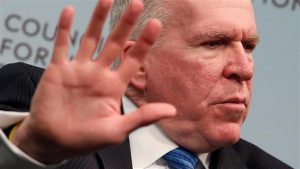 A brazen and unprecedented intervention in domestic U.S. politics by the intelligence community established the basic premise of the cascade of leaks about alleged Trump aides’ shady dealing with Russia. Led by CIA Director John Brennan, the CIA, FBI and NSA issued a 25-page assessment on Jan. 6 asserting for the first time that Russia had sought to help Trump win the election.
Brennan had circulated a CIA memo concluding that Russia had favored Trump and had told CIA staff that he had met separately with Director of National Intelligence James Clapper and FBI Director James Comey and that they had agreed on the “scope, nature and intent of Russian interference in our presidential election.”
In the end, however, Clapper refused to associate himself with the document and the NSA, which agreed to do so, was only willing to express “moderate confidence” in the judgment that the Kremlin had sought to help Trump in the election. In intelligence community parlance, that meant that the NSA considered the idea the Kremlin was working to elect Trump was merely plausible, not actually supported by reliable evidence.
In fact, the intelligence community had not even obtained evidence that Russia was behind the publication by Wikileaks of the e-mails Democratic National Committee, much less that it had done so with the intention of electing Trump. Clapper had testified before Congress in mid-November and again in December that the intelligence community did not know who had provided the e-mails to WikiLeaks and when they were provided.
The claim – by Brennan with the support of Comey – that Russia had “aspired” to help Trump’s election prospects was not a normal intelligence community assessment but an extraordinary exercise of power by Brennan, Comey and NSA Director Mike Rogers.
Brennan and his allies were not merely providing a professional assessment of the election, as was revealed by their embrace of the the dubious dossier compiled by a private intelligence firm hired by one of Trump’s Republican opponents and later by the Clinton campaign for the specific purpose of finding evidence of illicit links between Trump and the Putin regime.
Salacious Gossip
When the three intelligence agencies gave the classified version of their report to senior administration officials in January they appended a two-page summary of the juiciest bits from that dossier – including claims that Russian intelligence had compromising information about Trump’s personal behavior while visiting Russia. The dossier was sent, along with the assessment that Russia was seeking to help Trump get elected, to senior administration officials as well as selected Congressional leaders.
Among the claims in the private intelligence dossier that was summarized for policymakers was the allegation of a deal between the Trump campaign and the Putin government involving full Trump knowledge of the Russian election help and a Trump pledge – months before the election – to sideline the Ukraine issue once in office. The allegation – devoid of any verifiable information – came entirely from an unidentified “Russian emigre” claiming to be a Trump insider, without any evidence provided of the source’s actual relationship to the Trump camp or of his credibility as a source.
After the story of the two-page summary leaked to the press, Clapper publicly expressed “profound dismay” about the leak and said the intelligence community “has not made any judgment that the information in this document is reliable,” nor did it rely on it any way for our conclusions.”
One would expect that acknowledgment to be followed by an admission that he should not have circulated it outside the intelligence community at all. But instead Clapper then justified having passed on the summary as providing policymakers with “the fullest possible picture of any matters that might affect national security.”
By that time, U.S. intelligence agencies had been in possession of the material in the dossier for several months. It was their job to verify the information before bringing it to the attention of policymakers.
A former U.S. intelligence official with decades of experience dealing with the CIA as well other intelligence agencies, who insisted on anonymity because he still has dealings with U.S. government agencies, told this writer that he had never heard of the intelligence agencies making public unverified information on a U.S. citizen.
“The CIA has never played such a open political role,” he said.
The CIA has often tilted its intelligence assessment related to a potential adversary in the direction desired by the White House or the Pentagon and the Joint Chiefs of Staff, but this is the first time that such a slanted report impinges not only on domestic politics but is directed at the President himself.
The egregious triple abuse of the power in publishing a highly partisan opinion on Russia and Trump’s election, appending raw and unverified private allegations impugning Trump’s loyalty and then leaking that fact to the media begs the question of motive. Brennan, who initiated the whole effort, was clearly determined to warn Trump not to reverse the policy toward Russia to which the CIA and other national security organizations were firmly committed.
A few days after the leak of the two-page summary, Brennan publicly warned Trump about his policy toward Russia. In an interview on Fox News, he said, “I think Mr. Trump has to understand that absolving Russia of various actions that it’s taken in the past number of years is a road that he, I think, needs to be very, very careful about moving down.”
Graham Fuller, who was a CIA operations officer for 20 years and was also National Intelligence Officer for the Middle East for four years in the Reagan administration, observed in an e-mail, that Brennan, Clapper and Comey “might legitimately fear Trump as a loose cannon on the national scene,” but they are also “dismayed at any prospect that the official narrative against Russia could start falling apart under Trump, and want to maintain the image of constant and dangerous Russian intervention into affairs of state.”
Flynn in the Bull’s Eye
As Trump’s National Security Adviser, Michael Flynn presented an easy target for a campaign to portray the Trump team as being in Putin’s pocket. He had already drawn heavy criticism not only by attending a Moscow event celebrating the Russian television RT in 2016 but sitting next to Putin and accepting a fee for speaking at the event. More importantly, however, Flynn had argued that the United States and Russia could and should cooperate in their common interest of defeating Islamic State militants.
That idea was anathema to the Pentagon and the CIA. Obama’s Defense Secretary Ashton Carter had attacked Secretary of State John Kerry’s negotiating a Syrian ceasefire that included a provision for coordination of efforts against Islamic State. The official investigation of the U.S. attack on Syrian forces on Sept. 17 turned up evidence that CENTCOM had deliberately targeted the Syrian military sites with the intention of sabotaging the ceasefire agreement.
The campaign to bring down Flynn began with a leak from a “senior U.S. government official” to Washington Post columnist David Ignatius about the now-famous phone conversation between Flynn and Russian Ambassador Sergei Kislyak on Dec. 29. In his column on the leak, Ignatius avoided making any explicit claim about the conversation. Instead, he asked “What did Flynn say, and did it undercut the U.S. sanctions?”
And referring to the Logan Act, the 1799 law forbidding a private citizen from communicating with a foreign government to influence a “dispute” with the United States, Ignatius asked, “Was its spirit violated?”
The implications of the coy revelation of the Flynn conversation with Kislyak were far-reaching. Any interception of a communication by the NSA or the FBI has always been considered one of the most highly classified secrets in the U.S. intelligence universe of secrets. And officers have long been under orders to protect the name of any American involved in any such intercepted communication at all costs.
But the senior official who leaked the story of Flynn-Kislyak conversation to Ignatius – obviously for a domestic political purpose – did not feel bound by any such rule. That leak was the first move in a concerted campaign of using such leaks to suggest that Flynn had discussed the Obama administration’s sanctions with Kislyak in an effort to undermine Obama administration policy.
The revelation brought a series of articles about denials by the Trump transition team, including Vice President-elect Mike Pence, that Flynn had, in fact, discussed sanctions with Kislyak and continued suspicions that Trump’s aides were covering up the truth. But the day after Trump was inaugurated, the Post itself reported that the FBI had begun in late December go back over all communications between Flynn and Russian officials and “had not found evidence of wrongdoing or illicit ties to the Russian government….”
Two weeks later, however, the Post reversed its coverage of the issue, publishing a story citing “nine current and former officials, who were in senior positions at multiple agencies at the time of the calls,” as saying that Flynn had “discussed sanctions” with Kislyak.
The story said Flynn’s conversation with Kislyak was “interpreted by some senior U.S. officials as an inappropriate and potentially illegal signal to the Kremlin that it could expect a reprieve from sanctions that were being imposed by the Obama administration in late December to punish Russia for its alleged interference in the 2016 election.”
The Post did not refer to its own previous reporting of the FBI’s unambiguous view contradicting that claim, which suggested strongly that the FBI was trying to head off a plan by Brennan and Clapper to target Flynn. But it did include a crucial caveat on the phrase “discussed sanctions” that few readers would have noticed. It revealed that the phrase was actually an “interpretation” of the language that Flynn had used. In other words, what Flynn actually said was not necessarily a literal reference to sanctions at all.
Only a few days later, the Post reported a new development: Flynn had been interviewed by the FBI on Jan. 24 – four days after Trump’s inauguration – and had denied that he discussed sanctions in the conversation. But prosecutors were not planning to charge Flynn with lying, according to several officials, in part because they believed he would be able to “parse the definition of the word ‘sanctions’.” That implied that the exchange was actually focused not on sanctions per se but on the expulsion of the Russian diplomats.
Just hours before his resignation on Feb. 13, Flynn claimed in an interview with the Daily Caller that he had indeed referred only to the expulsion of the Russian diplomats.
“It wasn’t about sanctions. It was about the 35 guys who were thrown out,” Flynn said. “It was basically, ‘Look, I know this happened. We’ll review everything.’ I never said anything such as, ‘We’re going to review sanctions,’ or anything like that.”
The Russian Blackmail Ploy
Even as the story of the Flynn’s alleged transgression in the conversation with the Russian Ambassador was becoming a political crisis for Donald Trump, yet another leaked story surfaced that appeared to reveal a shocking new level of the Trump administration’s weakness toward Russia.
The Post reported on Feb. 13 that Acting Attorney General Sally Yates, an Obama holdover, had decided in late January – after discussions with Brennan, Clapper and FBI Director James Comey in the last days of the Obama administration – to inform the White House Counsel Donald McGahn in late January that Flynn had lied to other Trump administration officials – including Vice President Mike Pence – in denying that he discussed sanctions with Kislyak. The Post cited “current and former officials” as the sources.
That story, repeated and amplified by many other news media, led to Flynn’s downfall later that same day. But like all of the other related leaks, the story revealed more about the aims of the leakers than about links between Trump’s team and Russia.
The centerpiece of the new leak was that the former Obama administration officials named in the story had feared that “Flynn put himself in a compromising position” in regard to his account of the conversation with Kislyak to Trump members of the Trump transition.
Yates had told the White House that Flynn might be vulnerable to Russian blackmail because of the discrepancies between his conversation with the Ambassador and his story to Pence, according to the Post story.
But once again the impression created by the leak was very different from the reality behind it. The idea that Flynn had exposed himself to a potential Russian blackmail threat by failing to tell Pence exactly what had transpired in the conversation was fanciful in the extreme.
Even assuming that Flynn had flatly lied to Pence about what he had said in the meeting – which was evidently not the case – it would not have given the Russians something to hold over Flynn, first because it was already revealed publicly and second, because the Russian interest was to cooperate with the new administration.
The ex-Obama administration leakers were obviously citing that clumsy (and preposterous) argument as an excuse to intervene in the internal affairs of the new administration. The Post’s sources also claimed that “Pence had a right to know that he had been misled….” True or not, it was, of course, none of their business.
Pity for Pence
The professed concern of the Intelligence Community and Justice Department officials that Pence deserved the full story from Flynn was obviously based on political considerations, not some legal principle. Pence was a known supporter of the New Cold War with Russia, so the tender concern for Pence not being treated nicely coincided with a strategy of dividing the new administration along the lines of policy toward Russia.
All indications are that Trump and other insiders knew from the beginning exactly what Flynn had actually said in the conversation, but that Flynn had given Pence a flat denial about discussing sanctions without further details.
On Feb. 13, when Trump was still trying to save Flynn, the National Security Adviser apologized to Pence for “inadvertently” having failed to give him a complete account, including his reference to the expulsion of the Russian diplomats. But that was not enough to save Flynn’s job.
The divide-and-conquer strategy, which led to Flynn’s ouster, was made effective because the leakers had already created a political atmosphere of great suspicion about Flynn and the Trump White House as having had illicit dealings with the Russians. The normally pugnacious Trump chose not to respond to the campaign of leaks with a detailed, concerted defense. Instead, he sacrificed Flynn before the end of the very day the Flynn “blackmail” story was published.
But Trump appears to have underestimated the ambitions of the leakers. The campaign against Flynn had been calculated in part to weaken the Trump administration and ensure that the new administration would not dare to reverse the hardline policy of constant pressure on Putin’s Russia.
Many in Washington’s political elite celebrated the fall of Flynn as a turning point in the struggle to maintain the existing policy orientation toward Russia. The day after Flynn was fired the Post’s national political correspondent, James Hohmann, wrote that the Flynn “imbroglio” would now make it “politically untenable for Trump to scale back sanctions to Moscow” because the “political blowback from hawkish Republicans in Congress would be too intense….”
But the ultimate target of the campaign was Trump himself. As neoconservative journalist Eli Lake put it, “Flynn is only the appetizer. Trump is the entree.”
Susan Hennessey, a well-connected former lawyer in the National Security Agency’s Office of General Counsel who writes the Lawfare blog at the Brookings Institution, agreed. “Trump may think Flynn is the sacrificial lamb,” she told The Guardian, “but the reality is that he is the first domino. To the extent the administration believes Flynn’s resignation will make the Russia story go away, they are mistaken.”
The Phony “Constant Contacts” Story
No sooner had Flynn’s firing been announced than the next phase of the campaign of leaks over Trump and Russia began. On Feb. 14, CNN and the New York Times published slight variants of the same apparently scandalous story of numerous contacts between multiple members of the Trump camp with the Russian at the very time the Russians were allegedly acting to influence the election.
There was little subtlety in how mainstream media outlets made their point. CNN’s headline was, “Trump aides were in constant touch with senior Russian officials during campaign.” The Times headline was even more sensational: “Trump Campaign Aides Had Repeated Contacts with Russian Intelligence.”
But the attentive reader would soon discover that the stories did not reflect those headlines. In the very first paragraph of the CNN story, those “senior Russian officials” became “Russians known to U.S. intelligence,” meaning that it included a wide range Russians who are not officials at all but known or suspected intelligence operatives in business and other sectors of society monitored by U.S. intelligence. A Trump associate dealing with such individuals would have no idea, of course, that they are working for Russian intelligence.
The Times story, on the other hand, referred to the Russians with whom Trump aides were said to be in contact last year as “senior Russian intelligence officials,” apparently glossing over a crucial distinction that sources had made to CNN between intelligence officials and Russians being monitored by U.S. intelligence.
But the Times story acknowledged that the Russian contacts also included government officials who were not intelligence officials and that the contacts had been made not only by Trump campaign officials but also associates of Trump who had done business in Russia. It further acknowledged it was “not unusual” for American business to come in contact with foreign intelligence officials, sometimes unwittingly in Russia and Ukraine, where “spy services are deeply embedded in society.”
Even more important, however, the Times story made it clear that the intelligence community was seeking evidence that Trump’s aides or associates were colluding with the Russians on the alleged Russian effort to influence the election, but that it had found no evidence of any such collusion. CNN failed to report that crucial element of the story.
The headlines and lead paragraphs of both stories, therefore, should have conveyed the real story: that the intelligence community had sought evidence of collusion by Trump aides with Russia but had not found it several months after reviewing the intercepted conversations and other intelligence.
Unwitting Allies of the War Complex?
Former CIA Director Brennan and other former Obama administration intelligence officials have used their power to lead a large part of the public to believe that Trump had conducted suspicious contacts with Russian officials without having the slightest evidence to support the contention that such contacts represent a serious threat to the integrity of the U.S. political process.
Many people who oppose Trump for other valid reasons have seized on the shaky Russian accusations because they represent the best possibility for ousting Trump from power. But ignoring the motives and the dishonesty behind the campaign of leaks has far-reaching political implications. Not only does it help to establish a precedent for U.S. intelligence agencies to intervene in domestic politics, as happens in authoritarian regimes all over the world, it also strengthens the hand of the military and intelligence bureaucracies who are determined to maintain the New Cold War with Russia.
Those war bureaucracies view the conflict with Russia as key to the continuation of higher levels of military spending and the more aggressive NATO policy in Europe that has already generated a gusher of arms sales that benefits the Pentagon and its self-dealing officials.
Progressives in the anti-Trump movement are in danger of becoming an unwitting ally of those military and intelligence bureaucracies despite the fundamental conflict between their economic and political interests and the desires of people who care about peace, social justice and the environment.
President’s Quest for Détente with Russia Continues Despite Fierce Opposition
By John V. Walsh | Dissident Voice | February 21, 2017
President Trump rose from the ashes of Mike Flynn at his press conference last Thursday. In a bravura performance, defiant and funny at times, the President took on the corporate media en masse.
It is a performance that should not be missed. You can savor both video and transcript at your leisure here.
The press
Trump: “Unfortunately, much of the media in Washington, D.C., along with New York, Los Angeles in particular, speaks not for the people, but for the special interests and for those profiting off a very, very obviously broken system. The press has become so dishonest that if we don’t talk about it, we are doing a tremendous disservice to the American people. Tremendous disservice. We have to talk to find out what’s going on, because the press honestly is out of control. The level of dishonesty is out of control.”
Sounds like what many “progressives” have been saying for a mighty long time, and it deserves resounding applause from them.
Trump: “And I’ll tell you what else I see. I see tone. You know the word ‘tone.’ The tone is such hatred. I’m really not a bad person, by the way. No, but the tone is such — I do get good ratings, you have to admit that — the tone is such hatred.”
And: “Now, I will say this. I watch it. I see it. I’m amazed by it. The public gets it, you know. Look, when I go to rallies, they turn around, they start screaming at CNN. They want to throw their placards at CNN. You know.”
The bias of the press against Trump is so obvious and heavy handed that no one can miss it. I asked one friend who is an avid and careful reader of the NYT whether he could name a single pro-Trump article over the last year. He could not. Does the press believe that the public are such fools that they cannot see this tone? This is but one more sign of the contempt that the clueless Elite have for the working stiff.
Russia and Putin
The most important point of the press conference was undoubtedly Trump’s refusal to back off one inch from his desire to “get along with Russia,” what some call New Détente or Détente 2.0. It is the most important, because tension between the two nuclear powers could well lead to war and nuclear exchange. For anti-warriors of every stripe Trump’s steadfastness was good news. The Flynn episode has not changed Trump’s resolve one iota.
Trump continued. Were he to denounce Russia and Putin, he instructed the press, it would be much easier for him politically. He would be hailed by the corporate press, the elitists of both Parties, the neocons, the Hillarycons and the entire foreign policy establishment, all of whom are itching for a fight, heedless that it might lead to a nuclear exchange. So Trump’s willingness to hold to this position is hardly opportunistic.
But he went farther. Trump let the press know that the atmosphere they are creating would make it difficult to negotiate with Putin, to defeat ISIS, or to bring an end to the crises in Ukraine or Syria nurtured by the US over the last six plus years. Why? Because he would have difficulty making concessions, giving as well as taking which any negotiation or deal demands. Any concession would trigger the charge that Trump is Putin’s puppet, the crazed mantra with which we are harangued daily and for which after all these many months there is not a shred of evidence. This is the very same point that Stephen F. Cohen, Emeritus Professor of Russian History at Princeton and NYU, often makes in his weekly discussions (Jan.25 episode especially) of U.S., Russia relations with John Batchelor on WABC.
Trump: “But I want to just tell you, the false reporting by the media, by you people, the false, horrible, fake reporting makes it much harder to make a deal with Russia. And probably Putin said ‘you know.’ He’s sitting behind his desk and he’s saying ‘you know, I see what’s going on in the United States, I follow it closely. It’s going to be impossible for President Trump to ever get along with Russia because of all the pressure he’s got with this fake story.’ OK? And that’s a shame because if we could get along with Russia — and by the way, China and Japan and everyone. If we could get along, it would be a positive thing, not a negative thing.” (Emphasis, jw).
And later, Trump: “But you know what? I want to do the right thing for the American people. And to be honest, secondarily, I want to do the right thing for the world.
If Russia and the United States actually got together and got along — and don’t forget, we’re a very powerful nuclear country and so are they. There’s no upside. We’re a very powerful nuclear country and so are they. I have been briefed. And I can tell you one thing about a briefing that we’re allowed to say because anybody that ever read the most basic book can say it, nuclear holocaust would be like no other. (Emphasis, jw)… They’re a very powerful nuclear country and so are we. If we have a good relationship with Russia, believe me, that’s a good thing, not a bad thing.”
The idea of “getting along” with other nations, even as we compete with them economically, is of course the way to peace and the very antithesis of the path the neocons and liberalcons from the Clintons to Bush to Obama have set us on these past thirty plus years of killing and destruction. And yet the “peace movement” expresses nothing but hatred for Trump and pushes for his impeachment. Some “peace” movement, that.
Back to l’affaire Flynn for a moment. Permit this writer to make a surmise, scarcely a ripple on the sea of surmises these days about the Deep State, Trump etc. Flynn did nothing illegal. Trump did not have to let him go, and it can easily be argued that Trump may have kept blood out of the water by sticking by Flynn and keeping him on. Flynn has been an asset. He is a champion of Détente 2.0 with Russia. He knows the national “intelligence” apparatus and where all its skeletons are closeted. He seems to know the deep story of the support that the Obama and Hillary forces gave to ISIS – certainly indirectly through US allies and probably also directly through the CIA, Mossad etc. But Flynn is also a man near crazed with an irrational bellicosity to Iran. That would have thrown a monkey wrench into Détente 2.0 since Russia and Iran have close ties especially in the fight against Sunni fundamentalist terrorism. So sooner or later Flynn had to go to preserve Détente 2.0. Did Trump take this opportunity to do so? And did Tillerson also crave this? It is a suspicion worth pondering. Trump has shown a cold-blooded capacity to say “you’re fired” when someone’s liabilities outweigh their assets. This writer suspects that Flynn’s time had come.
John V. Walsh can be reached at john.endwar@gmail.com.
No substantive change in US rhetoric on Iran: Shamkhani
Press TV – February 20, 2017
A senior Iranian official says the rhetoric of the US administration of President Donald Trump on the Islamic Republic is substantively no different from that of the former officials in Washington.
“There has been no substantive shift in the rhetoric of the new US officials [in comparison with] the previous [ones] and various figures and parties in the country have always maintained an aggressive approach toward independent countries,” Secretary of Iran’s Supreme National Security Council (SNSC) Ali Shamkhani told reporters on Monday.
He added that the fact-based admissions by President Trump about the chaotic situation in the West and the United States are a new issue which had never been publicly acknowledged by other US leaders.
Such confessions show that Washington can no more cover up the tumultuous and confused situation in the US, the top Iranian official emphasized.
“Although it is still early to make a definitive judgment about the new US administration, the current trend shows that there will be no change in the chaotic situation of the country in the new era either,” the SNSC secretary pointed out.
The new US Republican president, who took office in January, has repeatedly echoed the same warnings made by former President George W. Bush who on several occasions said he would not take the military option against Iran off the table.
Former President Barack Obama also threatened military action against Iran before the nuclear agreement between Tehran and world powers in 2015.
Trump said on February 2 that “nothing is off the table” in terms of a response to a recent ballistic missile test by Iran.
Iranian officials have always dismissed such statements as foreign meddling in the country’s domestic affairs, saying that the missile tests were the nation’s inalienable right to self-defense. Iran has also vowed a crushing response to any military attack against it.
The Empire Strikes Back
By Brad Benson | OffGuardian | February 17, 2017
On the surface, the resignation of General Michael Flynn is being sold as a cut-and-dried case of the General getting ahead of his skis by calling the Russian Ambassador to discuss the lifting of sanctions. This was ostensibly then complicated by the General not being honest about his discussions, when queried about it by Vice President Mike Pence. However, as is always the case in these types of affairs, the real story will go untold and General Flynn’s “resignation” will have ramifications far beyond these first headlines.
In reality, the General’s early fall is a signal that the Deep State is not about to permit rapprochement with Russia. This is because any moves to defuse the New Cold War could threaten to undercut Obama’s $1 Trillion, 30 year nuclear arms rearmament program, which has been quietly moving forward for several years.
Flynn, the former head of the Defense Intelligence Agency (DIA), which is the military’s counterpart to the CIA, was originally fired by Obama for an intelligence assessment, which disputed information that Obama was being fed by the CIA. In retrospect, this report was rather prescient, since it noted that an infant ISIS was a much bigger threat than Obama was being told, while further advising that it was a mistake for the CIA to be supplying them with arms in their ill-fated effort to bring down Assad in Syria.
This put Flynn in direct conflict with then CIA Director, John Brennan, then Director of National Intelligence, John Clapper, and a whole cadre of Neo-Con Interventionists inside Hillary Clinton’s State Department. Flynn’s timing was also bad, since the War Hawks had only recently overthrown Gaddafi and, in the ecstasy of their “success”, no one, especially Obama, wanted to be told that rain clouds were already gathering over their parade.
When General Flynn reemerged as an advisor to Trump during the campaign, there was no immediate concern within the Deep State, since Trump was not seen as a serious factor. However, as Trump began to talk about rapprochement with Putin’s Russia on the campaign trail, Flynn was identified as one of the driving forces behind this idea and, as a result, the Clinton Campaign opened up a new front to denigrate him as a racist nut-case. This may very well have been true, but it does not, as a consequence, make him wrong in regard to his recognition of the necessity to defuse the New Cold War with Russia.
Flynn’s early departure is a big victory for the Deep State Thugs who are heavily invested in the New Cold War. It is most certainly also a signal to Trump that he can be removed, since MSM talking heads are already spinning stories about the fired DOJ Acting Attorney General, Sally Yates, having previously warned the White House that tapped phone calls, between Flynn and the Russian Ambassador, might make the General subject to “blackmail” by the Russians.
Indeed, not-so-subtle threats of impeachment are already being floated, with nuances of the famous question, “What did the President know and when did he know it?” One Neo-Con Flim-flam man has already gone so far as to refer to the “Russian Stench” and demanded to know what is behind this “Russian connection”, which, if anyone gave it any real thought, was essentially a move toward peace.
However, this was apparently just the warm up act for the big guns, since the next up was Thomas Friedman, the influential NY Times op-ed writer, who helped the Bush and Obama Administrations to lie us into several wars. Adopting a stern demeanor, while staring directly into the camera, Friedman demands no less than a full investigation into Trump’s associations with these pesky Russkies, who “undermined our election”, ominously concluding that this was an “event as significant as Pearl Harbor”.
Meanwhile, early rumblings from Moscow are noting that this could be bad news for future relations with the US and could ultimately lead to a deterioration of relations. This is a nice way of saying that they know that our Deep State is undermining the move toward rapprochement, while also sending a subtle message to Trump that they hope he’s not falling for it. Sadly, it may already be too late.
This is the first move to set up Trump for impeachment, with Mike Pence, a Neo-Con, sitting in the catbird seat. Those that celebrate the demise of Flynn and hope for the early fall of Trump should be careful in regard to their wishes. The ultimate result intended in all of this is that there will be no rapprochement with Russia and that the New Cold War might eventually develop into a hot one.
The Empire has struck back. Whether one likes Trump or not, no one should be distracted by the “Russian Connection” Sideshow. This is about the future of a major rearmament program and the Deep State has subtly enlisted the support of the Trump haters on the left to create the conditions for Trump’s early removal.
With many Neo-Cons on the right also poised to feed on the carcass of a guy they couldn’t stop in the primaries, the American People better wake up. This is not a question of left or right. It may very well be a question of survival.
Is Trump Killing Israel With Kindness?
By Gearóid Ó Colmáin | February 17, 2017
We wrote a few months ago that the only good thing one could say about Trump was that he was unpredictable. Just a month in the Oval Office, President Trump is living up to his reputation. His meeting with Israeli Prime Minister Benjamin Netanyahu on the 16th of February was not particularly well received in Israel. In contrast to President Obama, Trump’s body language and rhetoric strongly suggested he, and not Netanyahu, was in charge.
Trump was questioned about recent accusations that he was a ‘holocaust denier’. The American president imperiously ignored the question. Then, he dropped a bomb: The president indicated that he would be happy with a one-state solution in Palestine. I have argued for years that the creation of one democratic state encompassing Palestinians and Jews is the only option for long-term peace and stability. Zionists, however, do not even want any talk of that possibility; they understand that a one state solution will ultimately bring an end to Jewish supremacy – both in Israel and throughout the world.
The demographic statistics in Palestine show that the Arab population is growing rapidly. A one-state scenario would enable the millions of Palestinian refugees to return to their lands, thus swelling the Arab population. Moreover, power-sharing in the Knesset (or whatever a future assembly would be called) would change the domestic and foreign policy of the formerly ‘Jewish State’ entirely. The Israeli liberal press is worried about Trump. Yet Trump is arguably the most pro-Israeli President in history; his daughter ‘converted’ to Judaism and his son-in-law Jared Kushner has been financing Jewish settlements in Palestine. But the danger of the Trump regime for the Jewish supremacists is Steve Bannon, Trump’s Chief Strategist.
Steve Bannon has been accused of anti-semitism in the past for criticising the lack of American patriotism among international financiers who happen to be Jewish. But Bannon’s reactionary Breitbart News is staunchly Zionist. There is no contradiction between being Zionist and ‘anti-semitic’. In 1933, National Socialist Germany signed the Haavara Accord with international Zionists, whereby Germany would facilitate Jewish emigration to Palestine. After the Second World War, the USSR showed captured German films to soviet cinema goers. Some of the films such as Harlan’s Jud Süß were banned due to their Zionist content.
Steve Bannon calls himself a “Leninist” who wants to ” destroy the state”. Trump’s shadowy éminence grise, Bannon is believed to be the brains of the Trump administration. He certainly seems to understand dialectical materialism. But how could this dialectical conundrum play out?
During his election campaign, Donald Trump threatened to ban Muslims from entering the United States. His comments provoked international outrage. Benjamin Netanyahu was among the leaders who publicly denounced Trump’s xenophobic statements. We all know that far-right Zionist Netanyahu doesn’t care a farthing about Muslims. So, why would he make such a statement? We might say that, Netanyahu was attempting to present himself as a friend of the Arabs and all Muslims. But there is another aspect to the policy of borders: it is a policy which threatens the New World Order. Open borders and mass immigration are a key agenda of globalisation. We have shown that globalisation is being driven by liberal leftism. The most powerful institutions of the ‘Youth Industry’, ‘Colour Revolutions’, and ‘world-without-borders’ ideology are overwhelmingly Jewish-led. The same can be said for much of the liberal leftist ‘alternative’ media.
A state without borders
Israel has no official borders because they are constantly in expansion. Israel and its agents in the international media and academia unceasingly promote multiculturalism, immigration and open borders for all states – except Israel.
The Trump regime could render Israel’s espionage and intelligence penetration of the United States problematic. Dozens of Israelis were arrested after the 9/11 attacks on suspicion of terrorism. Some had been caught with explosives. They were all released due to the intervention of Homeland Security chief Micheal Chertoff, an Israeli-American. When Israeli Mossad agents were spotted celebrating the 9/11 terrorist attacks, they were described as ‘Middle Eastern-looking’.
Mohammed Atta, the chief terrorist suspect in the 9/11 attacks was, according to French intelligence, a Mossad agent. The Israelis have always used Islamist patsies and dupes for false flag attacks against civilian populations. Israeli security companies such as ICTS have repeatedly allowed terrorists to enter the United States and other countries. Is it possible that Netanyahu understood the significance of Trump’s xenophobic border policies? Impossible to tell.
But it is important to consider the fact that the real source of Jewish power in the world is the liberal ‘left’ media. Trump is currently at war with that establishment. Takfiri terrorism is and always has been a tool of Zionism. From the King David Hotel bombing of 1946, the Lavon Affair of 1954, to 9/11, the ‘war on terrorism’ has been about the recruitment, training and funding of Jihadi forces to be used as false-flag terror patsies and to fight proxy wars on behalf of Zionism.
The Takfiri and Wahhabi ideology is promoted by Israel’s ugly sister Saudi Arabia. If global Islam is taken over by Wahhabism – including in Gaza – Israel begins to look good, while genuine Muslims suffer. If Trump were to genuinely fight Takfiri terrorism in the Middle East, allying with President Assad, Israel’s ‘New Middle East’ project would fail. By putting a US embassy in Jerusalem, Trump is saying that a one-state option is back on the table. An Assad victory in Syria and a one-state solution, involving a burgeoning Palestinian population, would be the beginning of the end for Zionist world domination.
Left liberalism’s ‘Fisk-al deficit’
One only has to read what left liberal disinformation agents are actually saying to see the significance of all this. Take Robert Fisk’s latest piece: ‘ Why Israel is in for a rough ride under Trump’. Fisk believes that Trump and Bannon’s anti-Iran rhetoric is a threat to Israel. But he ignores the fact that it has been Israel, far more than the United States, who has been calling for war on Iran. Fisk is trying to imply that Israel wants peace with Iran. That is clearly not the case. Israel’s ‘left liberals’ and Mr Fisk have been backing the war against Syria to the hilt. As the Jewish-owned Brooking’s Institution makes clear in their 2009 Analysis Paper: ‘Which Path to Persia’, the destruction of Syria is the first stage of the war against Iran. Robert Fisk is right to be worried about Israel; his entire career of lies and disinformation about the Middle East may be undermined by Bannon’s methodological madness – at least at the level of discourse.
In many respects, Adam Curtis is correct to point out that Steve Bannon seems to be playing a similar role to Vladislav Surkov in Russia. Surkov, an advisor to President Vladimir Putin, developed the ideology of sovereign democracy, which Curtis claims led to a bewildering social state of “destabilised perception.”
Bannon and Surkov are the grand strategists of a new abstract art of disinformation designed to defend the interests of the national bourgeoisie against degenerate cosmopolitan elites and the working class. However, it is only by seeing this contradiction and taking control of its fallout that working class interests can be advanced. The White nationalist and violent ‘leftist’ hoodie-utionaries ultimately serve the same class interests. Workers should not be influenced by the reactionary ideology of either.
They are, in many respects, two sides of a Surkovian psyops ruthlessly conceived to maintain class domination.
Time to play Chess
In the Nineteenth century British imperial policy in Ireland consisted of co-opting the Irish to British power by granting them privileges and protection. The policy became known as ‘Killing home-rule with kindness’. The United States cannot afford to wage another catastrophic war of destruction against an emerging regional power like Iran.
Israel’s ‘rough ride’ under Trump will be a good thing if the Islamic Republic of Iran is sufficiently creative in its negotiations with Washington. Iran will need to tighten its alliance with Russia and China and correct serious foreign policy errors such as support for Zionist/Wahhabi agendas in South East Asia.
Iran should look towards strengthening its relationship with countries such as Hungary. Relations at present between Hungary and the Islamic republic of Iran are good. A Hungarian delegation recently visited Tehran and said that they hoped to make Budapest into Iran’s portal in Europe. Strengthening its diplomatic ties with nationalist countries in Europe and Russia, as well as constructive engagement with the Trump administration could contribute to the weakening of Zionism, the phoney war on terrorism and the Talmudic New World Order. Such policies will not bring the contradictions of capitalism to an end, but rather accelerate them. For those contradictions are systemic to the capitalist mode of production itself. But there is the possibility of a realignment of forces away from total war and destruction towards constructive change.
Featured Video

Rewriting the risk? Inside the government’s vaccine safety messaging
or go to
Aletho News Archives – Video-Images
Book Review
“Davos Can Really Replace the UN”
Inside the book that maps the architecture behind global governance — from the Epstein files to the Pact for the Future
Lies are Unbekoming | April 1, 2026
On June 13, 2019, the United Nations and the World Economic Forum signed a partnership deal to “accelerate the implementation of the 2030 Agenda for Sustainable Development.” That same evening, WEF president Börge Brende — Norway’s former Foreign Minister — had dinner with Jeffrey Epstein at Epstein’s Manhattan townhouse. The Epstein files, released January 2026, contain an exchange between the two from the previous year. Epstein to Brende: “Davos can really replace the UN. C21, cyber, crypto . genetics… intl coordination.” Brende back to Epstein: “Exactly — we need a new global architecture. World Economic Forum (Davos) is uniquely positioned — public private.”
The next day, the UN General Assembly adopted the framework for restructuring global governance.
That sequence — the partnership signing, the Epstein dinner, the candid admission about replacing the UN with a public-private architecture, and then the formal adoption — opens Jacob Nordangård’s The Digital World Brain. Pages two and three. Footnoted to the UN resolution number, the Epstein files, and the General Assembly record.
I keep coming back to it because it captures what this book does that almost nothing else in the independent research space manages. I’ve followed Jacob’s work for years now and interviewed him about his research. Each book peels back another layer of the same institutional architecture, and each time I think he’s reached the limit of what can be documented, the next one goes further. Nordangård doesn’t speculate. He doesn’t editorialize much. He lays institutional actions next to each other in chronological order and lets the pattern announce itself. … continue
Blog Roll
 Aletho News
- How I fell foul of the BBC thought police
- The End of NATO
- 37 days of war on Iran cost US staggering $42bln, tracker shows
- Baghdad tells Asian refiners, traders to begin loading Iraqi crude amid Iranian exemption
- Under fire, Moscow and Tehran close ranks
- Iran, US receive Pakistan-mediated plan for ceasefire then final deal
- Iran submits demands for end to war as mediators scramble ahead of Trump deadline
- Iran Threatens Retaliatory Strike on Stargate AI Project in UAE
- US sent ‘a lot’ of arms to Iranian protesters – Trump
- Barak Ravid Launders Deception To Allow Trump To Back Off Of His Power Plant Threat – Again
- If Americans Knew
- U.N. experts demand Israel release prominent Gaza doctor after reports of ‘severe torture’
- Israel’s Latest Genocide Is Against the Shias of Lebanon. Why Is the World Silent?
- How Eliot Cohen’s influence over U.S. war-making paved the way for Trump’s war crimes in Iran
- Israelis don’t pay for the weapons we ‘sell’ to them — US taxpayers do
- While Distancing from AIPAC, Most 2028 Democratic Hopefuls Are Still Embracing Israel
- A brief history of the Israeli nuclear program, the open secret at the heart of the Iran war
- Israeli Settlers Killed a Palestinian Farmer on His Own Land, in Front of His Father. Yes, Again
- The US-Israeli War on Science is an Assault on our Future
- 100+ International Law Experts Say US Strikes on Iran Violate UN Charter, Could Be War Crimes
- ‘Vile, Horrifying, Evil’: Trump Threatens to Bomb Nation of 90 Million People ‘Back to the Stone Ages’
- No Tricks Zone
- An Inconvenient Tree: Uncovered In Alps… Europe Much Warmer Than Today 6000 Years Ago
- New Study Reports A 60% Slowdown In Greenland’s Ice Loss Rate In The Last Decade
- Low Intensity Tornado Wrecks Major Solar Farm, Creating A Potential Toxic Dump
- New Study Finds Warming Saves Lives…Cold Temperatures 12 Times More Deadly Than Excess Heat
- German Science Blog Accuses PIK Climate Institute Of Hallucinating Climate Tipping Points
- Devastating Assessment Of Comirnaty Vaccine By Former Senior Pfizer Europe Toxicologist
- New Study: CO2 Is ‘Effectively Negligible’ As An Explanatory Climate Change Factor Since 2000
- Former Pfizer Toxicologist Dr. Helmut Sterz Tells Bundestag Hearing Pfizer Vaccine Should Have Never Been Approved
- Energy Expert: Germany’s Nuclear Phaseout Was A “500 Billion Euro Mistake”
- New Research: South Australia’s Mid-Holocene Sea Surface Temperatures Were 4°C Warmer Than Today
 Aletho News