US media reports of Trump links to Russian intelligence ‘laughable, cite no facts’ – Kremlin
RT | February 15, 2017
Moscow has criticized news reports alleging associates of Donald Trump had numerous contacts with Russian intelligence during the election, with the Kremlin’s spokesman complaining that it’s hard to distinguish fact from fiction in the US media lately.
“Those reports are not based on concrete facts,” Dmitry Peskov stressed on Wednesday, noting “there are five different sources in the story and none is named. So you see, really laughable stories are now given a go.”
The Russian president’s spokesman added, “Let’s not just believe the press. It’s difficult lately tell the real deal from fakes and hoaxes,” referring to reports in the New York Times and on CNN which cited anonymous US sources as saying that several people close to President Donald Trump had communicated with Russian intelligence officers during the presidential campaign.
Russia’s Foreign Ministry has reacted cautiously, saying the publications indicate a big political game involving power bargaining is being played within the US establishment.
Other Russian officials were more forthcoming, however.
“It’s common tactic to discredit a person,” Senator Vladimir Dzhabarov told RIA Novosti, commenting on expose stories run by the New York Times and CNN, adding that it’s a continuation of the same campaign that forced Michael Flynn’s resignation as National Security Advisor earlier.
“Trump should realize that the real target of such leaks is him. Unless the American president puts an end to this witch-hunt and stops surrendering his people, this will all end bad. The final goal of his enemies is to impeach the president,” he added.
Dzhabarov, who holds a seat in the Russian Senate, is a veteran intelligence officer who retired with the rank of Colonel General.
Leonid Slutsky, a fellow legislator and head of the Parliament’s Foreign Affairs Committee, came to a similar conclusion, saying that the US mainstream media is carrying out a concerted attack on Trump.
“Such outlets use any chance to mar the new president and use this overused and baseless ‘Russian dossier’ for the purpose often because it makes a reliable impact on their readers,” he explained.
The Russian Foreign Intelligence Service, whose agents Trump’s aides were allegedly in contact with, told TASS they were surprised by the reports and would not comment on “media speculations that lack proof.”
In an earlier article, the New York Times cited unnamed current and former US officials as saying that members of Trump’s election campaign had had contacts with senior Russian intelligence officers. The newspaper said US intelligence had intercepted the communications of Trump’s aides as they were collecting information to see if there was any evidence showing collusion between the Republican and Russia on the alleged hack of the Democratic National Convention – evidence that they reportedly failed to find.
The report said that, not only campaign members, but also other associates of Trump had been targeted by the surveillance. The only name it provided was that of Paul Manafort, who had to resign as Trump’s campaign manager after Ukrainian authorities accused him of having been involved in the corruption of the previous Ukrainian government. The evidence of such corruption was later disavowed by the Ukrainian investigators.
Commenting for the NYT report, Manafort denied having any ties with the Russian intelligence.
“This is absurd. I have no idea what this is referring to. I have never knowingly spoken to Russian intelligence officers, and I have never been involved with anything to do with the Russian government or the Putin administration or any other issues under investigation today,” he told the newspaper.
The NYT sources would not disclose any details, including the names of alleged Russian spies or the number of Trump people that had allegedly communicated with them, claiming the data had been collected as part of routine surveillance of the communications of foreign officials.
CNN ran a similar story independently of the newspaper, citing anonymous “law enforcement and administration officials.”
US to Adhere to Deterrence Strategy Toward North Korea – Trump Adviser
Sputnik – 12.02.2017
The United States will build its strategy concerning North Korea based on the principles of deterrence, US President Donald Trump’s adviser Stephen Miller said on Sunday.
“We will reinforce and strengthen our vital alliances in the Pacific region as part of our strategy to deter and prevent the increasing hostility that we’ve seen in recent years from the North Korean regime,” Miller said in an interview with the Fox News channel.
Earlier in the day, North Korea launched a ballistic missile from the country’s North Pyongan province. The missile plunged into the Sea of Japan after flying some 310 miles. Japan said that the missile fell outside of the country’s exclusive economic zone and did not inflict any damages.
Following the launch, South Korea and Japan held emergency meetings of the countries’ National Security Councils and both called the launch a provocative action threatening international security. Other countries, as well as the United States and the European Union, have condemned the launch.
Castigating Trump for Truth-Telling
By Robert Parry | Consortium News | February 7, 2017
Gaining acceptance in Official Washington is a lot like getting admittance into a secret society’s inner sanctum by uttering some nonsensical password. In Washington to show you belong, you must express views that are patently untrue or blatantly hypocritical.

Fox News’ Bill O’Reilly interviewing President Donald Trump
For instance, you might be called upon to say that “Iran is the principal source of terrorism” when that title clearly belongs to Saudi Arabia and other Gulf state allies that have funded Al Qaeda, the Taliban and the Islamic State. But truth has no particular value in Official Washington; adherence to “group think” is what’s important.
Similarly, you might have to deny any “moral equivalence” between killings attributed to Russian President Vladimir Putin and killings authorized by U.S. presidents. In this context, the fact that the urbane Barack Obama scheduled time one day a week to check off people for targeted assassinations isn’t relevant. Nor is the reality that Donald Trump has joined this elite club of official killers by approving a botched and bloody raid in Yemen that slaughtered a number of women and children (and left one U.S. soldier dead, too).
You have to understand that “our killings” are always good or at least justifiable (innocent mistakes do happen from time to time), but Russian killings are always bad. Indeed, Official Washington has so demonized Putin that any untoward death in Russia can be blamed on him whether there is any evidence or not. To suggest that evidence is needed shows that you must be a “Moscow stooge.”
To violate these inviolable norms of Official Washington, in which participants must intuitively grasp the value of such “group think” and the truism of “American exceptionalism,” marks you as a dangerous outsider who must be marginalized or broken.
Currently, President Trump is experiencing this official opprobrium as he is widely denounced by Republicans, Democrats and “news” people because he didn’t react properly to a question from Fox News’ Bill O’Reilly terming Putin “a killer.”
“There are a lot of killers.” Trump responded. “We’ve got a lot of killers. What do you think — our country’s so innocent. You think our country’s so innocent?”
Aghast at Trump’s heresy, O’Reilly sputtered, “I don’t know of any government leaders that are killers.”
Trump: “Well — take a look at what we’ve done too. We made a lot of mistakes. I’ve been against the war in Iraq from the beginning.”
O’Reilly: “But mistakes are different than —“
Trump: “A lot of mistakes, but a lot of people were killed. A lot of killers around, believe me.”
‘Moral Equivalence’
Though Trump is justly criticized for often making claims that aren’t true, here he was saying something that clearly was true. But it has drawn fierce condemnation from across Official Washington, not only from Democrats but from Trump’s fellow Republicans, too. Neoconservative Washington Post opinion writer Charles Krauthammer objected fiercely to Trump’s “moral equivalence,” and CNN’s Anderson Cooper chimed in. lamenting Trump’s deviation into “equivalence,” i.e. holding the U.S. government to the same ethical standards as the Russian government.
This “moral equivalence” argument has been with us at least since the Reagan administration when human rights groups objected to President Reagan’s support for right-wing governments in Central America that engaged in “death squad” tactics against political dissidents, including the murders of priests and nuns and genocide against disaffected Indian tribes. To suggest that Reagan and his friends should be subjected to the same standards that he applied to left-wing authoritarian governments earned you the accusation of “moral equivalence.”
Declassified documents from Reagan’s White House show that this P.R. strategy was refined at National Security Council meetings led by U.S. intelligence propaganda experts. Now the “moral equivalence” theme is being revived to discredit a new Republican president who dares challenge this particular Official Washington “group think.”
Lots of Killing
The unpleasant truth is that all leaders of major countries and many leaders of smaller countries are “killers.” President Obama admitted that he had ordered military strikes in seven different countries to kill people. His Secretary of State Hillary Clinton rejoiced over the grisly murder of Libyan leader Muammar Gaddafi with a clever twist on a famous Julius Caesar boast of conquest: “We came, we saw, he died,” Clinton chirped.
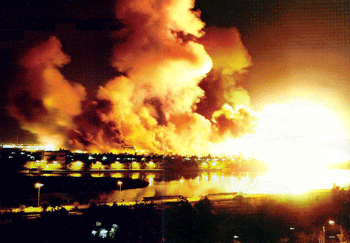
U.S. invasion of Iraq in 2003, “shock and awe”
President George W. Bush launched an illegal war against Iraq based on false pretenses, causing the deaths of hundreds of thousands of Iraqis, many of them children and other civilians.
President Bill Clinton ordered a vicious bombing campaign against the Serbian capital of Belgrade, which included intentionally targeting the Serb TV building and killing 16 civilian employees because Clinton considered the station’s news reports to be “propaganda,” i.e., not in line with U.S. propaganda.
President George H.W. Bush slaughtered scores of Panamanians who happened to live near the headquarters of the Panamanian Defense Forces and he killed tens of thousands of Iraqis, including incinerating a civilian bomb shelter in Baghdad, after he brushed aside proposals for resolving Iraq’s invasion of Kuwait peacefully. (Bush wanted a successful war as a way to rally the American people behind future foreign military operations, so, in his words, the country could kick “the Vietnam Syndrome once and for all.”)
Other U.S. presidents have had more or less blood on their hands than these recent chief executives, but it is hard to identify any modern U.S. president who has not been a “killer” in some form, inflicting death upon innocents whether as part of some “justifiable” mission or not.
But the mainstream U.S. press corps routinely adopts double standards when assessing acts by a U.S. president and those of an “enemy.” When the U.S. kills people, the mainstream media bends over backwards to rationalize the violence, but does the opposite if the killing is authorized by some demonized foreign leader.
That is now the case with Putin. Any accusation against Putin – no matter how lacking in evidence – is treated as credible and any evidence of Putin’s innocence is ridiculed or suppressed.
That was the case with a documentary that debunked claims that hedge fund accountant Sergei Magnitsky was murdered in a Russian prison because he was a whistleblower when the documentary showed that he was a suspect in a massive money-laundering scheme and died of natural causes. Although produced by a documentarian who started out planning to do a sympathetic portrayal of Magnitsky, the facts led in a different direction that caused the documentary to be shunned by the European Union and given minimal distribution in the United States.
By contrast, the ease with which Putin is called a murderer – based on “mysterious deaths” inside Russia – is reminiscent of how American right-wing groups suggested that Bill and Hillary Clinton were murderers by distributing a long list of “mysterious deaths” somehow related to the Clinton “scandals” from their Arkansas days. While there was no specific evidence connecting the Clintons to any of these deaths, the sheer number created suspicions that were hard to knock down without making you a “Clinton apologist.” Similarly, a demand for actual evidence proving Putin’s guilt in a specific case makes you a “Putin apologist.”
However, as a leader of a powerful nation facing threats from terrorism and other national security dangers, Putin is surely a “killer,” much as U.S. presidents are killers. That appears to have been President Trump’s point, that the United States doesn’t have clean hands when it comes to shedding innocent blood.
But telling such an unpleasant albeit obvious truth is not the way to gain entrance into the inner sanctum of Official Washington’s Deep State. The passwords for admission require you to say a lot of things that are patently false. Any inconvenient truth-telling earns you the bum’s rush out into the alley, even if you’re President of the United States.
Investigative reporter Robert Parry broke many of the Iran-Contra stories for The Associated Press and Newsweek in the 1980s.
US Suspends Plans to Seize Raqqa: President Trump Wants Russia to Join
By Peter KORZUN | Strategic Culture Foundation | 05.02.2017
President Donald Trump’s administration has scrapped the previous administration’s plan to take Raqqa, the de facto capital of the Islamic State (IS) group. The plan proposed a strategy of training Kurdish forces, providing them with new equipment, and helping them retake the city.
US-supplied armored vehicles have only been delivered to the Syrian Arab Coalition (a part of the Syrian Democratic Forces – SDF), which is made up of militants predominantly from local Arab areas. The Kurdish components of SDF have been denied the aid not to spoil the US relations with Turkey.
According to the Washington Post, the officials said they were dismayed that there was no provision for coordinating operations with Russia and no clear political strategy to address Turkey, a country that would be angered by the US cooperation with the Kurds, and the lack of a plan B in case the Kurdish offensive failed. They also said the plan lacked specifics on the number of troops needed for the operation.
The operation Euphrates Anger was launched by US-backed SDF in November 2016. Obviously, President Trump sets much store by cooperation with Moscow in the fight against terrorists. He faces the problem of getting Turkey on board. Russia and the US could join together as intermediaries to facilitate talks between the Kurds and Turkey.
Turkey has excellent relations with the Iraqi Kurds who could also join in any mediation effort. If progress is achieved, Washington will not let down the Syrian Kurds, cooperating with Ankara. Since January 18, Russia and Turkey, a US NATO ally, have been engaged in a joint operation to retake Al Bab.
No success is achievable without sufficient ground forces. The Kurdish formations are not enough and there is a basis for joining together – the US and Turkey see eye to eye on the idea to create safe zones in Syria. Russia has agreed to discuss the issue in principle. It’s important that the Trump team is not as adamant as the previous administration about making Syrian President Assad resign.
Michael T. Flynn, Donald Trump’s new National Security Adviser, has always been critical of Obama’s Syria policy calling it inconsistent. He has supported the idea of the US and Russia cooperating in the fight against the IS. «We have to work constructively with Russia. Whether we like it or not, Russia made a decision to be there (in Syria) and to act militarily. They are there, and this has dramatically changed the dynamic», Flynn told Der Spiegel in an interview.
President Donald Trump has stated that regime change in Syria would only cause more instability in the region. He thinks that shoring up President Assad is the most efficient way to stem the spread of terrorism. According to Mr. Trump’s statements, he would weigh an alliance with Russia against Islamic State militants.
On January 28, the president ordered military leaders to give him a report in 30 days that outlines a new strategy for defeating the IS. The document is expected to include recommendations on changes to military actions, diplomacy, coalition partners, mechanisms to cut off or seize the group’s financial support and a way to pay for the strategy.
The president charged Defense Secretary James Mattis with developing a plan with the help of the secretaries of State, Treasury and Homeland Security, the director of national intelligence, the chairman of the Joint Chiefs of Staff, the assistant to the president for national security affairs and the assistant to the president for homeland security and counterterrorism.
The order was signed hours after speaking to Russian President Vladimir Putin on the phone – the first call between the leaders since Donald Trump took office. Mr. Putin emphasized that «for over two centuries Russia has supported the United States, was its ally during the two world wars, and now sees the United States as a major partner in fighting international terrorism».
With Donald Trump in office, a deal on coordinating activities is reachable. Joint operations to retake Raqqa would be a good start. The zones of influence and mutual obligations could be defined. Russia is ready to cooperate with the US during the operation to retake Raqqa. Last October, it was reported that Moscow planned to discuss the issue with the US officials.
Joining together, the parties could gradually move forward within the framework of Astana process and the UN-brokered talks to be revived in Geneva this month. The cooperation between Russia and the US is key to achieving progress in the Syria’s crisis management. It could spread to other areas of the bilateral relationship.
Actually, an offensive to liberate Raqqa is impossible without coordinating activities with Moscow. Russia, the US and Turkey are the pivotal actors in the conflict. The operation to retake Raqqa must be conducted with the consent of Syria’s government. It is hard to imagine the US and Turkey discussing the issue with the government of Bashar Assad. Russia is perfectly suited to be a mediator.
And what comes next after Raqqa is retaken? Who and under what authority will govern? With the pertinent actors involved in the conflict holding different, even opposite, visions of the country’s future, there will have to be international presence and agreement on what to do next.
The cooperation between Russia, the US and Turkey during the battle for Raqqa could become a start of wider process with diplomacy given a chance. It could also become a start of Russia-US cooperation in Syria and other countries where the IS has presence.
Trump administration fails to back Ukraine
By Alexander Mercouris | The Duran | February 5, 2017
Though the White House has not yet published on its website a readout of US President Trump’s telephone conversation on Saturday with Ukrainian President Poroshenko, it is clear that it did not contain the strong support for Ukraine Poroshenko must have been looking for.
The conversation took place against the backdrop of intense fighting between the Ukrainian military and the eastern Ukrainian militia around the town of Avdeevka in eastern Ukraine.
The White House is reporting that Trump said to Poroshenko the following
We will work with Ukraine, Russia, and all other parties involved to help them restore peace along the border
This comment contains no criticism of Russia, it does not accuse Russia of initiating the fighting, and it makes no reference to “Russian aggression”. Nor does it make any strong statement of support for Ukraine.
This has been the consistent pattern of Donald Trump’s statements to European leaders since he became US President.
Donald Trump has now met with British Prime Theresa May and German Vice-Chancellor Sigmar Gabriel, and he has had telephone conversations with German Chancellor Angela Merkel and French President Francois Hollande.
If the White House readouts of these these conversations are to be believed, in not one of them has he said anything about Russia committing aggression in Ukraine. His most substantive discussion of Ukraine with any European leader was his one with German Chancellor Merkel. Here is the White House’s summary of the conversation
President Trump and Chancellor Merkel today held an extensive telephone conversation covering a range of issues, including NATO, the situation in the Middle East and North Africa, relations with Russia, and the Ukraine crisis. Both leaders affirmed the importance of close German-American cooperation to our countries’ security and prosperity and expressed their desire to deepen already close German-American relations in the coming years.
Not only does this summary separate the issue of the “Ukraine crisis” from the question of “relations with Russia” – an idea that totally overturns the Western foreign policy orthodoxy of the last three years – but it lumps the “Ukraine crisis” – supposedly (according to Western leaders) the biggest crisis in Europe since the end of the Second World War – with those of the Middle East and North Africa, whilst mentioning it last in a way that seems to give it the least priority.
Contrary to what many are saying, I do not see any significant difference between Trump and other US officials on this issue.
In the hours following President Trump’s conversation with Poroshenko, Vice President Pence – often regarded as an anti-Russia hawk – appeared on ABC News’ “This Week”. Here is how Bloomberg sums up what he said
We’re watching,” Pence said on ABC. “And very troubled by the increased hostilities over the past week in eastern Ukraine.”
Pence noted that Trump spoke about Ukraine with Russian President Vladimir Putin on Jan. 28. He said the question of whether sanctions on Russia remain in place if it continues to violate the cease-fire in Ukraine will depend on Russia’s actions and the opportunity to work together on matters such as defeating Islamic State.
“It just simply all depends on whether or not we see the kind of changes in posture by Russia and the opportunity perhaps to work on common interests
(bold italics added)
Again this is scarcely a resounding denunciation of Russia – such as might once have been expected from Obama administration officials – and it even appears to link the possibility of lifting the sanctions to Russia’s cooperation in fighting the Islamic State.
What of the statement made by US ambassador Nikki Haley to the UN Security Council, which is being widely reported as contradicting Donald Trump’s position, and which is supposed to have contained a stern denunciation of Russia?
In my opinion this interpretation is wrong, and to show why I herewith provide Nikki Haley’s full statement, which I shall then analyse
Thank you, Mr. President. Thank you, Under-Secretary-General Feltman, Under-Secretary-General O’Brien, and Ambassador Apakan for your useful and comprehensive briefings today.
This is my first appearance in this chamber as the Permanent Representative of the United States. It is an immense honor for me to sit behind the United States placard and to follow in the footsteps of so many giants of American diplomacy. It is humbling to be part of a body whose responsibility is nothing less than maintaining international peace and security. I look forward to working closely with each of you on this Council. The United States is determined to push for action. There is no time to waste.
I consider it unfortunate that the occasion of my first appearance here is one in which I must condemn the aggressive actions of Russia. It is unfortunate because it is a replay of far too many instances over many years in which United States Representatives have needed to do that. It should not have to be that way. We do want to better our relations with Russia. However, the dire situation in eastern Ukraine is one that demands clear and strong condemnation of Russian actions.
The sudden increase in fighting in eastern Ukraine has trapped thousands of civilians and destroyed vital infrastructure. And the crisis is spreading, endangering many thousands more. This escalation of violence must stop.
The United States stands with the people of Ukraine, who have suffered for nearly three years under Russian occupation and military intervention. Until Russia and the separatists it supports respect Ukraine’s sovereignty and territorial integrity, this crisis will continue.
Eastern Ukraine, of course, is not the only part of the country suffering because of Russia’s aggressive actions. The United States continues to condemn and call for an immediate end to the Russian occupation of Crimea. Crimea is a part of Ukraine. Our Crimea-related sanctions will remain in place until Russia returns control over the peninsula to Ukraine. The basic principle of this United Nations is that states should live side by side in peace.
There is a clear path to restoring peace in eastern Ukraine: full and immediate implementation of the Minsk agreements, which the United States continues to support. For the people in eastern Ukraine, the stakes are high. With each passing day, more people are at risk of freezing to death, or dying from a mortar blast.
The United States calls on Russia and the combined Russian-separatist forces to fulfill their commitments in the Minsk agreements and fully restore and respect the ceasefire. The Minsk agreements require the disengagement of forces and withdrawal of heavy weapons from both sides of the contact line. This is the formula for a sustainable ceasefire. Pulling back forces and taking heavy weapons out of this area will save lives. The Organization for Security and Cooperation in Europe Special Monitoring Mission must also be granted full, unfettered access. The presence of OSCE monitors can help calm tensions.
Cooperation on this issue is possible. Earlier this week, both Russia and Ukraine supported this Council’s unanimous call to return to a ceasefire. It was the first time in years that this Council was able to come together on Ukraine. The parties on the ground should heed this signal and hold their fire. The United States expects that those who can influence the groups that are fighting – in particular, Russia – will do everything possible to support an end to this escalation of violence. Thank you.
(bold italics added)
This is a very different statement from the one which might have expected from someone like Samantha Power.
It says that the US wants better relations with Russia. It does not say that Russia or the eastern Ukrainian militia started the latest fighting. It calls for full implementation of the Minsk Accords, which (as everyone knows) Ukraine is not implementing. Lastly it calls for heavy weapons to be removed from “both sides of the contact line”, when everyone knows it was Ukraine’s decision to violate this provision by moving heavy weapons into the buffer zone (which includes Avdeevka) which caused the latest fighting.
As for the criticisms of Russia, not only do these have a ritual quality – with Haley simply repeating what is still official US policy – but she actually says she regrets having to do it. Moreover it is difficult to avoid reading Haley’s comment about her having to do it being “unfortunate because it is a replay of far too many instances over many years in which United States Representatives have needed to do that” as being anything other than a veiled reference to Samantha Power, with the clear implication being that Haley wants to be different from her.
Lest anyone think that I am alone in reading Haley’s statement in this way, I should say that no less a person than Vitaly Churkin, Russia’s ambassador to the UN, who was physically present in the Security Council chamber when Haley read her statement, is of the same view.
Immediately following the UN Security Council meeting on Thursday where Haley read out her statement, Churkin said that he had noted “a tangible change of tone”, and said that he found Haley “friendly enough, with the allowances for the circumstances and the subject.”
Churkin and Haley then met on the following day. Interestingly, it was Haley who went to see Churkin, not the other way round. The report of the meeting provided by the Russian news agency TASS reads as follows
Russia’s UN envoy Vitaly Churkin has held the first meeting with his newly-appointed US counterpart Nikki Haley. As the Russian missions’ spokesman Fyodor Strzhizhovsky said, Churkin and Haley agreed to maintain close cooperation in accordance with Moscow’s and Washington’s intentions. “The Russian envoy received Nikki Haley at his residence. Both sides expressed the intention to cooperate tightly within the United Nations in accordance with their respective capitals’ intentions,” he said.
(bold italics added)
The talk about “close” and “tight” cooperation “within the United Nations” suggests discussion about jointly sponsored Resolutions aimed at defeating Jihadi terrorism and ISIS, which is quite clearly the new administration’s priority.
Of course this is all very tentative. The difficulties in the way of a detente between the US and Russia are so great they may prove insurmountable. The opponents of such a detente are legion, and they have not gone away. Besides it is far from clear upon what terms Trump wants such a detente, and whether they are terms the Russians feel able to concede to him.
However it is wrong to say that on this subject the new administration is not speaking with one voice. On the contrary all its senior officials – including of course most importantly President Trump himself – are saying they want a detente with Russia, and all the administration’s statements – including Trump’s in his telephone call with Poroshenko, and Haley’s in her statement to the UN Security Council – suggest the new administration wants to put the Ukrainian crisis behind it so that it can concentrate on the fight against Jihadi terrorism and ISIS, for which it obviously feels it needs Russia’s help.
Is Trump Unpredictable? The View from Russia – 2
By Elena PONOMAREVA | Strategic Culture Foundation | 03.02.2017
With Trump’s arrival in the White House, European leaders were the first to talk of «a new historical era» (Angela Merkel) and the fact that «the old world of the 20th century is over» (Frank-Walter Steinmeier). The alarmism running through these statements is fuelling discussions about the uncertainty and unpredictability of the new American president. In my view, however, judgements on his «unpredictability» should be tempered slightly. At the very least because if a political entity is «unpredictable» and everything surrounding it suddenly becomes uncertain, then one can easily imagine that planning would be impossible, leaving nothing to do but wait and see what Trump is going to do next and then react. Ultimately, this way of thinking will prevent countries from developing their own national strategies.
If there is any «unpredictability» with regard to Trump, then it is only in comparison with the White House’s previous policies, which the new administration will not be pursuing. When Richard Nixon was impeached, it heralded a creeping coup d’etat that resulted in supporters of cosmopolitan finance capital coming to power in the US. Over the past quarter of a century, the interests of American banksters have brought about the large-scale demolition of industry and the middle class in their own country. A huge number of Americans with links to the real economy were never going to be happy with such a state of affairs, and this is where the interests of certain groups of manufacturers coincided with the interests of parts of the middle class and skilled workers. Trump’s arrival in the White House is a victory for this group of manufacturers and workers and is seriously changing the rules of the game that have existed for almost forty years. And in this sense, Trump’s victory could be considered revolutionary.
At the same time, however, Trump’s rhetoric and his ‘soothing’ remarks should not be idealised for a number of reasons.
Firstly, whatever extraordinary personal qualities the president may have, the US political system is designed in such a way that he needs the support of its major segments. Trump is not an island; he is a man of the system, or, to be more precise, a certain part of it. Only «collective Trump» was able to become the president of the United States. Wealth and connections are an indispensable part of big politics and if these are used to achieve supreme power, then this supreme power will, in turn, be used to serve the interests of all those who helped the rise of a new political star.
Secondly, by promoting ‘their’ presidential candidate, stakeholders already have a strategy, a plan of action, the audit results of resources and capabilities. What’s more, domination and influence are primarily ideas that produce money and galvanise other resources. Trump’s team has such ideas. They are balanced and well thought out and show the new US president’s ‘business approach’ to politics. And, equally importantly, Donald Trump is committed. Unlike Barack Obama, Hillary Clinton and other hired managers of the ‘global elite’, he is sure that he’s right.
Thirdly, the laws governing the development of society, the class struggle, and social solidarity are still in place. As the richest president ever, Trump will not indulge in altruism or hand out money on the streets. His goal is to streamline economic and political institutions, which he’s already doing. The world views he expressed in his inauguration speech are acquiring clear outlines.
Among the recent news stories demonstrating his readiness to back up his words with deeds is his decision to introduce a tax on Mexican oil. This looks like the protection of domestic oil producers with a view to revolutionising the offshore oil and gas sectors. And let it contradict the rules of ‘free trade’ – for Trump and those who brought him to power, these rules mean absolutely nothing. The most important thing is to revitalise the US economy and improve the country’s industrial capacity.
By combining nationalism and protectionism, prioritising America’s internal problems, and appealing to labourers, blue collar workers and America’s Rust Belt, Trump is building on the authority of America’s seventh president, Andrew Jackson (who, incidentally, was the founder of the Democratic Party). Jackson’s ideology and policies are fundamentally different from the Wilsonian principles so dear to those in charge of the Federal Reserve System (it’s no coincidence that America’s 28th president, Woodrow Wilson, who is quite rightly considered to be the founder of the liberal world order project, is on America’s biggest bank note ($100,000)).
By following in Jackson’s footsteps, Trump is putting national interests rather than global leadership at the heart of his policies, and this is an interesting point that will not necessarily coincide with the interests of Russia and may actually go against them. During his inauguration speech, Trump said: «We will seek friendship and goodwill with the nations of the world, but we do so with the understanding that it is the right of all nations to put their own interests first. We do not seek to impose our way of life on anyone, but rather to let it shine as an example for everyone to follow». These words are worth thinking about.
Fourthly, the respected American analyst Edward Luttwak is convinced that the emergence of a politician like Trump was a reaction to what went before and was 90% unavoidable.
In fact, much of what went before has led to catastrophic changes in global politics. Anti-modern forces have replaced secular regimes in the Muslim world. The strategy of ‘controlled chaos’ chosen by the Democrats has not only helped destroy secular states, but has also given rise to anti-system forces where aggression and destruction, archaism and barbarity have infiltrated Europe along with hundreds of thousands of refugees who no longer have borders. With his global expansion policy, Obama drove the European Union into a trap and contributed to its weakening and imbalance. The split within the American elite and the support for Trump are largely down to a reluctance to repeat Europe’s experience. Hence the tough anti-immigration rhetoric and the new administration’s desire to destroy the Islamic State. That’s on the one hand.
On the other, «collective Trump» knows all too well that expansion does not just bear fruit in the form of military bases, a vassal mentality in the leaders of other countries, cheap goods, and the triumph of the dollar on all continents. Expansion is also a heavy burden that threatens to tear such forces apart. A little breathing space is needed to make a breakthrough and «shine as an example for everyone». Efforts need to be concentrated and regrouped and resources need to be optimised. The entire history of the US has been an alternation of two trends: a period of expansion, of enlargement (under the Democrats Wilson, Roosevelt, Truman and Kennedy) followed by a period of ‘contraction’, of concentration (under the Republicans, with the exception of George W Bush).
Trump as a reaction to what went before is, above all, this much-needed breathing space; it is America focussing on its internal problems; it is a period to digest what has been eaten. Trump’s America could be regarded as America getting ready for a new leap, for new heights. Hence its focus on its own internal problems. This focus is temporary, however. There is no point in portraying Trump as an isolationist. He will implement a foreign policy that will strengthen the US and there are a number of ways that this could happen. By weakening the European Union and China, for example, or by abandoning an active policy towards Ukraine. Ukraine had already become an old suitcase without handles for the Obama administration – difficult to carry, but a shame to throw away. Getting rid of something in politics is the same as losing face, but Trump is not in danger of losing face – he can easily swap Ukraine for other options.
As far as Russia is concerned, Trump’s arrival mostly opens a window of opportunity. While the US digests its thick broth of globalisation, brought to the boil by Obama, Russia will be able to solve a few of its own problems. The most important thing is that it has a clear understanding of these problems, and a clear understanding of America’s new strategy. And with such an understanding, there will be no «unpredictability».
See also:
The New Trump Administration – a New Strategy or a New Paradigm? The View from Russia – 1
Zionist Regime Plays down White House Comments on Settlements
Al-Manar – February 3, 2017
A senior Israeli official played down Friday remarks from the White House that building new or expanding existing settlements in the occupied Palestinian territories “may not be helpful” in securing peace.
In an apparent break from President Donald Trump’s previously full-throated support of settlements building, White House spokesman Sean Spicer told reporters on Thursday that the new administration hadn’t yet taken an official position on settlements.
Responding Friday, Israeli ambassador to the United Nations Danny Danon said Spicer’s comments didn’t amount to “a U-turn”.
“The statement is very clear and essentially means: wait for the meeting with (Israeli) Prime Minister (Benjamin) Netanyahu, who is arriving in Washington in less than two weeks to meet President Trump, and then we’ll determine our policy,” Danon told Israeli public radio.
The Zionist entity has now approved more than 6,000 settler units since Trump took office having signaled a softer stance on settlement construction than predecessor Barack Obama.
“While we don’t believe the existence of settlements is an impediment to peace, the construction of new settlements or the expansion of existing settlements beyond their current borders may not be helpful,” Spicer said on Thursday.
Trump is scheduled to welcome Netanyahu to the White House on February 15.
Featured Video

Rewriting the risk? Inside the government’s vaccine safety messaging
or go to
Aletho News Archives – Video-Images
Book Review
“Davos Can Really Replace the UN”
Inside the book that maps the architecture behind global governance — from the Epstein files to the Pact for the Future
Lies are Unbekoming | April 1, 2026
On June 13, 2019, the United Nations and the World Economic Forum signed a partnership deal to “accelerate the implementation of the 2030 Agenda for Sustainable Development.” That same evening, WEF president Börge Brende — Norway’s former Foreign Minister — had dinner with Jeffrey Epstein at Epstein’s Manhattan townhouse. The Epstein files, released January 2026, contain an exchange between the two from the previous year. Epstein to Brende: “Davos can really replace the UN. C21, cyber, crypto . genetics… intl coordination.” Brende back to Epstein: “Exactly — we need a new global architecture. World Economic Forum (Davos) is uniquely positioned — public private.”
The next day, the UN General Assembly adopted the framework for restructuring global governance.
That sequence — the partnership signing, the Epstein dinner, the candid admission about replacing the UN with a public-private architecture, and then the formal adoption — opens Jacob Nordangård’s The Digital World Brain. Pages two and three. Footnoted to the UN resolution number, the Epstein files, and the General Assembly record.
I keep coming back to it because it captures what this book does that almost nothing else in the independent research space manages. I’ve followed Jacob’s work for years now and interviewed him about his research. Each book peels back another layer of the same institutional architecture, and each time I think he’s reached the limit of what can be documented, the next one goes further. Nordangård doesn’t speculate. He doesn’t editorialize much. He lays institutional actions next to each other in chronological order and lets the pattern announce itself. … continue
Blog Roll
 Aletho News
- How I fell foul of the BBC thought police
- The End of NATO
- 37 days of war on Iran cost US staggering $42bln, tracker shows
- Baghdad tells Asian refiners, traders to begin loading Iraqi crude amid Iranian exemption
- Under fire, Moscow and Tehran close ranks
- Iran, US receive Pakistan-mediated plan for ceasefire then final deal
- Iran submits demands for end to war as mediators scramble ahead of Trump deadline
- Iran Threatens Retaliatory Strike on Stargate AI Project in UAE
- US sent ‘a lot’ of arms to Iranian protesters – Trump
- Barak Ravid Launders Deception To Allow Trump To Back Off Of His Power Plant Threat – Again
- If Americans Knew
- U.N. experts demand Israel release prominent Gaza doctor after reports of ‘severe torture’
- Israel’s Latest Genocide Is Against the Shias of Lebanon. Why Is the World Silent?
- How Eliot Cohen’s influence over U.S. war-making paved the way for Trump’s war crimes in Iran
- Israelis don’t pay for the weapons we ‘sell’ to them — US taxpayers do
- While Distancing from AIPAC, Most 2028 Democratic Hopefuls Are Still Embracing Israel
- A brief history of the Israeli nuclear program, the open secret at the heart of the Iran war
- Israeli Settlers Killed a Palestinian Farmer on His Own Land, in Front of His Father. Yes, Again
- The US-Israeli War on Science is an Assault on our Future
- 100+ International Law Experts Say US Strikes on Iran Violate UN Charter, Could Be War Crimes
- ‘Vile, Horrifying, Evil’: Trump Threatens to Bomb Nation of 90 Million People ‘Back to the Stone Ages’
- No Tricks Zone
- An Inconvenient Tree: Uncovered In Alps… Europe Much Warmer Than Today 6000 Years Ago
- New Study Reports A 60% Slowdown In Greenland’s Ice Loss Rate In The Last Decade
- Low Intensity Tornado Wrecks Major Solar Farm, Creating A Potential Toxic Dump
- New Study Finds Warming Saves Lives…Cold Temperatures 12 Times More Deadly Than Excess Heat
- German Science Blog Accuses PIK Climate Institute Of Hallucinating Climate Tipping Points
- Devastating Assessment Of Comirnaty Vaccine By Former Senior Pfizer Europe Toxicologist
- New Study: CO2 Is ‘Effectively Negligible’ As An Explanatory Climate Change Factor Since 2000
- Former Pfizer Toxicologist Dr. Helmut Sterz Tells Bundestag Hearing Pfizer Vaccine Should Have Never Been Approved
- Energy Expert: Germany’s Nuclear Phaseout Was A “500 Billion Euro Mistake”
- New Research: South Australia’s Mid-Holocene Sea Surface Temperatures Were 4°C Warmer Than Today
 Aletho News