Trump, Kennedy, and the Russia Collusion Delusion
By Jacob G. Hornberger | FFF | July 15, 2020
President Trump’s commutation of Roger Stone’s jail sentence has brought the Russia collusion delusion back into the limelight.
Special prosecutor (and former FBI Director) Robert Mueller, the lawyer in charge of conducting an in-depth investigation into whether Trump colluded with the Russians to win the 2016 presidential election, immediately fired a salvo against Trump’s commutation in an op-ed defending his investigation that was published in the Washington Post.
Mueller’s op-ed was then followed by an op-ed by one of his senior prosecutors, Andrew Weismann, in yesterday’s New York Times, which called for summoning Stone before a grand jury to force him to tell the truth about why he lied. Weissmann’s idea is that if Stone fails to tell the truth again, he should again be prosecuted and punished for perjury, preferably after Trump is defeated in November.
What about Clapper?
Mueller and Weissmann can wax eloquent all they want about the importance of testifying truthfully to Congress or federal investigators. But their words ring hollow given what happened to James R. Clapper Jr., the former director of national intelligence. He knowingly, deliberately, and intentionally testified falsely to Congress about the mass secret surveillance that the NSA was conducting on the American people. U.S. prosecutors turned a blind eye toward his perjury and did nothing to indict or prosecute him. Why go after Stone (or, for that matter, Martha Stewart) and do nothing against Clapper?
The Russia collusion delusion
What is really going on here? It’s the Russia collusion delusion that is at the center of this entire controversy. Mueller, Weissmann, and their Inspector Clouseau cohorts were convinced from the beginning that there was a conspiracy between Donald Trump and the Russians to rig the U.S. presidential election in favor of Trump. Even worse, they, along with members of the FBI and the national-security establishment, obviously convinced themselves that as part of the deal, Trump may well have become an unregistered covert agent of the Russian government.
Anyone who thinks that the U.S. Cold War mindset ended with the dismantling of the Soviet Union in 1989 is loving in la la land. Sure, the Berlin Wall came crashing down, Soviet troops withdrew from Eastern Europe, and the Warsaw Pact and the Soviet Union dismantled. But the anti-Soviet, anti-Russian mindset that afflicted U.S. officials for 45 years, especially those in the national-security establishment, never disappeared. As long as Russia has maintained a sense of independence from U.S. control, it has continued to be considered a grave threat to U.S. “national security.”
The fact is that the U.S. national-security establishment — or what President Eisenhower referred to as the military-industrial-congressional complex — will never permit a U.S. president to establish normal and friendly relations with Russia. And any president who does so will automatically be considered suspect, just as Trump has been. If he goes too far in that direction, he runs the risk of being considered a grave threat to “national security.”
Kennedy: a threat to “national security?
That is, of course, what happened with President Kennedy. After the Cuban Missile Crisis, he made no bones about it. He threw the gauntlet down to the U.S. national security establishment. In his famous Peace Speech at American University 3 1/2 months before he was assassinated, he suddenly announced that he was declaring an end to the Cold War. He also stated that he intended to establish a relationship of peaceful co-existence with the Soviet Union and the communist world. He told the audience and the world that despite philosophical differences, there was no reason why America and Russia could not work together with a peaceful and friendly relationship. He then entered into secret personal negotiations to that end with Soviet Premier Nikita Khrushchev.
As part of his plan, Kennedy announced a partial withdrawal of U.S. troops from Vietnam. He told aides that as soon as he won the 1964 election, he would pull out the rest. He also entered into a nuclear test-ban treaty with the Soviets. He proposed a joint trip to the moon, which would have meant sharing rocket technology with the Soviets. It doesn’t take a rocket scientist to figure out what the next logical step was going to be — the dismantling of the Cold War apparatus and a restoration of a limited-government republic.
Imagine how all of that went over with the U.S. national-security establishment, which was already convinced that there was a communist conspiracy based in Moscow to take over the world, including the United States. The notion that the free world could live in peaceful harmony with the communist world was considered naive folly at best and treason at worst. In the eyes of the U.S. national security establishment, ending the Cold War, which likely would have led to the dismantling of the U.S. national security state, was equivalent to simply surrendering the United States to the communists.
After all, don’t forget that this was the very reason why the U.S. government was converted after World War II into a national-security state — to enable U.S. officials to exercise the same omnipotent, dark-side powers employed by the communists in order to prevent their supposed conspiracy from succeeding.
Don’t forget also that sympathy and empathy with communism or the Russians was precisely the reason U.S. national-security state officials initiated regime change operations against foreign presidents and prime ministers both before and after the Kennedy assassination: Mossadegh in Iran, Arbenz in Guatemala, Lumumba in Congo, Castro in Cuba, and Allende in Chile.
How could U.S. national-security state officials just ignore a U.S. president who suddenly had become a threat to national security, a much graver threat in fact than the foreign officials they had ousted from power in regime-change operations.
Given their conviction that Kennedy’s actions were going to result in a communist takeover of the United States, what were U.S. officials supposed to do — just let it happen? For all they knew, Kennedy had become a covert agent of the Soviets, just as U.S. officials in our time have become convinced that Trump became a covert agent of the Russians.
What Kennedy was doing was certainly not an impeachable offense, and so they couldn’t remove him from office that way, as they tried to do with Trump. Moreover, it was clear that Kennedy would almost certainly defeat Barry Goldwater in the 1964 election.
What to do? Follow the Constitution and let America fall to the communists? Or do here in the United States what had to be done in Iran, Guatemala, Congo, Cuba, and Chile to protect “national security”?
See also:
JFK’s War with the National Security Establishment: Why Kennedy Was Assassinated by Douglas Horne
The Kennedy Autopsy by Jacob Hornberger
The Kennedy Autopsy 2: LBJ’s Role in the Assassination by Jacob Hornberger
Regime Change: The JFK Assassination by Jacob Hornberger
The CIA, Terrorism, and the Cold War: The Evil of the National Security State by Jacob Hornberger
CIA & JFK: The Secret Assassination Files by Jefferson Morley
“The National Security State and JFK,” a FFF conference featuring Oliver Stone and ten other speakers
“Altered History: Exposing Deceit and Deception in the JFK Assassination Medical Evidence,” a five-part video by Douglas P. Horne
“The JFK Assassination,” a video series by Jacob Hornberger
How an Israeli Spy-Linked Tech Firm Gained Access to the US Gov’t’s Most Classified Networks
By Whitney Webb |
Unlimited Hangout| July 15, 2020
If the networks of the U.S. military, the U.S. intelligence community and a slew of other U.S. federal agencies were running the software of a company with deep ties, not only to foreign companies with a history of espionage against the U.S. but also foreign military intelligence, it would — at the very least — garner substantial media attention. Yet, no media reports to date have noted that such a scenario exists on a massive scale and that the company making such software recently simulated the cancellation of the 2020 election and the declaration of martial law in the United States.
Earlier this month, MintPress News reported on the simulations for the U.S. 2020 election organized by the company Cybereason, a firm led by former members of Israel’s military intelligence Unit 8200 and advised by former top and current officials in both Israeli military intelligence and the CIA. Those simulations, attended by federal officials from the FBI, DHS and the U.S. Secret Service, ended in disaster, with the elections ultimately canceled and martial law declared due to the chaos created by a group of hackers led by Cybereason employees.
The first installment of this three part series delved deeply into Cybereason’s ties to the intelligence community of Israel and also other agencies, including the CIA, as well as the fact that Cybereason stood to gain little financially from the simulations given that their software could not have prevented the attacks waged against the U.S.’ electoral infrastructure in the exercise.
Also noted was the fact that Cybereason software could be potentially used as a backdoor by unauthorized actors, a possibility strengthened by the fact that the company’s co-founders all previously worked for firms that have a history of placing backdoors into U.S. telecommunications and electronic infrastructure as well as aggressive espionage targeting U.S. federal agencies.
The latter issue is crucial in the context of this installment of this exclusive MintPress series, as Cybereason’s main investors turned partners have integrated Cybereason’s software into their product offerings. This means that the clients of these Cybereason partner companies, the U.S. intelligence community and military among them, are now part of Cybereason’s network of more than 6 million endpoints that this private company constantly monitors using a combination of staff comprised largely of former intelligence operatives and an AI algorithm first developed by Israeli military intelligence.
Cybereason, thus far, has disclosed the following groups as lead investors in the company: Charles River Ventures (CRV), Spark Capital, Lockheed Martin and SoftBank. Charles River Ventures (CRV) was among the first to invest in Cybereason and has been frequently investing in other Israeli tech start-upsthat were founded by former members of the elite Israeli military intelligence Unit 8200 over the last few years. Spark Capital, based in California, appears to have followed CRV’s interest in Cybereason since the venture capitalist who co-founded Spark and led its investment in Cybereason is a former CRV partnerwho still has close ties to the firm.
While CRV and Spark Capital seem like just the type of investors a company like Cybereason would attract given their clear interest in similar tech start-ups coming out of Israel’s cyber sector, Cybereason’s other lead investors — Lockheed Martin and SoftBank — deserve much more attention and scrutiny.
Cybereason widely used by US Government, thanks to Lockheed
“A match made in heaven,” trumpeted Forbes at the news of the Lockheed Martin-Cybereason partnership, first forged in 2015. The partnership involved not only Lockheed Martin becoming a major investor in the cybersecurity company but also in Lockheed Martin becoming the largest conduit providing Cybereason’s software to U.S. federal and military agencies.
Indeed, as Forbes noted at the time, not only did Lockheed invest in the company, it decided to integrate Cybereason’s software completely into its product portfolio, resulting in a “model of both using Cybereason internally, and selling it to both public and private customers.”
Cybereason CEO and former offensive hacker for Israeli military intelligence — Lior Div — said the following of the partnership:
Lockheed Martin invested in Cybereason’s protection system after they compared our solution against a dozen others from the top industry players. The US firm was so impressed with the results they got from Cybereason that they began offering it to their own customers – among them most of the top Fortune 100 companies, and the US federal government. Cybereason is now the security system recommended by LM to its customers for protection from a wide (sic) malware and hack attacks.”
Rich Mahler, then-director of Commercial Cyber Services at Lockheed Martin, told Defense Daily that the company’s decision to invest in Cybereason, internally use its software, and include the technology as part of Lockheed Martin’s cyber solutions portfolio were all “independent business decisions but were all coordinated and timed with the transaction.”
How independent each of those decisions actually was is unclear, especially given the timing of Lockheed Martin’s investment in Cybereason, whose close and troubling ties to Israeli intelligence as well as the CIA were noted in the previous installment of this investigative series. Indeed, about a year prior to their investment in the Israeli military intelligence-linked Cybereason, Lockheed Martin opened an office in Beersheba, Israel, where the IDF has its “cyberhub”. The office is focused not on the sales of armaments, but instead on technology.
Marilyn Hewson, Lockheed Martin’s CEO, said the following during her speech that inaugurated the company’s Beersheba office:
The consolidation of IDF Technical Units to new bases in the Negev Desert region is an important transformation of Israel’s information technology capability… We understand the challenges of this move. Which is why we are investing in the facilities and people that will ensure we are prepared to support for these critical projects. By locating our new office in the capital of the Negev we are well positioned to work closely with our Israeli partners and stand ready to: accelerate project execution, reduce program risk and share our technical expertise by training and developing in-country talent.”
Beersheba not only houses the IDF’s technology campus, but also the Israel National Cyber Directorate, which reports directly to Israel’s Prime Minister, as well as a high-tech corporate park that mostly houses tech companies with ties to Israel’s military intelligence apparatus. The area has been cited in several media reports as a visible indicator of the public-private merger between Israeli technology companies, many of them started by Unit 8200 alumni, and the Israeli government and its intelligence services. Lockheed Martin quickly became a key fixture in the Beersheba-based cyberhub.
Not long before Lockheed began exploring the possibility of opening an office in Beersheba, the company was hacked by individuals who used tokens tied to the company, RSA Security, whose founders have ties to Israel’s defense establishment and which is now owned by Dell, a company also deeply tied to the Israeli government and tech sector. The hack, perpetrated by still unknown actors, may have sparked Lockheed’s subsequent interest in Israel’s cybersecurity sector.
Soon after opening its Beersheba office, Lockheed Martin created its Israel subsidiary, Lockheed Martin Israel. Unlike many of the company’s other subsidiaries, this one is focused exclusively on “cybersecurity, enterprise information technology, data centers, mobile, analytics and cloud” as opposed to the manufacture and design of armaments.
Haden Land, then-vice president of research and technology for Lockheed Martin, told the Wall Street Journal that the creation of the subsidiary was largely aimed at securing contracts with the IDF and that the company’s Israel subsidiary would soon be seeking partnership and investments in pursuit of that end. Land oversaw the local roll-out of the company’s Israel subsidiary while concurrently meeting with Israeli government officials. According to the Journal, Land “oversees all of Lockheed Martin’s information-systems businesses, including defense and civilian commercial units” for the United States and elsewhere.
Just a few months later, Lockheed Martin partnered and invested in Cybereason, suggesting that Lockheed’s decision to do so was aimed at securing closer ties with the IDF. This further suggests that Cybereason still maintains close ties to Israeli military intelligence, a point expounded upon in great detail in the previous installment of this series.
Thus, it appears that not only does Lockheed Martin use Cybereason’s software on its own devices and on those it manages for its private and public sector clients, but it also decided to use the company’s software in this way out of a desire to more closely collaborate with the Israeli military in matters related to technology and cybersecurity.
The cozy ties between Lockheed Martin, one of the U.S. government’s largest private contractors, and the IDF set off alarm bells, then and now, for those concerned with U.S. national security. Such concern makes it important to look at the extent of Cybereason’s use by federal and military agencies in the United States through their contracting of Lockheed Martin’s Information Technology (IT) division. This is especially important considering Israeli military intelligence’s history of using espionage, blackmail and private tech companies against the U.S. government, as detailed here.
While the exact number of U.S. federal and military agencies using Cybereason’s software is unknown, it is widespread, with Lockheed Martin’s IT division as the conduit. Indeed, Lockheed Martin was the number one IT solutions provider to the U.S. federal government up until its IT division was spun off and merged with Leidos Holdings. As a consequence, Leidos is now the largest IT provider to the U.S. government and is also directly partnered with Cybereason in the same way Lockheed Martin was. Even after its IT division was spun off, Lockheed Martin continues to use Cybereason’s software in its cybersecurity work for the Pentagon and still maintains a stake in the company.
The Leidos-Lockheed Martin IT hybrid provides a litany of services to the U.S. military and U.S. intelligence. As investigative journalist Tim Shorrock noted for The Nation, the company does “everything from analyzing signals for the NSA to tracking down suspected enemy fighters for US Special Forces in the Middle East and Africa” and, following its merger with Lockheed and consequential partnership with Cybereason, became “the largest of five corporations that together employ nearly 80 percent of the private-sector employees contracted to work for US spy and surveillance agencies.” Shorrock also notes that these private-sector contractors now dominate the mammoth U.S. surveillance apparatus, many of them working for Leidos and — by extension — using Cybereason’s software.
Leidos’ exclusive use of Cybereason software for cybersecurity is also relevant for the U.S. military since Leidos runs a number of sensitive systems for the Pentagon, including its recently inked contract to manage the entire military telecommunications infrastructure for Defense Information Systems Agency (DISA). In addition to maintaining the military telecom network, Cybereason is also directly partnered with World Wide Technologies (WWT) as of this past October. WWT manages cybersecurity for the U.S. Army, maintains DISA’s firewalls and data storage as well as the U.S. Air Force’s biometric identification system. WWT also manages contracts for NASA, itself a frequent target of Israeli government espionage, and the U.S. Navy. WWT’s partnership is similar to the Lockheed/Leidos partnership in that Cybereason’s software is now completely integrated into its portfolio, giving the company full access to the devices on all of these highly classified networks.
Many of these new partnerships with Cybereason, including its partnership with WWT, followed claims made by members of Israel’s Unit 8200 in 2017 that the popular antivirus software of Kaspersky Labs contained a backdoor for Russian intelligence, thereby compromising U.S. systems. The Wall Street Journal was the first to report on the alleged backdoor but did not mention the involvement of Unit 8200 in identifying it, a fact revealed by the New York Times a week later.
Notably, none of the evidence Unit 8200 used to blame Kaspersky has been made public and Kaspersky noted that it was actually Israeli hackers that had been discovered planting backdoors into its platform prior to the accusation levied against Kaspersky by Unit 8200. As the New York Times noted:
Investigators later discovered that the Israeli hackers had implanted multiple back doors into Kaspersky’s systems, employing sophisticated tools to steal passwords, take screenshots, and vacuum up emails and documents.”
Unit 8200’s claims ultimately led the U.S. government to abandon Kaspersky’s products entirely in 2018, allowing companies like Cybereason (with its own close ties to Unit 8200) to fill the void. Indeed, the very agencies that banned Kaspersky now use cybersecurity software that employs Cybereason’s EDR system. No flags have been raised about Cybereason’s own collaboration with the very foreign intelligence service that first pointed the finger at Kaspersky and that previously sold software with backdoors to sensitive U.S. facilities.
SoftBank, Cybereason and the Vision Fund
While its entry into the U.S. market and U.S. government networks is substantial, Cybereason’s software is also run throughout the world on a massive scale through partnerships that have seen it enter into Latin American and European markets in major ways in just the last few months. It has also seen its software become prominent in Asia following a partnership with the company Trustwave. Much of this rapid expansion followed a major injection of cash courtesy of one of the company’s biggest clients and now its largest investor, Japan’s SoftBank.
SoftBank first invested in Cybereason in 2015, the same year Lockheed Martin initially invested and partnered with the firm. It was also the year that SoftBank announced its intention to invest in Israeli tech start-ups. SoftBank first injected $50 million into Cybereason, followed by an additional $100 million in 2017 and $200 million last August. SoftBank’s investments account for most of the money raised by the company since it was founded in 2012 ($350 million out of $400 million total).
Prior to investing, Softbank was a client of Cybereason, which Ken Miyauchi, president of SoftBank, noted when making the following statement after Softbank’s initial investment in Cybereason:
SoftBank works to obtain cutting edge technology and outstanding business models to lead the Information Revolution. Our deployment of the Cybereason platform internally gave us firsthand knowledge of the value it provides, and led to our decision to invest. I’m confident Cybereason and SoftBank’s new product offering will bring a new level of security to Japanese organizations.”
SoftBank — one of Japan’s largest telecommunications companies — not only began to deploy Cybereason internally but directly partnered with it after investing, much like Lockheed Martin had done around the same time. This partnership resulted in SoftBank and Cybereason creating a joint venture in Japan and Cybereason creating partnerships with other tech companies acquired by SoftBank, including the U.K.’s Arm, which specializes in making chips and management platforms for Internet of Things (IoT) devices.
SoftBank’s interest in Cybereason is significant, particularly in light of Cybereason’s interest in the 2020 U.S. election, given that SoftBank has significant ties to key allies of President Trump and even the president himself.
Indeed, SoftBank’s Masayoshi Son was among the first wave of international business leaders who sought to woo then-president-elect Trump soon after the 2016 election. Son first visited Trump Tower in December 2016 and announced, with Trump by his side in the building’s lobby, that SoftBank would invest $50 billion in the U.S. and create 50,000 jobs. Trump subsequently claimed on Twitter that Son had only decided to make this investment because Trump had won the election.
Son told reporters at the time that the investment would come from a $100 billion fund that would be created in partnership with Saudi Arabia’s sovereign wealth fund as well as other investors. “I just came to celebrate his new job. I said, ‘This is great. The US will become great again,’” Son said, according to reports.
Then, in March of 2017, Son sent top SoftBank executives to meet with senior members of Trump’s economic team and, according to the New York Times, “the SoftBank executives said that because of a lack of advanced digital investments, the competitiveness of the United States economy was at risk. And the executives made the case, quite strongly, that Mr. Son was committed to playing a major role in addressing this issue through a spate of job-creating investments.” Many of SoftBank’s investments and acquisitions in the U.S. since then have focused mainly on artificial intelligence and technology with military applications, such as “killer robot” firm Boston Dynamics, suggesting Son’s interest lies more in dominating futuristic military-industrial technologies than creating jobs for the average American.
After their initial meeting, Trump and Son met again a year later in June 2018, with Trump stating that “His [Son’s] $50 billion turned out to be $72 billion so far, he’s not finished yet.” Several media reports have claimed that Son’s moves since Trump’s election have sought to “curry favor” with the President.
Through the creation of this fund alongside the Saudis, SoftBank has since become increasingly intertwined with Saudi Crown Prince Muhammad bin Salman (MBS), a key ally of President Trump in the Middle East known for his authoritarian crackdowns on Saudi elites and dissidents alike. The ties between Saudi Arabia and SoftBank became ever tighter when MBS took the reins in the oil kingdom and after SoftBank announced the launch of the Vision Fund in 2016. SoftBank’s Vision Fund is a vehicle for investing in hi-tech companies and start-ups and its largest shareholder is the Public Investment Fund of Saudi Arabia. Notably, Son decided to launch the Vision Fund in Riyadh during President Trump’s first official visit to the Gulf Kingdom.
In addition, the Mubadala Investment Company, a government fund of the United Arab Emirates (UAE), gave $15 billion to the Vision Fund. UAE leadership also share close ties to the Trump administration and MBS in Saudi Arabia.
As a consequence, SoftBank’s Vision Fund is majority funded by two Middle Eastern authoritarian governments with close ties to the U.S. government, specifically the Trump administration. In addition, both countries have enjoyed the rapid growth and normalization of ties with the state of Israel in recent years, particularly following the rise of current Saudi Crown Prince Muhammad bin Salman and Jared Kushner’s rise to prominence in his father-in-law’s administration. Other investments in the Vision Fund have come from Apple, Qualcomm and Oracle’s Larry Ellison, all tech companies with strong ties to Israel’s government.
The Saudi and Emirati governments’ links to the Vision Fund are so obvious that even mainstream outlets like the New York Times have described them as a “front for Saudi Arabia and perhaps other countries in the Middle East.”
SoftBank also enjoys close ties to Jared Kushner, with Fortress Investment Group lending $57 million to Kushner Companies in October 2017 while it was under contract to be acquired by SoftBank. As Barron’s noted at the time:
When SoftBank Group bought Fortress Investment Group last year, the Japanese company was buying access to a corps of seasoned investors. What SoftBank also got is a financial tie to the family of President Donald Trump’s senior advisor and son-in-law, Jared Kushner.”
According to The Real Deal, Kushner Companies obtained the financing from Fortress only after its attempts to obtain funding through the EB-5 visa program for a specific real estate venture were abandoned after the U.S. Attorney and the Securities and Exchange Commission began to investigate how Kushner Companies used the EB-5 investor visa program. A key factor in the opening of that investigation was Kushner Companies’ representatives touting Jared Kushner’s position at the White House when talking to prospective investors and lenders.
SoftBank also recently came to the aid of a friend of Jared Kushner, former CEO of WeWork Adam Neumann. Neumann made shocking claims about his ties to both Kushner and Saudi Arabia’s MBS, even asserting that he had worked with both in creating Kushner’s long-awaited and controversial Middle East “peace plan” and claimed that he, Kushner and MBS would together “save the world.” Neumann previously called Kushner his “mentor.” MBS has also discussed on several occasions his close ties with Kushner and U.S. media reports have noted the frequent correspondence between the two “princelings.”
Notably, SoftBank invested in Neumann’s WeWork using money from the Saudi-dominated Vision Fund and later went on to essentially bail the company out after its IPO collapse and Neumann was pushed out. SoftBank’s founder, Masayoshi Son, had an odd yet very close relationship with Neumann, perhaps explaining why Neumann was allowed to walk with $1.7 billion after bringing WeWork to the brink of collapse. Notably, nearly half of SoftBank’s approximately $47 billion investments in the U.S. economy since Trump’s election, went to acquiring and then bailing out WeWork. It is unlikely that such a disastrous investment resulted in the level of job creation that Son had promised Trump in 2016.
Given that it is Cybereason’s top investor and shareholder by a large margin, SoftBank’s ties to the Trump administration and key allies of that administration are significant in light of Cybereason’s odd interest in 2020 U.S. election scenarios that end with the cancellation of this year’s upcoming presidential election. It goes without saying that the cancellation of the election would mean a continuation of the Trump administration until new elections would take place.
Furthermore, with Cybereason’s close and enduring ties to Israeli military intelligence now well-documented, it is worth asking if Israeli military intelligence would consider intervening in 2020 if the still-to-be-decided Democratic contender was strongly opposed to Israeli government policy, particularly Israel’s military occupation of Palestine. This is especially worth considering given revelations that sexual blackmailer and pedophile Jeffrey Epstein, who targeted prominent U.S. politicians, mostly Democrats, was in the employ of Israeli military intelligence.
Notably, Cybereason’s doomsday election scenarios involved the weaponization of deep fakes, self-driving cars and hacking Internet of Things devices, with all of those technologies being pioneered and perfected — not by Russia, China or Iran — but by companies directly tied to Israeli intelligence, much like Cybereason itself. These companies, their technology and Cybereason’s own work creating the narrative that U.S. rival states seek to undermine the U.S. election in this way, will all be discussed in the conclusion of MintPress’ series on Cybereason and its outsized interest in the U.S. democratic process.
New evidence shows the FBI knew General Flynn was not ‘agent of Russia’ but prosecuted him anyway
RT | July 10, 2020
President Donald Trump’s first national security adviser Michael Flynn was “not acting as an agent of Russia” by the FBI’s own determination, yet the Mueller probe was based on that claim and his legal odyssey still continues.
New evidence provided by the Justice Department to Flynn’s legal team this week, and made public on Friday as part of a court filing, shows that the FBI determined Flynn wasn’t a Russian agent, and believed he did not deliberately lie to agents during his January 2017 interview.
A handwritten document shows the officials believed there were no reasonable grounds for prosecution under the Logan Act, an arcane old law prohibiting US citizens from engaging in foreign policy.
After the Washington Post published fragments of leaked information from the FBI suggesting the opposite, however, Flynn was forced to resign in February 2017, and later that year faced perjury charges from Special Counsel Robert Mueller’s investigation into ‘Russian collusion’ by the Trump campaign.
What makes these revelations particularly egregious is the fact that the scope memo for Mueller’s probe, written by Deputy Attorney General Rod Rosenstein in May 2017 and kept classified for years, cited the Logan Act as one of the predicates for going after Flynn.
The fourteen pages of additional evidence provided by the government on July 7 demonstrate Flynn’s innocence, the “absence of any crime,” as well as “government misconduct” in investigating Flynn and “prosecutorial misconduct in the suppression of evidence favorable to the defense,” his legal team said in a statement.
Flynn initially pleaded guilty to one count of lying to the FBI, but later changed legal counsel and claimed prosecutorial misconduct. A steady drip of evidence from the DOJ ever since has revealed the plot to catch him in a perjury trap, the role of disgraced FBI agent Peter Strzok in keeping the case improperly open, and that Flynn did nothing wrong in his conversations with Russian Ambassador Sergey Kislyak – among other things.
Despite the overwhelming evidence against the prosecutors, US District Judge Emmet Sullivan has refused to approve the DOJ motion to drop the case. Instead, he appointed a retired judge who had just denounced the DOJ in the Washington Post to help him challenge it as amicus curiae.
Flynn’s lawyers took their case to the appeals court, which ruled on June 24 that Sullivan had to dismiss the charges. He refused, asking for a full-bench (en banc) review, with Flynn and the government now given ten days to respond.
The entire process is without precedent in Washington, but is hardly surprising given the political implications of the trial. Mueller’s probe was supposed to get Trump impeached and invalidate the 2016 presidential election, and though it failed the mainstream media and Democrats continue to insist on ‘Russiagate collusion.’ As the new documents show, all of it rests on the prosecution of Flynn, and falls apart entirely if he walks.
Are the Democrats a Political Party or a CIA-Backed Fifth Column?
By Mike Whitney • Unz Review • July 5, 2020
How do the Democrats benefit from the nationwide Black Lives Matter protests?
While the protests are being used to paint Trump as a race-bating white supremacist, that is not their primary objective. The main goal is to suppress and demonize Trump’s political base which is comprised of mainly white working class people who have been adversely impacted by the Democrats disastrous free trade and immigration policies. These are the people– liberal and conservative– who voted for Trump in 2016 after abandoning all hope that the Democrats would amend their platform and throw a lifeline to workers who are now struggling to make ends meet in America’s de-industrialized heartland.
The protests are largely a diversion aimed at shifting the public’s attention to a racialized narrative that obfuscates the widening inequality chasm (created by the Democrats biggest donors, the Giant Corporations and Wall Street) to historic antagonisms that have clearly diminished over time. (Racism ain’t what it used to be.) The Democrats are resolved to set the agenda by deciding what issues “will and will not” be covered over the course of the campaign. And– since race is an issue on which they feel they can energize their base by propping-up outdated stereotypes of conservatives as ignorant bigots incapable of rational thought– the Dems are using their media clout to make race the main topic of debate. In short, the Democrats have settled on a strategy for quashing the emerging populist revolt that swept Trump into the White House in 2016 and derailed Hillary’s ambitious grab for presidential power.
The plan, however, does have its shortcomings, for example, Democrats have offered nearly blanket support for protests that have inflicted massive damage on cities and towns across the country. In the eyes of many Americans, the Dems support looks like a tacit endorsement of the arson, looting and violence that has taken place under the banner of “racial justice”. The Dems have not seriously addressed this matter, choosing instead to let the media minimize the issue by simply scrubbing the destruction from their coverage. This “sweep it under the rug” strategy appears to be working as the majority of people surveyed believe that the protests were “mostly peaceful”, which is a term that’s designed to downplay the effects of the most ferocious rioting since the 1970s.
Let’s be clear, the Democrats do not support Black Lives Matter nor have they made any attempt to insert their demands into their list of police reforms. BLM merely fits into the Dems overall campaign strategy which is to use race to deflect attention from the gross imbalance of wealth that is the unavoidable consequence of the Dems neoliberal policies including outsourcing, off-shoring, de-industrialization, free trade and trickle down economics. These policies were aggressively promoted by both Bill Clinton and Barack Obama as they will be by Joe Biden if he is elected. They are the policies that have gutted the country, shrunk the middle class, and transformed the American dream into a dystopian nightmare.
They are also the policies that have given rise to, what the pundits call, “right wing populism” which refers to the growing number of marginalized working people who despise Washington and career politicians, feel anxious about falling wages and dramatic demographic changes, and resent the prevailing liberal culture that scorns their religion and patriotism. This is Trump’s mainly-white base, the working people the Democrats threw under the bus 30 years ago and now want to annihilate completely by deepening political polarization, fueling social unrest, pitting one group against another, and viciously vilifying them in the media as ignorant racists whose traditions, culture, customs and even history must be obliterated to make room for the new diversity world order. Trump touched on this theme in a speech he delivered in Tulsa. He said:
“Our nation is witnessing a merciless campaign to wipe out our history, defame our heroes, erase our values and indoctrinate our children. Angry mobs are trying to tear down statues of our founders, deface our most sacred memorials and unleash a wave of violent crime in our cities.”
Author Charles Burris expanded on this topic in an article at Lew Rockwell titled America’s Monumental Existential Problem:
“The wave of statue-toppling spreading across the Western world from the United States is not an aesthetic act, but a political one, the disfigured monuments in bronze and stone standing for the repudiation of an entire civilization. No longer limiting their rage to slave-owners, American mobs are pulling down and disfiguring statues of abolitionists, writers and saints in an act of revolt against the country’s European founding, now re-imagined as the nation’s original sin, a moral and symbolic shift with which we Europeans will soon be forced to reckon.”
The statue-toppling epidemic is vastly more disturbing than the the looting or arson, mainly because it reveals an ideological intensity aimed at symbols of state power. By tearing down the images of the men who created or contributed to our collective history, the vandals are challenging the legitimacy of the nation itself as well as its founding “enlightenment” principles. This is the nihilism of extremists whose only objective is destruction. It suggests that the Democrats might have aspirations that far exceed a mere presidential victory. Perhaps the protests and riots will be used to justify more sweeping changes, a major reset during which traditional laws and rules are indefinitely suspended until the crisis passes and order can be restored. Is that at all conceivable or should we dismiss these extraordinary events as merely young people “letting off a little steam”?
Here’s how General Michael Flynn summed up what’s going on on in a recent article:
“There is now a small group of passionate people working hard to destroy our American way of life. Treason and treachery are rampant and our rule of law and those law enforcement professionals are under the gun more than at any time in our nation’s history… I believe the attacks being presented to us today are part of a well-orchestrated and well-funded effort that uses racism as its sword to aggravate our battlefield dispositions. This weapon is used to leverage and legitimize violence and crime, not to seek or serve the truth…. The dark forces’ weapons formed against us serve one purpose: to promote radical social change through power and control.”
I agree. The toppling of statues, the rioting, the looting, the arson and, yes, the relentless attacks on Trump from the day he took office, to Russiagate, to the impeachment, to the insane claims about Russian “bounties”, to the manipulation of science and data to trigger a planned demolition of the US economy hastening a vast restructuring to the labor force and the imposition of authoritarian rule; all of these are cut from the same fabric, a tapestry of lies and deception concocted by the DNC, the Intel agencies, the elite media, and their behind-the-scenes paymasters. Now they have released their corporate-funded militia on the country to wreak havoc and spread terror among the population. Meanwhile, the New York Times and others continue to generate claims they know to be false in order to confuse the public even while the people are still shaking off months of disorienting quarantine and feelings of trepidation brought on by 3 weeks of nonstop social unrest and fractious racial conflict. Bottom line: Neither the Democrats nor their allies at the Intel agencies and media have ever accepted the “peaceful transition of power”. They reject the 2016 election results, they reject Donald Trump as the duly elected president of the United States, and they reject the representative American system of government “by the people.”
So let’s get down to the nitty-gritty: Which political party is pursuing a radical-activist strategy that has set our cities ablaze and reduced Capitol Hill to a sprawling war zone? Which party pursued a 3 year-long investigation that was aimed at removing the president using a dossier that they knew was false (Opposition research), claiming emails were hacked from DNC computers when the cyber-security company that did the investigation said there was no proof of “exfiltration”? (In other words, there was no hack and the Dems knew it since 2017) Which party allied itself with senior-level officials at the FBI, CIA, NSA and elite media and worked together collaboratively to discredit, surveil, infiltrate, entrap and demonize the administration in order to torpedo Trumps “America First” political agenda, and remove him from office?
Which party?
No one disputes the Democrats right to challenge, criticize or vigorously oppose a bill or policy promoted by the president. What we take issue with is the devious and (possibly) illegal way the Democrats have joined powerful elements in the Intelligence Community and the major media to conduct a ruthless “dirty tricks” campaign that involved spying on members of the administration in order to establish the basis for impeachment proceedings. This is not the behavior of a respected political organization but the illicit conduct of a fifth column acting on behalf of a foreign (or corporate?) enemy. It’s worth noting that an insurrection against the nation’s lawful authority is sedition, a felony that is punishable by imprisonment or death. Perhaps, the junta leaders should consider the possible consequences of their actions before they make their next move.
What we need to know is whether the Democrat party operates independent of the Intel agencies with which it cooperated during its campaign against Trump? We’re hopeful that the Durham investigation will shed more light on this matter. Our fear is that what we’re seeing is an emerging Axis–the CIA, the DNC, and the elite media– all using their respective powers to terminate the Constitutional Republic and establish permanent, authoritarian one-party rule. As far-fetched as it might sound, the country appears to be slipping inexorably towards tyranny.
So it wasn’t ‘by the book’? Strzok notes reveal Obama & Biden were involved in FBI going after General Flynn
RT | June 24, 2020
New evidence shows that the decision to send the FBI after General Michael Flynn, president-elect Donald Trump’s top adviser, came from President Barack Obama and Vice President Joe Biden and wasn’t “by the book” at all.
Biden was the one to raise the Logan Act, while Obama instructed FBI Director James Comey and Deputy Attorney General Sally Yates to have “the right people” on the case during a White House meeting, according to a handwritten note from FBI Agent Peter Strzok.
The note was provided by the DOJ earlier this week to Flynn’s attorneys, who submitted it to the court as evidence on Wednesday.
While Strzok’s hard-to-read note does not mention names, it refers to people by letters – P for president, VP for vice-president, DAG for Yates, D for Director Comey, etc. – according to the court filing.
The Logan Act is an old law that bans private citizens from conducting foreign policy, but it did not apply to Flynn, since he was an incoming national security adviser to the president-elect. Even Comey admitted that his telephone conversations with Russian Ambassador Sergey Kislyak “appear legit[imate],” but was nonetheless told to pursue a case, according to Strzok’s note.
This directly contradicts the narrative about the meeting put forth by Obama’s security adviser Susan Rice, who wrote a strange memo to herself on the eve of Trump’s inauguration repeatedly saying that Obama wanted the investigation to be “by the book.”
Strzok’s note is undated, but the filing says it appears to be referring to a meeting on January 4, 2017 – the same date Strzok intervened to keep the FBI background case against Flynn open, though it had been scheduled to close due to lack of evidence of any wrongdoing. Strzok would later be one of the agents to interview Flynn, and admitted in texts to heavily editing the memorandum of that interview – which has not been made available as evidence.
Earlier in the day, the Washington, DC Circuit Court of Appeals ordered the federal judge in charge of Flynn’s case to immediately agree to the government motion to drop the charges. Last month, Judge Emmet Sullivan responded to the DOJ motion to dismiss charges – in light of evidence revealing the prosecution of Flynn was improperly predicated – by appointing a hostile ex-judge to evaluate the motion and hiring a private attorney to represent himself, at taxpayers’ expense. Flynn’s team reacted by seeking a writ of mandamus from the appeals court.
Flynn was the first casualty of the ‘Russiagate’ probe targeting Trump for alleged “collusion” with Russia in the 2016 election. The adviser was forced to resign after less than two weeks on the job, after the Washington Post accused him of lying to the FBI based on yet-unidentified leaks. He was charged by Special Counsel Robert Mueller in late 2017, and pleaded guilty to lying to the FBI under pressure, but has been fighting the charges after getting a new legal counsel in 2018.
President Trump reacted to the news by wondering if Comey and the FBI, or Mueller and his prosecutors, or Obama and Biden, will apologize to Flynn and others caught up in the probe.
Mueller’s investigation ended in May 2019 finding no evidence of any collusion anywhere, forcing Democrats to claim Trump had abused power by withholding aid from Ukraine as a pretext to impeach him.
‘Russiagate’ case against ex-Trump adviser Michael Flynn effectively OVER, as DC appeals court orders to close it
RT | June 24, 2020
An appeals court in Washington, DC, ruled that the case against President Trump’s one-time national security adviser, Michael Flynn, must end. The Justice Department had dropped charges against Flynn, but his case remained open.
In a ruling issued on Wednesday, the Washington DC Circuit Court of Appeals effectively ended the case against Flynn, ordering federal judge Emmet Sullivan to heed the Justice Department’s advice and close the case. Sullivan had attempted to keep the case active, even though the Justice Department dropped its charges against Flynn last month.
The appeals battle was a last-ditch showdown between Flynn and the Justice Department on one side, and Sullivan on the other. Though reporters as recently as last week reckoned the appeals court would side with Sullivan, they were proven wrong on Wednesday morning.
Of course, Sullivan may appeal again, but with the government and prosecution in agreement, his chances of breathing life into the Flynn case – ongoing for more than two years – is slim.
Appointed national security advisor following Trump’s election win in 2016, Flynn quickly became the first and most prominent White House official caught up in the FBI’s ‘Russiagate’ investigation. He was fired in early 2017 and later pleaded guilty to lying to FBI agents about his contacts with Russian Ambassador Sergey Kislyak.
However, the case was dropped last month, after it emerged that the charges against him were baseless.
Before he was interviewed by FBI agents in January 2017, FBI brass knew they had “no derogatory information” on the retired General, yet then-FBI Director James Comey ordered the interview to proceed regardless, breaching agency protocol. Disgraced FBI agent Peter Strzok urged his superiors to keep the case against Flynn open, and plotted with other agents to “get him to lie” during the interview. Furthermore, Strzok and former FBI lawyer Lisa Page edited the transcript of the interview to incriminate Flynn.
All of this information was revealed last month, when acting Director of National Intelligence Richard Grenell declassified a trove of ‘Russiagate’ documents. According to the document dump, a host of Obama administration officials dug into Flynn’s intelligence records as the FBI were attempting to entrap him in the interview.
President Trump, who has long accused the FBI and Obama administration of orchestrating a plot to take down his presidency, retweeted a call from his son last week for Flynn to “sue the FBI and it’s corrupt actors for all they’re worth.”
The Spirit of Hoover’s FBI is Revived under New Cyber-Warfare Protocols
By Matthew Ehret | American Herald Tribune | June 11, 2020
This week, the Grayzone’s Gareth Porter exposed an important strategy led by the FBI to purge the internet of alternative media outlets who question the mainstream narratives being used to shepherd society into an Orwellian post-COVID world order.
Although FBI propagandists strewn throughout mainstream media have attempted to project the idea that the corrupt days of America’s internal Gestapo operation led by J. Edgar Hoover are a thing of the past, the reality is that its days of COINTEL PRO, MK Ultra, assassinations and media manipulation of the 1960s and 1970s not only didn’t go away but only amplified their influence during the modern age of cyberwarfare.
Porter’s Insight into the FBI’s Censorship Agenda
In his June 5, 2020 article entitled ‘FBI Launches Open Attack on ‘Foreign’ Alternative Media Outlets Challenging US Foreign Policy’, Porter exposed the FBI’s recent counter-intelligence strategy which was launched in the wake of the 2016 defeat of Hillary Clinton.
Knowing that alternative media was a decisive factor in the downfall of Hillary (and her neocon backers), a vast operation was put into motion designed to convince Americans that the elections were never really legitimate in the first place because… Russia.
Four years of Russiagate contaminated the American political landscape ultimately producing both a multi-million dollar nothing burger and also one of the most dangerous reforms in counter-intelligence operations that currently threatens to render what little remains of the first amendment forever obsolete.
Countering Malign Foreign Influences in the Media
In his article, Porter begins by describing the creation of the October 2017 creation of the FBI’s Foreign Influence Counter-Intelligence Task Force which generated a new procedure for extending internet censorship to any media outlet that could be labelled a “malign foreign influence” if connected in any way to America’s major adversaries of Russia, China, Iran and North Korea.
Porter describes how Facebook, Google, Twitter and Instagram promptly interfaced with the Task Force and began deleting accounts and pages of alternative media outlets who were labelled puppets of foreign actors. The biggest purge occurred in 2018 as Facebook deleted 559 pages and 251 accounts including Anti-media, the Free Thought Project and Naked Empire due to their supposed “coordinated inauthentic behaviour” tied to shadowy “malign foreign influences”.
While the American Herald Tribune was not officially listed as one of the targets during this operation, it’s de-platforming over Facebook, Instagram and Google was later admitted to have been part of the purge (more to be said on that below).
Shadowy Enemies and New Protocols
In an April 26, 2019 speech to the Council on Foreign Relations, FBI director Christopher Wray described “malign foreign influence” to be “the fairly aggressive campaign we saw in 2016 and that has continued pretty much unabated, is the use of social media, fake news, propaganda, false personas etc… to spin us up, pit us against each other, sow divisiveness and discord, and undermine America’s faith in democracy”.
According to Wray (and echoed in recent days by former Obama advisor Susan Rice), such divisiveness and discord as we see across America’s protests now have less to do with the systemic corruption, economic injustice (or even George Soros’ moneybags fueling the fires of chaos)… but rather Russia, China and Iranian fake news campaigns.
Gareth Porter cites the important February 2020 remarks by the FBI’s Assistant Section for the Foreign Influence Task Force David Porter, who described the foreign operations which “seek to weaken an adversary from within” using “information confrontation to target the perceptions of their adversaries’ population”. These methods then “erode confidence in democratic values and institutions, encourage negative sentiment, apathy and mistrust of government.” One of the most dangerous by-products for agent David Porter is that the public loses confidence in the “credibility of an established, free and independent news media” pushing “consumers towards alternative news sources of news media where of course it is much easier to introduce false narratives.”
David Porter focuses his discourse on Russia and China explaining that the two nations differ in their methods of information warfare in the following manner: Where China “confines its manipulation to its geostrategic economic goals” and “wants to manage our gradual economic decline over the course of generations”, Russia is more vicious and just “wants to see us tear ourselves apart”.
How does the FBI decide who is guilty of “malign foreign influence”? Not by wasting their time “chasing content” or looking at what websites actually say, but rather by “attribution”. In laymen’s terms, “attribution” merely implies using behavioral pattern recognition logarithms to de-platform and censor alt media accounts. Evidence of actual funding by a foreign government or even systemic lying need not be considered under this sort of attribution. Merely having shared a server with a company that “at some point may have” hosted a website affiliated with a foreign government, or publishing narratives that are critical of the western establishment are sufficient proof to remove and blacklist you under this new digital McCarthyism.
The Targeting of the American Herald Tribune
Gareth Porter takes the time to showcase the important case study of American Herald Tribune as an example of the FBI’s brazen abuse of this loosely defined standard of “attribution”. Just days after the August 2018 takedown of the Tribune’s pages on Facebook (and Google’s cancellation of the site’s ad service which act as a vital revenue stream for any alternative media agency), Christopher Wray admitted to have provided social media companies with the “specific threat indicators” used to justify censorship… although they did not openly admit to targeting the American Herald Tribune at this time.
It was only on January 24, 2020 that Facebook finally confirmed publicly in the form of a CNN report) that American Herald Tribune was taken down due to Wray’s counter-intelligence program. The January 24 CNN article cited by Porter asserted that a Facebook spokesperson asserted that the Cybersecurity company FireEye (which is highly enmeshed in all branches of American intelligence agencies) found the AHT’s links to the Iran government’s larger influence operation “with moderate confidence”.
For anyone familiar with the modern newspeak of the FBI’s lexicon, “moderate confidence” means little more than “we feel that there may be some connection but have no actual evidence.”
Illustrating the Tribune’s great sin, the CNN article in question stated that “The articles posted to American Herald Tribune are largely in line with the views of Iran’s ruling establishment. It publishes stories criticizing American foreign policy and attacking President Donald Trump and Israel. Often the criticism is not unlike viewpoints expressed on authentic US-based independent websites, especially ones with an anti-establishment perspective.”
Here we have the essence of what the FBI considers the Tribune’s great crime: Permitting anti-establishment views to be published critical of American foreign policy. It’s really that simple.
The Strategic Reality of the Fight: A Word from Anthony Hall
Grayzone’s expose should be studied in tandem with a powerful report written by American Herald Tribune Editor in Chief Anthony Hall published on June 8 entitled COVID-19, Antifa, and Black Lives Matter: The Battle for Control of the Internet. In this important article, Hall explains that the current convergent of major global developments has come to a historic head.
As we move into and through this turbulent phase of history, the speed of world events has accelerated to unprecedented levels exemplified from the quick change of focus from one controlled fallacious narrative featuring Gates as the star performer Global Pandemic show to a new Soros-managed narrative of controlled chaos across America under the Black Lives Matter/Antifa show.
In his article, Hall points out: “In recent days the focus suddenly shifted from COVID-19 and compulsory vaccines to insurrection and anarchy from within. Suddenly the vaccine czar, Bill Gates, has been swept from the center stage of current events. Suddenly multi-billionaire Gates has been upstaged by multi-billionaire George Soros.”
In both cases of COVID-19 and Soros-financed mass anarchy, the target is the same thing: The free access to information on the internet which has become a focal point for the battle ground for the future of the human race. As Hall points out, “the drama of these cataclysmic times is serving to highlight the importance of the Internet not only as a medium for reporting events but as a vehicle that is instrumental in the shaping of events; in determining what actually happens or not.”
In the case of the current controlled chaos agenda, this battle is playing out over President Trump’s recent Executive Order invoking Section 230 of the Communications and Decency Act of 1996 in defense of a free and uncensored internet. On this point, Hall writes: “Love him or hate him, Donald Trump has recently moved forward with the most significant anti-censorship initiative in the history of the Internet. Trump is seeking to stop the takeover of humanity’s most vital infrastructure of communications by a cabal of extremists.”
Trump’s Executive Order stands in direct opposition to those forces of the Anglo-American Five Eyes empire which seeks nothing less than to turn humanity into a society of sheepish zombies as pliable as the mobs of Ancient Rome who would as soon cheer for Pompei one day as they would Julius Caesar, Brutus or Marc Antony the next… as long as blood and wine continued to flow in the gladiator arenas.
It is important to emphasize here that no one is safe from this new age of post-2016 cyberwarfare.
Whether you place yourself on the “left” or on the “right” of America’s political spectrum, the chances are that if your conscience is intact, then you don’t want your nation to become a dictatorship, you prefer the constitution not be shredded and you certainly don’t want the American Military Industrial Complex to blow up the world. If this is the case, then you would do well to pay attention to any FBI-run protocols which demand that the population be kept fearful and confused enough to willingly renounce their liberties, free speech and very constitution upon which so many people gave their lives, in exchange for a Deep State bureaucrat’s definition of “security”.
Matthew J.L. Ehret is a journalist, lecturer and founder of the Canadian Patriot Review.
FBI launches open attack on ‘foreign’ alternative media outlets challenging US foreign policy
By Gareth Porter | Grayzone Project | June 5, 2020
The FBI has publicly justified its suppression of dissenting online views about US foreign policy if a media outlet can be somehow linked to one of its adversaries. The Bureau’s justification followed a series of instances in which Google and other social media platforms banned accounts following consultations with the FBI.
In a particularly notable case in 2018, the FBI encouraged Facebook, Instagram and Google to ban the American Herald Tribune (AHT), an online journal that published critical opinion articles on US policy toward Iran and the Middle East. The bureau has never offered a clear rationale, however, despite its private discussions with Facebook on the ban.
The FBI’s first step toward intervening against dissenting views on social media took place in October 2017 with the creation of a Foreign Influence Task Force (FTIF) in the bureau’s Counterintelligence Division. Next, the FBI defined any effort by states designated by the Department of Defense as major adversaries (Russia, China, Iran and North Korea) to influence American public opinion as a threat to US national security.
In February 2020, the FBI defined that threat in much more specific terms and implied that it would act against any online media outlet that was found to fall within its ambit. At a conference on election security on February 24, David K. Porter, who identified himself as Assistant Section Chief of the Foreign Influence Task Force, defined what the FBI described as “malign foreign influence activity” as “actions by a foreign power to influence US policy, distort political sentiment and public discourse.”
Porter described “information confrontation” as a force “designed to undermine public confidence in the credibility of free and independent news media.” Those who practice this dark craft, he said, seek to “push consumers to alternative news sources,” where “it’s much easier to introduce false narratives” and thus “sow doubt and confusion about the true narratives by exploiting the media landscape to introduce conflicting story lines.”
“Information confrontation”, however, is simply the literal Russian translation of the term “information warfare.” Its use by the FTIF appears to be aimed merely at justifying an FBI role in seeking to suppress what it calls “alternative news sources” under any set of circumstances it can justify.
While expressing his intention to target alternative media, Porter simultaneously denied that the FBI was concerned about censoring media. The FITF, he said “doesn’t go around chasing content. We don’t focus on what the actors say.” Instead, he insisted that “attribution is key,” suggesting that the FTIF was only interested in finding hidden foreign government actors at work.
Thus the question of “attribution” has become the FBI’s key lever for censoring alternative media that publishes critical content on US foreign policy, or which attacks mainstream and corporate media narratives. If an outlet can be somehow linked to a foreign adversary, removing it from online platforms is fair game for the feds.
The strange disappearance of American Herald Tribune
In 2018, Facebook deleted the Facebook page of the American Herald Tribune, a website that publishes commentary from an array of notable authors who are harshly critical of US foreign policy. Gmail, which is run by Google, quickly followed suit, along with the Facebook-owned Instagram.
Tribune editor Anthony Hall reported at the time that the removals occurred at the end of August 2018, but there was no announcement of the move by Facebook. Nor was it reported by the corporate news media until January 2020, when CNN elicited a confirmation from a Facebook spokesman that it had indeed done so in 2018. Furthermore, the FBI was advising Facebook on both Iranian and Russian sites that were banned during that same period of a few days. As Facebook’s chief security officer Alex Stamos noted on July 21, 2018, “We have proactively reported our technical findings to US law enforcement, because they have much more information than we do, and may in time be in a position to provide public attribution.”
On August 2, a few days following the removal of AHT and two weeks after hundreds of Russian and Iranian Pages had been removed by Facebook, FBI Director Christopher Wray told reporters at a White House briefing that FBI officials had “met with top social media and technology companies several times” during the year, “providing actionable intelligence to better enable them to address abuse of their platforms by foreign actors.” He remarked that FBI officials had “shared specific threat indicators and account information so they can better monitor their own platforms.”
Cybersecurity firm FireEye, which boasts that it has contracts to support “nearly every department in the United States government,” and which has been used by Department of Homeland Security as a primary source of “threat intelligence,” also influenced Facebook’s crackdown on the Tribune. CNN cited an unnamed official of FireEye stating that the company had “assessed” with “moderate confidence” that the AHT’s website was founded in Iran and was “part of a larger influence operation.”
The CNN author was evidently unaware that in US intelligence parlance “moderate confidence” suggests a near-total absence of genuine conviction. As the 2011 official “consumer’s guide” to US intelligence explained, the term “moderate confidence” generally indicates that either there are still differences of view in the intelligence community on the issue or that the judgment ”is credible and plausible but not sufficiently corroborated to warrant higher level of confidence.”
CNN also quoted FireEye official Lee Foster’s claim that “indicators, both technical and behavioral” showed that American Herald Tribune was part of the larger influence operation. The CNN story linked to a study published by FireEye featuring a “map” showing how Iranian-related media were allegedly linked to one another, primarily by similarities in content. But CNN apparently hadn’t bothered to read the study, which did not once mention the American Herald Tribune.
Finally, the CNN piece cited a 2018 tweet by Daily Beast contributor Josh Russell which it said provided “further evidence supporting American Herald Tribune’s alleged links to Iran.” In fact, his tweet merely documented the AHT’s sharing of an internet hosting service with another pro-Iran site “at some point in time.” Investigators familiar with the problem know that two websites using the same hosting service, especially over a period of years, is not a reliable indicator of a coherent organizational connection.
CNN did find evidence of deception over the registration of the AHT. The outlet’s editor, Anthony Hall, continues to give the false impression that a large number of journalists and others (including this writer), are contributors, despite the fact that their articles have been republished from other sources without permission.
However, AHT has one characteristic that differentiates it from the others that have been kicked off Facebook: The American and European authors who have appeared in its pages are all real and are advancing their own authentic views. Some are sympathetic to the Islamic Republic, but others are simply angry about US policies: Some are Libertarian anti-interventionists; others are supporters of the 9/11 Truth movement or other conspiracy theories.
One notable independent contributor to AHT is Philip Giraldi, an 18-year veteran of the CIA’s Clandestine Service and and an articulate critic of US wars in the Middle East and of Israeli influence on American policy and politics. From its inception in 2015, the AHT has been edited by Anthony Hall, Professor Emeritus at University of Lethbridge in Alberta, Canada.
In announcing yet another takedown of Iranian Pages in October 2018, Facebook’s Gleicher declared that “coordinated inauthentic behavior” occurs when “people or organizations create networks of accounts to mislead others about who they are what they’re doing.” That certainly doesn’t apply to those who provided the content for the American Herald Tribune.
Thus the takedown of the publication by Facebook, with FBI and FireEye encouragement represents a disturbing precedent for future actions against individuals who criticize US foreign policy and outlets that attack corporate media narratives.
Shelby Pierson, the CIA official appointed by then director of national intelligence in July 2019 to chair the inter-agency “Election Executive and Leadership Board,” appeared to hint at differences in the criteria employed by his agency and the FBI on foreign and alternative media.
In an interview with former acting CIA Director Michael Morrell in February, Pierson said, “[P]articularly on the [foreign] influence side of the house, when you’re talking about blended content with First Amendment-protected speech… against the backdrop of a political paradigm and you’re involving yourself in those activities, I think that makes it more complicated” (emphasis added).
Further emphasizing the uncertainty surrounding the FBI’s methods of online media suppression, she added that the position in question “doesn’t have the same unanimity that we have in the counterterrorism context.”
Gareth Porter is an independent investigative journalist who has covered national security policy since 2005 and was the recipient of Gellhorn Prize for Journalism in 2012. His most recent book is The CIA Insider’s Guide to the Iran Crisis co-authored with John Kiriakou, just published in February.
MSNBC hires former FBI attorney Lisa Page as legal analyst
RT | June 6, 2020
Lisa Page, the FBI lawyer whose leaked anti-Trump text messages with another federal agent indicated deep-seated bias in the Russiagate probe, has been hired as an analyst at MSNBC, drawing jeers and praise alike.
Announcing the move on Friday, MSNBC said Page had been brought on as a national security and legal analyst after making her debut on the channel’s ‘Deadline: White House’ program. Wasting little time before weighing in on the decision, President Donald Trump deemed it a “total disgrace!”
Page rose to fame in 2017 after a series of text messages with FBI agent Peter Strzok – with whom she was then having an affair – were leaked, showing the two bureau employees disparaging Donald Trump, who had not yet won the Oval Office at the time. In one of the messages, Strzok told Page that “we can’t… risk” a Trump presidency, describing an “insurance policy” that was apparently meant either to guarantee he never got elected or to have a back-up plan in case he did. Due to his apparent bias, Strzok was removed from the special counsel probe into Trump’s alleged ties to Moscow following the leaks, while Page later left the bureau on her own accord.
Much like the president, critics online have also castigated MSNBC for the hiring decision, with some poking fun at her credentials as a “non-partisan” and “impartial” analyst.
Page is not the first MSNBC hiree to feature prominently in the Trump-Russia probe following the 2016 election, with jobs also handed to Obama-era CIA Director John Brennan and Andrew Weissmann – who the New York Times described as former special counsel Robert Mueller’s “pit bull.”
The Next American Revolution? Anticipated Civil Unrest
“Warning shots will not be fired”
By Larry Romanoff – Global Research – November 27, 2019
Preparing For Civil War?
US authorities have for decades become increasingly prepared for mass civil disturbances resulting from government and corporate attacks on American society. We can recall that in the early 1980s the Hidden State launched its open war on the middle class by the savage FED-induced recession and the unilateral revocation of the social contract that had existed since 1946. At that time, the US government had already anticipated widespread public unrest, fully expecting mass protests and riots, and had made preparations to deal with them in the form of internment camps. In a real sense, the government had prepared for another civil war.
Like most of the “Great Transformation”, it began during Reagan’s reign with what was called “Rex 84”, an abbreviation for Readiness Exercise 1984, a plan by the US government to detain large numbers of American citizens in case of civil unrest. This master plan involved the FBI, Department of Defense, the Emergency Measures group, the Secret Service, the CIA and altogether 34 government agencies.
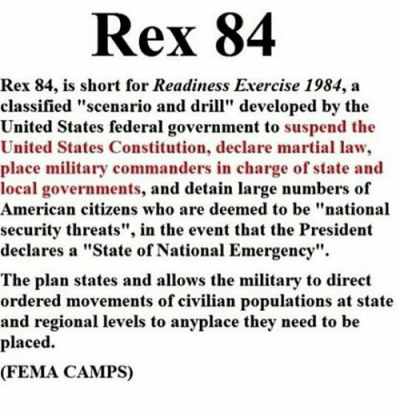
It was presented as an exercise to test military assistance in civil defense in times of national emergency, but in fact the plan was anticipating civil disturbances, major demonstrations and labor strikes that would affect continuity of government. The anticipated civil unrest from the FED-induced financial crisis that devastated the middle class was considered “subversive”, REX-84 being an authorisation for the US military to implement government-controlled movements of civilian populations at both state and regional levels, the arrest of many segments of the American population, and the imposition of martial law. (1) (2)
The Rex-84 program was created under the pretense of a possible mass exodus of illegal aliens attempting to cross into the US from Mexico, but when the program accidentally became public during the Iran-Contra Congressional hearings in 1987 it was revealed that it was in fact a secret federal government program
“to suspend the Constitution, declare martial law, assign military commanders to take over state and local governments, and detain large numbers of American citizens determined by the government to be ‘national security threats’.”
This was part of a master contingency plan for which the FBI today has a primary list of more than 100,000 Americans, and a secondary list ten times larger, who are targeted to be rounded up as subversives, including labor leaders, scholars and public figures, the incarceration designed to isolate political dissidents and to contain civil unrest.
And these are prison camps, ringed with fences, barbed wire and armed guards, not places from which escape would be likely, and they were designed to hold Americans, not Mexicans. (3)
There is no question the US government is prepared for the possibility of widespread and uncontrollable domestic disorder. This program in place and building for years was encouraged by fears of a massive public uprising in the wake of the 2008 banking fraud.
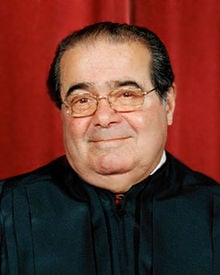 US Supreme Court Justice Antonin Scalia said some years ago that concentration camps were a likely future reality for Americans and that the Supreme Court would not do anything about the tyranny should the executive branch think it necessary. He mentioned the World War II internment of Japanese in the US and said of these camps,
“you are kidding yourself if you think the same thing will not happen again”. (4) (5)
In 2009, as the US financial crisis deepened and concern about public unrest was increasing, the US National Guard was posting job opportunities for “Internment/Resettlement Specialists” to work in “civilian internee camps” within the United States, and Halliburton [former] subsidiary KBR was seeking subcontractors to staff “emergency environment” camps located in five regions of the US. Earlier, in 2006, KBR was contracted by Homeland Security to build detention centers designed to deal with “the rapid development of unspecified “new programs” that would require large numbers of people to be interned.” (6) (7)
The US has for many years been dangerously close to a situation where, if the American people take to the streets in protest, these internments can be easily carried out. By 2004, there were more than 800 of these internment camps in the US, all empty, but all fully operational, staffed, and surrounded by full-time guards, ready to receive prisoners. I have seen photos. As well, many military bases are slated to be closed down and used as extra civilian prisons if the need arises, all intended for the internment of dissidents and others deemed “potentially harmful to the state”. Some camps can each hold 20,000 or more prisoners, a massive effort at civilian population control, and the program is still expanding. The US is very near the point today where political dissidents questioning the actions of their government will risk being rounded up and forced into these prison camps, essentially a government plan to forcibly suppress political dissent under the guise of rooting out domestic “terrorism”.
The US government defines many Americans as having become “pre-revolutionary” from their outrage at the 2008 government-approved housing collapse, with increasing concern that massive civil unrest would emerge from both the poverty-stricken lower classes and the eviscerated middle class, leading to what would become an internal civil war. This is the reason that the FBI and DHS increasingly focus their “anti-terror” apparatus on white middle-class Americans like the Occupy Wall Street protestors who were categorised as “low-level terrorists”.
In 2008, the Washington Post reported government plans to station many tens of thousands of troops inside the country for purposes referred to as “domestic security” in the light of massive civil unrest that would follow an economic collapse or serious financial crisis, perhaps stemming from 2008.
According to the government document,
“Widespread civil violence inside the United States would force the defense establishment to reorient priorities in extremis to defend basic domestic order and human security”,
stating that the military may be needed to quell “purposeful domestic resistance”. To prepare for this quelling of resistance, the US has resorted to demonising its own citizens, a recent study funded by DHS conveniently identifying those Americans who are “suspicious of centralized federal authority” and who exhibit signs of being “reverent of individual liberty”, and re-categorising them as “extreme right-wing” terrorists. (8) (9) (10)
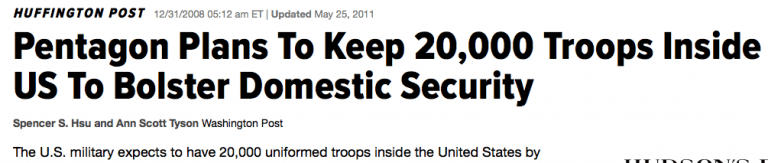
The program is designed to “reduce and eliminate” all domestic resistance to the US government. “Crowd control agents” will be used for this purpose, and government agencies will be involved in “gathering information on dissidents” to identify all those who have either “threatened or are creating disturbances”. The US military produced a manual on what it termed “Civil Disturbance Operations” that outlines how military assets will be used to “help local and state authorities to restore and maintain law and order” in the event of mass riots and civil unrest. Military and other law-enforcement will be tasked with “breaking up unauthorized gatherings” and restoring order by
“presenting a show of force, establishing roadblocks, breaking up crowds, employing crowd control agents, and other operations as required”.
The same government manual describes how prisoners will be processed through these internment camps, and outlines how these internees would be “re-educated” while detained in prison camps inside their own country by their own government. A leaked military document titled ‘FM 3-39.40 Internment and Resettlement Operations’, outlined a program for “re-education camps” in the US which contained plans for “political activists” to be “pacified” by various psychological officers into “sympathising” with the government and into “developing an appreciation of US policies” while detained in prison camps inside the US. The document was restricted to Department of Defense personnel but was been leaked and posted online. It outlined policies for “processing detainees into internment camps” and made clear these operations would be used for domestic civilian situations. (11) (12) The full document is available here: (13)
“Once the detainees have been processed into the internment camp, the manual explains how they will be “indoctrinated”, with a particular focus on coercing political dissidents into expressing support for U.S. policies.”
Part of the stated role of the psychological officers would be to identify political activists, political leaders, ‘malcontents’, and other agitators, and to develop and execute appropriate
“indoctrination programs to reduce or remove antagonistic attitudes”.
However, their first task would be to “pacify and acclimate detainees to accept the internment facility’s authority and regulations”.
There are also disturbing insights into the government’s intention to use brutal force to violently quell any civil political unrest. The manual includes a long list of weapons meant to be used against protesting American civilians, including anti-riot grenades. Page 20 of the manual authorises the use of “deadly force” in confronting these peaceful political “dissidents”, the murderous intent made disturbingly clear with the directive that “Warning shots will not be fired” first. Northcom itself, in a September 8, 2008 Army Times article, said the first wave of the deployment, which was put in place on October 1st at Fort Stewart and at Peterson Air Force Base in Colorado Springs, would be aimed at tackling “civil unrest and crowd control”.
In November of 2013, Forbes Magazine ran an article based on the AP newswire, detailing that DHS had been assembling a massive weapons arsenal since 2011 or 2012. (14) The AP reported that Homeland Security had been stockpiling ammunition by buying more than 1.6 billion rounds of ammunition in addition to a prior purchase of 1.5 billion rounds, for a staggering total of more than three billion rounds. This is more ammunition than the US military used collectively in all its wars in the last decade, and represents about ten shots for every man, woman and child in America. There were also confirmed purchases by various government agencies, of hundreds of millions of hollow-point rounds to be delivered to dozens of locations around the US. These bullets are so lethal they are banned for battlefield use during wars because they mushroom and fragment on impact, their only purpose being to cause the maximum possible damage to internal organs. Also purchased were large numbers of magnum rounds with the power to penetrate walls, and a frightening hundreds of millions more rounds of specialty sniper ammunition.
Even more, it was reported in early 2015 that DHS had placed orders for massive amounts of other kinds of anti-civilian weaponry termed “Less Lethal Specialty Munitions”, which were described as “an arsenal of specialized weaponry for training and deployment against crowds”. These included flash grenades, light bursts, gas and chemical grenades, riot rounds, rubber bullets, and much more. These are all heavy-duty crowd control and civilian intimidation weapons. They have no other purpose and, in the volume in which they are being purchased, it is clear the US government is expecting some very serious civil disturbances, possibly a revolution, and soon.
As recently as 2018, Forbes was reporting more of the same, that these purchases have reached an astonishing ubiquity. It isn’t only Homeland Security who is arming to the teeth. Thousands of agents at the IRS now have tactical assault rifles and heavy weaponry.
Screenshot Forbes, October 20, 2017
The Small Business Administration and the Department of Veterans Affairs have purchased thousands of Glock handguns. The Health Services agencies purchased millions of dollars worth of Glock handguns – equipped with silencers. The US Geological Survey, which is a weather bureau, purchased millions of dollars worth of Winchester Black Shadow shotguns with large bulk ammunition orders in addition to Glock handguns. Even the Department of Education purchased millions of dollars worth of Glock handguns, shotguns and body armor. I am unaware of any nation in the world where the income tax department or the departments of education and health care require huge amounts of military-grade weapons, much less body armor and gun silencers.
In June of 2016, RT reported that non-military federal agencies had more firepower than the entire US Marine Corps, this including agencies like education, health and income tax. (15) RT documented, a new report where 67 non-military federal US agencies spent $1.50 billion purchasing guns, ammunition and military-style equipment. The details came from the Militarization of America: non-military federal agencies purchases of guns, ammo, and military-style equipment, published by the non-profit good government group OpentheBooks.com. (16) (17)
In addition to the massive purchase of ammunition, DHS was showing off its acquisition of heavily armored and mine-resistant personnel carriers which have been seen on streets all across America and verified with photos and video. Forbes noted that these vehicles are equipped with gun ports and are “designed to withstand IEDs, mine blasts and 50 caliber hits to bullet-proof glass”, and asked why they would be necessary on American streets. The DHS also purchased large amounts of riot gear and bullet-proof checkpoint booths, as well as a purchase of 7000 automatic rifles, and 2700 armored vehicles, and the deployment of drones with allowance for their use on US citizens.
The DHS is becoming a massive domestic army to handle domestic conflict. In the words of Ellen Brown,
“somebody in government is expecting some serious civil unrest …”
DHS chief Janet Napolitano claimed this was to prepare for a mass influx of immigrants into the United States that would require the “shelter and processing” of large numbers of people, but this is nonsense. By whom will the US be attacked that Homeland Security would be responsible for defense, and from where would arise a mass of peaceful immigrants so large as to require more than three billion bullets to repel them?
This is the same government that recently shut down many of its operations including most of the National Parks, for lack of funds, yet had sufficient money to purchase billions of bullets for a non-existent civilian army. A spokesperson was quoted as justifying this massive purchase to “help the government get a low price for a big purchase”, and claimed DHS used “as many as 15 million rounds every year in training exercises”. Someone should ask DHS to divide 3 billion by 15 million, which tells us the ammunition purchase will supply DHS needs for the next 200 years. The authorities naturally attribute criticism and hard questions to mentally-unbalanced ‘conspiracy theorists’, but this is one more instance where actions appear irrational and the official story is so full of holes that it makes no sense.
Another DHS purchase that produced a firestorm of anger when its news went viral, was the supply of what we might call ‘unconventional’ paper targets which were used as practice shooting targets in ‘training exercises’. These targets consisted of figures of American civilians in residential settings. They included small children, a young pregnant mother, old women in robes, grandmothers and grandfathers in their kitchens and front yards, teenagers in parks, little girls and more, perhaps the most frightening part being that all these were termed “no hesitation targets”, meaning to fire without hesitation at the sight of these enemies. What could possibly justify the supply of such targets to a military force, with such an instruction? The US fedbiz.op website took down the solicitation after Infowars broke the story, and eventually apologized publicly for creating these targets of small children.
In early 2014 it was reported that the US military had built a $100 million fake city of about 300 acres in Virginia, for use in training troops for the occupation of cities, complete with a sports stadium, bank, school, and an underground subway in order to train for future combat scenarios in American urban areas. The subway carriages even carry the same logo as those in Washington DC. More disturbingly, it was reported that
“soldiers are being taught that Christians, Tea Party supporters and anti-abortion activists represent a radical terror threat, mirroring rhetoric backed by the Department of Homeland Security which frames “liberty lovers” as domestic extremists.”
The DHS is also building a 176-acre secure compound in the lowest-income area of Washington, DC, which seems almost certainly a preparation for civil war. (18) (19)
The trigger could be an economic collapse that causes angry Americans to flood the streets similar to the Occupy Wall Street and other scenes witnessed across both the US and Europe during the last FED-induced economic crisis. It is worth noting that the Occupy Wall Street protest had the right idea but the wrong target. Wall Street is just an idea, and a bit player. The ultimate cause is the FED, and that should have been their focus. But the FED, the bankers and the FBI saw this coming and infiltrated and financed the protest groups as a way to take control and deflect them from any useful action or focus.
In the middle of 2013 several US local media reported the DHS was conducting widely public but still “top secret” exercises categorised as “full scale terrorism drills” across the entire nation with the stated purpose of making citizens “feel safe”, but which resulted in thousands of terrified people not knowing how to respond to what appeared as a domestic invasion by the US military. People were capriciously apprehended and released after having their belongings searched, but nevertheless urged to celebrate their “independence” from tyranny. These drills were presented as readiness training for potential terrorist incursions, though DHS failed to mention the New York Times observation that all the domestic terror plots in the United States over the last decade were “hatched by the FBI”.
One other worrying development was the appearance of US military C-130 cargo planes apparently spraying mosquitoes over various Florida cities at an altitude of less than 50 meters. Pest control is hardly a military duty, these events immediately reminding me of the US military spraying bacterial and other pathogens over many parts of the US in various CIA-related experiments on the domestic population. These low-altitude overflights are almost certainly practice runs for potential crowd control in the future, for dispensing tear gas or other non-lethal (or lethal) material that would disperse or disorient protestors. I cannot imagine all the possibilities, but the US military most certainly is not going into the mosquito-spraying business. (19) (20)
US Major General Curry was quoted as stating,
“We have local police, backed up by each state’s National Guard, backed up by the Department of Defense. So in addition to all these forces why does Homeland Security need its own private army? Why do the SSA, NOAA and other government agencies need to create their own civilian security forces armed with hollow nose bullets?”
Some may want to dismiss this as just another conspiracy theory, but we might recall the words of Senator Daniel Inouye in 1987,
“There exists a shadowy Government with its own Air Force, its own Navy, its own fundraising mechanism, and the ability to pursue its own ideas of national interest, free from all checks and balances, and free from the law itself.”
The threats to civil liberties go much farther and are much more ominous than I’ve related so far. Another factor is the spate of secret Executive Orders that Obama signed without Congressional approval, observers claiming those orders violated existing laws and were therefore illegal but that the powers behind the White House considered themselves above all law. One of the most sinister was Executive Order 13603 which granted authorization to seize possession of every possible resource, including property and “all food storage facilities”. One author wrote that “This extremist, maniacal edict is designed to enforce our submission, rendering us totally dependent on Big Brother government or face the obvious – starvation and extermination.”
What could possibly have instigated such an order, unless the government is preparing for an all-out war against the American people? What possible excuse, during peace-time, would a “democratic” government have, for the initiation of a program to seize all the “food, water and food storage facilities” of a nation? If we add these to the internment camps and the bullets, what conclusions are possible?
Another ominous threat is that much of the NSA’s illegal intelligence-gathering activities were transferred to the Department of Homeland Security, the same people with the 800 internment camps and the 3 billion bullets. The apparent reason is that the NSA can collect information on domestic political dissidents but has no police powers to act on them, whereas DHS has legislative authority to gather, arrest and incarcerate anyone on their watch lists. DHS is apparently creating a “graded list” of these targeted so-called “security threats”, with those at the top of this list assessed according to how widely disseminated are their anti-establishment views, the followers they appear to have, and these will be the first to disappear into the internment maze. This new policy gives Homeland Security full authority to effectively terrorise the American people under a pretense of controlling domestic terrorism. When we consider these two items, Executive Order 13603 and the new powers granted to DHS, the only possible response can be fear.
If all this isn’t enough, DHS was revealed to have a secret procedure for the instant shutting down of all private communications in America, including mobile phone networks, a program accidentally revealed when government officials in San Francisco disabled all mobile phone calls during a peaceful protest against yet another man shot dead by the police. The administration insisted it had the legal authority to control these communications “during times of national crisis”, “for the purpose of ensuring public safety”, but it has also given DHS the power to actually “seize” all privately-owned communications facilities in order to prevent any civilian communications occurring. Some individuals applied to the courts for further information on these new procedures and policies, but DHS claimed it was “unable to locate or identify any records” in relation to the matter. Nothing more to be said, but it’s difficult to avoid the conclusion that the US government is quickly becoming fully prepared for war against its civilian population.
With the NSA revelations by Edward Snowdon, there is no longer any question that many US government agencies have been monitoring and gathering information on large numbers of known American political dissidents, these agencies including the NSA, FBI, CIA, DHS, various military groups and another 70 or 80 so-called “public-private fusion centers” scattered around the US. Former NSA Technical Director William Binney claimed in an interview that the NSA had a list of 500,000 to one million people in the US who were closely watched and whose every communication and bit of personal data were recorded. These are not terrorists in any sense, but potential leaders of political dissension and therefore potential suspects in the event of civil disturbances.
There also exists a database known as “Main Core”, containing names of Americans who might be considered troublesome, and which knowledgeable sources claim contains the names and communication information of more than eight million Americans who would be potential suspects of political activism, which would include “national opposition to US military invasion abroad”. It includes political dissidents, environmental and other activists, political and tax protesters, lawyers and professors, publishers and journalists, and many more who are most likely harmless, average people.
The database apparently contains all to and from email addresses, all email content, all in and out phone numbers plus duration of calls, the amounts and locations of ATM withdrawals, all credit card purchases and much more. It appears that this dissident surveillance program dates back to the early 1980s, the time of our Great Transformation, when it was revealed that Oliver North, operating from a secure White House site, had been using a database called PROMIS which was part of the REX-84 plan, to track dissidents and potential troublemakers within the United States. This database was meant to identify and immediately locate perceived “enemies of the state” if mass civil disturbances were to break out. (21) (22)
The Middle-Class Revolt
In late 2008 a leaked internal memo from Tom Fitzpatrick, Citibank’s chief technical strategist, contained ominous predictions for American civil society after the vicious financial crisis. He wrote,
“The world is not going back to normal ‘after the magnitude of what they have done’”.
Fitzpatrick claimed that the massive destruction of the middle class, the draining of all the wealth from the population, and the QE money creation by the FED would either bring about a resurgence of inflation or that the US would fall into “depression, civil disorder and possibly war”. He claimed that with the passing of each week and month there was a growing danger that could lead to political instability, a risk of domestic unrest because people were becoming increasingly disenfranchised and impoverished.
Lest we succumb to the temptation of accepting the 2008 financial crisis and the resulting loss of homes as an accident of fate, it would be wise to consider these quotes by Montagu Norman, Governor of The Bank of England prior to the crash of 1929, addressing the United States Bankers’ Association, New York, Idaho Leader, 26 August 1924.
“Capital must protect itself in every possible way, both by combination and legislation. Debts must be collected, mortgages foreclosed as rapidly as possible. When, through process of law, the common people lose their homes, they will become more docile and more easily governed through the strong arm of the government applied by a central power of wealth under leading financiers. These truths are well known among our principal men, who are now engaged in forming an imperialism to govern the world.”
And his thoughts on democracy:
“By dividing the voters through the political party system, we can get them to expend their energies in fighting for questions of no importance.” “It is thus, by discrete action, we can secure for ourselves that which has been so well planned and so successfully accomplished.”
The US government has developed an increasing fear of its own middle class, wide awake to the protests and uprisings in other nations where governments have colluded with the international bankers and large multi-nationals to gut their middle classes and effect the same transfer of wealth to the top 1% as occurred in America. People in many Western societies have become disgruntled and bitter at the increasing evidence that their vaunted democracies have been usurped by the unrestrained capitalists, creating intolerable situations where the people are sacrificed for the increasing wealth of that same top 1%.
At first, the US government exhibited a grim and rather reprehensible kind of satisfaction at watching the misery in other nations where the FED and IMF and the International Bankers had succeeded in their aims of wealth transference, but it also realised that the same boiling rage existed in America and perhaps much less controllable.
US citizens were protesting against a government that was no longer democratic in any sense, and was both unwilling and unable to repair a hopelessly corrupt and inefficient system. They finally awoke en masse and objected to ingrained corruption, shoddy public services, high taxes, homelessness, unemployment, rising inflation, the development of a police state, and more. It is public rage at the realisation of having been betrayed by a “democratic” government that converts civil unrest into political activism and revolution, and it is this that lies at the heart of the FBI’s categorisation of US political dissent as “domestic terrorism”. This terminology is important because the US, in all its hypocrisy for democracy, free speech and freedom of assembly, cannot face the world with open and apparent suppression of political dissent. Therefore, US citizens protesting against their own government cannot be exercising free speech but rather anarchy and terrorism, thereby justifying the use of deadly force to control dissension. The powers that control America have no interest in fairy-tales of freedom. They are interested in wealth and control, and the people in any country are irrelevant – including those in the US.
Americans have experienced first-hand the destruction of their quality of life; they see clearly the disappearance of future opportunity for their children, and they recognise better than most the loss of their freedom of expression which they have so valued. And they know it is precisely the retraction of that expression that is necessary for their no-longer-democratic government to maintain control. This is where their economic and social dissatisfaction mutates into political activism – revolution, in fact – and it is this realisation among the authorities that has spawned the internship camps, the billions of bullets purchased, and the “shoot to kill” orders.
Revolution – The Struggle for Class Power
Buried in the litany of troubles the US is facing today is the primary fact that the nation is engaged in a brutal class war, a struggle for class power that the bottom 99% are losing. This war was declared in the late 1970s, gained great momentum in the 1980s and 1990s, and is still accelerating toward its final desperate conclusion. There are few signs on the horizon that cause hope for a change in direction, and I fear it may be too late.
There is still power with the people themselves, and indeed without the both active cooperation and silent complicity of the people, none of the pathological descent into despair would have been possible. Probably the only force in America that can change what is happening is the combined force of labor. This isn’t so easy today, since the government killed most labor organisations and there is now little if any leadership. A total withdrawal of labor succeeded in forcing a new social contract in 1946 and may be the only power remaining today, but times have changed and tactics must change too. If all unions withdrew their services with the full cooperation of unorganised labor, change might be possible.
But realistically, there is no hope that such a mass protest could be organised even though it is the only possible way to get the attention of whatever remains of a conscientious government and force through a reversal of the tide. In any case, taking to the streets is unlikely to produce pleasant results. If the police don’t have enough bodies to beat up and arrest everyone, DHS has its internment camps, its 3 billion bullets, its years of practice with “no-hesitation” human targets, and it will use all of them.
The only safe way for Americans to go on strike today is to stay at home. On this topic, one internet commenter wrote,
“Just don’t go to work. There is no need to picket in the streets to be on strike, and the factories and offices will be just as quiet and empty, and the profits just as non-existent. The police cannot possibly conduct home-by-home visits to beat up strikers one by one, and no military, even the DHS, is efficient when trying to blow up houses scattered all over the county, one by one. Strikers are probably safe if they stay at home and lock their door.”
Another wrote,
“Another tactic is for Americans to simply quit shopping. They don’t have the money anyway, and don’t need all that useless junk. Don’t buy anything you don’t actually need, and delay even those purchases as long as possible, especially the big-ticket items like cars and furniture. If at all possible, delay every purchase for at least one year. As much as is practicable, stop driving your car. Cancel your cable TV and read a book.” Your grandmother gave you advice 100 years ago that is still valid today: “Use it up, wear it out. Make it do. Do without.”
A third commenter gave this advice:
“One thing you can do to get their attention is to stop paying your bills. VISA and MasterCard can’t cancel 800 million credit cards at the same time, and no bank can process 100 million mortgage defaults. No system can cope with massive non-payment of debt. You are their only source of money and you can ensure they don’t get any of it. That will wake them up. Tell them you’ll begin paying when the overseas corporate tax holiday is over, when high income taxes are reinstated for the rich, when the individual bankers are in prison and when the lost jobs begin returning. This isn’t foolproof, but it’s the best I can do.”
And finally, a more ambitious poster offered these comments:
“Today, the US State Department, the CIA and the FBI pride themselves on their ability to use Twitter and Facebook to cause civil unrest, chaos, violence, and even revolutions, in other countries. It may not have occurred to them that the same tools they use against everyone else can be just as easily used against them. The CIA used Gene Sharp and his Einstein Institute to prepare the Otpor civil disobedience manuals that our government used as the gunpowder to destroy Jugoslavia, and as the template for a dozen other “color revolutions” of which it was so proud. Copies are freely available on the internet.”
William Blum again:
“As I’ve said before: Inasmuch as I can’t see violent revolution succeeding in the United States (something deep inside tells me that we couldn’t quite match the government’s firepower, not to mention its viciousness), I can offer no solution to stopping the imperial beast other than this: Educate yourself and as many others as you can, raising their political and ideological consciousness, providing them with the factual ammunition and arguments needed to sway others, increasing the number of those in the opposition until it raises the political price for those in power, until it reaches a critical mass, at which point … I can’t predict the form the explosion will take or what might be the trigger … But you have to have faith. And courage.”
Rebuilding America
 This is an amended list of actions Americans must take if they want to bring their country into the community of nations as a civilised member instead of its present status as a genocidal bully, and to begin healing the nation itself. It is compiled from my own notes with the inclusion of excerpts from a speech made by Chris Hedges at Northeastern University. (23)
Discard the existing two-party political system as diseased and useless, and form one new party with a totally new slate of legislators not formerly involved in government. Their first tasks would be to:
1. Arrest all war criminals on American soil. Begin with both Bushes, Cheney and Rumsfeld, Powell and Rice, both Clintons, Kissinger, Albright, and a long list of other White House and Congressional staff, on charges of treason, war crimes and crimes against humanity.
2. Disband the Federal Reserve Banking System and repudiate all outstanding debt to the FED. The government would, according to the law and constitution, issue its own currency from this point forward.
3. Force the break-up of all the big banks and eliminate interstate banking. Nationalise the so-called investment banks like Goldman Sachs, confiscate their assets and shut them all down. Reintroduce banking sector regulations as was done after the 1930s, to ensure a catastrophe cannot recur, with violations punished by mandatory prison sentences. Outlaw program stock trading by the banks. Force the banks to revert to simple banking functions to serve the economy.
4. Disband the CIA and all its clandestine projects by cutting off all funding. Confiscate all CIA records, files, computers, data, and make the details public. Emasculate the FBI and all its executives and officers. Arrest the planners and perpetrators of all false-flag ops. Kill the NSA. Immediately cease all domestic espionage on US citizens. Cut off all funding, seize all bank accounts and confiscate all records and documents. Bomb the Arizona data storage facility to rubble. Kill the Department of Homeland Security and dismantle and close all internment camps within the continental US.
5. Disband the NED, USAID, the VOA and the 100+ other subversive NGOs that are used today to destabilise the governments and societies of other nations. Recall all CIA espionage agents from foreign embassies and consulates, who constitute about 80% of all US foreign “diplomatic” staff. Designate all Foundations and Think Tanks as enemy aliens, and shut them down.
6. Reduce the military budget by 85% and close all foreign military bases. Bring home all foreign-based military personnel and give them jobs guarding the bankers.
7. Totally eliminate the private sector from infrastructure and social services and confine it to commerce where it belongs. Roll back deregulation and privatisation, reclaiming all public infrastructure to be operated by the government for the common good. Especially kill the despicable private prison system, and free the more than one million who should never have been in prison at all. Kill the movements to debtor’s prisons and civil forfeiture before they gain any more momentum, and pass harsh legislation that holds policemen individually responsible for their crimes.
8. Begin immediate construction of a system of publicly-owned and operated hospitals and medical clinics, and guarantee that all citizens have access to free or easily-affordable health care. Eliminate all insurance companies from the health-care process. Restore funding for universal education.
9. Make all lobbying illegal, with automatic prison sentences for influence-peddling. Designate lobby groups like AIPAC as criminal organisations and hostile enemy aliens, and treat them accordingly. Kill the SuperPacs and corporate donations. Eliminate all corporate contributions to election campaigns, and limit individual contributions to $1,000 maximum. Break the corrupt Zionist control of Congress, Wall Street, the media, the World Bank and the IMF. Terminate their globalism and any reference to a New World Order. Eliminate immediately all funding and financial support for Israel.
10. Eliminate legal immunity for the elites. Make illegal the payment of corporate fines for personal crimes. Put the people in prison. Levy an 85% income tax on all corporate profits being held outside the country by US-based multinationals. Reinstate the taxes on the rich and very rich. Eliminate personal tax breaks on capital gains and institute an 85% tax on all income over $500,000 per year.
11. The media monopoly must be broken by forcing de-centralisation and pushing the ownership once again into thousands of individual companies owned by totally unrelated parties. The current control of the media must be dismantled because of the Zionists’ propaganda and the Hidden State’s political agenda. Force the disintegration of all media holding groups and wide dispersion of all media, restricting ownership to only one newspaper or TV station per market. Outlaw opinion-based journalism and make untruthful news reports punishable by public flogging.
12. Eliminate GM food, or at least legislate full disclosure on food labels. Eliminate factory farms; institute extensive monitoring and harsh penalties for food chemical violations.
13. Use the money collected from the rich, the bankers and the FED to begin repairing America’s dilapidated infrastructure before any more dams and bridges collapse.
14. Close all the torture prisons. Close Guantanamo, Diego Garcia, Abu Ghraib, and the other torture prisons and demand an accounting of all prison ships and their human cargo. Close the School of the Americas and destroy all the torture manuals.
15. Emasculate the US President, the Presidency, and the White House, and return all power to Congress because it is the concentration of power in the office of the President that has permitted the total alien control of all vital parts of the US government.
16. Eliminate all US-sponsored sanctions against other nations, especially China, Russia, Syria and Iran. End the illegal occupation of Hawaii, Puerto Rico, Afghanistan, Iraq and Libya. Get out of the Ukraine. Dismantle immediately all organised interference in the internal affairs and elections of other nations. Refund the $100 billion of Iraqi gold and cash seized, and the similar amount from Libya.
*
Note to readers: please click the share buttons above or below. Forward this article to your email lists. Crosspost on your blog site, internet forums. etc.
Larry Romanoff is a retired management consultant and businessman. He has held executive positions in international consulting firms, and owned an international import-export business. He lives in Shanghai and is currently writing a series of ten books generally related to China and the West. He can be contacted at: 2186604556@qq.com
Notes
(1) Rex 84: FEMA’s Blueprint for Martial Law in America
(2) Rex 84 – Your Internment Camp Awaits You
(3) U.S. Concentration Camps: FEMA and the REX 84
(5) https://www.washingtontimes.com/news/2014/feb/3/justice-scalia-to-lecture-at-univ-of-hawaii/
(6) Army National Guard Advertises for “Internment Specialists”
(7) Video: Become a FEMA Camp Internment/Resettlement Specialist
(8) http://www.washingtonpost.com/wp-dyn/content/article/2008/11/30/AR2008113002217_2.html?hpid=topnews
(9) Pentagon Plans To Keep 20,000 Troops Inside US To Bolster domestic security
(10) Washington Post: 20,000 More U.S. Troops To Be Deployed
(11) FM 3-39.40 INTERNMENT AND RESETTLEMENT
(12) FM 3-39.40 INTERNMENT AND RESETTLEMENT OPERATIONS
(13) https://www.infowars.com/yes-the-re-education-camp-manual-does-apply-domestically-to-u-s-citizens/
(14) Why Are Federal Bureaucrats Buying Guns And Ammo? $158 Million Spent By Non-Military Agencies
(15) 24 Jun, 2016; Non-military federal agencies have more firearm authority than entire US Marine Corps
(16) https://www.openthebooks.com/the-militarization-of-america–open-the-books-oversight-report/
(17) https://www.openthebooks.com/openthebooks_oversight_report_-_the_militarization_of_america/
(17) Asymmetric Warfare Group Built a Fake City in Virginia
(18) US army builds fake city to shoot at during training
(19) https://www.cbsnews.com/news/texas-enlists-u-s-air-force-to-spray-for-mosquitoes-after-harvey/
(20) Pentagon Misinformation Ops Target Press and Public
(23) http://calendar.northeastern.edu/event/political_economy_forum_presents_chris_hedges
Copyright © Larry Romanoff, Moon of Shanghai, 2020
US Appeals Court Contemplates Hillary Clinton Testifying on Email Scandal
By Oleg Burunov – Sputnik – June 3, 2020
Earlier this year, a federal judge ordered Hillary Clinton to provide a sworn deposition in person about her using a private email server for government business while serving as US Secretary of State from 2009 to 2013.
During an online hearing on Tuesday, the US Court of Appeals for the District of Columbia Circuit dealt with former Secretary of State Hillary Clinton‘s efforts to avoid testifying under oath about her involvement in the email scandal.
The hearing was first reported by Judicial Watch, a conservative watchdog group, which said that Clinton’s former Chief of Staff Cheryl Mills is also seeking to shun providing testimony on the matter.
The watchdog added that the appeals court was looking into Clinton’s and Mills’ extraordinary request, also known as “petition for writ of mandamus,” aimed at overturning an order earlier issued by US District Court Judge Royce Lamberth that would require them to testify.
According to Judicial Watch, the appeals court ruled that the case had been adjourned until 9 September, when Clinton’s testimony is slated to take place. She insists that she is not obliged to testify because she is a former senior government official and that the FBI already conducted a probe into the matter.
Judge Orders Hillary Clinton to Give Depostion on Her Private Email Server
The Tuesday hearing comes after Lamberth ordered the former US Secretary of State in March to provide a sworn deposition in person about her private email server. The order granted Judicial Watch’s request to depose Clinton about her correspondence and documents related to the 2012 attack on the US Consulate in Benghazi, Libya.
At the time, Republican officials and members of Congress accused then-Secretary of State Clinton of failing to prevent the attack, which left four Americans dead, while she defended her handling of the incident.
The court also ordered the deposition of Mills and two other State Department officials, additionally allowing Judicial Watch to subpoena Google for documents and records related to Clinton’s emails during her time at the State Department from 2009 to 2013.
The watchdog’s lawsuit seeking Benghazi-related records led to a scandal in 2015 when it helped discover that Clinton had repeatedly used her own private email server, rather than a government-issued one, when she served as US Secretary of State.
The issue resurfaced amid the 2016 presidential election campaign as the FBI probed the former Secretary of State for misconduct.
Despite the use of a private server preventing her emails from being available via the Freedom of Information Act (FOIA), the FBI advised against opening a criminal case against Clinton, merely describing her actions as “extremely careless”.
The results of the probe reportedly irked President Donald Trump as he complained that alleged attempts by Clinton to hide emails from the public must be further investigated.
Veteran FBI Lawyer Boente Resigns Over Role in Michael Flynn Case
Sputnik – 31.05.2020
Federal Bureau of Investigation lawyer Dana Boente has resigned after 38 years due to pressure from the Justice Department, after facing criticism for his role in the investigation into former national security adviser Michael Flynn.
“Few people have served so well in so many critical, high-level roles at the Department. Throughout his long and distinguished career as a public servant, Dana has demonstrated a selfless determination to ensure that justice is always served on behalf of our citizens. While it will be difficult to replace Dana, I am committed to ensuring that the next general counsel is experienced, objective, and prepared to lead the men and women who make up this vital part of the FBI’s mission,” FBI Director Christopher Wray said in a statement.
Boente, who had also been acting assistant attorney general of the National Security Division and US attorney for the Eastern District of Virginia, has come under fire for his handling of the case against Flynn.
Flynn pleaded guilty December 2017 to lying to FBI investigators about conversations with Russian Ambassador Sergey Kislyak regarding a United Nations resolution on Israel – Flynn has since rescinded his plea, and the Justice Department is seeking to drop the case.
In late April, a couple of right-leaning news outlets reported Boente had concealed exculpatory evidence related to Flynn. These reports were amplified by Fox Business host Lou Dobbs, who said on his show, “Shocking new reports suggest FBI General Counsel Dana Boente was acting in coordination with FBI Director Christopher Wray to block the release of that evidence that would have cleared Gen. Flynn.”
Wray picked Boente to be the FBI’s general counsel in January 2018, and he went on to play a key role in the agency’s Trump-Russia investigation – Senator Lindsey Graham, chair of the Judiciary Committee, named him as a possible target for subpoena as part of the panel’s probe of the FBI’s Crossfire Hurricane counterintelligence investigation into potential collusion between the Kremlin and the Trump campaign.
Boente is the last remaining active government official who signed off on a FISA warrant targeting Trump campaign adviser Carter Page – former FBI Director James Comey signed off on the second FISA renewal for the FBI April 2017 – which occurred during his brief stint as acting attorney general. He assumed the role after Sally Yates, deputy attorney general in the Obama administration, was fired in late January 2017 for refusing to defend President Trump’s travel ban. Boente was replaced by Jeff Sessions.
Justice Department Inspector General Michael Horowitz’s December report into Crossfire Hurricane criticised the FBI for at least 17 “significant errors and omissions” related to FISA warrants against Page in 2016 and 2017 and for the Bureau’s reliance on former MI6 operative Christopher Steele’s utterly discredited dossier. Recently declassified footnotes show the FBI was aware the document’s content may have been compromised by Russian intelligence and used it anyway..
The report noted Boente and other DOJ officials who signed off on the applications “did not have accurate and complete information at the time they approved them”.
Featured Video
More Iran War fallout: Maritime insurance industry shifts from London to China
or go to
Aletho News Archives – Video-Images
From the Archives
The Biggest Threat to Peace in Middle East
By Dr. Elias Akleh* | Sabbah Report | May 24, 2010
A build up of heightened tension in the Middle East is escalating in the last few weeks. American and Israeli postures towards Lebanon, Syria, and Iran have become more threatening. Listening to speeches of political leaders one hears talks only about war not peace. Iranians and Israelis are continuously training hard for a possible showdown. Both sides are conducting extensive war games every month. This led Syrians to claim that Israel is preparing for a soon-to-come another war. The Jordanians also are warning that current stalemate of the peace process is an indication of a war breaking out this summer. The Russian President and his army chief hinted, a few months ago, that the US and Israel were planning for an attack on Iran.
Indeed Iran is, as it has been for last few years, the target of most of the threats and accusations of supporting terrorism. Escalating incitement against Iran the American Defense Department sent last month (April) to Congress a report on Iran’s military claiming Iran could develop intercontinental ballistic missiles capable of reaching the US by 2015.
Ignoring the fact that N. Korea, India, Pakistan, and Israel are proven to have nuclear weapons while Iran does not, the US Secretary of State Hillary Clinton chose in her speech, to the nuclear Non-Proliferation Treaty review conference at the UN, to focus on Iran’s alleged nuclear ambitions putting the whole world at risk as she put it. According to Clinton Iran’s acquisition of nuclear weapons, rather than Israel’s more than 200 nuclear bombs, is destabilizing the Middle East. She called on the world’s nations to rally around US efforts to hold Iran, not other nuclear countries, to account.
The accusation that Usama Bin Laden is living comfortably in Iran had received a boost after the broadcast of a documentary called “Feathered Cocaine”. This echoed the June 2003 claims of the Italian newspaper Corre de la Sierra that Bin Laden was in Iran according to some intelligence report, and according to Richard Miniter’s book “Shadow War”. … continue
Blog Roll
 Aletho News
- German journalist threatened with homelessness as German court upholds EU sanctions in landmark free speech case
- US Tells Allies That Ukraine-Bound Arms Could be Sent to Middle East
- Organized terrorism: Iran condemns killing of its diplomats in Lebanon
- Why could Gaza enter the regional war?
- Hamas official rejects Mladenov Plan linking disarmament to Gaza reconstruction
- Two Primary Elections for the Soul of ‘America First’
- Japan Clings to US Vassalage Despite Energy Crunch Caused By Iran War
- US Seeks Control Over Global Energy Infrastructure – Kremlin
- US senators target Orban government for standing up to Zelensky
- The deep-rooted culture of corruption in Ukraine
- If Americans Knew
- Researchers at Human Rights Watch Resign Over Blocked Report on Palestinian Refugee Return
- Jewish Groups Are Backing a War Americans Don’t Want
- Eric Fingerhut Thinks He’s the President of the Jews
- Top Jewish Philanthropists, Rabbis Urge Israeli President to Take Action Against ‘Jewish Extremists’
- Don’t Be Fooled. Zionist Leaders Have Always Wanted to Control Southern Lebanon
- Israel’s widespread use of torture is a core element of its genocide against the Palestinian people
- In Israel’s War on Iran, Many Middle East US Bases Rendered “All But Uninhabitable”
- ‘Burn the lawn’: Israel pursues ‘Rafah model’ in southern Lebanon
- A genocide here, an amputation there
- Reports: Iran mobilizing 1M fighters, Israel-US run low on ammo, Israeli army faces shortage – Not a ceasefire Day 168
- No Tricks Zone
- Devastating Assessment Of Comirnaty Vaccine By Former Senior Pfizer Europe Toxicologist
- New Study: CO2 Is ‘Effectively Negligible’ As An Explanatory Climate Change Factor Since 2000
- Former Pfizer Toxicologist Dr. Helmut Sterz Tells Bundestag Hearing Pfizer Vaccine Should Have Never Been Approved
- Energy Expert: Germany’s Nuclear Phaseout Was A “500 Billion Euro Mistake”
- New Research: South Australia’s Mid-Holocene Sea Surface Temperatures Were 4°C Warmer Than Today
- Storing Green Energy To Last Germany 10 Days Would Require A 60-Million Tonne Battery
- New Studies: UK Sea Levels Were 4 Meters Higher Than Today During The Mid-Holocene
- Destructive Green New Deal: German Energy And Metal Group Warns Of Drastic Crisis
- New Study Documents A 20-Year Pause In Arctic Sea Ice Decline – Driven By Internal Variability
- Wake-up Call: Survey Shows Majority Of Germans Now Favor Postponing Climate Targets!
 Aletho News