Kremlin reacts to Macron’s remarks on NATO troops in Ukraine
RT | February 27, 2024
A direct conflict between Russia and NATO will likely become inevitable if member states of the US-led military bloc send troops to Ukraine, Kremlin spokesman Dmitry Peskov has said, after French President Emmanuel Macron raised the possibility.
Macron, whose government hosted a high-profile meeting of Ukraine backers on Monday, said EU members “will do everything necessary to prevent Russia from winning” – including deploying forces on the ground to support Kiev. Several governments have since ruled out sending troops to the front line.
Opponents of the proposal “have a sober assessment of the potential risks” of having NATO forces in Ukraine, Peskov told the media on Tuesday. That would be “absolutely against the interests of those nations” and their people, he warned.
Asked about the probability of a direct conflict with NATO if Western troops are sent to Ukraine, the Kremlin spokesman said, “in this case, we have to talk not about the probability, but rather the inevitability.”
German Chancellor Olaf Scholz has spoken out against the idea. Participants of the meeting in Paris came to an agreement against it, he told a news conference on Tuesday.
At a joint press conference in Prague on Tuesday, Czech Prime Minister Petr Fiala and his Polish counterpart, Donald Tusk, ruled out sending their citizens to fight in Ukraine. Senior officials in Hungary and Slovakia issued similar statements.
Macron said Western leaders could end up changing their minds in the future, similarly to how they did with military assistance – which in some cases initially involved items such as helmets to eventually donating lethal weaponry including tanks and fighter jets.
While there was no consensus over the proposal, the participants agreed to create a coalition to supply medium and long-range missiles to Kiev, the French president said.
Moscow considers the Ukraine conflict to be a US-orchestrated proxy war against Russia, and has repeatedly warned that by supplying increasingly sophisticated weapons to Kiev, NATO members are drawing closer to a direct confrontation.
NATO Countries Did Not Make Decision to Send Their Military to Ukraine – Polish President
Sputnik – 26.02.2024
WARSAW – NATO countries disagree on sending their military to Ukraine and have not made a decision to do so, Polish President Andrzej Duda said on Tuesday.
On Monday, Slovak Prime Minister Robert Fico said that several EU and NATO countries are considering the possibility of sending their military to Ukraine on the basis of bilateral agreements.
“If we are talking about providing specific assistance, then individual countries decide what kind of assistance they specifically provide to Ukraine. There was a heated discussion about sending soldiers to Ukraine, and there was no absolute mutual understanding on this issue. There are different opinions. But I want to emphasize that there are absolutely no such decisions,” Duda told reporters after the end of a conference on supporting Ukraine, held in Paris.
French President Emmanuel Macron added that “nothing can be ruled out,” commenting on the possibility of sending NATO troops to Ukraine.
NATO troops in Ukraine can’t be ruled out – Macron
RT | February 26, 2024
French President Emmanual Macron has argued that deployments of troops to Ukraine by NATO members and other allies cannot be ruled out because Western powers must stop at nothing to ensure that Russia does not defeat Kiev’s forces.
“There’s no consensus today to send, in an official manner, troops on the ground,” Macron told reporters after hosting a meeting of European leaders on Monday in Paris. “But in terms of dynamics, we cannot exclude anything. We will do everything necessary to prevent Russia from winning this war.”
France hosted Monday’s summit of Ukraine backers to demonstrate steadfast support and European unity amid concerns that US aid to Kiev may stop, especially if Donald Trump wins this year’s presidential election. Macron said that while Ukraine’s European allies want to avoid escalating the conflict into a direct war with Russia, they agree that they must do more to ensure that Moscow doesn’t win.
“We have to take stock of the situation and realize our collective security is at stake,” the French leader said. “We have to ratchet up. Russia must not win, not only for Ukraine, but secondly, we are, by doing so, ensuring our collective security for today and for the future.”
Macron noted that the allies who say “never, ever” today about direct troop deployments to Ukraine are the same ones that previously ruled out escalations of military aid that were later granted, including long-range missiles and fighter jets. “Two years ago, a lot around this table said that we will offer helmets and sleeping bags, and now they’re saying we need to do more to get missiles and tanks to Ukraine. We have to be humble and realize that we’ve always been six to eight months late, so we’ll do what is needed to achieve our aim.”
There is broad consensus among the nations represented at Monday’s meeting that the allies must provide more aid to Ukraine and step up more quickly, Macron claimed. “We are not at war with the Russian people, but we cannot let them win in Ukraine,” he said, adding, “We are determined to do everything necessary for as long as necessary. That is the key takeaway from this evening.”
Washington ran out of money for Ukraine last month, after burning through $113 billion in congressionally approved aid packages. US President Joe Biden is seeking an additional $60 billion in Ukraine funding as part of an emergency spending bill that also includes aid for Israel and Taiwan. Conservative Republican lawmakers have balked at approving more aid for Ukraine, saying Biden is merely prolonging the conflict without changing its outcome. Trump has claimed he will end the crisis within 24 hours by forcing Ukrainian and Russian leaders to the negotiating table.
FRENCH BILL SEEKS TO CRIMINALIZE MEDICAL “MISINFORMATION”
The Highwire with Del Bigtree | February 22, 2024
Press and medical journalists appear to be the target of a new bill proposed in France that may seek to criminalize criticism of therapeutic and prophylactic remedies that have been deemed safe by the medical community.
Over 90% of French Citizens Support Farmers’ Protests – Poll
Sputnik – 22.02.2024
PARIS – The farmers’ protests that have erupted in France have the support of 91% of the French, and the majority of them believe that President Emmanuel Macron and his government are not handling the crisis well, an Odoxa-Backbone Consulting poll for Le Figaro newspaper showed on Wednesday.
The overwhelming majority of the French, or 91%, support the protests, 85% of citizens hold the government responsible for the crisis, 90% of respondents believe that the European Union is to blame for the crisis, and 92% of those polled blame big retailers.
Moreover, 70% of the French believe that the measures proposed by the government are insufficient, and 77% of respondents said Macron and his cabinet are “reacting poorly” to the crisis.
The French also opposed “punitive ecology” and condemned harsh environmental protection measures that harm farmers.
Ahead of the Paris International Agricultural Show, which opens on Saturday, French farmers continue to stage protest actions, dumping manure, hay and tires on highways and in cities.
Farmers in France have been protesting heavily since January, blocking highways and dumping manure and waste in front of government buildings across the country, with rallies subsiding somewhat in recent weeks. The farmers demand recognition of the importance of their profession and denounce the government’s agricultural policies, which they say make them noncompetitive.
In particular, they oppose the import of cheap agricultural products, restrictions on the use of water for irrigation, and the increase in diesel fuel prices, as well as restrictive measures to protect the environment and the growing financial burden.
French farmers are among those protesting all over Europe. Farmers in Germany, Italy, Belgium, Poland, Romania and the Netherlands are also pushing back against various environmental policies that they see as detrimental to their interests, especially in the face of high inflation and competition from imports.
France: ANY Criticism Of The mRNA DEATHVAX™ Platform Punishable Up To 3 Years Imprisonment And 45,000 Euros
2nd Smartest Guy in the World | February 15, 2024
The WEF-captured government of France has pushed through a draconian new law entitled Article 4. This Orwellian and unconstitutional color of law power grab is a purposely poor attempt at obscuring the irrefutable slow kill bioweapon death and destruction data.
What makes Article 4 particularly incendiary is that the majority of the French population has been outright refusing all “vaccinations.” Throttling their free speech as it pertains to gene modifying poisons will only increase the already heightened tensions between the criminal Macron administration and the awakening French populace, by design.
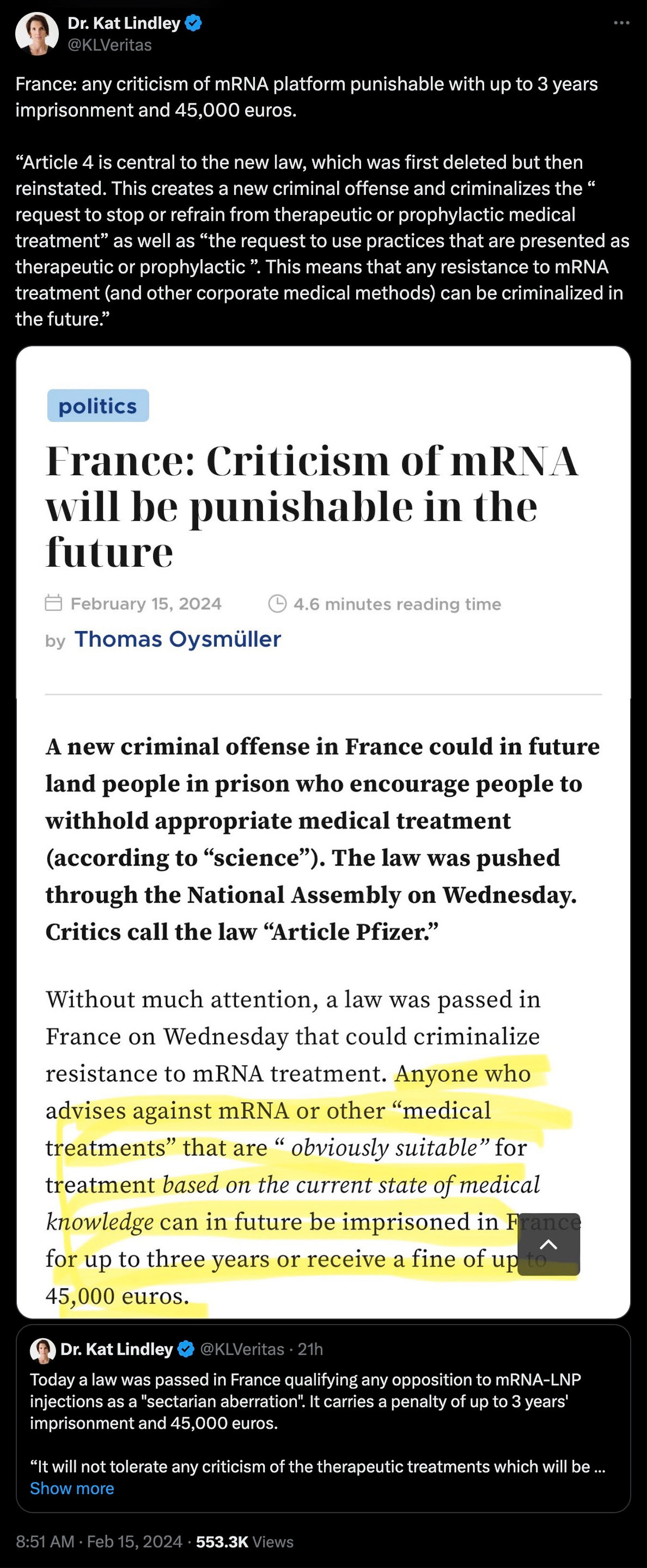
Between WEF puppet Trudeau in Canada and WEF puppet Macron in France, there is now a race to create the most totalitarian technocommunist nation in the West, with France now taking a slight lead; to wit:
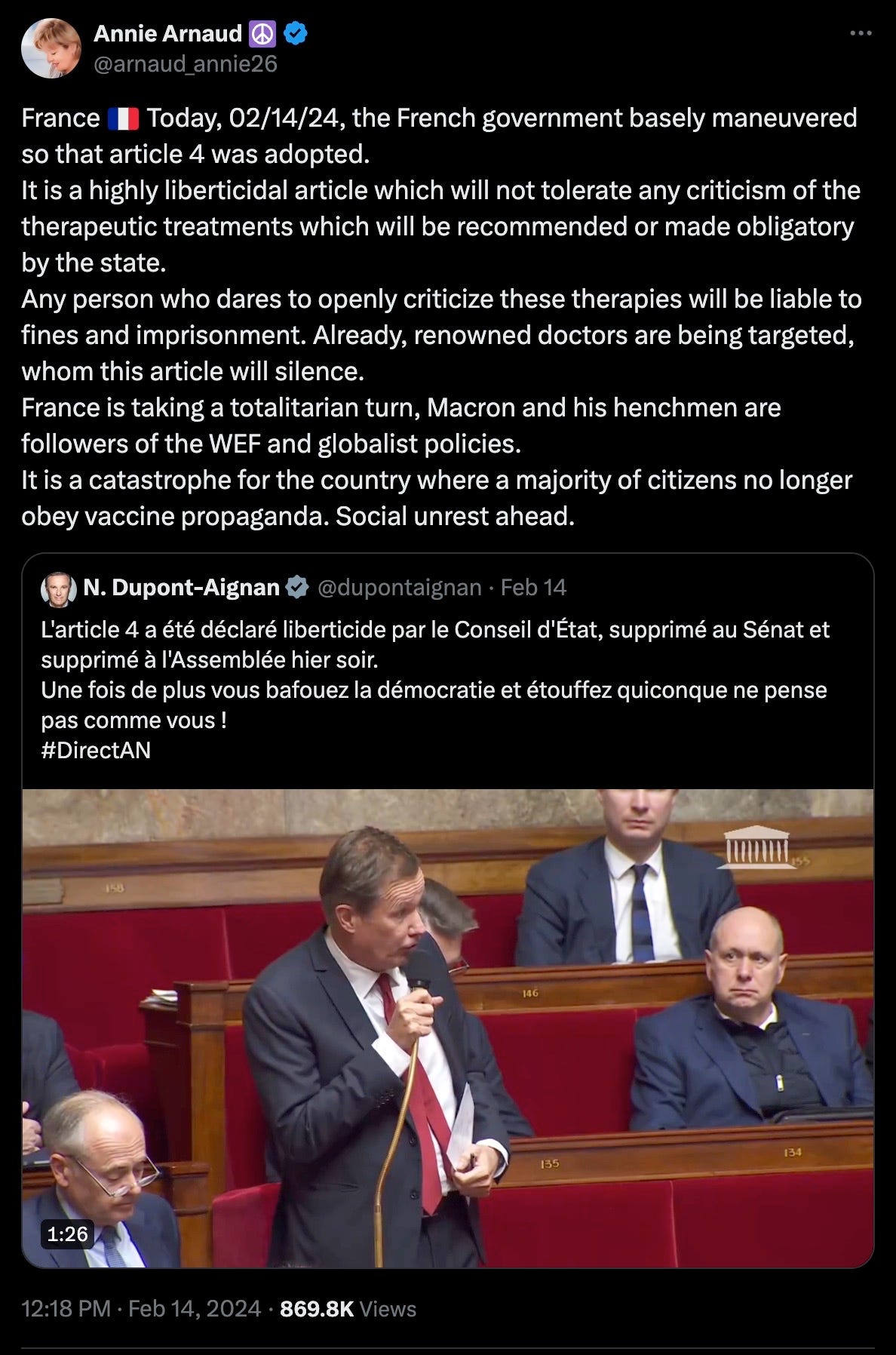
These policies and “laws” are nothing more than an extension of the ongoing democide, and the associated iatrocide.
Meanwhile, back in the USSA, the Center for Disease Crimes (CDC) is still at it with their “Trust the Science” mendacity and murder:
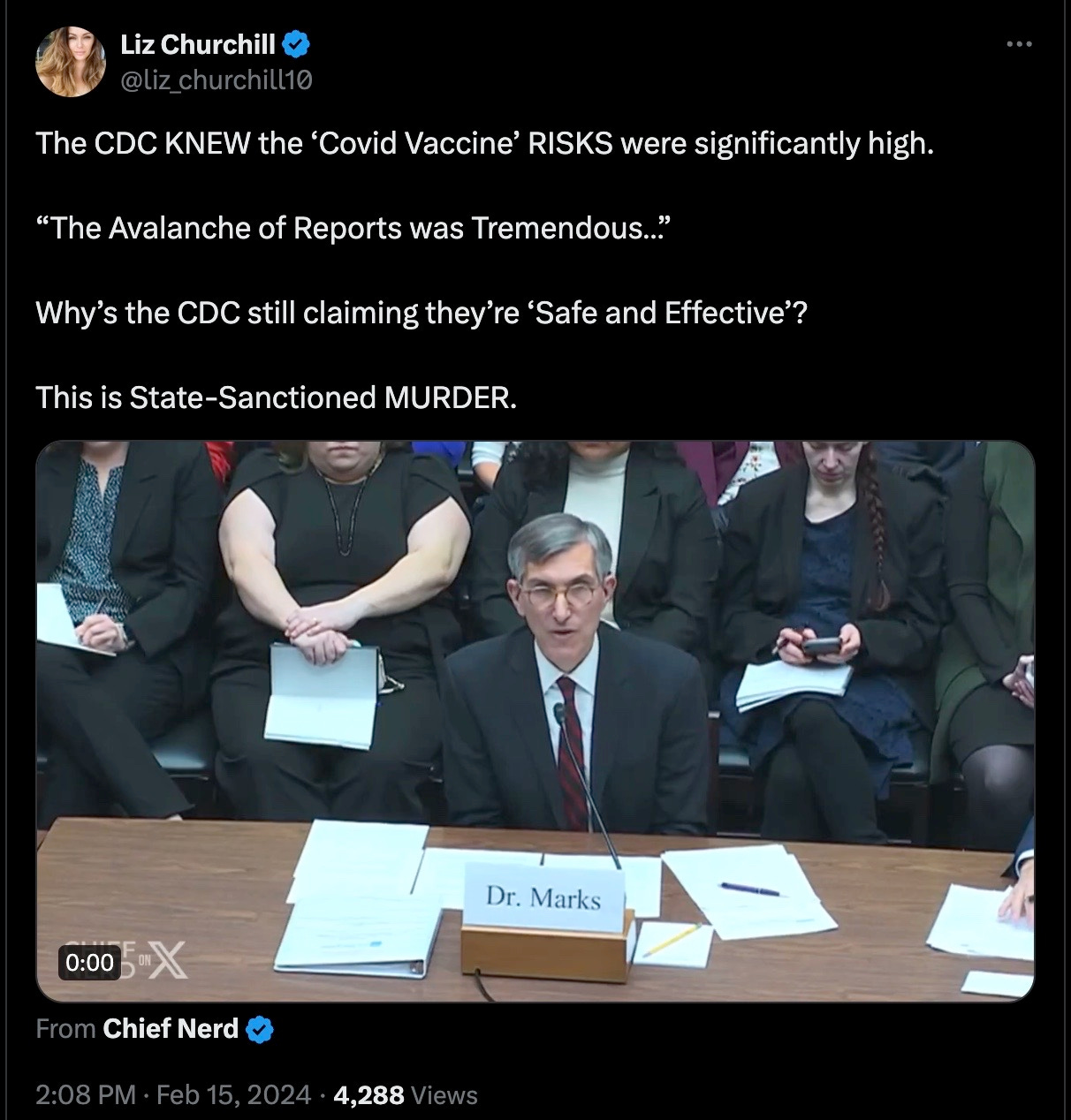
Readers of this Substack fully appreciate the myocarditis and turbo cancer epidemics currently underway — not to mention soaring excess non-PSYOP-19 mortality — since the rollout of the “vaccines:”
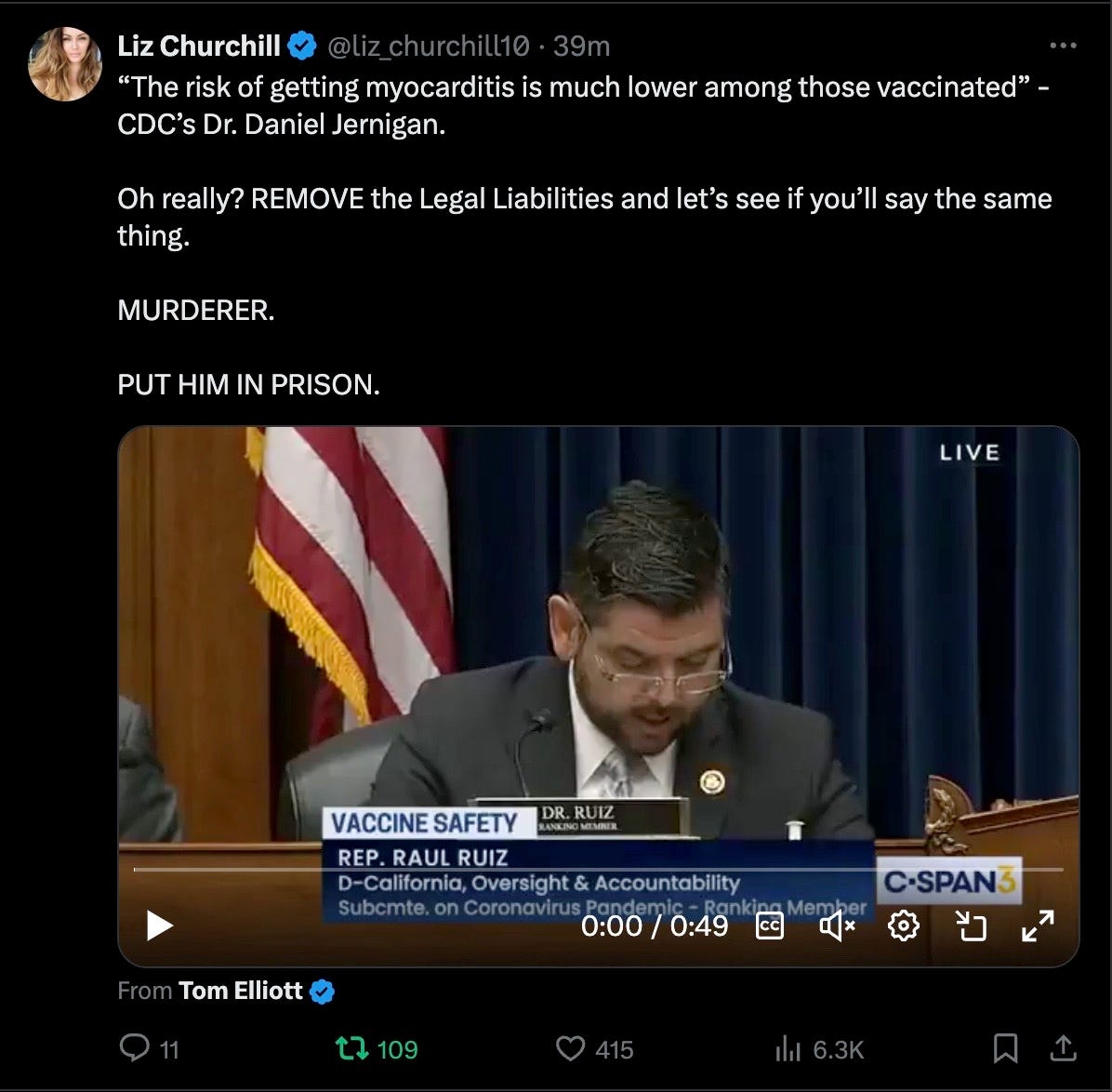
Removing all BigPharma legal liabilities and prosecuting the various “health” agencies like the FDA, CDC, NIH, et al. has never been more urgent.
France’s Article 4 is just a hint at what is to come, especially if the WHO’s Pandemic Treaty scam ever passes in the various nations that they are attempting to further hijack.
They want you dead.
Do NOT comply.
Professor Didier Raoult Calls for COVID-19 Vaccine Moratorium
BY JOHN LEAKE | COURAGEOUS DISCOURSE | FEBRUARY 4, 2024
Of the many remarkable characters we write about in our book The Courage to Face COVID-19: Preventing Hospitalization and Death While Battling the Bio-Pharmaceutical Complex, Professor Didier Raoult may be the most fascinating and colorful. A May 12, 2020 feature in the New York Times introduced him to American readers as follows:
Raoult … has made a great career assailing orthodoxy, in both word and practice. “There’s nothing I like more than blowing up a theory that’s been so nicely established,” he once said. He has a reputation for bluster but also for a certain creativity. He looks where no one else cares to, with methods no one else is using, and finds things.14
A tireless researcher, he has published 2,300 papers and is the most cited microbiologist in Europe. He and his team have discovered 468 species of bacteria—about 1/5 of all those named and described. The bacteria genus Raoultella was named in his honor. He is probably best known as the discoverer of the so-called giant virus, so large it had previously been mistaken for an intracellular bacterium. He has won 13 major awards and is a Commander of the National Order of Merit.
Like Dr. McCullough, Professor Raoult strongly advocated early treatment of COVID-19, and he conducted multiple studies demonstrating the efficacy of hydroxychloroquine combined with azithromycin, especially when administered early. In return for his efforts to save his patients, he has been relentlessly persecuted by France’s official medical establishment in Paris.
Now comes the news that Professor Raoult is calling for a moratorium on COVID-19 vaccines. The following is a translation from his recent, French language post on X:
Propaganda and knowledge. We’re the good guys, but we’re not ignorant! When vaccines were developed against Covid, 3 types of vaccines were proposed: – Traditional vaccines (as quickly available as the others) made in China with the entire inactivated virus. These vaccines have not been authorized in France for reasons that escape me. This type of vaccine, comparable to that against the flu, carries fewer unknown risks and does not fight against a single target of the virus: the Spike. I feared, and this happened, that the mutations of the virus and its respiratory specificity would not provide lasting immunity and that the vaccine would not have a very long duration of protection because I published the first known case of reinfection with covid. The disease being poorly immunizing, the vaccine would not do any better.
The second vaccine (the English one from Astra Zeneca, that from Johnson and Johnson, and the Russian Sputnik) is a vaccine based on a virus (Monkey Adenovirus for Astra Zeneca), transformed by integrating the Spike gene. It doesn’t integrate or replicate. I was the first in France to report an accident of cerebral venous thrombosis, this phenomenon is well described in particular in young women and England stopped its prescription for those under 50, followed by many countries and finally it is no longer used in France. There are millions of expired doses left.
The 3rd group of vaccine (Pfizer, Moderna) consists of the injection of RNA coding for the Spike whose elements have been modified so as not to be eliminated quickly. This vaccine is included in a lipid nanoparticle to be able to enter cells. This vaccine, in addition to the disadvantages common to the others, presented unforeseen side effects: extremely frequent menstrual disorders (now recognized by the CDC) of which no one can say whether they will be associated with consequences on fertility, myocarditis and sometimes fatal pericarditis in young people (mainly boys, now recognized by the CDC) and rare thromboses of the veins (recognized by all scientific authorities).
None of these vaccines had been evaluated for mild or asymptomatic forms and therefore for the prevention of contagion. They could not claim to eradicate a disease which, moreover, was circulating among animals. Vaccination was then only justified in those who were at risk of serious forms (subjects over 65 years of age and fragile subjects (obese, immunocompromised). Now we see that the quality controls on batches of Pfizer vaccines do not appear to meet required standards. There should be no DNA or minute doses due to the risk of introducing it into cells through nanoparticles, because DNA easily enters the nuclei and integrates into the chromosomes like a virus with consequences unknown because lymph node cancers can be the natural consequence (Epstein Barr virus, HTLV virus and Helicobacter pylori). The quantity of DNA in the vaccine doses is much higher than that announced in the samples tested. Each batch of Pfizer should be tested, it is easy in any laboratory to do a DNA PCR to check the quantity. Let those who don’t believe it do so!
Finally, we cannot inject a drug without knowing what it will produce in the body. A very unpleasant surprise published in Nature in December 2023 shows that modified RNAs can produce unknown proteins. This should be explored on a large scale because among the proteins that could be created in this way, one of them is an amyloid which would be released while it is in the natural Spike, coated in a protein and without danger. These free amyloids, which can be produced by vaccines through reading errors, can be the cause of amyloidosis plaques which cause various diseases, including neurological ones. All this is knowledge for the knowers, not opinions for scavengers. Given the demonstration of this phenomenon, the consequence of vaccination must be studied in humans, which has not been done.
At this stage of knowledge, it is reasonable to follow Denmark into a moratorium on Covid vaccination. Indeed, the effectiveness is doubtful because new variants appear which make current vaccines ineffective (millions of doses have been thrown away) and the manufacturing of new vaccines based on current variants will be outdated when they are available because new variants will circulate. Other countries are reaching these conclusions, the “surgeon general” of Florida has called for a total stoppage of the Pfizer vaccine, the attorney general of Texas (Mr. Paxton) has just attacked Pfizer for disinformation and censorship (what a reversal!). American and English parliamentarians question administrative and political leaders about their decisions, where we are surprised to see Fauci, the head of covid management in the USA, saying that social measures (masks, confinement, curfew) do not serve to nothing and B. Johnson apologize for his management in England! Humans are not stupid, covid vaccination rates and Pfizer shares are plummeting. It is time to take up the problem, de-dramatize it and treat the patients, re-evaluating it by competent people. At least ten molecules have shown effectiveness on the disease and do not cost much. This must stop being an opportunity for the industry and become a problem for doctors again!
Von der Leyen celebrates ‘a great day for Europe’ as farmers trash Brussels

By Rachel Marsden | RT | February 2, 2024
“Agreement! The European Council delivered on our priorities. Supporting Ukraine…. A good day for Europe,” tweeted unelected European Commission President Ursula von der Leyen on Thursday, as EU farmers “high-fived” her by throwing eggs, lighting fires and dumping manure in Brussels, where a reported 1,300 tractors gathered in protest.
Surely it must have been in anticipation of this “great day for Europe” that Brussels rolled out the barbed wire to keep the bloc’s own struggling farmers at bay while its leaders cut yet another check for Ukraine — after threatening the one anticipated holdout with national economic “blackmail,” as Hungarian Prime Minister Viktor Orban qualified it. It’s hard to believe that this meeting actually took place in Brussels. These officials are so disconnected from reality that it may as well have been held on a whole other planet.
Unlike the Ukrainian products making their way onto Western European dinner plates to stick it to Russian President Vladimir Putin (because turtlenecks and short, cold showers apparently failed to do the job), this crisis is certifiably EU-made. No one knows this better than the farmers, who also realize that it makes more sense to blockade the streets of Brussels than the national highways of their home countries, which they’ve been doing with overwhelming public support – from nine out of every ten citizens in the case of France, according to a recent Odoxa poll.
It was the EU with its climate change obsession that imposed a Common Agricultural Policy on farmers across the entire bloc, managed by bureaucrats divorced from the reality on the ground. Pencil pushers use EU Copernicus satellite images to spy and crack down on farmers whose paperwork doesn’t match – even if any discrepancies can be chalked up to uncontrollable but temporary conditions like the weather.
It was also the EU that piled on regulations under the pretext of ensuring the quality of farm products, while at the same time flooding the bloc with grain, poultry, and other imports from Ukraine. Does “Chernobyl chicken” mass-produced by workers who are paid a pittance represent a threat to the physical health of citizens and economic health of farmers? If not, then why can’t Brussels take its jackboot off the necks of its own farmers so they can compete on a level playing field? The EU has also suddenly decided to ease up on some pesticide bans, angering greens. Paris is promoting the idea that ideologically-driven bans need to end, which seems like a tacit admission of their uselessness. So what should we be more worried about now – ideologically-driven authoritarianism under the guise of health consciousness, or an actual health threat?
And what about that Ukrainian grain that EU officials demanded Russia unblock to feed the poor in developing countries? It turns out that Turkey and Russia were right when they raised the alarm about it just being dumped right next door in Europe, and it sounds like Russian President Vladimir Putin was effectively a bigger defender of EU farmers’ interests than Brussels was. But who’s even surprised anymore by Brussels’ misplaced priorities, given the image that has now emerged of another €50 billion ($54 billion) going out the door to Kiev, in support of a country that’s undercutting the EU’s own farmers without even being in the EU itself?
It was also the EU that screwed itself, its entire population, industry, and farmers out of cheap Russian energy, driving inflation that caused consumers to turn to cheaper food products and, in turn, driving industrial distributors to buy more cheaply, favoring Ukrainian imports. French President Emmanuel Macron said that he’d now be merciless with those industrials, as he limbers up to toss them under the tractors instead of taking responsibility for his own inaction or blaming Brussels for a top-down anti-Russia policy that’s doing far more harm than good.
The farmers’ problems are existential. And while some French farming union chiefs have called for the suspension of blockades in light of the most recent series of promised reforms announced by Prime Minister Gabriel Attal, it’s not clear whether the rank and file will actually listen in the long term. These are people who don’t talk much, but when they do, they’re direct and concrete. As one farmer told me, “Our feet may be in the dirt, but the dirt is clean” – in contrast to some politicians who have different narratives depending on their audience. Even with the suspension of the blockades on Friday, union reps admit that if government action and implementation doesn’t follow shortly, then the blowback from the same farmers risks being “catastrophic.”
For many farmers I’ve spoken with, it’s far too little, and way too late. The average French farmer’s income, estimated by government statistics back in 2021 at around €17,700 a year (for people who regularly work 70 hours a week), has since been subjected to even more blows. Yet governments have insisted on milking this particular cow until there’s nothing left. How else to explain the careless decision to raise taxes on farm fuel by 3 cents a liter, every year, and the insistence on maintaining such a policy at a time when the price of energy had skyrocketed as a result of knee-jerk anti-Russian ideological choices imposed by the EU? Until the tractors spilled onto the highways in France, Paris showed no interest in reversing this tax policy, which was implemented to drive the “green transition” away from conventional energy, and against all pragmatic reality. Clearly French officials knew of its devastating impact, as it was one of the very first concessions that Attal tried tossing like a speed bump in front of the advancing tractors on January 26 – and which the farmers rolled right over, demanding more.
Then there’s Queen Ursula briefly breaking from her fawning over the EU farmers’ current nemesis, Ukraine, to propose easing their “administrative burden.” Too bad she didn’t do that before letting Ukraine into the market in the first place. Guess she could always just blame Putin for making her do it. The bureaucracy is so overwhelming at this point that her proposal to the farmers is like offering to save people drowning in the ocean by tossing them a bucket. She could have stopped the paperwork pile-on at any time, but didn’t.
And how exactly could she know this demagoguery was killing European farming? You’d think that the first clue would have been the fact that EU policies ended up strong-arming Dutch farmers to sell their land to the government because their cattle’s nitrogen emissions exceeded climate policy limits.
Macron has now started to lobby the EU to restrict Ukrainian imports. Wow. You’d think these tractors were Decepticon Transformers about to rise up and kick their behinds, the way that all these EU leaders are suddenly springing into action. But the fact that an elected president even has to go cap in hand to plead with unelected Brussels bureaucrats, rather than make sovereign decisions in the best interests of his own country, is pathetic. Like, what if they say no? Then what? Does Macron think that he’s going to single-handedly and permanently derail the new Mercosur free trade deal, ready for signature, and set to flood the EU with even more farm products from Brazil and the rest of South America?
If Macron, or any other EU leader had any courage, they would have vetoed the €50 billion for Ukraine and demanded that it be used in consultation with EU farmers to ease their burden and “unscrew” the bloc. That’s a lot of bought time for the EU to figure out how to deconstruct the mess that it has made of its own house through corruption and special interests – all in hope that one day, people doing honest work can also make a commensurately decent living.
Rachel Marsden is a columnist, political strategist, and host of independently produced talk-shows in French and English.
West refusing to cooperate with Ukrainian POW plane crash investigation – Kremlin
RT | February 1, 2024
The US and its allies have shown little interest in launching an international probe into last week’s crash involving a Russian aircraft that was carrying Ukrainian captives, Kremlin spokesman Dmitry Peskov told journalists on Thursday. President Vladimir Putin called for an investigation on Wednesday.
A Russian Il-76 military transport aircraft with 65 Ukrainian POWs on board crashed in Belgorod Region on January 24. All of the Ukrainians, as well as six crew members and three Russian military personnel, died in the crash. Moscow immediately blamed Kiev for the incident.
On Wednesday, Putin said Moscow had asked “for international experts to be deployed [here] to conduct an analysis, assess the existing material evidence” as part of an international probe.
According to Peskov, Western nations have demonstrated no interest in the Russian initiative. “The president stated it publicly and openly yesterday that we are ready for an international investigation,” he said, adding that the US and its allies were demanding official written requests and refusing to consider the issue without such documentation.
The West’s position came as no surprise for Russia, since it is a “direct participant” in the ongoing conflict, Peskov said. “It is clear that not one of them [the US and its allies] would be interested in conducting a probe and stumbling upon themselves as a result,” he added.
Earlier, Ukrainian President Vladimir Zelensky had disputed Moscow’s claims and called for an international probe into the incident as well.
On Thursday, the Russian Investigative Committee confirmed that the aircraft had been shot down by a US-made Patriot air-defense system. Such systems have been provided to Kiev’s troops by the Western backers.
French fury: Farmers sowing seeds of revolution against elites in Paris
By Rachel Marsden | RT | January 25, 2024
The French government is scrambling to get a whole lot of tractors off the nation’s major highways. Good luck with that when 89% of French citizens back the protesting farmers, according to a new Odoxa poll.
France is joining a movement that now encompasses nearly 20% of the EU, with farmers in five of the bloc’s 27 countries convoying and blockading major roads. Farmers from Poland, Romania, Germany, and the Netherlands have now been joined by their counterparts from the country virtually synonymous with revolution. And one particular incident here in France has just shifted the nascent movement into overdrive.
Alexandra Sonac, a 35-year-old cattle and corn farmer from the south of France, and three of her four family members were struck by a car in the dark early morning hours at a farmers’ highway blockade near Toulouse. Sonac and her 12-year-old daughter were killed, while her husband is in intensive care. The incident is still under investigation, but to add insult to injury, the three Armenian occupants of the vehicle that struck the family were reportedly under an expulsion order.
The symbolism here is glaring. A productive farmer resisting government economic oppression was killed by someone who has enjoyed the benefits of government laxity. Just 12% of expulsion orders were carried out by France between 2015 and 2021, one of the lowest rates in Europe, according to recent statistics.
French farmers’ complaints converge with those of their counterparts across the EU. They’re angry with their own governments, but only because these elected officials have insisted on sliding into the fitted straitjacket imposed on them by the unelected technocratic tyrants in Brussels and their top-down, ideologically driven policies. There’s a good reason why French farmers this week have ripped up and burned the same EU flag that President Emmanuel Macron insists on placing alongside the French tricolor in his various appearances.
Farmers all across the bloc have similar demands. They want a fair price for energy while the EU not only has imposed costly climate policies that treat fossil fuels like the plague, but has also decided, “for Ukraine,” to destroy its own supply of cheap Russian gas that drove Europe’s economy. Then, again for Ukraine, they decided to lift import duties on goods and services from Ukraine, allowing the EU to be flooded with truckers who undercut local providers and with equally undercutting farm products that don’t even meet the EU standards with which European farmers are forced to comply at their own expense. Farmers don’t want handouts, but they want governments to lay off the increasingly heavy taxation as their solution to filling state coffers emptied as a result of their constantly misplaced priorities. They also want their national governments to defend their interests against Brussels’ attempts to replace them with cheap foreign imports through endless free trade deals with countries whose farmers don’t operate under the same regulatory diktats, all while Brussels pushes member states (notably the Netherlands) to buy out farms whose cattle waste doesn’t serve its climate change policies.
It’s no surprise that the average person sympathizes, since they’re equally fed up with their incompetent heavy-handed government serving as a white glove for Brussels’ iron fist. They see that their gas and electricity costs are endlessly climbing, and their buying power is circling the drain, all while the French defense minister, for example, talks about how the Ukraine conflict, that has served as a convenient pretext for Europe’s transfer of wealth from the people to the elites, is such a wonderful opportunity for the military industrial complex. And when the French National Assembly approved themselves a €300 ($327) a month increase in their own allowances this week, just to offset the inflation that’s crushing the average citizen, it serves as yet another example of their total tone-deafness.
On the afternoon of January 24, a massive row of tires and manure was set ablaze by angry French farmers right in front of the prefecture of Agen, in southwest France. Some farmers present denounced the move, others voiced their support, but all agreed to being fed up. More tellingly, police and firefighters on the scene dragged their feet in reacting as the smoke extended almost to the height of the adjacent building, considered a symbol of the French state. Apparently, even frontline workers who serve the state’s institutions are getting fed up with the establishment elites. And not just in Europe, but elsewhere in the West.
Canadian Freedom Convoy truckers and their supporters were vindicated in Canadian Federal Court this week when a judge ruled that Prime Minister Justin Trudeau’s government constitutionally violated fundamental rights and freedoms when it evoked the Emergency Act against protesting opponents to the government’s Covid mandates, which they considered a violation of basic rights and freedoms. The fact that the government ordered bank accounts blocked as a deterrent against protesting should have been the first big hint of growing authoritarianism, but apparently it took a federal judge to spell it out.
German farmers and truckers who began convoying across the country earlier this month told me in Berlin that they were inspired by the Freedom Convoy as they railed against the German government’s imposition of more taxes on the diesel that fuels their farm vehicles, already pricy as a result of the government’s misguided energy policies driven by ideological, knee-jerk opposition to fossil fuels and to cheap gas from Russia. In both the Freedom Convoy and farmer cases, grotesque attempts by government officials to portray protesters as some kind of right-wing radicals, to absolve elites from responsibility, have fallen flat among the general population.
Truckers, bakers, students, firefighters, and police are already showing signs of solidarity with the farmers, backed by an overwhelming and quantified silent majority. And these national movements are finding common cause with each other around Europe and the Western world. Attempts to foster division by pitting big farms against small ones or right against left fall flat.
French Prime Minister Gabriel Attal, who only started in the job on January 9 and probably still hasn’t found all the washrooms at his new office, trudged down to the rural southern Rhone region last weekend. Attal said that “our farmers are not bandits, polluters, people who torture animals, as we sometimes hear.” Where does he hear that? In Brussels? His seduction skills could use some work. It’s like showing up for a date and saying, “Hey, you’re not as psycho as I heard you were.” What a charmer. Can’t wait to see how this diplomatic savant is going to resolve this whole mess.
A meeting last Monday between Attal and farming reps included a delegate for the Young French Farmers Union. I spoke with several of their counterparts in Berlin at that protest earlier this month — young entrepreneurs, so well-spoken and educated. These young farmers say they work 80-hour weeks and feel there is so much red tape or prohibitions from the EU that it’s paralyzing. And yet France is desperate to encourage young people to adopt farming as a profession at a time when it’s a dying business. Gee, big mystery why that might be, geniuses.
The tragic deaths of Alexandra Sonac and her daughter this week will forever stand as a symbol of struggle against the oppression of the working class by an authoritarian global governance that’s fomenting chaos as it caters to special interests increasingly divorced from those of the average citizen. No amount of tinkering by the offending governments will quell the growing unrest. Only a deep and fundamental rethinking of their relationship with their citizens, whose interests they’re supposed to serve exclusively, would have any hope of resolving this deepening crisis.
Brussels’ diktat on climate change and support for Ukraine is seen as more important than the people who actually feed the country
Rachel Marsden is a columnist, political strategist, and host of independently produced talk-shows in French and English.
France’s and Germany’s Lack of Independence Forces Them to Continue Bankrolling Ukraine
Sputnik – 20.01.2024
While Western powers’ lavish financial and military contributions to Kiev’s war effort have so far failed to produce any meaningful results, many leaders seem eager to keep bankrolling Ukraine until it runs out of manpower.
The EU may be looking to amend the mechanism used to provide military support to Ukraine by creating a new fund in addition to the European Peace Facility (EPF) that has so far been used by Europe to funnel arms to Kiev.
According to Bloomberg, the new fund may have an annual budget of €5 billion but EU member states are yet to come to a consensus on how this initiative is going to work out.
Commenting on this development, Gabor Stier, senior foreign policy analyst at the conservative Hungarian daily Magyar Nemzet, told Sputnik that whatever shape and form this new fund is going to take, it will ultimately harm European states.
According to him, the EU leadership is essentially trying to come up with a plan to bankroll Ukraine regardless of what Hungary might think about it, with Stier referring to attempts by Hungarian Prime Minister Viktor Orban to come up with a plan to provide aid to Ukraine without harming the EU budget in the process.
Orban’s proposals – that involve dividing the aid to Kiev into smaller tranches and keeping track of exactly how this money would be spent – are very much disliked by Brussels, Stier said. The EU leadership is reportedly concerned that the Hungarian prime minister might veto options he does not like (as decisions to allocate funds under the auspices of EPF require unanimous agreement).
“There will be a new fund but with what money?” Stier inquired. “The first option would be a new fund where money from the EU budget would go into. This does not solve the issue with the Hungarian veto. The second option would involve creating a fund outside the EU budget. The problem with this option is that it would take too long as each (EU) country and its respective parliament would have to vote on it separately. There will be arguments and it will all drag on. While this would go on, Ukraine would already suffer a defeat.”
Thus, Stier suggests, the new fund will likely be filled with money from the EU budget.
“It is already clear that this fund will be designed through discussions within the EU, which is clear in light of the new strikes in Germany or in France. It seems that everyone is either not too keen to trust Ukrainian politicians or have reconsidered their approach to the allocation of funds,” he mused.
Stier also noted that some European states use Orban as “cover” by making it look like he is the lone obstacle on the way to agreeing on the Ukrainian aid issue.
“There are internal frictions, this much is clear. Earlier in Budapest, Slovakian Prime Minister Robert Fico voiced his agreement with Orban on everything related to Ukraine,”
he said. “Austria is also on the same wavelength as Orban. But when it comes to voting in Brussels, no one besides Orban says that they are against (the funding of Ukraine).”
According to Stier, even France and Germany essentially use Orban to “force Ukraine, who is brazenly spending all resources of the Western powers, to slow down somewhat.”
Only Poland, the Baltic states and the Scandinavian states wholeheartedly support Ukraine, he argued, along with the “Benelux and the Netherlands,” though the latter two have some “internal problems.”
He did note, however, that even though Germany, France and Italy may not be thrilled by the prospects of continuously financing Ukraine, they simply cannot stop doing so.
“This is how their dependence on the United States manifests,” Stier explained. “Europe is going to bear the financial burden in the future, that much is obvious.”
The analyst also claimed that this year is going to be “critical” for Ukraine in terms of financing, and that “more justifications are required to amass so much money everywhere” to support Kiev.
Featured Video

The Source of America’s Wars – Kristol Clear
or go to
Aletho News Archives – Video-Images
From the Archives
Is Israel to blame for the Iraq War?
American Goy | March 10, 2008
I am so tired of this old canard that “Israel had nothing to do with USA’s war with Iraq – in fact, it officially advised America against it”.
Bullshit. … continue
Blog Roll
 Aletho News
- Ceasefire for all or for none: Iran shuts Hormuz over Lebanon attacks
- Strait of Hormuz is Iran’s ‘nuclear weapon’ that forced US retreat: Medvedev
- Energy crisis will last for months – Kremlin envoy
- Europe’s quiet role in the war on Iran
- Forty days that shook the Empire: How Iran turned the tables on US and prevailed
- Netanyahu unilaterally declares Lebanon outside of ceasefire deal
- Israeli leaders: ‘Not a single goal’ achieved in war with Iran
- What on earth just happened? Trump, Iran, and the unlikely ceasefire
- Alberta Bill Would Fine Political Deepfakes $10,000 Without Satire Exemptions
- Iran declares ‘historic victory’ over US, says enemy forced to accept its proposal
- If Americans Knew
- Gazans face a triple crisis: severe shortages of water and bread, healthcare in tatters
- NY Times reports how Netanyahu took the US into Iran War
- A sigh of relief over Iran, but Gaza and Lebanon in dire straits – Daily Update
- Thousands dead and neighborhoods razed to the ground: Aid agencies fear southern Lebanon is becoming the new Gaza
- The war the US is fighting for Israel could cost trillions
- ‘Cigarette Burns, Nail Wounds’: Toddler Tortured in Gaza to Coerce Father
- Trump Says US Sent ‘a Lot of Guns’ to Protesters in Iran
- Israeli forces destroy 17 UN peacekeeper cameras in south Lebanon
- US-Israeli strikes ‘completely destroy’ synagogue in Tehran
- Archbishop for US Military Says Iran War Is Unjust Under Catholic Teaching
- No Tricks Zone
- An Inconvenient Tree: Uncovered In Alps… Europe Much Warmer Than Today 6000 Years Ago
- New Study Reports A 60% Slowdown In Greenland’s Ice Loss Rate In The Last Decade
- Low Intensity Tornado Wrecks Major Solar Farm, Creating A Potential Toxic Dump
- New Study Finds Warming Saves Lives…Cold Temperatures 12 Times More Deadly Than Excess Heat
- German Science Blog Accuses PIK Climate Institute Of Hallucinating Climate Tipping Points
- Devastating Assessment Of Comirnaty Vaccine By Former Senior Pfizer Europe Toxicologist
- New Study: CO2 Is ‘Effectively Negligible’ As An Explanatory Climate Change Factor Since 2000
- Former Pfizer Toxicologist Dr. Helmut Sterz Tells Bundestag Hearing Pfizer Vaccine Should Have Never Been Approved
- Energy Expert: Germany’s Nuclear Phaseout Was A “500 Billion Euro Mistake”
- New Research: South Australia’s Mid-Holocene Sea Surface Temperatures Were 4°C Warmer Than Today
 Aletho News