Hamas continues offensive inside occupied territories as war with Israel escalates
The Cradle | October 8, 2023
Heavy clashes between Palestinian resistance fighters and Israeli troops continued across the settlements of the Gaza envelope on 8 October.
One day after the start of Hamas’ Operation Al-Aqsa Flood, Palestinian fighters attempted to advance further into the occupied territories after partly liberating and establishing a presence in over several settlements and military sites in the Israeli-occupied territories.
Hebrew media reported a serious security incident at the Israeli Tasalim military base in the Negev (Al-Naqab) after dozens of resistance fighters and paratroopers stormed the site. Dead and wounded Israeli soldiers were transported to Soroka Hospital shortly after.
According to Palestinian reports, Hamas fighters have also expelled Israeli soldiers from the Kissufim military site and raised their flag over it.
Clashes also raged across the settlements of Beeri and Kfar Azza.
A group of resistance fighters ambushed an Israeli military site in the Mefakeim settlement near the city of Asqalan, capturing a vehicle and making their way to Ashdod south of Tel Aviv, where intense clashes are taking place with Israeli forces. Fifteen settlers were reportedly killed in the Mefakeim settlement.
A correspondent for the Palestinian Islamic Jihad’s (PIJ) military wing, the Quds Brigades, said: “Our fighters … have continued continuous clashes for more than 30 hours in several axes within the Gaza envelope settlements.”
“We confirm that the enemy is fighting from behind the walls and is afraid of advancing, and what we need is the prayers of our people.”
Israel has announced the capture of hundreds of resistance fighters.
In a speech on 8 October, Qassam Brigades spokesman Abu Obeida said that the group was “able to replace their forces and carry out new infiltration operations.”
In Sderot resistance fighters clashed with Israeli forces, as the city was targeted with missiles from Gaza. Other cities in the southern occupied territories were also hit with missile barrages, resulting in serious infrastructure damage.
Meanwhile, Israeli warplanes are launching continuous indiscriminate airstrikes on the Gaza Strip after Prime Minister Benjamin Netanyahu declared all-out war with Hamas.
Residential buildings have been destroyed in the targeting. The homes of resistance commanders, reportedly including Hamas leaders Yahya al-Sinwar and Abu Anas Ghandour, have been bombed. 313 Palestinians have been killed and nearly 2,000 injured.
Resistance also launched rocket barrages into the illegal settlements of “Nahal Oz,” “Kfar Azza,” “Saad,” and “Alumim.”
Since the start of Operation Aqsa Flood, at least 400 Israelis have been killed by the resistance, and over 1,800 injured. Dozens of captured soldiers, commanders, and settlers have been captured and returned to the Gaza Strip.
Hebrew media reports say that up to 750 Israelis have been declared missing.
Hamas, in coordination with other resistance factions, launched Operation Al-Aqsa Flood during the early hours of 7 October.
Taking Israel completely by surprise, less than a thousand fighters, equipped with vehicles and parachutes, descended on the settlements surrounding the Gaza Strip, taking dozens of settlers and soldiers as prisoners, while simultaneously launching rockets into Israel.
The operation has been described as a total failure of Israel’s security and intelligence establishments.
Hamas Attacks, What Does It Mean?
By Ian Welsh | October 7, 2023
For once I was taken by surprise. I didn’t expect this attack and despite my low opinion of the Israeli military, would not have expected it to be so successful.
Hamas actually captured the Israeli southern command base briefly. It was retaken with massive air strikes (meaning Israel was willing to hit its own people.) In the initial 12 hours or so they wiped the floor with local Israeli forces.
This is the most successful Palestinian military operation I can think of.
Hamas could not, of course, hold the ground it took and is retreating to Gaza. Israel has declared war and stated that they will invade Gaza.
A ground invasion will be extremely bloody, Gaza is one of the most densely populated places on Earth, and Hamas has had plenty of time to prepare. Bombing and shelling urban areas does not make invasion significantly easier.
Let’s draw out some specific points:
Complete Mossad Intelligence Failure
Mossad, the Israeli intelligence agency, has a fearsome reputation, but they either wanted the attack to happen (which is unlikely) or they were caught completely by surprise. This is an embarrassment, to vastly understate the case.
Israeli Military Weakness
As I have said repeatedly, and as the last war with Hezbollah showed, the Israeli army, no matter how many weapons or men or planes it has, is weak and incompetent. This is not the military of 1967 or even 1980, when the legend of Israeli military brilliance was created.
This is due to serving primarily as an occupation army. All occupation armies, fighting against the weak, become weak, brutal bullies incompetent at fighting real opposition.
The Israeli army was slow to respond, a general was captured and a command base. This is, again, humiliating.
Humiliation
Humiliation is the word of the day. Just as a bully whose victim manages to get in a few good punches has to be brutal in response, so Israel will lash out massively.
Context
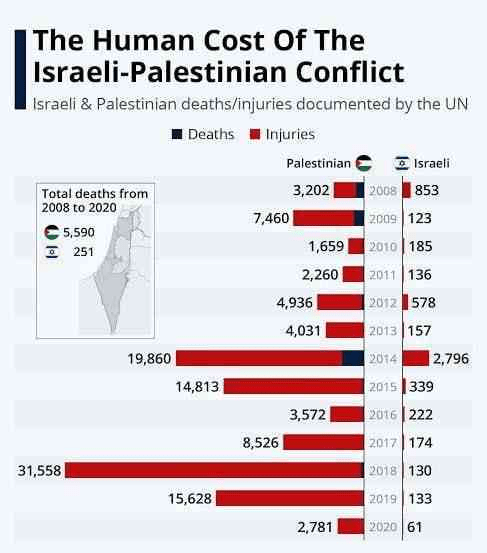
This is one reason why Hamas lashed out. No one could be expected to endure this, year on year, and not want to strike back. It is also why, while I have sympathy for anyone hurt or killed, I have no patience with crocodile tears from Israeli supporters, acting as if they haven’t been doing worse to Palestinians for years.
The Hezbollah Question
is whether they’ll attack. The answer seems to be “probably” as Hezbollah has said that if there is a ground invasion of Gaza, they will declare war. Hezbollah is no joke, they are battle hardened, have between 40K and 150K missiles, a drone force, and their own private comms system.
Israel is moving forces to the Lebanese border as we speak. Militarily speaking, if I were Hezbollah, I might attack sooner rather than later.
The Iran Question
Iran is Hamas and Hezbollah’s sponsor. It is VERY unlikely Hamas did this without Iranian greenlighting and if that’s so, the plan isn’t “do one attack, then get hammered.”
The “Iron” Dome
Israel’s missile defenses cracked under Hamas’s missile barrage. There is no question, if Hezbollah attacks, the Iron Dome will not shoot down most missiles. This time it won’t be Lebanon’s heartland being bombed mercilessly while Tel Aviv is spared, there will be carnage in both homelands.
Nukes
In some ways this is the bottom line. Israel has nukes. If they did not, I would expect Iran to join in and if I were Egypt, I might invade. Israel is weak and humiliated. But as long as they have nukes, other countries will shy off from direct war unless they think they have a way of taking out those nukes.
Diplomatic Damage
Israeli-Saudi Arabia negotiations are dead for the time being and other Arab allies will not be able to do anything but condemn Israel. There are massive demonstrations in support of Hamas in Turkey, Egypt and many other Muslim countries.
Ethnic Cleansing and Occupation
Israel has a huge problem, in that it has a massive population of non-citizens, and those non-citizens are out-breeding the citizenry, except for the ultra-orthodox Jews who do not serve in the military. This is an ulcer, and many Israeli politicians have been clear they want to just get rid of the Palestinians. They can’t genocide them, because it would destroy the Holocaust trump card, but many would love ethnic cleanse them. This may be an opportunity.
This is also an issue because if Israel wants to directly run Gaza, the occupation will be a bloody guerilla war, an endless bleeding ulcer.
If they don’t want to run it, they have to find a friendly quisling force, like the Palestinian authority, to do it for them, and at least right now, there’s no one to take that role. Hamas are more moderate than the other main Gaza factions.
The Ukraine Connection
Of significant amusement is that it appears that much of the weaponry used by Hamas is from stockpiles sent to Ukraine and sold on the black market. This spread of weaponry was predicted and lo.
Imperial Overstretch
Usually when Israel is in trouble the US airlifts in massive arms and munitions to help them, as they did in the 2006 war. But right now the shelves are almost bare because of Ukraine.
Balance of Forces
Hamas is obviously still the massive underdog. They are praying for Hezbollah to join in, and perhaps they want Israel to invade so they can fight a ground war against Israel on their own ground. The smart money is still on Israel.
But do not underestimate Hezbollah, and don’t underestimate how nasty this could get if Hezbollah does intervene. As noted above, they will be able to strike Israel’s heartland. If Israel attacks into Lebanon in response, with ground assets, my money is Hezbollah and if I were Hezbollah I would want that. Defeat the attack, then counter-attack into Israel.
If Hezbollah has to attack on the ground because Israel won’t oblige them I honestly don’t know how it will go.
But, while smaller and less well equipped, Hezbollah is the superior military with higher morale. If I were Israeli, I would not be sanguine.
Concluding Remarks
I won’t cavil, I think Hamas is justified in this attack. I also think the argument that settlers are civilians is weak (though by settlers I do not mean all Israelis.) Israel is an apartheid religious-ethnic state which stole another people’s land and continues to brutalize them.
The only humane solution, one which allows Israel to continue to exist, is a single state with everyone as full citizens.
Alas, that is not on the table.
In the long run, Israel as an ethic religious state, like the Crusader States, is doomed.
The only question is how many people have to suffer before Israel becomes a nation whose very basis is not completely unjust.
(Oh, and if Iran joins in.)
‘We are not attacking civilians’: Hamas says amid Operation Al-Aqsa Storm

Press TV – October 8, 2023
The Palestinian resistance movement Hamas has rejected accusations of targeting civilians as the fighting rages across the occupied territories since the resistance groups launched Operation Al-Aqsa Storm on Saturday.
Osama Hamadan, senior spokesperson of Hamas, has told Al Jazeera that they are not attacking civilians.
“You have to differentiate between settlers and civilians; settlers attacked Palestinians,” Hamdan said.
“We are not targeting civilians on purpose. We have declared settlers are part of the occupation and part of the armed Israeli force. They are not civilians,” Hamadan added.
His remarks came after a number of Western-backed rights groups, including Amnesty International, accused the resistance movement of killing “Israeli civilians” in their retaliatory strikes.
Asked whether civilians in southern Israel were considered settlers, the Hamas spokesman said “Everyone knows there are settlements there.”
On Saturday, the Palestinian Hamas resistance movement launched its large-scale operation, with a heavy barrage of rockets in response to Israel’s desecration of the Al-Aqsa Mosque and increased settler violence.
At least 400 Israeli settlers and forces have died as a result of the large-scale operation — code-named Al-Aqsa Storm — and more than 2000 others have sustained injuries.
Following the operation, a spokesperson for the Israeli defense forces confirmed that Israeli settlers and soldiers are held captive in Gaza, however, the spokesperson declined to specify the number of hostages.
According to Israeli media outlets, unofficial estimates suggest that approximately 750 Israeli soldiers and settlers have been missing since fighting broke out.
Hospital officials in the Gaza Strip have recorded the death of 320 Palestinians and the injury of 1,990 others. A large number of buildings, homes, and public facilities have also been badly damaged due to heavy Israeli bombardments.
The Qassam Brigades, the armed wing of Hamas, said on its Telegram channel that the group had directed a “major missile strike on the settlement of Sderot with 100 missiles.”
The Qassam Brigades also called on Palestinians “to join this battle” as fighting between Israeli forces and Hamas fighters continues.
Meanwhile, Mohannad Aklouk, Palestine’s permanent representative to the Arab League, said he had submitted a request for an emergency meeting of the regional body’s foreign ministers in the wake of the latest Israeli onslaught.
“The urgent meeting comes in light of the ongoing Israeli aggression against the Palestinian people, including the escalation of incursions into the Al-Aqsa Mosque compound by thousands of settlers and Israeli officials over the past days,” Aklouk was quoted as saying by the official Wafa news agency.
The retaliatory operation by Hamas on the occupied territories is the largest after the 11-day Israeli war against the Gaza Strip in May 2021, which took place after weeks of violence against Palestinians in Al-Quds and a brutal crackdown on worshipers at the al-Aqsa Mosque, as well as attempts to steal their land in the Sheikh Jarrah neighborhood.
At least 260 Palestinians, including over 60 children, were killed during the Israeli offensive as the Gaza-based resistance movements retaliated. The regime was eventually forced to announce a ceasefire brokered by Egypt.
Statement by Hamas’s Al-Qassam Brigades top military commander
MEMO | October 7, 2023
On the military operation against the Israeli occupation across the borderline of the Gaza Strip, the commander-in-chief of Hamas’s Al-Qassam Brigades, Mohammed Deif, states the following:
The Zionist colonial occupation occupied our Palestinian homeland and displaced our people, destroyed our towns and villages, committed hundreds of massacres against our people, killing children, women and elderly people and demolishing homes with their inhabitants inside in violation of all international norms, laws and human rights conventions.
We have previously warned the Israeli occupation against continuing their crimes and appealed to world leaders to work on putting an end to the Israeli crimes against our Palestinian people and detainees, their holy sites and homeland and to put pressure on the Israeli occupation to abide by international law and resolutions.
Neither did the Israeli occupation leaders heed our demands, nor did the world leaders act in this regard.
Instead, the Israeli occupation intensified its crimes, crossing all red lines, particularly in occupied Jerusalem and the Al-Aqsa Mosque – the Muslims’ first Qibla and third holiest site.
The Israeli occupation forces have escalated their raids into the Al-Aqsa Mosque, desecrating the Muslim sacred sites and repeatedly attacking worshippers, particularly women, children and elderly people.
Meanwhile, the Israeli occupation banned the Palestinian citizens from accessing the Al-Aqsa Mosque and allowed Israeli colonial settlers to defile the Muslim sacred site and conduct daily raids into the Muslim holy compound.
During such raids, Israeli colonial settlers performed religious rituals and prayers and blew the horn at the Al-Aqsa Mosque. They have declared their intentions to build their purported temple on the ruins of Al-Aqsa Mosque.
They also insulted our Prophet Muhammad (PBUH) inside the Al-Aqsa compound, tore up the Quran and brought dogs into the Muslim sacred site.
Each day, the Israeli colonial settlers attempt to impose a new fait accompli on the ground, attack the Palestinian citizens of occupied Jerusalem and steal their homes and property.
The Israeli occupation has desecrated the Al-Aqsa Mosque, from which the Prophet Muhammad (PBUH) ascended to heaven on the Al-Isra wa Al-Mi’raj journey.
Hundreds of Palestinian citizens have been killed and wounded so far this year in crimes committed by the Israeli occupation and colonial settlers.
In the meantime, the Israeli occupation is holding thousands of Palestinian detainees in its prisons, where they are subjected to the most heinous forms of oppression, torture and humiliation.
Hundreds of Palestinian detainees have been jailed for over 20 years; dozens more have suffered cancers and other diseases; several more have died as a result of medical negligence and deliberate slow-death policies.
However, our calls for a humanitarian swap deal were met with rejection by the Israeli occupation.
The Israeli occupation forces storm the towns and villages of the occupied West Bank on a daily basis, raiding and ransacking Palestinian homes and shooting and detaining Palestinian citizens.
Hundreds of Palestinian citizens have been killed and wounded in crimes committed by the Israeli occupation.
Israeli settlers captured as Hamas and PIJ fighters overrun the Israeli army near the Gaza border
The Cradle | October 7, 2023
Palestinian resistance factions from the Gaza Strip have taken control of over a dozen illegal settlements in southern Israel as part of ‘Operation Al-Aqsa Floods,’ which has been raging since the early hours of 7 October.
Fighters from Hamas and the Palestinian Islamic Jihad (PIJ) say they hold at least 50 prisoners of war (POW) after overrunning many Israeli checkpoints and neighborhoods. Israeli media says the death toll from the operation has reached 100, with close 1,000 injured.
In describing the operation, Hamas deputy chief Saleh al-Arouri told Al Jazeera: “We managed to kill and capture many Israeli soldiers. The fighting is still on. As to our prisoners, I say, your freedom is looming large. What we have in hand will see you set free. The longer fighting continues, the higher the number of prisoners will become.”
Footage across social media has shown the extent of the resistance’s advance, as Israeli soldiers lay dead in many streets while settlers had to run for their lives or surrender to the armed groups.
https://twitter.com/TheCradleMedia/status/1710605327501017461
Among those captured is Israeli General Nimrod Aloni, the commander of the Depth Corps, a unit that coordinates the army’s long-range operations “deep in enemy territory.”
The spokesman for Hamas’ armed wing, Abu Hamza, confirmed that fighters from the Al-Quds Brigades and the Al-Qassam Brigades were at the front of today’s incursion, saying that the Gaza resistance recorded “a new chapter of victory” and “broke the prestige of the enemy entity,” with “a resounding historical shock.”
“Al-Aqsa Flood [revealed Israel] as an illusion made of dust and capable of being defeated and broken.”
In response, Tel Aviv has been conducting air raids inside the Gaza Strip, a coastal area considered the world’s largest open-air prison, leaving over 200 Palestinians dead and 1,600 injured. Survivors of the onslaught say they are “bracing” for the continued Israeli response as Hamas declared, “We are ready for an [Israeli] land invasion.”
Saturday’s operation caught the world by surprise, with even former Israeli security officials calling it a “colossal failure” of the intelligence apparatus, which failed to detect the launch of about 7,000 rockets from Gaza.
“All of Israel is asking itself: Where is the [army], where is the police, where is the security?” the former head of the Israeli Navy said during a TV interview. “It’s a colossal failure; the hierarchies have simply failed, with vast consequences.”
In response to the crisis, Israeli Prime Minister Benjamin Netanyahu declared his country at “war” to the support of his western allies. However, the offensive may throw a wrench at ongoing normalization talks with Saudi Arabia.
In a statement, kingdom officials said: “[Saudi Arabia] repeatedly warned of the consequences of [the deterioration] of the situation as a result of the occupation as well as of depriving the Palestinian people of their legitimate rights and [not halting] systematic provocations against their holy [sites].”
The UAE, which normalized ties with Israel in 2020, issued a statement “[expressing] its deep concern over the escalation of violence between Israelis and Palestinians,” also calling “for an immediate cessation of the escalation and protection of the lives of civilians.”
Support for the operation has poured in from the regional resistance, with Hezbollah Secretary General Hassan Nasrallah calling it a “triumphant operation [and] a decisive response to the ongoing crimes of the occupation.”
Nasrallah also said the Lebanese resistance is “closely following the significant developments [in Palestine]” and “looking at the field conditions with utmost interest.”
Similarly, Yemen’s Ansarallah said that “[Operation Al-Aqsa Flood] revealed the weakness, fragility, and impotence of the temporary zionist entity and showed the world the strength and effectiveness of the resistance in Palestine and its ability to strike the ‘Israeli’ depths, storm the settlements, kill the zionists, and capture their soldiers.”
For Israel, support has poured in from the west, with French President Emmanuel Macron saying via statement, “France stands in solidarity with Israel and the Israelis, committed to their security and their right to defend themselves.”
The White House issued a similar statement, describing Saturday’s resistance operation as “appalling terrorist attacks.”
Palestine: The Resistance Rises toward Revolution, Return and Liberation
Samidoun Palestinian Prisoner Solidarity Network | October 7, 2023
As the morning dawns on 7 October 2023, the resistance is rising throughout occupied Palestine, smashing the siege on Gaza with a comprehensive offensive confronting the occupier by land and air, taking control of Palestinian land, seizing occupation settlers and soldiers and launching thousands of missiles as Palestinian resistance forces fight to advance return and the liberation of Palestine.
The new resistance operation, titled the Al-Aqsa Flood by Mohammed Deif, commander in chief of the Izz el-Din al-Qassam Brigades, the military wing of Hamas, comes on the 50th anniversary of the 1973 war in which Egypt reclaimed the occupied Sinai from Zionist occupation, and is set to alter the direction of the struggle in occupied Palestine, moving from resistance toward revolution and liberation.
The resistance operation comes in response to the ongoing stream of crimes against the Palestinian people, the daily murder of Palestinians on the streets of the West Bank of occupied Palestine, the siege on Gaza, the theft of land for settlements, the denial of refugees’ right to return, imposing exile for over 75 years, the torture and attacks on the Palestinian prisoners, the ongoing invasions of Al-Aqsa Mosque, and the 75 years of Zionist occupation and over 100 years of imperialist domination and colonialism throughout occupied Palestine.
It also comes to bring about the liberation of Palestinian prisoners, as part and parcel of the Palestinian people and land. The occupation has repeatedly dragged its feet in conducting a prisoner exchange with the resistance, and now the resistance has announced that it has taken a significant number of prisoners from among the occupation soldiers and settlers in order to liberate the 5,250 Palestinian prisoners in occupation prions, including the 1350 jailed without charge or trial under administrative detention, 39 women and 170 children. The resistance is taking new steps to liberate Palestinian land, to confront the settlement project and to liberate the prisoners from a position of power.
News is developing rapidly; however it is clear that the Palestinian resistance is determined to reset the status quo in the region and uncover the reality that the Zionist regime can no longer rely on its technological strength and imperialist weaponry to impose its domination on the Palestinian people. In particular, coming as it does on the 50th anniversary of the 1973 war, it is a decisive rebuke to the entire path of Oslo and normalization imposed upon the Palestinian and Arab people for the past 50 years, indicating a new path forward with a clear goal: liberation, and nothing less. It builds upon the liberation of south Lebanon from occupation by the Lebanese resistance, led by Hezbollah, in 2000, and the defeat of the Zionist invasion of Lebanon in 2006, as well as the successive heroic battles waged by the Palestinian resistance throughout occupied Palestine and especially from its base area of resistance land in Gaza.
In his statement announcing the operation, Deif said: “Starting from today, security coordination ends. Today, the people reclaim their revolution, correct their path, and return to the march of return.” He called upon all to participate in the resistance, and specifically to all the forces of resistance in the region, in Lebanon, Syria, Iran and Yemen, and all of the Arab peoples from the Gulf to the ocean, to join in this battle, which is their battle for freedom, dignity and liberation, declaring, “it is time for the forces of Arab resistance to unite.”
Samidoun joins the Masar Badil, the Palestinian Alternative Revolutionary Path Movement, in calling “the masses of our Palestinian people, supporters of the resistance in exile and diaspora, allies from the liberation forces and movements, and solidarity committees with the Palestinian people everywhere, to express their support for the heroic Palestinian resistance, raise the flag of Palestine and the banners of resistance, and organize popular, political and media demonstrations and events to expose the Zionist crimes against our people in occupied Palestine…. The heroic Palestinian resistance has opened a chapter of battles of dignity and pride at the dawn of October 7, 2023, and it is now responding to decades of continuous and repeated Zionist, American and European aggression against the masses of our Arab and Islamic nation from the ocean to the Gulf, and in the face of the wars of starvation and siege that the United States and its agents have engineered against our peoples in the region, especially in Syria, Lebanon, Yemen and Iran.”
As the Palestinian resistance confronts occupation forces, it is critical that internationalists everywhere speak out, mobilize and act to confront the U.S.-led imperialist system, including the EU states, Britain and all complicit powers to end their ongoing crimes against the Palestinian people, and to defend the resistance. These crimes are reflected not only in the Balfour Declaration and the $3.8 billion in U.S. military aid to the occupation regime annually, but in the racist assaults on the Palestinian people in exile and diaspora throughout Europe, and especially in Germany, for speaking out and organizing to take up their role in the cause, for their return to Palestine and the liberation of their land.
Imperialism is the primary enemy of the Palestinian cause, creating the Zionist project and arming it to the teeth as a mechanism of attack against the Arab and Iranian peoples, alongside Zionism, the “Israeli” occupation regime and reactionary, complicit Arab forces.
Today, the resistance is making clear that despite the weaponry and brutality of the occupier, the promise of liberation is closer than ever before.
From the river to the sea, Palestine will be free.
Gaslighting Gaza: Israel’s deceptive extraction approval prioritizes economics over politics
The Cradle | August 1, 2023
A significant breakthrough has emerged as the Hamas authorities in the Gaza Strip have expressed their willingness, in principle, to grant the Fatah-led Palestinian Authority (PA) access to a natural gas field off the Gaza coast.
This groundbreaking development comes as part of a US-brokered deal that involves the PA, an Egyptian gas company, and Israel. If the plans proceed, the potential benefits are far-reaching, holding the promise of bolstering the economy and improving living standards in the besieged Gaza Strip.
Moreover, this agreement opens up the possibility of indirect negotiations between Hamas and the Israeli occupation, following a path similar to the recent developments in neighboring Lebanon. Notably, Hezbollah has given its approval for the Lebanese government to engage in talks with Israel over maritime demarcation lines, while asserting the country’s rights to its natural resources and threatening the use of force to secure it. It appears that Hamas may now be inclined to adopt a pragmatic approach, mirroring Lebanon.
Israeli green light for Gaza gas field
In parallel with the Israeli government’s decision to delegate enhanced powers to pro-settler Finance Minister Bezalel Smotrich, aimed at expediting settlement procedures, Israeli Prime Minister Benjamin Netanyahu’s office announced on 18 June, preliminary approval for the development of the Gaza Marine gas field.
According to the prime minister’s office, the move will place emphasis “on Palestinian economic development and maintaining security stability in the region.”
The approval paves the way for the Egyptian EGAS company to assume responsibility for the administrative and technical aspects of gas exploration, with plans to transport the gas to the Damietta station for liquefaction and subsequent export to Europe and beyond.
Notably, the agreement between Egypt, the PA, and Israel was announced in October 2022, pending Israeli approval, which has now been granted. However, the announcement did not address the share of the Gaza Strip governed by Hamas, who have remained silent on the matter. Analysts attribute this silence to a potential understanding between Hamas leadership and Egypt regarding a positive approach to the agreement.
One policy for Gaza, another for West Bank
This development poses a challenge as the resistance factions in Gaza have previously warned against any agreement that deprives the Strip’s residents of their rightful gas revenues. One Palestinian official was quoted by Reuters as saying: “We are waiting to know what exactly the Israelis have agreed to in detail. We can’t make a position based on a statement to the media.”
Hamas official Ismail Rudwan was also quoted by the news agency as saying: “We reaffirm that our people in Gaza have the rights to their natural resources.” In a rally held last September under the slogan “Our Gas is Our Right,” the factions expressed their firm stance on the matter, raising concerns about the potential repercussions.
Suhail al-Hindi, a member of the political bureau of Hamas, commented on the matter on Arabi21, saying: “In no way can Gaza be absent from this natural wealth, and every Palestinian has the right to benefit from the country’s wealth, including this field, with emphasis that the Palestinian people have the right to obtain this gas.
Al-Hindi stressed that “the Israeli occupation cannot be allowed to steal Palestinian wealth, and besieged Gaza has the right to live like all cities in the world, and for our people to enjoy their natural wealth.”
Discovered in 1999, the Gaza Marine gas field holds significant reserves, estimated at 1.1 trillion cubic feet of natural gas. The British Gas Group and its partners, Consolidated Contractors Company (CCC), were granted a gas exploration license by the PA. Located 603 meters below sea level, approximately 22 miles west of Gaza, the field has a production capacity of 1.5 billion cubic meters annually over a span of 20 years.
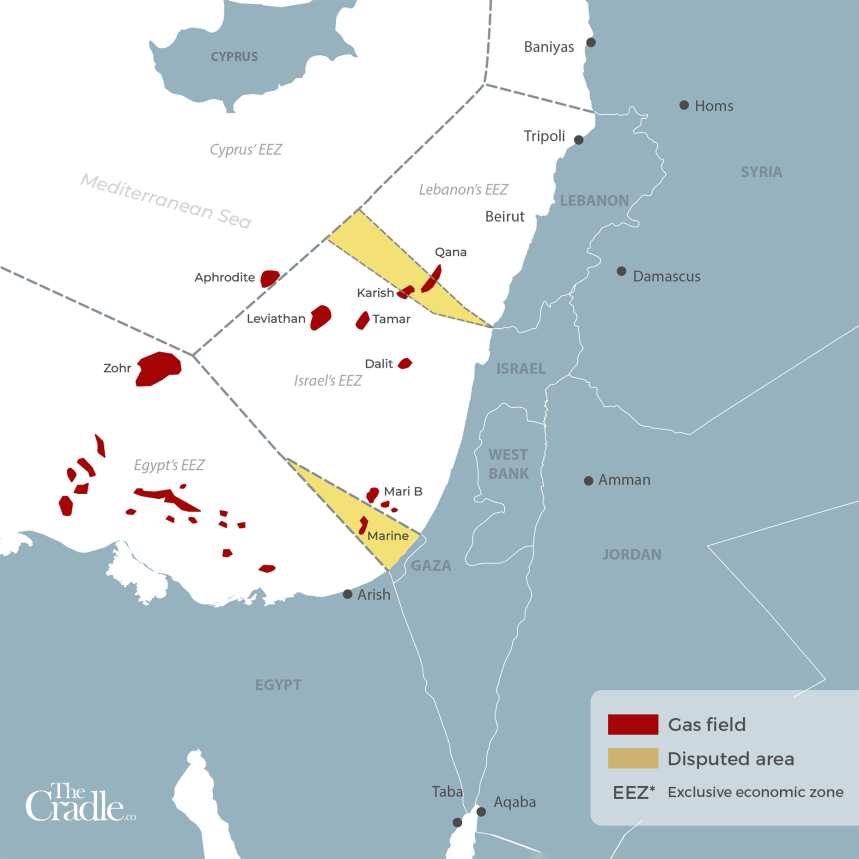
Map of gas fields east of the Mediterranean Sea
Economic analyst Muhammad Abu Jayab tells The Cradle that the US implicitly agreed to provide part of the revenues from the Gaza Marine field to Hamas, which explains why the latter did not comment on the recent agreement. According to Abu Jayab “Egypt is at the forefront as a guarantee that Hamas will deal positively with the agreement, due to Cairo’s influence on the Palestinian factions.”
Nevertheless, the Israeli approval of the Gaza Marine gas field agreement comes at a sensitive time, especially for the resistance factions, as it coincides with the establishment of over 5,000 new illegal settlement units in the face of escalating tensions in the occupied West Bank. Israeli security warnings about the potential consequences of right-wing policies and international opposition, including from the US, further compound the situation.
Plans like the E1 proposal, which connects the Ma’ale Adumim settlement with occupied Jerusalem, and effectively bifurcates the West Bank, have garnered significant criticism due to their potential to impede any future prospects for the so-called two-state solution.
Calm before the storm
Sources close to the decision-making circles of the resistance factions inform The Cradle that the Israeli approval serves as a bargaining chip to buy restraint and non-interference from Gaza Strip resistance groups in events unfolding in the West Bank and Jerusalem.
However, from the perspective of the resistance factions, the cost Israel demands exceeds the economic gains, as recent actions by Hamas underscore its commitment to prioritize resistance over financial incentives.
Mustafa al-Sawaf, a political analyst close to Hamas, tells The Cradle:
“The attack on Eli settlement, which was carried out by two members of the al-Qassam Brigades [armed wing of Hamas] on 20 June, came in response to all attempts to buy calm and silence. It was a clear message from Hamas to all regional and international parties not to dream of exchanging resistance for economic gains.”
Lessons from Lebanon
Meanwhile, political researcher Ismail Muhammad points out that all regional and international parties realize that there is no possibility of bypassing Hamas in the gas file. He explains to The Cradle that:
“The resistance in Gaza was inspired by Hezbollah’s experience in imposing its conditions and obtaining Lebanon’s rights in the Karish field. It sent clear messages, that whatever the pressures, it will not accept being an idle witness while the country’s wealth is stolen before its eyes. The most important conclusions of the Lebanese experience are that investment needs calm, and that none of the Arab or international companies will operate under the threat of fire. At least by disabling it. The resistance possesses the military capabilities that enable it not to bomb the gas fields, but rather to disrupt work in them at least.”
Gas deals: A tool for dividing Palestinians
Politically-speaking, Israel’s pursuit of gas agreements carries broader political implications beyond immediate security concerns. Political analyst Ziyad Abu Ziyad believes that Israel is leveraging these agreements to foster internal Palestinian divisions.
Egypt’s assumption of management responsibilities for Gaza Marine, in the absence of Palestinian reconciliation, and Israel’s refusal to demarcate the maritime borders with the PA, “reminds us of the solution that Israel previously proposed to the Palestinian leadership: a Palestinian state without borders.”
This approach focuses on improving the Palestinians’ economic situation by harnessing their own resources, essentially implementing an economic solution to the conflict without addressing its underlying political dimensions.
The occupation state’s approval of gas extraction from the Gaza Marine gas field has exposed the delicate balance between geopolitics, security, and economic interests in the region. As resistance factions draw inspiration from past experiences and assert their conditions, the path forward remains uncertain, casting doubt on the regional stability that Netanyahu’s office claimed would be maintained with the extraction approval.
Hamas slams US House resolution calling Israel “not racist state”
Palestine Information Center – July 19, 2023
OCCUPIED JERUSALEM – The Hamas Movement has strongly denounced the US House of Representatives for passing a resolution claiming that the Israeli occupation state is “not a racist or apartheid state.”
In a statement on Wednesday, Hamas condemned the resolution as a flagrant US bias in favor of the occupation state and a step intended to encourage it to persist in its crimes and violations against the Palestinian people, especially its ethnic cleansing policy.
“This US resolution has ignored the black history of the Zionist occupation, which is filled with dozens of massacres, and turned a blind eye to the crimes that were committed recently by settler gangs under military protection in Huwara town and dozens of Palestinian villages, which were exposed to arson attacks and organized destruction of homes, vehicles and farms,” Hamas underscored.
Hamas described the recent settler crimes in the West Bank as “an example of the racist practices and the ethnic cleansing policy that are pursued by the occupation state against the Palestinian people.”
“Many Israeli officials have voiced fascist positions, such as the recent remarks of the criminal minister, Smotrich, in which he gave the Palestinians the choice between living in the so-called state of Israel as second-class citizens or being banished or killed,” the Movement said.
“Such a US resolution will not change the reality of the criminal and racist Zionist occupation entity, which relies on ethnic cleansing, displacing the rightful owners of the land and replacing them with intruders,” it added.
The US House of Representatives overwhelmingly passed a resolution calling Israel “not a racist or apartheid state,” on Tuesday
The measure passed, in a 412-to-nine vote, a few hours after president Joe Biden met with Israeli president Isaac Herzog at the White House.
The legislation comes in response to remarks last Saturday from Congresswoman Pramila Jayapal, chair of the Congressional Progressive Caucus, in which she called Israel a “racist state.”
Later, the congresswoman apologized following pressures, while stressing that Israel’s “extreme right-wing government has engaged in discriminatory and outright racist policies.”
Twisted narratives promote the targeted assassinations of Palestinians
By Ramona Wadi | MEMO | June 20, 2023
A recent poll by the Palestinian Centre for Policy and Survey Research detailed how Palestinians are largely in favour of armed resistance against Israel’s settler-colonialism. More importantly, Palestinians have again asserted that they no longer need to take their cues from the main Palestinian political factions, indicating a sharp detachment from the politics of the previous years that monopolised resistance depending on factions and geographical territory.
In the poll, 71 per cent of Palestinians favoured the forming of armed resistance groups such as the Lions’ Den and the Jenin Battalion. The Palestinian Authority continued to lose favour among the people of occupied Palestine, with 80 per cent of survey participants against the surrender of members from resistance groups to the PA. In relation to this, 86 per cent of Palestinian respondents declared themselves to be against the PA’s persecution of resistance group members.
Juxtaposed against these findings is the statement of Avigdor Lieberman, Israel’s former foreign minister and current head of the Yisrael Beiteinu party, who has called for a targeted assassination policy against Hamas leaders in Gaza. “We cannot accept the ‘rules of the game’ in which they can inflame Judea and Samaria while being immune in Gaza,” said Lieberman, referring to Palestinian resistance in the occupied West Bank. He also called for a large-scale military operation in the occupied Palestinian territory to quash the resistance.
The current Palestinian resistance — which is legitimate under international law — does not follow the politics of Palestinian factions, preferring instead to maintain a unified front encompassing all groups. Moreover, support for Hamas in the occupied West Bank is not a recent phenomenon, but the result of the Fatah-led PA’s corrupt existence.
Referring to the Israeli raid of the Jenin refugee camp in which five Palestinians were killed (a sixth has since died of his wounds), Hamas spokesman Hazem Qassem pointed out that, “The resistance fighters from all factions were united on the battlefield. It shows that the resistance still exists in the West Bank cities.”
Two narratives are at play here. One is the unified front which Palestinians are moving towards and embracing in their anti-colonial struggle. The other portrays Hamas as the epitome of Palestinian resistance and the reason why Palestinian resistance exists. Much of this is attributed to the discrepancy between Gaza and the occupied West Bank in terms of their portrayal, as well as the different reactions to their unique socio-economic and political realities. Now that the PA has lost much of its grip over the occupied West Bank, Hamas is looming as a bigger threat in the official narrative, despite Palestinians clearly veering towards a unified resistance that encompasses all factions and which remains independent.
Lieberman’s call for targeted assassinations exploits the image of Hamas as synonymous with Palestinian resistance. The movement is being used to promote Israel’s policy of targeted assassinations, a purportedly rational objective in the settler-colonial narrative. The impact, however, is not restricted to Gaza. A growing independent Palestinian resistance which is out of the PA’s control is an uncontained reality which Israel currently faces. Maintaining the narrative of Hamas as the exclusive source of resistance can ultimately be used as a facade for Israel and the PA to normalise extrajudicial killings of Palestinians in the occupied West Bank.
Read also: Israel forces assassinate Palestinian Authority officer in West Bank
Israeli ploy to divide PIJ and Hamas in Gaza a grave miscalculation
By Robert Inlakesh | Press TV | May 12, 2023
The Israeli regime’s new assassination campaign in the besieged Gaza Strip has essentially sought to isolate the Palestinian Islamic Jihad (PIJ) resistance movement from Hamas, in what Palestinian resistance leaders, across the board, believe is a miscalculation.
The Israeli occupation military carried out a barrage of deadly strikes on the residences of PIJ leaders in the Gaza Strip in the wee hours of Tuesday morning.
The strikes were carried out just after 2:00 AM local time and claimed the lives of Khalil Bahtini, Jihad Ghanem and Tariq Ezz Ad-Din, three senior leaders of the Gaza-based PIJ movement, along with their spouses and children.
The three resistance leaders were reportedly supposed to head to the Egyptian capital Cairo that day to discuss rising tension in the occupied territories and the regime’s relentless aggression, due to which PIJ had loosened its state of emergency a day earlier.
On Thursday, two more PIJ officials, part of the al-Quds brigades, were assassinated in Israeli drone strikes, prompting a massive barrage of rockets from Gaza towards Tel Aviv and other occupied areas in retaliation.
According to a PIJ military source, who spoke to the Press TV website on the condition of anonymity, Zionists launched the attack to “save their image” and to “isolate the resistance groups”.
“They wanted to see Islamic Jihad isolated from our brothers in Hamas. This has failed and we fight as one force, an attack on one is an attack on all,” he said.
Divide and conquer fails
This statement reflects the sentiment of the PIJ leadership too, who view this battle as a means to demonstrate unity among the resistance movements, which has been established through the Joint Room for the resistance factions in Gaza, which rose to prominence during the Battle of Saif al-Quds in May 2021.
Head of the Islamic Jihad’s political department, Muhammad al-Hindi asserted that there is political communication at the highest level between the two movements and “attempts to drive wedge will fail”.
Hamas has also explicitly said that it is part of the response and its armed wing, the Qassam brigades, is the most powerful force in the Palestinian Joint Room.
The Joint Room also released a statement affirming that the resistance “will remain on all fronts of the homeland as one unit, a sword and a shield for our people, our land, and our sanctities.”
The component of dividing the Palestinian resistance factions has been integral to the Zionist entity’s assassination campaign in Gaza, with the Israeli military warning Hamas to stay out of the confrontation after it carried out its initial strikes.
Yoav Gallant, the Israeli minister of war, stated after the first extrajudicial killings were carried out that “the goals of the operation have been achieved; the leadership of Islamic Jihad in Gaza has been eliminated”, without mentioning Hamas.
Calculated response
However, the resistance forces managed to flip the script on their enemy, waiting for over a day before retaliating, despite continued Israeli missile strikes.
The decision to make the Israelis wait for the response caused hysteria, keeping bomb shelters open for settlers throughout occupied Palestine, as they waited for the anticipated response to high-profile assassinations.
Notably, the response of the resistance forces was not anticipated in the way that it happened. Although there were preparations made for rocket fire toward Tel Aviv, many Israeli analysts believed that past strategies of slowly expanding the range of fire would be adopted.
The wait was perhaps the most important component of the initial retaliatory rocket fire, building anticipation and causing bickering amongst Israelis.
Another key component of the Israeli offensive has been the game of political point scoring, claiming imaginary victories and making tall and deceptive statements following the assassination strikes.
Israeli prime minister Benjamin Netanyahu’s far-right coalition partners – Likud and Otzma Yehudit – had been in dispute over what was labeled by Israel’s security minister Itamar Ben Gvir as a “feeble” response to the PIJ rocket fire last week.
Adnan’s murder
The rocket fire came as a response from the Joint Room to the custodial murder of Palestinian political icon and PIJ West Bank spokesperson, Khader Adnan, who was allowed to die a slow death inside his cell in an Israeli military prison, denied basic medical aid.
Adnan went on hunger strike for 86 consecutive days and according to the Palestinian Prisoners Society organization his custodial murder came as a result of deliberate medical negligence by prison authorities, therefore making it an assassination, or as one Palestinian group said, “cold-blooded execution”.
Before the killing of Adnan, another exchange of fire occurred between the occupation forces and Gaza’s resistance groups during the holy month of Ramadan.
After the Israeli forces stormed the al-Aqsa Mosque compound, attacked worshippers, desecrated the holy site, and arrested and injured over 400 Palestinians, rockets were fired from the Gaza Strip.
The following day, a barrage of rockets also came from southern Lebanon, followed by two batches of rockets fired from Syria into the occupied Golan Heights.
Israeli strikes in Gaza, Lebanon and Syria were lackluster against the backdrop of major threats from the Zionist entity at the time. In both Gaza and Lebanon, Israeli strikes hit open areas of no strategic value, which even made it to social media memes.
Wary of backlash
It is because of the two previous exchanges that the Zionist regime has gone through a process of repeated embarrassments. Its leadership is wary of the political backlash that would come with the outbreak of a real war with all sides, so it settled for a low-scale battle.
In the case of the latest aggression on the besieged Gaza Strip, the PIJ movement has been chosen as what Israel believes to be an easier target, however, as Hamas leader Ismail Haniyeh stated this Tuesday, the regime has “severely miscalculated” and instead of being able to isolate PIJ, they have been dragged into a battle with a unified resistance front this time.
On November 12, 2019, the Zionist regime carried out a brief military operation that targeted only the PIJ movement, assassinating the group commander Baha Abu Atta, which sparked days of fierce fighting.
At that time, Palestinian Islamic Jihad fought separately from Hamas even though the relations between both groups remained friendly, contrary to the hideous Israeli propaganda.
Last year, in August, under former Israeli prime minister, Yair Lapid, the Zionist military launched another military operation to assassinate leading members of PIJ, managing to kill Khaled Mansour and Tayseer Jabaari.
In response, the PIJ movement, as part of the Joint Room, launched “Operation Unity of Squares”, which involved heavy coordination with Hamas throughout.
The aim of dividing the groups failed, yet the Zionist regime managed to keep Hamas from getting involved with full force.
It was using this model that Israeli PM Benjamin Netanyahu launched an attack this time, however, what was planned to be a short assassination campaign failed to isolate the PIJ movement from the other resistance groups and rather unified the resistance front against the occupying entity.
Robert Inlakesh is a journalist, writer and political analyst, who has lived in and reported from the occupied West Bank.
Hamas: Ben Gvir’s militia plan reflects “ethnic cleansing mentality”
Palestine Information Center – April 3, 2023
GAZA – Hamas spokesman Hazem Qasem has described the Israeli government’s decision to form a terrorist militia under the name of “national guard” led by far-right security minister Itamar Ben Gvir as a “serious development confirming that this fascist government plans to escalate its aggression against the Palestinians in 1948 occupied Palestine.”
In press remarks on Sunday, spokesman Qasem said that such decision asserts that “the racist and fascist behavior is the main element that governs the Israeli government’s behavior and policies.”
The spokesman added that this decision also reflects that “the mentality of ethnic cleansing is still present in the Israeli practices against the Palestinians in 1948 occupied Palestine.”
The Israeli government approved on Sunday the establishment of a national guard supervised by the far-right security minister, Itamar Ben-Gvir, who said it would focus on suppressing Arab protests and unrest in Israel.
The exact powers of this national guard squad will be discussed by a committee comprising all the Israeli security agencies, which will submit recommendations within 90 days, Israeli premier Benjamin Netanyahu’s office claimed in a statement.
Ben Gvir, for his part, said that government funding would enable the initial intake of 1,850 persons for the new squad.
UN resolutions on Palestine won’t be implemented as long as Israel enjoys US support: Hamas
Press TV – December 31, 2022
The Palestinian resistance movement Hamas has condemned the United States’ unwavering support for Israel, saying United Nations resolutions concerning Palestine will not be implemented as long as Tel Aviv enjoys Washington’s support.
Hamas spokesman Hazem Qassem made the remarks in a statement on Saturday, after the United Nations General Assembly approved a resolution in favor of Palestinians, according to Arabic-language al-Ahad television network.
“This resolution will add to the long list of international resolutions concerning Palestine, which have never tuned into a practical step to put pressure on the occupying regime even once,” Qassem said.
“As long as the US acts as a partner of the occupying regime and covers up Israeli crimes, all such decisions will remain on paper,” he added.
On Friday, the UNGA adopted a resolution calling on the International Court of Justice (ICJ) to give an opinion on the legal consequences of the decades-long Israeli-Palestinian conflict, Israeli “annexation” and the “legal status of the occupation” of Palestinian territories.
The resolution promoted by Palestinians passed by a vote of 87 in favor, 26 against, with 53 abstentions. Russia and China voted in favor of the resolution.
Israel, the US and 24 other members – including the United Kingdom and Germany – voted against the resolution, while France was among the 53 nations that abstained.
The resolution is titled “Israeli practices and settlement activities affecting the rights of the Palestinian people and other Arabs of the occupied territories” and calls on the Hague-based ICJ to “render urgently an advisory opinion” on Israel’s “prolonged occupation, settlement and annexation of Palestinian territory.”
It also calls for an investigation into Israeli measures “aimed at altering the demographic composition, character and status of the Holy City of al-Quds” and says Israel has adopted “discriminatory legislation and measures.”
The resolution demands the court weigh in on the conflict in accordance with international law and the UN charter.
Palestine’s UN ambassador Riyad Mansour noted that the vote came one day after the swearing-in of a new far-right Israeli cabinet led by hawkish prime minister Benjamin Netanyahu, which he said promises an expansion of illegal settlements and will accelerate “colonial and racist policies” towards Palestinians.
Earlier this month, Palestinian Minister of Foreign Affairs and Expatriates Riyad al-Maliki announced that the UN General Assembly has adopted a resolution that affirms the Palestinian people’s right to self-determination.
He further called on the international community to work on obliging Israel “to implement international resolutions and guarantee the right of the Palestinian people, as he hailed the resolution.
The General Assembly also adopted five resolutions recently in favor of Palestinians, including the issue of Palestinian refugees.
These decisions are issued every year by the General Assembly, which is consisted of 193 members, and are non-binding.
Featured Video

Rewriting the risk? Inside the government’s vaccine safety messaging
or go to
Aletho News Archives – Video-Images
Book Review
“Davos Can Really Replace the UN”
Inside the book that maps the architecture behind global governance — from the Epstein files to the Pact for the Future
Lies are Unbekoming | April 1, 2026
On June 13, 2019, the United Nations and the World Economic Forum signed a partnership deal to “accelerate the implementation of the 2030 Agenda for Sustainable Development.” That same evening, WEF president Börge Brende — Norway’s former Foreign Minister — had dinner with Jeffrey Epstein at Epstein’s Manhattan townhouse. The Epstein files, released January 2026, contain an exchange between the two from the previous year. Epstein to Brende: “Davos can really replace the UN. C21, cyber, crypto . genetics… intl coordination.” Brende back to Epstein: “Exactly — we need a new global architecture. World Economic Forum (Davos) is uniquely positioned — public private.”
The next day, the UN General Assembly adopted the framework for restructuring global governance.
That sequence — the partnership signing, the Epstein dinner, the candid admission about replacing the UN with a public-private architecture, and then the formal adoption — opens Jacob Nordangård’s The Digital World Brain. Pages two and three. Footnoted to the UN resolution number, the Epstein files, and the General Assembly record.
I keep coming back to it because it captures what this book does that almost nothing else in the independent research space manages. I’ve followed Jacob’s work for years now and interviewed him about his research. Each book peels back another layer of the same institutional architecture, and each time I think he’s reached the limit of what can be documented, the next one goes further. Nordangård doesn’t speculate. He doesn’t editorialize much. He lays institutional actions next to each other in chronological order and lets the pattern announce itself. … continue
Blog Roll
 Aletho News
- How I fell foul of the BBC thought police
- The End of NATO
- 37 days of war on Iran cost US staggering $42bln, tracker shows
- Baghdad tells Asian refiners, traders to begin loading Iraqi crude amid Iranian exemption
- Under fire, Moscow and Tehran close ranks
- Iran, US receive Pakistan-mediated plan for ceasefire then final deal
- Iran submits demands for end to war as mediators scramble ahead of Trump deadline
- Iran Threatens Retaliatory Strike on Stargate AI Project in UAE
- US sent ‘a lot’ of arms to Iranian protesters – Trump
- Barak Ravid Launders Deception To Allow Trump To Back Off Of His Power Plant Threat – Again
- If Americans Knew
- U.N. experts demand Israel release prominent Gaza doctor after reports of ‘severe torture’
- Israel’s Latest Genocide Is Against the Shias of Lebanon. Why Is the World Silent?
- How Eliot Cohen’s influence over U.S. war-making paved the way for Trump’s war crimes in Iran
- Israelis don’t pay for the weapons we ‘sell’ to them — US taxpayers do
- While Distancing from AIPAC, Most 2028 Democratic Hopefuls Are Still Embracing Israel
- A brief history of the Israeli nuclear program, the open secret at the heart of the Iran war
- Israeli Settlers Killed a Palestinian Farmer on His Own Land, in Front of His Father. Yes, Again
- The US-Israeli War on Science is an Assault on our Future
- 100+ International Law Experts Say US Strikes on Iran Violate UN Charter, Could Be War Crimes
- ‘Vile, Horrifying, Evil’: Trump Threatens to Bomb Nation of 90 Million People ‘Back to the Stone Ages’
- No Tricks Zone
- An Inconvenient Tree: Uncovered In Alps… Europe Much Warmer Than Today 6000 Years Ago
- New Study Reports A 60% Slowdown In Greenland’s Ice Loss Rate In The Last Decade
- Low Intensity Tornado Wrecks Major Solar Farm, Creating A Potential Toxic Dump
- New Study Finds Warming Saves Lives…Cold Temperatures 12 Times More Deadly Than Excess Heat
- German Science Blog Accuses PIK Climate Institute Of Hallucinating Climate Tipping Points
- Devastating Assessment Of Comirnaty Vaccine By Former Senior Pfizer Europe Toxicologist
- New Study: CO2 Is ‘Effectively Negligible’ As An Explanatory Climate Change Factor Since 2000
- Former Pfizer Toxicologist Dr. Helmut Sterz Tells Bundestag Hearing Pfizer Vaccine Should Have Never Been Approved
- Energy Expert: Germany’s Nuclear Phaseout Was A “500 Billion Euro Mistake”
- New Research: South Australia’s Mid-Holocene Sea Surface Temperatures Were 4°C Warmer Than Today
 Aletho News