Israeli regime openly calls on IAEA to censure Iran
Press TV – June 7, 2022
The Israeli regime is openly putting pressure on the United Nations’ nuclear watchdog to censure Iran’s peaceful nuclear energy program.
“We expect the IAEA (the International Atomic Energy Agency’s) Board of Governors to place a clear warning light in front of the regime in Tehran, and make it clear that if it continues in its defiant nuclear policy, it will pay a heavy price,” the regime’s Prime Minister Naftali Bennett said on Tuesday, addressing the Knesset (Israeli parliament), The Times of Israel reported.
The comments came a day after the board started a five-day meeting in Vienna.
The event is set to adopt an anti-Iran resolution, drafted by Britain, France, Germany, and the United States to accuse the Islamic Republic of withholding cooperation with the agency.
Various media reports and official sources have warned about the existence of the Israeli regime’s footprints across the process that has led to the emergence of the draft resolution.
Raising even more suspicion was a Friday flying visit to the occupied territories by the IAEA’s Secretary-General Rafael Grossi, and his meeting there with Bennett, with some reports even sounding the alarm about the watchdog and Tel Aviv’s “collusion” against Iran.
“He (Grossi) arrived for a snap visit in Israel, and I made Israel’s stance clear — that we are operating and will continue to maintain our freedom of action to act against Iran’s nuclear program as long as necessary… nothing ties our hands,” Bennet said.
The Israeli regime has, over years, conducted several sabotage operations against Iran’s nuclear facilities and assassinated at least seven Iranian nuclear scientists.
The regime’s vicious anti-Iran campaign comes while Tel Aviv, itself, continues to be the sole possessor of nuclear arms in the Middle East region, with a stockpile of hundreds of atomic warheads. Due to the cover provided by the US and Europeans, however, the regime has refused to open up its nuclear sites to the IAEA’s inspectors and join the Nuclear Non-Proliferation Treaty (NPT).
“When it comes to nuclear weapons, we live in a world of double standards,” Frank N. von Hippel, an American physicist, who is a professor and co-director of the Program on Science and Global Security at Princeton University, told Press TV.
“This unequal situation cannot persist indefinitely: Either we get rid of nuclear weapons or nuclear weapons will get rid of us,” he added.
Iran and IAEA relations on tenterhooks
Press TV – June 7, 2022
The Vienna based International Atomic Energy Agency, the IAEA, is supposed to monitor compliance with the 1968 nuclear Non Proliferation Treaty, NPT, which has been described as the centerpiece of global efforts to prevent the spread of nuclear weapons, promote cooperation in the peaceful uses of nuclear energy and to achieve the ultimate goal of global nuclear disarmament.
The IAEA is supposed to engage upon technical, unbiased and professional cooperation with NPT signatories and to be free of politics or political considerations.
The IAEA has had a high profile role regarding Iran’s nuclear energy programme. In 2015, when Iran and the P 5+ 1 struck a deal known as a Joint Comprehensive Plan of Action. The IAEA was subsequently tasked with monitoring Iran’s compliance with the terms of the agreement.
In many of its reports over the years, the agency has said that it has found no evidence of any diversion in Iran’s nuclear programme.
As the fate of the faltering 2015 deal remains increasingly unclear, the technical role and supposed independence of the atomic watchdog are being tested.
In a recent report, the IAEA said Iran’s stockpile of enriched uranium had grown to more than 80 times the limit allowed in the 2015 agreement.
The agency also said Iran has failed to answer its remaining questions.
Tehran described the latest IAEA statements as one sided pointing out that it fails to reflect Iran’s extensive cooperation with the agency.
“The International Atomic Energy Agency seems to be succumbing to the same sort of takeover that the United States and the Anglo Zionist Empire has been doing to so many other international organizations such as, for example, in athletics, for example, in economics with the World Economic Forum, for example, all these organizations; they seem to want to control them.” – Tony Gosling, Investigative Journalist
Meanwhile, reports say Western countries lobbied by Israel are planning to push the International Atomic Energy Agency to criticize Iran at its upcoming meeting of the Board of Governors.
In March Rafael Mariano Grossi, the head of the International Atomic Energy Agency, visited Iran. The IAEA and Iran announced at the end of the visit that they had agreed on an approach for resolving remaining bilateral issues.
The visit came as representatives from Iran and the P 4+1 were trying to find a way to move forward in their negotiations which were aimed at reviving the 2015 deal. The talks are currently stalled with Iran saying the United States is failing to make necessary political decisions.
At this point, any stance by the IAEA could have an important effect on the stalled talks. This week Iran’s top diplomat said the agreement between Tehran and the agency in March was mutually satisfactory. He warned that political interference in the technical affairs of the agency is totally unconstructive.
The comments by Amir-Abdollahian came ahead of a meeting of the IAEA Board of Governors scheduled for June the sixth. With days left to the meeting the IAEA chief has arrived in Israel as Tel Aviv released documents alleging Iran spied on the IAEA.
Iran says Israel, which has refused to join the NPT and is believed to possess hundreds of nuclear warheads, hates the JCPOA and wants to derail the effort to revive it.
The problem with much of what the International Atomic Energy Agency has been doing is that it is trying to find excuses to, I suppose, make out that the Iranian nuclear programme is a military programme.
One of the problems with the IAEA is they’re not looking anywhere near as closely at the Israelis, who do have nuclear weapons.
“They tried to keep it secret, but Mordechai Vanunu blew the whistle in the Sunday Times here in Britain back in the 1980s and did a massive jail term for his, when he was kidnapped actually, for his trouble, that they do have many nuclear weapons, probably something like 200 …” – Tony Gosling, Investigative Journalist
Reports say the United States and its Western allies, pushed by Israel, plan to pile pressure on Iran at the upcoming IAEA meeting.
Tehran has warned that it would respond firmly and appropriately to any such move, because Iran has been cooperating based on the agreement reached in March.
The fate of months of negotiations between Iran and the P 4+1 seems to be at stake as a meeting of the IAEA Board of Governors draws close.
One wonders who would benefit from a possible collapse of the talks.
Iranian nuclear chief: IAEA’s Grossi lacks serious will to find Tehran’s ‘accurate’ answers convincing
Press TV | June 6, 2022
The head of the Atomic Energy Organization of Iran (AEOI) says Tehran has given accurate answers to questions posed by the International Atomic Energy Agency (IAEA), but the Agency bases its reports on the information provided to it by the enemies of Iran.
In an interview with Al Jazeera network on Monday, Mohammad Eslami said the director general of the IAEA, Rafael Grossi, lacks serious will to describe Iran’s answers to the Agency’s queries as convincing.
“The International Atomic Energy Agency relies on the intelligence reports [provided by] our enemies, topped by Israel,” Iran’s nuclear chief said.
Eslami made the remarks after the IAEA chief, in his introductory statement to the Board of Governors’ meeting on Monday, once again repeated his anti-Iran rhetoric, alleging that since February 23, 2021, the Agency’s “activities have been seriously affected by Iran’s decision to stop the implementation of its nuclear-related commitments under the JCPOA, including the Additional Protocol.”
Grossi claimed, “Iran has not provided explanations that are technically credible in relation to the Agency’s findings at three undeclared locations in Iran.” Grossi’s allegation, however, came after his meeting with Eslami and the adoption of the two sides’ joint statement on March 5, 2022.
The AEOI and the IAEA agreed, in continuation of their cooperation as stated in the Joint Statement of August 26, 2020, to accelerate and strengthen their cooperation and dialogue aimed at the resolution of the issues, read part of the joint statement.
Grossi’s remarks came despite frequent warnings by Iran that in case the Agency drifts away from its technical nature and makes a politicized decision related to Iran’s peaceful nuclear program, the country will respond in kind.
Elsewhere in his interview, Eslami pointed to the possible adoption of an anti-Iran resolution during the ongoing meeting of IAEA’s Board of Governors and said even if adopted, such a resolution would not create a new situation.
Advising the UN nuclear watchdog to block political influence on its decisions and abide by its own regulations, the AEOI’s head said, “The IAEA has not condemned attacks on our [nuclear] facilities and this is a big question mark.”
Over the past years and amid lack of sensitivity and proper attention on the part of the IAEA towards performing a responsible role in the area of protection of various countries’ peaceful nuclear activities, some malign activities, for which the Zionist regime has implicitly accepted responsibility, have afflicted some damage to our country’s nuclear facilities.
Although these activities have never had a decisive effect on the progress of Iran’s peaceful nuclear program, given the sensitivity that is inherent to the nature of nuclear work, adoption of new strategies in the structural, hardware, and software aspects have found a place on the AEOI authorities’ agenda so the nuclear facilities’ security can be completely ensured.
Eslami also rejected allegations that Iran is planning to build nuclear weapons, saying, “Nuclear weapons have no place in our strategies” and that all such allegations are nothing but spiteful accusations.
Asked about the IAEA’s access to information recorded by monitoring cameras it has installed in Iran’s nuclear facilities, Eslami said this issue depends on the fate of the ongoing talks in the Austrian capital on the revival of the 2015 Iran deal, officially known as the Joint Comprehensive Plan of Action (JCPOA).
“If other parties commit to all articles of that agreement, we are ready for full compliance with the accord,” Iran’s nuclear chief said.
Under the JCPOA, Iran accepted certain caps on its nuclear program in exchange for the removal of international sanctions.
The US, however, unilaterally abandoned the deal in 2018 and re-imposed crippling sanctions despite Tehran’s full compliance with its share of obligations.
Israel-IAEA collusion: Grossi lands in Tel Aviv ahead of UN nuclear agency meet

Press TV – June 3, 2022
The chief of the UN nuclear agency has traveled to Israel and met the regime’s extremist premier Naftali Bennett, ahead of the body’s Board of Governors meeting on Monday.
The high-profile visit by Rafael Grossi also comes in the wake of the latest report by the International Atomic Energy Agency (IAEA) on Iran’s nuclear program amid a stalemate in Vienna talks to salvage the 2015 nuclear deal, called the Joint Comprehensive Plan of Action (JCPOA).
Iran has on many previous occasions cautioned the UN nuclear agency against allowing the Israeli regime to influence its independent mandate and decision-making.
On Thursday, during a phone call with his Singaporean counterpart Vivian Balakrishnan, Iran’s Foreign Minister Hossein Amir-Abdollahian described any political interference in the technical affairs of the IAEA as “unconstructive”.
He said during Grossi’s recent visit to Iran, the two sides had reached a mutually satisfactory agreement through a positive process.
However, the IAEA’s latest report last week drew Iran’s criticism, rejecting it as “unfair and unbalanced” that had deviated from the technical path under Israel’s pressure.
Earlier this week, Bennett accused Iran of stealing classified documents from the IAEA and using them to deceive international inspectors nearly two decades ago. Iran rejected the allegations as outright lies.
Iran’s Foreign Ministry spokesman Saeed Khatibzadeh on Wednesday called the Israeli regime “the world’s #1 JCPOA hater” which he said also “happens to be NPT-denier and the only nuke-possessor” of the region.
“We know this. The world knows this. Time for E3/US to stop pretending to be asleep. They can pursue diplomacy—or pursue the opposite. We’re ready for both,” the spokesman said.
Israel is the Middle East’s sole, though undeclared, nuclear-armed entity, but it has never allowed the IAEA to inspect its nuclear sites. It has also refused to sign the Non-Proliferation Treaty (NPT).
On the other hand, Iran’s nuclear energy program has been subject to the most intensive inspections. The Islamic Republic is a signatory of the NPT, but it continues to reel under harsh sanctions for working to benefit from the peaceful use of nuclear energy, like other countries.
On Friday, Bennett told Grossi that Israel would prefer a diplomatic resolution but could take unilateral action against Iran’s nuclear energy program.
Bennett “stressed (to Grossi) the importance of the IAEA Board of Governors delivering a clear and unequivocal message to Iran in its upcoming decision”, a
statement from the Israeli premier’s office said.
Warning to IAEA
The IAEA board of governors is slated to hold a meeting on Monday for which Britain, France, Germany, and the US have reportedly prepared a draft resolution to mount pressure on Iran.
The United States on Thursday confirmed that it will join Europeans in backing the resolution against Iran.
Iran has pledged a “firm and appropriate” response to any “unconstructive” move. “We will respond firmly and appropriately to any unconstructive action at the board of governors,” Khatibzadeh said on Wednesday.
China also warned that any confrontational moves at the upcoming meeting will only undermine cooperation between Iran and the IAEA, and disrupt the process to revive the 2015 nuclear deal.
Chinese Foreign Ministry spokesman Zhao Lijian said exerting pressure on Iran and the UN nuclear agency will escalate tensions and complicate the situation.
He called on Washington to make a political decision as soon as possible on the revival of the nuclear agreement and actively respond to what Iran’s legitimate concerns.
Iran has repeatedly stated that it is waiting for a response from the US on its proposals to revive the deal, but Washington has been dragging its feet on it.
International nuclear watchdog passes resolution on Ukraine
RT March 3, 2022
In a resolution passed on Thursday by its board of directors, the International Atomic Energy Agency (IAEA) reportedly “deplored” Moscow’s invasion of Ukraine. Russia has denounced the document, calling it politicized and factually incorrect.
The resolution, which is yet to be published, apparently calls on Russia to allow the Ukrainian authorities to resume control of its nuclear sites. Moscow says the assertion that they are not already in control is incorrect.
There were claims that Russian troops had occupied the site of the destroyed Chernobyl nuclear power plant as they moved from Belarus towards Kiev. The Russian Defense Ministry has denied them, stating that Ukrainian guards remained in control of the facility.
On March 1, Reuters gave a preview of the draft of the damning resolution, which was penned by Poland and Canada on behalf of Ukraine.
The news of the resolution’s passage, with just two votes having been cast against it at the session of the 35-member board, was welcomed by Ukraine. Foreign Minister Dmytro Kuleba claimed in a tweet that it showed the world was “united against Russia’s actions, which threaten Ukraine and all of Europe.”
Russia’s representative at the IAEA, Mikhail Ulyanov, blasted the document, claiming it contained “intentional politically motivated lies and mistakes.” In particular, the assertion that the Ukrainian authorities were not in control of the nation’s nuclear sites was wrong, the official said in a series of tweets.
Moscow was satisfied that “countries whose populations taken together exceed a half of the mankind refused to support the resolution,” Ulyanov added.
China has confirmed that it voted against the resolution. Its representative, Wang Qun, said the document “obviously” overstepped the agency’s mandate to monitor nuclear security, and that by adopting the resolution, it had undermined the IAEA’s position as a professional, non-political organization.
The diplomat complained that some nations had “forcibly pushed” the draft and rejected suggestions submitted by other board members about how to improve the document.
Earlier on Thursday, IAEA Director General Rafael Mariano Grossi confirmed to journalists that all safety precautions the agency had taken in Ukraine remained intact.
Iran envoy: No IAEA access to new nuclear site in Isfahan before conclusion of JCPOA revival talks
Press TV – January 31, 2022
Iran’s ambassador to international organizations based in Vienna says the International Atomic Energy Agency (IAEA) will have no access to the country’s new nuclear site in the central city of Isfahan before the ongoing talks on the removal of US sanctions and revival of the 2015 Iran nuclear deal reach a definitive result.
Mohammad Reza Ghaebi made the remarks while speaking to reporters on Monday after the IAEA announced earlier the same day that Iran has informed the world body that it would move the production of centrifuge rotor tubes and bellows from TESA Karaj Complex to Isfahan.
He said the process “has not started yet,” adding, “The IAEA will be able to adjust its surveillance rules accordingly, although the information gathered through that surveillance process will remain in Iran and the IAEA will not have access to it until Tehran resumes its nuclear commitments under the JCPOA,” referring to the 2015 nuclear deal, officially known as the Joint Comprehensive Plan of Action.
The Iranian diplomat added that the IAEA report was a routine update of the agency that provides the “latest technical information on Iran’s nuclear activities to its members.”
In its Monday statement, the UN nuclear agency said its inspectors had installed surveillance cameras in a new workshop in Isfahan on January 24 to ensure the machines intended for the production of centrifuge rotor tubes and bellows were under monitoring but the production of the parts there had not started then.
The UN nuclear agency noted that the production of centrifuge rotor tubes and bellows at TESA Karaj Complex has ceased.
Back in December, Spokesman for the Atomic Energy Organization of Iran (AEOI) Behrouz Kamalvandi said that the country had allowed the IAEA to reinstall its surveillance cameras at TESA Karaj Complex only after the UN nuclear watchdog met Tehran’s preconditions.
Kamalvandi explained that Iran’s preconditions included technical and security examination of the new IAEA cameras, judicial and security investigations into the dimensions of the June attack against the facility, which damaged the previous cameras, and also the IAEA’s condemnation of such acts of sabotage.
Back in September, Iran refused to allow the United Nations’ nuclear agency access to a number of cameras that had been damaged during a terrorist operation targeting the TESA Karaj Complex, a centrifuge component manufacturing workshop in north-central Iran. The Islamic Republic’s refusal was based on the fact that the country needed to complete some legal-security investigations into the incident.
Iran Asks Why Israel Gets Preferential Treatment With IAEA Despite Its Arsenal of Nukes
By Ilya Tsukanov – Sputnik – 06.03.2021
Tel Aviv adheres to a policy of ‘nuclear ambiguity’, meaning that it neither confirms nor denies possessing nuclear weapons. At the same time, the country reserves itself the right to bomb, sabotage or otherwise act to stop activities of any Middle Eastern power it believes could lead to the development of a nuclear weapon.
Israel’s suspected nuclear arsenal poses a threat to the Middle East and the world, and Tehran is concerned by the country’s apparent preferential treatment with the International Atomic Energy Agency despite its status as a non-signatory to the Treaty on the Non-Proliferation of Nuclear Weapons, Kazem Gharibabadi, Iran’s ambassador to international organizations in Vienna, has said.
“Since all [countries] in the Middle East region, except the Israeli regime, are parties to the NPT and have undertaken to accept the Agency’s comprehensive safeguards, development of a clandestine nuclear weapons programme by this regime poses a continuing serious threat not only to the security and stability of the region and the world, but also to the effectiveness and efficiency of the NPT and the Agency’s safeguards regime,” Gharibabadi said, speaking at the meeting of the IAEA border of governors meeting this week.
The diplomat suggested that despite Israel’s censure at the United Nations and the IAEA over its suspected non-proliferation violations, the country has refused to accede to the NPT, or to place its nuclear facilities and activities under the IAEA’s safeguards regime.
“Ironically, Israel is now even enjoying a more preferential treatment as compared with that of the Nuclear Weapons States, since they are members of the NPT and have several obligations specifically under Articles 1 and VI of the Treaty,” Gharibabadi argued. The articles he mentioned relate to the non-transfer of nuclear weapons technologies, and to good-faith talks on the cessation of the nuclear arms race and disarmament.
“It is a clear contradiction that Israel as a non-member to the NPT is enjoying the full rights and privileges due to its membership to the IAEA, while at the same time, it considers itself free from any responsibility, and participates in all deliberations of the Agency related to members of the NPT,” the diplomat said.
It is “an irony” that the IAEA has focused its attentions on Iran and other members of the NPT while making “the chronic strategic mistake” of “overlook[ing] Israel’s nuclear materials and activities in the volatile region of the Middle East,” Gharibabadi suggested, suggesting that this “very serious shortcoming” needs to be addressed.
Otherwise, he asked, “what is the advantage of being both a NPT member and fully implementing the Agency’s safeguards?”
Israel has repeatedly called on the international community to take action against Iran’s nuclear programme and its alleged secret military component. Tel Aviv has also threatened that it would not rule out unilateral military actions to halt this alleged weapons programme. Prime Minister Benjamin Netanyahu has claimed for the better part of the last decade that Iran is on the verge of obtaining nuclear weapons, with the timeframe involved claimed to be either “weeks” or “months.”
Israeli threats of action against Iran come amid multiple reports citing satellite intelligence suggesting that Tel Aviv itself is engaged in major construction activity at the Shimon Peres Negev Nuclear Research Center, the top secret installation thought to have given birth to Israel’s first atomic bomb in the 1960s.
Israel does not confirm nor deny possessing nuclear weapons. Estimates on the size of its nuclear arsenal range from 80 to 400 warheads, with these weapons believed to be deliverable via a number of medium and long-range ground-based missiles, aircraft and cruise missiles launched by subs.
Iran is not known to possess nukes, and its leaders have issued at least two fatwas (religious rulings) banning their development. In the 1980s, one of these fatwas also prohibited Iran from retaliating to Iraqi chemical attacks using Iran’s own chemical weapons arsenal. The country later eliminated these weapons before joining the Chemical Weapons Convention.
In 2015, the Islamic Republic, the United States, Russia, China, Britain, France, Germany and the European Union signed the Joint Comprehensive Plan of Action, a landmark treaty promising Iran relief from sanctions in exchange for restrictions on its peaceful nuclear programme. Washington pulled out of the agreement in 2018, and the Biden administration has yet to live up to its campaign pledge to rejoin it.
United Nations Confirms Nuclear Cooperation With Iran
teleSUR – November 24, 2020
The International Atomic Energy Agency (IAEA) published on Friday its new quarterly report in which it highlighted the goodwill of the Islamic Republic of Iran in allowing the international inspectors access to one of the Iranian strategic sites, which, according to the Agency, is one of the facilities where “suspicious” activities are allegedly taking place. The 40-page report ratifies Iran’s verification of the Non-Proliferation Treaty’s safeguards to prevent the manufacture of nuclear weapons.
In its dossier, the IAEA points out that Iranian heavy water reserves have been reduced to 130 tons, thus placing it within the framework of the Comprehensive Joint Action Plan (CJAP or JCPOA), the official name of the nuclear agreement signed in 2015 between Iran and the 5+1 Group, composed at that time by the U.S., the UK, France, Russia, and China, plus Germany.
According to the Iranian press, despite this confirmation, IAEA director Rafael Grossi, under pressure from the West, called last week for greater transparency in the Iranian peaceful nuclear program.
However, this Saturday, after learning the contents of the report, Mikhail Ulyanov, permanent representative of Russia to the international organizations based in Vienna, Austria, in a message published on his Twitter account, has stressed that this document disrupts all efforts of those who sought to undermine the issues related to Iran’s cooperation with the IAEA.
“The data in the report published by the IAEA indicates that Iran has begun to allow access to the sites indicated by the Agency. Those who wanted to create a crisis on this issue should be very disappointed,” wrote the senior Russian diplomat. After stressing that the spirit of cooperation between the Atomic Energy Organization of Iran (AEOI) and the IAEA prevailed, Ulyanov said that this understanding clarifies that Iran remains faithful to its nuclear commitments, unlike the United States.
U.S. President Donald Trump, despite multiple reports from the IAEA that Tehran was meeting all the commitments it accepted at the IACP, used the pretext that Tehran was not doing so to abandon the agreement May 2018 and re-impose a series of illegal sanctions on Tehran.
The new IAEA report comes after the Trump government added two major diplomatic defeats in recent weeks. First, its plan to extend the arms embargo against Iran and then its attempt to restore the United Nations Security Council (UNSC) international sanctions against Tehran, eliminated under the nuclear agreement, failed.
Iran ready for coop with IAEA as long as it retains independence: Rouhani
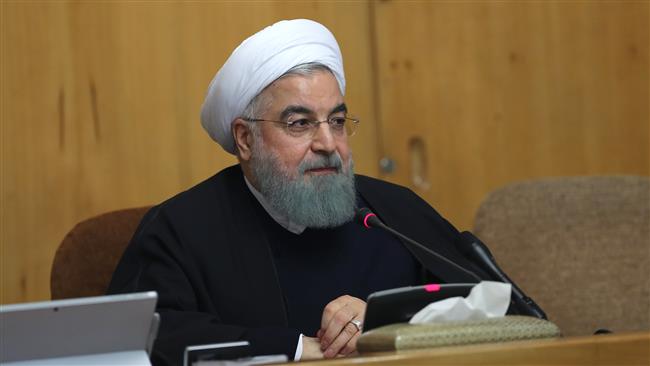
Iran’s President Hassan Rouhani
Press TV – June 24, 2020
President Hassan Rouhani says Iran is prepared, as before, to continue its cooperation with the International Atomic Energy Agency (IAEA) as long as the UN nuclear watchdog does not deviate from the legal frameworks and does not fall under Israeli and American influence.
“Iran is prepared to take the agency’s legal inspections and engage in close cooperation with it within the framework of the [standing] regulations,” Rouhani said, addressing a cabinet session in Tehran on Wednesday.
“For us, cooperation with the agency has always formed the basis,” he said, adding, “We will maintain this [principle] today too.”
He said the Islamic Republic has invariably enjoyed a “friendly” relationship with the watchdog, whose inspectors have examined the country’s nuclear facilities regularly and confirmed its non-diversion from a 2015 nuclear agreement between Tehran and world countries in more than a dozen reports.
The president, however, cautioned that “the agency too should pay attention not to deviate from its legal path.”
On Friday, the IAEA’s Board of Governors adopted a resolution — drawn up by the UK, France, and Germany — that called on Iran to allow access to two sites that Israeli intelligence services claim are related to Tehran’s nuclear program. Tehran has condemned the resolution, rebuffed the allegations, and reminded the agency that it cannot request inspections based on accusations made up by intelligence agencies.
“I fear these charlatans may tarnish the agency,” Rouhani said, referring to the Israeli regime and the United States that changelessly backs the regime’s stances and allegations. “They dupe the agency and push it away from its course.”
“The agency’s task consists of reporting on the manner of application of nuclear materials. That is what the agency is supposed to do,” the president said.
He, accordingly, urged the IAEA to act justly in its assessments and retain its independence.
Rouhani, meanwhile, berated the European trio for their falling under Tel Aviv and Washington’s pressure in devising of the anti-Iranian resolution, while praising Russia and China for their decisive stance against the resolution.
On US offer of talks
Separately, the chief executive referred to the United States’ new offer of talks with Iran.
The Islamic Republic is always prepared for negotiations as soon as the US renews commitment to the international regulations, he said, adding that it was Washington that left the negotiation table in the first place by reneging on its commitments.
Washington left the nuclear deal in 2018, although the accord has been endorsed by the UN Security Council as a resolution.
“They were the ones, who created trouble, broke the negotiation table, and tyrannized the Iranian nation,” Rouhani said.
He also urged that the US apologize to the Iranian people for the economic damage that it has tried to afflict on them through the sanctions that it reinstated after leaving the deal, and compensate the nation.
China does not approve of further tension over Iran nuclear program: Foreign Ministry

Chinese Foreign Ministry spokesperson Zhao Lijian
Press TV – June 22, 2020
Chinese Foreign Ministry spokesperson Zhao Lijian says his country opposes any measure leading to exacerbation of tensions over the Iranian nuclear program in the wake of the recent adoption of an anti-Iran resolution by the Board of Governors of the International Atomic Energy Agency (IAEA).
“China supports the IAEA in playing its role in an objective, professional and neutral manner in verifying Iran’s compliance with its safeguards obligations. We are against politicizing its work,” Zhao said at a regular press conference on Monday.
He pointed to an explicit announcement by the IAEA that the “safeguards issue is neither urgent nor poses a proliferation risk” and welcomed Iran’s readiness to resolve issues through dialogue and said, “Under such circumstances, China does not approve of actions that artificially exacerbate tensions and escalate the situation.”
He expressed hope that all relevant parties to the international 2015 nuclear agreement, officially known as the Joint Comprehensive Plan of Action (JCPOA), will remain calm, exercise restraint, and support the settlement of issues between Iran and the UN nuclear agency through dialogue and cooperation.
“On the Iranian nuclear issue, China’s unwavering aim is to uphold the JCPOA, multilateralism, peace and stability in the Middle East, and the international order based on international law,” the Chinese diplomat said.
He expressed Beijing’s readiness to work closely with the sides in order to find a “political and diplomatic” way to solve issues pertaining to Iran’s nuclear program.
The Board of Governors at the UN’s nuclear agency on Friday passed the anti-Iran resolution, put forward by Britain, France and Germany – the three European signatories to the JCPOA.
The resolution, the first of its kind since 2012, urges Iran to provide the IAEA inspectors with access to two sites that the trio claims may have been used for undeclared nuclear activities in the early 2000s.
The Islamic Republic rejects any allegations of non-cooperation with the IAEA, insisting that it is prepared to resolve potentially outstanding differences with the IAEA.
Russia and China, two other permanent members of the UN Security Council and signatories to the JCPOA, voted against the resolution.
The Chinese diplomatic mission to the IAEA also warned on Twitter that the resolution could have “huge implications” for the future of the JCPOA.
Iran’s reduction of JCPOA compliance result of US maximum pressure
In response to a question about the E3 foreign ministers’ last week statement on the JCPOA, the Chinese Foreign Ministry spokesman once again stressed the importance of upholding and implementing the nuclear deal as the “only right way” to resolve the Iranian nuclear issue.
Zhao added that Chinese State Councilor and Foreign Minister Wang Yi had recently sent letters to the UN secretary general and the rotating president of the Security Council to emphasize that the JCPOA, endorsed by Security Council Resolution 2231, is an “important outcome of multilateral diplomacy and a key element in international nuclear non-proliferation system.”
“Iran’s reduction of compliance is a result of the US maximum pressure. We urge the US to abandon unilateral sanctions and ‘long-arm jurisdiction’, and return to the right track of observing the JCPOA and the Security Council resolution,” the Chinese diplomat said.
He highlighted the significance of earnestly implementing all provisions in Resolution 2231 and said, “In the meantime, all parties to the JCPOA should take concrete measures to restore the balance of rights and obligations under the agreement.”
Pointing to the withdrawal of the US from the JCPOA, he said Washington “has no right to ask the Security Council to launch the snapback mechanism that allows the re-imposition of sanctions.”
He reminded the trio’s foreign ministers that they have reaffirmed their commitment to keeping the JCPOA in place and implementing Resolution 2231.
“They believe that the strategy of maximum pressure will not effectively address shared concerns about Iran’s nuclear program. As any unilateral attempt to trigger UN sanctions snapback would have serious adverse consequences in the UNSC, they would not support such a decision which would be incompatible with current efforts to preserve the JCPOA,” Zhao pointed out.
He vowed that Beijing would work with the three European parties to the JCPOA and the larger international community to stick to the nuclear agreement and Resolution 2231, uphold multilateralism, and work for the political and diplomatic settlement of the Iranian nuclear issue.
“In the meantime, we will resolutely safeguard our own legitimate rights and interests,” he added.
Iran parliament: IAEA resolution proof of structural discrimination within UN nuclear watchdog
Press TV – June 21, 2020
The majority of lawmakers at the Iranian parliament have denounced an anti-Iran resolution recently passed by the International Atomic Energy Agency’s Board of Governors, saying the document is another indication of “structural discrimination” within the UN atomic watchdog.
In a statement read out on Sunday by Ali Karimi Firouzjaee, a member of the parliament’s presiding board, 240 MPs argued that the IAEA resolution — introduced by the three European signatories to a 2015 nuclear deal with Iran, namely France, Germany, and Britain — explicitly demonstrated the trio’s “excessive demands.”
The Islamic Republic has voluntarily implemented the Nuclear Nonproliferation Treaty (NPT) and allowed the IAEA to conduct the most rigorous inspections of its nuclear sites in the history of the Vienna-based agency, read the statement.
The lawmakers further complained about the hypocrisy of the European trio, saying they devised “the illegal anti-Iran resolution” contrary to their claims to remain committed to the Iran deal and to make efforts to salvage the deal.
The IAEA resolution clearly indicates, the MPs warned, that the three European states “have once again fallen into the trap of the United States and the Zionist regime, and joined forces with them in the failed US project of exerting maximum pressure against Iran, hence dealing another blow to international multilateralism.”
Passed by a 25-2 margin with seven abstentions, the IAEA resolution called on Iran to “fully cooperate” with the IAEA and “satisfy the Agency’s requests without any further delay,” including by providing “prompt” access to two nuclear sites.
Tehran has rejected allegations of non-cooperation with the IAEA, arguing that the mentioned sites are totally irrelevant to its current nuclear program, and that the agency’s insistence on inspecting the two locations comes on the basis of fabricated information provided by Israel.
“Iran’s parliament strongly condemns the IAEA Board of Governors’ resolution, which was adopted against Iran’s national interests based on a proposal by three European countries, Britain, France and Germany, under pressure from the US regime and the fake Zionist regime on June 19, 2020,” the statement read, adding that the resolution was “another sign of structural discrimination within the IAEA.”
The Iranian lawmakers also expressed their gratitude to China and Russia for voicing their opposition to the biased resolution, which they called “an obvious attempt at political extortion.”
“In addition to expressing gratitude to the states that did not support the move, the parliament considers the non-binding resolution another sign of the culture dominating the IAEA, which allows nuclear-armed member states not honoring their own NPT commitments to block other states’ access to peaceful nuclear technology.”
Featured Video

No Threat Can Force Iran’s Surrender /Trita Parsi & Lt Cl Daniel Davis
or go to
Aletho News Archives – Video-Images
From the Archives
An Expert Military Analysis of War with China
Actually, None is Necessary
By Fred Reed • Unz Review • December 13, 2020
The Correlation of Armed Forces: U.S. goods and services trade with China totaled an estimated $634.8 billion in 2019. Exports were $163.0 billion; imports were $471.8 billion. The U.S. goods and services trade deficit with China was $308.8 billion in 2019. Trade in services with China (exports and imports) totaled an estimated $76.7 billion in 2019. Services exports were $56.5 billion; services imports were $20.1 billion. The U.S. services trade surplus with China was $36.4 billion in 2019.
There is talk within the Washingtoniat of a possible war with China. Steve Bannon, who apparently was dropped on his head as a child, actually favors such a war. We hear the usual shoo-the-boobs alarm about how the Chinese are doing something terrible and we must gird our loins and American values and show them what for, bow wow, woof. The danger is that the current game of who-blinks-first in Asian waters might actually provoke a shooting war. You know the kind of thing: One warship refuses to get out of the way of another, a collision ensues, some retard lieutenant who signed up on waivers opens fire, and we’re off and running. It is not a good idea to let children play with matches.
The said war is discussed either in emotional terms by idiots or in purely naval terms by those familiar with such things, so we hear of the First Island Chain and the Second Island Chain and whose missiles against the other’s missiles and so on. This would be appropriate if we were fighting World War Two again. Which we aren’t. Let’s take a quick-and-dirty look at how such a war might go.
To begin the war, America would overestimate itself and underestimate China. This is doctrine in the Pentagon. … continue
Blog Roll
 Aletho News
- Iran To Target Military Industrial-Tech Complex That Facilitated Gaza Genocide
- Collapsing Empire: The Resistance Disarms ‘Israel’
- Suicide Should Not Be a Government Service
- Rethinking America’s greatest threat: Iran vs. Israel-Firsters
- Iran accuses adversaries of false flags to strain Turkey ties
- Poland rules out sending Patriot missiles to US/Israel amid war on Iran
- Tehran approves new Hormuz plan with major restrictions
- No Threat Can Force Iran’s Surrender /Trita Parsi & Lt Cl Daniel Davis
- UK’s New Pandemic Plan Would Turn Big Tech Into a Mass Location Tracking Network
- Growing insecurity, soaring prices fuel protests in north as regime bans evacuation: Sources
- If Americans Knew
- Ann Coulter Rips Into Fox News for Iran War Coverage, Compares to False Rigged 2020 Election Reporting
- Joe Kent Urges Americans To Call White House and Congress To Object To Sending Troops Into Iran
- DNC Resolution to Reject AIPAC Funding Puts Democratic Leaders in the Hot Seat
- Swedish foundation to build 400 schools as over 650,000 Gaza children remain without education for 2 years
- Israeli army admits photshopping image of slain Lebanese journalist
- This is how Israel is systematically killing health workers under the cover of war in Lebanon
- Carrying life under fire: Israeli invasion of Lebanon leaves pregnant women facing deadly risks
- Champagne all around for the new death penalty (for Palestinians) law – Not a ceasefire Day 172
- Why are Palestinian books struggling to be seen on Amazon?
- The Line Between Affinity and Conspiracy
- No Tricks Zone
- New Study Finds Warming Saves Lives…Cold Temperatures 12 Times More Deadly Than Excess Heat
- German Science Blog Accuses PIK Climate Institute Of Hallucinating Climate Tipping Points
- Devastating Assessment Of Comirnaty Vaccine By Former Senior Pfizer Europe Toxicologist
- New Study: CO2 Is ‘Effectively Negligible’ As An Explanatory Climate Change Factor Since 2000
- Former Pfizer Toxicologist Dr. Helmut Sterz Tells Bundestag Hearing Pfizer Vaccine Should Have Never Been Approved
- Energy Expert: Germany’s Nuclear Phaseout Was A “500 Billion Euro Mistake”
- New Research: South Australia’s Mid-Holocene Sea Surface Temperatures Were 4°C Warmer Than Today
- Storing Green Energy To Last Germany 10 Days Would Require A 60-Million Tonne Battery
- New Studies: UK Sea Levels Were 4 Meters Higher Than Today During The Mid-Holocene
- Destructive Green New Deal: German Energy And Metal Group Warns Of Drastic Crisis
 Aletho News