The HighWire with Del Bigtree | March 6, 2025
SUGAR, NOT GENES: THE HIDDEN DRIVER OF CHRONIC DISEASE?
Most U.S. infant formulas contain mainly added sugars, posing a serious risk to babies’ health, researchers say
By Pamela Ferdinand | US Right To Know | February 25, 2025
Most infant formulas in the U.S. contain mostly added sugars instead of natural lactose, which experts say can harm early development, a new report from the University of Kansas shows.
“Infants may consume upwards of 60 grams of added sugars per day, or the equivalent of two soft drinks per day if they are entirely formula-fed,” researchers say in the study, published yesterday [Feb. 24, 2025] in the Journal of Food Composition and Analysis.
The findings reveal “the staggering extent” to which sugar-laden U.S. formulas undermine federal healthy diet recommendations for infants—and cannot be easily avoided, they say.
“[Most] of the formulas that parents and caregivers feed their infants likely present a substantial risk to their infant’s health and development. Ultimately, caregivers and infants in the US deserve a formula market that promotes healthy infant development and does not promote early obesity risk.”
Added sugars provide energy but lack nutritional value, boosting the odds of rapid infant weight gain that can eventually lead to obesity, type 2 diabetes, cardiovascular disease, and other health problems. They may also make babies develop a stronger preference for sweet foods, increasing the risk of overeating and obesity later in life. And they do not support beneficial gut bacteria as well as lactose.
In contrast, lactose, which is naturally found in breast milk, cow and goat milk, is perfectly designed to support an infant’s nutrition, immune system, and gut health, researchers say. Because lactose digests slowly, it doesn’t cause the sharp spike in blood sugar that can set the stage for long-term health problems. It also satiates hunger and helps the body absorb minerals that are important for bone health.
Dr. David Ludwig, an endocrinologist and researcher at Boston Children’s Hospital who conducted some of the original studies linking sugar-sweetened beverages and fast food to obesity, calls infant formula spiked with added sugars a “metabolic nightmare for infants.”
“You lose the beneficial effects of what lactose does, and you get the harmful effects of what these fast-digesting sugars do,” Ludwig says. “Unless we’re talking about the very rare child who can’t take lactose, that should be the dominant carbohydrate.”
Out of 73 formulas available in the U.S. in 2022, the vast majority of which were for infants up to 12 months old, the researchers found only five contained mainly naturally occurring lactose—and those are no longer available in this country. It is unknown whether any formulas on the current U.S. market contain primarily naturally occurring lactose, they say.
The study also shows the quality and type of sugars in infant formulas varied by formula. Gentle (with marketing claims such as “gentle,” “soothe,” “sensitive,” or “acid reflux”) and lactose-free formulas contain less sugar than standard formulas but much more starch, the study shows.
“Our findings highlight a major problem with the infant formula supply,” says lead author Audrey Rips-Goodwin, who headed the analysis of data from the Nutrition Data System for Research for KU’s Health Behavior and Technology Lab. “Our infant formula market totally contradicts what experts in infant health recommend.”
Children under 2 years should not be given any foods or beverages with added sugars, since they need nutrient-rich diets and are developing taste preferences, according to the American Academy of Pediatrics and the Dietary Guidelines for Americans (2020–2025). Yet with few formula options free of added sugars, the researchers say parents and caregivers who can’t breastfeed or access breast milk face tough choices in terms of finding a nutritionally suitable formula due to lax government regulations.
Unlike adult food products, US regulations do not require that added sugars be reported on the nutrition label of infant formulas (only total carbohydrates). The FDA specifies 30 nutrients that must be included in infant formulas but does not regulate the types of carbohydrates or require their clear labeling. That means formula manufacturers can use any type of carbohydrate, including starches or added sugars such as corn syrup solids, fructose, and glucose.
“Consumers are blinded to the fact that added sugars may be present in infant formulas, and in what quantities,” the researchers say. “As a result, parents and guardians may unknowingly feed their infants formula that contains substantial quantities of added sugars.”
The study builds on others that revealed the high sugar content of infant formula. It also comes less than a year after news reports that two of Nestlé’s leading baby-food brands, promoted as healthy in Africa, Asia, and Latin America, contain high levels of added sugar.
To promote healthy development, the researchers say efforts should focus on requiring formula companies to produce products that contain naturally occurring lactose as the only sugar. The amount of lactose present in infant formula should also reflect that of human milk.
At the same time, societal barriers to breastfeeding, including a lack of parental leave and affordable early child care, should be removed, the researchers add.
“[The] focus on an individual-level solution (breastfeeding promotion to women and caregivers) is not well matched to addressing the systemic nature of the problem and places an unfair burden on women and families who are expected to navigate this systemic issue,” Rips-Goodwin says.
Senior author Tera Fazzino agrees.
“Even though breastfeeding is promoted as the best option, the lack of support makes it hard to do exclusively,” says Fazzino, associate director of the Cofrin Logan Center for Addiction Research & Treatment at KU’s Life Span Institute. “Most parents end up using formula, either as a supplement or completely. But our findings suggest that formula itself may pose a serious risk to infant health.”
Reference
Rips-Goodwin AR, Jun D, Griebel-Thompson A, Kong KL, Fazzino TL. US infant formulas contain primarily added sugars: An analysis of the infant formulas on the US market. Journal of Food Composition and Analysis. Published online February 2025:107369. doi:10.1016/j.jfca.2025.107369
Venezuela Promotes Breastfeeding over Baby Food, Corporate Media Spins Out of Control
By Tamara Pearson | Venezuelanalysis | June 20, 2013
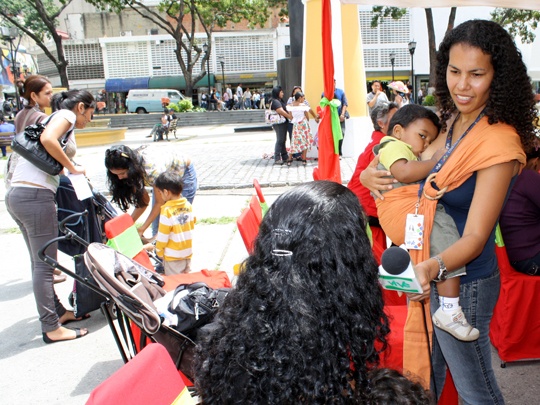
A Venezuelan public media journalist breastfeeds as she works. Public breastfeeding is fairly accepted in Venezuela (blog.chavez)
Venezuela’s national assembly is debating a reform to its breastfeeding law which could see baby food companies like Nestle fined in certain situations. The corporate media have reacted hysterically to the law, claiming that President Nicolas Maduro is “taking bottles from babies’ mouths”.
Though breastfeeding is widely promoted by the Venezuelan government, and public breastfeeding is relatively de-stigmatised, a study by Venezuela’s National Nutrition Institute (INN) between 2006 and 2008 showed that only 55% of mothers exclusively breastfed when their baby was born, going down to 20% when their baby was three months old, and 11% by six months.
The percentages have probably increased since then, with broad educational campaigns in public schools and health centres, and actions such as mass public breastfeeding in plazas, organised by the INN.
However, the low figures reflect the low confidence some mothers have in their ability to breastfeed, as well as the power of multinational infant formula companies in health centres. It is common practice to give infant formula to babies from the moment they are born, without the consent of parents, according to LactArte, a pro-breastfeeding collective in Venezuela. Companies give gifts and other promotions to health workers and health centres in order to create alliances with them, and give free samples of the products to new mothers, thereby creating dependent consumers of new born babies, or at least discouraging exclusive breast feeding.
What the law actually says
In 2007 Venezuela’s national assembly passed the Law of Protection, Promotion, and Support for Breastfeeding. The law regulates the way baby formula and baby food companies advertise and label their products, and how they interact with hospitals and clinics. However, the companies have been ignoring the law, as it doesn’t specify penalties. The reform to the law currently being discussed is looking at penalties of US$600 – $50,000, and also training for health professionals. Once the reform is passed in first discussion by the assembly, it will be subject to “street parliament” – discussion by collectives and Venezuelan citizens, to then be passed by the national assembly in second discussion.
The 2007 law argues that breastfeeding provides babies with “all the necessary nutrients” in their first six months, as well as “protecting them and immunising them from illness and contributing to the development of their breathing and gastrointestinal capacity”. It states that “mothers have the right to breastfeed their children, with the support and collaboration of the fathers… [who] should provide all the support necessary so that mothers can provide this human right… The state, with solidarious participation from organised communities, will promote, protect, and support exclusive breastfeeding…of children under six months of age and breastfeeding with complementary food … until the age of two”.
Concretely under the law, health workers and health centres must help mothers start breastfeeding within the first half hour of birth, and guarantee that the newborn is always near the mother after birth, except in exceptional medical situations. They should also educate mothers, fathers, and the family on the issue, and abstain from providing babies under the age of 6 months with food other than breast milk, except when there is a specific medical need. Health centres must create human milk “banks”.
Baby food and formula products must be in Spanish or Venezuelan indigenous languages (Nestle products for example, often aren’t), and they should inform of the risks of including such food in the baby’s diet too early. Publicity or labelling can’t create the impression that such food is equal to breast milk, and publicity of any kind discouraging breastfeeding is not allowed.
All food aimed at children under three must include labelling that clearly states its ingredients, including any GMO products, and milk formulas must including a warning that “breast milk is the best food for children under two years old”.
Samples, prizes, and promotions of baby food and formula are prohibited. Likewise, companies are prohibited from donating toys, books, posters or other products which promote or identify their company to health centres, and they are also prohibited from donating “gifts” to health centre workers and from sponsoring events or campaigns aimed at pregnant or breastfeeding women, fathers, health professions, families, and communities.
Breastfeeding rights in Venezuela
Last year, with the passing of the new labour law, women’s breastfeeding rights were further expanded. Post-natal leave was extended to six months, and articles 344-352 state that mothers have the right to two half hour breaks per day to breastfeed. If there is no breastfeeding room provided by the work place, that is extended to two 90 minute breaks, and all employers of more than 20 workers must maintain a nursery centre with a breastfeeding area.
For Luisa Calzada and Kaustky Garcia, of LactArte, breastfeeding is also an act of food sovereignty – that is, third world productive or economic independence from greedy transnationals. Garcia argued that such sovereignty has been “sabotaged” in Venezuela by the “transnational industry dedicated to the business of infant formulas”. Indeed the industry is huge here – visit any supermarket or corner shop and you’ll see full aisles or shelves of powdered baby milk formula and compote.
LactArte supports a boycott of Nestle, one of the main powdered milk formula companies here, producing the infamous Cerelac since 1886. They argue that there is“collusion” between the baby food industry and the medical industry, with the food transnationals enlisting an “army of health professionals” to sell baby formula.
According to Business Insider, infant formula is an $11.5 billion market. The International Baby Food Action Network (IBFAN) claims that Nestle, apart from distributing free samples of its products in maternity wards, also uses “humanitarian aid” to create markets, and offers gifts and sponsorship to influence health workers to promote its products. According to a 1982 New Internationalist article, Nestle makes mostly third world mothers dependent on its formula in three ways: “Creating a need where none existed, convincing consumers the products are indispensable, and linking products with the most desirable and unattainable concepts- then giving a sample”.
What the corporate media are saying
The 2007 law and the draft reforms do not ban the production or sale of baby food or formula, as national and international media have alleged, nor do they apply any fines to mothers or penalise any choices regarding her body that a mother may make. The penalties are only for health care centres and their workers, and baby food and formula companies.
However the corporate media over the last two weeks has completely distorted the issue. Fox News Latino headlined “Venezuela Wants To Ban Baby Bottles To Promote Breast-Feeding” and stated that “Motherly love has become a state affair in Venezuela”.
Growing Your Baby also headlined “Venezuela considering baby bottle ban”, and opened with the utterly misinformed and misleading question, “What would you do if you woke up one morning and learned that baby bottles were no longer being made or sold in your country? This question may become a reality for Venezuelan moms who may not have planned on breastfeeding”.
Reuters won the prize however for manipulation and sensationalism, with the headline “Venezuela considers taking bottles from babies’ mouths”, while other agencies have carried similar titles along the “banning” theme, with CNN’s article “Venezuela considering a ban on baby bottles” and Huffington Post ‘Venezuela considers baby bottle ban to encourage breastfeeding’. Al Jazeera went as far as to argue in its piece that “some mothers don’t want the government telling them how to feed their children”. If Al Jazeera had bothered to read the 2007 law, it would have discovered that is actually the point of the law – to stop companies interfering, through misleading information and other gimmicks, in the breastfeeding process.
Venezuelan corporate press and other Spanish language media have been equally manipulative. Here is a small selection of their headlines: EFE: “Venezuela is debating a law to prohibit baby bottles”, Semana: “Baby bottle and dummy: the new enemies of Chavismo”, El Pais: “The Venezuelan government wants to oblige mothers to breastfeed”, El Popular: “Venezuela: Nicolas Maduro wants to eliminate the use of baby bottles”, Noticias24 “They’ll prohibit baby bottles in health centres of Venezuela in order to force breastfeeding”, El Mundo, “Venezuela declares war on the baby bottle”, and Entornointeligente, “Goodbye to baby bottles for stimulating breastfeeding”.
Garcia argued that the media campaign to demonise the law and the proposed reforms is being pushed by the milk formula industry. She said it has had an impact in Venezuela, with “many women, even those not using baby bottles, feeling scared”.
“They are worried that the government is going to try to help them to breastfeed, that the government will take away their baby bottles and infant formulas, and is going to prohibit them from feeding their infants with baby bottles, but that’s absolutely false. First of all it’s unpractical, and secondly it is this government which has most given freedom and provided information so that families can freely chose the path they desire for their children,” she said.
The World Health Organisation recommends that babies be exclusively breast fed during the first six months, and in 1981 the 34th World Health Assembly adopted a resolution which included the International Code of Marketing Breast-Milk Substitutes. Funnily enough, it stated that food companies shouldn’t promote their products in hospitals, give free samples to mothers, or provide misleading information. One wonders if these international bodies were also accused of “stealing the bottle from babies mouths”, or is that sort of rubbish reserved for countries like Venezuela where a revolution is trying to get some justice at the expense of the poor transnationals?
Featured Video
Laith Marouf: Hezbollah’s position on US-Iran ceasefire
or go to
Aletho News Archives – Video-Images
From the Archives
Is Israel to blame for the Iraq War?
American Goy | March 10, 2008
I am so tired of this old canard that “Israel had nothing to do with USA’s war with Iraq – in fact, it officially advised America against it”.
Bullshit. … continue
Blog Roll
 Aletho News
- Laith Marouf: Hezbollah’s position on US-Iran ceasefire: What you’re not being told
- Israel’s priority lies in destroying chances of peace between Iran, US: Ex-UN nuclear chief
- Ceasefire for all or for none: Iran shuts Hormuz over Lebanon attacks
- Strait of Hormuz is Iran’s ‘nuclear weapon’ that forced US retreat: Medvedev
- Energy crisis will last for months – Kremlin envoy
- Europe’s quiet role in the war on Iran
- Forty days that shook the Empire: How Iran turned the tables on US and prevailed
- Netanyahu unilaterally declares Lebanon outside of ceasefire deal
- Israeli leaders: ‘Not a single goal’ achieved in war with Iran
- What on earth just happened? Trump, Iran, and the unlikely ceasefire
- If Americans Knew
- Gazans face a triple crisis: severe shortages of water and bread, healthcare in tatters
- NY Times reports how Netanyahu took the US into Iran War
- A sigh of relief over Iran, but Gaza and Lebanon in dire straits – Daily Update
- Thousands dead and neighborhoods razed to the ground: Aid agencies fear southern Lebanon is becoming the new Gaza
- The war the US is fighting for Israel could cost trillions
- ‘Cigarette Burns, Nail Wounds’: Toddler Tortured in Gaza to Coerce Father
- Trump Says US Sent ‘a Lot of Guns’ to Protesters in Iran
- Israeli forces destroy 17 UN peacekeeper cameras in south Lebanon
- US-Israeli strikes ‘completely destroy’ synagogue in Tehran
- Archbishop for US Military Says Iran War Is Unjust Under Catholic Teaching
- No Tricks Zone
- An Inconvenient Tree: Uncovered In Alps… Europe Much Warmer Than Today 6000 Years Ago
- New Study Reports A 60% Slowdown In Greenland’s Ice Loss Rate In The Last Decade
- Low Intensity Tornado Wrecks Major Solar Farm, Creating A Potential Toxic Dump
- New Study Finds Warming Saves Lives…Cold Temperatures 12 Times More Deadly Than Excess Heat
- German Science Blog Accuses PIK Climate Institute Of Hallucinating Climate Tipping Points
- Devastating Assessment Of Comirnaty Vaccine By Former Senior Pfizer Europe Toxicologist
- New Study: CO2 Is ‘Effectively Negligible’ As An Explanatory Climate Change Factor Since 2000
- Former Pfizer Toxicologist Dr. Helmut Sterz Tells Bundestag Hearing Pfizer Vaccine Should Have Never Been Approved
- Energy Expert: Germany’s Nuclear Phaseout Was A “500 Billion Euro Mistake”
- New Research: South Australia’s Mid-Holocene Sea Surface Temperatures Were 4°C Warmer Than Today
 Aletho News