Powell & Iraq—Regime Change, Not Disarmament: The Fundamental Lie
By Scott Ritter – Consortium News – July 18, 2020
The New York Times Magazine has published a puff piece soft-peddling former Secretary of State Colin Powell’s role in selling a war on Iraq to the UN Security Council using what turned out to be bad intelligence. “Colin Powell Still Wants Answers” is the title of the article, written by Robert Draper. “The analysts who provided the intelligence,” a sub-header to the article declares, “now say it was doubted inside the CIA at the time.”
Draper’s article is an extract from a book, To Start a War: How the Bush Administration Took America into Iraq, scheduled for publication later this month. In the interest of full disclosure, I was approached by Draper in 2018 about his interest in writing this book, and I agreed to be interviewed as part of his research. I have not yet read the book, but can note that, based upon the tone and content of his New York Times Magazine article, my words apparently carried little weight.
Regime Change, Not WMD
I spent some time articulating to Draper my contention that the issue with Saddam Hussein’s Iraq was never about weapons of mass destruction (WMD), but rather regime change, and that everything had to be viewed in the light of this reality—including Powell’s Feb. 5, 2003 presentation before the UN Security Council. Based upon the content of his article, I might as well have been talking to a brick wall.
Powell’s 2003 presentation before the council did not take place in a policy vacuum. In many ways, the March 2003 U.S.-led invasion and subsequent occupation of Iraq was a continuation of the 1991 Gulf War, which Powell helped orchestrate. Its fumbled aftermath was again, something that transpired on Powell’s watch as the chairman of the Joint Chiefs of Staff in the administration of George H. W. Bush.
Powell was part of the policy team that crafted the post-Gulf War response to the fact that Iraq’s president, Saddam Hussein, survived a conflict he was not meant to. After being labeled the Middle East equivalent of Adolf Hitler whose crimes required Nuremburg-like retribution in a speech delivered by President Bush in October 1990, the Iraqi President’s post-conflict hold on power had become a political problem for Bush 41.
Powell was aware of the CIA’s post-war assessment on the vulnerability of Saddam’s rule to continued economic sanctions, and helped craft the policy that led to the passage of Security Council resolution 687 in April 1991. That linked Iraq’s obligation to be disarmed of its WMD prior to any lifting of sanctions and the reality that it was U.S. policy not to lift these sanctions, regardless of Iraq’s disarmament status, until which time Saddam was removed from power.
Regime change, not disarmament, was always the driving factor behind U.S. policy towards Saddam Hussein’s Iraq. Powell knew this because he helped craft the original policy.
I bore witness to the reality of this policy as a weapons inspector working for the United Nations Special Commission (UNSCOM), created under the mandate of resolution 687 to oversee the disarming of Iraq’s WMD. Brought in to create an intelligence capability for the inspection team, my remit soon expanded to operations and, more specifically, how Iraq was hiding retained weapons and capability from the inspectors.
SCUDS
One of my first tasks was addressing discrepancies in Iraq’s accounting of its modified SCUD missile arsenal; in December 1991 I wrote an assessment that Iraq was likely retaining approximately 100 missiles. By March 1992 Iraq, under pressure, admitted it had retained a force of 89 missiles (that number later grew to 97).
After extensive investigations, I was able to corroborate the Iraqi declarations, and in November 1992 issued an assessment that UNSCOM could account for the totality of Iraq’s SCUD missile force. This, of course, was an unacceptable conclusion, given that a compliant Iraq meant sanctions would need to be lifted and Saddam would survive.
The U.S. intelligence community rejected my findings without providing any fact-based evidence to refute it, and the CIA later briefed the Senate that it assessed Iraq to be retaining a force of some 200 covert SCUD missiles. This all took place under Powell’s watch as chairman of the Joint Chiefs.
I challenged the CIA’s assessment, and organized the largest, most complex inspection in UNSCOM’s history to investigate the intelligence behind the 200-missile assessment. In the end, the intelligence was shown to be wrong, and in November 1993 I briefed the CIA Director’s senior staff on UNSCOM’s conclusion that all SCUD missiles were accounted for.
Moving the Goalposts
The CIA’s response was to assert that Iraq had a force of 12-20 covert SCUD missiles, and that this number would never change, regardless of what UNSCOM did. This same assessment was in play at the time of Powell’s Security Council presentation, a blatant lie born of the willful manufacture of lies by an entity—the CIA—whose task was regime change, not disarmament.
Powell knew all of this, and yet he still delivered his speech to the UN Security Council.
In October 2002, in a briefing designed to undermine the credibility of UN inspectors preparing to return to Iraq, the Defense Intelligence Agency trotted out Dr. John Yurechko, the defense intelligence officer for information operations and denial and deception, to provide a briefing detailing U.S. claims that Iraq was engaged in a systematic process of concealment regarding its WMD programs.
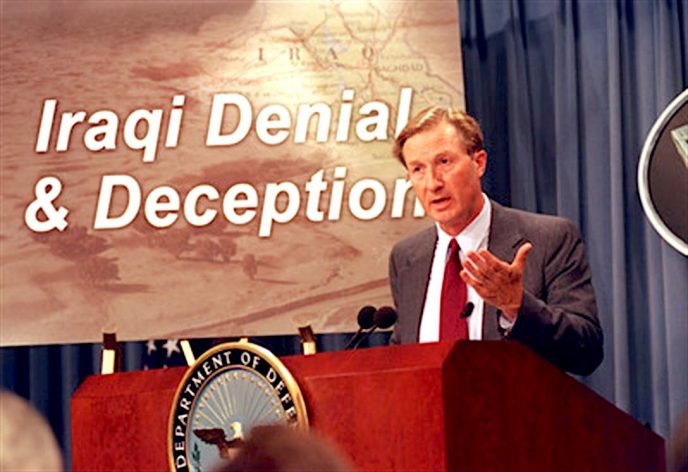
John Yurechko, of the Defense Intelligence Agency, briefs reporters at the Pentagon on Oct. 8, 2002 (U.S. Defense Dept.)
According to Yurechko, the briefing was compiled from several sources, including “inspector memoirs” and Iraqi defectors. The briefing was farcical, a deliberate effort to propagate misinformation by the administration of Bush 43. I know—starting in 1994, I led a concerted UNSCOM effort involving the intelligence services of eight nations to get to the bottom of Iraq’s so-called “concealment mechanism.”
Using innovative imagery intelligence techniques, defector debriefs, agent networks and communications intercepts, combined with extremely aggressive on-site inspections, I was able, by March 1998, to conclude that Iraqi concealment efforts were largely centered on protecting Saddam Hussein from assassination, and had nothing to do with hiding WMD. This, too, was an inconvenient finding, and led to the U.S. dismantling the apparatus of investigation I had so carefully assembled over the course of four years.
It was never about the WMD—Powell knew this. It was always about regime change.
Using UN as Cover for Coup Attempt
In 1991, Powell signed off on the incorporation of elite U.S. military commandos into the CIA’s Special Activities Staff for the purpose of using UNSCOM as a front to collect intelligence that could facilitate the removal of Saddam Hussein. I worked with this special cell from 1991 until 1996, on the mistaken opinion that the unique intelligence, logistics and communications capability they provided were useful to planning and executing the complex inspections I was helping lead in Iraq.
This program resulted in the failed coup attempt in June 1996 that used UNSCOM as its operational cover—the coup failed, the Special Activities Staff ceased all cooperation with UNSCOM, and we inspectors were left holding the bag. The Iraqis had every right to be concerned that UNSCOM inspections were being used to target their president because, the truth be told, they were.
Nowhere in Powell’s presentation to the Security Council, or in any of his efforts to recast that presentation as a good intention led astray by bad intelligence, does the reality of regime change factor in. Regime change was the only policy objective of three successive U.S. presidential administrations—Bush 41, Clinton, and Bush 43.
Powell was a key player in two of these. He knew. He knew about the existence of the CIA’s Iraq Operations Group. He knew of the successive string of covert “findings” issued by U.S. presidents authorizing the CIA to remove Saddam Hussein from power using lethal force. He knew that the die had been cast for war long before Bush 43 decided to engage the United Nations in the fall of 2002.
Powell Knew
Powell knew all of this, and yet he still allowed himself to be used as a front to sell this conflict to the international community, and by extension the American people, using intelligence that was demonstrably false. If, simply by drawing on my experience as an UNSCOM inspector, I knew every word he uttered before the Security Council was a lie the moment he spoke, Powell should have as well, because every aspect of my work as an UNSCOM inspector was known to, and documented by, the CIA.
It is not that I was unknown to Powell in the context of the WMD narrative. Indeed, my name came up during an interview Powell gave to Fox News on Sept. 8, 2002, when he was asked to comment on a quote from my speech to the Iraqi Parliament earlier that month in which I stated:
“The rhetoric of fear that is disseminated by my government and others has not to date been backed up by hard facts that substantiate any allegations that Iraq is today in possession of weapons of mass destruction or has links to terror groups responsible for attacking the United States. Void of such facts, all we have is speculation.”
Powell responded by declaring,
“We have facts, not speculation. Scott is certainly entitled to his opinion but I’m afraid that I would not place the security of my nation and the security of our friends in the region on that kind of an assertion by somebody who’s not in the intelligence chain any longer… If Scott is right, then why are they keeping the inspectors out? If Scott is right, why don’t they say, ‘Anytime, any place, anywhere, bring ‘em in, everybody come in—we are clean?’ The reason is they are not clean. And we have to find out what they have and what we’re going to do about it. And that’s why it’s been the policy of this government to insist that Iraq be disarmed in accordance with the terms of the relevant UN resolutions.” (emphasis added, Aletho News )
Of course, in November 2002, Iraq did just what Powell said they would never do—they let the UN inspectors return without preconditions. The inspectors quickly exposed the fact that the “high quality” U.S. intelligence they had been tasked with investigating was pure bunk. Left to their own devices, the new round of UN weapons inspections would soon be able to give Iraq a clean bill of health, paving the way for the lifting of sanctions and the continued survival of Saddam Hussein.
Powell knew this was not an option. And thus he allowed himself to be used as a vehicle for disseminating more lies—lies that would take the U.S. to war, cost thousands of U.S. service members their lives, along with hundreds of thousands of Iraqis, all in the name of regime change.
Back to Robert Draper. I spent a considerable amount of time impressing upon him the reality of regime change as a policy, and the fact that the WMD disarmament issue existed for the sole purpose of facilitating regime change. Apparently, my words had little impact, as all Draper has done in his article is continue the false narrative that America went to war on the weight of false and misleading intelligence.
Draper is wrong—America went to war because it was our policy as a nation, sustained over three successive presidential administrations, to remove Saddam Hussein from power. By 2002 the WMD narrative that had been used to support and sustain this regime change policy was weakening.
Powell’s speech was a last-gasp effort to use the story of Iraqi WMD for the purpose it was always intended—to facilitate the removal of Saddam Hussein from power. In this light, Colin Powell’s speech was one of the greatest successes in CIA history. That is not the story, however, Draper chose to tell, and the world is worse off for that failed opportunity.
Scott Ritter is a former Marine Corps intelligence officer who served in the former Soviet Union implementing arms control treaties, in the Persian Gulf during Operation Desert Storm, and in Iraq overseeing the disarmament of WMD.
US military convoy blown up in Iraq’s Diwaniyah: Reports
Press TV – July 11, 2020
A US military convoy carrying logistic supplies has been attacked in Iraq on the road between Samawah and Diwaniyah, south of the Iraqi capital of Baghdad, local media reports say.
At least three vehicles of the convoy were reportedly destroyed or damaged in the attack which occurred at 10 pm (local time) on Saturday.
Some media reports say the convoy has been targeted by a remote-controlled VBIED.
The convoy was reportedly traveling between the cities of Diwaniyah in Al-Qadisiyyah province and Svehiclein Muthanna province.
The videos and images released of the incident suggest that the vehicles caught fire following the attack.
It is not immediately clear if any casualties were incurred.
The newly formed Iraqi group, Saraya Thawrat al-Eshreen al-Thaniya, has claimed responsibility for the attack.
Anti-US sentiments have been running high in Iraq since Washington assassinated top Iranian commander Qassem Soleimani and the second-in-command of the Iraqi popular mobilization units, Abu Mahdi al-Muhandis, in January.
Following the attack, Iraqi lawmakers unanimously approved a bill on January 5, demanding the withdrawal of all foreign troops.
Baghdad and Washington are currently in talks over the withdrawal of American troops.
Iraqi resistance groups have vowed to take up arms against US forces if Washington fails to comply with the parliamentary order.
US violated UN Charter with drone strike on Soleimani – UN rapporteur on extrajudicial executions
RT | July 7, 2020
The US strike that killed Iranian General Qassem Soleimani was not justified by any ongoing or imminent attack on American interests and violated the UN charter, according to UN rapporteur on arbitrary executions Agnes Callamard.
Washington has produced insufficient evidence that there was any attack on US interests that might have justified the January 3 drone strike on Soleimani’s convoy as it left Baghdad airport, Callamard revealed in a scathing report due to be presented Thursday before the UN Human Rights Council.
“Major General Soleimani was in charge of Iran military strategy, and actions, in Syria and Iraq. But absent an actual imminent threat to life, the course of action taken by the US was unlawful,” an excerpt of the report published by Reuters on Monday reads.
Callamard, whose full title is UN rapporteur for extrajudicial, summary or arbitrary executions, is demanding accountability for targeted drone killings and wants the deadly weapons to be more strictly regulated. Speaking with Reuters, she called out the UN Security Council for being “missing in action” on the use of the unmanned craft in extrajudicial killings, noting that “the international community, willingly or not, stands largely silent.”
“The world is at a critical time, and possible tipping point, when it comes to the use of drones.”
The targeted killing was believed to be the first time any nation has claimed self-defense as justification for an attack against state forces in a third state’s territory, she added. However, despite the flagrant violation of the UN Charter, no international body has come forward to punish the US for the murder of Soleimani and several others traveling with him, including a high-ranking Iraqi commander.
The January drone strike was met with a barrage of rockets from Tehran, which hit two military bases in Iraq used by US and coalition forces. While no casualties were initially reported, the possibility of the conflict mushrooming into an all-out war led the Iraqi Parliament to issue a resolution ordering all foreign troops off Iraqi soil. However, the Iraqi government did not attempt to enforce that measure.
The US has repeatedly accused Iran of supporting terrorism and plotting attacks on US forces – claims it rarely attempts to back with proof. Tehran, in its turn, considers the assassination of Soleimani to be an act of state terrorism. Last week, Iran issued an arrest warrant for US President Donald Trump and 35 other Americans deemed responsible for the death of its beloved general, seeking the assistance of Interpol in apprehending the suspects.
Iraq frees 14 PMU members detained in ‘US-dictated’ raid
Press TV – June 29, 2020
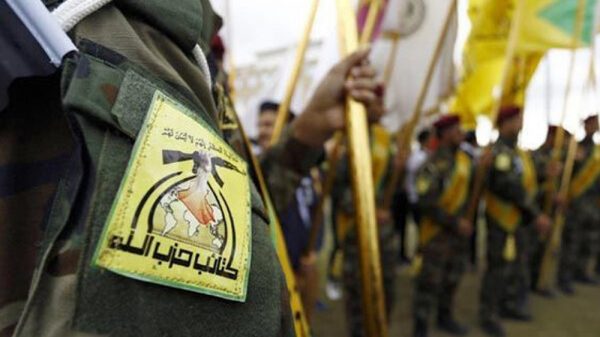
Iraq has released more than a dozen members of Popular Mobilization Units, better known as Hashd al-Shaabi, a few days after an unprecedented raid on the headquarters of Kata’ib Hezbollah, which is said to have been dictated by the US.
The PMU members were released on Monday and all charges against them were dropped, Kata’ib Hezbollah’s military spokesman Jaafar al-Husseini told AFP.
“The judge ordered their release due to a lack of evidence. The arrests shouldn’t have happened,” the spokesman said.
He said they had appeared at a Hashd military tribunal, as Iraq’s various security forces each have their own court system.
Kata’ib Hezbollah is a military unit operating under the PMU – an Iraqi umbrella group which includes more than 40 militia groups fighting Takfiri terrorism.
Iraqi counter-terrorism forces detained the Kata’ib Hezbollah members late Thursday for allegedly planning a rocket attack on Baghdad’s Green Zone, where the US and other embassies as well as state buildings are located.
Despite Washington’s accusations, Kata’ib has never claimed responsibility for the attacks.
The Thursday raid on Kata’ib headquarters raised serious questions about Iraq’s direction under the new government, as Iraqi leaders describe it as an attempt dictated by the US occupiers.
“The late Thursday night’s operation against Hashd al-Sha’abi had been dictated by the United States. There are foreign interventions and bids to harm the PMU,” Qais al-Khazali, leader of Asa’ib Ahl al-Haq which is part of the PMU, said in a statement released on Friday.
He advised Iraqi officials not to engage in a confrontation with Hashd al-Sha’abi as the anti-terror group represents people from all strata of the Iraqi society.
“No one can prevent the resistance fighters from battling US forces in order to drive them out of Iraq if they do not withdraw through peaceful means,” Khazali pointed out.
He stressed that no resistance faction has ever targeted Iraqi government institutions inside Baghdad’s heavily fortified Green Zone.
A senior official with Harakat Hezbollah al-Nujaba also called upon Iraqi authorities not to play into the hands of US military forces, warning against further raids on PMU headquarters.
Nasr al-Shammari, the deputy secretary-general and official spokesman of the movement, touched on numerous sacrifices made by Kata’ib Hezbollah in the campaign against Daesh terrorists, saying members of the group must not be targeted.
Shammari cited efforts by certain parties in Iraq to stoke sedition in Iraq, saying the Thursday raid was “a desperate attempt” that would have “unpredictable consequences for its planners”.
In November 2016, the Iraqi parliament recognized Hashd al-Sha’abi as an official force with similar rights as those of the regular army, therefore legally establishing it as part of the National Armed Forces.
The PMU has long rejected Washington’s military presence in the country as an obstacle impeding long-lasting security and stability in Iraq.
In January, the Iraqi parliament unanimously approved a bill, demanding the withdrawal of all foreign military forces led by the United States from the country following the assassination of Iran’s top military commander, Lt. Gen. Qassem Soleimani, and the second-in-command of Iraq’s Popular Mobilization Units (PMU), Abu Mahdi al-Muhandis.
Iraqi resistance groups have vowed to take up arms against US forces if Washington fails to comply with a parliamentary order calling for the expulsion of US troops following the assassination.
US suspected of role after headquarters of Kata’ib Hezbollah raided in Baghdad
Press TV – June 26, 2020
The headquarters of an anti-terror group within the Popular Mobilization Units (PMU), better known as Hashd al-Sha’abi, have come under attack in Baghdad, raising suspicions about the US role in Iraq.
More than a dozen members of Kata’ib Hezbollah were reportedly detained during the raid in southern Baghdad in the early hours of Friday. Initial reports said several commanders of the anti-US group, which is integrated into Iraq’s security forces, were among those arrested.
Their fate remains unclear, with some unnamed officials saying they are in the custody of Iraqi security services. Other informed sources said some the detainees had been released.
The newly-elected prime minister of Iraq has visited the command center of the Popular Mobilization Units (PMU) in Baghdad, wearing their uniform and calling the counter-terrorism forces a source of honor for the Iraqi nation.
An Iraqi official initially told Reuters news agency that at least three of the group’s detained commanders had been transferred over to the US military.
A number of local media outlets also reported that American forces were involved in the raid.
One tweet by a PMU member claimed that Prime Minister Mustafa al-Kadhimi had apologized to the anti-terror group’s head Hadi al-Ameri over the incident.
The Arabic-language al-Sumaria television network, citing an unnamed security source, reported on Friday that all 13 PMU members who had been detained are now free.
Back on April 6, a member of the Iraqi parliament’s security and defense committee warned against the ulterior motives behind the redeployment of US troops to various military sites across the Arab country, saying Washington was drawing up plans to target PMU commanders.
“The withdrawal of US forces from a number of military bases does not come in line with the parliamentary resolution calling on the government to push out foreign troops from the country. It is rather part of redeployment plans for American forces inside Iraq,” Karim al-Muhammadawi told Arabic-language al-Masalah news agency in an exclusive interview at the time.
He added, “The real intention behind the redeployment of US soldiers in Iraq remains unknown. But it is assumed to be related to the deployment of the forces to fortified bases, especially after the installation of Patriot missile systems there. The US is purportedly seeking to launch precision strikes against Hashd al-Sha’abi positions and intends to assassinate commanders associated with them.”
On March 27, the New York Times newspaper reported that the Pentagon had ordered a secret directive, which called on US military commanders to prepare a campaign against Kata’ib Hezbollah, which is part of Hashd al-Sha’abi.
But the United States’ top commander in Iraq had warned that such a campaign could be bloody and counterproductive.
Lieutenant General Robert P. White wrote in a blunt memo that a new military campaign would also require that thousands more American troops be sent to Iraq.
Hashd al-Sha’abi fighters have played a major role in the liberation of areas held by Daesh terrorists ever since the Takfiri group launched an offensive in the country, overrunning vast swathes in lightning attacks.
In November 2016, the Iraqi parliament voted to integrate the PMU, which was formed shortly after the emergence of Daesh in Iraq in 2014, into the military.
The popular group, however, is a thorn in the side of the United States which is widely believed to be managing an array of militant groups, including Daesh, to advance its Israel-centric agenda in the region.
In 2009, the US State Department blacklisted Kata’ib Hezbollah and imposed sanctions on the group which has been the frequent target of American airstrikes in Iraq.
Iraqi lawmakers unanimously approved a bill on January 5, demanding the withdrawal of all foreign troops following the US assassination of Lieutenant General Qassem Soleimani, the commander of the Quds Force of Iran’s Islamic Revolution Guards Corps, along with Abu Mahdi al-Muhandis, the deputy head of Iraq’s PMU, and their companions.
Later on January 9, former Iraqi prime minister, Adel Abdul-Mahdi, called on the United States to dispatch a delegation to Baghdad tasked with formulating a mechanism for the move.
The 78-year-old politician said Iraq rejected any violation of its sovereignty, particularly the US military’s violation of Iraqi airspace in the assassination airstrike.
The US has refused to withdraw its troops, with President Donald Trump balking at the idea with the threat to seize Iraq’s oil money held in bank accounts in the United States.
US military presence in Iraq aimed at protecting Israel’s security, interests: PMU leader
Press TV – May 25, 2020
A high-ranking official with Iraq’s Popular Mobilization Units (PMU), better known by the Arabic name Hashd al-Sha’abi, has strongly denounced US military presence in his country, saying such a deployment is meant to safeguard the security and interests of the Israeli regime.
“There is a national and courageous will, which rejects the presence of any foreign troops on Iraqi soil. There have been talks of US intentions to withdraw from Iraq, but we doubt them,” Qais al-Khazali, leader of Asa’ib Ahl al-Haq, which is part of the PMU, was quoted as saying by the Lebanon-based and Arabic-language al-Ahed news website on Monday.
He added, “The US [military] presence in Iraq is meant to protect the security and interests of the Israeli regime. Neither are we warlords nor thirsty for blood, but rather patriots looking for the dignity and sovereignty of the Iraqi nation.”
“If the withdrawal [of US troops] does not take place, the foreign occupier must know that Iraqis will not accept the presence of its forces. The Americans, who will open negotiations [on the extension of their presence] in June, must remember the centenary of the Great Iraqi Revolution of 1920 against British forces,” Khazali pointed out.
He also praised the sacrifices made by Lieutenant General Qassem Soleimani, the commander of the Quds Force of Iran’s Islamic Revolution Guards Corps, and Abu Mahdi al-Muhandis, the deputy head of PMU, who were assassinated along with their companions in a US airstrike authorized by President Donald Trump near Baghdad International Airport early on January 3.
Iraqi lawmakers unanimously approved a bill two days later, demanding the withdrawal of all foreign military forces led by the United States from the country following the targeted killings.
Later on January 9, former Iraqi prime minister Adel Abdul-Mahdi called on the United States to dispatch a delegation to Baghdad tasked with formulating a mechanism for the move.
The 78-year-old politician said Iraq rejected any violation of its sovereignty, particularly the US military’s violation of Iraqi airspace in the assassination airstrike.
Syrian Air Defenses Repel Israeli Missiles that Targeted a Military Site in the North of the Country
By Khaled Iskef | American Herald Tribune | May 5, 2020
On Monday night, air defenses in the Syrian army responded to an Israeli offensive that targeted military warehouses in Al-Safirah area in Aleppo eastern countryside.
Private Syrian sources reported that the attack targeted the Scientific Research Center in Aleppo eastern countryside. Syrian air defenses repelled several hostile missiles, resulting in explosions in the sky.
In turn, Syrian Ministry of Defense stated that “At 22:32 on May 4, 2020, enemy warplanes appeared on the screens of our air defenses. The warplanes came from the northeast of Athria and targeted some military warehouses in Al-Safirah area with missiles”.
Sources said that the Israeli aircraft entered the Syrian territories through Iraqi airspace and pointed out that the offensive took place through Al-Tanf base near the Syrian-Iraqi borders.
Through the war years, Israeli warplanes intentionally attacked Syria within its policy based on an attempt to weaken the capabilities of the Syrian army for the benefit of the armed groups. The last Israeli attack was on March 27, 2020 on the south of Damascus, killing three civilians and injuring three others due to shrapnel of the missiles in Adliya and Al-Hujaira. However, Syrian air defenses repelled and downed most of the missiles.
Iraq mounts counter-terrorism operations amid warnings of US-Daesh plot to split region
Press TV – May 5, 2020
Iraqi army troops and allied fighters from Popular Mobilization Forces — known as Hashd al-Sha’abi — have conducted fresh operations against Daesh militants amid warnings of collaboration between the United States and remnants of the Takfiri terror outfit in the country.
On Monday, Iraq’s Security Media Cell announced the launch of a new military campaign, dubbed ‘Desert Lions,’ against Daesh sleeper cells in the country’s desert areas.
The operation covers “Wadi Houran, Husayniyyat, Al-Kara, H2, and Wadi al-Hallcom, all the way to international borders” in Iraq’s western Anbar Province with an aim to “enhance security and stability in these areas, to pursue terrorist elements and to arrest those wanted,” it said in a statement.
The new campaign followed a string of deadly attacks by Daesh terrorists targeting Iraqi forces, among them Saturday’s assault in Salahuddin Province that killed at least 10 Hashd al-Sha’abi fighters.
On Monday, the Iraqi Army’s intelligence detained a Daesh ringleader, called Abu Hajar, in Nineveh Province.
It came one day after the arrest of another Daesh element, Abu Abdulmalik, in Nineveh’s provincial capital of Mosul, which once served as the terror group’s main bastion in the Arab country.
Also on Monday, Rudaw media network reported that an explosive-laden vehicle had gone off in Madham area in western Anbar, killing the occupants — all terrorists.
Among those slain were Daesh military commander Abu Ghasurah, the report said.
Concerns rise about Daesh-US collaboration
Meanwhile, Mahmoud al-Rubaye, spokesman of Iraq’s Asaib Ahl al-Haq group, which is part of the Hashd al-Sha’abi, said that the US has long been supporting terrorists in Iraq and Syria and that Daesh is part of Washington’s scheme to disintegrate the region.
The US, he added, plans to settle Palestinians in western Anbar under President Donald Trump’s self-proclaimed “deal of the century.”
Rubaye also emphasized that the Americans should honor the Iraqi parliament’s resolution on the withdrawal of foreign forces from the country. The resolution was passed in January following the US assassination of top Iranian anti-terror commander Lieutenant General Qassem Soleimani and senior Hashd commander Abu Mahdi al-Muhandis, in addition to several other comrades.
The US is evacuating its bases in Iraq and amassing its troops at Ain al-Assad and Harir bases, situated in Anbar and Kurdistan’s regional capital of Erbil, respectively, in the face of the outrage of the Iraqi people and popular forces, he pointed out.
Asaib spokesman further warned of armed resistance if the US refuses to leave Iraq and settles in the country’s remote areas.
Additionally, Iraq’s Harakat Hezbollah al-Nujaba, which is also part of Hashd al-Sha’abi, said the US has been planning to transfer senior Daesh commanders from eastern Syria to neighboring Iraq.
“Washington is insisting on the implementation of a plot to return the terrorists to Iraq by transferring a large number of ISIS (Daesh) commanders and militants from the eastern Euphrates and other parts of Syria,” it said in an online statement.
The group also described the Americans as “occupiers,” noting, “We stress that the Islamic Resistance of Iraq is monitoring all your destructive plots to prevent the dangers which threaten the Iraqi provinces.”
Daesh began a terror campaign in Iraq in 2014, overrunning vast swathes in lightning attacks.
Hashd al-Sha’abi fighters played a major role in reinforcing the Iraqi army, which had suffered heavy setbacks against the Takfiri elements.
Iraq declared victory over Daesh in December 2017 after a three-year counter-terrorism military campaign, which also had the support of neighboring Iran.
US seeking to replace Iraq’s PMU in the western Anbar province bordering Syria: Analyst
Press TV – April 26, 2020
An Iraqi military advisor and analyst has said that the US is seeking to replace Iraq’s Popular Mobilization Units in the western Anbar province bordering Syria with its own forces.
Speaking to Iraq’s al-Maloumah news agency on Sunday, Safa al-A’ssam said that Washington seeks to force the PMU out of the province’s al-Qaim border region by fanning sectarian tensions.
“The plan is to redeploy American forces to the al-Qaim region on the pretext of countering Deash terrorist attacks and filling the security vacuum following a PMU withdrawal,” he added.
The PMU formed shortly after the emergence of the Daesh terrorist group in Iraq in mid-2014.
The group played a major role pushing back and ultimately defeating the terrorist forces which had taken control of a large swathes of the country.
The Iraqi parliament voted to integrate the PMU into the Iraqi military in 2016, effectively placing the force under the command of the prime minister and granting the group a standing similar to that of other branches of Iraqi security forces.
Fazel Jaber, an Iraqi lawmaker affiliated with the Fatah Alliance, has also warned of attempts by certain Iraqi groups to undermine the PMU’s presence in the province despite being deployed under the command of Iraq’s federal government.
He said the attempts to weaken the PMU were led by Washington, which fears the group’s presence.
The PMU has long rejected Washington’s military presence in the country as an obstacle impeding long-lasting security and stability in Iraq.
In January, Washington assassinated the group’s deputy commander, Abu Mahdi al-Muhandis, alongside Iran’s top anti-terror Lieutenant General Qassem Soleimani in the capital city Baghdad.
Iraqi resistance groups have vowed to take up arms against US forces if Washington fails to comply with a parliamentary order calling for the expulsion of US troops following the assassination.
US main stumbling block to Iraq’s possession of advanced air defense systems: Lawmaker
Press TV – April 23, 2020
A member of the Iraqi parliament’s security and defense committee has blamed the United States for opposing Baghdad’s acquisition of sophisticated air defense missile systems to protect its airspace against any possible act of aggression.
“Since 2014, Americans have acted as the major stumbling block to Iraq’s procurement of an advanced air defense system. Repeated attempts to sign contracts with a number of countries, including Russia, have been unsuccessful because of Washington’s interference,” Kata’ al-Rikabi told Arabic-language al-Maalomah news agency in an exclusive interview on Wednesday night.
Rikabi added, “Americans installed Patriot [missile] systems in Ain al-Assad [air base] and other bases, where their forces are currently deployed in violation of [Iraq’s] national sovereignty and without the approval of the government. The presence of foreign forces [on Iraqi soil] is indeed an act of aggression, let alone the establishment of bases and deployment of systems and military hardware.”
Last week, the Iraqi parliament’s security and defense committee submitted an in-depth study to the country’s caretaker prime minister Adel Abdul-Mahdi, requesting the procurement of the Russian-built long-range, surface-to-air S-400 missile defense system.
“The committee has presented a comprehensive study to the prime minister, demanding approval for the purchase of the advanced S-400 air defense system. The issue has already been discussed with relevant figures at the General Command of Armed Forces, and now awaits the premier’s agreement,” Badr al-Ziyadi, a member of the committee, told Arabic-language al-Sabaah newspaper on April 18.
He emphasized that the purchase of the S-400 missile system, with the aim of boosting the country’s defense capabilities, will be finalized once the next Iraqi government is formed and it ratifies procurement of the system.
The United States has already warned Iraq of the consequences of extending military cooperation with Russia, and striking deals to purchase advanced weaponry, particularly S-400 missile systems.
Former US State Department spokeswoman Heather Nauert said on February 22, 2018 that Washington has contacted many countries, including Iraq, to explain the significance of the Countering America’s Adversaries Through Sanctions Act (CAATSA), and possible consequences that would arise in the wake of defense agreements with Moscow.
On August 2, 2017, US President Donald Trump signed into law the CAATSA that imposed sanctions on Iran, North Korea, and Russia.
Iraqi parliament demands Baghdad’s procurement of Russia’s S-400 missile system
Press TV – April 18, 2020
The Iraqi parliament’s security and defense committee has submitted an in-depth study to the country’s caretaker prime minister Adel Abdul-Mahdi, requesting the procurement of the Russian-built long-range, surface-to-air S-400 missile defense system.
“The committee has presented a comprehensive study to the prime minister, demanding approval for the purchase of the advanced S-400 air defense system. The issue has already been discussed with relevant figures at the General Command of Armed Forces, and now awaits the premier’s agreement,” Badr al-Ziyadi, a member of the committee, told Arabic-language al-Sabaah newspaper.
He emphasized that the purchase of the S-400 missile system, with the aim of boosting the country’s defense capabilities, will be finalized once the next Iraqi government is formed and it ratifies procurement of the system.
“The approval to acquire such a sophisticated system requires large financial allocations and a political decision in order to diversify the sources to get the weapons as we cannot just rely on the Western camp, but rather need to incline towards the Eastern camp as well,” Ziyadi pointed out.
The Iraqi lawmaker went on to say that his parliamentary committee “will support the next Iraqi government’s decisions in this regard, and will present relevant proposals and pieces of advice to it.”
Back on March 18, Ziayadi said US and Israeli arms firms were putting pressure on the Baghdad government not to discuss the purchase of sophisticated military equipment with other states, and sign arms contracts with them.
“There are companies and traders pushing to prevent Iraq from concluding contracts to purchase weapons from developed countries,” he told Arabic-language al-Maalomah news agency in an exclusive interview at the time.
The same Iraqi parliamentarian said on January 20 that the Baghdad government was planning to send delegations to Russia, China and Ukraine to hold negotiations over the acquisition of advanced air defense missile systems to protect its territory from any possible act of aggression.
“The delegations intend to visit countries like Russia, China and Ukraine to negotiate the purchase of modern systems to protect Iraq’s airspace,” he told al-Sabaah daily then.
The lawmaker added, “The Iraqi parliament is right now forming a joint executive and legislative delegation to visit developed countries and sign contracts on procuring advanced weapons.”
The United States has already warned Iraq of the consequences of extending military cooperation with Russia, and striking deals to purchase advanced weaponry, particularly S-400 missile systems.
Former US State Department spokeswoman Heather Nauert said on February 22, 2018 that Washington has contacted many countries, including Iraq, to explain the significance of the Countering America’s Adversaries Through Sanctions Act (CAATSA), and possible consequences that would arise in the wake of defense agreements with Moscow.
On August 2, 2017, US President Donald Trump signed into law the CAATSA that imposed sanctions on Iran, North Korea, and Russia.
Buying Punishment for “Terrorists”: Washington’s Reward Program Is Largely Ineffective
By Philip Giraldi | American Herald tribune | April 15, 2020
Many people worldwide are aware of the fact that the United States government offers cash rewards to informants who provide information on individuals and groups that it chooses to define as terrorists. The program is referred to as the Rewards for Justice Program (RFJ). It was established in 1984 as part of the Act to Combat International Terrorism and is run by the Department of State’s Diplomatic Security Service (DS). The rewards can be substantial, up to the $25 million that was offered for Osama bin Laden, and they sometimes include resettlement in another country with a new identity for informants whose security is threatened by their cooperation.
The program relies on information provided by local people, referred to on the RFJ website as “tips.” The website itself is accessible in a number of languages and, in its English version, features a headline that promotes its mission as: “Stop a Terrorist Save Lives. The most important reasons to stop a terrorist are all around you. Terrorism kills innocent people in every walk of life. By providing information that prevents a terrorist act, you save lives, protect families, and preserve peace. The United States is offering a reward for information leading to the arrest of persons engaged in terrorism. If you have information that can help, please submit a tip now. Submit a Tip.”
RFJ elaborates its role in very broad terms as “… offering rewards for information that prevents or favorably resolves acts of international terrorism against U.S. persons or property worldwide. Rewards also may be paid for information leading to the arrest or conviction of terrorists attempting, committing, conspiring to commit, or aiding and abetting in the commission of such acts. The Rewards for Justice Program has paid more than $145 million for information that prevented international terrorist attacks or helped bring to justice those involved in prior acts.”
After a slow start in which the program was first called the Counter Terror Rewards Program and then HEROES, by 1997 the site was processing over one million contacts per year. Admittedly, many of the “tips” were little more than bids to obtain cash and resettlement from the American government, but the State Department’s periodic evaluations of the program have considered it to be a success.
Critics note, however, that the reward for bin Laden attracted thousands of calls but no substantive information was obtained. Nor has RFJ been very effective against Islamic radical groups, considered to be its primary target. The website identifies top terrorist targets, but apart from Ramzi Ahmed Yousef, the World Trade Center bomber of 1993 who was also involved in various plots involving airliners in the Philippines, no one important has been identified and arrested through information developed by way of the program. Ramzi was arrested in Pakistan in 1995 after an informant identified him. He is currently in prison in Colorado.
The RFJ program has also claimed several executions of claimed terrorists, to include the killing of two leaders of the Filipino radical group Abu Sayyaf. Many more terrorist leaders, like ISIS head Abu Bakr al-Baghdadi, were killed without any input from RFJ. The relative lack of success against actual militants from groups recognized generally as terrorist, inevitably led to a broadening of the target pool. On December 22, 2011, RFJ offered a $10 million for information leading to Ezedin Abdel Aziz Khalil, the alleged organizer of an al-Qaeda fundraising operation in Iran that sent money to Pakistan and Afghanistan. It was the first listing of what was claimed to be a terrorist financier.
Two major current targets of RFJ are, in fact, financiers and fund-raising mechanisms related to Lebanese Hizballah and the Iranian Revolutionary Guards Corps (IRGC). To include them on the list, the United States declared both organizations to be Foreign Terrorist Groups (FTOs) in 1997 and 2019 respectively. Regarding Hizballah, the RFJ website includes “Rewards for Justice is offering a reward of up to $10 million for information leading to the disruption of the financial mechanisms of Lebanese Hizballah. Terrorist groups such as Hizballah rely on financing and facilitation networks to sustain operations and launch attacks globally. Hizballah earns almost one billion dollars annually through direct financial support from Iran, international businesses and investments, donor networks, corruption, and money laundering activities. The group uses those funds to support its malign activities throughout the world, including: Deployment of its militia members to Syria in support of the Assad dictatorship; alleged operations to conduct surveillance and gather intelligence in the American homeland; and enhanced military capabilities to the point that Hizballah claims to possess precision-guided missiles. These terrorist operations are funded through Hizballah’s international network of financial supporters and activities — financial enablers and infrastructure that form the lifeblood of Hizballah.”
Regarding the IRGC, the RFJ site includes “The U.S. Department of State’s Reward for Justice Program is offering a reward of up to $15 million for information leading to the disruption of the financial mechanisms of Iran’s Islamic Revolutionary Guard Corps (IRGC) and its branches, including the IRGC-Qods Force (IRGC-QF). The IRGC has financed numerous terrorist attacks and activities globally. The IRGC-QF leads Iran’s terrorist operations outside Iran via its proxies, such as Hizballah and Hamas… Since its founding 40 years ago, the IRGC has been involved in terrorist plots and supports terrorism worldwide. The IRGC is responsible for numerous attacks targeting Americans and U.S. facilities, including those that killed U.S. citizens. The IRGC has supported attacks against U.S. and allied troops and diplomatic missions in Iraq and Afghanistan.”
The first thing that strikes the casual reader of the descriptions of the cases made against both Hizballah and the IRGC is that much of the “evidence” is unsubstantiated, fabricated or exaggerated. To be sure, neither group is a friend of the United States or of Israel, but the descriptions of worldwide terror operations is largely made up, particularly the claims about attacks against Americans which have been credibly attributed to ISIS, not to Iranian sources or proxies. That Lebanese Hizballah has been gathering intelligence on the “American homeland,” presumably to stage an attack, is complete nonsense.
To cite only one example of how the RFJ is primarily a vehicle for attacking individuals and groups that the U.S. and Israel do not like, one might cite Muhammad Kawtharani. Informants would be rewarded for information on the “… activities, networks, and associates of Muhammad Kawtharani, a senior Hizballah military commander. This announcement is part of the Department’s standing reward offer for information leading to the disruption of the financial mechanisms of the terrorist organization Lebanese Hizballah. Muhammad Kawtharani is a senior leader of Hizballah’s forces in Iraq and has taken over some of the political coordination of Iran-aligned paramilitary groups formerly organized by Qassim Soleimani after Soleimani’s death in January. In this capacity, he facilitates the actions of groups operating outside the control of the Government of Iraq that have violently suppressed protests, attacked foreign diplomatic missions, and engaged in wide-spread organized criminal activity. As a member of Hizballah’s Political Council, Kawtharani has worked to promote Hizballah’s interests in Iraq, including Hizballah efforts to provide training, funding, political, and logistical support to Iraqi Shi’a insurgent groups.”
Well, RFJ gets Kawtharani’s name right and he is a Hizballah commander, but from that point on the story is pure spin and disinformation. The militia groups that Kawtharani presumably associates with and that have been attacked by U.S. forces are not “outside control of the government,” nor are they “insurgents.” They are, in fact, integrated into the Iraqi army. Nor have attacks on foreign diplomatic missions been demonstrated to be their responsibility as the rage against U.S. presence in Iraq is widespread across sectarian lines. Kawtharani is present in Iraq as a guest of the government in Baghdad, as was Qassim Soleimani before him, largely to assist in the fighting against ISIS. And if he is in Iraq to promote Hizballah interests in that country, why should it surprise anyone? In short, his being featured in RFJ is part of a plan to create a major incentive to kill him, little more. If he committed an actual terrorism crime or act, where is it?
Rewards for Justice is not about justice at all, unless one is promoting vigilante justice, as virtually no one who appears on its site is actually arrested and tried. It is a kill list providing the United States with one more tool to target and eliminate political opponents from countries with which Washington is not at war. As it has now been expanded to include the targeting of organizations and funding mechanisms of groups that are considered hostile, it is a mechanism for widening the hideous global war on terror that has done such terrible damage to American democracy while also killing hundreds of thousands and upending whole countries worldwide.
Featured Video

Deception – Submarines against Olof Palme
or go to
Aletho News Archives – Video-Images
From the Archives
Woolsey Fire started at Santa Susana Field Lab — where “radioactive materials released were never accurately measured”
By John Laforge | CounterPunch | November 30, 2018
In my Nov. 16 column, I reported on potential radiation risks posed by California’s Woolsey wildfire having burned over parts or all of the Santa Susana Field Laboratory—south of Simi Valley, Calif., 30 miles outside Los Angeles—site of at least four partial or total nuclear reactor meltdowns.
The field laboratory operated 10 experimental reactors and conducted rocket engine tests. In his 2014 book Atomic Accidents, researcher James Mahaffey writes, “The cores in four experimental reactors on site … melted.” Reactor core melts always result in the release of large amounts of radioactive gases and particles. Clean up of the deeply contaminated site has not been conducted in spite of a 2010 agreement.
Los Angeles’s KABC-7 TV reported Nov. 13 that the Santa Susana lab site “appears to be the origin of the Woolsey Fire” which has torched over 96,000 acres. Southern Calif. Public Radio said, “According to Cal Fire, the Woolsey Fire started on the afternoon of Thursday, Nov. 8 … on the Santa Susana site.” … continue
Blog Roll
 Aletho News
- Between war and industrial breakdown: The US-Israeli attrition crisis
- Pressure builds on Iran to ‘drop’ Lebanon ceasefire demand as Islamabad talks hang in balance
- In another clash report, US denies agreement to release Iran’s assets
- What is fueling unrest across the EU?
- Why no power can undermine Iran’s eternal dominance over the Strait of Hormuz
- Is The War Against Iran Over?
- Iran war will leave long-term ‘scar’ on Wall Street, investors warn
- How Iran decimated US power projection in West Asia: Military lessons of 40-day war
- Iran’s report details US-Israeli war crimes in targeting schools, hospitals, livelihoods
- NATO’s Slow Fracture: How Trump’s Iran War Exposed the Instrument of Hegemony
- If Americans Knew
- After killing 350+, Israel still has a “score to settle” with Lebanon before ceasefire – Daily Update
- Military aid to Israel emerges as the latest political litmus test for Democrats
- The only Palestinian children’s rights organization closes following years-long Israeli campaign against it
- ‘I Can’t Forget the Smell’: Lebanese Reel After Israel Kills Over 300 in Single Day
- DNC Shoots Down Resolutions Calling Out AIPAC and Limiting Arms to Israel
- TCN: Is Israel Blackmailing President Trump?
- Israel killed at least 303 Lebanese yesterday – who were they? Daily Update
- Amnesty: Urgent – Protect Lebanese civilians from brutal escalation in Israeli attacks
- Is The War Against Iran Over?
- Inside the Israeli army’s propaganda wing
- No Tricks Zone
- New Study: No Linear Warming Or Glacier Retreat Along Northern Antarctic Peninsula Since 1980s
- An Inconvenient Tree: Uncovered In Alps… Europe Much Warmer Than Today 6000 Years Ago
- New Study Reports A 60% Slowdown In Greenland’s Ice Loss Rate In The Last Decade
- Low Intensity Tornado Wrecks Major Solar Farm, Creating A Potential Toxic Dump
- New Study Finds Warming Saves Lives…Cold Temperatures 12 Times More Deadly Than Excess Heat
- German Science Blog Accuses PIK Climate Institute Of Hallucinating Climate Tipping Points
- Devastating Assessment Of Comirnaty Vaccine By Former Senior Pfizer Europe Toxicologist
- New Study: CO2 Is ‘Effectively Negligible’ As An Explanatory Climate Change Factor Since 2000
- Former Pfizer Toxicologist Dr. Helmut Sterz Tells Bundestag Hearing Pfizer Vaccine Should Have Never Been Approved
- Energy Expert: Germany’s Nuclear Phaseout Was A “500 Billion Euro Mistake”
 Aletho News