US announces Gaza ‘Board of Peace’ amid ongoing Israeli ceasefire breaches
Press TV – January 17, 2026
The administration of US President Donald Trump has announced the executive members of Gaza’s so-called Board of Peace, a body purportedly tasked with managing transitional governance in the territory, as Israel continues to violate its ceasefire agreement with Hamas.
On Friday, the White House published the names of the Gaza Strip’s so-called “Board of Peace” members and the head of the National Committee for the Administration of Gaza (NCAG), marking the launch of the second phase of Trump’s 20-point plan for Gaza.
Ali Sha’ath, a former Palestinian deputy minister in the Palestinian Authority (PA), will lead the NCAG, according to the White House.
The so-called Board of Peace will be chaired by Trump himself, with key members including Secretary of State Marco Rubio, Trump’s special envoy Steve Witkoff, Trump’s son-in-law Jared Kushner, and former UK Prime Minister Tony Blair.
The statement also listed members of a “Gaza Executive Board”: Turkish Foreign Minister Hakan Fidan; United Arab Emirates’ Minister of State for International Cooperation Reem Al-Hashimy; veteran Qatari diplomat Ali Al-Thawadi; Egypt’s intelligence chief Hassan Rashad; UAE-based Bulgarian diplomat and former UN envoy Nickolay Mladenov; Cypriot-Israeli businessman Yakir Gabay; Dutch politician Sigrid Kaag; as well as Witkoff, Kushner, and Blair.
Mladenov will act as High Representative for Gaza, linking the Board of Peace with the NCAG, while Major General Jasper Jeffers will lead the International Stabilization Force (ISF).
The US also appointed Aryeh Lightstone and Josh Gruenbaum as senior advisers to the Board of Peace to supervise “day-to-day strategy and operations.”
More appointments to the Executive Board and the Gaza Executive Board are expected in the coming weeks.
The announcement follows Witkoff’s Wednesday statement launching the second phase of the Gaza ceasefire plan.
The second phase is said to focus on “demilitarisation, technocratic governance, and reconstruction.”
However, most of the goals in Trump’s 20-point plan that became the basis for a ceasefire in Gaza three months ago never became a reality on the ground.
Phase one was designed to immediately halt the fighting, facilitate the exchange of Israeli and Palestinian captives, set a boundary for Israeli withdrawal from parts of Gaza, allow the full entry of humanitarian aid, and open the Rafah crossing between Gaza and Egypt.
While the daily number of Israeli attacks has decreased since the start of the ceasefire, Israel has killed at least 451 Palestinians and injured 1,251 – an average of nearly five killed every day – since October 10.
Under the ceasefire deal, Hamas released all 20 living Israeli captives in exchange for nearly 2,000 Palestinian prisoners.
Hamas has also returned 27 of the 28 bodies of deceased captives, while the search is still on for the remaining body, believed to be buried under the rubble of buildings bombed by Israel.
However, according to Hamas, Israel has failed to release all women and child prisoners as stipulated in the agreement.
Moreover, the Israeli military did not fully withdraw its troops to an area dubbed the “yellow line” and continues to restrict aid.
The opening of the Rafah crossing did not happen, either.
Since Israel launched its genocidal campaign on October 7, 2023, more than 71,000 Palestinians have been killed and over 172,000 wounded, the majority of them women and children.
Hamas: Israeli minister’s boasting over Gaza’s destruction an open admission of genocide
Palestinian Information Center – January 17, 2026
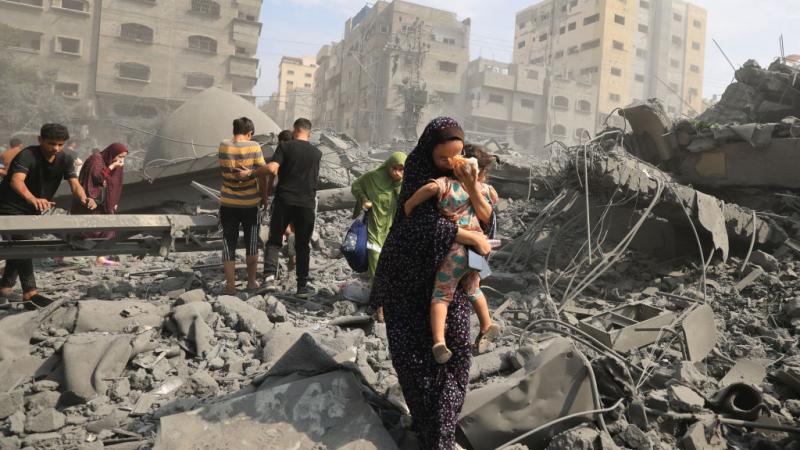
GAZA – Hamas spokesperson Hazem Qassem said on Saturday that the Israeli war minister’s public boasting about the destruction of the Gaza Strip, and his congratulation to the soldiers for criminal acts, amounts to an explicit and unprecedented admission of genocide.
Qassem said the remarks, made in light of revelations by Western media about the scale of devastation in Gaza, constitute further proof of a level of contempt for international law and humanitarian norms unseen in modern history.
He added that what has unfolded in the Gaza Strip, genocide and ethnic cleansing, constitutes a full-fledged crime under international law, now accompanied by a clear and public confession from those responsible. This, he said, necessitates genuine accountability for the entire Israeli occupation system behind these crimes.
Israel launched a genocide in the Gaza Strip in October 2023 that continued for more than two years, resulting in the killing of more than 71,000 Palestinians and the wounding of over 171,000 others. The assault caused massive destruction to approximately 90 percent of Gaza’s civilian infrastructure, with the United Nations estimating reconstruction costs at around $70bn.
Latest US-backed regime change operation in Iran hits the wall
By Samuel Geddes | Al Mayadeen | January 17, 2026
Having bombed the country in 2025, “Israel” and the US seemed to think that provoking street violence would have more success at collapsing the Iranian state. Instead, it fizzled almost instantly.
We have been here at least half a dozen times in the past two decades. Street protests in Iran over an internal economic, social or political issue emerge, gather a degree of momentum in urban areas and the Western propaganda system declares that the protests have “shifted” from their initial focus, to calls for the repudiation of the Islamic Revolution and the end of the political system it created. European and American politicians issue their empty statements of solidarity with the Iranian people and unilaterally decide that the Islamic Republic has “lost its legitimacy,” that its fall is simply a matter of “when,” not “if.” We have seen this narrative played out often enough to recognize it never survives contact with the real world.
The source of the persistent delusion that the Islamic Republic is about to fall comes not only from the Euro-American elite class wishing it to be so, but also from its deferral to the “analysis” of segments of the diaspora whose own political objectives are detached from reality.
Whether it is protests over the government’s handling of the economy, energy blackouts, or the water crisis, most external observers are incapable of viewing each individual issue through any lens other than that of regime change.
This time around the US and Israelis, in coopting the protests to destabilize the country through street violence, have not even bothered to hide their involvement. It has also not helped the West’s case that it is now feigning “humanitarian concern” for the rights of Iranian citizens while it has spent more than two years facilitating the ongoing slaughter and starvation of Gaza’s population. Any observer following both issues can detect the dissonance and conclude what is motivating the frantic calls to escalate the situation into military intervention. That is, the desire to crush a state and society that has resisted Western dominance for more than four-and-a-half decades.
The brazenness of the West’s affected concern for the well-being of the Iranian public is particularly galling in light of the sanctions. If Iranians’ living standards were really of any concern to Washington, London or Brussels, they would start by unconditionally ending their economic strangulation in effect against the country. The truth is that the suffering and misery engendered by the sanctions is entirely the point. As well as stifling the development of an independent state outside the globalized-Western economy, the siege is specifically intended to make living conditions unbearable for the average Iranian so that they are incentivized to undermine the Islamic Republic. The continuation of the sanctions is a barely disguised punishment of the Iranian public for not pursuing the West’s geopolitical goal of regime-change for them.
Were it not glaringly obvious to the Trump administration before the latest unrest, it surely is now that the exiled political diaspora most actively pushing for the fall of the Islamic Republic through Western military action are entirely incapable of political organization. Even the least crazed fan of the defunct Pahlavi dynasty is pathologically hostile to the terrorist personality cult of the MEK, as much as they are to the Islamic Republic itself. There simply is no political alternative, to say nothing of whether it even has any domestic support, waiting to replace the Islamic Republic.
Flush from the “success” of his abducting Venezuelan president Maduro, Trump seemed temporarily convinced he might have a similar option here, to carry out a meaningless military stunt for which he can take credit and declare “victory.” His problem is that there is no level of open military action against Iran that would allow him to do this without igniting a regional war that destroys the global economy.
This realization, if he has come to it, would explain his backtracking on the red lines he set, that any executions would trigger US attacks. If a controlled, stage-managed performance is his goal, as it almost always is, then the confrontation with Iran leaves him with no viable option but to back down.
The absence of any realistic military option has now seen both the US and Europe revert to their standard tactic; the intensification of the sanctions they have used to punish the Iranian people. Trump’s latest declaration of a 25% tariff on any country trading with Iran is his way of giving himself an off-ramp, for now, from a crisis that is largely of his making.
Figures behind massacre of starving Gazans now shaping US Gaza plan
Press TV – January 16, 2026
Many of the figures now being elevated as key figures in Washington’s proposed postwar administration for Gaza were architects of the Gaza Humanitarian Foundation (GHF), a US-Israeli aid operation under which Palestinian civilians were repeatedly killed while attempting to access food.
According to the Financial Times, individuals shaping the new Gaza executive committee were directly involved in designing and promoting GHF, a scheme that operated for months inside Israeli-controlled areas of the strip.
GHF was presented as a humanitarian workaround after Israel restricted UN and NGO aid access. In practice, it forced starving Palestinians to travel through militarized corridors to tightly controlled distribution hubs, where limited food was handed out under the watch of Israeli troops and US contractors.
Gaza health officials reported that hundreds of Palestinians were killed along access routes to these sites, while some estimates place the death toll at close to 2,000 over six months.
Israeli authorities denied deliberate targeting and disputed casualty figures, even as repeated shootings were documented near GHF hubs.
Despite the collapse of the foundation in November, the same network behind it is now shaping Gaza’s future governance.
The planned executive committee, operating under a Trump-led “Board of Peace,” is being influenced by Roman Gofman, Israeli prime minister Benjamin Netanyahu’s chief military adviser and a nominee to head the Mossad; US-Israeli venture capitalist Michael Eisenberg; US-Israeli policymaker Aryeh Lightstone; and Israeli tech entrepreneur Liran Tancman, who has links to Israeli intelligence.
All four were involved in establishing or promoting GHF.
The executive committee is expected to include Palestinian technocrats tasked with replacing Hamas in civil administration under the second phase of a US-brokered ceasefire.
Eighteen Palestinian figures have reportedly received invitations, with former Palestinian Authority planning official Ali Shaath designated to head the body and retired intelligence officer Mohammed Nisman expected to oversee security.
Meetings are scheduled to take place in Cairo, while the committee is set to operate under direct US supervision.
The push comes as Israel continues to violate the ceasefire. Since the truce was announced in October, Israeli forces have killed more than 440 Palestinians and injured over 1,200, according to Gaza’s Health Ministry.
Israeli troops were supposed to withdraw to designated lines and halt attacks during the first phase of the agreement, but instead have expanded their presence, destroyed thousands of buildings, and constructed new military outposts inside Gaza.
Humanitarian commitments under the ceasefire have also gone unmet. Of the 57,000 aid trucks stipulated in the agreement, fewer than 25,000 have been allowed into Gaza, according to the Government Media Office.
Promised increases to 4,200 trucks per week have not materialized, while Israel has announced plans to bar dozens of international NGOs from operating in the strip. The blockade remains in place, exacerbating food insecurity, medical shortages, and displacement.
Former UN envoy and Bulgarian defense minister Nickolay Mladenov is set to be named “high representative” for Gaza, overseeing a 14-member Palestinian technocratic committee responsible for day-to-day governance.
The broader “Board of Peace,” expected to include Trump and 15 international leaders, has been delayed, reportedly due to regional tensions and Trump’s threats of military action against Iran.
The US team driving Gaza policy answers directly to Jared Kushner, with much of the planning conducted outside formal diplomatic and military coordination channels.
Meanwhile, Israeli media have reported that the army has drawn up plans for a renewed assault on Gaza aimed at seizing additional territory, even as Washington announces the start of the ceasefire’s second phase.
Hamas and other Palestinian factions, meeting in Cairo, have focused discussions on reopening crossings, ensuring aid entry, and securing Israeli withdrawal, while Israeli artillery and gunfire continue to target multiple areas across the strip.
“Real men go to Tehran” — The Zion-Con fantasy of regime change in Iran
By Junaid S. Ahmad | MEMO | January 16, 2026
“Anyone can go to Baghdad. Real men go to Tehran.”
It is difficult to imagine a sentence that more perfectly distils the arrested adolescence of American neoconservatism. Equal parts locker-room bravado and imperial hallucination, the phrase belongs to the same intellectual ecosystem as Rambo sequels, Tom Clancy paperbacks, and the enduring belief that history naturally submits to men armed with air superiority and a television-ready talking point.
The slogan has circulated for decades among Washington’s most aggressively incurious minds. Iraq was merely the appetizer. Tehran was always the entrée — the Everest of regime change, the final boss in a video game played by men who have never once paid the price of defeat.
Iran is not different merely because of its size, its population, or its terrain — though the Zagros Mountains are far less forgiving than the streets of Fallujah. Iran is different because it has refused, stubbornly and at enormous cost, to internalise the post–Cold War catechism: accept American primacy, subcontract your sovereignty, and call the arrangement “integration into the international order.”
For the ‘Zion-Cons’ — Zionist neoconservatives — this refusal is not simply strategic defiance. It is psychological heresy.
The theology of regime change
Neoconservatism is not a foreign-policy framework. It is a belief system. Like all theologies, it comes equipped with sacred texts, sanctioned demons, and end-times fantasies. Iran occupies a unique place in this cosmology: simultaneously an ideological abomination and a geopolitical temptation too intoxicating to abandon.
The Islamic Republic represents everything neocon thought cannot tolerate — an independent regional power immune to Western legitimacy rituals, rooted in a civilizational memory more than a millennium older than Washington itself. That it is also openly hostile to Israel, and persistently aligned with Palestinian resistance, elevates Iran from problem to obsession.
This obsession is always framed as concern. Concern for democracy. Concern for women’s rights. Concern for regional stability. Yet the concern follows a suspiciously selective pattern. It spikes when Iranian women protest. It flattens when women in Gaza are buried beneath concrete and shrapnel. It demands sanctions in the name of “helping the Iranian people” while celebrating the annihilation of Iran’s middle class as a strategic achievement.
This is not hypocrisy. It is architecture.
Sanctions are not a failed alternative to regime change; they are its slow-motion variant. When bombing proves politically inconvenient, starvation becomes policy. When diplomacy threatens stabilisation, diplomacy must be sabotaged. Engagement is dangerous precisely because it works. The objective is not reform. The objective is obliteration.
Israel’s strategic mirage
For Israel’s security establishment, Iran is the final unresolved obstacle in a region otherwise disciplined into submission. Egypt neutralised. Syria pulverised. Iraq shattered and held together with duct tape. Lebanon perpetually destabilised. Only Iran remains intact and intolerably autonomous.
The idea that Israel’s posture toward Iran has ever been defensive borders on parody. The fear is not that Iran will strike tomorrow; it is that Iran will exist coherently ten years from now.
This explains the fixation on Iran’s air defences, its scientists, its infrastructure. The logic is brutally simple: a state that cannot defend itself cannot act independently. A state that cannot act independently can eventually be wrecked, partitioned, and remade.
But here the fantasy collides with reality. Iran is not Syria. It is not Libya. It is not Iraq circa 2003 — hollowed out by sanctions and ruled by a dictatorship so despised that collapse felt like relief. Iran, like all societies, contains fractures and rivalries. But fragmented societies do not automatically disintegrate. Quite often — especially under existential threat — they consolidate. External assault does not reliably dissolve states. Sometimes it forges them.
The opposition mirage
Every regime-change project requires a hero. In Iran’s case, while ritualistic nods are made toward protesters with genuine grievances, the starring role is awkwardly reserved for an exile aristocracy whose Twitter/X followings vastly exceed their domestic relevance.
Reza Pahlavi is marketed like a Silicon Valley prototype: sleek, Western-approved, and permanently “almost ready.” His appeal thrives in think tanks, donor salons, and Israeli conference halls. Inside Iran, his name provokes neither mass devotion nor visceral hatred — just indifference at best, uncontrollable laughter at worst.
This is the core contradiction of Washington’s Iran policy: regime change without revolution; installation without legitimacy; democracy without the inconvenience of mass politics.
The resulting strategy is perversely elegant in its cynicism — wait for collapse while ensuring no alternative survives long enough to govern.
Civil war option
What follows regime collapse? Zion-Con discourse treats the question like a software update users will sort out later. Something, it is assumed, will emerge. Something manageable. Something vaguely liberal.
History offers no such reassurance
Iran’s disintegration would not yield a liberal republic — and it is not meant to. It would yield precisely what Zion-Cons privately welcome: centrifugal violence, ethnic fragmentation, militia economies, refugee flows that would make Syria look like a rehearsal dinner. Kurdish separatism. Baloch insurgency. Nuclear insecurity. The scenario reads less like a transition plan than a controlled demolition spiralling out of control.
For Washington and Tel Aviv, this is not a deterrent. It is an acceptable – perhaps even desirable – outcome. A broken Iran is preferable to a strong one, even if the shards cut indiscriminately.
The masculinity problem
“Real men go to Tehran” is not merely rhetoric. It is theatre. It reflects a masculinity crisis at the heart of American empire — a compulsion to prove relevance through violence because legitimacy has evaporated.
Short wars. Clean optics. Cinematic strikes. The problem with Iran is that it refuses to follow the script. There is no “Mission Accomplished” banner waiting in the Persian Gulf. There is only attrition, retaliation, and the dawning realisation that power is not a substitute for strategy.
The endgame nobody admits
The scarcely concealed truth is that regime change in Iran is not primarily about Iran. It is about preserving Zionist hegemony in the region. An Iran that survives sanctions, absorbs pressure, and refuses submission is contagious. It teaches others that defiance is survivable.
That lesson is intolerable
So, the fantasy endures. The slogans recycle. The men who went to Baghdad insist they are wiser now — just before deliberately repeating the same catastrophe, only on a grander scale.
But Tehran is not a sequel. It is a reckoning. And this time, the audience will not be so forgiving.
Leaked files tie Epstein to Israel-UAE backchannel and possible kompromat
MEMO | January 15, 2026
The notorious sex offender Jeffrey Epstein, widely believed to be an Israeli intelligence asset, played a behind-the-scenes role in nurturing the secret relationship between Israel and the United Arab Emirates (UAE) years before the 2020 Abraham Accords, newly leaked communications reveal.
The revelations emerge from newly obtained material published by Drop Site News as part of an ongoing investigation into Epstein’s political and intelligence connections. The documents, spanning more than a decade, shed light on Epstein’s long-standing friendship with Sultan Ahmed bin Sulayem, the powerful head of the UAE’s DP World, and suggest that Epstein used his connections to promote Israeli commercial, military and surveillance technology in Emirati‑controlled logistics hubs.
Leaked emails show that Epstein not only facilitated strategic ties between Israel and the UAE, but also operated in a context ripe for the gathering or circulation of compromising material—so-called kompromat—on powerful elites. In one exchange, Sulayem joked about wanting “some PUSSYNESS” rather than “BUSINESS” in reference to a mutual female contact. Epstein responded approvingly: “praise Allah, there are still people like you.”
Epstein, who was later found to have registered a neighbouring private island in Sulayem’s name, also forwarded sexually explicit material from a separate scandal involving a Liberian official to JPMorgan executive Jes Staley—further showing his role in distributing content of a compromising nature among political and financial elites.
These instances, coupled with Epstein’s facilitation of meetings and shared travel among Israeli, Emirati and Western intelligence-linked figures, have raised serious questions about whether personal vulnerabilities were exploited to advance geopolitical objectives.
The leaks show Epstein’s efforts to insert Israeli strategic interests into UAE-led economic expansion across the Red Sea and Horn of Africa, including in Somaliland and Djibouti. These moves are thought to be essential in laying the groundwork for the UAE’s more recent push to recognise Somaliland as an independent state, a move formally backed by Israel last month.
The emails further reveal Epstein’s attempt to broker investment from Emirati elites in Israeli cybersecurity firm Carbyne, which later received backing from the UAE following the Abraham Accords. The company was founded by a former officer of Israel’s Unit 8200, the military’s elite signals intelligence division responsible for electronic surveillance, cyber operations and mass data collection on Palestinians and other regional targets.
Carbyne has since received millions of dollars in investment from Emirati‑linked entities, raising concerns that surveillance and data‑gathering technologies closely associated with Israeli military intelligence are being embedded within port operations and security infrastructure under UAE control.
Evidence of Epstein arranging high-level meetings between former Israeli Prime Minister Ehud Barak and Sulayem further demonstrates his role in establishing personal connections that would later underpin formal diplomatic ties.
In one such exchange, Epstein emailed Barak suggesting, “He is the right hand of Maktoum. I think you should meet,” referring to Sheikh Mohammed bin Rashid Al Maktoum, the ruler of Dubai and the UAE’s vice president and prime minister. Barak would later go on to serve as chairman of Carbyne.
Drop Site reports also highlight Epstein’s apparent efforts to provide Emirati elites with access to elite Israeli medical care, using personal contacts to connect Sulayem’s family with neurologists in Israel. This level of trust, the investigation notes, served as a platform for deeper strategic cooperation.
The timing of Epstein’s involvement is significant. Following his 2009 conviction, he re-emerged into elite circles and intensified efforts to build influence across political, financial and intelligence networks. One of Epstein’s key associates, Sulayem, would go on to become a vocal proponent of normalising ties with Israel, including publicly backing the recognition of Somaliland.
This revelation comes amid growing scrutiny of how the Abraham Accords were shaped not just by public diplomacy but by decades of covert networking, influence operations and shared intelligence priorities between Israel and Abu Dhabi. The UAE has long sought regional dominance through military and commercial control of key sea lanes, a vision increasingly aligned with Israel’s own strategic ambitions.
Drop Site hints at the possible use of kompromat and coercion as tools of statecraft by Israeli agencies operating through proxies like Epstein. While no direct evidence of blackmail has yet emerged, the deeply personal nature of Epstein’s relationships and the sensitive political contexts involved raise serious concerns.
As Israel continues to entrench its military presence in Somaliland, with UAE support, the long-term consequences of these covert partnerships are becoming ever more apparent, not just for Palestinians but for the future of the Horn of Africa.
Report: Kurdish Fighters Have Been Entering Iran From Iraq and Clashing With the IRGC
By Dave DeCamp | The Libertarian Institute | January 14, 2026
Turkish intelligence has warned Iran’s Islamic Revolutionary Guard Corps (IRGC) that Kurdish fighters have been entering Iran from Iraq amid protests inside Iran, Reuters reported on Wednesday.
An unnamed senior Iranian official speaking to the outlet said that the IRGC has been clashing with armed Kurdish fighters dispatched from both Iraq and Turkey. The Kurdistan Freedom Party, or PAK, a Kurdish Iranian separatist group mainly based in Iraq, has been claiming that its armed wing has been conducting operations against Iranian forces.
On Tuesday, the PAK claimed its forces launched an attack on an IRGC base in western Iran. The Reuters report and claims of Kurdish attacks come as Tehran is accusing the US and Israel of arming “terorrists” inside Iran who have attacked Iranian security forces.
The US has a significant presence in Iraqi Kurdistan, including a military base and an $800 million consulate compound that it opened in December. The Israeli Mossad is also known for having a presence in the area, and Iran claimed that it attacked a Mossad base in Iraqi Kurdistan in 2024.
The Mossad has a long history of covert operations inside Iran, and a Farsi-language X account affiliated with the Israeli spy agency suggested it had operatives on the ground in Iran when the protests first broke out. “Let’s come out to the streets together. The time has come. We are with you. Not just from afar and verbally. We are with you in the field as well,” the account said on December 29.
Israel’s Channel 14 has reported that “foreign actors” have armed protesters in Iran and said that’s the reason why hundreds of Iranian security personnel have been killed.
“We reported tonight on Channel 14: foreign actors are arming the protesters in Iran with live firearms, which is the reason for the hundreds of regime personnel killed,” Channel 14 reporter Tamir Morag wrote on X on Tuesday. “Everyone is free to guess who is behind it.”
Villains of Judea: Paul Singer’s Empire of Debt & Demographic Replacement
Paul Singer is the embodiment of Jewish plutocracy
José Niño Unfiltered | January 12, 2026
Paul Elliott Singer stands as one of the most influential figures in global finance. The Jewish billionaire hedge fund manager has amassed a fortune estimated at $6.2 billion to $6.7 billion by purchasing distressed sovereign debt and corporate bonds at deep discounts, then pursuing ruthless legal campaigns to extract full repayment plus interest.
Born August 22, 1944, in Teaneck, New Jersey, Singer transformed a $1.3 million startup in 1977 into Elliott Management, a hedge fund empire managing approximately $65.5 billion to $72 billion in assets.
Yet Singer does more than just make financial moves. He has emerged as a kingmaker in Republican politics, becoming the second-largest GOP donor in 2016, and a major force behind AIPAC, immigration reform, and LGBT rights advocacy. His business model has devastated entire communities from Sidney, Nebraska, to Buenos Aires, Argentina. His political activism spans seemingly contradictory causes, supporting both hawkish pro-Israel policies and same-sex marriage rights. His most recent venture, the $5.9 billion purchase of Venezuela’s Citgo assets, positions him to reap billions from the Trump administration’s military intervention in Venezuela.
Singer’s business model has earned him the moniker vulture capitalist. In the 1990s, Singer began leaving his mark after purchasing $20 million in Peruvian sovereign debt. Through aggressive litigation, he eventually secured a payout of $58 million, nearly triple his investment. A U.S. court revealed that Elliott’s purchase of Peruvian debt was made with the explicit intention of pursuing full repayment through lawsuits. Investigative journalist Greg Palast reported that Singer’s lawyer allegedly told him Singer allowed Peru’s President Alberto Fujimori, who fled the country ahead of murder charges, to escape in return for ordering Peru’s treasury to pay Singer $58 million.
Between 2002 and 2003, Singer earned over $100 million from a $30 million investment in Congo-Brazzaville debt. But his most audacious campaign targeted Argentina. After Argentina’s 2001 economic crisis, Singer purchased distressed bonds for approximately $117 million. He refused to participate in debt restructuring agreements that other creditors accepted, instead pursuing full repayment through international courts. The campaign culminated in a 2016 settlement that netted Elliott Management $2.4 billion, a staggering 1,270 percent return.
Singer’s tactics proved extraordinary even by hedge fund standards. In 2012, Elliott successfully convinced a Ghanaian court to detain the Argentine naval training vessel ARA Libertad with 220 crew members aboard, demanding $20 million for its release. Then-Argentine President Cristina Fernández de Kirchner refused to pay Singer’s fund, calling Elliott and similar firms “financial terrorists” and vulture funds. The Obama administration and Secretary of State Hillary Clinton demanded courts dismiss Singer’s attempt to bankrupt Argentina, but Singer’s legal campaign ultimately prevailed.
Pro-Israel Bankroller
Singer has emerged as one of the most significant donors to pro-Israel causes in the United States. Through The Paul E. Singer Foundation, he has donated approximately $300 million since 2010. Singer donated $2 million to AIPAC and contributed $3 million to AIPAC’s super PAC, United Democracy Project, since 2022, making him tied for AIPAC’s third-largest donor. He serves on the board of directors of the Republican Jewish Coalition and co-founded Start-Up Nation Central, an organization dedicated to connecting Israeli innovation with global markets.
Singer has also been a major funder of the Foundation for Defense of Democracies, a neoconservative think tank advocating hawkish policies aligned with Israeli interests. From 2008 to 2011, Singer contributed $3.6 million to FDD, making him the organization’s second-largest donor. The organization has been described by former Secretary of State Colin Powell’s chief of staff Lawrence Wilkerson as a fervent advocate for war against Iran. At the Jewish Funders Network in Jerusalem, Singer stated that “Israel may be the only insurance policy all Jews, everywhere, can rely upon for the safety and continuity of Judaism.”
Promoter of LGBT Degeneracy and Mass Migration
Like many Jewish plutocrats, Singer became a significant supporter of LGBT causes after his son Andrew came out as a homosexual. In 2012, Singer provided $1 million to start American Unity PAC, whose sole mission was to encourage Republican candidates to support same-sex marriage. From 2012 to 2015, he contributed over $5.5 million to this organization. In 2013, Singer donated $500,000 to the Human Rights Campaign. Since 2001, Singer has donated more than $11 million toward legalizing homosexual marriage and supporting LGBT causes.
Singer’s crusade to redefine marriage within Republican ranks was just one facet of his broader agenda; he soon pivoted to advocating mass immigration to transform America’s demographics. In 2013, Singer made a six-figure donation to the National Immigration Forum to support comprehensive immigration reform, better known as amnesty. As one of the first high-profile Republican megadonors to publicly back amnesty, Singer worked to marshal conservative support for an overhaul of federal laws. In 2014, Singer formed the American Opportunity Alliance, bringing together wealthy Republican donors who shared his support for LGBTQ rights, immigration reform, and Israel.
Singer’s Looting of Sidney, Nebraska
Singer’s domestic business dealings generated controversies as devastating as his international operations. In 2015, Elliott Management acquired an 11 percent stake in outdoor retailer Cabela’s and forced a merger with Bass Pro Shops that devastated Sidney, Nebraska, where Cabela’s was headquartered. The town experienced massive job losses, a significant housing value collapse, and economic depression. According to court filings, Elliott pressured Cabela’s board to sell the company until the board relented. The merger resulted in Elliott making nearly $100 million profit. Residents told Fox News producers that the hedge fund destroyed their town, with one saying, “If money is that big of a God to him, he is a pretty sick human being.”
Tucker Carlson’s Exposé
In December 2019, Fox News host Tucker Carlson devoted a major investigative segment to Paul Singer, focusing on the Cabela’s case. Carlson described Singer’s business model as “vulture capitalism” that involves “buying large stakes in American companies, firing workers, driving up short-term share prices, and in some cases, taking government bailouts.” He stated, “It bears no resemblance whatsoever to the capitalism we were promised in school. It creates nothing. It destroys entire cities. It couldn’t be uglier or more destructive.”
Carlson emphasized Singer’s political power, noting that “people like Paul Singer have tremendous influence over our political process.” He revealed that Singer was “the second largest donor to the Republican Party in 2016 and has given millions to a super PAC that supports Republican senators. Carlson noted, “You may never have heard of Paul Singer, which tells you a lot in itself, but in Washington he is rock star famous.”
As Carlson was producing the segment, he reported being warned repeatedly by people around Washington, “Don’t criticize Paul Singer, that’s not a good idea.” During the broadcast, Carlson received a text from a very well-known person in Washington saying, “Holy smokes, I can’t believe you’re doing this. I’m afraid of Paul Singer.”
Venezuela and Citgo
One of Singer’s most recent controversial business deals involves Venezuela’s Citgo Petroleum. In November 2025, Elliott Investment Management won a court-mandated auction to purchase Citgo for $5.9 billion. Citgo represents the crown jewel of Venezuela’s international oil assets, owning three major Gulf Coast refineries with capacity to process 800,000 barrels per day, 43 oil terminals, and over 4,000 gas stations.
Singer acquired Citgo at what multiple sources describe as a major discount. Court advisors estimated Citgo’s actual value at approximately $13 billion, while Venezuelan officials valued the assets at $18 billion to $20 billion. This means Singer paid roughly 45 percent of the estimated market value.
A highly controversial aspect of the sale involves Robert Pincus, the court-appointed special master who oversaw the auction and recommended Singer’s bid. Pincus sits on the national board of directors of AIPAC. Gold Reserve Inc., a competing bidder that offered $7.9 billion, filed motions to disqualify Pincus for conflicts of interest. Venezuela rejected the sale’s legitimacy, calling it a “fraudulent process” and the “theft of the century.”
Trump’s Venezuela Intervention is Singer’s Wet Dream
The timing of events raised serious questions about the relationship between Singer’s Citgo purchase and Trump administration actions. In 2024, Singer donated $5 million to Trump’s super PAC and contributed $37 million to support Republican congressional candidates. On January 3, 2026, U.S. armed forces conducted a military raid in Caracas, capturing Venezuelan President Nicolás Maduro.
The removal of Maduro positions Singer to reap enormous profits. Economist Paul Krugman noted, “If Trump lifts that embargo, Singer will receive a huge windfall.” Within days of Maduro’s capture, Trump announced that Venezuela would be turning over between 30 and 50 million barrels of oil to the United States.
Rep. Thomas Massie (R-KY), who is a staunch opponent of the intervention in Venezuela, also caught on to how Singer stands to benefit from military action against Venezuela. He tweeted on January 4, 2026, “According to Grok, Paul Singer, globalist Republican mega-donor who’s already spent $1,000,000 to defeat me in the next election, stands to make billions of dollars on his distressed CITGO investment, now that this administration has taken over Venezuela.”
As Massie noted, Singer has ponied up $1 million to MAGA KY, a super PAC seeking to unseat the Kentucky congressman. Singer and his fellow Zionist Jews view Massie as an obstacle to further consolidating Jewish supremacy in the halls of Congress.
All told, Singer is the embodiment of Jewish plutocracy. He bankrolls the West’s demise through his advocacy of LGBT degeneracy, mass migration, never-ending wars on behalf of world Jewry, and vulture finance. Americans must awaken to these existential threats, revoke their elite privileges, and halt the Great Replacement before it consigns our polities to historical oblivion.
The Gaza ceasefire’s Phase 2 only exists in the media and at UN meetings
By Robert Inlakesh | Al Mayadeen | January 14, 2026
As the debate continues to rage regarding what Phase Two of the Gaza Ceasefire will look like, it has become clear that there is no such thing occurring on the ground. From start to finish, the entire process has been a US-Israeli gambit to achieve their regime change goals, while removing Gaza’s suffering from the headlines.
Through December 2025, reports emerged claiming that this January would see the implementation of a second phase to the so-called Gaza Ceasefire agreement. As expected, there has been even more stalling on this front, as only vague comments made regarding the implementation of US President Donald Trump’s plan.
United Nations Security Council (UNSC) resolution 2803, passed on November 17, 2025, laid out the agenda for the Gaza Strip as clear as day. There were no guarantees for the rights of the Palestinian people, all references to precedents set for decades on the issue of “Israel’s” occupation were absent, instead, there was a vague outline of a regime change plot.
Contrary to the Trump administration’s claims that it no longer seeks to be involved in “nation building”, UNSC Resolution 2803 gives approval for what is labelled the “Board of Peace” (BoP) in Gaza. It also approves the deployment of an “International Stabilisation Force” (ISF).
In essence, the BoP is an undemocratic rule set to be imposed upon the Palestinian people, with Trump taking over the role as de facto dictator of the Gaza Strip, while the ISF is set to be a multi-national invasion force tasked with regime change. Phase Two of the ceasefire will hedge upon the success of both these pillars of the so-called “peace plan”.
The failure of Phase Two
When it comes to the BoP, there is no clear strategy that has been set forth for making this work on the ground. A number of different vague proposals have been floated through the media in recent months, all pointing towards the imposition of the BoP for areas still under Israeli occupation.
The Zionist regime’s forces not only refused to respect the so-called “Yellow Line” barrier in the Gaza Strip, which was supposed to demark 53% of the territory from the remaining 47% in the hands of the Hamas-led administration and security authority. The Israelis are now operating inside nearly 60% of the territory.
Under the control of the Israeli occupation forces are five ISIS-linked militant groups that have been established, with the purpose of fighting the Palestinian resistance. The only people living in the seized territory are these militants and their families, whose numbers reportedly reach only into the thousands.
Last year, the Wall Street Journal reported that Donald Trump’s so-called “Project Sunrise” was being seriously pitched to regional governments. The proposal advances a rather ridiculous model featuring luxury resorts on the sea, high-rise buildings, high-speed rail, and an advanced AI-driven grid. All of this will allegedly cost at least 112 billion dollars over 10 years, according to the 32-page document put forth by Jared Kushner and Steve Witkoff.
This model aligns with an AI generated video published by the US President in early 2025, called “Trump Gaza”, featuring a sleazy billionaire’s playground where Trump and Israeli PM Benjamin Netanyahu are sitting at a resort together.
In the world, what has actually been laid out by more serious officials within the Trump and Netanyahu administration’s, is the idea of reconstruction in the areas of Gaza where the Zionist regime is currently based. This is of course failing the complete disarmament of the Palestinian resistance, which evidently is not going to happen.
This is where the so-called ISF comes into the picture. This multi-national force is intended to be composed of troop contributions from around the world. According to what has been revealed publicly, it appears as if the plan is for the ISF to number into the tens of thousands at most, meaning they will be outnumbered by the Palestinian resistance.
At this stage, although the ISF was supposed to have already been deployed to Gaza, Israeli authorities have been making huge issues regarding which armies will be permitted to join this force. Zionist officials have publicly opposed the inclusion of Turkish or Qatari forces, yet they now appear unable to secure even Azerbaijan’s agreement to agree to contribute troops.
The Egyptians, on the other hand, who are a guarantor of the ISF project, have publicly suggested that it be set up as a “peacekeeping force” that could be comparable to the UNIFIL forces deployed in Southern Lebanon. The US and Israelis are, however, adamant that the ISF not be a peacekeeping force, and according to UNSC 2803, it is not a UN-aligned force. If Cairo says no, getting the ISF off the ground will be difficult.
In the spirit of trying to reach some level of compromise in this regard, the US has floated the idea that the ISF would only work to ensure the security of the borders, train a new Palestinian security force and perhaps coordinate on other issues like securing the transfer of humanitarian supplies.
Yet, even such a limited ISF mission is already showing signs of disaster if it does go ahead. The security firm, UG Solutions – which was responsible for employing private military contractors to lead the defunct Gaza Humanitarian Foundation (GHF) scheme – was revealed as early on during the ceasefire to have been interviewing new recruits to deploy to the Gaza Strip.
According to the investigative reporting of Drop Site News, the role of these military contractors could be to coordinate with the ISF and again participate in aid distribution. The GHF project resulted in what Palestinians called a “death trap”, luring starving civilians to aid sites, where American private military contractors and the Israeli military would open fire upon them. The result was over 2,000 civilians murdered, primarily by the Zionist regime, over a period of 6 months. The GHF was directly funded by the US Trump administration.
Under the worst-case scenario, which the Israelis are pushing for, the ISF will be tasked with disarming the Palestinian Resistance. It does not take a military expert to understand that bringing together hundreds of soldiers from one foreign army, with thousands from another, all of whom speak different languages, have never encountered a situation like Gaza and operate under different doctrines, is a recipe for disaster.
The ISF is intended to be the regime change force that finishes the job that the Israeli military failed at. Bear in mind that the Israelis had deployed hundreds of thousands of soldiers, on rotation, inside the Gaza Strip and still failed.
Prior to the announcement of the ceasefire on October 8, 2025, the Israeli military was in the process of launching its failed “Gideon’s Chariots 2” Operation. According to internal Israeli estimates at the time, the goal of this campaign, which was to occupy Gaza City, would have required up to 200,000 soldiers and possibly taken up to a decade if it was to mirror a West Bank style occupation.
The Israelis were never willing to fight the Palestinian Resistance head on, instead they carried out a genocide, and the majority of their military tasks on a day-to-day basis were destroying civilian infrastructure. In other words, the Israeli army has not changed its primary function, during the war, since the beginning of the so-called ceasefire.
It has continued to demolish buildings and feed its own private industry that has developed behind this demolition work, throughout the ceasefire period. The only difference has been that it no longer experiences the high levels of danger it did previously, due to the resistance adhering to the ceasefire.
This entire genocide has gone down in a similar manner to the way the ceasefire is being implemented. The US-Israeli alliance has no idea how to achieve their desired victory, so they come up with scheme after scheme, military operation after military operation, then when they fail, they simply escalate the violence against civilians and try again.
The way that the US and Israeli military have managed the conflict in Gaza is perhaps the most embarrassing failure in the history of modern warfare. The combined power of the region’s most advanced military, alongside the world’s dominant military power, were not capable of defeating Palestinian Resistance groups who were armed primarily with light weapons they produced themselves under siege.
In every conceivable way, the Israelis and Americans have the upper hand, yet they have to resort to calling in an international invasion force to do their job for them, after committing genocide for over two years and destroying almost every standing structure in all of Gaza. Quite frankly, it is pathetic, not only that they have failed militarily and instead fought against civilians, but that they are so irrational that they cannot even accept defeat.
On the first day the ceasefire was declared, I predicted this exact predicament, that countless schemes would be set forth and that the agreement would be frozen between Phase One and Phase Two for some time. This is precisely what has happened. There was never any real ceasefire, because only one side has adhered to it, Hamas and the Palestinian Resistance. The exact same scenario has played out in Lebanon. The inevitable outcome on both fronts is more war.
We must act before Palestinian hostages are executed in the world’s worst prisons
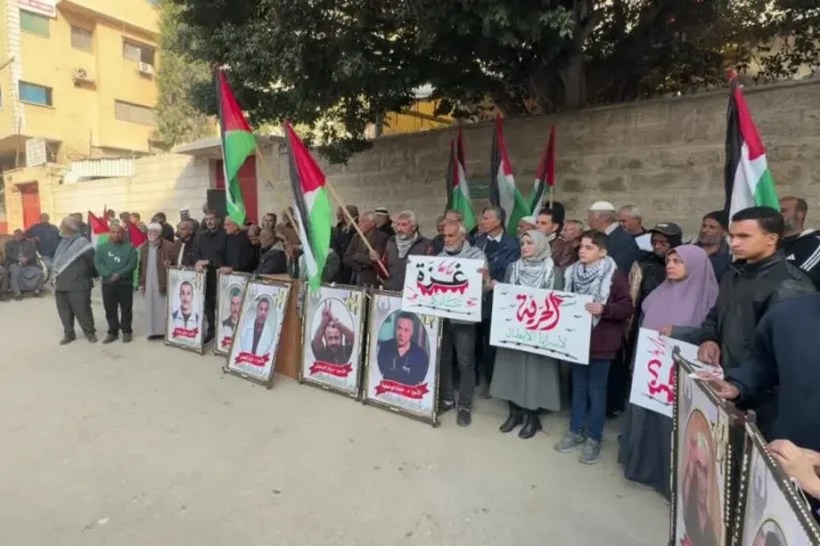
Demonstration held in Gaza in solidarity with Palestinian prisoners in Israeli jails. [photo by AA]
By Adnan Hmidan | MEMO | January 14, 2026
Warnings are no longer enough. Condemnation alone no longer carries any weight. We are standing at a moment that will be remembered, not for what was said, but for what was done. Today, in Israeli prisons, Palestinians are not simply being detained. They are being pushed, step by step, towards a reality where death itself is written into law, where execution is no longer a crime but a procedure, no longer an exception but a policy.
This is no longer just about harsh detention conditions or even about the routine violation of prisoners’ rights. The danger now runs deeper. What is unfolding is a systematic attempt to reshape justice to fit the needs of occupation, to turn trials into formalities before punishment and to reduce the law to a tool of retaliation rather than protection. New legislation, exceptional legal routes and an openly hostile political discourse now speak of execution not with embarrassment but with confidence, pride even. In such a climate, every legal fig leaf has fallen away and every moral mask has been removed.
Human rights organisations across the world have issued clear warnings about this direction, especially the push to establish “special” courts for Palestinians alone. These courts do not merely breach the principle of equality before the law; they destroy the very idea of justice. They operate outside internationally recognised standards and function in a space dominated by security priorities rather than judicial independence. When a person stands before a court designed especially and exclusively for him or her, not to offer fairness, but to ensure conviction, justice ceases to exist. It is a performance where the ending is known before the first word is spoken.
The threat does not end in the courtroom. It extends into a growing policy of denying release altogether, cutting off any realistic hope of freedom through exchange, parole, or genuine judicial review. What we are witnessing is a dangerous shift from punishment with limits to punishment without end, from imprisonment as a legal measure to imprisonment as a permanent political sentence. This approach deepens arbitrary detention, entrenches isolation and strips detainees of the most basic forms of human connection, turning prisons into spaces beyond accountability and beyond compassion.
Most disturbing of all is the open preparation for the death penalty, particularly when it is framed in a way that is mandatory, discriminatory, and aimed squarely at Palestinians. This represents a grave assault on the right to life and raises the terrifying possibility of executions carried out after trials shaped more by politics than by justice. Any attempt to apply such punishment retroactively, or to enforce it selectively, shatters the principle of legality and transforms the law into an instrument of elimination rather than protection. This is not a distant fear. It is a path already being cleared, step by step, in front of a world that seems increasingly willing to look away.
It is from this sense of urgency that the Red Ribbons Campaign was born, not as a slogan, nor as a gesture, but as a human alarm. A warning sounded before prison cells become execution chambers, and before silence becomes complicity. The colour red was chosen for a reason beyond the aesthetic; it signifies danger, the colour of blood and the colour of the final signal when words are no longer enough. It is the colour of freedom when it is taken by force and of injustice when it is endured in silence.
The campaign calls for a coordinated digital action beginning on the evening of Thursday 15th of January, under two clear hashtags: #الحرية_للأسرى and #FreePalHostages. The aim is to restore the human face of those held in Israeli prisons, not as statistics and certainly not as abstract political figures, but as doctors who once healed others, women whose lives were interrupted and children who should have been in classrooms, not in prison cells. This is about breaking a narrative that allows the suffering of one side to be visible while the pain of the other is deliberately and forcefully made invisible.
The action then moves from screens to streets on Saturday the 31st of January, with posters carrying the faces of Palestinian hostages placed in public spaces. This is not meant as theatre, but rather to remember while people are still alive, refusing to await their death to set a memorial. It is a way of saying: these lives matter now, not later.
But this movement will only have meaning if it belongs to people on the street and not just to organisations, movements or campaigns. It will only succeed if it becomes personal. No special permit is required to demonstrate care. No official mandate is needed to act. A photo can be placed in your local neighbourhood, with red ribbons tied around it; a picture taken, and then shared. In doing so, you become part of something larger, not a campaign of noise, but a community of conscience.
This is not a political disagreement that can be postponed. It is a moral test that demands an answer now. Will we act before executions take place, or will we limit ourselves to words of sorrow afterwards? Will we raise our voices while there is still time, or will we save them for statements that come too late?
The Red Ribbons Campaign may not be the final chapter in this struggle, but it could be one of the last chances to prevent a darker one from being written. History is not kind to those who watch from a distance. Blood, once spilled cannot be taken up. And justice, when abandoned at the moment of danger, becomes nothing more than a story we tell ourselves later.
We must act now, not because we seek attention, but because we refuse to be silent witnesses to the execution of Palestinian hostages in the world’s worst prisons.
Former Head of Israeli Military Intelligence Directorate: There’s a ‘very significant influence operation by the US’ in Iran
The Dissident | January 14, 2026
Recently, the Israeli newspaper Maariv interviewed the head of the Military Intelligence Directorat in Israel from 2018-2021, Tamir Hayman, who revealed that the United States currently has a “Significant Influence Operation” on the ground in Iran.
In the interview, Hayman said, “If the question is, is there zero operation right now? The answer is no, because there is already an operation. There is currently a very significant influence operation by the US” referring to the current unrest happening in Iran.
He added, “The sequence of news that is received from within Iran, rumors that are coming, videos that are coming, there are many things that are happening that have no explanation. It could be a coincidence, and it could be something else. Simply put, an influence effort is an effort that operates primarily in the cyber realm, and in the realm of local disruption and subversion, and there are some.”
Along with this, Tamir Hayman, acknowledged that U.S. sanctions were the cause of the economic issues that in Iran that sparked the initial protests in Iran which are apparently being exploited by American and Israeli intelligence, saying, “there is the attempt, as we heard tonight from Trump, that this is a path of negotiation with the Americans, that this is really the only thing that can save the Iranian economy, the lifting of sanctions”.
This comment comes at the same time that Tamir Morag, the Diplomatic Correspondent for the Netanyahu-linked Channel 14 in Israel, reported that “foreign actors are arming the protesters in Iran with live firearms, which is the reason for the hundreds of regime personnel killed.”
American and Israeli officials have been fairly open about the fact that Israeli intelligence is currently operating on the ground in Iran, with the former Secretary of State and CIA director, Mike Pompeo saying, “Happy New Year to every Iranian in the streets. Also, to every Mossad agent walking beside them” and the Israeli Heritage Minister, Amichai Eliyahu saying, “When we attacked in Iran during ‘Rising Lion’ we were on its soil and knew how to lay the groundwork for a strike. I can assure you that we have some of our people operating there right now”.
But now, Tamir Morag has revealed that there are “very significant influence operations by the US” in Iran, which include “operates primarily in the cyber realm, and in the realm of local disruption and subversion” and according to Tamir Morag, apparent operations to arm protestors in Iran to kill Iranian government officials.
Referring to the protests in Iran, the U.S. government connected private intelligence firm Stratfor, wrote, “the United States may also try to intervene, such as by covertly helping to organize the protesters”, something that is apparently already underway through American “influence operations”.
Israel–Syria security pact stumbles as Tel Aviv rejects withdrawal: Report
The Cradle | January 14, 2026
Israel has refused any withdrawal from Mount Hermon and the other areas of Syria it occupied after the fall of former Syrian president Bashar al-Assad’s government, while rejecting Russian patrols in the country’s south and demanding that Damascus be prohibited from ever possessing air defenses, Hebrew media revealed.
“The Israeli position is clear and non-negotiable: there will be no withdrawal from Mount Hermon,” an Israeli official was cited as saying by Hebrew newspaper Maariv on 14 January.
According to the report, talks are stalling due to Damascus’s demand that a security agreement with Tel Aviv be linked to a withdrawal of Israeli army forces from Syria.
The Israeli report added that Tel Aviv is concerned with a Syrian attempt to re-establish a Russian military presence in southern Syria. Israel considers this move a direct threat to its “freedom of action,” Maariv claimed.
The source told the newspaper that Israel is obstructing plans to deploy Russian forces in southern Syria, and that Tel Aviv has conveyed to Damascus, Moscow, and Washington that it will not allow a Russian presence.
Russian media had reported last year that the Syrian government was requesting a resumption of Russian military patrols in the south in order to help limit continuous Israeli raids and incursions.
The sources add that Tel Aviv is following with concern reports that Damascus is hoping to purchase weapons from Russia and Turkiye.
“The Israeli message conveyed to all relevant parties [is that] Israel will not agree that in any future security arrangement, Syria will have strategic weapons, primarily advanced air defense systems and weapons that could change the regional balance of power,” according to Maariv.
“The Israeli goal is clear: freezing the existing situation – without an IDF withdrawal from Mount Hermon, without Syrian reinforcements, and without a foreign military presence that limits the IDF.”
In particular, Israel is demanding a complete demilitarization of southern Syria. “Israel’s security-strategic interest comes first. For now, Trump accepts this position.”
The report also says that the two rounds of Syrian–Israeli talks in Paris last week made “no breakthrough was achieved,” only a “limited understanding” for “the establishment of a coordination mechanism aimed at preventing clashes on the ground, with active US involvement.”
A joint statement by Washington, Tel Aviv, and Damascus on 6 January said that Syria and Israel have agreed to establish a US-supervised “joint fusion mechanism” to “share intelligence” and pursue de-escalation.
Damascus and Tel Aviv “reaffirm their commitment to strive toward achieving lasting security and stability arrangements for both countries,” the statement said, adding that they agreed to “establish a joint fusion mechanism – a dedicated communication cell.”
This mechanism aims “to facilitate immediate and ongoing coordination on their intelligence sharing, military de-escalation, diplomatic engagement, and commercial opportunities under the supervision of the US.”
“This mechanism will serve as a platform to address any disputes promptly and work to prevent misunderstandings,” according to the statement, published by the US State Department after the two rounds of Paris talks.
The Israeli army occupied large swathes of southern Syria as soon as Assad’s government fell, declaring the 1974 Disengagement Agreement null. It has since established permanent outposts and has seized control over vital water sources – practically encircling the Syrian capital.
The occupation continues to expand as Israeli forces carry out almost daily raids. In a span of one year, the Israeli army attacked Syria over 600 times.
Tel Aviv and the new Syrian government have been engaged in direct talks for nearly a year to reach a security arrangement. Damascus has vowed that it has no interest in confronting Israel and has reportedly made commitments to coordinate with Tel Aviv against Iran, Hezbollah, and the Axis of Resistance.
Despite this, Israel has shown no willingness to pull out of Syria.
Negotiations stalled for several weeks before Hebrew media reported in late December that “significant progress” had been made and that a deal could be announced “soon.”
A Syrian source told Israeli outlet i24 on 27 December that there was the possibility of a meeting between Israeli Prime Minister Benjamin Netanyahu and Syria’s self-appointed President Ahmad al-Sharaa, a former Al-Qaeda chief.
US President Donald Trump is reportedly pressuring both sides to reach a deal quickly.
Featured Video
The US bombed the Shahs house lol
or go to
Aletho News Archives – Video-Images
From the Archives
How a War with Iran Would Diminish American Power
By Greg Scoblete | The Compass | August 13, 2010
Jennifer Rubin wants a war with Iran:
But the emphasis on the existential threat to Israel ignores a more basic issue for Americans to ponder: a nuclear-armed Iran represents a dagger at the heart of America and an existential threat to our status as a superpower and guarantor of the West’s security. As to the former, Iran is pressing ahead with its long-range ballistic missile program. First the Middle East and Eastern Europe, then all of Europe and, within a matter of years, the U.S. will be within range of Iranian missiles. If those are nuclear and not conventional, what then? We’re not talking about whether Iran is going to be “merely” a destabilizing factor in the Middle East or whether it will set off an arms race with its neighbors or imperil Israel’s existence. We’re talking about whether America will then be at risk (and lacking sufficient missile-defense capabilities if we continue to hack away at our defense budget). The argument about whether mutual assured destruction can really work against Islamic fundamentalists who have an apocalyptic vision becomes not about Israel’s ability to deter an attack but about ours. Those who oppose American military action have an obligation to explain why America should place itself in that predicament.
I would argue that any obligation to present an explanation lies with those whose disastrous policy prescriptions with respect to Iraq lead America into the worst strategic blunder in the country’s recent history. That aside, note the blind faith in the power of the military to actually achieve its ends. … continue
Blog Roll
 Aletho News
- Former Head Of MI6 Admits That The U.S. And Israel Are Losing The Iran War
- Scattered Thoughts on War and Peace
- Iran Threatens to Close Red Sea to Shipping in Response to Invasion
- Iran in excellent position to prevail in war with US, Israel: John Mearsheimer
- Iran warns US: Do not call your retreat an agreement
- Neighbors first – Moscow signals shift in energy strategy
- Almost 400 Ukrainian drones downed over Russia in single night – MOD
- Battle for Hungary: How the Russiagate blueprint has been unleashed against Orban
- Brussels warns Slovakia over ‘discriminatory’ dual fuel pricing targeting foreign drivers
- Hungary to halt gas deliveries to Ukraine – Orban
- If Americans Knew
- Jacob Reses, one of the most powerful pro-Israel operatives in Trump’s Washington
- Israeli-US assaults kill or injure 87 children a day – Not a ceasefire Day 166
- ‘Forever live by the sword’: Understanding Israelis’ massive support for Iran war
- UN’s special rapporteur on human rights says Israel is systematically torturing Palestinians
- Trump White House plagiarized Iran war manifesto from Israel-aligned think tank
- Gaza says 6–10 patients die daily waiting for treatment abroad as Israel blocks medical evacuations
- ‘Substantial evidence’ of double-tap strike in killing of Gaza’s Hind Rajab
- ‘Do Not Want To Die For Israel’: Doubts About Trump’s Iran Strategy Spread Among Troops
- Instead of taking Joe Kent’s claims seriously, the media is disregarding him as an antisemite
- Joe Kent’s Explosive Interviews about his Resignation over the Iran War
- No Tricks Zone
- Devastating Assessment Of Comirnaty Vaccine By Former Senior Pfizer Europe Toxicologist
- New Study: CO2 Is ‘Effectively Negligible’ As An Explanatory Climate Change Factor Since 2000
- Former Pfizer Toxicologist Dr. Helmut Sterz Tells Bundestag Hearing Pfizer Vaccine Should Have Never Been Approved
- Energy Expert: Germany’s Nuclear Phaseout Was A “500 Billion Euro Mistake”
- New Research: South Australia’s Mid-Holocene Sea Surface Temperatures Were 4°C Warmer Than Today
- Storing Green Energy To Last Germany 10 Days Would Require A 60-Million Tonne Battery
- New Studies: UK Sea Levels Were 4 Meters Higher Than Today During The Mid-Holocene
- Destructive Green New Deal: German Energy And Metal Group Warns Of Drastic Crisis
- New Study Documents A 20-Year Pause In Arctic Sea Ice Decline – Driven By Internal Variability
- Wake-up Call: Survey Shows Majority Of Germans Now Favor Postponing Climate Targets!
 Aletho News