How pro-Israel money captured Starmer’s Labour
By Nasim Ahmed | MEMO | September 26, 2025
The UK Labour Party has been rocked by yet another scandal and is facing scrutiny over revelations that its leadership has been captured by a network of unelected funders and lobbyists with deep ties to Israel and Zionist organisations.
At the centre of the controversy is Morgan McSweeney, Keir Starmer’s powerful chief of staff, and his long-time association with billionaire businessman Trevor Chinn. Documents and leaks show that between 2017 and 2020, McSweeney oversaw Labour Together, a factional project that secretly accepted more than £730,000 (around $930,000) in undeclared donations, allegedly in breach of electoral law.
Much of this money is said to have come from Chinn, a figure whose involvement in Labour politics has for decades been bound up with the defence of Israel and the advancement of Zionist networks inside the party.
Chinn is no ordinary donor. A director of Labour Together until 2024, he has bankrolled both Conservative and Labour Friends of Israel (LFI) throughout his career. In early 2025, he was awarded the Israeli Presidential Medal of Honour by President Isaac Herzog for his services to the apartheid state. Chinn’s commitment to Israel has been described as one of his “animating concerns” over three decades of political donations.
An investigation by Jody McIntyre, who stood as a candidate for the Workers Party in the last general election, shows how deeply enmeshed Chinn became with McSweeney’s project. McSweeney reportedly concealed donations “to protect Trevor” from scrutiny, according to McIntyre’s investigation. Labour Together, however, later dismissed the failure to declare the funds as an “administrative error,” a line advised by solicitor Gerald Shamash, another Labour figure with a record of blocking debates on sanctions against Israel.
Chinn’s influence was not limited to donations. According to minutes of a 2020 meeting revealed by Electronic Intifada, Chinn and five other lobbyists set up a “regular channel of communication” with Labour MP Steve Reed, a close ally of McSweeney and vocal supporter of LFI. The leaked record illustrates the extent to which pro-Israel lobbyists were embedded in Labour’s factional leadership project.
McSweeney’s own ties to Zionism go back further than his dealings with Chinn. In his youth, he spent time living on Sarid, a Zionist settlement built on the ruins of the Palestinian village of Ikhneifis. There, he is said to have become closely acquainted with Hashomer Hatza’ir, a Zionist movement that played a central role in Israel’s settler-colonial project.
McIntyre’s research and internal documents allege that McSweeney campaigned for Steve Reed—who is known to have received funding from LFI for travel to occupied Palestine—and later worked closely with Margaret Hodge, a self-declared Zionist. Some sources also suggest McSweeney oversaw Liz Kendall’s 2015 leadership run, during which she made public statements against boycotts and sanctions of Israel—though the precise nature and funding of these campaigns remain under investigation.
By 2017, McSweeney was director of Labour Together, where Chinn sat on the board. Internal documents revealed that the group’s work included secret projects to undermine Jeremy Corbyn by inflaming the anti-Semitism crisis, planting hostile media stories, and fracturing the party’s left wing.
McSweeney, according to Double Down News, even devised a covert strategy dubbed Operation Red Shield, aimed at “burning down” Corbyn’s Labour in order to capture the party for a pro-business, pro-Israel faction.
The secret funding allowed McSweeney to commission hundreds of thousands of pounds’ worth of polling into the Labour membership. This research shaped Starmer’s leadership campaign, presenting him as a “unity” candidate who pledged to uphold policies such as public ownership and a Green New Deal.
However, once elected, Starmer rapidly U-turned on those commitments, dropping all ten of his leadership pledges. The sequence of events suggests that Starmer’s campaign positions were adopted to secure victory rather than to be implemented in government.
Starmer’s subsequent record confirmed that pattern of deception. Within months of becoming leader, he ditched all ten of his leadership pledges and moved Labour sharply to the right. On Palestine, Starmer has repeatedly echoed Israeli government narratives, refusing to condemn the genocide while expelling Labour members who criticised Israel.
While Trevor Chinn is central to this latest scandal, he is not the only pro-Israel donor bankrolling Labour. Since Starmer’s election, the party has increasingly relied on wealthy businessmen with strong ties to Zionist organisations.
One of these is Gary Lubner, the South African-born former CEO of Autoglass, who has donated more than £5 million ($6.3 million) to Labour. Lubner’s family fortune was built during apartheid South Africa, when his father and uncle were accused of helping to bust international sanctions.
Today, Lubner is a major supporter of the United Jewish Israel Appeal, a fundraising arm for Israeli causes. His son Jack is active in the Jewish Labour Movement and other pro-Israel networks.
Lubner’s uncle Bertie was a major donor to Ben-Gurion University, an institution identified by human rights groups as complicit in Israel’s apartheid system. Under Starmer’s leadership, Labour has drawn heavily on donations from pro-Israel businessmen such as Lubner, underlining the party’s financial dependence on figures with strong political and financial ties to Israel.
The cumulative effect of these revelations is stark: Labour under Starmer has been captured by a narrow, unrepresentative network of pro-Israel donors and lobbyists. Their influence was decisive in undermining Corbyn’s leadership, installing Starmer, and silencing members who demanded a just policy on Palestine.
As Israel’s genocide in Gaza has killed more than 68,000 Palestinians, mostly women and children, the Labour government has aligned itself with Israeli war crimes—refusing to halt arms sales, authorising surveillance flights over Gaza and granting Israel political cover on the international stage.
Labour’s latest scandal is not simply about undeclared donations. It speaks to the hollowing out of democracy inside Labour and its subordination to interests directly tied to the Israeli state. Decisions in Labour today are shaped less by members or voters than by figures like McSweeney, Chinn and Lubner—unelected operators whose record and affiliations show a consistent commitment to defending Israel, often over the views of party members.
Tucker Carlson Reveals What Shocked Him While Making 9/11 Docuseries
Glenn Greenwald | September 24, 2025
This is a clip from our show SYSTEM UPDATE, now airing every weeknight at 7pm ET on Rumble. You can watch the full episode for FREE here: https://rumble.com/v6zdjaw-system-upd…
Now available as a podcast! Find full episodes here: https://linktr.ee/systemupdate_
Join us LIVE on Rumble, weeknights at 7pm ET: https://rumble.com/c/GGreenwald
Become part of our Locals community: https://greenwald.locals.com/
Malaysian army ready to join possible peacekeeping force in Gaza, says army chief
MEMO | September 25, 2025
Malaysian Army Chief Gen. Muhammad Hafizuddeain on Thursday said that his force is ready to join a possible peacekeeping force in Gaza, according to state-run media, Anadolu reports.
Speaking to reporters at the closing ceremony of the 14th Indo-Pacific Armies Chiefs Conference, he said that the Malaysian forces have experience in peacekeeping and are ready to join any mission, including a possible deployment to Gaza, Palestine, if asked to do so, Bernama News reported.
“We have been involved in peacekeeping operations since 1960, starting in Congo, and then in Somalia, Bosnia and Cambodia,” he said.
However, Hafizuddeain noted that any participation would depend on the government’s decision, as well as an evaluation of the mission’s effectiveness and safety.
His statement came after Indonesian President Prabowo Subianto said Tuesday that his country is ready to deploy 20,000 peacekeepers in Gaza.
Addressing the 80th session of the UN General Assembly in New York, Prabowo said: “If and when the Security Council and this Assembly decide,” Indonesia is ready to dispatch 20,000 or “even more” soldiers to “help secure peace in Gaza or elsewhere in Palestine as part of a united multilateral force — so that peace in both Palestine and Israel, can become real, not just envisioned.”
The Israeli army has killed more than 65,500 Palestinians, most of them women and children, in Gaza since October 2023. The relentless bombardment has rendered the enclave uninhabitable and led to starvation and the spread of diseases.
Greece is aiding Netanyahu regime’s genocidal project: Former Greek Finance Minister Varoufakis
MEMO | September 25, 2025
Former Greek Finance Minister Yanis Varoufakis has accused Athens of “violating International Law to aid and abet the Netanyahu government’s genocidal project” after a Gaza-bound humanitarian aid flotilla was attacked by drones off southern Crete, Anadolu reports.
Varoufakis, a prominent author, opposition politician, and commentator, said on X that he had spoken to the crew of the Family, the main vessel of the Global Sumud Flotilla, which was struck on the night of Sept. 23 by “a swarm of drones with explosives and CS (tear) gas.”
The flotilla, he said, had requested urgent help from the Greek Coast Guard to repair damage and provide protection while sailing through Greece’s Search and Rescue area.
“Remarkably, nauseatingly to be precise, the Greek Coastguard turned both requests down!” he said.
“Such is the determination of the Greek government to aid and abet Israel’s genocide in Gaza and, more generally, its ethnic cleansing of Palestine, that the Greek authorities took the step of refusing assistance that the Law of the Sea obliges them to provide.”
According to Varoufakis, the refusal highlights how “readily, in a bid to satisfy (Israeli Prime Minister) Netanyahu, the Greek government has forfeited not only its responsibilities but also its sovereignty.”
Under Prime Minister Kyriakos Mitsotakis, he added, “a long process by which Greece has become a satellite of the last Apartheid State is now complete,” referring to Israel’s policies of discriminating against and oppressing Palestinians.
He also pointed to wider evidence of complicity. On the night of the flotilla attack, Varoufakis claimed, a Beechcraft King Air 350 spy plane took off from the US Air Force base at Souda in northwestern Crete and flew south.
The aircraft, he said, belongs to the US leasing company Metrea Special Aerospace ISR and had previously been used to monitor Gaza from a British base in the Greek Cypriot Administration.
“One thing is clear from all of the above,” Varoufakis added.
“Through a mixture of omission and commission, the Greek government is violating International Law to aid and abet the Netanyahu government. Our party, MeRA25, will fight this government on the streets, in the workplaces, across a country – Greece – which refuses to be counted as complicit with Israel’s genocide.”
Since October 2023, the Israeli army has killed more than 65,000 Palestinians, most of them women and children, in Gaza. The relentless bombardment has rendered the enclave all but uninhabitable and led to starvation and the spread of diseases.
Washington escalates pressure on Iraq to ‘detach from Iran’: Report
The Cradle | September 24, 2025
The US has escalated its pressure on Iraq to “disengage from Iran” in recent weeks, senior Iraqi officials were cited as saying by Al-Araby al-Jadeed on 24 September.
“These measures go beyond the issue of armed factions and their advanced weaponry, and include reforms to the judiciary and financial sectors to ensure greater independence from the influence of groups allied with Iran,” the sources said.
One official said Washington has also demanded legal action against leaders of Iraqi resistance groups.
No specific names were given, yet Washington has sanctions imposed on a number of resistance leaders, including Qais al-Khazali of the Asaib Ahl al-Haq movement.
The pressure includes “the banking sector, where public and private banks have been subjected to a US oversight mechanism aimed at preventing Iran from exploiting the Iraqi financial system.”
“The Iraqi financial sector, both public and private, is now under near-total oversight by the US Treasury to ensure that Iran or its affiliates do not benefit from the Iraqi financial system. All financial transfers from Iraq abroad pass through intermediary banks in Jordan and the UAE, as part of current US oversight measures,” an Iraqi diplomat told the outlet.
“Dissolving armed groups” or integrating them into the state’s army is also on the list of US demands.
The Coordination Framework (CF), a political coalition of Shia parties aligned with and including several Iran-backed resistance factions, views the pressure as a potential green light for Israel to strike targets inside Iraq, according to the report.
Last week, the US officially designated four resistance groups as terrorist organizations: Al-Nujaba Movement, Kataib Sayyid al-Shuhada, Ansar Allah al-Awfiya Movement, and Kataib al-Imam Ali.
The US State Department said it was part of Washington’s “maximum pressure on Iran.”
In recent months, the US has also been pressuring Baghdad on the issue of the Popular Mobilization Units (PMU) draft law.
The law was signed into legislation in 2016 and institutionalized the PMU, a coalition of armed factions, some of which previously fought ISIS and resisted the 2003 US invasion of the country. The law integrated the organization, formed in 2014, into Iraq’s military structure.
A new draft law was introduced earlier this year, aiming to replace the 2016 law and further institutionalize the PMU into the Iraqi state with comprehensive regulation, including a mandatory retirement age and clearer administrative structure.
The law would also transform the PMU into a fully independent security institution directly under the country’s prime minister.
Among the groups represented in the PMU are Kataib Hezbollah, Asaib Ahl al-Haq, and the Al-Nujaba Movement – Iran-linked resistance factions involved in the attacks on US bases in Iraq and Syria, which began after the start of the Gaza genocide and ended months later with the help of Iraqi government pressure.
The US has slammed the draft law, calling it the “institutionalization of Iranian influence” in Iraq.
Last year, the US launched heavy strikes on Kataib Hezbollah sites in Iraq in response to the killing of three soldiers in a drone strike on a US military base on the Syria–Jordan border.
Washington has reportedly threatened renewed attacks against Iraq if resistance factions linked to Iran are not disarmed.
How MI6 Fabricated Iran Nuke Fraud
By Kit Klarenberg | Global Delinquents | September 24, 2025
On September 19th, the UN Security Council voted to reimpose savage economic restrictions on Iran over its nuclear program. European leaders have in recent months repeatedly accused Tehran of refusing to abide by the 2015 Joint Comprehensive Plan of Action’s terms. A core, repeated claim is the Islamic Republic has collated a uranium stock over 40 times the level permitted under that deal. No supporting evidence for the charge has been provided, and the source of this information isn’t clear.
It may nonetheless be highly significant London has taken the lead in calling for the restoration of sanctions, independently imposed punitive measures on Iranian individuals and commercial entities, and employed relentlessly bellicose rhetoric about the Islamic Republic’s purported breaches of its JCPOA commitments. In August, then-Foreign Secretary David Lammy declared Tehran had “consistently failed to provide credible assurances on the nature of its nuclear programme.” In the wake of the UNSC vote, British ambassador Barbara Woodward proclaimed, “we urge [Iran] to act now.”
As this journalist has previously exposed, the JCPOA resulted from a long-running MI6 black propaganda campaign to falsely frame the Islamic Republic as possessing nuclear weapon ambitions, if not nukes outright. Under the Agreement’s terms, Tehran received sanctions relief in return for granting the International Atomic Energy Agency virtually unhindered access to its secret nuclear complexes. Despite the IAEA consistently certifying Iran’s compliance, the Trump administration shredded the Agreement in May 2018, and launched a “maximum pressure” campaign to cripple the country.
Information gathered by the IAEA under the Agreement appears to have assisted Israel’s criminal 12 Day War in June, raising the obvious question of whether the Agreement was always intended as an espionage operation, in preparation for future conflict with Tehran. This interpretation is amply reinforced by leaked documents, indicating the IAEA provided Zionist entity intelligence with names of Iranian nuclear scientists who were subsequently assassinated. Meanwhile, the papers show Agency chief Rafael Grossi enjoys an intimate, covert relationship with officials in Tel Aviv.
These disclosures understandably motivated Iranian lawmakers and President Masoud Pezeshkian to halt any and all cooperation with the Agency. The sanctions eased by the JCPOA being the product of an MI6 black propaganda effort, to falsely convince the West and its overseas proxies and puppets Tehran posed a global nuclear weapon threat, provides the Republic with even more urgent justification for ignoring the Agreement’s terms. Iran’s grounds for rejecting any accommodation with the same countries now seeking to sanction her are inarguable.
‘Supportive Relations’
At the centre of MI6’s black propaganda war on Iran was longtime British intelligence officer Nicholas Langman, a veteran dark arts specialist who has been repeatedly publicly exposed perpetrating the dirtiest imaginable deeds for London’s foreign spying agency the world over. He was for example intimately implicated in Britain’s contribution to the CIA’s global post-9/11 torture program. However, rather than being penalised or defenestrated for his actions and unmasking, he appears to have been richly rewarded, and consistently failed upwards.
A leaked CV shows 2006 – 2008, Langman led MI6’s Iran Department. Here, he oversaw a team seeking to “develop understanding” of Iran’s “nuclear program”. Then, 2010 – 2012, he led an “inter-agency” effort to infiltrate the IAEA, while “[building] highly effective and mutually supportive relations across government and with senior US, European, Middle and Far Eastern colleagues for strategy which enabled major diplomatic success [sic] of Iranian nuclear and sanctions agreement.”
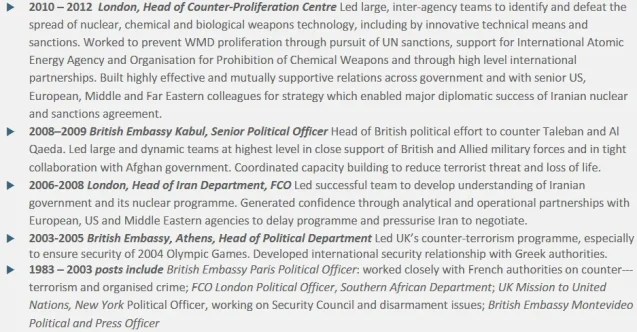
Nicholas Langman’s leaked CV
It was during the latter period that public and governmental attitudes across the West – and in vassal states – towards the Islamic Republic became highly belligerent, and negative. One by one, governments and international bodies – including the EU and UN – imposed ravaging sanctions against Tehran, devastating its economy, influence, and standing. MI6 journeyman Langman triumphed in his mission to foment concerted global hostility against Iran, based on the bogus spectre of the country posing a nuclear threat.
The question of whether British ‘intelligence’ on Iran’s nuclear program was the product of torture is an open and obvious one. Langman moved straight to leading MI6’s Iran Department from running the agency’s station in Athens, Greece. There, in late 2005, he was exposed by local media as having overseen an operation to abduct and ferociously mistreat 28 Pakistani guestworkers, wrongfully suspected of having had contact with individuals accused of perpetrating the 7/7 bombings in London in July that year.
That Langman wasn’t reprimanded over the incident strongly suggests he enjoyed a high level of protection, and London approved of his vicious intelligence-gathering methods – known to invariably produce false testimony from detainees. MI6 was not only an enthusiastic collaborator in the CIA’s global extraordinary rendition program, but led its own operations. Markedly, in at least one case, the British sought to sideline the CIA and ensure exclusive access to “intelligence” from a detainee in which Langley also had an interest.
The Obama administration was during its first year in office formally committed to non-interference in the Islamic Republic’s affairs, to the extent State Department apparatchik Jared Cohen was almost fired for publicly demanding Twitter halt planned maintenance during June 2009 protests in Iran, to ensure demonstrators could continue posting. It’s therefore unknown whether Washington was in on MI6’s Iran nuke con. If not, it wouldn’t be the first time British intelligence has misled the international community, with catastrophic results.
‘Possible Manipulation’
In July 2004, the Senate Intelligence Committee issued a scathing report on “the US intelligence community’s prewar intelligence assessments on Iraq.” It reserved particular disdain for how the CIA et al had “[relied] too heavily on foreign government services and third party reporting, thereby increasing the potential for manipulation of U.S. policy by foreign interests [emphasis added].” This was a reference to MI6’s central role in gathering – or concocting – intelligence on Baghdad’s purported WMD capabilities:
“Due to the lack of unilateral sources on Iraq’s links to terrorist groups like al-Qaida [redacted], the [US] Intelligence Community (IC) relied too heavily on foreign government service reporting and sources to whom it did not have direct access to determine the relationship between Iraq and [redacted] terrorist groups… The IC left itself open to possible manipulation by foreign governments and other parties interested in influencing US policy.”
As far back as the late 1990s, Britain’s foreign spying agency took the lead on sourcing dud ‘intelligence’ to manufacture consent for the against Baghdad. Under the auspices of a psychological warfare effort dubbed Operation Mass Appeal, MI6 black propaganda specialists circulated false information to foreign editors and reporters on its payroll “to help shape public opinion about Iraq and the threat posed by WMD,” which was then recycled by Western leaders and news outlets to reinforce its credibility.
In September 2002, then-MI6 chief Richard Dearlove personally approached British Prime Minister Tony Blair, claiming his agency had cultivated a source inside Iraq with “phenomenal access”, who could provide the “key to unlock” Iraq’s purported WMD program. Their assorted claims subsequently formed the basis of a dossier, which made a number of wild charges about Baghdad’s chemical and biological weapon capabilities. A prominently reported allegation was that Iraq could deploy WMD against Western countries within just 45 minutes. Its source was an Iraqi taxi driver.
This claim was repeated in a radio address by George W. Bush that month. In January the next year, as the invasion of Iraq rapidly loomed, the President declared in his State of the Union address, “the British government has learned that Saddam Hussein recently sought significant quantities of uranium from Africa.” That December, then-CIA chief George Tenet admitted this assertion was completely fallacious, and “these 16 words should never have been included in the text written for the President.”
The Zionist entity justified its unprovoked assault against Iran in June in large part on an intelligence dossier, which concluded the Islamic Republic had reached the “point of no return” in acquiring nukes. Its findings relied heavily on a May IAEA report that provided zero fresh information, but concluded Tehran supposedly maintained “undeclared nuclear material” until the early 2000s. While intended to trigger regime change, Tel Aviv’s broadside ended promptly in embarrassing failure, despite extensive foreign support, including US airstrikes.
Undeterred by the fiasco, Benjamin Netanyahu remains determined to crush the “Iranian axis”, while Trump has declared he would bomb Tehran “without a question” in response to indications the Islamic Republic has enriched uranium beyond agreed levels. We could be on the precipice of another war. As with the Iraq invasion, the perilous trail that brought us to this grave point could lead back to London. Yet again, MI6 may have taken the lead in concocting ‘intelligence’, justifying further US-Israeli aggression against the Islamic Republic.
Italy redirects navy ship to assist Global Sumud Flotilla after drone attacks

The Cradle | September 24, 2025
Italy’s Defense Minister Guido Crosetto said in a statement on 24 September that an Italian navy ship has been redirected towards the Global Sumud Flotilla to provide it with “possible assistance,” after it came under a series of Israeli attacks overnight.
The Italian defense minister strongly condemned the overnight drone attacks.
Activists on board several of the flotilla’s boats reported at least 10 explosions after witnessing drones launch several attacks early on Wednesday. The boats were situated off the coast of Greece.
“Multiple drones, unidentified objects dropped, communications jammed, and explosions heard from a number of boats. We are witnessing these psychological operations firsthand, right now, but we will not be intimidated,” Global Sumud Flotilla said.
US activist Greg Stoker said a quadcopter “dropped a little popper on deck,” adding that “other boats experienced that as well.”
“Our VHF [very high frequency] radio was hijacked by adversarial comms, and they started playing ABBA,” he added. One boat was reportedly sprayed with chemicals as well.
Israel has not commented on the attacks targeting the Gaza-bound flotilla.
In a statement on Tuesday, the Israeli Foreign Ministry said the flotilla was “pursuing a violent course of action” that “highlights the insincerity of the flotilla members and their mission to serve Hamas, rather than the people in Gaza.”
The International Committee to Break the Siege on Gaza (ICBSG) had warned on Sunday that unidentified drones were flying close to the vessels.
Workers across Italy launched a nationwide strike on 22 September to oppose Israel’s genocide in Gaza, halting public transport, rail services, schools, public offices, and ports in more than 60 cities. Italian grassroots trade union, Unione Sindacale di Base (USB), called the strike to force Rome to “immediately break off relations with the terrorist state of Israel, which is the concrete way in which Italy can, and must, react to the genocide that is taking place.”
Rail freight was suspended on Sunday night, with ports including Ravenna, Livorno, Trieste, and Genoa joining the actions. In Genoa, dockworkers blocked a vessel scheduled for Israel, while in Livorno, access to the port was restricted by protesters.
The flotilla bombarded early on 24 September is the third to attempt to break the siege of Gaza in the last four months.
The Global Sumud Flotilla also came under two attacks earlier in September.
The vessels are carrying hundreds of tons of humanitarian aid for civilians in Gaza, who are being starved and bombarded by the Israeli army. It has been described as the largest civilian flotilla in history.
In late July, the Gaza Freedom Flotilla’s Handala vessel was intercepted and seized by Israeli forces as it was trying to break the siege and deliver aid to the strip. Crewmembers were detained.
The month before, Israeli forces intercepted the Gaza Freedom Flotilla’s Madleen vessel in international waters as it was approaching Gaza to break the siege, seizing the boat and detaining the 12 activists on board.
In May this year, an Israeli drone bombed a Freedom Flotilla aid vessel that was en route to Gaza, blowing a hole through the ship, causing a fire, and putting it at risk of sinking.
Settler arson attack on vital West Bank agricultural hub is blow to Palestinian food security
International Solidarity Movement – Palestine | September 23, 2025
The Mishtil Al-Junaidy Al-Hadith plant nursery in Deir Sharaf, a major West Bank seed distributor and the heart of the region’s agriculture, was set on fire by illegal Israeli settlers on 8 September 2025, costing the owners over three million shekels and seriously damaging the already fragile Palestinian food system.
The footage captured by security cameras shows seven masked settlers descending on the nursery at 8pm to destroy the agricultural hub. Using diesel fuel, the settlers set fire to several buildings, stole supplies, and broke the windows of the main office, destroying seeds, computers, and most importantly, invaluable data centers holding information on agricultural practices in the region, which cannot be retrieved.
The fire department was informed immediately, but the Israeli authorities didn’t permit the firemen to reach the site for 45 minutes, which uninterrupted would only be a ten minute drive from the station in nearby Nablus. The attack was caught on camera, and the Israeli military, Shin Bet and Civil administration all arrived, but – just like past attacks – no updates on the investigation have been provided and no arrests have been made.
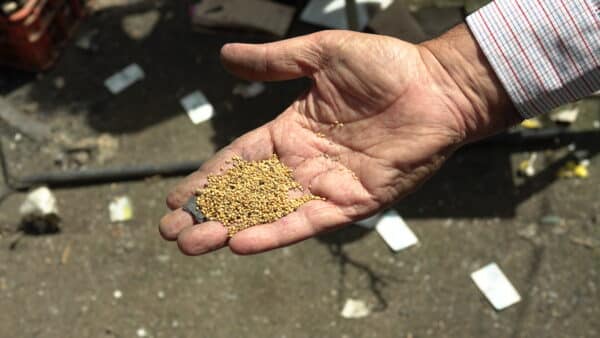
Sameer Al Junaidy, one of the four Al Junaidy brothers who owns and runs the nursery, says he doesn’t hire security because he would rather take damage to the property than put a Palestinian’s life at risk. Unarmed guards would be powerless against armed settlers, who regularly assault and murder local Palestinians.
The nursery is situated next to the illegal Shavei Shomron settlement, one of the West Bank’s first illegal settlements built in 1977 on land seized from Deir Sharaf and An-Naqura. Just before October 7, 2023, illegal settlers established an outpost on the other side of the nursery and have been intent on building a road that goes through it to connect them.
Since then, settlers have attacked the nursery at least five times. Recently, they set fire to bulldozers, a truck, and a forklift owned by the nursery. Settlers have also burned down olive trees, destroyed water pipes, and attacked Palestinians in neighboring communities. Footage from previous attacks that contains the assailants’ faces captured by Al Junaidy has been handed over to police, but no arrests were ever made.
Al Junaidy says that the Israeli Civil Administration told him that they understand how important the center is to West Bank agriculture and communities but they said: “There are two policies on the ground”, and some in the Israeli government want to see the assailants go unpunished. The nursery is also adjacent to Kedumin, the settlement where Israeli far-right Finance Minister Benzamar Smotrich lives, which is in the same council of settlements as Shavei Shomron.
The attack is a devasting blow to an already precarious food system in the besieged territory, bound to raise costs for local farmers who buy their seeds through the company. The nursery produces 80% of the West Bank’s olive tree saplings and all of its almond tree saplings, two crops central to Palestinian food security.
The destruction of over forty years of data could have far reaching impacts on agriculture across the West Bank. The data which has been lost included detailed information on how to best cultivate their thousands of seeds, meaning without this data, farmers may not know the ideal way to cultivate the crops. It is also used by agricultural engineering students at universities across Palestine.
Assaults on the West Bank’s economy and food systems through attacks like this one on the Al Junaidy Nursery are just one tactic in the occupiers’ overall project to ethnically cleanse the territory of all of its Palestinian inhabitants by disconnecting them from their land, their traditions, and the resources they need to survive.
Dozens missing after Israeli strike levels residential building in central Gaza
MEMO | September 23, 2025
At least 60 Palestinians are missing after an Israeli airstrike flattened a residential building in central Gaza City on Monday, local sources reported. Residents of the building were inside when it was bombed without prior warning, according to eyewitnesses.
The strike took place near the Shawa Building in the Al-Samar area, which itself has been threatened with attack. Gaza has come under heavy Israeli bombardment since 11 August as part of the army’s ongoing military campaign to seize control of the city.
Eyewitnesses said efforts to recover those trapped under the rubble are severely hampered by the lack of rescue equipment. Videos shared by Palestinians on social media showed the building reduced to rubble.
In one video, a woman—whose name was withheld—said her brother and his family were among those missing. Another man, standing nearby in tears, was heard calling out for his daughter trapped beneath the debris.
‘Peace through diplomacy’ is an excuse for collaboration with the Israelis
By Robert Inlakesh | Al Mayadeen | September 23, 2025
Following what has been widely dubbed as the failure of a recent emergency Arab-Islamic Summit, following the Israeli attack in Doha, many Arab Nations and political actors continue to pursue the concept of “peace through diplomacy”. This is not only a failed strategy, but also disingenuous.
The recent emergency conference, convened as a supposed step towards imposing a price on the Israelis for violating Qatari sovereignty and striking Doha, in a failed assassination attempt against Hamas leaders, has largely been dubbed a failure. Immediately after the conclusion of this summit, the Zionists escalated their terror bombing of Gaza City, and Israeli media announced the beginning of their ground operation to occupy the area.
Similarly, following the United Nations General Assembly (UNGA)’s adoption of the so-called “New York Declaration” on Palestinian Statehood, which is a combined Saudi-French initiative that is bringing about greater Western recognition of Palestine, the Israelis took it as a greenlight to escalate in the occupied West Bank.
Meanwhile, the Lebanese government and a range of ministers have adopted a plan towards disarming Hezbollah. Lebanese Prime Minister, Nawaf Salam, has also publicly stated his desire to normalise ties with the Zionist regime in a CNN interview, while claiming that diplomacy will be a sufficient response to force the Israelis to stop attacking his country.
Perhaps more embarrassingly, Syria’s ruler, Ahmad al-Sharaa, who is being widely mocked for his weak 50-second speech at the recent Arab-Islamic Summit, has now been offered a normalisation agreement by the Zionist regime, according to a report from Axios. This normalisation agreement is being sold as a “security deal”, yet has been compared to the 1979 Egyptian-Israeli normalisation accord.
In Syria, this so-called diplomatic approach will lead only to greater Israeli domination of the fractured nation. The Zionist entity demands that all of Syria south of Damascus be demilitarised, while it remains in the occupied Golan Heights, including the territory they just captured late last year. The Israelis were also revealed by Reuters to be funding around 3,000 militants in the Druze majority area of Suweida.
The Israeli demands in Syria are that they be allowed to have total air dominance and a corridor that would allow direct access to strike Iran, while the authorities in Damascus escalate their efforts to crack down on the Palestinian Resistance and prevent weapons transfers to Hezbollah in Lebanon.
As for the Lebanese government’s approach, the Israelis send their high-ranking officials to tour southern occupied Lebanon and forcefully assert that they will not leave the south of the country. They have carried out over 5,000 violations of the ceasefire agreement over the past year, continue to murder and abduct civilians, while the US-backed rulers in Beirut twiddle their thumbs and complain about Iran allegedly violating their sovereignty.
What is currently taking place is a public humiliation ritual against the Arab leaders, who behave like battered wives who refuse to admit that their rich husbands are abusive narcissists.
The Zionist Entity has bombed Gaza, the West Bank, Lebanon, Syria, Iraq, Yemen, Egypt, Qatar, Tunisia, and Iran over the past two years. Israeli Prime Minister Benjamin Netanyahu openly states that he pursues the so-called “Greater Israel” project, as he occupies more territory in Lebanon and Syria, threatening to annex the occupied West Bank and portions of Gaza too. The Israelis are even now threatening Egypt.
The leaders of the Arab and Islamic countries know all this, yet they continue to speak to their populations as if they are intellectually inferior to them and can’t figure out what is going on. The military spokesperson for the al-Qassam Brigades, Abu Obeida, stated in his last speech that these Arabs and Muslims are the enemies of Gaza and will one day be held accountable. His condemnation didn’t come out of nowhere, as he asserted that the whole Muslim world has failed to even deliver food to the people of Gaza.
Last year, prior to his assassination in Beirut, Sayed Hassan Nasrallah warned the Arab leaders that their complicity will come back to bite them, that they too would fall victim to the Zionists they have been collaborating with, and that nobody will be spared.
Frontline leaders in the battle against the Zionist regime have warned the Arab nations of what is to come, yet all of them decided to ignore these calls. Now, the chickens have come home to roost.
Ex-CIA chief Petraeus hails former Al-Qaeda leader for ‘clear vision’ in Syria
The Cradle | September 23, 2025
Self-appointed Syrian President Ahmad al-Sharaa engaged in a wide-ranging dialogue on 22 September with former CIA director David Petraeus as part of his visit to New York.
Sharaa, a former Al-Qaeda commander, met Petraeus, who commanded troops in Iraq after the 2003 invasion, at the Concordia Summit on the sidelines of the UN General Assembly. They discussed issues facing Syria, including reconstruction, governance, economic sanctions, and regional relations.
“We faced massive destruction over the past years, but we are focusing on economic development and building capabilities,” Sharaa stated.
“Syrians by nature are people of work and trade. So please lift the sanctions and see what we can do,” he added, referring to the 2019 US Caesar Act, which imposed crushing economic sanctions on Syria, impoverishing millions.
US President Donald Trump removed some sanctions earlier this year, but Congress must authorize their permanent removal.
Petraeus said that the conversation with the former Al-Qaeda in Iraq commander “has filled me with enormous hope.”
“Your vision is powerful and clear. Your demeanor is very impressive as well … We obviously hope for your success, Inshallah, because at the end of the day, your success is our success,” Petraeus added.
Though Sharaa was deemed a terrorist by the US State Department in 2012, the CIA covertly provided arms and funding to the Al-Qaeda affiliate he founded in Syria, then known as the Nusra Front.
According to journalist Seymour Hersh, Petraeus established a “rat line” between Libya and Syria to send weapons to the Nusra Front and other extremist groups seeking to topple the government of former Syrian president Bashar al-Assad.
The CIA operation, known as Timber Sycamore, enjoyed a budget of over $1 billion per year. The operation finally allowed Sharaa to oust Assad and establish an extremist Islamic state over Syria in December.
According to former French intelligence officer and political analyst Thierry Meyssan, Petraeus continued to help fund Al-Qaeda groups, including ISIS, after he was forced to resign from the CIA in 2012 after a sex scandal.
Meyssan says that Petraeus joined the private equity firm Kohlberg Kravis Roberts (KKR), headed by Jewish billionaire Henry Kravis, which funded the Nusra Front and ISIS on behalf of the CIA in an off-the-books manner.
Addressing Israel’s war on Gaza, Sharaa dismissed speculation about Syria joining the Abraham Accords to normalize relations with Israel.
He claimed the destruction of Gaza has made any broad normalization with Israel impossible, but said limited security arrangements could be considered.
Before Sharaa’s trip to New York, Syrian and Israeli officials were carrying out security talks that would allow Israel to maintain control of the strategic Mount Hermon, establish a no-fly zone over the south of the country, and prevent Syrian forces from entering a demilitarized zone in the south.
In a personal question, Petraeus asked how Sharaa manages the pressure of leading a country after years of conflict.
“I spent 25 of my 43 years in conflict and crisis, so I am used to hardship. Decisions that carry the destiny of a nation must be taken with calm and an open mind.”
Sharaa first traveled to Iraq to join Al-Qaeda after the 2003 invasion and was known for dispatching suicide bombers to kill civilians. He was allegedly arrested by US forces in 2005 and sent to the US prison at Camp Bucca.
After his release in 2009, he became the Emir of the Islamic State of Iraq (ISI) in Mosul, before traveling to Syria to establish the Nusra Front in 2011 on the instructions of Islamic State (later ISIS) leader Abu Bakr al-Baghdadi.
West’s grip slips with Saudi–Pakistan security deal
Riyadh’s pact with Islamabad redraws alliances, weakens Indian leverage, and hints at a new Muslim deterrence framework beyond western control.
By F.M. Shakil | The Cradle | September 23, 2025
On 17 September, Riyadh rolled out the rare royal purple carpet for Pakistani Prime Minister Shehbaz Sharif – an honor previously reserved for global power players like US President Donald Trump.
Accompanying him on the trip was Pakistan’s Army Chief, Field Marshal Asim Munir. His presence highlighted that Riyadh values its defense pact with a nuclear power that, despite economic challenges, remains militarily strong.
Nuclear umbrella over Riyadh
The centerpiece of their visit was the signing of a “Strategic Mutual Defense Agreement” (SMDA), which declares that an attack on either country will be considered an attack on both.
Described by a senior Saudi official to Reuters as covering “all military means,” the pact has triggered speculation that it includes a nuclear umbrella, which would be a game-changing development in the military balance of West Asia.
With 81 percent of Pakistan’s weapon imports coming from China, the agreement implicitly aligns Saudi Arabia with the Chinese military-industrial orbit, whether by design or default. The kingdom has long been reliant on US arms, training, and security guarantees.
The pact was signed just two days after an extraordinary joint session between the Arab League and the Organisation of Islamic Cooperation (OIC) was called, following the 9 September Israeli airstrikes on Qatar – a major non-NATO ally and Gulf neighbor – with no substantial response from Washington, reinforcing perceptions that western security commitments are both selective and expendable.
Mushahid Hussain Syed, a former information minister and chairman of Pakistan’s Senate Defense Committee, tells The Cradle that the US has pivoted away from Arab allies toward Tel Aviv, leaving the region disillusioned and increasingly leaning toward alternatives.
“The strategy of ‘Greater Israel,’ spearheaded by Netanyahu, has involved military actions against five more Muslim nations. Pakistan’s recent triumph against India has demonstrated its capacity to contest Israel’s significant ally, India, and establish itself as a strategic alternative for Gulf nations.”
Toward an Islamic NATO?
Iraqi Prime Minister Mohammed Shia al-Sudani recently called for an Islamic military alliance, akin to NATO, in response to Israel’s airstrike on Doha. His proposal echoed Egypt’s earlier attempt to revive a joint Arab defense force under the 1950 treaty – an initiative blocked by Qatar and the UAE, reportedly under US pressure.
A similar proposal has also come from Islamabad when Pakistan’s Defense Minister, Khawaja Asif, urged Muslim countries to band together in a NATO-like military alliance in light of the Israeli aggression in Doha.
During an appearance on Geo TV last week, Asif drove home the point that a united Muslim military front is essential to tackle common security issues and fend off outside dangers. Asif invoked the wider role of the west in instigating instability in West Asia, emphasizing the intricate network of US support for Al-Qaeda and the CIA’s covert actions that led to Osama bin Laden’s relocation to Sudan or the regime change war in Syria.
Is nuclear deterrence a part of the Pact?
The nuclear dimension of the Riyadh–Islamabad pact remains opaque, but highly significant. While no official statement from either side confirms the presence of a nuclear component, Asif hinted that Pakistan’s nuclear capabilities could be shared with Saudi Arabia as part of the agreement.
Syed, however, clarifies to The Cradle that Pakistan’s nuclear doctrine is India-centric and that its deterrence posture is South Asia-specific and does not extend to the Persian Gulf.
“A novel security framework for the region appears to be taking shape, focusing on Global South nations such as Pakistan and Saudi Arabia, whereas the Indo-Israeli Axis, previously supported by the US, now finds itself significantly diminished.”
The defense agreement between Pakistan and Saudi Arabia, he says, represents a notable achievement for Pakistan, establishing it as a pivotal entity within the geopolitical framework of West Asia, particularly among Muslim countries.
“The agreement is shaped by three significant elements: the perceived neglect of Arab allies by the United States, Israel’s proactive maneuvers in areas such as Iran, Qatar, Lebanon, Syria, and Yemen, and Pakistan’s recent triumph over India in May.”
New Delhi, Tel Aviv on alert
Foreign media and analysts are already warning that the pact may have unintended consequences for India and Israel, despite claims that it targets neither. Others predict that this pact is really about Riyadh’s ambitions to counter Iran and Yemen’s Ansarallah-led government in the region.
Dr Abdul Rauf Iqbal, a senior research scholar at the Institute for Strategic Studies, Research and Analysis (ISSRA) at Islamabad’s National Defence University (NDU), tells The Cradle that New Delhi views the pact with unease as it formalizes Saudi–Pakistani security ties that could entangle Riyadh in South Asian rivalries, especially the India–Pakistan border tensions over Jammu and Kashmir:
“It represents a setback for Prime Minister Modi’s foreign policy, potentially leading to Saudi involvement in a prospective Indo–Pak conflict. Furthermore, future Saudi investments in Pakistan’s Gwadar port and economic corridors would challenge India’s regional influence and initiatives such as the India-Middle East-Europe Corridor (IMEC).”
He adds that Saudi Arabia’s pivot toward Pakistan reflects a broader alignment of Muslim powers and could push Tel Aviv to recalibrate its war on Gaza. It also pressures Tel Aviv by placing Pakistan – a vocal opponent of Israeli expansionism – into West Asian affairs.
“This agreement is not meant to counterbalance Iran’s regional influence, but rather to promote the Saudi Iranian reconciliation, as Pakistan maintains friendly relations with both nations. By formalizing ties with nuclear-armed Pakistan, Riyadh secures a credible deterrent as US security guarantees weaken. While western think tanks view it as an effort to contain Iran, the Arab world emphasizes it as strengthening Gulf deterrence independently of Washington.”
Indian concerns also stem from fears that the pact’s NATO-style clause could complicate ongoing operations like Sindoor, which remains active in a limited capacity following the skirmish between the two nuclear powers in May, especially given that the Gulf states’ swift mediation to resolve the crisis reflects their own interests with India and makes any military action against it unlikely.
Secondly, India is strategically analyzing Pakistan’s nuclear capability, which could see a boost if Saudi Arabia, having no such capacity, begins channeling funds to share Pakistan’s nuclear assets.
A post-western Gulf order?
While Tel Aviv and New Delhi remain publicly silent, both capitals are undoubtedly scrutinizing the fallout. Israel’s failed assassination attempt on Hamas leaders in Qatar, and India’s pressure campaign along the Line of Control, suggest that the axis is nervous about the consequences of a Saudi–Pakistani alliance. Israeli media downplayed the Saudi–Pakistan defense deal, seeing it as a show of force after Riyadh failed to influence Trump or West Asian policy.
As Syed notes, “The traditional ‘Oil for Security’ framework, which once defined US relations with the Middle East [West Asia], now serves as a remnant of a bygone era. As Saudi economic power increasingly reinforces China’s backing of Pakistan, India may feel vulnerable and isolated.”
Mark Kinra, an Indian geopolitical analyst with a focus on Pakistan and Balochistan, tells The Cradle that this development holds particular significance for India. New Delhi, he argues, has sustained robust economic and diplomatic ties with Saudi Arabia for many years, and the influx of Saudi investments in India continues to expand:
“India will be meticulously observing the progression of this agreement, particularly given that its specific terms are not publicly available. Any alteration in the regional security equilibrium may influence India’s strategic assessments, energy security, and diplomatic relations.”
As Washington’s selective security guarantees falter and Israel escalates unchecked, Persian Gulf states like Saudi Arabia are looking eastward for credible deterrents and strategic autonomy.
By aligning with nuclear-armed Pakistan, Riyadh is asserting greater independence from the western military order. It also signals the emergence of a multipolar Persian Gulf security architecture –one increasingly shaped by Global South coordination, not western diktats.
Featured Video

More Iran War fallout: Maritime insurance industry shifts from London to China
or go to
Aletho News Archives – Video-Images
From the Archives
The Biggest Threat to Peace in Middle East
By Dr. Elias Akleh* | Sabbah Report | May 24, 2010
A build up of heightened tension in the Middle East is escalating in the last few weeks. American and Israeli postures towards Lebanon, Syria, and Iran have become more threatening. Listening to speeches of political leaders one hears talks only about war not peace. Iranians and Israelis are continuously training hard for a possible showdown. Both sides are conducting extensive war games every month. This led Syrians to claim that Israel is preparing for a soon-to-come another war. The Jordanians also are warning that current stalemate of the peace process is an indication of a war breaking out this summer. The Russian President and his army chief hinted, a few months ago, that the US and Israel were planning for an attack on Iran.
Indeed Iran is, as it has been for last few years, the target of most of the threats and accusations of supporting terrorism. Escalating incitement against Iran the American Defense Department sent last month (April) to Congress a report on Iran’s military claiming Iran could develop intercontinental ballistic missiles capable of reaching the US by 2015.
Ignoring the fact that N. Korea, India, Pakistan, and Israel are proven to have nuclear weapons while Iran does not, the US Secretary of State Hillary Clinton chose in her speech, to the nuclear Non-Proliferation Treaty review conference at the UN, to focus on Iran’s alleged nuclear ambitions putting the whole world at risk as she put it. According to Clinton Iran’s acquisition of nuclear weapons, rather than Israel’s more than 200 nuclear bombs, is destabilizing the Middle East. She called on the world’s nations to rally around US efforts to hold Iran, not other nuclear countries, to account.
The accusation that Usama Bin Laden is living comfortably in Iran had received a boost after the broadcast of a documentary called “Feathered Cocaine”. This echoed the June 2003 claims of the Italian newspaper Corre de la Sierra that Bin Laden was in Iran according to some intelligence report, and according to Richard Miniter’s book “Shadow War”. … continue
Blog Roll
 Aletho News
- US Tells Allies That Ukraine-Bound Arms Could be Sent to Middle East
- Organized terrorism: Iran condemns killing of its diplomats in Lebanon
- Why could Gaza enter the regional war?
- Hamas official rejects Mladenov Plan linking disarmament to Gaza reconstruction
- Two Primary Elections for the Soul of ‘America First’
- Japan Clings to US Vassalage Despite Energy Crunch Caused By Iran War
- US Seeks Control Over Global Energy Infrastructure – Kremlin
- US senators target Orban government for standing up to Zelensky
- The deep-rooted culture of corruption in Ukraine
- Iran mobilizing one million soldiers to ‘create hell’ for any US ground assault: Report
- If Americans Knew
- Researchers at Human Rights Watch Resign Over Blocked Report on Palestinian Refugee Return
- Jewish Groups Are Backing a War Americans Don’t Want
- Eric Fingerhut Thinks He’s the President of the Jews
- Top Jewish Philanthropists, Rabbis Urge Israeli President to Take Action Against ‘Jewish Extremists’
- Don’t Be Fooled. Zionist Leaders Have Always Wanted to Control Southern Lebanon
- Israel’s widespread use of torture is a core element of its genocide against the Palestinian people
- In Israel’s War on Iran, Many Middle East US Bases Rendered “All But Uninhabitable”
- ‘Burn the lawn’: Israel pursues ‘Rafah model’ in southern Lebanon
- A genocide here, an amputation there
- Reports: Iran mobilizing 1M fighters, Israel-US run low on ammo, Israeli army faces shortage – Not a ceasefire Day 168
- No Tricks Zone
- Devastating Assessment Of Comirnaty Vaccine By Former Senior Pfizer Europe Toxicologist
- New Study: CO2 Is ‘Effectively Negligible’ As An Explanatory Climate Change Factor Since 2000
- Former Pfizer Toxicologist Dr. Helmut Sterz Tells Bundestag Hearing Pfizer Vaccine Should Have Never Been Approved
- Energy Expert: Germany’s Nuclear Phaseout Was A “500 Billion Euro Mistake”
- New Research: South Australia’s Mid-Holocene Sea Surface Temperatures Were 4°C Warmer Than Today
- Storing Green Energy To Last Germany 10 Days Would Require A 60-Million Tonne Battery
- New Studies: UK Sea Levels Were 4 Meters Higher Than Today During The Mid-Holocene
- Destructive Green New Deal: German Energy And Metal Group Warns Of Drastic Crisis
- New Study Documents A 20-Year Pause In Arctic Sea Ice Decline – Driven By Internal Variability
- Wake-up Call: Survey Shows Majority Of Germans Now Favor Postponing Climate Targets!
 Aletho News