West’s grip slips with Saudi–Pakistan security deal
Riyadh’s pact with Islamabad redraws alliances, weakens Indian leverage, and hints at a new Muslim deterrence framework beyond western control.
By F.M. Shakil | The Cradle | September 23, 2025
On 17 September, Riyadh rolled out the rare royal purple carpet for Pakistani Prime Minister Shehbaz Sharif – an honor previously reserved for global power players like US President Donald Trump.
Accompanying him on the trip was Pakistan’s Army Chief, Field Marshal Asim Munir. His presence highlighted that Riyadh values its defense pact with a nuclear power that, despite economic challenges, remains militarily strong.
Nuclear umbrella over Riyadh
The centerpiece of their visit was the signing of a “Strategic Mutual Defense Agreement” (SMDA), which declares that an attack on either country will be considered an attack on both.
Described by a senior Saudi official to Reuters as covering “all military means,” the pact has triggered speculation that it includes a nuclear umbrella, which would be a game-changing development in the military balance of West Asia.
With 81 percent of Pakistan’s weapon imports coming from China, the agreement implicitly aligns Saudi Arabia with the Chinese military-industrial orbit, whether by design or default. The kingdom has long been reliant on US arms, training, and security guarantees.
The pact was signed just two days after an extraordinary joint session between the Arab League and the Organisation of Islamic Cooperation (OIC) was called, following the 9 September Israeli airstrikes on Qatar – a major non-NATO ally and Gulf neighbor – with no substantial response from Washington, reinforcing perceptions that western security commitments are both selective and expendable.
Mushahid Hussain Syed, a former information minister and chairman of Pakistan’s Senate Defense Committee, tells The Cradle that the US has pivoted away from Arab allies toward Tel Aviv, leaving the region disillusioned and increasingly leaning toward alternatives.
“The strategy of ‘Greater Israel,’ spearheaded by Netanyahu, has involved military actions against five more Muslim nations. Pakistan’s recent triumph against India has demonstrated its capacity to contest Israel’s significant ally, India, and establish itself as a strategic alternative for Gulf nations.”
Toward an Islamic NATO?
Iraqi Prime Minister Mohammed Shia al-Sudani recently called for an Islamic military alliance, akin to NATO, in response to Israel’s airstrike on Doha. His proposal echoed Egypt’s earlier attempt to revive a joint Arab defense force under the 1950 treaty – an initiative blocked by Qatar and the UAE, reportedly under US pressure.
A similar proposal has also come from Islamabad when Pakistan’s Defense Minister, Khawaja Asif, urged Muslim countries to band together in a NATO-like military alliance in light of the Israeli aggression in Doha.
During an appearance on Geo TV last week, Asif drove home the point that a united Muslim military front is essential to tackle common security issues and fend off outside dangers. Asif invoked the wider role of the west in instigating instability in West Asia, emphasizing the intricate network of US support for Al-Qaeda and the CIA’s covert actions that led to Osama bin Laden’s relocation to Sudan or the regime change war in Syria.
Is nuclear deterrence a part of the Pact?
The nuclear dimension of the Riyadh–Islamabad pact remains opaque, but highly significant. While no official statement from either side confirms the presence of a nuclear component, Asif hinted that Pakistan’s nuclear capabilities could be shared with Saudi Arabia as part of the agreement.
Syed, however, clarifies to The Cradle that Pakistan’s nuclear doctrine is India-centric and that its deterrence posture is South Asia-specific and does not extend to the Persian Gulf.
“A novel security framework for the region appears to be taking shape, focusing on Global South nations such as Pakistan and Saudi Arabia, whereas the Indo-Israeli Axis, previously supported by the US, now finds itself significantly diminished.”
The defense agreement between Pakistan and Saudi Arabia, he says, represents a notable achievement for Pakistan, establishing it as a pivotal entity within the geopolitical framework of West Asia, particularly among Muslim countries.
“The agreement is shaped by three significant elements: the perceived neglect of Arab allies by the United States, Israel’s proactive maneuvers in areas such as Iran, Qatar, Lebanon, Syria, and Yemen, and Pakistan’s recent triumph over India in May.”
New Delhi, Tel Aviv on alert
Foreign media and analysts are already warning that the pact may have unintended consequences for India and Israel, despite claims that it targets neither. Others predict that this pact is really about Riyadh’s ambitions to counter Iran and Yemen’s Ansarallah-led government in the region.
Dr Abdul Rauf Iqbal, a senior research scholar at the Institute for Strategic Studies, Research and Analysis (ISSRA) at Islamabad’s National Defence University (NDU), tells The Cradle that New Delhi views the pact with unease as it formalizes Saudi–Pakistani security ties that could entangle Riyadh in South Asian rivalries, especially the India–Pakistan border tensions over Jammu and Kashmir:
“It represents a setback for Prime Minister Modi’s foreign policy, potentially leading to Saudi involvement in a prospective Indo–Pak conflict. Furthermore, future Saudi investments in Pakistan’s Gwadar port and economic corridors would challenge India’s regional influence and initiatives such as the India-Middle East-Europe Corridor (IMEC).”
He adds that Saudi Arabia’s pivot toward Pakistan reflects a broader alignment of Muslim powers and could push Tel Aviv to recalibrate its war on Gaza. It also pressures Tel Aviv by placing Pakistan – a vocal opponent of Israeli expansionism – into West Asian affairs.
“This agreement is not meant to counterbalance Iran’s regional influence, but rather to promote the Saudi Iranian reconciliation, as Pakistan maintains friendly relations with both nations. By formalizing ties with nuclear-armed Pakistan, Riyadh secures a credible deterrent as US security guarantees weaken. While western think tanks view it as an effort to contain Iran, the Arab world emphasizes it as strengthening Gulf deterrence independently of Washington.”
Indian concerns also stem from fears that the pact’s NATO-style clause could complicate ongoing operations like Sindoor, which remains active in a limited capacity following the skirmish between the two nuclear powers in May, especially given that the Gulf states’ swift mediation to resolve the crisis reflects their own interests with India and makes any military action against it unlikely.
Secondly, India is strategically analyzing Pakistan’s nuclear capability, which could see a boost if Saudi Arabia, having no such capacity, begins channeling funds to share Pakistan’s nuclear assets.
A post-western Gulf order?
While Tel Aviv and New Delhi remain publicly silent, both capitals are undoubtedly scrutinizing the fallout. Israel’s failed assassination attempt on Hamas leaders in Qatar, and India’s pressure campaign along the Line of Control, suggest that the axis is nervous about the consequences of a Saudi–Pakistani alliance. Israeli media downplayed the Saudi–Pakistan defense deal, seeing it as a show of force after Riyadh failed to influence Trump or West Asian policy.
As Syed notes, “The traditional ‘Oil for Security’ framework, which once defined US relations with the Middle East [West Asia], now serves as a remnant of a bygone era. As Saudi economic power increasingly reinforces China’s backing of Pakistan, India may feel vulnerable and isolated.”
Mark Kinra, an Indian geopolitical analyst with a focus on Pakistan and Balochistan, tells The Cradle that this development holds particular significance for India. New Delhi, he argues, has sustained robust economic and diplomatic ties with Saudi Arabia for many years, and the influx of Saudi investments in India continues to expand:
“India will be meticulously observing the progression of this agreement, particularly given that its specific terms are not publicly available. Any alteration in the regional security equilibrium may influence India’s strategic assessments, energy security, and diplomatic relations.”
As Washington’s selective security guarantees falter and Israel escalates unchecked, Persian Gulf states like Saudi Arabia are looking eastward for credible deterrents and strategic autonomy.
By aligning with nuclear-armed Pakistan, Riyadh is asserting greater independence from the western military order. It also signals the emergence of a multipolar Persian Gulf security architecture –one increasingly shaped by Global South coordination, not western diktats.
Canada keeps bankrolling Ukraine’s war crimes
By Eva Bartlett | RT | September 22, 2025
Following in the shameful footsteps of both Justin Trudeau and Chrystia Freeland, Canadian Prime Minister Mark Carney continues pledging support and money (which Canadians desperately need) to Ukraine, to prolong the proxy war against Russia.
Carney chose Ukrainian Independence Day to voice the Canadian government’s continued pledge to support Ukraine. As he landed in Kiev on August 24, Carney posted on X, “On this Ukrainian Independence Day, and at this critical moment in their nation’s history, Canada is stepping up our support and our efforts towards a just and lasting peace for Ukraine.”
Later in the day he posted, “After three years at war, Ukrainians urgently need more military equipment. Canada is answering that call, providing $2 billion for drones, armoured vehicles, and other critical resources.” This latest pledge brings Canada’s expenditure on Ukraine since February 2022 to nearly $22 billion.
Further, he pledged to potentially send Canadian or allied soldiers, stating, “I would not exclude the presence of troops.”
Pause for a moment to examine the utter lack of logic behind these statements: For “peace” for Ukraine, Canada will support further war to ensure more Ukrainian men are ripped off the streets and forced to the front lines, where they will inevitably die in a battle they didn’t sign up for.
Like his European counterparts, Carney’s insistence on prolonging the war is in contrast to Russia’s position of finding a resolution.
I recently spoke with former Ambassador Charles Freeman, an American career diplomat for 30 years. Speaking of how the Trump administration, “began in office by perpetuating the blindness and deafness of the Biden administration to what the Russian side in this conflict has said from the very beginning,” he outlined the terms that Russia made clear in December 2021, “and from which it has basically not wavered.”
These include: “neutrality and no NATO membership for Ukraine; protections for the Russian speaking minorities in the former territories of Ukraine; and some broader discussion of European security architecture that reassures Russia that it will not be attacked by the West, and the West that it will not be attacked by Russia.”
It’s worth keeping in mind that Canada has been one of the main belligerents in Ukraine, funding and training Ukrainian troops for many years before the 2022 start of Russia’s military operation.
Canada’s training of Ukrainian troops included members of the notorious neo-Nazi terrorists of the Azov regiment. Former Deputy Prime Minister Chrystia Freeland proudly waved a Banderite flag in 2022. She was also proud of her dear grandfather, who was a chief Nazi propagandist.
In 2023, the Trudeau administration brought to speak in the Canadian parliament a Ukrainian Nazi, Yaroslav Hunka, who had been a voluntary member of the 1st Galician Division of the Waffen SS – well known for their mass slaughter of civilians.
Carney, in light of this, is merely keeping with the tradition of Ottawa’s support of extremism – including Nazism – in Ukraine (and in Canada). This support is not at all about protecting Ukrainian civilians.
Supporting Ukrainian war crimes
Canada’s continued support to Ukraine makes it complicit in the atrocities Ukraine commits. I myself have documented just some of Ukrainian war crimes in the Donbass, in 2019 and heavily throughout 2022.
These include deliberately shelling civilian areas (including with heavy-duty NATO weapons), slaughtering civilians in their homes, in markets, in the streets, in buses; peppering Donbass civilian areas with internationally prohibited PFM-1 “Petal” mines (since 2022, 184 civilians have been maimed by these, three of whom died of their injuries); and deliberately targeting medics and other emergency service rescuers.
Ukraine has also heavily shelled Belgorod and Kursk, targeting civilians, as well sending drones into Russian cities, killing civilians and destroying infrastructure.
Less detailed are Ukraine’s crimes against civilians in areas under Ukrainian control. These crimes – including rape, torture and point-blank assassination – come to light with the testimonies of terrorized civilians in regions liberated by Russia.
Bring the government spending home
The social media fervor of Ukrainian hashtags and flags has died down considerably since 2022. Now, you see more and more Canadians demanding their government stop fueling war and start spending money to take care of Canadians.
Carney’s campaign pledges included easing the cost of living in Canada, yet he has taken no concrete actions to do so. In the many understandably angry replies to Carney’s latest tweets about supporting Ukraine, Canadians are demanding accountability.
“Mark Carney stop pretending you’re fighting for “freedom and sovereignty.” You just signed off on $2 BILLION of Canadian money for Ukraine while Canadians can’t even afford rent, food, or heating,” reads one of numerous such replies. “Veterans are abandoned, fentanyl floods our streets, and families collapse under inflation. You stand on foreign soil preaching about democracy while selling out the very people you’re supposed to serve. That’s not leadership that’s betrayal. Canadians never voted for this. You don’t speak for us.”
Scroll through replies to Carney’s Kiev stunt and you’ll find Canadians opposed to the wasting of still more money needed in their home country.
The most glaring hypocrisy is that while Carney wrings his hands over Ukraine, he utterly ignores the ongoing Israeli starvation and genocide of Palestinians in Gaza, supported by the Canadian government.
Eva Bartlett is a Canadian independent journalist. She has spent years on the ground covering conflict zones in the Middle East, especially in Syria and Palestine (where she lived for nearly four years).
Mohammad Marandi: Iran KILLS IAEA Deal — Cairo Agreement Wiped Out After SnapBack!
Dialogue Works | September 21, 2025
Israeli court issues mass eviction orders against Palestinians in Jerusalem’s Silwan neighborhood
Palestinian Information Center – September 22, 2025
OCCUPIED JERUSALEM – Israeli police forces have ordered dozens of Palestinian families in the Baten al-Hawa area of Silwan, south of the al-Aqsa Mosque, in Occupied Jerusalem to evacuate their homes, threatening the displacement of nearly 300 people in favor of settler groups.
Jerusalemite sources said on Monday that residents of 37 apartments now face forced eviction under a settlement scheme pushed by the “Ateret Cohanim” association, which claims ownership of five dunums and 200 square meters of land in Baten al-Hawa, based on allegations dating back to 1881.
The plan targets between 30 and 35 residential buildings housing 80 families, roughly 600 people, who have lived in the neighborhood for decades with official documentation proving residency.
Zuheir Rajabi, head of the Baten al-Hawa neighborhood committee in Silwan, said 250 residents living in 26 homes received new eviction orders on Sunday from the Israeli central court, aimed at seizing their properties in favor of settlers.
He noted that an additional 11 apartments in three adjacent buildings belonging to the Rajabi families, Yaqub, Nidal, and Fathi, are now under immediate threat, putting about 60 people at risk.
Rajabi condemned the measures as “forced displacement and ethnic cleansing of Jerusalemites to replace them with settlers,” vowing that residents “will remain steadfast in their homes until the very last moment.”
The Basbus family also received eviction notices for their homes, which shelter 30 people in Baten al-Hawa.
Family member Bilal Basbus said they have been engaged in a “battle for existence” for years against demolition and eviction orders targeting their homes overlooking the al-Aqsa Mosque.
He stressed that despite enormous challenges, the family refuses to abandon their homes or comply with occupation orders.
These latest eviction notices are part of a wider Judaization campaign aimed at driving Palestinians out of Jerusalem to make way for settlement groups.
Notably, the Basbus family’s grandparents were expelled from the village of al-Dawayima in 1948 by Zionist militias, and today, settler organizations are pursuing their descendants to displace them once again from their homes in Silwan.
Israeli army raids Birzeit University in occupied West Bank
Palestinian Information Center – September 22, 2025
RAMALLAH – In a pre-dawn raid on Monday, Israeli occupation forces (IOF) stormed Birzeit University in Ramallah, deploying dozens of soldiers, military vehicles, and a surveillance drone.
Local sources said troops broke through the university gates from multiple directions after detaining campus security guards. Soldiers ransacked university facilities, destroyed student movement displays, tore down banners supporting Gaza and honoring martyrs, and defaced national slogans.
The IOF also posted leaflets inside the campus, directly threatening the Islamic Bloc, the student arm of Hamas, and warning against its activities. Resistance-themed posters and flags were confiscated.
Ghassan Barghouthi, the Dean of Student Affairs at Birzeit University, reported that 11 IOF vehicles entered the campus. Soldiers assaulted five members of the university’s security staff, leaving them with bruises and injuries.
He said several faculties and facilities were raided, including the arts and literature buildings, as well as Naseeb Shaheen Theater.
Barghouthi added that murals inside the theater were vandalized, along with exhibits prepared for welcoming new students. The murals, he noted, depicted the destruction of academic institutions in Gaza.
Meanwhile, the IOF detained Birzeit student Youssef al-Haj Mohammed after raiding his home in the village of al-Mughayir, northeast of Ramallah.
Trump scrambles to contain fallout from Israeli crime spree with meeting in New York
MEMO | September 22, 2025
President Donald Trump is set to host a high-level meeting with a select group of Arab and Muslim leaders on Tuesday in New York to discuss the ongoing Israeli genocide in Gaza. The summit, to be held on the sidelines of the UN General Assembly, comes as Western governments declared their recognition of the State of Palestine and amid growing international condemnation of Israel’s war crimes.
Two Arab officials confirmed to Axios that leaders from Saudi Arabia, the United Arab Emirates, Qatar, Egypt, Jordan and Turkey have been invited to the closed-door meeting, which will take place at 2:30pm Eastern Time.
The summit is expected to precede Trump’s meeting with Israeli Prime Minister Benjamin Netanyahu, scheduled for 29 September at the White House. Sources familiar with the preparations said Arab leaders will call on Trump to pressure Netanyahu to end the assault on Gaza and to abandon plans to annex the illegally occupied West Bank.
Washington’s agenda reportedly includes a proposal for Arab and Muslim countries to contribute to a post-war stabilisation plan in Gaza, including potential troop deployments to replace the Israeli occupation forces. However, such proposals are expected to meet resistance unless a political framework guaranteeing Palestinian sovereignty is agreed.
Trump is also expected to hold a second meeting on Tuesday with leaders of the Gulf Cooperation Council (GCC), including Oman, Bahrain and Kuwait, to address broader regional concerns including Israel’s escalation in the region.
The unprovoked attack on Doha two weeks ago by Israel was met was global condemnation. Qatar reportedly demanded an apology before the resumption of negotiations.
Israel’s strike triggered an emergency summit of Arab and Muslim countries in Doha, and was swiftly followed by a new Saudi-Pakistani security pact—widely interpreted as a response to growing doubts about Washington’s reliability as a security guarantor in the Gulf.
Israeli intransigence is also threatening to unravel the hallmark foreign policy initiative of Trump’s previous presidency: the so-called Abrahm Accords. The UAE has reportedly warned that any annexation of the West Bank could lead to the collapse of the agreement which saw a number of Arab states normalise ties with the occupation state. The White House has not issued an official statement in response to the reports.
Iranian parliament pushes for ‘nuclear option’ as deterrence to western threat
The Cradle | September 22, 2025
Over 70 members of Iran’s parliament on 22 September called for a reassessment of the country’s defense doctrine, pressing authorities to consider nuclear weapons as a deterrent.
In a letter addressed to the Supreme National Security Council and the heads of the executive, legislative, and judicial branches, the lawmakers demanded that the issue be raised urgently.
“We respectfully request that, since the decisions of that council acquire validity with the endorsement of the Leader of the Revolution, this matter be raised without delay and the expert findings communicated to the parliament,” the statement read.
The MPs argued that while the development and use of nuclear arms contradicts the 2010 ‘fatwa’ of Iranian Supreme Leader Ali Khamenei banning them, circumstances have changed.
They wrote that “developing and maintaining such weapons as a deterrent is another matter,” stressing that “in Shia jurisprudence, a change in circumstances and conditions can alter the ruling.”
“Moreover, safeguarding Islam – which today is bound to the preservation of the Islamic Republic – is among the paramount obligations.”
The push was led by Hassan-Ali Akhlaghi Amiri, a representative from the holy city of Mashhad, according to Hamshahri Online.
Lawmakers noted that the nuclear doctrine was shaped at a time when the international community was still able to restrain Israeli aggression.
They pointed to the large-scale assault launched by Israel in June, backed by the US, which included direct strikes on three Iranian nuclear facilities, among them Fordow.
Iran has long stated its nuclear program is peaceful, rejecting western claims it seeks weapons capability. Tehran continues to cite Khamenei’s fatwa as proof of its intentions.
At the same time, the Supreme National Security Council announced the suspension of cooperation with the International Atomic Energy Agency (IAEA) after the UN Security Council imposed sanctions.
State media quoted the body as saying the move was a response to the “ill-considered steps of three European countries.”
Lawmakers warned that pressure tactics by the E3 countries will draw a “harsher and more decisive” response than before.
URGENT: A family standing against Israeli army and settler violence, and imminent displacement in the Jordan Valley
International Solidarity Movement – Palestine | September 21, 2025
In the hills of the northern Jordan Valley, one Palestinian family is facing the threat of being displaced from their land. On September 20, the Israeli army issued them a final eviction order — threatening to destroy their tents, farming shelters, animals, and everything they depend on for survival.
This family is the last to remain in their community. Others have already been forced to leave in recent years by Israeli colonisers, who confiscated or destroyed their homes and belongings. Their struggle shows how army actions and settler violence combine to push Palestinians from their land.
Palestinian families’ daily life under threat
The family makes a living from shepherding. With more than 200 sheep and goats, their livelihood depends on access to open grazing. Today, this way of life is nearly impossible. Settlers attack shepherds, block grazing land, and steal animals. To keep their herds alive, the family must now buy fodder, which is costly and reduces the quality of the products they sell.
Two weeks ago, settlers poisoned the family’s water supply. Like all Palestinians in the Jordan Valley, they are not connected to the water network and depend on cisterns. Without safe water, their health and their animals’ survival are in danger. They also live without electricity, relying only on solar panels for minimal power.
In recent weeks, the army has raided the land and their home several times. Soldiers ordered demolitions of shelters, claiming the area is a “military zone.” Family members have been injured multiple times during these raids.
Meanwhile, settlers are expanding, with new outposts being built nearby and existing settlements growing closer. This increases the pressure on the family to leave.
Background on Jordan Valley
The northern Jordan Valley lies in Area C, which makes up over 60% of the occupied West Bank and remains under full Israeli military control. Israel imposes severe restrictions on Palestinians living there on building, farming, and access to basic services. The army often declares Palestinian areas as “firing zones” or “closed military zones,” using these designations to demolish homes, stop grazing, and force families to move. In practice, this clears space for settlements while displacing Palestinians.
For decades, Israel has uprooted entire communities across the Jordan Valley under these policies. Where once there were villages with families, schools, and farmland, only scattered households remain.
What can you do?
Contact your governments and demand they put pressure on Israel to stop its ethnic cleansing campaign in the Jordan Valley and elsewhere. They must:
1 Cancel the eviction order against the families immediately.
2 Stop settler violence such as poisoning, theft, intimidation, and ensure protection of Palestinian civilians as required under international law.
3 End the use of “military zones” as a pretext for displacement
4 Provide access to basic rights: water, electricity, education, and security.
International communities, media, and civil society — it’s time to raise awareness and take action.
This is not only about one family. It is part of a larger effort to remove Palestinians from the Jordan Valley and Area C of the West Bank. This family now stands almost alone, holding on to their land and way of life. If they are displaced, another piece of Palestinian presence in the Jordan Valley will be erased.
Their story must be told and shared. The world needs to see what is happening and act before yet another community disappears.
‘Israel’ barred from tourism fair in Italy over war on Gaza
Al Mayadeen | September 21, 2025
“Israel” has been reportedly excluded from a tourism fair in Italy, a decision reported following a public appeal from the mayor of Rimini on Thursday, who urged the event’s organizers to cancel “Israel’s” participation in the TTG Travel Experience over the war on Gaza.
In a joint statement posted on Facebook, Mayor Jamil Sadegholvaad and the head of the Emilia-Romagna region, Michele De Pascal,e argued that an Israeli presence would represent “inequality”, urging the event’s organizers, the Italian Exhibition Group (IEG), to reconsider the inclusion of the “Israel” stand.
“We really don’t think that today it is ethically and morally acceptable to propose as holiday destinations places of war, terror and death,” the pair stated.
This comes as part of a broader international boycott movement against “Israel”, in response to its crimes and brutal war on Gaza, which has claimed the lives of more than 65,000 people since October 7th with many uncounted victims still buried under the rubble.
‘Israel’ faces international boycotts worldwide and sector-wide
A coalition of advocacy organizations and fan groups launched a billboard in New York’s Times Square on September 17, kicking off their #GameOverIsrael campaign with a call for European soccer federations to boycott “Israel” in the months leading up to the World Cup.
Campaigners are urging soccer federations across multiple European nations, including Belgium, England, France, Greece, Ireland, Italy, Norway, Scotland, and Spain, to institute a comprehensive boycott of the Israeli national team and to prohibit Israeli players from participating in their domestic competitions, a direct response to the ongoing genocide in Gaza.
In a significant escalation of the cultural boycott against “Israel”, Spain’s public broadcaster RTVE has officially announced it will boycott the Eurovision 2026 Song Contest if “Israel” is allowed to take part, a move that makes Spain the first of the competition’s major contributors to commit to such a stance. This position has been further supported by signals from Ireland and Slovenia that they would also withdraw from the contest if the Israeli occupation is allowed to participate.
The boycott has also affected academia, with the head of the Scientific Council at “Israel’s” Weizmann Institute, Nir Davidzon, revealing that the research center suffered heavy destruction during Iran’s recent retaliation and is now facing mounting isolation from the international academic community.
In an interview for Israeli Channel 12 on September 13, Nir Davidzon stated that the Weizmann Institute, long considered one of “Israel’s” most internationally connected scientific institutions, is now being increasingly boycotted by universities and research centers abroad.
“Everything that was built over decades is collapsing because of the war in Gaza,” he said. “Even good friends are telling us they can no longer work with us.”
Hundreds of actors, directors, and film workers have pledged to refuse any collaboration with Israeli cultural institutions, which they accuse of being complicit in genocide and apartheid against the Palestinian people.
This initiative has drawn support from over 1,200 signatories, including acclaimed directors like Yorgos Lanthimos, Ava DuVernay, Asif Kapadia, Boots Riley, and Joshua Oppenheimer. Prominent actors such as Olivia Colman, Mark Ruffalo, Tilda Swinton, Javier Bardem, Ayo Edebiri, Riz Ahmed, Josh O’Connor, Cynthia Nixon, Julie Christie, Ilana Glazer, Rebecca Hall, Aimee Lou Wood, and Debra Winger also signed the pledge.
Israeli trade relations collapse amid war on Gaza, global boycotts
Al Mayadeen | September 21, 2025
“Israel’s” trade relations are suffering a serious deterioration in recent weeks, with deals and meetings being canceled even with historically “friendly” nations, amid an atmosphere of secrecy and embarrassment.
Israeli exporters have revealed that companies in Europe and the United States have refused to renew export contracts, while marketing networks have announced a halt to the import of Israeli products “until further notice.”
In this context, Ynet reported that a delegation of experts from the Moody’s rating agency visited Tel Aviv and left with very worrying impressions of the possibility of a rating reduction soon. One official said, “It will be a miracle if a reduction is not made within two weeks.”
A senior economic official who met with Moody’s representatives pointed to extreme concern over the massive rise in defense spending during the war on Gaza, confirming it represents a critical turning point.
The official warned that the Israeli government could lose all control over budget management, threatening a huge rise in the deficit and an accumulation of debt.
Israeli trademarks take heavy blows
The president of the Israeli Manufacturers Association, Ron Tomer, confirmed that the Israeli brand has been severely damaged, warning that the economy could be set back by years. Tomer also pointed to a shocking request from a supposedly “friendly country” to erase any images of meetings with Israeli companies to avoid political embarrassment.
An exporter explained that the situation has deteriorated significantly since the announcement of the intent to occupy Gaza and with the increasing spread of videos documenting the bombing of buildings and mosques and the deaths of civilians.
The exporter added that the footage from Gaza can no longer be overlooked and that they are now destined to complete isolation and feel shunned all over the world.
71% of scrapped deals connected to war on Gaza
According to a survey prepared by the Israeli Manufacturers Association, which included 132 industrialists, nearly half of all exporters have lost deals or not had their contracts renewed, while 71% of them indicated the cancellations were for political reasons related to the war on Gaza.
The European Union was the most proactive in cancellations, as 84 percent of industrialists reported losing contracts there, while 31 percent were surprised by similar decisions from clients in the United States, according to the survey.
The survey also indicated that 76 percent of exporters have seen their exports directly harmed, with the impact exceeding 40 percent of total exports for some of them.
The survey further revealed that more than half of all new clients now refuse to deal with Israeli companies, while 49 percent of exporters are facing unprecedented logistical difficulties with shipping, customs, and ports.
Economic analyses link this crisis to the repercussions of the war on the Gaza Strip and statements by Israeli Prime Minister Benjamin Netanyahu about turning “Israel” into a closed system, which has alarmed investors over rising security expenditures and a worsening deficit.
Imagine There Was A Violent Cult Committing Atrocities with Impunity
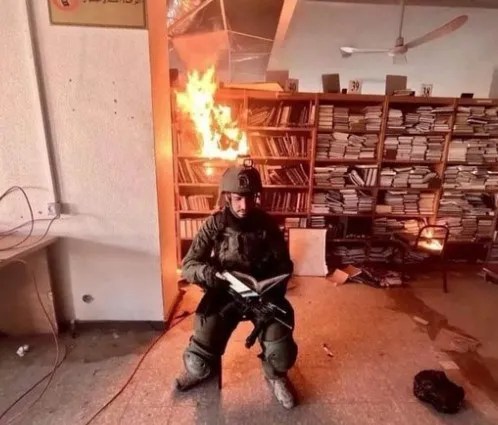
By Caitlin Johnstone | September 20, 2025
Imagine there was a violent cult that used scriptures from an ancient religion to convince its followers to do evil things.
Imagine the cult was given its own state.
Imagine the cult was given machine guns, tanks and war planes.
Imagine the cult obtained nuclear weapons.
Imagine the cult started committing genocide against the indigenous people who’d been living in the area where the cult’s state was established.
Imagine the cult had huge branches in the most powerful nation on earth, and the powerful nation defended the cult no matter what it did.
Imagine the cult flipped out and started relentlessly attacking and invading the surrounding nations.
Imagine the cult had so much influence and support in western society that western governments and institutions would censor, silence, fire, marginalize and deport anyone who criticized the cult’s actions.
Imagine the western media sympathized highly with the cult and spent the entire time framing its atrocities as entirely reasonable defensive actions, and framing critics of the cult as malicious bigots.
Imagine the cult kept getting crazier and crazier and more and more violent, but nobody could find a way to stop it because its actions were backed by this giant western power structure.
That’d suck, huh?
I think that’d be just about the most bat shit insane situation anyone could possibly imagine.
A nuclear-armed death cult just murdering and massacring mountains of human beings with total impunity, backed by the most powerful people on earth? That would be an unfathomable madness.
If someone made a movie about such a thing I’d stop watching halfway through, because I would find it too unbelievable.
I’d be like, come on man. Come up with a more realistic plot line. And come up with a more believable antagonist; nobody is that evil.
I’d be like come on Hollywood, you seriously expect me to maintain my suspension of disbelief when you’re putting out a movie about these cartoonishly evil bad guys who blow up hospitals and assassinate journalists and murder humanitarian workers and deliberately massacre starving civilians seeking food?
I’d be like, you really expect me to believe a violent cult could get all this power and do all these evil things and get away with it, just by lying about it all the time? Eventually people would stop believing their lies!
I’d be like, somebody would stop them. Not only does this movie have unbelievable antagonists, it also lacks any believable protagonists. Basic human decency would compel the world to stop all these atrocities being committed right out in the open. Where are the heroes in this story?
And then I’d storm out of the movie theater, glad to be outside that horrible fictional world where such freakish absurdities were taking place.
And then I’d stand in the parking lot and look up at the sky, and thank God I’m back in reality again.
Featured Video

More Iran War fallout: Maritime insurance industry shifts from London to China
or go to
Aletho News Archives – Video-Images
From the Archives
The Biggest Threat to Peace in Middle East
By Dr. Elias Akleh* | Sabbah Report | May 24, 2010
A build up of heightened tension in the Middle East is escalating in the last few weeks. American and Israeli postures towards Lebanon, Syria, and Iran have become more threatening. Listening to speeches of political leaders one hears talks only about war not peace. Iranians and Israelis are continuously training hard for a possible showdown. Both sides are conducting extensive war games every month. This led Syrians to claim that Israel is preparing for a soon-to-come another war. The Jordanians also are warning that current stalemate of the peace process is an indication of a war breaking out this summer. The Russian President and his army chief hinted, a few months ago, that the US and Israel were planning for an attack on Iran.
Indeed Iran is, as it has been for last few years, the target of most of the threats and accusations of supporting terrorism. Escalating incitement against Iran the American Defense Department sent last month (April) to Congress a report on Iran’s military claiming Iran could develop intercontinental ballistic missiles capable of reaching the US by 2015.
Ignoring the fact that N. Korea, India, Pakistan, and Israel are proven to have nuclear weapons while Iran does not, the US Secretary of State Hillary Clinton chose in her speech, to the nuclear Non-Proliferation Treaty review conference at the UN, to focus on Iran’s alleged nuclear ambitions putting the whole world at risk as she put it. According to Clinton Iran’s acquisition of nuclear weapons, rather than Israel’s more than 200 nuclear bombs, is destabilizing the Middle East. She called on the world’s nations to rally around US efforts to hold Iran, not other nuclear countries, to account.
The accusation that Usama Bin Laden is living comfortably in Iran had received a boost after the broadcast of a documentary called “Feathered Cocaine”. This echoed the June 2003 claims of the Italian newspaper Corre de la Sierra that Bin Laden was in Iran according to some intelligence report, and according to Richard Miniter’s book “Shadow War”. … continue
Blog Roll
 Aletho News
- German journalist threatened with homelessness as German court upholds EU sanctions in landmark free speech case
- US Tells Allies That Ukraine-Bound Arms Could be Sent to Middle East
- Organized terrorism: Iran condemns killing of its diplomats in Lebanon
- Why could Gaza enter the regional war?
- Hamas official rejects Mladenov Plan linking disarmament to Gaza reconstruction
- Two Primary Elections for the Soul of ‘America First’
- Japan Clings to US Vassalage Despite Energy Crunch Caused By Iran War
- US Seeks Control Over Global Energy Infrastructure – Kremlin
- US senators target Orban government for standing up to Zelensky
- The deep-rooted culture of corruption in Ukraine
- If Americans Knew
- Researchers at Human Rights Watch Resign Over Blocked Report on Palestinian Refugee Return
- Jewish Groups Are Backing a War Americans Don’t Want
- Eric Fingerhut Thinks He’s the President of the Jews
- Top Jewish Philanthropists, Rabbis Urge Israeli President to Take Action Against ‘Jewish Extremists’
- Don’t Be Fooled. Zionist Leaders Have Always Wanted to Control Southern Lebanon
- Israel’s widespread use of torture is a core element of its genocide against the Palestinian people
- In Israel’s War on Iran, Many Middle East US Bases Rendered “All But Uninhabitable”
- ‘Burn the lawn’: Israel pursues ‘Rafah model’ in southern Lebanon
- A genocide here, an amputation there
- Reports: Iran mobilizing 1M fighters, Israel-US run low on ammo, Israeli army faces shortage – Not a ceasefire Day 168
- No Tricks Zone
- Devastating Assessment Of Comirnaty Vaccine By Former Senior Pfizer Europe Toxicologist
- New Study: CO2 Is ‘Effectively Negligible’ As An Explanatory Climate Change Factor Since 2000
- Former Pfizer Toxicologist Dr. Helmut Sterz Tells Bundestag Hearing Pfizer Vaccine Should Have Never Been Approved
- Energy Expert: Germany’s Nuclear Phaseout Was A “500 Billion Euro Mistake”
- New Research: South Australia’s Mid-Holocene Sea Surface Temperatures Were 4°C Warmer Than Today
- Storing Green Energy To Last Germany 10 Days Would Require A 60-Million Tonne Battery
- New Studies: UK Sea Levels Were 4 Meters Higher Than Today During The Mid-Holocene
- Destructive Green New Deal: German Energy And Metal Group Warns Of Drastic Crisis
- New Study Documents A 20-Year Pause In Arctic Sea Ice Decline – Driven By Internal Variability
- Wake-up Call: Survey Shows Majority Of Germans Now Favor Postponing Climate Targets!
 Aletho News