What I Hear in Every European Country I Visit: The Politicians Are All in Bed with the Israeli Government
By Miko Peled | American Herald Tribune | July 3, 2017
I recently returned from a ten – day speaking tour in Europe, to launch the German language translation of “The General’s Son, Journey of an Israeli in Palestine.” I had lectures to German speaking audiences and even and interviews with main stream media outlets. The tour also included two lectures in Italy, one in Milan and one in the small town of Biella, which of course were not related to the German edition. All the lectures were well attended and people did not mind sitting through the extreme hot weather plaguing Europe this summer or the lengthy process of translation – indeed the audiences sat for hours and listened and then remained for lengthy discussions and Q&A sessions.
This was the latest of many speaking tours I have had in Europe and there is a line that I hear and that is repeated in every European country I visit: “Here in (fill in the blank) the Zionist lobby is very strong, the politicians are all in bed with the Israeli government and media will not report on Palestine.” This stands in contrast to the prevailing opinion which is, that in Europe there is a strong Palestine solidarity movement. That people in general are sympathetic to the cause of justice for Palestine and the BDS movement has recorded serious accomplishments in Europe. And yet, it is true that European governments and mainstream media and the EU as a body are fully supportive of Israel and collaborate with Israel on every level which means that there is an enormous gap between the politicians and their constituents on this issue.
One example of the official and perhaps true attitude of the European Union to Israel and the issue of “illegal settlements” is the following: In the spring of 2016 a conference was held in Jerusalem under the title of “How to Fight the BDS.” I was in Jerusalem at the time and decided to attend. After all, Israeli television news channel 10 described me as a leader of the BDS movement and “the nightmare of the Israeli Hasbara,” two claims in which there is very little truth. The event was very well attended and among the many panels there was one that included the European Union ambassador to Tel Aviv, his Excellency, Lars Faaborg-Andersen. The ambassador was asked about the EU law demanding that products made in the Israeli settlements in the West Bank be labeled indicating that they are not made in Israel but in the West Bank. “We welcome the products from the Settlements” the ambassador responded, “the labeling is merely for accuracy.”
There have been several attempts by the European states and the EU to pacify the pro-Palestinian sentiment and surprisingly, they seem to have worked. One such attempt is the recognition by several European governments and parliaments of a Palestinian state. This recognition is received by many supporters of the Palestinian cause as a reason to rejoice, a reason to feel that justice is being served. But the recognition of a state that does not exist does nothing to promote justice for Palestinians or change the reality in Palestine. The recognition of a fictional Palestinian state does not change the fact that for seven decades Palestine is occupied, Palestinians are subjected to genocide, ethnic cleansing and are forced to live in an apartheid regime. In fact, even the name Palestine has all but been erased off the map and the area recognized as what may one day be a Palestinian state, i.e., the West Bank, is now Judea and Samaria and has – much like all other parts of Palestine – been settled by Jews and, with the exception of some three million Palestinians living there, has been fully integrated into the state of Israel.
So what has this recognition done? Nothing but placate, sedate and allow the Zionist regime to go on with its policies of extermination and dispossession. Instead of recognizing and declaring that Palestine is occupied and should be freed from the regime that has been on a mission to destroy it and its people, the Europeans have recognized a state that has no defined boundaries, no capital, no citizenry and certainly no sovereignty. But as former colonizers themselves, the European states are quite accustomed to the practice of imposing puppet regimes that have no authority or real legitimacy, recognizing a so called state and then doing with it as they will. This is what they are now allowing Israel – a settler colonial project – to do.
The other placating measure was the law that prohibits the labeling of products made in Jewish settlements in the West Bank as made in Israel. This law, as it happens exists in the US as well since the Clinton Administration. It was reiterated by the Obama administration in 2016, and as JPost reported, “The move signals the Obama administration’s continued resistance to folding recognition of settlement products into goods made within Israel’s pre-1967 borders.” but US government officials claimed this was only for providing guidance and is in no way a boycott “or anything like that.”
This ridiculous demand for labeling forces all involved to put forward enormous efforts to define what is “Israeli proper,” or “Legal Israel” as opposed to the expanded or “greater” Israel which includes the West Bank and the Gaza strip. Where do the occupied territories begin and which of the illegal settlements are to be labeled? Are the settlements that are attached to East Jerusalem legal or illegal? What about products that are grown in other areas but get their water from the West Bank which has an enormous water reservoir from which Israel gets much of its water? But in reality there is no West Bank and there is no “Israel proper.” Whichever way we choose to look at it, all of Israel is occupied Palestine, and all of Palestine is occupied. There is no more a line that defines any single area within Palestine that is not part of the State of Israel. So, its either all legal and acceptable or all illegal and unacceptable.
If we take a moment to discuss the US, in what is a bizarre chain of events, we should thank Donald Trump’s ignorance and his close advisors’ hawkish stance on Israel for changing the conversation on Israel and bringing its apartheid nature of the state into the forefront. In his ignorance Trump suggested that any solution is fine with him, one state, two state – whatever. His advisors, the son-in-law Jared Kushner and his ambassador to Israel David Friedman who have funded and supported settlements and even the notorious IDF, have allowed the conversation to move far away from a two-state solution. This can only mean one thing: Is it going to be a democracy which will require equal rights for Palestinians or an apartheid state with a US stamp of approval? Arguably Kushner and Friedman have no problem with the latter, but now the truth is out and clearly there is no third option.
But the European approach is a more subtle one. Labeling the products of Jewish settlements and pretending that there is such a place as the West Bank, and that Israel must not settle Jews in that West Bank while pretending there is a Palestinian state and at the same time arming and funding Israel as it continues to execute its policies of genocide, ethnic cleansing and apartheid. It is what you might call win-win except that Israel is always winning and the Palestinians keep losing. The US – for comparison sake – wouldn’t dream of recognizing a Palestinian state and blatantly and unapologetically arms and supports Israel even though this violates US law.
The spineless attitude towards Israel and the lack of regard for human rights and human lives that are expressed both by the US and the EU create a reality in which anyone who does not stand clearly in opposition to Israel is in fact complicit with Israeli crimes. And while the European approach is somewhat different than that of the US, the result is the same – in both cases the governments work closely with Israel and ignore the plight of the Palestinian people. This places greater demands on people of conscience who need to act, to organize until the political climate is such that supporting Israel is political suicide.
Israeli authorities approve budget for controversial ‘Apartheid road’ in West Bank
Ma’an – June 27, 2017
BETHLEHEM – Israel has reportedly approved a budget for the construction of the so-called Eastern Ring Road in the occupied West Bank, known by activists and rights groups as the “Apartheid road.”
The road, part of Israel’s plans of developing the controversial E1 corridor, has been denounced as an attempt to further expand illegal Israeli settlement construction in the occupied Palestinian territory, while deepening the separation between Palestinian communities on opposite sides of Israel’s separation wall.
According to a statement released by Israeli rights group Ir Amim on Monday, the development of the road is “one of several developments necessary for preparing the ground for E1.”
The reports emerged from Israeli media outlet Israel Hayom, which stated that the road is expected to be opened to Israeli traffic in the next 10 months.
According to rights groups, settlement construction in E1 would effectively divide the West Bank and make the creation of a contiguous Palestinian state — as envisaged by the internationally backed two-state solution to the Palestinian-Israeli conflict — almost impossible.
Israeli activity in E1 has attracted widespread international condemnation, and Palestinian President Mahmoud Abbas has in the past said that “E1 is a red line that cannot be crossed.”
However, the Eastern Ring Road was proposed by former Israeli Prime Minister Ariel Sharon as a plan to apparently solve the issue of bifurcating the West Bank, by facilitating “navigation from Ramallah to Bethlehem for Palestinians but without any access to Jerusalem.”
Following the second Palestinian intifada and Israel’s construction of the separation wall that has disjointed Palestinian territory, Palestinians from the “West Bank side” of the separation barrier have been forced to obtain Israeli-issued permits in order to access occupied East Jerusalem, which some Palestinians and the international community still consider to be the future capital of an independent Palestinian state.
A map released by Ir Amim shows the expected route of the road. According to the group, the road would “ease access” for Israeli settlers residing around Ramallah in contravention of international law, as settlers have “long exerted pressure to open the road, complaining about traffic jams and delays.”
Ir Amim pointed out that Israel’s plan would enable further expansions of Israel’s illegal settlements around Ramallah.
The road is also planned to connect with Road 1 that connects the mega settlement Maale Adumim with Jerusalem, and would also link to the Mount Scopus Tunnel Road through the Zeitim interchange, another controversial E1 related project that Israeli authorities had begun construction on several months ago, according to Ir Amim.
According to an earlier report released by Ir Amim, the Zeitim interchange is located between Jerusalem and Maale Adumim, and would connect the Eastern Ring Road in the northern West Bank to road 417, leading to the south.
The group highlighted in the report that connecting these roads is “a crucial part in realizing the E1 plans,” as Israeli settlement construction in the E1 corridor would prevent Palestinians in the West Bank from using road 437, which “connects to road 417 and enables Palestinian traffic between the northern and southern West Bank.”
The plans aim to replace road 437 with the northern section of the Eastern Ring Road, which would divert Palestinian traffic away from road 437 and the E1 area” and would establish separate lanes for Israeli and Palestinian traffic, thus its label as an “apartheid road.”
Israel’s plans in E1 have long been denounced by rights groups and the international community since its approval in 1999, in the wake of the Oslo Accords which expected the area of E1 to be transferred to the Palestinian Authority (PA) within an interim period of five years.
Another central aspect of Israel’s development plans in the area includes the full eviction and relocation of Bedouin communities residing in E1, near Maale Adumim.
This plan was furthered earlier this year when Israeli authorities delivered demolition notices to every single home in the Bedouin village of Khan al-Ahmar, including the village’s elementary school. The village is located on the site of planned Israeli settlement development and on the Israeli side of the planned route of Israel’s separation barrier.
Rights groups and Bedouin community members have sharply criticized Israel’s relocation plans for the Bedouin residing near Maale Adumim, claiming that the removal would displace indigenous Palestinians for the sake of expanding Israeli settlements.
Bedouin villages in the area also face routine demolitions by Israeli forces.
Since the E1 corridor is part of Area C — the more than 60 percent of the West Bank under full Israeli military control and where Israel’s settlements are planned, the Palestinians living there face routine attempts by Israeli authorities to push them off the land.
Khan al-Ahmar is one of 46 villages comprising of a population of 7,000 — 70 percent of whom are Palestinian refugees — in the central West Bank that are considered by the UN as being at risk of forcible transfer by Israeli authorities to alternative sites, in violation of international law.
In addition, Israeli rights group B’Tselem has noted in the past that plans to develop the E1 corridor would also further isolate Palestinians straddled between the “West Bank side” of the separation barrier and those in occupied East Jerusalem, by “enclosing East Jerusalem from the East and linking it up with Israeli neighborhoods built north of the Old City.”
As East Jerusalem used to be the primary urban center for Palestinians in the West Bank, the E1 plans would further exacerbate a Palestinian-Palestinian separation that has wreaked havoc on Palestinian economic, social, and political life.
Israel refuses entry to UNESCO group expected to visit Hebron’s Old City

Ma’an – June 26, 2017
BETHLEHEM – Israeli authorities have refused to grant entry visas for a United Nations Educational, Scientific and Cultural Organization (UNESCO) investigative team scheduled to conduct a field visit to the Old City in the southern occupied West Bank district of Hebron in advance of an upcoming vote next month to consider the area an endangered world heritage site, Israeli media reported on Sunday.
While Palestinian authorities had planned to introduce the site for consideration on UNESCO’s World Heritage List for 2018, they decided to fast track the site’s application owing to routine Israeli violence in the Old City, which Palestinians have claimed threatens the integrity of the site, and instead propose the area as an endangered site.
A Palestinian delegation to UNESCO had reportedly expressed the “alarming details about the Israeli violations in Al-Khalil/ Hebron, including the continuous acts of vandalism, property damage, and other attacks,” in a letter to the World Heritage Center.
Since Israel took over the West Bank in 1967 and began advancing Israeli settlements across Palestinian territory in violation of international law, Hebron has been a flashpoint for Israeli settler violence on Palestinians and their properties.
The Ibrahimi Mosque, known to Jews as the Cave of the Patriarchs, in the Old City where the Prophet Abraham is believed to be buried has been a focal point of such violence for decades, as the site is holy to both Muslims and Jews and has been a prime site for Israeli settler activities in the area.
The UNESCO team’s visit is aimed at assessing whether or not the Old City of Hebron is actually endangered, and would submit these findings to the International Council on Monuments and Sites (ICOMOS), a body that provides recommendations to UNESCO involving sites that could be considered on the World Heritage in Danger list.
According to The Jerusalem Post, other protected sites in the occupied Palestinian territory, including the Church of Nativity in Bethlehem, the ancient terraces of Battir, and the pilgrimage route in Bethlehem, had also been fast tracked by Palestinian authorities in previous years to include them on UNESCO’s World Heritage in Danger list.
Israel’s Ambassador to UNESCO Carmel Shama Hacohen reportedly said that the UNESCO group was being rejected entry into Israel owing to the fact that ICOMOS had advised against considering the previous sites in the occupied territory as endangered and instead recommended that Palestinian authorities continue with the normal process.
UNESCO, however, had rejected these recommendations by ICOMOS for the Church of Nativity and Battir. Hacohen said that due to these past decisions by UNESCO to ignore recommendations made by ICOMOS, it would be “a shame to waste the time and money” of the committee.
He went on to denounce what he considered “Palestinian political moves under the guise of culture and heritage,” and added that UNESCO’s consideration of the site represented “lies that plot against the state of Israel as well as the history and the connection of the Jewish people to this important holy site.”
The Old City, which is under full Israeli military control, is home to some 30,000 Palestinians and around 800 Israeli settlers who live under the protection of Israeli forces.
UNESCO is scheduled to decide on the status of the Old City during a conference in Krakow, Poland from July 2-12. The vote is expected to include a clause rejecting Israeli sovereignty over occupied East Jerusalem, which Israel annexed in 1980 in a move never recognized by the international community.
Meanwhile, Israeli media site Ynet reported that Israeli authorities have been scrambling to collect the seven votes needed to block the motion.
Ynet also said that in the “context of a peace process,” the inclusion of Hebron’s Old City into UNESCO’s World Heritage List would “impose limits on Israeli construction, the protection and development of the site and on specific areas in the vicinity,” and expressed worry that Israel would “be condemned each time it erects a security checkpoint or conducts work in the area on the grounds that is is damaging a world heritage site.”
However, Israeli activities in Hebron and the rest of occupied Palestine have long been condemned by rights groups and the international community as human rights abuses against the Palestinian people and a threat to any future peace agreements, while the some 500,000 to 600,000 Israeli settlers in the occupied West Bank are residing there in contravention of international law.
Israel has accused the United Nations and its respective bodies of being “anti-Israel” for its stances against the now half-century occupation of the Palestinian territory, including East Jerusalem.
Such allegations have escalated following the passing of UN Resolution 2334, which condemned Israel’s settlement building in Palestinian territory. The US had taken Israel by surprise at the time by abstaining from the vote, in a split from its typical objections to such moves.
Earlier this month, US Ambassador to the United Nations Nikki Haley said that the UN could no longer “bully” Israel over its violations of international law, and said that “we are not going to let that happen anymore.”
US President Donald Trump had also denounced the UN resolution, and even warned in a Twitter post last year that “things will be different” following his inauguration.
Earlier this year, the US House of Representatives even passed a resolution confirming US commitment as a diplomatic ally to the Israeli government, and demanded that the US government dismiss any future UN resolutions they deemed “anti-Israel.”
Life imprisoned in a ‘closed military zone’. “Daily Life”?
International Solidarity Movement | June 26, 2017
Hebron, occupied Palestine – Israeli forces at Shuhada checkpoint in occupied al-Khalil (Hebron) have put up yet another sign ‘instructing’ the Palestinian residents on their behavior at the checkpoint. The bright-red sign with pictures clearly prohibits any kind of supposedly ‘dangerous’ materials like guns, knives and scissors. Just like when you attempt to cross security in any airport. Whereas those objects have long been prohibited and most Palestinians wouldn’t dare bring any of those to any checkpoint, as they’d have to fear for their lives, the signs also illustrate something else: life for the Palestinians living in this area is immensely restricted.
At an airport, most people can at least attempt to grasp why those objects aren’t allowed. But now consider this checkpoint is on your daily way to your house. Your own home. Not an airport, you have to cross this checkpoint all the time. That’s what it is like for Palestinians living in the Israeli forces declared ‘closed military zone’ in Tel Rumeida and on Shuhada Street. Those restrictions, newly illustrated with little images, restrict daily tasks such as cooking and studying, doing arts, and even such mundane things as cutting your nails. No Palestinian is allowed to bring any kind of knife, so unless you have a big stack of sharp knifes – you won’t be cutting either your fruit, nor meat, nor vegetables. If you break a pair of scissors, your children will not be doing arts anymore, and no matter how often they ask for new ones, the parents are prohibited to bring scissors, even non-sharp children’s-scissors, into this area.
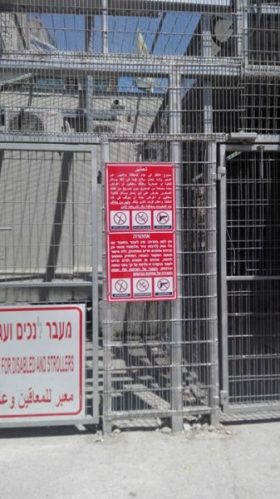
Newly installed sign illustrating the daily restrictions enforced solely for Palestinians
Doing so against the warning, you’d most likely pay with your life. A sentence on the sign says that a ‘permit’ can be applied for to bring any of the mentioned items. But even if that would be successful – assuming a Palestinian wouldn’t just be arrested for just applying for such a permit – or refused like so many Palestinians applying for building permits, it would cost a lot of bravery to actually show up at the checkpoint with any of those items. Bringing ‘banned items’ to the checkpoint, and then telling the heavily-armed soldier: “I’m bringing a knife”. It’s debatable whether that conversation would ever go beyond that point, or rather be cut short by gunshots from a heavily-armed occupation force.
In stark contrast to airports, where the measures are [at least purportedly] for security, in this context they are merely and deliberately solely for humiliation. In international law, a praxis like this is called ‘creating a coercive environment’ in order to facilitate ‘forced displacement’. And that’s what it is about: in an area that so conveniently connects all the illegal settlements within the city center of al-Khalil and on its outskirts, Palestinians are merely considered a nuisance. The attempts to drive them out are thus ever more enforced by the occupying army.
Israel blocks road to Bedouin village, preventing 100 children from going to school
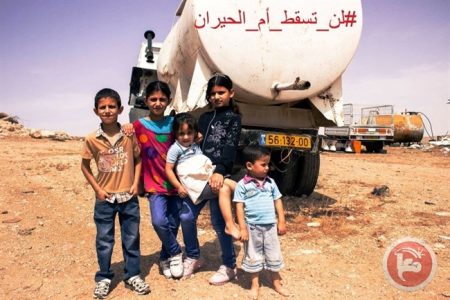
Children in the Bedouin village of Umm al-Hiran in the Negev
Ma’an – June 12, 2017
BETHLEHEM – A recently installed guardrail on an Israeli highway has isolated a Bedouin community in southern Israel for days, preventing 100 Bedouin children from attending school, NGO Adalah reported on Sunday.
According to the group, which focuses on the rights of Palestinian citizens of Israel, Israeli authorities effectively sealed off Umm Bidoun, a Bedouin community in the Negev desert unrecognized by Israel, by blocking off the only dirt road connecting the village to Highway 31 with a guardrail.
The road surface markings on the highway near other passage out of Umm Bidoun have also recently been changed, making it illegal for vehicles to cross the road, Adalah added.
The recent changes have effectively prevented any vehicles, including school buses, from accessing the village, Adalah said.
As a result, the legal NGO stated that, due to the absence of schools in Umm Bidoun, 100 children who study in the village of al-Furaa 15 kilometers away have been unable to go to school for days.
Adalah said on Sunday it had contacted officials from the Israeli Education Ministry, the al-Qasoum regional council, and Netivei Israel, the national roads authority, to demand that the obstacles to freedom of movement for the residents of Umm Bidoun be lifted.
Adalah field researcher Marwan Abu Freih told Ma’an on Monday that Netivei had told the organization that it was examining the issue.
Spokespersons from the Ministry of Education did not immediately respond to a request for comment on the case on Monday.
“It is inconceivable that some 100 students can — in such a sudden and arbitrary manner — be prevented from attending school without any advance notice to or consultation with parents,” Abu Freih said on Sunday. “Adalah and the families demand that the Education Ministry act immediately to correct this situation.”
Abu Freih added on Monday that members of Israel’s parliament, the Knesset, representing Palestinian citizens of Israel, had reached out to Adalah to offer their assistance in resolving the case.
Bedouin villages were established in the Negev soon after the 1948 Arab-Israeli war following the creation of the state of Israel. Many of the Bedouins were forcibly transferred to the village sites during the 17-year period when Palestinians inside Israel were governed under Israeli military law, which ended shortly before Israel’s military takeover of Gaza and the West Bank, including East Jerusalem, in 1967.
Between 160,000 and 170,000 Bedouins are believed to reside in the Negev today, more than half of whom reside in unrecognized villages, according to the Association for Civil Rights in Israel (ACRI).
The classification of their villages as “unrecognized” prevents Bedouins from developing or expanding their communities, while Israeli authorities have also refused to connect unrecognized Bedouin villages to the national water and electricity grids, and have excluded the communities from access to health and educational services.
A Knesset report on Bedouins in Israel noted that “(school) dropout rates are high, among various reasons due to lack of access and public transportation to their schools.”
Meanwhile, Jewish-Israeli communities in the Negev continuously expand, with five new Jewish plans approved last year. According to an investigation undertaken by Israeli rights groups ACRI and Bimkom, two of the approved communities are located in areas where unrecognized Bedouin villages already exist.
Rights groups have claimed that Israeli policies in Bedouin communities are specifically aimed at depopulating the Negev of its Bedouin residents to make room for the expansion of Jewish Israeli communities.
Israel has already Judaised 95% of Jerusalem
MEMO | May 30, 2017
The head of the Islamic and Christian Committee in Jerusalem has stressed the importance of international watchdog reports which condemn Israeli policies in the city, Qudsnet News reported on Monday. Hanna Naser noted that Israel’s occupation authorities have already Judaised 95 per cent of Jerusalem.
“Crimes are not subject to a statute of limitations based on UN treaties,” he pointed out. Israel’s crimes are intended to eradicate the presence of indigenous Jerusalemites in their own city. Although Israel is colonising East Jerusalem with Jewish settlers, said Naser, the demographic balance is in favour of the Palestinians.
He gave details of a number of the Israeli Judaisation projects, including a railway and subway that connect Jewish areas to Al-Buraq (the “Western”) Wall adjoining Al-Aqsa Mosque. He also pointed out that almost $10 million has been allocated to Judaising infrastructure in the Old City.
Commenting on Human Rights Watch’s report that there are 90,000 Palestinians in East Jerusalem living in unlicensed homes, Naser told Qudsnet that this proves that the organisation is angry with the fake Israeli pretext used to justify the refusals of licence applications made by Palestinians. At least 12 international laws and conventions, he pointed out, ban the policy of home demolitions as adopted by Israel, including the Declaration of Human Rights.
On a related issue, Naser revealed that the Israeli foreign ministry has issued a statement to Israeli embassies worldwide claiming that its settlements across the occupied Palestinian territories, including East Jerusalem, are “legitimate and legal”. He also revealed that there is a Jewish tourist attraction being built beneath Al-Aqsa Mosque which is due to open in 2020 with the aim of attracting 6 million visitors a year. A number of fake tombs — almost 10,000 — have been created around the mosque area, he added.
Israeli authorities move forward plan for new illegal West Bank settlement
Ma’an – May 29, 2017
BETHLEHEM – Israeli authorities have greenlit the construction of a new illegal settlement on occupied Palestinian lands, Israeli media reported on Sunday, advancing plans for the first settlement to officially be created by the Israeli government in decades as compensation for residents of the illegal settlement outpost of Amona.
According to news outlet Ynet, the Israeli Civil Administration approved jurisdiction for an area designated for the construction of a new settlement promised by Israeli Prime Minister Benjamin Netanyahu to Amona settlers, after their outpost was evacuated by Israeli authorities in February due to it being built illegally on private Palestinian lands.
However, the settlement, which will be located in the central occupied West Bank and has been referred to as both Amichai and Emek Shilo, still requires the approval of Israel’s military central command before construction can proceed, Ynet reported, adding that the next step of would then be the establishment of a full construction plan.
There are some 196 government recognized Israeli settlements scattered across the Palestinian territory, all considered illegal under international law. While Israeli outposts are considered illegal even under Israeli domestic law, earlier this year, Israel passed the outpost Regularization law, which would pave the way for the retroactive legalization of dozens of Israeli settler outposts.
While the Israeli government has carried out demolitions of Israeli outposts in the past, most notably the demolition of Amona earlier this year, it has at the same time fast-tracked the expansion of official Israeli settlements throughout the Palestinian territory.
“It is still too early to be happy.” Ynet quoted Amona leader Avichai Boaron as saying on Sunday. “Only a GOC Central Command injunction for the establishment of a temporary residential site can take us out of our desperation.”
Boaron added that Amona settlers had still not heard back from the army central command weeks after having requested approval for the settlement construction plan.
Boaron threatened Netanyahu if he did not uphold his promise to the settlers. “If he does not do so, we will have no choice but to unilaterally uphold the agreement and go up to the land on our own,” the Times of Israel quoted him as saying.
Palestine Liberation Organization Executive Committee member Hanan Ashrawi slammed the Israeli plan for the new settlement in March, saying that it “once again proves that Israel is more committed to appeasing its illegal settler population than to abiding by the requirements for stability and a just peace.”
Peace Now meanwhile accused the Israeli government in April of attempting to “fool the international community” by developing a policy of restraint around Israeli settlement construction in name only, while actually contributing to the unfettered expansion of illegal settlements, which has been consistently condemned and deemed illegal by the international community.
Between 500,000 and 600,000 Israelis live in Jewish-only settlements across occupied East Jerusalem and the West Bank in violation of international law, with recent announcements of settlement expansion provoking condemnation from the international community.
Israeli human rights group B’Tselem argued in a report in December that settlers acted as “envoys” of Israel in pushing land grabs in the occupied Palestinian territory, allowing the government to officially detach themselves from the settlers’ violent and illegal actions, while avoiding or blocking any legal penalties that could be imposed on the settlers, except in the most extreme of cases.
“The state helps settlers operate as a mechanism for dispossession in Palestinian space — settlers serving as a means purportedly not under state control, and settlers also use serious violence against Palestinian residents,” the group explained.
Many have linked the increase in Israeli settlement expansion plans in 2017 to the election of US President Donald Trump, who is widely seen as a stalwart ally of the Israeli government, despite Israeli authorities reported postponing decisions regarding settlements to after Trump’s visit to Israel on Monday, the Times of Israel said.
Israeli settlers reportedly destroy Palestinian-owned water well near Bethlehem
Ma’an – May 3, 2017
BETHLEHEM – Israeli settlers destroyed a Palestinian-owned water well on Tuesday in the town of al-Khader south of Bethlehem in the southern occupied West Bank, according to official Palestinians news agency Wafa.
Hasan Brijiyeh, a local activist from the separation wall and settlements’ committee in Bethlehem, told Wafa that a group of Israeli settlers destroyed the well under the protection of Israeli forces, identifying the owner of the well as Ahmad Ghnaim.
The 100-square-meter well was built almost 250 years ago, according to the report, and is located near the illegal settlement outpost of Sde Boaz, built on Palestinian-owned land.
Two weeks ago, Wafa reported that Israeli settlers from Sde Boaz razed privately-owned Palestinian land in the Wadi al-Ghawit area in the western outskirts of al-Khader, and physically assaulted the Palestinian landowner.
Sde Boaz, also known as Nevi Daniel North, was established in 2002 when settlers from the established illegal Nevi Daniel settlement took over a hilltop about 1.5 kilometers north of Nevi Daniel.
Israeli settlers from Sde Boaz destroyed over 300 newly planted grape vines belonging to the Sbeihs in 2014.
Some 600,000 Israeli settlers live in settlements across the occupied West Bank and East Jerusalem, in contravention of international law.
The international community regards all settlements built on occupied Palestinian land to be illegal, though the Israeli government distinguishes between the state-sponsored settlements and dozens of unauthorized outposts like Sde Boaz.
Israel’s parliament, the Knesset, passed the outpost “Regularization law” in February, which could grant official Israeli governmental recognition to more than a dozen illegal settlement outposts in the West Bank established on private Palestinian lands.
Israeli terrorists incite murder of Arabs south of Nablus
Palestine Information Center – May 3, 2017
NABLUS – Israeli settlers at predawn Wednesday preformed sacrilegious rituals and yelled “death to Arabs” at Yitzhar crossroads, south of Nablus.
Palestinians driving in the area said over 100 Israeli settlers, escorted by heavily-armed soldiers, flocked to the northern entrance to Hawara town, south of Nablus, and yelled anti-Arab chants.
The Israeli settlers further called for revenge against the Palestinians, shouting “Death to Arabs and Muslims.”
On Tuesday evening, a horde of Israeli fanatics showed up at Hawara checkpoint and on the access road to Bracha settlement, illegally built on Palestinian land in Kafr Kalil and Irak Burin, to mark Israel’s establishment anniversary on the land of Palestine.
Israel denies compensation to family of toddler burned to death
Palestine Information Center – May 1, 2017
OCCUPIED JERUSALEM – Israel will not pay terror victims’ compensation to Ahmed Dawabsha, a Palestinian boy whose parents and brother were killed in a 2015 arson attack carried out on their home by Israeli settlers, Israel’s war minister Avigdor Lieberman told a Knesset member in an official correspondence on the issue.
Writing to Joint (Arab) List MK Yousef Jabareen in response to a question as to why the now-orphaned Ahmed has not yet received money from Israel, Lieberman said the 6-year-old, who was badly injured in the attack, does not qualify as a “terror victim” and will therefore not receive compensation.
According to the Times of Israel daily, the current law stipulates that Israel must compensate Israelis affected by terrorism, but does not apply to Palestinians “who are not citizens or residents of Israel,” Lieberman wrote.
In January 2016, then-attorney general Yehuda Weinstein rejected a request from Jabareen for Dawabsha to be recognized as a terror victim.
“The compensation should be a right, not a gift,” he claimed. “The state needs to give him full compensation due to the severe incident he has suffered.”
Jabareen said the family would now “turn to the courts” in order to seek both recognition and compensation for Dawabsha.
Two homes in Duma, south of Nablus, were set alight in the July 31 attack. In the attack, Ali Dawabsha,18 months old, was burned to death and father Saad Dawabsha, his wife Riham and their son Ahmad, who was four at the time, were critically injured. Saad died in August and Riham in September. The only surviving member of the family, Ahmed, received months of treatment for severe burns.
Responding to Lieberman’s letter, Jabareen accused the war minister of implementing a racist policy towards the Palestinians.
“The defense minister’s position is based on racial discrimination,” Jabareen said in a statement. “If we were talking about Jewish settlers hurt by Palestinians, the victims would automatically receive compensation.”
The attack caused massive outrage in the occupied Palestinian territories and around the world.
In January 2016, a 21-year-old Israeli settler—Amiram Ben-Uliel—and an unnamed 16-year-old minor were indicted for carrying out the Duma terror attack.
Israeli travel agencies will soon have to promise not to send tourists to the West Bank
Ma’an – April 24, 2017
BETHLEHEM – Israeli authorities have notified Israeli travel agencies that they will be forced to sign a commitment pledging not to take groups of tourists to the occupied West Bank, according to a copy the notification obtained by Ma’an on Sunday.
In the Hebrew-language document dated April 23, the Border Control Department of the Israeli Population and Immigration Authority notifies travel agencies that as of May 15, the day when Palestinians commemorate the 1948 Nakba, they will have to “attach, with each request to bring a group of tourists into the country, a special form pledging that they will not send tourists to Judea and Samaria,” using the Israeli term for the occupied West Bank.
The document only addresses Israeli tourism agencies, and not individual would-be tourists.
The forms must be signed and sent to one of three Population and Immigration Authority email addresses listed in the document.
The document warns tourism agencies that their requests to bring groups of tourists would “not be processed” if the pledge was not signed and attached.
A spokesperson for the Israeli Population and Migration Authority could not immediately be reached for comment.
If implemented, the new regulation described in the document would be an additional blow to a suffering tourism industry in the occupied West Bank, which already has to contend with numerous unequal laws and restrictions that have crippled the Palestinian market, while investing millions of dollars in the Israeli market.
A number of sites which attract thousands of visitors each year, such as the Nativity Church in Bethlehem, could be affected by this directive.
“Israel’s occupation and colonization of Palestine is not limited only to its military elements, but is also manifested in its use of tourism as a political tool. It is a tool used to strengthen its position as occupying power, and to maintain its domination over Palestinian land and people, but also as an instrument for the dissemination of propaganda to millions of tourists, including politicians, community leaders and journalists who receive free-of-charge first class tours to Israel,” human rights lawyer and legal researcher Amjad Alqasis wrote in 2015.
As current regulations stand, when applying for visas, Israeli tourism agencies only need to submit names and passport numbers, while Palestinian agencies attempting the same are met with administrative obstacles, and cannot guarantee that their visa requests will be accepted.
Tourists who tell Israeli border control officials of their intention to visit the occupied West Bank also face the possibility of undergoing lengthy interrogations, or even deportation for alleged security reasons, or without being provided an explanation at all.
When tourists are able to reach the occupied West Bank, they are then forced to negotiate with hundreds of Israeli checkpoints and other military obstacles that restrict movement for Palestinians both within the West Bank and along its borders with Israel and Jordan.
“Another obstacle to operating a tour is the presence of 500,000 to 600,000 illegal Israeli Jewish settlers currently living in the occupied Palestinian territory,” who “constitute a growing and consistent threat to Palestinian livelihoods,” including Palestinian tour guides, Alqasis noted.
Several Palestinians hospitalized over multiple settler attacks in Nablus area

Ma’an – April 22, 2017
NABLUS – Israeli forces shot and injured four Palestinians with rubber-coated steel bullets, after residents in a Palestinian village south of Nablus in the northern occupied West Bank gathered to defend their homes from a mob of Israeli settlers that stormed the community. Hours later, two Palestinians were hospitalized when a group of settlers attacked Palestinians in a nearby village.
Ghassan Daghlas, an official who monitors settler activities in the northern West Bank, told Ma’an that some 100 “extremist settlers” from the illegal Yitzhar settlement entered the village of Urif from its east side and proceeded to smash windows of houses, included one belonging to resident Munir al-Nouri.
He added that the settlers were about to break into the house before Palestinian villagers gathered and forced them away.
According to a Facebook group for Urif, loudspeakers from the village’s mosque were used to inform residents of the incident and to urge them to help defend the homes from the “herds of settlers” attacking the village.
Minutes later, Daghlas said, a number of Israeli military vehicles stormed the village to protect the Israelis.
Clashes erupted between Palestinians youth and Israeli forces who “haphazardly” fired tear gas canisters, stun grenades, and rubber-coated steel bullets at Palestinians, according to Daghlas.
Daghlas said that four Palestinians were shot with rubber-coated steel bullets, one of whom was hit in the head. Medical sources said that Adel al-Safadi, Jihad Saad, Mustafa Fawzi, and Sharif Abd al-Hafith were taken to Rafidiya hospital to be treated for the gunshot injuries.
An Israeli army spokesperson told Ma’an that a “violent dispute erupted between Israelis and Palestinians” who she said were “mutually throwing rocks at each other in an area around the village.” When Israeli forces arrived to “disperse the dispute, several Palestinians shot flares at (Israeli) forces.”
In response, Israeli forces used “riot dispersal means,” she said. No Israeli were reported injured
Later Saturday afternoon, Daghlas said that another group of Israeli settlers attacked Palestinian homes in the town of Huwwara, just a few kilometers away from Urif, on the southeastern edge of Yitzhar.
Daghlas said that dozens of settlers attacked Palestinians and their homes with stones and “sharp objects.” A 72-year-old woman, Badiah Muhammad Hamdan, and a young man identified as Ahmad Yousif Udah were hospitalized. Daghlas said Hamdan sustained head injuries.
A video shared on social media showed the woman, bloodied and incapacitated, being evacuated in an ambulance.
Separately, a young Palestinian man was run over by an Israeli settler later Saturday afternoon in al-Masoudiyya west of Nablus city, Daghlas said.
Daghlas told Ma’an that 19-year-old Asim Salim from Nablus city was evacuated to Rafidiya hospital, where doctors said he sustained moderate wounds. Daghlas added that Salim was trying to cross the road in al-Masoudiyya when a settler’s vehicle hit him and fled the scene.
An Israeli border police spokesperson could not be reached for comment on the reported hit and run.
According to the Applied Research Institute – Jerusalem (ARIJ), since the state of Israel confiscated land from Urif and other Palestinian villages to establish the illegal Yithzar settlement in the 1980s, “attacks and violence perpetrated by settlers has had a profoundly negative impact on Palestinian residents and their property,” stressing that Yitzhar “poses a daily threat to residents of the neighboring Palestinian villages.”
Settlers have also been known to steal crops, damage and burn trees and other plants, and attack places of worship in the area, in an attempt to intimidate Palestinian villagers and farmers from using their land.
On Friday, a video was released showing 15 masked Israeli settlers attacking Israeli activists in the central West Bank, throwing rocks and hitting the activists with clubs.
Many Palestinian activists and rights groups have meanwhile accused Israel of fostering a “culture of impunity” for Israeli settlers and soldiers committing violent acts against Palestinians.
In March, Israeli NGO Yesh Din revealed that Israeli authorities served indictments in only 8.2 percent of cases of Israeli settlers committing anti-Palestinian crimes in the occupied West Bank in the past three years.
Between 500,000 and 600,000 Israelis live in Jewish-only settlements across occupied East Jerusalem and the West Bank in violation of international law, with recent announcements of settlement expansion provoking condemnation from the international community.
According to the United Nations Office for the Coordination of Humanitarian Affairs (OCHA), there were a total of 221 reported settler attacks against Palestinians and their properties in the West Bank and occupied East Jerusalem in 2015, and 107 in 2016.
Featured Video

Stanislav Krapivnik: Russia-Iran Cooperation & Escalation in Ukraine
or go to
Aletho News Archives – Video-Images
Frlom the Archives
A dark page from the CIA’s history: What was Project Artichoke, launched 74 years ago?
By Erkin Oncan | Strategic Culture Foundation | August 22, 2025
One of the most useful instruments hidden behind the U.S. empire’s rhetoric of “freedom and democracy” was the Central Intelligence Agency, founded on September 18, 1947, as the successor of the Office of Strategic Services (OSS).
Since its creation, the CIA has carried out countless inhumane operations: assassinations, coups, drug trafficking, support for terrorism, conspiracies. The list of its crimes is endless. But among the darkest and most inhumane chapters of its record lie the notorious “mind control” experiments. … continue
Blog Roll
 Aletho News
- Stanislav Krapivnik: Russia-Iran Cooperation & Escalation in Ukraine
- Indonesia suspends participation in Board of Peace following attack on Iran
- ‘Operation Epic Fury’ burns an estimated $5.82 billion in just 100 hours
- Zionism’s grip over the world: From Epstein to Greater Israel
- How Israel and the FBI manipulated assassination plots to goad Trump into Iran war
- Iranian Strikes Dispel the Illusion of US Security Umbrella
- US Boasts of Destroyed Iranian Launchers Lack Credibility – Ex-DoD Official
- Europe not in position to cooperate with US and Israel against Iran
- Iran Has ‘Broken the Myth’ of Israeli Military Power: Former Pakistani Envoy
- How, and why, US data centers in the Gulf became targets of war
- If Americans Knew
- US troops were told war on Iran was ‘all part of God’s divine plan’, watchdog alleges
- Trump wants to run the show in Iran, but doesn’t know what he’s doing – Not a ceasefire Day 147
- ‘Dirty Work’ :The truth about how Israel was founded
- Mass Expulsion in Lebanon as Israel Expands War: “We Don’t Know Where to Go”
- Lies, distortions, and propaganda: how the U.S. mainstream media coverage on Iran hides the truth
- Palestinians in Gaza fear famine returning as Israel cuts off food amid Iran war
- AIPAC, other pro-Israel groups enter midterms with $100 million to spend
- Iranian girls killed by ‘double-tap’ strikes on Minab school
- Bari Weiss Is Going Full ‘Propaganda-Palooza’ With the Iran War
- Inside the Pro-Israel Campaign to Stop ‘The Voice of Hind Rajab’ From Winning an Oscar
- No Tricks Zone
- Televised! Leading German Political Candidate Tells Schoolchildren CO2 Makes Sun Hotter!
- New Study: A Century Warming Of 1.1°C Is ‘Commonplace’ And ‘Not Unusual’ During This Interglacial
- New Study: ‘Internal Noise’ And Volcanic Forcing Can Trigger 10-15°C Warming Within Decades
- Glaciers Worldwide Are Suddendly Surging, Experts Blame Warming!
- Surprising Discovery: Sahara Is Greening…Billions Of Trees Where Once Thought To Be Barren
- New Research Reaffirms Clouds, Aerosols, And Surface Solar Radiation Are ‘Driving The Climate System’
- Germany: Electric Car Catches Fire At Charging Station, Sets Off Local “Inferno”, Widespread Damage
- New Study: Canada’s New Brunswick Was 1°C Warmer Than Today During The Medieval Warm Period
- Coal Power Back In Trend As Globe Tries To Keep Pace With Growing Demand For Power
- New Study: A 4°C Warmer Beaufort Sea Had ‘No Sea Ice’ 11,700 – 8200 Years Ago
 Aletho News