Sukkot, feast of intimidation, oppression and illegal annexation
International Solidarity Movement | October 20, 2016
Hebron, Occupied Palestine – This past week marked the feast of Sukkot, which brought settlers from illegal settlements all over the occupied West Bank to al-Khalil (Hebron). There, with restrictions, harassment, collective punishment and intimidation of Palestinians – all in favor of the illegal settlers – the spirit of the Jewish holiday was turned into a feast of intimidation and oppression for the Palestinian residents, going hand in hand with increasing illegal annexation of their land.
With bus-loads of settlers from all over the illegally occupied Palestinian West Bank pouring into al-Khalil, Israeli forces stepped up the movement-restrictions and checkpoint closures for Palestinians even more, thus making the maze of checkpoints, already almost impossible to navigate into a maze that ends mainly in dead-ends. For several days, the main checkpoint connecting the Palestinian market with the area around the Ibrahimi Mosque was closed for Palestinians, and Palestinian shop-owners in the mosque-area were forced shut by the Israeli forces – all to facilitate settler movement in areas that lack any presence of Palestinians.
The road connecting the settlements in the heart of al-Khalil with the Kiryat Arba settlement on the outskirts of al-Khalil – where only settlers are allowed to drive – has largely been cordonned off with police-barriers.
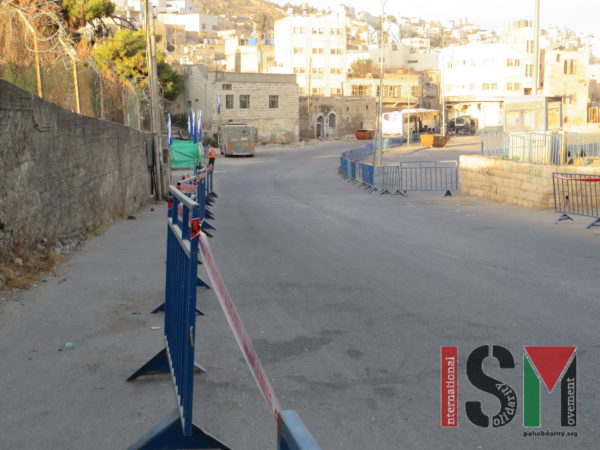
The area cordonned off by Israeli forces
Thus, school-children were not only forced to pass an even larger amount of heavily-armed military and police forces, but also navigate the maze of complete closures for Palestinians, areas to avoid due to excessive settler presence and the gates put up preventing movement in certain directions.
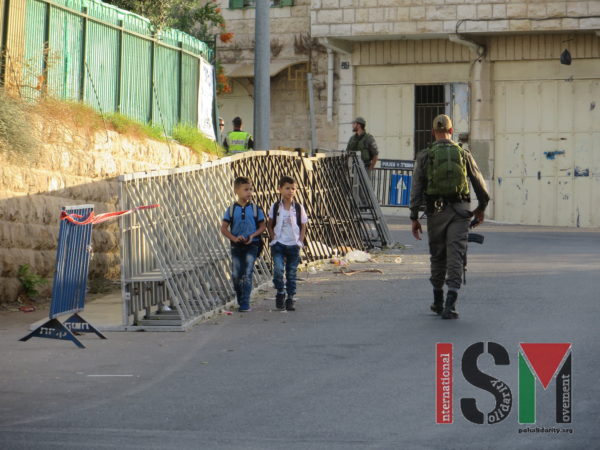
School-children forced to pass heavily-armed Israeli forces and the maze of police-barriers
Students of al-Faihaa girls school in the Ibrahimi Mosque area, where just recently a new CCTV surveillance tower was put up following and recording every step of the Palestinian residents movement, are now studying right next to a military encampment. The building right next to the girls school entrance has already been mis-used and turned into a military encampement during last year’s Sukkot celebrations.
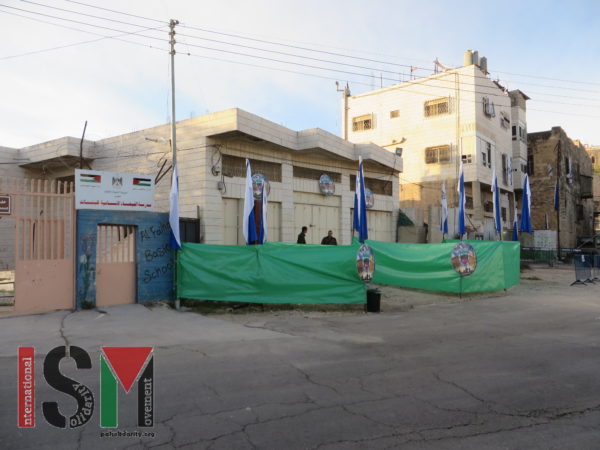
Building illegally occupied by Israeli forces for a military base
On Tuesday, many of the settlers arriving to al-Khalil on the occassion of the holiday, were ‘guided’ through the Palestinian market by Israeli forces, preventing Palestinians’ access in their own marketplace for hours. Just a day later, soldiers effectively imposed a curfew on the tiny strip of Shuhada Street where Palestinians are still allowed to walk, the Tel Rumeida neighborhood and the Bab al-Zawwiya area. The latter is located in the H1 area of al-Khalil, supposedly under full Palestinian control. With the closure of Shuhada checkpoint for six hours, Palestinian civilians were either locked inside or outside their houses, while settlers were accompanied by heavily armed military forces to a tomb located in the H1-area, forcing shop-owners to close.
On Thursday morning, Israeli forces marched through the streets of al-Khalil, with drums and music, in a pure show of force and power. The march went on the settler only road, that has been ethnically cleansed from Palestinian cars (but does still allow Palestinian pedestrians), illustrating the continuous plans and attempts to connect the illegal settlements in an area ethnically cleansed of any Palestinian presence.
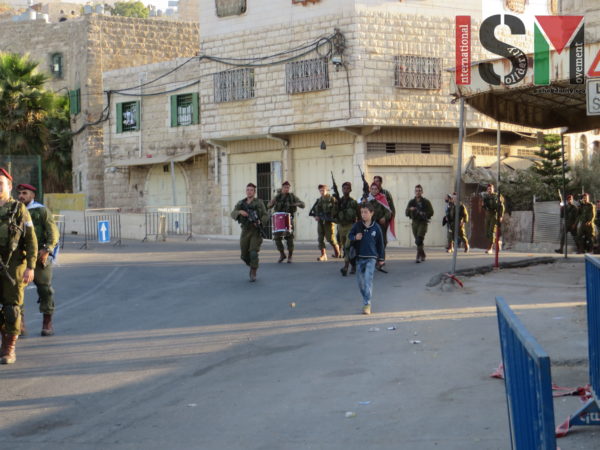
Soldiers marching through al-Khalil
Throughout the increasing efforts to illegally annex more and more strips of land, and erase first the memory of the Palestinian heritage as a step to then erase the whole Palestinian population, Israeli forces are employing the ‘power of words’. More and more areas, streets and houses that belong to Palestinians, but in which settlers have already moved in (and were succinctly kicked out by the army), are given Hebrew names, eradicating the Palestinian names. This is just one small step of illegal annexation that even goes so far to call the illegal Israeli settlements in the city center of al-Khalil “Jewish neighborhoods”.
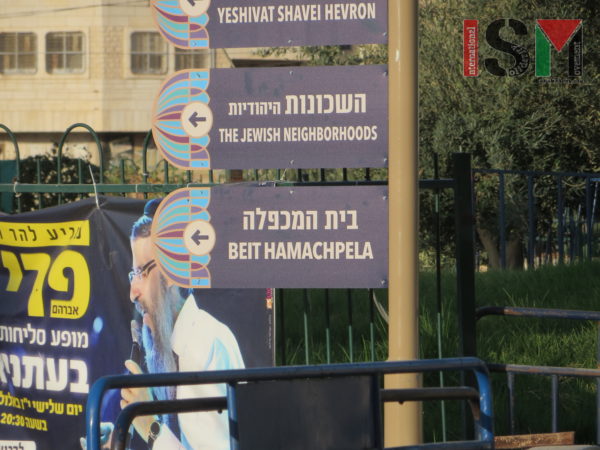
Signs put up for ‘tourist settlers’ in al-Khalil by Israeli forces
With the holiday of Sukkot lasting for another three days, more restrictions and harassment are expected. And even with the end of the holiday, the restrictions, harassment and intimidation of Palestinian civilians solely and deliberately on the ground of their ethnic group, with the continuous illegal annexation of the land, will not stop as long as the illegal occupation is allowed by the international community to continue their efforts of ethnic cleansing.
AL-KHALIL (HEBRON): A week in photos 4-10 October 2016
CPTnet | October 14, 2016
|

|
|
|
|

|
|
|
|

|
|
|
|

|
|
|
|

|
|
|
|

|
|
|
|

|
Israel sets restrictions across Jerusalem for Yom Kippur, arms Israeli ‘volunteers’
Palestinian Information Center – October 11, 2016
OCCUPIED JERUSALEM – The Israeli authorities imposed tight restrictions throughout occupied Jerusalem in anticipation of the Jewish holiday of Yom Kippur.
Haaretz Hebrew newspaper said that a series of closures and heightened security operations were declared between the eastern and western parts of occupied Jerusalem.
Palestinian vehicles’ movement is completely restricted as several checkpoints were erected throughout the occupied city, according to the sources.
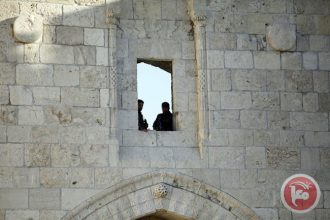 Israeli Police spokeswoman Luba al-Samri said in a statement that Israeli police, border police, and Israeli “volunteers” would be spread through different areas in the city of Jerusalem beginning early Tuesday morning, the beginning of Yom Kippur.
Al-Samri added that Israeli police provided the volunteers with weapons to “guarantee the safety of the worshipers.”
“Israeli police in cooperation with the Jerusalem municipality will install checkpoints at the main roads to prevent cars of Eastern residents from heading to West Jerusalem,” al-Samri said in her statement, referring to preventing the access of any Palestinian residents from the eastern part of Jerusalem to its western part.
“Israeli police will also be stationed at neighborhoods to prevent any rock throwing,” according to her statements.
Earlier Monday, Israeli authorities imposed a complete closure in occupied West Bank and Gaza Strip on the occasion of Jewish holiday Yom Kippur.
Israeli Foreign Ministry projects Palestinians as the Zionists, Ashkenazis as indigenous, in twisted video
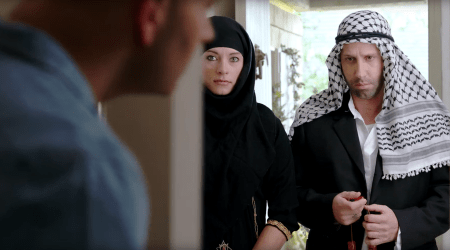
© Israel / YouTube
RT | October 7, 2016
Israel’s Foreign Ministry is calling out at pretty much everyone and anyone who has wronged Jews over the last 3,000 years in a modern-day history lesson in a satirical video.
The satirical video outlines the “history of the Jewish people” by focusing on Jacob and Rachel, a nice Jewish couple that are pushed out of their home by an endless stream of unwelcome visitors.
“From ancient times to modern days, the Land of Israel has seen a whirlwind of visitors knocking on its door… but Jews were always present in their home-sweet-home,” read the new YouTube video’s caption.
Assyrians, Greeks, Arabs, crusaders, the British and many other guests stop by to “claim the home as their own” until the British eventually “realize this isn’t Europe” and give the couple back their home.
That is until, finally, a knock at the door unveils a Palestinian couple looking for somewhere to stay.
Israel to build large new synagogue in Old City of Jerusalem
Palestinian Information Center – October 4, 2016
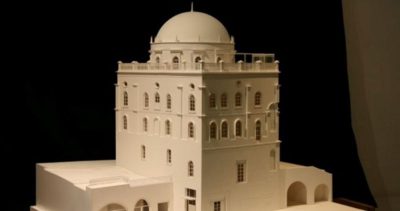 OCCUPIED JERUSALEM – The Israeli occupation authority (IOA) has finished all preparations, in cooperation with unnamed Jewish groups, to build a big synagogue called the Jewel of Israel in the heart of the Old City of Jerusalem.
It will be located about 200 meters away from the western side of the Aqsa Mosque.
According to the Palestinian news website Qpress, the new synagogue project will cost around 48 million shekels, mostly from the Israeli government and the rest from wealthy Jews.
The synagogue will be composed of six floors, two underground, and will be built on the ruins of an Islamic historical site dating back to the Ottoman and Mamluk eras.
The project is part of a large-scale Israeli plan aimed at planting religious Jewish structures in the heart of Old Jerusalem to change the Islamic and Arab identity of the holy city.
It will be the second massive Jewish edifice in the Old City after the Hurva synagogue, which was built in 2010.
Nowhere to hide: New illegal observation tower in occupied Hebron
International Solidarity Movement | October 3, 2016
Hebron, Occupied Palestine – Israeli forces put up a CCTV observation tower in the Ibrahimi mosque area, further increasing not only their all-encompassing surveillance of Palestinians, but also their slow but steady illegal annexation of more and more Palestinian land in occupied al-Khalil (Hebron).
At the end of last week, Israeli forces in a ‘secret’ over-night action put up the observation tower, surrounded by dozens of cement blocks and barbed-wire. Located in a corner between Palestinian houses, the observation post with a container and all the surrounding paraphernalia is just another step in the illegal annexation of yet more land. In recent weeks, Israeli forces have increased their illegal annexations of the tiny strip of Shuhada Street still accessible to Palestinian pedestrians and stepped up the game of creating a coercive environment directly leading to forced displacement of Palestinians in the Tel Rumeida area.
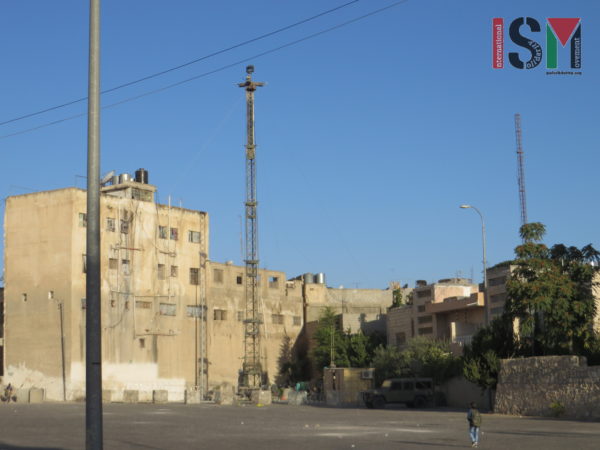
CCTV surveillance tower newly put up in Palestinian neighborhood
This observation tower is fitted with a camera that reaches high above the houses in the neighborhood, thus watching Palestinians constantly. This feeling of permanently being watched for Palestinians is combined with the ever present controls and humiliations at the more-and-more militarized checkpoints. Palestinians are watched, humiliated, numbered, deprived of their most basic human rights – occupied not only physically by the Israeli occupation forces, but also mentally. They can never tell whether they’ll be allowed through a checkpoint (something that solely depends on the respective soldiers whim), whether their children will be tear-gassed on their way to school or arrested, or even whether they’ll be gunned down by Israeli forces at a checkpoint and left to bleed to death. Any and all of these forms of collective punishment are enforced by the Israeli occupying forces on the entire population of civilians in complete disregard of any care for international law or humane treatment of the occupied indigenous Palestinian population.
The Tel Rumeida neighborhood, Shuhada Street, and the area around the Ibrahimi Mosque are already linked by a settler-only street that has been ethnically cleansed of Palestinians in the aftermath of the Ibrahimi Mosque massacre. Restrictions in the Tel Rumeida neighborhood (declared a ‘closed military zone’ solely enforced on Palestinian residents for almost a year now) and around the Ibrahimi Mosque (where Palestinians are often prevented from passing checkpoints on a age-limit between 15-30) have escalated in a very short amount of time, making life for the Palstinians as hard – or rather impossible – as possible, leaving them with no choice than to leave. The only and clear aim is the forcible transfer of all Palestinians in this area, thus geographically linking the illegal settlements in an area ethnically cleansed of any Palestinian presence.

CCTV camero on top of the surveillance tower
Israel closes Ibrahimi Mosque to Palestinian worshippers
Press TV – October 3, 2016
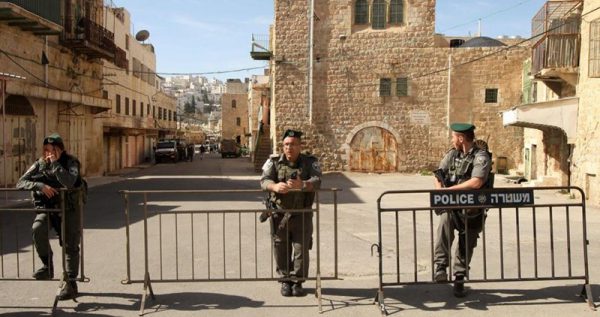
Israeli authorities have decided to close the Ibrahimi Mosque, in the heart of the occupied West Bank city of al-Khalil (Hebron), to Palestinians, Muslim worshipers and non-Jewish visitors for seven non-consecutive days.
Yousif Ideis, the Palestinian minister of endowment and religious affairs, said on Sunday that the sacred site will be closed to Palestinians and non-Jews on October 3, 4, 9, 12, 18, 19 and 26.
Israeli officials have said the shutdown is aimed at maintaining security in the wake of Rosh Hashanah (the Jewish New Year), Yom Kippur (The Day of Atonement), Sukkot (Feast of Booths) and Simchat Torah holidays.
Ideis added that dozens of illegal Israeli settlers broke into the mosque courtyard on Saturday night amid protection by Israeli troopers.
In the meantime, Israeli authorities are closing all passageways between the blockaded Gaza Strip and Israel, as well as between the occupied West Bank and Israel for Rosh Hashanah.
Israeli officials regularly impose stringent restrictions for Palestinians during Jewish holidays for alleged security purposes.
The constraints include denied access to the Ibrahimi Mosque, which is revered by Jews, Christians and Muslims and has been the site of violent tensions between Israelis and Palestinians for decades.
On February 25, 1994, at least 29 Palestinians were killed and 125 others wounded when American-Israeli Baruch Goldstein opened fire on a large number of Palestinian Muslims, who had gathered inside the Ibrahimi Mosque to say prayers during the holy fasting month of Ramadan.
The occupied territories have already been the scene of increased tensions ever since Israeli forces imposed restrictions on the entry of Palestinian worshipers into the al-Aqsa Mosque compound in East Jerusalem al-Quds in August 2015.
Nearly 250 Palestinians have lost their lives at the hands of Israeli forces since the beginning of last October.
‘FIFA Tarnishing Football by Allowing Games on Stolen Land’
Al-Manar | September 26, 2016
Human Rights Watch (HRW) accused world football’s governing body FIFA of “tarnishing the beautiful game” by allowing “games on stolen land”.
In a report published on Sunday, HRW said that FIFA was legitimizing the building of Israeli settlements in the West Bank—considered illegal under international law—and was sponsoring business activity that supports the settlements.
The New York-based body urged FIFA to force six Israeli football clubs based in settlements in the West Bank to relocate from occupied territories or be banned from competitions recognized by football’s governing body.
The six clubs in question are located in the West Bank and play in the lower Israeli leagues—Beitar Givat Ze’ev, Beitar Ironi Ariel, Ironi Yehuda, Beitar Ironi Maale Adumim and Hapoel Bik’at Hayarden.
The report follows an online petition that has gained more than 150,000 signatures, calling for FIFA official Tokyo Sexwale—who is heading up FIFA’s investigation into the issue—to ban settlement clubs from FIFA-recognized competitions.
More than 60 members of the European Parliament (MEPs) also sent an open letter to FIFA President Gianni Infantino earlier in September, calling for the settlement clubs to be relocated or excluded from the Israeli Football Association (IFA).
FIFA’s rulebook states that football clubs that are a member of one football association may not play on the territory of another football association without the other association’s permission. The Palestinian Football Association has been recognized by FIFA since 1998.
“By holding games on stolen land, FIFA is tarnishing the beautiful game of football,” said Sari Bashi, ‘Israel’ and Palestine country director at HRW.
Thousands rally against Netanyahu’s visit to The Hague

Former Dutch Prime Minister Dries Van Agt
Press TV – September 7, 2016
Thousands of people have staged a demonstration in The Hague in protest at an official visit by Israeli Prime Minister Benjamin Netanyahu to the Netherlands, saying he should be brought to justice for his crimes.
On Tuesday, the protesters carried Netanyahu’s mugshots and signs that read “Bring Bibi Netanyahu to International Criminal Court” as the Israeli leader arrived in the Netherlands and met with senior Dutch officials.
Chants such as “Free free Palestine, boycott boycott Israel” could also be heard during the demonstration.
“I’m standing here because Netanyahu is visiting the Netherlands. I’m standing in The Hague and we think that rather than him being received by the parliament, he should be put on trial in the Peace Palace of the UN tribunal,” a protester said in English.
Some of the protesters also criticized local authorities for attempting to cancel the anti-Netanyahu gathering.
“This demonstration is not only against Netanyahu, but it’s also for our right to demonstrate, at the places where we want, where it’s happening, because the Zionists, they always get the permission to stand in front of the parliament,” another demonstrator commented.
The rally was originally planned to be staged outside the Dutch parliament building in The Hague downtown, but authorities later did not allow the protesters to proceed.
The demonstration came a day after former Dutch prime minister Dries Van Agt reacted angrily to Netanyahu’s two-day visit to the Netherlands, calling on government officials to “send him right away to the International Criminal Court.”
Speaking in an interview with the NPO1 public broadcaster on Monday, Van Agt described the 66-year-old Chairman of Israel’s right-wing Likud political party as a “war criminal,” arguing that the Tel Aviv regime has been committing a crime under the ICC’s Rome Statute.
“The occupation and expansion… building of settlements, of occupied territory, this is according to the Rome Statute, which is… the setup… the statute on which the international criminal court is based, in so many words, a war crime,” he said.
“So why should we receive someone who continues with such things, we could have sent him right away to the International Criminal Court, that would have been better,” the 85-year-old politician and activist, known for his vocal support of the Palestinian cause, the ex-PM pointed out.
The Rome Statute, which went into effect in July 2002, outlines the four grave international crimes, namely crimes of aggression, war crimes, genocide and crimes against humanity. The statute forms one of the foundations of The Hague-based International Criminal Court.
Israel signed the treaty in December 2000, but “unsigned” it two years later by means of the US lobby.
One of the primary reasons behind the decision was a clause in the document, which allowed the prosecution of the Israeli regime over war crimes for “transfer of parts of the civilian population of an occupying power into occupied territory.”
Israeli forces hunt for Palestinian children in Hebron market
International Solidarity Movement | August 1, 2016
Hebron, Occupied Palestine – On Sunday, 31st July 2016, Israeli forces in the Old City souq, the Palestinian market, of occupied al-Khalil (Hebron), were searching for a group of three Palestinian boys. Claiming they were throwing stones, Israeli forces were searching for them in order to arrest and incarcerate them.
A group of Israeli soldiers went into the Palestinian market in search for the children they claimed were throwing stones, stopping any child they encountered on their way, that more or less fit the age-group of around 10-14 years old. They stopped and questioned a 12-year old boy at Bab al-Baladiyya, one of the entrance and exit-points for the soldiers to enter from the illegal settlements located on Shuhada Street into the Palestinian market. Without any family or a lawyer present, the soldiers questioned the boy, first claiming that he was throwing stones and threatening to arrest him and take him to the police station. Only because of the intervention of a local, the boy wasn’t kidnapped by the Israeli forces, which eventually admitted that the video-evidence they have does not even show him. Still, they claimed that he was there and thus were attempting to force him into giving information.
After they finally allowed the boy to leave, they arbitrarily stopped any child that fit their age group to question them about their whereabouts and where they were going, even entering a Palestinian shop to interrogate a child. After about half an hour, they gave up their search, but approached human rights observers to ‘justify’ their behaviour, showing them a video on a phone that showed a boy throwing small stones, at a securely fenced military tower, without any possibility of the pebbles even hurting anyone. Despite only one boy throwing these small stones, Israeli forces were out looking for all the three children in the video. Israeli forces ‘justified’ their search for the children to the human rights observers, stating that because of what can be seen in the video, they went out to look for ‘a boy in a white T-Shirt’ – despite the boy in the video clearly wearing a green T-Shirt. In spite of both these facts, they stopped and interrogated any child loosely fitting the age-group of around 10-14.
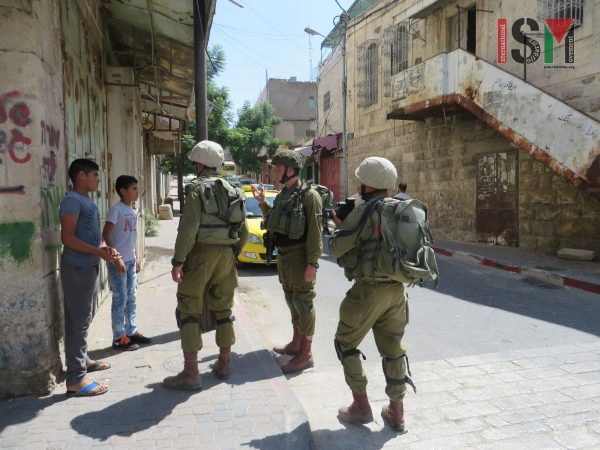
Israeli forces cornering children in the street for interrogation
In the evening, Israeli forces again entered the market, to stop, harass and question children fitting this age-group, and another arrest of an arbitrarily picked child could only be prevented by the intervention of a local.
The fact that the arrest of any children under the age of 12 is illegal even under Israeli military law that applies to all Palestinians in the West Bank, did not bother the Israeli forces. Despite the boy in the video clearly being less than 12 years old, they went out to hunt down children that are below the legal age for arrest even under the apartheid military law, the orders in clear violation of not only international law, but even the racist and apartheid Israeli military law.
Leaked EU report reveals indirect approval of colonial Israel
By Ramona Wadi | MEMO |July 27, 2016
Once again, Israel is exerting a great deal of effort in order to prevent discussion of an EU paper among European institutions. The internal report, which was drafted in December 2015 and then endorsed by all EU member states, attributes the development of the Jerusalem Intifada (Uprising) to “Israel’s occupation”. It included reference to the living conditions of Palestinian citizens and the failure to implement the two-state paradigm.
The EU Observer, which has seen the 39-page report, has stated that the document is intended as a reference for EU foreign ministers and “for proposals put forward by the EU Foreign Service.”
While having a dearth of facts, the report is not lacking in the kind of contradictions that mark the constant cycle of condemnation and appeasement of Israel at the expense of withholding Palestinian narratives. The Jerusalem Post has deemed the EU document to be veering away from Israeli Prime Minister Benjamin Netanyahu’s claim that Israel and the rest of the world are facing the same terror threats. Rhetorically, the EU has distanced itself from Netanyahu’s sweeping statements that generalise every terrorist incident in order to normalise state violence against Palestinian resistance. Nevertheless, as on other occasions, the EU has devised its own strategies which uphold Israel’s narrative at a regional and international level.
The report is ambiguous in the extreme. “Some Palestinian perpetrators of individual attacks,” it explains, “have apparently been shot and killed in situations where they no longer pose a threat.” Despite Netanyahu himself publicly endorsing such extrajudicial killings, the EU has preferred to subjugate the facts to hypotheses through the use of terminology like “apparently”, “appeared” and “possibly amounting in certain cases to unlawful killings.” By not condemning such unlawful killing explicitly, the discourse suggests the EU’s tacit approval of Israeli state and settler violence. This is illustrated further in the report’s standard equivalence clause that “both sides” have indulged in “inflammatory rhetoric”, thus negating the fact that Palestinian resistance is a legitimate response to illegal Israeli colonial violence.
EU Foreign Relations chief Federica Mogherini has opposed the proposal that “known violent settlers and those calling for acts of violence” should be placed under EU visa bans. According to Mogherini: “There’s currently no question of sanctioning anybody. The question is rather how to motivate people to… restart peace talks.” Such leniency works in concordance with Israeli policy towards settler terrorists who are mostly shielded by the colonial state, enabling them to act with impunity.
Perhaps the most incriminating evidence of support for Israeli colonisation is the recommendation that the EU develops “further guidelines that differentiate between Israel and its illegal settlements,” according to the EU Observer. This distinction has been of interminable benefit to Israel and its implications are many, including the refusal to recognise the fact that Israel is a colonial entity and that its manifestation is contrary to the principles enshrined in international law. Referring to Israel as the “occupying power” without any reference to colonisation in effect absolves both Israel and the international community of accountability when it comes to recognising the Palestinian right to resistance and liberation. Unless this anomaly is rectified, all reports issued by the EU will be inherently biased towards Israel, regardless of the content. To treat colonial expansion as a recent phenomenon is a transgression of truth and an impediment to Palestinian struggle, although that is, after all, the apparent international intent behind such blatant deception.
Deir Qaddis resists ongoing theft of village land
International Solidarity Movement | July 21, 2016
Deir Qaddis, Occupied Palestine – On the morning of July 14th, Israeli excavators arrived on Majid Mahmoud’s farmland in Deir Qaddis to begin work on an illegal expansion of a wastewater facility for the nearby illegal settlement of Nili.
Construction vehicles and Occupation forces were met by about fifty Palestinians from Deir Qaddis and nearby Nil’in in protest of the theft and destruction of village land, who refused to leave until the construction was halted. Through nonviolent means the villagers managed to temporarily prevent the destruction of their grazing lands, though excavation and land clearing did resume in the days afterwards. Illegal settlements around Deir Qaddis have been expanding for decades, swallowing up thousands of dunams and dispossessing farmers and agricultural workers in the area.
Majid’s land, now on the other side of a settler road, has been rendered mostly inaccessible by both the expansion of illegal settlements and the threat of violence from Israeli forces and private settlement security.
“We have no rights under this Occupation. I cannot ask the soldiers why they are on my land. It is as if I am being beaten, but cannot question it or raise my hands to stop it,” Majid said. “We have all the papers to prove ownership, but it does not matter.”
Majid and members of the local council are planning to bring the case to court and have all the documentation necessary to do so. They are not optimistic, however, about their chances.
Though the people of Deir Qaddis did succeed in halting the illegal construction on Thursday, it has since resumed. Fares Naser, mayor of the village, has little confidence that the settlement expansion and illegal construction will ever end. “It will not stop,” said Fares, “and the next generation will wonder why it is this way.”
Deir Qaddis is surrounded on three sides by the Apartheid Wall and the illegal Israeli settlements of Nili, Modi’in Illit, and Na’aleh, cutting it off from much of the West Bank. According to Fares, only 4,000 of the village’s original 10,000 dunams have not yet been seized by Israeli forces and settlers. Over ninety percent of the Deir Qaddis is classified as “Area C,” territory in which Israel maintains full military and civil control.
In 1999, Israeli authorities assured the people of Deir Qaddis that all land lying west of the town would remain untouched. Israel has since broken that promise, with both state confiscation and private theft of valuable farmland within Deir Qaddis. According to international law, all Israeli settlements are illegal, as is nearly every piece of the Israeli colonial apparatus. Israel will continue to build, and the people of Deir Qaddis will continue to resist the ongoing theft of their land and livelihoods.
Featured Video
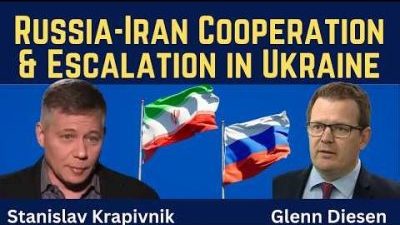
Stanislav Krapivnik: Russia-Iran Cooperation & Escalation in Ukraine
or go to
Aletho News Archives – Video-Images
Frlom the Archives
A dark page from the CIA’s history: What was Project Artichoke, launched 74 years ago?
By Erkin Oncan | Strategic Culture Foundation | August 22, 2025
One of the most useful instruments hidden behind the U.S. empire’s rhetoric of “freedom and democracy” was the Central Intelligence Agency, founded on September 18, 1947, as the successor of the Office of Strategic Services (OSS).
Since its creation, the CIA has carried out countless inhumane operations: assassinations, coups, drug trafficking, support for terrorism, conspiracies. The list of its crimes is endless. But among the darkest and most inhumane chapters of its record lie the notorious “mind control” experiments. … continue
Blog Roll
 Aletho News
- Are the Jews indigenous to Palestine?
- Stanislav Krapivnik: Russia-Iran Cooperation & Escalation in Ukraine
- Indonesia suspends participation in Board of Peace following attack on Iran
- ‘Operation Epic Fury’ burns an estimated $5.82 billion in just 100 hours
- Zionism’s grip over the world: From Epstein to Greater Israel
- How Israel and the FBI manipulated assassination plots to goad Trump into Iran war
- Iranian Strikes Dispel the Illusion of US Security Umbrella
- US Boasts of Destroyed Iranian Launchers Lack Credibility – Ex-DoD Official
- Europe not in position to cooperate with US and Israel against Iran
- Iran Has ‘Broken the Myth’ of Israeli Military Power: Former Pakistani Envoy
- If Americans Knew
- US troops were told war on Iran was ‘all part of God’s divine plan’, watchdog alleges
- Trump wants to run the show in Iran, but doesn’t know what he’s doing – Not a ceasefire Day 147
- ‘Dirty Work’ :The truth about how Israel was founded
- Mass Expulsion in Lebanon as Israel Expands War: “We Don’t Know Where to Go”
- Lies, distortions, and propaganda: how the U.S. mainstream media coverage on Iran hides the truth
- Palestinians in Gaza fear famine returning as Israel cuts off food amid Iran war
- AIPAC, other pro-Israel groups enter midterms with $100 million to spend
- Iranian girls killed by ‘double-tap’ strikes on Minab school
- Bari Weiss Is Going Full ‘Propaganda-Palooza’ With the Iran War
- Inside the Pro-Israel Campaign to Stop ‘The Voice of Hind Rajab’ From Winning an Oscar
- No Tricks Zone
- Televised! Leading German Political Candidate Tells Schoolchildren CO2 Makes Sun Hotter!
- New Study: A Century Warming Of 1.1°C Is ‘Commonplace’ And ‘Not Unusual’ During This Interglacial
- New Study: ‘Internal Noise’ And Volcanic Forcing Can Trigger 10-15°C Warming Within Decades
- Glaciers Worldwide Are Suddendly Surging, Experts Blame Warming!
- Surprising Discovery: Sahara Is Greening…Billions Of Trees Where Once Thought To Be Barren
- New Research Reaffirms Clouds, Aerosols, And Surface Solar Radiation Are ‘Driving The Climate System’
- Germany: Electric Car Catches Fire At Charging Station, Sets Off Local “Inferno”, Widespread Damage
- New Study: Canada’s New Brunswick Was 1°C Warmer Than Today During The Medieval Warm Period
- Coal Power Back In Trend As Globe Tries To Keep Pace With Growing Demand For Power
- New Study: A 4°C Warmer Beaufort Sea Had ‘No Sea Ice’ 11,700 – 8200 Years Ago
 Aletho News