Israel refuses entry to UNESCO group expected to visit Hebron’s Old City

Ma’an – June 26, 2017
BETHLEHEM – Israeli authorities have refused to grant entry visas for a United Nations Educational, Scientific and Cultural Organization (UNESCO) investigative team scheduled to conduct a field visit to the Old City in the southern occupied West Bank district of Hebron in advance of an upcoming vote next month to consider the area an endangered world heritage site, Israeli media reported on Sunday.
While Palestinian authorities had planned to introduce the site for consideration on UNESCO’s World Heritage List for 2018, they decided to fast track the site’s application owing to routine Israeli violence in the Old City, which Palestinians have claimed threatens the integrity of the site, and instead propose the area as an endangered site.
A Palestinian delegation to UNESCO had reportedly expressed the “alarming details about the Israeli violations in Al-Khalil/ Hebron, including the continuous acts of vandalism, property damage, and other attacks,” in a letter to the World Heritage Center.
Since Israel took over the West Bank in 1967 and began advancing Israeli settlements across Palestinian territory in violation of international law, Hebron has been a flashpoint for Israeli settler violence on Palestinians and their properties.
The Ibrahimi Mosque, known to Jews as the Cave of the Patriarchs, in the Old City where the Prophet Abraham is believed to be buried has been a focal point of such violence for decades, as the site is holy to both Muslims and Jews and has been a prime site for Israeli settler activities in the area.
The UNESCO team’s visit is aimed at assessing whether or not the Old City of Hebron is actually endangered, and would submit these findings to the International Council on Monuments and Sites (ICOMOS), a body that provides recommendations to UNESCO involving sites that could be considered on the World Heritage in Danger list.
According to The Jerusalem Post, other protected sites in the occupied Palestinian territory, including the Church of Nativity in Bethlehem, the ancient terraces of Battir, and the pilgrimage route in Bethlehem, had also been fast tracked by Palestinian authorities in previous years to include them on UNESCO’s World Heritage in Danger list.
Israel’s Ambassador to UNESCO Carmel Shama Hacohen reportedly said that the UNESCO group was being rejected entry into Israel owing to the fact that ICOMOS had advised against considering the previous sites in the occupied territory as endangered and instead recommended that Palestinian authorities continue with the normal process.
UNESCO, however, had rejected these recommendations by ICOMOS for the Church of Nativity and Battir. Hacohen said that due to these past decisions by UNESCO to ignore recommendations made by ICOMOS, it would be “a shame to waste the time and money” of the committee.
He went on to denounce what he considered “Palestinian political moves under the guise of culture and heritage,” and added that UNESCO’s consideration of the site represented “lies that plot against the state of Israel as well as the history and the connection of the Jewish people to this important holy site.”
The Old City, which is under full Israeli military control, is home to some 30,000 Palestinians and around 800 Israeli settlers who live under the protection of Israeli forces.
UNESCO is scheduled to decide on the status of the Old City during a conference in Krakow, Poland from July 2-12. The vote is expected to include a clause rejecting Israeli sovereignty over occupied East Jerusalem, which Israel annexed in 1980 in a move never recognized by the international community.
Meanwhile, Israeli media site Ynet reported that Israeli authorities have been scrambling to collect the seven votes needed to block the motion.
Ynet also said that in the “context of a peace process,” the inclusion of Hebron’s Old City into UNESCO’s World Heritage List would “impose limits on Israeli construction, the protection and development of the site and on specific areas in the vicinity,” and expressed worry that Israel would “be condemned each time it erects a security checkpoint or conducts work in the area on the grounds that is is damaging a world heritage site.”
However, Israeli activities in Hebron and the rest of occupied Palestine have long been condemned by rights groups and the international community as human rights abuses against the Palestinian people and a threat to any future peace agreements, while the some 500,000 to 600,000 Israeli settlers in the occupied West Bank are residing there in contravention of international law.
Israel has accused the United Nations and its respective bodies of being “anti-Israel” for its stances against the now half-century occupation of the Palestinian territory, including East Jerusalem.
Such allegations have escalated following the passing of UN Resolution 2334, which condemned Israel’s settlement building in Palestinian territory. The US had taken Israel by surprise at the time by abstaining from the vote, in a split from its typical objections to such moves.
Earlier this month, US Ambassador to the United Nations Nikki Haley said that the UN could no longer “bully” Israel over its violations of international law, and said that “we are not going to let that happen anymore.”
US President Donald Trump had also denounced the UN resolution, and even warned in a Twitter post last year that “things will be different” following his inauguration.
Earlier this year, the US House of Representatives even passed a resolution confirming US commitment as a diplomatic ally to the Israeli government, and demanded that the US government dismiss any future UN resolutions they deemed “anti-Israel.”
Life imprisoned in a ‘closed military zone’. “Daily Life”?
International Solidarity Movement | June 26, 2017
Hebron, occupied Palestine – Israeli forces at Shuhada checkpoint in occupied al-Khalil (Hebron) have put up yet another sign ‘instructing’ the Palestinian residents on their behavior at the checkpoint. The bright-red sign with pictures clearly prohibits any kind of supposedly ‘dangerous’ materials like guns, knives and scissors. Just like when you attempt to cross security in any airport. Whereas those objects have long been prohibited and most Palestinians wouldn’t dare bring any of those to any checkpoint, as they’d have to fear for their lives, the signs also illustrate something else: life for the Palestinians living in this area is immensely restricted.
At an airport, most people can at least attempt to grasp why those objects aren’t allowed. But now consider this checkpoint is on your daily way to your house. Your own home. Not an airport, you have to cross this checkpoint all the time. That’s what it is like for Palestinians living in the Israeli forces declared ‘closed military zone’ in Tel Rumeida and on Shuhada Street. Those restrictions, newly illustrated with little images, restrict daily tasks such as cooking and studying, doing arts, and even such mundane things as cutting your nails. No Palestinian is allowed to bring any kind of knife, so unless you have a big stack of sharp knifes – you won’t be cutting either your fruit, nor meat, nor vegetables. If you break a pair of scissors, your children will not be doing arts anymore, and no matter how often they ask for new ones, the parents are prohibited to bring scissors, even non-sharp children’s-scissors, into this area.
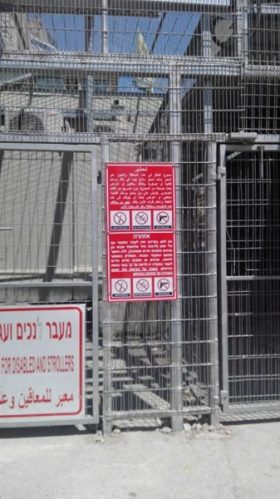
Newly installed sign illustrating the daily restrictions enforced solely for Palestinians
Doing so against the warning, you’d most likely pay with your life. A sentence on the sign says that a ‘permit’ can be applied for to bring any of the mentioned items. But even if that would be successful – assuming a Palestinian wouldn’t just be arrested for just applying for such a permit – or refused like so many Palestinians applying for building permits, it would cost a lot of bravery to actually show up at the checkpoint with any of those items. Bringing ‘banned items’ to the checkpoint, and then telling the heavily-armed soldier: “I’m bringing a knife”. It’s debatable whether that conversation would ever go beyond that point, or rather be cut short by gunshots from a heavily-armed occupation force.
In stark contrast to airports, where the measures are [at least purportedly] for security, in this context they are merely and deliberately solely for humiliation. In international law, a praxis like this is called ‘creating a coercive environment’ in order to facilitate ‘forced displacement’. And that’s what it is about: in an area that so conveniently connects all the illegal settlements within the city center of al-Khalil and on its outskirts, Palestinians are merely considered a nuisance. The attempts to drive them out are thus ever more enforced by the occupying army.
Israel blocks road to Bedouin village, preventing 100 children from going to school
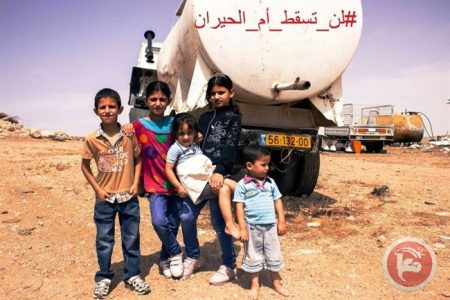
Children in the Bedouin village of Umm al-Hiran in the Negev
Ma’an – June 12, 2017
BETHLEHEM – A recently installed guardrail on an Israeli highway has isolated a Bedouin community in southern Israel for days, preventing 100 Bedouin children from attending school, NGO Adalah reported on Sunday.
According to the group, which focuses on the rights of Palestinian citizens of Israel, Israeli authorities effectively sealed off Umm Bidoun, a Bedouin community in the Negev desert unrecognized by Israel, by blocking off the only dirt road connecting the village to Highway 31 with a guardrail.
The road surface markings on the highway near other passage out of Umm Bidoun have also recently been changed, making it illegal for vehicles to cross the road, Adalah added.
The recent changes have effectively prevented any vehicles, including school buses, from accessing the village, Adalah said.
As a result, the legal NGO stated that, due to the absence of schools in Umm Bidoun, 100 children who study in the village of al-Furaa 15 kilometers away have been unable to go to school for days.
Adalah said on Sunday it had contacted officials from the Israeli Education Ministry, the al-Qasoum regional council, and Netivei Israel, the national roads authority, to demand that the obstacles to freedom of movement for the residents of Umm Bidoun be lifted.
Adalah field researcher Marwan Abu Freih told Ma’an on Monday that Netivei had told the organization that it was examining the issue.
Spokespersons from the Ministry of Education did not immediately respond to a request for comment on the case on Monday.
“It is inconceivable that some 100 students can — in such a sudden and arbitrary manner — be prevented from attending school without any advance notice to or consultation with parents,” Abu Freih said on Sunday. “Adalah and the families demand that the Education Ministry act immediately to correct this situation.”
Abu Freih added on Monday that members of Israel’s parliament, the Knesset, representing Palestinian citizens of Israel, had reached out to Adalah to offer their assistance in resolving the case.
Bedouin villages were established in the Negev soon after the 1948 Arab-Israeli war following the creation of the state of Israel. Many of the Bedouins were forcibly transferred to the village sites during the 17-year period when Palestinians inside Israel were governed under Israeli military law, which ended shortly before Israel’s military takeover of Gaza and the West Bank, including East Jerusalem, in 1967.
Between 160,000 and 170,000 Bedouins are believed to reside in the Negev today, more than half of whom reside in unrecognized villages, according to the Association for Civil Rights in Israel (ACRI).
The classification of their villages as “unrecognized” prevents Bedouins from developing or expanding their communities, while Israeli authorities have also refused to connect unrecognized Bedouin villages to the national water and electricity grids, and have excluded the communities from access to health and educational services.
A Knesset report on Bedouins in Israel noted that “(school) dropout rates are high, among various reasons due to lack of access and public transportation to their schools.”
Meanwhile, Jewish-Israeli communities in the Negev continuously expand, with five new Jewish plans approved last year. According to an investigation undertaken by Israeli rights groups ACRI and Bimkom, two of the approved communities are located in areas where unrecognized Bedouin villages already exist.
Rights groups have claimed that Israeli policies in Bedouin communities are specifically aimed at depopulating the Negev of its Bedouin residents to make room for the expansion of Jewish Israeli communities.
Israel has already Judaised 95% of Jerusalem
MEMO | May 30, 2017
The head of the Islamic and Christian Committee in Jerusalem has stressed the importance of international watchdog reports which condemn Israeli policies in the city, Qudsnet News reported on Monday. Hanna Naser noted that Israel’s occupation authorities have already Judaised 95 per cent of Jerusalem.
“Crimes are not subject to a statute of limitations based on UN treaties,” he pointed out. Israel’s crimes are intended to eradicate the presence of indigenous Jerusalemites in their own city. Although Israel is colonising East Jerusalem with Jewish settlers, said Naser, the demographic balance is in favour of the Palestinians.
He gave details of a number of the Israeli Judaisation projects, including a railway and subway that connect Jewish areas to Al-Buraq (the “Western”) Wall adjoining Al-Aqsa Mosque. He also pointed out that almost $10 million has been allocated to Judaising infrastructure in the Old City.
Commenting on Human Rights Watch’s report that there are 90,000 Palestinians in East Jerusalem living in unlicensed homes, Naser told Qudsnet that this proves that the organisation is angry with the fake Israeli pretext used to justify the refusals of licence applications made by Palestinians. At least 12 international laws and conventions, he pointed out, ban the policy of home demolitions as adopted by Israel, including the Declaration of Human Rights.
On a related issue, Naser revealed that the Israeli foreign ministry has issued a statement to Israeli embassies worldwide claiming that its settlements across the occupied Palestinian territories, including East Jerusalem, are “legitimate and legal”. He also revealed that there is a Jewish tourist attraction being built beneath Al-Aqsa Mosque which is due to open in 2020 with the aim of attracting 6 million visitors a year. A number of fake tombs — almost 10,000 — have been created around the mosque area, he added.
Israeli authorities move forward plan for new illegal West Bank settlement
Ma’an – May 29, 2017
BETHLEHEM – Israeli authorities have greenlit the construction of a new illegal settlement on occupied Palestinian lands, Israeli media reported on Sunday, advancing plans for the first settlement to officially be created by the Israeli government in decades as compensation for residents of the illegal settlement outpost of Amona.
According to news outlet Ynet, the Israeli Civil Administration approved jurisdiction for an area designated for the construction of a new settlement promised by Israeli Prime Minister Benjamin Netanyahu to Amona settlers, after their outpost was evacuated by Israeli authorities in February due to it being built illegally on private Palestinian lands.
However, the settlement, which will be located in the central occupied West Bank and has been referred to as both Amichai and Emek Shilo, still requires the approval of Israel’s military central command before construction can proceed, Ynet reported, adding that the next step of would then be the establishment of a full construction plan.
There are some 196 government recognized Israeli settlements scattered across the Palestinian territory, all considered illegal under international law. While Israeli outposts are considered illegal even under Israeli domestic law, earlier this year, Israel passed the outpost Regularization law, which would pave the way for the retroactive legalization of dozens of Israeli settler outposts.
While the Israeli government has carried out demolitions of Israeli outposts in the past, most notably the demolition of Amona earlier this year, it has at the same time fast-tracked the expansion of official Israeli settlements throughout the Palestinian territory.
“It is still too early to be happy.” Ynet quoted Amona leader Avichai Boaron as saying on Sunday. “Only a GOC Central Command injunction for the establishment of a temporary residential site can take us out of our desperation.”
Boaron added that Amona settlers had still not heard back from the army central command weeks after having requested approval for the settlement construction plan.
Boaron threatened Netanyahu if he did not uphold his promise to the settlers. “If he does not do so, we will have no choice but to unilaterally uphold the agreement and go up to the land on our own,” the Times of Israel quoted him as saying.
Palestine Liberation Organization Executive Committee member Hanan Ashrawi slammed the Israeli plan for the new settlement in March, saying that it “once again proves that Israel is more committed to appeasing its illegal settler population than to abiding by the requirements for stability and a just peace.”
Peace Now meanwhile accused the Israeli government in April of attempting to “fool the international community” by developing a policy of restraint around Israeli settlement construction in name only, while actually contributing to the unfettered expansion of illegal settlements, which has been consistently condemned and deemed illegal by the international community.
Between 500,000 and 600,000 Israelis live in Jewish-only settlements across occupied East Jerusalem and the West Bank in violation of international law, with recent announcements of settlement expansion provoking condemnation from the international community.
Israeli human rights group B’Tselem argued in a report in December that settlers acted as “envoys” of Israel in pushing land grabs in the occupied Palestinian territory, allowing the government to officially detach themselves from the settlers’ violent and illegal actions, while avoiding or blocking any legal penalties that could be imposed on the settlers, except in the most extreme of cases.
“The state helps settlers operate as a mechanism for dispossession in Palestinian space — settlers serving as a means purportedly not under state control, and settlers also use serious violence against Palestinian residents,” the group explained.
Many have linked the increase in Israeli settlement expansion plans in 2017 to the election of US President Donald Trump, who is widely seen as a stalwart ally of the Israeli government, despite Israeli authorities reported postponing decisions regarding settlements to after Trump’s visit to Israel on Monday, the Times of Israel said.
Israeli settlers reportedly destroy Palestinian-owned water well near Bethlehem
Ma’an – May 3, 2017
BETHLEHEM – Israeli settlers destroyed a Palestinian-owned water well on Tuesday in the town of al-Khader south of Bethlehem in the southern occupied West Bank, according to official Palestinians news agency Wafa.
Hasan Brijiyeh, a local activist from the separation wall and settlements’ committee in Bethlehem, told Wafa that a group of Israeli settlers destroyed the well under the protection of Israeli forces, identifying the owner of the well as Ahmad Ghnaim.
The 100-square-meter well was built almost 250 years ago, according to the report, and is located near the illegal settlement outpost of Sde Boaz, built on Palestinian-owned land.
Two weeks ago, Wafa reported that Israeli settlers from Sde Boaz razed privately-owned Palestinian land in the Wadi al-Ghawit area in the western outskirts of al-Khader, and physically assaulted the Palestinian landowner.
Sde Boaz, also known as Nevi Daniel North, was established in 2002 when settlers from the established illegal Nevi Daniel settlement took over a hilltop about 1.5 kilometers north of Nevi Daniel.
Israeli settlers from Sde Boaz destroyed over 300 newly planted grape vines belonging to the Sbeihs in 2014.
Some 600,000 Israeli settlers live in settlements across the occupied West Bank and East Jerusalem, in contravention of international law.
The international community regards all settlements built on occupied Palestinian land to be illegal, though the Israeli government distinguishes between the state-sponsored settlements and dozens of unauthorized outposts like Sde Boaz.
Israel’s parliament, the Knesset, passed the outpost “Regularization law” in February, which could grant official Israeli governmental recognition to more than a dozen illegal settlement outposts in the West Bank established on private Palestinian lands.
Israeli terrorists incite murder of Arabs south of Nablus
Palestine Information Center – May 3, 2017
NABLUS – Israeli settlers at predawn Wednesday preformed sacrilegious rituals and yelled “death to Arabs” at Yitzhar crossroads, south of Nablus.
Palestinians driving in the area said over 100 Israeli settlers, escorted by heavily-armed soldiers, flocked to the northern entrance to Hawara town, south of Nablus, and yelled anti-Arab chants.
The Israeli settlers further called for revenge against the Palestinians, shouting “Death to Arabs and Muslims.”
On Tuesday evening, a horde of Israeli fanatics showed up at Hawara checkpoint and on the access road to Bracha settlement, illegally built on Palestinian land in Kafr Kalil and Irak Burin, to mark Israel’s establishment anniversary on the land of Palestine.
Israel denies compensation to family of toddler burned to death
Palestine Information Center – May 1, 2017
OCCUPIED JERUSALEM – Israel will not pay terror victims’ compensation to Ahmed Dawabsha, a Palestinian boy whose parents and brother were killed in a 2015 arson attack carried out on their home by Israeli settlers, Israel’s war minister Avigdor Lieberman told a Knesset member in an official correspondence on the issue.
Writing to Joint (Arab) List MK Yousef Jabareen in response to a question as to why the now-orphaned Ahmed has not yet received money from Israel, Lieberman said the 6-year-old, who was badly injured in the attack, does not qualify as a “terror victim” and will therefore not receive compensation.
According to the Times of Israel daily, the current law stipulates that Israel must compensate Israelis affected by terrorism, but does not apply to Palestinians “who are not citizens or residents of Israel,” Lieberman wrote.
In January 2016, then-attorney general Yehuda Weinstein rejected a request from Jabareen for Dawabsha to be recognized as a terror victim.
“The compensation should be a right, not a gift,” he claimed. “The state needs to give him full compensation due to the severe incident he has suffered.”
Jabareen said the family would now “turn to the courts” in order to seek both recognition and compensation for Dawabsha.
Two homes in Duma, south of Nablus, were set alight in the July 31 attack. In the attack, Ali Dawabsha,18 months old, was burned to death and father Saad Dawabsha, his wife Riham and their son Ahmad, who was four at the time, were critically injured. Saad died in August and Riham in September. The only surviving member of the family, Ahmed, received months of treatment for severe burns.
Responding to Lieberman’s letter, Jabareen accused the war minister of implementing a racist policy towards the Palestinians.
“The defense minister’s position is based on racial discrimination,” Jabareen said in a statement. “If we were talking about Jewish settlers hurt by Palestinians, the victims would automatically receive compensation.”
The attack caused massive outrage in the occupied Palestinian territories and around the world.
In January 2016, a 21-year-old Israeli settler—Amiram Ben-Uliel—and an unnamed 16-year-old minor were indicted for carrying out the Duma terror attack.
Israeli travel agencies will soon have to promise not to send tourists to the West Bank
Ma’an – April 24, 2017
BETHLEHEM – Israeli authorities have notified Israeli travel agencies that they will be forced to sign a commitment pledging not to take groups of tourists to the occupied West Bank, according to a copy the notification obtained by Ma’an on Sunday.
In the Hebrew-language document dated April 23, the Border Control Department of the Israeli Population and Immigration Authority notifies travel agencies that as of May 15, the day when Palestinians commemorate the 1948 Nakba, they will have to “attach, with each request to bring a group of tourists into the country, a special form pledging that they will not send tourists to Judea and Samaria,” using the Israeli term for the occupied West Bank.
The document only addresses Israeli tourism agencies, and not individual would-be tourists.
The forms must be signed and sent to one of three Population and Immigration Authority email addresses listed in the document.
The document warns tourism agencies that their requests to bring groups of tourists would “not be processed” if the pledge was not signed and attached.
A spokesperson for the Israeli Population and Migration Authority could not immediately be reached for comment.
If implemented, the new regulation described in the document would be an additional blow to a suffering tourism industry in the occupied West Bank, which already has to contend with numerous unequal laws and restrictions that have crippled the Palestinian market, while investing millions of dollars in the Israeli market.
A number of sites which attract thousands of visitors each year, such as the Nativity Church in Bethlehem, could be affected by this directive.
“Israel’s occupation and colonization of Palestine is not limited only to its military elements, but is also manifested in its use of tourism as a political tool. It is a tool used to strengthen its position as occupying power, and to maintain its domination over Palestinian land and people, but also as an instrument for the dissemination of propaganda to millions of tourists, including politicians, community leaders and journalists who receive free-of-charge first class tours to Israel,” human rights lawyer and legal researcher Amjad Alqasis wrote in 2015.
As current regulations stand, when applying for visas, Israeli tourism agencies only need to submit names and passport numbers, while Palestinian agencies attempting the same are met with administrative obstacles, and cannot guarantee that their visa requests will be accepted.
Tourists who tell Israeli border control officials of their intention to visit the occupied West Bank also face the possibility of undergoing lengthy interrogations, or even deportation for alleged security reasons, or without being provided an explanation at all.
When tourists are able to reach the occupied West Bank, they are then forced to negotiate with hundreds of Israeli checkpoints and other military obstacles that restrict movement for Palestinians both within the West Bank and along its borders with Israel and Jordan.
“Another obstacle to operating a tour is the presence of 500,000 to 600,000 illegal Israeli Jewish settlers currently living in the occupied Palestinian territory,” who “constitute a growing and consistent threat to Palestinian livelihoods,” including Palestinian tour guides, Alqasis noted.
Several Palestinians hospitalized over multiple settler attacks in Nablus area
Ma’an – April 22, 2017
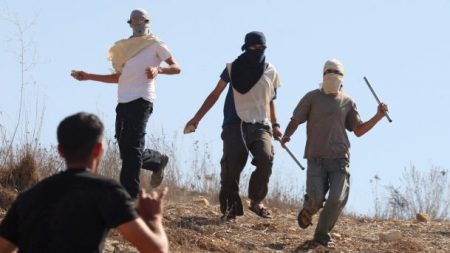
NABLUS – Israeli forces shot and injured four Palestinians with rubber-coated steel bullets, after residents in a Palestinian village south of Nablus in the northern occupied West Bank gathered to defend their homes from a mob of Israeli settlers that stormed the community. Hours later, two Palestinians were hospitalized when a group of settlers attacked Palestinians in a nearby village.
Ghassan Daghlas, an official who monitors settler activities in the northern West Bank, told Ma’an that some 100 “extremist settlers” from the illegal Yitzhar settlement entered the village of Urif from its east side and proceeded to smash windows of houses, included one belonging to resident Munir al-Nouri.
He added that the settlers were about to break into the house before Palestinian villagers gathered and forced them away.
According to a Facebook group for Urif, loudspeakers from the village’s mosque were used to inform residents of the incident and to urge them to help defend the homes from the “herds of settlers” attacking the village.
Minutes later, Daghlas said, a number of Israeli military vehicles stormed the village to protect the Israelis.
Clashes erupted between Palestinians youth and Israeli forces who “haphazardly” fired tear gas canisters, stun grenades, and rubber-coated steel bullets at Palestinians, according to Daghlas.
Daghlas said that four Palestinians were shot with rubber-coated steel bullets, one of whom was hit in the head. Medical sources said that Adel al-Safadi, Jihad Saad, Mustafa Fawzi, and Sharif Abd al-Hafith were taken to Rafidiya hospital to be treated for the gunshot injuries.
An Israeli army spokesperson told Ma’an that a “violent dispute erupted between Israelis and Palestinians” who she said were “mutually throwing rocks at each other in an area around the village.” When Israeli forces arrived to “disperse the dispute, several Palestinians shot flares at (Israeli) forces.”
In response, Israeli forces used “riot dispersal means,” she said. No Israeli were reported injured
Later Saturday afternoon, Daghlas said that another group of Israeli settlers attacked Palestinian homes in the town of Huwwara, just a few kilometers away from Urif, on the southeastern edge of Yitzhar.
Daghlas said that dozens of settlers attacked Palestinians and their homes with stones and “sharp objects.” A 72-year-old woman, Badiah Muhammad Hamdan, and a young man identified as Ahmad Yousif Udah were hospitalized. Daghlas said Hamdan sustained head injuries.
A video shared on social media showed the woman, bloodied and incapacitated, being evacuated in an ambulance.
Separately, a young Palestinian man was run over by an Israeli settler later Saturday afternoon in al-Masoudiyya west of Nablus city, Daghlas said.
Daghlas told Ma’an that 19-year-old Asim Salim from Nablus city was evacuated to Rafidiya hospital, where doctors said he sustained moderate wounds. Daghlas added that Salim was trying to cross the road in al-Masoudiyya when a settler’s vehicle hit him and fled the scene.
An Israeli border police spokesperson could not be reached for comment on the reported hit and run.
According to the Applied Research Institute – Jerusalem (ARIJ), since the state of Israel confiscated land from Urif and other Palestinian villages to establish the illegal Yithzar settlement in the 1980s, “attacks and violence perpetrated by settlers has had a profoundly negative impact on Palestinian residents and their property,” stressing that Yitzhar “poses a daily threat to residents of the neighboring Palestinian villages.”
Settlers have also been known to steal crops, damage and burn trees and other plants, and attack places of worship in the area, in an attempt to intimidate Palestinian villagers and farmers from using their land.
On Friday, a video was released showing 15 masked Israeli settlers attacking Israeli activists in the central West Bank, throwing rocks and hitting the activists with clubs.
Many Palestinian activists and rights groups have meanwhile accused Israel of fostering a “culture of impunity” for Israeli settlers and soldiers committing violent acts against Palestinians.
In March, Israeli NGO Yesh Din revealed that Israeli authorities served indictments in only 8.2 percent of cases of Israeli settlers committing anti-Palestinian crimes in the occupied West Bank in the past three years.
Between 500,000 and 600,000 Israelis live in Jewish-only settlements across occupied East Jerusalem and the West Bank in violation of international law, with recent announcements of settlement expansion provoking condemnation from the international community.
According to the United Nations Office for the Coordination of Humanitarian Affairs (OCHA), there were a total of 221 reported settler attacks against Palestinians and their properties in the West Bank and occupied East Jerusalem in 2015, and 107 in 2016.
Israeli settler attempts to run over Palestinians near Hebron
Ma’an – April 7, 2017
HEBRON – Two Palestinians from the Hebron-area village of Beit Ummar were lightly injured Friday after an Israeli settler attempted to run them over on a main road connecting the southern occupied West Bank city of Hebron to Jerusalem.
Local activist Muhammad Awad told Ma’an that an Israeli settler was driving on the road, located near Beit Ummar, when the settler attempted to to run over Palestinians Muhammad Basem Khader al-Alami, 25, and Saed Samir Hassan al-Salibi, 20.
“The Israeli settler drove very fast with his car towards the two, who noticed the settler’s car rushing towards them at the last moment, causing them to fall on the side of the street, while the Israeli settler escaped,” Awad said, describing the scene to Ma’an.
An Israeli army spokesperson said they were looking into reports.
The incident came a day after Israeli settlers from the illegal settlement of Yitzhar in the northern West Bank closed a Nablus-area road in protest, calling for “revenge” on Palestinians after an alleged car-ramming attack was carried out earlier in the day near the illegal Israeli Ofra settlement in Ramallah, which killed an Israeli soldier and wounded another moderately.
Incidents involving Israeli settlers hitting Palestinians in the occupied Palestinian territory are a relatively regular occurrence, and are usually treated by Israeli security forces as accidents, even in cases when witnesses claim the car rammings were deliberate.
Many Palestinian activists and rights groups have accused Israel of fostering a “culture of impunity” for Israeli settlers and soldiers committing violent acts against Palestinians.
Between 500,000 and 600,000 Israelis live in Jewish-only settlements across occupied East Jerusalem and the West Bank in violation of international law, with announcements of settlement expansion earlier this year sparking condemnation from the international community.
According to the United Nations Office for the Coordination of Humanitarian Affairs (OCHA), there were a total of 107 reported settler attacks against Palestinians and their properties in the West Bank and occupied East Jerusalem in 2016.
Silwan Palestinians receive evacuation orders due to damage caused by Israeli tunnels
Ma’an – April 6, 2017
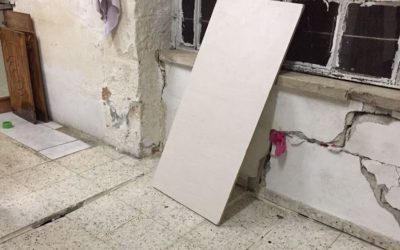
JERUSALEM – The Israeli municipality of Jerusalem issued evacuation orders for three housing apartments in the Wadi Hilweh area of the occupied East Jerusalem neighborhood of Silwan on Wednesday evening, due to fractures and cracks formed at the base of the houses, as Israeli authorities continued work on a tunnel network expected to be used to provide services to Israeli settlers.
According to the Wadi Hilweh Information Center, the houses belong to Hamed Oweida, Abed Oweida, and Suleiman Oweida.
Sixteen family members, including ten children, reside in the houses.
The Oweida family said that Israeli tunnel-digging under their homes has increased over the past three days, adding that loud noises from the digging would last for several hours, while the family could feel their houses shaking during the construction.
They said that the digging had caused severe damage of fractures and cracks in the walls and the bases of the houses.
The family added that they had called the Israeli police, who had then summoned a municipality team to inspect the houses. After taking photographs and inspecting the damage, an architect for the municipality decided to issue an emergency order for the families to evacuate and seal the houses, saying that it was dangerous to remain inside.
Suleiman Oweida had left his house several days ago after fractures in the walls had become more severe.
The information center said that Israeli authorities were creating a tunnel network for Israeli settlers directly under the Oweida family’s house.
Member of the Wadi Hilweh neighborhood committee Ahmad Qarrain said that the Israeli authorities began work under the neighborhood in 2007.
The residents at the time appealed to Israeli courts and were able to halt the construction under their homes for 14 months. However, Israeli courts later issued another order allowing the work to continue on the condition that the digging not endanger the lives of residents.
However, Qarrain said that the digging and work under the houses continued “without any consideration for the safety of residents,” and pointed out that the streets, walls, structures, and houses of the neighborhood have also been fractured and collapsed owing to the tunnel work.

A spokesperson for the Israeli Jerusalem municipality told Ma’an that the municipality had informed the residents that their properties were “unsound and dangerous” out of “concern for their own welfare,” while also being built “without regard for building codes or safety standards.”
The spokesperson added that “claims that the city is attempting to construct underneath this family’s structure are patently false.”
Featured Video

How Many More Gulf States Get Dragged Into Trump’s Iran War?
or go to
Aletho News Archives – Video-Images
Villains of Judea
David Wurmser
A shadowy neocon strategist spent 30 years maneuvering Washington toward war with Iran

José Niño Unfiltered | November 17, 2026
As American forces clash with Iran in 2026, a decades-long campaign orchestrated from the shadows of Washington has finally reached its climax. Earlier this year, foreign policy strategist David Wurmser openly called for Washington to let Israel start a war of aggression against Tehran, portraying the conflict as a historic reckoning akin to the Soviet collapse. For avid critics of American foreign policy, the current war represents the ultimate triumph of a shadowy Jewish operative who spent over 30 years advancing Israeli strategic priorities inside the highest echelons of the United States government.
Born in Switzerland, David Wurmser earned three degrees from Johns Hopkins University, including a doctorate. He spent 11 years in Navy Reserve intelligence and reached the rank of lieutenant commander. During that service, the Defense Intelligence Agency mobilized him for its Iraq Intelligence Task Force in 1994, 1996 and 1998.
Yet his defining partnership was personal as much as institutional. His Israeli born wife, Meyrav Wurmser, wrote her doctoral dissertation on Revisionist Zionism. In 1998, she cofounded the Middle East Media Research Institute, known as MEMRI, with Yigal Carmon, a former colonel in the Israeli military. Carmon served in Israel Defense Forces intelligence from 1968 to 1988. He later advised prime ministers Yitzhak Rabin and Yitzhak Shamir on counterterrorism.
During the mid-1990s, Wurmser moved seamlessly between Washington institutions and Jerusalem policy circles. … continue
Blog Roll
 Aletho News
- How Many More Gulf States Get Dragged Into Trump’s Iran War? | Matt Bracken
- US-Iran escalation: The side effects and benefits of low intensity war
- Lebanon on the Brink: How Washington and Tel Aviv Turned the “Peace Process” into an Instrument of Pressure
- Before Laundering The Iran Dirty Bomb Hoax, Jake Tapper Was Israel’s Chief Propagandist For Genocide.
- Minuteman III Test at APEC Opening Aimed to Show US Remains a Dangerous Power – Ex-Pentagon Analyst
- Estonia’s border closure is collective punishment of ethnic Russians
- US Plan to Toughen Restrictions on Chip Exports to China After Nvidia Scandal – Reports
- Villains of Judea: David Wurmser
- Anthony Aguilar: The Point of No Return Has Been Reached
- Iran accuses NYT report of paving way for attacks on dams
- If Americans Knew
- An error has occurred; the feed is probably down. Try again later.
- No Tricks Zone
- Argentina’s Perito Moreno Glacier Joins Antarctica and Arctic In Defying Doomsday Melt Claims
- New Study: Barents Sea Temperatures Were Warmer And Sea Ice Less Extensive In The 1700s Than Today
- German Authorities Start Initiative To Evaluate Public Register For Climate “Disinformation” Spreaders!
- Zonal Asymmetry of Temperature Change in the Antarctic Circumpolar Current
- New Study: The Net Fossil Fuel Contribution To Rising Atmospheric CO2 Has Been Zero For 500 Years
- Germany’s Green Energy Transition Becoming Increasingly Expensive…Another 6 Trillion Euros!
- Sudden Stratospheric Warming, Powerful El Niño Combination May Lead To Extreme Europe Cold, Energy Crisis!
- Two New Studies Find Thwaites Glacier Melt Cannot Be Driven By Human Activity Or A Warming Ocean
- E-Cars Reduce CO2 Emissions By Only 41% Compared To Internal Combustion Engine Vehicles
- Predictions Made By Renowned Climate Professor Over Past Decades Have Been Proven To Be Poor

