UN General Assembly: Israel’s actions in Jerusalem are null and void
MEMO | November 27, 2014
The United Nations General Assembly adopted six resolutions regarding Israeli occupied territories through a recorded vote last night, addressing the areas of Jerusalem and the Syrian Golan.
In terms of Jerusalem, the Assembly voted on a resolution confirming that all legislative and administrative measures taken by Israel to change the legal status of the Holy City of Jerusalem are null and void.
The decision was supported by a recorded vote of 144 countries in favour, six countries opposed, namely Canada, Israel, Marshall Islands, Micronesia, Palau and United States, while ten countries abstained from the vote (Australia, Cameroon, Central African Republic, Madagascar, Panama, Papua New Guinea, Paraguay, Togo and Tonga and Vanuatu).
The Assembly also adopted a resolution that stressed the need for Israel, the occupying power, to withdraw from the occupied Palestinian territories, and demanded the complete cessation of all Israeli settlement activity and Israel’s compliance with its obligations under international law.
The Assembly’s decision also outlined the need for delivering humanitarian and medical aid to the Palestinians.
Another decision was implemented regarding the Syrian Golan Heights as a result of the Assembly’s concern for Israel’s lack of compliance with Resolution 497 (issued in 1981) calling on Israel to withdraw its forces from the Golan Heights which have been illegally occupied since 1967. The decision was supported by 99 countries, rejected by six, while 57 (mostly European) countries abstained from the vote.
Israel transforms Jerusalem’s suburbs into a “big prison”
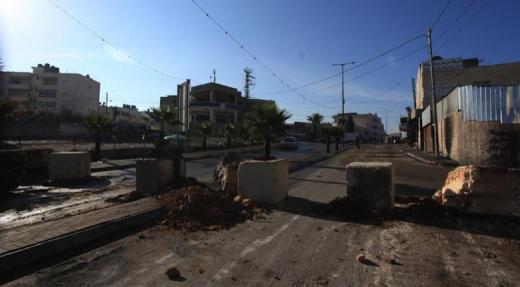
Concrete blocks are placed by Occupation security forces at the entrances to the Palestinian village of al-Ram, northeast of Jerusalem on November 19, 2014. Issam Rimawi – Anadolu Agency
By Mohammed Abdel Fattah | Al-Akhbar | November 26, 2014
Perhaps Israeli prisons can not accommodate more Palestinians, and so Israeli authorities have now chosen to imprison Palestinians inside their villages, especially in the suburbs of Jerusalem. That is part of the collective punishment inflicted on villages, whose residents dared to rise up against the occupation and the discriminatory policies it imposes on Palestinians – such as preventing them from praying at al-Aqsa Mosque, repeatedly storming the mosque, and turning a blind eye on violence and murder of Palestinians at the hands of fanatical Israeli settlers.
Occupied Jerusalem – The Israeli response to a village that revolts is to surround it with concrete barriers and military checkpoints, in addition to using weapons of all types and sizes against young demonstrators. Recently, the occupation forces began to seal off the villages of Hay al-Thawri, Sur Baher and al-Ram in the Jerusalem district after a series of protests against the killing of Ghassan and Uday Abu Jamal, both of whom carried out the recent Knesset operation. Before sealing off these villages, the Israelis encircled and sealed off the village of al-Issawiya, but the concrete barriers were later removed from its entrances following a protest by hundreds of its residents.
Sur Baher, located south of occupied Jerusalem, continues to be closed, hemming in its 27,000 residents. The Israelis tightened the noose around the village by closing its entrances with concrete barriers, leaving only one route for its residents. The people of Sur Baher enter and leave the village through that road, where an Israeli military checkpoint manned by abusive Israeli soldiers regularly mistreat anyone who passes by on foot or in a vehicle. Going in and out of the village presently takes an hour, while Israeli soldiers search every single person from head to toe and search cars from the hood to the trunk.
Students are forced to step out of cars and buses to cross the checkpoint on foot in order to get to school even if that means arriving half an hour late.
The director of the company Sur Baher Buses for Public Transportation, Raafat Nimr, complained that now they have to leave an hour before it is time to pick up students from outside the village to be able to drop them off at school somewhat on time.
He said his and other bus companies have suffered from closing the village and restricting access in and out to one checkpoint as it cut the number of trips buses take from the village in half. This will force the company to close down soon because the cost of “loading passengers increased and there is no longer a large number of trips to make up for it,” he said.
People who do not have a business to take care of outside the village have decided not to leave the village so that they won’t get upset and agitated. For example, Hamza Umaira has not left Sur Baher for a week. Besides, Israeli soldiers at the checkpoint regularly prevent him from going to Jerusalem to pray at al-Aqsa Mosque.
In Hay al-Thawri, where the family of Moataz Hijazi lives, the martyr who carried out the assassination attempt on the life of the extremist rabbi, Yehudah Glick, the situation is as bad as the rest. Like Sur Baher, the Israeli occupation sealed the village twice. The first time after killing Hijazi and the second time after the operation carried out by Ghassan and Uday Abu Jamal. The difference with this neighborhood to others is that it has been encircled with concrete barriers without military checkpoints. This prompts people to take bypass roads, delaying workers and students.
The town facing the worst mistreatment is al-Ram, whose closure affects the residents of the nearby Qalandia refugee camp as they go to and from Ramallah and Jerusalem. In addition to closing the northern entrance to the town with concrete blocks, the closure affects the revenue of businesses located along the road to the northern entrance. The Israeli authorities also closed the Jabaa road adjacent to the town, thereby creating a suffocating traffic jam that takes people two hours to get out of.
Just like the average citizen suffers, medical services suffer too. Turning the Palestinian villages surrounding Jerusalem into “large prisons” obstructs ambulances and prevents them from reaching areas where sick and wounded people need to be taken to hospitals.
Palestinian Red Crescent official, Amin Abu Ghazaleh, said that Israeli occupation forces deal with Red Crescent ambulances as though they are part of the young people’s uprising against them, especially after Israeli ambulances refused to enter Arab areas.
He pointed out that Israeli soldiers did not make it easy for ambulances to enter confrontation areas, treat the injured there or transfer them to hospitals. Instead, they refused to remove any barriers, which increases the rate of field medical treatment.
Residents of the villages facing closure believe that this policy will add to the tension in the city because most of their villages lack basic facilities, such as hospitals and markets.
For his part, political analyst, Fadel Tahboub argues that “Israelis do not want to calm the situation down in Jerusalem, so they continue to close villages and settlers continue to storm al-Aqsa Mosque.”
“The goal of the Israeli occupation is to isolate the Palestinian villages from Jerusalem in order to reduce the Arab population in the city, and to pave the way for annexing them to the West Bank at a later time, completely disconnecting them from occupied Jerusalem,” he concluded.
Jerusalem child shot by Israeli forces loses eyesight
Ma’an – 14/11/2014
JERUSALEM – An 11-year-old Palestinian child shot in the face by a sponge bullet during clashes in al-Issawiya on Thursday has been left blind in one eye, a local official said.
Member of a local neighborhood committee, Muhammad Abu al-Hummus, told Ma’an that Saleh Samer Attiyeh Mahmoud, 11, was shot in the face at close range by Israeli forces firing sponge bullets in al-Issawiya during clashes.
He was hit directly between the eyes, causing severe bleeding to his nose and the loss of sight in his left eye. The vision in his right eye is also severely damaged.
Villagers in the East Jerusalem neighborhood were protesting the closure of three out of four entrances to the village by Israeli forces when the incident took place.
Sponge rounds are made from high-density plastic with a foam-rubber head, and are fired from grenade launchers.
Israeli police have been using them in Israel and occupied East Jerusalem since the use of rubber-coated metal bullets was prohibited, but protocol explicitly prohibits firing them at the upper body.
Palestinian activists cross separation wall in protest action
Ma’an – 14/11/2014
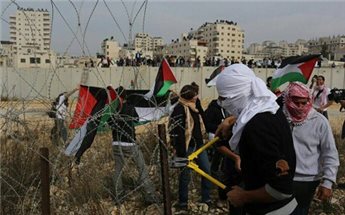 RAMALLAH – Dozens of Palestinian activists crossed Israel’s separation wall on Friday near Qalandia checkpoint as part of a series of non-violent protest actions to demonstrate solidarity with Jerusalem.
Activists used makeshift ramparts, ladders and cut through barbed wire to climb over the separation wall near Qalandia military checkpoint, which is at least six-eight meters in height.
The action was part of a campaign entitled #On2Jerusalem that was organized by the Popular Resistance Committees.
Coordinator of the popular committees, Salah Khawaja, said they attempted to enter Jerusalem but were prevented from doing so by Israeli forces, who deployed heavily in the area.
Israeli forces used live fire, tear gas canisters, stun grenades and rubber-coated steel bullets to disperse the march.
Dozens of Palestinian activists also gathered near the village of Hizma carrying Palestinian flags and shouting slogans in support of Jerusalem.
Several youths were injured as Israeli forces opened fire at them to prevent them crossing the checkpoint. The activists managed to close the road, with Israeli forces preventing settlers from traveling to the area.
Dozens of activists also demonstrated by the entrance to Maale Adumim settlement waving Palestinian flags.
“They attempted to detain us for carrying Palestinian flags,” Khawaja said. “What we did today was to emphasize that we do not have a choice but popular resistance and clashing with Israel is a part of our fight to stop Israeli crimes against Palestinians”
An Israeli army spokeswoman said there was an “attempt” to cross the wall, without providing further details.
Al-Arabiya echoes Zionist rhetoric in reporting about al-Aqsa
By Zeinab Hawi | Al-Akhbar | November 6, 2014
It was rather normal for Al-Arabiya news channel to retract its story about the unprecedented closure of al-Aqsa Mosque on October 28. The channel may have thought that the terminology it used would go unnoticed. However, Al-Arabiya later deleted the story from its website after having caused an online backlash for echoing Zionist rhetoric.
In an act further promoting Zionist terminology, the Saudi news channel replaced al-Aqsa Mosque with the “the holy compound,” a term usually reserved for Zionists in their reference to the holy site.
In fact, Israel had closed the mosque following the shooting of hardline Rabbi Yehuda Glick [allegedly] by Palestinian Mutaz Hijazi, with Al-Arabiya reporting the news as, “A right-wing Israeli activist was shot and wounded last night as he left a conference promoting a campaign to permit both Jews and Muslims to pray at the holy compound.”
The channel, hence, adopted the terminology used by Zionists. This caused an angry backlash over social media websites, with activists accusing Al-Arabiya of committing “political and religious treason” by adhering to the “Zionist plan” to Judaize Palestine.
However, after thoroughly reading Al-Arabiya’s report, one would notice that the channel not only resorted to Zionist terms, but framed the story in a manner that reflected the channel’s policy that complies with Zionism. The term “occupation” did not appear, not even by chance, and the channel opted to use “Israeli police” instead. Moreover, the story depicted Jewish hardliners present at al-Aqsa on an equal footing with Palestinians.
The story was hence reported as follows, “the Israeli police closed the Noble Sanctuary… in a rare step aiming to prevent clashes between Muslims and Jews.”
The hardline rabbi who was calling to “open the doors of the Noble Sanctuary for Jews” and promoting “prayers that gather both Muslims and Jews” is for Al-Arabiya a simple “right- wing Israeli activist.”
The scandalous coverage did not stop there; it also “reassured” that the Palestinian shooter – “the sole suspect” in the incident – was shot and killed by a police special force unit at his house in Abu al-Thuri neighborhood in Jerusalem.
Al-Arabiya did not settle for such biased reporting, it also quoted the director of Shaare Zedek Medical Center as saying that the rabbi is in “critical but stable” condition and that he underwent surgery after being shot in the chest and abdomen.
The closure of the al-Aqsa Mosque apparently meant nothing for the Saudi channel. It was more interested in reassuring the public about the health of the injured Zionist and making sure that the shooter “got what he deserved.”
In the end, it is not merely about adopting the Zionist settlers’ policy to change the understanding of the issue and the terminology used to define it, but it is about adopting a process aimed at wiping out the cause of not just a people but an entire nation, which the Saudi channel and its affiliates are slowly paving the way for.
Dozens injured during Aqsa clashes, several detained
Ma’an – November 5, 2014
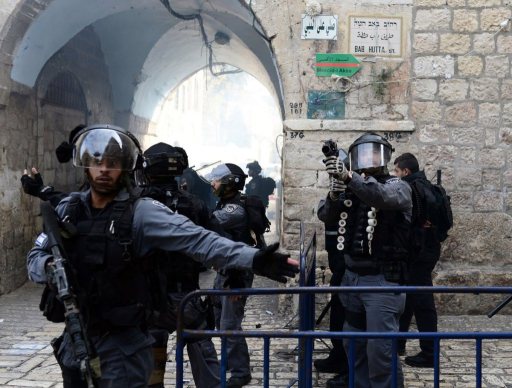
JERUSALEM – Dozens of Palestinians suffered tear-gas inhalation and several others were injured by stun grenades, shrapnel and rubber-coated steel bullets during clashes in the Al-Aqsa mosque compound area on Wednesday, an official said.
Palestinian Red Crescent official Amin Abu Ghazaleh told Ma’an that Red Crescent ambulances moved nine injured to the Al-Maqased Hospital where their injuries were reported as moderate.
Two were injured in the eye, and 32 with stun grenades, shrapnel and rubber-coated steel bullets in addition to many who suffered severe gas inhalation.
Three Palestinian members of Israel’s Knesset, Hanin Zoabi, Talab Abu Arrar and Ibrahim Sarsour, were able to enter the mosque during the closure and clashes.
Israeli soldiers neared the Al-Qabali mosque inside the compound as they fired stun grenades and tear-gas bombs inside, the director of the Al-Aqsa Mosque, Sheikh Omar al-Kiswani, said.
He said that a fire erupted inside the muezzin’s hall and cables and speakers were also burned and damaged.
Soldiers “deliberately” threw holy books on the floor, he alleged.
Israeli forces detained Tareq al-Hashlamon, an employee of the Islamic endowment department, after assaulting him inside Al-Aqsa, along with another endowment employee identified as Hussam Seder and three Palestinians.
Four Palestinians were also detained, one of them a minor. Two others were identified as Omar al-Kilani and Amin Qirsh.
Meanwhile, Jordan recalled its ambassador to Israel over the violence.
Jordanian Prime Minister Abdullah Nsur asked the foreign minister to “recall the Jordanian ambassador from Tel Aviv in protest at Israel’s escalation on the Al-Aqsa mosque compound,” the Petra news agency reported.
The clashes came amid continued tensions over right-wing Jewish demands to be able to pray inside the compound despite being off-limits in mainstream Judaism, in addition to the expansion of Israeli settlement building in Palestinian East Jerusalem.
Earlier, a police spokeswoman said that “Dozens of masked protesters threw stones and firecrackers at security forces who then entered the Temple Mount and pushed the demonstrators back inside the mosque.”
Israeli occupation authorities demolish two homes in East Jerusalem
MEMO | November 4, 2014
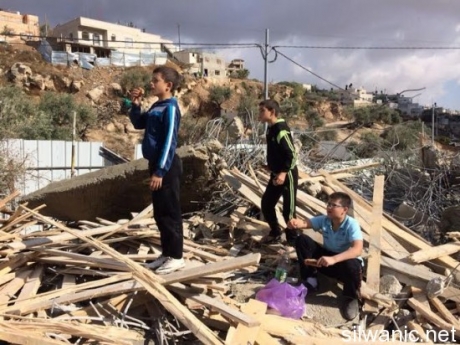
Israel demolished two homes in Silwan, south of Al-Aqsa Mosque in East Jerusalem, today claiming they were constructed without a license, eye witnesses said.
Eye witnesses reported that “a large bulldozer belonging to the Israeli municipality arrived this morning at Wadi Yasoul in Silwan accompanied by Israeli police and army forces.”
They added: “The Israeli forces surrounded the home of the released prisoner Khalil Abu Rajab and demolished it before demolishing Assem Abu Subaih’s home.”
Witnesses noted that the “demolition occurred without prior warning. There are concerns that more demolitions will take place in the area.”
“Abu Subaih’s home consists of three rooms and he lived in it with his five family members. As for Abu Rajab’s home, it was made up of two apartments he lived in with seven family members and his mother,” sources reported.
These demolitions occurred after Israeli media outlets reported a few days ago that the Israeli Mayor of Jerusalem Nir Barkat approved a series of sanctions against Palestinians in the city, including demolishing unlicensed homes “in order to stop the phenomenon of throwing rocks”.
Various clashes between the Palestinian youth and Israeli forces have continued in a number of neighbourhoods in East Jerusalem since last July.
Palestinian, Israeli and international human rights organisations noted that while the municipality has been increasingly giving building permits to Israelis in East Jerusalem, it is restricting construction work done by Palestinians, which forces many to build without permits.
The Israeli Information Centre for Human Rights in the Occupied Territories (B’tselem) said: “While large-scale constructing and major investments are being carried out in Jewish neighbourhoods, the Israeli authorities are working on stifling all development and construction for Palestinian residents, which make up about a third of the city’s population.”
The Planning and Building Committee of the Israeli Ministry of Interior approved the construction of 500 settlement units in Ramat Shlomo settlement in Shuafat in northern Jerusalem yesterday which provoked Palestinian and international criticism.
Palestinian stone-throwers face up to 20 years in Israel prison
Al-Akhbar | November 3, 2014
Israeli cabinet on Sunday approved an amendment to the Israeli penal code to enable more severe punishment against Palestinians convicted of involvement in “stone-throwing” attacks against Israeli targets.
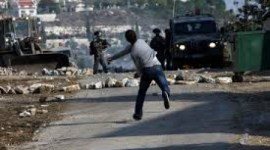 The new sections, which will be added to the Israeli penal code, would allow the imposition of a prison sentence up to 20 years for those convicted of throwing stones or other objects at Israeli vehicles.
“Israel is strongly acting against terrorists, against who throw stones, Molotov cocktails and fireworks,” Israeli Prime Minister Benjamin Netanyahu said at the weekly cabinet meeting.
Netanyahu went on to say that the new legislation aims to restore what he called “peace to all parts of Jerusalem.”
“We will dedicate massive force and an aggressive legislation to restore quiet and security to every part of our capital,” he added.
The new code would slap an imprisonment sentence of ten years against whoever throws stones or other objects at vehicles and 20 years for doing so with the view of exposing passengers to danger. Whoever throws rocks at police cars in order to obstruct the work of Israeli police will be jailed for up to five years.
Moreover, the law would also allow Israeli forces to imprison Palestinian minors under the pretext of allegedly endangering the lives of Israelis by throwing stones.
On Friday, Israeli Occupation Forces in occupied East Jerusalem attempted to detain two Palestinian children, a two-year-old and a nine-year old, on suspicion of throwing stones.
Last week, Israeli forces detained four Palestinian children, aged 13 to 16, for allegedly throwing stones at Israeli cars.
In 2013, a group of seven Israeli soldiers and an officer detained 5-year old Wadi’a Maswadeh after the boy allegedly threw a stone at a Zionist settler’s car at a checkpoint near Hebron.
According to a 2013 UN children’s fund’s report, over the past decade, Israeli forces have arrested, interrogated and prosecuted around 7,000 children between 12 and 17, mostly boys, noting the rate was equivalent to “an average of two children each day.”
A report by Defense for Children International (DCI) published in May 2014 said Israeli jails 20 percent of Palestinian children prisoners in solitary confinement. … Full article
28 injured as clashes rage across Jerusalem overnight
Ma’an – 01/11/2014
JERUSALEM – At least 28 Palestinians were injured as clashes with Israeli forces continued into the late hours of the night on Friday across Jerusalem, as anger over a series of killings by Israeli police boiled over into the streets of the city’s Palestinian neighborhoods.
Clashes broke out in the occupied East Jerusalem neighborhoods of Silwan, al-Issawiya, al-Tur, and Wadi al-Joz, as hundreds marched and fought pitched battles with security forces in anger over the killing of Mutaz Hijazi, 32, early Thursday, as well as the killing of Abd al-Rahman al-Shaludi, 21, the week before.
Both men were suspected by authorities of involvement in violent incidents targeting Israelis. But Palestinians have been outraged by their killings, highlighting that instead of being arrested both were shot dead by police on sight.
An autopsy on Friday revealed that Mutaz Hijazi, 32, was shot 20 times by different officers and left to die on his rooftop, as Israeli police refused to allow locals to reach him — and later forced an ambulance to surrender his body, before returning it to the family late Thursday.
On Friday evening, Israeli forces raided the area around Hijazi’s home al-Thawri neighborhood in Silwan, and locals told Ma’an that soldiers attacked a tent set up by the mourning family where friends and relatives were dropping in to offer condolences.
Israeli forces reportedly fired stun grenades, tear-gas canisters, and rubber-coated steel bullets at mourners gathered at the tent, and several men and women suffered severe tear gas inhalation while many others were injured by rubber-coated bullets.
Activist Jihad Oweida told Ma’an that one mourner, Attiya Shabbaneh, was injured by shrapnel from stun grenades in his face and was taken to al-Maqasid Hospital for treatment.
In the Bir Ayyub neighborhood, Israeli soldiers fired rubber-coated steel bullets and tear-gas canisters at more than 200 Palestinian youths who had gathered to visit the mourning tent set up in Hijazi’s home.
Many suffered from excessive tear-gas inhalation and one was injured and received a fracture in his foot. A Palestinian youth identified as Rami Salah was detained by Israeli forces.
An official responsible for ambulance and emergency services at the Palestinian Red Crescent, Amin Abu Ghazaleh, told Ma’an that 28 Palestinians suffered from light injuries, including from rubber-coated steel bullets injuries and tear-gas inhalation, while three were taken to hospitals after they were hit at close range with rubber-coated steel bullets in the head, legs, and stomach.
In the al-Issawiya neighborhood, meanwhile, dozens suffered from excessive tear gas inhalation after Israeli forces fired tear gas canisters heavily during clashes that erupted as Israeli forces detained an unidentified Palestinian.
Clashes also erupted in the Sur Baher village, Wadi al-Jouz neighborhood, and other neighborhoods in the Old City of Jerusalem.
An Israeli police spokesman did not immediately return a request for comment.
Old City security tight
Also on Friday, Israeli police released the director of the Wadi Hilweh Information Center, Jawad Siyam, along with Yazan Siyam, Muntaser Faraj and Mahmoud Gaith who were all detained Friday on charges of “assaulting” Israeli settlers in September.
It was unclear why the arrests had taken place more than a month after the alleged assault, but some have speculated that the arrests were related to the political nature of the work of the Wadi Hilweh Information Center, which focuses on resisting settler encroachment in the neighborhood of Silwan.
The four were released on the condition to pay a 500 shekels bill each, and were sentenced to house arrest until next Monday.
The clashes and arrests across Jerusalem came after days of intense security across the city, where Israeli police have deployed heavily amid four months of tensions between local Palestinians and occupation authorities.
Police, some in riot gear, guarded a series of checkpoints leading from the Old City’s outer gates all the way to the Al-Aqsa compound, an AFP correspondent said.
They checked identity papers of people passing between the barricades, both those on their way to pray and those who worked nearby.
Zuheir Dana, 67, said he was unable to get from his shop to his home.
“I wanted just to get home, which is about 50 meters (yards) away from the Al-Aqsa compound, but police didn’t let me through,” he said.
“It’s been bad every day here since Ramadan,” he added, referring to the Muslim holy month that fell in July.
Markets in the Old City, normally bustling on a Friday morning, were nearly deserted due to the security measures.
The security measures followed the unprecedented complete closure of the Al-Aqsa mosque compound — the third-holiest site in Islam — for the first time since 1967, which ignited protest across the Arab world and even from the United States.
Palestinian community officials say the wave of unrest gripping the city is fueled by a sense of hopelessness resulting from Israel’s policies in occupied East Jerusalem, which have left many young people with a sense that they have nothing to lose.
The arrests of hundreds over summer for participation in protests against Israel’s massive assault on Gaza — which left nearly 2,200 dead in the tiny coastal enclave — has only added fuel to the fire.
Although Palestinians in East Jerusalem live within territory Israel has unilaterally annexed, they lack citizenship rights and are instead classified only as “residents” whose permits can be revoked if they move away from the city for more than a few years.
They face discrimination in all aspects of life including housing, employment, and services, and are unable to access services in the West Bank due to the construction of Israel’s separation wall.
East Jerusalem is internationally recognized as Palestinian territory, but Israel occupied it in 1967 and later annexed it in a move never considered legitimate abroad.
Israel closes al-Aqsa to all visitors after the shooting of a right-wing rabbi
Al-Akhbar | October 30, 2014
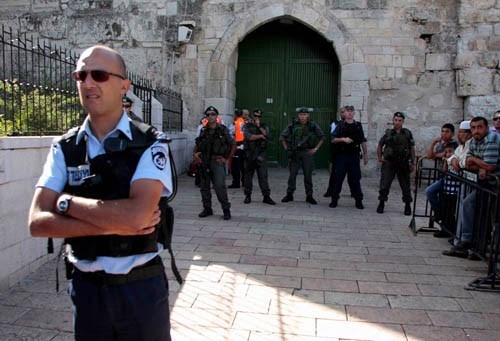
Israeli Occupation Forces on Thursday closed the al-Aqsa Mosque compound to all visitors after an overnight shooting incident in which a man on a motorbike tried to gun down an Israeli hardliner.
“This dangerous Israeli escalation is a declaration of war on the Palestinian people and its sacred places and on the Arab and Islamic nation,” Palestinian President Mahmoud Abbas spokesman Nabil Abu Rudeina quoted him as saying on Thursday.
“We hold the Israeli government responsible for this dangerous escalation in Jerusalem that has reached its peak through the closure of the al-Aqsa mosque this morning,” he told AFP.
“The state of Palestine will take all legal measures to hold Israel accountable and to stop these ongoing attacks,” he added.
Earlier on Thursday, Israeli forces killed a Palestinian man suspected of the shooting attack on the Israeli hardliner, a spokesman said.
“The Palestinian, who was the main suspect in the Wednesday night attack, was eliminated at his home in Jerusalem’s Abu Tor neighborhood by special police forces,” police spokesman Micky Rosenfeld told AFP.
Abu Tor straddles the seam line between west Jerusalem and the occupied eastern sector, which was occupied by Israel during the 1967 Six Day War.
The suspect’s death took place just hours after a gunman on a motorcycle had opened fire at a right-wing Zionist Rabbi called Yehuda Glick at a rally in Jerusalem, leaving him critically wounded.
Glick was reportedly shot in his upper body at “close range” at an event outside the Menachem Begin Heritage Center in Jerusalem, where a number of Israeli members of Knesset and right-wing activists were in attendance, Israeli news site Ynet said.
Israeli Prime Minister Benjamin Netanyahu on Thursday ordered a “significant increase” in police deployments in Jerusalem following the shooting.
“I have ordered a significant increase in forces as well as in means (available to them) so we can both ensure security in Jerusalem and also maintain the status quo in the holy places,” he said in a statement released by his office.
The attack was reported after a conference focused on the reconstruction of a Jewish temple on top of the al-Aqsa mosque was concluded at the center, with top right-wing Zionist officials and activists in attendance.
The incident comes amid increasing tension in Jerusalem over an expected Knesset vote to potentially divide the al-Aqsa mosque compound — the third-holiest site in Islam — between Muslims and Jews, or else restrict Muslim worship at the site.
The Israeli army radio announced early October that the ministry of tourism was working on a plan to allow Jews to enter the al-Aqsa compound through the Cotton Merchants Gate, in addition to the Moroccan Gate which is already used as an entrance for non-Muslims.
Although mainstream Jewish leaders consider it forbidden for Jews to enter the area, right-wing nationalist activists have increasingly called for Jewish prayer to be allowed on the site.
Since Israel occupied East Jerusalem in 1967, an agreement with Jordan has maintained that Jewish prayer be allowed at the Western Wall plaza — built on the site of a Palestinian neighborhood of 800 that was destroyed immediately following the conquest — but not inside the al-Aqsa mosque compound itself.
Yehuda Glick is an American-born Israeli and the chairman of the Temple Mount Heritage Fund, a Zionist organization focused on “strengthening the relationship between Israel and the Temple Mount.”
Critics charge that the Fund actually leads Jewish tours to the site with the intention of leading Jewish prayer there — currently banned under Israeli agreements — and encouraging Jews to destroy the Al-Aqsa mosque and build a Jewish temple there.
He has been previously banned by Israeli authorities from entering the compound due to provocations while on the site.
For Muslims, al-Aqsa represents the world’s third holiest site.
Al-Aqsa restrictions, violations
Israel continues to restrict the entry of Palestinian worshipers into al-Aqsa for the fifth week in a row.
In an urgent message to the US administration on Sunday, Palestinian Authority President Mahmoud Abbas warned that Israel’s continued provocations at the mosque complex would lead to a “wide-reaching explosion.”
Israeli authorities have imposed restrictions on Palestinians seeking to enter the al-Aqsa Mosque compound, denying Muslim men under 40 access to the holy site while facilitating the entry of Zionist settlers of all ages.
In recent months, hundreds of extremist Zionist settlers – often accompanied by Israeli security forces – have repeatedly forced their way into East Jerusalem’s flashpoint al-Aqsa Mosque complex.
The frequent violations anger Palestinians who fear Zionist presence on the al-Aqsa is aimed at usurping the site.
Abbas said Saturday legal measures would be taken to prevent Zionist settlers from attacking Jerusalem’s flashpoint Al-Aqsa mosque compound.
“The Palestinian leadership will be taking the necessary legal measures, at the international level, regarding the aggression of settlers on the Al-Aqsa mosque,” Abbas said in a speech to the Revolutionary Council of his Fatah party.
“We will not allow settlers to attack the mosque,” he added, referring to the entire compound, which is the third holiest site in Islam.
A Palestinian official last week called for holding an emergency Arab and Islamic summit to discuss Israeli plans to divide the al-Aqsa Mosque compound between Palestinians and Israelis.
“Israel is racing against time to legitimize storming of the al-Aqsa Mosque compound by herds of extremist settlers,” Ahmed Qurei, a member of the Executive Committee of the Palestine Liberation Organization (PLO), said in a statement.
Earlier this month, UN chief Ban Ki-moon said he was “deeply concerned by repeated provocations at the holy sites in Jerusalem,” saying that such actions “only inflame tensions and must stop.”
Meanwhile, Lebanon’s Hezbollah resistance movement condemned the “Israeli aggressions within the al-Aqsa Mosque compound” and slammed “Arab silence” and “international complicity.”
The resistance group called on “directing all efforts to protect al-Aqsa and the Islamic and Christian holy sites.”
Israel occupied East Jerusalem during the 1967 Middle East War. It later annexed the holy city in 1980, claiming it as the capital of the self-proclaimed Zionist state – a move never recognized by the international community.
In September 2000, a visit to the site by controversial Israeli leader Ariel Sharon sparked what later became known as the “Second Intifada” – a popular uprising against the Israeli occupation in which thousands of Palestinians were killed.
(Ma’an, AFP, Al-Akhbar)
Featured Video

Deception – Submarines against Olof Palme
or go to
Aletho News Archives – Video-Images
From the Archives
Woolsey Fire started at Santa Susana Field Lab — where “radioactive materials released were never accurately measured”
By John Laforge | CounterPunch | November 30, 2018
In my Nov. 16 column, I reported on potential radiation risks posed by California’s Woolsey wildfire having burned over parts or all of the Santa Susana Field Laboratory—south of Simi Valley, Calif., 30 miles outside Los Angeles—site of at least four partial or total nuclear reactor meltdowns.
The field laboratory operated 10 experimental reactors and conducted rocket engine tests. In his 2014 book Atomic Accidents, researcher James Mahaffey writes, “The cores in four experimental reactors on site … melted.” Reactor core melts always result in the release of large amounts of radioactive gases and particles. Clean up of the deeply contaminated site has not been conducted in spite of a 2010 agreement.
Los Angeles’s KABC-7 TV reported Nov. 13 that the Santa Susana lab site “appears to be the origin of the Woolsey Fire” which has torched over 96,000 acres. Southern Calif. Public Radio said, “According to Cal Fire, the Woolsey Fire started on the afternoon of Thursday, Nov. 8 … on the Santa Susana site.” … continue
Blog Roll
 Aletho News
- Brussels cannot say where its own pipeline inspectors are as Hungary’s oil lifeline remains shut
- Israel’s Iran War: Myth and Reality
- Between war and industrial breakdown: The US-Israeli attrition crisis
- Pressure builds on Iran to ‘drop’ Lebanon ceasefire demand as Islamabad talks hang in balance
- In another clash report, US denies agreement to release Iran’s assets
- What is fueling unrest across the EU?
- Why no power can undermine Iran’s eternal dominance over the Strait of Hormuz
- Is The War Against Iran Over?
- Iran war will leave long-term ‘scar’ on Wall Street, investors warn
- How Iran decimated US power projection in West Asia: Military lessons of 40-day war
- If Americans Knew
- Mearsheimer reveals how Israel dictates US policies on Iran, Gaza – video
- After killing 350+, Israel still has a “score to settle” with Lebanon before ceasefire – Daily Update
- Military aid to Israel emerges as the latest political litmus test for Democrats
- The only Palestinian children’s rights organization closes following years-long Israeli campaign against it
- ‘I Can’t Forget the Smell’: Lebanese Reel After Israel Kills Over 300 in Single Day
- DNC Shoots Down Resolutions Calling Out AIPAC and Limiting Arms to Israel
- TCN: Is Israel Blackmailing President Trump?
- Israel killed at least 303 Lebanese yesterday – who were they? Daily Update
- Amnesty: Urgent – Protect Lebanese civilians from brutal escalation in Israeli attacks
- Is The War Against Iran Over?
- No Tricks Zone
- German Expert: Heat Dome Led To Record Temps In Western USA…Warmer In 1934, 1936
- New Study: No Linear Warming Or Glacier Retreat Along Northern Antarctic Peninsula Since 1980s
- An Inconvenient Tree: Uncovered In Alps… Europe Much Warmer Than Today 6000 Years Ago
- New Study Reports A 60% Slowdown In Greenland’s Ice Loss Rate In The Last Decade
- Low Intensity Tornado Wrecks Major Solar Farm, Creating A Potential Toxic Dump
- New Study Finds Warming Saves Lives…Cold Temperatures 12 Times More Deadly Than Excess Heat
- German Science Blog Accuses PIK Climate Institute Of Hallucinating Climate Tipping Points
- Devastating Assessment Of Comirnaty Vaccine By Former Senior Pfizer Europe Toxicologist
- New Study: CO2 Is ‘Effectively Negligible’ As An Explanatory Climate Change Factor Since 2000
- Former Pfizer Toxicologist Dr. Helmut Sterz Tells Bundestag Hearing Pfizer Vaccine Should Have Never Been Approved
 Aletho News