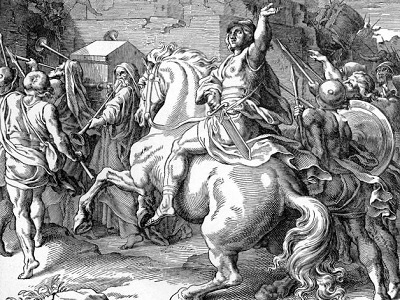
If Joshua did not conquer Jericho, was there any conquest?
The Narrative Challenge
The war of narratives shaped as a “slam dunk” win for the Palestinian people, and had the potential to change the lineup of forces in the struggle for a just solution to the Middle East crisis. After all, unlike the Zionists, the Palestinians are a singular people, speak a common language, have common customs, and lived a shared history. They inhabited the area for centuries, if not for millennia, and tilled and watered the land to which they had legal title. Western nations restructured the Middle East, denied the Palestinians a country, and placed them in a British Mandate. Refusal to agree to surrendering any of their lands to the UN Partition Plan led to the catastrophe in 1948 (Al-Nakba), which left them stateless and subject to Israeli occupation and oppression. As a community, the Palestinians are now headed toward destruction. Can they prevent that destruction by winning the war of narratives?
A Palestinian Negligence
Despite their more compelling narrative, the Palestinians have been unable to successfully articulate their experiences or implement a powerful rebuttal to Israel’s narrations, and Israel has prevailed in the war of narratives, a feat that defies the possible. Adding to the failure is the perplexing manner by which Palestinian institutions and persons unknowingly validate portions of the Zionist narrative and its falsifications of history. As an example, this excerpt appears on the website of the Palestine center, the foremost Palestinian “think tank” in Washington, DC:
The Canaanites were the earliest known inhabitants of Palestine. They became urbanized and lived in city-states, one of which was Jericho. Thus Jericho is considered to be one of the oldest continuously inhabited cities on earth.
“The Israelites, a confederation of Hebrew tribes, defeated the Canaanites, but found the struggle with the Philistines more difficult. The Philistines had established an independent state on the southern coast of Palestine and controlled the Canaanite town of Jerusalem. The Philistines were superior in military organization to the Israelites [and] severely defeated them about 1050 BCE.
“David, Israel’s king, united the Hebrew tribes and eventually defeated the Philistines. The three groups assimilated with each other over the years. The unity of Israelite tribes enabled David to establish a large independent state, with its capital at Jerusalem. However, that did not last long as that state split into two: Israel in the north and Judea in the south.
Unknowingly, The Palestine Center has published a dubious biblical history, which Israel’s propagandists use to advantage. History and archaeology contest the presentation:
(1) Jericho, one of the earliest cities, no longer existed at the time of the later Canaanites (it eventually recovered), which means it was not continually inhabited, and there was no Jericho for Joshua, and probably no conquest by a Joshua of other tribes.
(2) The Exodus, Conquest and lives of David and Solomon are myths. If a David and/or Solomon existed, they were minor chieftains and not leaders with a capital in Jerusalem.
Exodus and Lack of Proof
Although the ancient Egyptians kept meticulous records, no manuscripts, drawings or documents describe Hebrew slaves in Egypt or an exodus. Besides, Egypt was not, as Rome, a slave state and only kept foreigners captured in war as slaves. If they wandered 40 years in the desert, would not the 100,000 plus Hebrews have left some traces for future collaboration – pottery shards, implements, shreds of garments, or weapons? If they had the latter, which they needed for conquest, how were they obtained or forged? Lastly, because the earliest examples of written Hebrew date from the 10th century B.C. would not the Hebrews, after being captive in Egypt for centuries, have spoken and written a Middle Egyptian language? What language did they speak?
Did Joshua Assault Jericho?
Archaeologist Kathleen Kenyon, in her book Digging up Jericho: The Results of the Jericho Excavations, 1952-1956, Praeger, New York, estimated the city was destroyed before 1550 BC, 150 years prior to Joshua’s supposed arrival, and remained dormant until the 11th century B.C. Radiocarbon tests by Hendrink J. Burns, Tell es-Sultan (Jericho): Radiocarbon results of short-lived cereal and multiyear charcoal samples from the end of the middle Bronze age, Jacob Blaustein, Institute for Desert Research, Ben-Gurion University of the Negev, confirmed Ms. Kenyon’s conclusions.
Jericho: Was There any Conquest?
The most definitive rebuttal to biblical history before the 9th century B.C. comes from recognized Tel Aviv University archaeologists Israel Finkelstein and Neil Asher Silberman, who documented their explorations in The Bible Unearthed : Archaeology’s New Vision of Ancient Israel and the Origin of Its Sacred Texts, Simon & Schuster, 2002.
Their archaeological diggings demonstrated that “the Israelites were simply Canaanites who developed into a distinct culture. Recent surveys of long-term settlement patterns in the Israelite heartlands show no sign of violent invasion or even peaceful infiltration, but rather a sudden demographic transformation about 1200 BCE in which villages appear.”
Finkelstein and Silberman continue with discoveries, which “suggest that Jerusalem was sparsely populated and only a village during the time of David and of Solomon. During the time of Solomon, the northern kingdom of Israel had an insignificant existence, too poor to be able to pay for a vast army, and with too little bureaucracy to be able to administer a kingdom, certainly not an empire.” It was not until the eighth century B.C., 200 years after David, that Jerusalem began to grow.
Control of Jerusalem
Jerusalem’s status is furiously debated in “balanced” discussions. Israel demands total control of a “united city,” which it claims is essential to its heritage, and Palestinians are willing to defer to Jerusalem becoming a shared city. In these “balanced” meetings, the Palestinians cannot gain the offensive, and are unable to obtain a reply to a simple question: Why are Jews allowed to settle in East Jerusalem and reclaim a few dubious properties, while Palestinians are not allowed to settle in West Jerusalem and regain multitudes of usurped properties?
Examine the Holy Basin. The Holy Basin contains well-marked Christian and Muslim institutions and holy places that have had historical placement for more than a millennium – Church of the Holy Sepulcher, Al Asqua Mosque, Dome of the Rock, and Mosque of Omar.
Although Hebrews had major presence in Jerusalem during the centuries of biblical Jerusalem, which included rule by several kingdoms and control by the Hasmonean dynasties, their control and major presence were interrupted between the kingdom and dynasty and became insignificant after 70 A.D. Commentary has enabled the more than two thousand years of lack of control and presence to seem as if they never happened, and that today is only a short interval from the ancient years of King Hezekiah. Centuries of Christian and Crusader rule and more than one thousand years of Muslim rule are less noted, and their tremendous constructions and creations in Jerusalem are downplayed. The Christian and Muslim everythings become nothing and a minor Hebrew something becomes everything. Myth replaces reality. Ethereal spirituality replaces physical presence.
Some remains of Jewish dwellings, burial grounds and ritual baths can be found, but few, if any, major Jewish monuments, buildings or institutions from the Biblical era exist within the “Old City” of today’s Jerusalem. The oft cited Western Wall is the supporting wall for Herod’s platform and is not directly related to the Second Temple. No remains of that Temple have been located.
The Western Wall, which erroneously entered the vernacular as the Wailing Wall by someone during the 19th century, is considered to be close to the “holiest of the holies,” the most revered site in Judaism. According to historian Karen Armstrong, in her book Jerusalem, Ballantine Books; April 29, 1997, Jews did not pray at this part of the Western Wall until the Mamluks in the 15th century allowed them to move their congregations from a dangerous Mount of Olives and pray daily at the Wall. At that time, she estimates that there may have been no more than 70 Jewish families in Jerusalem.
This portion of the Western Wall lacks absolute proof of its being close to the “holiest of the holies,” and therefore has religious significance by default – there is no other readily apparent religious construction from the ancient Hebrew’s Jerusalem. Or, is it significant because Israel wants control of part of the wall that surrounds the Temple Mount/Haram al Sharif, a site it hopes to control one day?
In an attempt to connect ancient Israel to present day Jerusalem, Israeli authorities apply spurious labels to Holy Basin landmarks.
• Neither King David’s Tower nor King David’s Citadel relate to the time of King David.
• Neither the Pools of Solomon nor the Stables of Solomon relate to the time or life of King Solomon.
• Absalom’s Tomb is an obvious Greek sculptured edifice and therefore cannot be the tomb of David’s son.
Why should anyone acquiesce to Israel’s demand for incorporating all of a Jerusalem that has no ancient religious institution standing? The answer is conditioning – the constant repetitions of “If I forsake thee Jerusalem,” and “Jerusalem is indivisible” – internalization of a dubious argument and done for covert reasons.
Israel is a physically small and new country with an eager population and big ambitions. It needs more prestige and wants to be viewed as a power broker on the world stage. To gain those perspectives, Israel needs a capital city that commands respect, contains ancient traditions and is recognized as one of the world’s most important and leading municipalities. To assure the objectives, there can be only one Jerusalem and it must be the one that contains the Holy City. A united Jerusalem with a single tourist and business authority is worth a lot of Shekels.
It is distressing to witness “balanced” discussions characterize Jewish identity in Jerusalem as the same, if not of greater intensity, than that of the Palestinians (Muslim and Christian), not have this “balance’ politely refuted, and be tacitly approved by audiences.
And not only is Jewish identity in Jerusalem questioned; modern Judaism’s roots also deserve to be questioned.
Modern Judaism and the Holy Land
In a posted interview on Nov 18, 2008 of an American PBS program Archeology of the Hebrew Bible, William Dever, Professor Emeritus at the University of Arizona, who has investigated the archeology of the ancient Near East for more than 30 years, exclaimed, “This is awkward for some people, the notion that Israelite religion was not exclusively monotheistic. But we know now that it wasn’t. Monotheism was a late development. Not until the Babylonian Exile and beyond does Israelite and Judean religion—Judaism—become monotheistic.”
The last sentence is significant.
After the prophets returned from Babylonian exile, possibly influenced by Zoroastrianism, a religion whose God of good and light fought evil and dark, the Hebrews became Jews, instilled with a change in belief from monolatry, exclusive worship of one God without excluding foreigners to worship other Gods, to monotheism, exclusive worship of one universal God. David Danzig in an article Evidence for Survivals of Mesopotamian Civilization in the Babylonian Talmud: clarifies the reason: “The concept of a single God whom all nations would eventually worship evolved among a conquered and exiled people no longer assured of their divinely protected status.”
Many Jews remained in the regions of their exile. Later, hundreds of thousands of Jews arrived in Mesopotamia and Persia during the Persian Parthian and Sassasian Empires, (248 B.C. to 641 A.D.) In this area, schools of Judaism flourished, eventually codifying the oral and written laws and producing the Babylonian Talmud, which, rather then the Jerusalem Talmud, became the central text of Rabbinic Judaism and the basis for all Jewish law. In Iraq and Persia, from 500 B.C. and through the Middle Ages, the Jews from Judah shed themselves from the restraints of arid lands and a controlling priestly class, achieved almost total male literacy, developed intellectual prowess, and by 650 A.D., had changed their occupations from artisans, and struggling farmers to those of agriculturists, merchants, and traders, many becoming wealthy from the silk trade.
The biblical “Exodus” story did not free the Jews. Just the opposite, it has been used to keep Jews in perpetual bondage to a spurious history and to promote an attitude of constant victim hood, while distracting them from realizing they might also play a role in the injustices done to others.
The Jewish exodus from their birth lands to Babylonia and Persia (and throughout the Roman Empire), during the centuries before the destruction of the Second Temple in 70 A.D. and several centuries after its occurrence, freed the Jews from a pastoral life, arid conditions, and restricted economics. The already weakened and dispersed Israelite tribes completely disintegrated, and the Hebrews lost a place in an ongoing history. As in the hypothesis of punctured equilibrium, where new species suddenly arise to replace a dying species, new communities of Mesopotamian Jews, knowledgeable and worldly, quickly appeared in the Fertile Crescent. In that region, which soon housed the three great Jewish universities of Surah, Pumbadita and Nehardea, the legacy and heritage of modern Jews and Judaism are best expressed. In The Chosen Few: How Education Shaped Jewish History, 70-1492, winner of the 2012 National Jewish Book Award in Scholarship, by Maristella Botticini, Zvi Eckstein, Princeton University press, 2012, the authors claim that “Judaism reached its Golden Age in 800 -1200 A.D. During that time, Mesopotamia and Persia contained 75% of world Jewry with the rest in North Africa and Western Europe.”
Battle between Dead and Dying
The World War II Holocaust, which cost the lives of several million Jews, is firmly established in the Israeli conscience and its history is continually circulated throughout the world. The Palestinian catastrophe, Al-Nakba, hides in the shadows of the World War II onslaught. Why is it not more revealed?
Because the Zionist movement to Palestine started decades before World War II and almost all refugees from the conflagration had been relocated before establishment of the state of Israel, the relationship between the state of Israel and the European Holocaust is tenuous. Nevertheless, Israel makes full use of the Jewish tragedy to secure sympathy, periodically reminding the world of previous era horrors, repeating them daily to its children, as if they are being threatened, and convincing a world they need to define their own security in order to prevent the next genocidal attack against them.
The Palestinians have not been alert in changing the direction of the dispute, still regarding it as a conflict between them and the Israelis, when it is now only a crisis for them. The initial disputes between the Zionists and the Palestinians erupted into a conflict. After Israel achieved military victory in 1967, the conflict essentially ended; the Palestinian allies had been defeated and the Palestinians were subjected to Israeli occupation. From then on it has been a growing crisis, which could lead to total destruction of the Palestinian community. This is not semantics; it focuses on the real problem and prevents resources and attention from being diverted to useless activities. As a matter of fact, the attacks on the Palestine community resemble the UN definition of genocide:
Article II: In the present Convention, genocide means any of the following acts committed with intent to destroy, in whole or in part, a national, ethnical, racial or religious group, as such:
(a) Killing members of the group;
(b) Causing serious bodily or mental harm to members of the group;
(c) Deliberately inflicting on the group conditions of life calculated to bring about its physical destruction in whole or in part;
(d) Imposing measures intended to prevent births within the group;
(e) Forcibly transferring children of the group to another group.
Israeli forces have been continuously guilty of the first four acts. Without assistance from international organizations, Arab countries, philanthropies, individuals and private fund raisers, all of whom have supplied the Palestinians with food, energy, training, funds, education and resources that counter Israeli oppression, the precarious plight of the Palestinians would have reached a critical level a long time ago.
Genocide is not necessarily broadcasted; it can be silent and stealth – breaking bones and imprisoning males to deny children of working fathers, preventing expansion of food, water and housing supplies so a population is economically deprived and exists at subsistence levels, confining families to limited areas to stifle education, knowledge and community interaction, restricting travel so that people are not able to contact others and learn the new tools and mechanisms for adaptation to a modern world, planting harassment and sowing fear to create psychological disturbances. Recipients of these policies applied by the Israeli government in the West Bank and Gaza have no recourse to reply, except to leave the area or suffer until death.
The World War II Holocaust is over, the dead cannot be reclaimed and yet their lives are continually discussed. In Palestine, the destruction continues, lives can be reclaimed and yet the threat to their existence is insufficiently discussed. The crisis started with Al-Nakba and the Palestinians have not been able to make the world react to the seriousness of the growing catastrophe.
War of Narratives
What have Jews accomplished by in-gathering and becoming citizens of the state of Israel? They have bolstered a spurious interpretation of history, and identified themselves with twelve tribes who established some states and administration, but apparently vanished from history and left little imprint of having been a strong or extensive civilization for a long period of time. By incorporating biblical history into its ‘reason to be,’ Israel has exalted Joshua the warrior, guilty of nine genocides, David, a bandit, suspected murderer of those who barred his route to kingship, and philanderer who coveted the wives of others, and Solomon, who used forced labor and exorbitant taxes to build huge construction projects (For this, Moses took them out of Egypt?), and kept a harem of 700 wives. Evidently, the Israelis intend to accomplish in real life what a mythical Joshua and his Israelites accomplished – conquer the city of Jericho, lay the entire West Bank to waste and “let the people be hewers of wood and water carriers in the service of the whole assembly.”
It seems strange that Jews embrace the dubious connection with wandering tribes and errant kings and reject the well established memories of their most precious epochs and proud moments of history – their centuries of sojourn in Mesopotamia and Persia. Readily absorbing the new wisdom they encountered after their exodus to ancient Iraq and Persia, the Jews compiled the Talmud, and moved rapidly into achieving almost total male literacy, obtaining economic advancement, and becoming leaders for progress and modernity. Hopefully, Jews who absorb actual history will awaken other Jews to the destructive impulses generating from Israel, which prevents them from recognizing the roots of modern Judaism and instead reverts them to become atavistic and reactionary relics of the ancient Hebrew world.
The Palestinians have found themselves thrust in an unenviable role with specific challenges – expose the contrived narrative of the Israelis and impress the world with their narrative of continuous transitory life as Canaanites, or possibly Hebrews, to Christians, to Muslims, to Arabs, to citizens of the Ottoman Empire and finally to suffering the Al-Nakba, which started their route to being oppressed. Despite decades of mental, physical and emotional fatigue, they owe this task to themselves, to their communities in Diasporas, to Jews who don’t want to be involved in the injustices, to a Middle East that suffers from the expansion of the crisis, and to a world that might soon face a related catastrophe. They owe it and should show it.
November 27, 2013
Posted by aletho |
Deception, Ethnic Cleansing, Racism, Zionism, Timeless or most popular | Israel, Jericho, Jerusalem, Middle East, Palestine, Zionism |
Leave a comment
Three huge granite stones rest comfortably on the top of Midbar Sinai Street, in Givat Havatzim, Jerusalem’s northernmost district. Cut to specification, the imposing stones represent one of several preparations by the Temple Mount and Land of Israel Faithful Movement’s to erect a Third Temple on the Haram al-Sharif/Temple Mount.
Since the Islamic Wafq owns and controls all the property on the Haram al-Sharif, by what means can these stones be transferred to the Temple Mount and how can a temple be constructed there? Not by any legal means.
The stones are a provocation, which the Israel government refuses to halt. Neglect and passivity lead to a belief that an eventual Muslim reaction to the increasing provocations will give Israel an excuse to seize total control of the Holy Basin — the ultimate of the properties that Israel intends to incorporate into a greater Jerusalem.
For decades, Israeli authorities have spoken of a united Jerusalem — suggesting a spiritual quality to its message — as if Israel wants the home for the three monotheistic faiths to be solid and stable. By being guided from one central authority, a united Jerusalem also offers a preservation of a common and ancient heritage. However, by stressing the word ‘unification,’ Israel disguises the lack of a sufficiently supporting and verifiable historical narrative that could bolster its thrust to incorporate all of an artificially created greater Jerusalem into its boundaries. Coupled with inconsistencies and contradictions, Israel’s eagerness to create a greater Jerusalem under its total control becomes suspect. The intensive concentration on a ‘united’ Jerusalem reveals a hidden agenda that debases Jerusalem’s religious ingathering and heightens division, hatred and strife.
Examine the Holy Basin. The Holy Basin contains well-marked Christian and Muslim institutions and holy places that have had historical placement for millenniums. Although people of the Jewish faith had major presence in Jerusalem during the centuries of Biblical Jerusalem, which included rule by King Hezekiah and control by the Hasmonean dynasties, their control and presence were interrupted for two millennia. Extensive commentary has enabled the two thousand years of lack of control and presence to seem as if it never happened and that today is only a short time from the years of Hezekiah. Some remains of Jewish dwellings and ritual baths can be found, but few if any major Jewish monuments, buildings or institutions from the Biblical era exist in the “Old City” of today’s Jerusalem. The often cited Western Wall is the supporting wall for Herod’s platform and is not directly related to the Second Temple. No remains of the Jewish Temple have been located in Jerusalem — not even a rock.
According to Karen Armstrong, Jerusalem, Jews did not pray at the Western Wall until the Mamluks in the 15th century allowed them to move their congregations from a dangerous Mount of Olives and pray daily at the Wall. At that time, she estimates that there may have been no more than 70 Jewish families in Jerusalem. After the Ottomans replaced the Mamluks, Suleiman the Magnificent issued a formal edict in the 16th century that permitted Jews to have a place of prayer at the Western Wall.
The only remaining major symbol of Jewish presence in Jerusalem’s Holy City is the Jewish quarter, which Israel cleared of Arabs and rebuilt after 1967. During its clearing operations, Israel demolished the Maghribi Quarter adjacent to the Western Wall, destroyed the al-Buraq Mosque and the Tomb of the Sheikh al-Afdhaliyyah, and displaced about 175 Arab families.
Although the Jewish population in previous centuries comprised a large segment of the Old City (estimates have 7,000 Jews during the mid-19th century), the Jews gradually left the Old City and migrated to new neighborhoods in West Jerusalem, leaving only about 2,000 Jews in the Old City. Jordanian control after the 1948 war reduced the number to nil. By 2009, the population of the Jewish quarter in the Old City had grown to 3,000, or 9 percent of the Old City’s population. The Christian, Armenian and Muslim populations are the principal constituents and their quarters contain almost the entire Old City commerce.
In an attempt to attach ancient Israel to present day Jerusalem, Israeli authorities continue the attachment of spurious labels to Holy Basin landmarks, while claiming the falsification is due to the Byzantines, who got it all wrong.
King David’s Tower’s earliest remains were constructed several hundred years after the Bible dates David’s reign. It is a now an obvious Islamic minaret.
King David’s Citadel earliest remains are from the Hasmonean period (200 B. C. E.). The Citadel was entirely rebuilt by the Ottomans between 1537 and 1541.
King David’s tomb, located in the Dormition Abbey, is a cloth-covered cenotaph (no remains) that honors King David. It’s only an unverified guess that the casket is related to David.
The Pools of Solomon, located in a village near Bethlehem, are considered to be part of a Roman construction during the reign of Herod the Great. The pools supplied water to an aqueduct that carried the water to Bethlehem and to Jerusalem.
The Stables of Solomon, under the Temple Mount, are assumed to be a construction of vaults that King Herod built in order to extend the Temple Mount platform.
Absalom’s Tomb is an obvious Greek sculptured edifice and therefore cannot be the tomb of David’s son.
The City of David contains artifacts that date before and during David’s time. However, some archaeologists maintain there is an insufficient number of artifacts to conclude any Israelite presence, including that of King David, before the late ninth century. In any case any Israelite presence must have been in a small and unfortified settlement.
The Jerusalem Archaeological Park within the Old City, together with the Davidson Exhibition and Virtual Reconstruction Center also tell the story. Promising to reveal much of a Hebrew civilization, the museums shed little light on its subject. The Davidson Center highlights a coin exhibition, Jerusalem bowls and stone vessels.
The Archeological Park in the Old City contains among many artifacts, Herodian structures, ritual baths, a floor of an Umayyad palace, a Roman road, Ottoman gates, and the façade of what is termed Robinson’s arch, an assumed Herodian entryway to the Temple Mount. The exhibitions don’t reveal many, if any, ancient Hebrew structures or institutions of special significance.
Reliable archaeologists, after examining excavations that contain pottery shards and buildings, concluded that archaeological finds don’t substantiate the biblical history of Jerusalem and its importance during the eras of a united Jewish kingdom under David and Solomon.
Margaret Steiner in an article, titled It’s Not There: Archaeology Proves a Negative, in the Biblical Archaeology Review, July/August, 1998, states: “ . . . from the tenth century B. C. E. there is no archaeological evidence that many people actually lived in Jerusalem, only that it was some kind of public administrative center . . . We are left with nothing that indicates a city was here during their supposed reigns (of David and Solomon) . . . It seems unlikely, however, that this Jerusalem was the capital of a large state, the United monarchy, as described in Biblical texts.”
West Jerusalem is another matter. With banditry prolific and Old City gates being closed before nightfall, living outside the city gates did not appeal to the population. Wealthy philanthropist Moses Montefiore wanted to attract the Jewish population to new surroundings and he constructed the first Jewish community outside of the Old City — Yemin Moshe’s first houses were completed in 1860. From that time, Jewish presence played a role in creating a West Jerusalem. Other institutions, Greek Orthodox, Catholic, Russian Orthodox and Muslim soon ventured forth and owned much property in the evolving West Jerusalem.
In 1948, After the Israeli army seized absolute control of West Jerusalem, the new Israeli government confiscated all West Jerusalem property owned by Muslim institutions. Reason — enemy property. Few Muslims and no mosques remain in today’s West Jerusalem.
One contradiction. By attacking and ethnically cleansing the Christian Arab communities of Deir Yassin and Ein Kerem, Israeli forces characterized Christian Palestinians as an enemy. Nevertheless, Israel did not confiscate Christian properties, many of which are apparent in West Jerusalem. The Greek Orthodox Church owns extensive properties in West Jerusalem, many marked by its “TΦ” (Tau + Phi) symbol, interpreted as the word ‘Sepulchre.’
Another contradiction. Israel has cared for the Jewish cemetery on the Mount of Olives and expanded it as a heritage site. Part of the famous Muslim Mamilla cemetery in West Jerusalem has been classified as refugee property and is being prepared to be demolished for the new Museum of Tolerance.
East Jerusalem reveals more contradictions. The repeated warning by Israeli leaders that co-existence is not feasible and that it is necessary to separate the Jewish and Palestinian communities is contradicted by Israel’s desire to incorporate East Jerusalem into Israel. Incorporation means accepting somewhere between 160,000 and 225,000 Palestinians into a Jewish state. Or does it? Whereas the older historical Jewish neighborhoods in West Jerusalem have their character meticulously maintained or are rebuilt in their original style, the older Arab neighborhoods in East Jerusalem are entirely neglected (all of Arab East Jerusalem is neglected) or destroyed. How much deterioration and destruction can Palestinians absorb before they decide to leave?
Construction of Jewish homes in East Jerusalem Arab neighborhoods proceeds and destruction of Arab homes, either declared illegally constructed or illegally purchased, continues. On 44 dunums of lands confiscated from Palestinian families, a private company has constructed the gated community of Nof Zion, and conveniently separated Palestinian Jabal Al Mukabir from other parts of East Jerusalem. No Arabs need apply. The million dollar condominiums are advertised for American investors.
The Israeli ministry of Interior has approved a plan to demolish a kindergarten and wholesale market in East Jerusalem’s Wadi Joz neighborhood in order to construct a new hotel close to the Old City and near the Rockefeller Museum. The result will be the destruction of an Arab neighborhood and its replacement by Jewish interests, which will one day join other Jewish interests.
These are only two examples of a master plan to replace the centuries old Arab presence in East Jerusalem with a modern Jewish presence. The ancient Arab presence in an ancient land is further subdivided by the Separation Wall, which runs through the East Jerusalem landscape and detaches East Jerusalem from the West Bank, making it unlikely for a Palestinian state to have its capital in East Jerusalem. The master plan extends the boundaries of Jerusalem to include the large Israeli settlement (city) of Maale Adumim. Between Maale Adumim and East Jerusalem, Israel proposes to construct the E1 corridor, which joins settlements in a ring and adds to the separation of East Jerusalem from the West Bank. The E1 corridor will divide the northern and southern West Bank and will impede direct transit between Palestine Bethlehem, which is south of E1 and Palestine Ramallah, which is north of E1. Construction of the E1 corridor, portions of which are owned by Palestinians, could prevent the formation of a viable Palestinian state.
So, if Israel is destroying Jerusalem’s heritage and subjugating its spiritual meaning, why does Israel want to unify Jerusalem?
Israel’s Hidden Agenda
Israel is a physically small and relatively new country with an eager population and big ambitions. It needs more prestige and wants to be viewed as a power broker on the world stage. To gain those perspectives Israel needs a capital city that commands respect, contains ancient traditions and is recognized as one of the world’s most important and leading cities. Almost all of the world’s principal nations, from Egypt to Germany to Great Britain, have capitals that are great cities of the world. To assure its objectives, Israel wants an oversized Jerusalem that contains the Holy City.
That’s not all.
Jerusalem has significant tourism that can be expanded. It can provide new commercial opportunities as an entry to all of the Middle East. An indivisible Jerusalem under Israeli control is worth a lot of shekels.
Israel competes with the United States as the focus of the Jewish people. It needs a unique Jerusalem to gain recognition as the home of Judaism.
By controlling all of the holy sites, Israel commands attention from Moslem and Christian leaders. These leaders will be forced to talk with Israel and Israel will have a bargaining advantage in disputes.
Whatever Israel gains, the Palestinians are denied. Even if Israel agrees to the establishment of a Palestinian state, it will direct its policies to limit the effectiveness of that state. Since East Jerusalem and its holy sites greatly benefit a Palestinian economy and increase Palestine legitimacy, Israel will do everything to prevent East Jerusalem being ceded to the new state of Palestine. An “indivisible” Jerusalem is part of that effort.
West Jerusalem only gives Israel a North/South capital. An indivisible Jerusalem gives Israel a forward look towards an East/West capital or a centralized capital of the land of previous biblical Jewish tribes.
The Zionist socialist ideals and the cooperative Kibbutzim received support and sympathy from idealistic world peoples for many years. Israel’s attachment to the Holocaust tragedy extended that sympathy and support to more of the world. With the end of the Zionist dream, the decline of kibbutz life and the over-popularizing of the Holocaust, Israel needs a new symbol of identity that captures world attention.
If Israel has legitimate claims to Jerusalem, then those claims should be heard and discussed in a proper forum. However, that is not the process forthcoming. The process has the Israeli government using illegal and illegitimate procedures, as well as deceitful and hypocritical methods to force its agenda. Israel is not presenting its case but is exerting its powers to trample all legal, moral and historical considerations.
In the Museum of the Citadel of David is an inscription: The land of Israel is in the center of the world and Jerusalem is the center of the land of Israel.
This self-praise was echoed at a West Jerusalem coffee house in a conversation with several Israelis. A youthful Israeli abruptly sat at the table and entered the conversation with the words: “All the world looks to Jerusalem. Jerusalem is the center of the world and Jerusalem is the capital of Israel. Everyone needs Jerusalem and they will need to talk with Israel.”
And that is why Israel desperately wants its greater Jerusalem.
Dan Lieberman is the editor of Alternative Insight, a monthly web based newsletter. Dan has written many articles on the Middle East conflict, which have circulated on websites and media throughout the world. He can be reached at alternativeinsight@earthlink.net.
November 25, 2013
Posted by aletho |
Ethnic Cleansing, Racism, Zionism, Illegal Occupation, Timeless or most popular | Haram al-Sharif, Israel, Jerusalem, Jews, Palestine, Zionism |
Leave a comment
By Ghada Karmi | July, 2004
When the Zionists decided in 1897 to establish a Jewish state in Palestine, the Jews of Vienna dispatched a delegation to examine the country for its suitability. The delegation reported back as follows: “the bride is beautiful but she is married to another man”. They had found that Palestine to their dismay was already inhabited by another people. And this has been Zionism’s central problem ever since. How to “vanish the Palestinians” and get an empty land? The latest manifestation of this imperative is the barrier wall, which Israel is currently building to separate and enclose Palestinian towns and villages in the lands it occupied after 1967. There are those who rightly point to the wall’s illegality and infringement of human rights. And the International Court of Justice has just affirmed this view resoundingly in its ruling, passed on 9.7.04 by 14 of the 15 judges, that the wall was an illegal structure when in the occupied Palestinian territories and that Israel would have to tear it down and make restitution for the damage it has caused to thousands of Palestinians. This position is entirely valid, but critics, in my view, have missed one crucial aspect of the wall’s purpose, which is, to “vanish” the Palestinians, to make them so invisible that Israelis can go on pretending that there is no “other man”.
Observers of Palestinian history have long been familiar with Israel’s position on this issue. But few realise how successful, subtle and far reaching this Israeli policy has been. Arriving in Haifa recently I could see how hard Israel had tried to make that wish to send the Palestinians into oblivion come true. Haifa prides itself on being the best example of a ‘mixed’ Arab-Jewish city in Israel, practising a much-vaunted mutual tolerance and cooperation. In fact, it is overwhelmingly Jewish, the Arabs forming less than ten per cent of the population. Haifa is a picturesque city; its famous Carmel Mountain, where the city’s Arab notables used to live before 1948, overlooks a beautiful harbour.
Today, Jews inhabit those houses and the Arab minority that remained after the 1948 expulsions lives in a rundown district by the port below, segregated in all but name. The old Haifa street names have been replaced by Jewish ones. To me, an “original” Palestinian exiled in England since 1948, the place was ineffably depressing. Beneath the phoney friendliness in public there was no disguising the unequal relationship between the two sides: the menial jobs in which Arabs are concentrated, the discrimination in housing, jobs and education, implicit rather then legislative, and the aversion to meaningful social contact. One woman described her struggle to buy into the exclusive Carmel district. People had said Arabs in the neighbourhood would depress property prices, rather as blacks are said to do in some Western countries.
Israeli Jews look down on Arabs. Even recently arrived Ethiopian “Jews”, themselves fighting discrimination, affect to despise Arabs. Walking along Haifa’s streets, a disturbing hybrid of modern European and old Arab, I had a sense of a city gutted and soulless, its true past barely discernible beneath the new constructions. People showed me where my uncle’s house had once stood; it is now a municipal car park, demolished by the authorities in 1983. The vanishing process I could see was well advanced here. It had started with the Zionist slogan of Palestine as ‘a land without a people’, to which end the Israelis expended much effort. In 1948, a majority of Palestine’s population was expelled (my family amongst them) and was never allowed to return. A campaign to eradicate the Palestinian presence swiftly followed. Over 500 Palestinian villages were demolished and replaced with Israeli settlements; Hebrew place names were substituted for the previous Arabs ones; the country’s history was re-written to claim that Palestine had been a wasteland, home to a few wandering Bedouin tribes. Israeli schoolchildren were reared for decades on this mythology. Palestinian customs were appropriated as “Israeli”, and the minority of Palestinians that remained became invisible.
This was the narrative I grew up with in Britain. It was so effective that no one here doubted its truth for decades and Israelis themselves were astonished to “discover” the Palestinians of the West Bank and Gaza after 1967. However, in occupying them, Israel was back to the old problem of how to keep the new land without the people. Since physical expulsion was no longer an option, the alternative has been to make the Palestinians disappear as a nation by destroying their society. The history of the last 37 years of Israeli occupation can perhaps be best understood in this context. The Israeli colonisation of land and resources has strangled the Palestinian economy and made statehood unviable. At the same time, the destruction of Palestinian history proceeds unabated. One of the least noted aspects of Israel’s 1982 invasion of Lebanon was the removal to Israel of truckloads of crucial Palestinian archives and documents from the PLO Research Centre in Beirut. The Israelis did the same in 2002 when they invaded Ramallah. Vital statistics, computer hard drives, population statistics and land registers were taken out with the aim of destroying the Palestinian collective memory, history and national existence.
Israel had meanwhile denigrated the PLO, which threatened to give the Palestinian cause international stratus, as terrorists. In 1969, Golda Meir, Israel’s prime minister, made the now notorious statement that “there was no such thing as a Palestinian people”. The world was supposed to understand that, even if there were Palestinians, they did not amount to a separate people with national rights. Our route from Haifa to Jerusalem took us past the barrier wall, which is the subject of the ICJ’s preoccupation and snakes its way down to Jerusalem; it is obscenely high in some places up to eight metres clearly on the principle that what you don’t see does not exist. When we reached East Jerusalem and saw the shrivelled Palestinian community there that tries to survive in this truncated part of the original homeland, I saw another kind of vanishment. So-called Arab Jerusalem now consists effectively of three main streets and is surrounded by Jewish settlements. Israel considers the city “Jewish forever” and the previous Arab population preponderance has been deliberately overturned from 72 to 28 per cent by vigorous Israeli colonisation.
I was born in Jerusalem and yet I hate to see it now, The Old City, with its magnificent Islamic architecture, once the glory of Jerusalem and beyond into the Arab and Islamic worlds, is now a place of aggressive competition for ownership. Extremist religious settlers harass the Arabs, aiming to evict them, and threaten openly to build the Jewish Temple in place of the Aqsa mosque. Sad shopkeepers tell a story of poor business, encroaching Jewish settlement, unfair competition from Israeli traders and tourist guides who warn visitors against buying from “cheating Arabs”, and high taxes imposed by a state of which they are not citizens. It is an unnatural place, but not yet a ghost town like Haifa, though with Israeli strictures against Jerusalemites, I wondered for how long? Friends who worked in Jerusalem were now barred from entry there (or anywhere else). Visiting them in Ramallah one night, I left later than I should, forgetting that the checkpoints close at arbitrary times in the evening. I just made it to the no-man’s land beyond the second checkpoint and stood waiting for a taxi to take me on. None came, and in the eerie stillness with the shapes of heavily armed Israeli soldiers just discernible in the night gloom, I felt I was in a war-zone. But what war and with whom? With a poor people whose only crime is that they are not Jewish?
The wall, the stifling restrictions on movement, the impoverishment, and the daily killings are all designed to encourage flight. Unconfirmed reports say that 200,000 West Bank people have already left. The deliberate targeting of Palestinian leaders, (Sheikh Yassin, the head of Hamas and his replacement were both killed within weeks of each other earlier this year and Arafat is threatened with a similar fate), aims to create a chaotic people incapable of articulating their case. The constant reiteration that “there is no one to talk to” on the Palestinian side, when such interlocutors have been effectively eliminated, is another tactic towards the same end. These extreme antics bespeak an Israeli desperation to preserve the Jewish state “pure”, perhaps understandable in those who perceive, however wrongly, that without it their very survival is at stake. But what continues to baffle and frustrate is America’s unwavering support for Israel and thereby its collusion with this campaign to render the Palestinians invisible President Bush backed Ariel Sharon’s unilateral plan for the Palestinians in April of this year and would be expected to veto any Security Council resolution condemning Israel’s wall. The US of course is only following on British precedent when, in 1917, the Balfour Declaration decided the Palestinians’ fate over their heads and cancelled their identity by re-defining them as “non-Jewish communities”.
The world, meanwhile, looks on ineffectually, as if there were a tacit consensus to see the Palestinians vanish. Of course the rhetoric is beguiling; it speaks of a Palestinian state that even Bush supports. The ICJ’s condemnation of Israel’s barrier wall has encouraged Palestinians to feel hopeful. But the facts speak otherwise. Compare the treatment of the Kosovans in 1999. Then every effort was made to safeguard their integrity as a people; NATO, the EU and the US strove to return them to their homes. Compare also the case of the Iraqi Kurds, protected since 1991 by US and British no-fly zones, and now given special status by the Coalition in Iraq. So why are the Palestinians denied the same treatment? Why are their national identity, aspirations and right of return to their homeland under such vicious, concerted attack? They have retaliated by largely standing their ground, refusing to repeat the tragic exodus of 1948 and 1967, though for how long they can withstand this multi-pronged attack on their society is anyone’s guess. As for Israel, racing against time to hold back the Arab “demographic” tide, it is also anyone’s guess how long it can put off its inevitable absorption into the Arab world by such antics.
Ghada Karmi is a Palestinian writer and academic living in London. Her latest book is ‘Married to a man: Israel’s dilemma and the one-state solution’.
November 23, 2013
Posted by aletho |
Ethnic Cleansing, Racism, Zionism, Timeless or most popular | Israel, Jerusalem, Palestine, West Bank, Zionism |
Leave a comment
Israeli forces Monday demolished a property in occupied East Jerusalem owned by the Roman Catholic Church, displacing 14 Palestinians. At a press conference held by the ruins of the home, Latin Patriarch of Jerusalem Fuad Tawwal condemned the demolition in the presence of senior church officials, foreign diplomats and journalists, saying “there is no justification for the demolition” and accusing the Jerusalem “municipality and the Israeli government” of “increase[ing] hatred” through its policies.
Tawwal claimed that it was the first time Israel had demolished property belonging to the church, and promised “legal action in appropriate courts” in response.
Meanwhile, it has been reported that hundreds of Palestinian families in East Jerusalem have recently received demolition orders, notices which give residents 30 days to appeal.
Palestinian-owned properties in Israeli-annexed East Jerusalem are routinely demolished by the Jerusalem municipality on the grounds of lacking the right permit – permits that are notoriously difficult to get. For example, just 13 per cent of the Jerusalem housing units granted building permits in the period 2005-’09 were in Palestinian neighbourhoods.
November 6, 2013
Posted by aletho |
Aletho News | Catholic Church, East Jerusalem, Human rights, Israel, Jerusalem, Palestine, Zionism |
Leave a comment
OCCUPIED JERUSALEM — Al-Aqsa Foundation for Endowments and Heritage said Israeli groups seek to enact laws and regulations aiming at partitioning the Aqsa Mosque between Muslims and Jews, and defining times and areas where collective and individual Jewish prayers can be held.
The Foundation said in a statement that Israeli ministers, MKs and party members, in addition to Israeli organizations and decision-makers, are seeking to reach a political and religious consensus to change the status quo in the Aqsa Mosque, and turn it into a Jewish holy site under the occupation authority.
It stated that the Knesset Interior Committee held a session on Monday in this regard, attended by Deputy Minister of Religious Affairs Eli Ben Dahan who called on the new “Chief Rabbinate” to issue an advisory opinion allowing Jews to pray at Al-Aqsa Mosque.
For her part, the head of the Knesset Interior Committee, Likud party member Mary Rigab, pointed out that the aim of holding the consecutive sessions is to enact regulations that will define the times and areas where Jewish prayers will be held in the “Temple Mount”, regardless of the opinion of the “Chief Rabbinate”, and regardless of the threats of a third intifada.
November 5, 2013
Posted by aletho |
Ethnic Cleansing, Racism, Zionism, Illegal Occupation | Al-Aqsa Mosque, Eli Ben-Dahan, Israel, Jerusalem, Jews, Knesset |
Leave a comment
Renewed ‘peace talks’ between Israeli and the Palestinian Authority officials have quietly been going on behind closed doors and a U.S.-imposed media blackout for three months now. Like all previous such exercises they will almost certainly break down without delivering justice or bringing peace.
Even though the Palestine Papers made it clear that the leaders of the PA, a creation of the Oslo process, have offered huge concessions in past rounds of talks, pro-Israel commentators are nonetheless pre-emptively rehearsing their arguments to blame the Palestinian side and obfuscate the fundamental longstanding issue: Israeli intransigence. A key – though little known – organisation engaged in this activity in British political circles is BICOM, the Britain Israel Communications and Research Centre.
‘BICOM: Giving peace a chance?’, a new report published by Spinwatch, subjects this organisation to detailed scrutiny for the first time. It concludes that BICOM, like Israel itself, seeks to maintain the façade of progress towards peace, but in practice exhibits deep disdain for international law.
BICOM was established in 2001 in the wake of the Second Intifada and increasing international exasperation with Israel. Looking back a decade later, its primary funder, the billionaire businessman Poju Zabludowicz, neatly articulated its raison d’etre: ‘We have learnt over the last 10 years… that the key to creating a more supportive environment for Israel in Britain is convincing people in this country that Israel seeks a lasting peace… As long as this argument remains credible then people will generally forgive mistakes and difficulties even if peace continues to be elusive’, he wrote.
So BICOM’s aim is not to contribute to peace, but to convince people that peace is what Israel wants. The professions of support for a two state solution BICOM issues seem to be little more than a rhetorical device to foster, in Zabludowicz’s words, a ‘supportive environment’ in which people will ‘forgive’ Israel for its ‘mistakes’.
The existence of a broad international consensus in support of Palestinian statehood is enough to explain why BICOM judges it must pay lip service to the abstract idea of a Palestinian state. But the devil is in the detail. Though BICOM poses as the voice of sensible centrism, its political positions, when subjected to scrutiny, are far from moderate. In practice BICOM opposes key tenets of international law that serve as the framework for implementing the recognised prerequisites of a Palestinian state. It echoes Israeli exceptionalism on the four key issues of the conflict: borders, settlements, Jerusalem and refugees. The following is based on an analysis of BICOM’s own statements.
After the 1967 Arab-Israeli War, the UN Security Council passed resolution 242 which called for Israel to end its occupation of territories captured during the war. Following the Israeli government’s unique interpretation, however, BICOM argues that the absence of either the word ‘the’ or ‘all’ from the English language version of resolution 242 when referring to ‘territories captured’, means that Israel need not withdraw to pre-67 borders. This, despite the resolution’s preamble clearly asserting the ‘inadmissibility of the acquisition of territory by war’.
On settlements too, despite international consensus on their illegality as articulated in UN Security Council resolutions and reiterated in 2004 by the International Court of Justice, BICOM stands by the Israeli government’s position which is, again, at odds with the international community. Israel disputes the applicability of the Fourth Geneva Convention which outlaws the transfer of civilians into the occupied territories. Indeed, whilst engaging in talks supposedly intended to demonstrate its commitment to achieving peace, Israel yet again announced more settlement construction and Prime Minister Benjamin Netanyahu sent a letter of solidarity to Israeli settlers in Hebron.
While BICOM, for obvious reasons, generally tries to avoid spelling out the extent to which its positions contradict with the requirements of international law, Luke Akehurst, who manages the BICOM spin-off group We Believe in Israel, has explicitly challenged the internationally accepted interpretation of the Fourth Geneva Convention. But more frequently, since Israel is in violation of so many laws and UN resolutions, BICOM simply dispenses with international legal principles as an explanatory framework. Instead its stances are frequently premised upon – and justified by way of reference to – what Israelis are ‘willing to contemplate’ or the ‘broad consensus in Israel’.
On Jerusalem, for example, BICOM asserts that ‘most Israelis would not be willing to contemplate’ Israeli ‘loss of Israeli sovereignty’ over the city. Thus it endorses the Israeli government’s unilateral rejection of the international political and legal consensus. BICOM’s attitude is illustrated in its use of language too. It euphemistically refers to settlements as ‘communities’ or ‘neighbourhoods’, to the West Bank as ‘disputed’ rather than occupied territory and calls the Jerusalem ‘the capital of Israel’ – though even the United States does not recognise this and therefore maintains its embassy in Tel Aviv.
On the thorny issue of the Palestinian refugees BICOM claims that in the 1948 war ‘there was no deliberate, co-ordinated Jewish policy to expel the Arabs’. This Zionist myth has long been disproved by Israel’s so-called New Historians, such as Ilan Pappe, who have shown convincingly that the contrary is in fact true. At any rate, the right of the approximately 700,000 refugees – and their descendants – to return to their homes is upheld in UN resolution 194. Yet BICOM’s take on the refugee issue appears, once more to ignore international law and UN resolutions. Instead it offers the legally insubstantial argument that ‘Israel does not believe it is responsible for resettling the refugees, believing their plight to be the responsibility of the Arab states that rejected the 1947 Partition Plan [and] started the war’.
Cutting to the heart of the situation is BICOM’s statement (again couched in terms of Israeli desires, not legality) that ‘no Israeli government will accept a solution that would allow millions of Palestinians to settle in Israel [as] this would effectively spell the end of the Jewish majority’. Even without reference to the return of refugees, BICOM’s research director, Toby Greene, writing in BICOM’s recently launched glossy publication ‘Fathom‘, speaks of a ‘demographic threat’ posed to Israel – and its self-definition as a Jewish state – by natural Palestinian population growth alone. This illuminates the underlying ethnic exclusivism in BICOM’s vision of ‘two states for two peoples’.
Just as the ‘peace process’ functions as a fig leaf for continuation of the status quo, BICOM’s lobbying activities – which focus on encouraging the British media to take what it paradoxically refers to as ‘the most objectively favourable line‘ – serve to ward off condemnation of Israel. This seems to be true amongst the strategically vital political elite at least, though grassroots trends show increasing pro-Palestinian feeling.
Ultimately it is symptomatic of the tenuous nature of democracy in the UK that by maintaining close relationships at the top – with the likes of the influential Labour and Conservative Friends of Israel groups – BICOM is able to inculcate in the political class the idea that Israel is a benign and reasonable actor in search of peace, while its underlying arguments and Israel’s actions, belie this narrative.
The report BICOM: Giving peace a chance? will be launched on the 7th of November. Register to attend the launch event here.
November 4, 2013
Posted by aletho |
Deception, Ethnic Cleansing, Racism, Zionism, Illegal Occupation, Timeless or most popular | Fourth Geneva Convention, Israel, Jerusalem, Palestine, Palestine Papers, Palestinian National Authority, Poju Zabludowicz, United Nations Security Council, Zionism |
Leave a comment
The Zionist enemy plans to build another 1,500 settlement units in the Arab eastern sector of Jerusalem almost immediately after it began freeing 21 prisoners to the West Bank and another five to the Hamas-run Gaza Strip.
“The prime minister (Benjamin Netanyahu) and the interior minister (Gideon Saar) agreed on four building plans in Jerusalem,” a senior Zionist source told Agence France Presse, confirming details initially reported on military radio.
The announcement was timed to trump headlines focusing on the celebrations in the West Bank and Gaza after the 21 prisoners walked free into their respective home territories shortly after 1:00 am local time.
In the West Bank, thousands of people turned out to welcome home the 21 prisoners at a formal ceremony at Mahmoud Abbas’s presidential compound in Ramallah.
The prisoners had left Ofer prison in two minibuses with blacked-out windows and were driven to Beitunia crossing where fireworks split the night sky as they tasted freedom for the first time in 20 years or more.
The entity’s move to ramp up settlement in tandem with the prisoner release was mooted last week by a senior Zionist official who said the expected announcement on new construction had been coordinated in advance with the Palestinians and the Americans.
Similar sentiments were expressed by Defence Minister Moshe Yaalon.
“In recent months we have been facing sensitive diplomatic circumstances and weighty strategic considerations which require us to take difficult and painful steps,” he said on Tuesday in remarks communicated by his office.
October 30, 2013
Posted by aletho |
Ethnic Cleansing, Racism, Zionism, Illegal Occupation | Jerusalem, Palestine, West Bank, Zionism |
Leave a comment
The Israeli occupation authorities have imposed a complete closure of Kabsa neighbourhood in Abu-Dis on the outskirts of the holy city of Jerusalem in response to activists smashing a 2.5 metre wide hole in the Apartheid Wall.
Eyewitnesses described a “massive” number of Israeli security forces tracking down dozens of Palestinian youth responsible for making the hole in the wall built by Israel between the occupied West Bank and occupied Jerusalem. The youngsters clashed with the soldiers and threw rocks at them. No casualties were reported.
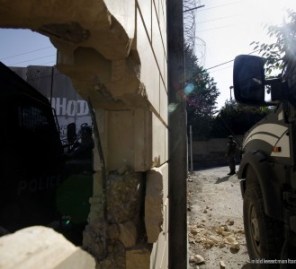 After making the hole, a number of the Palestinians crawled through and stood on the Jerusalem side for a minute. “The youth wanted to send a message to the Israeli occupation that they can enter the city despite the measures put in place by the occupation to stop them,” said witnesses.
Activist Ata Jefal told the Turkish Anadolu news agency that he and his friends have sent a number of signals to the Israelis that they can enter the city at will.
Kabsa lies to the east of Al-Aqsa Mosque. Its residents do not have a free access to the mosque because of the Israeli wall, the building of which began in 2002. At 8 metres high the wall has control towers and CCTV manned around the clock. Its final length is planned to be 780km, most of which will be built on occupied Palestinian land. Although the Israelis claim that it is a “security” wall, the fact that it takes up so much of the occupied West Bank has led to it being described as just another means of grabbing more Palestinian land, along with illegal settlements, settler-only roads, “nature reserves” and “military zones”. Just over 60 per cent of the wall has been completed.
October 24, 2013
Posted by aletho |
Ethnic Cleansing, Racism, Zionism, Illegal Occupation | Abu Dis, Al-Aqsa Mosque, Human rights, Jerusalem, Palestine, West Bank, Zionism |
Leave a comment

Photo credit – alarabiya.net
Suspected Jewish extremists slashed the tires of five Palestinian-owned cars in Israeli-occupied east Jerusalem overnight, a police spokeswoman and local media said on Tuesday.
Separately in the occupied West Bank village of Burin, near Nablus, Israeli settlers set fire to a car, Ma’an news agency cited a Palestinian Authority official as saying.
“Five vehicles were vandalized close to the Old City at the entrance to the Silwan neighborhood, and the slogan ‘price tag’ written on a wall nearby,” spokeswoman Luba Samri said.
Initially carried out against Palestinians in “retaliation” for their filing lawsuits against Israel to reclaim stolen land occupied by settlers, price tag attacks have become a much broader phenomenon with racist and xenophobic overtones.
And in the northern West Bank, Ma’an reported that settlers from the illegal Yizhar outpost torched a car belonging to a Palestinian man at the entrance of the northern West Bank village of Burin, according to official Ghassan Daghlas who documents settler crimes.
Tuesday’s attacks come two days after police caught four Israelis red-handed as they destroyed Christian tombstones in a Palestinian cemetery in Jerusalem cemetery.
(AFP, Al-Akhbar)
October 1, 2013
Posted by aletho |
Ethnic Cleansing, Racism, Zionism | al-Akhbar, East Jerusalem, Israeli settlement, Jerusalem, Palestine, West Bank, Zionism |
Leave a comment
The reigning state of despair among Palestinians has been growing steadily since the end of the Second Intifada. Day after day, the Israeli occupation expands as the options for Palestinians, ostensibly represented by a new generation of the Palestinian National Authority (PNA) eager to seek a “settlement,” grow narrower. The killing has not abated, nor the settlement movement and the Judaization of Jerusalem. The “peace process” track continues as a “strategic option.” But the streets have not come to a rest since the Second Intifada, as they didn’t after the First Intifada and during the period of the Oslo Agreement.
Although, the frequency of clashes and confrontations might have decreased, the revolution continues to simmer, awaiting a spark to ignite. Today the situation in the West Bank evokes the period leading up to the First Intifada. The pace of clashes is rising and military operations are intensifying, despite the project for peace.
Ramallah – In a matter of hours, attention shifted from the far north of the West Bank to the south. In Qalqilya in the north, a Palestinian citizen named Nidal Emer led Israeli air force pilot Tomer Khazan to an empty spot. He killed him, in order to swap his body with that of his detained brother. Nidal took the initiative, but ended up like his brother: in an occupation cell.In Hebron in the south, amid daily clashes between occupation forces and residents, a Palestinian sniper shot at stationed soldiers, killing one and injuring another. The occupation forces retaliated, closing the city and waging a sweeping campaign of arrests, but were unable to find the “unidentified shooter.”
Al-Aqsa Martyrs Brigades – Knights of the Galilee, part of Fatah, claimed the operation in Qalqilya. Some people were optimistic about the movement’s return to special operations and the escape of the Fatah genie from the PNA’s bottle. However, its credibility was soon called into doubt the next day, when it issued another statement also claiming the Hebron operation, which had already been claimed by al-Asifa, part of Fatah-Intifada, which had split from the Fatah Movement in 1983.
On Israeli Radio 2, an Israeli security official spoke about the continuing security coordination between the PNA and Israel to capture the “killer” in Hebron. The father of the man from Qalqilya denounced his son to the station. “My son is a killer and deserves to be killed,” he said.
But it does not matter anymore. What matters is that Palestinian youth can take the initiative from outside of the quarreling factions and narrow interests of the political parties. Two soldiers were killed in less than 24 hours, something that has not happened since the Second Intifada, whose anniversary falls next Friday.
The details of the Hebron operation remain unclear, despite the maniacal security operation, which led to the arrest of a man close to 100 years of age for owning an Ottoman era rifle. The identity of the Hebron sniper is not yet clear, however, and the statements by the factions claiming the operation have not been verified.
Meanwhile, military experts in the occupation army have maintained that the sniper was professional and successfully carried out the operation in its three stages: locating the perfect spot, selecting a target, and the withdrawal of security. The sniper picked a soldier standing on open ground, so that the bullet would not ricochet behind him. However, the downside of the operation were the ensuing squabbles between the parties and their lack of credibility, exposed after contradictory statements were issued within less than an hour by two factions with a long history of political disagreements.This negative fallout also plagued the Second Intifada and was one of the most important factors in its collapse. However, the breadth and size of the clashes of last month, especially in the West Bank and Jerusalem camps, could herald a new uprising.
Amidst all the fury, a young group calling itself the Intifada Youth Coalition is calling for mobilization and protests to protect sacred sites next Friday, which coincides with the anniversary of the Second Intifada. A video made by the coalition is being widely shared on social media sites. In it, a young man calls for confronting the occupation on all fronts set to a song by Julia Boutros, Ya Thuwar al-Ard, which brings to mind the Second Intifada.
Despite differences between the factions, there is a general consensus rejecting negotiations. Several factions launched a popular campaign against the negotiations at a press conference in Ramallah, attended by all PLO factions.
Senior Fatah officials have also expressed their rejection of the negotiations process, including central committee member Abbas Zaki, who declared that negotiations were futile and called for “struggle and insisting on Palestinian constants.”
Even figures who had participated in the Oslo process have expressed, albeit timidly, their regret at signing the agreement, including Yasser Abed Rabbu and Ahmed Qorei. The head Palestinian negotiator Saeb Erekat went as far as complaining that “Israel is not fulfilling its obligations.”
However, this was not enough to inspire the Palestinian leadership to halt or even postpone negotiations for one day, despite the fact that three young men were martyred in Qalandiya. It did not even review the “legitimacy” of its choice, which contradicts the consensus of PLO factions, nor did it change its policies or strategies, which seem to be wholly focused on turning “Palestinian life into negotiations.”Seven martyrs have fallen since the beginning of the latest round of negotiations two months ago. They were all from the camps where the First Intifada erupted and caused the most trouble during the Second.
It is enough to see the sacrifices of Jenin camp, which was back in the headlines following the martyrdom of Islam al-Toubassi at the beginning of this week. The incident led to a limited military operation at the nearby Jalama checkpoint, before the PNA’s security forces managed to suppress the camp’s anger, prohibiting its residents from reaching the frontline areas.
But Jenin is the not the only camp where the revolution is still simmering. In Qalandiya, three Palestinians were recently martyred and clashes continue near the Qalandiya occupation checkpoint nearby. In al-Oroub and al-Fawwar camps in Hebron, clashes have been occurring on a daily basis with the occupation forces stationed nearby, far from the eyes of the media and the PNA’s forces.
Current conditions and factors do not provide Palestinians with any other option. Al-Aqsa mosque faces daily raids and there have been calls by Israelis for a million person march on the holy site to coincide with the anniversary of its storming by Ariel Sharon, which laid the ground for the Second Intifada.
Popular mobilization against Israel is also on the rise inside the 1948 territories, particularly in the Negev and the Triangle, which also coincides with the October 1 revolt that led to the martyrdom of 13 Palestinians from the occupied territories.
It seems the break out of a third intifada is only a matter of time. Friday could be the day the phoenix rises from the ashes.
The PNA Impedes the Intifada
The PNA has cloaked all options following Oslo under the guise of the “national project.” Anyone who objects or dissents falls outside this project. Under this slogan, the Palestinian resistance was liquidated in the West Bank, including the al-Aqsa Brigades, where the PNA’s forces are the only power on the ground. Any weapons not in its hands have become outlawed.The PNA suppressed all action against negotiations, supported by its wide popular base which follows the Fatah movement and the regional winds that put wind in its sails. The PNA has the money and media and is capable of manipulating the discourse. Sometimes it dons the robe of piety, accusing its detractors of debauchery and blasphemy, as it does with the PFLP, for example.
With Hamas, accusations of bartering with religion and extremism are mounted. Fatah’s minister of awqaf (endowments) unabashedly declared a fatwa for “revolution against Hamas” and forbade any opposition to the president in the West Bank.
In political differences it finds an opportunity to avoid facing reality, accusing others of instigating a crisis.
The bedlam following the killing of the two soldiers is the responsibility of Hamas, according to Fatah spokesperson Usama al-Qawasimi, who said that “Hamas’ credibility in the Palestinian street suffered a serious blow after the uncovering of their real schemes and their use of religion and resistance as a cover. If Hamas wanted to change the situation and aim for resistance, it has to start resisting in Gaza and to maintain the truce with Israel at gunpoint.”
September 26, 2013
Posted by aletho |
Ethnic Cleansing, Racism, Zionism, Solidarity and Activism, Timeless or most popular | Al-Aqsa Mosque, Fatah, Hebron, Jenin, Jerusalem, Palestine, Palestinian National Authority, Qalqilya, Second Intifada, West Bank, Zionism |
Leave a comment
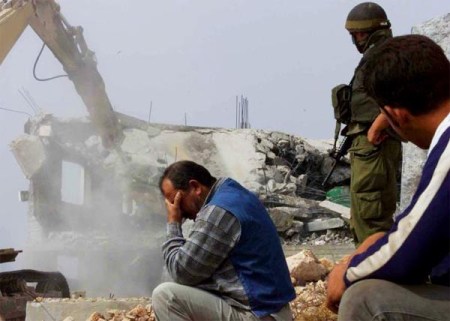
An international human rights organisation has revealed that one-third of the Palestinian-owned houses in Jerusalem face demolition under the pretext that applications for building permits were incomplete. This, claims Euro-Mid Observer for Human Rights, is a way for the Israeli authorities to continue their demographic war against Palestinians in the Holy City. Israel gives Jerusalemite Palestinians the right to use just 13 per cent of the area of occupied East Jerusalem to meet the needs of their growing population.
A report from Euro-Mid shed some light on the widespread Israeli settlement programme in Jerusalem. It mentioned that the financial committee of the Israeli-controlled Jerusalem municipality decided to support 1,500 new settlement units in the city at the end of August. The human rights group also pointed out that Israel’s bulldozers are still razing Palestinian homes in Al-Tour neighbourhood because the authorities plan to set up the “National Israeli Park”.
According to the UN, poverty is getting worse among Palestinians in Jerusalem. Euro-Mid noted that the unemployment rate rose to 78 per cent in 2012 compared with 64 per cent in 2006. More than 40 per cent of Palestinian Jerusalemites now live below the official poverty line; one of the reasons is the disparity in wage rates between Israeli and Palestinian labourers.
Euro-Mid has called upon Israel to stop its frenzy of settlement construction in the occupied territories and to protect Palestinian sovereignty over East Jerusalem, as the potential capital of a Palestinian state.
September 26, 2013
Posted by aletho |
Ethnic Cleansing, Racism, Zionism | East Jerusalem, Human rights, Israeli settlement, Jerusalem, Middle East, Palestine, West Bank, Zionism |
Leave a comment
By Fayez Rasheed | Al Quds Al Arabi | September 18, 2013
The ill-fated Oslo Accords, signed 20 years ago, have only made Israel more arrogant and open about its disregard of the Palestinians’ national rights. Illegal settlements and their infrastructure now cover 80 per cent of the West Bank, leaving the Palestinians with just 12 per cent of historical Palestine. The occupation has left cities, villages and whole districts disconnected by the Apartheid wall; Jerusalem and its surroundings have been Judaised; the land of the Jordan Valley is being looted. Moreover, Israel is imposing more of its conditions on the Palestinians, including the condition of “recognising its Jewish character” and the power of the Palestinian Authority in its own land is becoming more and more limited. On top of all this, the geographical and political split between the West Bank and Gaza Strip is still in place, which is leading, by means of the Oslo Accords, to the decline of the Palestinian national project.
Israel’s main intention in signing the accords was to get the Palestinian representatives to abandon the armed struggle, which is what happened at the 1996 Palestinian National Council session in Gaza; US President Bill Clinton was present when the PNC voted for all the articles regarding armed struggle to be dropped from the Palestinian National Charter.
Furthermore, the Israelis wanted to limit the Palestinian revolution to specific geographic areas in the West Bank and Gaza, in order to monitor and control it more easily. I recall Yitzhak Rabin’s words in the Knesset shortly after the Oslo Accords were signed, when a fellow member asked him why Israel signed the agreement. His response was that Israel had gathered most of the Palestinians belonging to “terrorist” groups in one geographic area to make it easier to keep an eye on them. When Ehud Barak, who was the Army Chief of Staff at the time, was asked about how to solve disputes between the Palestinians and Israel he said, “We will resolve any contradiction according to the Israeli interpretation of the matter disputed over, because we are stronger.”
Israel wanted to see the Palestinian Authority created for two reasons:
- To solve the administrative and daily problems of the Palestinians in the occupied territories far away from Israel and its budget, thus easing the financial burden of the occupation. This way it was able to continue its occupation, but the international community, including the Arab world, would bear the expense of looking after the Palestinians.
- To establish Palestinian security institutions obliged to coordinate and cooperate with the occupation authorities, under American supervision, in order to prevent military operations against Israel.
The accords did not make any mention, at Israel’s insistence, of the creation of an independent Palestinian state. They only refer to a “self-administrating” state. The main issues of Jerusalem, the borders, refugees, water, etc., were postponed to what it called “final-status negotiations”. These issues should have been resolved by 1999 but, as Rabin said, “Appointments are not sacred.” Now we are in 2013 and these issues have still not been discussed. This, too, is part of Israel’s strategy to make sure that Oslo did nothing for the Palestinians; another Israeli prime minister, Yitzhak Shamir, told the Madrid Conference in 1991 that “we will prolong negotiations with the Palestinians for 20 years”; that is exactly what has happened.
All along, Israel as the stronger signatory, and the occupying power, has interpreted the terms of Oslo in its favour. When the Israelis re-entered the occupied territories in force in 2002, Prime Minister Ariel Sharon announced Oslo’s “death”, despite which the PA and its officials continued to declare that they would be sticking to it.
The final status discussions, if they ever take place, will be pointless, for Israel has already made it very clear that Palestinian refugees will never be allowed to return to their homeland; it will never withdraw fully from the territories it occupied in 1967; and Jerusalem is the “united and eternal capital” of Israel. As long as Israel is the top dog, this will be its position.
The Palestinians have made a number of strategic errors since Oslo. For a start, they have failed to read Israeli intentions, not least with regards to the illegal settlement programme. They have also limited the Palestinian struggle to popular resistance and negotiations. This is no way to alter the balance of power in order to convince the Israelis that its occupation must end.
In the creation of the Palestinian Authority, the leadership set up an alternative to the PLO as the representative of the people. This has led to the total neglect of Palestinian institutions across the occupied territories as well as the diaspora. Distanced from the people they claim to represent, this has meant that “leaders” such as Yasser Abed Rabbo could go to meetings with Israelis and unilaterally abandon, for example, the refugees’ right of return; and Ahmed Qurei could agree to link the Palestinian economy inexorably to that of Israel.
Moreover, the current round of negotiations has gone ahead even though the stated Palestinian condition of an end to Israeli settlement activity has not been met and the Judaisation of occupied Jerusalem continues apace.
For 20 years the Palestinians have been negotiating despite their utter foolishness, and delegations from both sides have attended “normalisation” meetings to promote contacts between the occupier and the occupied.
All of this is down to the lack of an honest broker in the search for peace and justice. Counting on the US in this role is pointless because no administration in Washington can ever be anything other than Israel’s main ally. Arab states, meanwhile, have almost totally abandoned any pretence of doing anything about the “Zionist enemy”. They have left the resistance movements to their own devices instead of backing them with material, financial and political support.
Any notion that the Palestinian Authority can lead us to the creation of an independent State of Palestine while it is still under occupation is delusional. In becoming an administrative authority and not a liberation movement the PA’s role is inconsistent with the national cause.
Many supporters of Oslo are positive about it. They point to Israel’s recognition of the Palestinian people, it’s acknowledgement of the PLO, the return of nearly half a million Palestinians to the occupied territories in 1967, the establishment of the PA as a prelude to the establishment of a state, the establishment of state institutions, and the failure of the Israelis to falsify the facts.
In response I say this: Israel’s recognition of the Palestinian people was the result of the armed Palestinian revolution, not of the Oslo Accords. If the First Intifada had been followed through then the establishment of an independent Palestinian state would have been a fact rather than a fanciful theory.
We must be honest and acknowledge that the PA was created to act as a vehicle for limited self-rule as determined by Israel, not to be the government of a state. In the interim, the Israelis have made sure that potential and actual Palestinian leaders strong enough to stand up to them have been assassinated. That is the reality.
This is the swamp that Oslo has put us in. It is possible to escape from this predicament by cancelling Oslo and announcing that the Palestinians are no longer bound by its terms. Israel has always ignored them so why can’t we? The legitimate armed struggle must be reinstated along with other forms of civil disobedience and disruption so that the occupation becomes once more a burden for the Israelis. If this requires the dissolution of the Palestinian Authority, so be it. The leadership got us into this swamp; the least they can do is help us to get out of it.
~
The author is a Palestinian writer. Translated by Middle East Monitor.
September 22, 2013
Posted by aletho |
Ethnic Cleansing, Racism, Zionism, Timeless or most popular | Israel, Jerusalem, Oslo, Palestine, Palestinian National Authority, West Bank, Zionism |
Leave a comment
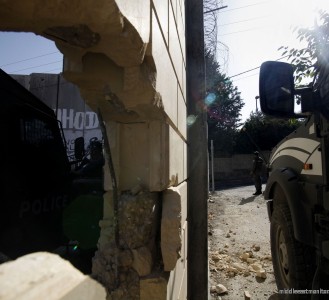 After making the hole, a number of the Palestinians crawled through and stood on the Jerusalem side for a minute. “The youth wanted to send a message to the Israeli occupation that they can enter the city despite the measures put in place by the occupation to stop them,” said witnesses.
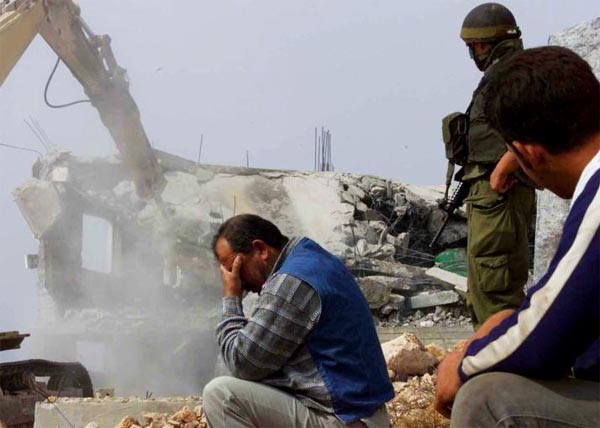

 Aletho News
 Aletho News