
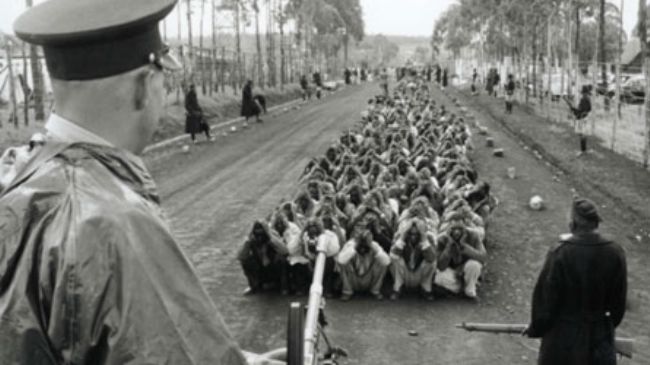
More than 8,000 Kenyans, severely mistreated under British colonial rule during the 1950s Mau Mau uprising, are seeking compensation from the UK.
According to the reports, thousands of names have been submitted to the Law Society of Kenya (LSK), seeking multi-million pound compensation from the British government.
“The Law Society of Kenya has received lists of ex-Mau Mau fighters seeking compensation running into billions of shillings from the British government,” LSK chief Apollo Mboya said in a statement.
More names are expected to be submitted from the Kenya Human Rights Commission, the statement added.
There are also reports that Britain agreed on a compensation settlement totaling £14 million. Britain’s Foreign Office, however, has refused to comment on the issue.
At least 10,000 people died during the 1952-1960 Mau Mau uprising against British colonial rule, with some sources giving far higher estimates.
The British government has admitted to British forces’ torturing of detainees at the time following disclosure of a vast archive of colonial-era documents which the Foreign Office had kept secret for decades.
June 5, 2013
Posted by aletho |
Ethnic Cleansing, Racism, Zionism, Timeless or most popular, War Crimes | Africa, British Empire, British government, Human rights, Kenya, Law Society of Kenya, LSK, Mau Mau, Mau Mau Uprising |
Leave a comment
Britain is negotiating out-of-the-court settlements to compensate thousands of Kenyans severely mistreated under British colonial rule during the 1950s Mau Mau uprising.
According to a letter sent to lawyers representing some of the claimants, the Foreign Office has changed its mind on appealing last October’s High Court ruling that gave victims the green light to sue the government, The Guardian reported.
“The parties are currently exploring the possibility of settling the claims brought by our clients,” Dan Leader, a partner with the Leigh Day law firm told the paper.
“Clearly, given the ongoing negotiations, we can’t comment further.” He added.
The Foreign Office has refused to comment on the issue, but admitted the victims suffered “pain and grievance” during the bloody events of the Emergency period in Kenya.
Three victims won the case to sue the government at the High Court last year.
The trio’s lawyers said one of them was castrated, antoher severely tortured and the third subjected to appalling sexual abuse in detention camps during the Mau Mau rebellion.
There was also a fourth claimant Susan Ngondi who has died since legal proceedings began.
The British government has admitted to British forces’ torturing of detainees at the time following disclosure of a vast archive of colonial-era documents which the Foreign Office had kept secret for decades.
May 7, 2013
Posted by aletho |
Ethnic Cleansing, Racism, Zionism, Illegal Occupation, Subjugation - Torture | Foreign and Commonwealth Office, Foreign Office, Government of the United Kingdom, Kenya, Mau Mau, Mau Mau Uprising |
Leave a comment
Karuturi Global Limited, a publicly registered holding company headquartered in Bangalore, India, may be under fire from the Kenya Revenue Authority (KRA) for tax evasion, but the complaints against it go further than that. The agribusiness firm, whose farm operations also straddle Ethiopia and India, has been dodging bullets about labour law violations, human rights abuses and environmental issues. Even the World Bank Group is no longer considering the company’s request for risk insurance for its investments in Ethiopia. This background note summarises the various problems that Karuturi has come to be known for among social justice movements around the world.
Tax evasion
Every year around US$ 1000 billion disappears without a trace from developing countries, ending up in tax havens or rich countries. The main part of this is driven by multinational companies seeking to evade tax where they operate.
The sum that leaves developing countries each year as unreported financial outflows, referred to as illicit capital flight, amounts to ten times the annual global aid flows, and twice the debt service developing countries pay each year. During 2000-2008 Africa was the region with the largest real growth of illicit capital flight, amounting to 21.9 % per year.
This money, if properly registered and taxed in the country of origin, could of course contribute to fulfilling human rights like the right to education and health care, and make a major difference in the fight to combat poverty. Due to just two forms of illicit capital flight used by corporations (‘mispricing’ and ‘false invoicing’), developing countries are losing three times the amount that is missing to achieve the UN millennium development goals (like universal education, stopping the spread of HIV, and halving extreme poverty) in tax revenues every year.
(For all facts on tax evasion above and more info on mispricing please see “Bringing the billions back: how Africa and Europe can end illicit capital flight” by Fröberg and Waris, 2011)
In 2012, the Kenya Revenue Authority developed a team of transfer pricing experts to audit accounts of companies in order to assess whether there was transfer mispricing and tax evasion taking place. Some transnational companies that export from Kenya are notoriously adept at it. However, the government has had difficulty tracing these firms’ operations due to lack of capacity and to date all audits and assessments, apart from one against Unilever, have been settled outside of public view.
On the 4th of April 2013 Karuturi filed a notice of appeal against the decision of the tax tribunal for taxes due to the Kenyan government and the Kenyan people. According to ICRA, an Indian credit rating research agency, in an October 2012 analysis commissioned by Karuturi as well as Karuturi’s 2012 annual report, Karuturi has been facing a number of potential threats to its financial viability, namely:
- An INR 57.8 crore (= KES 975 million / USD 10.7 million / EUR 8 million) dispute from the Kenya Revenue Authority over transfer pricing
- An INR 83.5 crore (= KES 1.4 billion / USD 15 million / EUR 11.5 million) claim on unpaid income taxes from the Indian authorities
- A risk of default on a USD 54.7 million (= KES 4.8 billion / EUR 40.3 million) foreign currency convertible bond due for redemption on 19 Oct 2012 which was since restructured
The overall tax claims come to USD 26 million, which is about one-quarter of the multinational’s global turnover in fiscal year 2012 (USD 106 million) while the amount for Kenya amounts to almost 1 per cent of Kenya’s total annual tax collection.
Money of this magnitude could be used as additional income for development or to replace some current taxes that target the poor like value added tax or even to delay the enactment of additional taxes like the one on maize flour due to be activated in Kenya in 2015.
Land grabs
Since 1996, Karuturi’s core business has been floriculture, producing 580 million roses per year from 289 hectares of land the company leases in Kenya (154 hectares), Ethiopia (125 hectares) and India (10 hectares). In 2012, the group commanded no less than 9% of the cut rose market in Europe. Since the 2007/2008 global food crisis, Karuturi began expanding from floriculture into food production. Its plan is to set up farming operations on over one million hectares, mainly in eastern and southern Africa, to produce primarily maize, rice, sugarcane and palm oil for international markets.
The hub of this expansion is Ethiopia. In 2009, Karuturi acquired 10,700 ha of land in Bako for maize, rice and vegetable production. In 2010, it got an additional 300,000 hectares for expansion in Gambela. The company aims to farm a total of 750,000 ha in Ethiopia. This land is leased from the government at bargain prices, but local communities consider it their own.
As a result, many conflicts have emerged around compensation, displacement and the relocation of villagers and herders who suddenly found themselves fenced off of their lands by the Indian company.
In 2011, Karuturi announced it was expanding further by pursuing a US$500 million investment for 370,000 ha in Tanzania, including an initial 1,000 ha in the country’s fertile Rufiji Basin. That same year, the company announced that it was in discussions with government officials in the Republic of Congo for a farm project in a special economic zone in Oyo-Ollombo, 400 km north of Brazzaville. In addition, it has been planning fruit and vegetable farms in Sudan, Mozambique and Ghana, and, says CEO Ramakrishna Karuturi, “in Senegal, we have made an exploratory probe and in Sierra Leone we have made initial contacts.” All of these countries are rife with land grabs right now.
Labour issues & disputes
According to a 2012 report published by the London Business School, 5% of Karuturi’s workforce in Ethiopia is composed of foreigners. Karuturi has been bringing in staff and consultants from abroad, including India, to run management, irrigation & drainage operations, and logistics because they said they could not find the experience locally. Same for manual labourers. Karuturi hires Ethiopians as unskilled labour but for skilled labour it says it faces problems. At the end of 2011, Karuturi got into a dispute with the Ethiopian government because they brought in several hundred Indian farmers to work on their farms in Gambela, which the Ethiopian authorities said contravened Ethiopian law and for which they would not give the permits. Karuturi reportedly also expects to rely on Indian farmers to handle its work on oil palm.
According to media and labour organisation organisation reports, workers on Karuturi farms in both Kenya and Ethiopia have been complaining about, and initiating labour actions against, various conditions, especially related to wages and safety.
In November 2012, Karuturi reportedly began laying off about 900 of its 3,500 seasonal workers in Naivasha, Kenya, due to financial problems. The number was later reduced to 600. In December 2012, 1,000 Karuturi workers went on strike to demand action from management on unpaid salaries and poor working conditions.
Earlier, in June 2010, Workers Rights Watch, a Kenyan association, carried out focus group discussions with Karuturi flower farm workers in Naivasha and registered a mixed scorecard of positive and negative opinions about the company.
Regarding Karuturi’s Ethiopian farms, various media and research reports have exposed complaints of poor wages. For example, a solid report commissioned by the International Land Coalition shows that Karuturi pays Ethiopian farm labourers at its Bako farm ETB 10 per day (US$ 0.50) which compares with about ETB 20 per day (US$ 1.00) for labourers on commercial sesame farms in the country. Night guards for the company are said to be paid ETB 300 per month (US$ 15) if they own a gun and ETB 200 (US$ 10) per month if they do not.
Human rights violations
According to a powerful 2012 report by Human Rights Watch, the Ethiopian government is forcibly relocating thousands of indigenous people in western Gambela to new villages lacking adequate food, farmland, healthcare, and educational facilities to make way for large scale agricultural projects of foreign investors, including Karuturi. The report said, based on interviews with community representatives, that crops of local Anuak communities were cleared without consent for the Karuturi operations and that residents of Ilea, a village of over 1,000 people within Karuturi’s lease area, were told by the Ethiopian government that they would be moved in 2012 as part of its “villagisation programme”. In response, CEO Sai Ramakrishna Karuturi denied any connection between his company’s activities and the government’s villagisation programme. In conversation with the Wall Street Journal’s unit in India, he described the Human Rights Watch report as “hogwash” and “a completely jaundiced western vision”, and even denied that the villagisation programme exists.
Loss of livelihoods
Karuturi’s 10,700 ha Bechera Agricultural Development Project in the Bako Plains of Ethiopia has deprived several local communities of their communal grazing areas and access to water for their livestock, thus severely affecting their livelihoods. This comes from a study commissioned by the International Land Coalition, based on detailed discussions with local communities, local authorities and Karuturi employees. The study documents how the lands were provided to Karuturi without the consent of the local communities and without compensation. It reveals that Karuturi is refusing to implement even the most minimal measures recommended by local authorities to address some of the impacts from its operations. For example building a livestock corridor through its fields so that locals could access water sources for their animals, or allowing them to graze their animals on crop residues.
Environmental & health concerns
Karuturi operates one of the largest flower farms in the Lake Naivasha Basin in Kenya, the country’s second largest freshwater lake. The flower farms are blamed for causing a drop in the lake’s water level, for polluting the lake with pesticides and chemical fertiliser runoff and for affecting the lake’s biodiversity. Workers at Karuturi’s flower farms in Naivasha who spoke with Muungano wa Wanavijiji, a local partner organisations of Forum Syd, in February 2013 said that the dilapidated condition of the Karuturi operations and poor protective clothing puts them at risk to exposure from chemicals. They say the company does not seem to care about their concerns.
For its farm in Gambela, Ethiopia, Karuturi has developed an irrigation system with 50km of canals, 50km of drainage, and 40km of dykes, to pump a reported 22,000 litres of water per second from the Baro River, a crucial source of water for people dependent on the White Nile. Karuturi’s smaller 10,700 ha farm in Bako also generates significant issues related to access to water and water quality for the local communities. Although environmental impact assessments are usually required for irrigation projects in Ethiopia, Karuturi reportedly did not undertake any such assessment prior to constructing its farming complex in Bako.
Investor confidence
Karuturi and its shareholders have been waiting since at least May 2011 for the World Bank’s Multilateral Investment Guarantee Agency (MIGA) to approve the company’s long pending bid for political risk insurance for its Ethiopian operations. According to Sai Karuturi, as of 2012 the application had still not been approved due to Karuturi’s plans to produce palm oil — a sensitive issue for which the Bank would require the Ethiopian government to put in place environmental protocols. Karuturi explained that he was therefore advised by MIGA to omit palm oil from the application for now and so he did. If MIGA protection fails to materialise, the company told investors that its fallback option would be to seek support from India’s Export Credit Guarantee Agency. On 29 January 2013, MIGA informed GRAIN, flatly, that Karuturi’s application “is no longer under consideration”.
In March 2013, Bloomberg reported that Karuturi was seeking “hundreds of millions” of fresh investment dollars from an unnamed sovereign wealth fund after yet another unnamed development bank refused it a loan.
In April 2013, the Indian paper Business Today reported that Karuturi was thinking of taking the company private.
April 23, 2013
Posted by aletho |
Corruption, Deception, Economics, Timeless or most popular | Africa, Ethiopia, India, Karuturi, Kenya, Kenya Revenue Authority |
Leave a comment
Never before seen files on Britain’s cruel colonial grip on Kenya have revealed a desperate attempt to cover up the massacre of unarmed prisoners during the Mau Mau uprising.
Eleven prisoners at the Hola detention camp were brutally clubbed to death and dozens more injured by prison wardens on March 3 1959 after they refused to work.
One of three elderly Kenyans, who last month won a High Court ruling to sue the British government for damages over torture, claims he was beaten unconscious during the incident.
Despite the overwhelming evidence nobody has ever been prosecuted.
Shockingly, the previously secret documents show that British colonial officials refused to identify individuals involved and attempted to blame the deaths on the prisoners “drinking too much water.”
The prison camp was one of many built during the uprising in which suspected rebels were detained by British colonial forces, often in dire conditions.
Shortly before the Hola deaths, a plan had been drawn up by colonial authorities allowing prison staff to use force to make detainees work if they refused, the Foreign Office files released by the National Archives show.
Prison officer Walter Coutts told the inquest into the Hola deaths that the detainees either “willed themselves to death or had died because they drank too much water.”
But a colonial official’s assistant, Kenyan Johannes Ezekiel, said he saw camp commandant Michael Sullivan moving between groups of prison warders, and could “see perfectly well what was going on.”
Mr Ezekiel’s comments were discounted by attorney-general Eric Griffith-Jones, who was in charge of criminal prosecutions, as he was “strongly suspected” to have links with Kenyan nationalist opposition politician Tom Mboya.
After post-mortem examinations revealed the deaths were caused by violence, the commissioner of prisons, who authorised the plan to use force, claimed that he had warned there were risks.
To make matters worse the attorney-general caused uproar in Britain after announcing that no charges could be brought against any individuals.
He said in a secret letter to the Kenyan chief secretary: “No evidence was available to establish whether any, and, if so, what, injuries had been inflicted by the beating in question or on whom.”
The Hola deaths signalled the beginning of the end of Britain’s clampdown on the Mau Mau uprising as colonial authorities began to close prison camps around Kenya in the following years.
Kenya declared independence from Britain just over four years after the Hola deaths, on December 12 1963.
Separate government files, also released for the first time today, show that colonial officials in Cyprus had considered producing adventure comic books and running an essay competition in the 1950s as part of a propaganda bid to stop youngsters rebelling against British rule.
Cyprus won independence from Britain in 1960.
December 1, 2012
Posted by aletho |
Civil Liberties, Deception, Ethnic Cleansing, Racism, Zionism, Subjugation - Torture, Timeless or most popular | British Empire, Government of the United Kingdom, Hola massacre, Kenya, Mau Mau Uprising, Tom Mboya, Walter Coutts |
Leave a comment
Boxes containing top secret files about former British colonial rule have gone missing, with those relating to Singapore possibly destroyed. Declassified colonial Kenyan files earlier played a key role in proving the UK responsible for grave abuses.
Britain has admitted that it was aware that 170 boxes of files were transferred to Britain from former colonies. But the UK’s Foreign and Commonwealth Office (FCO) Minister David Lidington said that the government did not know what had happened to the files afterwards.
“It remains the case that the FCO is still unable to confirm the existence or destruction of 170 boxes of top secret colonial administration files known to have been returned to the UK,” Lidington told AFP.
“There is some evidence that the Singapore-related top secret colonial administration files were destroyed as part of a review of FCO post files in the 1990s.”
The FCO is continuing the search for the files and any evidence relating to their possible destruction.
The revelation comes after files relating to British rule in Kenya and Cyprus were declassified, made public and played a key in a court case by three elderly Kenyans who say they were tortured during the British army’s suppression of the 1950s Mau Mau Rebellion.
At the court hearing an archive of 8,800 secret files were examined. The released documents proved attempts by UK authorities to cover-up the killings of 11 prisoners during the uprising and showed that detainees had been battered to death by warders at the Hola detention camp.
A British court granted a historic victory to the three Kenyans, allowing them to claim damages for the suffered abuses when imprisoned during the Mau Mau uprising, including castration, beatings and severe sexual assaults.
The Kenyan case set a historical precedent and it is estimated that 2,000 other surviving Kenyans imprisoned during the Mau Mau insurgency can know sue the British government, which could have significant consequences for the government.
Overall, Britain used to have total control over 50 colonies including Canada, India, Australia, Nigeria, and Jamaica. Currently, there are 14 British Overseas Territories that remain under British rule. However, all have their own internal leadership and most are self-governing.
December 1, 2012
Posted by aletho |
Civil Liberties, Deception, Ethnic Cleansing, Racism, Zionism | Britain, British Empire, Foreign and Commonwealth Office, Government of the United Kingdom, Kenya |
Leave a comment

Britain has admitted that Kenyan prisoners were tortured and sexually abused under the UK rule in Kenya, local media reported.
For the first time ever, British ministers were forced to issue a public confession admitting that atrocities were carried out ‘at the hands of the colonial administration’.
The admission came via a Whitehall lawyer addressing three elderly Kenyans who had gone to the High Court in London to demand damages and an apology.
Now in their 80s, one of them told the court how he had been brutally castrated in a British detention camp during the Mau Mau rebellion – Britain’s bloodiest colonial war.
If the trio win their case, it would open the door to up to 20,000 Kenyan survivors of the Mau Mau purge to sue Britain for millions of pounds, using no-win, no-fee lawyers.
The Foreign Office is contesting the case because it officially denies liability and maintains the Kenyans have left it too late to make claims.
Yesterday, each of the three claimants walked slowly to the witness stand to deliver their graphic testimony.
But before Guy Mansfield, the Foreign Office’s QC, cross-examined them, he said: “I wish to make it clear that the British government does not dispute that each of you suffered torture and other ill-treatment at the hands of the colonial administration.”
The Mau Mau uprising began in 1952 to end British colonial rule. Britain initially dismissed reports of unrest, but later declared a state of emergency – introducing the death penalty for Mau Mau members. The violence ended in 1956, but the state of emergency was only revoked in 1960.
July 18, 2012
Posted by aletho |
Civil Liberties, Subjugation - Torture, Timeless or most popular, War Crimes | Britain, British Empire, Kenya, Mau Mau Uprising, Whitehall |
Leave a comment
Thousands of documents detailing some of the most shameful acts and crimes committed during the final years of the British empire were systematically destroyed to prevent them falling into the hands of post-independence governments, an official review has concluded.
Those papers that survived the purge were flown discreetly to Britain where they were hidden for 50 years in a secret Foreign Office archive, beyond the reach of historians and members of the public, and in breach of legal obligations for them to be transferred into the public domain.
The archive came to light last year when a group of Kenyans detained and allegedly tortured during the Mau Mau rebellion won the right to sue the British government.
The Foreign Office promised to release the 8,800 files from 37 former colonies held at the highly-secure government communications centre at Hanslope Park in Buckinghamshire.
The historian appointed to oversee the review and transfer, Tony Badger, master of Clare College, Cambridge, says the discovery of the archive put the Foreign Office in an “embarrassing, scandalous” position.
“These documents should have been in the public archives in the 1980s,” he said. “It’s long overdue.”
The papers at Hanslope Park include monthly intelligence reports on the “elimination” of the colonial authority’s enemies in 1950s Malaya; records showing ministers in London were aware of the torture and murder of Mau Mau insurgents in Kenya, including a case of aman said to have been “roasted alive”; and papers detailing the lengths to which the UK went to forcibly remove islanders from Diego Garcia in the Indian Ocean.
April 20, 2012
Posted by aletho |
Civil Liberties, Subjugation - Torture, Timeless or most popular | British Empire, Foreign and Commonwealth Office, Foreign Office, Kenya, Mau Mau Uprising, Tony Badger |
Leave a comment
Harare – Could Australia be planning some sort of military action in Africa, specifically Zimbabwe, Kenya and Nigeria?
Absurd as such a question would have sounded just a fortnight ago, the possibility now seems real.
Australian media this past week claimed Canberra had deployed special forces to the three African countries on “intelligence-gathering missions”.
The New Age newspaper said the soldiers were, among other things, assessing border controls, exploring landing sites for possible military interventions and possible escape routes for the evacuation of Australian nationals and military assessments of local politics and security.
Soldiers are not normally deployed as spies.
Further fueling speculation that Australia did indeed deploy– despite the official denials – are indications that a“Western” or “Arab” spy, believed to belong to elite-trained special forces, was arrested in Harare in the past month.
Intelligence gathered by the Australians is believed to flow into databases used by the US and its allies in Africa.
Officials from both Zimbabwe and Australia have not been keen to comment on this.
A few weeks ago, police arrested an Australian couple purporting to be tourists on charges of spying.
The duo was deported.
However, Australia’s Ambassador in Harare, Matthew Neuhaus, told The Southern Times, “I can confirm that there is no Australian SAS or defence operation in Africa.
“I can categorically say there (are) none in Zimbabwe.”
He said issues like evacuation of Australian citizens were dealt with on a “case-by-case” basis.
Neuhaus added that Australia operated within the confines of international law, and its naval assets were part of an operation to hunt down pirates along Africa’s East Coast.
SAS 4 Squadron
According to the New Age newspaper, Australia’s covert unit,the SAS 4 Squadron, which was established by the John Howard government in 2005, has been in Africa since at least last year. However, its existence has never been acknowledged.
The squadron has been operating in three African countries with which Australia is not officially at war.
Authorisation for deployment came from Defence Minister Stephen Smith in late 2010. Smith is believed to have also permitted the transformation of the military unit into one that also dabbles in intelligence gathering.
They are not uniformed and are not accompanied by personnel from the Australian Secret Intelligence Service, with whom undercover SAS forces are conventionally deployed. In essence, they have no legal right to be in Africa and if captured can be treated as spies.
Australian National University’s Professor Hugh White, a former Deputy Secretary of Defence, has been quoted saying, “Such an operation deprives the soldier of a whole lot of protections, including their legal status and, in a sense, their identity as a soldier.”
The New Age said Australia’s close links with the US might have influenced its decision to create the SAS 4 Squadron and dispatch troops to Zimbabwe, Nigeria and Kenya.
It is believed Australia is following the US model of training and deploying “soldier-spies”. These have both a military and intelligence-gathering background.
Acting like terrorists
Defence and security expert, Retired Colonel Panganai Kahuni, told this paper that if Australia had deployed in Zimbabwe that would be a violation of international law.
“In the first place, Zimbabwe is a peaceful country with no terrorism activities at all.
“Zimbabwe has no defence and security pact with Australia; hence if such operations are happening they are violating international law and immigration law.
“Those involved could easily be regarded as terrorists since they are operating covertly without the consent of Zimbabwe’s authorities.
“If arrested they could easily be charged under treason laws of Zimbabwe.
“They also can be charged for violating our immigration laws.
“However, these terroristic activities demand that our security institutions become more vigilant and alert.”
The chair of the Institute of Peace and Conflict Management (IPCM), Chakanyuka Karase, said such activities should be looked at within the wider and deeper context of increased Western military involvement in Africa’s affairs.
“The IPCM implores African governments and populations to be vigilant against these foreign machinations.
“The IPCM also implores the international community to discard interventionist doctrines camouflaged under the cloak of ‘protecting civilians’ to promote the interests of certain states by effecting regime change.
“The role of the special forces of Western countries in the destruction of Libya is gradually being exposed and revealed to the world.
“The international community in the interests of peace and security has a duty to guard against a repeat of what transpired in Libya,” he told The Southern Times.
Professor Ben Saul of the University of Sydney was quoted in the media adding, “If Australian forces are present in other countries, in circumstances where Australia is not fighting lawfully in an armed conflict, but they are just picked up as spies on the ground, that then exposes them to the full force and penalty of the local domestic law.
“In many countries espionage is an incredibly serious political offence, which can carry the death penalty.”
Vultures Circling
In recent years, several Western powers have not hidden their desire to intervene militarily in Africa to further their own ends.
The US is keen to establish a military base, the Africa Command (AFRICOM).
In 2011, the US sent special forces to “assist” Uganda rebel Lord’s Resistance Army rebels in Uganda and used AFRICOM to launch the war on Libya.
The Israelis have agreements with Kenya, the Western-backed Somali government and Tanzania on various “military co-operation” deals to curb Islamic militants in the Horn of Africa.
France has deployed militarily in Libya and Cote d’Ivoire in the past year alone, and is understood to be meddling in Madagascar’s political crisis.
An alliance between Australia’s SAS and the US would be natural in the geo-political order of things.
A British paper recently stated that Australia’s SAS played a key role in the potentially illegal detention of prisoners of war at a secret Iraqi prison.
The Guardian said documents showed an SAS squadron of 150 men was integral to the operation of a secret detention facility, known as H1.
A blog called American Interests expounds on the US-Australia military relationship.
It says, “For nearly 100 years, Australia has committed its armed services in every major conflict fought by the United States.
“Its foreign policymakers and its people have mostly accepted that the US is a force for good; a force that historically we have wanted to be associated with.
“Beginning in 1908 when Australian Prime Minister Alfred Deakin successfully invited Teddy Roosevelt to send his fleet to visit our shores through to the fighting in WWI.
“From when John Curtin turned our military operations over to US General Douglas MacArthur during WWII, through to Vietnam and presently, Afghanistan and Iraq – some 50,000 Australians, including ground troops and air force and navy personnel, served in Vietnam.”
The SAS, according to the blog, is the “cream” of Australia’s military and is moulded along the same lines of the British special forces of the same name. Canberra has always been secretive about its existence and activities.
March 17, 2012
Posted by aletho |
Militarism, Timeless or most popular | Africa, Australia, Australian Secret Intelligence Service, Kenya, Libya, Zimbabwe |
Leave a comment
“An international cabal of pan-African and global imperialist interests are combining forces to destabilise Africa”
Once again, the spotlight is on Africa as four Kenyans – three political leaders and a journalist – have been indicted at the International Criminal Court (ICC). Once again, the question that has never been answered is, why Africa? And why the speed? In Anglo-Saxon parts of the world, some leaders are treated with kid gloves when they commit ‘crimes against humanity’. Others, like the former British Prime Minister Tony Blair and former US President George Bush, go on to write memoirs defending their abuse of international laws.
Let us put this in context, in Ivory Coast, ex-President Laurent Gbagbo was ‘abducted’ (the words used by Jerry John Rawlings, former President of Ghana) at midnight and carted off to The Hague. In my view, his crimes remain unknown except to the French and his Ivorian adversaries. Charles Taylor (Liberia) remains in The Hague incarcerated. Now we learn that all along, the former President of Liberia may have been a CIA agent. So we can guess why the leadership of the United States would like to see him remain in The Hague. He knows too much. In the case of Libya, Colonel Muammar Gaddafi and his sons were even indicted before the ICC could establish whether they had committed crimes ‘against humanity.’ Other Africans from the Democratic Republic of the Congo are also facing charges in The Hague. In the Sudan, a sitting head of state, President Omar Bashir, has also been indicted. The queue of Africans waiting to be hanged by this international court is endless.
Yet, a cursory glance at the world also tells of many crimes committed against ordinary citizens – from Palestine to Afghanistan, to Libya and, of course, Iraq. Who bears responsibility for these crimes? Are we suggesting that the lives of Iraqi, Libyan and Palestanian children and women do not matter? How come no one is facing so-called justice in The Hague?
This raises serious questions about the selective justice and double standards of the international systems of justice that is selectively applied to Africa and especially African leaders by the so-called ‘international community’. It leaves me with no option but to conclude that the ICC has become a vehicle for enforcing neocolonial interest in Africa, which members of the UN Security Council can exploit. What is even more worrying is that the ICC has become a tool in the hands of vicious African elite/politicians fighting for the national cake. All it takes is to convince the so-called international community that your opponent needs to go to The Hague. I will suggest in all seriousness that serious crimes against humanity have been committed in Libya by NATO forces, and by both sides in the post-election crisis in the Ivory Coast. But we are yet to see some action on that front. The work of the ICC will make sense, and justice will be served, if the leaders who authorised the bombing of Tripoli under the guise of UN resolutions also face the same justice that the Kenyans are supposedly going to face.
In the case of Kenya, the facts should be separated from the chaff. There was post-election violence in which over 1,000 citizens died, some under gruesome conditions. Someone or some groups bear responsibility for this. As usual, the international community, and a flaking Kenyan leadership, abdicated responsibility for punishing those responsible to a horde of international experts and UN rapporteurs with lengthy reports.
Maybe, these people did some good, but these reports are now gathering dust while all attention is paid to the antics of the chief prosecutor of the ICC Luis Moreno-Ocampo. The man now thinks he is a celebrity in Kenya. ‘Kenyans love me’, he is reported to have said. Second, the Kenyan ruling class failed to set up a local tribunal to address cases of post-election violence and historical injustices, thereby fuelling the feeling among ordinary Kenyans that the ICC route was the only way to seek justice. Third, the Kenyan elite, especially those in civil society, seem united in their view that to end ‘impunity’, they need the intervention of some foreign ‘knight in armour’ who should descend in Kenya to take out the bad guys (their leaders who are responsible for impunity). I suggest that impunity is deep-seated in Africa, and its historical and structural causes should be addressed. Impunity has colonial and neo colonial roots. The ICC can only deal with the symptoms.
In Kenya, the ICC debate, like most debates, has become a lawyers’ paradise where people talk of ‘the Rome statute’ and similar words with arrogant recklessness and self-satisfaction. That African heads of states signed up to this is ‘Rome statute’ is not in doubt, but for good reasons. Others refused. But this does not constitute a blood oath to which we are bound for life, as the juju takers in Nollywood movies suggest.
The debate about how to seek justice for the victims of the post-election violence in Kenya seems to have been relegated to a few campaigners. The internally displaced people (citizens) of Kenya are still living in IDP camps. Women who were abused have not been offered counseling or financial compensation or support to deal with the consequences of the abuse. Children of IDP families are not receiving quality primary education as their families are on the move and lack stability. Kenya is yet to heal, as the ruling elite and the so-called international community engages in futile and sometimes endless debates about ‘impunity’ and the ICC. The nongovernmental organisations and civil society have been caught up in this maze as some seek publicity for themselves and their organisations at the expense of real justice for victims. Playing to the international gallery has become the endgame in Nairobi. Who speaks for the IDPs? Who speaks for the women who were abused?
This reminds me of Sierra Leone. When I visited Freetown after the civil war, there was a lot of talk about ‘impunity’ and justice, as we are hearing today. The UN Tribunal for Sierra Leone was set up in a huge compound in Freetown as a justice centre of some sort to deal with so-called perpetrators of the civil war, nothing about the victims. It was full of young European and American lawyers recruited as ‘investigators’, with their fanciful laptops and mobile phones. All was set for justice. Down the road was an amputee camp, where amputees, real victims of the savage civil war, lived in unimaginable abject poverty. So the question I asked myself was: where is our sense of priority? Are we condemning the living, young as they are, to a life of penury, so that some octogenerian leaders can be put on trial, and for what purpose? Millions of dollars were spent on this illusive justice while the youthful victims of the civil war – ex-combatants and their families – were abandoned by the same international system which has ripped off Sierra Leone for its diamonds. Is that the African sense of justice? Many Sierra Leoneans and other West Africans had the same feeling; we could only shake our heads in disbelief. In the case of Sierra Leone, most of the so-called perpetrators died in jail awaiting trials.
I would suggest that Kenya is headed in that same direction. The broad sense of seeking social justice for victims has been pushed to the dustbin of history as people seek retribution, and settle petty political scores of a different nature. Whether the four indicted individuals deserve to be indicted by the ICC or not is for Kenyans to answer. But some of us will never know, as only those with voices and access to Kenya’s media which is embedded with powerful interests, and positions that appeal to or support the marginalisation of Africa, and the abuse of African leaders in the international system get heard. But it would be churlish and ahistorical to separate what is happening to the Kenyan four. It is part of a broader cat and mouse game of humiliating African leaders to serve the global imperialist interests of some countries, and to justify their continued plunder of the continent and its resources, a game in which Africa will always emerge as the loser.
In the case of the Kenyan four, I cannot help but feel that this is more about the impending election (2012 0or 2013), than about justice for victims. Some in the international community and their minions have suggested that some ethnic groups should be sidelined. A dangerous proposition for a country seeking to build a cohesive society.
In a contribution to Pambazuka News last year, I suggested that an international cabal of pan-African and global imperialist interests are combining forces to destabilise Africa. This is a continuation of this debate. The idea that shipping four Kenyans (Africans) to join the already high number in The Hague is somehow the best way to achieve justice does not appeal to me. My position will be the same if these four were Libyan, Nigerian, Ghanaian or Ugandan. I believe that Africa has come of age to settle its own problems. I believe that neither the US nor British governments will subject their citizens, especially, young, intelligent and committed politicians, to the sort of humiliation that the four Kenyans are being subjected to in the name of fighting impunity.
The ICC has time and time again proven that it is beholden to countries that are not even signatories to the Rome statute (for example the United States, as in the case of President Charles Taylor). Ocampo has proven that he is anti-African, that his interest is only in persecuting and prosecuting Africans because we have made ourselves vulnerable to this process. This same court which acknowledges that African countries are signatories ignores the voice of the African Union leadership – those we have elected to represent our interest as Africans. Will the ICC ignore the leaders of France, the UK, the European Union and the United States? Yet, the ICC ignored the AU in the case of Sudan, and ignored the pleas of Kenya’s Vice President who had the support of the majority of progressive thinking African leaders in the Africa Union. This underlies the contemptuous attitude towards African leaders by lower officials in international organisations. Why do we allow this to happen?
In the case of Kenya, what is even more worrying is the impact of this process on the national psyche. It destabilises the country, creates unnecessary anxiety and fuels rumours of the dangerous type. Kenyans need closure to the post-election violence if they are to build a cohesive and progressive society based on the ethic of the 2010 constitution. The intelligentsia is supposed to lead this struggle, but it is failing as they are devoid of any ideological leanings or clarity. ‘Human rights’ is treated as if it is value-free, with no ideological underpinnings. The debate about political transition in Kenya is being sidelined and made to look moribund as the country frets and is on tenterhooks awaiting decisions from the ICC. In Kenya, the ICC has been elevated to a ‘god’ with the prosecutor as some sort of deity. Dissenting voices are silenced or seen as irrelevant to this debate.
However, it is important for Africans to realise that there is no alternative to nation-building and to local processes. Neither the US nor France will abdicate such awesome responsibilities to a foreign court or subject the whole nation to such unnecessary anxiety. Africans must have the courage and steadfast belief in our ability to change the continent, to deal with abuses and seek justice on our own terms. For me, the ICC will always remain an imperialist-led institution set up to hold back the forces of progress, while undermining African institutions and our ability to deal with forces of retrogression and ‘impunity’. It is time for African leaders to take charge and not hand over the continent to some faceless ‘judges’ of the international system.
February 12, 2012
Posted by aletho |
Deception, Timeless or most popular | Africa, Hague, International Criminal Court, Kenya, Laurent Gbagbo, Luis Moreno-Ocampo, Sierra Leone |
Leave a comment
Israel is looking at Africa’s east as an important strategic interest, and trying to step up ties with nations in the region under the name of “controlling the spread of Islamic extremists”.
The Associated Press reports that Israeli Prime Minister Benjamin Netanyahu hosted the leaders of Uganda and Kenya earlier this week.
The Kenyan leader has said that the Zionist entity has promised to provide ‘security assistance’ to his country to help protect its borders.
Kenyan Prime Minister Raila Odinga has said Netanyahu promised to help build “a coalition against fundamentalism,” bringing together the countries Kenya, Ethiopia, South Sudan and Tanzania. The African country also has said Israel’s president, Shimon Peres, has told him Israel is ready to make “everything available to Kenya” for internal security.
For the Israeli part, Netanyahu’s office refuses to comment on Odinga’s claims, while Peres’ office suggests the Kenyan leader has gone too far.
An official in the Peres’ office says he has boasted that Israel is one of the most advanced countries in the world regarding homeland security and would be happy to share its expertise with any country fighting “global terror.” But the official, speaking on condition of anonymity says no specifics have been discussed.
Another Israeli official says an alliance with Kenya and other eastern African countries is natural.
An agency quotes Israeli government spokesman Mark Regev as saying: “We have joint interests and we believe that mutual cooperation can be beneficial to us all”.
Uganda and Kenya have been battling al-Shabab, a Somalia-based ‘al-Qaeda’ linked group.
According to AP, the Zionist entity also has intentions to build strong ties with the newly liberated South Sudan whose president has held a meeting with Netanyahu at the United Nations in September.
In Israel’s eyes, eastern Africa poses a potential hinterland where ‘al-Qaeda’ and other militants can potentially forge ties with similarly minded groups just to the north in Egypt and Gaza. Israeli officials already believe that Sudan is a pathway for smugglers providing weapons to militants in Gaza and the Sinai, and that ‘al-Qaeda’ linked groups in Egypt have been behind a deadly cross-border raid in August that killed eight Israelis.
The Zionist entity already has military ties with several African countries, including Nigeria, Tanzania and the Ivory Coast.
Relations with Kenya, Uganda and South Sudan have not yet reached that stage, though Israel’s “Defense” Ministry has given clearance for private Israeli security firms to operate in those nations, including some arms sales. Israeli defense officials say intelligence sharing is limited to a few close allies at this stage.
“The Ministry of Defense has excellent relations with a number of friendly nations in Africa, especially internal security and counterterrorism,” an official said, refusing to elaborate. He was not allowed to be identified under ministry regulations.
Israel has a long history of involvement in Africa, sending experts in agriculture and development, as well as military advisers and mercenaries, over the years.
November 18, 2011
Posted by aletho |
Timeless or most popular, Wars for Israel | Africa, Benjamin Netanyahu, Israel, Kenya, Mark Regev, Shimon Peres, Uganda |
Leave a comment

 Aletho News
 Aletho News