A Year after the North Korea–United States Hanoi Summit: Expectations for the Next One
By Konstantin Asmolov – New Eastern Outlook – 23.03.2020
Just over a year has gone by since US President Donald Trump met with Chairman of the DPRK State Affairs Commission Kim Jong-un in Hanoi. It was the second North Korean-American summit to be held, following on from the first 2018 North Korea–United States Singapore Summit. Many were surprised that the meeting ended without any concrete agreements being made, due to a variety of reasons. The primary disagreements between the two sides were made more difficult to resolve due to actions taken by American conservatives and domestic politics in the United States at the time, which prevented Trump from making any concessions.
The talks which followed between working groups and high-level officials also ended without any visible results. A brief meeting between the Supreme leader of the DPRK and the US President on the sidelines of Trump’s visit to South Korea was little more than a media photo op, and the working-level talks in Stockholm got off to a bad start: North Korea demanded that Washington come up with a new plan by the end of 2019 if the US wants denuclearization talks.
Towards the end of 2019, the North Korean leader gave a clear delineation of relations between the two countries, yet Kim Jong-un did not keep his promise to deliver a “Christmas gift”, by which he meant a demonstration of North Korea’s new strategic weapons. As it was put at the time, “the door is closed, but not locked.” There are several different explanations given for this. Pro-Pyongyang experts say Kim made a gesture of goodwill. Others believe that China used its leverage to make North Korea call off the demonstration and avoid exasperating the situation. We would like to add that given the increased attention the DPRK was receiving during this period (due to its satellites, constant use of reconnaissance aircraft, etc.), it would not have made sense for Pyongyang to “show its cards” at the time.
Failed efforts to impeach Donald Trump did not help them make any progress either, and the DPRK conducted a planned short-range missile launch which almost coincided with the anniversary of the summit. This missile test and others have yet to quell discussions over whether North Korea’s defense industry is modern, or whether its rusty missiles have been cobbled together using stolen technologies from Ukraine, China or Russia.
The outcome has been summed up in the South Korean media: “One year on since the meeting in Hanoi, the North Korean situation seems to have reverted back to its former state”. Given the current situation, I would like to discuss the prospects for this dialog between the United States and North Korea based on a series of quotes made on March 4-6, 2020.
Let’s start with Trump, who was posed a question on his 2020 presidential campaign trail about what he would do with North Korea if re-elected. The question sparked an enthusiastic response: the US President stressed that his relationship with Kim is “very good,” but insisted that he has not given anything to the communist regime and that sanctions have not been lifted. At the same time, Donald Trump reiterated that the policies being put forward by his opponents would lead to a big war with the DPRK, and also took credit for the beginning of inter-Korean rapprochement.
The US President actually dismissed the fact that a short-range missile was launched: “No reaction,” was what he had to say. Unlike at previous events, he did not even try to play this card in the UN Security Council. On March 5, the Security Council discussed this issue, but the North Korean issue was raised in a separate category for additional topics at a meeting about Syria. Immediately after the meeting, the United Kingdom, France, Germany, Belgium and Estonia adopted a joint statement condemning the actions of the DPRK and calling on Pyongyang to resume negotiations on denuclearization, but it should be noted that this statement is meaningless from a legal point of view, and the United States did not participate in it.
Interestingly, the South Korean authorities took a more right-wing position. During a speech at South Korea’s Air Force Academy on March 4, President Moon Jae-in pointed out the unpredictability of the security situation on the Korean Peninsula and underlined the importance of an impregnable defense. The South Korean media also rebuked Trump. They say the US President “brushed off North Korea’s missile tests, even though they are prohibited by U.N. Security Council resolutions” and instead took credit for Pyongyang’s suspension of its long-range missile tests and nuclear tests.
Meanwhile, US Secretary of Defense Mark Esper said North Korea’s ballistic missile capabilities pose an “increasingly complicated” threat, as the regime seeks to modernize its missile systems. When asked whether North Korea’s long-range ballistic missiles pose a threat to the United States, his answer was affirmative.
But on a tactical level, the United States “stands ready to resume denuclearization negotiations with North Korea as soon as possible and hopes to hear back from the regime.” Assistant Secretary of State for International Security and Non-Proliferation Christopher Ford made this comment on March 5: “From a State Department perspective, it remains true that we are ready and willing and prepared for the beginning of working-level discussions with North Korea – in which they will, one hopes, implement the commitments made in Singapore.”
Lastly, we will consider the public opinion on this issue in the United States. A recent poll conducted by the Chicago Council on Global Affairs found that 52% of Americans view North Korea’s nuclear weapons program as a critical threat. That is a large amount of people, but this figure had been 75% at the height of tensions in 2017.
When asked which country poses the greatest threat to the United States, 13% of respondents chose North Korea. The DPRK came in behind Iran (34%), Russia (28%) and China (16%). In 2017, North Korea ranked the highest among these four countries at 59%.
Out of the list of options on how to deal with the North’s nuclear program, tighter economic sanctions received the most support, with 73%.
According to Chicago Council on Global Affairs who conducted the poll, these results are not so much a reflection of the lack of progress that has been made on the diplomatic front, but rather stem from the prolonged absence of noticeable tension and a weakening of the perception of North Korea as a threat.
What can we expect? According to the information the Chicago think tank has gleaned from respondents, there is a sort of informal directive being followed in Washington: make no sudden movements in any direction before the November elections. Amid the race for the White House, fussing over the relations between the United States and North Korea would hardly have a positive effect on Trump’s approval ratings, and certainly should not see them fall.
It became clear to both sides during the working talks that with the time that has passed since Hanoi, the DPRK is prepared to make a certain number of concessions, but Pyongyang is demanding that they are met with proportionate actions in return. Washington is not prepared to take these steps, because the idea of easing sanctions flies in the face of American dogma, and according to this dogma, Kim Jong-un did not cooperate as a gesture of goodwill, but because he was pressured into doing so by an unprecedented level of sanctions. The belief is therefore that this is the main leverage America has to force North Korea into negotiations, and they cannot let up on it.
In the run-up to the election, it is therefore very important “not to get on Kim Jong-un’s nerves”, because any sort of tough response from North Korea will hurt Trump’s campaign, who is still selling his electorate the idea that relations between Washington and Pyongyang would be much worse under any other American president.
Of course, Trump could hardly say no to another photo-op meeting, but both sides know that they can only hold so many of these purely symbolic events, and they have already reached their limit, now they must have something to show for all those handshakes, posing in front of flashing cameras.
This is where we should note the debate among experts regarding the motives of each side. One theory is that Kim and Trump would both like to get more out of the talks, but are prepared to settle for a minor victory, where no answer can be found, but the search for one can continue once the process is put on pause. The view other experts take is that Trump believes the denuclearization of North Korea is a real possibility, but it has been put on hold while he is busy with his re-election campaign, and he is working according to his belief that during the next ten years, something could happen that could change North Korea’s position. However, we must not forget that nuclear weapons are seen in Pyongyang as an unambiguous guarantee of the regime’s survival. This is not only a lesson for Libya, but Iran should also take note (be it the American actions on the Iran nuclear deal or the assassination of General Soleimani).
The pause is likely to go on until the US presidential election is held, but then what? If Trump wins, American political analysts have two theories. One is that Kim will continue the “period of peaceful respite”, devoting his energy to making a few final arrangements so that the economy will be more prepared if it is hit with another round of sanctions. The moratorium will remain abandoned, especially given that it had only ever been a verbal promise, and it was the ultimate failure of the summit in Hanoi that prevented it from being transformed into a written commitment.
The second theory is that North Korea is truly disappointed with the strategic prospects of the dialog. Kim had hoped that it could lead to sanctions being lifted, but it turned out that the materials from the December 2019 plenum ruled this out as something he cannot even dream about, and he now sees the need to move as quickly as possible to increase the country’s military might with nuclear weapons and missiles, in order to ensure a guaranteed level of deterrence. In this context, we can expect to hear about ICBM launches with missiles fired on a flat trajectory, or the hypothetical Hwasong-20, which is said to have no problem reaching anywhere on US territory.
The long-awaited North Korean Navy’s Sinpo class submarine is no less likely to make an appearance, capable of carrying 3-4 missiles with nuclear warheads. We believe it could be revealed as North Korea’s “new strategic weapon”.
What if the Democrats win? There may not necessarily be a radical change of course under a slogan like “anything but what Trump did.” A large number of officials from the Democratic Party who write the bills that are then signed by politicians in government are gradually coming around to the idea that we will have to live with a nuclear North Korea.
Therefore, after weighing up the best and worst options in comparison with the current status quo, we hope that the dialog will continue after November 2020, or that the two sides will finally meet again by the next anniversary of the Hanoi summit.
Konstantin Asmolov, PhD in History, is a Leading Research Fellow at the Center for Korean Studies of the Institute of Far Eastern Studies of the Russian Academy of Sciences.
COVID-USA: Targeting Italy and South Korea?
By Larry Romanoff | Global Research | March 21, 2020
A high-level Italian virologist, Giuseppe Remuzzi, has published papers in the Lancet and other articles in which he states facts not hitherto known. (1)
The doctor stated that Italian physicians now recall having seen:
“a very strange and very severe pneumonia, particularly in old people in December and even November [2019]. This suggests that the virus was circulating, at least in Lombardy, and before we were aware of this outbreak occurring in China.“(2)
Chinese medical authorities have determined the same underlying phenomenon, that the virus had been circulating among the population for perhaps two months before it finally broke out into the open.
Further, according to the Italian National Health Service (ISS):
“It is not possible to reconstruct, for all patients, the chain of transmission of infection. Most cases reported in Italy report an epidemiological link with other cases diagnosed in Lombardy, Emilia Romagna and Veneto, the areas most affected by the epidemic.” [translation from Italian] (3)
The above statement is of crucial importance since it supports in itself the assertion of several simultaneous infection clusters and several ‘patients zero’. There are cases in Lombardy that could not be placed in an infection chain, and this must also be true for other areas. (see below) Given that the virus broke out separately in disparate regions of Italy, we can expect the identification of independent infectious clusters in those regions as well. That would mean Italy was hit by at least several individual ‘seedings’ of the virus.
China’s outbreak of consequence was primarily in the city of Wuhan but with multiple sources in the city and multiple patients zero, with a minor outbreak in Guangdong that was easily contained. China had multiple clusters in Wuhan. There was no single source, and no patient zero has been identified which is similar to those of Italy.
The mystery of Italy’s “Patient No. 4”
Was the Italian outbreak caused by infections from China? Yes, and no.
Before February 20, 2020, there were only three cases of coronavirus infection in Italy, two tourists from Wuhan, China, confirmed on January 30th, and an Italian man who returned to Rome from Wuhan on February 6th. These were clearly imported cases with Italy experiencing no new infections during the next two weeks.
Then suddenly there appeared new infections that were unrelated to China. On February 19, the Lombardy Health Region issued a statement that a 38-year-old Italian man was diagnosed with the new coronavirus, becoming the fourth confirmed case in Italy. The man had never traveled to China and had no contact with the confirmed Chinese patients.
Immediately after this patient was diagnosed, Italy experienced a major outbreak. In one day, the number of confirmed cases increased to 20 and, after little more than three weeks, Italy had 17,660 confirmed cases.
The Italians were not idle in searching for their patient zero. They renamed the “patient 4” “Italian No. 1”, and attempted to learn how he became infected. The search was apparently fruitless, the article stating that “America’s pandemic of the century has become the subject of suspicion by Italians“.(4)
The mystery of South Korea’s “Patient No. 31”
South Korea’s experience was eerily similar to that of Italy, and also to that of China. The country had experienced 30 imported cases which began on January 20, I believe all of which were traceable to contact with Hubei and/or Wuhan.
But then South Korea discovered a “Patient No. 31”, a 61 year-old South Korean woman diagnosed with the new coronavirus on February 18. This ‘local’ patient had no ties to China, had had no contact with any Chinese, and no contact whatever with any of the infected South Koreans. Her infection was a South Korean source.
Just as with Italy, the outbreak in South Korea exploded rapidly after the discovery of Patient 31. By the next day, February 19 (Italy was February 21, for comparison), there were 58 confirmed cases in South Korea, reaching 1,000 in less than a week. After little more than three weeks, South Korea had 8,086 confirmed cases. It would now seem likely (yet to corroborated) that South Korea and Italy could have been ‘seeded’ at approximately the same time.
Like the Italians, South Korea performed a massive hunt for the source of the infection of their “Korean No. 1”, combing the country for evidence, but without success. They discovered the confirmed cases in South Korea were mainly concentrated in two separate clusters in Daegu and Gyeongsang North Road, most of which – but not all – could be related to “Patient 31”. As with Italy, multiple clusters and multiple simultaneous infections spreading like wildfire – and without the assistance of a seafood market selling bats and pangolins.
For both Italy and South Korea, I could also add that there is no supposed “bio-weapons lab” anywhere within reach (as was claimed for China), but that wouldn’t be accurate. There are indeed bio-weapons labs easily within reach of the stricken areas in both Italy and South Korea – but they belong to the US Military.
Korea is particularly notable in this regard because it was proven likely that MERS resulted from a leak at the American military base at Osan. The official Western narrative for the MERS outbreak in South Korea was that a Korean businessman became infected in the Middle East then returned to his home in Gyeonggi Province and spread the infection. But there was never any documentation or evidence to support that claim, and to my best knowledge it was never verified by the South Korean Government.
Pertinent to this story is that according to the Korean Yonhap News Service, at the onset of the outbreak about 100 South Korean military personnel were suddenly quarantined at the USAF Osan Air Base. The Osan base is home to the JUPITR ATD military biological program that is closely related to the lab at Fort Detrick, MD, both being US military bio-weapons research labs.
There is also a (very secretive) WHO-sponsored International Vaccine Institute nearby, which is (or at least was) managed by US military biological weapons personnel. At the time, and given the quarantine mentioned above, the event sequence accepted as most likely was that of a leak from a JUPITR biowarfare project. (5) (6)
The Korean path is similar with that of Italy. If we look at a map of the virus-stricken areas of Italy, there is a US military base within almost a stone’s throw of all of them. This is of course merely a case of circumstance arousing suspicion, and by no means constitutes proof of anything at all.
However, there is a major point here which cannot be overlooked, namely the fact of simultaneous eruptions of a new virus in three different countries, and in all three cases no clear epidemiology, and an inability to identify either the original source or a patient zero.
Multiple experts on biological weapons are in unanimous agreement that eruptions in a human population of a new and unusual pathogen in multiple locations simultaneously, with no clear idea of source and cases with no proven links, is virtually prima facie evidence of a pathogen deliberately released, since natural outbreaks can almost always be resolved to one location and one patient zero. The possibility of a deliberate leak is as strong in Italy and South Korea as in China, all three nations apparently sharing the same suspicions.
Larry Romanoff is a retired management consultant and businessman. He has held senior executive positions in international consulting firms, and owned an international import-export business. He has been a visiting professor at Shanghai’s Fudan University, presenting case studies in international affairs to senior EMBA classes. Mr. Romanoff lives in Shanghai and is currently writing a series of ten books generally related to China and the West.
He is a Research Associate of the Centre for Research on Globalization (CRG).
He can be contacted at: 2186604556@qq.com
Notes
(A) This is an aside, but Italy has experienced a fatality rate nearly twice that of Wuhan, but there may be an external contributing factor. Observations were made that, in most cases especially among the elderly in Italy, ibuprophen was widely used as a painkiller. The Lancet published an article demonstrating that the use of ibuprophen can markedly facilitate the ability of the virus to infect and therefore to increase the risk of serious and fatal infection. (YY)
https://www.thelancet.com/journals/lanres/article/PIIS2213-2600(20)30116-8/fulltext
(B) “The mean age of those who died in Italy was 81 years and more than two-thirds of these patients had . . . underlying health conditions, but it is also worth noting that they had acute respiratory distress syndrome (ARDS) caused by . . . SARS-CoV-2 pneumonia, needed respiratory support, and “would not have died otherwise.”
(3) https://www.iss.it/web/guest/primo-piano/-/asset_publisher/o4oGR9qmvUz9/content/id/5293226
(4) http://dy.163.com/v2/article/detail/F7N756430514G9GF.html
(5) https://www.21cir.com/2015/06/south-korea-mers-emerged-out-of-the-pentagons-biowarfare-labs-2/
(6) https://www.businessinsider.com/almost-200-north-korean-soldiers-died-coronavirus-2020-3
Copyright © Larry Romanoff, Global Research, 2020
US Military Accuses North Korea of Lying About Coronavirus Infection Rate of Zero
Sputnik – March 17, 2020
North Korea, whose contacts with the outside world remain limited even in a normal situation, was one of the first countries to introduce tough inspection and quarantine measures, canceling tourist visits, cutting off flights and rail travel and quarantining all workers coming home from abroad.
Nearly three months into the COVID-19 outbreak, North Korean health officials maintain that the country has zero cases of the virus.
The Korean Central News Agency reported last week that it there were no cases of COVID-19 in the country, but urged the public to remain vigilant. The agency reported that the country has enforced “strict, top-class anti-epidemic measures,” to intensify its coronavirus response, including the tightening of inspection and quarantine of imports from abroad. The measures are said to include comprehensive “inspection and disinfection of vehicles, vessels and goods,” and a 10-day quarantine of imports.
The World Health Organization too has indicated that it’s not aware of any cases of the virus in the self-isolating country, although the organization does plan to send equipment and supplies to help Pyongyang battle COVID-19. North Korea had previously asked the WHO for material assistance including disposable gowns, gloves and hazmat suits.
The popular Coronavirus Resource Center map run by Johns Hopkins’ University School of Medicine, which depends on credible sources including the WHO and the US Centers for Disease Control and Prevention, also reports zero cases for North Korea thus far.
However, US officials believe Pyongyang, which is required to report on any outbreak of contagious viruses as part of its WHO membership obligations, is lying.
Speaking to reporters last week, US Forces Korea commander Gen. Robert Abrams said the Pentagon was “fairly certain” that the country had coronavirus cases given the lack of noticeable military activity. According to the US commander, the North Korean military only recently restarted training following a month-long lockdown.
Keith Luse, executive director of the National Committee on North Korea, a Washington-based think tank, told Bloomberg that it “it’s hard to imagine that North Korea could dodge the COVID-19 bullet.”
Western media have similarly spread stories suggesting that the virus was quietly raging throughout the country, with one report by the US National Endowment for Democracy-sponsored Daily NK online newspaper claiming that as many as 200 soldiers had already died, and that another 4,000 people were in quarantine. These claims, citing anonymous sources, were never verified, but have been spread widely by English-language media.
North Korea, which is thought to have successfully weathered both the SARS and Ebola outbreaks in 2003 and 2014, became one of the first countries in the world to mount a nation-wide emergency response to COVID-19 amid rising infection rates in neighbouring China, South Korea and Japan.
These measures included a ban on all foreign tourists in late January, quarantine for travellers from China exhibiting potential symptoms of the virus in Sinuiju in the country’s west, and the declaration of a “state emergency” to deal with the epidemic on January 30, including the creation of a special ‘Central Emergency Anti-Epidemic Headquarters’.
North Korea’s presumed infection rate stands in sharp contrast to those of its neighbours, with China, where the virus originated, reporting over 81,000 cases, including some 218 cases in the North-Korea neighbouring regions of Liaoning and Jilin. South Korea has 8,320 confirmed cases. Japan has reported 833 cases. Russia, meanwhile, has 93 confirmed cases.
North Korea: Kim Jong-un’s Aunt Appears Alive After Six Years of Media Saying He Killed Her
By Alan Macleod | MintPress News | January 27, 2020
It’s well past Halloween, but people in the Democratic People’s Republic of Korea are rising from the dead (again). That is according to our media, who have for six years been claiming Kim Kyong-hui, the aunt of current ruler Kim Jong-un and daughter of the father of the nation Kim Il-sung, was dead, only for her to be spotted beside her nephew enjoying the Lunar New Year festivities in Pyongyang at the weekend.
CNN and the Daily Telegraph both reported that Kim Jong-un had her poisoned in 2014. Or perhaps she died of a stroke? Or was it a heart attack? Or was she in a permanent vegetative state? The media couldn’t decide, yet they all agreed she was definitely gone. The press appeared unsurprised by the government’s apparent ability with necromancy, covering her reappearance merely as an “isn’t this crazy” story, merely “a reminder of how weird and brutal North Korea is” (BBC). While that statement might be accurate (Kyong-hui’s husband, a top official, was executed by the state, after all), across the media, there was little self-reflection at all as to how and why they had been reporting fake news for six years.
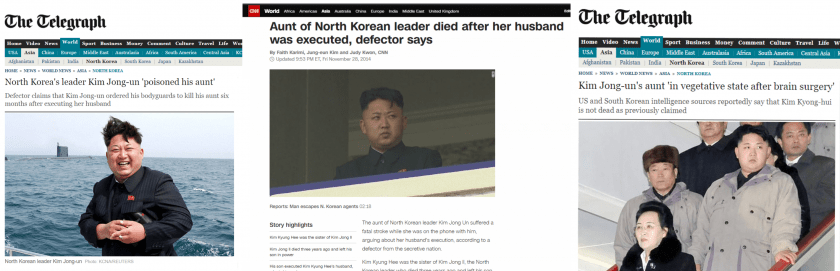
According to media, Kim Kyong-hui, has been poisoned, died of a stroke, had a heart attack or could be in a vegetative state
This is hardly the first time that the press has breathlessly reported that members of the DPRK’s elite have been killed, only for their untimely reappearance to spoil the narrative. Last year corporate media claimed that Korean negotiators were executed for failing to achieve a deal with the U.S. at the nuclear disarmament summit in Vietnam, something CNBC called part of a “massive purge to divert attention away from internal turmoil and discontent.” But barely a few days after the media deluge, the negotiating team’s leader appeared at a performance alongside Kim Jong-un.
In 2013, it was widely reported that Hyon Song-wol, a popular musician and reputed love interest of the DPRK’s supreme leader was executed in a “hail of machine gun fire while members of her orchestra looked on” (BBC). Unfortunately for this narrative, Song-wol is very much alive and singing, continuing to publicly perform to this day. And there is a cavalcade of military officials the corporate press has insisted were killed, often in comically over-the-top ways who turn up later seemingly unharmed. For example, in 2018 General Ri Yong-gil, the officer Donald Trump awkwardly saluted, was promoted to Chief of General Staff, this, despite having been “executed” in 2016 as part of a “brutal consolidation of power,” according to CNN.
Another North Korean figure rising from the dead is national soccer coach Yun Jong-su. After the country lost 7-0 to Portugal at the 2010 World Cup, media reported that he had been shot. This narrative was only dropped after a journalist ran into him at an airport. Ten years later, not only is Jong-su alive, but he is still the national team’s coach.
The problem with these stories is that they largely emanate from one source: notorious conservative South Korean daily the Chosun Ilbo, which has a long and detailed history of printing lurid fake news. Yet Western press are dependent on the Chosun Ilbo for much of their reporting. As Business Insider said while falsely reporting that Kim Kyong-hui, aunt of Kim Jong-un was dead, “the Chosun Ilbo is generally considered a reliable source.”
Other stories are based on testimonies from defectors, who are paid in cash for their stories, something that the poor, isolated and jobless dissidents themselves complain gives them a perverse incentive to exaggerate. The saying, in journalism, goes: “if it bleeds it leads,” i.e. the more shocking a story is, the more likely it is to be published, meaning that defectors who do not offer the sordid details journalists, intelligence agencies or human rights groups want, will not be paid. Defectors are not necessarily trustworthy sources either. One Korean defector who was praised for his heroic actions later admitted that he was actually on the run for a murder he confessed he committed.
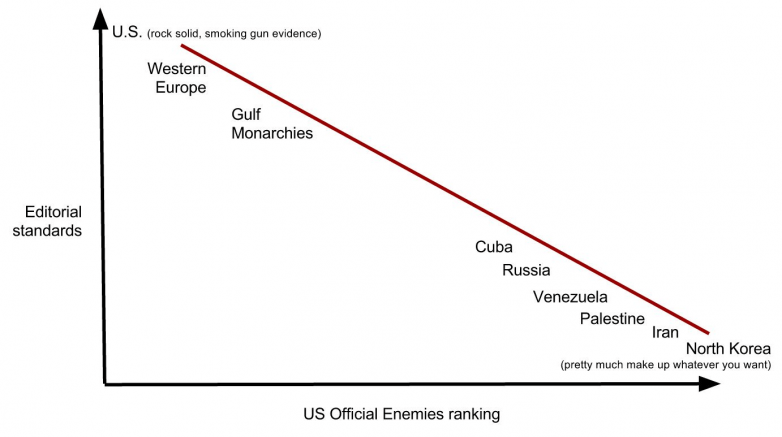
Adam Johnson’s North Korea law of journalism. Credit | FAIR
The perverse incentive also exists for media, too, who live in a hyper-competitive world driven by the need to get clicks. Careful, nuanced analysis does not pay. Added to that is the fact that the DPRK is an official enemy of the United States. The United States killed up to one quarter of the Korean race in bombing during the 1950s, using chemical weapons against them and committing other war crimes such as bombing civilian targets. Media analyst Adam Johnson put forward his theory of the “North Korea law of journalism,” where, he says, “editorial standards are inversely proportional to a country’s enemy status.” While the U.S. or friendly countries are covered favorably, the most lurid fantasies can be printed with regards to enemy states like Venezuela, Bolivia or the DPRK, as there is no penalty for being incorrect. Publishing stories claiming Donald Trump had thrown General Michael Flynn into a tank of ravenous piranhas would result in outlets being shut down, re-ranked and delisted by search engines and social media, and perhaps even journalists being arrested. But the same story run about North Korea is a money-spinner.
Thus, the same orientalist tropes are used again and again when it comes to reporting on Korea – that there is only one haircut allowed, that it has “banned sarcasm,” that there is no electricity or tall buildings in the country– are endlessly repeated by journalists reproducing imperial propaganda. As Kim Kyong-hui’s case shows, in North Korea, stories are often too bad to be true.
Alan MacLeod is a Staff Writer for MintPress News. After completing his PhD in 2017 he published two books: Bad News From Venezuela: Twenty Years of Fake News and Misreporting and Propaganda in the Information Age: Still Manufacturing Consent.
‘Middle East Will Become a Graveyard for US’: Pyongyang Apprehensively Eyes Iran Crisis
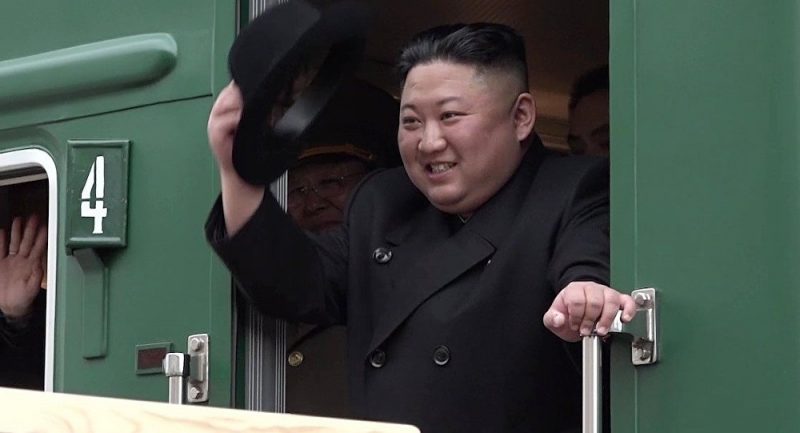
Sputnik – January 6, 2020
Following the US assassination of Iranian general Qassem Soleimani, the Democratic People’s Republic of Korea has taken measure of the international situation, which is expected to excercise new caution. However, North Korean dailies noted Washington’s course was destined for disaster.
North Korean cultural publication Arirang Meari put the issue in no uncertain terms, saying on Sunday that the “Middle East will become a graveyard for the US.”
“Global military experts recently analyzed that the US is being bogged down in a war in the Middle East,” Meari wrote, according to the South Korean-based Yonhap News Agency. “Even pro-American countries have been passively answering the US’s request for sending troops on account of their internal politics and economic challenges, driving the US into despair.”
The Korean Central News Agency (KCNA), the DPRK’s state-run news outlet, noted on Monday that Moscow and Beijing had taken strong stances against the US drone strike that killed Soleimani in Baghdad early Friday morning.
“China and Russia emphasized that they not only object to abuse of military power in international relations but also cannot tolerate adventurous military acts,” KCNA wrote, according to Yonhap, describing a Saturday phone call between Chinese Foreign Minister Wang Yi and his Russian counterpart Sergey Lavrov, noting they “expressed concerns over regional situations being worsened by the US’ illegal acts.”
Kim ‘Pressured Psychologically’ by Soleimani Killing
However, despite the rhetoric, experts have noted the episode is likely to shake Pyongyang’s leaders.
Yang Moo Jin, a professor at Seoul’s University of North Korean Studies, told the Korea Herald that as a result of the Baghdad airstrike, DPRK leader Kim Jong Un “will be pressured psychologically.”
Former South Korean Unification Minister Jeong Se Hyun said during a television appearance on Sunday the DPRK would be even more careful than before about revealing Kim’s precise whereabouts.
Andrei Lankov, a Russian scholar and expert on Korean affairs, noted in NK News on Sunday that Soleimani’s assassination showed US President Donald Trump was willing to take greater risks than North Korean strategists had previously believed, casting the “fire and fury” rhetoric of his presidency’s earlier years in a much starker light.
“As time went by, more and more observers were inclined to see the 2017 as a simple bluff, and it became widely accepted that Donald Trump did not have the guts to deliver on his threats of a military operation in a highly unstable part of the world,” Lankov wrote. “But last week’s killing of General Soleimani demonstrated that the world has underestimated Trump’s desire to take risks (or, perhaps, overestimated his ability to make rational decisions).”
“No doubt the North Koreans have taken note, and, most likely, see it as a warning sign.
Soleimani’s death reminded them that excessively risky behavior might result in a US drone quietly approaching some targets in Pyongyang suburbs,” Lankov added.
A Cautious But Steadfast Approach in 2020
As 2019 drew to a close, so did Pyongyang’s patience for negotiations with Washington, which after 18 months of talks had failed to yield significant results beyond a June 12, 2018, promise from Trump at his first summit with Kim in Singapore. In his New Year’s address, given several days before Soleimani’s killing, Kim had already taken a more cautious tone than in December, when North Korean publications promised a return to bellicose posturing.
Kim had previously promised a “Christmas gift” to Washington, which analysts widely predicted would be Pyongyang’s first long-range ballistic missile test since its self-imposed moratorium in 2017. However, no such “present” was delivered. Instead, Kim noted Washington’s delaying tactics were designed to prolong the harmful effects of economic sanctions on the DPRK, advising North Koreans to buckle their belts more tightly, since relief seemed unlikely anytime soon.
“If the US fails to keep the promises it made before the world, if it misjudges the patience of our people and continues to use sanctions and pressure against our republic, then we’ll have no choice except to seek a new path to secure the sovereignty and interests of our country,” Kim said on January 1.
Similar Struggles in Iran, DPRK
Like Pyongyang, Tehran has been engaged in a prolonged struggle to forge an independent path from Washington amid attempts to frustrate its ability to ensure its self-defense. Both countries have been subjected to strangling economic sanctions in an effort to force them into compliance, but unlike Iran, the DPRK has nuclear weapons as well as means of delivering them.

Kim Yong Nam, president of the Presidium of the Supreme People’s Assembly of North Korea, meets with Iranian President Hassan Rouhani in August 2018
Iranian leaders have long been accused by Washington of pursuing an atomic bomb and not merely nuclear power and medical research, as they have claimed. Tehran signed the Joint Comprehensive Plan of Action in 2015 to lower those sanctions in exchange for accepting tight constraints on the volume of nuclear fuel it could possess, but Trump reimposed them in 2018, accusing Iran of secretly pursuing a nuclear bomb – a conclusion not shared by other signatories to the agreement.
As a consequence, Tehran has slowly stepped back from the commitments it made in the 2015 deal, announcing on Sunday it would scrap the last ones it still followed.
The two countries’ experiences negotiating with Washington have long informed each other, and in the face of intransigence and doubletalk by the Trump administration, experts like Lankov have predicted US belligerence toward Iran, despite its obedience to the 2015 deal, was likely only to embolden those who hold hard-line positions in Pyongyang, opposing negotiations and concessions to Washington.
Why Trump is Winding Up Tensions with North Korea
By Finian Cunningham | Strategic Culture Foundation | December 25, 2019
After 18 months of on-off diplomacy with North Korea, the Trump administration seems determined now to jettison the fragile talk about peace, reverting to its earlier campaign of “maximum pressure” and hostility. It’s a retrograde move risking a disastrous war.
In a visit to China this week, South Korean President Moon Jae-in and Chinese leader Xi Jinping both urged for greater momentum in the diplomatic process with North Korea, saying that renewed tensions benefit no-one. The two leaders may need to revise that assertion. Tensions greatly benefit someone – Washington.
Why Trump is winding up tensions again with Pyongyang appears to involve a two-fold calculation. It gives Washington greater leverage to extort more money from South Korea for the presence of US military forces on its territory; secondly, the Trump administration can use the tensions as cover for increasing its regional forces aimed at confronting China.
In recent weeks, the rhetoric has deteriorated sharply between Washington and Pyongyang. The Democratic People’s Republic of Korea (DPRK) has resumed references to Trump being a senile “dotard”, while the US president earlier this month at the NATO summit near London dusted off his old disparaging name for Kim Jong-un, the North Korean leader, calling him “rocket man”.
On December 7 and 15, North Korea tested rocket engines at its Sohae satellite launching site which are believed to be preparation for the imminent test-firing of an intercontinental ballistic missile (ICBM). North Korea unilaterally halted ICBM test-launches in April 2018 as a gesture for diplomacy with the US. Its last launch was on July 4, 2017, when Pyongyang mockingly called it a “gift” for America’s Independence Day.
Earlier this month, Pyongyang said it was preparing a “Christmas gift” for Washington. That was taken as referring to resumption of ICBM test launches. However, Pyongyang said it was up to the US to decide which gift it would deliver.
On the engine testing, Trump said he was “watching closely” on what North Korea did next, warning that he was prepared to use military force against Pyongyang and that Kim Jong-un had “everything to lose”.
The turning away from diplomacy may seem odd. Trump first met Kim in June 2018 in Singapore at a breakthrough summit, the first time a sitting US president met with a North Korean leader. There were two more summits, in Hanoi in February 2019, and at the Demilitarized Zone on the Korean border in June 2019. The latter occasion was a splendid photo-opportunity for Trump, being the first American president to have stepped on North Korean soil.
During this diplomatic embrace, Trump has lavished Kim with praise and thanked him for “beautiful letters”. Back in September 2017 when hostile rhetoric was flying both ways, Trump told the UN general assembly he would “totally destroy” North Korea if it threatened the US. How fickle are the ways of Trump.
What’s happened is the initial promises of engagement have gone nowhere, indicating the superficiality of Trump’s diplomacy. It seems clear now that the US president was only interested in public relations gimmickry, boasting to the American public that he had reined in North Korea’s nuclear activities.
When Trump met Kim for the third time in June 2019, they reportedly vowed to resume negotiations on denuclearization of the Korean Peninsula. North Korea had up until recently stuck to its commitment to halt ICBM testing. However, for that, Pyongyang expected reciprocation from the US side on the issue of sanctions relief, at least a partial lifting of sanctions. Kim gave Trump a deadline by the end of this year to make some concession on sanctions.
Russia and China last week proposed an easing of UN sanctions on North Korea. But Washington rebuffed that proposal, categorically saying it was a “premature” move, and that North Korea must first make irreversible steps towards complete decommissioning of its nuclear arsenal. The high-handed attitude is hardly conducive to progress.
The lack of diplomatic reciprocation from Washington over the past six months has led Pyongyang to angrily repudiate further talks. It has hit out at what it calls Trump’s renewed demeaning name-calling of Kim. There is also a palpable sense of frustration on North Korea’s part for having been used as a prop for Trump’s electioneering.
The fact that Washington has adopted an intransigent position with regard to sanctions would indicate that it never was serious about pursuing meaningful diplomacy with Pyongyang.
Admittedly, Trump did cancel large-scale US war games conducted with South Korea as a gesture towards North Korea, which views these exercises as provocative rehearsals for war. This was an easy concession to make by Trump who no doubt primarily saw the cessation of military drills as a cost-cutting opportunity for the US.
Significantly, this month US special forces along with South Korean counterparts conducted a “decapitation” exercise in which they simulated a commando raid to capture a foreign target. Furthermore, the operation was given unusual public media attention.
As the Yonhap news agency reported: “A YouTube video by the Defense Flash News shows more details of the operation, with service personnel throwing a smoke bomb, raiding an office inside the building, shooting at enemy soldiers over the course, and a fighter jet flying over the building… It is unusual for the US military to make public such materials… according to officials.”
The Trump administration appears to have run out of further use for the diplomatic track with North Korea. The PR value has been milked. The policy shift is now back to hostility. The instability that generates is beneficial for Washington in two ways.
Trump is currently trying to get South Korea to boost its financial contribution towards maintaining US forces on its territory. Trump wants Seoul to cough up an eye-watering five-fold increase in payments “for US protection” to an annual $5 billion bill. South Korea is understandably reluctant to fork out such a massive whack from its fiscal budget. Talks on the matter are stalemated, but expected to resume in January.
If US relations with North Korea were progressing through diplomacy then the lowered tensions on the peninsula would obviously not benefit Washington’s demand on South Korea for more “protection money”. Therefore, it pays Washington to ramp up the hostilities and the dangers of war as a lever for emptying Seoul’s coffers.
The other bigger strategic issue shaping US intentions with North Korea is of course Washington’s longer-term collision course with China. US officials and defense planning documents have repeatedly targeted China as the main geopolitical adversary. American forces in South Korea comprising 28,500 troops, nuclear-capable bombers, warships and its anti-missile Terminal High Altitude Area Defense (THAAD) system are not about protecting South Korea from North Korea. They are really about encircling China (and Russia). Washington hardly wants to scale back its military assets on the Korea Peninsula. It is driven by the strategic desire to expand them.
In media comments earlier this month, Pentagon chief Mark Esper made a curious slip-up when referring to withdrawing US troops from Afghanistan. He said they would be redeployed in Asia to confront China.
Esper said: “I would like to go down to a lower number [in Afghanistan] because I want to either bring those troops home, so they can refit and retrain for other missions or/and be redeployed to the Indo-Pacific to face off our greatest challenge in terms of the great power competition that’s vis-a-vis China.”
The logic of war profits and strategic conflict with China mean that Trump and the Washington establishment do not want to find a peaceful resolution with North Korea. Hence a return to the hostile wind-up of tensions.
Russia, China Submit UN Resolution to Lift Sanctions on North Korea
Sputnik – December 16, 2019
Russia and China have submitted a draft resolution to the UN Security Council to lift sanctions on North Korea and promptly resume the ‘six-party’ talks, according to the text of the document.
The resolution proposes to exempt the inter-Korean rail and road cooperation from UN sanctions and lift all measures previously imposed by the UN Security Council directly related to civilian livelihood, among others.
The draft resolution also “calls for prompt resumption of the six-party talks or re-launch of multilateral consultations in any other similar format, with the goal of facilitating a peaceful and comprehensive solution through dialogue, reducing tensions on the Korean Peninsula and beyond, and promoting peaceful co-existence and mutually beneficial regional cooperation in North-East Asia”.
North Korea has been subject to numerous UN sanctions since 2006 for its nuclear and ballistic missile tests.
After a US-North Korea summit in Vietnam in February, Pyongyang committed itself to end nuclear tests and launches of intercontinental ballistic missiles. This non-binding pledge did not, however, extend to engine tests, or the launches of satellites or medium- and short-range ballistic missiles.
In October, Pyongyang gave the US until the end of the year to come up with a mutually-acceptable deal to advance the denuclearization process. North Korea’s vice foreign minister, Ri Thae Song, said that the dialogue on denuclearization promoted by Washington was a “foolish trick” used in favor of the political situation in the US and warned of a “Christmas gift”.
Earlier this month, Pyongyang conducted what it had described as “crucial” tests at the Sohae Satellite Launching Ground. The tests reportedly threaten to undermine Washington’s drive to denuclearize the Korean peninsula through the use of diplomacy.
US President Donald Trump told reporters earlier that his administration is closely watching North Korea amid reports that Pyongyang is resuming missile tests and would be disappointed if something was “in the works”.
Since 2018, the United States and North Korea have held two summits, agreeing in principle to normalize relations while pursuing a policy of denuclearization.
Negotiations came to a halt, with Washington demanding more decisive steps from Pyongyang. North Korea has blamed the United States for not properly following through on its previous gestures of goodwill.
Western leaders, screw your ‘Sanctions Target the Regime’ blather: Sanctions KILL PEOPLE
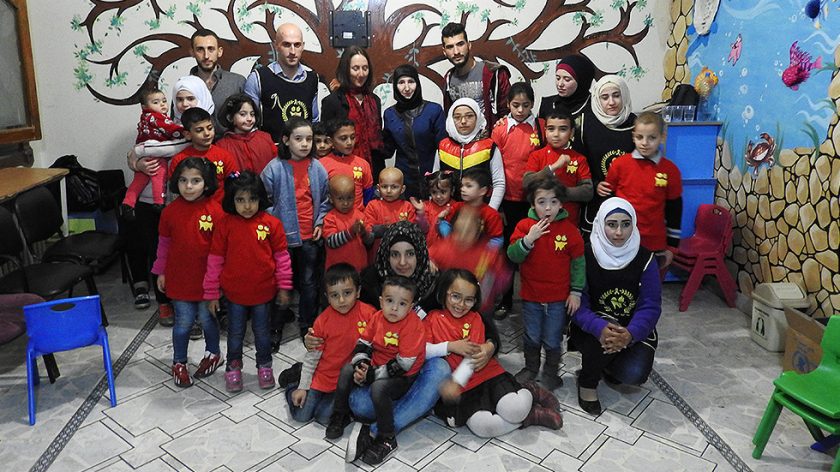
Children with cancer couldn’t get adequate treatment due to sanctions (photo Aleppo 2016)
By Eva Bartlett | RT | December 16, 2019
The US has a favourite tool for bullying non-compliant nations: sanctions. Sanctions inflict considerable suffering, even death, on ordinary people in targeted nations. Yet those defiant nations persist and resist.
A recent opinion piece in the Washington Post proposing a new oil-for-food scheme, this time in Venezuela, surprisingly acknowledges that sanctions “can also end up harming the people that they intend to protect.”
Okay, first off, we know there is no intention of “protecting” civilians in any of the countless countries targeted by Western sanctions. Do Western talking heads really think we’ve forgotten the half-a-million dead Iraqi children, thanks to US sanctions?
Yet, ask a Western leader about crippling sanctions placed on nations which don’t bow to Imperial demands and you’ll be met with some nonsensical explanation that sanctions only target ‘regimes’ and ‘terrorists,’ not the people.
I’ve lived in, spent considerable time in, or visited areas under sanctions and siege, and I’ve seen first hand how sanctions are a form of terrorism, choking civilians, depriving them of basic and urgent medical care, food, employment, and travel entitlements that many of us in Western nations take for granted.
When I was in Syria last October, a man told me his wife had been diagnosed with breast cancer, but because of the sanctions he couldn’t get her the conventional treatments most in the West would avail of.
In 2016, in Aleppo, before it was liberated of al-Qaeda and co, Dr. Nabil Antaki told me how –because of the sanctions– it had taken him well over a year to get a simple part for his gastroenterology practise.
In 2015, visiting Damascus’ University Hospital, where bed after bed was occupied by a child maimed by terrorists’ shelling (from Ghouta), a nurse told me:
“We have so many difficulties to ensure that we have antibiotics, specialized medicines, maintenance of the equipment… Because of the sanctions, many parts are not available, we have difficulties obtaining them.”
Visiting a prosthetic limbs factory in Damascus in 2016, I was told that, due to the sanctions, smart technology and 3D scanners –used to determine the exact location where a limb should be fixed– were not available. Considering the over eight years of war and terrorism in Syria, there are untold numbers of civilians and soldiers in need of this technology to simply get a prosthetic limb fixed so they can get on with their lives. But no, America’s concern for the Syrian people means that this, too, is near impossible.
In 2018, Syria’s minister of health told me Syria had formerly been dubbed by the World Health Organization a “pioneer state” in providing health care.
“Syria had 60 pharmaceutical factories and was exporting medicine to 58 countries. Now, 16 of these factories are out of service. Terrorists partially or fully destroyed 46 hospitals and 620 medical centres.”
I asked the minister about the complex in Barzeh, targeted with missile strikes by the US and allies in April 2018. Turns out it was part of the Ministry of Health, and manufactured cancer treatment medications, as well as antidotes for snake or scorpion bites/stings, the antidote also serving as a basic material in the manufacture of many medicines.
Last year, Syrian-American doctor Hussam al-Samman told me about his efforts to send to Syria chemotherapy medications for cancer patients in remission. He jumped through various hoops of America’s unforgiving bureaucracy, to no avail. It was never possible in the first place.
“We managed to get a meeting in the White House. We met Rob Malley, a top-notch assistant or adviser of Obama at that time. I asked them: ‘How in the world could your heart let you block chemotherapy from going to people with cancer in Syria?’
They said: ‘We will not allow Bashar al-Assad to have anything that will make people love him. We will not support anything that will help Bashar al-Assad look good’.”
Fast forward to the present: in spite of the sanctions, or precisely because of the sanctions, Syria recently opened its first anti-cancer drugs factory. President Assad is, again, looking rather good to Syrians.
UN expert: Sanctions on Venezuela “a form of terrorism”
Alfred de Zayas, the human rights lawyer and former UN official, aptly calls sanctions a form of terrorism, “because they invariably impact, directly or indirectly, the poor and vulnerable.”
Earlier this year, The Center for Economic and Policy Research estimated 40,000 deaths had occurred due to sanctions in 2017-2018.
While in Venezuela in March this year, I spoke with people from poor communities about the effects of sanctions. Most I met were very well aware of the US economic war against their country, and rallied alongside their government.
One woman told me:
“If you don’t have water, don’t have electricity, the basics, how would you feel, as a mother? This makes some of the population, that doesn’t understand about the sanctions, blame the government.”
Venezuela’s Foreign Minister, Jorge Arreaza, said during that visit:
“We told [American diplomat and Trump envoy] Mr Elliott Abrams, ‘the coup has failed, so now what are you going to do?’ He kind-of nodded and said, ‘Well, this is going to be a long-term action, then, and we are looking forward to the collapse of your economy.’”
Indeed, that collapse would come about precisely due to the immoral US sanctions against the Venezuelan people.
North Korean Youth: Sanction the USA
After visiting Korea’s north in August 2017, in a photo essay I noted: “The criminal sanctions against the North, enforced since 1950, making even more difficult the efforts to rebuild following decimation. The sanctions are against the people, affecting all sectors of life.”
And although most I met there were proud of their country’s achievements in spite of the sanctions, they were also vocal about the injustice of being bombed to near decimation and then sanctioned.
In a Pyongyang Middle School, to my questions about the sanctions, a girl replied:
“The sanctions are not fair, our people have done nothing wrong to the USA.”
Another boy spoke of the silence around America’s use of nuclear bombs on civilians: “Why do people all over the world give us sanctions? Why can’t we put sanctions on the US?”
At the Okryu Children’s Hospital, Doctor Kim Un-Song said: “As a mother, I feel extremely angry at the sanctions against the DPRK, even blocking medicine and instruments for children. This is inhumane and against human rights.”
As with Syria, sanctions on the DPRK prevent further entry to Korea of hospital machinery, as well as replacement parts.
Defying the sanctions
In spite of draconian sanctions, Syria, the DPRK and Venezuela continue to resist. After fighting international terrorism since 2011, Syria is rebuilding in liberated areas. That process could proceed more quickly were sanctions lifted, making it easier for companies outside of Syria to invest.
But Syria is managing, with its allies’ support, including that of North Korea, and due to the steadfastness of the heroic Syrian people, and its leadership.
Likewise, Venezuela and North Korea, facing America’s economic war and endless propagandistic rhetoric, continue to resist.
In each of these countries, I’ve met well-informed people who are fighting the sadism of the sanctions, and who are determined to remain free of US tyranny.
Eva Bartlett is a Canadian independent journalist and activist. She has spent years on the ground covering conflict zones in the Middle East, especially in Syria and Palestine (where she lived for nearly four years).
Seoul shows ‘preemptive strike’ with F-35s & boasts of ‘glorious victory’ over Pyongyang in propaganda video
RT | December 14, 2019
The South Korean Air Force has put out an incendiary video simulating a preemptive attack on its northern neighbor using a high-tech arsenal of US-supplied weapons. Pyongyang is unlikely to receive the clip in holiday spirits.
The promotional video depicts computer generated F-35 fighters and other jets launching strikes on North Korean positions, clearly marked with bright red stars – in case there was any mystery about who the message was intended for.
Published earlier this week, the four-minute video begins with a US-made Global Hawk spy drone detecting enemy activity, at one point showing what appears to be a North Korean Hwasong-14 ICBM platform just before it’s blown apart in a dramatic explosion. A narrator speaking in Korean then pledges the “glory of victory is promised under any circumstances,” according to JTBC, a South Korean TV network.
The provocative clip was released on the heels of the latest North Korean rocket engine test late last week, which some have speculated could be its first step toward developing a long-range ballistic missile capability. While insisting its weapons are purely for self-defense, Pyongyang has steadily ramped up such tests as denuclearization talks with the US falter and a year-end deadline set by North Korea to revive negotiations fast approaches.
Earlier this month, North Korean Vice Minister of Foreign Affairs Ri Thae Song placed the ball squarely in Washington’s court, stating it is now “entirely up to the US what Christmas gift it will select” from the Hermit Kingdom, though failed to specify what “gifts” the country may have on offer.
Seoul inked a deal with Washington in 2014 to buy several dozen F-35A stealth fighters to the tune of $6.8 billion, and is currently on track to operate a total of 40 of the aircraft by 2021. Another deal was struck the same year for 30 RQ-4 Global Hawk surveillance drones, another American system. Such arms sales are regarded by Pyongyang as acts of hostility, a conclusion which regular US-South Korean war games – rehearsing a full-scale invasion of the North – have done nothing to dissuade.
Trump’s Creaky Door to Peace in the Koreas
By Patrick Lawrence – Consortium News – December 10, 2019
In June 2018, when Donald Trump and Kim Jong-un summitted in Singapore, the American and North Korean leaders opened the door to peace on the Korean Peninsula wider than at any time since hostilities ceased in 1953. Eighteen months later, we watch as this door creaks closed.
Which side has betrayed the once-promising prospect of denuclearization and an end of seven decades of flashpoint tension in Northeast Asia? This is our question.
A succession of developments over the past week indicates that bilateral efforts to denuclearize the two Koreas will pass into history at year-end. Kim asserted nearly a year ago, that, absent a credible diplomatic framework for a bilateral accord, the North will give up on a settlement with the U.S. and “find a new way to defend the sovereignty of the country.”
A test conducted Sunday at a previously deactivated missile launch site suggests this means Pyongyang intends to recommit to nuclear and long-range missile programs it had suspended so long as talks with the U.S. progressed.
There is a good chance the North has already determined to pursue Kim’s “new way.” Pyongyang’s ambassador to the U.N. indicated as much just prior to the test at the Sohae site Sunday.
“We do not need to have lengthy talks with the U.S. now,” Kim Song said the previous day in New York. “Denuclearization is already gone out of the negotiating table.” By the time Kim Song spoke, the North Korean wire service, KCNA, had already begun to publish shrill warnings that hostilities with the U.S. could be renewed at any time.
John Bolton’s Impact
Kim Jong-un set the Dec. 31 deadline for progress in bilateral talks after the failure last February of his second summit with Trump, held in Hanoi. Subsequent reporting by two Reuters correspondents revealed that Trump, on the advice of John Bolton, his national security adviser at the time, told Kim he must accede to all U.S. demands before Washington would negotiate any concessions of its own. The Reuters report demonstrated that Bolton’s advice to Trump — delivered just as the president sat down with Kim, so leaving him little time to consider it — was intended to precipitate precisely the sudden breach between the two leaders that then took place.
“It occurs to us that there may not be a need to continue,” Choe Son-hui, Kim’s vice-foreign minister, said after the North Korean leader abandoned the Hanoi talks in acrimony. “We’re doing a lot of thinking.” In hindsight, Choe’s remark seems to have signaled the North’s post–Hanoi distrust of U.S. intentions despite Kim’s notably friendly personal relations with Trump.
This wariness and impatience are justified. In a round of talks held in Stockholm in October, North Korean negotiators walked out in a matter of hours, complaining that the U.S. side had nothing to offer but a repackaged version of the fatal proposition presented in Hanoi. If you reject our proposal that 6 and 4 make 10, let us offer you 7 and 3: This is effectively the U.S. position to date.
Nothing that has occurred since the first Trump–Kim summit in Singapore suggests that the president is anything other than entirely sincere in his desire to forge an historic agreement with Pyongyang. One need not assign Trump any transcendent geopolitical vision to recognize this. The Dealmaker wants a deal, preferably one that has eluded all of his predecessors in the White House.
On Saturday Trump conferred with South Korean President Moon Jae-in for half an hour by telephone to discuss how to salvage the negotiation process between the North and the U.S. Moon has assiduously promoted negotiations with the North since he took office in May 2017. Plainly, Trump wants Moon to help him draw Kim back from the brink.
“Kim Jong-un is too smart and has too much to lose, everything actually, if he acts in a hostile way,” Trump said Sunday. “He does not want to void his special relationship with the President of the United States or interfere with the U.S. presidential election in November.”
These remarks appear to signal that, despite Trump’s conversation with Moon, the U.S. does not take Kim’s year-end ultimatum seriously. They also suggest that Trump considers the current escalation of tensions between Washington and Pyongyang nothing more than the posturing he indulges in prior to any significant negotiation.
In both cases, Trump is likely to be proven wrong for two reasons.
The first is that Trump may have just overplayed his hand. There are indications that Kim thinks the Sohae test Sunday — the nature of which remains unclear — significantly improves his diplomatic position. While the North’s tough talk may also be posturing, Washington now risks forfeiting some of Kim’s willingness to negotiate the elimination of the North’s nuclear and ballistic-missile capacities. “The results of the recent important test will have an important effect on changing the strategic position of the DPRK once again in the near future,” KCNA reported Sunday.
The second is that by now Trump almost certainly understands the extent to which policy cliques in Washington have circumscribed his agenda on questions such as Russia, Syria and North Korea. It may be to his credit that he persists in the face of this resistance, but his chances of overcoming it are, if anything, diminished after nearly three years of incessant subterfuge on the foreign policy side. Trump does not have a Kim Jong-un problem; he has a “deep state” problem at home.
When U.S.–North Korean talks have collapsed on previous occasions, official U.S. records tend to blur the chronology of events, erase causality, and then imply that responsibility for failure lies with the North Koreans. While there are already indications that we will see the same this time, there has been enough good reporting, mostly in other-than-corporate media, to make this fallacy plain. No one should be fooled when we read once again about those bellicose, irrational North Koreans.
All indications now suggest that Kim plans another of his blockbuster New Year’s speeches, similar to those delivered in previous years. In 2018 he announced that the North had achieved a weaponized nuclear capability with which to deter threats from the U.S. This year he declared he would be willing to meet Trump “anytime” while announcing his “new way” should diplomacy fail.
The first of these assertions is now patently true. After a year of disappointments, the second awaits the outcome of the current impasse. We will have to see in coming weeks.
After the talks in Stockholm collapsed in October, North Korea termed the debacle “sickening.” So it is, considering the opportunity that the U.S. — not for the first time — is in the process of intently squandering.
Patrick Lawrence, a correspondent abroad for many years, chiefly for The International Herald Tribune, is a columnist, essayist, author and lecturer. His most recent book is “Time No Longer: Americans After the American Century” (Yale). Follow him on Twitter @thefloutist. His web site is Patrick Lawrence.
Featured Video
Chinese jet fuel and the myth of energy independence
or go to
Aletho News Archives – Video-Images
Book Review
Former Insiders Criticize Iran Policy as U.S. Hegemony
By GARETH PORTER | CounterPunch | February 27, 2013
“Going to Tehran” arguably represents the most important work on the subject of U.S.-Iran relations to be published thus far.
Flynt Leverett and Hillary Mann Leverett tackle not only U.S. policy toward Iran but the broader context of Middle East policy with a systematic analytical perspective informed by personal experience, as well as very extensive documentation.
More importantly, however, their exposé required a degree of courage that may be unparalleled in the writing of former U.S. national security officials about issues on which they worked. They have chosen not just to criticise U.S. policy toward Iran but to analyse that policy as a problem of U.S. hegemony. … continue
Blog Roll
 Aletho News
- What is fueling unrest across the EU?
- Why no power can undermine Iran’s eternal dominance over the Strait of Hormuz
- Is The War Against Iran Over?
- Iran war will leave long-term ‘scar’ on Wall Street, investors warn
- How Iran decimated US power projection in West Asia: Military lessons of 40-day war
- Iran’s report details US-Israeli war crimes in targeting schools, hospitals, livelihoods
- NATO’s Slow Fracture: How Trump’s Iran War Exposed the Instrument of Hegemony
- Chinese jet fuel and the myth of energy independence
- Ukraine Sea Drone Fired From Libya Hit Russian Tanker in Mediterranean
- IRGC: Iranian forces launched no attacks during ceasefire hours
- If Americans Knew
- Military aid to Israel emerges as the latest political litmus test for Democrats
- The only Palestinian children’s rights organization closes following years-long Israeli campaign against it
- ‘I Can’t Forget the Smell’: Lebanese Reel After Israel Kills Over 300 in Single Day
- DNC Shoots Down Resolutions Calling Out AIPAC and Limiting Arms to Israel
- TCN: Is Israel Blackmailing President Trump?
- Israel killed at least 303 Lebanese yesterday – who were they? Daily Update
- Amnesty: Urgent – Protect Lebanese civilians from brutal escalation in Israeli attacks
- Is The War Against Iran Over?
- Inside the Israeli army’s propaganda wing
- Hundreds of Gaza Amputees Stranded in Legal Limbo
- No Tricks Zone
- An Inconvenient Tree: Uncovered In Alps… Europe Much Warmer Than Today 6000 Years Ago
- New Study Reports A 60% Slowdown In Greenland’s Ice Loss Rate In The Last Decade
- Low Intensity Tornado Wrecks Major Solar Farm, Creating A Potential Toxic Dump
- New Study Finds Warming Saves Lives…Cold Temperatures 12 Times More Deadly Than Excess Heat
- German Science Blog Accuses PIK Climate Institute Of Hallucinating Climate Tipping Points
- Devastating Assessment Of Comirnaty Vaccine By Former Senior Pfizer Europe Toxicologist
- New Study: CO2 Is ‘Effectively Negligible’ As An Explanatory Climate Change Factor Since 2000
- Former Pfizer Toxicologist Dr. Helmut Sterz Tells Bundestag Hearing Pfizer Vaccine Should Have Never Been Approved
- Energy Expert: Germany’s Nuclear Phaseout Was A “500 Billion Euro Mistake”
- New Research: South Australia’s Mid-Holocene Sea Surface Temperatures Were 4°C Warmer Than Today
 Aletho News