London: Pro-Palestine protesters disrupt Israeli performance

Press TV – May 29, 2012
Pro-Palestine campaigners have disrupted a performance by the Israeli regime’s theatre company at London’s Globe Theatre by standing up during the performance with Palestinian flags and banners denouncing “The Israeli Apartheid regime.”
On May 28, when Israel’s Habima Company was performing Shakespeare’s ‘The Merchant Of Venice’ during the Globe to Globe festival, a group of 15 demonstrators started waving Palestinian flags.
The police also arrested a man on suspicion of assault on a security guard, with the Scotland Yard confirming his keeping in custody.
The Palestinian-led global movement for the boycott, divestment and sanctions (BDS) of Israel had made a call to boycott the Habima’s Hebrew-language performance as the Israeli company was working with the apartheid regime of Israel as a “cultural ambassador.”
“This campaign is not an attack on individual artists, we are not censoring the content of their work nor are we concerned about their ethnicity or the language they speak,” said Naomi Wimborne-Idrissi, coordinator with the Boycott Israel Network.
“As with South African sport in the apartheid era, this is about refusing to allow culture to be used to whitewash oppression.”
London theatre has vowed “enhanced security” for Israel by sending a letter to ticket holders, outlining extraordinary measures including extensive bag and “random body searches,” aiming to prevent protesters expected to disrupt the controversial performance on 28-29 May 2012.
However, the boycott Israel activist group London BDS accused the Globe of “turning the theater into an Israeli-style checkpoint.”
“We tried non-violently to convey the message that culture may not be used to give a civilized gloss to a state that perpetrates human rights abuses,” said protester Zoe Mars.
Related articles
London Olympic rockets left unguarded

Military rockets left unguarded outside a block of flats in London
Press TV – May 5, 2012
Amateur video posted on the internet shows military rockets left unguarded outside a block of flats in Bow, East London, as Britain’s Ministry of Defense (MoD) prepares to deploy missiles on top of flats in London during the 2012 Olympics.
The video was posted by journalist Brian Whelan who lives in Bow Quarter, London. The video shows unguarded military rockets with nobody around.
The unguarded military rockets were part of the MoD’s security plans for the London Olympics. Earlier this week, the MoD confirmed that six sites, including two residential blocks of flats, would be tested as launch pads for missile systems in order to combat air threats during the Olympics.
Local residents have expressed their anger over the plans saying they were not consulted and questioning why the MoD did not build a missile base instead of using residential flats as a missile base.
Experts have also expressed concerns over the security risks for people. Military liaison officer Lieutenant Colonel Brian said flats could be targeted because of missiles deployed on their roof tops.
Furthermore, experts have called into question the usefulness of the missiles saying they would be useless in poor weather because the missile systems rely on the operator being able to see the target.
Writing on his blog, Whelan also described how these missiles work. The missile battery is the HVM A5 Missile System. Whelan revealed that only a small number of A5 missiles were fired in trials and even two malfunctioned during trials.
Evidence in British court contradicts CIA drone claims
By Chris Woods | The Bureau of Investigative Journalism | April 24th, 2012
A major case in the British High Court has revealed fresh evidence of civilian deaths during a notorious CIA drone strike in Pakistan last year.
Sworn witness testimonies reveal in graphic detail how the village of Datta Khel burned for hours after the attack. Many of the dozens killed had to be buried in pieces.
Legal proceedings were begun in London recently against British Foreign Secretary William Hague, over possible British complicity in CIA drone strikes.
Britain’s GCHQ – its secret monitoring and surveillance agency – is reported to have provided ‘locational evidence’ to US authorities for use in drone strikes, a move which is reportedly illegal in the United Kingdom.
Sworn affidavits
The High Court case focuses in particular on a CIA drone strike in March 2011 which killed up to 53 people.
Sworn affidavits presented in court and seen by the Bureau offer extensive new details of a strike the CIA still apparently claims ‘killed no non-combatants’.
 Ahmed Jan (pictured) is a tribal elder in North Waziristan. On March 17 2011 he was attending a gathering with other village elders, to discuss a mining dispute.
‘We were in the middle of our discussion when the missile hit and I was thrown about 24 feet from where I was sitting. I was knocked unconscious and when I awoke I saw many individuals who were dead or injured,’ he says in his affidavit.
Most of those who died in Datta Khel village that day were civilians. The Bureau has so far identified by name 24 of those killed, whilst Associated Press recently reported that it has the names of 42 civilians who died that day.
Pakistan’s president, prime minister and army chief all condemned the Datta Khel attack. A recent Bureau investigation with the Sunday Times quoted Brigadier Abdullah Dogar, who commanded Pakistani military forces in the area at the time.
We in the Pakistan military knew about the meeting, we’d got the request ten days earlier. It was held in broad daylight, people were sitting out in Nomada bus depot when the missile strikes came. Maybe there were one or two Taliban at that Jirga – they have their people attending – but does that justify a drone strike which kills 42 mostly innocent people?
Yet the US intelligence community has consistently denied that any civilians died.
Last year an anonymous US official told the New York Times: ‘The fact is that a large group of heavily armed men, some of whom were clearly connected to al Qaeda and all of whom acted in a manner consistent with AQ [Al Qaeda] -linked militants, were killed.’
The sworn affidavits seen by the Bureau offer a very different perspective. Imran Khan’s father Ismail was another of the elders who died that day. Imran says of his father: ‘He always did the right thing for the community and the tribe. He opposed terrorism and militancy and was not himself in any way connected to these things.’
Khalil Khan’s late father Hajji Babat was a local policeman who was ‘not an enemy of the United States of America or any other country.’ His son describes in his affidavit how he rushed back to his village to find his father dead, the bus station and surrounding buildings still burning six hours after the drone strike.
And Fateh Khan, who once worked for British Telecom, lost his 25-year old nephew Din Mohammed in the CIA attack. He reports that his nephew’s body had to be buried in pieces, and that ‘he left behind four children, all of whom now live in my house. His eldest child is currently only five years old.’
‘Absolute lie’
The most senior tribal elder to die that day was Daud Khan. Initially he was claimed to have been a senior Taliban figure. His son Noor told the Bureau that this was ‘an absolute lie’.
‘My father was not a militant but an elder who was working day and night for his people. There have been many children who have been killed in drone strikes. I ask the US if they think those children were militants and combatants and dangerous enough to be killed in such a manner?’
The CIA declined to comment when asked whether it still believed it had killed no ‘non-combatants’ in Pakistan since May 2010, or that no civilians died in Datta Khel last year.
In London, legal campaigners are seeking a judicial review in the High Court – a process by which senior judges can question and even overturn any government policy on aiding US drone strikes.
The case is being brought by legal charity Reprieve, and by the Islamabad-based lawyer Shahzad Akbar and the Foundation for Fundamental Rights, which focuses on civilian victims of CIA drone strikes in Pakistan.
The British government is understood to have firmly challenged the grounds of the case on a number of fronts.
Follow @chrisjwoods on Twitter
Related articles
- Hague to be sued for aiding US drone attacks in Pakistan (alethonews.wordpress.com)
- The cost and consequences of exposing the drone wars (alethonews.wordpress.com)
- “Drones also targeting mourners and rescuers” (alethonews.wordpress.com)
- NYT Lets Nameless Official Smear Drone Researchers as Al-Qaeda Fans (alethonews.wordpress.com)
- The boy sitting with me in these photos was protesting against deadly US drone strikes… Three days later he was killed ¿ by a US drone, says Jemima Khan (dailymail.co.uk)
- White House OKs broad Yemeni drone drive (upi.com)
Deir Yassin Day in London
By Paul Eisen* | Uprooted Palestinians | April 8, 2012
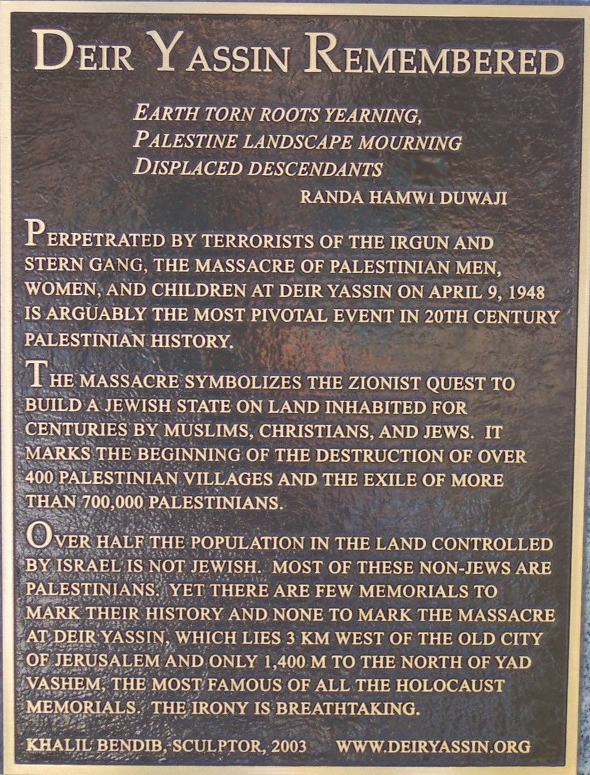 On April 23 in London, Deir Yassin Remembered and The General Union of Palestinian Students will be commemorating Deir Yassin Day 2012.
Deir Yassin Day commemorates the Deir Yassin massacre of April 9th 1948.
Not the only massacre at that time and by no means the worst, Deir Yassin signaled and has come to symbolise, the dispossession of the Palestinian people and their continuing exile.
April 23 is also the birthday of Miguel Cervantes creator of Don Quixote and of Roy Orbison creator of “Only the Lonely” – and a man who, just when you thought he could go no higher – up an octave he’d go. It’s also the birth- and death day of William Shakespeare – highly appropriate for a man known for his immaculate dramatic structure and pleasing endings.
But in England April 23rd is above all, St. George’s Day. St George is the patron Saint of England and strangely, St George was a Palestinian.
George hailed from the Palestinian town of Lydda, turned into an airport in 1948 and named Lod, and named again after the great ethnic-cleanser David Ben Gurion. Like Deir Yassin itself, the story of Lydda could serve as a template for all the expulsions and massacres of 1948.
At Deir Yassin the perpetrators massacred over a hundred villagers and burned their bodies. Others were loaded onto trucks and paraded through the streets of Jewish Jerusalem, then taken to a nearby quarry and shot. Orphaned children of Deir Yassin, dragged from under the bodies of their dead and dying relatives were taken and dumped, dazed and bleeding, in a Jerusalem alley.
At Lydda the Israelis massacred 426 men, women, and children; 176 slaughtered in the town’s main mosque and the remainder driven into exile. Forced to walk in the summer heat, they left behind them a trail of bodies – men, women and children. It was the Palestinians’ very own ‘Trail of Tears’.
And, just like at Deir Yassin, the town of Lydda was repopulated with Jewish immigrants, the name Hebraised to Lod and, like the name Deir Yassin, the name Lydda was wiped off the map.
At our commemoration DYR and GUPS will be joined by the Palestinian Delegation, the Palestinian community of the U.K. and many British and other supporters. We will also be joined by Abu Ashraf, now of Azaria but once of Deir Yassin – because in April 1948 Abu Ashraf lived in Deir Yassin and, on April 9th at the time of the massacre, was a few days short of his eighth birthday.
So, it’s fitting that our commemoration be held on April 23rd, St. George’s Day; in London, the capital of England, and led by Abu Ashraf of Deir Yassin.
* (With thanks to Stuart Littlewood)
Related articles
- | Remembering ongoing Zionist Apartheid +Anti-Palestinianism: Distinguishing ‘illegitimate victimisers’ from ‘victims!’ (truthaholics.wordpress.com)
- The Ethnic Cleansing of Palestine by Ilan Pappe (alethonews.wordpress.com)
Featured Video
9/11 In Perspective
or go to
Aletho News Archives – Video-Images
From the Archives
Still No End in Sight of the Murder and Mayhem Wrought by the 9/11 Culprits
By Prof. Tony Hall | American Herald Tribune | July 17, 2016
The Kevin Barrett-Chomsky Dispute in Historical Perspective – Fourth part of the series titled “9/11 and the Zionist Question”
Back in 2006 all but a prescient few, such as Christopher Bollyn, perceived it as premature to try to identify and bring to justice the actual perpetrators of the 9/11 crimes. There was still some residue of confidence that responsible officials in government, law enforcement, media and the universities could and would respond in good faith to multiple revelations that great frauds had occurred in interpreting 9/11 for the public.
Accordingly, the main methodology of public intellectuals like Dr. Kevin Barrett or, for instance, Professors David Ray Griffin, Steven E. Jones, Peter Dale Scott, Graeme MacQueen, John McMurtry, Michael Keefer, Richard B. Lee, A.K. Dewdney, Nafeez Mossadeq Ahmed, and Michel Chossudovsky, was to marshal evidence demonstrating that the official narrative of 9/11 could not be true.
The marshaling of evidence was spurred on by observations coming from government insiders like Eckehardt Wertherbach, a former head of Germany’s intelligence service. In a meeting in Germany with Christopher Bollyn and Dr. Andreas von Bülow, Wertherbach pointed out that, “an attack of this magnitude and precision would have required years of planning. Such a sophisticated operation would require the fixed frame of a state intelligence organization, something not found in a loose group like the one led by the student Mohammed Atta in Hamburg.”
Andreas von Bülow was a German parliamentarian and Defense Ministry official. He confirmed this assessment in his book on the CIA and 9/11. In the text von Bülow remarked that the execution of the 9/11 plan “would have been unthinkable without backing from secret apparatuses of state and industry.” The author spoke of the “invented story of 19 Muslims working with Osama bin Laden in order the hide the truth” of the real perpetrators’ identity. … continue
Blog Roll
 Aletho News
- Kaja Kallas: an uncomfortable figure useful to the EU’s Russophobic purposes
- German state blacklists right-wing party for first time
- Romania’s stolen elections were only the start: Inside the EU’s war on democracy
- Hawaii bills would allow gov’t to quarantine people, enter property without permission, seize firearms, and suspend laws
- Epstein files may contain ‘crimes against humanity’ – UN
- UK Government Plans to Use Delegated Powers to Undermine Encryption and Expand Online Surveillance
- Epstein Files Expose Israeli Occupation of America
- The Mandelson Molecule: Exposing the Architecture of Cross-Border Political Suppression
- The U.S. Sanctions Cuban Journalist For Reporting On The U.S. Blockade
- Israeli firms transform cars into intelligence devices: Reports
- If Americans Knew
- Why won’t Trump’s “Board of Peace” bring peace? – Not a ceasefire Day 131
- Help end the injustice against Shadi
- Israel’s Favorite American President
- Israel’s “Yellow Line” Is a Death Trap for Palestinians. We Drove Into It.
- Why Israel’s expanding occupation in Syria presents a critical legal test
- Gaza is not a natural disaster. It is the victim of genocide enabled by global inaction
- Netanyahu’s plan to “end” US aid to Israel is to give even more money under a different name
- Israel ceased firing on Gaza for just 15 days of the “ceasefire” – Not a ceasefire Day 130
- In Gaza, “rats run over our faces” – Not a ceasefire Day 129
- Israel-backed border guards, GHF-linked aid – Not a ceasefire Day 128
- No Tricks Zone
- Coal Power Back In Trend As Globe Tries To Keep Pace With Growing Demand For Power
- New Study: A 4°C Warmer Beaufort Sea Had ‘No Sea Ice’ 11,700 – 8200 Years Ago
- Unfudging The Data: Dutch Meteorological Institute Reinstates Early 20th Centruy Heat Waves It Had Erased Earlier
- German Gas Crisis…Chancellor Merz Allegedly Bans Gas Debate Ahead of Elections!
- Pollen Reconstructions Show The Last Glacial’s Warming Events Were Global, 10x Greater Than Modern
- Germany’s Natural Gas Storage Level Dwindles To Just 28%… Increasingly Critical
- New Study Rebuts The Assumption That Anthropogenic CO2 Molecules Have ‘Special’ Properties
- Climate Scientist Who Predicted End Of “Heavy Frost And Snow” Now Refuses Media Inquiries
- Polar Bear Numbers Rising And Health Improving In Areas With The Most Rapid Sea Ice Decline
- One Reason Only For Germany’s Heating Gas Crisis: Its Hardcore-Dumbass Energy Policy
 Aletho News