Collapsing Empire: US Bows To African Revolutionaries
By Kit Klarenberg | Al Mayadeen | February 6, 2026
On February 2nd, the BBC published an extraordinary report on how the Trump administration “has declared a stark policy shift” towards Burkina Faso, Mali, and Niger, the governments of which have sought to eradicate all ties to Western imperial powers, and forged the Alliance of Sahel States (AES). The independent bloc is a revolutionary enterprise, with the prospect that further countries will follow its members’ lead. And Washington is under no illusions about the new geopolitical realities unfolding in Africa.
The British state broadcaster records how Nick Checker, State Department African Affairs chief, is due to visit Mali to convey US “respect” for the country’s “sovereignty”, and chart a “new course” in relations, moving “past policy missteps.” Checker will also express optimism about future cooperation with AES “on shared security and economic interests.” This is an absolutely unprecedented development. After military coups deposed the elected presidents of all three countries 2020 – 2023, the trio became Western pariahs.
France and the US sought to isolate and undermine the military governments, halting “cooperation” projects in numerous fields. Meanwhile, the Economic Community of West African States, a neocolonial union of which all three were members, first imposed severe sanctions on Burkina Faso, Mali, and Niger, before its combined armed forces prepared to outright invade the latter in summer 2023. The three countries didn’t budge, and in fact welcomed Western isolation, forging new international partnerships and strengthening their ties. ECOWAS military action never came to pass.
In January 2025, the trio seceded from the union and created AES. Western-funded, London-based Amani Africa branded the move “the most significant crisis in West Africa’s regional integration since the founding of ECOWAS in 1975,” claiming it dealt “a significant blow to African… cooperation architecture.” Meanwhile, Burkina Faso’s leader Capt Ibrahim Traoré has become a media hate figure. A disparaging May 2025 Financial Times profile slammed him as a cynical opportunist leading a “Russia-backed junta”, and his supporters a “cult”.
As the BBC unwittingly explains, such antipathy towards Traoré stems from establishing himself “as a standard-bearer in resisting ‘imperialism’ and ‘neocolonialism’.” Via “vigorous social media promotion, he has gained huge support for this stance and personal popularity among young people across the continent and beyond,” ever since seizing power in September 2022. Far from just talk, Traoré and his fellow AES “junta” leaders have systematically sought to neutralise malign Western influence locally, while pursuing left-wing economic policies for the good of their populations.
France and the US have proven markedly powerless to hamper, let alone reverse, this seismic progress. While officials in Paris and Washington hitherto relentlessly hammered AES’ members over “democracy and human rights” concerns, the BBC reports such considerations will be wholly “absent from the agenda” when State Department officials now visit Mali. In other words, the Empire recognises it no longer has the ability to dictate the composition or policies of regional governments and must engage administrations on their own terms.
‘Despotic Governments’
While generating only occasional mainstream interest, the push by Burkina Faso, Mali, and Niger to rid themselves of Western imperialism has been remarkable in its scope and efficacy. French and US media programmes and channels have been blocked throughout AES. In August 2022, Paris’ forces were sent packing from Mali after a nine-year-long occupation. Two years later, Russian soldiers took over an airbase in Niger housing American forces at the government’s invitation, after authorities demanded Washington withdraw from the country.
These purges have had a knock-on effect in the wider region. For example, in November 2024, Chad abruptly terminated a military agreement, ending France’s long-running occupation of the country. Around the same time, Senegal demanded that the French close their military base in Dakar. The last troops departed in July 2025, leaving Paris with no permanent installations in Central or West Africa. Meanwhile, efforts by AES members to drive Britain, France, and the US out of every major sector of their economies are ongoing.
Right when Chad and Senegal were bidding bon voyage to French forces, Niger seized control of local mining firm Somaïr, a component of state-owned French nuclear company Orano. Somaïr provided a quarter of the uranium supply to European nuclear power plants. Resultantly, EU imports of uranium from Russia rose by over 70%, despite the supposedly crippling sanctions imposed over the Ukraine proxy war. In another bitter irony, Moscow has concurrently cemented itself as a close partner of AES member states in economic and military fields.
This burgeoning relationship has triggered a predictable chorus of condemnation and fearmongering from Western journalists, politicians, and pundits. Yet, a March 2024 poll published by the German Friedrich Ebert Stiftung Foundation found 98% of Malians approve of their country’s bond with Russia, with 83% being “very satisfied” and 15% “rather satisfied”. More generally, the same survey highlighted how Mali’s “junta” enjoys overwhelming public support, about which Western governments can only fantasise.
In all, 81% of respondents believed life in Mali had improved since the military administration took power. A staggering 99% expressed satisfaction with the work of security forces, 95% were optimistic about the country’s future prospects, and 87% rejected calls for an election. Similar results were found in a poll of Burkina Faso’s population in August. A stunning 66% of citizens said it was legitimate for the military to seize power, if “elected leaders abuse their power for their own interests.”
As a fascinating paper by Senegalese academic Ndongo Samba Sylla forensically details, ever since supposed independence was granted to Africa in the 1960s, France and other imperial powers have worked concertedly to ensure its constituent countries are ruled by pliant puppets. Along the way, the West has “shown no scruples in backing odious civilian or military regimes” favourable to their interests. This produces “choiceless democracies” across Africa, with “despotic governments” that come to power “through fraudulent elections and… do not create any welfare for their people.”
‘Lasting Solutions’
Sylla cites the example of Chad, where France sustained a corrupt, brutal dictator, Idriss Deby Itno, in office 1990 – 2021. Following his death, Emmanuel Macron diplomatically backed his son’s “unconstitutional succession”. The French President’s unabashed advocacy for an illiberal, nepotistic power grab is to be contrasted with Macron’s furious censure of the military coups in Burkina Faso, Mali, and Niger, demands they hold elections, and calls for “financial sanctions from African countries, the West and its financial institutions.”
France could impose sanctions directly on the trio due to Paris’ control of the Central Bank of West African States, the financial arm of ECOWAS. Membership ties states to the CFA Franc, a currency created after World War II that allowed Paris to maintain grossly iniquitous trading relationships with its African colonies, when its economy was ravaged and its overseas empire rapidly unravelling. The CFA Franc makes it cheap for members to import from France and vice versa, but prohibitively expensive for them to export elsewhere.
Such forced dependency creates a captive market for the French, and by extension, Europe, decisively blunting local development. Member states are impotent to enact meaningful policy changes, as they lack control over their own economies, forced to take orders from the IMF, World Bank, and Western investors. As Sylla remarks: “No matter who you elect, they will have to stick with the basic economic policy blueprint.” Creating a replacement currency is AES’ next major challenge – although its members have already started constructing a central bank.
AES’ continued existence and successes are anathema to Paris. Since “decolonisation” in Africa in the early 1960s, the French have launched 50 overt interventions in Africa, which doesn’t account for assassinations of anti-imperialist leaders, palace coups, rigged elections, and other skullduggery employed to maintain France’s mephitic, exploitative grip over its former holdings. Delusions of keeping the continent wedged under their heels have not faded, despite the dramatic collapse of French power locally. In April 2024, General Francois Lecointre, former French Army Chief of Staff, declared:
“What we Europeans have in common is the Mediterranean and Africa, where our destiny is at stake… Europe will have an obligation to return to Africa to help restore the state and bring back administration and development. It’s not China, Russia, or Wagner [Group] who are going to provide lasting solutions to the very great difficulties facing these African countries and their people.”
Residents of AES evidently beg to differ, and stand ready to defend their leaders from foreign destabilisation. US officials aren’t unwise to the region’s new power dynamic. In an October 2025 interview with Le Monde, Trump confidante and State Department senior advisor for Africa, Massad Boulos, rejected any suggestion Washington would criticise the Sahel’s military governments, as while “democracy is always appreciated… people are free to choose whatever system is appropriate for them.” The anti-imperialist struggle continues apace in Africa – and for now, revolutionaries are winning.
Russia Urges International Community to Curb Arms Flow From Ukraine to Africa
Sputnik – 04.02.2026
Russia calls on the international community to prevent the trafficking of arms and Starlink terminals from Ukraine to militants in African countries, Russian Permanent Representative to the United Nations Vassily Nebenzia said on Wednesday.
“We call on the international community to take effective measures to prevent weapons and their components from falling into the hands of terrorists. The supply of weapons to militants must not go unpunished,” Nebenzia said during a UNSC meeting on threats to international peace and security caused by terrorist acts.
Nebenzia added that weapons from Ukraine find their way through black markets to militants across Africa and their trafficking grows.
The diplomat stressed the need to prevent the ISIS terror group and its affiliates from acquiring and using commercial satellite communication terminals including Starlink.
“We expect the states under whose jurisdiction the relevant technology companies operate to exercise foresight and take effective measures to prevent such technologies from falling into the hands of terrorists,” Nebenzia stressed.
In November 2024, French media reported, citing a military source in Mali, that terrorists from the alliance of Malian armed separatist groups CSP-DPA had traveled to Ukraine for training.
Russian Foreign Ministry spokeswoman Maria Zakharova told RIA Novosti that Ukraine was backing terrorist groups in African states that were friendly to Moscow because it was unable to defeat Russia on the battlefield.
Mali severed diplomatic relations with Ukraine in August 2024.
Mali holds firm: West eyes new front to sabotage Sahel independence
By Aidan J. Simardone | The Cradle | November 19, 2025
If you are to believe western media, Mali is days away from falling to Al-Qaeda. Jama’at Nasr al-Islam wal-Muslimin (JNIM), a branch of Al-Qaeda in the Islamic Maghreb, is blockading fuel to the capital, Bamako. It is only a matter of time before growing frustration turns Malians against their “illegitimate” government. Or so the story goes.
The reality tells a different tale. The situation is serious, not only for Mali but also for the broader Alliance of Sahel States, which includes Burkina Faso and Niger. And yet, Mali is recovering. Russia has stepped in, delivering vital fuel shipments. Schools are reopening. Vehicles are back on the road. Towns previously captured by JNIM are being reclaimed.
It is a huge gamble for Russia. But should it succeed, Moscow will have secured a key ally and gained the favor of anti-imperialist countries in Africa. The risk, however, might not come from JNIM. Instead, it could come from a western-supported intervention that seeks not to stop Al-Qaeda, but to destroy the Alliance of Sahel States.
From French client to anti-colonial spearhead
After it gained independence, Mali continued to rely on France. Even its currency, the CFA franc, is pegged to the euro. In school, children were taught French history and learned to speak French. Until recently, France had 2,400 troops stationed as part of its “counterterrorism” operations.
Despite these apparent efforts, groups like JNIM, the Islamic State in the Sahel, and Azawad separatist militias grew. Meanwhile, western corporations profited as Mali became the fourth-largest producer of gold. With this wealth extracted, Mali remained one of the poorest countries in the world.
Bamako’s cooperation with the west did not always curry favor. Its alleged failure to follow the 2015 Algiers Accords with Azawad separatists resulted in the UN Security Council (UNSC) imposing sanctions in 2017. This made little impact, with Mali’s economy continuing to grow.
Yet most Malians were still in poverty, and the security situation worsened. Frustrated, a coup was launched in 2020. But when protests erupted, another coup followed in 2021, led by Assimi Goita, Mali’s current president. Western institutions portrayed it as democratic backsliding, with a military unjustly taking over the country. But the coup was highly popular, with people celebrating. According to a 2024 poll, nine out of 10 people thought the country was moving in the right direction.
President Goita was a radical, anti-colonial, pan-Africanist. In 2022, he kicked French troops out, instead seeking help from Russia. In 2025, Mali withdrew from the Economic Community of West African States (ECOWAS), accusing it of working with western powers. Goita nationalized the gold mines, removed French as Mali’s official language, and replaced school curricula about French history with Bamako’s own rich history.
Western-aligned institutions retaliated with sanctions. ECOWAS, the West African Economic and Monetary Union (WAEMU), and the EU imposed economic penalties. Cut off from financial institutions, Mali defaulted on its debt. But the impact was partly muted.
A few months after sanctions were imposed, the court of the WAEMU ordered that sanctions had to be lifted. Gold mining, which contributes to 10 percent of the economy, saw no impact. Mali shifted its trade to non-ECOWAS countries, and the economy continued to grow.
The West African country redirected trade outside the ECOWAS bloc and resolved its debt in 2024. Far from isolating the country, sanctions strengthened internal solidarity.
Even when ECOWAS lifted sanctions in July 2022 – citing a transition plan to civilian rule – no action was taken when the deadline passed. The reason? The sanctions had backfired, exposing ECOWAS as a western instrument and bolstering support for the Goita government.
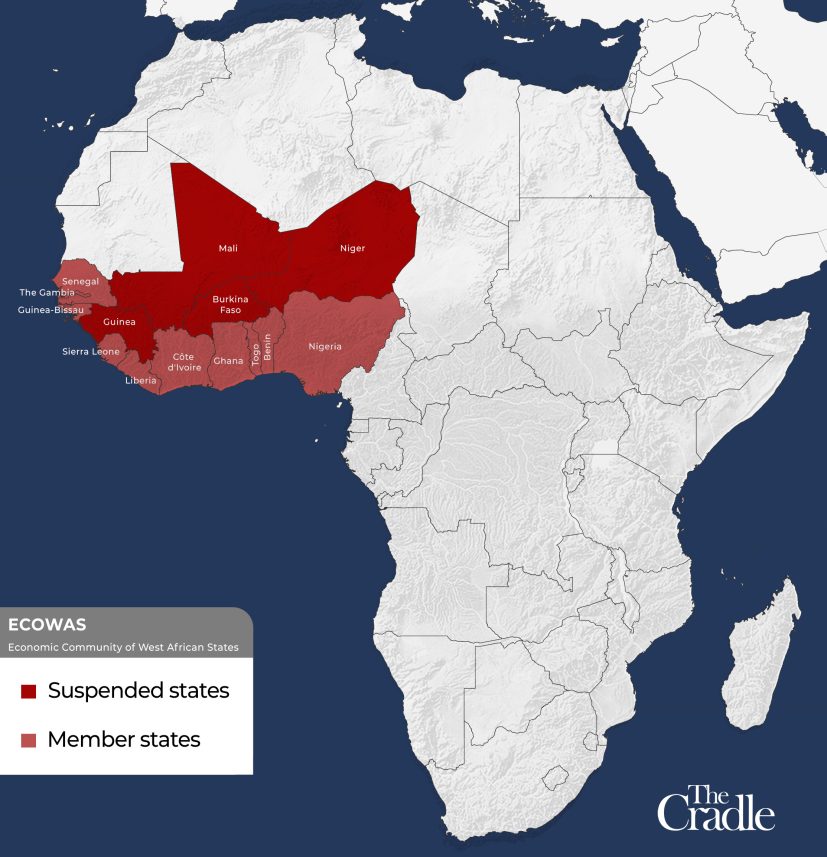
Map of the Economic Community of West African States (ECOWAS)
Sanctions failed, so proxy war begins
JNIM continues to receive financing from Persian Gulf patrons and income from ransoms and extortion. While it has a strong rural presence, it controls no major cities. Azawad separatists and ISIS fighters are similarly confined to Mali’s remote north.
A different strategy was needed. In recent weeks, JNIM has attacked fuel trucks, depriving Bamako of oil. Cars were unable to fill up, and schools closed. According to western media, JNIM wants to strangle the capital to promote unrest. Mali has had five coups since independence, three of which have occurred since 2012. News reports suggest that given this history, JNIM can ultimately topple the Malian government.
Reports of an “immediate collapse” are nearly a month old. What Western media fails to understand is that, unlike previous governments in Mali, the current one is highly popular. Truckers are willing to risk their lives to bring fuel to the capital. “If we die, it’s for a good cause,” one trucker said. Even if the blockade were to stop all fuel, Malian’s resilience and support for Goita would only increase.
Thankfully for Bamako, JNIM is facing setbacks. Russia, which provides support from the Africa Corps (formerly Wagner Group) and, in 2023, vetoed the UNSC’s sanctions, sent 160,000 and 200,000 metric tons of petroleum and agricultural products. This has provided some relief, with fuel lines shortening and schools reopening.
On 15 November, Mali and the African Corps seized the Intahaka mine. The next day, the town of Loulouni was also recaptured. That same day, the blockade south of Bamako was weakened, allowing convoys of fuel trucks to reach the city.
Manufacturing consent for intervention
So why does the western media continue insisting that Mali is collapsing? Simple: to justify military intervention.
One of the biggest propagandists has been France. In a post on X from the French Ministry for Europe and Foreign Affairs, Paris blamed Russia for abandoning Mali, despite being one of the only nations supporting it during this crisis. French news channels LCI and TF1 ran stories such as “Mali, the Jihadists at the gates of Bamako” and “Mali, the new stronghold of Al-Qaeda.”
In response, Bamako banned them from the country. Niger has also accused Benin of being a base of operations for France. French state media, France 24, did not deny the claim, only disputing that the number of soldiers was far less than Niger claimed.
France stands to regain a significant geopolitical advantage from regime change in Mali. The country borders seven former French colonies. A return would reassert French regional influence and weaken the anti-imperialist Alliance of Sahel States. Niger remains crucial to France’s uranium supply, which is necessary for 70 percent of the country’s energy. Bamako is also quickly becoming a major exporter of lithium – essential for electronics and electric cars – with the recent opening of its second mine.
Other western countries have also lost out under Goita’s rule. Canadian company Barrick Mining lost $1 billion when Mali nationalized the mining industry. Last month, other western firms, such as Harmony Gold, IAMGOLD, Cora Gold, and Resolute Mining, had their mining exploration licenses revoked.
The growing Russia–Mali partnership resembles Moscow’s 2015 intervention in Syria. Just as Russia propped up Damascus for as long as it could from a US-led proxy war, it now shores up Bamako. The payoff could be similarly strategic: diplomatic support, military basing rights, and influence in an emerging multipolar Africa.
Unlike past interventions cloaked as counterterrorism, the west now appears reluctant. Washington and its allies, usually quick to bomb under any pretext, have done nothing to aid Bamako. This silence suggests either tacit support for JNIM or confidence that Mali will implode without direct action.
Outsourcing war
As a member of the Alliance of Sahel States, the west fears that Mali’s resilience will be an inspiration to others to join the anti-imperialist struggle. The 2021 coup emerged as a result of inequality and insecurity. These factors can be found in many other West African countries such as Benin, the Ivory Coast, and Togo.
Some observers theorize that Africa’s most populous country, Nigeria, could soon have a revolution, amid high inequality and insecurity from Boko Haram. Nigeria’s growing ties with Mali are a serious threat to the west.
With sanctions failing to bring Mali to its knees, the only solution for the west is military intervention. This might be direct, as seen with Niger, where French troops are stationed in bordering Benin. But more likely, western countries will outsource their intervention to African states. This has occurred in Somalia, where the US has Kenya and Uganda do its dirty work in return for aid. The same could occur with Mali.
The most likely actors to play this role are ECOWAS and the African Union. ECOWAS receives military training from the US, and many of its leaders are closely tied to Washington. It also receives extensive financing from the EU, most recently receiving €110 million ($119 million) to support “peace, trade, and governance.” Far from neutral, it has become an enforcement arm for western interests. The bloc has previously sanctioned Mali and, in 2023, threatened to invade Niger.
The African Union has also served the interests of the west, such as the African Union Mission to Somalia, which is supported and financed by Washington and Brussels. The African Union Constitutive Act prohibits military intervention in any member state, with the exception of war crimes or at the request of the state.
Mali, however, was suspended from the African Union in 2021, making intervention fully legal under the Act. Chairperson of the African Union Commission, Mahmoud Ali Youssouf, recently called for “urgent international Action as crisis escalates in Mali.”
Bamako versus the empire
Mali faces a two-pronged assault: economic strangulation and the threat of foreign-backed military intervention.
Though JNIM remains a nuisance, it has failed to topple the government. The bigger threat comes from western capitals and their African proxies. Russia remains one of Mali’s few reliable allies. If successful, Moscow’s support will elevate its standing across the continent.
More importantly, Mali’s endurance will inspire other African states to challenge western domination and reclaim sovereignty.
Mali Alarmed That Weapons Supplied to Ukraine Fuel Terrorism in Sahel Region – Envoy to UN
Sputnik – 30.08.2024
UNITED NATIONS – Mali is alarmed that the weapons supplied to Ukraine by the collective West are ultimately fueling terrorism in the Sahel region, Malian Ambassador to the United Nations Oumar Daou said in Friday.
“The government of Mali would like to express its alarm with regard to the supply of weapons to Ukraine, because it’s been clearly established that a good part of the weapons … end up fueling terrorism and crime in the Sahel,” Daou said during a meeting of the UN Security Council.
The Malian ambassador also said that the weapons deliveries carry the risk of further destabilizing countries in Africa and exacerbate the suffering of the Malian people, who have already been “sorely tested by several years of conflict with dramatic consequences.”
French media, citing a Malian military source, reported in early August that terrorists from the Malian armed separatist groups traveled to Ukraine to receive training there.
Mali Cuts Ties with Ukraine Over Kiev’s Support for Al-Qaeda
By Kyle Anzalone | The Libertarian Institute | August 6, 2024
Mali has severed its diplomatic ties with Ukraine following an attack by the local Al-Qaeda affiliate on Malian forces. Kiev called the move short-sighted.
Late last month, opposition forces, including an al Qaeda affiliate in the Sahel, Jama’at Nusrat al-Islam wal-Muslimin (JNIM), killed scores of Malian soldiers and mercenaries from the Russian Wagner Group that is supporting Bamako.
Andriy Yusov, a representative of Ukraine’s Security Service (SBU), said Kiev aided JNIM in its assault. “The rebels received the necessary information, which enabled a successful military operation against Russian war criminals.” An estimated 84 Russian contractors were killed, along with nearly 50 Malian soldiers.
Bakamo expressed “deep shock” over the “subversive remarks” and received the statement as an admission of Kiev’s involvement in the slaughter of its soldiers.
Malian government spokesman Colonel Abdoulaye Maiga denounced Ukraine for supporting JINM. He said Yusov’s remarks confirmed “Ukraine’s involvement in a cowardly, treacherous and barbaric attack by armed terrorist groups.”
“Mali condemns the hostility of the authorities of Ukraine who do not observe that Mali has always called for a peaceful settlement of the crisis between the Russian Federation and Ukraine,” he added.
Kiev responded by claiming Bakamo failed to provide evidence proving Ukraine backed the terrorists. “It is regrettable that … Mali decided to sever … relations … without conducting a thorough study of the facts and circumstances of the incident … and without providing any evidence of Ukraine’s involvement in the said event,” a statement from the Ukrainian Foreign Ministry said.
Kiev added it has the right to take all necessary political and diplomatic retaliations.
Following the 2011 American-backed uprising in Libya that ousted long-time leader Muammar Gaddafi, jihadist groups spread into neighboring countries and throughout the African Sahel. In the following decade, Mali experienced several coups as the jihadists destabilized the region.
During the latest coup in 2021, Assimi Goïta swept into power in Bakamo. Part of the policy of the junta has been to expel France, Mali’s long-time colonial ruler. Under Goïta, Mali has stepped up ties with Moscow including the private military firm Wager.
Niger, Burkina Faso, Mali sign treaty to become confederation
Al Mayadeen | July 7, 2024
“This summit marks a decisive step for the future of our common space,” Capt. Ibrahim Traore, the leader of Burkina Faso, wrote on X.
The military-led governments of Mali, Burkina Faso, and Niger convened their first joint summit on Saturday in Niamey, the capital of Niger. During this historic meeting, they announced the formation of a confederation of the three Sahel states.
In their inaugural summit since coming to power, the leaders adopted a joint statement outlining a treaty to establish the confederation.
“This summit marks a decisive step for the future of our common space. Together, we will consolidate the foundations of our true independence, a guarantee of true peace and sustainable development through the creation of the ‘Alliance of Sahel States’ Confederation,’” Capt. Ibrahim Traore, the leader of Burkina Faso, wrote on X.
Tensions with ECOWAS persist
The summit appears to signal a departure from the Economic Community of West African States (ECOWAS). Tensions between the Sahel nations and ECOWAS escalated after Gen. Abdourahamane Tiani seized power from the elected President Mohamed Bazoum in a coup in Niger last July. In response, ECOWAS imposed sanctions on Niger and threatened intervention, further straining relations.
“The AES (Alliance of Sahel States) is full of enormous natural potential which, if properly exploited, will guarantee a better future for the people of Niger, Mali and Burkina Faso,” said Traore.
“Our people have irrevocably turned their backs on ECOWAS,” stated Tiani to his fellow Sahel leaders.
The three AES countries accuse ECOWAS of being manipulated by former colonial ruler France, with Tiani calling for the new bloc to become a “community far removed from the stranglehold of foreign powers.”
Niger, Mali, and Burkina Faso’s military leaders have all rejected French influence, expelling French troops from their countries and turning instead toward what they call their “sincere partners” – Russia, Turkey, and Iran. They emphasize sovereignty as a guiding principle of their governance and aim to establish a common currency.
Germany to Close Airbase in Niger After Negotiations on Soldiers Immunity Fail – Reports
Sputnik – 07.07.2024
The German armed forces will give up its airbase in Niger, which was used as a military transport hub, by August 31, as the sides failed to extend the agreement concerning the base, German media reported on Saturday, citing the German Defense Ministry.
The talks broke down after the new Nigerien authorities had refused to grant German soldiers with immunity from prosecution, the NTV news outlet reported, citing a document the ministry had presented before the parliament.
Germany expects to withdraw its troops from the country by the end of August as well.
The German military has used the base in Niger’s capital, Niamey since 2013 as a supply center for its armed forces in neighboring Mali, which were stationed there as part of a UN peacekeeping mission.
Nigerien authorities, which took power in a military takeover in July 2023, have since then also terminated military agreements with France and the United States, which led to the French and US forces’ withdrawal from the country.
Canceled US Joint Exercises in Africa Shows Washington’s Influence Abroad Slipping
Sputnik – 28.01.2024
Retired CIA intelligence officer and State Department official Larry Johnson told Sputnik the move may be related to internal pressure not to work alongside “troops associated with coup governments.”
The United States military leadership has scrapped plans to hold joint exercises with several African states such as Sudan, Mali, Niger, Ethiopia, Eritrea and Burkina Faso.
According to the Washington Post, the Pentagon’s change of plans was, “at least in part,” the result of US Democrats pressuring the Biden administration to bar “troops associated with coup governments” from participating in US-led military exercises.
Exercises such as these are usually planned many months in advance, so the decision to scrap these plans means “there’s an issue with the governments that were supposed to participate,” said retired CIA intelligence officer and State Department official Larry Johnson.
Describing the military exercises’ cancellation as a “significant” development, Johnson told Sputnik that this move by the Pentagon may have also been prompted by the decision of the host African governments not to participate.
“In any event, I think what it does signify is that US influence over other countries, its ability to basically tell countries what to do and compel countries to follow US policy, is slipping, that the US influence in areas like Africa is growing weaker, not stronger,” he remarked.
Johnson also suggested that the decision by Niger, Mali and Burkina Faso to withdraw from the Economic Community of West African States (ECOWAS) may be related to this development, considering that ECOWAS is primarily regarded as an entity “under Western influence.”
According to him, the fact that these countries chose to part ways with ECOWAS and pursue “bilateral agreements among themselves” does seem like signs of them “distancing themselves from US control.”
Macron Recalling Ambassador to Niger, French Embassy’s Staff, Troops
Sputnik – 24.09.2023
France is recalling French Ambassador to Niger Sylvain Itte, all staff of the French Embassy, and all French troops in the West African country, President Emmanuel Macron said on Sunday.
“The Ambassador in Niamey, as well as all staff of the embassy, will return to France in the coming weeks or months,” Macron told a French broadcaster.
He added that the military cooperation with Niger is “over” and French troops will leave the country by the end of the year.
“I spoke with President Mohamed Bazoum today and informed him that France has decided to recall its ambassador … We will also put an end to our military cooperation with the current Nigerien authorities because they are no longer aiming to fight terrorism. This is the end of this cooperation, it [the troops withdrawal] will be organized in the coming weeks or months. The troops will return in an organized manner before the end of the year,” Macron said.
Bazoum was deposed as president by his guard during a military takeover in July. France has refused to recognize the new government in Niger, initially ignoring their demands for French troops and the ambassador to leave the country.
Roughly 1,500 French troops are currently deployed in Niger. Despite the move, Macron said he still views Bazoum as the true leader of Niger.
Bazoum has called for his reinstatement, calling for help from the Economic Community of West African States, but two members of the block, Burkina Faso and Mali, signed a defensive pact with the military leadership of Niger and threatened to leave ECOWAS if it took military action against Niger.
The French embassy in Niamey and French military bases have been the focus of mass protests in the capital city.
Mali, Burkina Faso, Niger Sign Charter to Create Defense Alliance
Sputnik – 17.09.2023
The leaders of Mali, Burkina Faso and Niger have signed a charter establishing an alliance of Sahel states to create a collective defense architecture, Mali’s interim president for the transitional period, Assimi Goita, said on Saturday.
“I have signed today with the leaders of Burkina Faso and Niger the Liptako Gourma Charter, establishing the Alliance of Sahel States to create an architecture of collective defense and mutual assistance for the benefit of our people,” Goita said on X.
An attack on the sovereignty or territorial integrity of one or more parties to the charter will be regarded as aggression against the other parties and will require their assistance, including the use of military force, the document read.
The parties also commit to fighting terrorism and organized crime on the territory of Sahel states, the charter added.
The Nigerien Coup Prompted A Long-Overdue Discussion About Sovereignty In West Africa
BY ANDREW KORYBKO | AUGUST 27, 2023
It was earlier assessed that “The AU-ECOWAS Rift Over Niger Was Predictable” due to their differing approaches towards the continent’s latest regime change. The AU believes that its ousted leader should be returned to power via peaceful means while ECOWAS’ active members are in favor of forcefully reimposing his rule. Neither of them support the interim authorities’ three-year transitional plan, however, with ECOWAS rejecting it outright and the AU suspending Niger right afterwards.
The AU also “called upon all Member States of the AU and the international community including bilateral and multilateral partners, at large to reject this unconstitutional change of government and to refrain from any action likely to grant legitimacy to the illegal regime in Niger.” This came shortly after reports began circulating that neighboring Burkina Faso and Mali, which are also run by interim military-led governments, stationed warplanes in Niger to deter a French-backed Nigerian-led ECOWAS invasion.
Late last week, those three countries’ Foreign Ministers met in Niamey, where they issued a joint statement that importantly declared the following:
“The three countries have agreed to grant each other facilities for mutual assistance in matters of defense and security in the event of aggression or terrorist attacks. They have decided to set up a consultation framework that allows them to coordinate their actions in order to deal with the multiple situations and challenges to which they are exposed. This consultation framework remains open to countries wishing to participate in this dynamic in order to respond to the concerns and needs of their populations in terms of peace, security and economic and monetary development. To this end, they agreed to set up a Joint Secretariat.”
Simply put, they’ve established a regional mutual defense alliance (“Sahelian Alliance”) that’ll also aim to accelerate political and economic-financial integration between them.
Before delving into a discussion about which of the three organizations involved in the West African Crisis – the AU, ECOWAS, and the Sahelian Alliance – truly represent the Nigerien people’s sovereign will, Russian Foreign Minister Lavrov’s detailed reaction to that country’s regime change is worth mentioning. It can be read in full here, but he basically concluded that the region’s interim military-led governments sought to rebalance their prior leaderships’ relations with the West for the betterment of their people.
That observation segues into the subject of this analysis since it lends credence to the views shared by Burkinabe leader Ibrahim Traore during late July’s Second Russia-Africa Summit in St. Petersburg. While speaking among those of his fellow African leaders who were brave enough to resist Western pressure to attend, he still lambasted many of them for being imperialist puppets due to their opposition to his interim military-led government after it was suspended from the AU and ECOWAS.
His country’s people and those of similarly military-ruled Guinea, Mali, and now Niger all rallied behind their armed forces after they overthrew their French puppet leaderships, yet each were still punished by those two organizations to different extents, with Niger now facing the threat of invasion. It stands to reason that all of these interim military-led governments genuinely enjoy grassroots support otherwise there’d be Color Revolution attempts and even anti-state rebellions/insurgencies/terrorist campaigns.
To be sure, Burkina Faso, Mali, and Niger – which have now joined forces to become the Sahelian Alliance – are indeed facing terrorist threats, but they’re derived from a radical ideological virus that predates their respective military coups and aren’t a result of those regime changes. The AU represents the African Establishment, however, whose members fear being overthrown by their own armed forces. For that reason, it always opposes coups even if they’re popular among the people.
The same can be said about ECOWAS’ stance since it’s pretty much just a regionally focused version of the AU that represents the West African Establishment more so than the West African people. Since the Nigerien coup is the fourth one to take place in the ambit of its influence, the non-suspended members of the group are more worried than the distant AU is about the possibility of a so-called “domino effect”, ergo why they’re threatening the use of force to reverse the situation while the AU remains against it.
Both organizations prioritize the interests of their elite members, the African Establishment as a whole in the AU’s case and the West African one in ECOWAS’, over those of the people that they claim to represent. This explains why they’re not only against the Nigerien coup, but why the AU told others not to legitimize it while ECOWAS is threatening an invasion. Although Russia is formally opposed to it and any anti-constitutional regime change too, Moscow’s stance is much more pragmatic than theirs.
Post-coup Mali became one of Russia’s closest military partners on the continent behind the Central African Republic, while Burkina Faso is considering following in its neighbor’s footsteps after Interim President Traore declared earlier this spring that he considers Russia his country’s strategic ally. These two Sahelian security relationships are flourishing in spite of Moscow having opposed their anti-constitutional regime changes since it believes in cooperating with them during their transitions.
By contrast, the AU and ECOWAS are against third parties legitimizing the post-coup leaderships of those countries who they’ve suspended even though the aforesaid could advance everyone’s objective interests like in the Russian example of helping Mali and Burkina Faso fight transnational terrorists. Once again, it’s important to remind the reader that neither those two, Guinea, or Niger experienced any Color Revolution attempts or serious anti-state violence, thus confirming popular support for their rulers.
All factors considered, the AU and ECOWAS are arguably against the sovereign will of the Nigerien people whereas that country’s interim military-led authorities, the newly formed Sahelian Alliance, and Russia all embody it on the national, regional, and international levels. The first of those three carried out their coup for patriotic reasons aimed at realizing their people’s desire for true sovereignty after languishing under France’s neo-colonial occupation for decades as de facto slaves.
The second’s allies experienced their own patriotic military coups for the same reason and then sought to pool their forces to deter imperialist puppets like ECOWAS’ remaining members. As for Russia’s interests, it pragmatically decided to help these post-coup countries’ leaderships fight transnational terrorism since it’s in their own people’s, the region’s, and all of Africa’s interests. These three – Niger’s new authorities, the Sahelian Alliance, and Russia – are the true vanguards of sovereignty in West Africa.
Niger junta says France plotting to ‘intervene militarily’
AFP | July 31, 2023
Niger’s new junta on Monday accused France of seeking to “intervene militarily” to reinstate deposed President Mohamed Bazoum as tension mounted with the former colonial power and neighbours.
Bazoum, a western ally whose election just over two years ago was a watershed in Niger’s troubled history, was toppled on July 26 by the elite Presidential Guard.
Guards chief General Abdourahamane Tiani declared himself leader — but his claim has been shunned internationally and the West African bloc ECOWAS has given him a week to hand back power.
Bazoum’s PNDS party on Monday warned Niger risked becoming a “dictatorial and totalitarian regime” after a series of arrests.
On Monday morning, Oil Minister Mahamane Sani Mahamadou — the son of influential former president Mahamadou Issoufou — and Mining Minister Ousseini Hadizatou were arrested, the party charged.
The head of the PNDS’s national executive committee, Fourmakoye Gado, was also arrested, it said.
The junta had previously arrested the interior minister, the transport minister and a former defence minister, the party said.
On Sunday, French President Emmanuel Macron vowed “immediate and uncompromising” action if French citizens or interests were attacked after thousands rallied outside the French embassy.
Some tried to enter the compound but were dispersed by tear gas.
‘Plotting intervention’
The junta on Monday accused France of plotting an intervention.
“In its search for ways and means to intervene militarily in Niger, France with the complicity of some Nigeriens, held a meeting with the chief of staff of the Nigerien National Guard to obtain the necessary political and military authorisation,” the putschists said on national TV.
They also said six people needed hospitalisation after the embassy security services fired tear gas against the rally.
A demonstration in support of the junta was also held in Zinder, eastern Niger, on Monday.
Tough ECOWAS warning
On Sunday, the Economic Community of West African States (ECOWAS) sounded a tough warning.
The bloc demanded that Bazoum be reinstated within a week, failing which it would take “all measures” to restore constitutional order, which “may include the use of force”.
“No more time for us to send a warning signal… It’s time for action,” said ECOWAS chairman Bola Tinubu, president of Nigeria — Niger’s neighbour to the southeast and the regional superpower.
Russia called for the swift return of “the rule of law” and “restraint from all parties so that this doesn’t result in human casualties”.
Niger became the third Sahel country in less than three years, following neighbours Mali and Burkina Faso, to be shaken by a military coup.
In all three nations, a jihadist insurgency strained fragile governments, stoked anger in the military and rained economic blows on some of the world’s poorest countries.
The overthrow of elected presidents has been accompanied by anti-French, pro-Russian demonstrations.
Crucial ally
Protesters say France, the country’s traditional ally, has failed to shield them against the jihadists, whereas Russia would be a stronger ally.
In Mali, a 2020 putsch led to a bust-up with France which last year withdrew its troops as the junta brought in Russian paramilitaries.
France also quit Burkina Faso after two coups last year brought in a junta that adopted a nationalist line.
The withdrawals prompted France to reconfigure its decade-long anti-jihadist strategy in the Sahel, concentrating on Niger, where it fields 1,500 troops with a major air base near Niamey.
The latest coup, according to the putschists, was a response to “the degradation of the security situation” linked to the jihadist conflict, as well as corruption and economic woes.
International critics have ratcheted up pressure, targeting trade and development aid.
ECOWAS has suspended all commercial and financial transactions, while France, the European Union and the United States, which has 1,100 troops in Niger, have either cut off support or threatened to do so.
Germany suspended financial aid and development cooperation on Monday, and UN humanitarian operations have also been put on hold.
Niger has seen four coups since independence from France in 1960 and numerous other attempts, including two previously against Bazoum.
The 63-year-old is a former interior minister whose elections marked Niger’s first peaceful transition of power since independence.
Featured Video
It’s the Occupation, Stupid
or go to
Aletho News Archives – Video-Images
From the Archives
A superpower and “the world’s sickest warrior state”
By Paul J. Balles | March 8, 2010
Living through five or six major wars has hardened me to what I thought were the extremes of inhuman cruelty and brutality.
Two things made those extremes almost bearable: the brutality always revealed – at least according to the media coverage – the viciousness of the enemy. It was therefore quite understandable when our “brave men and women” pulverized the enemy.
Films of Japanese torturing captive Americans somehow justified holding Japanese Americans in internment camps during World War II; and only a small percentage of Americans found the bombing of Hiroshima and Nagasaki unreasonably vengeful at best, at worst, depraved.
The media giants in America portrayed the North Koreans as barbaric beasts with their captives, quite unlike their southern counterpoints – our allies during the Korean War. No one ever felt the need to explain how the South Koreans were a civilized breed while the North Koreans were absolute savages, at least according to the official line.
In Vietnam, our warriors justifiably (or so the media made us believe) dropped napalm on the North Vietnamese who had the gall to hide in villages and tunnels to ravage our invaders. At least it was accepted practice until some rogue photojournalist filmed a young girl screaming down a Vietnamese road in flames. … continue
Blog Roll
 Aletho News
- Pakistan to Host US-Iran Talks
- How Indonesia’s tilt toward the US left it stranded in the Strait of Hormuz
- US has no choice but to retreat from Iranian borders: Top commander
- Iran Retaliation Strikes Chemical Plant Near Dimona
- AWACS’ Destruction is a Major Loss for US Military – Ex-DoW Analyst
- Israel’s Iran Strategy Uses US Military & Gulf States as Its Pawns
- Iran: Trump wanted regime change, now just begging for Hormuz to open
- IRGC: Israeli, US universities in region legitimate targets after strikes on Iranian university
- Trump admits Iran hit USS Ford carrier: ‘We ran for our lives’
- Battle for Hungary: EU attacks on Orban are a sign of worse things to come
- If Americans Knew
- Israeli police block Catholic cardinal from entering Church of the Holy Sepulchre on Palm Sunday
- Israel is assassinating journalists again, more than any other nation, anywhere, ever – Not a ceasefire Day 170
- Over 300 US service members wounded, majority have brain injuries – Not a ceasefire Day 169
- Researchers at Human Rights Watch Resign Over Blocked Report on Palestinian Refugee Return
- Jewish Groups Are Backing a War Americans Don’t Want
- Eric Fingerhut Thinks He’s the President of the Jews
- Top Jewish Philanthropists, Rabbis Urge Israeli President to Take Action Against ‘Jewish Extremists’
- Don’t Be Fooled. Zionist Leaders Have Always Wanted to Control Southern Lebanon
- Israel’s widespread use of torture is a core element of its genocide against the Palestinian people
- In Israel’s War on Iran, Many Middle East US Bases Rendered “All But Uninhabitable”
- No Tricks Zone
- German Science Blog Accuses PIK Climate Institute Of Hallucinating Climate Tipping Points
- Devastating Assessment Of Comirnaty Vaccine By Former Senior Pfizer Europe Toxicologist
- New Study: CO2 Is ‘Effectively Negligible’ As An Explanatory Climate Change Factor Since 2000
- Former Pfizer Toxicologist Dr. Helmut Sterz Tells Bundestag Hearing Pfizer Vaccine Should Have Never Been Approved
- Energy Expert: Germany’s Nuclear Phaseout Was A “500 Billion Euro Mistake”
- New Research: South Australia’s Mid-Holocene Sea Surface Temperatures Were 4°C Warmer Than Today
- Storing Green Energy To Last Germany 10 Days Would Require A 60-Million Tonne Battery
- New Studies: UK Sea Levels Were 4 Meters Higher Than Today During The Mid-Holocene
- Destructive Green New Deal: German Energy And Metal Group Warns Of Drastic Crisis
- New Study Documents A 20-Year Pause In Arctic Sea Ice Decline – Driven By Internal Variability
 Aletho News