PBS Goes to Israel and Palestine–Mostly Israel
By Peter Hart | FAIR | February 12, 2013
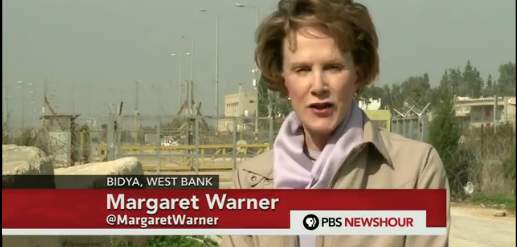
On the January 22 broadcast of the PBS NewsHour, correspondent Margaret Warner reported on the outcome of the Israeli elections. It told the same story as most other reports on the issue, trying to sort out the implications for Prime Minister Benjamin Netanyahu. Palestinians basically do not exist in the report; Warner makes one reference to ultra-right Israeli politician Naftali Bennett, who she says believes “the time for negotiating with the Palestinians is over.”
But what was most intriguing was a comment at the end of the piece, from anchor Gwen Ifill: “We will hear more from Margaret as she travels through Israel, the West Bank and Gaza over the next week and a half.”
That sounded like it could be be an interesting opportunity for TV viewers to get a glimpse of Palestinian life. But that’s not what PBS chose to put on the air.
The next installment (1/25/13) was also about the Israeli elections: “So, Margaret, a few days after the election, what kind of government seems to be taking shape?” asked anchor Jeffrey Brown. The emphasis was on Israeli society: “How divided does it feel politically and culturally?”
Warner explained that
the old divide used to be over how much and how to deal with the Arabs and the Palestinians in particular and whether to give land for peace. The new divide is very cultural, and it is between the ultra-orthodox religious and also the pro-settler nationalist movement, which aren’t the same.
Later on Brown asked Warner to explain what her reporting would be touching on. Warner explained that the big stories are “the Iranian nuclear program, the conflict in Syria, and the Israeli/Palestinian issue.” She added that, “of course, we have talked to a lot of Israelis. But, yesterday, for instance, we went up to the Golan Heights, which is, you know, land that the Israelis captured from the Syrians.” So Israelis one day, Israeli-occupied land the next day. Warner nonetheless promised “some textured stories next week that look at all three of those.”
The next report (1/28/13) was again about the Israeli elections–a look at the relationship between Netanyahu and Barack Obama, including their plan to deal with “the threat posed by Iran’s nuclear program.” Warner started in Israeli-occupied Golan Heights:
The sweeping vistas of the Golan Heights plateau and the bucolic life of the Israelis who live here bear quiet witness to the strategic importance of this area, which Israel captured from Syria during the 1967 Arab/Israeli war.
The report was entirely about how Israeli officials view the possibility of the Syrian war “spilling over” into the land they were occupying. Warner shifts the focus to include a look at Tel Aviv, where houses include safe rooms, and she recalled
the conflict last November,when radical Palestinian groups in Hamas-controlled Gaza fired rockets into Tel Aviv, sending residents scrambling to their shelters.
In Gaza, such safe rooms mostly do not exist; over 100 civilians were killed in those Israeli attacks.
At the end of the piece, anchor Gwen Ifill previewed the next installment: “Margaret’s next story looks at the debate in Israel over how to deal with the threat of a nuclear-armed Iran.”
And that’s exactly what viewers got on January 30, a report that started out with Warner’s unsubstantiated claims about an Israeli airstrike inside Syria, relying on what the Israeli and U.S. governments were saying. Warner also referred to how several nations were “concerned about Iran’s nuclear weapons program”–a false description of the state of Iran’s nuclear enrichment program, which has not been shown to be connected to any weapons program.
On January 31, Warner was back–with another report about what Israelis think of the world. Anchor Judy Woodruff offered this description:
Tonight, Margaret Warner, on assignment in the Middle East, reports on the growing debate within Israel about how much of a threat Iran really is.
The piece was an exploration of Iran from various Israeli perspectives–from those who see Iran as an “existential threat” to those who do not. Current and former military officials occupied much of the conversation. And Warner took a look at an Israeli emergency medical facility.
It wasn’t until the February 1 broadcast–in a series that was supposed to take viewers around Israel, the West Bank and Gaza–that viewers actually started hearing from Palestinians.
The report started with a furniture business in the West Bank, which used to do a lot of business with Israelis. “Then came the second Palestinian intifada, or uprising,” explained Warner, “that brought suicide bombings and terror to Israel.”
Had violence ever been “brought” to Palestinians in Gaza or the West Bank? Warner didn’t say.
And years later, this West Bank shopping district “has become a virtual ghost town.” Israelis and Palestinians are not hopeful about the future and are suspicious of each other. Warner makes a brief stop in Gaza, interviewing a Palestinian fisherman who used to work alongside an Israeli who lived in a Gaza settlement.
So what the PBS NewsHour gave viewers was the view from Israel–with a few moments at the end of the series to include Palestinian perspectives, never as subjects in their own right, but to illustrate a “divide” that exists on “both sides.”
On February 5, anchor Jeffrey Brown remarked, “All last week, Margaret Warner and a NewsHour team reported from Israel on many facets of its increasingly tense relations with its neighbors.” That is a far more accurate description of what PBS actually gave viewers.
Related articles
Iran’s ‘Nuclear Weapons Program,’ Again
By Peter Hart | FAIR | January 31, 2013

On Monday’s edition of the NewsHour (1/28/13), host Gwen Ifill referred to concerns about the “threat posed by Iran’s nuclear program,” and told viewers at the end of a Margaret Warner report that “Margaret’s next story looks at the debate in Israel over how to deal with the threat of a nuclear-armed Iran.”
And on last night’s broadcast (1/30/13), Warner explained that countries like the U.S., Israel and Turkey “are concerned about Iran’s nuclear weapons program.”
To reiterate an obvious point: There is no proof of an Iranian nuclear weapons program. There are allegations that Iranian’s enrichment of uranium for its nuclear power program is hiding a military component, but weapons inspectors have not uncovered any such diversion.
The NewsHour has made this mistake before, as FAIR noted in a recent action alert:
In an October 22 discussion of the foreign policy presidential debate, the PBS NewsHour‘s Jeffrey Brown stated that “Iran’s nuclear weapons program has been a particular flash point.”
A few weeks earlier (10/5/12) on the NewsHour, Ray Suarez said that Venezuelan president Hugo Chávez had
continued to thwart American efforts on a range of international issues, such as Washington’s attempt to convince Iran’s President Mahmoud Ahmadinejad to halt his country’s pursuit of nuclear weapons.
How hard is it for NewsHour to understand that allegations are not facts? Write to them at onlineda2@newshour.org
Featured Video

The First Pyrrhic Victory of the Vietnam War
or go to
Aletho News Archives – Video-Images
Frlom the Archives
The 52 Major Jewish American Organizations and Israel Celebrate Passover with the Slaughter of 25 Muslim, Christian and Secular Palestinians
By James Petras • Unz Review • April 8, 2018
Introduction
As of April 7, nearly three thousand unarmed Christian, Muslim and secular Palestinians have been wounded, over three dozen are in critical condition and at least twenty-five unarmed protestors, including children have been assassinated by hundreds of Israeli snipers and heavily armed troops shooting tank shells into crowds of civilians protesting their decades of incarceration by the racist Israeli state.
The Israeli government praised the ‘restraint and morality’ of the IDF, as did the fifty-two Major Jewish American Organizations (MJAO) who largely control the US Congress. These grotesque massacres began during the Christian Holy Week on Good Friday and Easter, coinciding with the Jewish Passover. The self-righteous officials of the MJAO and their relatives and friends broke matzos at joyful Seders as the blood of Palestinians soaked into ground at the fence containing the largest open-air prison camp in history, Gaza.
While tribal loyalties bonded the Israeli and Jewish American leaders, the politicians of the Western oligarchic electoral regimes refrained from criticizing the shocking display of brute force and even defended Israel’s cold blood mass killings of Palestinian civilians in their Gaza prison.
This paper will discuss and analyze the reasons for Israel’s willing Western accomplices and the centrality of its fifth column in the United States. … continue
Blog Roll
 Aletho News
- Top US Counterterrorism Official Resigns in Protest of Operation Against Iran
- Just Get Out! Now!
- Unpacking glaring contradictions in US-Zionist justifications for war against Iran
- Iranian model of warfare bleeds US dry while Persian Gulf states watch and learn: Analyst
- IRGC orders ‘defeated’ US to evacuate industrial facilities in region
- Hegseth’s call for ‘no mercy’ to Iranians deemed war crime
- Iran War Exposes Limits of US Military Power – Journalist
- Even The Neo-Cons Admit The Iran War Is Failing
- Inside the Caucasus Drone Corridor Fueling Tensions With Iran
- ‘Not our war’: Trump’s naval coalition to reopen Strait of Hormuz dead in the water
- If Americans Knew
- Top US counterterror advisor resigns in protest of “war manufactured by Israel” – Not a ceasefire Day 158
- ‘I Liked the House’: When Israeli Soldiers Turn Palestinian Homes into Barracks
- ‘They Were All I Had’: Lebanese Father Buries Parents, 4 Daughters Killed by Israeli Bombing
- Israel and its supporters are causing attacks on Jewish institutions. Case in point: Michigan synagogue tragedy.
- These are the casualties and cost of the war in Iran 2 weeks into the conflict
- Chicago Teachers Union accuses AIPAC of swaying elections with ‘dark money’
- Predictions of another 9/11, amid Israel-US killing spree – Not a ceasefire Day 157
- As US-Israel war on Iran rages, Gaza faces massive dust storm – Not a ceasefire Day 156
- No let-up in attacks on Gaza as Israel takes on Iran, Lebanon – Not a ceasefire Day 155
- ‘Of Course’: IDF Drops Case Against Soldiers Accused of Raping Palestinian Prisoner
- No Tricks Zone
- Storing Green Energy To Last Germany 10 Days Would Require A 60-Million Tonne Battery
- New Studies: UK Sea Levels Were 4 Meters Higher Than Today During The Mid-Holocene
- Destructive Green New Deal: German Energy And Metal Group Warns Of Drastic Crisis
- New Study Documents A 20-Year Pause In Arctic Sea Ice Decline – Driven By Internal Variability
- Wake-up Call: Survey Shows Majority Of Germans Now Favor Postponing Climate Targets!
- Televised! Leading German Political Candidate Tells Schoolchildren CO2 Makes Sun Hotter!
- New Study: A Century Warming Of 1.1°C Is ‘Commonplace’ And ‘Not Unusual’ During This Interglacial
- New Study: ‘Internal Noise’ And Volcanic Forcing Can Trigger 10-15°C Warming Within Decades
- Glaciers Worldwide Are Suddendly Surging, Experts Blame Warming!
- Surprising Discovery: Sahara Is Greening…Billions Of Trees Where Once Thought To Be Barren
 Aletho News