China-Iran ties on the right side of history
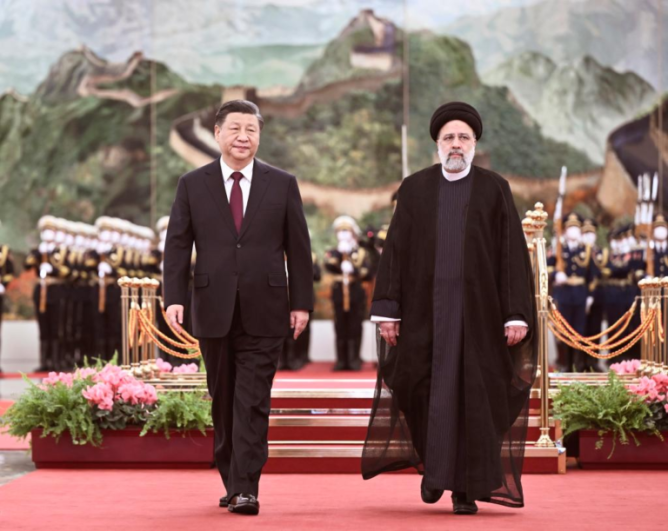
Chinese President Xi Jinping held a welcoming ceremony for Iran’s President Ebrahim Raisi prior to talks at the Great Hall of the People in Beijing, February 14, 2023
BY M. K. BHADRAKUMAR | INDIAN PUNCHLINE | FEBRUARY 16, 2023
The three-day state visit by Iran’s president Ebrahim Raisi to China on February 14-16 is a landmark event affecting regional politics and international security. The red carpet welcome accorded to Raisi signified the high importance attached by Beijing to the comprehensive strategic partnership between China and Iran in the prevailing international milieu.
In a ‘curtain-raiser’ on Monday, Global Times wrote that the visit “shows the Raisi administration’s unswerving determination to promote the ‘Look to the East’ policy.”
The CCP Central Committee newspaper then went on to make a profound statement: “Iran’s ‘Look to the East’ policy meant the transition from its policy of negative balancing and non-alignment to building alliances with non-western world powers that have similar political structures to Iran, such as Russia and China.”
This must be the first time that Beijing explicitly hailed Iran’s transition toward an alliance with non-western world powers that do not qualify as liberal democracies — “such as Russia and China.” This characterisation becomes the leitmotif of Raisi’s visit to China. Indeed, Beijing, Moscow and Tehran are sailing in the same boat as the pioneers of a democratised world order defying US hegemony.
On the following day, in a lengthy editorial, Global Times dwelt on the strategic ramifications, taking note that “outside the US-West bloc and its influence circle, there is huge space and potential for win-win cooperation” between Beijing and Tehran. It said:
“China’s deepening cooperation with Iran also has anti-hegemony and anti-bullying feature. Both China and Iran uphold independent foreign policies, firmly defend the principle of non-interference in internal affairs on international occasions, and safeguard the common interests of developing countries. This is conducive to promoting the multi-polarization and diversified development of the world, and conforms to the general trend of the times…
“Under Washington’s moves, the international structure is being divided and restructured, with the vicious trend of forming blocs and camps again emerging, which puts the non-Western world in a difficult situation and once again faces historical choices. The existing US-led international system has designs to bully and exploit developing countries and emerging countries. Now Washington still thinks that it is not convenient enough, that the interests of developing countries have increased in weight, and wants to reconstruct a new international system with a stronger tendency, which is undoubtedly a major challenge for the non-Western world and needs to be resisted by forming a joint effort.”
This compelling thought appeared in the opening statement of Chinese President Xi Jinping at the meeting with Raisi on Tuesday at the Great Hall of the People in Beijing when he said that “amid the profound changes in the international situation, China and Iran have constantly consolidated their strategic mutual trust and steadily advanced pragmatic cooperation. They have promoted their common interests and upheld international fairness and justice, writing a new chapter for China-Iran friendship.”
Xi underscored that “China supports Iran in safeguarding its sovereignty, independence, territorial integrity and national dignity as well as resisting unilateralism and hegemony, and opposes attempts by external forces to interfere in Iran’s domestic affairs and undermine its security and stability.”
The big picture comprises three key elements here: Moscow’s ‘friendship without limits’ with Beijing, Iran’s Eurasian integration, and the Russian-Iranian alliance in the making. The Shanghai Cooperation Organisation provides a platform for all three countries for strengthening communication and coordination in a spirit of mutual respect and trust and jointly work on regional security issues.
Raisi’s visit will accelerate the implementation of the 25-year agreement signed in 2021 between Iran and China. The program, including energy, trade and infrastructure, faced obstacles due to the pandemic and the escalation of US sanctions. But things are on the cusp of change. China watches Russian stealing a march on it, although the latter’s 25-year agreement with Iran is still a work in progress.
To be sure, the talks in Beijing focused on how to advance practical cooperation between Iran and China, even as China is coming out of the self-imposed restrictions during the pandemic, is raring to go and is revving up the Belt and Road.
However, what is yet to sink in is that a major outcome of the confrontation between Russia and the NATO countries is that Iran is set to break through the rings of western containment through the past four decades since the 1979 revolution. Beijing sees that Russia is providing strategic depth for Iran in a win-win engagement.
Just before Raisi embarked on the state visit to Beijing, the new governor of Iran’s central bank, Mohammadreza Farzin stated in Tehran that “The financial channel between Iran and the world is being restored.” In effect, he was announcing that Iran and Russia have taken a significant step towards linking their banking infrastructures amid Western sanctions.
After years of work, the two countries have managed to connect Iran’s SEPAM national financial messaging service to Russia’s Financial Messaging System of the Bank of Russia (SPFS), the Russian equivalent of SWIFT, that aims to link with other major powers like China and India. The tie-up signifies that Moscow today has the political will to forge ahead with an optimal partnership with Iran, as they also pursue greater use of their national currencies in trade.
Moreover, Russia and Iran are creating a firewall to sequester their defence cooperation from the prying eyes of the US. Moscow is about to transfer cutting-edge military technology to Tehran, including the famous Su-35 multipurpose 4+ generation fighter jets as part of a $3 billion arms deal that also includes two S-400 air defence systems. None of this is escaping Beijing’s attention. (Interestingly, Farzin was included in Raisi’s delegation to Beijing.)
Beijing understands that the confrontation between Russia and the US is working to the advantage of two of its key partners to break out of the Western stranglehold of sanctions and realise their full potential as regional powers — North Korea and Iran — which has profound implications for the power dynamic in the Asia-Pacific and West Asia. The Chairman of the Chiefs of Staff of the Iranian Armed Forces General Mohammad Bagheri greeted the newly-appointed North Korean counterpart General Pak Su-il recently with a call for expansion of military ties “to confront any move that disrupts global security.”
China-Iran relationship is entering interesting times. Fortuitously, the Gulf states themselves are decoupling from the US-Israeli strategy to whip up anti-Iran frenzy. Meanwhile, Iran’s relations with Saudi Arabia are steadily improving and the latter is developing diversified external relations as well with accent on partnerships with China and Russia. The growing similarity lately in the respective diplomatic trajectories of Iran and Saudi Arabia would have a calming effect incrementally on Gulf security and eliminates the scope for US interference in the GCC interaction with China (and Russia.)
President Xi highlighted to Raisi the importance of stability in West Asia, saying that upholding stability matters to the well-being of the countries and people in the region and also has great relevance to world peace, global economic development and the stability of energy supplies.
Xi noted in particular that “China appreciates Iran’s willingness to actively improve relations with neighbouring countries, and supports countries in the region in resolving their differences through dialogue and consultation to realise good neighbourliness.”
This paradigm shift in Gulf security puts the Sino-Iranian partnership on the right side of history.
Russia makes claim over West’s ‘hybrid war’
RT | February 15, 2023
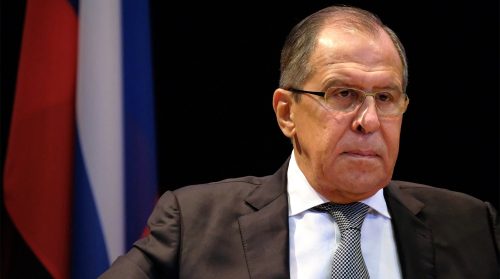
The West is attempting to use the Ukraine conflict to portray Russia as a “rogue state” in the eyes of the world, Foreign Minister Sergey Lavrov said on Wednesday. He stressed that the strategy has not been successful.
“The US and its satellite states are waging an all-encompassing hybrid war that they have long been preparing for, and are using Ukrainian radical nationalists as a battering ram against us,” Lavrov said in a speech in the lower house of the Russian parliament, the State Duma.
“They are not even trying to hide the goal of this war: it is not only to defeat our country on the battlefield and destroy our economy, but also to surround us with a ‘sanitary cordon’ and turn us into a type of a rogue state.”
The statement came the same day that European Commission President Ursula von der Leyen unveiled proposals for a new sanctions package against Russia, including additional export bans and measures to prevent the bypassing of restrictions.
Lavrov said that the West’s efforts to isolate Russia have failed because Moscow continues to develop relations with partners in other areas of the globe. He added that nations that have refused to back the “unprecedented” sanctions make up the majority of the world’s population.
The countries of the Asia-Pacific, the Middle East, Africa, and South America “don’t want to live in accordance with the West-centric order,” the Russian minister stated. “So it makes perfect sense why three-quarters of the world’s countries have not joined the anti-Russian sanctions and have a reasonable view regarding the situation in Ukraine.”
China and India are among the major economies that have refused to impose restrictions on Moscow. Denis Alipov, Russia’s ambassador to New Delhi, said on Tuesday that sanctions “had an opposite effect” and facilitated more trade and closer cooperation between Russia and India.
Beijing, meanwhile, has accused the US of fueling the Ukraine conflict and trying to weaponize the world economy for its own benefit.
Russian FM: US playing with fire, encouraging separatism in Kurdish region in Syria
Press TV – February 6, 2023
Russian Foreign Minister Sergei Lavrov says the United States is “playing with fire” with its activities on the common border between Iraq and Syria, especially by backing separatist militants affiliated with the so-called Syrian Democratic Forces (SDF) and encouraging separatism.
Lavrov said at a press conference in Baghdad with his Iraqi counterpart, Fuad Hussein, that Washington “fosters separatism among locals of Kurdish-populated regions in Iraq and Syria. It is playing with fire.”
He added, “Americans encourage Kurdish separatism one way or another and ignore other matters, including the territorial integrity of Syria, warning that such an approach “exposes other countries in the region to ensuing dangers and threats.”
Security conditions have been deteriorating in the areas controlled by the US-led SDF in Syria’s northern and northeastern provinces of Raqqah, Hasakah, and Dayr al-Zawr amid ongoing raids and arrests of civilians by the US-sponsored militants.
Locals argue that SDF’s constant raids and arrest campaigns have generated a state of frustration and instability, severely affecting their businesses and livelihoods.
Residents accuse the US-backed militants of stealing crude oil and failing to spend money on service sectors.
Local councils affiliated with the SDF have also been accused of financial corruption. They are said to be embezzling funds provided by donors, neglecting services, and not meeting the basic needs.
The Russian foreign minister went on to note that Moscow continues to work on negotiations within the Astana format for the peaceful settlement of Syria conflict, and regards the peace talks as useful.
“We consider Iraq’s observer status at the Astana talks, with Iran, Russia and Turkey acting as the guarantor states, to be very useful. We will continue our interactions and welcome participation of Iraq as an observer. Jordan and Lebanon also play the same role,” Lavrov said.
The Russian foreign minister went on to speak of a “vital importance” to “safeguard” bilateral economic ties with Iraq against “illegal sanctions” imposed on his country by the United States and its allies due to the conflict in Ukraine.
Lavrov said Russia had already invested some $13 billion in Iraq, arguing that Russian oil companies have not received outstanding payments because of the West’s coercive measures.
Elsewhere in his remarks, the top Russian diplomat underlined the importance of the Palestinian issue, saying that the West is procrastinating resolution of the Israeli-Palestinian conflict.
Hussein, for his part, termed Lavrov’s visit to Iraq as a remarkable development, stressing that Baghdad and Moscow will discuss problems linked to the work of Russian companies and Russian financial dues in the Arab country through meetings of the joint committee between the two sides.
The Iraqi foreign minister said he would discuss the issue of cooperating with Russian companies during an upcoming visit to the US.
Hussein said he would insist the US should refrain from imposing sanctions on Iraqi companies for working with Russian partners in Iraq.
He also touched on the Ukraine crisis, stating that Iraq demands a ceasefire between Russia and Ukraine, and calls for an end to the crisis through sincere dialogue between the two countries.
US giving cold feet to countries willing to normalize with Syria
Press TV – February 3, 2023
The United States is actively working to discourage countries willing to normalize relations with Syria, according to a report.
The report, based on the summary of a recent UN Security Council meeting on Syria seen by al-Akhbar, shows that Washington has tried to draw “red lines” for countries seeking to normalize with Syria, return the Syrian refugees to their homeland, or help find a permanent solution to the crisis in the Arab country.
Regarding the return of refugees, the report said instead of encouraging a repatriation process, the United States is urging the host countries to “double their support” for refugee programs, despite the heavy social and economic burden the refugee crisis puts on some of these countries, most notably Lebanon.
Al-Akhbar said the European representatives present in the meeting conditioned their support for the reconstruction of Syria and the repatriation of refugees on Damascus accepting a “credible and comprehensive political process” – which is considered by many to mean a political process dictated by Washington.
The report said that the summary of the meeting, which was held on January 25, shows the US-led camp continues to block a rapprochement – facilitated by Russia and Iran – between Syria and Turkey.
Ankara resumed diplomatic contacts with Damascus in late December, following a decade of severed ties in the wake of the crisis in Syria.
Turkey has now announced its willingness for a meeting between President Recep Tayyip Erdogan and his Syrian counterpart Bashar al-Assad.
A number of Arab countries have also resumed contact with Syria, including Oman and the United Arab Emirates.
White House continues to block energy sharing plan for Lebanon: French official
The Cradle | February 1, 2023
Pierre Duquesne, France’s envoy on international support to Lebanon, stated on 31 January that Egypt is still seeking assurances from Washington to start exporting gas to Lebanon via Syria.
“My Egyptian counterparts today told me, ‘we want something precise’ … There is a problem of exemption … and that concern should be dealt with not only on a political basis but on a legal basis,” Duquesne said during a visit to Cairo.
Alongside Egyptian gas, the US-orchestrated plan, announced in 2021, also calls for exporting electricity from Jordan via Syria, which could add up to 700 megawatts to Lebanon’s battered power grid.
Duquesne confirmed that all preparations for the energy-sharing plan had been completed, and there were no hold-ups over the pricing or quantity of gas. However, western sanctions on Syria prevent the Levantine nation from receiving the much-needed aid.
Moreover, Duquesne warned that Lebanon’s presidential vacuum is also working against the plan, which has yet to go to the World Bank board for a review of specific pre-conditions ahead of the release of a $300 million loan to finance the gas exports over 18 months.
The same day the French official made his comments, the US canceled a tripartite meeting between the US Ambassador Dorothy Shea, Minister of Energy Walid Fayyad, and World Bank representatives after refusing to grant Lebanon any exceptions to the sanctions imposed on Syria.
Lebanese power stations have gone almost entirely offline since the start of the manufactured crisis in 2019, while fuel subsidy cuts have caused the costs for private generators to skyrocket.
The energy sharing plan between Egypt, Jordan, Syria, and Lebanon was revealed soon after resistance movement Hezbollah launched a plan to import Iranian fuel in 2021.
Washington’s abuse of the energy crisis in Lebanon falls in line with recent remarks by US officials, who said Lebanon must be forced towards collapse as the only solution to deal with Hezbollah.
“[Collapse will enable] Lebanon to somehow be rebuilt from the ashes, and freed from the curse of Hezbollah,” US Assistant Secretary of State for Near Eastern Affairs, Barbara Leaf, said on 4 November.
Russia, Syria reopen airbase after providing it with AD systems
The Cradle | January 24, 2023
Russia and Syria have restored the Al-Jarrah military airbase in northern Syria, Russia’s Defense Ministry announced on 23 January. The airbase, which had been destroyed during the Syria conflict, will now host both Russian and Syrian warplanes.
Russian forces have also deployed Buk M2E and Pantsir S1 air defense systems inside the airbase, with the aim of defending Syria’s northern border and closing Syrian airspace to Israeli warplanes, which have regularly bombed Syria since 2013.
The opening ceremony of the airbase was attended by the commander of the Russian armed forces in Syria, General Andrey Serdyukov, and the Syrian Minister of Defense, General Ali Mahmoud Abbas, in addition to military personnel and guests of honor from both countries.
During the ceremony, planes and helicopters of the Russian Aerospace Forces and the Syrian Air Force demonstrated their combat capabilities, while Syrian special forces carried out parachute drops from helicopters and carried out simulated surround and destroy exercises.
The Al-Jarrah airbase, which lies in Manbij, between Aleppo and Raqqa, was first captured by US and Saudi-backed militants from an Al-Qaeda affiliated Salafist militia, Ahrar al-Sham, in February 2013. The operation to capture Al-Jarrah was part of a broader Al-Qaeda led push, known as the “War of the Airports,” to capture Syria’s major military airbases, including Taftanaz, Wadi al-Deif, and Menagh.
According to Abu Abdallah Minbij, an Ahrar al-Sham commander, the 2013 capture of Al-Jarrah cut off Syrian army supply lines to the east and made it difficult for the army to send reinforcements to Raqqa province. Raqqa city fell to Al-Qaeda led forces, including Ahrar al-Sham and the Nusra Front, a month later, in March 2013.
In April 2013, the Nusra Front and Islamic State of Iraq (ISI) split with ISI and became ISIS. Many Nusra fighters and commanders pledged allegiance to the organization. This allowed ISIS to establish a foothold in Raqqa. ISIS then expelled its jihadist rivals and took full control of Raqqa city in January 2014, making the city its Syrian capital.
ISIS captured Al-Jarrah airbase from Ahrar al-Sham in January 2014 as well.
With Russian assistance, the Syrian army recaptured the airbase in 2017, in a bloody battle led by the Syrian Major General Suheil al-Hassan’s Tiger Forces. Some 3,000 ISIS militants were killed and wounded in the fighting.
The joint restoration of the Al-Jarrah airbase by Syria and Russia represents an increase in Russian presence in the country, as well as the recent surge in military cooperation between the two states.
Saudi Crown Prince defies the US policy against Syria
By Steven Sahiounie | Free West Media | January 22, 2023
In November 2022, Saudi Arabia formally changed its stance on Syria. Saudi Arabia is the political powerhouse of the Middle East, and often shares positions on foreign policy and international issues with the UAE, which has previously re-opened their embassy in Damascus.
“The kingdom is keen to maintain Syria’s security and stability and supports all efforts aimed at finding a political solution to the Syrian crisis,” Saudi Foreign Minister Prince Faisal bin Farhan told the November Arab League summit in Algeria.
Syria was suspended from the Arab League in 2011 following the outbreak of conflict instigated by the US, and portrayed in western media as a popular uprising of pro-democracy protesters.
Arab League Secretary-General Ahmed Aboul Gheit said, “The developments in Syria still require a pioneering Arab effort. It is necessary to show flexibility from all parties so that the economic collapse and political blockage can be dispelled. Syria must engage in its natural Arab environment.”
The next Arab League summit will be held in Saudi Arabia, and there is a possibility of Syria once again taking its seat at the round table.
On January 16, the Syrian Foreign Ministry agreed to resume imports from Saudi Arabia after over a decade of strained relations, and Syria planned to import 10,000 tons of white sugar. This development signals a new beginning between the two countries.
Saudi and the Syrian tribes
The Arab tribes in the north east of Syria have traditionally had strong ties with Saudi Arabia, and have received support from the kingdom. The tribes have opposed the ethnic cleansing and forced displacement of Arab villages which the US-led YPG militia has conducted for years. Even though Saudi Arabia has been viewed as a US ally in the past, this has changed since the US military has supported the Marxist YPG who have oppressed Syrians who are not Kurdish.
The US occupied oil wells in north east Syria may come under attack by Arab tribes who are demanding their homes, farms and businesses back from the US-supported YPG. Some analysts foresee the US troops pulling out of Syria after the Kurds find a political solution with Damascus.
Turkey and Syria repair relationship
Turkey and Syria have begun steps to repair their relationship, which ended after Turkey supported the US-NATO attack on Syria for regime change, and hosted CIA operations funneling weapons and terrorists into Syria, under the Obama administration.
Syrian President Bashar al-Assad recently demanded the withdrawal of Turkish troops from Syria to begin to repair the relationship.
Russia is brokering the reconciliation between Erdogan and Assad, which began with the Moscow hosted meeting of the three defense ministers, and a meeting between the three foreign ministers is upcoming.
The developments between Turkey and Syria are being watched by Iran. Foreign Minister Hossein Amirabdollahian said his country was “happy with the dialogue taking place between Syria and Turkey.” Amirabdollahian will travel to Damascus on Saturday for talks with Syrian Foreign Minister Mekdad.
Iran is looking to establish a new role in the recovery process in Syria. President Ebrahim Raisi will visit both Turkey and Syria soon, his first visit to Turkey since taking office two years ago. While analysts see Saudi Arabia and Iran as antagonists, some feel the kingdom will ultimately realize they have to work with Iran in Syria and Lebanon. Iran is part of the region and can’t be excluded from the geo-political sphere.
Saudi Arabian reforms
Saudi Crown Prince Mohammed bin Salman (MBS) said on April 27, 2021 that the country was undergoing a sweeping reform which would restructure the role of religion in Saudi politics and society. The process began a few years before he became crown prince, but under his leadership it has accelerated. Islamic institutions in the Kingdom have seen changes in procedure, personnel, and jurisdiction. All of these reforms are in line with the future vision of the country.
Some analysts feel the rise of the Muslim Brotherhood in the 1960s eventually gave rise to support for domestic religious institutions, and eventually led to funding of religious activities abroad, while religious leaders at home wielded power over public policy.
Vision 2030
Saudi King Salman, Custodian of the Two Holy Mosques, and his son, MBS have a plan for the country which is known as Vision 2030. MBS is also Prime Minister and Chairman of the Council of Economic and Development Affairs.
The days of unlimited oil and markets are in the decline. Education, training, and employment opportunities are the stepping stones to building a thriving country and MBS is determined to plan for a long future of growth and innovation.
MBS
The Crown Prince is young and has new ideas. He is instituting sweeping reforms to the society which have included more rights and freedoms for women. He has championed projects to place Saudi Arabia as a tourist destination, year round golf and soccer venue, and encouraged cultural arts such as musical productions. MBS is breaking the mold: no longer will Saudi Arabia be a breeding ground for Radical Islam.
Extremist preachers
Saudi Arabia had hosted many extremist preachers. Some were featured on satellite TV channels located in Saudi Arabia, and others were local preachers, authors, or scholars. Some had traveled abroad preaching in pulpits and exporting their hatred and sectarian bigotry.
One of the most famous preachers was Muhammed Al-Arifi, who has had an electronic surveillance device attached to him by Saudi intelligence agents, after they seized all of his social media accounts. His last tweet is said to be on May 6, 2019, when he had 20 million followers, and 24 million likes on Facebook, which ranked him as tenth in the Arab world and in the Middle East. The kingdom is shutting down clerics who are extreme.
In 2014, Great Britain banned Arifi from entering the UK following reports that was involved in radicalizing three young British citizens who went to Syria as terrorists.
A YouTube video in 2013 showed Arifi preaching in Egypt and prophesying the coming of the Islamic State. Egyptian TV reported Arifi meeting with the former Muslim Brotherhood prime minister Hisham Qandil in his office.
Arifi is best remembered for his statement on the media Al Jazeera in which he called for jihad in Syria and supported Al Qaeda.
Adnan al-Arour is another extremist preacher who had appeared regularly on two Saudi-owned Salafist satellite channels. Arour was originally from Syria before settling in Saudi Arabia, and in the early days of the Syrian conflict he would stand up on camera, shake his finger, and call for his followers to ‘grind the flesh’ of an Islamic minority sect in Syria and ‘feed it to the dogs’.
These extremist preachers made it clear that the battles being waged in Syria had nothing to do with freedom or democracy, which the western media was pushing as the goal. The truth was the conflict in Syria was a US-NATO attack for regime change and utilized terrorists following Radical Islam, who fought a sectarian war with the goal of establishing an Islamic State in Syria.
The previous Crown Prince
Muhammad bin Nayef Al Saud (MBN) served as the crown prince and first deputy prime minister of Saudi Arabia from 2015 to 2017. On June 21, 2017 King Salman appointed his own son, MBS, as crown prince and relieved MBN of all positions.
MBN met with British Prime Minister David Cameron in January 2013. He then met with President Obama in Washington, on 14 January 2013. The discussion focused on the US-NATO attack on Syria and its support from Saudi Arabia.
In February 2014, MBN replaced Prince Bandar bin Sultan, then intelligence chief of Saudi Arabia, and was placed in charge of Saudi intelligence in Syria. Bandar had been in charge of supporting the US attack on Syria. Bandar had been trying to convince the US in 2012 that the Syrian government was using chemical weapons. However, research has shown that the terrorists used chemical weapons to push Obama into a military invasion, based on his speech of ‘The Red Line’.
In March 2016, MBN was awarded Légion d’honneur by French President François Hollande, another partner in the US-NATO attack on Syria.
On February 10, 2017, the CIA granted its highest Medal to MBN and was handed to him by CIA director Mike Pompeo during a reception ceremony in Riyadh. MBN and Pompeo discussed Syria with Turkish officials, and said Saudi Arabia’s relationship with the US was “historic and strategic”. Just months later in June MBS would depose MBN and strip him of powers, in a move considered to be “upending decades of royal custom and profoundly reordering the kingdom’s inner power structure”.
US diplomats argued that MBN was “the most pro-American minister in the Saudi Cabinet”. That is what brought MBN down. The days of blindly following the US directives are over in Saudi Arabia. MBS has refused to bow down to Biden when he demanded an increase in oil production. The Vision 2030 that MBS developed does not include financing failed wars in the Middle East for the benefit of the Oval Office. MBS has a strained relationship with Biden, and he wears it as a badge of honor.
Saudi role in the Syrian war
Saudi Arabia played a huge role in the large-scale supply of weapons and ammunition to various terrorist groups in Syria during the Syrian conflict. Weapons purchased in Croatia were funneled through Jordan to the border town of Deraa, the epi-center of the Syrian conflict.
At the height of Saudi involvement in Syria, the kingdom had their own militia in Syria under the command of Zahran Alloush. The Jaysh al-Islam are remembered for parading women in cages through the Damascus countryside prior to massacring them.
In summer 2017, US President Donald Trump shut down the CIA operation ‘Timber Sycamore’ which had been arming the terrorists fighting in Syria. About the same time, Saudi Arabia cut off support to the Syrian opposition, which was the political arm of the terrorists.
Richard Dearlove, former head of MI6, expressed his view at the time that “Saudi Arabia is involved in the ISIS-led Sunni rebellion” in Syria.
Syria has been destroyed by the US and their allies who supported the attack beginning in 2011. Now, Turkey and Saudi Arabia are looking to find a solution which will help the Syrian people to rebuild their lives. Both Turkey and Saudi Arabia have turned away from past policies which found them supporting the conflict in Syria at the behest of the US. There is a new Middle East emerging which makes its own policies and is not subservient US interests.
JFK and America’s Destiny Betrayed
A Review of DiEugenio’s “Foreign Policy Coup” Theory
BY LAURENT GUYÉNOT • UNZ REVIEW • JANUARY 21, 2023
I have watched Oliver Stone’s documentary on the assassination of JFK, both the short version, JFK Revisited: Through the Looking Glass, and the long version in four episodes, JFK: Destiny Betrayed. I recommend the latter, which I will discuss here. Although the technical parts (the bullets, the autopsy, Oswald’s CIA handlers) are interesting and partly new, I will focus exclusively on the theory regarding the main culprits and their motive. And I will discuss the larger work of James DiEugenio, who wrote the film—and probably interviewed the different contributors, although Stone appears to be doing it.
James DiEugenio has been investigating the Kennedy presidency and the Kennedy assassination from the time of the Assassination Records Review Board (ARRB), which was largely a consequence of Oliver Stone’s Hollywood film JFK (1991). His first book was Destiny Betrayed: JFK, Cuba, and the Garrison Case (1992, newly edited in 2012). In 1993, he founded Citizens for Truth about the Kennedy Assassination (CTKA), and co-edited Probe Magazine, now replaced by the website KennedysandKing.com.
In 1997, DiEugenio published a powerful two-part book-length article, “the Posthumous Assassination of JFK” (1997). It is still essential reading for anyone interested in the controversies surrounding Kennedy’s presidency and assassination, or puzzled by the unending stream of bizarre Kennedy lore. This is the text you want to send to anyone telling you about the Kennedys’ mafia dealings and unrestrained sex life, their murder of Marilyn Monroe, or Bobby’s irresponsible assassination plots against Castro that backfired on his brother. These stories are so widespread, repeated in well-published and well-reviewed books, that millions of people assume them to be documented. Writing on the occasion of the release of Seymour Hersh’s The Dark Side of Camelot, DiEugenio exposed their fraudulent nature and their true motivation: the obsession to “smother any legacy that might linger,” for “assassination is futile if a man’s ideas live on through others.” This flow of defamation had started in the 70s, as a counter-fire to the Church Committee and the House Select Committee on Assassinations (HSCA), and intensified in the 1990s after the ARRB. It never dried up.
Character assassination is only one part of the propaganda unleashed against the Kennedy legacy. Another part has consisted in distorting the historical record of Kennedy’s presidency, and particularly the radical but short-lived innovations of his foreign policy. DiEugenio writes in “Dodd and Dulles vs. Kennedy in Africa” (1999, modified 2016):
a clear strategy of those who wish to smother any search for the truth about President Kennedy’s assassination is to distort and deny his achievements in office. Hersh and his ilk have toiled to distort who Kennedy really was, where he was going, what the world would have been like if he had lived, and who and what he represented.[1]
DiEugenio has provided insightful answers to these questions. A graduate in Contemporary American History, he is probably the best Kennedy historian among Warren Commission critics, and his work has opened the way for other revisionist historians like Monika Wiesak, author of the recent and excellent America’s Last President: What the World Lost When It Lost John F. Kennedy (read DiEugenio’s review here). According to DiEugenio, there has been, in addition to the cover-up about Kennedy’s death, a “cover-up about Kennedy’s foreign policy,”[2] so that even critics of the Warren Commission fairytale have largely failed to grasp the full extent of Kennedy’s changes from the foreign policy of his predecessors—dominated by the Dulles brothers; “by only chasing Vietnam and Cuba, to the neglect of everything else, we have missed the bigger picture.”[3] The bigger picture drawn by DiEugenio includes the Congo, Indonesia, Laos and the Middle East. DiEugenio’s most essential articles on these topics are:
- “Deconstructing JFK: A Coup d’État over Foreign Policy?” written for Covert-Operation magazine (2021)
- “Nasser, Kennedy, the Middle East, and Israel” (2020)
- “Introduction to JFK’s Foreign Policy: A Motive for Murder” (2014)
- “ Dodd and Dulles vs. Kennedy in Africa” (1999, modified 2016)
The three scholars who most contributed to DiEugenio’s understanding of the uniqueness of Kennedy’s foreign policy, and who are interviewed in the film JFK: Destiny Betrayed, are:
- Richard Mahoney, for JFK: Ordeal in Africa, Oxford University Press, 1983,
- Philip Muehlenbeck, for Betting on the Africans: John F. Kennedy’s Courting of African Nationalist Leaders, Oxford University Press, 2012,
- Robert Rakove, for Kennedy, Johnson, and the Nonaligned World, Cambridge University Press, 2012 (read DiEugenio’s review).
Although he praises James Douglass’s JFK and the Unspeakable (2008), DiEugenio rejects his mythical portrayal of JFK as a Cold Warrior converted to peacemaking during the 1962 Cuban Missile Crisis.[4] Despite the contrary impression he made during his televised debates with Nixon in 1960, Kennedy was never a Cold Warrior. The collection of statements published under the title The Strategy of Peace for his presidential campaign proves it.
DiEugenio traces Kennedy’s general ideas on foreign policy back to 1951, when Kennedy toured the Middle East and Asia. His meeting in Saigon with Edmund Gullion, whom he later brought into his cabinet, had convinced him that sending American troops to Indochina was a grave mistake.[5] He would never change his mind on that issue.[6]
By 1957, Kennedy was formulating a radical—by U.S. standard—foreign policy for the Arab world, which he outlined in a speech on the Senate floor denouncing French colonial occupation of Algeria:
In these days, we can help fulfill a great and promising opportunity to show the world that a new nation, with an Arab heritage, can establish itself in the Western tradition and successfully withstand both the pull toward Arab feudalism and fanaticism and the pull toward communist authoritarianism.[7]
Unlike his predecessors Truman and Eisenhower, and in defiance of the doctrine that prevailed in the CIA, the Pentagon and the State Department, Kennedy accepted and welcomed a multipolar world, the only way, in his view, to overcome the dangerous bi-polarization of the Cold War. Had he succeeded, he would have transformed the U.S. into something totally different from what it was starting to become since WWII, and has fully become since he died: an imperial bully feared but hated throughout the world. In “Deconstructing JFK: A Coup d’État over Foreign Policy?” DiEugenio makes the point that:
[Kennedy’s] speeches, correspondence and high-level meetings with emerging Third World leaders reveal his growing antipathy for colonialism, rejection of imperialism, toleration for the non-aligned movement—contrasting markedly with his predecessor—and promotion of nationalistic leaders, albeit ones that were considered to be “responsible” in their moderation.[8]
The first foreign policy reversal that Kennedy made once in office was on the Congo. Patrice Lumumba, Congo’s first democratically elected leader, was killed three days before Kennedy’s inauguration, victim of a coup supported by the CIA. Jacques Lowe’s shot of JFK getting the news of Lumumba’s death on February 13th is, to DiEugenio, the picture that best symbolizes Kennedy’s personal commitment to support the national independence of Third world countries, and the ordeal of his struggle against the CIA’s machinery of assassination and regime change. After U.N. Secretary-General Dag Hammarksjold was killed (likely murdered) in a plane crash in September 1961, Kennedy carried on his campaign for a free and independent Congo. Lyndon Johnson destroyed this first attempt at a democracy in post-colonial Africa, and backed Josef Mobutu, who turned into a corrupted dictator and allowed his country to be utilized by outside imperial interests.

Kennedy rejected the “with us or against us” mentality of the foreign policy establishment, and this was also demonstrated by his support for Indonesia’s nationalist leader Sukarno, who co-founded the Non-Aligned Movement. In 1958, Eisenhower had authorized the CIA’s attempt at overthrowing Sukarno, but when Kennedy assumed office, he reversed that policy, and helped Sukarno stabilize his country. Less than a year after Kennedy’s death, the CIA was planning again covert action against Sukarno, which led to the killing of at least 500,000 people suspected of communist sympathy. Sukarno was placed under house arrest and CIA-backed Suharto ruled for three decades, turning his people into low-wage workers for foreign companies.[9]
And then, of course, there is Cuba and Vietnam. The story of Kennedy’s resistance to the Pentagon and the CIA’s push for military confrontation and escalation in these countries has been told many times—most eloquently by James Douglass—, so that I do not need to tell it again. Authors of the dominant school of JFK assassination research—and that includes those interviewed in Stone’s documentary—assume that Cuba and Vietnam are, in that order, the most important reasons why Kennedy was killed. DiEugenio agrees, but brings a larger spectrum of motives.
DiEugenio writes in “Nasser, Kennedy, the Middle East, and Israel”:
For decades, the critical community overlooked areas of Kennedy’s foreign policy outside of Vietnam and Cuba. Kennedys and King has attempted to correct that oversight in recent years. We have tried to educate our readers on issues like Kennedy’s policies in Congo, Indonesia, Dominican Republic, and Laos. We have also tried to show how, after his murder, those policies—as well as his policy toward Vietnam and his attempts at detente with Moscow and Havana—were also altered.
But there is still another area of the world about which Kennedy’s reformist foreign policy is overlooked. That area is the Middle East. This is odd since many commentators justifiably perceive that the Middle East is one of the most important areas on the globe.[10]
He writes in his “Introduction to JFK’s Foreign Policy: A Motive for Murder”:
Why is the JFK case relevant today? Well, because the mess in the Middle East now dominates both our foreign policy and the headlines, much as the Cold War did several decades ago. And the roots of the current situation lie in Kennedy’s death, whereupon President Johnson began the long process which reversed his predecessor’s policy there.[11]
In other words, the Middle East is the region of the world where Kennedy’s foreign policy and Johnson’s reversal of that foreign policy have had the most dramatic and most lasting consequences. What was at stake was America’s involvement in the conflict between Israel and the Arab world, and that meant, essentially, between Ben-Gurion and Nasser.
So DiEugenio acknowledges that: 1. LBJ completely reversed JFK’s foreign policy, and 2. the most consequential reversal was in the Middle East, for the longtime benefit of Israel and to the detriment of Egypt. Yet he points, not to Johnson or Ben-Gurion, but to Allen Dulles as the most likely culprit for the Dallas coup. Does he document any evidence that Allen Dulles was interested in switching alliance from Egypt to Israel? None whatsoever. It is true that the Eastern Establishment generally favored Saudi Arabia over Egypt, but it is not the case that they wanted a closer relationship with Israel. So what is unique about Johnson’s pro-Israel policy is that it was not a return to a pre-Kennedy policy, but something new altogether. It was a radical break from all previous administrations. Recall Eisenhower’s resolute reaction to Israel’s invasion of the Sinai in 1956, and contrast it with what happened ten years later, when Johnson greenlighted Israel’s attack on Egypt and expansion, and covered up Israel’s false-flag attack on the USS Liberty designed to draw the U.S. into the war.
Allen Dulles’s major interest in foreign policy in the 1960s was over Cuba. Assassinating Castro and/or invading Cuba to restore an American colonial regime was his priority. Like the majority of JFK investigators, DiEugenio considers that Kennedy had so angered the CIA, and Dulles in particular, when he didn’t go along with their plan to invade Cuba—not once but twice, first with the Bay of Pigs landing in 1961, and secondly during the Cuban Missiles Crisis in 1962—that Dulles’s gang decided to assassinate him. But guess what: LBJ did not invade Cuba either. He didn’t give the CIA and Pentagon hawks the retaliatory invasion of Cuba that their plan was supposed to force upon him. He didn’t even try.
This is a major weakness of that semi-mainstream theory to which DiEugenio subscribes, and which he contributed to write. That weakness is partly compensated by the secondary focus on Vietnam. It is true that, in Vietnam, Johnson gave the National Security state what they wanted, and more. As author Peter Dale Scott wrote, Johnson “had been, since 1961, the ally of the Joint Chiefs (and in particular Air Force General Curtis LeMay) in their unrelenting efforts, against Kennedy’s repeated refusals, to introduce U.S. combat troops into Asia.”[12] Yet, that presentation ignores one aspect of the full story.
The strongest push for sending ground troops to Vietnam came from Walt Rostow (“the biggest Cold Warrior I’ve got,” Kennedy said). As deputy to the National Security Advisor McGeorge Bundy under Kennedy, Rostow had already weighted heavily on Kennedy’s decision to send military “advisors” to Vietnam. But Kennedy had grown weary of his bellicose advise (“Walt had ten ideas, nine of which would lead to disaster”).[13] Walt Rostow was promoted by Johnson as National Security Advisor, and found in the new president more enthusiasm for his war plans. Rostow was the main promoter of the lie that Johnson’s Vietnam policy was a continuation of Kennedy’s.[14]
Johnson named Walt’s brother Eugene Under-Secretary of State, “appointed precisely to support the coming Israeli war” according to Joan Mellen.[15] Walt and Eugene Rostow, sons of Jewish immigrants, had a good deal of control on U.S. Israeli policy. On June 8, 1967, the very day of the Israeli attack on the USS Liberty, Walt had recommended to Johnson that Israel be allowed to keep the captured territories.
Why did the Rostow brothers want a Vietnam War? In “Was Vietnam a Holocaust for Zion” I explained why the Vietnam War was good—even crucial—for Israel. But don’t take my word for it. Here is what French president Charles De Gaulle said during his November 27, 1967 press conference:
Without the tragedy of Vietnam, the conflict between Israel and the Arabs would not have become what it has become. And if South-East Asia could experience a renewal of peace, the Middle-East would also find its way to peace, in the climate of détente which would follow such an event.[16]
I am not implying that the shift in policy on Vietnam between Kennedy and Johnson does not support the theory that CIA and Pentagon killed Kennedy. It does. I am merely pointing out that Johnson’s pro-Israel cabinet members were at least as influential as Dulles and LeMay in Johnson’s reversal of Kennedy’s decision to withdraw from Vietnam, a fact which is also consistent with the theory that Israel was the prime mover.
In his JFK and the Unspeakable, James Douglass has documented JFK’s deep commitment to prevent nuclear proliferation and even abolish weapons of mass destruction “before they abolish us” (Kennedy’s speech at the UN General Assembly, September 25, 1961). But Douglass makes no mention of JFK’s bitter confrontation with Ben-Gurion and Eshkol on that very issue. In this way, Douglass has proven that the historical school of which he has become a standard bearer is involved in a cover-up. To be generous, I ascribe it to a case of “cognitive inhibition”. I imagine it works somewhat like this: “My work—that is, the truth—is too important to risk it being censored by saying something bad about Israel.” Personally, I prefer to stick to Peter Janney’s principle that “the truth takes no prisoners.”
To his credit, DiEugenio does not eschew the Dimona story. His website links to two articles by Avner Cohen, author of Israel and the Bomb (1998), and William Burr of the National Security Archive, accompanied by declassified documents (here and here).[17] DiEugenio himself writes about Israel’s effort to acquire nuclear weapons in “Nasser, Kennedy, the Middle East, and Israel” (2020):
Ben Gurion and the other Israeli leaders were so devoted to this aim that they resorted to two illicit means in order to secure the goal. First—there is no other way to say this—they involved themselves in a government-wide conspiracy to deceive Kennedy about the true nature of the Dimona reactor.
Israel’s second means to go nuclear was the theft of enriched Uranium from the U.S.:
Through [Roger] Mattson [author of Stealing the Atom Bomb], and also author Grant Smith [author of Big Israel], we know today that Israel had stolen hundreds of pounds of highly enriched uranium out of what was essentially their shell plant in Apollo, Pennsylvania, called NUMEC.[18]
Stone and DiEugenio mention the first of these Israeli deceptions in their film (the long version only, episode 3, 40:50). After a brief reminder of Kennedy’s decision to support the U.N. resolution for the return of Palestinian refugees, we are told:
The other problem Kennedy faced with Israel was the construction of the atomic reactor at Dimona. JFK was strongly against any proliferation of nuclear weaponry. He had been assured by Prime Minister David Ben-Gurion that Dimona was designed for peaceful uses of atomic energy. In the spring of 1963, Kennedy demanded full inspections by the US of the Dimona reactor, and threatened to place American aid for Israel in limbo if no agreement was reached. And at the time of his assassination, negotiations were in process for biannual inspections.
That is better than nothing. But since that story is only incidental to the thesis defended by Stone and DiEugenio, it seems to have been included only to immune the authors from the blame of covering it up, that Douglass deserves.
Interestingly, it is Stone who brings up this topic in this interview with Canadian journalist Éloïse Boies. At 34:20, DiEugenio states that “nobody was more anti-nuclear proliferation than John F. Kennedy. This was really a very important issue with him.” At this point, Stone interjects:
He took on Israel. He took on Ben-Gurion in Israel, because they were building a bomb that they’d stolen from us. And he really wanted to put a stop to that, but he, unfortunately died before, and Johnson carried through, knew about it and let it go, till Israel had the bomb by 1968. And even then, in 68, Johnson shut the Pentagon up. He said: “We are not going to announce this. The American people won’t know that Israel has the bomb.”
Notice Éloïse’s reaction: “Let’s talk about [something else].” The point is that, for Stone and DiEugenio, Dimona seems to be anecdotal and hardly relevant to solving the case. At the end (from 50:27), when asked “Who did it, and why?” they stick to the conclusion that Allen Dulles was the mastermind, with perhaps Curtis LeMay. But, they add as an afterthought, Dulles is only “the executioner” and “does get the OK from someone else. … You know who they are: the people with money” … like “David Rockefeller”. Éloïse gets it: “It’s all about money, at the end of the day.” It becomes absolutely ridiculous. When your theory implodes under its own hollowness, it’s time to change. But, as Stone says “once they’re locked in, it’s very hard for historians to go back” (19:10).
It might seem unfair for me to point to an interview rather than to the film itself. But the value of that interview is precisely to reveal the logical fallacies and confusions that are not apparent in the film.
In that same interview (from 40:30), Stone says: “I don’t think Johnson was involved in the murder.” DiEugenio adds: “Johnson fell for the CIA story coming out of Mexico City” (an Oswald impersonator visiting both the Soviet and the Cuban embassies in Mexico in October 1963). But then DiEugenio mentions that Edgar Hoover had told Johnson that the Mexico story was impossible, since neither the voice nor the photo provided by the Mexico CIA station fitted the real Oswald. So now “the question becomes: did Johnson really believe this?” This gets confusing. DiEugenio can’t seem to decide whether Johnson believed Oswald’s communist legend or not.
But DiEugenio’s dilemma has no reason to be. For not only Johnson knew the communist Oswald to be bogus; it was he who used this fake communist connection to block all investigations. DiEugenio is an admirer of the work of professor John M. Newman, whose books he reviewed (here, here, here, and here), and whom he interviewed for the film. One contribution of Newman, introduced in the 2008 edition of his book Oswald and the CIA and repeated in the first three volumes of his series The Assassination of President Kennedy, is, in his own words:
An essential element of the plot was a psychological operation to raise the specter of WWIII and the death of forty million Americans. This threat of a nuclear holocaust was then used by President Johnson to terrify Chief Justice Earl Warren and some of the other men who served on the Warren Commission to such an extent that they believed there was no alternative to writing a report stating Lee Oswald alone had assassinated the president.[19]
According to that theory, endorsed by DiEugenio in this review,[20] Oswald’s profile as a communist pro-Castro activist was inbuilt in the plan (by none other than James Jesus Angleton), not for the purpose of starting WWIII, but as a national security pretext that Johnson could use to impose the lone-nut theory, lest the discovery of a conspiracy would “kick us into a war that can kill forty million Americans in an hour,” as Johnson kept repeating.[21] One important implication is that “many of the post-assassination lies and cover-ups were carried out by people who had nothing to do with the pre-existing plot to assassinate the president” and who “thought that what they were doing was in the best interests of the country.”[22] This applies to thousands of people from the Dallas Police to TV networks. But can it apply to Johnson himself? Given Johnson’s quick and efficient mastery of this device, it is much more likely that it was fabricated by Angleton specifically for Johnson and with his foreknowledge.
Yet DiEugenio and other authors on his site are dismissive of investigators who incriminate Johnson, and especially of Phillip Nelson, author of LBJ: The Mastermind of JFK’s Assassination. A big book like that (730 pages) is bound to contain some weak arguments, but the reviews in KennedysandKing.com (here and here) do not do justice to the strong evidence accumulated by Nelson that Johnson was actively involved, not just in the cover-up, but in the preparation of the Dallas ambush.[23] (Read Nelson’s response to KennedysandKing.com here). DiEugenio concurs with Douglass that Johnson was unaware of the conspiracy against his president, but “chose to cover-up everything and surrender to Cold War prerogatives.”[24] He assumes that Johnson was a man who had no clear idea of his own in foreign policy and liked to be told what to do. That is at odds with everything we learn from Johnson’s biographers—especially Robert Caro.
From my viewpoint, which differs from Nelson’s, Johnson’s role in the assassination cannot be understood independently from Israel’s—nor can Angleton’s role. Johnson allowed, and probably planned, the Israeli attack on the USS Liberty in 1967, and he excused Israel when the operation failed (“Johnson did not break relations with Israel, and there were no trials held over this atrocity,” notes DiEugenio).[25] Not only that, but, as DiEugenio writes in “Nasser, Kennedy, the Middle East, and Israel”:
As Roger Mattson notes in his book on the subject, when the CIA alerted the new president that it appeared that Israel had now developed the atomic bomb, Johnson barely reacted. (Mattson, p. 97) There was no official investigation launched. In fact, Johnson told the CIA not to alert either State or Defense about the discovery.[26]
For those two acts, Johnson qualifies as a traitor to the country he had been sworn to serve. If Johnson was working for someone, it was not for the “Eastern Establishment,” of which he had never been part; it was for Israel. Johnson was the initiator of a pro-Israel policy that Truman, Eisenhower, the Dulles brothers or the Joint Chiefs of Staff under Kennedy would never have imagined in their worst nightmare. It is today widely known that Johnson is the US president who “firmly pointed American policy in a pro-Israel direction.”
In conclusion, I find several logical flaws in DiEugenio’s general theory, the basis for Stone’s documentary:
- DiEugenio recognizes that the change of foreign policy from JFK to LBJ was most consequential in the Middle East, yet he blames the CIA and the Pentagon (Dulles and LeMay) for the assassination, although neither the CIA nor the Pentagon ever advocated the pro-Israel policy that Johnson set up. Johnson’s unprecedented support for Israel, to the point of treason, went against the approach advocated by the CIA, the Pentagon or the State Department. But it was the best foreign policy that Ben-Gurion could dream of.
- According to DiEugenio and the dominant school, the CIA’s prime motive for eliminating Kennedy would have been to resume their favored foreign policy toward Cuba, which Kennedy had stubbornly opposed. But that didn’t happen after the assassination. Johnson kept Kennedy’s pledge to Khrushchev not to invade Cuba, which Dulles and LeMay considered pure treason.
- DiEugenio agrees that Kennedy was intensely worried about nuclear proliferation, and that Israel posed him the most difficult problem. He also knows that Johnson did nothing to stop Israel from going nuclear, and showed neither surprise nor displeasure when told that Israel made its first nuclear bomb in 1968, with bomb-grade uranium stolen from the U.S. Johnson tried to keep it secret—which obviously was what Israel wanted. Yet DiEugenio does not see Dimona as having been a motive in the assassination, and finds no reason to suspect either Israel or Johnson.
- DiEugenio believes that JFK’s assassination was a “coup d’État over foreign policy,” and I agree that this is the only way to make sense of it. But the purpose of a coup d’État is to replace one head of state by another. Therefore, it is self-contradictory for DiEugenio to minimize Johnson’s role and motive in the assassination.
Actually, I think DiEugenio’s notion of a “cover-up about JFK’s foreign policy” needs to be qualified. Not all areas of Kennedy’s foreign policy are equally covered up. The three teachers of DiEugenio—Richard Mahoney, Philip Muehlenbeck and Robert Rakove—are published by Oxford University Press and Cambridge University Press: not exactly fringe publishers. Rakove and Muehlenbeck are even included in the bibliography of the Wikipedia article on “Foreign policy of the John F. Kennedy administration” (so are James Douglass and John M. Newman). This Wikipedia article is quite accurate and detailed, with one exception for the section about “Israel and Arab States”—a fine hasbara job, probably by Bennett Naftali’s army of Zionist Wikipedia editors. See by yourself:

The real “cover-up about JFK’s foreign policy” is the cover-up about JFK’s Israeli policy. According to DiEugenio’s own logic, that points in the direction that DiEugenio is not looking.
Since DiEugenio sees a link between Kennedy’s assassination and his “posthumous assassination”, I also suggest that he gets a clue about Kennedy’s assassins by looking at the political profile of Kennedy’s “posthumous assassins”. The list includes, next to Seymour Hersh, authors who specialize in trashing the Kennedy family, like Ronald Kessler (The Sins of the Father, 1997), Edward Klein (The Kennedy Curse, 2004), or the incomparable C. David Heymann, the Mossad employee (by his own admission)[27] who wrote the salacious Bobby and Jackie: A Love Story (2009). Is there a pattern here?
What about Howard Zinn, Gar Alperovitz, Martin Peretz, and Noam Chomsky, that DiEugenio blames in “The Left and the Death of Kennedy” (1997) for their defense of the Warren Commission report and their participation in the orgy of Kennedy-bashing. Chomsky, whom DiEugenio sees as the most nefarious liar when it comes to Kennedy’s presidency or his assassination (here and here), has nothing in common with Allen Dulles or Curtis LeMay. He is an anti-imperialist, and as such he should make Kennedy his hero, his icon. But Chomsky has another agenda: one of his specialties is blaming America for the crimes of Israel. As for Martin Peretz, DiEugenio writes that his New Republic buried Kennedy’s death in 1979, then “tried to bury his life.”
It actually made a feature article out of a review of the tawdry Horowitz-Collier family biography The Kennedys. Who did that publication find suitable to review this National Enquirer version of the Kennedy clan? None other than Midge Decter, wife of neo-conservative godfather Norman Podhoretz, mother-in-law of Elliot Abrams.
The Podhoretzs are not Eastern Establishment, but they hate the Kennedys. Their hatred is transgenerational and inextinguishable. If you doubt it, read the piece below, written by Norman’s son a week after the tragic death of John F. Kennedy Jr. The author imagines Satan—or is it Yahweh?—teasing Joe Kennedy in hell and bragging to have killed his grandson—a particularly heinous version of the “Kennedy curse”.

Perhaps DiEugenio should give more serious consideration to the “who” and the “why” of Kennedy’s “posthumous assassination”. But that would take him on the road less traveled, a dangerous path—some say suicidal.
Strangely, though, many other well-trodden roads seem to now converge on the Israeli trail:
- Investigators tracking Johnson end up finding a snake pit of sayanim in his White House, as did Phillip Nelson in his second and third books (LBJ: From Mastermind to “The Colossus” and Remember the Liberty).
- Jefferson Morley, investigating Angleton, saw him in cahoots with the cream of the Mossad, who considered him “the biggest Zionist of the lot,” while Robert Amory, head of the CIA Directorate of Intelligence, called him a “co-opted Israeli agent” to his face.
- David Talbot concludes that RFK was assassinated by the same cabal as his brother, who now used for a patsy an anti-Zionist Palestinian, thereby presenting RFK’s assassination as motivated by “a visceral, irrational hatred of Israel” (but Talbot sees no Israeli fingerprint in there—another case of cognitive inhibition).
- No one investigating Jacob Rubenstein, known as Jack Ruby, can now ignore his work for the Irgun as a “gangster for Zion” and his repeated declarations that “I did it for the Jews”.[28]
- Clay Shaw, the only person (beside Oswald) to have been charged with having participated in the assassination, has been found a board member of Permindex, “a Mossad arms trading and money laundering venture” chaired by Louis Bloomfield, a devoted supporter of the Israeli cause and of the Mossad, as shown by Michael Collins Piper.[29]
- The word is out that Arlen “Magic Bullet” Specter was a dedicated Israel-firster, honored by the Israeli government as “an unswerving defender of the Jewish State,” and by AIPAC, as “a leading architect of the congressional bond between our country and Israel”.[30]
- It can’t be ignored that Abraham Zapruder, the man whose camera didn’t shiver when Kennedy’s head exploded, had his business office in one of the snipers’ nests, the Dal Tex Building overlooking Dealey Plaza, owned by B’nai B’rith financier David Weisblat.[31]
- Investigators interested in George DeMohrenschildt cannot fail to learn that, before being found dead with a bullet in his head, he had complained that “the Jewish mafia” was out to get him.[32]
And of course, we must add to the equation Israel’s criminal record for the last sixty years. Thanks to Ronen Bergman, author of Rise and Kill First: The Secret History of Israel’s Targeted Assassinations, we know that Israeli secret services has never had any inhibition against eliminating anyone perceived as a threat to Israel’s national security, especially when it comes to Israel’s nuclear hegemony in the Middle East. Bergman learned from the assassins themselves because, he writes, “acts that people in other countries might be ashamed to admit to are instead a source of pride for Israelis.”[33]
We now know so much more than Stone and DiEugenio could know when they first got involved in Kennedy assassination research. But those who understood Israel’s power back then already had a clue. In March 1992, commenting critically on Stone’s motion picture JFK, American Congressman Paul Findley noted in the Washington Report on Middle East Affairs:
It is interesting — but not surprising — to note that in all the words written and uttered about the Kennedy assassination, Israel’s intelligence agency, the Mossad, has never been mentioned. … on this question, as on almost all others, American reporters and commentators cannot bring themselves to cast Israel in an unfavorable light — despite the obvious fact that Mossad complicity is as plausible as any of the other theories.
Three years later, Mike Piper filled the gap with Final Judgment: The Missing Link in the JFK Assassination Conspiracy (expanded through five editions until 2005). His work has been ignored by most investigators, but in 2013, historian Martin Sandler (listen to him here) mentioned it in his precious edition of The Letters of John F. Kennedy, to introduce Kennedy’s letter to David Ben-Gurion dated May 18, 1963:
author Michael Collins Piper actually accused Israel of the crime. Of all the conspiracy theories, it remains one of the most intriguing. What is indisputable is that although it was kept out of the eye of both the press and the public, a bitter dispute had developed between Israeli prime minister David Ben-Gurion, who believed that his nation’s survival depended on its attaining nuclear capability, and Kennedy, who was vehemently opposed to it.[34]
In his previous letter to Kennedy, dated May 12, Ben-Gurion had assured Kennedy that the Egyptians “want to follow the Nazi example,” and begged: “Mr. President, my people have the right to exist… and this existence is in danger.”[35] He also made a bizarre digression about Jordanian King Hussein: “there is always a danger that one single bullet might put an end to his life and regime.”[36]
Notes
[1] DiEugenio, “Dodd and Dulles vs. Kennedy in Africa,” 15 February 1999, last modified 16 October 2016, www.kennedysandking.com/john-f-kennedy-articles/dodd-and-dulles-vs-kennedy-in-africa
[2] “DiEugenio at the VMI seminar,” 16 September 2017, www.kennedysandking.com/john-f-kennedy-articles/jim-dieugenio-at-the-vmi-seminar
[3] DiEugenio, “Introduction to JFK’s Foreign Policy: A Motive for Murder,” 22 December 2014, www.kennedysandking.com/john-f-kennedy-articles/introduction-to-jfk-s-foreign-policy-a-motive-for-murder
[4] “DiEugenio at the VMI seminar, 16 September 2017, www.kennedysandking.com/john-f-kennedy-articles/jim-dieugenio-at-the-vmi-seminar
[5] James Norwood, “Edmund Gullion, JFK, and the Shaping of a Foreign Policy in Vietnam,” 8 May 2018, www.kennedysandking.com/john-f-kennedy-articles/edmund-gullion-jfk-and-the-shaping-of-a-foreign-policy-in-vietnam
[6] James Douglass, JFK and the Unspeakable: Why He Died and Why It Matters, Touchstone, 2008, pp. 107, 102.
[7] Quoted in “DiEugenio at the VMI seminar,” 16 September 2017, www.kennedysandking.com/john-f-kennedy-articles/jim-dieugenio-at-the-vmi-seminar
[8] DiEugenio, “Deconstructing JFK: A Coup d’État over Foreign Policy?” January 14, 2021, covertactionmagazine.com/2021/01/14/deconstructing-jfk-a-coup-detat-over-foreign-policy/
[9] DiEugenio, “Deconstructing JFK: A Coup d’État over Foreign Policy?” January 14, 2021, covertactionmagazine.com/2021/01/14/deconstructing-jfk-a-coup-detat-over-foreign-policy/
[10] DiEugenio, “Nasser, Kennedy, the Middle East, and Israel,” 22 October 2020, www.kennedysandking.com/john-f-kennedy-articles/nasser-kennedy-the-middle-east-and-israel
[11] DiEugenio, “Introduction to JFK’s Foreign Policy: A Motive for Murder,” 22 December 2014, www.kennedysandking.com/john-f-kennedy-articles/introduction-to-jfk-s-foreign-policy-a-motive-for-murder
[12] Peter Dale Scott, Deep Politics and the Death of JFK, University of California Press, Berkeley, 1993, pp. 30-33.
[13] David Halberstam, The Best and the Brightest, Random House, 1972, pp. 156-162.
[14] John K. Galbraith, “Exit Strategy – In 1963, JFK ordered a complete withdrawal from Vietnam,” Oct/Nov 2003, www.bostonreview.net/articles/galbraith-exit-strategy-vietnam/
[15] Joan Mellen, Blood in the Water: How the US and Israel Conspired to Ambush the USS Liberty, Prometheus, 2018, p. 32.
[16] Film of De Gaulle’s press conference on fresques.ina.fr/de-gaulle/fiche-media/Gaulle00139/conference-de-presse-du-27-novembre-1967 at 41 min.
[17] Avner Cohen and William Burr, “ Concerned About Nuclear Weapons Potential, John F. Kennedy Pushed for Inspection of Israel Nuclear Facilities,” April 21, 2016, nsarchive.gwu.edu/briefing-book/nuclear-vault/2016-04-21/concerned-about-nuclear-weapons-potential-john-f-kennedy and “ The Battle of the Letters, 1963: John F. Kennedy, David Ben-Gurion, Levi Eshkol, and the U.S. Inspections of Dimona,” May 2, 2019, nsarchive.gwu.edu/briefing-book/nuclear-vault/2019-05-02/battle-letters-1963-john-f-kennedy-david-ben-gurion-levi-eshkol-us-inspections-dimona
[18] DiEugenio, “Nasser, Kennedy, the Middle East, and Israel,” 22 October 2020, www.kennedysandking.com/john-f-kennedy-articles/nasser-kennedy-the-middle-east-and-israel For more detail, read DiEugenio’s review of Roger Mattson’s book Stealing the Atom Bomb (2016), “How Israel Stole the Bomb”, September 11, 2016, on consortiumnews.com/2016/09/11/how-israel-stole-the-bomb/ Read also DiEugenio’s review of Monika Wiesak, America’s Last President.
[19] John Newman, Where Angels Tread Lightly: The Assassination of President Kennedy, volume 1, self-published, 2017, p. xx; repeated in vol. 2, Countdown to Darkness, and in vol. 3, Into the Storm.
[20] DiEugenio’s words: « In his new Epilogue for this 2008 edition, Newman explains why only someone who a.) Understood the inner workings of the national security state, and b.) Understood and controlled Oswald’s files, could have masterminded something as superhumanly complex as this scheme. One in which the conspiracy itself actually contained the seeds that would sprout the cover-up » (DiEugenio, “John Newman, Oswald and the CIA (re-issue),” 01 September 2008, on www.kennedysandking.com/john-f-kennedy-reviews/newman-john-oswald-and-the-cia-re-issue
[21] LBJ in a conversation to Senator Richard Russell on November 29, 1963, quoted in Douglass, JFK and the Unspeakable, op. cit., p. 83.
[22] John Newman, Where Angels Tread Lightly, op. cit., p. xx.
[23] Phillip Nelson, LBJ: The Mastermind of JFK’s Assassination, XLibris, 2010, p. 377-378
[24] Douglass, JFK and the Unspeakable, op. cit., p. 81.
[25] DiEugenio, “Deconstructing JFK: A Coup d’État over Foreign Policy?” January 14, 2021, covertactionmagazine.com/2021/01/14/deconstructing-jfk-a-coup-detat-over-foreign-policy/
[26] DiEugenio, “Nasser, Kennedy, the Middle East, and Israel,” 22 October 2020, www.kennedysandking.com/john-f-kennedy-articles/nasser-kennedy-the-middle-east-and-israel
[27] “C. David Heymann,” on spartacus-educational.com/JFKheymann.htm
[28] William Kunstler, My Life as a Radical Lawyer, Carol Publishing, 1994, p. 158.
[29] Michael Collins Piper, Final Judgment: The Missing Link in the JFK Assassination Conspiracy, American Free Press, 6th ed., 2005, chapter 15, pp. 247-269.
[30] Natasha Mozgovaya, “Prominent Jewish-American politician Arlen Specter dies at 82,” Haaretz, October 14, 2012, www.haaretz.com/jewish/arlen-specter-dies-at-82-1.5192779.
[31] That shots came from the Dal Tex was suggested by Jim Garrison in his October 1967 Playboy interview, p. 165-166, ia801307.us.archive.org/20/items/JimGarrisonPlayboyInterview/Jim-Garrison-Playboy-Interview.pdf.
[32] Police report on fr.scribd.com/document/258263723/Police-report-on-sucide-of-de-Mohrenschildt; His wife confirmed to Jim Marrs that her husband thought that “the Jewish Mafia and the FBI” were out to get him: Jim Marrs, Crossfire: The Plot that Killed Kennedy, Carroll and Graf, 1989, p. 285.
[33] Ronen Bergman, Rise and Kill First: The Secret History of Israel’s Targeted Assassinations, John Murray, 2019, p. xv.
[34] Martin Sandler, The Letters of John F. Kennedy, Bloomsbury Publishing, 2013, p. 333. Listen to Sandler here on this topic on www.c-span.org/video/?c4547313/user-clip-jfk-gurion-mossad-dimona
[35] Avner Cohen, Israel and the Bomb, Columbia UP, 1998, pp. 109 and 14.
[36] Quoted in Monika Wiesak, America’s Last President: What the World Lost When It Lost John F. Kennedy, self-published, 2022, p. 214.
Why Arabs Bolster Energy & Security Cooperation With Russia in Defiance of Western Sanctions
By Ekaterina Blinova – Samizdat – 19.01.2023
Arab countries have not joined the anti-Russian sanctions, despite pressure from the West, as Russian Foreign Minister Sergey Lavrov stressed during his press conference this week. What’s behind the Arab world’s resilience?
“The policy of the West in the East has gone bankrupt,” political analyst Vladimir Ahmedov told Sputnik.
“[Middle Eastern players’] trust in the United States, the leading western European states – the former colonizers who had colonies in this region – has already been largely lost,” the specialist in the modern history of Arab countries and senior research fellow at the Institute of Oriental Studies of the Russian Academy of Sciences continued.
New major players have entered the global arena: China, India, Iran, Turkey, Egypt, and Saudi Arabia, the scholar emphasized.
Ahmedov believes that the sanctions imposed against Russia are dictated by purely political considerations of a narrow circle of the western political elite. Meanwhile, the system of international relations and the world order has been undergoing changes, and the indirect proof of this is the position taken by the Arab countries, according to him.
“Russia’s policy in the East at the present time, and Russia’s policy in the world in general, has changed in comparison with the 1990s and the beginning of the 2000s,” the researcher continued. “Now it is a resolute policy aimed at defending [Russia’s] national state interests and the national interests of third countries. It impresses the countries of the East and, above all, the countries of the Middle East, which have been waiting for such a policy for a long time. This policy is in great demand in the East and therefore it meets with approval and understanding.”
In light of this, Russia’s efforts to mediate the Israeli-Palestine conflict as well as those in Syria and Iraq – mentioned by Lavrov during his Wednesday presser – are steps in the right direction, according to the scholar. In addition, Russia’s military presence in Syria serves as a stabilizing factor, he added.
Meanwhile, the West’s Ukraine strategy looks like nothing so much as its previous Middle Eastern policies. The West is using Ukrainians much in exactly the same way it previously used Arabs in order to reach its geopolitical objectives, and Middle Eastern players are well-aware of that, according to the researcher.
“Russia is not fighting against Ukraine or the fraternal Ukrainian people, but against the West, which wants to dismember Russia, belittle its role, minimize it, and so on,” Ahmedov said. “And [the Western policy] does not meet with any approval from the political elites of the East, who themselves suffered from it previously.”
Opportunities in the Middle East and North Africa
“The region of the Middle East and the Arab world in general is of tremendous importance in the world system in terms of geography, demography, a powerful energy market, the world’s oil and gas pantry and as a very important transport artery. Therefore the attention to this region will only grow,” Ahmedov emphasized.
The region develops its position by becoming an influential energy actor, echoed Ramy El Kalyouby, a visiting lecturer at the School of Orientalism of the National Research University Higher School of Economics (HSE).
“Gulf countries profited a lot from oil prices increase, and at some moment the Kingdom of Saudi Arabia’s oil revenues jumped to more than $1 billion daily,” El Kalyouby told Sputnik. “Egypt is also getting its chance to become an important gas supplier to the EU after discovering a few huge fields in the Mediterranean.
The academic singled out Egypt, the world’s biggest wheat importer. According to El Kalyouby, Russia can help Cairo replace a deficit of Ukrainian wheat, open its markets for Egyptian fruits and vegetables, and provide more tourists.
“There is also a project of a Russian industrial zone in Egypt that would help Russia to get around sanctions by changing the origin of products, and also to profit from the African Union free trade zone,” the lecturer highlighted.
Last year, the construction of Egypt’s first nuclear power plant was launched on July 20 in El Dabaa, Matrouh Governorate, by Russia’s State Atomic Energy Corporation Rosatom.
The El Dabaa NPP is meant to be the cornerstone of Egypt’s energy diversification policy, allowing Cairo not only to cover its own electricity needs, but also to provide energy to its neighbors. On November 19, the main construction phase for Unit 2 of the NPP began in the northern African country.
“Gulf countries could cooperate with Russia in the regulation of the oil market, although this becomes more difficult, as Russia provides important reductions on Urals oil,” El Kalyouby continued, adding that “Russia also remains a key actor in Syria as a mediator between Damascus and Ankara.”
Regional Security
Nonetheless, the Middle East and Northern Africa (MENA) region is continuing to suffer from local conflicts stemming from the bitter consequences of the Arab Spring, according to Ahmedov. The scientist noted that the reformatting of political systems of these countries is still going on while the common regional security system has not been formed yet.
Russia shares the same “geopolitical space” with the countries of the region and its objectives there include not only maintaining working ties with Middle Eastern players but also to protect its “soft underbelly” from extremist and terrorist elements reinvigorated by the Arab Spring havoc, the researcher explained.
In addition, Russia’s experience as a power broker in the region could come in handy for the West, since the latter has proven incapable of solving regional conflicts on its own, continued the scientist. According to him, European countries have no other alternative but to deal with Russia in the Middle East in the future if they want to ensure their security in the Mediterranean and Southern Europe.
Ahmedov noted that while Moscow cannot ensure a complete comprehensive settlement and stabilization of the situation in the Middle East, it can help regional players reach these goals.
“Russia can make a certain contribution to ensuring the system of regional security with the participation of other states,” he said. “We have excellent relations with Iran. And in this regard, of course, the Arab countries are interested in Russia in terms of softening the Iranian policy towards the Arab countries, which causes concern today in the Arab world. We have excellent relations with Turkey, which also plays a very important role as a major regional actor or player in this region, just like Iran. And therefore, in this case, we have a lot of advantages that we can realize. We have long-standing ties with Palestine since Soviet times. And therefore, in this case, we have a lot of advantages that we can realize.”
Russia has a long and successful record of work in the region, according to the scientist: in the 1960-1980s the USSR provided the primary industrialization of many MENA countries, including Iraq, Syria, Egypt, Algeria, Sudan, and Yemen. While developing ties with the region, Russia can build upon its expertise and best practices of the past, Ahmedov concluded.
US on alert as UAE seeks to join Turkish-Syrian reconciliation talks
The Cradle | January 8, 2023
During a speech in Ankara on 5 January, Turkish President Recep Tayyip Erdogan hinted that a meeting with his Syrian counterpart Bashar al-Assad may soon take place, “as part of efforts for peace.” He added that a tripartite meeting between the foreign ministers of Turkiye, Russia and Syria is scheduled to be held in the near future for the first time since 2011.
The upcoming meeting aims to enhance communication after Russian-sponsored talks between the Turkish and Syrian defense ministers were held in Moscow on 28 December. The meeting was the highest-level of official meetings between Ankara and Damascus since the start of the Syrian war.
In a phone call with Russian President Vladimir Putin on 5 January, Erdogan called on the Syrian government to “take the steps to achieve a tangible solution concerning the case of Syria.”
US seeks to establish a middle ground between Ankara and the SDF so as to prevent Turkish-Syrian reconciliation
The Syrian-Turkish rapprochement via declared Russian mediation was paralleled by Emirati-Syrian rapprochement – the latest of which was a “brotherly” meeting aimed at strengthening cooperation and restoring historical relations between Assad and Foreign Minister of the UAE Abdallah bin Zayed Al-Nahyan, according to SANA.
Saudi newspaper Asharq Al-Awsat reported that the UAE seeks “to join Russia in sponsoring Syrian-Turkish relations at a high level,” noting that the Emirati foreign minister’s visit to Damascus sought to arrange Turkiye’s participation in the tripartite meeting of Syrian-Turkish-Russian foreign ministers, making it a quadripartite meeting.
The meeting is meant to pave the way for a presidential meeting between Erdogan and Assad in the presence of Putin. Reportedly, the UAE has offered to host this summit, with a possibility of a high-level UAE official being present at the meeting if it will be held in Moscow.
Asharq Al-Awsat added that Turkish Foreign Minister Mevlut Cavusoglu plans to visit Washington on 16-17 January to brief US officials on the developments of Turkish-Syrian normalization, his meeting with Syrian Foreign Minister Faysal Mikdad, and the “roadmap” sponsored by Moscow in the context of security, military, political and economic fields – as agreed upon by the defense ministers as well as the intelligence chiefs in Syria, Turkiye and Russia over the past weeks.
As Turkiye has been launching successive operations against Kurdish groups both on the Turkish-Syrian border as well as within Syria itself under ‘Operation Claw Sword,’ a Western official informed Asharq Al-Awsat that a high-ranking US official will be visiting Ankara in the coming hours as part of efforts to mediate between Turkiye and the SDF in northeastern Syria.
Ankara has demanded that Moscow and Washington commit to the implementation of the bilateral military agreements signed at the end of 2019. The agreements stipulate the withdrawal of the Kurdish People’s Protection Units (YPG) and the Syrian Democratic Forces (SDF) to beyond 30 kilometers from the Turkish border, and from the areas of Manbij and Tal Rifaat, in addition to the withdrawal of all heavy weaponry.
The SDF says that it has fulfilled its obligations, and will not withdraw its police force – known as the Asayish – nor dismantle its local councils, despite Turkiye’s insistence on dissolving all Kurdish military and civil institutions in the area.
Meanwhile, Cavusoglu told media on 29 December that Ankara is willing to withdraw from the territory it occupies in northern Syria and hand it over to Damascus in the event that “political stability” is reached – after cooperation in “neutralizing ISIS members, the Kurdistan Workers’ Party (PKK) and the YPG.”
The Saudi newspaper’s report stated that US mediation seeks to reach a “compromise” between the Kurdish groups and Ankara without a new Turkish incursion taking place ahead of the Turkish presidential and parliamentary elections in mid-2023. This mediation seems to be an attempt at circumventing the imminent Syrian-Turkish reconciliation.
Another official source disclosed that Ankara was “uncomfortable with the leaks following the meeting of the Syrian, Turkish and Russian defense ministers in Moscow, and that it had agreed to a full withdrawal.” However, the source confirmed that, “it is true that Ankara and Damascus consider the PKK a common threat, and will work against any separatist agenda, because it is an existential threat to both countries,” adding that the two countries will “work to open the Aleppo-Latakia Highway.”
Following the UAE’s visit to Damascus, which came after the US called on its allies and international partners to refrain from normalizing ties with Syria, Asharq Al-Awsat quoted an official as saying that the US has been the only western country to issue a statement against normalization, and is working alongside Paris, Berlin, and London to assume a united stance against normalization with Syria.
Communication is currently underway for a meeting between the representatives of Paris, Berlin, London, and Washington and UN Special Envoy for Syria Geir Pederson in Geneva on 23 January. This meeting will take place before Pedersen’s visit to Damascus to meet with the Syrian foreign minister to “confirm the position against normalization, and support the provision of funding for electricity projects within the timeline of early recovery,” stipulated by a resolution for international aid that will be extended before 10 January.
Asharq Al-Awsat said that the UAE has proposed to contribute to the funding of economic and electrical projects in Syria – within the confines of the Caesar Act.
Simultaneously, Jordan, who was the first to open high-level channels of communication with Damascus, is leading efforts alongside other Arab countries to reach a “united Arab position that defines Arab demands in order to make normalization possible.”
The newspaper quoted another western official as saying that Jordan is calling for coordination to put pressure on Damascus to provide political and geopolitical steps for the coming phase in southern Syria, as Amman confirmed that there has been an increase in the smuggling of Captagon, weapons and ammunition across the Syrian border following the start of the normalization process. Additionally, Amman has said that the Iranian presence in southern Syria near the Jordanian border has not diminished, and that there has been an expansion of ISIS activity in the area, according to the official.
Syria’s Arab League membership was suspended in November of 2011 following the start of the Syrian war, and it has been excluded ever since.
Survey shows overwhelming majority in Arab countries oppose normalization with Israel
Press TV – January 7, 2023
A new survey has found that an overwhelming majority of people in Arab countries oppose normalization of relations with Israel, and consider the occupying regime’s policies to be a threat to security and stability of the region.
The opinion poll, conducted by the Arab Center for Research and Policy Studies (ACRPS), indicated that 84% of the participants disapprove any recognition of Israel by their home countries, the Jewish News website reported on Friday.
The London-based website went on to say that 36% cited “colonialist occupying power in Palestine” as the main reason for opposing recognition of Israel while 9% cited Israel’s expansionist policies and the intention to dominate more Arab territory as the reason for their opposition.
Meanwhile, 8% responded that they would support recognition of Israel by their countries, and 8% were unsure or declined to answer.
The latest findings were based on face-to-face interviews with 33,000 individuals from 14 Arab countries, including the United Arab Emirates, Morocco, Bahrain and Sudan which have already normalized ties with Israel.
In Morocco, the most Israel-friendly country included in the survey, 67% of participants opposed recognition of Israel, 20% answered in support, and 13% didn’t know or declined to answer.
Among respondents from Saudi Arabia, which prime minister Benjamin Netanyahu eyes normalization of ties with, 38% rejected recognition of Israel, but 57% decided not to respond.
The survey further revealed that 72% of participants support a democratic system while 87% believe that financial and administrative corruption is widespread in their countries while 39% say they don’t enjoy full equality.
It also found 84% consider policies by Israel and the United States to be a threat to stability and security in the region, with 53% having a “very negative” view of US policy concerning the Palestinians.
Four Arab countries – the UAE, Bahrain, Sudan and Morocco – agreed to normalize relations with Israel under US-brokered agreements in 2020, when former US President Donald Trump was in office.
Spearheaded by the UAE, the move has sparked widespread condemnations from Palestinians as well as nations and human rights advocates across the world, especially within the Muslim world.
Palestinians see the accords as a stab in their back and a direct affront to their cause to liberate their lands from Israeli occupation.
US meddled in Saudi-Yemen peace process
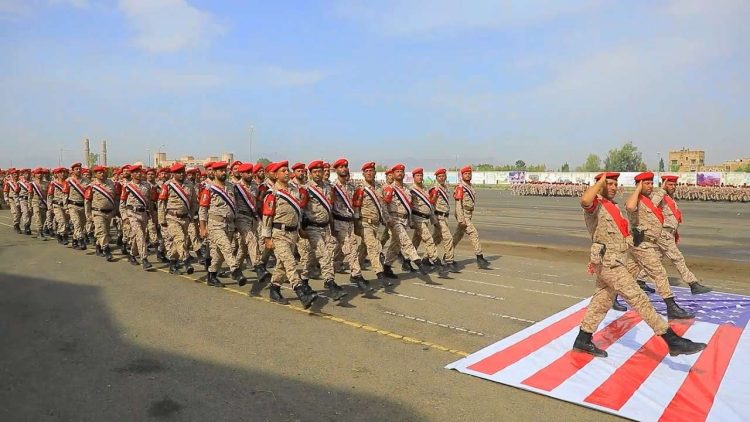
The Cradle | January 6, 2023
Lebanese daily newspaper Al-Akhbar reported on 6 January that Saudi Arabia has expressed its readiness to end the status quo in Yemen and withdraw under the conditions set by Ansarallah.
The kingdom agreed to lift the blockade, and pay compensations for the war after retreating under a pledge not to interfere in the country’s political process.
For that, Riyadh demanded the government in Sanaa present a set of “guarantees” that it will not threaten Saudi Arabia and its security, nor allow hostilities to originate from Yemeni soil.
According to Al-Akhbar, these demands were reiterated by Iran and the Sultanate of Oman, who assured the kingdom of Ansarallah’s willingness to meet Riyadh’s demands.
Despite that, no progress has been made to end the current state, which has left Yemen torn between peace and war. This lack of progress has prompted Ansarallah’s leadership to publicly reject that this limbo becomes a permanent reality.
In an interview with Al-Masirah TV on 1 January, Ansarallah’s spokesman and peace envoy, Mohammed Abdel Salam, demanded a permanent ceasefire between Yemen and Saudi Arabia.
“We are working to reach a point of clarity in Yemen, in which we move into either a truce or permanent ceasefire, and we have presented our point of view to the Omani mediator,” said Abdel Salam.
He added that this would require opening all ports, airports, and roads, and paying salaries with the revenue generated from Yemen’s oil and gas exports.
A source close to Ansarallah in Sanaa revealed to The Cradle that Saudi Arabia agreed to this demand in October 2022, and was ready – along with Qatar – to finance the salaries of all government employees in northern Yemen.
However, the US sabotaged this agreement and blocked the solution by pressuring Riyadh to cease its efforts.
The leader of Ansarallah, Abdul-Malik al-Houthi, has ordered the military to prepare for a scenario in which all prospects for peace diminish, as the status quo is no longer acceptable.
On the other hand, the UN coordinator for Yemen, Hans Grundberg, and US Deputy Assistant Secretary of State for Arabian Gulf Affairs, Tim Lenderking, met in Riyadh on 5 January, to discuss the developments with the head of the Yemeni Presidential Leadership Council, Rashad al-Alimi.
According to local media, the meeting tackled the UN’s efforts to coordinate with the international community to keep the peace process on track and explore ways to end Yemeni suffering.
However, progress has yet to materialize, and no plan has been set to find ways to establish communication with the Sanaa government, as a key to peace.
Featured Video
Yemen joins the war – Red Sea could be blocked next – Saudi regime at risk
or go to
Aletho News Archives – Video-Images
From the Archives
A superpower and “the world’s sickest warrior state”
By Paul J. Balles | March 8, 2010
Living through five or six major wars has hardened me to what I thought were the extremes of inhuman cruelty and brutality.
Two things made those extremes almost bearable: the brutality always revealed – at least according to the media coverage – the viciousness of the enemy. It was therefore quite understandable when our “brave men and women” pulverized the enemy.
Films of Japanese torturing captive Americans somehow justified holding Japanese Americans in internment camps during World War II; and only a small percentage of Americans found the bombing of Hiroshima and Nagasaki unreasonably vengeful at best, at worst, depraved.
The media giants in America portrayed the North Koreans as barbaric beasts with their captives, quite unlike their southern counterpoints – our allies during the Korean War. No one ever felt the need to explain how the South Koreans were a civilized breed while the North Koreans were absolute savages, at least according to the official line.
In Vietnam, our warriors justifiably (or so the media made us believe) dropped napalm on the North Vietnamese who had the gall to hide in villages and tunnels to ravage our invaders. At least it was accepted practice until some rogue photojournalist filmed a young girl screaming down a Vietnamese road in flames. … continue
Blog Roll
 Aletho News
- Russian tanker approaches Cuba despite US oil blockade
- Marandi: Yemen joins the war – Red Sea could be blocked next – Saudi regime at risk
- Pro-Palestinian French member of European Parliament denied entry to Canada
- Pakistan to Host US-Iran Talks
- How Indonesia’s tilt toward the US left it stranded in the Strait of Hormuz
- US has no choice but to retreat from Iranian borders: Top commander
- Iran Retaliation Strikes Chemical Plant Near Dimona
- AWACS’ Destruction is a Major Loss for US Military – Ex-DoW Analyst
- Israel’s Iran Strategy Uses US Military & Gulf States as Its Pawns
- Iran: Trump wanted regime change, now just begging for Hormuz to open
- If Americans Knew
- Israeli police block Catholic cardinal from entering Church of the Holy Sepulchre on Palm Sunday
- Israel is assassinating journalists again, more than any other nation, anywhere, ever – Not a ceasefire Day 170
- Over 300 US service members wounded, majority have brain injuries – Not a ceasefire Day 169
- Researchers at Human Rights Watch Resign Over Blocked Report on Palestinian Refugee Return
- Jewish Groups Are Backing a War Americans Don’t Want
- Eric Fingerhut Thinks He’s the President of the Jews
- Top Jewish Philanthropists, Rabbis Urge Israeli President to Take Action Against ‘Jewish Extremists’
- Don’t Be Fooled. Zionist Leaders Have Always Wanted to Control Southern Lebanon
- Israel’s widespread use of torture is a core element of its genocide against the Palestinian people
- In Israel’s War on Iran, Many Middle East US Bases Rendered “All But Uninhabitable”
- No Tricks Zone
- German Science Blog Accuses PIK Climate Institute Of Hallucinating Climate Tipping Points
- Devastating Assessment Of Comirnaty Vaccine By Former Senior Pfizer Europe Toxicologist
- New Study: CO2 Is ‘Effectively Negligible’ As An Explanatory Climate Change Factor Since 2000
- Former Pfizer Toxicologist Dr. Helmut Sterz Tells Bundestag Hearing Pfizer Vaccine Should Have Never Been Approved
- Energy Expert: Germany’s Nuclear Phaseout Was A “500 Billion Euro Mistake”
- New Research: South Australia’s Mid-Holocene Sea Surface Temperatures Were 4°C Warmer Than Today
- Storing Green Energy To Last Germany 10 Days Would Require A 60-Million Tonne Battery
- New Studies: UK Sea Levels Were 4 Meters Higher Than Today During The Mid-Holocene
- Destructive Green New Deal: German Energy And Metal Group Warns Of Drastic Crisis
- New Study Documents A 20-Year Pause In Arctic Sea Ice Decline – Driven By Internal Variability
 Aletho News