Israel to expand regional activities with US army
The Cradle | November 25, 2022
On 24 November, the Israeli Chief of Staff, General Aviv Kochavi, announced a significant expansion of joint activities with the US army in the region, indicating that Israel would work at a faster pace against the “positioning” of the Iranian government in the Middle East, according to Al-Arabiya news.
“To enhance our capabilities in the face of the challenges in the region, joint activity with CENTCOM will be significantly expanded in the near future. At the same time, the IDF will continue to act at an accelerated pace against the Iranian regime’s entrenchment in the region,” he said.
Kochavi returned from the United States on 24 November and met with US Joint Chiefs of Staff Chairman Mark Milley, with whom he discussed strengthening cooperation between the two military forces, according to Al-Arabiya.
The White House announced that US National Security Adviser Jake Sullivan met with Aviv Kochavi in Washington and discussed several issues during the meeting.
National Security Council spokeswoman Adrienne Watson said in a statement on 21 November that Sullivan “affirmed the US administration’s firm support for Israel’s security, and the two sides exchanged views on a broad range of regional security issues of mutual interest.”
“Sullivan affirmed US President Joe Biden’s commitment to ensuring that Iran does not acquire a nuclear weapon,” she added.
Meanwhile, The Times of Israel reported that Kochavi told US military officials that the two countries should accelerate what he described as “offensive operations plans” against Iran.
On 19 November, US Forces Central Command (CENTCOM) chief Michael Erik Kurilla announced in Bahrain that a US task force will deploy more than 100 unmanned vessels by 2023 to “help ensure maritime security” in the Gulf region’s strategic waters, according to Mehr News Agency.
“By this time next year, Task Force 59 will bring together a fleet of over 100 unmanned surface and subsurface vessels operating together, communicating together, and providing maritime domain awareness,” Kurilla announced during the annual Manama dialogue conference.
The Pentagon has also been collaborating with Israel, Saudi Arabia, and other nations in West Asia over the past eight months to create a network of unmanned drones to counter Iran in the Persian Gulf.
A Very Different Global State of Affairs Takes Hold
By Alastair Crooke | Strategic Culture Foundation | November 21, 2022
How the world appears all depends on whether your gaze is firmly focussed on the hub of the wheel, or alternatively, were you to watch the wheel’s rotation around the hub – and the bearing it follows – you would see the world differently.
Looked at from a DC-centric perspective, all is still: Nothing (as it were), is moving geo-politically. Was there an election in the U.S.? Well, certainly there is no longer an ‘Election Day’ event as the new mechanics of ballots vs in-person voting, commencing up to 50 days earlier, and ploughing on, weeks after, has become far removed from the old notion of having ‘an election’, and an aggregate macro outcome.
From this ‘centric’ viewpoint, the Midterms change nothing – stasis.
So many of Biden’s policies were already in stone anyway – and beyond the ability of any Congress to change in the short run.
New legislation, if there were any, could be vetoed. And should the election ‘month’ end with the House controlled by Republicans and the Senate controlled by Democrats, there might not be any legislation at all, because of partisanship and an inability to compromise.
More to the point, Biden anyway can rule for the next 2 years through Executive Order and bureaucratic inertia – and not need the Congress at all. In other words, the composition of Congress may not matter that much.
But now, turn your gaze to the rotation around the ‘hub’, and what do you see? The rim spinning wildly. It seizes more and more traction on the ground and has clear directionality.
The biggest pivot around the hub? Well probably, President Xi of China travelling to Riyadh to meet Mohammad bin Salman (MbS). The wheel rim here digs deep for a firm grip on bedrock, as Saudi Arabia makes its pivot toward the BRICS. Xi likely is going to Riyadh to seal the details of Saudi’s accession to the BRICS and the terms of China’s future ‘Oil Accord’ with Saudi Arabia. And that may be the beginning to the end to the petrodollar system – as whatever is agreed in terms of the Chinese mode of payment for oil will mesh with Russo-Chinese plans eventually to move Eurasia onto a new trading currency (far away from the dollar).
Saudi Arabia gravitating BRICS-wards means other Gulf and Mid East – states such as Egypt – leaning BRICS-wards also.
Another pivot: The Turkish Interior Minister Süleyman Soylu said after this week’s explosion in Istanbul: “We do not accept the condolence message of the U.S. Embassy. We understand the message that was given to us, we received the message that was given to us”. Soylu then dismissed the U.S. condolence as akin to “a killer being first to show up at a crime scene”.
Let’s be clear: The minister just told the U.S. to go sc**w itself. This unleashing of raw anger comes just as Turkey has agreed to join with Russia to establish a new gas hub in Turkey and is participating with Russia in a massive oil and gas investment and co-operation deal with Iran. Turkey too, is veering BRICS-wards.
And, as Turkey veers away from one ‘hub’, much of the Turkic sphere will take Turkey’s lead.
These two events – from Xi’s meeting with MbS’ thumbing his nose at the U.S., to Turkey’s fury at the terrorism in Istanbul – clearly dovetail together to mark a strategic Middle East pivot – both in terms of energy and monetary frameworks, towards the unfolding Eurasian free trade sphere.
Then comes the news from last Thursday: Iran says that it has developed a high-precision hypersonic missile. General Hajizadeh said the Iranian hypersonic ballistic missile can reach more than five times the speed of sound and, as such, it will be able to breach all present systems of anti-missile defence.
Simply put: Iran essentially already is a nuclear threshold state (but not a nuclear weapons state). The remarkable technical achievement of producing a hypersonic high-precision missile (which still eludes the U.S.), is a paradigm-changer.
Strategic nukes make no sense in a highly mix-populated, small Middle East – and now, there is no need for Iran to move towards becoming a weapons state. So, what would be the point to a complicated containment strategy (i.e. the JCPOA), oriented towards hindering an outcome that has become overtaken by new technology? A hypersonic ballistic missile capacity makes tactical nukes redundant. And hypersonic missiles are more effective; more easily deployed.
The problem for the U.S. and Israel is that Iran has done it – it has leaped beyond the JCPOA containment cage.
On top of that, a few days earlier, Iran also announced that it had launched a ballistic missile, carrying a satellite into space. If so, Iran now has ballistic missiles capable of reaching, not only Israel, but Europe too. Furthermore, Iran is reported to soon receive 60 SU-35 aircraft, as just one part to its rapidly evolving relationship with Russia, sealed last week with Nikolai Patrushev (Russia’s Security Council Secretary) in Tehran.
Again, to be clear, Russia has just acquired a highly potent kinetic force multiplier; access to Iran’s sanctions-busting rolodex of contacts and strategies, and a full partner to Moscow’s big play of Eurasia becoming a commodities super-oligopoly.
Simply put, as Iran enlists as a force multiplier to the Russia-China axis, so too will Iraq, Syria, Hizbullah and the Houthis slip along a somewhat similar trajectory.
Whilst the European ‘security architecture’ remains still frozen in a tight NATO, anti-Russian grip, West Asia’s security architecture is dissolving away from the old U.S. and Israeli-led hard polarisation of a Sunni sphere vs Shi’i Iran (i.e. the so-called Abraham Accords), and is re-forming around a new security architecture being shaped by Russia and China.
This makes sense. Turkey prizes its Turkic civilisational heritage. Iran clearly is a civilisational state, and MbS plainly wants his kingdom to be widely accepted as one, too (and not as just a U.S. dependency). The point of the SCO format is that it is ‘pro-autonomy’ and is opposed to any singularity of ideology. In fact, by being civilisational in concept, it becomes anti-ideological and opposed to tight binary (with us, or against us) alliances. Membership does not require endorsement of each other partner’s particular policies, provided they do not impinge on others’ sovereignty.
In effect, the whole of West Asia – to one degree or another – is being lifted up into this evolving Eurasian economic and security paradigm.
And, simply said, since Africa is already enlisted into the China camp, the African component to MENA is trending strongly Eurasia-wards, as well. The Global South’s affiliation too, largely can be taken for granted.
Where does this leave the old ‘hub’? It has Europe fully in its control. For now, yes…
However research published by France’s École de Guerre Economique suggests that whilst Europe has, since WW2, “lived in a state of the unspoken” in respect to its full-spectrum dependency on Washington, as Russia sanctions take their catastrophic effect on Europe, “a very different state of affairs takes hold”. Consequently, politicians, and the public alike, struggle to identify “who truly is their enemy”.
Well, the collective view, based on interviews with French intelligence experts (i.e. the French Deep State) is very clear: 97% percent consider the U.S. to be the foreign power that “most threatens” the “economic interests” of France. And they see it as a problem that must be resolved.
Of course, the U.S. will not easily let Europe go. Nonetheless, if parts of the Establishment can speak thus, then something is moving and afoot, beneath the surface. The report underlines naturally that the EU might have a trade surplus of 150 billion euros with the U.S., but the latter would never willingly allow this to translate into ‘strategic autonomy’. And any gain in autonomy is achieved against the constant backdrop of – and more than offset by – “strong geopolitical and military pressure” from the U.S. at all times.
Could the Nord Stream sabotage have been the straw that broke the camel’s back? In part, it was a trigger, but Europe hides its diverse old hatreds and long-nursed vindictiveness under ‘a Brussels lid of easy money’. But this pertains only so long as the EU remains a glorified ATM – states insert their debit-cards and withdraw cash. The concealed animosities are repressed, and monetarily lubricated into quiescence.
The ATM however, is in trouble (economic contraction, de-industrialisation and austerity cometh!); and as the ATM withdrawals’ window winnows down, so too the lid holding down the old animosities and tribal feelings will not hold for long. Indeed, the demons are rising – and are readily visible even now.
And finally, will the Washington ‘hub’ hold? Does it retain the resources to manage so many stress-test events – financial, systemic and political – all arriving synchronistically? We must wait to see.
In retrospect, the ‘Hub’ is not ‘on the move’. It has moved already. It is just that so many are stuck seeing an ‘empty space’ that once was occupied by something past, but which somehow still somehow lingers on, in visual memory, as a ‘shade’ of its earlier solidity.
Interview with US Ambassador Peter Ford
Free West Media | November 18, 2022
Steven Sahiounie of MidEastDiscourse interviewed Ambassador Peter Ford to hear his expert analysis of important issues developing in the region.
Israel, Lebanon, Syria and Turkey are neighbors in an increasingly unstable Middle East, in which Saudi Arabia plays a key role.
The US has meddled in the Middle East for decades and is responsible for the destruction of several countries who have not recovered from failed American policies.
Peter Ford served as the British ambassador to Bahrain from 1999 to 2003 and Syria from 2003 to 2006, and is currently the London-based Co-Chairman of the British Syrian Society. He is an Arabist with long established expertise in the Middle East.
Benjamin Netanyahu and his allies recently came back to power in “Israel”. In your opinion what does this mean for the Palestinians?
It makes no difference. Those who believe that one Israeli government is different from another are fools. Every Israeli government supports the occupation and practices repression. Any differences are purely optical.
That said, the participation of overt racists in Netanyahu’s government increases the chances that the US will distance itself from Israel in matters of secondary importance.
Lebanon is in the midst of a financial and social collapse. In your opinion, will the Israeli regime take advantage of the crisis and attack Lebanon?
Israel is already viciously attacking Lebanon – economically. The Israeli/US strategy is to avoid war, which they would lose, but instead to create enough suffering in Lebanon to make the Lebanese people turn against Hezbollah. In particular, they are trying to block oil reaching Lebanon from Iran. This is similar to their strategy towards Syria.
The UN Special Rapporteur has called for the end of sanctions on Syria because of the continuing suffering. Do you think there is any hope in removing the sanctions which are crippling the daily life of Syrians?
Sadly I see no prospect of sanctions on Syria being lifted or eased in the foreseeable future. It costs the US nothing to apply them and the US against all evidence persists in believing that sanctions weaken popular support for the Syrian government, or pretending to believe they weaken the government simply because it would be embarrassing to lift them. Lifting sanctions would look like an admission of failure and a concession to Russia and Iran.
Sanctions on Syria cannot be analyzed without taking the geopolitical situation into account. To some degree Syria is paying part of the price for US mishandling of its relations with Russia and Iran.
Saudi Crown Prince Mohammed bin Salman has not bowed down to pressure by US President Joe Biden. In your opinion, what will be the cost that Saudi Arabia has to pay?
The cost will be zero. On the contrary, Saudi defiance of the US over oil prices shows that the balance of power between the two has shifted and that the US is a paper tiger where Saudi Arabia is concerned. Let us not forget that the US arms industry has become highly dependent on sales to the Gulf, and the US has invested heavily in keeping Saudi Arabia away from rapprochement with Iran. Its leverage is minimal. It was different when MBS was an international pariah over Khashoggi, but time has done its work of prompting amnesia if not forgiveness. I expect to see more Saudi defiance of the US.
For the past few months, we have been hearing reports from the Turkish side of overtures at repairing the relationship between Turkey and Syria. In your opinion, will this have an effect on ending terrorist control in Idlib?
I am more optimistic about Idlib today than I have been for ages. Time is also doing its work here – demonstrating to the Turks that their Syria policy has been a total failure. That policy has failed to remove the Syrian government, failed to establish stability on Turkey’s border and failed to create conditions for the return of Syrian refugees. The burden of those refugees is felt especially acutely with the approach of presidential elections in Turkey. Whether Erdogan is serious about rapprochement with Syria remains however to be seen.
Steven Sahiounie is a two-time award-winning journalist
Israel produces weapons of mass destruction under West’s protection: Syria
Press TV – November 15, 2022
Permanent Representative of Syria to the United Nations, Bassam Sabbagh, says Israel must join the Nuclear Non-Proliferation Treaty (NPT) and eliminate its stockpile of nuclear weapons in order for a nuclear-weapon-free zone to be established in the Middle East.
Speaking at the Third Session of the Conference on the Establishment of a Middle East Zone Free of Nuclear Weapons and other Weapons of Mass Destruction in New York, Sabbagh lambasted Western countries, particularly the United States, for their generous support of the Israeli regime.
He argued that the approach has emboldened the regime to possess and develop more such munitions and to refuse to subject its nuclear facilities to international supervision, which have posed serious threats to regional peace and security.
He also complained that the tenth Review Conference of the Parties to the Treaty on the Prohibition of Nuclear Weapons failed to introduce practical steps that would guarantee the effective implementation of the 1995 Middle East Resolution, which serves as a fundamental pillar in supporting the non-proliferation regime on the regional level.
The senior Syrian diplomat said Damascus supported the UN General Assembly resolution as a path parallel to the implementation of the Middle East Resolution, and not an alternative to it.
“Ever since the adoption of the resolution, Syria has cooperated with regional states participating in the conference to achieve their common goals. The progress made by the conference indicates the sincere and serious efforts made by participating countries, and reveals, on the other hand, the disregard of Israel and the United States for the international will. This practice goes hand in hand with their obstructionism to create a Middle East free of weapons of mass destruction,” Sabbagh noted.
“Syria considers establishment of a Middle East free of nuclear weapons and other weapons of mass destruction as an important measure on the path of disarmament, empowerment of the non-proliferation regime, and a serious contribution to the protection of regional and international peace and security,” he said.
“Syria is a signatory to the Treaty on the Non-Proliferation of Nuclear Weapons (NPT) and tabled a draft resolution in 2002 and 2003 aimed at establishment of a Middle East free of weapons of mass destruction. The United States, however, aborted that initiative to protect Israel,” the Syrian diplomat said.
Israel, which pursues a policy of deliberate ambiguity about its nuclear weapons, is estimated to possess 200 to 400 nuclear warheads in its arsenal, making it the sole possessor of non-conventional arms in West Asia.
The illegitimate entity has, however, refused to either allow inspections of its military nuclear facilities or sign the NPT.
What has emboldened Tel Aviv to accelerate its nuclear activities, according to observers, is the support from the United States and Europe, the two parties most critical of Iran’s peaceful nuclear program.
Pentagon exploits post 9/11 laws to wage ‘secret wars’ worldwide: Report
The Cradle | November 9, 2022
A report released last week by the New York University School of Law’s Brennan Center for Justice details how the US Department of Defense (DoD) has been allowed to covertly deploy troops and wage secret wars over the past two decades in dozens of countries across the globe.
Among the nations in West Asia affected by these so-called ‘security cooperation authorities’ are Lebanon, Iraq, Syria, and Yemen; however, they also include many African and Latin American nations.
Known as ‘security cooperation authorities,’ they were passed by the US Congress in the years following the 11 September attacks, and are a continuation of the 2001 Authorization for Use of Military Force (AUMF), a piece of legislation that has been stretched by four successive governments.
According to the report, the AUMF covers “a broad assortment of terrorist groups, the full list of which the executive branch long withheld from Congress and still withholds from the public.”
Following in this tradition, the ‘security cooperation authorities’ being abused by the Pentagon are Section 333 and Section 127e of Title 10 of the United States Code (USC).
Section 333 authorizes the US army to “train and equip foreign forces anywhere in the world,” while Section 127e authorizes the Pentagon to “provide support to foreign forces, paramilitaries, and private individuals who are in turn supporting US counterterrorism operations,” with a spending limit of $100,000,000 per fiscal year.
However, thanks to the vague definition of ‘support’ and ‘training’ in the text of these laws, both Section 333 and Section 127e programs have been abused to target “adversarial” groups under a strained interpretation of constitutional self-defense; they have also allowed the US army to develop and control proxy forces that fight on behalf of – and sometimes alongside – their own.
As a result of this, in dozens of countries, these programs have been used as a springboard for hostilities, with the Pentagon often declining to inform Congress or the US public about their secret operations under the reasoning that the incidents are “too minor to trigger statutory reporting requirements.”
“Researchers and reporters uncovered Section 127e programs not only in Afghanistan and Iraq, but also in Cameroon, Egypt, Kenya, Lebanon, Libya, Mali, Mauritania, Niger, Nigeria, Somalia, Syria, Tunisia, and Yemen,” the report highlights.
Researchers also point out that defense authorities “have given little indication of how [they] interpret Section 333 and 127e.”
Even more concerning, and ignoring the damage caused by these ‘anti-terror’ laws, the US Congress recently expanded the Pentagon’s security cooperation authorities, particularly with Section 1202 of the National Defense Authorization Act (NDAA).
Section 1202 allows the US army to allow “irregular warfare operations” against “rogue states” like Iran or North Korea, or “near-peers,” like Russia and China.
The report comes at a time when the US army and its proxy militias are accused of illegally occupying vast regions of Syria and Yemen, looting oil from the war-torn countries, just over a year after their brutal occupation of Afghanistan ended. Moreover, a former US official on Tuesday revealed that anti-Iran militias are being armed in the Iraqi Kurdistan Region (IKR), where both the CIA and the Mossad are known to operate.
The West bullies Iran, again
BY M. K. BHADRAKUMAR | INDIAN PUNCHLINE | NOVEMBER 7, 2022
The manner in which Tehran handled its drone deal with Russia has been somewhat clumsy. The fact that the first ‘leak’ on this topic originated from none other than President Biden’s National Security Advisor Jake Sullivan should have alerted Tehran that something sinister was afoot.
Instead, for whatever reasons, Tehran went into a flat denial mode. And now in a turnaround, we are given to understand that Iran’s denial was factually correct, albeit not wholly true in content. Foreign Minister Hossein Amirabdollahian has acknowledged that the “drone part is true, and we provided Russia with a small number of drones months before the Ukraine war.”
The minister added the caveat that “This fuss made by some Western countries, that Iran has provided missiles and drones to Russia to help the war in Ukraine — the missile part is completely wrong.”
Howsoever good Iran’s drone technology might be, it has not been a game changer for Russia in the war in Ukraine. Russia’s own missile capability is surprising even the western experts who had predicted months ago that it was “running out” of its inventory. In fact, the missile strikes may continue until Ukraine collapses and the West has no meaningful interlocutor left in Kiev’s rubble.
Russia and Iran seem to have got mired in a controversy unnecessarily. What seems to have happened is that just as Iran did reverse engineering on US’ drone technology, Russians also did a good job to remake the Iranian kamikaze drones that were in its inventory prior to the special military operation in Ukraine. Kiev now says, after examining the debris of the Russian drones that it shot down, that they had Ukrainian parts, too!
It stand to reason that the Russian defence industry picked something from Iran’s technology, something else from Ukraine’s, and came up with a startling “Russian model”. That probably explains the sophistry in Moscow’ consistent stance that it didn’t use Iranian drones.
Amirabdollahian revealed that Iran offered to explain the situation to Ukrainian authorities and a meeting was even set up in Poland to clear the misunderstanding and restore Iran’s diplomatic ties with Kiev, but the Americans got it scuttled. Evidently, the US is not interested in a normalisation of Ukraine-Iran relations. Israel too would have an interest in keeping Iran at arm’s length from Kiev. The US and Israel would apprehend that a strong Iranian diplomatic presence in Kiev might work to Russia’s advantage.
Be that as it may, Amirabdollahian’s candid admission will have consequences. Iran possibly got carried away by the exhilarating feeling that a superpower stooped to source its military technology, and furthermore, relished the high publicity its drones received — not to mention the embarrassment caused to Ukraine’s western patrons who watched helplessly when the Russian drones created panic on such a scale.
However, belatedly, Iran realised the potential political and diplomatic fallout. In reality, all this “fuss,” as Amirabdollahian put it, stems from Tehran’s refusal to sign the EU draft nuclear agreement at Vienna, which infuriated Brussels and Washington, dashing their hopes that Iranian oil would come to the rescue of Europe by replacing the Russian oil imports that are being terminated w.e.f December 5.
Again, Iran’s increased oil production was what the US was counting on to introduce tensions within the OPEC and split the cartel.
According to a Spiegel report, Germany and eight other EU states have put together a new package of sanctions against Iran in Brussels on Wednesday, which contains 31 proposals targeting officials and entities in Iran connected with security affairs as well as companies, for their alleged “violence and repressions” in Iran. The alibi is human rights violations.
Evidently, the West has reverted to its bullying tactic. President Biden has pledged to “free Iran” from its present political system — although the Americans know from past experience that public protests are nothing unusual for Iran but regime change remains a pipe dream.
Why is the West resuscitating the “Iran question” at this point? There are two underlying reasons — perhaps, three. One is, Benjamin Netanyahu’s victory in the Israeli election last Sunday virtually guarantees that Israel’s existential rivalry with Iran is once again in the centre stage of West Asian politics. Without that happening, Netanyahu will come under pressure to address the core issue in West Asia, namely, the Palestinian problem.
As things stand, the “Iran question” will return to the centre stage of West Asian politics. There is a congruence of interests between Tel Aviv and Washington on that score at a time when there is going to be some friction inevitably in US-Israel relations, as the racist anti-Arab Religious Zionism alliance, Netanyahu’s latest coalition parters, contains elements that the US once regarded as terrorists. Whipping up a frenzy over Iran comes in handy for both Israel and the US.
But on the other hand, Netanyahu is realistic enough to know that it will be suicidal for Israel to attack Iran militarily without American support and second, that the Biden Administration has not yet entirely given up hope on a nuclear deal with Iran.
Therefore, in the event of the midterms radically changing the profile of Congress to the detriment of the Biden Administration, trust Netanyahu to insert the Iran nuclear issue as a key template of US domestic politics and the US-Israel relations.
A second factor is the trajectory of the war in Ukraine. Although the proxy war is in the home stretch and the US and NATO are staring at the defeat and destruction of Ukraine, the Biden Administration cannot simply walk away in humiliation, since this is Europe and not the Hindu Kush, and the fate of the western alliance system is at a crossroads.
Most certainly, US troops have appeared on Ukrainian soil and they can only be regarded as an “advance party.” Will Ukraine turn out to be another Syria, with the regions to the west of the Dnieper River — “the Rump” denuded of natural resources — coming under US occupation so that its NATO allies in the periphery do not jump into the fray of dormant ethnic tensions inherited from history to carve out their pieces out of the carcass? Or, will a US-led “coalition of the willing” be preparing to actually fight the Russian forces in eastern and southern Ukraine?
Either way, the point is, the strategic ties developing between Iran and Russia will remain a focal point for the West, Amirabdollahian’s “clarification” notwithstanding. It is only natural that in the conditions under sanctions, Russia’s external relations are in the cross-hairs of the US. Iran has a stellar record of rubbishing the “maximum pressure” strategy.
Put differently, having Iran as an ally will be a strategic asset for Russia in a multipolar setting. Iran and the Eurasian Economic Union have decided to negotiate a Free Trade Agreement while Tehran is also working out swap deals involving Russian oil. Simply put, Europeans can keep their SWIFT for whatever it is worth and that is not going to make any difference to Russia or Iran — and the rest of the world is watching this happening in real time, especially in Iran’s neighbourhood where oil is traded in dollars.
By now it is also clear to the US and its allies that JCPOA or no JCPOA, the overarching tilt toward Russia and China is Tehran’s version of the Israeli Iron Dome, in diplomacy. The bottom line is that Iran is becoming a role model for the Persian Gulf region, as is evident from the queue lengthening for membership of the Shanghai Cooperation Organisation, even as the parallel track of the Abraham Accords has disappeared in the endorheic basin of the Arabian Peninsula.
UK-Aided Ukrainian Attempt at Sabotaging Grain Deal to Backfire, Expert Says
Samizdat – 31.10.2022
MOSCOW – Ukraine attacked Russian naval ships that escorted vital grain exports in an attempt to escalate the hunger crisis for the world and blame it on Russia, but the move will likely backfire to make Africa and the Middle East wary of the West and more trustful of Moscow, French political commentator Charles Gave told Sputnik.
Russia quit the UN- and Turkey-brokered grain shipping deal on Saturday after its Black Sea naval ships and civil vessels were attacked in a drone strike that it said was coordinated by the UK. Russia, a leading global grain producer, promised to supply up to 500,000 tonnes of grain to the poorest countries free of charge in the coming months to offset shortfalls from Ukrainian exports.
“The only reason for this drone attack, which is a provocation that really threatens to stop altogether the delivery of grain from Ukraine, is the will to sabotage the grain agreement and present Russia as the arch-villain in the conflict,” Gave said.
He believes, however, that the opposite will likely happen.
“In the end the boomerang effect will probably be that African and Middle East countries will be made much more aware that they can count on Russian grain and that the West, by disrupting the export of grain through the Black Sea, is to blame for this new negative development,” he said.
The attack caused wheat and corn to trade higher on the global stock markets on Monday after the July grain deal saw cereal and vegetable oil prices drop to pre-conflict levels.
Gave, the founder of TVLibertes news channel, said Russia only stood to benefit from the Ukrainian drone strike because it would inflate its grain revenues, while its offer of free grain to those in need would strengthen its image as a reliable partner among the developing countries.
He also called Ukraine’s behavior irresponsible because it risked a deal that had been painstakingly negotiated by Turkey to stage a “public relations exercise and a provocation to create the buzz.”
“I see Russia gaining more and more capacity to influence ‘the rest of the world’ and turn developing countries away from the West,” Gave said. “The consequences are very bad for the countries of destination of the grain export. The West should stop involving itself more and more as a co-belligerent in the conflict and actively support negotiations,” he cautioned.
Americans criticize US Middle Eastern policies
By Viktor Mikhin – New Eastern Outlook – 18.10.2022
The USA never misses an opportunity to present itself as an open and democratic society and a state in which the government authorities respect the will of the majority of the people and tailor their policies accordingly. That may have been the case in the past, but the facts no longer support this view – the President and his team are pushing through policies which favor their own interests and which are quite different from what they promised in their election campaigns.
There is a great deal of evidence to support this claim, but one particularly striking example is a new wide-ranging survey of Americans’ views on Washington’s foreign policy in the Middle East. The survey revealed that the majority of young Americans oppose their country’s policy in relation to Israel and, specifically against its sale of arms to the Israeli regime. The survey also shows that there is a great deal of support in American society for the Iran nuclear deal.
The survey, conducted by the Eurasia Group Foundation (EGF), shows that young Americans are more politically aware than older generations in relation to Israel’s aggressive policies against the Palestinians and its Arab neighbors. Most respondents aged between 18 and 29 were not in favor of continuing to supply arms to Israel. Older Americans (over sixty years old), on the other hand, tend to be in favor of the US providing military support to Israel.
The US supplies Israel with military aid worth some $4 billion a year. As a result, Israel is the biggest recipient of American military support in the world. But this support is being paid for by American taxpayers, many of whom are unaware that their taxes are being used to support the genocide and ethnic cleansing of the native Palestinians. Similarly, more than 80% of Americans support the Biden administration’s policy of negotiating in order to revive the Iran nuclear deal, as they consider that this will help improve the situation in the Middle East. Both in the region and at the international level there is a great deal of debate about how ready ordinary Americans are to criticize their government’s military support for dictatorships and authoritarian regimes enforcing policies of territorial occupation and ethnic segregation. Washington, in a bid to justify its actions, frequently claims that its support is made necessary by so-called security concerns, but many are skeptical of these arguments, dismissing them as cheap populism.
Mark Hannah, senior fellow at the Eurasia Group Foundation, describes the motivation behind the survey, “We began this survey five years ago because we believed lawmakers and foreign policy leaders conducting foreign policy on behalf of the American people would benefit from a window into their opinions and priorities.” He also expressed the hope that the survey results would be used by decision makers responsible for foreign policy in relation to the Middle East would study the survey “to make the activities they pursue more sensitive to – and informed by – the opinions of their constituents, and to bridge the gap between the concerns of policymakers and those of ordinary Americans.”
Unfortunately, the above hope is very naive: officials in Washington and in the Biden administration do not take the interests of ordinary Americans into account when making foreign policy decisions. It would suffice to cite Washington’s involvement supporting neo-Nazi groups in the war in Ukraine, thus threatening the world with nuclear war.
Or one could cite its offer to supply Israel – completely free of charge – with four Boeing military refueling aircraft over the next four years. Boeing signed a contract with the US Defense Department for the supply of four Boeing KC-46 Pegasus aircraft at a cost of $927 million. In effect, this means that the purchase price of $927 million will be paid by the US taxpayer, and Boeing will make a handsome profit from the transaction. According to Israeli media reports and also official government sources, Israel is already planning to use these state-of-the art aircraft to attack Iranian territory. It is obvious that the revival of the so-called Iran nuclear deal is in the interests both of the USA and of ordinary Americans, and that it would have a very positive effect on the highly tense situation in the Middle East.
In a formal statement on the decision to supply Israel with the refueling planes, Benny Gantz, Israel’s Minister of Defense, said, “This is further proof of the alliance and the strategic relations of the Israeli and American defense establishments.” In line with their standard practice, the Minister of Defense and other Israeli officials, along with their counterparts in Washington, all falsely name Iran as the justification for their huge military aid budget. This military aid has support from both parties in Congress, and is approved each year by a majority of lawmakers, even though this support goes against the interests of ordinary Americans.
According to a study by Maryland University, less than 1% of respondents consider Israel to be one of Washington’s two main allies. Many other surveys conducted over a number of years confirm the findings of the Eurasia Group Foundation. Earlier this year a survey by Pew Research also found that Americans under 30 tended to have a negative view of Israel. 61% of respondents in that age group felt sympathy towards the Palestinians. Maryland University also found that only a small proportion were in favor of stronger links with Israel, and that Israel is able to manipulate these links to favor its own interests.
In an interview with Middle East Eye, Dr. Zuri Linetsky, a Research Fellow at the Eurasia Group Foundation, explained that many American respondents who stated that they were against arms sales to Israel explained that they saw Israel’s long-term occupation of Palestinian territory as a violation of human rights. That last survey also found that many Americans are against their government’s continuing arms sales to Saudi Arabia, with 70% of respondents critical of Washington’s policy in relation to Riyadh.
That is despite the fact that rights groups are deeply concerned about the Biden administration’s continuing approvals of new arms sales to countries such as Israel, which have a record of invading other Arab nations. In August President Biden approved a $5 billion sale of rocket technology to Saudi Arabia and the UAE. The survey also shows that respondents are in favor of reining in US military involvement abroad, and, conversely, want to see the US administration make more efforts in the field of diplomacy, especially in relation to US rivals.
One of the key findings of the survey conducted by the Eurasia Group Foundation is that respondents attach a lot of importance to the Iran nuclear deal. It revealed that, irrespective of whether they vote Democrat or Republican, most Americans are in favor of talks with Tehran. Almost 80% of them support Joe Biden’s administration engaging in talks to revive the nuclear deal. To a great extent, support for the talks cuts across party divisions, with more than 70% of Republicans believing that the USA should continue with the talks.
However, approximately 80% of respondents also feel that Congress should more strictly control the President’s powers and authority in military matters, and that such decisions should be made by Congress. The USA has invaded many countries, most notably Afghanistan and Iraq, and its military continues to be involved in combat operations in Syria. Washington is also still illegally “occupying” a number of Arab countries, and has military bases in Kuwait, Qatar, Oman, Saudi Arabia and Bahrain. And the Pentagon does all this without consulting Congress – it prefers to take action and present the legislature with a fait accompli.
When asked about Afghanistan, almost two thirds of respondents consider that the most important lesson to be learned from the Afghan war is that the USA should not be involved in nation-building, or that it should only send troops into harm’s way if its vital national interests are threatened.
As for nuclear weapons, almost 75% of respondents said that they were concerned about this problem. Those respondents who have served or currently serve in the armed forces were less concerned than those with no military experience. “For the vast majority of the 21st century, the United States has been involved in conflicts in far-flung parts of the world. So the question is, is this what the American people want? Does this represent their interests?”, asked Zuri Linetsky, in his interview with Middle East Eye.
In conclusion, the author can confidently state that the survey is a good test to determine the areas in which respondents are dissatisfied with American policies in relation to the Middle East, and what they consider should be their leaders’ priorities, whether concerning international or domestic matters. The survey shows that in relation to many questions, the White House’s policies are inconsistent with the views of the majority of respondents. The survey sample was made up of a highly diverse group of Americans from all parts of the country, with different religions, political affiliations, drawn from every age group and representing all income levels.
What kind of democracy is that?
The EU prioritises the Abraham Accords
By Ramona Wadi | MEMO | October 4, 2022
At the UN General Assembly, Israeli Prime Minister, Yair Lapid, defined Israel’s security concerns as the motivating factor behind supporting the two-state paradigm, even as the US has been repeating that it does not envisage any resolution in the immediate future. With the Abraham Accords being the main driving force behind US-Israeli decisions, Lapid’s nod towards the failed international consensus holds no substance for the Palestinian people. In practice, Lapid’s words are no different from refuting the paradigm – the Israeli government’s colonial settlement expansion has determined the pace.
However, the EU’s Foreign Policy Chief, Josep Borrell, claimed encouragement at Lapid’s words. “This is also what we want to push for. We want the resumption of a political process that can lead to a two-state solution and a comprehensive regional peace,” Borrell stated at the EU-Israeli Association Council meeting on Monday.
The EU’s position statement regarding the meeting, however, indicates full agreement with the Abraham Accords, which are mentioned prior to the bloc’s adherence to the two-state compromise. Referencing the normalisation agreements, the EU’s statement partly reads, “In this regard, the EU will seek to encourage and build upon the recent establishment of diplomatic relations between Israel and a number of Arab countries, with a view to enhancing the prospects to reach a comprehensive settlement in the Middle East Peace Process.” Giving prominence to the Abraham Accords in this way suggests that the EU was not as averse to the Trump administration’s politics as it sought to portray. Only US President Joe Biden made it easier for the EU to retain its two-state diplomacy, while overtly agreeing to policies which were previously ridiculed only because the US had Donald Trump as President.
Since the US is actively engaging with Arab countries through the normalisation framework and trying to get the Palestinian Authority on board as well, the Abraham Accords have gained more recognition in international circles. The EU, however, is clearly stating that it will be using the agreements to “enhance” the possibility of a resolution, knowing full well that the agreements only serve to solidify Israel’s diplomatic ties and, in return, bolster its impunity.
In his virtual address to the meeting yesterday, Lapid’s commitment to the two-state paradigm included an assertion that Jerusalem would remain Israel’s undivided capital, which goes against international resolutions. However, Lapid’s best card was the Israeli government’s economic concessions to the PA, spoken of without the context of Israel knowing it is facing a gradually changing Palestinian society which will not wait upon its leadership to determine the way forward to legitimate resistance against colonialism.
The EU’s press release describing the meeting states the intent to “build upon the momentum generated at the UN General Assembly” in terms of the so-called peace process. Yet, Palestinians know that the veneer of concern was nothing more than a bid to deflect criticism from the fact that the EU chose, yet again, to engage with a colonial entity which specialises in breaking international law and committing war crimes. With the Abraham Accords subtly taking centre stage, and with full agreement on behalf of the EU, it should at least be made clear that no independence and no Palestinian State can be reached, unless a radical change in politics is implemented.
Decoding the Pentagon’s online war against Iran

Photo Credit: The Cradle
By Kit Klarenberg | The Cradle | October 1, 2022
The civil unrest in Iran in response to the recent death of 22-year-old Mahsa Amini while she was waiting at a Tehran police station, although rooted in legitimate grievances, also bears the hallmark of a western-sponsored covert war, covering multiple fronts.
Mere days after the protests erupted on 16 September, the Washington Post revealed that the Pentagon had initiated a wide-ranging audit of all its online psyops efforts, after a number of bot and troll accounts operated by its Central Command (CENTCOM) division – which covers all US military actions in West Asia, North Africa and South and Central Asia – were exposed, and subsequently banned by major social networks and online spaces.
The accounts were busted in a joint investigation carried out by social media research firm Graphika, and the Stanford Internet Observatory, which evaluated “five years of pro-Western covert influence operations.”
Published in late August, it attracted minimal English-language press coverage at the time, but evidently was noticed, raising concerns at the highest levels of the US government, prompting the audit.
While the Washington Post ludicrously suggested the government’s umbrage stemmed from CENTCOM’s egregious, manipulative activities which could compromise US “values” and its “moral high ground,” it is abundantly clear that the real problem was CENTCOM being exposed.
#OpIran
CENTCOM’s geographical purview includes Iran, and given the Islamic Republic’s longstanding status as a key US enemy state, it’s perhaps unsurprising that a significant proportion of the unit’s online disinformation and psychological warfare efforts were directed there.
A key strategy employed by US military psyops specialists is the creation of multiple sham media outlets publishing content in Farsi. Numerous online channels were maintained for these platforms, spanning Twitter, Facebook, Instagram, YouTube and even Telegram.
In some cases too, fake journalists and pundits, with numerous “followers” on those platforms emerged, along with profile photos created via artificial intelligence.
For example, Fahim News claimed to provide “accurate news and information” on events in Iran, prominently publishing posts declaring “the regime uses all of its efforts to censor and filter the internet,” and encouraging readers to stick to online sources as a result.
Meanwhile, Dariche News claimed to be an “independent website unaffiliated with any group or organization,” committed to providing “uncensored and unbiased news” to Iranians within and without the country, in particular information on “the destructive role of the Islamic Revolutionary Guard Corps in all the affairs and issues of Iran and the region.”
Their respective YouTube channels pumped out numerous short-form videos, presumably in the hope they would be mistaken for organic content, and go viral on other social networks. The researchers identified one instance in which media outlets elsewhere had embedded Dariche News content into articles.
An army of bots and trolls
Some of the fake news organizations published original material, but much of their output was recycled content from US government-funded propaganda outfits such as Radio Farda and Voice of America Farsi.
They also repurposed and shared articles from the British-based Iran International, which appears to receive arm’s length funding from Saudi Arabia, as did several fake personas attached to these outlets.
These personas frequently posted non-political content, including Iranian poetry and photos of Persian food, in order to increase their authenticity. They also engaged with real Iranians on Twitter, often joking with them about internet memes.
Pentagon bots and trolls used different narrative techniques and approaches in an attempt to influence perceptions and engender engagement. A handful promoted “hardliner” views, criticizing the Iranian government for insufficiently hawkish foreign policy while being excessively reformist and liberal domestically.
One such bogus user, a purported “political science expert,” accrued thousands of followers on Twitter and Telegram by posting content praising Shia Islam’s growing power in West Asia, while other “hardliner” accounts praised the late General Qassem Soleimani of the Islamic Revolutionary Guard Corps (IRGC), slain in an illegal US drone strike in January 2020, as a martyr, and encouraged the wearing of hijabs.
The researchers state the purpose of these efforts was unclear, although an obvious explanation is the Pentagon sought to foster anti-government discontent among conservative Iranians, while creating lists of local “extremists” to monitor online.
Orchestrated opposition
Overwhelmingly though, Pentagon-linked accounts were viciously critical of the Iranian government, and the IRGC. Numerous Pentagon bots and trolls sought to blame food and medicine shortages on the latter, which was likened to ISIS, and posting videos of Iranians protesting and looting supermarkets captioned in Pashto, English, and Urdu.
More sober posts criticized Tehran for redistributing much-needed food to give to Lebanon’s Hezbollah movement, while others highlighted embarrassing incidents, such as a reported power outage that caused the country’s chess team to lose an international online tournament.
Furthermore, multiple fake users claimed to seek “justice for the victims of #Flight752”, referring to the Ukraine International Airlines flight accidentally shot down by the IRGC in January 2020.
Using hashtags such as #PS752 and #PS752justice hundreds of times, they blamed Iranian Supreme Leader Ali Khamenei personally for the incident.
Following the outbreak of war in Ukraine in February, these accounts used Persian versions of widely-trending hashtags #No_To_Putin and #No_To_War – themselves overwhelmingly disseminated on Twitter by pro-Ukraine bot and troll accounts, according to separate research.
The users condemned Khamenei’s verbal support of Putin and accused Iran of supplying drones to Moscow, which it was claimed were used to kill civilians.
They also pushed the narrative that Iran’s collusion with Russia would result in adverse political and economic repercussions for Tehran, while making unflattering comparisons between Khamenei and Ukrainian President Volodymyr Zelensky.
“One has sold Iran to Russia and ordered their peoples’ murder,” one account tweeted. “The other is wearing a combat uniform alongside his people and has stopped the colonization of Ukraine by Russia with all his might.”
Scattershot fury
There were also cloak-and-dagger initiatives intended to damage Iran’s standing in neighboring countries, and undermine its regional influence. Much of this work seems to have been concerned with spreading panic and alarm, and creating a hostile environment for Iranians abroad.
For instance, accounts targeting audiences in Afghanistan claimed that Quds Force personnel were infiltrating Kabul posing as journalists in order to crush opposition to the Taliban. They also published articles from a US military-linked website that claimed on the basis of zero evidence that the bodies of dead refugees who’d fled to Iran were being returned to their families back home with missing organs.
Yet another damaging false narrative perpetuated by this cluster in late 2021 and early 2022 was that the IRGC was forcing Afghan refugees to join militias fighting in Syria and Yemen, and that those who refused were being deported.
Iraq was a country of particular interest to the Pentagon’s cyber warriors, with memes widely shared throughout Baghdad and beyond depicting IRGC influence in the country as a destructive disease, and content claiming Iraqi militias, and elements of the government, were effective tools of Tehran, fighting to further Iran’s imperial designs over the wider West Asia.
Militias were also accused of killing Iraqis in rocket strikes, engineering droughts by damaging water supply infrastructure, smuggling weapons and fuel out of Iraq and into Syria, and fuelling the country’s crystal meth epidemic.
Another cluster of Pentagon accounts focused on Iran’s involvement in Yemen, publishing content on major social networks critical of the Ansarallah-led de-facto government in Sanaa, accusing it of deliberately blocking humanitarian aid deliveries, acting as an unquestioning proxy of Tehran and Hezbollah, and closing bookstores, radio stations, and other cultural institutions.
Several of their posts blamed Iran for the deaths of civilians via landmine, on the basis Tehran may have supplied them.
Laying the ground
Other CENTCOM psychological warfare (psywar) narratives have direct relevance to the protests that have engulfed Iran.
There was a particular focus among one group of bots and trolls on women’s rights. Dozens of posts compared Iranian women’s opportunities abroad with those in Iran – one meme on this theme contrasted photos of an astronaut with a victim of violent spousal abuse – while others promoted protests against the hijab.
Alleged government corruption and rising living costs were also recurrently emphasized, particularly in respect of food and medicine – production of which in Iran is controlled by the IRGC, a fact CENTCOM’s online operatives repeatedly drew attention to.
Women’s rights, corruption, and the cost of living – the latter of which directly results from suffocating US sanctions – are all key stated motivating factors for the protesters.
Despite the rioters’ widespread acts of violence and vandalism, targeted at civilians and authorities alike, such as the destruction of an ambulance ferrying police officers away from the scene of a riot, they also claim to be motivated by human rights concerns.
Establishment and fringe journalists and pundits have dismissed as conspiracy theories, any suggestions that protests in Iran and beyond are anything other than organic and grassroots in nature.
Yet, clear proof of foreign direction and sponsorship abounds, not least in the very public face of the anti-hijab movement, Masih Alinejad, who for many years has encouraged Iranian women to ceremonially burn their headscarves from the confines of an FBI safehouse in New York City, then publicizes the images online, which travel round the world and back via social media and mainstream news outlets.
A regime-change war by other means
Alinejad’s activities have generated a vast amount of fawning and credulous media coverage, without a single journalist or outlet questioning whether her prominent role in the supposedly grassroots, locally-initiated protest movement is affiliated with foreign hostile interference.
This is despite Alinejad posing for photos with former CIA director Mike Pompeo, and receiving a staggering $628,000 in US federal government contracts since 2015.
Much of these funds flowed from the Broadcasting Board of Governors, the US government agency that oversees propaganda platforms such as Radio Free Europe, and Voice of America, the latter of which has produced a Farsi-language show fronted by Alinejad for seven years.
These clusters of social media posts may appear innocuous and authentic in an age of click-bait and viral fake news, yet when aggregated and analysed, they form a potent and potentially dangerous weapon which it turns out is one of many in the Pentagon’s regime-change arsenal.
Featured Video
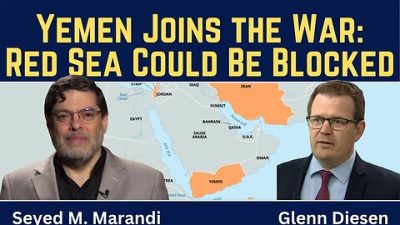
Yemen joins the war – Red Sea could be blocked next – Saudi regime at risk
or go to
Aletho News Archives – Video-Images
From the Archives
A superpower and “the world’s sickest warrior state”
By Paul J. Balles | March 8, 2010
Living through five or six major wars has hardened me to what I thought were the extremes of inhuman cruelty and brutality.
Two things made those extremes almost bearable: the brutality always revealed – at least according to the media coverage – the viciousness of the enemy. It was therefore quite understandable when our “brave men and women” pulverized the enemy.
Films of Japanese torturing captive Americans somehow justified holding Japanese Americans in internment camps during World War II; and only a small percentage of Americans found the bombing of Hiroshima and Nagasaki unreasonably vengeful at best, at worst, depraved.
The media giants in America portrayed the North Koreans as barbaric beasts with their captives, quite unlike their southern counterpoints – our allies during the Korean War. No one ever felt the need to explain how the South Koreans were a civilized breed while the North Koreans were absolute savages, at least according to the official line.
In Vietnam, our warriors justifiably (or so the media made us believe) dropped napalm on the North Vietnamese who had the gall to hide in villages and tunnels to ravage our invaders. At least it was accepted practice until some rogue photojournalist filmed a young girl screaming down a Vietnamese road in flames. … continue
Blog Roll
 Aletho News
- Russian tanker approaches Cuba despite US oil blockade
- Marandi: Yemen joins the war – Red Sea could be blocked next – Saudi regime at risk
- Pro-Palestinian French member of European Parliament denied entry to Canada
- Pakistan to Host US-Iran Talks
- How Indonesia’s tilt toward the US left it stranded in the Strait of Hormuz
- US has no choice but to retreat from Iranian borders: Top commander
- Iran Retaliation Strikes Chemical Plant Near Dimona
- AWACS’ Destruction is a Major Loss for US Military – Ex-DoW Analyst
- Israel’s Iran Strategy Uses US Military & Gulf States as Its Pawns
- Iran: Trump wanted regime change, now just begging for Hormuz to open
- If Americans Knew
- Israeli police block Catholic cardinal from entering Church of the Holy Sepulchre on Palm Sunday
- Israel is assassinating journalists again, more than any other nation, anywhere, ever – Not a ceasefire Day 170
- Over 300 US service members wounded, majority have brain injuries – Not a ceasefire Day 169
- Researchers at Human Rights Watch Resign Over Blocked Report on Palestinian Refugee Return
- Jewish Groups Are Backing a War Americans Don’t Want
- Eric Fingerhut Thinks He’s the President of the Jews
- Top Jewish Philanthropists, Rabbis Urge Israeli President to Take Action Against ‘Jewish Extremists’
- Don’t Be Fooled. Zionist Leaders Have Always Wanted to Control Southern Lebanon
- Israel’s widespread use of torture is a core element of its genocide against the Palestinian people
- In Israel’s War on Iran, Many Middle East US Bases Rendered “All But Uninhabitable”
- No Tricks Zone
- German Science Blog Accuses PIK Climate Institute Of Hallucinating Climate Tipping Points
- Devastating Assessment Of Comirnaty Vaccine By Former Senior Pfizer Europe Toxicologist
- New Study: CO2 Is ‘Effectively Negligible’ As An Explanatory Climate Change Factor Since 2000
- Former Pfizer Toxicologist Dr. Helmut Sterz Tells Bundestag Hearing Pfizer Vaccine Should Have Never Been Approved
- Energy Expert: Germany’s Nuclear Phaseout Was A “500 Billion Euro Mistake”
- New Research: South Australia’s Mid-Holocene Sea Surface Temperatures Were 4°C Warmer Than Today
- Storing Green Energy To Last Germany 10 Days Would Require A 60-Million Tonne Battery
- New Studies: UK Sea Levels Were 4 Meters Higher Than Today During The Mid-Holocene
- Destructive Green New Deal: German Energy And Metal Group Warns Of Drastic Crisis
- New Study Documents A 20-Year Pause In Arctic Sea Ice Decline – Driven By Internal Variability
 Aletho News