Negev Bedouin protest demolition orders for ‘recognized’ village
Ma’an – 19/10/2012
TEL AVIV, Israel – Around 2,000 Bedouin citizens of Israel protested in the southern city of Beersheba on Thursday after their village received demolition orders from the authorities, Israeli press reported.
The Palestinian residents of Bir Hajaj chanted “Yes to recognition! No to destruction!” outside the court and government offices, Haaretz newspaper said.
A large Israeli police force escorted officials to the village last week to hand over demolition orders, sparking clashes that were dispersed with tear gas and shock grenades.
“We’re demonstrating because as a result of the demolitions, there are people in the town who have no roof over their heads,” Haaretz quoted Bir Hadaj resident Ayash Abu Assa saying.
“The police decided to attack us. They want to prove that they are in control and that there’s nothing we can do about it.”
Bir Hajaj is among the Bedouin communities that have been formally “recognized” by the Israeli government.
Israel classifies approximately 40 villages in the Negev as unrecognized, arguing that the 53,000 Palestinian Bedouins living there cannot prove land ownership. The Bedouin communities say the land is their ancestral home.
“Despite (Bir Hajaj) being a recognized village, none of the residents have received permits to build new houses,” the director of the Adalah Legal Center for Minority Rights, Thabet Abu Rass, told Haaretz.
“While the media is busy with the (Israeli) elections, the state has opened a war of destruction against the Bedouin villages.”
Related articles
- A new Nakba looms as Israel plans ethnic cleansing of Palestinian village in the Negev (alethonews.wordpress.com)
- Israel threatens to demolish ‘illegal’ Bedouin school (alethonews.wordpress.com)
A new Nakba looms as Israel plans ethnic cleansing of Palestinian village in the Negev
MEMO | October 15, 2012
Anger and worry prevails amongst the people of Umm Al-Hayran, a Palestinian village in the Negev Desert following a decision by the Israeli Building Council to expel villagers in order to build a settlement for extremist Jews. An appeal by the humanitarian groups on behalf of the villagers was refused last week by the Israeli National Council for Planning and Construction.
Around 1,000 people will be affected by the latest bout of Israeli ethnic cleansing of Palestinians from their land. The District Committee for Planning and Construction in Beersheba has approved a proposal for a Jewish settlement called “Hayran” on the land belonging to Umm Al-Hayran village. This will not be the first time that the families in Umm Al-Hayran have been expelled by the Israelis. They used to live in the Zebala Valley in the Negev from where they were expelled by the nascent Israeli state; in 1956 they were uprooted again and forced to move to the site of Umm Al-Hayran. The current threat first arose in 2004, when the Israeli state accused the villagers of living illegally on state land.
Israel doesn’t “recognise” villages occupied by around 90,000 Bedouin living in Southern Palestine. As a result, their homes are regarded as “illegal” by the state and they can be demolished at any time.
Residents of such “unrecognised” villages do not receive any basic services or amenities provided by the state, including electricity, proper roads, health facilities, schools or water supplies.
Commenting on the latest decision, lawyer Suhad Beshara of the Legal Centre for Arab Minority Rights in Israel (Adala) said that the decision made by the appeal committee is part of the official policy of confiscating Bedouin land in the Negev. The intention is not only to provide land for Jews but also to be able to gather together the Bedouin communities in one place. According to Ms. Beshara, the authorities’ decision confirms that the villagers of Umm Al-Hayran have no rights in the village to which the Israeli government itself moved them in 1956.
The Palestinian law specialist clarified that the village of Umm Al-Hayran was established in its current location by order of the Israeli military authorities in 1956 after the army expelled its people by force from their homes in the area of Zebala valley. “They have established themselves with proper homes,” she said, “and they have invested all their efforts in order to resume their social and tribal lives which were shaken every time they were expelled from their land.” Today, a hundred and fifty families, totalling one thousand people, live in the village, all from the Abu Alqean tribe.
“We’re ready to die defending our land,” said the Mayor of the village, Saleem Abu Alqeaan. “They want to expel us and claim that our buildings are illegal, and they deprive us of all services; they even denied us drinking water in order to push us to leave the village and expel us.”
Mayor Abu Alqean added that the villagers refuse to accept the decision and that they will not leave their land even if the Israelis use force to expel them: “We have sworn to die on this land and we will not leave it this time, like previous times, and we will defend our land and our village with all our might and with all our means, because if they succeed in getting us out, the same tactics will be applied to other villages in the Negev which are not recognised by Israel.”
Commenting on the decision of the Israelis to name the proposed settlement “Hayran”, the mayor accused the Israeli government of trying to hijack Palestinian history in the area. “They want to make it look as if there is an old Israeli presence in the Negev,” he added.
Knesset Member Ibrahim Sarsoor, the head of the United Arab Bloc for Reform, condemned the government’s move. “This is yet another attack on the Arab presence in the Negev of the kind which has been taking place since the establishment of the Israeli state in 1948,” said Sarsoor. “It poses a serious threat to the already poor relations between Jews and Arabs in Israel.”
He pointed out that there is a systematic Israeli policy of uprooting the Arab presence in the Negev Desert. The latest decision, he insisted, shows how the Israeli government can act against its Arab citizens with impunity and with no just, legal or moral reason.
Stressing that the expulsion decision is “the biggest witness to the racism of Israeli governments’ policies towards the Arabs”, Sarsoor said that it confirms that ethnic cleansing of the indigenous population is an integral part of Israel’s Zionist ideology. “In short,” he concluded, “it is a policy of apartheid, pure and simple.”
Related articles
- EU support for Israeli crimes makes it unworthy of Nobel Peace Prize (altahrir.wordpress.com)
- New Palestinian Nakba in Umm Al-Hieran village in the Negev (occupiedpalestine.wordpress.com)
Israel threatens to demolish ‘illegal’ Bedouin school
RT | September 3, 2012
Israel has threatened to demolish a Bedouin encampment in the West Bank that contains a school, claiming that the community was built without appropriate permits and was hindering the development of new Israeli settlements.
The Khan Al-Ahmar elementary school was built in 2009 with the help of local and international humanitarian groups. The clay-and-tires structure employed 11 teachers, and instructed students belonging to some five neighboring Jahalin Bedouin tribes. Israeli authorities have issued a demolition order, claiming that the encampment containing the school was built illegally.
Demolishing the school would force the children to trek across the desert to Jericho for class, the closest place where education facilities are located. The Israeli military claimed that they will not destroy the school or the encampment until an alternate learning institution for the students is located.
According to UN reports, Tel Aviv has ordered the demolition of around 3,000 structures, including homes, cisterns, solar-power generators and 18 schools, including the Khan al-Ahmar Mixed Elementary School. Only 360 such demolitions have been carried out so far.
Israeli authorities believe that moving the indigenous population to planned communities will lift them out of poverty. Bedouin communities argue that their culture and its centuries-old traditions are being jeopardized by Jewish expansion.
The children of the Jahalin tribe previously attended school in Jericho, about 20 kilometers away, but school bus service was often unreliable. Locals now say that they may have no other choice: “We’ll go to school until it’s demolished,” the Washington Post cited 10-year-old Islam Hussein as saying,
Khan al-Ahmar is one of 20 Bedouin communities that are scheduled for relocation. Bedouin families have lived there since 1951, when refugees fled the Negev region during Israel’s war for independence. The West Bank is currently home to 300,000 Israeli settlers,
In September 2011, the Israeli government approved the ‘Prawer Plan,’ which called for the mass expulsion of the Arab Bedouin community in the Naqab desert. At the beginning of 2012, Tel Aviv announced a plan to establish ten new settlements along the disputed Green Line.
More than 70,000 Bedouins in 35 villages live in territory claimed by Israel. The settlements are considered to be ‘unrecognized’ by the Israelis, and the inhabitants are often referred to as ‘trespassers on state land.’
Related articles
- Palestinian Bedouin kids return to school, despite Israeli demolition order (altahrir.wordpress.com)
- Army Demolishes Four Homes In the Negev (imemc.org)
- Israeli occupation forces seize two farm tractors used to supply Bedouins with water (alethonews.wordpress.com)
- What The Netanyahu Government Will Demolish In The West Bank (andrewsullivan.thedailybeast.com)
- Bedouins forced to leave their homes to make way for Israeli maneuvers (alethonews.wordpress.com)
Israeli occupation offers the deportation of five Palestinian prisoners for two years
Palestine Information Center – 11/06/2012
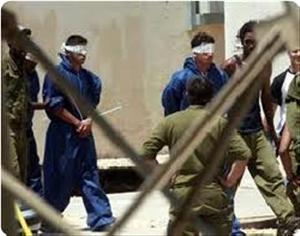 RAMALLAH — Palestinian human rights sources unveiled occupation efforts to deport a number of Palestinian prisoners from the occupied territories, after their release.
The Palestinian Prisoner Committee said in a press release on Monday, that the Israeli occupation intelligence service the “Shin Bet” is keeping five Palestinian prisoners in solitary confinement cells in Jalama prison, despite the end of their interrogation with them, with no charge.
The Committee stated that the court gave the occupation investigators from the “Shin Bet” one week to provide it with an indictment against the five detainees, if not the prisoners should be released. Thus, the intelligence officers proposed the prisoners an offer requiring their deportation for two years in exchange for their release.
The statement stressed the prisoners’ complete rejection of the deportation and their determination to stick to their position. The prisoners also called on all local and international human rights organizations to take urgent action and pressure on the Israeli occupation authorities to release them after being detained for two months without charge.
Meanwhile, the Israeli prison administration is imposing sanctions that include fines, solitary confinement and denial of visitation rights, against nearly two hundred Palestinian prisoners in Megiddo, the Negev, Jalama and Raymond detention centers.
Related articles
- #PalHunger | Palestinian Prisoner Mahmoud Sarsak Is In A Deteriorating Health Situation (occupiedpalestine.wordpress.com)
- #PalHunger | Palestinian female prisoners protest medical neglect (occupiedpalestine.wordpress.com)
- 20 Reasons to Get Angry for Palestinian Prisoners (theuglytruth.wordpress.com)
- Israel arrests 800,000 Palestinians since 1948 (alethonews.wordpress.com)
- Israeli occupation authority renews administrative detention of MP Rejoub for fourth time (alethonews.wordpress.com)
State of Israel Dispossesses Negev Bedouin
By Richard Silverstein | Tikun Olam | May 6, 2012
Not content with dispossessing nearly 1 million Israeli Palestinians during the Nakba through exile and theft of their land, Israel is repeating this Original Sin against the Negev Bedouin, who’ve lived in their homes for decades. The State now intends to expel the Bedouin from these settlements, where they’ve lived for several generations, and to appropriate the land for itself. In many cases, there are plans hatched with the Jewish National Fund and Israel Lands Authority to Judaize the Negev by creating new Jewish settlements to replace the Bedouin.
There are indigenous tribal members who are fighting back with every means at their disposal. But the odds and long and the deck is stacked. Every legal appeal has been repelled by a judiciary that many liberal Zionists like to claim stands as a bulwark against the worst excesses of rampant Israeli nationalism. This particular issue shows the limits of such optimism.

Nuri el Okbi, Negev indigenous activist, imprisoned for ‘being Bedouin without a license’
Ben Gurion University Prof. Oren Yiftachel provides historical background to this struggle:
Since its foundation, the State of Israel refuses to recognize Bedouin ownership over ancestral lands in the Negev. Most of the Bedouins did not register their lands in 1921, as was required by one of the British laws; but neither did most other residents of Mandatory Palestine, including Jewish ones, carry out such registration. Sixty years later, the State of Israel made cynical use of this lack of registration to order to register most Bedouin lands as “State Lands”, thus making the Bedouins into “invaders” or “squatters” on their own ancestral land.
Some of the Bedouins have tried to challenge the system of dispossession. Notable among them is Nuri el-Okbi, long-time dedicated human rights activist. In recent years, Nuri and his brothers are conducting a series of law suits against the state, demanding restoration of the lands taken from them in the fifties.
A few weeks ago, a ruling rejecting the claims of the el-Okbis was made in an important case – one in which for the first time a professional support team was involved, including attorney Michael Sfard, geographer Oren Yiftachel and other experts. The proceeding lasted three years, during which dozens of witnesses testified and hundreds of documents and expert reports [were] submitted, attesting to the el-Okbis’ ownership of the land.
The judge, however, chose to render a harsh, confrontational ruling, sticking to earlier precedents and concluding that any land which had not been registered in 1921 is ipso facto the property of the state. The court relied mainly on legal precedents, hardly referring to the evidence presented. Therefore, it is very important to lodge an appeal to the Supreme Court – the only body which is empowered to overturn precedents and strike out in a new direction.
At such a hearing, the judges would not be able to ignore the rich materials submitted by the el-Okbi Tribe, and the new legal arguments presented. In addition, such an appeal would strengthen the struggle of tens of thousands of Bedouins, who at this very moment are struggling against government plans to evict them to existing townships.
The government’s plan is based on the wrong assumption that Bedouins have no land ownership rights, and a Supreme Court appeal is now the only way to stop these draconian plans. Therefore, it is highly important to lodge an appeal on the el-Okbi Land Case, and make it clear that the Bedouin community is determined to struggle for their basic human rights – specifically to change a legal ruling which causes severe and completely undeserved damage to a large section of Israel’s citizen body.
Gush Shalom adds:
After a legal struggle lasting three years, the Be’er Sheba District Court rejected the appeal of Nuri al-Okbi, veteran activist for the rights of the Negev Bedouins. El-Okbi’s plea for recognition of ownership over the Al-Araqib lands, from which he and his family were evicted in 1951, was rejected out of hand by Judge Sarah Dovrat. The ruling has wide implications for Negev Bedouins in general, implying an overall denial of their rights over ancestral lands.
Related articles
- ISRAEL: Water being used to coerce Bedouin villagers, says NGO (alethonews.wordpress.com)
ISRAEL: Water being used to coerce Bedouin villagers, says NGO
IRIN | March 29, 2012

Photo: Jillian Kestler-D’Amours/IRIN
The Bedouins in Umm al-Hieran village live several kilometers away from a source of clean water and rely on trucks to get their supply
UMM AL-HIERAN, NEGEV DESERT – Salim Abu al-Qi’an’s family live in Israel’s Negev desert in the “unrecognized” Bedouin village of Umm al-Hieran, 9km from the nearest source of clean water.
“There is no water in the village. We truck it in. It costs about 50 shekels [US$13.4] per cubic metre of water,” explained the 53-year-old village leader. “There is a pipe that’s about 8km long, but it’s too old, and the planning authorities don’t allow us to put a new one under the ground. We are asking for better access to water, a new pipe that should be close to the village.”
The Israeli authorities forced Umm al-Hieran residents to move to the area where the village now sits in 1956, shortly after the military had evicted them from their original homes in the Wadi Zuballa area of the Negev desert.
In 2004, the villagers faced a new threat of expulsion, as the Southern District Planning Committee unveiled a master plan which involves once again displacing Umm al-Hieran, and building the Jewish community of Hiran in its place. According to the Israeli government, the 500 residents of Umm al-Hieran are trespassers who are illegally squatting on state land.
Some 80-90,000 Bedouin citizens of Israel live in unrecognized villages in the southern Negev, according to a report by the Association for Civil Rights in Israel. As a result of their unrecognized status, nearly every structure in these communities can be demolished at any time, and residents do not receive basic services from the state, including electricity, paved roads, healthcare facilities, schools, and water.
Constitutional right
In June 2011, however, the Israeli Supreme Court ruled that the right to water was a constitutional right, and that the state must guarantee a “minimum access to water” for the residents of the unrecognized villages. Still, the court did not specify what constituted a fair minimum.
Shortly thereafter, a Haifa court, acting as a water tribunal, rejected Umm al-Hieran’s application to be connected to the local water network. The court argued that the villagers had minimum access to water, and suggested they buy water from private citizens in towns connected to the water network, or move into nearby government-planned Bedouin townships.
According to Sawsan Zaher, an attorney at Adalah, the Legal Center from Arab Minority Rights in Israel, which has represented al-Qi’an’s family and the residents of Umm al-Hieran in their legal struggle, the water tribunal’s decision means that “a constitutional right, which is the right to water as part of the right to a minimal standard of living, [will] be provided by private actors and not by the state. This is in contradiction to constitutional law. The duty is on the state to fulfil this right and protect it even.”
Adalah has filed an appeal to Israel’s Supreme Court, asking that “minimum access to water” be explicitly defined, and challenging the constitutionality of forcing Umm al-Hieran residents to purchase water from non-state actors.
“Despite the fact that they are citizens, they are not entitled to the same level of rights as other citizens of Israel. Why? Because they are living in unrecognized villages,” Zaher told IRIN.
“We want you to move out”
“The purpose is not hidden any more. It is revealed and it’s very official: we are not connecting you to water because we want you to move out. This is the policy. It’s a kind of punishment. This is in huge contradiction with human rights and logic and humanity – to come and punish people by not giving them water for political purposes,” Zaher said.
In a 9 March report, the UN Committee on the Elimination of Racial Discrimination raised concerns about Bedouin communities in Israel, particularly with regard to Bedouin home demolitions, and inequalities between Bedouin and Jewish citizens’ access to land, housing, education, employment and public health.
Israel’s proposed Law for the Regulation of Bedouin Settlement in the Negev, which would forcibly displace 30,000-60,000 of the 80,000-90,000 Bedouins living in unrecognized villages, should be shelved, the UN Committee found, since it legalizes “the ongoing policy of home demolitions and forced displacement of the indigenous Bedouin communities”.
According to Salim Abu al-Qi’an, forcibly displacing residents of Umm al-Hieran to the nearby government-planned Bedouin township of Hura is indeed the motivation behind denying them direct access to high-quality water.
“They want to push us to leave the village and to displace us,” he told IRIN. “Even though we are an unrecognized village, this is nicer than to live in Hura. There are no services there. Sewage and garbage is in the street. There’s not enough space. It’s another refugee camp.”
Related articles
- Stop the JNF campaign makes steady gains as Israel charity goes “on the retreat” in UK (alethonews.wordpress.com)
- 2,600 Bedouins threatened with displacement as Israeli settlements expand (alethonews.wordpress.com)
- Professor of Hate: Israeli “scholar” urges ethnic cleansing of Bedouins (alethonews.wordpress.com)
- Jewish Agency: goal of Israeli government plan to block Bedouin “incursion” (alethonews.wordpress.com)
- Israeli bulldozers destroy Palestinian wheat crops in Negev (altahrir.wordpress.com)
Featured Video

Laith Marouf: Hezbollah’s position on US-Iran ceasefire
or go to
Aletho News Archives – Video-Images
From the Archives
The Dirty Little Secret behind the “Global Terrorism Index”
The Omission of Israeli Terrorism in the Occupied Palestinian Territories
By Karin Brothers | Global Research | December 6, 2014
… The Israeli settlements — all of which are illegal – have been identified as a major impediment to peace. The refusal of a major “global” terrorism report to name the Israeli settlers as one of the groups most responsible for terrorism not only misrepresents a major source of regional violence but exposes the Global Terrorism Index as a propaganda tool that supports a U.S. agenda.
In recent years, governments have been attempting to thwart terrorism by blocking supportive fund-raising. When it comes to Israeli settlements, however, the US and Canada actually encourage fund-raising by giving organizations (such as Christian Friends of Israeli Communities (CFOIC) and the Jewish National Fund) financial support in the form of donor tax-deductions.
Charities which provide funds for the Israeli settlements should be regarded as terror-financing organizations. They should not only lose their tax-deductible status, but they should be banned because they support the violation of international humanitarian law. The terror-financing laws that are being strictly enforced for Muslim charities should be applied to Christian and Jewish charities as well. … Read full article
Blog Roll
 Aletho News
- Israel faces ‘unsustainable’ strategic crisis following 40-day war against Iran: Analyst
- Iran restricts Hormuz access to 15 vessels per day under ceasefire terms: Report
- The ‘Opposition Party’ Has Done Nothing to Stop the Iran War and Much to Goad Trump Into Continuing It
- Moscow backs Tehran on status of Lebanon in US-Iran deal
- How UK Regulator Ofcom Quietly Bypassed International Law to Police American Speech
- The Black Cube Files: How Former Mossad Operatives Flipped a Nation
- Laith Marouf: Hezbollah’s position on US-Iran ceasefire: What you’re not being told
- Israel’s priority lies in destroying chances of peace between Iran, US: Ex-UN nuclear chief
- Ceasefire for all or for none: Iran shuts Hormuz over Lebanon attacks
- Strait of Hormuz is Iran’s ‘nuclear weapon’ that forced US retreat: Medvedev
- If Americans Knew
- This is ceasefire? Israel’s biggest massacre yet in Lebanon, another journalist killed in Gaza – Daily Update
- Tucker Carlson on Israel: This Is the Behavior of an Ally? Really?
- Gazans face a triple crisis: severe shortages of water and bread, healthcare in tatters
- NY Times reports how Netanyahu took the US into Iran War
- A sigh of relief over Iran, but Gaza and Lebanon in dire straits – Daily Update
- Thousands dead and neighborhoods razed to the ground: Aid agencies fear southern Lebanon is becoming the new Gaza
- The war the US is fighting for Israel could cost trillions
- ‘Cigarette Burns, Nail Wounds’: Toddler Tortured in Gaza to Coerce Father
- Trump Says US Sent ‘a Lot of Guns’ to Protesters in Iran
- Israeli forces destroy 17 UN peacekeeper cameras in south Lebanon
- No Tricks Zone
- An Inconvenient Tree: Uncovered In Alps… Europe Much Warmer Than Today 6000 Years Ago
- New Study Reports A 60% Slowdown In Greenland’s Ice Loss Rate In The Last Decade
- Low Intensity Tornado Wrecks Major Solar Farm, Creating A Potential Toxic Dump
- New Study Finds Warming Saves Lives…Cold Temperatures 12 Times More Deadly Than Excess Heat
- German Science Blog Accuses PIK Climate Institute Of Hallucinating Climate Tipping Points
- Devastating Assessment Of Comirnaty Vaccine By Former Senior Pfizer Europe Toxicologist
- New Study: CO2 Is ‘Effectively Negligible’ As An Explanatory Climate Change Factor Since 2000
- Former Pfizer Toxicologist Dr. Helmut Sterz Tells Bundestag Hearing Pfizer Vaccine Should Have Never Been Approved
- Energy Expert: Germany’s Nuclear Phaseout Was A “500 Billion Euro Mistake”
- New Research: South Australia’s Mid-Holocene Sea Surface Temperatures Were 4°C Warmer Than Today
 Aletho News