The New York Times Tries to Get Itself Out of the Duckgate Hole Using a Spade
By Rob Slane | The Blog Mire | June 5, 2019
A number of people, including myself, wrote to the New York Times journalist, Julian Barnes, to point out that the piece he and his colleague, Adam Goldman, published on 16th April 2019 about the CIA Director, Gina Haspel, contained a part which unwittingly showed that she had misled President Trump into expelling 60 Russian diplomats in March 2018. Here were the paragraphs of interest:
“During the discussion, Ms. Haspel, then deputy C.I.A. director, turned toward Mr. Trump. She outlined possible responses in a quiet but firm voice, then leaned forward and told the president that the “strong option” was to expel 60 diplomats.
To persuade Mr. Trump, according to people briefed on the conversation, officials including Ms. Haspel also tried to show him that Mr. Skripal and his daughter were not the only victims of Russia’s attack.
Ms. Haspel showed pictures the British government had supplied her of young children hospitalized after being sickened by the Novichok nerve agent that poisoned the Skripals. She then showed a photograph of ducks that British officials said were inadvertently killed by the sloppy work of the Russian operatives.
Ms. Haspel was not the first to use emotional images to appeal to the president, but pairing it with her hard-nosed realism proved effective: Mr. Trump fixated on the pictures of the sickened children and the dead ducks. At the end of the briefing, he embraced the strong option.
The outcome was an example, officials said, of how Ms. Haspel is one of the few people who can get Mr. Trump to shift position based on new information.”
I pointed out to the authors in an (unanswered) email that this was an extraordinary claim, because no children became sick due to poisoning by a toxic chemical, and nor did any ducks die. And so unless they were prepared to correct or retract their piece, there could only be two possibilities:
- Ms Haspel unwittingly showed false images to no less a person than the President of the United States, supplied to her by the British Government who knew them to be false, which persuaded him to embrace the “strong option”.
- Ms Haspel knowingly showed false images to no less a person than the President of the United States, which persuaded him to embrace the “strong option”.
It seems that the two journalists have not ignored mine and the many other emails they received about this issue, and they have today corrected their story. The paragraphs of interest now read as follows:
“During the discussion, Ms. Haspel, then deputy C.I.A. director, turned toward Mr. Trump. She outlined possible responses in a quiet but firm voice, then leaned forward and told the president that the “strong option” was to expel 60 diplomats.
To persuade Mr. Trump, according to people briefed on the conversation, officials including Ms. Haspel tried to demonstrate the dangers of using a nerve agent like Novichok in a populated area. Ms. Haspel showed pictures from other nerve agent attacks that showed their effects on people.
The British government had told Trump administration officials about early intelligence reports that said children were sickened and ducks were inadvertently killed by the sloppy work of the Russian operatives.
The information was based on early reporting, and Trump administration officials had requested more details about the children and ducks, a person familiar with the intelligence said, though Ms. Haspel did not present that information to the president. After this article was published, local health officials in Britain said that no children were harmed.
Ms. Haspel was not the first to use emotional appeals to the president. She and Mr. Pompeo showed Mr. Trump images of children sickened by chemical weapons attacks in Syria, in an earlier presentation. But Ms. Haspel’s strategy in the March briefing was to pair emotional appeals with her hard-nosed realism and it proved effective. At the end of the briefing, Mr. Trump embraced the strong option. [my emphasis]”
Below is Mr Barnes’s explanation on Twitter for the error and the correction:
“I made a significant error in my April 16 profile of Gina Haspel. It took a while to figure out where I went wrong. Initially, I reported that in March 2018, Gina Haspel, then the future CIA director, briefed President Trump about the Skirpal nerve agent attack, showing pictures of sickened children and dead ducks. That was wrong. There are—so far as we know—no pictures of dead ducks or sickened kids. Haspel did show pictures to Trump, but they were about the effects of nerve agents in general, they were not specific to the attack in the UK.
British officials did brief the Trump administration about early reports of dead ducks & sick children. Officials sought more info, believing such intel would be persuasive to Trump, who was skeptical of the proposed expulsion of 60 Russians in response to the attack. But Haspel did not brief the president on that intelligence.
Local UK health officials deny that any animals or children were sickened, as British officials pointed out soon after our story published. (In response to good reporting by @haynesdeborah, @guardian and others.) (link: https://www.theguardian.com/uk-news/2019/apr/18/no-children-ducks-harmed-novichok-attack-wiltshire-health-officials)
The intelligence about the ducks and children were based on an early intelligence report, according to people familiar with the matter. The intelligence was presented to the US in an effort to share all that was known, not to deceive the Trump administration. This correction was delayed because conducting the research to figure out what I got wrong, how I got it wrong and what was the correct information took time.
I regret the error and offer my apology. I strive to get information right the first time. That is what subscribers pay for. But when I get something wrong, I fix it.”
Here is my response on Twitter to Mr Barnes:
Dear Julian,
Thanks for taking the time to correct your report. However, it unfortunately raises just as many questions as the initial report.
Firstly, you say British officials briefed the Trump administration about early reports of dead ducks & sick children.
Really? Which early reports were these? There were none. The parents of the children who had tests to see if they had been contaminated were only contacted 2 weeks after the incident, and none of them was found to be ill. This is the first report on it, and it confirms the children were given the all clear. And there were never any dead ducks in Salisbury nor any reports of them.
Secondly, you say that “Officials sought more info, believing such intel would be persuasive to Trump, who was skeptical of the proposed expulsion of 60 Russians in response to the attack.” But the fact is that any further (truthful) info could not have persuaded Mr Trump, for the simple reason that no other people were harmed in Salisbury than the three people who were initially harmed. How, then, was he persuaded?
Thirdly, you presumably give the answer to the second point, when you say “Haspel did show pictures to Trump, but they were about the effects of nerve agents in general, they were not specific to the attack in the UK.” So in other words, Ms Haspel couldn’t show any pictures from Salisbury to persuade the sceptical Mr Trump, because there weren’t any to show. So she showed him pictures from other nerve agent attacks, which were presumably sufficiently bad to turn him from his scepticism, to expelling 60 diplomats. Even though nothing like that happened in Salisbury.
Thank you for clarifying that Ms Haspel did indeed wilfully mislead the President.”
Despite NYT’s correction, the question it poses is this: Which is worse:
- The deputy director of the CIA showing a sceptical President some fake pictures of dead ducks and sick children to persuade him to take the strongest action?
- Or the deputy director of the CIA, knowing full well that there weren’t any pictures of the effects of nerve agent on the population of Salisbury because only three people were ever affected, showing some pictures of actual nerve agent victims who were never anywhere near Salisbury to persuade him to take the strongest action?
The answer is they’re both as bad. In both scenarios, an utterly false picture of what happened in Salisbury was given to the sceptical President to twist his arm into taking action he didn’t want to take.
As they say, when in a hole, better stop digging.
How Did Russiagate Begin?
Why Barr’s investigation is important and should be encouraged.
By Stephen F. Cohen | The Nation | May 30, 2019
It cannot be emphasized too often: Russiagate—allegations that the American president has been compromised by the Kremlin and which may even have helped to put him in the White House—is the worst and (considering the lack of actual evidence) most fraudulent political scandal in American history. We have yet to calculate the damage Russsiagate has inflicted on America’s democratic institutions, including the presidency and the electoral process, and on domestic and foreign perceptions of American democracy, or on US-Russian relations at a critical moment when both sides, having “modernized” their nuclear weapons, are embarking on a new, more dangerous, and largely unreported arms race.
Rational (if politically innocent) observers may have thought that when the Mueller Report found no “collusion” or other conspiracy between Trump and Vladimir Putin’s Kremlin, only possible “obstruction” by Trump—nothing Mueller said in his May 29 press statement altered that conclusion—Russiagate would fade away. If so, they were badly mistaken. Evidently infuriated that Mueller did not liberate the White House from Trump, Russiagate promoters—liberal Democrats and progressives foremost among them—have only redoubled their unverified collusion allegations, even in once-respectable media outlets. Whether out of political ambition or impassioned faith, the damage wrought by these Russiagaters continues to mount, with no end in sight.
One way to end Russiagate might be to discover how it actually began. Considering what we have learned, or been told, since the allegations became public nearly three years ago, in mid-2016, there seem to be at least three hypothetical possibilities:
1. One is the orthodox Russiagate explanation: Early on, sharp-eyed top officials of President Obama’s intelligence agencies, particularly the CIA and FBI, detected truly suspicious “contacts” between Trump’s presidential campaign and Russians “linked to the Kremlin” (whatever that may mean, considering that the presidential administration employs hundreds of people), and this discovery legitimately led to the full-scale “counter-intelligence investigation” initiated in July 2016. Indeed, Mueller documented various foreigners who contacted, or who sought to contact, the Trump campaign. The problem here is that Mueller does not tell us, and we do not know, if the number of them was unusual.
Many foreigners seek “contacts” with US presidential campaigns and have done so for decades. In this case, we do not know, for the sake of comparison, how many such foreigners had or sought contacts with the rival Clinton campaign, directly or through the Clinton Foundation, in 2016. (Certainly, there were quite a few contacts with anti-Trump Ukrainians, for example.) If the number was roughly comparable, why didn’t US intelligence initiate a counter-intelligence investigation of the Clinton campaign?
If readers think the answer is because the foreigners around the Trump campaign included Russians, consider this: In 1988, when Senator Gary Hart was the leading candidate for the Democratic presidential nomination, he went to Russia—still Communist Soviet Russia—to make contacts in preparation for his anticipated presidency, including meeting with Soviet leader Mikhail Gorbachev. US media coverage of Hart’s visit was generally favorable. (I accompanied Senator Hart and do not recall much, if any, adverse US media reaction.)
2. The second explanation—currently, and oddly, favored by non-comprehending pro-Trump commentators at Fox News and elsewhere—is that “Putin’s Kremlin” pumped anti-Trump “disinformation” into the American media, primarily through what became known as the Steele Dossier. As I pointed out nearly a year and a half ago, this makes no sense factually or logically. Nothing in the Dossier suggests that any of its contents necessarily came from high-level Kremlin sources, as Steele claimed. Moreover, if Kremlin leader Putin so favored Trump, as A Russiagate premise insists, is it really plausible that underlings in the Kremlin would have risked Putin’s ire by furnishing Steele with anti-Trump “information”? On the other hand, there is plenty of evidence that “researchers” in the US (some, like Christopher Steele, paid by the Clinton campaign) were supplying him with the fruits of their research.
3. The third possible explanation—one I have termed “Intelgate,” and that I explore in my recent book War With Russia?: From Putin & Ukraine to Trump & Russiagate—is that US intelligence agencies undertook an operation to damage, if not destroy, first the candidacy and then the presidency of Donald Trump. More evidence of “Intelgate” has since appeared. For example, the intelligence community has said it began its investigation in April 2016 due to a few innocuous remarks by a young, lowly Trump foreign policy adviser, George Papadopoulos. The relatively obscure Papadopoulos suddenly found himself befriended by apparently influential people he had not previously known, among them Stefan Halper, Joseph Mifsud, Alexander Downer, and a woman calling herself Azra Turk. What we now know—and what Papadopoulos did not know at the time—is that all of them had ties to US and/or UK and Western European intelligence agencies.
US Attorney General William Barr now proposes to investigate the origins of Russiagate. He has appointed yet another special prosecutor, John Durham, to do so, but the power to decide the range and focus of the investigation will remain with Barr. The important news is Barr’s expressed intention to investigate the role of other US intelligence agencies, not just the FBI, which obviously means the CIA when it was headed by John Brennan and Brennan’s partner at the time, James Clapper, then Director of National intelligence. As I argued in The Nation, Brennan, not Obama’s hapless FBI Director James Comey, was the godfather of Russiagate, a thesis for which more evidence has since appeared. We should hope that Barr intends to exclude nothing, including the two foundational texts of the deceitful Russiagate narrative: the Steele Dossier and, directly related, the contrived but equally ramifying Intelligence Community Assessment of January 2017. (Not coincidentally, they were made public at virtually the same time, inflating Russiagate into an obsessive national scandal.)
Thus far, Barr has been cautious in his public statements. He has acknowledged there was “spying,” or surveillance, on the Trump campaign, which can be legal, but he surely knows that in the case of Papadopoulos (and possibly of General Michael Flynn) what happened was more akin to entrapment, which is never legal. Barr no doubt also recalls, and will likely keep in mind, the astonishing warning Senator Charles Schumer issued to President-elect Trump in January 2017: “Let me tell you, you take on the intelligence community, they have six ways from Sunday at getting back at you.” (Indeed, Barr might ask Schumer what he meant and why he felt the need to be the menacing messenger of intel agencies, wittingly or not.)
But Barr’s thorniest problem may be understanding the woeful role of mainstream media in Russiagate. As Lee Smith, who contributed important investigative reporting, has written: “The press is part of the operation, the indispensable part. None of it would have been possible … had the media not linked arms with spies, cops, and lawyers to relay a story first spun by Clinton operatives.” How does Barr explore this “indispensable” complicity of the media in originating and perpetuating the Russiagate fraud without impermissibly infringing on the freedom of the press?
Ideally, mainstream media—print and broadcast—would now themselves report on how and why they permitted intelligence officials, through leaks and anonymous sources, and as “opinion” commentators, to use their pages and programming to promote Russiagate for so long, and why they so excluded well-informed, nonpartisan alternative opinions. Instead, they have almost unanimously reported and broadcast negatively, even antagonistically, about Barr’s investigation, and indeed about Barr personally. (The Washington Post even found a way to print this: “William Barr looks like a toad …”) Such is the seeming panic of the Russiagate media over Barr’s investigation, which promises to declassify related documents, that The New York Times again trotted out its easily debunked fiction that public disclosures will endanger a purported US informant, a Kremlin mole, at Putin’s side.
Finally, but most crucially, what was the real reason US intelligence agencies launched a discrediting operation against Trump? Was it because, as seems likely, they intensely disliked his campaign talk of “cooperation with Russia,” which seemed to mean the prospect of a new US-Russian détente? Even fervent political and media opponents of Trump should want to know who is making foreign policy in Washington. The next intel target might be their preferred candidate or president, or a foreign policy they favor.
Nor, it seems clear, did the CIA stop. In March 2018, the current director, Gina Haspel, flatly lied to President Trump about an incident in the UK in order to persuade him to escalate measures against Moscow, which he then reluctantly did. Several non-mainstream media outlets have reported the true story. Typically, The New York Times, on April 17 of this year, reported it without correcting Haspel’s falsehood.
We are left, then, with this paradox, formulated in a tweet on May 24 by the British journalist John O’Sullivan: “Spygate is the first American scandal in which the government wants the facts published transparently but the media want to cover them up.”
This commentary is based on Stephen F. Cohen’s most recent weekly discussion with the host of The John Batchelor Show. Now in their sixth year, previous installments are at TheNation.com.
NYT Parrots US Propaganda on Hezbollah in Venezuela
Lucas Koerner and Ricardo Vaz | FAIR | May 24, 2019
Judith Miller and Michael Gordon published their now infamous New York Times article on September 8, 2002, falsely claiming on the basis of unnamed “American officials” that Iraq had acquired “aluminum tubes” with the aim of producing “an atomic bomb.”
Disgraced by her regurgitation of bogus claims, Miller left the Times in 2005, but her spirit is “alive and well” at the “paper of record.” Nicholas Casey follows faithfully in Miller’s footsteps, authoring dubious, anonymously sourced stories that coincidentally happen to further US regime-change objectives.
In a recent piece headlined “Secret Venezuela Files Warn About Maduro Confidant” (5/2/19), the Times’ Andes bureau chief claimed, on the basis of a leaked Venezuelan intelligence “dossier” that only his paper has seen, that Venezuela’s Industry minister and former Vice President Tareck El Aissami has active links to Hezbollah and drug trafficking. Casey wrote:
The dossier, provided to the New York Times by a former top Venezuelan intelligence official and confirmed independently by a second one, recounts testimony from informants accusing Mr. El Aissami and his father of recruiting Hezbollah members to help expand spying and drug trafficking networks in the region.
Unsurprisingly, the article has been endorsed by Florida Republican Sen. Marco Rubio, widely considered the point man for Trump’s Latin America policy, and whose zeal for regime change in Caracas appears unperturbed by elementary facts or international law. In a May 16 tweet, Rubio openly celebrated the fact that Venezuelan President Maduro “can’t access funds to rebuild electric grid,” thereby dispensing with any pretence that US sanctions are not directly aimed at the Venezuelan population.
The claims of an alleged relationship between Caracas and Hezbollah are, however, entirely unoriginal, having been repeated by corporate journalists and national security pundits without evidence for years.

Attempts to tie Venezuela to Hezbollah are not new (The Hill, 1/13/17)
“Hezbollah has a long and sordid history in Venezuela,” wrote Foreign Policy (2/2/19) earlier this year. Newsweek claimed in a 2017 article (12/8/17) that the Lebanese political party “was involved in cocaine shipments from Latin America to West Africa, as well as through Venezuela and Mexico to the United States,” while The Hill (1/13/17) labeled El Aissami a “fan of Iran and Hezbollah,” rehashing US allegations going back to 2008.
Likewise, corporate media claims about Hezbollah presence in Latin America have not been exclusive to Venezuela, with similar baseless rumors circulating about the Lebanese political party operating in the so-called Tri-Border Area of Paraguay (Extra!, 9–10/07).
Such stories just happen to buttress similar unsupported claims by US Secretary of State Mike Pompeo that Hezbollah has “active cells” in Venezuela. Pompeo and other senior administration officials have repeatedly warned that a military option to remove the Maduro government is “on the table,” while self-proclaimed “interim president” Juan Guaidó has requested “cooperation” from the Pentagon’s US Southern Command.
Casey himself has a long-established track record in dodgy Venezuela reporting, ranging from ludicrous stories about Cuban doctors (FAIR.org, 3/26/19) to false claims that private media like Globovision and El Universal “toe a government line.” (See FAIR.org, 5/20/19.)
Suspect sources
According to Casey’s “dossier,” Tareck El Aissami conspired with his father, Carlos Zaidan El Aissami,
in a plan to train Hezbollah members in Venezuela, “with the aim of expanding intelligence networks throughout Latin America and at the same time working in drug trafficking.”
We should begin by recognizing that Casey provides no proof of the authenticity of the alleged documents, and there is no reason why readers should take the assurances of unnamed “former top Venezuelan intelligence official[s]” at face value, especially those currently outside Venezuela collaborating with Washington. Similar sources were used to craft the fraudulent case for war in Iraq.
For instance, former Venezuelan intelligence czar Hugo “El Pollo” Carvajal, who broke with the Maduro government in 2017, is facing extradition to the US from Spain on cocaine-smuggling charges. In February, the ex-general gave an interview to Casey and the Times (2/21/19) in which he accused El Aissami of similar drug trafficking and Hezbollah links. Nowhere in the article did Casey think it relevant to mention that Carvajal plans to cooperate with US authorities, and thus has reasonable motive to fabricate information that improves the conditions of his plea bargain.
Taking refuge in anonymity, which the Times’ own handbook describes as a “last resort,” Casey leaves open the question of whether his source is Carvajal or another ex-official collaborating with the US who authored the dossier after leaving Venezuela, since no date is provided. From “Curveball” to North Korean defectors, corporate media have been consistently guilty of not examining sources’ motives so long as their “information” bolsters US foreign policy interests, even at the cost of tens or hundreds of thousands of lives.
Urea-gate?
Beyond the issue of sourcing, the alleged “dossier” has a troubling number of logical and factual inconsistencies. A case in point is the alleged testimony from an unnamed National Guard officer about a 2004 raid near the border with Brazil, which reportedly found more than 150 tons of urea in a warehouse. Casey disingenuously refers to urea as a “precursor substance used to make cocaine,” when in fact over 90 percent of industrially produced urea is used for fertilizer. Casey does concede later on that urea has non-cocaine purposes, but cannot conceive of the possibility of the substance being stored in a given location only to be used elsewhere.
The narrative function of the urea bust, which for some reason was not reported until a mysterious dossier was handed to the New York Times 15 years later, is to provide a link to Walid Makled, allegedly the owner of the urea warehouses, and a drug trafficking kingpin of sorts. Even assuming that the urea was meant for cocaine production, and not for more mundane agricultural purposes, a key fact is that Makled is currently serving a jail sentence in Venezuela for drug trafficking. This inconvenient reality, noted but not explained by the Times, on its face seriously undermines the idea that the current Industry minister, supposedly a close associate of Makled, is a powerful figure running a drug ring at the heart of the Venezuelan state.
That aside, it’s worth reviewing the “links” that Casey presents between Makled and El Aissami:
- According to the “dossier,” El Aissami’s brother, Feraz, went into business with Makled.
- The government gave “contracts” to a company “tied to Mr. Makled.” (Casey doesn’t think it relevant to explain the nature of these “ties” or “contracts”)
- The US government offered a similarly vague level detail regarding El Aissami’s alleged “ties” to drug-running when it sanctioned the then-vice president in 2017, and even Casey admits that Washington “never revealed the evidence.”
- “Two people familiar with [El Aissami’s] family” identified Haisam Alaisami as being El Aissami’s cousin, with Alaisami supposedly telling prosecutors he was a legal representative of Makled’s company. Beyond the anonymous genealogy, no concrete evidence is presented linking El Aissami to Alaisami, and hence to drugs.
In the absence of any externally verifiable evidence, what Casey presents as bombshell revelations of solid links to drug trafficking come out looking like 15-year-old gossip from unnamed sources.
Hezbollah hysteria
While Casey’s story provides very questionable allegations on links to drug trafficking and to Hezbollah, the connection between both is even more dubious.
The dossier concludes with informant testimony on the family’s ties to Hezbollah…. One of the sources of the information was the drug lord, Mr. Makled, who described Mr. El Aissami’s involvement in the scheme, according to the intelligence memo.
After establishing highly questionable ties between Tareck El Aissami and Walid Makled, largely based on their shared Syrian ancestry, Casey’s “dossier” then claims it is none other than Makled who “reveals” El Aissami’s supposed Hezbollah plot.
According to the alleged “documents,” El Aissami and his father were “involved in a plan to train Hezbollah members in Venezuela, ‘with the aim of expanding intelligence networks throughout Latin America and at the same time working in drug trafficking.’”
The unspoken assumption is that Hezbollah, which is a resistance movement and political party that forms part of the the elected Lebanese government, would be interested in conducting such illicit activities halfway around the world. Here Casey displays a geopolitical illiteracy on par with top Trump administration officials since, according to Middle East expert As’ad AbuKhalil, “there is no agenda or reason for Hezbollah to have an international presence.”
“For what purpose? Doesn’t the party have enough on its plate in Lebanon itself?” he asked, while acknowledging that the party does have sympathizers and supporters worldwide.
On the assertion that Hezbollah is engaged in drug trafficking, the University of California at Stanislaus professor is equally skeptical. “There has been no credible story in Arabic or in Western languages about Hezbollah’s involvement in drugs,” he stressed:
Hezbollah publicly and organizationally took a stance against drugs and issues fatwas against drugs not only among members but even in Shiite areas of Lebanon. Hezbollah has even allowed Lebanese government agencies to penetrate deep into its strongholds [this year] to search for drug traffickers.
Casey and his editors cleverly shield themselves from any reputational damage over the ludicrous nature of these allegations with a rather significant proviso buried in the 14th paragraph of the article:
Whether Hezbollah ever set up its intelligence network or drug routes in Venezuela is not addressed in the dossier. But it does assert that Hezbollah militants established themselves in the country with Mr. El Aissami’s help.
In other words, what was originally presented as anonymously sourced claims about Hezbollah spying and drug trafficking in Venezuela turn out to be little more than speculation about intent to carry out such activities.
In giving credence to these allegations, the Times repeats the propaganda of top Trump administration officials and the Israeli government about the “global terrorist ambitions” of Iran/Hezbollah, which is in league with Venezuela’s socialist “narco-dictatorship.”
Having played a key propaganda role in recent US regime change operations in Iraq, Syria, Libya and elsewhere, corporate media outlets like the New York Times are all too eager to beat the drums of war once again. With Washington actively threatening military force in both Iran and Venezuela, Nicholas Casey lends a hand in manufacturing public consent for not one but two illegal wars.
‘Ratf***er and spy’: British academic sues FBI informant & MSM for calling her Russian ‘honeypot’
RT | May 25, 2019
A Russian-born British historian is suing FBI informant Stefan Halper and several news outlets for defaming her as a “honeypot” working for the Kremlin to seduce Trump aide Michael Flynn. She says the scandal ruined her life.
Former Cambridge University academic Svetlana Lokhova has demanded $25 million from Halper, along with the Washington Post, New York Times, MSNBC, and Wall Street Journal, charging their “combined character assassination” over the past three years “injured her business as an academic and author, and propelled her to the epicenter of a massive fraudulent hoax about ‘Russian collusion.'”
Calling Halper a “ratf***er and a spy, who embroiled an innocent woman in a conspiracy to undo the 2016 Presidential election,” Lokhova says he colluded with the FBI, political operatives at the university where they both worked, and mainstream media journalists to paint her as a traitor and a “honeypot” who seduced Michael Flynn at a dinner in 2014 when he was US Director of National Intelligence. The FBI informant claimed Lokhova was “not a real academic” and that her “research was provided by Russian intelligence on the orders of Vladimir Putin” – and the media ran with the story for three years, hounding her out of her job and home and any hope of a normal life.
(“Ratf***er,” the suit helpfully explains in a footnote, “is a colorful and foul simile [sic] for ‘pulling a dirty trick’ coined by a Nixon campaign strategist.”)
The suit alleges Halper fed the fake story of Lokhova seducing Flynn to the named media organizations, which despite knowing he was a spy failed to fact-check Halper’s claims. Instead, she says, they crafted the story “out of whole cloth,” knowing the “sensational and scandalous accusations of ‘Russian collusion'” would catch fire – and, hopefully, burn the Trump campaign to the ground, “creat[ing] another Watergate.”
While stating repeatedly that she is not, was not, and has never been a spy, Lokhova claims it is Halper who has extensive Russian intelligence connections – from whom he could have learned that she was not a spy. The former MI6 agent who invited her to the dinner with Flynn never would have done so if she’d been a spy, she says, and at no point did she so much as sit next to Flynn (she includes a photograph to illustrate this last point in which Flynn is flanked by two men). Indeed, she says, everything in the stories published about her is completely false, from the email from Flynn signed with a pet name inviting her to Moscow to work as his translator to the seduction of the former general on orders from Putin.
Lokhova learned from colleagues that Halper and another academic were spreading rumors about her, and those rumors soon found their way into print, where the story became more salacious with each retelling. Her attempts to correct the record were rebuffed, repeatedly. Journalists began showing up at her door.
After not only losing her job but two book contracts and seven years of work toward her PhD, Lokhova says she was forced to leave the country “in order to avoid public scrutiny, invasion of her privacy, and constant public ridicule,” destroying her health and leaving her suicidal. For “insult, pain, embarrassment, humiliation, mental suffering, injury to her reputation, loss of income and business, special damages, costs, and other out-of-pocket expenses,” she wants $25 million from those responsible.
The Mueller report and revelations that Halper may have used a “honeypot” gambit to try to entrap Trump aide George Papadopoulos vindicate her, Lokhova says, noting that while the special counsel interviewed Flynn 19 times, she was not interviewed once.
What Could Be More “Fun” than Covering the Pentagon and All Its “Toys”? Asks the New York Times
By Mark Crispin Miller | MintPress News | May 22, 2019
Every day, on page A2, the New York Times runs an excruciating feature called “Inside the Times,” wherein one of its reporters tells us (as the feature ought to be entitled) “What It’s Like to Be Me at the New York Times.” Such narcissistic burbling is so empty, and so much less enlightening than the news we should be getting from that skimpy propaganda rag, that this feature cannot possibly have been concocted in response to readership demand (unless those readers are the Times’ reporters’ mothers). What it’s really meant to do is take up space, along with all the other fluff used to fill out those first two pages of the Times : e.g., “Of Interest” (“noteworthy facts from today’s paper”), “The Conversation” (“four of the most read, shared and discussed posts from across the NYT” ), and “The Mini Crossword,” among other trifles.
But this is not to say that we learn nothing from the me-me-me blathering in that feature. Check out what the feature told us last month in “From Refugee to Pentagon Correspondent, Helene Cooper on Covering ‘the Best Beat in Washington,’” an interview with Times employee Cooper.
First, there’s this bit of background:
“I arrived in the United States from Liberia as a refugee at the age of 14. There had been a military coup in Liberia, and members of my family were attacked and shot. I hadn’t seen it coming, too consumed by my adolescent life to pay attention to what was going on around me.
Once we got to the United States, I became obsessed with the news. I devoured the local newspaper and read back copies of The New York Times. I watched ABC’s “World News Tonight” every day, wanting any glimmer of information on what was happening in Liberia and elsewhere around the world. This was in part because I never wanted to be surprised by something again, and in part because I felt isolated in Knoxville, Tenn., where we lived. I used the news as an escape.
Then I read “All the President’s Men” and was hooked. It was for A.P. American History in 11th grade. That was when I decided I wanted to be a reporter.”
Thus we learn that Helene Cooper is a woman of color (lest we miss that point, there’s a drawing of her face above the title) and, as well, an immigrant to these United States (so take that, Donald Trump!) and, to boot, an immigrant of color who was forced to spend her teen years feeling “isolated” out among the nativist deplorables in Tennessee, where she “used the news as an escape,” hungrily absorbing what she could from “back copies of The New York Times” and “ABC’s ‘World News Tonight,’” until she “read ‘All the President’s Men’ and was hooked,” deciding she would go to work as “a reporter.”

Helene Cooper waxes poetic about the Pentagon’s latest ‘toys’
Checking out all the toys
Now read how this reporter feels about her daily beat:
“What do you enjoy most about being a Pentagon correspondent? What is most challenging about it?
The cool hardware! I love checking out all the toys the American military has. I’ve flown for hours in the co-pilot seat of a B-1 bomber, including during midair refuels. I’ve done the catapult takeoff and abrupt landing on an aircraft carrier in the Persian Gulf. I’ve been in Apache, Black Hawk and Chinook helicopters over Baghdad, Kabul and the DMZ, on the border of North and South Korea. I’ve been on an American naval destroyer in the South China Sea while it was being shadowed by the Chinese. That part of the job is just pure fun.
But covering the military also allows me to keep my hand in national security policy, about which I love writing. I think the Pentagon is the best beat in Washington.
The challenging part is the language. The military lives and dies by acronyms. Sometimes sources sound as if they don’t even want to speak English. I’m always stopping people mid-sentence to make them explain what they’re saying.”
Where to begin? As to the orgasmic thrill that this “reporter” gets from riding in those homicidal “toys,” one wonders how that would go down if Helene were H. Lane Cooper, a fat white guy with a buzz-cut, born in Knoxville as opposed to having fled there from Liberia. The fact is that such naked gushing over all that lethal hardware is perfectly okay from someone with her racial/gender/national profile, even as that hardware is now being inescapably deployed in 36 code-named military operations all over her home continent, and wherever else “our troops” are on the job (for a different take on the “pure fun” of riding high in an Apache helicopter, see “Collateral Murder”).
And now for some real challenges
And while it can’t be easy mastering all those acronyms, if that’s what Helene Cooper finds “most challenging” about her beat, she needs to check out what’s been written on the Pentagon, and/or its works, by journalists who haven’t had the time, desire or opportunity to go joy-riding in a B-1 bomber.
For example, Helene Cooper would find it “most challenging” to press her sources on the $21 trillion that the Pentagon could not account for when finally audited late last year. If Cooper were to look into that mind-boggling disappearance, and the Pentagon’s decades of stonewalling as to where their money (that is, our money) goes, it could be the “most challenging” investigation of her whole career, since the Times and all the rest of “our free press” have carefully refrained from such investigation, even as the Pentagon has, year after year, asked for still more funding by Congress (which gladly hands it over), as Dave Lindorff — who broke the news of that failed audit in The Nation — noted in an interview with FAIR:
“…[W]hat we’re learning is that one of the main reasons for these plugs in the budget is to allow the Pentagon to come into Congress and say, “Look, we spent all the money you gave us last year, and we need more.” When, in fact, they probably are not spending all the money they get each year, and then the money that doesn’t get spent, which by law is supposed to be returned to the Treasury, gets — they have a term for it — it gets “nippered” away from the category it was in, and moved to five-year money in other parts of the budget, where it gets hidden away, and becomes a slush fund that the Pentagon can use for black projects and other things that it wants to use it for without any observation.”
Or, now that the Pentagon has warned of China’s plans to “build a string of military bases” around the world (as The Guardian has dutifully reported), adding some unspecified number to the one that China operates today (in Djibouti), Cooper also might accept the “challenge” of pressing her sources to help determine just how many military bases the U.S. runs worldwide, since, as Nick Turse noted in Asia Times in 2011, “no American knows [that number]. Not the president. Not the Pentagon. Not the experts. No one.” [emphasis added]
In fact, there are more than a thousand U.S. military bases dotting the globe. To be specific, the most accurate count is 1,077. Unless it’s 1,088. Or, if you count differently, 1,169. Or even 1,180. Actually, the number might even be higher. Nobody knows for sure.
If even the Pentagon does not know (or claims not to know) how many military bases the U.S. runs worldwide, it is because some number of “our” bases — drone bases, for example — are maintained by the CIA (see below). Couldn’t Cooper team up with some other challenge-seeking Times reporter(s) to find out that number? They could, but only if they’d want to (and if their editors would let them).
As noted parenthetically above, the Pentagon is now running 36 code-named operations in Africa. “The code-named operations cover a variety of different military missions, ranging from psychological operations to counterterrorism,” Nick Turse and Sean D. Naylor reported on Yahoo News on May 1. The countries where U.S. special operations forces saw combat — according to Army Brig. Gen. Don Bolduc, who served at U.S. Africa Command (AFRICOM) from 2013 to 2105 — are Burkina Faso, Cameroon, Central African Republic, Chad, Congo, Kenya, Libya, Mali, Mauritania, Niger, Somalia, South Sudan and Tunisia. “[Bolduc] added that U.S. troops have been killed or wounded in action in at least six of them: Kenya, Libya, Niger, Somalia, South Sudan and Tunisia.”
How is this not big news? Although Turse and Naylor mention no such operation in Liberia, Cooper might find it “challenging” to ask her sources at the Pentagon to shed more light on those three dozen U.S. wars on her home continent.
It also would be very “challenging” for Cooper to investigate the scandal, noted very quietly by a few outlets since 2010, of the roughly 1,700 Pentagon employees — and an unknown number of defense contractors, some with high-level security clearances — seeking out and downloading child pornography on government computers.
The discovery of this apparent criminal network inside the Department of Defense arose from Operation Flicker, “a wider investigation conducted by Immigration and Customs Enforcement,” according to Voice of America. Since this scandal is unknown to most Americans, Cooper could perform a crucial public service by doing an in-depth report on it for the New York Times, if her editor would let her. In keeping with the Times’ obsessive #MeToo coverage — and its peculiar lack of interest in the scourge of pedophilia outside the Catholic Church — Cooper has reported on Sen. Martha McSally’s (R-AZ) claim that she was raped by her superior officer in the Air Force.
The Pentagon’s school system educates 47,000 students in this country on military bases in seven states, and 24,000 students on foreign bases in 11 countries. Sexual abuse among children there is common, if not epidemic, and the military tends to let it slide, according to an AP exposé published in March of 2018:
“A decade after the Pentagon began confronting rape in the ranks, the U.S. military frequently fails to protect or provide justice to the children of service members when they are sexually assaulted by other children on base, an Associated Press investigation has found.”
In between her jaunts on Black Hawks and Chinooks, Cooper might find it “most challenging” to follow up on that AP report, which seems to have run almost nowhere in the corporate press. (PBS NewsHour, to its credit, did a piece about it.) That the story made no splash makes it quite likely that the Pentagon has not done much, if anything, to make those children safe, so there’s probably a lot for Cooper to investigate.
Diversity as propaganda’s passport
Thus Helene Cooper’s record on “the best beat in Washington” — like that of Eric Schmitt, her predecessor in that role — makes quite clear (as if it hadn’t been quite clear for decades) that the New York Times is wholly at the service of the U.S. war machine, no less so than Stars and Stripes; although that newspaper is explicitly a propaganda outlet for the Pentagon, while the Times pretends to serve the interests of the public, or at least its (Trump-bumped) readership of urban liberals.
Back before it shrank into a full-blown propaganda rag, the Times was highly critical of the Pentagon’s grotesquely bloated budgets. In pieces like “C-5A Jet Repairs to Cost $1.5 Billion,” “Pentagon Discloses $2-Million Increase in Price of an F-14” (both 1975), and “How Pentagon Spending Is Wrecking the Economy” (1986), the Times offered tough reporting on the military industrial complex which is unthinkable today.
This is the same Times that just six weeks ago featured an opinion piece on “Why America Needs a Stronger Defense Industry” and that has Helene Cooper never questioning the U.S. military budget, or its ruinous effects on all the rest of us, but instead selling those obscenely costly “toys,” by pitching the “pure fun” of riding in them, blithely unaware of their atrocious impact down below.
That there has been no protest of that psychopathic rhapsody — no comment anywhere throughout the U.S. press throughout the weeks since that interview appeared — could mean one of two things. The more hopeful possibility is that nobody reads “Inside the Times” (or anything else on those two pages of the paper), and so nobody protested Cooper’s paean to the Pentagon’s “cool hardware” because nobody read it.
If, however, people did read Cooper’s interview, it may be her identity that’s keeping everybody mute. Just as Obama’s color (and Hillary Clinton’s gender) had liberals sitting quiet in the face of an unprecedented surge of U.S. wars, which would have been a harder sell from white-male-Cheney-Rumsfeld-Bush (even with the background hue supplied by Colin Powell and Condoleezza Rice), so Helene Cooper’s categorical identity — her status as a (female) refugee (of color) — has clearly let her get away with what some may call whoring for the U.S. war machine as eagerly as if she’d posed, all smiles, in full-page ads for Rockwell, Boeing, Sikorsky, Northrop Grumman or Raytheon.
Cooper’s propaganda function would explain the Times’ avid emphasis on her identity, rather than her expertise in military policy or practices. That campaign began on Jan. 31, 2017 with “A Washington Correspondent’s Own Refugee Experience,” Cooper’s harrowing account of what her family went through in post-coup Liberia, “where enlisted soldiers took over the government and launched an orgy of retribution against the old guard:
“My father was shot. My cousin was executed on the beach by firing squad. My mother was gang-raped by soldiers in the basement of our house after she volunteered to submit to them on the condition that they leave my sisters and me, ages 8 to 16, alone.”
Cooper then recounts her family’s flight from that anarchic nightmare to the United States: “The plane was a DC-10 … it was like we were already in America, with carpets and air conditioning and air freshener.” And then proclaims her stand against Trump’s xenohphic immigration policy:
“This country took me and my family in when we were at one of the lowest points of our lives and returned to me a feeling I had lost: that of being safe. I was so proud when I eventually took the oath of citizenship and posed for photos, waving anAmerican flag, in front of the courthouse where I was sworn in.”
The piece ends with good news about the gradual recovery of Liberia — that “it elected a female president — the first African country to do so” — and a reprise of the exhilarating moment when that DC-10 took off from Monrovia.
“I hadn’t seen my mom cry in the whole month after the coup. Not even the night she was raped. But when the plane’s engines revved and it accelerated down the runway [as] we left for the United States, her chest heaved with big racking sobs.”
So poignant is this story of deliverance (and diversity) that it could seem a little churlish to deplore the author’s hearty appetite for military rides — or to point out that the “military coup” that rocked Liberia in 1980 causing so much misery for Cooper’s family and forcing them to flee to the United States, had been covertly run by the United States.
During the presidency of William Tolbert (who was murdered in the coup), “both the CIA and the Pentagon were … prospecting for leadership change in Liberia,” according to the final report of that nation’s Truth and Reconciliation Commission, founded in 2005 (the report has since disappeared online). That Cooper now reports so gently on the Pentagon responsible for her own family’s agony seems rather strange, to say the least.
The social justice war dance
But what all of this may tell us about Helene Cooper, and her beautiful career, matters far less than what it says about the U.S. war machine’s grand strategy — so far, a winning strategy — of using the clichés of “social justice” to sell war and coups — all over and forever.
This strategy explains Barack Obama’s rise from nowhere to front for an unprecedented seven wars at once (and maybe more), along with an unprecedented war on whistleblowers and total blackout on state operations — a record that is sure to be maintained, if not surpassed, by whichever female, black, Hispanic and/or gay exemplar of “diversity” may be anointed, and “elected,” to deliver us from Trump (right now Pete Buttigieg appears to be that person).
And that ostensible deliverance will have millions of us dancing in the streets, as other millions of us weep, and gnash their teeth — and still the U.S. war machine will just keep rolling along, killing further millions (mostly brown), and driving us still deeper into inequality and poverty.
And so it will go on and on, until the United States of America collapses, or the planet burns, unless we all wake up — and work as one to put a stop to it at last.
Media Stenography Turns Beheaded Saudi Protesters Into ‘Terrorism’
By Esha Krishnaswamy | FAIR | May 15, 2019
Saudi Arabia executed 37 men on April 23, as it announced in a press release in its official gazette. The first line of the release read, “Saudi Arabia said it executed 37 citizens last Tuesday after they were convicted of terrorism.”
A cursory Google search would have shown that this assertion was completely false. But many in the US press dutifully stenographed this claim into a headline:
- “37 Saudis Executed for Terrorism-Related Crimes”: Time (4/23/19)
- “Saudi Arabia Executes 37 in One Day for Terrorism”: New York Times (4/23/19)
- “Saudi Arabia Beheads 37 Prisoners for Terrorism Crimes”: PBS NewsHour (4/23/19)
In fact, by looking at court documents from the Saudi government, we know that of these 37 men, 11 of them were accused of being “Iranian spies,” and 22 were accused of participating in a demonstration during the Arab Spring. (These 33 belonged to the Shia minority; the others practiced Sunni Islam or could not be identified.)

Time‘s headline (4/23/19) accepts the reality of the Saudi government charges against the people it executed–which weren’t even the actual charges they were convicted under
Of the 22 men accused of protesting, six were juveniles at the time. Mujtaba Al Suweikat was on his way to study at Western Michigan University when the Saudi authorities arrested him and charged him with “inciting disloyalty to the king.”
Saeed Mohammed Al Skafi was 17 during the protests. One of the charges against him was “posting pictures of other detainees.” Most of the others were convicted of offenses like “chanting disloyal slogans about the king” and “using social media to incite demonstrations.”
Of the 11 convicted of being Iranian spies, they were also found guilty of farcical offenses such as “condemning the bloodshed” (in February 2012, Saudi forces in the Shia-majority Saudi governorate of Qatif had sprayed protesters with bullets) and saving images and documents of the protests (which are also available on YouTube) on their hard drives.
Among the other four people executed, Khaled Al Tuwairji, a Sunni, was accused of killing Maj. Gen. Nasser Othman. However, all three outlets repeated that he was a “Sunni extremist,” for which we have no other evidence. Al Tuwairji was tortured into a confession (Erem News, 4/23/19). But all three outlets justified his execution and subsequent crucifixion by insisting that he was a convicted Sunni militant.
Another of the Sunnis executed, Khaled Al Farraj, was convicted on the vague charge of being affiliated with an outlawed terrorist organization. But even according to Saudi state media, he didn’t engage in any acts of terrorism. He is the only one of the 37 people executed who seems to have been charged with a terrorism-related offense.

PBS NewsHour (4/23/19)
Having false information in the headlines is extremely prejudicial. Studies have repeatedly shown a large portion of readers do not read past the headlines–and those that do end up remembering the headline the most.
In its first version of the article, which has changed since then, the New York Times wrote of Saudi Arabia, “It listed the 37 men by name but provided little information about what specific crimes had been committed by whom or when.” Instead of relying on a Saudi press release, the Times could have tried a cursory web search–or even searched its own archives. In an article by the Times editorial board (8/3/17) nearly two years ago, it had a short biography of Mujtaba Al Suweikat, the “disloyal” Western Michigan student, and the specific crimes he had been charged with.
Though the Times article was edited after publication to include some information that didn’t come from the Saudi press release–citing a Human Rights Watch official’s concern that many of the cases “raised serious rights concerns,” for example–the revised article was still misleading. For example, in paragraph three, it stated, “Some men had been involved in bomb attacks on security headquarters that had killed officers, the [state news] agency said.” As far as we know, none of the 37 executed men had been involved in any bomb attacks, but the Times never challenged this Saudi government assertion.
Furthermore, the Times said that 14 of those killed had been arrested in relation to “sometimes violent protests.” It failed to mention that that violence came from the Saudi government. This video, from July 2012, clearly shows Saudi police firing on unarmed protesters. In searching through the news archives, articles have repeatedly mentioned protesters being shot by the Saudi police. There appear to be no reports (outside Saudi propaganda statements) of violence emanating from the protesters.
The articles in the Times, Time magazine and the NewsHour all mentioned Saudi/Iranian relations, thereby amplifying longstanding Saudi propaganda that accuses Shia of being naturally loyal to Iran, which is blamed for “stoking unrest” to justify brutal crackdowns of the religious minority.
All three outlets also added gratuitous details about the attack in Sri Lanka and/or other ISIS-related attacks–attacks that there’s no suggestion any of the defendants were connected to. In fact, most of these defendants were arrested before ISIS existed. And a majority of those killed, being Shiites, would be viewed by ISIS as heretics. To bring up these attacks seems like a distraction from the topic of the stories, which is the Saudi government beheading people who have for the most part been accused mainly of being dissidents.
Pretexts for an Attack on Iran
By Ray McGovern – Consortium News – May 15, 2019
An Iraq-War redux is now in full play, with leading roles played by some of the same protagonists — President Donald Trump’s national security adviser, John Bolton, for example, who says he still thinks attacking Iraq was a good idea. Co-starring is Secretary of State Mike Pompeo.
The New York Times on Tuesday played its accustomed role in stoking the fires, front-paging a report that, at Bolton’s request, Acting Defense Secretary Patrick Shanahan has come up with an updated plan to send as many as 120,000 troops to the Middle East, should Iran attack American forces or accelerate work on nuclear weapons. The Times headline writer, at least, thought it appropriate to point to echoes from the past: “White House Reviews Military Plans Against Iran, in Echoes of Iraq War.”
By midday, Trump had denied the Times report, branding it “fake news.” Keep them guessing, seems to be the name of the game.
Following the Iraq playbook, Bolton and Pompeo are conjuring up dubious intelligence from Israel to “justify” attacking — this time — Iran. (For belligerent Bolton, this was entirely predictable.) All this is clear.
What is not clear, to Americans and foreigners alike, is why Trump would allow Bolton and Pompeo to use the same specious charges — terrorism and nuclear weapons — to provoke war with a country that poses just as much strategic threat to the U.S. as Iraq did — that is to say, none. The corporate media, with a two-decade memory-loss and a distinct pro-Israel bias, offers little help toward understanding.
Before discussing the main, but unspoken-in-polite-circles, impulse behind the present step-up in threats to Iran, let’s clear some underbrush by addressing the two limping-but-still-preferred, ostensible rationales, neither of which can bear close scrutiny:
No. 1: It isn’t because Iran is the world’s leading sponsor of terrorism. We of Veteran Intelligence Professionals for Sanity shot down that canard a year and a half ago. In a Memorandum for President Trump, we said:
“The depiction of Iran as ‘the world’s leading state sponsor of terrorism’ is not supported by the facts. While Iran is guilty of having used terrorism as a national policy tool in the past, the Iran of 2017 is not the Iran of 1981. In the early days of the Islamic Republic, Iranian operatives routinely carried out car bombings, kidnappings and assassinations of dissidents and of American citizens. That has not been the case for many years.”
No. 2. It isn’t because Iran is building a nuclear weapon. A November 2007 U.S. National Intelligence Estimate concluded unanimously that Iran had stopped working on a nuclear weapon in 2003 and had not resumed any such work. That judgment has been re-affirmed by the Intelligence Community annually since then.
The Joint Comprehensive Plan of Action, commonly known as the Iran nuclear deal, imposed strict, new, verifiable restrictions on Iranian nuclear-related activities and was agreed to in July 2015 by Iran, the U.S., Russia, China, France, the U.K., Germany and the European Union.
Even the Trump administration has acknowledged that Iran has been abiding by the agreement’s provisions. Nevertheless, President Trump withdrew the U.S. from the Iran nuclear deal on May 8, 2018, four weeks after John Bolton became his national security adviser.
‘We Prefer No Outcome’
Fair Warning: What follows may come as a shock to those malnourished on the drivel in mainstream media: The “WHY,” quite simply, is Israel. It is impossible to understand U.S. Middle East policy without realizing the overwhelming influence of Israel on it and on opinion makers. (A personal experience drove home how strong the public appetite is for the straight story, after I gave a half-hour video interview to independent videographer Regis Tremblay three years ago. He titled it “The Inside Scoop on the Middle East & Israel,” put it on YouTube and it got an unusually high number of views.)
Syria is an illustrative case in point, since Israel has always sought to secure its position in the Middle East by enlisting U.S. support to curb and dominate its neighbors. An episode I recounted in that interview speaks volumes about Israeli objectives in the region as a whole, not only in Syria. And it includes an uncommonly frank admission/exposition of Israeli objectives straight from the mouths of senior Israeli officials. It is the kind of case-study, empirical approach much to be preferred to indulging in ponderous pronouncements or, worse still, so-called “intelligence assessments.”
It has long been clear that Israeli leaders have powerful incentives to get Washington more deeply engaged in yet another war in the area. This Israeli priority has become crystal clear in many ways. Reporter Jodi Rudoren, writing from Jerusalem, had an important article in TheNew York Times on Sept. 6, 2013, in which she addressed Israel’s motivation in a particularly candid way. Her article, titled “Israel Backs Limited Strike against Syria,” noted that the Israelis have argued, quietly, that the best outcome for Syria’s civil war, at least for the moment, is no outcome.
Rudoren wrote:
Jodi Rudoren. (Twitter)
“For Jerusalem, the status quo, horrific as it may be from a humanitarian perspective, seems preferable to either a victory by Mr. Assad’s government and his Iranian backers or a strengthening of rebel groups, increasingly dominated by Sunni jihadis.
“‘This is a playoff situation in which you need both teams to lose, but at least you don’t want one to win — we’ll settle for a tie,’ said Alon Pinkas, a former Israeli consul general in New York. ‘Let them both bleed, hemorrhage to death: that’s the strategic thinking here. As long as this lingers, there’s no real threat from Syria.’”

If this is the way Israel’s current leaders look at the carnage in Syria, they seem to believe that deeper U.S. involvement, including military action, is likely to ensure that there is no early resolution of the conflict especially when Syrian government forces seem to be getting the upper hand. The longer Sunni and Shia are at each other’s throats in Syria and in the wider region, the safer Israel calculates it will be.
The fact that Syria’s main ally is Iran, with whom it has a mutual defense treaty, also plays a role in Israeli calculations. And since Iranian military support has not been enough to destroy those challenging Bashar al-Assad, Israel can highlight that in an attempt to humiliate Iran as an ally.
Today the geography has shifted from Syria to Iran: What’s playing out in the Persian Gulf area is a function of the politically-dictated obsequiousness of American presidents to the policies and actions of Israel’s leaders. This bipartisan phenomenon was obvious enough under recent presidents like Clinton and Obama; but under Bush II and Trump, it went on steroids, including a born-again, fundamentalist religious aspect.
One need hardly mention the political power of the Israel lobby and the lucrative campaign donations from the likes of Sheldon Adelson. Israeli Prime Minister Benjamin Netanyahu is riding high, at least for the now, Israeli influence is particularly strong in the lead-up to U.S. elections, and Trump has been acquitted of colluding with Russia.
The stars seem aligned for very strong “retaliatory strikes” for terrorist acts blamed on Iran.
Tonkin — er, I Mean Persian Gulf
Over the weekend, four vessels, including two Saudi oil tankers, were sabotaged near the Strait of Hormuz. Last evening The Wall Street Journal was the first to report an “initial U.S. assessment” that Iran likely was behind the attacks, and quoted a “U.S. official” to the effect that if confirmed, this would inflame military tensions in the Persian Gulf.The attacks came as the U.S. deploys an aircraft carrier, bombers and an antimissile battery to the Gulf — supposedly to deter what the Trump administration said is the possibility of Iranian aggression.
On Tuesday, Yemen’s Houthi rebels, with whom Saudi Arabia has been fighting a bloody war for the past four years, launched a drone attack on a Saudi east-west pipeline that carries crude to the Red Sea. This is not the first such attack; a Houthi spokesman said the attack was a response to Saudi “aggression” and “genocide” in Yemen. The Saudis shut down the pipeline for repair.
Thus the dangers in and around the Strait of Hormuz increase apace with U.S.-Iran recriminations. This, too, is not new.
Tension in the Strait was very much on Joint Chiefs of Staff Chairman Adm. Mike Mullen’s mind as he prepared to retire on Sept. 30, 2011. Ten days before, he told the Armed Force Press Service of his deep concern over the fact that the U.S. and Iran have had no formal communications since 1979:
“Even in the darkest days of the Cold War, we had links to the Soviet Union. We are not talking to Iran. So we don’t understand each other. If something happens, it’s virtually assured that we won’t get it right, that there will be miscalculations.”
Now the potential for an incident has increased markedly. Adm. Mullen was primarily concerned about the various sides — Iran, the U.S., Israel — making hurried decisions with, you guessed it, “unintended consequences.”
With Pompeo and Bolton on the loose, the world may be well advised to worry even more about “intended consequences” from a false flag attack. The Israelis are masters at this. The tactic has been in the U.S. clandestine toolkit for a long time, as well. In recent days, the Pentagon has reported tracking “anomalous naval activity” in the Persian Gulf, including loading small sailing vessels with missiles and other military hardware.
Cheney: Down to the Sea in Boats
In July 2008, Pulitzer Prize-winning investigative journalist Seymour Hersh reported that Bush administration officials had held a meeting in the vice president’s office in the wake of a January 2008 incident between Iranian patrol boats and U.S. warships in the Strait of Hormuz. The reported purpose of the meeting was to discuss ways to provoke war with Iran.
Hersh wrote:
“There were a dozen ideas proffered about how to trigger a war. The one that interested me the most was why don’t we build in our shipyard four or five boats that look like Iranian PT boats. Put Navy seals on them with a lot of arms. And next time one of our boats goes to the Straits of Hormuz, start a shoot-up. Might cost some lives.
“And it was rejected because you can’t have Americans killing Americans. That’s the kind of, that’s the level of stuff we’re talking about. Provocation.
“Silly? Maybe. But potentially very lethal. Because one of the things they learned in the [January 2008] incident was the American public, if you get the right incident, the American public will support bang-bang-kiss-kiss. Youknow, we’re into it.”
Preparing the (Propaganda) Battlefield
One of Washington’s favorite ways to blacken Iran and its leaders is to blame it for killing U.S. troops in Iraq. Iran was accused, inter alia, of supplying the most lethal improvised explosive devices, but sycophants like Gen. David Petraeus wanted to score points by blaming the Iranians for still more actions.
On April 25, 2008, Joint Chiefs of Staff Chairman, Adm. Mike Mullen, told reporters that Gen. David Petraeus would be giving a briefing “in the next couple of weeks” that would provide detailed evidence of “just how far Iran is reaching into Iraq to foment instability.”
Petraeus’s staff alerted U.S. media to a major news event in which captured Iranian arms in Karbala, Iraq, would be displayed and then destroyed. But there was a small problem. When American munitions experts went to Karbala to inspect the alleged cache of Iranian weapons, they found nothing that could be credibly linked to Iran.
This embarrassing episode went virtually unreported in Western media – like the proverbial tree falling in the forest with no corporate media to hear it crash. A fiasco is only a fiasco if folks find out about it. The Iraqis did announce that Iraqi Prime Minister Nouri al-Maliki had formed his own Cabinet committee to investigate U.S. claims and attempt to “find tangible information and not information based on speculation.”
With his windsock full of neoconservative anti-Iran rhetoric, Petreaus, as CIA director, nevertheless persisted — and came up with even more imaginative allegations of Iranian perfidy. Think back, for example, to October 2011 and the outlandish White House spy feature at the time: the Iranian-American-used-car-salesman-Mexican-drug-cartel plot to assassinate the Saudi ambassador to the U.S. And hold your nose.
More recently, the Pentagon announced it has upped its estimate of how many U.S. troops Iran killed in Iraq between 2003 and 2011. The revised death tally would mean that Iran is responsible for 17 percent of all U.S. troops killed in Iraq.
Who Will Restrain the ‘Crazies’?
Pompeo stopped off in Brussels on Monday to discuss Iran with EU leaders, skipping what would have been the first day of a two-day trip to Russia. Pompeo did not speak to the news media in Brussels, but European foreign ministers said that they had urged “restraint.”
British Foreign Minister Jeremy Hunt told reporters: “We are very worried about the risk of a conflict happening by accident, with an escalation that is unintended, really on either side.” British Army Major General Christopher Ghika was rebuked by U.S. Central Command for saying Tuesday: “There has been no increased threat from Iranian backed forces in Iraq and Syria.” Central Command spokesperson Captain Bill Urban said Ghika’s remarks “run counter to the identified credible threats available to intelligence from U.S. and allies regarding Iranian backed forces in the region.”
Although there is growing resentment at the many serious problems tied to Trump’s pulling the U.S. out of the Iran deal, and there is the EU’s growing pique at heavyweights like Pompeo crashing their gatherings uninvited, I agree with Pepe Escobar’s bottom line, that “it’s politically naïve to believe the Europeans will suddenly grow a backbone.”
There remains a fleeting hope that cooler heads in the U.S. military might summon the courage to talk some sense into Trump, in the process making it clear that they will take orders from neither Pompeo nor from National Security Advisor John Bolton. But the generals and admirals of today are far more likely in the end to salute and “follow orders.”
There is a somewhat less forlorn hope that Russia will give Pompeo a strong warning in Sochi — a shot across the bow, so to speak. The last thing Russia, China, Turkey and other countries want is an attack on Iran. Strategic realities have greatly changed since the two wars on Iraq.
In 1992, still in the afterglow of Desert Storm (the first Gulf War), former Gen. Wesley Clark asked then Undersecretary of Defense for Policy Paul Wolfowitz about major lessons to be drawn from the Desert Storm attack on Iraq in 1991. Without hesitation, Wolfowitz answered, “We can do these things and the Russians won’t stop us.” That was still true for the second attack on Iraq in 2003.
But much has changed since then: In 2014, the Russians stopped NATO expansion to include Ukraine, after the Western-sponsored coup in Kiev; and in the years that followed, Moscow thwarted attempts by the U.S., Israel, and others to oust Syrian President Bashar al-Assad.
No doubt Russian President Vladimir Putin would like to “stop us” before the Bolton/Pompeo team finds an “Iranian” casus belli. Initial reporting from Sochi, where Pompeo met with Russian Foreign Minister Sergey Lavrov and President Vladimir Putin on Tuesday indicates there was no meeting of the minds on Iran. Both Pompeo and Lavrov described their talks as “frank” — diplomat-speak for acrimonious.
Pompeo was probably treated to much stronger warnings in private during the Sochi talks with Lavrov and Putin. Either or both may even have put into play the potent China card, now that Russia and China have a relationship just short of a military alliance — a momentous alteration of what the Soviets used to call the “correlation of forces.”
In my mind’s eye, I can even see Putin warning, “If you attack Iran, you may wish to be prepared for trouble elsewhere, including in the South China Sea. Besides, the strategic balance is quite different from conditions existing each time you attacked Iraq. We strongly advise you not to start hostilities with Iran — under any pretext. If you do, we are ready this time.”
And, of course, Putin could also pick up the phone and simply call Trump.
There is no guarantee, however, that tough talk from Russia could stick an iron rod into the wheels of the juggernaut now rolling downhill to war on Iran. But, failing that kind of strong intervention and disincentive, an attack on Iran seems all but assured. Were we to be advising President Trump today, we VIPS would not alter a word in the recommendation at the very end of the Memorandum for President George W. Bush we sent him on the afternoon of Feb. 5, 2003, after Colin Powell addressed the UN Security Council earlier that day:
“No one has a corner on the truth; nor do we harbor illusions that our analysis is irrefutable or undeniable [as Powell had claimed his was]. But after watching Secretary Powell today, we are convinced that you would be well served if you widened the discussion … beyond the circle of those advisers clearly bent on a war for which we see no compelling reason and from which we believe the unintended consequences are likely to be catastrophic.”
Ray McGovern works with Tell the Word, a publishing arm of the ecumenical Church of the Saviour in inner city Washington. He was a CIA analyst for 27 years and presidential briefer and is co-founder of Veteran Intelligence Professionals for Sanity.
Why is the US always ‘stumbling’ or ‘sliding’ into war? How the media misleads with language

By Danielle Ryan | RT | May 15, 2019
The way the mainstream media tells it, the United States never, ever ends up embroiled in wars and military conflicts on purpose — only ever by mistake, or as a result of things like ‘bad planning’ or ‘strategic missteps’.
Very often when media coverage of war is analysed, there is a focus on how hawkish pundits cheerlead for conflict and journalists parrot official narratives while dissenting voices are drowned out. Mainstream networks, for example, have been heavily criticized by media watchdogs for almost exclusively inviting pro-war guests and ex-military hawks onto their news shows to convince Americans that war is the only reasonable course of action, while refusing to let anti-war commentators get a look in.
But there is another more subtle and unnoticeable way that the media deceives us. Even when they are not outright cheerleading for military action (as was the case in the lead up to the Iraq War), the language they use to describe events is designed to absolve Washington of blame.
Next time you read the news, notice how the US is always “stumbling into” war, or “drifting into” war or “sliding into” war — or even “sleepwalking into” war. To “stumble into” war seems to be a firm favorite among headline writers. The US has “stumbled” into war in Iraq and Syria and has been, at one time or another, at risk of “stumbling” into war with Russia, North Korea and most recently Iran.
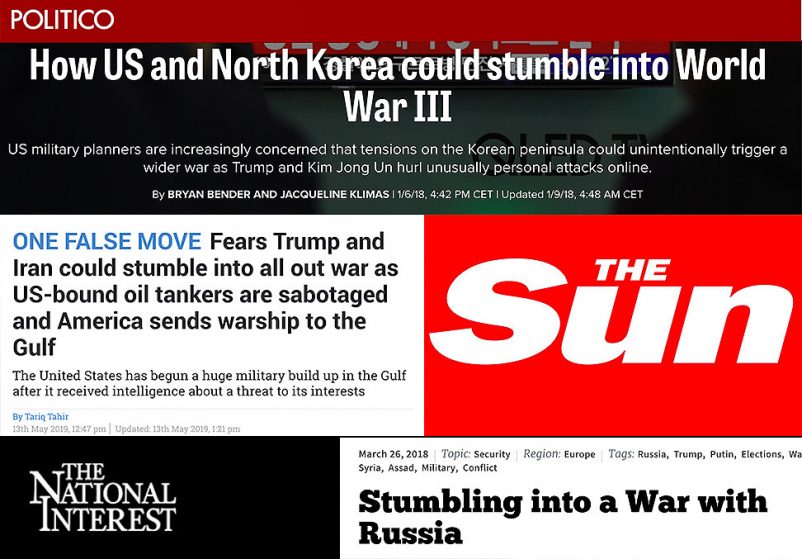
According to these headlines, the US has also been “dragged into” (CNN) and “sucked into” (NI ) war in Syria and Afghanistan, twice (NI, The Times ). In recent weeks, the Trump administration has been “sliding into” (AP ) a potential “accidental” war with Iran — and back in 2017, it was “dragged into” (FP ) the disastrous Yemen conflict.
The examples of the US stumbling, blundering and bumbling its way into wars are endless — and it does raise a question that no one ever seems to ask: If it’s so easy to trip and fall into massive never-ending wars, why isn’t it happening to everyone else? Is Washington just especially clumsy?
With this narrative of the bumbling superpower, agency is always removed from the architects of war. Instead of enthusiastically banging the drums for war, we’re told the White House is always ‘reluctant’ to deploy its military, but is ‘forced’ into it . Then, once the war is in full-swing, when things are not panning out exactly as planned, the US can become the sacrificial hero, propelled into a deadly conflict not of its own making.
A recent headline in the Miami Herald framed recent US actions on Venezuela as the US being “pushed to act.” Pushed by who? The Trump administration voluntarily helped organize and instigate the attempted coups that worsened the country’s political crisis and proudly imposed the economic sanctions which have led directly to thousands of premature deaths. There was no “pushing” involved.
In April, Foreign Policy magazine even had Venezuela’s self-declared interim president Juan Guaido “stumbling toward a coup.” How do you stumble into a military coup? Surely that’s the kind of thing that requires careful, deliberate planning and execution? The Washington Post had Trump “fumbling” an uprising in Caracas, too.
It’s not just media pundits and journalists who employ this kind of misleading language, either. British Foreign Secretary Jeremy Hunt said this week that a US war with Iran could happen “by accident.” Did Hunt take a vacation from reality and miss US Secretary of State Mike Pompeo and National Security Advisor John Bolton ramping up war rhetoric against Iran for months? Maybe Trump abandoned the 2015 Iran nuclear deal by accident and sent an aircraft carrier and bomber task force into the Persian Gulf last week to “send a message” to Iran by mistake.
Such framing obscures basic facts about Washington’s motives and predilection toward military conflict over diplomacy. Washington doesn’t get into wars by mistake. Unless a country is directly attacked, threatened or occupied, wars are quite easy to avoid getting into if you really don’t want to be in them — but the hawks in Washington, no matter how much they pretend to not want war, are always itching for more and they will stop at nothing to get what they want, even if that means fabricating evidence (as in Iraq) or pulling off false flag attacks to use as convenient pretexts for the US to ‘respond’ to.
US military actions are designed specifically to provoke the conflicts that they believe will be of benefit to their overall geopolitical strategy. Talk of freedom, democracy and human rights are just a convenient cover. Washington is never at risk, for example, of stumbling into war with Saudi Arabia, despite Riyadh’s laundry list of crimes against humanity.
Whether this propagandistic language is always employed in a totally conscious way or not, it’s difficult to tell. Either way, it’s a psychological trick which frames the most powerful, military-minded and trigger-happy country in the world as some kind of innocent victim of events beyond its control.
Also on rt.com:
US media’s love affair with war: Major outlets showed zero opposition to Syria strikes
The Russians are coming for European elections! Just don’t ask for proof
Graham Dockery | RT | May, 2019
Those dastardly Russian hackers are alive and well and meddling in the upcoming European Parliament elections, warned the New York Times. Just don’t expect to see any proof, because the paper offers none.
Fresh from interfering in seemingly everything wrong in America, unidentified Russian hackers have shifted their attention to Europe, deploying information warfare tactics to give a boost to populist and right-wing parties ahead of next month’s European Parliament elections. At least according to a New York Times article, given the front-page treatment on Sunday.
The story is heavy with accusation. The Russians, it states, are busy “spreading disinformation, encouraging discord and amplifying distrust in the centrist parties that have governed for decades.” Among their tools are news websites that “bear the same electronic signatures as pro-Kremlin websites,” Twitter accounts, Facebook profiles, and WhatsApp groups.
Although the Times article claimed that “intelligence officials,” and “security experts” back up its theories, it quotes only one: Former FBI analyst Daniel Jones, who now runs a nonprofit entitled Advance Democracy.
“They’re working to destroy everything that was built post-World War II,” Jones said, an explanation rivaling George W. Bush’s “they hate our freedom” for its nonsensical reductionism.
Is it possible that Jones might have an agenda? Most definitely. The former intelligence analyst runs a second nonprofit, The Democracy Integrity Project, from his home in Virginia. TDIP spent much of the last two years emailing a daily “collusion”newsletter to journalists, including those at the New York Times.
Jones’ ties to the Democratic party machine are also extensive. A former staffer for California Senator Dianne Feinstein (D), Jones reportedly worked with opposition research firm Fusion GPS to continue to search for evidence of collusion between the Trump campaign and Russia even after Trump’s election. The uncorroborated claims made in the so-called ‘Steele Dossier’ often featured prominently in TDIP’s daily memos to reporters, and leaked text messages to Democrat Senate Intelligence Committee member Mark Warner revealed Jones to be an associate of Christopher Steele, the former British spy who compiled the dossier.
With the Steele Dossier deemed unfit to print by every single mainstream media outlet (except, of course, Buzzfeed ), and with the “collusion” narrative completely dismantled by Special Counsel Robert Mueller’s final report, who else can the New York Times bring in to back up their Russian meddling expose?
Enter Ben Nimmo, who claims at the end of the article that Europe is a “test bed” for Russian interference efforts. Again, Nimmo offers no proof, but a glimpse at his resume gives an idea of what his motivations might be. A senior fellow at NATO-sponsored think tank the Atlantic Council, Nimmo has emerged in recent years as a reliable Russia-basher, always ready to give a juicy soundbite to the media. He’s also identified thousands of ‘Russian-linked’ Twitter accounts, based on some thoroughly dodgy methodology.
With two ‘experts’ down, what has the Times got left? Not much. The article notes that “a definitive attribution would require the kind of tools that the American government used to reveal the 2016 interference.” Of course, none is provided.
Even if the Russians aren’t involved, the article claims that populist and right-wing groups in Europe are “adopting many of the Kremlin’s tactics.” In practice, this means that the nasties on the right side of the political spectrum make funny memes and videos to support their candidates of choice.
Running through the article is a palpable fear that the centrism that has dominated European politics for more than half a century is now under threat. “False and divisive stories about the European Union, NATO, immigrants and more,” amplify the threat, driving voters into the embrace of populist parties, “many of them sympathetic to Russia.”
However, never once does it occur to the authors that perhaps Europeans are simply tiring of the consensus. Perhaps they disagree with mass immigration, especially at a time of slow economic recovery from the Great Recession. Perhaps they disagree with the often unaccountable bureaucracy of Brussels, and their membership in a military alliance that they have personally never felt a connection with. After all, populism is called populism because its positions are popular ones.
But nope, it’s all a sinister Russian plot to undermine democracy. Let’s go with that one.
Zero Percent of Elite Commentators Oppose Regime Change in Venezuela
By Teddy Ostrow | FAIR | April 30, 2019
A FAIR survey of US opinion journalism on Venezuela found no voices in elite corporate media that opposed regime change in that country. Over a three-month period (1/15/19–4/15/19), zero opinion pieces in the New York Times and Washington Post took an anti–regime change or pro-Maduro/Chavista position. Not a single commentator on the big three Sunday morning talkshows or PBS NewsHour came out against President Nicolás Maduro stepping down from the Venezuelan government.
Of the 76 total articles, opinion videos or TV commentator segments that centered on or gave more than passing attention to Venezuela, 54 (72 percent) expressed explicit support for the Maduro administration’s ouster. Eleven (14 percent) were ambiguous, but were only classified as such for lack of explicit language. Reading between the lines, most of these were clearly also pro–regime change. Another 11 (14 percent) took no position, but many similarly offered ideological ammo for those in support.
The Times published 22 pro–regime change commentaries, three ambiguous and five without a position. The Post also spared no space for the pro-Chavista camp: 22 of its articles expressed support for the end to Maduro’s administration, eight were ambiguous and four took no position. Of the 12 TV opinions surveyed, 10 were pro-regime change and two took no position.
(The Times and Post pieces were found through a Nexis search for “Venezuela” between 1/15/19–4/15/19 using each paper as a source, narrowed to opinion articles and editorials. The search was supplemented with an examination of each outlet’s opinion/blog pages. The TV commentary segments were found through Nexis searches for “Venezuela” and the name of the talkshow during the same time period, in the folders of the corresponding television network: NBC News/CBS News transcripts, ABC News transcripts, and PBS NewsHour. Non-opinion TV news segments were omitted. The full list of items included can be found here.)
Corporate news coverage of Venezuela can only be described as a full-scale marketing campaign for regime change. If you’ve been reading FAIR recently (1/25/19, 2/9/19, 3/16/19)—or, indeed, since the early 2000s (4/18/02; Extra!, 11–12/05)—the anti-Maduro unanimity espoused in the most influential US media should come as no surprise.
This comes despite the existence of millions of Venezuelans who support Maduro—who was democratically elected twice by the same electoral system that won Juan Guaidó his seat in the National Assembly—and oppose US/foreign intervention. FAIR (2/20/19) has pointed out corporate media’s willful erasure of vast improvements to Venezuelan life under Chavismo, particularly for the oppressed poor, black, indigenous and mestizo populations. FAIR has also noted the lack of discussion of US-imposed sanctions, which have killed at least 40,000 Venezuelans between 2017–18 alone, and continue to devastate the Venezuelan economy.
Many authors in the sample eagerly championed the idea of the US ousting Maduro, including coup leader Juan Guiadó himself, in the Times (1/30/19) and Post (1/15/19), and on the NewsHour (2/18/19).
The Times made its official editorial opinion on the matter crystal clear at the outset of the attempted coup (1/24/19): “The Trump administration is right to support Mr. Guaidó.” Followed by FAIR’s favorite Times columnist, Bret Stephens (1/25/19):
The Trump administration took exactly the right step in recognizing National Assembly leader Juan Guaidó as Venezuela’s constitutionally legitimate president.
It’s generally a nation’s supreme court that has the final say on who is constitutionally legitimate, but in this case they can apparently be overruled by a foreign government—or a foreign newspaper columnist.
The Post editorial board also joined Team Unelected President (1/24/19):
The [Trump] administration’s best approach would be to join with its allies in initiatives that would help Venezuelans while bolstering Mr. Guaidó.
The Times even produced an opinion video (4/1/19) with Joanna Hausmann, “a Venezuelan American writer and comedian,” as she is described in her Times bio. Between sarcastic stabs at Venezuela’s “tyrannical dictator” and cute animations of “Ruth Bader Ginsburg in workout clothes”—Hausmann’s self-described “spirit animal”—come more serious declarations about the nation’s political situation:
Juan Guiadó is not an American right-wing puppet leading an illegitimate coup, but a social democrat appointed by the National Assembly, the only remaining democratically elected institution left in Venezuela…. Let’s provide humanitarian aid and support efforts to restore democracy.
Odd that the Times didn’t find it necessary to note a blaring conflict of interest: Hausmann’s father is Ricardo Hausmann, Juan Guaidó’s appointed Inter-American Development Bank representative. Mint Press News (3/19/19) bluntly described him as the “neoliberal brain behind Juan Guaidó’s neoliberal agenda.”
It would be ludicrous to think the Times would withhold as blatant a connection to Maduro if one of his aides’ daughters made a snarky opinion video calling Juan Guaidó a would-be “brutal dictator”—even if our theoretical commentator was “an independent adult woman who has built a popular following on her own,” as Times opinion video producer Adam Ellick said in defense of the omission. Such a crucial relationship to a powerful Chavista politician would never go undisclosed—in the unlikely event that such a perspective would be tolerated in the opinion pages of an establishment paper.
These are just a few of many media pundits’ endorsements of Guaidó—someone whose name most of the Venezuelan population did not even recognize before he declared himself interim president. Put more accurately, they are endorsements of a US-backed coup attempt.
One of the more muddled regime change endorsements came from Rep. Ro Khanna’s Post op-ed (1/30/19), in which he says no! to military intervention, no! to sanctions, yet yes! to… “diplomatic efforts”:
The United States should lend its support to diplomatic efforts to find some form of power-sharing agreement between opposition parties, and only until fair elections can take place, so that there is an orderly transition of power.
“Diplomatic” is a reassuring term, until you realize that US diplomacy, as FAIR’s Janine Jackson explained on Citations Needed podcast (3/20/19), is “diplomacy where we try to get other countries to do what we want them to do”—in this case, effecting a “transition of power” in another country’s government.
Francisco Rodríguez and Jeffrey D. Sachs (New York Times, 2/2/19) envision similar efforts for a “peaceful and negotiated transition of power,” and Khanna made sure to characterize Maduro as “an authoritarian leader who has presided over unfair elections, failed economic policies, extrajudicial killings by police, food shortages and cronyism with military leaders.”
In other words, Maduro the Dictator must be overthrown—but don’t worry, the US would be diplomatic about it.
Those that didn’t take explicit positions nonetheless wrote articles blaming all or most of Venezuela’s woes on Maduro and Chávez. Economics wiz Paul Krugman (New York Times, 1/29/19) gave his spiel:
Hugo Chávez got into power because of rage against the nation’s elite, but used the power badly. He seized the oil sector, which you only do if you can run it honestly and efficiently; instead, he turned it over to corrupt cronies, who degraded its performance. Then, when oil prices fell, his successor tried to cover the income gap by printing money. Hence the crisis.
Note that Krugman failed to mention the 57 percent reduction in extreme poverty that followed Chávez’s replacement of management of the state-owned oil industry (which has been nationalized since 1976, long before Chavismo). Nor does he acknowledge the impact of US sanctions, or any other sort of US culpability for Venezuela’s economic crisis.
Caroline Kennedy and Sarah K. Smith (Washington Post, 2/5/19) did not explicitly blame Maduro and Chávez for Venezuela’s “spiral downward,” but similarly ignored evidenced US involvement in that spiral. There are only so many places where you can point fingers without naming names.
Dictatorship-talk—writers lamenting the horrific and helpless situation under an alleged “dictator”—characterized many of the ambiguous and no-position articles. In the Post (1/24/19), Megan McArdle asked:
You have to look at Venezuela today and wonder: Is this what we’re seeing, the abrupt end of Venezuela’s years-long economic nightmare? Has President Nicolás Maduro’s ever-more-autocratic and incompetent regime finally completed its long pilgrimage toward disaster?
By simply describing the declining situation of a country (Times, 2/12/19, 4/1/19) and using words like “regime” (Times, 2/14/19), “authoritarian” (Post, 1/29/19) and, of course, “dictatorship” (Post, 1/23/19; Times, 2/27/19) in reference to government officials, commentators create the pretext for regime change without explicitly endorsing it.
The Sunday talkshows and NewsHour also couldn’t find a single person to challenge the anti-Maduro narrative. They did find room, however, for three of the most passionate advocates of regime change in Venezuela: Sen. Marco Rubio (Meet the Press, 1/27/19), Donald Trump (Face the Nation, 2/3/19) and Guaidó himself (NewsHour, 2/18/19).
Other TV regime change proponents included Florida Sen. Rick Scott (Meet the Press, 2/3/19), 2020 Democratic presidential hopefuls Peter Buttigieg (This Week, 2/3/19) and Amy Klobuchar (Meet the Press, 3/17/19), Sen. Tim Kaine (Face the Nation, 3/17/19), and Guaidó-appointed, Mike Pence-approved “chargé d’affaires” Carlos Vecchio (NewsHour, 3/4/19).
But leave it to Nick Schifrin of the NewsHour (1/30/19) to bring on “two views” of the US intervention question that are both pro-regime change and pro-US intervention. View No. 1 came from Isaias Medina, a former Venezuelan diplomat who resigned from his post in protest against Maduro. Medina made the unlikely claim that 94 percent of the Venezuelan population—or 129 percent of the population over the age of 14—support US intervention to overthrow the Maduro government:
Not only I, but 30 million people, support not only the US circumstance, but also the Latin American initiative to restore the rule of law, democracy and freedom in Venezuela.
View No. 2, the ostensibly anti-regime change take, came from Benjamin Gedan, who served on the Obama administration’s National Security Council as director for Venezuela and the Southern Cone. When asked if he supported Trump’s moves to sanction Maduro and possibly use US troops to oust him, Gedan responded:
I think both of those steps are problematic. I think the sense of urgency that the United States administration has shown is absolutely correct…. The question is, how can we assist the Venezuelan people [to] promote a peaceful transition in Venezuela, without harming the people themselves, or fracturing the coalition that we have built over two administrations?
In other words, how can we overthrow the Venezuelan government without destroying the country—or “fracturing the coalition we have built”? The US has many options on the table, but none of them involve not pursuing the overthrow of Maduro.
In the “no position” camp for TV news, New York Times chief Washington correspondent David Sanger (Face the Nation, 1/27/19) noted that the problem with US support for Guaidó is one of “both history and inconsistency”:
Our history in Latin America of intervening is a pretty ugly one, and the inconsistency of not applying the same standards to places like Saudi Arabia and Egypt, where the president has embraced strong men, I think may come back to make the United States look pretty hypocritical, not for the first time.
Sanger indulged in the popular “hypocrisy takedown”: The problem, as presented, isn’t that the US disrupts democracies, destroys economies and kills people, but rather that it does so inconsistently. While vaguely acknowledging the US’s horrific track record of Latin American interventions, and Trump’s cherry-picking of governments worthy of regime change, Sanger didn’t take the logical next step of calling for the US to keep its hands off Venezuela. Instead, he called Maduro’s supporters—defined as “China, Russia and Cuba”—“not a great collection,” and failed to push back against the claim that Maduro “fixed the last” election. Without a formal declaration, Sanger did all the ideological preparation for foreign-backed regime change.
That elite media didn’t find a single person to vouch for Maduro or Chavismo, and that almost all the opinions explicitly or implicitly expressed support for the ouster of Venezuela’s elected president, demonstrates a firm editorial line, eerily obedient to the US government’s regime change policy.
This isn’t the first time that FAIR (e.g., 3/18/03, 4/18/18) has found a one-sided debate in corporate media on US intervention. When it comes to advocating the overthrow of the US government’s foreign undesirables, you can always count on opinion pages to represent all sides of why it’s a good thing. And the millions of people who beg to differ? Well, they’re just out of the question.
The New York Times Apologizes for “Anti-Semitic” Cartoon While Enabling Real Bigotry in Israel
By Helen Buyniski | Aletho News | May 1, 2019
The New York Times has begged forgiveness for printing a cartoon that supposedly “included anti-Semitic tropes” in its international edition, but no amount of shameless groveling will stop the Israeli weaponization of the “anti-Semitism” smear as it steamrolls America’s once-sacred First Amendment freedoms. This is a crusade to silence all legitimate criticism of a criminal regime, and if the Times has anything to apologize for, it is its complicity in that quest.
The offending cartoon depicts President Donald Trump as a blind man being led by a guide dog with the face of Israeli PM Benjamin Netanyahu, identified by a star-of-David collar. It’s unclear what the “anti-Semitic trope” in this case is supposed to be – the collar is arguably necessary to confirm the dog is Netanyahu, and the reader would have to be a political illiterate to interpret that as a stand-in for “all Jews.” The Times’ willingness to slap the “anti-Semitic trope” label on the cartoon anyway should put to rest the ridiculous “anti-Semitic trope” trope that is tirelessly deployed to smother accusations of wrongdoing by Israel or its lobbying organizations inside the US.
Netanyahu himself has boasted that Trump acted on his orders when he declared Iran’s Islamic Revolutionary Guard Corps a terrorist organization earlier this month, and Trump’s willingness to flout international law to unilaterally “give” the Golan Heights to Netanyahu as a re-election present shocked the world, unsettling even some Zionists who believe the land is rightfully theirs but worry the US’ official declaration will galvanize regional opposition to the occupation. Netanyahu’s last election campaign was arguably based on his ability to “lead” the US president blindly off the edge of a geopolitical cliff. Is he guilty of perpetuating anti-Semitic tropes for bragging about it?
Most papers only apologize when they’ve printed something erroneous. The Times has chosen instead to issue a correction for one of the few accurate depictions of the relationship between Israel and the White House, a glimmer of truth even more notable for its contrast with the paper’s usual disinformation painting Trump as some sort of foaming-at-the-mouth anti-Semite.
The Times’ decision to apologize for this cartoon while remaining silent when a cartoon depicting Trump in a gay love affair with Vladimir Putin was condemned by LGBT readers last year betrays the editorial board’s high moral dudgeon as the most transparent hypocrisy. US media has long smeared Putin’s government as homophobic, yet here they were presenting him half-clothed in a stomach-turning romantic embrace with Trump – a president who, it should be noted, has presided over the deterioration of US-Russia relations to levels not seen since the Cold War. But LGBT Twitter ultimately has little power in society, unlike the Israeli lobby, and the unfavorable depiction of Trump ensured most influential LGBT organizations steered clear of criticizing the cartoon. Outrage has become yet another commodity to be traded, not a genuine response to offense.
If it’s in a repentant mood, however, the Times could apologize for its one-sided coverage of the Israeli-Palestinian conflict – much of it fed to them by The Israel Project, which skews US coverage of the facts on the ground in Israel by supplying American reporters with talking points in order to “neutralize undesired narratives.” From these spinmeisters we get the passive voice used to frame IDF soldiers mowing down unarmed protesters as “clashes occurred” and “Palestinian protesters were killed,” as well as breathless coverage of tunnels, kites, and rocket attacks that rarely seem to hit anyone.
The Times could apologize for its failure to expose the global campaign to redefine “anti-Zionism” as “anti-Semitism,” instead of playing into it by pretending a truthful cartoon is somehow an affront to Jews – as if all Jews support the racist policies of the Israeli government. Indeed, to assume all Jews back the criminal Netanyahu regime in its openly genocidal campaign to eradicate the Palestinians from the few enclaves of the West Bank in which they remain while maintaining an open-air concentration camp in Gaza is wildly anti-Semitic.
The Times could apologize for failing to report on the massive Israeli spying operation – funded, in no small part, by the US taxpayer – targeting American activists on American soil, exposed in detail in the suppressed al-Jazeera documentary “The Lobby,” which leaked last year to deafening silence in the media. Journalist Max Blumenthal actually spoke with a Times journalist who wanted to cover the explosive revelations of the documentary, but no story ever appeared. As Ali Abunimah, founder of the Electronic Intifada, has pointed out, the suppression of the documentary should have been a story in and of itself – and would have, had it involved any other country.
“Imagine that this had been an undercover documentary revealing supposed Russian interference, or Iranian interference… in US policy, and powerful groups had gone to work to suppress its broadcast and it had leaked out. Just that element of it – the suppression and the leak – should be front page news in the Washington Post and the New York Times,” he told Chris Hedges, whose RT program was the closest thing to mainstream coverage the documentary received in the US.
The Times instead chooses to cover up the actions of groups like the Israel on Campus Coalition as they surveil and smear pro-Palestinian activists – college students, professors, and others sympathetic to Israel’s sworn enemy – using a strategy the ICC’s executive director Jacob Baime admits is based on US General Stanley McChrystal’s counterinsurgency strategy in Iraq. “The Lobby” revealed that agents working for the Israeli government infiltrate pro-Palestinian, pro-peace groups using fake social media accounts and report their findings back to the Israeli Ministry of Foreign Affairs, a shocking fact that none of the organizations named in the film have disputed. A foreign government operating a military-style surveillance network to target and smear American citizens in their own country – for nothing more than exercising their freedom of speech – gets a pass from the Times, but a cartoon showing Trump’s blind loyalty to Israel for what it is must be condemned.
It’s tough to electrify an outraged mob based on a story that wasn’t printed, but the Times’ failure to address the very real threat to Americans exercising their free speech – a threat all the more dire because it is funded by US tax dollars to the tune of $3.8 billion per year – merits at least a full-page apology. Compounding the insult is a domestic economic crisis, with many American cities facing record homelessness, skyrocketing cost of living, a dearth of secure employment and an excess of exploitative “gig economy” temp work, and a rapidly-disappearing social safety net. Israel is a wealthy country, as Netanyahu often boasts, a successful country. Only a truly blind government could continue to fork over such enormous sums of money while Americans languish in poverty.
“The anti-Semitism smear is not what it used to be,” one lobbyist laments to al-Jazeera’s hidden camera-equipped reporter. Perhaps this is why the state of Florida has advanced a bill to criminalize “anti-Semitism,” now broadly redefined to include “alleging myths… that Jews control the media, economy, government, or other institutions.” The bill passed the House unanimously, the one holdout bullied into submission when she voiced concerns about its incompatibility with the First Amendment, yet to point out – as AIPAC does – that this bipartisan approval exists because the Israeli lobby has influence over both parties, or that this influence can make or break a candidate, is about to become illegal. When even a milquetoast like Democratic congressman Beto O’Rourke has stuck his neck out to call Netanyahu a racist – and he receives more money from the Israeli lobby than most of his House colleagues – the Times should be ashamed of itself for pushing the fiction that criticism of Israel and its iron grip on the US government is equivalent to anti-Semitism.
The Times’ own article about its apology quotes an interview with the “guilty” party, Portuguese cartoonist Antonio Moreira Antunes, from the aftermath of the Charlie Hebdo attack, when four cartoonists and the magazine’s editor were murdered, supposedly for printing an offensive cartoon. There is a definite parallel with the Zionist outrage mobs calling for Antunes’ head – figuratively, if not yet literally; many are unsatisfied with the Times’ apology and insist Antunes suffer for his insolence by losing his job, if not his life. Antunes, in the interview, called his job “a profession of risk,” but states “there is no other option but to defend freedom of expression.”
The New York Times, and everyone else who demanded they apologize for a truthful cartoon while ignoring their failure to oppose genuine bigotry in the Netanyahu regime and supporters of Zionism, clearly do not agree that freedom of expression is worth defending. A press that cannot even defend itself does not deserve to be called “free.’
For NYT, Israel Is Always Nearing ‘Apartheid,’ but Never Quite Gets There
By Gregory Shupak | FAIR | April 26, 2019
Following Benjamin Netanyahu’s re-election as Israeli prime minister earlier this month, the New York Times’ editorial board (4/11/19) wrote:
Under Mr. Netanyahu, Israel is on a trajectory to become what critics say will be an apartheid state like the former South Africa—a country in which Palestinians will eventually be a majority, but without the rights of citizens.
A harsh criticism? Actually, the paper has been saying that Israel/Palestine could “become” an apartheid state for the better part of two decades. It ran a piece in 2003 (1/29/03) arguing that
if Israel does not give up the territories, it will face a choice: relinquish either democracy or the ideal of a Jewish state. Granting Palestinians in the territories the right to vote would turn Israel into an Arab state with a Jewish minority. Not allowing them to vote would result in a form of permanent apartheid.
For almost 20 years, the paper has suggested that Israel/Palestine risks devolving into an apartheid state if it continues to rule over Palestinians in the territories—Gaza, the West Bank and East Jerusalem—who cannot choose their rulers. This population includes approximately 4.75 million occupied Palestinians—320,000 in East Jerusalem, 2.8 million in the rest of the West Bank and 1.8 million in besieged Gaza—to say nothing of the millions of Palestinian refugees who cannot return to their homes and participate in elections because the people who put on those elections won’t let them.
That situation has remained the same, not only for the period that the Times has been publishing material saying the arrangement might someday add up to apartheid, but since 1967. Yet the Times persists in characterizing Israeli apartheid as a hypothetical future development. The paper acknowledges that governing millions of Palestinians but denying them the vote is a form of apartheid, so there’s no justification for saying, after nearly 52 years of such disenfranchisement, that that will eventually constitute apartheid, but for some unspecified reason doesn’t yet at this point.
Tom Friedman’s Groundhog Day
New York Times columnist Thomas Friedman appears to be having a Groundhog Day experience: He keeps waking up, looking at Israel’s ethnocracy, and saying that if it continues to be apartheid, it will become apartheid. In 2002 (10/16/02), he commented:
If you think it is hard to defend Israel on campus today, imagine doing it in 2010, when the colonial settlers have so locked Israel into the territories it can rule them only by apartheid-like policies.
2010 came and went, and the “apartheid-like” conditions remained, but Friedman persisted in treating Israeli apartheid as a mere possibility, writing (2/1/11) of the 2011 protests in Egypt:
If Israelis tell themselves that Egypt’s unrest proves why Israel cannot make peace with the Palestinian Authority, then they will be talking themselves into becoming an apartheid state — they will be talking themselves into permanently absorbing the West Bank and thereby laying the seeds for an Arab majority ruled by a Jewish minority between the Mediterranean Sea and the Jordan River.
A year later (8/1/12), Friedman said:
It is in Israel’s overwhelming interest to test, test and have the US keep testing creative ideas for a two-state solution. That is what a real US friend would promise to do. Otherwise, Israel could be doomed to become a kind of apartheid South Africa.
Two years after that (2/11/14), Friedman said that “Israel by default could become some kind of apartheid-like state in permanent control over… 2.5 million Palestinians.” Even in this so-called criticism of Israel, Friedman does the state a favor by acting as though the West Bank Palestinians are the only ones disenfranchised by Israel, overlooking the refugees and Gaza, even as Israel continues to control the latter. (He also appears to leave out Palestinian Jerusalemites.)
Evidence for Already-Existing Apartheid
As Friedman and his paper kept predicting that Israel/Palestine could turn into an apartheid entity, evidence mounted that it is exactly that. For example, United Nations special rapporteur John Dugard found in 2007 that “elements of the [Israeli] occupation constitute forms of colonialism and of apartheid, which are contrary to international law.” He went on to say that at the checkpoints throughout the West Bank and surrounding Jerusalem,
a [Palestinian] person may be refused passage through a checkpoint for arguing with a soldier or explaining his documents…. Checkpoints and the poor quality of secondary roads Palestinians are obliged to use, in order to leave the main roads free for settler use, result in journeys that previously took 10 to 20 minutes taking 2 to 3 hours…. In apartheid South Africa, a similar system [was] designed to restrict the free movement of blacks —the notorious “pass laws.”
Another UN special rapporteur, Richard Falk, noted in 2010 that “among the salient apartheid features of the Israeli occupation” are “discriminatory arrangements for movement in the West Bank and to and from Jerusalem,” as well as
extensive burdening of Palestinian movement, including checkpoints applying differential limitations on Palestinians and on Israeli settlers, and onerous permit and identification requirements imposed only on Palestinians.
A March 2017 report by the UN Economic and Social Commission for Western Asia concluded that “Israel has established an apartheid regime that dominates the Palestinian people as a whole.”
That July, however, Friedman (7/12/17) continued to treat Israeli apartheid as something that might happen down the road, wishing that President Trump had admonished Netanyahu in a meeting between the two:
Bibi, you win every debate, but meanwhile every day the separation of Israel from the Palestinians grows less likely, putting Israel on a “slippery slope toward apartheid,” as former Israeli Prime Minister Ehud Barak recently warned.
Last September (9/19/18), Friedman was still worried about this supposedly theoretical scenario:
Without some dramatic advance, there is a real chance that whatever Palestinian governance exists will crumble, and Israel will have to take full responsibility for the health, education and welfare of the 2.5 million Palestinians in the West Bank. Israel would then have to decide whether to govern the West Bank with one legal authority or two, which would mean Israel would be choosing between bi-nationalism and apartheid, both disasters for a Jewish democracy.
Netanyahu, Friedman went on to say, has failed to offer “any new, or old, ideas on how to separate from the Palestinians to avoid the terrible choices of bi-nationalism and apartheid.”
Erasing Palestinians
Setting aside the troubling assertion that Israelis and Palestinians living as equals would be not only a “disaster,” but as bad a “disaster” as apartheid, Friedman ignored the fact that just two months earlier, the Knesset had passed the Nation State Law that defined Israel as the national homeland of the Jewish people. The law asserted that “the realization of the right to national self-determination in Israel is unique to the Jewish people,” even though 20 percent of the population living inside Israel is not Jewish; encouraged “the development of Jewish settlement” and vowed that the state will “promote its establishment and consolidation.” It declared that “the state’s language is Hebrew,” deprecating Arabic, the first language of roughly half the people under that state’s control.
The Nation State Law demonstrates that the bad faith, future tense descriptions of Israeli apartheid are overly narrow, in that they focus exclusively on the Palestinian territories that Israel has occupied since 1967. Yet on the Israeli-held side of the Green Line, Palestinians are systematically discriminated against.
It’s not only the occupation that make Israel/Palestine apartheid. It’s the Israeli state’s foundational principles and actions: driving two-thirds of the indigenous Palestinian population from their homes at its birth, subsequently making more than 2 million of them refugees, and then denying their right to return, despite its being mandated under international law.
Meanwhile, Jewish people anywhere on Earth are given the right to immigrate, because Israeli leaders want to maintain a demographic advantage. They pursue this goal—with decisive help from their sponsors in Washington—through their longstanding operational policy mantra: maximum land, minimum Arabs.
Not even three full days after the New York Times’ most recent brooding about how Israel might “become” an apartheid state, Israel’s Supreme Court approved the demolition of 500 Palestinian homes in Jerusalem. Is it apartheid yet?
Featured Video

Chinese jet fuel and the myth of energy independence
or go to
Aletho News Archives – Video-Images
Book Review
Former Insiders Criticize Iran Policy as U.S. Hegemony
By GARETH PORTER | CounterPunch | February 27, 2013
“Going to Tehran” arguably represents the most important work on the subject of U.S.-Iran relations to be published thus far.
Flynt Leverett and Hillary Mann Leverett tackle not only U.S. policy toward Iran but the broader context of Middle East policy with a systematic analytical perspective informed by personal experience, as well as very extensive documentation.
More importantly, however, their exposé required a degree of courage that may be unparalleled in the writing of former U.S. national security officials about issues on which they worked. They have chosen not just to criticise U.S. policy toward Iran but to analyse that policy as a problem of U.S. hegemony. … continue
Blog Roll
 Aletho News
- Iran war will leave long-term ‘scar’ on Wall Street, investors warn
- How Iran decimated US power projection in West Asia: Military lessons of 40-day war
- Iran’s report details US-Israeli war crimes in targeting schools, hospitals, livelihoods
- NATO’s Slow Fracture: How Trump’s Iran War Exposed the Instrument of Hegemony
- Chinese jet fuel and the myth of energy independence
- Ukraine Sea Drone Fired From Libya Hit Russian Tanker in Mediterranean
- IRGC: Iranian forces launched no attacks during ceasefire hours
- Trump Administration Moves To Automate U.S. Military Draft Registration
- Spain orders reopening of Tehran embassy, condemns Israel’s carpet bombing of Lebanon
- Israel faces ‘unsustainable’ strategic crisis following 40-day war against Iran: Analyst
- If Americans Knew
- Israel killed at least 303 Lebanese yesterday – who were they? Daily Update
- Amnesty: Urgent – Protect Lebanese civilians from brutal escalation in Israeli attacks
- Is The War Against Iran Over?
- Inside the Israeli army’s propaganda wing
- Hundreds of Gaza Amputees Stranded in Legal Limbo
- The gallows law: Israel moves toward executing Palestinian children
- Tucker Carlson: The Path to Peace requires ending ‘special alliance’ with Israel
- This is ceasefire? Israel’s biggest massacre yet in Lebanon, another journalist killed in Gaza – Daily Update
- Tucker Carlson on Israel: This Is the Behavior of an Ally? Really?
- Gazans face a triple crisis: severe shortages of water and bread, healthcare in tatters
- No Tricks Zone
- An Inconvenient Tree: Uncovered In Alps… Europe Much Warmer Than Today 6000 Years Ago
- New Study Reports A 60% Slowdown In Greenland’s Ice Loss Rate In The Last Decade
- Low Intensity Tornado Wrecks Major Solar Farm, Creating A Potential Toxic Dump
- New Study Finds Warming Saves Lives…Cold Temperatures 12 Times More Deadly Than Excess Heat
- German Science Blog Accuses PIK Climate Institute Of Hallucinating Climate Tipping Points
- Devastating Assessment Of Comirnaty Vaccine By Former Senior Pfizer Europe Toxicologist
- New Study: CO2 Is ‘Effectively Negligible’ As An Explanatory Climate Change Factor Since 2000
- Former Pfizer Toxicologist Dr. Helmut Sterz Tells Bundestag Hearing Pfizer Vaccine Should Have Never Been Approved
- Energy Expert: Germany’s Nuclear Phaseout Was A “500 Billion Euro Mistake”
- New Research: South Australia’s Mid-Holocene Sea Surface Temperatures Were 4°C Warmer Than Today
 Aletho News