Trump ignored intel, launched Tomahawks in Syria based on media – Pulitzer winner Seymour Hersh
RT | June 25, 2017
US President Donald Trump ignored reports from US intelligence that said they had no evidence Syria had used sarin to attack a rebel-held town, Pulitzer-winning investigative journalist Seymour Hersh says.
Hersh is most famous for exposing the My Lai Massacre and its cover-up during the Vietnam War. He also uncovered the abuse of prisoners by US personnel at the Abu Ghraib prison in Iraq. In a report published by the German newspaper Die Welt on Sunday, he describes how the Trump administration mishandled the media frenzy after the Syrian bombing of the rebel-held town Khan Sheikhoun in April.
Trump chose to ignore reports compiled by American intelligence and the military that contradicted the prevailing media narrative accusing Damascus of using sarin gas to kill civilians, the report says. Instead, he ordered his military to prepare options for a response, which they did.
The subsequent Tomahawk attack on the Syrian Shayrat Air Base did less damage that the White House claimed, as was apparently intended by the military planners of the operation, Hersh said. The US mainstream media failed to question the government’s narrative of the situation, instead giving Trump what appears to be the pinnacle achievement of his presidency so far.
“None of this makes any sense,” one US officer told colleagues upon learning of the White House decision to retaliate against Syria. “We KNOW that there was no chemical attack… the Russians are furious. Claiming we have the real intel and know the truth… I guess it didn’t matter whether we elected Clinton or Trump.”
Special weapon
Hersh’s report is based on interviews with several US advisers and evidence they provided, including transcripts of real-time communications that immediately followed the Syrian attack on April 4. According to the advisers, the Syrian Air Force’s attack on Khan Sheikhoun targeted a meeting of several high-value leaders of jihadist groups, including Ahrar al-Sham and Al-Nusra Front, which has changed its name to Jabhat al-Nusra.
The US was informed of the operation in detail beforehand as part of a conflict prevention arrangement with Russia. The two-way information sharing in place in Syria at the time helped the US-led coalition and Russia-backed Damascus to avoid accidental encounters in the air, protect intelligence assets on the ground, and coordinate with each other when planning missions.
“They were playing the game right,” a senior US adviser is cited by Hersh as saying regarding the pre-mission notice from Russia.
“It was a red-hot change. The mission was out of the ordinary – scrub the sked,” the adviser said. “Every operations officer in the region” – in the Army, Marine Corps, Air Force, CIA, and NSA – “had to know there was something going on. The Russians gave the Syrian Air Force a guided bomb and that was a rarity. They’re skimpy with their guided bombs and rarely share them with the Syrian Air Force. And the Syrians assigned their best pilot to the mission, with the best wingman.”
The special weapon used in the bombing was mentioned in Syrian communications collected before the attack by a US ally. The interception was widely reported in the Western media as an indication that Damascus had used a chemical weapon.
“If you’ve already decided it was a gas attack, you will then inevitably read the talk about a special weapon as involving a sarin bomb,” the adviser told Hersh. “Did the Syrians plan the attack on Khan Sheikhoun? Absolutely. Do we have intercepts to prove it? Absolutely. Did they plan to use sarin? No. But the president did not say: ‘We have a problem and let’s look into it.’ He wanted to bomb the shit out of Syria.”
Fertilizers & decontaminants
The target of the Syrian bombing was described as a two-story cinder-block building. According to Russian intelligence, the jihadists used the second floor as a command and control center. The first floor housed a grocery store and other businesses. The basement was used as a warehouse for weapons, ammunition, and goods, including chlorine-based decontaminants and fertilizers.
“The rebels control the population by controlling the distribution of goods that people need to live – food, water, cooking oil, propane gas, fertilizers for growing their crops, and insecticides to protect the crops,” a senior adviser to the American intelligence community told Hersh.
According to a US assessment of the morning airstrike cited by Hersh, the 500-pound Russian bomb triggered secondary explosions. The heat could have evaporated the chemical products in the basement, producing a toxic cloud that spread over the town, pressed close to the ground by the dense morning air.
The scenario is consistent with the accounts of patients who reported a chlorine odor in interviews with Medecins Sans Frontieres. It could also explain the symptoms of nerve agent poisoning that were attributed to sarin, but may have been caused by organophosphates used in many fertilizers, Hersh said.
Meanwhile, US intelligence had no evidence to indicate the presence of sarin gas at or near the Shayrat Air Base, from which the bombing mission was launched.
“This was not a chemical weapons strike,” the journalist cites a source as saying. “That’s a fairy tale. If so, everyone involved in transferring, loading and arming the weapon – you’ve got to make it appear like a regular 500-pound conventional bomb – would be wearing Hazmat protective clothing in case of a leak. There would be very little chance of survival without such gear.”
“Military grade sarin includes additives designed to increase toxicity and lethality. Every batch that comes out is maximized for death. That is why it is made. It is odorless and invisible and death can come within a minute. No cloud. Why produce a weapon that people can run away from?” the adviser added.
The Trump Show
The Trump administration quickly adopted the rebel narrative, which accused President Bashar Assad’s government of conducting a sarin gas attack on Khan Sheikhoun. Top US officials went on to condemn Damascus and accuse Russia of complicity in the bombing. Trump ordered the national defense apparatus to prepare a response within hours of seeing photos of poisoned children on TV, Hersh’s report cites a senior adviser as saying.
“No one knew the provenance of the photographs. We didn’t know who the children were or how they got hurt,” the adviser said. “Sarin actually is very easy to detect because it penetrates paint, and all one would have to do is get a paint sample. We knew there was a cloud and we knew it hurt people. But you cannot jump from there to certainty that Assad had hidden sarin from the UN because he wanted to use it in Khan Sheikhoun.”
“The president saw the photographs of poisoned little girls and said it was an Assad atrocity,” he added. “It’s typical of human nature. You jump to the conclusion you want. Intelligence analysts do not argue with a president. They’re not going to tell the president, ‘if you interpret the data this way, I quit.’”
At a national security meeting at Mar-a-Lago on April 6, Trump was offered four options for responding to the Syrian incident, ranging from doing nothing and to assassinating President Assad, the report said. Eventually, the US president chose to attack the Syrian air base, which Hersh’s source described as “the ‘gorilla option’: America would glower and beat its chest to provoke fear and demonstrate resolve, but cause little significant damage.”
Of the 59 Tomahawk missiles fired at Shayrat, as many as 24 missed their targets because the initial strikes hit gasoline storage tanks, triggering a huge fire and a lot of smoke that interfered with the guidance systems of the following missiles. Only a few actually penetrated the hangars, and these only destroyed nine aircraft that were apparently not operational and could not be moved during the window of opportunity between the US warning of the looming attack and the strike itself.
“It was a totally Trump show from beginning to end,” the senior adviser told Hersh. “A few of the president’s senior national security advisers viewed the mission as a minimized bad presidential decision, and one that they had an obligation to carry out. But I don’t think our national security people are going to allow themselves to be hustled into a bad decision again. If Trump had gone for option three [a massive attack on Syrian military facilities], there might have been some immediate resignations.”
Trump trapped by own mistake
The reaction to the show of force in the US media was probably everything the Trump administration could have hoped for. MSNBC anchorman Brian Williams described the sight of Tomahawks being launched at the Syrian base as “beautiful.” CNN host Fareed Zakaria reacted by saying that Trump finally “became president of the United States.”
According to Hersh, of the top 100 American newspapers, 39 published editorials supporting the bombing in its aftermath, including the New York Times, Washington Post, and Wall Street Journal.
Five days later, the White House briefed the national media on the operation and the US response to Russia’s assertion that Syria has not used sarin gas. The Trump administration’s insistence that a chemical attack actually did happen was not challenged by any of the reporters present.
The following US coverage of the situation accused Russia of trying to cover up the alleged chemical attack, Hersh says. The New York Times described “declassified information” released during the press briefings as coming from a “declassified intelligence report,” though no formal report from US intelligence stated that Syria had used sarin, Hersh notes.
“The Salafists and jihadists got everything they wanted out of their hyped-up Syrian nerve gas ploy,” the senior adviser told him. “The issue is, what if there’s another false flag sarin attack credited to hated Syria? Trump has upped the ante and painted himself into a corner with his decision to bomb. And do not think these guys are not planning the next faked attack. Trump will have no choice but to bomb again, and harder. He’s incapable of saying he made a mistake.”
Read more:
Policing ‘Truth’ to Restore ‘Trust’
By Robert Parry | Consortium News | June 24, 2107
There’s been a lot of self-righteous talk about “truth” recently, especially from the people at The New York Times, The Washington Post and the rest of the mainstream news media. They understandably criticize President Trump for his casual relationship with reality and happily dream about how nice it would be if they could develop algorithms to purge the Internet of what they call “fake news.”
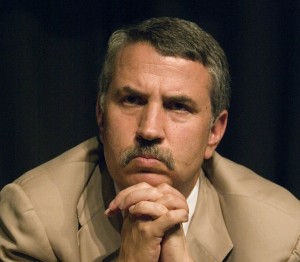
New York Times columnist Thomas L. Friedman
But these “truth-loving” pundits, the likes of star Times columnist Thomas L. Friedman, never seem to reflect on their own responsibility for disseminating devastating “fake news,” such as the falsehoods about Iraq’s WMD, lies that led to the deaths of hundreds of thousands of Iraqis and thousands of American soldiers and spread horrific chaos across the Mideast and into Europe.
Nor does that Iraq experience ever cause Friedman and his fellow pundits to question other Official Narratives, including those relating to the proxy war in Syria or the civil war in Ukraine or the New Cold War with Russia. Meanwhile those of us who ask for substantiating facts or observe that some official claims don’t make sense are subjected to insults as fill-in-the-blank “apologists” or “stooges.”
It seems that any deviation from Officialdom’s pronouncements makes you an enemy of “truth” because “truth” is what the Establishment says is “truth.” And, if you don’t believe me, I refer you to Friedman’s Wednesday’s column.
Friedman leads off the article by quoting himself telling a questioner at a Montreal conference: “I fear we’re seeing the end of ‘truth’.”
But Friedman doesn’t take himself to task by noting how he helped disseminate the Iraq WMD lies and how he flacked for that illegal and disastrous war for years.
If he had ‘fessed up, maybe Friedman could then have explained why he didn’t resign in disgrace and engage in some lifelong penance, preferably including a vow of silence, rather than continuing to spout lots of other nonsense while also continuing to collect a handsome salary and to rack up lucrative speaking fees.
Instead, after wringing his hands over why Americans no longer trust their leaders, Friedman cites another voice of authority, a friend and mentor, Dov Seidman, who complains that “What we’re experiencing is an assault on the very foundations of our society and democracy – the twin pillars of truth and trust. …
“What makes us Americans is that we signed up to have a relationship with ideals that are greater than us and with truths that we agreed were so self-evident they would be the foundation of our shared journey toward a more perfect union – and of respectful disagreement along the way. We also agreed that the source of legitimate authority to govern would come from ‘We the people’.”
Friedman then goes on to share Seidman’s lament that when “we” no longer share basic truths “then there is no legitimate authority and no unifying basis for our continued association.”
The Villains
Friedman identifies the villains in this scenario as “social networks and cyberhacking,” which help “extremists to spread vitriol and fake news at a speed and breadth we have never seen before.” So, it seems those “truth” algorithms can’t arrive soon enough.
However, if you keep reading Friedman’s column, you learn that the real problem is not that “cyberhacking” is generating “fake news,” but rather that it has let Americans see too many ugly truths about their leadership, as happened when WikiLeaks published emails showing how the Democratic National Committee unethically tilted the playing field against Sen. Bernie Sanders; how Hillary Clinton pandered to Goldman Sachs in return for lucrative speaking fees; and how the Clinton Foundation engaged in pay-to-play with rich foreigners.
Friedman’s column acknowledges as much, again citing Seidman: “Social networks and hacking also ‘have enabled us to see, in full color, into the innermost workings of every institution and into the attitudes of those who run them,’ noted Seidman, ‘and that has eroded trust in virtually every institution, and the authority of many leaders, because people don’t like what they see’.”
In other words, the answer to restoring “trust” and to respecting “truth” is to hide ugly realities from the unwashed public. If the people are shielded from the facts, the Establishment will regain its control over “truth” and thus win back the people’s “trust.”
If all this seems upside-down to you – if you think that the real answer is for America’s leaders to behave more responsibly, to let the public in on the real “truth,” and thus to make the people’s “trust” mean something – you must be a “Kremlin stooge.” After all, the current groupthink is that the diabolical Russians slipped WikiLeaks those Democratic emails in a nefarious plot to undermine Americans’ faith in their democracy.
However, if you’re still having trouble with Friedman’s logic, you also must not understand how America’s new media paradigm works. The job of the media is not to provide as much meaningful information as possible to the people so they can exercise their free judgment; it is to package certain information in a way to guide the people to a preferred conclusion.
Pleasant Myths
You see the last thing that Friedman really wants is for the American people to understand their own reality – the good, the bad and the ugly. Instead, we are to have our pretty little heads filled with pleasant myths that make us feel special as we are herded either to the shearing shed or to the slaughterhouse.
For instance, reflect on the history that we hear from Friedman’s friend Seidman about how we “signed up” for those high-minded proclamations in the Declaration of Independence and the U.S. Constitution. The truth is that most of us didn’t “sign up” for anything; we were just born here; and – by the way – the Founders were hypocrites who said and wrote things that they didn’t believe at all.
When slaveholding Thomas Jefferson wrote “We hold these truths to be self-evident, that all men are created equal, that they are endowed by their Creator with certain unalienable Rights, that among these are Life, Liberty and the pursuit of Happiness,” he didn’t believe a word of it. He considered his black slaves inferior beings and thought they deserved none of those “unalienable rights.” He devoted much of his adult life to defending and expanding the institution of slavery, which – by increasing demand for his human chattel – also increased his personal wealth.
When Gouverneur Morris penned the Preamble to the U.S. Constitution, citing “We the People” as the nation’s true sovereigns, he really meant white men of money and means, not poorer white men, nor women, and surely not slaves. His reference to “the People” was another propagandistic affectation.
There may be some irony in the fact that history imparts genuine value to the words of Jefferson and Morris even if they were simply empty propaganda when written. Jefferson’s assertion that “all men are created equal” possessing “unalienable rights” has inspired people around the world – and a literal interpretation of Morris’s florid rhetoric did, in a way, make “We the People” the technical sovereigns of America, as much as today’s ruling elites don’t really believe that either.
Much of what we see from the likes of Friedman is designed to reassert elite control by putting us back in an information-starved dependent state, reliant on the Establishment to parcel out a few morsels of information as it sees fit, the “truth” that the powers-that-be deign to give us. All the better for us to “trust” them.
But the messy behind-the-scenes reality that WikiLeaks and other publishers of “cyberhacked” and leaked material have made available to us – as well as the hypocritical and ambiguous history of the United States – is part of America’s “truth” and thus a reality that should belong to all the people.
Instead, Friedman and other Important People prefer a future in which unpleasant and unpopular truths can be marginalized or erased, all the better to guarantee our “trust” in our leaders.
The Times and the Post, in particular, have consistently conflated any deviation from their preferred groupthinks with “fake news” and “propaganda.” That is why it is particularly troubling when they and other self-proclaimed arbiters of truth, including the pro-NATO propaganda site Bellingcat, sit on Google’s First Draft Coalition and salivate over the prospects of unleashing high-tech algorithms to hunt down and eliminate information that runs counter to what they call the “truth.”
The real truth about truth is that it is almost always complex and often hidden by powerful interests. It requires skepticism, hard work and even courage to reveal it.
Sure, there are occasions when creeps and crazy people purposely make up stuff or ignore reality in pursuit of some nutty conspiracy theory – and that deserves hearty condemnation – but there are many other times when the conventional wisdom is wrong and the people demanding inconvenient facts and asking probing questions turn out to be right.
So, if Friedman and his friends really want to restore trust and truth, they might begin by acknowledging their own flaws and by admitting the times when their groupthinks turned out to be wrong. They also might start respecting the value that dissent has in the difficult pursuit of truth.
Investigative reporter Robert Parry broke many of the Iran-Contra stories for The Associated Press and Newsweek in the 1980s.
Such a “Surprise” in the UK!
By Thomas S. Harrington | CounterPunch | June 12, 2017
I just can’t believe what happened in the British elections.
I can’t get over the fact that that when a politician with real convictions honed over 40 years of political life—generous and forward-looking convictions rooted in an understanding of how social progress for the many has actually been engineered in previous times—speaks out unencumbered by corporate-minded, fraidy-cat image doctors, people actually respond enthusiastically.
It’s shocking, absolutely shocking.
Why am I so confused?
Well, for thirty years, the brilliant people at the NYT, NPR, PBS, the BBC and The Guardian have told me again and again that candidates from Labor in the UK and the Democratic Party in the US must always be oh-so-careful careful to not veer too far left in their policy prescriptions, to not appear too “populist” and, most of all, to not to go “too far outside the mainstream”.
The question of who defines what is the mainstream, or how lavishly-funded pro-business and pro-war think-tanks might actually be the people establishing its functional parameters by funding armies of think-tank “scholars” and “experts” were, of course, a complex hermeneutical problems that I never had the time nor the energy to ponder or deconstruct.
If those smart Ivy and Oxbridge-type guys and gals in the prestige media were telling us time and again that our societies were all fundamentally center-right collectives with a deep suspicion of government action (except, that is, when it came to making unceasing war on a world-wide scale) who was I, an obscure analyst of Iberian nationalisms and other sundry issues, to say anything about it?
Can you imagine someone like me actually believing he had the right to question brilliant and connected people like David Brooks, Tom Friedman or Jonathan Freeland or Polly Toynbee?
It would have been the height of hubris on my part to do so. After all, unlike them, I don’t spend my time networking each day with ambitious like-minded people deeply enamored of power, nor do I have the option of knowing exactly what stories and messages will provoke society’s centers of financial and military power to pressure a media conglomerate to trim a pundit’s paycheck or to convince well-heeled seekers of transcendent insight to stop paying her fat speaking fees.
Because I lack this essential information, I have always assumed my rightful place as an uncritical consumer of their deeply though-out and always prescient nostrums.
True, today I am feeling a little confused and bereft. But I know that by the time the next news cycle comes around they’ll have it all figured out for me, providing explanations that will in no way contradict or vitiate all the brilliant things they’ve been saying over so many years.
NYT’s New Syria-Sarin Report Challenged
MIT national security technical expert Theodore Postol
By Robert Parry | Consortium News | June 7, 2017
For U.S. mainstream journalists and government analysts, their erroneous “groupthinks” often have a shady accomplice called “confirmation bias,” that is, the expectation that some “enemy” must be guilty and thus the tendency to twist any fact in that direction.
We have seen this pair contribute to fallacious reasoning more and more in recent years as the mainstream U.S. media and the U.S. government approach international conflicts as if the “pro-U.S. side” is surely innocent and the “anti-U.S. side” is presumed guilty.
That was the case in assessing whether Iraq was hiding WMD in 2002-2003; it was repeated regarding alleged chemical weapons attacks in Syria during that six-year conflict; and it surfaces as well in the New Cold War in which Russia is always the villain.
The trend also requires insulting any Western journalist or analyst who deviates from the groupthinks or questions the confirmation bias. The dissidents are called “stooges”; “apologists”; “conspiracy theorists”; or “purveyors of fake news.” It doesn’t really matter how reasonable the doubts are. The mocking insults carry the day.
In addition, there is almost no accountability in those rare cases when the mainstream media and government propagandists must admit that they were demonstrably wrong. For every Iraq WMD confession – which resulted in almost no punishments for the “groupthinkers” – there are dozens of cases when the Big Boys just hunker down, admit nothing and count on their privileged status to protect them.
It doesn’t even seem to matter how well-credentialed the skeptic is or how obvious the failings of the mainstream analysis is. So, you even have weapons experts, such as Theodore Postol, professor of science, technology and national security policy at the Massachusetts Institute of Technology, who are ignored when their judgments conflict with the conventional wisdom.
The Syrian Case
For instance, in a little-noticed May 29, 2017 report on the April 4, 2017 chemical weapons incident at Khan Sheikhoun in northern Syria, Postol takes apart the blame-the-Syrian-government conclusions of The New York Times, Human Rights Watch and the Establishment’s favorite Internet site, Bellingcat.
Postol’s analysis focused on a New York Times video report, entitled “How Syria And Russia Spun A Chemical Strike,” which followed Bellingcat research that was derived from social media. Postol concluded that “NONE of the forensic evidence in the New York Times video and a follow-on Times news article supports the conclusions reported by the New York Times.” [Emphasis in original.]
The basic weakness of the NYT/Bellingcat analysis was a reliance on social media from the Al Qaeda-controlled area of Idlib province and thus a dependence on “evidence” from the jihadists and their “civil defense” collaborators, known as the White Helmets.
The jihadists and their media teams have become very sophisticated in the production of propaganda videos that are distributed through social media and credulously picked up by major Western news outlets. (A Netflix infomercial for the White Helmets even won an Academy Award earlier this year.)
Postol zeroes in on the Times report’s use of a video taken by anti-government photographer Mohamad Salom Alabd, purporting to show three conventional bombs striking Khan Sheikhoun early in the morning of April 4.
The Times report extrapolated from that video where the bombs would have struck and then accepted that a fourth bomb – not seen in the video – delivered a sarin canister that struck a road and released sarin gas that blew westward into a heavily populated area supposedly killing dozens.
The incident led President Trump, on April 6, to order a major retaliatory strike with 59 Tomahawk missiles hitting a Syrian government airfield and, according to Syrian media reports, killing several soldiers at the base and nine civilians, including four children, in nearby neighborhoods. It also risked inflicting death on Russians stationed at the base.
A Wind Problem
But the Times video analysis – uploaded on April 26 – contained serious forensic problems, Postol said, including showing the wind carrying the smoke from the three bombs in an easterly direction whereas the weather reports from that day – and the presumed direction of the sarin gas – had the wind going to the west.
Indeed, if the wind were blowing toward the east – and if the alleged location of the sarin release was correct – the wind would have carried the sarin away from the nearby populated area and likely would have caused few if any casualties, Postol wrote.
Postol also pointed out that the Times’ location of the three bombing strikes didn’t match up with the supposed damage that the Times claimed to have detected from satellite photos of where the bombs purportedly struck. Rather than buildings being leveled by powerful bombs, the photos showed little or no apparent damage.
The Times also relied on before-and-after satellite photos that had a gap of 44 days, from Feb. 21, 2017, to April 6, 2017, so whatever damage might have occurred couldn’t be tied to whatever might have happened on April 4.
Nor could the hole in the road where the crushed “sarin” canister was found be attributed to an April 4 bombing raid. Al Qaeda jihadists could have excavated the hole the night before as part of a staged provocation. Other images of activists climbing into the supposedly sarin-saturated hole with minimal protective gear should have raised other doubts, Postol noted in earlier reports.
There’s also the question of motive. The April 4 incident immediately followed the Trump administration’s announcement that it was no longer seeking “regime change” in Syria, giving the jihadists and their regional allies a motive to create a chemical-weapons incident to reverse the new U.S. stand. By contrast, the Syrian government seemed to have no logical motive to provoke U.S. outrage.
In other words, Al Qaeda and its propagandists could have posted video from an earlier bombing raid and used it to provide “proof” of an early-morning airstrike that corresponded to the staged release of sarin or some similar poison gas on April 4. Though that is just one possible alternative, it’s certainly true that Al Qaeda does not show very much humanitarian concern about the lives of civilians.
Critics of the White Helmets have identified the photographer of the airstrike, Mohamad Salom Alabd, as a jihadist who appears to have claimed responsibility for killing a Syrian military officer. But the Times described him in a companion article to the video report only as “a journalist or activist who lived in the town.”
Mocking the Russian/Syrian Account
For their part, the Syrian government and the Russians said Syrian planes conducted no airstrike early in the morning but did attack the area around noon. They speculated that the noontime attack may have struck chemical weapons stored by the jihadists, causing an accidental release of poisonous gas.
The Times jumped on the discrepancy between the reports of an early-morning attack and the Syrian-Russian account of a noontime strike to show that the Syrians and Russians were lying.
In response to Syrian President Bashar al-Assad asking, “How can you verify the video?” the Times narration by Malachy Browne smugly says: “Well, here’s how. Let’s take a look at videos, satellite photos and open source material of that day. They show that Assad and Russia are telling a story that contradicts the facts.”
Yet, the Times’ point about the Syrians and Russians lying about the time element makes little sense because the Syrians and Russians aren’t denying that an airstrike occurred. They acknowledged that there was an airstrike, albeit later in the day, and they speculate that the attack might have accidentally released chemicals stored by Al Qaeda’s Nusra Front. In other words, they gained no advantage by putting the time at noon instead of early in the morning.
There could have been honest confusion on the part of the Syrians and Russians as they struggled to understand what had occurred and how – or the noontime airstrike and the morning chemical release could have been unrelated, i.e., the jihadists and/or their foreign allies could have staged the early-morning poison-gas “attack” and the Syrian bombing raid could have followed several hours later but could have been unrelated to the poison-gas release.
However, for the Times and others to pounce on a seemingly meaningless time discrepancy, further shows how “confirmation bias” works. The “enemy” must be shown to be guilty, so any comment – no matter how innocent or irrelevant – can be cited to “prove” a point.
Double Standard on Trust
The Times also has displayed a bizarre bias when Syrians speak from government-controlled areas. Then, the Times always inserts language suggesting that the interviewees may be under coercion. Yet the Times assumes that “witnesses” inside Al Qaeda-controlled territory are commenting honestly, freely and without fear of contradicting the jihadists.
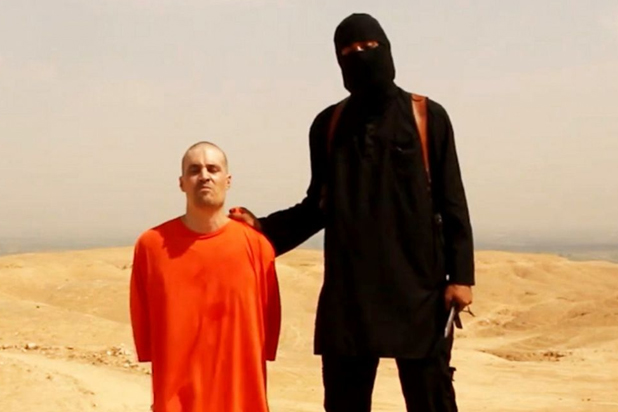
Journalist James Foley executed by ISIS
The Times’ double standard is particularly curious because United Nations investigators don’t even dare enter these jihadist zones because the jihadists have a history of beheading journalists and other civilians who get in the way.
An example of this bias was on display in Wednesday’s Times in an article about the family of Omran, the boy made famous by a photo of him in an ambulance. The article discussed the family’s ordeal and mentioned the father’s vocal support for the Assad government.
However, because the family backed Assad, the Times inserted this caveat: “Syrians appearing on state television or on channels associated with the Assad government are not able to speak freely. The government exerts tight control over all information broadcast about the war, including interviews with civilians, who can be coerced and threatened with arrest if they criticize the government.”
Yet, the Times treats interviews with people inside jihadist-controlled territory as inherently truthful with the interview subjects described in favorable or neutral terms, such as “rescue workers,” “journalists,” “eyewitnesses” or sometimes “activists.” There is rarely any suggestion that Al Qaeda might either be controlling these messages or intimidating the interviewees, who are usually denouncing Assad, what the Times and other mainstream news outlets want to hear.
False-Flag Evidence
This gullibility has continued despite evidence that the jihadists do generate sophisticated propaganda to promote their cause, including staging “false-flag” chemical weapons attacks. For instance, U.N. investigators who examined one alleged chlorine-gas attack by the Syrian government against Al-Tamanah on the night of April 29-30, 2014, heard multiple testimonies from townspeople that the event had been staged by rebels and played up by activists on social media.
“Seven witnesses stated that frequent alerts [about an imminent chlorine weapons attack by the government] had been issued, but in fact no incidents with chemicals took place,” the U.N. report stated. “While people sought safety after the warnings, their homes were looted and rumours spread that the events were being staged. … [T]hey [these witnesses] had come forward to contest the wide-spread false media reports.”
Accounts from other people, who did allege that there had been a government chemical attack on Al-Tamanah, provided suspect evidence, including data from questionable sources, according to the U.N. report.
The report said, “Three witnesses, who did not give any description of the incident on 29-30 April 2014, provided material of unknown source. One witness had second-hand knowledge of two of the five incidents in Al-Tamanah, but did not remember the exact dates. Later that witness provided a USB-stick with information of unknown origin, which was saved in separate folders according to the dates of all the five incidents mentioned by the FFM [the U.N.’s Fact-Finding Mission].
“Another witness provided the dates of all five incidents reading it from a piece of paper, but did not provide any testimony on the incident on 29-30 April 2014. The latter also provided a video titled ‘site where second barrel containing toxic chlorine gas was dropped tamanaa 30 April 14’”
Some other “witnesses” alleging a Syrian government attack offered curious claims about detecting the chlorine-infused “barrel bombs” based on how the device sounded in its descent.
The U.N. report said, “The eyewitness, who stated to have been on the roof, said to have heard a helicopter and the ‘very loud’ sound of a falling barrel. Some interviewees had referred to a distinct whistling sound of barrels that contain chlorine as they fall. The witness statement could not be corroborated with any further information.”
The U.N. report might have added that there was no plausible explanation for someone detecting a chlorine canister in a “barrel bomb” based on its “distinct whistling sound.” The only logical conclusion is that the chlorine attack had been staged by the jihadists, and their supporters then lied to the U.N. team to enrage the world public against the Assad regime.
Another Dubious Case
In 2013, the work of Postol and his late partner, Richard M. Lloyd, an analyst at the military contractor Tesla Laboratories, debunked claims from the same trio — Bellingcat, the Times and Human Rights Watch — blaming the Syrian government for the even more notorious sarin-gas attack outside Damascus on Aug. 21, 2013, which killed hundreds.
Postol and Lloyd showed that the rocket carrying the sarin had only a fraction of the range that the trio had assumed in tracing its path back to a government base.
Since the much shorter range placed the likely launch point inside rebel-controlled territory, the incident appeared to have been another false-flag provocation, one that almost led President Obama to launch a major retaliatory strike against the Syrian military.
Although the Times grudgingly acknowledged the scientific problems with its analysis, it continued to blame the 2013 incident on the Syrian government. Similarly, Official Washington’s “groupthink” still holds that the Syrian government launched that sarin attack and that Obama chickened out on enforcing his “red line” against chemical weapons use.
Obama’s announcement of that “red line,” in effect, created a powerful incentive for Al Qaeda and other jihadists to stage chemical attacks assuming that they would be blamed on the government and thus draw in the U.S. military on the jihadist side. If Obama’s expected “retaliation” had devastated the Syrian military in 2013, Al Qaeda or its spinoff Islamic State might well have taken Damascus.
Yet, the 2013 “groupthink” of Syrian government guilt survives. After the April 4, 2017 incident, President Trump took some pleasure in mocking Obama’s weakness in contrast to his supposed toughness in quickly launching a “retaliatory” strike on April 6 (Washington time, although April 7 in Syria).
White House Claims
Trump’s attack came even before the White House released a supportive – though unconvincing – intelligence report on April 11. Regarding that report, Postol wrote, “The White House produced a false intelligence report on April 11, 2017 in order to justify an attack on the Syrian airbase at Sheyrat, Syria on April 7, 2017. That attack risked an unintended collision with Russia and a possible breakdown in cooperation between Russia and United States in the war to defeat the Islamic State. The collision also had some potential to escalate into a military conflict with Russia of greater extent and consequence.
“The New York Times and other mainstream media immediately and without proper review of the evidence adopted the false narrative produced by the White House even though that narrative was totally unjustified based on the forensic evidence. The New York Times used an organization, Bellingcat, for its source of analysis even though Bellingcat has a long history of making false claims based on distorted assertions about forensic evidence that either does not exist, or is absolutely without any evidence of valid sources.”
Postol continued, “This history of New York Times publishing of inaccurate information and then sticking by it when solid science-based forensic evidence disproves the original narrative cannot be explained in terms of simple error. The facts overwhelmingly point to a New York Times management that is unconcerned about the accuracy of its reporting.
“The problems exposed in this particular review of a New York Times analysis of critically important events related to the US national security is not unique to this particular story. This author could easily point to other serious errors in New York Times reporting on important technical issues associated with our national security.
“In these cases, like in this case, the New York Times management has not only allowed the reporting of false information without reviewing the facts for accuracy, but it has repeatedly continued to report the same wrong information in follow-on articles. It may be inappropriate to call this ‘fake news,’ but this loaded term comes perilously close to actually describing what is happening.”
No Admissions
When I interviewed Postol on Wednesday, he said he had received no responses from either the Times or Bellingcat, adding: “It seems to me that the analysts were ignorant beyond plausibility or they rigged the analysis. … To me, this is malpractice on a large scale.”
Referring to some of the photographed scenes in Khan Sheikhoun, including a dead goat that appeared to have been dragged into location near the “sarin crater,” Postol called the operation “a rather amateurish attempt to create a false narrative.”
But the problem of the Times and Bellingcat presenting dubious – or in Postol’s view, “fraudulent” – information about sensitive geopolitical and national security issues has another potentially even darker side. These two entities are part of Google’s First Draft Coalition of news organizations that are expected to serve as gatekeepers separating “truth” from “fake news.”
The emerging idea is to take their judgments and enter them into algorithms to scrub the Internet of information that doesn’t comport with what the Times, Bellingcat and other approved news outlets deem true.
That these two organizations would operate with a pattern of “confirmation bias” on sensitive war-and-peace issues is thus doubly troubling in that their future “groupthinks” could not only mislead their readers but could ensure that contrary evidence is whisked away from everyone else, too.
Investigative reporter Robert Parry broke many of the Iran-Contra stories for The Associated Press and Newsweek in the 1980s.
Obama vs. Trump

By Margaret Kimberley | Black Agenda Report | May 31, 2017
Barack Obama presided over the sale of more than $100 billion in weaponry to Saudi Arabia during his presidency. These deals were transacted before, during and after the Saudis’ devastating attacks on Yemen. It is important to state these simple facts because there is now a concerted effort among the rulers to make us believe that these recent events never took place.
Donald Trump’s visit to Saudi Arabia and announcement of yet another arms sale is the immediate cause of consternation. The continuity in foreign policy decision making from one president to another is a longstanding American tradition. But acknowledgement is problematic now that Trump is the one acting as his predecessors did.
The Saudi bombing and blockade of Yemen has resulted in starvation and a cholera epidemic. The corporate media and their talking heads ignored the crime as long as Barack Obama was in the White House. Now the same forces who hid the carnage beginning in 2015 behave as if the new president bears responsibility when Obama gave the green light.
A New York Times editorial is an example of the official propaganda scheme. Entitled “Will President Trump Help Save Yemen,” the editorial excoriated Trump for doing nothing more than what Obama had done. There was no mention of the former president’s support, in fact the Times gave the impression that he somehow opposed a policy he had carried out.
The New York Times is not alone in trying to make observant people disbelieve their lying eyes. Obama UN ambassador Samantha Power is also part of the amnesiac brigade. In a twitter post she responded to Trump administration boasting about the arms sale. “For a country whose attacks on civilians in Yemen — and inability to learn from mistakes — have been devastating to human life.” Fortunately, social media is a two way street and her obvious attempt at changing history was called into question by angry readers.
So concerned are the elites and their friends around the world that they won’t let Obama go. Defending the prerogatives of the ruling classes is a permanent position after all. That is why Obama was invited months ago to give a speech in Berlin with Angela Merkel by his side. The obvious goal of the photo opportunity was to help Merkel’s election campaign. Now an Obama visit may also undermine any foreign policy changes Trump may contemplate. Trump’s message of America first throws the imperial project into jeopardy and causes panic among current and former leaders.
The corporate media and foreign governments don’t care about the damage Trump is doing domestically. The ICE raids, emboldened racism, voter suppression and cuts to government programs don’t concern them. But Trump’s victory already killed the TPP trade deal. His white America first philosophy leaves less room for NATO machinations and imperial imperatives.
Trump literally shoved the president of Montenegro aside at the NATO summit. The juvenile alpha male move was ironic for several reasons. Tiny Montenegro has been pushed into NATO against the wishes of many of its people. But NATO is determined to expand because Russia is the last country capable of saying no to America’s whims and its determination to run the whole world.
Trump’s understanding of European foreign policy consists of worrying about how much America contributes towards NATO funding vis a vis other nations. He is a businessman after all and sees no reason to pay more than the next guy. This nationalistic impulse creates huge problems for the elites, who had no intention of giving up on their grand schemes of control backed by American muscle.
Trump’s non-commitment to NATO’s Article 5 may have done the world a huge favor. Article 5 makes every member nation responsible for the defense of the others. NATO assists in every act of aggression that the United States cooks up and that is one of the reasons the elites want Trump gone. The American/NATO effort to tear Yugoslavia apart included the bombing of Montenegro. Trump’s wrong headed impulse reveals some important truths about the state of the world.
And that is why Obama will keep showing up for his friends. He is still working for the western oligarchs who want the system to keep running as it has done. No one should worry about Merkel’s lament that Europe can’t count on the United States. Trump’s boorish behavior is a lot less dangerous than the trans Atlantic alliance of war making.
Of course Obama acolytes are lying about his relationship with Saudi Arabia. American presidents always genuflect to their partner in crime. The Saudis have aided in the destruction of much of that region but those facts are inconvenient. Obama’s second act won’t work unless some very big lies are served up.
Margaret Kimberley can be reached via e-Mail at Margaret.Kimberley(at)BlackAgendaReport.com.
US Journalism’s New ‘Golden Age’?
By Robert Parry | Consortium News | May 22, 2017
The mainstream U.S. media is congratulating itself on its courageous defiance of President Trump and its hard-hitting condemnations of Russia, but the press seems to have forgotten that its proper role within the U.S. democratic structure is not to slant stories one way or another but to provide objective information for the American people.
By that standard – of respecting that the people are the nation’s true sovereigns – the mainstream media is failing again. Indeed, the chasm between what America’s elites are thinking these days and what many working-class Americans are feeling is underscored by the high-fiving that’s going on inside the elite mainstream news media, which is celebrating its Trump- and Russia-bashing as the “new golden age of American journalism.”
The New York Times and The Washington Post, in particular, view themselves as embattled victims of a tyrannical abuser. The Times presents itself as the brave guardian of “truth” and the Post added a new slogan: “Democracy dies in darkness.” In doing so, they have moved beyond the normal constraints of professional, objective journalism into political advocacy – and they are deeply proud of themselves.
In a Sunday column entitled “How Trump inspired a golden age,” Washington Post columnist Dana Milbank wrote that Trump “took on the institution of a free press – and it fought back. Trump came to office after intimidating publishers, barring journalists from covering him and threatening to rewrite press laws, and he has sought to discredit the ‘fake news’ media at every chance. Instead, he wound up inspiring a new golden age in American journalism.
“Trump provoked the extraordinary work of reporters on the intelligence, justice and national security beats, who blew wide open the Russia election scandal, the contacts between Russia and top Trump officials, and interference by Trump in the FBI investigation. Last week’s appointment of a special prosecutor – a crucial check on a president who lacks self-restraint – is a direct result of their work.”
Journalism or Hatchet Job?
But has this journalism been professional or has it been a hatchet job? Are we seeing a new “golden age” of journalism or a McCarthyistic lynch mob operating on behalf of elites who disdain the U.S. constitutional process for electing American presidents?
For one thing, you might have thought that professional journalists would have demanded proof about the predicate for this burgeoning “scandal” – whether the Russians really did “hack” into emails of the Democratic National Committee and Hillary Clinton campaign chairman John Podesta and then slip the information to WikiLeaks to influence the outcome of the 2016 election.
You have surely heard and read endlessly that this conclusion about Russia’s skulduggery was the “consensus view of the 17 U.S. intelligence agencies” and thus only some crazy conspiracy theorist would doubt its accuracy even if no specific evidence was evinced to support the accusation.
But that repeated assertion is not true. There was no National Intelligence Estimate (or NIE) that would compile the views of the 17 intelligence agencies. Instead, as President Obama’s Director of National Intelligence James Clapper testified before a Senate Judiciary subcommittee on May 8, the Russia-hacking claim came from a “special intelligence community assessment” (or ICA) produced by selected analysts from the Central Intelligence Agency, National Security Agency and Federal Bureau of Investigation, or as Clapper put it, “a coordinated product from three agencies – CIA, NSA, and the FBI – not all 17 components of the intelligence community.”
Further, as Clapper explained, the “ICA” was something of a rush job beginning on President Obama’s instructions “in early December” and completed by Jan. 6, in other words, a month or less.
Clapper continued: “The two dozen or so analysts for this task were hand-picked, seasoned experts from each of the contributing agencies.” However, as any intelligence expert will tell you, if you “hand-pick” the analysts, you are really hand-picking the conclusion.
You can say the analysts worked independently but their selection, as advocates for one position or another, could itself dictate the outcome. If the analysts were hardliners on Russia or hated Trump, they could be expected to deliver the conclusion that Obama and Clapper wanted, i.e., challenging the legitimacy of Trump’s election and blaming Russia.
The point of having a more substantive NIE is that it taps into a much broader network of U.S. intelligence analysts who have the right to insert dissents to the dominant opinions. So, for instance, when President George W. Bush belatedly ordered an NIE regarding Iraq’s WMD in 2002, some analysts – especially at the State Department – inserted dissents (although they were expunged from the declassified version given to the American people to justify the 2003 invasion of Iraq).
An Embarrassing Product
Obama’s “ICA,” which was released on Jan. 6, was a piece of work that embarrassed many former U.S. intelligence analysts. It was a one-sided argument that lacked any specific evidence to support its findings. Its key point was that Russian President Vladimir Putin had a motive to authorize an information operation to help Hillary Clinton’s rival, Donald Trump, because Putin disdained her work as Secretary of State.
But the Jan. 6 report failed to include the counter-argument to that cui bono assertion, that it would be an extraordinary risk for Putin to release information to hurt Clinton when she was the overwhelming favorite to win the presidency. Given the NSA’s electronic-interception capabilities, Putin would have to assume that any such undertaking would be picked up by U.S. intelligence and that he would likely be facing a vengeful new U.S. president on Jan. 20.
While it’s possible that Putin still took the risk – despite the daunting odds against a Trump victory – a balanced intelligence assessment would have included such contrary arguments. Instead, the report had the look of a prosecutor’s brief albeit without actual evidence pointing to the guilt of the accused.
Further, the report repeatedly used the word “assesses” – rather than “proves” or “establishes” – and the terminology is important because, in intelligence-world-speak, “assesses” often means “guesses.” The report admits as much, saying, “Judgments are not intended to imply that we have proof that shows something to be a fact. Assessments are based on collected information, which is often incomplete or fragmentary, as well as logic, argumentation, and precedents.”
In other words, the predicate for the entire Russia-gate scandal, which may now lead to the impeachment of a U.S. president and thus the negation of the Constitution’s electoral process, is based partly on a lie – i.e., the claim that the assessment comes from all 17 U.S. intelligence agencies – and partly on evidence-free speculation by a group of “hand-picked” analysts, chosen by Obama’s intelligence chiefs.
Yet, the mainstream U.S. news media has neither corrected the false assertion about the 17 intelligence agencies nor demanded that actual evidence be made public to support the key allegation that Russia was the source of the WikiLeaks’s email dumps.
By the way, both Russia and WikiLeaks deny that Russia was the source, although it is certainly possible that the Russian government would lie and that WikiLeaks might not know where the two batches of Democratic emails originated.
A True ‘Golden Age’?
Yet, one might think that the new “golden age of American journalism” would want to establish a firm foundation for its self-admiring reporting on Russia-gate. You might think, too, that these esteemed MSM reporters would show some professional skepticism toward dubious claims being fed to them by the Obama administration’s intelligence appointees.
That is unless, of course, the major U.S. news organizations are not abiding by journalistic principles, but rather see themselves as combatants in the anti-Trump “resistance.” In other words, if they are behaving less as a Fourth Estate and more as a well-dressed mob determined to drag the interloper, Trump, from the White House.
The mainstream U.S. media’s bias against Putin and Russia also oozes from every pore of the Times’ and Post’s reporting from Moscow. For instance, the Times’ article on Putin’s comments about supposed secrets that Trump shared with Russian Foreign Minister Sergey Lavrov at the White House had the headline in the print editions: “Putin Butts In to Claim There Were No Secrets…” The article by Andrew Higgins then describes Putin “asserting himself with his customary disruptive panache” and “seizing on foreign crises to make Russia’s voice heard.”
Clearly, we are all supposed to hate and ridicule Vladimir Putin. He is being demonized as the new “enemy” in much the way that George Orwell foresaw in his dystopian novel, 1984. Yet, what is perhaps most troubling is that the major U.S. news outlets, which played instrumental roles in demonizing leaders of Iraq, Syria and Libya, believe they are engaged in some “golden age” journalism, rather than writing propaganda.
Contempt for Trump
Yes, I realize that many good people want to see Trump removed from office because of his destructive policies and his buffoonish behavior – and many are eager to use the new bête noire, Russia, as the excuse to do it. But that still does not make it right for the U.S. news media to abandon its professional responsibilities in favor of a political agenda.
On a political level, it may not even be a good idea for Democrats and progressives who seem to be following the failed strategy of Hillary Clinton’s campaign in seeking to demonize Trump rather than figuring out how to speak to the white working-class people who voted for him, many out of fear over their economic vulnerability and others out of anger over how Clinton dismissed many of them as “deplorables.”
And, by the way, if anyone thinks that whatever the Russians may have done damaged Clinton’s chances more than her colorful phrase disdaining millions of working-class people who understandably feel left behind by neo-liberal economics, you may want to enroll in a Politics 101 course. The last thing a competent politician does is utter a memorable insult that will rally the opposition.
In conversations that I’ve had recently with Trump voters, they complain that Clinton and the Democrats weren’t even bothering to listen to them or to talk to them. These voters were less enamored of Trump than they were conceded to Trump by the Clinton campaign. These voters also are not impressed by the endless Trump- and Russia-bashing from The New York Times, The Washington Post, CNN and MSNBC, which they see as instruments of the elites.
The political danger for national Democrats and many progressives is that mocking Trump and thus further insulting his supporters only extends the losing Clinton strategy and cements the image of Democrats as know-it-all elitists. Thus, the Democrats risk losing a key segment of the U.S. electorate for a generation.
Not only could that deny the Democrats a congressional majority for the foreseeable future, but it might even get Trump a second term.
Investigative reporter Robert Parry broke many of the Iran-Contra stories for The Associated Press and Newsweek in the 1980s.
Harvard Study Shows Unprecedented Anti-Trump Media Bias — Except For When He Bombed Syria
By Chris Menahan – InformationLiberation – May 19, 2017
A new Harvard study published on Thursday found unprecedented levels of anti-Trump bias from the major media in Trump’s first 100 days in office, with NBC, CBS and CNN generating over 91 percent negative coverage.
The Harvard Kennedy School’s Shorenstein Center on Media, Politics and Public Policy analysed news reports from the print editions of The New York Times, The Wall Street Journal, and The Washington Post, as well as “the main newscasts of CBS, CNN, Fox News, and NBC, and three European news outlets (The UK’s Financial Times and BBC, and Germany’s ARD).”
Here’s what they found:
– President Trump dominated media coverage in the outlets and programs analyzed, with Trump being the topic of 41 percent of all news stories—three times the amount of coverage received by previous presidents. He was also the featured speaker in nearly two-thirds of his coverage.
– Republican voices accounted for 80 percent of what newsmakers said about the Trump presidency, compared to only 6 percent for Democrats and 3 percent for those involved in anti-Trump protests.
– European reporters were more likely than American journalists to directly question Trump’s fitness for office.
– Trump has received unsparing coverage for most weeks of his presidency, without a single major topic where Trump’s coverage, on balance, was more positive than negative, setting a new standard for unfavorable press coverage of a president.
– Fox was the only news outlet in the study that came close to giving Trump positive coverage overall, however, there was variation in the tone of Fox’s coverage depending on the topic.
Charts:


Note, the one week he got the most positive coverage was week 12 when he attacked Syria and started ditching all his campaign promises and acting like he was being blackmailed. Since going rogue again and firing Comey the coverage has no doubt gotten worse than ever.

The tone of coverage was overwhelmingly positive for his Tomahawk missile strike on Syria:

Fox News is not much better than other networks on a lot of issues and as we know they’ve recently shifted even further to the left.

This is death by a thousand paper cuts and on top of it all the deep state is sabotaging Trump’s every move.
If you really look at these polls, it’s clear the only way he could get positive news coverage is if he came out for open borders and amnesty, then launched a full-scale ground invasion of Syria and started a war with Russia.
Featured Video

Deception – Submarines against Olof Palme
or go to
Aletho News Archives – Video-Images
From the Archives
Woolsey Fire started at Santa Susana Field Lab — where “radioactive materials released were never accurately measured”
By John Laforge | CounterPunch | November 30, 2018
In my Nov. 16 column, I reported on potential radiation risks posed by California’s Woolsey wildfire having burned over parts or all of the Santa Susana Field Laboratory—south of Simi Valley, Calif., 30 miles outside Los Angeles—site of at least four partial or total nuclear reactor meltdowns.
The field laboratory operated 10 experimental reactors and conducted rocket engine tests. In his 2014 book Atomic Accidents, researcher James Mahaffey writes, “The cores in four experimental reactors on site … melted.” Reactor core melts always result in the release of large amounts of radioactive gases and particles. Clean up of the deeply contaminated site has not been conducted in spite of a 2010 agreement.
Los Angeles’s KABC-7 TV reported Nov. 13 that the Santa Susana lab site “appears to be the origin of the Woolsey Fire” which has torched over 96,000 acres. Southern Calif. Public Radio said, “According to Cal Fire, the Woolsey Fire started on the afternoon of Thursday, Nov. 8 … on the Santa Susana site.” … continue
Blog Roll
 Aletho News
- Dr. Abu-Sitta: Beirut ‘felt like a day in Shifa Hospital’
- Iran Has Won the War, It Will Be Up to the US to Secure the Peace: Mohammad Marandi
- Iran condemns assassination threats against Iranian negotiators amid US talks
- Brussels cannot say where its own pipeline inspectors are as Hungary’s oil lifeline remains shut
- Israel’s Iran War: Myth and Reality
- Between war and industrial breakdown: The US-Israeli attrition crisis
- Pressure builds on Iran to ‘drop’ Lebanon ceasefire demand as Islamabad talks hang in balance
- In another clash report, US denies agreement to release Iran’s assets
- What is fueling unrest across the EU?
- Why no power can undermine Iran’s eternal dominance over the Strait of Hormuz
- If Americans Knew
- Pro-Israel ‘Thinktanks’ and Individuals who Influence U.S. Foreign Policy
- Mearsheimer reveals how Israel dictates US policies on Iran, Gaza – video
- After killing 350+, Israel still has a “score to settle” with Lebanon before ceasefire – Daily Update
- Military aid to Israel emerges as the latest political litmus test for Democrats
- The only Palestinian children’s rights organization closes following years-long Israeli campaign against it
- ‘I Can’t Forget the Smell’: Lebanese Reel After Israel Kills Over 300 in Single Day
- DNC Shoots Down Resolutions Calling Out AIPAC and Limiting Arms to Israel
- TCN: Is Israel Blackmailing President Trump?
- Israel killed at least 303 Lebanese yesterday – who were they? Daily Update
- Amnesty: Urgent – Protect Lebanese civilians from brutal escalation in Israeli attacks
- No Tricks Zone
- German Expert: Heat Dome Led To Record Temps In Western USA…Warmer In 1934, 1936
- New Study: No Linear Warming Or Glacier Retreat Along Northern Antarctic Peninsula Since 1980s
- An Inconvenient Tree: Uncovered In Alps… Europe Much Warmer Than Today 6000 Years Ago
- New Study Reports A 60% Slowdown In Greenland’s Ice Loss Rate In The Last Decade
- Low Intensity Tornado Wrecks Major Solar Farm, Creating A Potential Toxic Dump
- New Study Finds Warming Saves Lives…Cold Temperatures 12 Times More Deadly Than Excess Heat
- German Science Blog Accuses PIK Climate Institute Of Hallucinating Climate Tipping Points
- Devastating Assessment Of Comirnaty Vaccine By Former Senior Pfizer Europe Toxicologist
- New Study: CO2 Is ‘Effectively Negligible’ As An Explanatory Climate Change Factor Since 2000
- Former Pfizer Toxicologist Dr. Helmut Sterz Tells Bundestag Hearing Pfizer Vaccine Should Have Never Been Approved
 Aletho News