Pyongyang Seeks to ‘Write New History’ of Korean Unification – State Media
Sputnik – 06.03.2018
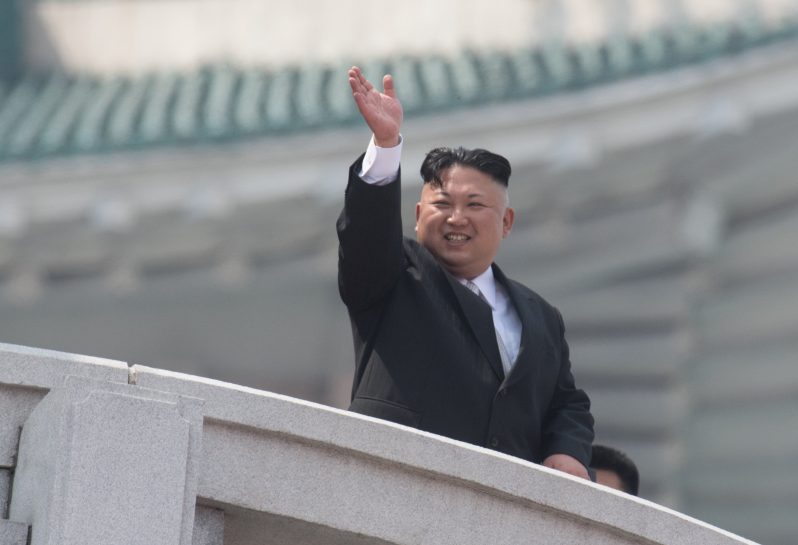
Shortly after Kim Jong-un hosted a high-level delegation of South Korean officials for dinner in Pyongyang on Monday, North Korean state media said the country’s leader intends to advance inter-Korean relations and make the story of Korean history a story of unification.
Kim “repeatedly clarified that it is our consistent and principled stand and his firm will to vigorously advance the North-South relations and write a new history of national reunification by the concerted efforts of our nation to be proud in the world,” according to North Korea’s Korea Central News Agency (KCNA).
The Yonhap news agency has reported that the main goal of South Korean President Moon Jae-in’s envoy to Pyongyang is to enable US-North Korea talks. Chung Eui-young, the head of South Korean national security, and Suh Hoon, Seoul’s spy chief, are among those who met with Kim.
Moon’s delegation hand-delivered a letter from the South Korean president addressing Kim. “Hearing the intention of President Moon Jae-in for a summit from the special envoy of the south side, he exchanged views and made a satisfactory agreement,” KCNA said. Further, the Pyongyang’s leader “gave the important instruction to the relevant field to rapidly take practical steps for it.”
“He [Kim] also made an exchange of in-depth views on the issues for easing the acute military tensions on the Korean Peninsula and activating the versatile dialogue, contact, cooperation and exchange,” KCNA added.
The United States and South Korea are in close contact regarding the inter-Korean talks that are currently underway, State Department spokesperson Katina Adams told Sputnik on Monday. “We are in contact with the Republic of Korea about our unified response to North Korea,” said Adams said.
Washington and Seoul will work together “through the maximum pressure of the campaign to ensure that North-South progress is accompanied by advances towards denuclearization.”
KCNA reports that the meeting was held in “a compatriotic and sincere atmosphere.”
South Korea ‘to send high-level delegation to North’
Press TV – March 4, 2018
South Korea has announced a decision to send a high-level political delegation to the North, raising hopes for a diplomatic solution to the decades-long conflict on the Korean Peninsula.
The South Korean presidential office announced on Sunday that a special 10-member government delegation was to visit North Korea on Monday.
“The special delegates will have extensive discussions over issues including creating conditions for North-US talks to denuclearize the Korean Peninsula and improving inter-Korea ties,” Blue House spokesman Yoon Young-chan told reporters.
The 10-member group comprises five top delegates, including top national security adviser Chung Eui-yong and intelligence chief Suh Hoon. It will fly to the North’s capital, Pyongyang, on Monday afternoon before returning on Tuesday, Yoon said.
The delegation will then fly to the US to brief officials in Washington, he added.
The move comes just weeks after the North’s leader Kim Jong-un sent a delegation to the South that included his younger sister, Kim Yo-jong.
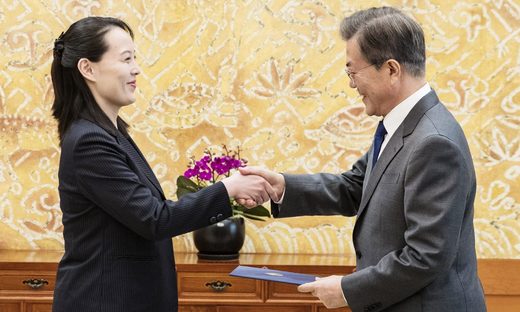
During her stay, Kim Yo-jong personally delivered to South Korean President Moon Jae-in an invitation from her brother for a summit meeting in Pyongyang.
Peace advocate
President Moon, 65, who hails from the Democratic Party, rose to power last year vowing to ameliorate the broken ties between the two Koreas.
Last week, Moon advised US leaders to stop setting preconditions to hold talks with North Korea and make greater efforts for peace and stability. Washington needs to “lower the threshold for talks” with Pyongyang, he said.
On Saturday, a Foreign Ministry spokesman in Pyongyang called on the US to drop any precondition for talks.
“The US is taking preposterous action by continuing to trumpet an insistence that it will not have dialog unless a right condition is met,” the unnamed spokesman was quoted as saying by the state-run KCNA news agency.
The US, which has imposed many sanctions on Pyongyang, has said that North Korea should denuclearize in order for negotiations to begin.
Late last month, the US imposed the “toughest ever” sanctions on North Korea.
The sanctions were imposed shortly after athletes from the North and South marched together in a show of unity at the PyeongChang Winter Olympics, which ended February 25.
North Korea, for its part, says its nuclear arsenal is a deterrent against potential US aggression.
The US has substantial military presence in the region and has repeatedly threatened the North with military action.
Trump And Kim’s Tug-Of-War Over President Moon
By Andrew KORYBKO – Oriental Review – 03/03/2018
North Korea is reportedly willing to engage in talks with South Korea and the US.
The message was apparently conveyed after a high-level North Korean official met with the South Korean President, Moon Jae-In, who had previously campaigned on a promise to revive the so-called “Sunshine Policy” of some of his predecessors in actively seeking a rapprochement with Pyongyang. The course of developments in the 9 months since his election, especially regarding US actions towards North Korea and its preplanned calculated responses to it, made it almost impossible to advance this idea, but the recently concluded Pyeongchang Winter Olympics proved to be the perfect opportunity for breathing new life into this stalemated but nevertheless promising vision.
China and Russia previously proposed what they called the “Double Freeze” whereby the US and South Korea would indefinitely halt their joint military drills with one another in exchange for North Korea doing the same with its missile and nuclear tests. Washington took the first step in announcing the postponement of its planned exercises with Seoul, which created an amicable atmosphere for Pyongyang to do its part in making the Olympic Games a diplomatic success for everyone and infusing fresh optimism into the “Double Freeze” proposal. As could have been expected, however, the US recently said that it would be resuming its military games with South Korea and even deploying attack drones to the peninsula, which drew sharp condemnation from North Korea who accused America of endangering the incipient peace process.
Even so, this hasn’t yet resulted in any characteristically ostentatious moves from Pyongyang, which can be interpreted in one of two ways. The first is how Trump and his team are likely perceiving this, which is that North Korea is indicating its receptivity to talks from a position of weakness, especially after the US’ new sanctions against the country. The second, though, is more probable, and it’s that North Korea doesn’t want to be seen as being the first one to break the “Double Freeze” , especially since it’s betting that its recent “charm offensive” during the Olympics was enough to convince President Moon of Kim Jong-Un’s sincerity in holding talks with him.
Basically, the North Koreans are trying to deepen the divide between the US and their military allies in South Korea in an attempt to embolden Seoul to flex its independence and proactively take the initiative to further the positive gains achieved during the “Olympic Peace” and “Double Freeze”. Pyongyang has gone to great lengths to “humble itself” before the eyes of the world in presenting its peaceful intentions, which it’s hoping was successful in creating space for President Moon to once more try his hand at reviving the “Sunshine Policy”. Kim will try to encourage him, Trump will try to deter him, but what everything essentially comes down to is which of the two ultimately comes out on top in this tug-of-war over President Moon.
The post presented is the partial transcript of the CONTEXT COUNTDOWN radio program on Sputnik News, aired on Friday Mar 2, 2018.
US war with North Korea ‘worth it’ – Lindsey Graham

RT | March 3, 2018
The damage caused by a US war with North Korea would be “worth it,” Senator Lindsey Graham said. The comments further fuel speculation the US is gearing up for action against Pyongyang.
“All the damage that would come from a war would be worth it in terms of long-term stability and national security,” the Republican senator from South Carolina told CNN. “I’m completely convinced that President Trump and his team reject the policy of containment… They’ve drawn a red line here and it is to never let North Korea build a nuclear-tipped missile to hit America.”
Graham’s comments come as the US is reportedly considering military action against North Korea, should Pyongyang build a nuclear missile capable of striking the US, according to multiple sources, CNN reports.
Last week, Washington revealed its latest round of sanctions against North Korea for its nuclear and ballistic missile tests, targeting Pyongyang’s shipping industry. Trump warned a phase two could be “very, very unfortunate for the world.”
The US appears at odds with the apparent willingness of both North and South Korea to engage in dialogue following the Winter Olympic Games, which saw North Korean leader Kim Jong-un’s sister, Kim Yo-jong, attending. Kim Yo-jung was the first member of North Korea’s ruling family to visit the South since the Korean War, and shook hands with South Korean President Moon Jae-in at the opening ceremony.
On Thursday, Moon told Trump he plans to send an envoy to North Korea following the invitation extended by Pyongyang. This would be the first inter-Korean summit since 2007. South Korea said in a statement that dialogue with the North “will go on.”
Graham, a member of the Senate Armed Services Committee, is a longtime hawk who has often advocated for US military action, including calling for the US to send 10,000 troops to fight Islamic State (IS, formerly ISIS) in Iraq. He was also among the chorus of Republican presidential candidates calling for the US to shoot down Russian planes in Syria in 2015.
Curiously, Graham is aware of the devastation a conflict between the US and North Korea would create in the region. Speaking on the Today show in August, Graham noted: “Japan, South Korea, China would all be in the crosshairs of a war if we started one with North Korea.”
“If there’s going to be a war to stop [Kim Jong-un], it will be over there. If thousands die, they’re going to die over there. They’re not going to die here,” he added. “And [Trump] told me that to my face. That may be provocative, but not really. When you’re president of the United States, where does your allegiance lie? To the people of the United States.”
During the Korean War of 1950-53, an estimated 2.5 million people died. Should the US enter a war with North Korea, the conflict would likely have disastrous consequences for the greater region and endanger US citizens.
South Korea’s Moon informs Trump of plan to send special envoy to North Korea
Press TV – March 1, 2018
South Korean President Moon Jae-in has told his American counterpart Donald Trump that he intends to send a special envoy to Pyongyang in response to an invitation by Kim Jong-un, the North’s leader, following the recent Olympic-driven detente between the two Koreas.
“In response to the visit by North Korea’s special envoy Kim Yo Jong, … Moon conveyed to Trump his plans to dispatch a special envoy to the North soon,” Seoul’s presidential office said in a statement on Thursday, following their phone conversation.
It added that Moon and Trump further “agreed to continue their efforts to maintain the momentum for South-North dialogue so it may lead to the denuclearization of the Korean Peninsula.”
The development came after Pyongyang, in a rare move, participated in the 2018 Winter Olympics held in South Korea, providing an opportunity for the two neighbors to resolve long-running hostilities. The two sides have exchanged diplomatic and high-level visits, and there is hope that relations could improve effectively.
The two neighbors have been separated by a heavily-militarized border since the three-year Korean War came to an end in 1953. The conflict ended with an armistice rather than a formal peace treaty and left many families separated on the two sides.
The situation on the Korean Peninsula has been tense due to Pyongyang’s development of its nuclear and missile programs.
Moon has sought to use the Pyeongchang Winter Olympics, which concluded on Sunday, to open dialogue between Washington and Pyongyang in the hopes of easing a nuclear standoff that has caused global security fears.
The South Korean leader said earlier this week that Washington needed to “lower the threshold for talks” with Pyongyang.
Furthermore, senior North Korean officials visiting the South for the Winter Olympics said on Sunday that Pyongyang was open to talks with Washington.
However, the US has ruled out any possibility of negotiations before the North, which last year conducted multiple missile and nuclear tests, takes steps towards denuclearization.
The US and its allies in the West and in Asia engineered tough UN sanctions on North Korea last year when Pyongyang test-fired two missiles in July and then carried out its most powerful nuclear test in August.
However, many said the sanctions would not deter North Korea from pursuing its nuclear and missile program, which Pyongyang insists is part of its defense policy against the US. Critics have repeatedly warned that sanctions would more affect North Korean people rather than its military and the government.
Bull in a China Shop: US Announces More Unilateral Sanctions on North Korea
By Alex GORKA | Strategic Culture Foundation | 26.02.2018
On Feb.23, the US Treasury Department announced the introduction of sanctions on 56 shipping vessels and entities accused of illicit trading with North Korea. The pressure intensification pursues the goal of compelling Pyongyang to give up its nuclear program. Today, almost all ships used for trade with that country are under the restrictive measures, including ship-to-ship transfers.
It’s timing that is important. The move is taken at a time the Winter Olympics are being hosted by South Korea. The event is used for easing tensions and launching dialogue between Seoul and Pyongyang.
Gradually, Washington is edging closer to the imposition of an economic blockade enforced by the US Navy. “If the sanctions don’t work, we’ll have to go Phase 2,” President Trump said, obviously meaning the use of force. “Phase 2 may be a very rough thing,” he warned.
Washington appears to be serious about its intent to go really far. In December, 2017, the US tried to insert a provision into the resolution on Pyongyang that would permit to hail and board North Korean ships in international waters. In January, Defense Secretary James Mattis said the US military had prepared a North Korea war plan. According to leading American experts on nuclear issues, Pyongyang may have as many as 20 nuclear warheads.
US Treasury Secretary Steven Mnuchin says his country will sanction anyone who does not comply with the restrictive measures it imposes. But only the UN-endorsed sanctions are mandatory. If Russia or China imposed sanctions against a country the US maintains trade ties with, would it agree to comply?
There is another aspect of the problem to be paid attention to. US lawmakers are not biding time. The legislation has already passed the House of Representatives. This is a very dangerous legislation that few people remember about. It not only the calls for being as tough as can be but also includes «inspection authorities» over the sea ports of Russia, China, Iran and Syria (Section 104). The legislation mentions the Russian ports of Vladivostok, Nakhodka and Vanino. It authorizes US Secretary of Homeland Security to search any vessel or aircraft that have used North Korean airports or seaports to make them subject to nothing less than “seizure and forfeiture”! The bill openly dictates that other countries must comply with US laws.
And the proposed surveillance of sovereign ports in the Russian Far East! If enforced, it would not only grossly violate international law but also constitute an act of war. But how could lawmakers approve it? Will US senators be wise enough to realize that Russia, China or Iran compliance with these provisions is as realistic as a dog observing a barking ban?
One more thing to emphasize. There had been no real bipartisan debate before the Act was voted by the House. It was handled under a “suspension of the rules” procedure, which is normally applied to noncontroversial bills. It helped to make it pass with only one “no” vote.
The UN Security Council has never delegated the authority to inspect other countries’ vessels or seaports to the US. The 1994 Memorandum of Understanding on Port State Control in the Asia-Pacific Region describes in detail the procedures in question. No country has special rights to get onboard of other countries’ ships.
An attempt to board a foreign ship would be a hostile act with unpredictable consequences. Russia and China will certainly counter such activities. But the US Navy will have to do it, once the legislation becomes law. The representatives who endorsed it were fully aware of what it might lead to but they did what they did. It reflects the mentality of those who are responsible for shaping US foreign policy as members of Congress.
And the new sanctions just announced by the administration, who are they aimed at? Probably, ordinary people instead of those who are responsible for the nuclear tests.
The problem is the reluctance of American politicians to perceive reality. The days when the US could do it alone are gone. Only an international effort can solve the North Korean problem. Unilateral actions are fraught with provoking conflicts not because other countries sympathize with or support North Korea but because they have no choice but stand up to the US challenge to remain sovereign nations. It’s time for the US to change mentality and stop behaving like a bull in a china shop.
North Korea slams US for sanctions & ‘clouds of war’ but says it is open for talks
RT | February 25, 2018
Pyongyang has accused Washington of bringing “clouds of war” to the region by imposing “the largest-ever” sanctions during the Olympic Games, but says it is still open to direct talks with the US.
A statement published by state news agency KCNA hailed North Korea’s leadership for their “strong determination for peace, long-awaited inter-Korean dialogue and cooperation,” which began to surface during the 2018 Pyeongchang Winter Olympics. The statement went on to say that Washington is violating the Korean Olympics truce and “is running amok to bring another dark cloud of confrontation and war over the Korean peninsula” by announcing new wave of sanctions against the North.
“We came to possess nuclear weapons, the treasured sword of justice, in order to defend ourselves from such threats from the United States,” the statement read, adding that “we will consider any type of blockade an act of war against us.”
On Friday, Washington announced “the largest-ever set of new sanctions on the North Korean regime,” targeting the country’s industries and exports.
Twenty-seven foreign companies, 28 ships, and one person – mainly based in China, Hong Kong, Taiwan, and Singapore – were sanctioned, according to the US Treasury. US President Donald Trump has said that “if the sanctions don’t work, we will have to go to phase two, and phase two may be a very rough thing, may be very, very unfortunate for the world.”
The president did not specify what exactly he meant by “phase two,” but qualified the statement by saying he did not think he was “going to exactly play that card.”
Still, Pyongyang says it is open for direct talks with Washington and continues negotiations with Seoul. On Sunday, South Korean President Moon Jae-in hosted Kim Yong-chol, vice chairman of the Central Committee of North Korea’s ruling Workers’ Party, in Pyeongchang, Yonhap reports. This was President Moon’s second meeting with top-tier North Korean officials in just two weeks.
Previously, he held talks with a delegation which included Kim Jong-un’s sister, Kim Yo-jong, who delivered a special message from her brother, inviting Moon to Pyongyang in future. Moon is yet to accept the invitation, and if he does, it would be the first visit by a South Korean head of state since 2007, when then-President Roh Moo-hyun met with Kim Jong-il in Pyongyang.
The Trump administration seems to be wary of the ongoing inter-Korean détente which started earlier this year with high-level contacts between the two countries’ officials. Notwithstanding some promising statements by US Vice President Mike Pence, Washington is continuing its policy of sanctions and military pressure.
This spring, the US and South Korea will resume massive military drills – Foal Eagle and Key Resolve. Though Washington and Seoul maintain that the exercises are critical to prepare for a North Korean attack, Pyongyang views the wargames as a rehearsal for invasion, and has threatened retaliatory strikes.
Russia and China have consistently urged caution in the matter. In January, the two countries put forward a ‘double freeze’ initiative that envisaged the US and its allies ceasing all major military exercises in the region in exchange for North Korea suspending its nuclear and ballistic missile program. The initiative was rejected by Washington.
North Korea Calls US-Japan Missile Drills Provocation Against Intra-Korean Dialogue
Sputnik – 22.02.2018
MOSCOW – North Korea’s committee on Korean reconciliation condemned on Thursday an upcoming joint US-Japan missile defense drill as an attempt to reignite regional tensions and obstruct the ongoing thaw between Pyongyang and Seoul.
“Branding this as a ferocious gangster-like act aimed to tarnish the hard-won atmosphere for the improvement of the North-South ties and for peace on the Korean Peninsula, and as a dangerous military provocation to ignite the train of a war,” the [North’s] Korean National Peace Committee said in a statement, announced by state-run Korean Central News Agency (KCNA) and quoted by South Korea’s Yonhap news agency.
The statement was made after on February 15, the Japanese Defense Ministry announced that this year’s joint ballistic missile defense exercise, which is due to start on Friday and last for a week, would have a larger scale than the previous ones and involve not only the Japanese Maritime Self-Defense Force and the US Navy but also the two countries’ air force units and the US Marine Corps. The ministry stressed the importance of the drill, citing November’s North Korean ballistic missile activities.
The committee also noted “greater bellicosity” and the danger of the forthcoming exercise, pointing to the planned involvement of fighter jets and US marines.
Tensions on the Korean Peninsula have further escalated as North Korea achieved significant progress in its nuclear and missile programs last year. Pyongyang tested several ballistic missiles, including its most advanced intercontinental ballistic missile in November, which it said was capable of hitting any part of the mainland of the United States. In turn, Washington has led a number of diplomatic initiatives to put pressure on Pyongyang and held several drills in the region.
In January, Pyongyang and Seoul resumed bilateral talks ahead of the Pyeongchang Winter Olympics. As a result, their national teams marched together under a “unification flag” at the opening ceremony and are jointly participating in a number of sporting events.
The sides also reportedly agreed to delay their military activities until after the Olympics, which will last through Sunday.
US, S. Korean militaries to conduct joint drills despite detente with Pyongyang
RT | February 20, 2018
The US and South Korea will go ahead with military drills off the Korean peninsula despite the “Peace Olympics” and the recent thaw in North-South relations, the South’s defense ministry said in a report to the National Assembly.
In the run-up to the Olympic Games in PyeongChang, Seoul was able to convince Washington to delay the start of their annual winter/springtime joint military exercises until after the games. The temporary halt to the annual Foal Eagle/Key Resolve US-South Korea joint military exercises allowed North and South Korea to develop a dialogue that the South hopes will ease the mounting tension in the region.
On Tuesday, a day after Pyongyang warned against the resumption of the military drills, South Korea’s defense ministry announced that the allies will still hold the Key Resolve and Ulchi Freedom Guardian exercises. Holding the drills this year, the S. Korean military said it will enhance the so-called 4D Operational Concept amid allies which aims “to detect, disrupt, destroy and defend against North Korean missile threats,” the ministry said in a report to the National Assembly, Yonhap reports.
No concrete schedule for the drills has yet been announced for 2018, and the report did not mention the fate of the Foal Eagle drills. A Key Resolve computer-simulated command post exercise was held March 8-23 last year. The 2017 Ulchi Freedom Guardian exercise involving some 17,500 US service members took place August 21-31.
The North has long urged the allies to stop their joint military training, and on Monday reiterated its objection to war games on its borders. “Resuming the war exercises is a wild act of ruthlessly trampling even a small sprout of peace that has been seen on the Korean peninsula,” North Korean KCNA said in an official commentary.
N. Korea particularly accused Donald Trump’s administration of seeking “war” in the region, blaming the US for using the “most powerful weapon in the world” to coerce Pyongyang. “The Trump group has to ponder over the catastrophic consequences to be entailed by its reckless saber-rattling, and make a responsible choice,” KCNA said.
“We are ready for dialogue and war.”
The latest statement comes amid the war of words and muscle flexing in the region between Pyongyang and Washington. As the US again threatens to pursue a military option to neutralize North Korea, Russia and China have been calling for calm. Moscow and China have consistently urged for a diplomatic solution to the crisis based on the ‘double freeze’ initiative. The simple Sino-Russian proposal, firmly rejected by Washington, seeks a simultaneous suspension of both nuclear tests by Pyongyang and the large-scale military exercises by Washington and Seoul.
Read more:
The Patheticism of U.S. Sanctions on North Korea
By Jacob G. Hornberger | FFF | February 12, 2018
Officials of the Sheraton Hotel might be experiencing some sleepless nights as a result of what they recently did at the Winter Olympics in South Korea. A five-star Sheraton Hotel permitted Kim Yo Jong, the sister of North Korean dictator Kim Jong-un, to stay there during her official visit to the Olympic Games. If they did that without the permission of U.S. officials, they might just find themselves the targets of severe punishment at the hands of U.S. bureaucrats.
Why might that incur the ire of U.S. officials? Because U.S. officials have Kim Yo Jong on their list of North Koreans specifically targeted for U.S. sanctions. If the Sheraton permitted her to stay there without securing the permission of U.S. officials, they might soon find that U.S. officials can be as vicious as their North Korean counterparts.
Just ask Bert Sacks, the American citizen from Washington State who dared to violate U.S. sanctions against the Iraqi people. Horrified by the high death toll among Iraqi children from the sanctions, Sachs decided to take medicines into Iraq knowing full well that he was violating the sanctions. U.S. officials went after him with a vengeance that bordered on the pathological. Fining him $10,000 for daring to violate their sacred sanctions, a fine that Sachs refused to pay, U.S. officials pursued him for more than a decade in their attempt to collect not just the fine but also extremely high penalties and interest. (For more on the remarkable story of Sack’s heroic resistance to the U.S. sanctions on the Iraqi people, see here.)
It’s what they do to anyone who dares to violate their sacred sanctions. That’s why even big and powerful international businessmen quiver and quake whenever they are faced with the possibility that they are violating U.S. sanctions. They know what U.S. officials will do them if they violate them.
Consider Samsung, for example. It has a policy of giving out smartphones to the Olympic athletes, not only as a means of communication but also so that they will be able to take photos of their Olympic experience.
Not so for the North Korean athletes, who won’t be taking any selfies home with them. No, not because they might be punished by North Korean officials for having something by which they could access the Internet but because Samsung was scared to death that they would be violating U.S. sanctions if they gave free phones to the North Korean athletes. Samsung officials were scared of what the U.S. government, not the Korean government, might do to them.
Is that pathetic or what?
That’s not all.
A North Korean 229-member cheerleading squad, consisting of an “army of beauties,” has mesmerized the crowds and the press at the Olympics. They came down from North Korea in a huge ferry, where North Korean officials required them to stay to prevent their learning too much about life in South Korea and to prevent defections.
But a big problem arose with the ferry. After it arrived, it was low on fuel and asked the South Koreans to refuel it. South Korean officials were scared to death. They just didn’t know how the U.S. government would react to what would amount to a clear violation of sanctions. According to an article in the New York Times, “As of Wednesday evening, the South had not decided whether to supply the fuel.”
Pathetic. Absolutely pathetic.
According to the Times’ article, the sanctions problem extends to hockey sticks and uniforms. When North Korea’s hockey team showed up at a tournament in New Zealand last year, they brought their battered wooden sticks with them. The organizers lent them high-tech carbon fiber sticks but required they return them before going home for fear of what U.S. officials would do to them for violating the sanctions.
Nike is another company afraid of antagonizing the U.S. government. Despite being an official Olympics sponsor, it decided to let a Finnish company furnish the uniforms for the Korean hockey team for fear of violating the sanctions.
U.S. officials decided to be nice to Asiana Airlines. It granted the airlines permission an “exception” to the sanctions by permitting it to enter U.S. airspace after flying South Korean hockey players to train in North Korea. The sanctions require that when a plane flies into North Korea, it has to wait six months before entering U.S. airspace. Maybe U.S. officials are concerned with the spread of communist germs, which, theoretically, could lead to an expansion of such socialist programs as Social Security, Medicare, public schooling, and farm subsidies.
Vice President Pence was in attendance at the Olympics and, not surprisingly, spent all his time growling, scowling, and calling for increased enforcement of U.S. sanctions against the North Koreans. Agitated and angry over North Korea’s Olympics outreach to South Koreans, Pence was not amused by either the cheerleaders or Kim Yo Jong, who he pointedly refused to acknowledge when she was seated directly behind him during the opening ceremonies.
The last thing Pence or other U.S. officials want is for Americans to begin personalizing the North Koreans. Better that Americans continue thinking of everyone in North Korea as nothing more than a bunch of commies or commie sympathizers. It that way, Americans, including American Christians, will consider it to be no big deal to kill all of them, either with sanctions or, if war breaks out, with carpet-bombing of towns and villages, as the U.S. military did during the Korean War.
After all, don’t forget the purpose of the sanctions: To kill the North Korean populace, including those North Korean cheerleaders, through starvation and illness. The idea is that if enough of them are dying, either Kim Jong-un will abdicate in favor of a pro-U.S. dictator or the North Korean people will initiate a violent revolution and install a pro-U.S. dictator into power.
Neither one is going to happen. Kim Jong-un is not going to capitulate to U.S. extortion. And the North Korean people are never going to revolt, especially since they are all disarmed as a result of North Korea’s strict gun-control policy. Thus, the only thing that is going to happen is that the sanctions will continue to kill more and more North Koreans, especially in combination with North Korea’s socialist system.
Unfortunately, business people are not the only ones afraid of acting without getting the permission of U.S. officials. When Kim Yo Jong extended an invitation to South Korean president Moon Jae-in to visit North Korea, he deflected the invitation, no doubt scared to accept the invitation without first checking with U.S. officials to see if it was okay to accept.
Throughout the Olympics, the American right-wing has never ceased reminding us of the brutality of the North Korean regime. Well, duh. It is a communist regime. But I can’t help but wonder whether the North Korean people are more afraid of their government than Samsung, Nike, and other big businesses are scared of the U.S. government. I also can’t help but wonder whether it matters to a North Korean whether he dies from North Korean socialist policies or U.S. sanctions policies.
Featured Video
Jeffrey Epstein’s ‘one single cause’: Israel
or go to
Aletho News Archives – Video-Images
Book Excerpt
Leslie Wexner’s Inner Demon
BY WHITNEY WEBB |
UNLIMITED HANGOUT| JUNE 10, 2022
This short excerpt from Whitney Webb’s upcoming book “One Nation Under Blackmail” examines an obscure media profile of Leslie Wexner, Jeffrey Epstein’s mentor, from the 1980s that contains disconcerting revelations about Wexner’s personality and his inner world. … continue
Blog Roll
Recent Comments
loongtip on Von der Leyen to have new secu… papasha408 on First Gaza, then the world: Th… papasha408 on Is Nixing Aid to Israel a Pois… papasha408 on Japan to Sign Up For NATO’s Uk… Redracam on Iran Willing to Dilute Enriche… loongtip on When Threats Replace Evid… loongtip on Zelensky tried to kill the cha… eddieb on I might get killed for posting… Bill Francis on I might get killed for posting… loongtip on Beijing cancels Panama deals a… loongtip on Showdown loongtip on New York Bans Israel-Linked Te…


 Aletho News
- Russia preparing oil lifeline to Cuba – embassy
- Jeffrey Epstein’s ‘one single cause’: Israel
- Instagram suspends Track AIPAC, watchdog tracking pro-Israel lobby spending
- Nouri al-Maliki defends Hashd al-Shaabi as inseparable part of Iraqi security system
- First Gaza, then the world: The global danger of Israeli exceptionalism
- Iran received no concrete US proposal in Oman talks: Security chief
- US mulling new pressure tactic on Iran – WSJ
- World on the verge of uncontrolled deployment of nuclear weapons in space
- Russia warns of countermeasures if Greenland militarized
- Von der Leyen to have new security unit under her command
- If Americans Knew
- Why Israel persecutes children like my son Shadi
- In Gaza, One Man Is Searching for the Remains of His Family With a Flour Sifter
- Horrific situation in Gaza, West Bank – Not a ceasefire Day 124
- Mysterious ‘peace’ groups are sending Americans pro-Israel texts
- Epstein files: Western media must stop burying the Israel connection
- Software developer exposes Israeli nonprofits’ massive spending to influence Americans
- Israel preparing for another, more intense Gaza offensive – Not a ceasefire Day 123
- Ronald Lauder’s son-in-law Kevin Warsh emerges as the next Fed chair
- A 14-year-old Palestinian Bled to Death for 45 Minutes as Israeli Soldiers Stood Nearby
- The toxic legacy of genocide
- No Tricks Zone
- German Gas Crisis…Chancellor Merz Allegedly Bans Gas Debate Ahead of Elections!
- Pollen Reconstructions Show The Last Glacial’s Warming Events Were Global, 10x Greater Than Modern
- Germany’s Natural Gas Storage Level Dwindles To Just 28%… Increasingly Critical
- New Study Rebuts The Assumption That Anthropogenic CO2 Molecules Have ‘Special’ Properties
- Climate Scientist Who Predicted End Of “Heavy Frost And Snow” Now Refuses Media Inquiries
- Polar Bear Numbers Rising And Health Improving In Areas With The Most Rapid Sea Ice Decline
- One Reason Only For Germany’s Heating Gas Crisis: Its Hardcore-Dumbass Energy Policy
- 130 Years Later: The CO2 Greenhouse Effect Is Still Only An Imaginary-World Thought Experiment
- New Study Affirms Rising CO2’s Greening Impact Across India – A Region With No Net Warming In 75 Years
- Germany’s Natural Gas Crisis Escalates … One Storage Site Near Empty …Government Silent
 Aletho News