North Korea Would Be Stupid to Trust the U.S.
By Jacob G. Hornberger | Future of Freedom Foundation | September 28, 2017
To many mainstream pundits, the solution to the crisis in Korea is for U.S. officials to sit down and “talk” to North Korea in the hopes of negotiating a mutually beneficial agreement. While it won’t guarantee that a deal will be worked out, they say, “talking” is the only chance there is to resolve the crisis.
They ignore an important point: Any deal that would be reached would involve trusting the U.S. government to keep its end of the bargain. And trusting the U.S. government would be the stupidest thing North Korea could ever do. That’s because as soon as U.S. officials found it advantageous, they would break the deal and pounce on North Korea, with the aim of achieving the regime change they have sought ever since the dawn of the Cold War more than 70 years ago.
Look at what U.S. officials did to Libya. Its dictator, Muammar Qaddafi, agreed to give up his nuclear-weapons program in return for regime security. That turned out to be stupid move. As soon as U.S. officials saw an opening, they pounced with a regime-change operation. Today, Qaddafi is dead and Libya is in perpetual crisis and turmoil. That wouldn’t have happened if Qaddafi had a nuclear deterrent to a U.S. regime-change operation.
Look at what U.S. officials are doing to Iran. They entered into a deal in which the U.S. government agreed to lift its brutal system of sanctions, which has brought untold suffering to the Iranian people, in return for Iran’s abandoning its nuclear-weapons [sic] program. After the deal was reached and Iran had complied, U.S. officials broke their side of the deal by refusing to lift their brutal system of sanctions and even imposing more sanctions. U.S. officials are also now looking for any excuse or justification for getting out of the deal to which they agreed.
Even longtime partners and allies of the U.S. government can never be certain that the Empire won’t suddenly turn against them.
Look at what happened to the U.S. government’s loyal partner and ally Saddam Hussein. U.S. officials worked closely with him during the 1980s to kill Iranians. But when Saddam invaded Kuwait to settle an oil-drilling dispute, U.S. officials went after him with a vengeance, and notwithstanding the fact that, prior to Iraq’s invasion of Kuwait, they had falsely indicated to Saddam their indifference to his dispute with Kuwait. Result? Today Saddam is dead, and the U.S. government succeeded in achieving regime change in Iraq.
Look at Syria, which for a time served as a loyal partner and ally of the U.S. government, as reflected by the secret agreement to torture Canadian citizen Mahar Arar on behalf of U.S. officials and report their findings back to the CIA. Later, U.S. officials turned on Syria’s ruler, Bashar al-Assad, in a regime-change operation.
Unfortunately, this is not a new phenomenon. Recall the countless agreements that U.S. officials made in the 1800s with Native Americans. U.S. officials were notorious for breaking them once it became advantageous to do so. Native Americans were entirely justified in accusing U.S. officials of speaking with a “forked tongue.”
If you were a North Korean, would you trust U.S. officials? Would you give up the one thing that is deterring a U.S. regime-change operation in return for a promise from U.S. officials that they would not initiate a regime-change operation? That would really be a really stupid thing to do, from the standpoint of North Korea. As soon as the U.S. government found it advantageous to break the deal and invade North Korea, engage in another state-sponsored assassination, or impose a new round of regime-change sanctions, they would do it.
“Talking” to North Korea will do no good because North Korea will never trust the United States to fulfill its part of any deal that is worked out. There is but one solution to the crisis in Korea: withdraw all U.S. forces from that part of the world immediately and bring them home. Anything less will only continue the crisis or, even worse, result in a very deadly and destructive war.
How to End the Korea Crisis
By Ron Paul | September 25, 2017
The descent of US/North Korea “crisis” to the level of schoolyard taunts should be remembered as one of the most bizarre, dangerous, and disgraceful chapters in US foreign policy history.
President Trump, who holds the lives of millions of Koreans and Americans in his hands, has taken to calling the North Korean dictator “rocket man on a suicide mission.” Why? To goad him into launching some sort of action to provoke an American response? Maybe the US president is not even going to wait for that. We remember from the Tonkin Gulf false flag that the provocation doesn’t even need to be real. We are in extremely dangerous territory and Congress for the most part either remains asleep or is cheering on the sabre-rattling.
Now we have North Korean threats to detonate hydrogen bombs over the Pacific Ocean and US threats to “totally destroy” the country.
We are told that North Korean leader Kim Jong-Un is a “madman.” That’s just what they said about Saddam, Gaddafi, Assad, and everyone else the neocons target for US military action. We don’t need to be fans of North Korea to be skeptical of the war propaganda delivered by the mainstream media to the benefit of the neocons and the military industrial complex.
Where are the cooler heads in Washington to tone down this war footing?
Making matters worse, there is very little understanding of the history of the conflict. The US spends more on its military than the next ten or so countries combined, with thousands of nuclear weapons that can destroy the world many times over. Nearly 70 years ago a US-led attack on Korea led to mass destruction and the death of nearly 30 percent of the North Korean population. That war has not yet ended.
Why hasn’t a peace treaty been signed? Newly-elected South Korean president Moon Jae-in has proposed direct negotiations with North Korea leading to a peace treaty. The US does not favor such a bilateral process. In fact, the US laughed off a perfectly sensible offer made by the Russians and Chinese, with the agreement of the North Koreans, for a “double freeze” – the North Koreans would suspend missile launches if the US and South Korea suspend military exercises aimed at the overthrow of the North Korean government.
So where are there cooler heads? Encouragingly, they are to be found in South Korea, which would surely suffer massively should a war break out. While US Ambassador to the United Nations, Nikki Haley, was bragging that the new UN sanctions against North Korea would result in a near-complete blockade of the country (an act of war), the South Korean government did something last week that shocked the world: it announced an eight million dollar humanitarian aid package for pregnant mothers and infant children in North Korea. The US and its allies are furious over the move, but how could anyone claim the mantle of “humanitarianism” while imposing sanctions that aim at starving civilians until they attempt an overthrow of their government?
Here’s how to solve the seven-decade old crisis: pull all US troops out of [South] Korea; end all military exercises on the North Korean border; encourage direct talks between the North and South and offer to host or observe them with an international delegation including the Russians and Chinese, which are after all Korea’s neighbors.
The schoolyard insults back and forth between Donald Trump and Kim Jong-Un are not funny. They are in fact an insult to all of the rest of us!
Straws in the Wind for a Reset in US-Russian Relations
By M.K. BHADRAKUMAR – Asia Times – 23.09.2017
The receding specters of a war involving North Korea and a US-Russia confrontation in Syria. The sound of cracking ice in the frozen conflict in Ukraine. Russia and the United States bidding farewell to “tits-for-tat.” Is this the dawn of a brave new world?
You might be skeptical, but it’s possible to draw positive conclusions from the two meetings, on successive days, between US Secretary of State Rex Tillerson and Russian Foreign Minister Sergey Lavrov, on the sidelines of the United Nations General Assembly in New York this week. These meetings, in fact, bode well for another meeting ahead, between presidents Valdimir Putin and Donald Trump, this time in Danang, Vietnam, on the sidelines of the November 11-12 APEC summit.
There are straws in the wind that cannot be ignored. Lavrov told the media after listening to Trump’s UN speech that he viewed it positively. Lavrov was in a forgiving mood towards the threats held out by Trump to “evil regimes” in North Korea, Iran and Venezuela. Indeed, he felt that it was a “remarkable speech,” with Trump voicing respect for sovereignty and equality in international affairs and promising that the US will not impose itself on other countries. “I think it’s a very welcome statement, which we haven’t heard from the American leaders for a very long time,” Lavrov noted with satisfaction.
Thus, the foreplay has already begun that frames November’s Putin-Trump talks as a new page in Russian-American relations. Moscow judges that things can only improve in those relations and that Trump is wedded to his conviction that good relations with Russia are in the US’ best interests and – as Lavrov put it – “the interests of solving quite a number of important and most acute world problems.” Lavrov told the Associated Press :
“And what I feel talking to Rex Tillerson is that… they are not happy with the relations (with Russia)… And I believe that the understanding is that we have to accept the reality, which was created… by the Obama administration… And, being responsible people, the Russian government and the US administration should exercise this responsibility in addressing the bilateral links as well as international issues. We are not at a point where this would become a sustained trend but understanding of the need to move in this direction is present, in my opinion.”
The US and Russia have resumed dialogue over the global strategic balance, but to a great extent the shape of things to come over North Korea, Syria and Ukraine will set the tempo of their relations in the short term. US-Russia cooperation can make all the difference in addressing these problems, while any exacerbation of these conflict situations will inevitably impact their relationship.
North Korea: The Trump administration can turn the Russia-China entente to its advantage to defuse the North Korean crisis. While China’s capacity to leverage North Korea is not in doubt, what remains unexplored is that Moscow also wields influence with the leadership in Pyongyang. Kim Il Sung served as an officer in the Soviet Red Army after crossing into the USSR during World War II, before returning home to found North Korea in 1948.
Russia is uniquely placed to offer an “integration package” that might interest Pyongyang. It is a failure of leadership in Washington that the “Russian option” (in tandem with China) hasn’t been explored.
Syria: While the situation in Syria gives grounds for cautious optimism and the formation of new de-escalation zones may create conditions for internal dialogue in the country, it is time to work for a regional settlement as well.
A recent regional tour of the Persian Gulf by Lavrov and the upcoming visit by Saudi King Salman to Russia (October 4-7) should be viewed in this context. Russia also enjoys good relations with Turkey and Israel, while Iran is its ally in Syria. All this makes Russia a key interlocutor. Arguably, the Iran nuclear issue has morphed into a template for a settlement in the Iraq-Syria-Lebanon triangle.
Ukraine: The proposal mooted by Russia at the UN Security Council regarding the deployment of UN peacekeeping forces in the separatist Donbas region of Ukraine is gaining traction. Interestingly, NATO Secretary-General Jens Stoltenburg hailed the idea after a meeting with Lavrov in New York on September 21.
Germany is supportive of the Russian move and hopes to elaborate the concept in coordination with France, its western European partner in the Normandy format. With Angela Merkel remaining as Chancellor following Sunday’s Bundestag elections a definite prospect, it’s time to breathe new life into the Minsk accord, which is of course the base line for the EU to consider any rollback of sanctions against Russia.
While there is talk of Europe’s “strategic autonomy” in the Trump era, it is unrealistic to expect “an anti-American Europe that will break with Washington in favor of warmer relations with Moscow,” as noted Russian pundit Fyodor Lukyanov wrote recently. On the other hand, the Trump administration will have a tough time shepherding the EU into a united front against Russia (which President Obama brilliantly succeeded in doing, in 2014.) Clearly, a new framework for US-Russia relations has become necessary. And it must begin by breaking the stalemate in Ukraine.
US Comes to Russia With ‘Absurd’ Request for More Sanctions Against North Korea
Sputnik | September 11, 2107
Given the US approach to its relations with Russia, it is “absurd” for Washington to expect Moscow’s support for its sanctions plan for North Korea, Georgiy Toloraya of the Russian Academy of Sciences told Sputnik.
On Monday, the UN Security Council is to vote on a US-drafted resolution that would strengthen sanctions against North Korea in the aftermath of a reported sixth nuclear test.
The original version of the text called for a trade embargo on oil and textiles and a financial and travel ban for leader Kim Jong-un. China and Russia oppose sanctions that could lead to a humanitarian catastrophe in the country, which was already put under more sanctions in August. With that in view, the US has watered down the text in order to win the approval of the Security Council, although it still proposes a ban on North Korean textiles.
Georgiy Toloraya, Director of the Center for Russian Strategy in Asia at the Russian Academy of Sciences’ Institute of Economics, told Sputnik that the US position, which expects Russia to support sanctions against North Korea while at the same time sanctioning Russia, is “absurd.”
“The Americans want to deprive the North Koreans of heat, to expel all their guest workers who are needed by Russia in the Far East, and also to stop the export of textiles from the DPRK. What does that have to do with the nuclear missile program?” Toloraya asked.
“In addition, the Russian president said correctly that it is quite absurd to include Russia along with the DPRK on the sanctions list, and then ask us to take joint actions on sanctions. Moreover, we consider this unnecessary because sanctions simply don’t work.”
In July, the US Congress approved a sanctions bill targeting Russia, Iran and North Korea. Speaking at the BRICS conference last week, Russian President Vladimir Putin said, “It’s ridiculous to put us on the same sanctions list as North Korea and then ask for our help in imposing sanctions on North Korea.”
Zhou Yongsheng of the Center for International Relations Studies at the Diplomatic Academy told Sputnik China that as far as sanctions are concerned, it’s either all or nothing.
“I think that if we really apply a full package of sanctions to the DPRK, then this will also help solve the nuclear problem. Since right now the supply of energy resources and grain to the DPRK has not been completely stopped, this means that the DPRK has the means for a confrontation with the international community. In the event that some kind of supply to the DPRK is interrupted completely, then the country won’t last too long and it is very possible that it will make some concessions,” Zhou declared.
At a meeting with South Korean President Moon Jae-in on the sidelines of the Eastern Economic Forum in Vladivostok on Wednesday, Putin remarked on the importance of deescalating the tense situation in the Korean peninsula.
“There is no point in giving in to emotions and driving North Korea into a corner. Now, more than ever, everybody needs to stay calm and avoid steps that lead to an escalation of tension,” Putin said.
Moon Jae-in and Putin signed a host of deals to boost bilateral cooperation in the areas of joint financial and investment platforms, healthcare and IT. Putin also reiterated Russia’s readiness to develop trilateral projects in the Far East with both North and South Korea, which would open the country up economically and politically.
“Development of the Far East will not only contribute to the prosperity of the two states but also to changes in North Korea, which will become a basis for trilateral relations,” the South Korean president said.
North Korea Played a Winning Card!
Al-Manar | September 8, 2017
North Korea has successfully carried out its sixth nuclear experiment in 11 years.
The country now, beyond any doubt is a nuclear power. This new development has sparked a score of reactions across the world, yet the overall tone of threats, especially those coming from USA did not amount to a direct menace of starting a war. They rather called for tightening the sanctions, reaching a total siege that could bring North Korea to its knees.
The defiant regime in Pyongyang, knew exactly how and when to play its winning cards.
Now the situation has reached a turning point whereby the North Korean leader has enough influence and a balance of terror where he could bring the American administration back to the negotiating table.
It is worth mentioning that the whole situation in the Korean Peninsula could be summed up as follows:
– Both USA and North Korea have no interest in starting a military confrontation that could easily slip into a nuclear war which would lead to catastrophic consequences all over the world.
– USA wants China to interfere and tame its ally and reach a settlement to the crisis without paying any price to Pyongyang. To this effect, Washington is applying pressure and tough sanctions on Chinese companies to prompt a direct reaction against North Korea.
– Washington is taking advantage from the recent escalation to make more arm deals and sell more weapons to South Korea and Japan, and to present itself as their defender and savior!
– Russia and China are happy to witness the North Korean provocation and challenge to Washington as this serves as a very important testing balloon to see how USA reacts in such situations.
– North Korea is interested to strike a permanent deal with Washington that would guarantee regime stability plus economic benefits that ends the paralyzing siege against it.
– China, North Korea’s main and almost only ally and supplier is not happy to watch the North Korean card slipping from its hand, as Pyongyang is attempting to find an independent track by itself away from any country’s major influence.
As a summation, the Korean Peninsula crisis has been set to a new phase where Washington can never be at ease meddling in its affairs. The North Korean nascent nuclear power is capable of hitting not only Japanese and South Korean targets or even US targets, but probably also European ones. This opens a new chapter in the crisis where the title is not limited to USA but rather shared, influentially though by North Korea. This ends the American monopoly and ushers in a new era where unipolarity no more exists.
While Trump tweets, Putin steals a march on North Korea
By M.K. Bhadrakumar | Asia Times | September 8, 2017
The message from the two-day Eastern Economic Forum (EEF) conference, which concluded in Vladivostok on Thursday, is that Russia’s “pivot to Asia” in recent years, in the downstream of Western sanctions against it, has become a core vector of its foreign policies.
The EEF began modestly in 2015 with the agenda of showcasing the “new reality” of a role for the Russian Far East in the economic integration of the Asia-Pacific region. But this year’s EEF waded into the critical regional security issue of North Korea.
Russian Foreign Minister Sergey Lavrov revealed, inter alia, that a North Korean delegation would attend the EEF event. He said, “As I understand, the DPRK’s delegation to the EEF consists of representatives of the economic bloc. We (Russia) also have representatives of our economic ministries and departments here. So I think, meetings within the profile structures of the two countries will take place.”
This comes at a time when administration of US President Donald Trump is stepping up its rhetoric and demanding more sanctions against North Korea. Curiously, South Korean President Moon Jae-In also attended the EEF conference, taking time off to meet Russian President Vladimir Putin in Vladivostok on Wednesday.
Moon may well be quietly admiring of Putin for saying things upfront about North Korea which he is unable to do himself. When talking to the media in Xiamen on Tuesday following the BRICS summit, Putin had done some plain speaking regarding North Korea. Notably, he said:
“Everyone remembers well what happened to Iraq and Saddam Hussein. Hussein abandoned the production of weapons of mass destruction. Nonetheless… Saddam Hussein himself and his family were killed… Even children died back then. His grandson, I believe, was shot to death. The country was destroyed… North Koreans are also aware of it and remember it. Do you think that following the adoption of some sanctions, North Korea will abandon its course on creating weapons of mass destruction? “Certainly, the North Koreans will not forget it. Sanctions of any kind are useless and ineffective in this case. As I said to one of my colleagues yesterday, they will eat grass, but they will not abandon this program unless they feel safe.”
After meeting Moon, Putin again urged that dialogue is the only way out of the crisis. Putin is well aware that Moon has a pivotal role in preventing US President Donald Trump from taking military risks, and he cannot be unaware that some fractures have appeared lately in the US-South Korea alliance. Significantly, Moon said at his press conference with Putin on Wednesday:
“Mr. President and I have also agreed to build up the basis for the implementation of trilateral projects with participation of the two Koreas and Russia, which will connect the Korean Peninsula and the Russian Far East… We have decided to give priority to the projects that can be implemented in the near future, primarily in the Far East. The development of the Far East will promote the prosperity of our two countries and will also help change North Korea and create the basis for the implementation of the trilateral agreements. We will be working hard on this.”
To jog memories, Moscow has, in the past, mooted certain infrastructural projects involving North Korea that might hold the potential to stabilize the region: an extension of the Trans-Siberian railway system into South Korea via North Korea; a gas pipeline connecting South and North Korea with the vast Russian oil and gas fields in the Far East; and transmission lines to take surplus electricity from the Russian Far East to the Korean Peninsula.
South Korean companies are involved in Sakhalin-1 and Sakhalin-2 energy projects and are currently discussing with Russia the delivery of liquefied natural gas. South Korean shipyards are hoping to build 15 tankers to transport gas from the Yamal LNG plant in the Russian Far East.
Putin stated at the press conference with Moon that “Russia is still willing to implement trilateral projects with the participation of North Korea.” He flagged the above three projects specifically and added, “The implementation of these initiatives will be not only economically beneficial, but will also help build up trust and stability on the Korean Peninsula.”
The big question is whether there was some form of contact between the delegations of North and South Korea on the sidelines of the EEF conference in Vladivostok. Russia, the host country, is uniquely placed to play the role of facilitator.
At any rate, Moscow is willing to undertake a mediatory role between the two Koreas, which no other world capital today can perform. It can talk to Pyongyang to raise its comfort level and integrate North Korea in regional cooperation, while also easing South Korea’s existential angst. Moscow’s trump card is its privileged communication channels to Pyongyang and its common interests with Seoul (and Beijing, and Tokyo) in avoiding a catastrophic war.
In the given situation, Russian diplomacy becomes optimal. While bringing about peace, it also holds the potential to create wealth and shared prosperity, which provides the bedrock for regional stability and helps the development of the Russian Far East. Incidentally, Chinese Vice-Premier Wang Yang, the point person for China’s Belt and Road Initiative, also attended the EEF meet.
Putin arrived in Vladivostok from China where he held detailed discussions with President Xi Jinping on Monday regarding the situation on the Korean Peninsula. A high degree of Sino-Russian coordination on North Korea is already evident.
Any Russian peace initiative on North Korea will be a reflection on the failure of leadership in Washington. The Trump administration is unlikely to view such a scenario with equanimity, given its far-reaching implications for the US-led system of alliances in the Far East.
North Korean delegation arrives in Russia, to be joined shortly by South Korean President
By Adam Garrie | The Duran | September 5, 2017
Hours after the 9th annual BRICS summit wrapped up in Xieman, China, delegates from East and South East Asia have begun arriving in the Russian city of Vladivostok for the Eastern Economic Forum.
The Forum is an event designed to enhance economic partnerships and cooperation between multiple Asian nations including Russia, China, Japan, Vietnam and the Korean states.
This year’s summit occurs days after North Korea tested what is thought to be a hydrogen-weapon. Russia and China have both condemned the move and support UN sanctions against Pyongyang, but are equally opposed to further crippling unilateral sanctions from Washington.
With many suspecting that North Korea would boycott the event, Russian officials have confirmed otherwise, stating that the North Korean delegation is already in Vladivostok.
South Korean President Moon Jae-in is to arrive shortly along with the South Korean delegation. While the Korean crisis is set to dominate discussions that would otherwise have been reserved for discussing trade and economic matters, it is not yet clear if the North and South Korean delegations will interact at any level.
Many suspect that Russian President Vladimir Putin who hosts the event will attempt to conduct dialogue with the representatives of both Korean states in order to try and de-escalate regional tensions.
The Eastern Economic Forum officially begins on the 6th of September and runs through the 7th.
How ‘Regime Change’ Wars Led to Korea Crisis
By Robert Parry | Consortium News | September 4, 2017
It is a popular meme in the U.S. media to say that North Korean leader Kim Jong Un is “crazy” as he undertakes to develop a nuclear bomb and a missile capacity to deliver it, but he is actually working from a cold logic dictated by the U.S. government’s aggressive wars and lack of integrity.
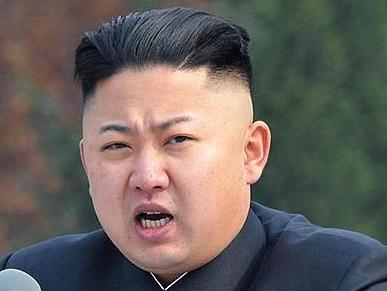
North Korean leader Kim Jong Un
Indeed, the current North Korea crisis, which could end up killing millions of people, can be viewed as a follow-on disaster to President George W. Bush’s Iraq War and President Barack Obama’s Libyan intervention. Those wars came after the leaders of Iraq and Libya had dismantled their dangerous weapons programs, leaving their countries virtually powerless when the U.S. government chose to invade.
In both cases, the U.S. government also exploited its power over global information to spread lies about the targeted regimes as justification for the invasions — and the world community failed to do anything to block the U.S. aggressions.
And, on a grim personal note, the two leaders, Saddam Hussein and Muammar Gaddafi, were then brutally murdered, Hussein by hanging and Gaddafi by a mob that first sodomized him with a knife.
So, the neoconservatives who promoted the Iraq invasion supposedly to protect the world from Iraq’s alleged WMDs — and the liberal interventionists who pushed the Libya invasion based on false humanitarian claims — may now share in the horrific possibility that millions of people in North Korea, South Korea, Japan and maybe elsewhere could die from real WMDs launched by North Korea and/or by the United States.
Washington foreign policy “experts” who fault President Trump’s erratic and bellicose approach toward this crisis may want to look in the mirror and consider how they contributed to the mess by ignoring the predictable consequences from the Iraq and Libya invasions.
Yes, I know, at the time it was so exciting to celebrate the Bush Doctrine of preemptive wars even over a “one percent” suspicion that a “rogue state” like Iraq might share WMDs with terrorists — or the Clinton Doctrine hailed by Secretary of State Hillary Clinton’s acolytes enamored by her application of “smart power” to achieve “regime change” in Libya.
However, as we now know, both wars were built upon lies. Iraq did not possess WMD stockpiles as the Bush administration claimed, and Libya was not engaged in mass murder of civilians in rebellious areas in the eastern part of the country as the Obama administration claimed.
Post-invasion investigations knocked down Bush’s WMD myth in Iraq, and a British parliamentary inquiry concluded that Western governments misrepresented the situation in eastern Libya where Gaddafi forces were targeting armed rebels but not indiscriminately killing civilians.
But those belated fact-finding missions were no comfort to either Saddam Hussein or Muammar Gaddafi, nor to their countries, which have seen mass slaughters resulting from the U.S.-sponsored invasions and today amount to failed states.
There also has been virtually no accountability for the war crimes committed by the Bush and Obama administrations. Bush and Obama both ended up serving two terms as President. None of Bush’s senior advisers were punished – and Hillary Clinton received the 2016 Democratic Party’s nomination for President.
As for the U.S. mainstream media, which behaved as boosters for both invasions, pretty much all of the journalistic war advocates have continued on with their glorious careers. To excuse their unprofessional behavior, some even have pushed revisionist lies, such as the popular but false claim that Saddam Hussein was to blame because he pretended that he did have WMDs – when the truth is that his government submitted a detailed 12,000-page report to the United Nations in December 2002 describing how the WMDs had been destroyed (though that accurate account was widely mocked and ultimately ignored).
Pervasive Dishonesty
The dishonesty that now pervades the U.S. government and the U.S. mainstream media represents another contributing factor to the North Korean crisis. What sensible person anywhere on the planet would trust U.S. assurances? Who would believe what the U.S. government says, except, of course, the U.S. mainstream media?
Remember also that North Korea’s nuclear program had largely been mothballed before George W. Bush delivered his “axis of evil” speech in January 2002, which linked Iran and Iraq – then bitter enemies – with North Korea. After that, North Korea withdrew from earlier agreements on limiting its nuclear development and began serious work on a bomb.
Yet, while North Korea moved toward a form of mutual assured destruction, Iraq and Libya chose a different path.
In Iraq, to head off a threatened U.S.-led invasion, Hussein’s government sought to convince the international community that it had lived up to its commitments regarding the destruction of its WMD arsenal and programs. Besides the detailed declaration, Iraq gave U.N. weapons inspectors wide latitude to search on the ground.
But Bush cut short the inspection efforts in March 2003 and launched his “shock and awe” invasion, which led to the collapse of Hussein’s regime and the dictator’s eventual capture and hanging.
Gaddafi’s Gestures
In Libya, Gaddafi also sought to cooperate with international demands regarding WMDs. In late 2003, he announced that his country would eliminate its unconventional weapons programs, including a nascent nuclear project.
Gaddafi also sought to get Libya out from under economic sanctions by taking responsibility for the 1988 bombing of Pan Am 103 over Scotland, although he and his government continued to deny carrying out the terror attack that killed 270 people.
But these efforts to normalize Libya’s relations with the West failed to protect him or his country. In 2011 when Islamic militants staged an uprising around Benghazi, Gaddafi moved to crush it, and Secretary of State Clinton eagerly joined with some European countries in seeking military intervention to destroy Gaddafi’s regime.
The United Nations Security Council approved a plan for the humanitarian protection of civilians in and around Benghazi, but the Obama administration and its European allies exploited that opening to mount a full-scale “regime change” war.
Prominent news personalities, such as MSNBC’s Andrea Mitchell, cheered on the war with the claim that Gaddafi had American “blood on his hands” over the Pan Am 103 case because he had accepted responsibility. The fact that his government continued to deny actual guilt – and the international conviction of Libyan Abdelbaset al-Megrahi was a judicial travesty – was ignored. Almost no one in the West dared question the longtime groupthink of Libyan guilt.
By October 2011, Gaddafi had fled Tripoli and was captured by rebels in Sirte. He was tortured, sodomized with a knife and then executed. Clinton, whose aides felt she should claim credit for Gaddafi’s overthrow as part of a Clinton Doctrine, celebrated his murder with a laugh and a quip, “We came; we saw; he died.”
But Gaddafi’s warnings about Islamist terrorists in Benghazi came back to haunt Clinton when on Sept. 11, 2012, militants attacked the U.S. consulate and CIA station there, killing Ambassador Christopher Stevens and three other Americans.
The obsessive Republican investigation into the Benghazi attack failed to demonstrate many of the lurid claims about Clinton’s negligence, but it did surface the fact that she had used a private server for her official State Department emails, which, in turn, led to an FBI investigation which severely damaged her 2016 presidential run.
Lessons Learned
Meanwhile, back in North Korea, the young dictator Kim Jong Un was taking all this history in. According to numerous sources, he concluded that his and North Korea’s only safeguard would be a viable nuclear deterrent to stave off another U.S.-sponsored “regime change” war — with him meeting a similar fate as was dealt to Hussein and Gaddafi.
Since then, Kim and his advisers have made clear that the surrender of North Korea’s small nuclear arsenal is off the table. They make the understandable point that the United States has shown bad faith in other cases in which leaders have given up their WMDs in compliance with international demands and then saw their countries invaded and faced grisly executions themselves.
Now, the world faces a predicament in which an inexperienced and intemperate President Trump confronts a crisis that his two predecessors helped to create and make worse. Trump has threatened “fire and fury” like the world has never seen, suggesting a nuclear strike on North Korea, which, in turn, has vowed to retaliate.
Millions of people on the Korean peninsula and Japan – and possibly elsewhere – could die in such a conflagration. The world’s economy could be severely shaken, given Japan’s and South Korea’s industrial might and the size of their consumer markets.
If such a horror does come to pass, the U.S. government and the U.S. mainstream media will surely revert to their standard explanation that Kim was simply “crazy” and brought this destruction on himself. Trump’s liberal critics also might attack Trump for bungling the diplomacy.
But the truth is that many of Washington’s elite policymakers – both on the Republican and Democratic sides – will share in the blame. And so too should the U.S. mainstream media.
Investigative reporter Robert Parry broke many of the Iran-Contra stories for The Associated Press and Newsweek in the 1980s.
Why North Korea’s Latest Missile Test Was a Humiliating Blow to US Missile Defense
Sputnik – 02.09.2017
Russian military observer Alexander Khrolenko explains how North Korea’s testing of more and more sophisticated missile systems is putting the US’s vast array of expensive missile defense systems to shame.
Last week, North Korea test launched its new Hwasong-12 intermediate range ballistic missile. The missile flew over Japan before falling into the Pacific Ocean, some 733 miles (1,180 km) east of Japan’s northern island of Hokkaido.
Several days later, the Japanese Ministry of Defense requested a record defense budget for the 2018 fiscal year, asking for some 5.25 trillion yen ($48.6 billion) for new ground and ship-based anti-air missiles, fighters, patrol ships and a submarine. The Ministry’s request includes a major push for the modernization of the country’s air defense network, and its anti-land and anti-ship missile capabilities.
Commenting on the missile test, and Japan’s response, RIA Novosti military observer Alexander Khrolenko wrote that Pyongyang’s latest test has demonstrated beyond a shadow of a doubt that all the sophisticated US missile defense systems in and around the Asian country are next to useless.
“Today,” the analyst explained, “Japan’s missile defense is provided by ships equipped with the American Aegis system (which features the SM-3 missile for exoatmospheric interception). In addition, Japan has ground-based Patriot-3 (PAC-3) systems for the destruction of missiles within the atmosphere.”
“However, all these means proved useless on August 29, when the North Korean ballistic missile flew over Japanese territory and fell 1,180 km from Cape Erimo in Hokkaido. In 14 minutes, the missile flew a total of 2,700 km, reaching a maximum altitude of 500 km.”
Although Japan reported no damage to any ships or aircraft from the test, Khrolenko noted that it was highly curious that they didn’t even attempt to shoot the rogue missile down. “They could have at least attempted to shoot it down, if only for training purposes,” the analyst wrote. “The world community would not condemn such a move, and Washington would have certainly supported Tokyo. However, US and Japanese missile defense systems only ended up tracking Hwaseong-12’s trajectory.”
“What’s even more interesting, of course, is how Japan may have intended to shoot down the North Korean missile flying at an altitude of 550 km, when the longest-range US SM-3 guided missile has a 250 km flight ceiling. With a target lock radius of 500 km, the Aegis system would not have been able to reach the missile even during its descent, either. All the more so, given that the target separated into three parts (possibly three warheads).”
With these facts in mind, Khrolenko suggested that the “record request by the Japanese Defense Ministry [actually] reflects the degree of panic within the camp of US allies; after all, this wasn’t the first time that a reason to doubt the omnipotence of US weapons, and specifically its ABM systems, presented itself.”
Last month, for instance, following threats from Pyongyang that they were prepared to stage a massed missile strike against Guam, the Pentagon responded that any such missile launch would be detected in a matter of minutes, and would lead to the prospect of full-scale war.
It was interesting, however, according to Khrolenko, that the Pentagon “did not specify whether the North Korean missiles would be intercepted. And this is fundamentally important when it comes to predicting losses and the outcome of a war (which would not leave Japan unaffected, either).”
Moreover, according to the analyst, the North Korean missile launch proved particularly humiliating in light of the fact that the same day the launch took place, Japanese troops were conducting air defense drills at the Yokota Air Base in western Tokyo, where they practiced the deployment of Patriot-3 interceptors.
“From a military perspective, the exercises coincided successfully with the test of North Korea’s new ballistic missile. Pyongyang ‘played ball’, but Washington did not accept the unexpected ‘pitch’. Servicemen looked on anxiously into the skies, and continued to practice the speedy deployment and setup of the PAC-3’s components, as if the motions were more important than the actual result.”
Factually, Khrolenko wrote, the true effectiveness of the US’s numerous and costly missile defense systems has yet to be proven in conditions resembling those on a battlefield.
“Only once, in February 2013, did an SM-3 interceptor, launched from the USS Lake Erie missile cruiser, destroy USA-193, a defective US satellite at an altitude of 247 km. The target simulated a medium-range ballistic missile (even though the latter do not fly along an orbit). The test was simplified as much as possible, the parameters of the flight were known in advance, as was the target sector. External target designation was provided from the STSS-D tracking satellite, which may not be handy in a real combat situation.”
“One more example: tests of the US missile defense system during NATO’s Maritime Theater Missile Defense drills in 2015 showed that… numerous alliance ships equipped with the Aegis combat information management system were capable of knocking out only a single, less than perfect short range ballistic missile – the Terrier Orion, and probably only at subsonic speed. The degree of effectiveness of such missile defenses in conditions of a mass strike remains unknown, but the degree of simplification involved for the testing suggests it’s rather low.”
In effect, Khrolenko noted that North Korea’s latest missile test has “created a paradoxical parity of forces in that country’s confrontation with the United States.” In these circumstances, he noted, Washington would be advised to avoid subjecting its regional allies to danger.
Putin on N. Korea crisis: Tensions ‘balancing on brink of large-scale conflict’
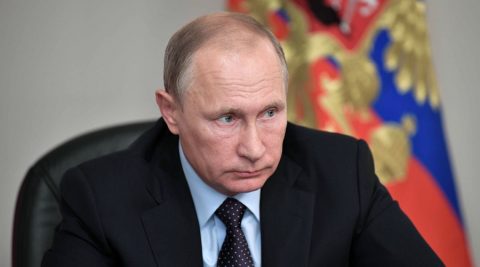
RT | September 1, 2017
Attempts to pressure North Korea into stopping its nuclear missile program through sanctions are “misguided and futile,” Russian President Vladimir Putin warned, adding that threats and provocations would only add more fuel to the fire.
“The situation on the Korean Peninsula, where tensions have grown recently, is balancing on the brink of a large-scale conflict. Russia believes that the policy of putting pressure on Pyongyang to stop its nuclear missile program is misguided and futile,” Putin, who is due to attend a summit of the BRICS nations in China next week, wrote ahead of his trip.
“The region’s problems should only be settled through a direct dialogue of all the parties concerned without any preconditions. Provocations, pressure and militarist and insulting rhetoric are a dead-end road,” he noted.
Russia and China have created a roadmap for a settlement on the Korean Peninsula that is designed to promote the gradual easing of tensions and the creation of a mechanism for lasting peace and security, the Russian leader added.
The Russian-Chinese initiative of “double freezing,” put forward by the Russian and Chinese foreign ministers on July 4, is designed to cease any missile launches and nuclear tests by Pyongyang, as well as large-scale military exercises by Washington and Seoul.
Last month, the UN Security Council unanimously agreed to impose more restrictive measures on Pyongyang, banning exports of coal, iron, lead, and seafood. The move came in response to North Korea’s missile launches in July, which it, as well as South Korea and the US, claimed were intercontinental ballistic missile (ICBM) tests. Moscow has questioned the claim, arguing North Korea was testing intermediate range rockets.
China announced a full ban on imports of coal, iron, and seafood, among other goods from North Korea as of August 15, thus cutting key export revenues for Pyongyang.
Russian Foreign Minister Sergey Lavrov said on Friday that all conceivable and unimaginable sanctions against North Korea have already been imposed, to no avail.
“All possible sanctions aimed at preventing North Korea from using a map of external relations for the development of missile and nuclear programs banned by the [UN] Security Council, all conceivable and even unimaginable sanctions, which have little to do directly with these areas of DPRK’s [the Democratic People’s Republic of Korea] activities, have already been adopted by the Security Council. In addition, unilateral sanctions have been adopted, which we consider illegitimate,” Lavrov said.
In a bid to ease tensions, Moscow will seek the resumption of six-party talks on the situation on the Korean Peninsula, the Russian Foreign Minister noted.
“We will still seek to resume these talks,” he said, adding that “we know that Americans are talking with representatives of Pyongyang via some semi-secret, semi-official, semi-academic channel.”
Moscow will be happy “if they agree on some de-escalation, so that all parties cool down, sit down at the negotiating table and start talking.”
“We have a common goal – denuclearization of the Korean Peninsula, so that neither the North nor the South, the US and us [Russia] have nuclear weapons,” Lavrov said.
Featured Video
or go to
Aletho News Archives – Video-Images
From the Archives
Israel Would Have No Qualms About USS Liberty-Style FALSE FLAG If Iran Campaign Falters – Analysts
By Ilya Tsukanov – Sputnik – 18.06.2025
Donald Trump is mulling whether or not to join Israel’s aggression against Iran as Tel Aviv faces problems sustaining its defenses against growing counterstrikes, and apparently lacks a realistic game plan for an end to hostilities after failing to achieve its goals. Analysts told Sputnik how the US could be ‘nudged’ into the conflict.
“The US is already assisting Israel with supplies, intel, refueling support, etc. One of the many US posts in the region could be attacked for a casus belli,” former Pentagon analyst Karen Kwiatkowski explained.
“If Trump doesn’t comply with Israel’s demand” and join its aggression voluntarily, “a false flag may be needed” to drag the US in, Kwiatkowski, retired US Air Force Lt. Col.-turned Iraq War whistleblower, fears.
Netanyahu has a diverse array of options at his disposal, according to the observer, including:
- a false flag against US assets abroad blamed on Iran or one of its Axis of Resistance allies, like the Houthis
- a US domestic attack or assassination blamed on Iran
- Iranian air defenses ‘accidentally’ hitting a civilian jetliner carrying Americans
- use of a dirty bomb or nuclear contamination somewhere in the region blamed on Iran
- even blackmailing by threatening to use nukes against Iran if the US doesn’t join the fight
Kwiatkowski estimates that Israel probably has “enough blackmail power” against President Trump and Congress to avoid the necessity of a false flag operation, but a “USS Liberty-style” attack, targeting the soon-to-be-retired USS Nimitz supercarrier that’s heading to the Middle East, for example, nevertheless cannot be ruled out entirely, she says. … continue
Blog Roll
 Aletho News
- Outlasting the Superpower: The Reasons Why Iran is Beating uhe US and Israel
- Top PMU commander, over a dozen fighters killed in new US strikes on Iraq
- Is Netanyahu’s war gamble threatening the future of ‘Israel’?: FT
- Smotrich calls for annexation of South Lebanon to Litani River
- Echos of Gallipoli? Hormuz and the Geography of Hubris
- Pakistan PM backs Iran’s right to self-defense amid tensions
- Hungary blasts ‘fake’ EU accusation
- SAFE Debt Trap: Poland’s €43.7 Billion Bet on Unipolar Illusion
- War on Iran threatens global Gulf capital flows: FT analysis
- Mossad De Facto Admits To Inciting Riots In Iran
- If Americans Knew
- Instead of taking Joe Kent’s claims seriously, the media is disregarding him as an antisemite
- Joe Kent’s Explosive Interviews about his Resignation over the Iran War
- Israel poised to take over southern Lebanon; settlers wreak havoc in West Bank – Not a ceasefire Day 165
- From Sde Teiman, the truth about Israel’s military justice system has been set free
- Child denied life-saving bone marrow transplant by Israel ‘because he is from Gaza’
- Raffi Berg: BBC Middle East Editor Exposed as CIA, Mossad Collaborator
- Jerusalem Archbishop Rebukes Netanyahu’s Statements on Christianity
- US to embed Palantir AI across entire military: Report
- Israeli-US war on Iran to drag on “a few more weeks” – Not a ceasefire Day 164
- Lebanon deaths top 1,200; Palantir AI to be embedded across US military – Not a ceasefire Day 163
- No Tricks Zone
- Devastating Assessment Of Comirnaty Vaccine By Former Senior Pfizer Europe Toxicologist
- New Study: CO2 Is ‘Effectively Negligible’ As An Explanatory Climate Change Factor Since 2000
- Former Pfizer Toxicologist Dr. Helmut Sterz Tells Bundestag Hearing Pfizer Vaccine Should Have Never Been Approved
- Energy Expert: Germany’s Nuclear Phaseout Was A “500 Billion Euro Mistake”
- New Research: South Australia’s Mid-Holocene Sea Surface Temperatures Were 4°C Warmer Than Today
- Storing Green Energy To Last Germany 10 Days Would Require A 60-Million Tonne Battery
- New Studies: UK Sea Levels Were 4 Meters Higher Than Today During The Mid-Holocene
- Destructive Green New Deal: German Energy And Metal Group Warns Of Drastic Crisis
- New Study Documents A 20-Year Pause In Arctic Sea Ice Decline – Driven By Internal Variability
- Wake-up Call: Survey Shows Majority Of Germans Now Favor Postponing Climate Targets!
 Aletho News