Five unanswered questions about the NSA’s surveillance programs
By Brendan Sasso | The Hill | 07/07/13
Leaks by former National Security Agency contractor Edward Snowden have provided new insight into how the government monitors domestic and foreign communications for threats to national security.
Although the government has disclosed some additional details about the programs in response to the leaks, important questions remain about the nature and scope of the surveillance programs.
Without that additional information, it is impossible to know the extent to which the government is peering into the lives of Americans in the name of national security, according to privacy advocates.
1. What other data is being collected under the Patriot Act?
The first leak from Snowden was a secret court order demanding that Verizon turn over vast batches of “metadata” on its U.S. customers. The data included the time and duration of calls, as well as the phone numbers involved, but not the contents of the conversations. The data collection was authorized under Section 215 of the Patriot Act.
The Director of National Intelligence (DNI) clarified that while the government does obtain data on millions of U.S. phone calls (and from more companies than just Verizon), it only “queries” the database a limited number of times for specific national security reasons.
Michelle Richardson, a legislative counsel for the American Civil Liberties Union (ACLU), questioned whether the NSA is using Section 215 to collect more than just phone records.
“Is it also financial data or Internet records or other things?” she asked. “Knowing now that the court has been so broad in its interpretation, it’s even more important to figure out what else they’re getting.”
Greg Nojeim, a senior counsel for the Center for Democracy and Technology, said the NSA is likely using the Patriot Act to collect the credit card records and IP addresses of millions of people within and outside of the United States.
2. How broad are the programs?
How many people have been spied on through the NSA programs remains unclear. According to the NSA, it queried its massive database of phone records fewer than 300 times in 2012. But the agency did not disclose figures on other years or how many phone numbers were accessed in those queries.
Richardson explained that a single query could be an algorithm that scans the database and returns information on many people.
The other major program revealed by Snowden is the NSA’s Internet surveillance program, called PRISM. Unlike the phone record collection program under the Patriot Act, the NSA uses PRISM to access the contents of communications, such as emails, video chats, photographs and other information.
According to the DNI, the NSA only accesses those online records if there is a “foreign intelligence purpose” and the target is “reasonably believed” to be outside of the U.S. The program is authorized by Section 702 of the Foreign Intelligence Surveillance Act, and the searches require approval by a secret FISA court.
The NSA has not disclosed how many people it has targeted under Section 702 or how many people were spied on incidentally as part of the program.
“We have no idea how many U.S. persons have had their communications swept up,” said Sharon Bradford Franklin, senior counsel for the Constitution Project.
3. What’s the legal rationale?
The NSA has insisted the surveillance programs comply with the law and are overseen by independent FISA courts. But the opinions of those courts are secret, so little is known about how the courts are enforcing privacy protections or why they signed off on certain surveillance methods.
Section 215 of the Patriot Act allows the government to collect business records if they are “relevant” to a terrorism investigation. The FISA courts have determined that that provision allows the NSA to collect records on virtually all phone calls within and outside of the U.S. Why the court determined that so much data is “relevant” to a terrorism investigation remains unclear.
“Generally we don’t know the legal rationale being offered by the administration and being accepted by the FISA court to justify these particular types of surveillance programs,” Bradford Franklin said. “We should not have secret law in a democracy.”
4. Is the NSA still collecting email records?
One of the latest leaks revealed that beginning in 2001, the NSA collected vast amounts of email records. The NSA was able to identify the email accounts that sent and received messages, as well as IP addresses. The data collection did not include the contents of the emails.
The Obama administration confirmed the existence of the program, but said it ended in 2011 for “operational and resource reasons.”
One major question, according to privacy advocates, is whether the government is still able to obtain similar email records through a separate program.
5. Are there other programs that we don’t know about?
Although the NSA has provided some details about the programs leaked by Snowden, it is unclear what other programs exist and how they work together as part of a broad surveillance strategy.
“There’s this giant surveillance superstructure out there that we’re finally getting glimpses of, but there’s still a lot of questions of how does the whole thing work,” Richardson said.
Related articles
New Snowden leak: Australia’s place in US spying web
RT | July 8, 2013
Ex-NSA contractor and whistleblower Edward Snowden has disclosed his first set of documents outlining Australia’s role in NSA surveillance programs, picking out four facilities in the country that contribute heavily to US spying.
The locations of dozens of the US’s and associated countries signal collection sites have been revealed by Snowden, who leaked classified National Security Agency maps to US journalist Glenn Greenwald, which were then published in the Brazilian newspaper O Globo.
The sites all play a role in the collection of data and interception of internet traffic and telecommunications on a global level.
Australian centers involved in the NSA’s data collection program, codenamed X-Keyscore, include Joint Defence Facility Pine Gap in central Australia and three Australian Signals Directorate facilities: the Shoal Bay Receiving Station in the country’s north, the Australian Defence Satellite Communications Facility on the west coast, and the naval communications station HMAS Harman outside the capital, Canberra.
New Zealand also plays a role, with the Government Security Communications Bureau facility at Waihopai, on the northern point of South Island, also contributing to the program.
X-Keyscore is described as a “national Intelligence collection mission system” by US intelligence expert William Arkin, according to Australian newspaper The Age. It processes all signals prior to being delivered to various “production lines” that deal with more specific issues including the exploration of different types of data for close scrutiny.
The different subdivisions are entitled Nucleon (voice), Pinwale (video), Mainway (call records) and Marina (internet records).
A spokesman for Australian Prime Minister Kevin Rudd declined to comment on the revelatory map, saying that it was not government practice to comment on intelligence matters, according to national broadsheet The Australian.
Australia is one of the “Five Eyes” – an alliance of intelligence-sharing countries which include of the US, United Kingdom, Canada, Australia and New Zealand.
When documents were published pertaining to the British signal intelligence agency, GCHQ’s “Tempora” program, Snowden reportedly commented that the other partners in the “Five Eyes” intelligence “sometimes go even further than the [National Security Agency] people themselves.”
“If you send a data packet and if it makes its way through the UK, we will get it. If you download anything, and the server is in the UK, then we get it,” he said.
In an interview published online last weekend in advance of its printing in German magazine Der Speigel this week, Snowden argued that the NSA was ‘in bed with the Germans’ commenting that the organization of intelligence gathering in countries involved with the organization is such that political leaders are insulated from the backlash, going on to denounce “how grievously they’re violating global privacy.”
Germany reacted to the report on Monday, with German chancellor Angela Merkel’s spokesman, Steffen Seibert, telling Reuters that the Federal Intelligence Agency’s (BND) cooperation with the NSA “took place within strict legal and judicial guidelines and is controlled by the competent parliamentary committee.”
The US and its affiliates have intelligence facilities distributed worldwide in a variety of US embassies, consulates and military facilities. In an earlier report by Der Spiegel, also based on revelations by Snowden, it was revealed that the NSA bugged EU diplomatic offices and gained access to EU internal computer networks.
Related articles
- Snowden links NZ to US spy programme (stuff.co.nz)
- Snowden reveals Australia’s links to US spy web (smh.com.au)
- Snowden releases information about Australian Intelligence gathering programs. (theage.com.au)
Brazil expresses deep concerns over US spying activities
Press TV – July 7, 2013
Brazil has expressed serious concerns over a report which says the United States has been spying on Brazilian companies and individuals for a decade.
Brazil’s O Globo newspaper reported on Sunday that the US National Security Agency (NSA) has collected data on billions of telephone and email conversations in the South American country.
The Globo report said that information released by US surveillance whistleblower Edward Snowden reveals that the number of telephone and email messages logged by the NSA in the 10-year period was near to the 2.3 billion captured in the US.
Brazilian Foreign Minister Antonio Patriota expressed “deep concern at the report that electronic and telephone communications of Brazilian citizens are being the object of espionage by organs of American intelligence.”
“The Brazilian government has asked for clarifications” through the US Embassy in Brasilia and the Brazilian Embassy in Washington, he said.
Patriota also said Brazil will ask the United Nations for measures “to impede abuses and protect the privacy” of Internet users, laying down rules for governments “to guarantee cybernetic security that protects the rights of citizens and preserves the sovereignty of all countries.”
The US Embassy in Brazil refused to comment over the issue.
But the Office of the Director of National Intelligence in the United States issued a statement saying, “The US government will respond through diplomatic channels to our partners and allies in the Americas … While we are not going to comment publicly on specific alleged intelligence activities, as a matter of policy we have made clear that the United States gathers foreign intelligence of the type gathered by all nations.”
The chairman of the US Joint Chiefs of Staff, Gen. Martin Dempsey, admitted on Sunday that Snowden’s exposés have seriously damaged US ties with other countries. “There has been damage. I don’t think we actually have been able to determine the depth of that damage.”
Snowden, a former CIA employee, leaked two top secret US government spying programs under which the NSA and the Federal Bureau of Investigation (FBI) are eavesdropping on millions of American and European phone records and the Internet data from major Internet companies such as Facebook, Yahoo, Google, Apple, and Microsoft.
On June 9, Snowden admitted his role in the leaks in a 12-minute video recorded interview published by The Guardian.
In the interview, he denounced what he described as systematic surveillance of innocent US citizens, saying his “sole motive is to inform the public as to that which is done in their name and that which is done against them.”
The NSA scandal took even broader dimensions when Snowden revealed information about its espionage activities targeting friendly countries.
Snowden has been holed up at Moscow’s Sheremetyevo Airport since June 23 when he travelled from Hong Kong to avoid US extradition.
He has already sought asylum in more than two dozen countries. Washington has asked these countries not to provide asylum to Snowden.
Three Latin American countries — Nicaragua, Bolivia, and Venezuela — have offered to grant asylum to Snowden.
Related article
NSA spies in bed with Germany, other Western states: Snowden
Press TV – July 7, 2013
U.S. intelligence leaker Edward Snowden said the National Security Agency (NSA) has massive spying partnerships with other Western states that are now grumbling about the agency’s surveillance programs.
He made the comments in an interview with U.S. cryptography expert Jacob Appelbaum and documentary filmmaker Laura Poitras before revealing the NSA’s internal and global surveillance programs last month.
NSA spies are “in bed together with the Germans and most other Western states,” Snowden said in remarks published by the German news weekly Der Spiegel on Sunday.
The fugitive leaker added that the NSA has a department called the Foreign Affairs Directorate which coordinates work with Western spying agencies.
Snowden said the NSA, for example, provides Germany’s BND foreign intelligence agency with “analysis tools” for data passing from regions like the Middle East through Germany.
The former NSA contractor has also revealed that the American agency spies on European Union offices in New York, Washington and Brussels, drawing ire from European leaders, especially Germany.
The NSA, according to top secret documents disclosed by Snowden, also collected around half a billion telephone calls, emails or mobile phone text messages and Internet chat entries in Germany per month.
Germany demanded an immediate explanation from the U.S. over the surveillance programs.
Justice minister, Sabine Leutheusser-Schnarrenberger, strongly condemned the U.S. spying, saying it was reminiscent of “the methods used by enemies during the Cold War.”
Snowden, 30, has reportedly holed up in the transit area of Moscow’s Sheremetyevo International Airport since arriving on a flight from Hong Kong on June 23. He is wanted in the US on espionage charges.
Related articles
‘Restore the Fourth’: Reddit, Mozilla, thousands of people set for July 4 NSA spying protest
RT | July 3, 2013
Thousands of websites will launch a July 4 online protest against the NSA surveillance programs. Reddit, WordPress, and Mozilla will take part in the ‘Restore the Fourth’ campaign online, while live protests take place in cities across the US.
‘Restore the Fourth’ is aimed at restoring the fundamentals of the Fourth Amendment – the part of the Bill of Rights which protects citizens against unlawful searches and seizures. Participants will display an online banner which reads, “This 4th of July, we stand by the 4th Amendment and against the U.S. government’s surveillance of internet users.”
The campaign, which was spawned on Reddit, has the support of several privacy and press freedom advocacy organizations, including Mozilla, Free Press, the Electronic Frontier Foundation, the Freedom of the Press Foundation, and ColorOfChange.org.
The rally was largely organized by Fight for the Future – another non-profit agency which fights against internet censorship. The organization’s co-founder, Tiffiniy Cheng, said in a statement that “the NSA programs that have been exposed are blatantly unconstitutional, and have a detrimental effect on free speech and freedom of press worldwide.” The rally is expected to be Fight for the Future’s largest online mobilization since its actions against the Stop Online Piracy Act (SOPA).
But the protest doesn’t stop online. Organizers are planning live protests in dozens of US cities, including New York, Philadelphia, Boston, Washington, D.C., Los Angeles, San Francisco, Houston, and Atlanta. Doug MacArthur, a member of Restore the Fourth’s national board and moderator on Reddit’s r/news, expects between 10,000 and 20,000 people to take part in the protests in the nation’s larger cities.
MacArthur stressed the need for the protest, largely because mainstream media is failing to adequately cover the NSA leaks and what that means for everyday citizens.
“I think if you are on social media right now and political blogs, this might seem like it’s an issue that’s all over the political blogs. But if you turn on CNN or Fox or MSNBC, you’ll see that a lot of the more mainstream channels aren’t covering this as much as you might be assuming. So I really think it’s important we get more citizens aware of this issue,” he said, as quoted by Mashable.
Free Press CEO and President Craig Aaron echoed MacArthur’s sentiments. “We need to bring these government and corporate activities into the light of day, and the only way that will happen is if millions more people get involved and demand accountability, demand change, demand the truth,” he said in a Tuesday press conference.
However, it’s not just internet activists getting involved in the fight – one Hollywood celebrity has been very vocal in expressing his views on the NSA’s surveillance practices.
“How long do we expect rational people to accept using terrorism to justify and excuse endless executive and state power?” actor John Cusack said during a press conference announcing the protests. “Why are so many in our government, our press, our intellectual class afraid of an informed public?”
Cusack, who is a board member of the Freedom of the Press Foundation, complained that many of those defending the NSA surveillance programs are focusing on supposed character flaws of former NSA contractor Edward Snowden instead of questioning the program’s legality.
Harvey Anderson, senior vice president of business and legal affairs at Mozilla, agrees with Cusack. He said in a statement that the spotlight on Snowden is a “big distraction to avoid focusing on the invasions that have actually been occurring.” The lack of transparency about the surveillance programs “undermines the openness of the internet,” he added.
There has been a massive outcry against the surveillance practices since former NSA contractor Edward Snowden leaked sensitive information in May. In just three weeks, StopWatching.us has collected more than 531,000 signatures from people calling for Congress to fully disclose details about the NSA surveillance programs.
Snowden is currently held up in the international transit zone of Moscow’s Sheremetyevo airport. He is unable to travel as his passport is invalid. Washington has issued an extradition order against Snowden, calling for international cooperation in returning him to American soil.
The whistleblower has so far made asylum requests for more than a dozen countries, with ten nations already denying him refuge. Venezuela says it will consider Snowden’s request when it is received.
Related article
NSA Can Neither Confirm Nor Deny Anything Without Causing ‘Exceptionally Grave Damage’ To National Security
By Tim Cushing | techdirt | June 26, 2013
When you find out your own government is harvesting your phone metadata and internet activity, what do you do? If you’re Jeff Larson at ProPublica, you file a FOIA request in hopes of getting the NSA to cough up some of the info it’s collected on you.
Shortly after the Guardian and Washington Post published their Verizon and PRISM stories, I filed a freedom of information request with the NSA seeking any personal data the agency has about me. I didn’t expect an answer, but yesterday I received a letter signed by Pamela Phillips, the Chief FOIA Officer at the agency (which really freaked out my wife when she picked up our mail).
Yes, Larson received three pages of unredacted excuses and explanations as to why the NSA would not be letting him in on what it had gathered, as well as some circuitous explanations as to why it was unable to confirm the existence of the data he requested.
The letter, a denial, includes what is known as a Glomar response — neither a confirmation nor a denial that the agency has my metadata. It also warns that any response would help “our adversaries”:
Any positive or negative response on a request-by-request basis would allow our adversaries to accumulate information and draw conclusions about the NSA’s technical capabilities, sources, and methods. Our adversaries are likely to evaluate all public responses related to these programs. Were we to provide positive or negative responses to requests such as yours, our adversaries’ compilation of the information provided would reasonably be expected to cause exceptionally grave damage to the national security.”
“Reasonably be expected to cause exceptionally grave damage to the national security…” That’s a beauty, as is the entire paragraph. Instead of “Yes, we have some stuff but we can’t let you look at it,” or “No, we don’t have your stuff, but thanks for asking,” we get “We can neither confirm nor deny we have your stuff because a simple yes or no would give terrorists the upper hand.” Alternately: “Sorry we can’t be more specific. Can I offer you some fear instead?” Fortunately, as Larson notes, he won’t be charged a fee for this non-answer to his request.
The NSA’s FOIA responder takes a little time to imply that the media possibly has all the facts wrong.
As you may be also be aware, there has been considerable speculation about two NSA intelligence programs in the press /media.
If by “considerable speculation,” she means “actual document leaks,” then we’re on the right track. Yes, there’s been plenty of speculation but there are several exposed documents that give this speculation a solid starting point. The non-confirmation/non-denial continues, spilling onto the next page after a brief respite where the NSA rolls out the talking points and proclaims everything to be firmly above-board.
Therefore, your request is denied because the fact or the existence or non-existence of responsive records is a currently and properly classified matter in accordance with Executive order 13526, as set forth in subparagraph of section 1.4.
The NSA: so secure even non-existing records are classified.
The response letter explains the other reasons everything remains under wraps. Larson is welcome to file an appeal but the lengthy list of exemptions included in this response gives the indication that actually doing so would be a waste of everyone’s time. This leaves Larson with only one legitimate option, the same option the ACLU and EFF find themselves pursuing with increasing frequency.
So where does this leave me? According to Aaron Mackey, a staff attorney at the Reporter’s Committee for Freedom of the Press, “If you wanted to see those records you would have to file a lawsuit.”
That’s the way it goes in the surveillance state. Information doesn’t want to be free. It wants to be litigated.
Senators say the NSA is still lying to Congress – NSA removes fact sheets
RT | June 25, 2013
Two Democrats on the Senate Select Committee on Intelligence say the National Security Agency provided “inaccurate” and “misleading” information to the American public about the government’s vast surveillance operations.
Senators Ron Wyden and Mark Udall sent a letter to NSA Director Gen. Keith Alexander on Monday asking him to make revisions to a set of fact sheets that were released by his agency to quell concerns about domestic surveillance in the wake of leaked documents attributed to former intelligence contractor Edward Snowden earlier this month.
The Guardian newspaper has been publishing top-secret documents provided by Snowden that he says proves the NSA operates secretive spying programs that retain information on United States citizens under Section 702 of the Foreign Intelligence Surveillance Act (FISA) and Section 215 of the PATRIOT Act. Snowden claims those two statutes are abused in order to surveil American citizens, an argument Gen. Alexander’s office recently attempted to counter by releasing a four-page set of bullet points outlining what the US government can and can’t do under federal law.
According to Sens. Wyden and Udall, the NSA’s response isn’t in-tune with what they’ve been told of the programs. “We were disappointed to see that this fact sheet contains an inaccurate statement about how the Section 702 authority has been interpreted by the US government,” they write Gen. Alexander. “In our judgment this inaccuracy is significant, as it portrays protections for Americans’ privacy as being significantly stronger than they actually are.”
But while the fact sheets have been made available online, Wyden and Udall can’t explain in their public letter what their allegations are in reference to since the lawmakers’ own knowledge of the clandestine operations are not allowed to be discussed, even among the constituents who elected them to the Senate. Instead, they wrote that they’ve “identified this inaccurate statement in the classified attachment” sent to Alexander.
Elsewhere, the lawmakers rejected the NSA’s claim that, “Any inadvertently acquired communication of or concerning a US person must be promptly destroyed if it is neither relevant to the authorized purpose nor evidence of a crime.”
“We believe that this statement is somewhat misleading,” replied the senators, “in that it implies that the NSA has the ability to determine how many American communications it has collected under Section 702, or that the law does not allow the NSA to deliberately search for the records of particular Americans. In fact, the intelligence community has told us repeatedly that it is ‘not reasonably possible to identify the number of people located in the United States whose communications may have been reviewed under the authority’ of the FISA Amendments Act.”
In a tweet sent out Monday evening, Sen. Wyden again said the FISA fact sheet included a “significant inaccuracy.”
Nowhere does the senators’ response include allegations of any discrepancies in the Section 215 fact sheet, but both Wyden and Udall have raised questions about how the government interprets that provision previously. “We believe most Americans would be stunned to learn the details of how these secret court opinions have interpreted Section 215,” they wrote in a joint letter to Attorney General Eric Holder last year. “As we see it, there is now a significant gap between what most Americans think the law allows and what the government secretly claims the law allows. This is a problem, because it is impossible to have an informed public debate about what the law should say when they public doesn’t know what its government thinks the law says.”
In their letter to Gen. Alexander this week, both Udall and Wyden wrote that they believe the US government should have “broad authorities to investigate terrorism and espionage,” and that it’s possible to “aggressively pursue terrorists without compromising the constitutional rights of ordinary Americans.”
“Achieving this goal depends not just on secret courts and secret congressional hearings, but on informed public debate as well,” they wrote.
But while Sens. Udall and Wyden have been long critical of surveillance powers provided through FISA and the PATRIOT Act, their take on the revelations exposed by Mr. Snowden differs drastically with that of President Barack Obama and many leading figures of his administration. Mr. Obama, Gen. Alexander and Mr. Holder have all defended the practices used by the NSA and say that no constitutional violations occur due to privacy safeguards in place, as have Senate Intelligence Chair Dianne Feinstein (D-Calif.).
“I think it’s important to recognize that you can’t have 100 percent security and also then have 100 percent privacy and zero inconvenience,” President Obama said earlier this month.
With respect to Section 702 and Section 215, Obama said, “These are programs that have been authorized by broad bipartisan majorities repeatedly since 2006. And so I think at the onset it is important to understand that your duly elected representatives have been consistently informed on exactly what we’re doing.”
Edward Snowden revealed himself as the contractor responsible for the leaks published by The Guardian less than one week after the paper first began releasing information on the programs. He gave several interviews in Hong Kong before flying to Moscow where he remains today, according to both the US and Russian presidents. The anti-secrecy website WikiLeaks announced Monday that Snowden has asked for asylum from several countries, including Iceland and Ecuador.
Related article
- NSA removes fact sheets (politico.com)
NSA Scandal: How Leaks Advance Liberty and Resist Tyranny
Using technology to keep the government in check
By Jerry Brito | Reason | June 18, 2013
We now know what we have long suspected: that the National Security Agency is collecting the phone call records of all Americans. And we are now justified in suspecting what we have long feared: that it is also keeping a permanent backup copy of everything that happens on the Internet, ready to be rewound and replayed in the future. Such a massive surveillance apparatus is a threat not only to privacy, but also to liberty. So what hope do we have that such power can be kept in check, and that we don’t succumb to ever greater tyranny?
If the secret surveillance itself is any indication, then the separation of powers is not up to the task. According to President Obama, domestic surveillance programs are “under very strict supervision by all three branches of government.” Yet it doesn’t seem very strict when more than half of the Senate couldn’t be bothered to show up last week for a major briefing by the government’s top intelligence officials.
“Strict supervision” also doesn’t seem very meaningful when you consider that the FISA Court is a hand-picked non-adversarial specialist court that approved every surveillance request it got last year. Experience suggests that specialist courts tend to get captured by their bar, and in the case of the FISA Court, that means just the government.
More to the point, a secret court issuing secret orders based on secret interpretations of the law makes any debate or commentary impossible. Even when there is a will on the part of some lawmakers to carry out oversight, executive branch officials will apparently lie under oath. So if not on the Constitution and its institutions, on what can we rely to keep government power in check?
Technology might be the answer, but not in the way you might think.
Yes, we can encrypt our communications by using PGP, Tor, and OTR chat, and we can transact using Bitcoin. These are invaluable tools of resistance to censorship and oppression. Ultimately, though, most people won’t use them because they won’t see any immediate benefit to justify the effort. And in a world where few use these tools, those who do will perversely draw attention to themselves.
Instead, technology might help keep government power in check the same way it helps it grow: by making it impossible for anyone to keep secrets—including the government itself.
When Daniel Ellsberg decided to leak the Pentagon Papers in 1969, he spent a year sneaking out the 7,000 classified pages one briefcaseful at a time. He spent countless hours each evening in front of a primitive photocopier, and he spent thousands of dollars on the endeavor. In contrast, Bradley Manning and Edward Snowden’s leaks of considerably more data were relative cakewalks. The same digital technology that makes it possible to capture and store vast quantities of surveillance information also makes it possible for the first time in history to copy and release hundreds of thousands of pages of classified information.
A surveillance state as big as the one that’s now coming into view necessarily means that there are more secrets and more people with access to those secrets than ever before. More than 92 million documents were classified in 2011, up from 76 million the year before, and 23 million when President Obama took office. All of that data is digital, and therefore eminently reproducible.
There are also over 4.2 million persons with security clearances, and over a million of those can access top secret documents. Contractors, like Snowden, are an indispensable part of the system, and there are almost 2,000 private companies working for the government on programs related to homeland security and intelligence.
There simply has to be that many documents and that many people with access in order to build and run such a massive edifice. The larger it grows, however, the more untenable it becomes. As Julian Assange pointed out in a pre-Wikileaks essay, an organization keeps secrets because if what it’s doing is revealed, it will induce opposition. A small criminal conspiracy may be able to keep its secrets by limiting its numbers and not writing anything down. A large conspiracy, on the other hand, can’t function unless it systematizes its activities, and that involves a long paper trail and lots of confidants, which makes it more difficult to prevent leaks.
“The more secretive or unjust an organization is, the more leaks induce fear and paranoia in its leadership and planning coterie,” Assange wrote. To cope, such an organization can shrink and do less, he wrote, or introduce more security and controls and thus inefficiency. Either way, the organization’s power will contract.
We’re already witnessing such a reaction to Snowden’s leaks. On Thursday Sen. Dianne Feinstein (D-Calif.) said that Congress plans to draft legislation limiting private contractor access to secret documents. “We will certainly have legislation which will limit [or] prevent contractors from handling highly classified data,” she said. Today NSA director Gen. Keith Alexander announced that the agency will implement a “two-person rule” that would require anyone copying data to do so with another person present—a buddy system that potentially halves the NSA’s efficiency.
In attempting to limit leaks, such legislation would also effectively limit government’s power. That’s the happy dilemma the technology introduces. Digital communications makes achieving and exploiting “total information awareness” possible, but it also makes it almost impossible to keep the resulting corruption under wraps. Secrecy just doesn’t scale.
Related articles
- Leaked: NSA’s Talking Points Defending NSA Surveillance (alethonews.wordpress.com)
- Obama Speaks with Forked Tongue on Surveillance (alethonews.wordpress.com)
- Spying on the World From Domestic Soil (alethonews.wordpress.com)
- Steve Chapman on Why the NSA Leaks Aren’t Putting Americans at Risk (reason.com)
Spying on the World From Domestic Soil
By Katitza Rodriguez | EFF | June 21, 2013
The world is still reeling from the series of revelations about NSA and FBI surveillance. Over the past two weeks the emerging details paint a picture of pervasive, cross-border spying programs of unprecedented reach and scope: the U.S. has now admitted using domestic networks to spy on Internet users both domestically and worldwide. The people now know that foreign intelligence can spy on their communications if they travel through U.S. networks or are stored in U.S. servers.
While international public outrage has justifiably decried the scope and reach of these revelations, carte blanche foreign intelligence surveillance powers over foreigners are far from new. In the U.S., foreign intelligence has always had nearly limitless legal capacity to surveil foreigners because domestic laws and protections simply don’t reach that surveillance activity.
This legal framework, with no protection for foreigners and little oversight besides, has been exacerbated by the growth in individuals now living their lives online, who conduct their most intimate communications in cloud services that are hosted in the U.S. and across different jurisdictions. To make matters worse, the vast amount of Internet traffic globally is routed through the U.S. Last but not least, logistical barriers to powerful, mass surveillance have lowered and the application of existing legal principles in new technological contexts has become unclear and shrouded in secrecy, especially in a extra-territorial surveillance context. The US government’s FISA powers, which in 2008 opened the door to broad surveillance of communications where one side is an American and the other side is a foreigner, represent just an example of an increasing state capacity to conduct nearly limitless invasive extra-territorial surveillance from domestic soil.
International Backlash
On June 18, Germans rallied at a well-known Berlin Wall crossing point called Checkpoint Charlie. Under the motto: “Yes We Scan!” German activists protested against PRISM and NSA surveillance in response to President Barack Obama’s Berlin visit. Pictures of the rally show protest signs claiming that the Obama administration has become “Stasi 2.0” with the quote “All your data belong to us”.
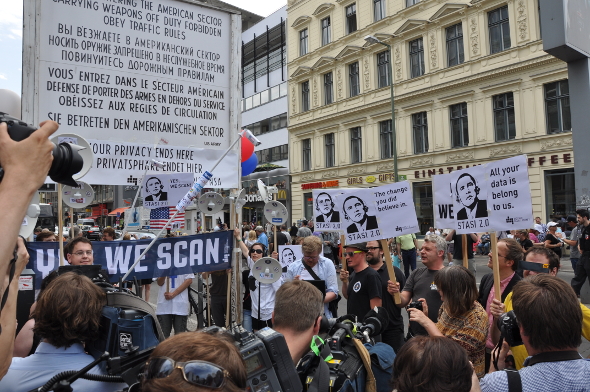
The Stasi 2.0 campaign was originally designed in 2007 to fight Germany’s mandatory data-retention law, a law implementing an EU Directive that force ISPs and telecom providers to continuously collect and store records documenting the online activities of millions of ordinary Europeans. Roughly 34,000 citizens filed a lawsuit against the mandatory data retention in protest. The campaign was successful and in March 2010 a German court declared the law unconstitutional and ordered the deletion of the collected data. Now, the Stasi 2.0 campaign has shifted focus on calling upon their government to protect them against overreach scope of NSA foreign surveillance practices, Sandra Mamitzsch from Digitale Gesellschaft told EFF.
Germany has also increased its capacity to conduct sweeping and invasive extra-territorial surveillance from its domestic soil. As we noted, the German government has leveraged its ability to remotely compromise computer systems in order to spy on its citizens. The government has used commercial malware to hack private data. While there has been no confirmation that Germany is deploying these investigative techniques against persons outside German territories, extra-territorial surveillance is feasible because infection occurs via email and other Internet transmissions.
Campaigns against the NSA spying overreach are now being planned for July 6 all around Australia. Australians can get involved here: http://ourprivacy.org.au/
Micheal Vonn, policy director at the B.C. Civil Liberties Association in Canada, told to the Global News in Canada: “[w]e fully intend to get some pointed questions to the Canadian government about knowledge, complicity, alliance with this program. And whether, in fact, very, very quietly, the Canadian security establishment has been harvesting the fruits of this program for some time.”
EFF is demanding Internet companies to join our cause and protect the privacy of their international customers calling on Congress to create a committee to uncover the truth about the NSA alarming allegations. You can take action here. Current foreign intelligence surveillance targetting foreigners must be challenged to ensure strong human rights safeguards, transparency and accountability across the world. A global dialogue on extra-territorial foreign intelligence surveillance among all nations is much needed.
EFF will continue blogging about the impact of the NSA leaks on Internet users abroad in our Spies Without Borders series. Next, we will examine what implications the government’s use of these FISA powers has for Internet users abroad, with an eye to other jurisdictions and the requirements of international law.
This is the 5th article of our Spies Without Borders series. The series are looking into how the information disclosed in the NSA leaks affect Internet users around the world whose private information is stored in U.S. servers, or whose data travels across U.S. networks.
Image: Digitale Gesellschaft, licensed under a Creative Commons BY SA 3.0 license.
Related article
Reassured by NSA’s Internal Procedures? Don’t Be. They Still Don’t Tell the Whole Story.
By Kurt Opsahl and Mark Rumold | EFF | June 21, 2013
Yesterday, the Guardian released two previously-classified documents describing the internal “minimization” and “targeting” procedures used by the NSA to conduct surveillance under Section 702. These procedures are approved by the Foreign Intelligence Surveillance Court (FISC) on an annual basis and are supposed to serve as the bulwark between the NSA’s vast surveillance capabilities and the private communications of Americans. As we noted earlier today, the procedures, themselves, aren’t reassuring: far too much discretion is retained by NSA analysts, the procedures frequently resolve doubt in favor of collection, and information is obtained that could otherwise never be obtained without a warrant.
Which would be bad enough, if it were the end of the story. But it’s not.
The targeting and minimization documents released yesterday are dated a few months after the first publicly known scandal over the new FAA procedures: In April 2009, the New York Times reported that Section 702 surveillance had “intercepted the private e-mail messages and phone calls of Americans . . . on a scale that went beyond the broad legal limits established by Congress.” In June 2009, the Times reported that members of Congress were saying NSA’s “recent intercepts of the private telephone calls and e-mail messages of Americans are broader than previously acknowledged.” Rep. Rush Holt described the problems as “so flagrant that they can’t be accidental.”
Presumably, following these “flagrant” abuses (and likely in response to the Congressional criticism of the original procedures), the government refined the procedures. The documents released yesterday are the “improved” targeting and minimization procedures, which appear to have been reused the following year, in 2010, in the FISC’s annual certification.
But these amended procedures still didn’t stop illegal spying under Section 702.
Unless the government substantially changed the procedures between August 2010 and October 2011, these are the very procedures that the FISC eventually found resulted in illegal and unconstitutional surveillance. In October 2011, the FISC issued an 86-page opinion finding that collection carried out under the NSA’s classified minimization procedures was unconstitutional. The opinion remains secret, but it is very likely that yesterday’s leaked NSA documents show the very minimization procedures the Director of National Intelligence admitted the FISC had found resulted in surveillance that was “unreasonable under the Fourth Amendment” and “circumvented the spirit of the law.”
And for good reason: the procedures are unconstitutional. They allow for the government to obtain and keep huge amounts of information it could never Constitutionally get without a warrant based on probable cause. As we explained, the procedures are designed such that the NSA will routinely fail to exclude or remove United States persons’ communications, and the removal of those communications are wholly entrusted to the “reasonable discretion” of an analyst.
EFF has been litigating to uncover this critical FISC opinion through the Freedom of Information Act and to uncover the “secret law” the government has been hiding from the American public. And EFF isn’t alone in fighting for the release of these documents. A bipartisan coalition of Senators just announced legislation that would require the Attorney General to declassify significant FISC opinions, a move they say would help put an end to precisely this kind of “secret law.”
When the government, and others, claim these procedures ensure your privacy is respected, know this: they’re only telling you half the story.
Take action now — to put an end to secret law, to demand the American public gets the full story, and to finally put an end to the NSA’s domestic spying program.
Related articles
- FISA Court Rejects Catch-22 Secrecy Argument in FOIA Case (eff.org)
- Government Says Secret Court Opinion on Law Underlying PRISM Program Needs to Stay Secret (alethonews.wordpress.com)
Featured Video

US IRAN TALKS: Who Are the Crazy Ones Here? /Lt Col Daniel Davis
or go to
Aletho News Archives – Video-Images
From the Archives
Woolsey Fire started at Santa Susana Field Lab — where “radioactive materials released were never accurately measured”
By John Laforge | CounterPunch | November 30, 2018
In my Nov. 16 column, I reported on potential radiation risks posed by California’s Woolsey wildfire having burned over parts or all of the Santa Susana Field Laboratory—south of Simi Valley, Calif., 30 miles outside Los Angeles—site of at least four partial or total nuclear reactor meltdowns.
The field laboratory operated 10 experimental reactors and conducted rocket engine tests. In his 2014 book Atomic Accidents, researcher James Mahaffey writes, “The cores in four experimental reactors on site … melted.” Reactor core melts always result in the release of large amounts of radioactive gases and particles. Clean up of the deeply contaminated site has not been conducted in spite of a 2010 agreement.
Los Angeles’s KABC-7 TV reported Nov. 13 that the Santa Susana lab site “appears to be the origin of the Woolsey Fire” which has torched over 96,000 acres. Southern Calif. Public Radio said, “According to Cal Fire, the Woolsey Fire started on the afternoon of Thursday, Nov. 8 … on the Santa Susana site.” … continue
Blog Roll
 Aletho News
- US IRAN TALKS: Who Are the Crazy Ones Here? /Lt Col Daniel Davis
- Talks with the US end without a deal over excessive US demands: Iran
- Feeling Better, Getting Worse: How Psychiatric Drugs Create the Illusion They Cure
- ‘Nobody Told Me’: Former Mental Health Patient Calls Out Dangerous Side Effects of Psychiatric Drugs
- Dr. Abu-Sitta: Beirut ‘felt like a day in Shifa Hospital’
- Iran Has Won the War, It Will Be Up to the US to Secure the Peace: Mohammad Marandi
- Iran condemns assassination threats against Iranian negotiators amid US talks
- Brussels cannot say where its own pipeline inspectors are as Hungary’s oil lifeline remains shut
- Israel’s Iran War: Myth and Reality
- Between war and industrial breakdown: The US-Israeli attrition crisis
- If Americans Knew
- Pro-Israel ‘Thinktanks’ and Individuals who Influence U.S. Foreign Policy
- Mearsheimer reveals how Israel dictates US policies on Iran, Gaza – video
- After killing 350+, Israel still has a “score to settle” with Lebanon before ceasefire – Daily Update
- Military aid to Israel emerges as the latest political litmus test for Democrats
- The only Palestinian children’s rights organization closes following years-long Israeli campaign against it
- ‘I Can’t Forget the Smell’: Lebanese Reel After Israel Kills Over 300 in Single Day
- DNC Shoots Down Resolutions Calling Out AIPAC and Limiting Arms to Israel
- TCN: Is Israel Blackmailing President Trump?
- Israel killed at least 303 Lebanese yesterday – who were they? Daily Update
- Amnesty: Urgent – Protect Lebanese civilians from brutal escalation in Israeli attacks
- No Tricks Zone
- German Expert: Heat Dome Led To Record Temps In Western USA…Warmer In 1934, 1936
- New Study: No Linear Warming Or Glacier Retreat Along Northern Antarctic Peninsula Since 1980s
- An Inconvenient Tree: Uncovered In Alps… Europe Much Warmer Than Today 6000 Years Ago
- New Study Reports A 60% Slowdown In Greenland’s Ice Loss Rate In The Last Decade
- Low Intensity Tornado Wrecks Major Solar Farm, Creating A Potential Toxic Dump
- New Study Finds Warming Saves Lives…Cold Temperatures 12 Times More Deadly Than Excess Heat
- German Science Blog Accuses PIK Climate Institute Of Hallucinating Climate Tipping Points
- Devastating Assessment Of Comirnaty Vaccine By Former Senior Pfizer Europe Toxicologist
- New Study: CO2 Is ‘Effectively Negligible’ As An Explanatory Climate Change Factor Since 2000
- Former Pfizer Toxicologist Dr. Helmut Sterz Tells Bundestag Hearing Pfizer Vaccine Should Have Never Been Approved
 Aletho News