Israeli deaths mount in Gaza as Tel Aviv plans ground withdrawal
The Cradle | December 24, 2023
At least ten Israeli soldiers were killed in intense battles across the Gaza Strip on 23 December, bringing the official death toll for this weekend to 14 soldiers.
Five soldiers in the Combat Engineering Corps and an army medic were killed by an anti-tank guided missile in southern Gaza, the military said. Four others were killed in explosive attacks carried out by the Palestinian resistance.
“Ten soldiers were killed on Saturday,” the Times of Israel reported on 24 December.
The army announced the deaths of four other soldiers on Friday, 22 December.
Since the launch of a full-scale assault into Gaza, the Israeli army has admitted to the deaths of 153 soldiers. However, hospital records indicate that Tel Aviv is significantly underreporting casualties.
Israel’s Channel 13 reported three days ago that the army’s elite Golani Brigade withdrew from Gaza following 60 days of fighting to “reorganize its ranks” after facing unprecedented losses.
According to retired Israeli general Moshe Kaplinsky, the Golani Brigade lost 88 soldiers since 7 October. Seventy-two were killed on the first day of the war – amounting to a quarter of the entire brigade, Kaplinsky said.
As Israeli casualties continue to mount, the Israeli Broadcasting Authority revealed this week plans within the government to switch to a new phase of the war “in the coming weeks,” bringing an end to ground operations and shifting the focus to continued heavy airstrikes on the Gaza Strip.
Local reports say the Israeli army has already begun withdrawing from specific areas.
Israel bombs Gaza with one-tonne bombs where civilians were sent to take refuge
MEMO | December 23, 2023
Almost all Saudi nationals oppose Arab ties with Israel, poll finds
Press TV – December 23, 2023
A new survey has found that 96 percent of Saudi Arabian citizens want Arab countries to cut all types of ties with Israel in response to the occupying regime’s war on Gaza.
Conducted by the Washington Institute for Near East Policy, a pro-Israel think tank based in Washington, the survey saw almost every Saudi agreeing with the proposal “Arab countries should immediately break all diplomatic, political, economic, and any other contacts with Israel, in protest against its military action in Gaza.”
The study further found that a big majority of the Saudis (91%) believe that “despite the destruction and loss of life, this war in Gaza is a win for the Palestinians, Arabs, and Muslims.”
The majority of respondents in Jordan, Lebanon and Egypt held favorable views towards the Palestinian resistance movement Hamas, but saw a 30-point growth in its popularity in the case of Saudi Arabians, compared to August.
The survey said 87% agree with the suggestion that “recent events show that Israel is so weak and internally divided that it can be defeated someday.”
Conducted to measure the change in shift of attitudes of Saudi nationals after the bloody war broke out, the survey was conducted from November 14 to December 6.
The results of the study are a clear manifestation of the difficulties the United States is going to face as it advocates for intertwined Arab-Israeli cooperation.
Prior to the war, the US was actively working towards achieving an agreement to normalize Saudi Arabia-Israel relations.
Earlier in September, during an interview with Fox News, Saudi Crown Prince Mohammed bin Salman stated that the two countries were getting closer to such an agreement “every day.”
After the war broke out, Riyadh put a pause on normalization talks and has made its diplomatic outreach public as one that seeks “to stop the ongoing escalation.”
The Israeli genocide in Gaza has significantly suppressed support for allowing contact with Israelis.
The US and Israel face a powerful new enemy in the Middle East conflict
By Robert Inlakesh | RT | December 23, 2023
In yet another case of blowback, reflecting the failure of Western military interventionism in West Asia, Yemen’s Ansarallah (Houthi) movement has inserted itself as an active participant in the ongoing war between Israel and Gaza. First launching batches of loitering munitions, ballistic and cruise missiles towards Israel, Ansarallah then moved on to prevent the passage of Israeli-owned or operated ships through the Red Sea, before announcing a complete closure of the shipping route for any vessels destined to dock at the port of Eilat.
After the Houthis seized a number of ships, while attacking others with drone strikes, activity at Eilat has dropped some 85%. International and Israeli shipping companies have opted to take the long route, which in some cases takes an additional 12 days, to reach Israel with their cargo, a costly diversion to say the least. In opposition to this, US Defense Secretary Lloyd Austin traveled to the region and announced the formation of a multinational naval task force to be deployed in the Red Sea. Despite talk of the coalition including Saudi Arabia, Egypt, and even the United Arab Emirates, the only Arab nation that joined was Bahrain.
So, without a United Nations Security Council (UNSC) resolution to back them up, usually required to make the militarisation of a territory legal under international law, the US has launched yet another foreign intervention. This one is significant because it failed to convince any major regional players to join, demonstrating the decline in American influence, but has also elevated the status of Yemen’s Ansarallah.
Under former US President Barack Obama, Washington backed the Saudi-led coalition’s intervention in Yemen back in 2015. Since then, some 377,000 people have died, largely as a result of the deadly blockade imposed on the majority of the country’s population, while some 15,000 civilians have died due to direct conflict. The objective of the Saudi-led intervention, which received the backing of the US and UK, was to remove Ansarallah from power in the nation’s capital, Sanaa. Although the group does not enjoy international recognition as Yemen’s governing force, it rules over more than 80% of the population, has the support of two-thirds of the nation’s armed forces, and operates a government out of Sanaa.
Ansarallah came to power following a popular revolution against then-Yemeni President Abdrabbuh Mansour Hadi in 2014. Months later, Hadi resigned and fled the country after Ansarallah militants had decided to take over by force. In the midst of a seven-year war, the political, social and armed movement that is often referred to as “the Houthi rebels” operates as the de facto government of Yemen, but is yet to receive recognition at the UN, which instead recognises the ‘Presidential Leadership Council’ that was created in Riyadh, Saudi Arabia, in 2022.
The context above is crucial for understanding the capabilities of Yemen’s Ansarallah, which was downplayed as a band of “Iran-backed rebels” in Western corporate media for years. While the governments of the collective West have tried to pretend that the Yemeni group is insignificant, Washington’s recent decision to form a multi-national naval coalition to confront the Houthis is an admission that they are a major regional actor. In fact, Ansarallah is the only Arab movement that controls state assets and a standing army that is participating in the ongoing war with Israel.
The reality that the US is now confronting is something that both Saudi Arabia and the UAE came to realize early last year. Following two separate drone and missile attacks on Abu Dhabi and Dubai in January of 2022, it became apparent that the West’s current level of support could not provide sufficient security for the UAE. Up until a nationwide ceasefire was brokered in April 2022, Ansarallah had also demonstrated its developed missile and drone capabilities, striking valuable economic targets inside Saudi Arabia too.
Despite receiving a lot less attention than it deserved, Ansarallah forces strategically timed their second attack on the UAE to coincide with the arrival of Israeli President Isaac Herzog in the country. This was a clear message to the Emirati and Saudi leaderships that Western support will not provide sufficient security. It’s likely because of this threat from Yemen that Riyadh sought a security pact with the US, in order to make a normalization agreement with Israel possible. Such a security pact would have stipulated that an attack on one is an attack on all, hence dragging the Americans into a direct war against Yemen in the event that the conflict was to flare up again.
The US attempted to help topple the current government in Sanaa, but ended up creating a battle-hardened group that has domestically developed capabilities well beyond those it possessed at the start of the conflict in 2015. In his first foreign policy address after taking office in 2021, US President Joe Biden pledged to end the war in Yemen. However, instead of pursuing a Yemen-Saudi deal, the White House abandoned its pledge and sought to broker a Saudi-Israeli deal instead. That fatal decision is coming back to bite policymakers in Washington.
Backing the Israelis to the hilt in their war on Gaza, spelling out that there are no red lines as to how far the government of Benjamin Netanyahu can go, the US has allowed a Palestine-Israel war to expand into a broader regional Arab-Israeli conflict. The threat of escalation between the Israeli army and Lebanese Hezbollah is growing by the day, while Ansarallah leader Abdul-Malik al-Houthi has stated that his forces “will not stand idly by if the Americans have a tendency to escalate and commit foolishness by targeting our country.”
By every metric, US diplomatic stock has dropped internationally as a result of its handling of Israel’s war on Gaza. It has failed to convince any major regional actors in West Asia to back its escalatory agenda, all of which are standing on the same side as Russia and China in calling for a ceasefire. The world sees the hypocrisy of Washington. For the sake of comparison, the death toll in Gaza today is said to have exceeded 23,000, the majority being women and children. Israel has killed this many people in just over two months, while in the first two years of the ISIS/Daesh insurgency in Iraq, the UN estimated that the terrorist group killed some 18,800 civilians. The total number of civilians killed by ISIS in Syria is set at just over 5,000.
The level of human suffering being inflicted in Gaza is without precedent, breaking records in modern history for the tonnage of explosives dropped on such a small territory, in addition to the highest number of journalists, medical workers, and children killed in a single conflict. In reaction, the US government has repeatedly blocked ceasefire resolutions at the UNSC, gives Israel unlimited support unconditionally, and now threatens to drag a coalition of Western nations into a war on Yemen. The solution here is very simple: Ansarallah has said the blockade on ships to Israel will end when the war on Gaza ends. Washington has the ability to stop the war, but refuses to do so, while its threats against Yemen will not work to achieve any result beyond further escalation.
Robert Inlakesh is a political analyst, journalist and documentary filmmaker currently based in London, UK. He has reported from and lived in the Palestinian territories and currently works with Quds News. Director of ‘Steal of the Century: Trump’s Palestine-Israel Catastrophe’.
Reports: Hamas seeks release of Marwan Barghouti in any hostage deal
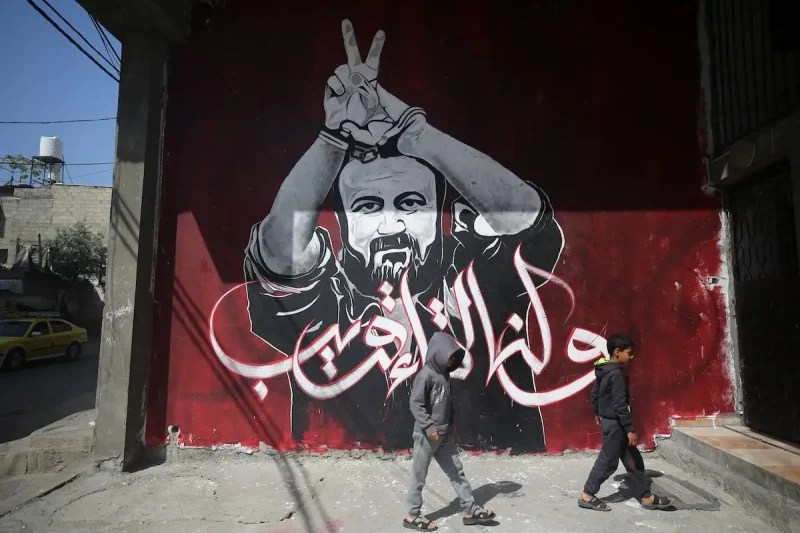
A mural shows jailed Fatah leader Marwan Barghouti, in Jabalia refugee camp in the northern Gaza Strip on April 16, 2023. [Majdi Fathi/NurPhoto]
MEMO | December 22, 2023
UN Security Council passes resolution demanding more Gaza aid deliveries
Press TV – December 22, 2023
The United Nations Security Council has finally passed a resolution on the ongoing Israeli onslaught against Gaza, demanding increased aid deliveries to the besieged region but stopping short of calling for an immediate halt to the genocide.
The watered-down resolution, ratified on Friday, demanded all sides in the conflict allow the “safe and unhindered delivery of humanitarian assistance at scale.”
It also called for the creation of “conditions for a sustainable cessation of hostilities” but it did not call for an immediate end to fighting.
The vote in the 15-member council was 13-0 with the United States and Russia abstaining.
The vote followed the US veto of a Russian amendment that would have restored that call for a suspension of hostilities. That vote was 10 members in favor, the US against and four abstentions.
The text, sponsored by the United Arab Emirates, was passed following days-long negotiations over its wording, during which it was watered down at the US request.
Washington had earlier vetoed two UNSC resolutions on the conflict, drawing widespread condemnations over the body’s lack of action since the start of the onslaught.
Russia says resolution ‘toothless’
Russian ambassador to the UN Vasily Nebenzya hit out at the United States, saying “they have resorted to their favorite tactic… of twisting of arms”, calling the text “toothless.”
The UAE’s ambassador to the UN Lana Zaki Nusseibeh said “it responds with action to the dire humanitarian situation.”
“We know this is not a perfect text… We will never tire of calling for a humanitarian cease-fire,” she said.
The resolution demands all sides “allow and facilitate the use of all… routes to and throughout the entire Gaza Strip, including border crossings… for the provision of humanitarian assistance.”
It also requests the appointment of a UN humanitarian coordinator to oversee and verify third-country aid to Gaza.
An earlier text had said that the aid mechanism to accelerate the delivery of relief would be “exclusively” under UN control.
It now states it would be managed in consultation with “all relevant parties” — meaning Israel would retain operational oversight of aid deliveries.
Israel has pounded the Gaza Strip since October 7, killing at least 20,057 Palestinians, mostly women and children, and injuring 53,320 others, according to health authorities in the region.
The Israeli onslaught has left Gaza in ruins with half of the coastal territory’s housing stock damaged or destroyed, and nearly 2 million people displaced within the densely-populated territory amid shortages of food and clean water.
US ‘Builds Trap for Itself’ in Red Sea
By Scott Ritter – Sputnik – 22.12.2023
On December 18, following a tour of the Middle East with stops in Kuwait, Bahrain, Qatar and Israel, US Defense Secretary Lloyd Austin announced the establishment of Operation Prosperity Guardian, under the umbrella of Combined Task Force (CTF) 153, which focuses on security in the Red Sea, to protect maritime shipping.
Back on November 19, Yemen’s Houthi rebels, operating in solidarity with the Palestinians of Gaza, took over an Israeli-linked cargo ship, the Galaxy Leader. The Houthis announced that they would block all shipping transiting the Red Sea toward Israel—in effect establishing a blockade of Israel—until Israel allowed humanitarian aid into Gaza.
The Houthis have subsequently attacked numerous vessels passing through the Bab al-Mandeb Strait, a narrow passageway leading into the Red Sea and further on to the Suez Canal, threatening global trade as major oil and shipping giants, including BP, MSC, Evergreen, OOCL, and Maersk, suspended operations through the Red Sea. The damage to the Israeli economy done by the Houthi blockage is estimated to run into the billions of dollars, and Israel’s Prime Minister Benjamin Netanyahu has threatened to use military force against the Houthis if the United States does not intervene on its behalf.
CTF 153, which has operated under both US and Egyptian command, is tasked with international maritime security and capacity-building efforts in the Red Sea, Bab al-Mandeb, and Gulf of Aden. Its compliment of four ships—three US destroyers (the USS Carney, USS Mason, and USS Thomas Hudner) and the UK Royal Navy guided-missile destroyer HMS Diamond) have all been involved in intercepting Houthi missiles and drones fired against either Israel or merchant shipping operating in the Red Sea.
Austin also ordered Carrier Strike Group 2, consisting of aircraft carrier the USS Dwight D. Eisenhower and three escorts (a cruiser and two destroyers), to join up with CTF 153 as part of Operation Prosperity Guardian. Ohio-class submarine the USS Florida, equipped with 154 Tomahawk cruise missiles, is also operating in the region.
Austin announced that the US and UK would be joined by Bahrain, Canada, France, Italy, the Netherlands, Norway, Seychelles, and Spain as part of Operation Prosperity Guardian. Notable absentees include Arab nations like Egypt and Saudi Arabia. Australia was asked to provide a warship, but offered [13] personnel only.
French Navy guided-missile frigate the FS Languedoc is already operating in the Red Sea and, like its US and UK counterparts, has been involved in the shooting down of Houthi drones and missiles. However, France has stated that the Languedoc will operate under French command, complicating its relationship with CTF 153.
Italy’s Defense Ministry has announced that it will deploy naval frigate the Virginio Fasanto the Red Sea. Its command relationship with CTF 153 remains unclear as of the present time.
The military problem facing CTF 153 is threefold. First, there is a need to establish a barrier defense against the Houthi missile and drone attacks. This will require that the guided missile destroyers and frigates establish a picket line along the eastern channel of the Bab al-Mandeb Straight which will screen shipping from any Houthi attack. Second, CTF 153 will need to engage in aggressive patrolling designed to deter and repel any Houthi efforts to repeat their hijacking of the Galaxy Leader. Lastly, CTF 153 will need to provide mine clearance capabilities to deal with any sea mines that the Houthis may place in the narrow waters of the Bab al-Mandeb.
These missions alone will be taxing, and difficult to accomplish. As things stand, while the CTF 153 ships have shot down dozens of Houthi drones and missiles, scores have gotten through, striking targets in Israel and hitting shipping in the Red Sea. Simply put, CTF 153 doesn’t have enough ships to adequately screen either Israel or maritime shipping from Houthi attack. And given the lack of mine warfare ships in the CTF 153 organization, any deployment of sea mines by the Houthis will effectively close the region from commercial shipping, and threaten military deployments in the area, until demining capability can be deployed.
The only way that Operation Prosperity Guardian could possibly keep the Bab al-Mandeb Straight open is to launch strikes against the Houthi capability of launching missiles and drones in hopes of interdicting them before they can be used. Here the plot thickens—the Houthis have made it clear that if attacked, they will expand the conflict to include Saudi and UAE oil production, threatening global energy supplies. Moreover, targeting mobile missile and drone launchers is no simple task—Saudi Arabia, using US intelligence support to assist in targeting, was unable to prevent the Houthis from launching missiles and drones against Saudi targets during the entirety of its ongoing conflict with the Houthis. The US would likely run into similar problems.
In short, by initiating Operation Prosperity Guardian, the US appears to have built a trap for itself, where it is damned if it doesn’t attack the Houthi (since the Red Sea would remain blocked to all Israeli traffic), and damned if it does (since it wouldn’t be able to stop the Houthi attacks, and such action would likely expand the scope and scale of the conflict to the detriment of US interests.)
Keep in mind that all of this could have been solved with a single phone call from US President Joe Biden to Israeli Prime Minister Benjamin Netanyahu directing Israel to accept a ceasefire and allow humanitarian aid to be sent to the Palestinian residents of Gaza. Instead, the United States is destroying its moral standing in the world by openly facilitating the ongoing slaughter of Palestinian civilians at the hands of the Israel Defense Forces, while simultaneously undermining the credibility of US military deterrence by getting itself mired in a tar baby of its own making.
The deployment of the USS Dwight D. Eisenhower into the Sea of Aden comes on the heels of its brief foray into the Persian Gulf, where it was closely monitored by Iran. The US has also deployed a second carrier battlegroup, consisting of the USS Gerald R. Ford and its six escorts, in the eastern Mediterranean Sea. Meanwhile, the USS Carl Vinson and its five escorts operate just over the horizon, in the South China Sea.
Never in the history of the American Navy have so many carrier battlegroups been moved around the globe with so little impact.
The reality of modern warfare is that small nations and non-state actors such as the Houthis can be armed with modern military weaponry which negates the military impact of multibillion-dollar investments such as the carrier battlegroup. It costs the Houthis tens of thousands of dollars to fire its drones and missiles against Israel and maritime shipping; it costs the US Navy millions of dollars to shoot them down. Moreover, it costs the US navy hundreds of millions of dollars just to keep a carrier battle group deployed and operating, while the Houthis can credibly threaten to sink a carrier using weapons that cost hundreds of thousands of dollars.
The final score card regarding Operation Prosperity Guardian has yet to be written. But the reality is that it will most likely not succeed in its mission of preventing Houthi attacks against either Israel or maritime shipping. This failure goes far beyond the issue of security for the Red Sea. The United States has long maintained that it could guarantee that if Iran ever sought to close the strategic Straight of Hormuz, the US Navy would be able to reopen it in a very short period. Operation Prosperity Guardian puts a lie to that claim. The fact is, the world balance of power has changed dramatically, and legacy systems like the carrier battlegroup are no longer the dominant means of power projection they once were. The US has, in effect, put all its eggs in one basket through its over-reliance upon the carrier battlegroup when it comes to force projection.
The looming failure of Operation Prosperity Guardian exposes the impotence of the US when it comes to being able to accomplish its plans for regional dominance in the Persian Gulf, South Pacific, and Taiwan, and signals a new era where the appearance of an American fleet of the shores of a far way land no longer inspires fear and intimidation. For a nation like the United States, which has premised so much of its foreign and national security on the notion of strength-based deterrence, the revelation that its military power projection capabilities are more bark than bite undermines its credibility as an ally and partner in a world largely defined by conflicts created by, or on behalf of, the United States.
Attacking Yemen Is a Waste of Time, Money and Resources
By Declan Hayes | Strategic Culture Foundation | December 22, 2023
What to do with a problem like Yemen and its 2,000 km (1,200 mile) long Red Sea coastline? And indeed with Eritrea, Djibouti and Somali, all three of which share maritime borders with Yemen.
The issue is that Yemen’s Houthi have decided that all ships using the Red Sea that have any connection, near or far, with Israel, are legitimate targets for its batteries of missiles some of which, as previously discussed, are almost unstoppable ballistic missiles.
The problem is how to sail Israeli and other targeted ships through the Bab el-Mandeb Strait and thence onwards to pay the $500,000-$1,000,000 toll to sail through Egypt’s Suez Canal. This problem is compounded by (Russia’s) dark and grey fleets, which transfer embargoed oil, being allowed free passage and the Chinese, which have a major naval base in nearby Djibouti, playing schlump about the whole matter. NATO’s problem is how to deal with the Houthi, whilst also marginalising China, Iran and Russia, all three of which have very big dogs in this very important fight.
Although diplomacy would seem an obvious candidate to help resolve matters NATO, in its wisdom, long ago discarded that card and China is, in any event, playing a totally different and far more incendiary global game.
On top of all that, NATO’s major shipping lines have their own profiteering demands, which further complicate matters. In essence, those major companies want NATO to escort all its ships, and not just those flying NATO flags, in convoy through the Red Sea. Although that would benefit them, NATO is primarily obliged to protect its own fleet and not the 40% of the world’s ships that fly the flags of open registry countries like Panama, Liberia and the Marshall Islands or, heaven forbid, that transport dark or grey cargo on behalf of Russia and its partners. And, if that were not enough, many non-eligible ships carry military ordnance for NATO and, most likely, Israel as well.
Even if NATO were, like Tom Hanks in Greyhound, to convoy some or all of those ships through the Red Sea, there is no guarantee that they would not be hit there or further up the chain, say in the Suez Canal itself. Although convoys are a risk those large shipping companies should probably run, their extreme risk aversion means they instead prefer to detour past the entire African continent and thereby weaken NATO’s already weak supply chains by needlessly extending them. NATO’s shipping companies are divided on how best to respond and, of course, a house divided cannot stand.
The second and third options are to plonk NATO armadas off the Yemeni coast, to send marines and French legionaries ashore and to bomb the living shit out of the Yemeni, to poke the Houthi hornet’s nest, in other words and make them bleed, something they are long inured to.
Although these are scenarios NATO’s High Command has yet to fully war game out, retired US Vice Admiral James Stavridris, who now fronts the Carlyle Group, summarises the main issues in this revealing article, where he points to the domino effect on global supply chains, where combatting swarms of cheap Houthi (and, later Iranian?) drones is a very expensive proposition and where alternative options to obliterate the Houthi threat are haram.
These other options include arming merchant shipping with appropriate weaponry, a solution that would be unacceptable to any neutral port the ships might like to dock in. Stavridris’ solution, unsurprisingly for NATO’s former military commander, is to bomb the living shit out of Yemen, “to carry out offensive strikes against targets ashore, perhaps using Tomahawk missiles and attack aircraft from the carrier USS Eisenhower, now patrolling the Gulf of Oman.”
All well and good but the Houthi are mobile and they have a lot of real estate to play about in, not only in Yemen itself but in contiguous countries. And that is before we consider Iran’s plans to have giant flotillas of small but highly armed speedboats causing mayhem in nearby waters, should the need arise. You can swat all the Houthi and Iranian mosquitoes you like but you will still get badly bitten.
Stavridris is undeterred by any of that. He believes that if saturation bombing does not work, “it would be entirely appropriate to strike the sponsor — Iran — especially its maritime infrastructure in the north Indian Ocean and the Gulf. This could include oil and gas platforms, port facilities and patrol vessels of the Islamic Revolutionary Guard Corps.”
All of which makes eminent sense if the problem is a solitary nail and NATO’s navy is, as it always seems to be, a hammer capable of hammering down only one defenceless group of people at a time.
The issue here is that the Houthi, perhaps in cahoots with Iran, have shown that global supply lines are easily interdicted and Stavridis, Hanks and their Hollywood armadas notwithstanding, NATO and its merchant marine fleet can no longer ride roughshod over even marginal players like the Houthi, Hezbollah and Hamas, never mind Russia and, with regards to Asian waters, China, whose Fishing Militia has helped inspire Iran to form its own Maritime Militia of some 55,000 voluntary forces with 33,000 vessels.
And then there is NATO’s very odd toehold of Djibouti, which is home to military bases belonging to Germany, Spain, Italy, France, the United States, Britain, China, and Saudi Arabia, with Russia and India also being eager to set up shop there. Not only does Djibouti depend on the rents from these bases to stay afloat but Djibouti’s growing national debt is such that she can have no independent diplomatic leverage. Djibouti’s increased debt to China, which promised to make it another Dubai, means that it is a “black box” of a looming danger in the region – a danger that arises from the competition over military bases that goes much beyond the Houthi’s pinpricks.
If the Houthi were not already sufficiently riled up, NATO’s plans to build a Ben Gurion Canal from the Gulf of Aqaba via a flattened Gaza to the Mediterranean is sure to really get up their noses. Leaving all other considerations aside, Aqaba is best known in the West from Lawrence of Arabia, where Hollywood heart throb Peter O’Toole led Arab tribesmen to a famous victory over the Turks embedded there, even though that assault put the infamous Sykes-Picot Agreement to carve up Ottoman Arabia in jeopardy.
Though the consequences of the Sykes Picot Agreement and the related Balfour Declaration still have the noses of the Houthi and very many others out of joint, it seems NATO is prepared to play this game through to the end not only in the Gulf of Suez, the Gulf of Aqaba and the other West Asian choke points the Houthi and their allies have a presence in but much further afield to the Strait of Malacca and the Taiwan Strait as well. And, though the hammer happy US Vice Admiral James Stavridris no doubt has a solution for them factored around Tomahawk missiles, US marines and French paratroopers, one can only surmise that NATO’s adventurism in the Red Sea is the latest of several nails it is hammering into its own coffin.
Israel Reportedly Struck Gazan Churches Using Coordinates Received From US Congress
Sputnik – 21.12.2023
WASHINGTON – The Israeli military reportedly used the locations of a Catholic Church and a convent in Gaza obtained from US congressional staff to later strike them with rockets and snipers.
In an attempt to prevent Israeli strikes on religious sites in Gaza, one of the largest Christian aid organizations there, Catholic Relief Services, passed on the coordinates of several sites in the enclave to Senate staffers, who, in turn, sent them to Israel, US media reported on Thursday citing a series of emails from October.
The move by the aid organization was reportedly an attempt to get a commitment from Israel not to target at least four buildings in Gaza, including the two that were later struck by the Israeli military.
On more than one occasion, church leaders shared GPS satellite data with the Israeli military, but it didn’t help to prevent the deadly incident, according to Father Ibrahim Nino, a spokesperson for the Latin Patriarchate of Jerusalem cited in the report.
“But what happened, happened,” the report cited Father Nino as saying. “And we are sure of it because we have 648 witnesses inside the compound of the church.”
On Saturday, the Latin Patriarchate of Jerusalem, the Catholic body overseeing the region, published a statement condemning Israeli sniper and tank attacks on the Holy Family parish, the only Catholic parish in the enclave, and the convent of the Missionaries of Charity located in a shared compound in Gaza killing two women and injuring several more.
The Antisemitic Moment
Maligning critics by Jewish groups to “protect” Israel only damages their credibility
BY PHILIP GIRALDI • UNZ REVIEW • DECEMBER 21, 2023
In a 2002 interview the former Israeli government minister Shulamit Aloni was asked by Amy Goodman: “Often when there is dissent expressed in the United States against policies of the Israeli government, people here are called antisemitic. What is your response to that as an Israeli Jew?” Shulamit Aloni replied “Well, it’s a trick, we always use it. When from Europe somebody is criticizing Israel, then we bring up the Holocaust. When in this country [the US] people are criticizing Israel, then they are antisemitic.” She added that there is an “Israel, my country right or wrong” attitude and “they’re not ready to hear criticism.” Antisemitism, the Holocaust and “the suffering of the Jewish people” are exploited to “justify everything we do to the Palestinians.”
Currently Israel is involved in a conflict with Hamas in Gaza that it has described as a “war” though the disparity in force levels involving a country with a modern fully equipped army, navy and air force versus something more like a militia armed with small arms and home-made rockets suggest that a different label might be more appropriate. The fighting has been constant apart from a six day pause to exchange hostages and prisoners and promises to continue into the New Year, and possibly much longer, due to the difficulty in engaging in anything like conventional warfare in a bombed out and devastated urban environment that favors the defense.
Israeli extreme brutality has been on display for all the world to see. Last week, Israeli soldiers shot dead three Jewish hostages who had escaped from their Hamas captors under cover of an Israeli bombardment. The hostages took most of their clothes off so it could be clearly seen that they were unarmed and they were carrying a white flag with their hands in the air, but the soldiers reacted by shooting two of them immediately. The third took cover in a building while calling for help in Hebrew, but he too was pursued and killed. In another incident two Catholic women, mother and daughter, taking shelter in Gaza’s only Catholic church were targeted and shot by Israeli snipers. This produced a rebuke from the Pope.
However it turns out, the conflict in Gaza will be Israel’s longest “war” by far since the creation of the country in 1948. Israel’s intention is to force the Gazans to leave whether by forced resettlement in neighboring countries, in Europe or in the United States, or by killing them all. The deputy mayor of Jerusalem has recently labeled the Palestinians “subhumans” and has recommended rounding them up and burying them alive. He is not alone in that viewpoint and, at a minimum, many government ministers believe that the best outcome of the Palestinian problem is to get rid of the Palestinians in Gaza and also on the West Bank completely, whatever that takes, to establish once and for all “Eretz” or Greater Israel from the Mediterranean to the Jordan River and possibly even expanding into southern Lebanon and Egypt’s Sinai.
Israeli willingness to use bombs, starvation and even disease against the Palestinians in what is now being frequently referred to as a genocide has meant that the Jewish state’s list of friends around the world has shrunk dramatically and is limited to several European states and the US under self-declared Zionist President Joe Biden. A UN Security Council motion calling for a ceasefire was blocked by a US veto even though the ten other council members voted for it with one abstention by the UK. A subsequent call for a ceasefire, ignored by Israel, obtained 153 “Yes” votes in the UN General Assembly against 10 “Nos” two of which were Israel and the United States plus US “freely associated” micro-states Micronesia and Palau which always align with Washington. And even in those mostly European countries nominally supporting Israel’s attacks in Gaza, there have been large demonstrations supporting the Palestinians. As the death toll among civilians approaches and almost certainly has already exceeded 20,000, many governments have begun to hedge their bets and wobble in their assertions that “Israel has a right to defend itself.” Defense does not apparently include targeting hospitals, schools, churches and apartment buildings full of fearful civilians seeking shelter from the explosions. Even Joe Biden is calling for restraint in the “indiscriminate” bombing though he is also expediting providing the Israelis with more bombs to do the killing.
As the crisis in Gaza worsened, the UN responded with yet another Security Council resolution, which was introduced by the United Arab Emirates on December 18th. The vote was subsequently delayed three times until the 21st primarily to allow time for debate over the exact wording so as to make it acceptable to the United States in order to avoid another veto by Washington. Cynics have been quick to observe quite plausibly that the Biden Administration is seeking to vote in favor of or abstain on a document that is completely toothless, allowing Israel to do whatever it wants, as is usually the case. The vote on “urgent humanitarian pauses” was expected on Thursday December 21st, but the US again forced a delay for further discussion after aligning its position with that of Israel and claiming, falsely, that UN involvement in the monitoring of assistance would actually slow down relief efforts.
Israel had previously insisted, with US support, that UN direct involvement in monitoring and coordinating the massive humanitarian effort needed to help the Gazans should not be permitted. Israel demanded that only it should be responsible for inspecting incoming goods for “threats,” which, as the Jewish state is a party to the conflict, will itself inevitably and intentionally slow down assistance dramatically and will result in many unnecessary deaths. And Israeli Prime Minister Benjamin Netanyahu also objected to the possibility that some wording in the resolution might suggest transformation of the “pause” into a lengthy ceasefire rather than a temporary “suspension” of hostilities with fighting resuming after a short period. Netanyahu has vowed that the military action will continue until all Hamas leaders and followers have surrendered or are dead. He is also demanding the immediate release of all Israeli hostages as a sine qua non for further deliberations on what might come next.
More important to Americans than dishonest parliamentary maneuvers at the UN should be the fact that defending Israel has meant that there is underway a wholesale assault on the First and Fourth Amendments of the Bill of Rights relating to freedom of speech and association. The attacks are being conducted by the Israeli Lobby and its assets and allies in both of the major political parties, the mainstream news media, Zionist-dominated American social media, and the American National Security apparatus. This has distorted what has happened in Gaza and why by turning the narrative of the conflict into a totally false bit of propaganda claiming alleged Arab terrorism and irredentism directed against the poor Jewish Israelis, who are once again serving as the featured victims. In America, universities are being described as hotbeds of surging antisemitism because students are protesting against Israel’s ethnic cleansing in Gaza while the heavily Jewish-influenced media and Jewish billionaires are working overtime to do whatever it takes to block any and all such criticism. Interestingly, the drive to ban or shut down protests and gatherings has had some major success directed against Arab or Muslim groups in a number of states with no Jewish groups on campus or in the community being interfered with in spite of their often robust support of Israel’s killing spree in Gaza.
The interference of Israel in both American domestic and foreign politics will only get worse in the upcoming year due to national elections. A number of Jewish groups are currently raising money and organizing to go after critics of Israel more aggressively, most particularly the few progressives in the Democratic Party who have spoken up about the genocide of the Palestinians that is taking place. Since the Israel Lobby already controls the White House, its aim is to make the Congress a 100% loyal cheerleader and protector of Israel and all its works, to include the continuing flow of billions of taxpayer dollars annually. Some major American Jewish organizations have, for example, just launched “The 10/7 Project” which will feature centralized communications to promote bipartisan support of Israel. “The 10/7 Project” will be sponsored and managed by the American Jewish Committee, the Jewish Federations of North America, the Anti-Defamation League, the American Israel Public Affairs Committee, and the Conference of Presidents of Major American Jewish Organizations.
Ted Deutch, CEO of the American Jewish committee explained “The 10/7 Project’s” purpose, saying that “Since October 7, there has been a concerted and consistent effort from Israel’s enemies to draw a false and dangerous equivalence between Hamas’ deadly rampage to destroy the Jewish state and Israel’s right to defend itself against terrorists. ‘The 10/7 Project’ will be a trusted and timely source of accurate information to set the record straight and combat false narratives perpetuated by Hamas terrorists and their anti-Israel allies… At this critical juncture, it is imperative that we separate fact from fiction regarding America’s most important Middle East ally and remind people that the vast majority of Americans understand that Hamas is our common enemy.”
What Deutch is really saying between the lies and misinformation is that there will be a well-funded and staffed effort to stifle criticism of Israel’s slaughter of the Palestinians using a narrative that portrays the Israelis as victims of Arab terror, an assertion which might well be described as Zionist propaganda and fact twisting. The attacks on free speech at universities will definitely be on the agenda, in a campaign that started several months ago, when students at a number of public and private universities began protesting over Israel’s deliberate targeting of civilians, leading to a death toll that is almost certainly currently approaching or exceeding 20,000 when all the corpses are dug up from the rubble of bombed buildings.
As the anti-Palestinian narrative took shape in political, media and Zionist circles, it adopted a familiar line, which goes something like this though with slight adjustments to reach target audiences: Israel is the Jewish state. If you criticize the Jewish state and/or Zionism you are therefore by the definition accepted by the US government State Department Special Envoy to Monitor and Combat Antisemitism an antisemite. Antisemitism is a “hate crime” since it is by the same logic based on hatred of Jews. If you advocate or argue for any Palestinian group like Hamas, which the US government has conveniently labeled “terrorist” even though it has never threatened Americans, you are providing “material assistance to terrorism” which is a crime for which you can be fined or imprisoned. The end result is that Israel, which is immune from the consequences of its own actions internationally, also increasingly cannot be criticized at all without serious consequences for the critic, which have included posting the names of protesting students on lists of alleged antisemites so they will be unable to find work after they graduate. In other words, freedom of speech in the United States and also in some European countries including France and Germany only exists, insofar as it does, if you are not disparaging Israel or even its friends due to their easily demonstrable “war criminal” behavior.
Some of those consequences of not rolling over for the Israel Lobby were experienced recently by three presidents of prominent American universities, responding to a congressional December 7th grilling that was set up to address concerns over allegations that colleges are hotbeds of antisemitism and are responsible for major increases in incidents targeting Jews. The presidents of the University of Pennsylvania Liz Magill, Harvard Claudine Gay and MIT Sally Kornbluth were grilled by Congress but were afterwards trashed because they were unwilling to agree with the congressional interrogators that Jews were being terrorized on campus, observing that words must have a physically threatening or harassing “context” if they are to be banned or blocked.
The responses of the three women suggesting that speech should remain free on campus were found to be unacceptable by Congress and the largely Zionist media. Magill has since resigned, joined by the chairman of the university board of trustees Scott Bok, who was immediately replaced by Julie Beren Platt, head of the Jewish Federations of North America, who has been named interim board chair. But politicians joined by prominent commentators and philanthropists still continue to call for the others to resign as well, though Harvard’s Gay has received a vote of confidence from her board and also from faculty and students. Many major Jewish donors have coupled those “calls” with threats that their multi-million dollar gifts would be withdrawn if the presidents stay on. In one example, Penn lost a $100 million donation from Ross Stevens, who pulled it after the hearing. Those seeking to punish appear to be undeterred by the fact that their actions have already sparked discussions about unacceptable levels of Jewish power, often including the observation how promise of money or denying it is used as an instrument to obtain what Israel and its Lobby want.
There is a certain irony in the allegations since Jews in America are the wealthiest, best educated, most politically powerful, most prestigiously employed and most protected by Homeland Security of all ethno-religious demographics. And there is not much real evidence that Jews are in any way increasingly “victims” in the United States or in Europe. The antisemitic incidents that are “surging” are frequently based on criticisms of what the Israelis are doing to the Palestinians and often consist of a Jewish college student being offended or annoyed by a poster or a speaker criticizing Israeli behavior. Instances of actual physical confrontation are few and far between and are immediately reported in the accommodating mainstream media to heighten the sense that Jews in America and even worldwide are threatened. Certain groups like the American Israel Political Action Committee (AIPAC) and the Anti-Defamation League (ADL) are heavily into the promotion of the narrative of Jew hatred as it is in their bottom line to do so given their donor base which likes to hear exactly that.
In other words, what one reads and hears about “surging antisemitism” is largely a contrivance to obtain political and economic benefits as well as a free pass on bad behavior both by Israel and domestically that might not otherwise be forthcoming. And it should be noted in passing that the Israel Lobby groups have somehow avoided registering with the Department of Justice, as required by the Foreign Agents Registration Act (FARA) of 1938, which would require them to maintain transparency over their funding and political activity. The last American president who tried to register what became the Israel Lobby and also sought to stop Israel’s illegal secret nuclear weapons program was John F. Kennedy. Some suspect that Israeli interests might have played a part in his assassination as a result.
Some congressmen have been particularly incensed by student pro-Palestinian demonstrators chanting “Intifada” and “From the river to the sea, Palestine will be free,” interpreting both expressions being calls for the destruction of Israel, which they are not. Intifada is “shaking off” in Arabic and is a call for liberating the Palestinian people and their land from the Israeli tyranny. The “river to sea” is somewhat similar, a call for a Palestinian state with actual sovereignty and neither is an explicit call for killing Israelis or Jews. They might be considered generic cries for freedom.
But the real mystery in this is why is it happening at all? Jews are supposed to be smart but is it smart to reveal how much power you have, particularly when you are prepared to wield it ruthlessly to suppress people who just might begin to wonder if there is something going on that is being deliberately contrived to benefit a tiny percentage of the US population and a foreign government? And if that kind of thinking catches on, which I believe it already has, there might be serious discussions of ways to counter the efforts to limit free speech and association for citizens who are not comfortable with the way Israel behaves and the way the US Israel Lobby silences critics. Instead of trying to criminalize what people are thinking, wouldn’t it be smarter and even more ethical for American Jews to call on Israel to stop the killing and work out some formula that allows the Palestinians at least a modicum of self-government and freedom? That would seem to make sense and many Jews in the US are actually making that argument. The problem is to also convince the hard core and well financed Jewish groups that support Israel no matter who it has to kill that learning to live together with equal rights is the way to go. And then we must convince the know nothings in the Biden Administration and idiots in Congress like Senator Lindsey Graham and Marco Rubio…
Philip M. Giraldi, Ph.D., is Executive Director of the Council for the National Interest, a 501(c)3 tax deductible educational foundation (Federal ID Number #52-1739023) that seeks a more interests-based U.S. foreign policy in the Middle East. Website is councilforthenationalinterest.org, address is P.O. Box 2157, Purcellville VA 20134 and its email is inform@cnionline.org.
US Vetoes UNSC Gaza Peace Bids as Resolutions Would Give ‘Legitimacy’ to Actions Against Israel
By Fantine Gardinier – Sputnik – 21.12.2023
The US is continuing to oppose a UNSC resolution on Gaza because it would give legal sanction to action nations may take against Israel, such as that threatened by Ansarallah, the de facto government in Yemen, a journalist told Sputnik.
After a second resolution for an immediate ceasefire in Gaza was brought before the United Nations Security Council (UNSC) this week, the US has again moved to delay the vote after having vetoed the first resolution earlier this month.
American diplomats are reportedly engaging in high-level talks with Arab nations and US allies about changing parts of the text they dispute, ranging from references to a cessation of hostilities to a plan for the UN to take over security details for aid trucks entering the Gaza Strip.
After the US veto earlier this month, in which it was the sole nation to vote against the resolution, the General Assembly took up the question and passed a non-binding resolution calling for a humanitarian ceasefire. Since October 7, Israeli bombing and a ground invasion have killed more than 20,000 Palestinians in Gaza and left over 50,000 wounded. Almost the entire population of 2.3 million people have been uprooted, forced into a tiny corner of the territory where Israel says it will not bomb as it continues to hunt down Hamas forces.
Despite the veto and continued opposition to a ceasefire, there are signs the Biden administration’s patience is wearing thin: US President Joe Biden has publicly criticized his Israeli counterpart, Benjamin Netanyahu, for being uninterested in a two-state solution, the internationally accepted path to peace for Israel and the Palestinians. Netanyahu replied by confirming the accusation.
Editor of The Polemicist Jim Kavanagh told Radio Sputnik’s Political Misfits on Thursday that a UN resolution would give any nation the authority to act to relieve the humanitarian catastrophe in Gaza – something neither Israel nor the US will allow.
“A Security Council resolution, at least theoretically, legally opens the door to enforcement, that’s the issue here. The United Nations, the United States, can say anything it wants, whatever United Nations resolutions are passed doesn’t mean anything if they’re not going to be enforced by someone. And as you said, the only ones that get enforced are the ones that allow the United States to go to war,” he said.
“In this case, you can’t be naive about it, the downside is for the United States. The United States is supporting Israel in its attack on Gaza. And the attack on Gaza has a main objective, which is to kill and expel Gazans, to create a situation where Gazans can no longer live in Gaza, which they have mostly created, to kill as many of them as they can, in front of the world, showing the world they will cruelly and gratuitously attack hospitals, kill doctors and their families, journalists and their families, poets and intellectuals and their families at home. They know what they’re targeting, they’re destroying the possibility of life in Gaza and they’re pushing the Gazans into a corner where they’re starving, there’s no medicine, there’s going to be diseases that even the Israelis are saying you’ve got to be careful about this because those diseases might come and infect us.”
“The purpose of the Israelis is to create a situation where the world is either going to have to take the Gazans out [of the Gaza Strip], which is really what Israel wants … Israel’s going to say ‘take them.’ They’re saying it, ‘take 25,000 to this country, 50,000 to that – oh, Canada, Germany, you like your immigrants? Take them.’ We want the Palestinians to have a nice life – just not in Gaza. They want the Palestinians out of Gaza and they’re creating a situation where the world is going to have to either watch the Palestinians get killed or take them out,” he said.
Kavanagh noted that despite the dire need for humanitarian aid in Gaza, Israel has jealously guarded its sole control over the aid that goes into Gaza, having for 15 years kept the Palestinians “on a diet,” only allowing in just enough to prevent starvation.
“So you have a situation now where somebody, some force in the world has to come in in defiance of Israel and the United States, which is going to support Israel, and force humanitarian aid in there and force the rebuilding of a country where the possibility of life doesn’t exist. It’s a very dangerous situation.”
“The United States is going to support Israel and is not going to vote for a resolution that Israel doesn’t give it the permission to vote for. And no resolution that degrades Israeli control of Gaza, that takes out of the hands of Israel the control of life in Gaza, is going to be okay with Israel.”
Calling the humanitarian situation “the most horrible thing since World War II,” Kavanagh said the situation is “deliberate” and has “got a purpose: to create misery and pain and starvation and horror until they leave or someone takes them.”
“Everybody is complaining about it: the Arab states, Turkiye, Russia, the Gulf states certainly, but what are they doing?” he asked. “Because to do something is going to require defying, with either military and/or economic force, and it must be backed by military force. Why don’t Turkiye and Russia say, ‘We’re having a flotilla of ships and we’re coming into Gaza without navies supporting them and we’re going to bring humanitarian aid in?’ That’s the only way it’s going to get in.”
“The only people who are doing anything are Ansarallah, the Houthis, who are saying, ‘We’re not going to let Israel have its merchant shipping unless they let humanitarian aid in.’ That’s the demand of Ansarallah: the demand is to let humanitarian aid into Gaza. Let food and medicine in. So those are the only people I see in the world who are actually doing something. It’s hard because they’ll threaten you, the Israelis will threaten you and the Americans will back them up,” he said.
“A UN Security Council resolution would allow some other country to say, ‘well we have the legitimacy of doing this now, we’re enforcing a UN Security Council resolution.’ But even then, I don’t know if anybody would do anything,” Kavanagh said.
“Israel doesn’t care if it is the most hated country in the world, it doesn’t care, it’s going to do what it wants to do unless it is forcibly stopped from doing it.”
Featured Video

Deception – Submarines against Olof Palme
or go to
Aletho News Archives – Video-Images
From the Archives
Woolsey Fire started at Santa Susana Field Lab — where “radioactive materials released were never accurately measured”
By John Laforge | CounterPunch | November 30, 2018
In my Nov. 16 column, I reported on potential radiation risks posed by California’s Woolsey wildfire having burned over parts or all of the Santa Susana Field Laboratory—south of Simi Valley, Calif., 30 miles outside Los Angeles—site of at least four partial or total nuclear reactor meltdowns.
The field laboratory operated 10 experimental reactors and conducted rocket engine tests. In his 2014 book Atomic Accidents, researcher James Mahaffey writes, “The cores in four experimental reactors on site … melted.” Reactor core melts always result in the release of large amounts of radioactive gases and particles. Clean up of the deeply contaminated site has not been conducted in spite of a 2010 agreement.
Los Angeles’s KABC-7 TV reported Nov. 13 that the Santa Susana lab site “appears to be the origin of the Woolsey Fire” which has torched over 96,000 acres. Southern Calif. Public Radio said, “According to Cal Fire, the Woolsey Fire started on the afternoon of Thursday, Nov. 8 … on the Santa Susana site.” … continue
Blog Roll
 Aletho News
- Feeling Better, Getting Worse: How Psychiatric Drugs Create the Illusion They Cure
- ‘Nobody Told Me’: Former Mental Health Patient Calls Out Dangerous Side Effects of Psychiatric Drugs
- Dr. Abu-Sitta: Beirut ‘felt like a day in Shifa Hospital’
- Iran Has Won the War, It Will Be Up to the US to Secure the Peace: Mohammad Marandi
- Iran condemns assassination threats against Iranian negotiators amid US talks
- Brussels cannot say where its own pipeline inspectors are as Hungary’s oil lifeline remains shut
- Israel’s Iran War: Myth and Reality
- Between war and industrial breakdown: The US-Israeli attrition crisis
- Pressure builds on Iran to ‘drop’ Lebanon ceasefire demand as Islamabad talks hang in balance
- In another clash report, US denies agreement to release Iran’s assets
- If Americans Knew
- Pro-Israel ‘Thinktanks’ and Individuals who Influence U.S. Foreign Policy
- Mearsheimer reveals how Israel dictates US policies on Iran, Gaza – video
- After killing 350+, Israel still has a “score to settle” with Lebanon before ceasefire – Daily Update
- Military aid to Israel emerges as the latest political litmus test for Democrats
- The only Palestinian children’s rights organization closes following years-long Israeli campaign against it
- ‘I Can’t Forget the Smell’: Lebanese Reel After Israel Kills Over 300 in Single Day
- DNC Shoots Down Resolutions Calling Out AIPAC and Limiting Arms to Israel
- TCN: Is Israel Blackmailing President Trump?
- Israel killed at least 303 Lebanese yesterday – who were they? Daily Update
- Amnesty: Urgent – Protect Lebanese civilians from brutal escalation in Israeli attacks
- No Tricks Zone
- German Expert: Heat Dome Led To Record Temps In Western USA…Warmer In 1934, 1936
- New Study: No Linear Warming Or Glacier Retreat Along Northern Antarctic Peninsula Since 1980s
- An Inconvenient Tree: Uncovered In Alps… Europe Much Warmer Than Today 6000 Years Ago
- New Study Reports A 60% Slowdown In Greenland’s Ice Loss Rate In The Last Decade
- Low Intensity Tornado Wrecks Major Solar Farm, Creating A Potential Toxic Dump
- New Study Finds Warming Saves Lives…Cold Temperatures 12 Times More Deadly Than Excess Heat
- German Science Blog Accuses PIK Climate Institute Of Hallucinating Climate Tipping Points
- Devastating Assessment Of Comirnaty Vaccine By Former Senior Pfizer Europe Toxicologist
- New Study: CO2 Is ‘Effectively Negligible’ As An Explanatory Climate Change Factor Since 2000
- Former Pfizer Toxicologist Dr. Helmut Sterz Tells Bundestag Hearing Pfizer Vaccine Should Have Never Been Approved
 Aletho News