The Israeli occupation authorities have confirmed the involvement of 19 Israeli prison guards in the brutal beating of a Palestinian prisoner, which ultimately led to his death on 18 November.
According to Israel Hayom, Thayer Abu Assab was 38 and from the northern West Bank city of Qalqilya. An autopsy was carried out last month which concluded that he had been subjected to assault and beatings, leading to his death.
All 19 of the prison guards implicated in the assault have been released under “restrictive conditions” pending the conclusion of an investigation.
Israel’s far-right National Security Minister, Itamar Ben-Gvir, has voiced his support for the guards involved in the incident, claiming that they are innocent until proven otherwise. He opposes the idea of charging any of them in connection with the killing of Abu Assab and proceeded to describe the Palestinian freedom fighters detained in Israeli prisons as “human scum” and “murderers”.
The Prisoners’ and Ex-Prisoners’ Affairs Commission had confirmed earlier that the occupation authorities were responsible for the killing of Abu Assab, who was held in Al-Naqab Prison in the Negev from 2005, serving a 25-year sentence. The commission accused the Israel Prison Service (IPS) of carrying out systematic and premeditated killings of Palestinian prisoners.
As many as six Palestinian prisoners have died in detention recently, including one from Gaza who has not been identified.
There are now more than 7,800 Palestinians being held in Israel’s prisons, including more than 2,870 administrative detainees who are held with neither charge nor trial, and 260 classified as “unlawful combatants” from Gaza. The number may be higher because Israel doesn’t release the details of all of the Palestinians it has imprisoned.
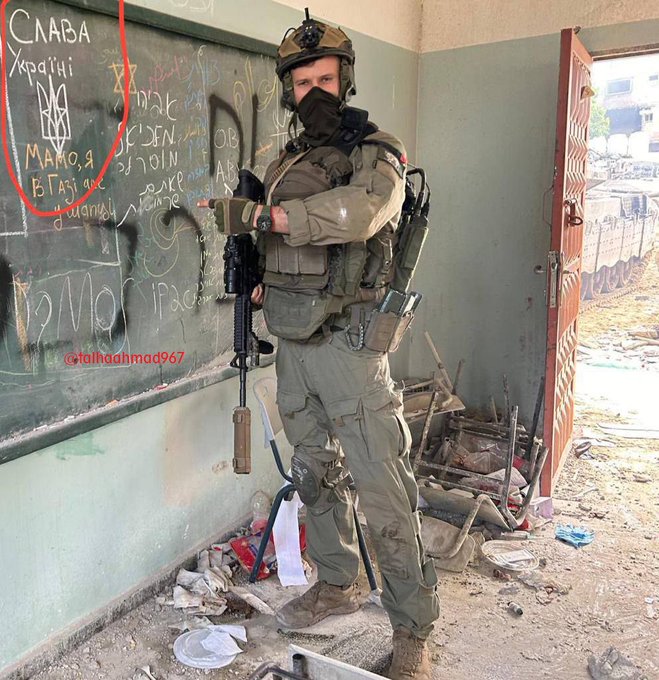
Fighters from Qassam Brigades, the armed wing of Hamas, ambushed and killed at least seven Ukrainian mercenaries who were fighting with the Israeli army in Gaza, Quds News Networkreported on 21 December.
According to sources speaking with the network, Qassam fighters targeted the mercenaries on 14 November after spotting them on Hassanein Street in the Shujaiya neighborhood, one of the main centers of Palestinian resistance to the ongoing Israeli ground invasion.
The sources added that “the occupation army did not include the dead among the numbers it acknowledges about its losses among soldiers in Gaza,” and that the ambush killed soldiers from the Israeli army as well.
According to the sources, a video that circulated on social media of a unit of Ukrainian mercenaries in a Shujaiya school was recorded on the same day as the attack.
It also showed a group of Ukrainian mercenaries in a neighborhood of Gaza City, hiding behind a wall.
Ukrainians fighting for Israel is a reversal of a dynamic that appeared in 2022, as reports emerged of hundreds of Ukrainian-born Israelis and several native Israelis traveling to Ukraine to join volunteer units after the Russian invasion.
The Quds Network report comes as the Israeli military announced the deaths of three additional soldiers on Thursday, Lavi Gehati, Omri Schwartz, and Yacoub Elian, during battles in the Gaza Strip. This brings the number of Israeli soldiers killed to more than 136, according to Israel, since the start of its ground invasion in Gaza on 27 October.
However, as The Cradle has reported, Israeli military leaders seeks to hide many of their soldiers’ deaths, and the number killed and wounded is likely much higher than the military’s official acknowledgements.
Hamas has released a flurry of combat videos in the past week showing its fighters targeting Israeli troops, armored personnel carriers, and tanks. This indicates that while Israel has caused massive destruction in Gaza, the Qassam Brigades are still strong militarily and are inflicting heavy losses on the Israeli army.
The escalating attacks on ships in the Arabian Sea and the Bab Al-Mandeb Strait by the Houthi movement in Yemen pose a real threat to the Israeli, Western and American economies. The Red Sea is one of the world’s busiest shipping routes for oil and gas. Most of the major shipping companies, such as the world’s largest container company, Italian and Swiss-owned Mediterranean Shipping Company (MSC), Denmark-based Maersk, Germany’s Hapag-Lloyd, and France’s CMA CGM have suspended their use of the Red Sea.
Due to the Houthi attacks, ships now have to go around Africa via the Cape of Good Hope, adding 4,000 nautical miles to the journey. This will result in the doubling of the shipping costs, to $4,000 per forty-foot container. According to experts, this change is due to the extra fuel cost of $1 million for each vessel going via the Cape instead of the Red Sea and the Suez Canal.
The Houthis are apparently applying an ethically justified approach built on the same logic used by the Israeli occupation state. Israel besieges the Gaza Strip and grants itself the right to do so. With this logic, the group grants itself the right to besiege Israel and links the opening of the strait to lifting the Israeli blockade on Gaza.
As the attacks intensify and pose a real danger to maritime routes, causing many companies to fear using the Red Sea and raising the cost of insurance and transportation, the US has announced the formation of an international naval coalition intended to protect cargo vessels. Ironically, though, the US is the largest country to impose blockades on other states and use sanctions as a weapon.
While previous US presidents considered any foreign war as an opportunity to rally the American people behind them and give themselves an electoral boost, the situation under President Joe Biden is different. He is the main advocate of the war against Russia in Ukraine, which he is losing despite throwing billions of dollars into it. Engaging in an armed confrontation with the Houthis would be a resounding failure, since the group has little to lose and does not fear war. Indeed, it would gain more legitimacy as the only force in Yemen to be fighting imperialism. Moreover, its war with the Saudi-led Arab coalition, including the United Arab Emirates, has shown that it is resilient, and able to force the coalition to freeze combat missions after years of fighting.
The outbreak of another war in this region would mean serious long-term disruption and increased transportation costs, as well as rising fuel and energy costs for end users. This would have a major impact on Europe during the winter given the already suspended supplies of oil and gas from Russia. Crude oil prices are already creeping up.
The impact of a war would be challenging for Biden as well. The US president sees himself as the, not a, world leader, but he faces difficult choices. He is accused of corruption and faces domestic issues, as does his rival, former President Donald Trump. In addition, the existing wars and crises are having long-term negative impacts on Washington’s standing and international influence.
Despite this, it seems to be impossible for Americans to consider alternative, more intelligent means to approach problems instead of military “shock and awe”. The US and its protégé Israel have always tried to play the role of gods in international politics, where what they want becomes a reality regardless of international laws and conventions. This may succeed in the short term, but it backfires in the long run, as seen in Vietnam, Iraq and Afghanistan. Armed interference in all of these countries has drained the US and its people, who are generally controlled by the political, economic and media elites.
These elites combined work systemically to nurture violence among American citizens, implanting a gung-ho mentality with war seen as the most effective way to solve international problems. Hollywood and video games instill the idea of US (and Israeli) exceptionalism and invulnerability in the minds of the public, so that it becomes easy to recruit them to fight and die in the elite’s battles. The US helps to spread racism in the world by creating divisions among people and inciting them against each other. The old principle well-loved by settler-colonial states is divide and rule; people are easier to manipulate, helping to ensure the concentration of wealth in the hands of the elite that fosters racism.
A simple comparison with cinema in Iran — which the US designates as a sponsor of terrorism — reveals a stark difference. Iranian cinema only rarely focuses on humanitarian and social topics, and hardly ever depicts violence, unlike Hollywood, which thrives on screen violence, normalising it and de-sensitising the audience to the extent that people find it easier to harm their fellow human beings in the service and interests of the elite.
While the economy is failing and education is facing great challenges in America, the government is spending trillions of dollars on unjustified and futile wars, including the one which Israel is waging against the Palestinian people. Sinking more and more resources in the quagmire of the Middle East will only lead to more suffering within America and abroad. Likewise, what is happening in Yemen will have an impact worldwide, not just in Gaza.
The consequences of a war against the Houthis will be much broader, dragging the Zionist colonial project and Western imperialism into a hellish scenario. Regardless of what the Zionists and their supporters in the West believe, they did not create a safe haven for Jews when they created the state of Israel in the heart of the Arab world. The Houthis are turning the tables on everyone in their defence of the Palestinians against Israel’s genocide in Gaza.
While Israel is causing starvation in Gaza, Israeli soldiers are cheerfully filming themselves destroying food, looting, and vandalizing Palestinian property.
Defence for Children Palestine | December 18, 2023
Dunia A., 12, and her family were struck by an Israeli airstrike in the Gaza Strip. Dunia’s family was killed and she lost her leg.
While she was recovering in Naser Hospital in Khan Younis, an Israeli tank-fired shell hit the hospital and killed Dunia. This video was filmed on November 25 during a seven-day truce between Israeli forces and Palestinian armed groups and Dunia was killed on December 17, 2023.
Hamas political leaders are in talks with the Palestinian Authority (PA) about how to govern Gaza and the West Bank after the war with Israel ends, with the goal of establishing a Palestinian state, The Wall Street Journal (WSJ)reported on 20 December.
“We don’t fight just because we want to fight. We are not partisans of a zero-sum game,” Husam Badran, a member of Hamas’ Doha-based political bureau, stated. “We want the war to end.”
The Hamas leader’s statement marks a change from 7 October, when the armed wing of the group led an assault on Israeli military bases and settlements in which more than 1,200 Israelis were killed, both by Hamas and Israeli forces themselves due to the Hannibal Directive.
Hamas wished to break the 17-year siege on Gaza and put the Palestinian issue back on the table in the international arena.
During the attack, Hamas took over 200 Israeli soldiers and civilians captive hoping to exchange them for the freedom of thousands of Palestinians long held in Israeli prisons.
Now, after Israel has killed more than 20,000 Palestinians in Gaza, Hamas’s political wing is seeking an end to the conflict.
“We want to establish a Palestinian state in Gaza, the West Bank and Jerusalem,” Badran said.
Badran also stated Hamas wishes to join the Palestine Liberation Organization (PLO), which represents Palestinians at the United Nations and other international forums.
“It will be a national dialogue,” Badran said. “We have always said the PLO should contain any Palestinian faction.”
Badran and other Hamas officials say the talks have also included Mohammed Dahlan, a former Gaza security chief with close Emirati and Egyptian support, and former Palestinian Prime Minister Salam Fayyad.
“I am no friend of Hamas,” Dahlan said. “But do you think anybody is going to be able to run to make peace without Hamas?”
The Hamas political leaders indicated they would be willing to join the PLO and support negotiations for a Palestinian state within the 1967 borders.
But Badran said that Hamas had no plans to recognize Israel as long as the occupation continues. “The world has no right to ask when people are being killed,” he said. “It’s not logical to ask this question at this time.”
Badran denied rumors of a division between Hamas’ Gaza branch and its political leadership in Doha. “The leadership of Hamas, both inside Gaza and outside it, is in complete agreement on strategies and political positions across various issues,” he said.
Badran says Hamas is seeking a full-scale ceasefire and a full exchange of captives from both sides. “If there is a ceasefire, our stance is crystal clear: We want an exchange of all-for-all,” he said.
Israel has for years sought to foster divisions between Hamas and the PA, led by Mahmoud Abbas’ Fatah Party, to prevent the establishment of a Palestinian state.
Prime Minister Benjamin Netanyahu has made clear he has for years approved Qatari payments to Hamas in Gaza, while ensuring the PA remained weak and unable to win the establishment of a Palestinian state through peaceful diplomatic means.
Israel has also sought to use the PA security forces to dismantle Palestinian resistance groups in the West Bank.
The US and Israel appear to disagree on a final solution for Gaza. The US wants a PA security force to crack down on Hamas after the war and to administer Gaza, said Diana Buttu, a former Palestinian peace negotiator. “They essentially want the PA’s role as Israel’s security subcontractor in the West Bank to be expanded into Gaza,” she said.
Buttu said the US is willing provide renewed financial and political support for the PA to maintain what New York Times journalist Thomas Friedman this summer called the “shared fiction” of a Palestinian state. “There is a longstanding and continuing false promise of Palestinian statehood,” Buttu added.
However, Israel has vowed it will not allow the PA to take control in Gaza. Numerous Israeli political and military figures have called for destroying Gaza, forcing its 2.3 million residents to flee to Egypt or Europe as refugees, and to rebuild the Jewish settlement in Gush Katif on the Gaza coast that was evacuated in 2005.
The Iranian Foreign Ministry spokesman has strongly condemned the Israeli regime’s complicity in drafting and approving the human rights resolution against the Islamic Republic, saying the move is nothing but a big political and moral scandal for Western countries.
Nasser Kan’ani made the remarks in a statement on Wednesday, noting that the action of some Western countries in drafting and approving a resolution against Iran in the United Nations General Assembly on the issue of human rights “is a clear example of the double standard and the use of human rights as a tool for illegitimate political purposes.”
He said the human rights resolution against Iran was proposed by some Western countries while these nations are turning a blind eye to the Israeli war crimes and genocide in Gaza and the occupied West Bank, and some of them are fully supporting the criminal regime.
“This regime is a criminal, and even more ridiculous is that it is also one of the co-founders of the resolution against Iran,” Kan’ani added, emphasizing that the Israeli collusion devalues the concept of human rights.
He further stressed that countries that have a long history of systematically violating human rights all over are not in a position to give human rights recommendations to the government and people of Iran, while reiterating that the resolution lacks any legitimacy or validity.
The Islamic Republic of Iran is a system based on religious democracy and has always been very serious about promoting human rights and fulfilling its international obligations, he said.
On December 19, a resolution dubbed “Situation of human rights in the Islamic Republic of Iran” was adopted in the third committee of the UN General Assembly, condemning what it claimed as “rights abuses against women” in the country.
The resolution was adopted by 80 votes in favor, 29 against, and 65 abstentions.
If the US decides to launch direct attacks on Yemeni forces imposing a blockade against Israeli shipping in the Red Sea, it will only make Washington’s tenuous situation in the Middle East worse and expand the conflict across the region at a time when the US public is increasingly opposed to such wars, a journalist told Sputnik.
Several major global shipping companies announced that they are to seek alternate routes from the Red Sea after the Yemeni militant group Ansarallah, better known as the Houthi movement, closed it to Israeli cargo traffic, throwing global trade into chaos. In response, the US has mobilized an international task force dubbed Operation Prosperity Guardian to keep the sea lanes open.
Meanwhile, the Pentagon is weighing whether its patrols will be purely defensive in nature or will also include offensive strikes against Ansarallah targets in Yemen, which the group mostly controls after eight years of brutal civil war and Saudi-led military intervention.
Ansarallah’s actions, which include capturing several Israel-linked vessels in the area in recent weeks, are in response to Tel Aviv’s invasion of Gaza, which has killed nearly 20,000 people and displaced almost the entire population of 2.3 million. The group has also fired ballistic missiles at the southern Israeli port of Eilat on the Gulf of Aqaba in the northern Red Sea.
Beirut-based broadcaster and journalist Laith Marouf told Sputnik that the multinational task force assembled by the US includes several European allies but also Bahrain, a small Persian Gulf state that hosts a massive US Navy base, and the Seychelles, an island nation in the Indian Ocean with a coast guard composed of nine small patrol boats used to combat piracy and illegal fishing.
“This is the alliance that the United States is going to face Yemen with to try to allow shipping to go through to the Zionist colony and not make it feel the pain that the Palestinians are feeling with the blockade in Gaza,” he said.
“The [recent] attack that the government in Sana’a did on the two ships in the Red Sea was the first attack recorded in any military of a ballistic missile hitting a naval target that is moving at 60-somewhat knots, which was [the speed at which] these ships were moving. So we see now that the Yemenis have actually some of the most advanced land-to-sea missiles in the world.
“Knowing that the American aircraft carrier is now parked on the shorelines of Somalia facing Yemen, they are in the range of these missiles. Probably the Yemenis will not need to hit this aircraft carrier if the United States actually attacks Yemen or any of the sites of launching these missiles from Yemen. The Yemeni forces, all they have to do is sink a few destroyers and that aircraft carrier will scurry running back home because it wouldn’t have any protection.”
“This is now a dangerous game that the United States is playing, all to defend this Zionist colony. And the American people hearing us right now must understand that the deaths of any American soldiers that are going to come in the next few days will be because the United States is defending the Zionist colony and is not defending itself. They will be dying for the sake of Israel,” he said.
“Canadian, French, British and American ships will be sinking if the United States or this coalition dares to attack Yemen. Yemen has been under attack for a decade by the United States and its vassals in the region, and even the vassals that were co-operating in the attacks on Yemen – namely the Saudi government and the United Arab Emirates government – have refused to join this coalition. Why? Because their assets will be fried if the United States attacks Yemen. And this is why we’re seeing right now: these vassals are each one of them being given a role.”
“The Emirates and the Saudis are continuing to allow trade to come through their ports on trucks to Jordan to the Zionist colony, and they’re all going to be kept out of this war. In this situation, it’s not only that their assets, their oilfields, would be attacked if they join this coalition, but also because they need to continue to be the lifeline of the Zionist colony in terms of trade in the future as this rolls out,” Marouf said.
Marouf added that “we will be entering a new stage of this war” if Yemen fires back on the coalition ships because it will trigger wider attacks on US bases in Iraq and Syria by allied militia forces, which have been happening at a somewhat low intensity since early October.
The Axis of Resistance’s regional coordination against Israel and its allies “is going to be taught in military schools and strategists’ schools for decades to come,” Marouf told Sputnik.
“What has been rolling out for the last two and a half months, clearly, the Resistance Axis that includes all these groups in Iraq, Syria, Jordan, Palestine, Yemen and Iran are very coordinated,” he said.
“They have all now shared all their capabilities in terms of military and training. So we see units of each one of these components that fought in the different battlefields across the last 15 years in the region. And the technology knowledge on building capabilities has been passed along across this whole region. So now we have a more kind of homogeneous coalition between these groups.
“They all have one thing that they agree on, which is ending American presence in the region and then sovereignty for the peoples. So to see them, how they are playing out right now, each one of them, their own role separately is a brilliant thing to watch. And the United States and Israel are in a quagmire, and the end is clear for everybody to see.”
Growing US Public Opposition
He likewise noted that opposition to the Israeli attack on Gaza has continued to grow in the United States, where new protests are happening daily in hundreds of cities and towns, and constituents are pressuring politicians to take a stand against the war.
“For the American voters, it’s becoming problematic as we come closer and closer to the elections in the United States. Both parties are championing genocide and the Zionist colony, and the vast majority of Americans do not want to be associated with this genocide and do not want their country to carry the brunt of financing and weaponizing this genocide,” he said.
“So what happens in the next election? I think Palestine, just like Vietnam in the 1970s, is going to be one of the decisive things that drive this election and actually the conversation of the United States as a whole. And I hope people of all walks of life take advantage of how Palestine now has exposed all the true lines of power and the limitations of the so-called ‘democracy and freedoms’ that were touted to be given to them and figure out something before the next election. Maybe to push for a third party, if that’s even possible at this moment.”
“But if the United States is in a regional war that is spilling into a global war before this election, it may be that this election will never happen in the United States. I’m maybe too pessimistic, but I see things from now till next year, if this war keeps on going in the stages that are and how long these stages are taking us, as we see it now, it’s taking us two and a half months to get to the stage of real possibility of a regional war. And once this a regional war, how long is it going to take for it to become a global world war? Those are things that may be indicating that all this experiment of democracy in the West is dead.”
Israel’s Economy in Dire Straits
Marouf noted that Israel was suffering severe economic repercussions due to the war, not just from the recently imposed Yemeni blockade, but also due to the constant bombardments from Gaza, the simmering border war with Hezbollah, and simply due to having mobilized hundreds of thousands of citizens into the Israeli Defense Forces (IDF).
“There are 7 million ‘Jewish colonists’ in Palestine and already close to a million of them have left. And you know, many of them already have second citizenships, and we heard countries like Portugal all talk about 10,000 Israeli families applying for citizenship. These are the ones that don’t have citizenship that are already applying to European countries. And so we have an exit from the Zionist colony on a scale that we haven’t seen ever since 1948. And now we also, of course, all the economy of the state is at a total standstill because they have mobilized so many people into the military.”
“Ansarullah, the government in Yemen, has been able to shut down all trade, almost 88% of trade has stopped into the [Israeli] ports, even the ones in the Mediterranean. Because remember now, although all the ones that were supposed to go to the Red Sea port in the Aqaba Gulf had to turn around.
“So now there’s a delay in an empty space in Israeli ports for the next two weeks. So, the country is in a total standstill and it’s now living off the handouts coming from the West. And the American public has an ability to make a difference if they cut these handouts, because this country cannot continue to exist at this moment without that.”
The Malaysian government has imposed an indefinite ban on vessels owned by an Israeli shipping cargo company from docking at its ports in response to the bloody Israeli onslaught against Palestinians in the Gaza Strip.
Ships en route to the occupied Palestinian territories and Israeli-flagged vessels will also be barred from loading cargo at any port in the largely Muslim Southeast Asian nation.
Prime Minister Anwar Ibrahim said in a statement on Wednesday that the Transport Ministry has been instructed to enforce the ban with immediate effect.
Anwar singled out Israel’s biggest shipping firm ZIM.
Malaysia’s cabinet had in 2002 authorized Israeli-registered companies to dock vessels at Malaysian ports; and in 2005, allowed Israeli-registered ships to anchor in Malaysia. However, Wednesday’s statement said that authorizations had been rescinded.
“The Malaysian government decided to block and disallow the Israeli-based shipping company ZIM from docking at any Malaysian port,” Anwar said.
“These sanctions are a response to Israel’s actions that ignore basic humanitarian principles and violate international law through the ongoing massacre and brutality against Palestinians.”
Malaysia “also decided to no longer accept ships using the Israeli flag to dock in the country” and ban “any ship on its way to Israel from loading cargo in Malaysian ports.”
Anwar said his country was confident its trade would not be affected by the decision.
Malaysia does not have diplomatic ties with Israel.
Malaysians have kept up a strong show of support for the Palestinian people’s struggle to claim their sovereign rights, and strongly condemned the cruelties being perpetrated by the Israeli regime in Gaza.
Malaysians in various parts of the country have held marches and motorcycle convoys to voice their support for the Palestinian people, who are suffering from oppression and atrocities committed by the Israeli regime.
Muslim scholars have called on all people to show undivided support for Palestine because the Palestinian issue is related to humanity and not just religion.
Israel waged the brutal war on Gaza on October 7 after the Palestinian Hamas resistance movement carried out Operation Al-Aqsa Storm against the usurping entity in retaliation for its intensified atrocities against the Palestinian people.
Since the start of the offensive, the Tel Aviv regime has killed at least 19,667 Palestinians, mostly women and children, and injured 52,586 others.
Thousands more are also missing and presumed dead under the rubble in Gaza, which is under “complete siege” by Israel.
The US-led joint patrol in the Red Sea following Houthi militia attacks against ships heading toward Israel shows that the Palestinian-Israeli conflict in Gaza is not only affecting the whole region, but also the international community. Chinese analysts pointed out that the root cause of the trade route problem is the ongoing conflict in Gaza, and only a sustainable cease-fire and allowing humanitarian aid to enter Gaza via land and sea routes can solve the problem in the Red Sea.
China will pay close attention to the situation, and Chinese naval vessels that conduct UN authorized anti-piracy missions in the region will keep performing their duty, analysts said, adding that China will stick to the priority of realizing a cease-fire and clear the way for humanitarian aid for the people in Gaza, rather than joining the US to conduct any military operations without UN authorization to escalate the crisis in Gaza.
The US and a host of other nations are creating a new force to protect ships transiting the Red Sea that have come under attack by drones and ballistic missiles fired from Houthi-controlled areas of Yemen, Defense Secretary Lloyd Austin announced Tuesday in Bahrain, the AP reported.
The UK, Bahrain, Canada, France, Italy, Netherlands, Norway, Seychelles and Spain have joined, Austin said. Some of those countries will conduct joint patrols while others will provide intelligence support in the southern Red Sea and the Gulf of Aden.
The Houthi militia attacked two commercial ships in the Red Sea with naval drones on Monday. The recent attacks have caused concerns about the impact on the passage of oil, grain and other goods on what is an important global trade route, and have pushed up the cost of insuring and shipping goods through the Red Sea, Reuters reported.
The Shanghai-based news website The Paper reported on Tuesday that following other international shipping companies including Denmark’s Maersk and France’s CMA, Chinese shipping giants like COSCO and Orient Overseas Container Line (OOCL) also suspended transport through the Red Sea.
Ma Xiaolin, dean of the Institute for Studies on the Mediterranean Rim at Zhejiang International Studies University, told the Global Times on Tuesday that the trade route via the Red Sea is truly important for China as it connects Europe, Asia and Africa, so China will pay close attention to the situation.
“However, although China has naval vessels in the region, their mission is about anti-piracy, rather than intervening in regional issues and other countries’ internal affairs. Only a solution to the ongoing crisis in Gaza can effectively solve the problem in the Red Sea,” Ma said.
On December 9, Al Jazeera reported that the armed group in Yemen claimed that “it will target all ships heading to Israel, regardless of their nationality, and warned all international shipping companies against dealing with Israeli ports.”
“If Gaza does not receive the food and medicines it needs, all ships in the Red Sea bound for Israeli ports, regardless of their nationality, will become a target for our armed forces,” the group’s spokesperson said in a statement on Saturday, according to Al Jazeera.
Song Zhongping, a Chinese military expert and TV commentator, told the Global Times on Tuesday that the “Houthis are specifically targeting Israel, so it’s unlikely it will attack Chinese vessels. China doesn’t need to be too worried about the situation and the Chinese warships in the region will stick to their plan.”
“China will keep making efforts to realize a sustainable cease-fire and clear the way for humanitarian aid to get into the Gaza Strip. This is the real priority that needs to be done,” Wang Jin, an associate professor at the Institute of Middle Eastern Studies at Northwest University, told the Global Times on Tuesday.
If Washington and its allies want to solve the Red Sea problem, they should play a responsible role in the UN Security Council to pass a cease-fire resolution and to put concrete efforts into improving the humanitarian situation in Gaza, which would be more effective than sending warships to conduct joint patrols, experts said.
The humanitarian situation in Gaza remains severe. According to Reuters on Tuesday, Israeli missiles and air strikes on the Rafah area in southern Gaza struck three houses killing at least 20 Palestinians, Gaza health officials said on Tuesday. Tens of thousands of displaced Palestinians have crammed into Rafah on Gaza’s border with Egypt to escape Israeli bombardments.
The lack of unity in the UN that is mainly caused by the US is another key reason why the situation is far from easing. The UN Security Council delayed until Tuesday morning a vote on an Arab-sponsored resolution calling for a halt to hostilities in Gaza to allow for urgently needed aid deliveries to a massive number of civilians as members intensified negotiations to try to avoid another veto by the US, the AP reported.
Wang Wenbin, a spokesperson for the Chinese Foreign Ministry, said at a routine press conference on Tuesday that “the UN General Assembly has adopted two resolutions with an overwhelming majority. We hope the US will listen to the voice of the international community, stop single-handedly blocking Security Council resolutions, and play its due role to promote an immediate cease-fire and prevent an even larger humanitarian catastrophe.”
Abla Lafi is 59 and from the village of Turmus Ayya, north of Ramallah in the occupied West Bank. She is passionate when speaking about her olive groves, which the Israeli army and illegal Jewish settlers prevent the villagers from harvesting.
“This is our own land,” she said defiantly. “How dare they prevent us from entering it and picking olives from the trees as if we were thieves? We planted them with our own hands. The settlers are the thieves and we are the owners of the land.”
October and November make up the main olive harvest season for Palestinian farmers. Thousands of families depend on a good crop for their livelihood. Around 45 per cent of agricultural land in the occupied West Bank is planted with an estimated 10 million olive trees, producing between 32-35,000 metric tons of olive oil every year.
This year, due to the war on Gaza, settlers and the Israeli army are preventing thousands of farmers from reaching their olive groves. Last month, the occupation state’s extreme far-right Finance Minister Bezalel Smotrich called on the Israeli government to prohibit Palestinians in the West Bank from harvesting their olive trees. According to Smotrich, Israel needs to establish “sterile security zones” with no Palestinian presence around settlements and settler-only roads. It looks as if the Israeli occupation forces are implementing this policy in order to block Palestinians from getting to their own land.
“Extensive damage to land and trees and stringent movement and access restrictions by Israeli forces hamper access to olive trees, especially those close to settlements,” the UN has reported. “At the end of November, an initial estimate indicates [that] 800,000 dunums of land have not been harvested due to Israeli settler violence and access restrictions.”
“Olives not only have economic importance to Palestinians, but are also symbolic of their roots, resilience and attachment to the land. For the Palestinians, the olive tree represents their spirit and identity.”
“We used to go to work on the land with joy and love for all family members, men, women, children and animals, because cultivation means belonging to the land, a feeling which we pass on to our children and grandchildren,” explained Lafi. “The olive season is like Eid for us; we celebrate its blessings with joy and happiness, even the taste of its food is different.” However, she added, since the establishment of the illegal Jewish settlements on Palestinian land, the locals have lived through the olive season in an atmosphere of fear, anxiety and terror from the settlers and the army. “The anxiety and sadness have increased this year due to the war on Gaza.”
The head of the agricultural committee in the village, Nidal Rabie, confirmed that since the war against the Palestinians in Gaza started, the settlers and settlement guards have stopped local residents from reaching their olive groves in the plain adjacent to the illegal settlements built on lands confiscated from the village. “They expelled us as recently as today,” said Rabie. “We tried to access our land, but they came and expelled us at gunpoint.”
The 61-year-old Palestinian farmer who holds US citizenship, added: “We are now in the middle of December trying to pick our olives to no avail. Every farmer who tries to pick olives is shot at. If we wait any longer, the olives will be ruined and the quality of the oil will become low and inedible.”
Although the settlers and soldiers obstruct the olive harvest every year, explained Rabie, sometimes the Palestinians succeed in harvesting at least part within hours and days determined by the Israeli army. “This year the soldiers prevented us from harvesting any olives in the plain. I personally own 30 dunums that I am not able to harvest at all.”
A few days ago, the army even stormed Turmus Ayya at night and confiscated 50 vehicles belonging to the villagers, because they were used in agricultural work. Altogether, around 2,500 dunums belonging to the villagers but adjacent to the illegal settlements have not been allowed to be harvested. “They would have produced around 70,000 litres of olive oil,” he added.
Palestinian farmers in the village are also prevented from cultivating their own land next to which illegal settlements have been built. Mishal Al-Quq, 43, said that he used to live in the US and went back to Palestine two years ago to take care of the land and cultivate it. “This year we are facing a big problem in growing wheat in the plain east of the village as we are prohibited from working there by the occupation army, but now is the season for planting seeds. We must plant quickly, otherwise it will be too late.” Wheat is very important and is a basic crop for the villagers, he said. “We must grow it.” This was confirmed by Rabie, who pointed out that he had bought wheat and barley seeds, but did not know whether he would be able to plant them or not.
The Israeli destruction of the olive groves unmasks a fact that not many in the West know about; it’s often heard that Israelis hold dual US citizenship, but we don’t hear so much about Palestinian Americans. It is estimated that between 45-60,000 Palestinian Americans live in the occupied West Bank, according to Reuters. However, this does not stop Israel from targeting them. They are treated by the apartheid state as Palestinians and have no “American” privileges. For instance, Israel prevents Palestinian Americans from entering the US from the West Bank, an apparent violation of a recent agreement in which citizens from the US and Israel can travel to the other country without a visa. According to Rabie, most of the residents of Turmus Ayya hold dual Palestinian and US citizenship, but the US government doesn’t provide any protection to the farmers. “Some villagers who hold American citizenship contacted the US Embassy and asked for protection to work on our own land. But the embassy said that it could only assist in securing travel to the United States. This would mean displacing us from our land in Turmus Ayya.”
Although the Biden administration has declared the intention to deny visas to violent settlers, Rabie doubts that it will happen. “This was only propaganda. Biden’s true position was clear when he said that if there was no Israel, the US would have to create one. This shows Washington’s collusion with Israel.”
Abla Lafi believes that the goal of Israeli “harassment” is to seize the Palestinian land close to the illegal settlements that were established on stolen land which contains olive trees that have been cultivated for hundreds of years. “They have no right or ownership over it,” she insisted. “We inherited the land from our ancestors and we should not be prevented from entering it. Although it is more difficult this year, we have been facing this same problem every year since the establishment of the first settlement, which I remember was Shilo, in 1978, when I was 14 years old. At the beginning, there were mobile homes and the road leading to them ran through our village. The roads were built on lands confiscated from Qaryut and Turmus Ayya, after which they began to spread like a cancer and descended from the hilltop on to our land in the plain and spread to the nearby villages.”
More settlements were built, such as Rachel, Adei Ad, Amichai and other random outposts inhabited by terrorists known as the hilltop youth, she added. “They began terrorising the people, shooting, destroying property and blocking the roads. Before those settlements were built, when I was a child, we used to live peacefully, plough and plant. I have beautiful memories of the different seasons of figs, olives and wheat that we used to grow.”
Rabie confirmed that settler crimes, the confiscation of land and the cutting down and burning of olive trees in his and other villages, have been carried out constantly by settlers and the Israeli army even before Israel’s latest war against the Palestinians in Gaza. The most ferocious attack by settlers happened on 21 June this year, when hundreds of settlers stormed the village killing Omar Qutain, burning dozens of houses and cars, and hundreds of olive trees and wheat fields, destroying the village. The Israeli army stood and watched, but did not intervene.
No indictment has been filed against anyone, and this is not an exceptional case. According to Yesh Din, out of a thousand cases regarding acts of violence committed by settlers between 2005 and 2021, 93 per cent were closed without an indictment.
“These attacks did not and will not stop farmers from continuing to work on their land,” said Rabie. “If we stop cultivating the land, the Israeli authorities will exploit that to claim that the land is no man’s land, confiscate it and give it to the settlers. They did this before.”
This was a reference to Israel’s use in 1979 of an Ottoman land law of 1858 which stipulates that if private land is not cultivated for three years in a row it becomes state property. “At which point Israel hands it over to the settlers.”
Abla Lafi is determined that these Israeli attacks and policies will not discourage Palestinian farmers from cultivating their land. “I love my land and I love the fertile plain. This is the land that was watered by the sweat of the farmers and the blood of the martyrs who fell defending it: Joda Awad shot dead by the Israeli army in 1988, and Khamis Abu Awad, who was killed by a settler in 1993 while ploughing the land. Minister Ziad Abu Ain was also martyred in the plain defending the land and so was, most recently, Omar Al-Qotain this summer. We cannot give up on the land that many died to defend. We will pass it on to our children.”
Israel’s National Security Minister Itamar Ben-Gvir has called for the execution of imprisoned members of the Islamic Resistance Movement, Hamas, for each day Israeli prisoners of war are held by the movement in the besieged Gaza Strip.
Ben-Gvir also called to “immediately stop” any talks aimed at concluding prisoner exchange deals with Hamas.
“Instead, the death penalty must be applied against the terrorists. Prisoners from elite Hamas forces must be executed for each day that passes in which the kidnapped are not released,” he posted on X.
In a clear call for carrying out war crimes, the controversial minister demanded humanitarian aid be banned from entering Gaza.
“How many Israeli soldiers have been killed in Gaza?”
This is a persistent question that many are asking as the Israeli military’s ground campaign in the bombed and besieged enclave nears its second month.
If the army is suffering relatively low losses while inflicting massive Palestinian civilian casualties, this suggests Israel is well on its way to achieving its clear objective of eliminating Hamas, but also its unspoken goals: conquer Gaza, ethnically cleanse its 2.3 million residents, and rebuild the Gush Katif settlement bloc.
But if the occupation army is indeed suffering huge losses, this suggests the Israeli military and political leadership may need to soon end their genocidal campaign prematurely, while citing exaggerated external pressure from the White House as the pretext.
Secrecy surrounding Israeli losses
Israel’s military claimed on 17 December that 121 soldiers had been killed since its delayed ground campaign began on 27 October, when tanks and infantry began to push into Gaza’s cities and refugee camps.
But determining the true number of Israeli soldier casualties has always been notoriously difficult, as Israel’s military goes to great lengths to cover up its combat losses. A recent battle between Hamas and Israel’s vaunted Golani Brigade exemplifies this secrecy.
“We are heading to the most difficult and deepest place with a large number of enemy fighters,” boasted Israeli Lt. Col. Tomer Grinberg, commander of the Golani Brigade’s 13th Battalion, shortly before leading his troops on a ground operation in the legendary Shujaiyya (which aptly means “courageous”) neighborhood in northern Gaza.
He then added, “I promise you a resounding victory.”
But Grinberg is now dead.
According to Israeli sources, Grinberg was killed during the 12 December operation, along with nine other Golani soldiers, in an ambush by Hamas fighters.
After four of the brigade’s soldiers were injured in a firefight, others sought to rescue them amid fears they may be dragged into a tunnel. The second group was also hit by explosives, as was a third group that also tried to evacuate the wounded.
After the battle, Hamas issued a statement warning:
“The longer you stay there, the greater the bill of your deaths and losses will be, and you will emerge from it carrying the tail of disappointment and loss, God willing.”
Resistance claims higher soldier toll
But there is compelling reason to believe the number of soldiers killed alongside Grinberg in Shujaiyya is much higher than the nine announced by the army.
Security expert and retired Israeli Colonel Miri Eisin toldCNN that the 12 December attack was particularly painful because so many of the dead were high-ranking officers:
“We’re hurting today… It’s always hard when soldiers are killed, but when it’s this level of command, it hits you in the gut. These are commanders that commanded hundreds of soldiers.”
This led one former US soldier to ask on X whether Israel was hiding the true number of soldiers killed in the ambush. “Where are all the privates, and the corporals, and the lower enlisted?”
Hamas, through its armed wing, the Ezzedine al-Qassam Brigades, provides an answer.
Regarding the events on 12 December, the Qassam Brigades reported killing 11 soldiers in Shujaiyya, including members of a rescue team, in an apparent reference to the deaths acknowledged by the Israeli army.
But according to Qassam, on the same day, its fighters also killed or injured 10 soldiers east of the city of Khan Yunis, killed or injured another 20 soldiers barricaded inside a building in the Sheikh Radwan area of Gaza City, and killed another 15 soldiers who attacked them in their make-shift base at the Abu Rashid Pool.
Censorship on the press and hospitals
Despite claiming to be “the only democracy in the Middle East,” Tel Aviv maintains a tight grip on information related to military casualties through the use of military censors, controlling what the press can publish concerning national security issues, including injuries and deaths of soldiers.
“The human losses announced by the security establishment are usually binding on hundreds of media institutions, and these are allowed to work basically according to this rule. The death toll always comes from one source, and no one questions it,” Hassan Abdo, The Cradle’s Palestine Correspondent, reported earlier this year.
Abdo attributes this to preserving the image of the invincible Israeli soldier “who does not fall victim to a weak, primitive opponent.”
This is “one of the main pillars of the Zionist project based on the tripartite of security, immigration, and settlement,” he added.
As The Cradlenoted, even before the outbreak of war on 7 October, Israeli soldiers have had a strange tendency to die in “accidents” during periods of heightened conflict with the Palestinian resistance, including in car accidents, plane crashes, suicides, gas leaks, and even falling from balconies.
But this invincible image was shattered with the operation Al-Aqsa Flood, when Hamas and other Palestinian resistance groups broke out of the Gaza Strip to attack the Israeli military bases and settlements (kibbutzim) enforcing the brutal 17-year siege on the tiny and impoverished enclave.
During Al-Aqsa Flood, Hamas killed 41 soldiers from Grinberg’s Golani battalion alone, in major battles at the Re’im and Nahal Oz military bases.
Hezbollah’s estimates and questions from within
Israel claims Hamas carried out a massacre at the Nova music festival, just a few kilometers from the Re’im base, but a major battle took place there as well. At Nova, 58 Israeli police were killed, including from elite combat counter-terror units of the Border Police, known as Yamam, who were the first to respond to the attack.
According to an Israeli police investigation regarding events at Nova, had there not been a substantial police deployment at Yad Mordechai, some 30 kilometers further north, “the terrorists would have been on their way to … Tel Aviv in 40 minutes.”
It, therefore, becomes more imperative than ever for the occupation state to hide the extent of its losses, both in the battle against the Palestinian resistance in Gaza and in the north in the battle with Hezbollah, to reestablish and maintain the myth of an overwhelmingly powerful military presence in the region.
Anecdotal evidence and estimates from Hezbollah suggest that the official count of 115 Israeli soldiers killed in the fighting in Gaza and near the Lebanese border following 7 October is likely much lower than the true figure. Reports from different sources indicate a significant discrepancy, with instances of mass casualties not officially acknowledged.
The Lebanese resistance movement estimates its attacks on settlements and military bases in northern-occupied Palestine have killed at least 35 Israeli soldiers and injured 172.
After just the first week of fighting in Gaza, the death toll, as announced by the Israeli army from fighting there, had reached 19. Among them were nine soldiers killed in just one attack. Hamas struck the “Namer” armored personnel carrier transporting the soldiers to the battle with an anti-tank missile.
Seven of the dead soldiers were 20 years old or younger, which seems to confirm the perception that Israel is sending inexperienced fighters into combat against Hamas’ battle-hardened fighters motivated by a cause, resistance to occupation, they firmly believe in.
But the occupation army spokesperson’s unit quickly learned not to announce the mass killing of soldiers of this sort.
Baruch Rosenblum, an Israeli rabbi, recalled a story from a senior officer in the army from the second week of the Gaza ground campaign. The officer explained that most of the fighting takes place at night, and that in just one operation, Hamas had killed 36 soldiers.
The rabbi explained that Hamas had attacked a convoy of three Namer armored vehicles, each carrying 12 soldiers, setting them ablaze. The army command watched via drone live feed as the soldiers abandoned the vehicles and Hamas eliminated them all with anti-tank weapons.
The senior officer chose not to disclose his name to the rabbi “to avoid arrest for revealing state secrets,” and the incident was never announced by the army or reported in the Israeli press.
On 18 November, in the third week of the ground operation, David Oren Baruch, the director of Mount Herzl Military Cemetery, provided another anecdote suggesting a soldier death toll much larger than what was publicly known.
He revealed that “We are now going through a period where every hour there is a funeral, every hour and a half a funeral.”
“I was asked to open a large number of graves. Only in the Mount Herzl cemetery did we bury 50 soldiers in 48 hours,” Baruch explained further.
Military control of the narrative
The Israeli military’s reluctance to disclose the number of wounded soldiers further adds to suspicions of underreporting.
Unlike in past wars, the Israeli military had refused to make any statement about the number of wounded in Gaza. This finally changed on 10 December, just before Haaretz planned to publish its report on the number of soldier casualties based instead on hospital sources.
Haaretz noted “a considerable and unexplained gap between the data reported by the military and that from the hospitals.” The hospital data the outlet obtained showed the number of wounded soldiers was “twice as high as the army’s numbers.”
The Israeli newspaper also highlighted the military’s tight control over the data reported by the hospitals themselves, explaining that members of the army spokesperson’s unit “are in the hospitals around the clock. Every press release regarding wounded soldiers and replies to media queries must receive their approval.”
Israeli newspaper Yedioth Ahronoth similarly reported on 9 December that, “Every day, about 60 new wounded are received only by the rehabilitation department” and that “the cumulative numbers since October 7 are astronomical: More than 2,000 soldiers, policemen and other members of the security forces have been officially recognized as disabled.”
“We have never been through anything even similar to this,” explained Limor Luria, head of the rehabilitation department at the Ministry of Defense.
“More than 58 percent of the wounded who are taken in by us have severe injuries of arms and legs, including those that require amputations. About 12 percent are internal injuries – spleen, kidney, tearing of internal organs. There are also head and eye injuries.”
In addition to thousands of horrific physical injuries, Israel is also facing “a tsunami of trauma,” the paper added. “I sat with a fighter who took three bullets. A physically torn person, a very serious injury,” Luria added, “but his main struggle is with the sights he saw.”
One injured soldier, Elisha Madan, recounted to a crowd how his fellow soldiers were killed in front of his eyes. “I came back from the dead alone. My entire squad died, and I was on the verge of death. I survived thanks to your prayers,” Madan said while seated in his wheelchair.
‘All warfare is based on deception’ – Sun Tzu
Since 7 October, the Israeli military leadership has reported falsehoods about almost every facet of that day’s events, and the war that followed.
They lied about Hamas beheading babies, they covered up burning alive their own soldiers and civilians with Apache helicopter and tank fire, and they continue to lie about pretending to care about the safety of Palestinian civilians, who they have mercilessly bombed for months with only the slightest pretext of targeting Hamas fighters and infrastructure.
As a result, while it is impossible to know the true numbers of Israeli soldiers killed in battle against the Palestinian resistance, there is ample reason to question the veracity of the information provided by the US-backed occupation army.
By John Laforge | CounterPunch | November 30, 2018
In my Nov. 16 column, I reported on potential radiation risks posed by California’s Woolsey wildfire having burned over parts or all of the Santa Susana Field Laboratory—south of Simi Valley, Calif., 30 miles outside Los Angeles—site of at least four partial or total nuclear reactor meltdowns.
The field laboratory operated 10 experimental reactors and conducted rocket engine tests. In his 2014 book Atomic Accidents, researcher James Mahaffey writes, “The cores in four experimental reactors on site … melted.” Reactor core melts always result in the release of large amounts of radioactive gases and particles. Clean up of the deeply contaminated site has not been conducted in spite of a 2010 agreement.
Los Angeles’s KABC-7 TV reported Nov. 13 that the Santa Susana lab site “appears to be the origin of the Woolsey Fire” which has torched over 96,000 acres. Southern Calif. Public Radio said, “According to Cal Fire, the Woolsey Fire started on the afternoon of Thursday, Nov. 8 … on the Santa Susana site.” … continue
This site is provided as a research and reference tool. Although we make every reasonable effort to ensure that the information and data provided at this site are useful, accurate, and current, we cannot guarantee that the information and data provided here will be error-free. By using this site, you assume all responsibility for and risk arising from your use of and reliance upon the contents of this site.
This site and the information available through it do not, and are not intended to constitute legal advice. Should you require legal advice, you should consult your own attorney.
Nothing within this site or linked to by this site constitutes investment advice or medical advice.
Materials accessible from or added to this site by third parties, such as comments posted, are strictly the responsibility of the third party who added such materials or made them accessible and we neither endorse nor undertake to control, monitor, edit or assume responsibility for any such third-party material.
The posting of stories, commentaries, reports, documents and links (embedded or otherwise) on this site does not in any way, shape or form, implied or otherwise, necessarily express or suggest endorsement or support of any of such posted material or parts therein.
The word “alleged” is deemed to occur before the word “fraud.” Since the rule of law still applies. To peasants, at least.
Fair Use
This site contains copyrighted material the use of which has not always been specifically authorized by the copyright owner. We are making such material available in our efforts to advance understanding of environmental, political, human rights, economic, democracy, scientific, and social justice issues, etc. We believe this constitutes a ‘fair use’ of any such copyrighted material as provided for in section 107 of the US Copyright Law. In accordance with Title 17 U.S.C. Section 107, the material on this site is distributed without profit to those who have expressed a prior interest in receiving the included information for research and educational purposes. For more info go to: http://www.law.cornell.edu/uscode/17/107.shtml. If you wish to use copyrighted material from this site for purposes of your own that go beyond ‘fair use’, you must obtain permission from the copyright owner.
DMCA Contact
This is information for anyone that wishes to challenge our “fair use” of copyrighted material.
If you are a legal copyright holder or a designated agent for such and you believe that content residing on or accessible through our website infringes a copyright and falls outside the boundaries of “Fair Use”, please send a notice of infringement by contacting atheonews@gmail.com.
We will respond and take necessary action immediately.
If notice is given of an alleged copyright violation we will act expeditiously to remove or disable access to the material(s) in question.
All 3rd party material posted on this website is copyright the respective owners / authors. Aletho News makes no claim of copyright on such material.





 Aletho News