Oman brokers US-Yemen ceasefire, Israelis in dark regarding deal
Al Mayadeen | May 6, 2025
The Omani Foreign Ministry announced on Tuesday that it had successfully brokered a ceasefire agreement between the United States and the authorities in Sanaa, aimed at achieving mutual de-escalation.
According to a statement from Muscat, the agreement entails a commitment by both sides, Washington and the Sanaa-based government, not to target each other in future military operations.
“The Sultanate thanks both parties for their constructive approach that led to this welcome outcome,” the statement read, emphasizing Oman’s longstanding diplomatic efforts in mediating regional conflicts.
US President Donald Trump had earlier declared an immediate halt to US airstrikes on Yemen, claiming that Yemeni authorities had promised to cease attacks on vessels in the Red Sea.
‘Trump surprised us’
The declaration appears to have caught the Israeli occupation off guard, with Axios journalist Barak Ravid quoting a senior Israeli official saying, “We didn’t know about this. Trump surprised us.”
Despite Trump’s claims of a breakthrough, Ansar Allah denied that any such concession had been made. In an interview with Bloomberg, Mohammed al-Bukhaiti, a member of the group’s Political Council, affirmed that military operations in the Red Sea and against “Israel” would continue until the aggression on Gaza ends and the siege on its people is lifted.
Support for Gaza will not cease
While al-Bukhaiti indicated that attacks on US warships may pause if American strikes cease, he stressed that “we will definitely continue our operations in support of Gaza,” underscoring that the movement’s military actions are directly tied to the Israeli regime’s ongoing war on the Gaza Strip.
Ansar Allah “will not stop regardless of the consequences until the end of the aggression on Gaza and blockade on its people,” al-Bukhaiti stressed.
US to halt airstrikes on Yemen
Trump announced on Tuesday that Washington will halt its airstrikes on Yemen, claiming that his administration received a “promise” from Yemeni representatives to stop attacks on vessels in the Red Sea. Trump described the move as “good news” and a step toward de-escalation in the region.
Speaking during a press conference at the White House alongside Canadian Prime Minister Mark Carney, Trump said his administration trusts the Yemeni assurances despite the absence of a formal agreement. “The Yemenis don’t want to fight, and we’ll stop bombing them. We believe their word that they won’t target ships anymore,” he said.
He emphasized that the decision was made in light of what he described as a “genuine desire for calm” and reiterated that there is “no reason to continue the air raids as long as Yemen holds to its commitment to end naval operations.”
‘Israel’ conducts airstrikes on Yemen
Trump’s remarks came just hours after Israeli warplanes carried out airstrikes on the Yemeni capital, Sanaa, resulting in several casualties and injuries.
According to The Jerusalem Post, the Israeli occupation was not informed in advance about the US decision to halt its aggression on Yemen.
Al Mayadeen’s correspondent confirmed that Sanaa International Airport was targeted by a series of Israeli airstrikes.
Footage shared on social media platforms showed scenes of Israeli airstrikes reportedly targeting Sanaa International Airport.
Norway sovereign wealth fund urged by largest union to divest from companies aiding Israel
Press TV – May 6, 2025
Norway’s largest trade union has urged the Scandinavian country’s sovereign wealth fund to divest from companies aiding the Israeli regime, which has been waging a genocidal war on the besieged Gaza Strip since 2023.
The Norwegian Confederation of Trade Unions (LO) called on the country’s $1.8 trillion sovereign wealth fund on Monday to divest from firms operating in Israel’s occupied Palestinian territories.
“We want the fund to pull out of the companies that have activities in the occupied Palestinian territories,” Steinar Krogstad, deputy leader at LO, said in an interview, speaking on the margins of the union’s congress, where the Palestinian flag flew alongside those of the United Nations and Norway.
LO, which is closely aligned with the ruling Labour Party, argues that such investments may implicate Norway in violations of international law, with Krogstad emphasizing that the urgency of this issue is in light of Israel’s recent military aggression in Gaza and the occupied West Bank.
He also stressed that under LO’s general policy, Norway’s sovereign wealth fund, which is the world’s largest, should not invest in companies that violate international law.
“This question is more on the agenda now … because of Israel’s policy, attacks and war in Gaza and in the West Bank,” Krogstad said.
LO, along with 47 other civil society organizations, has also sent a letter to Finance Minister Jens Stoltenberg, urging a reassessment of the fund’s investment guidelines to ensure alignment with international legal standards.
The Norwegian sovereign wealth fund, known for its ethical investment policies, has previously divested from Israel’s largest telecommunications company, Bezeq, due to its services in West Bank settlements.
Although the fund has cleared most companies in its recent ethical reviews, the ongoing genocidal war in Gaza and international scrutiny have increased calls for more comprehensive divestment.
As of the end of 2024, the fund held approximately $2.12 billion in 65 companies listed on the Tel Aviv Stock Exchange, representing about 0.1 percent of its portfolio.
LO’s recent move is in line with a broader trend among European financial institutions re-examining their investments related to Israeli settlements.
For instance, Storebrand Asset Management, a major Norwegian investor, divested from Palantir Technologies over concerns about its work in the Israeli occupied territories.
Such moves reflect mounting pressure on financial entities to ensure their investments do not contribute to activities considered illegal under international law.
Last year, the UN’s highest court ruled that Israel’s occupation of Palestinian territories and settlements there were illegal and must end as soon as possible.
Trump’s remarks on Gaza aid meant to justify Israeli policy of starvation: Hamas
Press TV – May 6, 2025
Hamas has rejected the accusation by US President Donald Trump that the Palestinian resistance group makes it impossible for aid to reach Palestinians in Gaza, saying the remarks are meant to justify Israel’s policy of starvation in the besieged territory.
In a statement released on Tuesday, Hamas said the remarks by Trump were “nothing more than a surprising parroting of the lies propagated by Netanyahu’s terrorist regime, which seeks to justify the systematic starvation it is inflicting upon innocent civilians.”
President Trump said on Monday that the US would help provide some food to the people of Gaza, where famine is currently being observed. He accused Hamas of taking all the aid that is brought into the besieged territory.
“We’re gonna help the people of Gaza get some food. People are starving, and we’re gonna help them get some food,” Trump said.
Hamas said the remarks by the US president contradict testimonies from humanitarian organizations operating in Gaza.
“These accusations blatantly contradict United Nations reports, testimonies from humanitarian organizations operating in the Strip, and all on-the-ground evidence, while aligning perfectly with the occupation’s policy of using starvation as a weapon, in clear violation of international law and humanitarian norms.”
The Palestinian movement also urged the Trump administration “to correct its position, cease providing cover for the genocide and starvation policies pursued by the occupation in the Gaza Strip.”
Hamas said it was not enough for Trump to ask Netanyahu to “send some food.”
It also called on the US to pressure Israel to “halt its aggression and open the crossings to allow the entry of all essential life-saving supplies.”
“What is required is a responsible stance that respects international humanitarian law, demands the immediate opening of crossings, ensures the uninterrupted flow of aid and relief, and puts an end to the use of food as a tool of blackmail and pressure in this war.”
Separately, Hamas said Israel’s plans to expand the operation in Gaza meant sacrificing Israeli captives and repeating past failures.
Hamas said the plan showed that the Israeli prime minister was determined to commit further war crimes against civilians in Gaza.
The Palestinian group urged the international community to intensify popular pressure to end the war against Gaza.
In March, after two months of ceasefire, Israel resumed its brutal military offensive in Gaza.
Furthermore, the regime imposed a blockade on all aid supplies, refusing to allow even a single truck carrying humanitarian or commercial goods to enter.
Israeli Forces Carry Out Large-Scale Demolitions Across West Bank
IMEMC | May 6, 2025
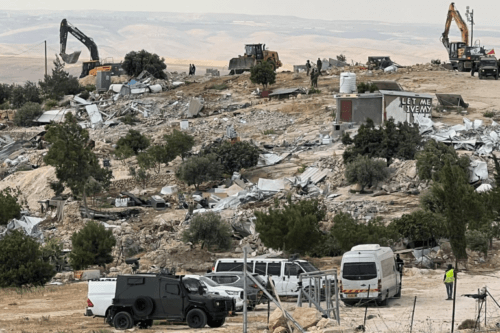
Israeli occupation forces have demolished an entire Palestinian village, Khirbet Khallet ad-Dabe’ in Masafer Yatta, south of Hebron, in the occupied West Bank, in addition to demolishing many homes and structures in villages near Ramallah, Qalqilia, and the northern Jordan Valley.
The demolitions, carried out under the pretext of “unauthorized construction,” mark one of the largest waves of destruction in recent months.
Mass Displacement in Masafer Yatta
In Khirbet Khallet ad-Dabe’, Israeli soldiers razed 25 structures, including homes, water wells, caves, agricultural rooms, livestock pens, and solar panels, most of which belonged to the Dababsa family.
Residents were forcibly evicted, prevented from retrieving their belongings, and left without shelter.
The village, home to 120 Palestinians, has been under constant threat of displacement since 2022, as Israel seeks to seize the land for colonial expansion by designating it a military firing zone.
Local activist Osama Makhamra stated that Israeli forces forced residents to evacuate at gunpoint, leaving them stranded in harsh conditions. He noted that only a school and two homes remain standing after the demolitions.
Expanding Colonial Control
The destruction in Masafer Yatta is part of a broader Israeli policy aimed at erasing Palestinian communities and replacing them with Jewish colonizers.
According to Nidal Younis, head of the local village council, Israel’s actions reflect a long-standing strategy of forced displacement, involving land confiscation, demolitions, and expansion of illegal Israeli colonies, built in direct violation of international law.
“Nearly 90% of the homes in Khirbet Khallet ad-Dabe’ have been destroyed, leaving families and livestock without shelter. This is a deliberate effort to wipe out Palestinian presence in the area,” Younis said.
Younis warned that all villages in Masafer Yatta are under threat, with Israel systematically declaring Palestinian lands as closed military zones to facilitate colonial expansion.
Over the past two years, Israel has established eight new colonies in the area, alongside colonizer-run livestock farms that encroach on Palestinian land.
Widespread Demolitions Across the West Bank
Israeli forces also demolished homes and structures in multiple locations, including:
– Al-Mughayyir, northeast of Ramallah – A 150-square-meter home housing five people was destroyed, with another home marked for demolition.
– Al-Funduq, east of Qalqilya – A 200-square-meter home belonging to Firas Bleyya was razed.
– Northern Jordan Valley – Several residential structures and livestock pens were demolished in Khirbet al-Deir.
– Jisr al-Zarqa, near Haifa – A Palestinian home, occupied for three decades, was destroyed under the pretext of unauthorized construction.
Colonizers’ Attacks and Illegal Land Seizures
Israeli paramilitary colonizers have intensified attacks on Palestinian communities, including:
– Al-Mughayyir – Colonizers cut down 200 olive trees belonging to Mohammad and Samir Hamayel.
– Al-Mu’arrajat, northwest of Jericho – Colonizers attempted to burn a Palestinian home and set fire to a tractor, while Israeli forces stood by without intervention.
Escalating Demolition and Colonial Expansion
A recent report by the Wall & Colonization Resistance Commission documented 1,693 Israeli violations in April 2025, including:
– 152 demolitions, affecting 96 homes and 34 agricultural structures.
– 46 demolition orders issued.
– 54 dunams of Palestinian land seized.
– 1,168 olive trees uprooted.
– Plans for 10 new colonial outposts, mostly agricultural and pastoral.
– 27 expansion projects for illegal colonies are under review to seize more Palestinian land.
New PCHR Report Reveals Israeli Destruction of Gaza’s Agricultural Sector and Food Systems
IMEMC | May 6, 2025
In a new report issued Monday, the Palestinian Centre for Human Rights (PCHR) confirms that the ongoing Israeli military assault on the Gaza Strip, which began in October 2023, has deliberately and extensively targeted Gaza’s agricultural sector and food production systems. This assault has resulted in the near-total collapse of a sector essential for the survival of the population. PCHR reveals that this destruction is part of a longstanding and systematic strategy by the IOF to exterminate the Palestinian people and uproot their existence. This objective has become a central policy of the current Israeli government, which uses destruction and starvation as weapons of war within the broader framework of the crime of genocide—seeking to eliminate Palestinians and strip them of the basic means of survival.
The report, titled “We Will Leave Them Nothing: The Israeli Systematic Destruction of the Agricultural Sector and Food Production Systems in Gaza”, meticulously documents the deliberate and large-scale destruction by the IOF of Gaza’s agricultural infrastructure. Nearly 75% of farmlands and orchards have been bulldozed and obliterated. The vast majority of agricultural facilities—including greenhouses, storage warehouses, farming equipment, irrigation systems, and power supplies—have been destroyed. In addition, livestock and fishery facilities, which are vital pillars of Gaza’s food security system, have also been decimated.
The report highlights that IOF has seized more than 130 km² of land across Gaza, much of it agricultural, and converted it into military buffer zones. This has deprived Palestinians of vast areas essential for food production—an explicit violation of the Fourth Geneva Convention’s protections for civilian property during wartime and the prohibition against seizing the land of occupied populations. The report also stresses that these unprecedented attacks on Gaza’s food sources have been compounded by an intensified blockade, the denial of humanitarian aid and food supplies, and the systematic use of starvation as a weapon of war. These acts have had catastrophic consequences for food security, triggering a severe hunger crisis and soaring levels of malnutrition.
PCHR warns that the destruction of Gaza’s food systems not only threatens the current survival of the population but also constitutes an assault on the future of Palestinian existence in the Strip. It entrenches a devastating reality of hunger and dependency by eliminating the foundations of recovery and forcing Gaza’s population into total reliance on external aid. This reflects Israel’s long-term colonial objective: to depopulate the land, seize control of its resources, and suppress any possibility of Palestinian self-sufficiency or resilience. Such conduct, the report asserts, directly violates Article II of the 1948 Convention on the Prevention and Punishment of the Crime of Genocide, which criminalizes the imposition of living conditions calculated to destroy a group physically and psychologically.
The report further affirms that these acts constitute grave violations of international law, particularly the International Covenant on Economic, Social and Cultural Rights, especially Article 11, which guarantees the right to adequate food and a dignified life. It also violates Article 54 of Additional Protocol I to the Geneva Conventions, which prohibits targeting “objects indispensable to the survival of the civilian population.” According to Article 8 of the Rome Statute of the International Criminal Court, these acts constitute a full-fledged war crime.
In its recommendations, PCHR calls on the international community to break its silence and to uphold its legal and moral responsibilities in confronting these crimes against Palestinian civilians and their sources of sustenance. It urges effective measures to hold Israel accountable, stop the ongoing genocide in Gaza, and ensure urgent international support for the rehabilitation of the agricultural sector. PCHR also emphasizes the necessity of restoring Palestinian sovereignty over their food systems and land, and demands an end to the culture of impunity that enables the repetition of Israeli crimes and undermines the foundations of international justice.
Do Trump’s Slick Comments Put Iran Talks in Jeopardy?
By Ted Snider | The Libertarian Institute | May 6, 2025
U.S. President Donald Trump’s unexpected answer on Sunday to an interviewer’s question has thrown his administration’s nuclear negotiations with Iran into confusion.
Trump has consistently said that negotiations with Iran over its nuclear program are limited to preventing Iran from developing a nuclear weapon: “You know, it’s not a complicated formula. Iran cannot have a nuclear weapon.” But in an interview on NBC’s Meet the Press, when the interviewer asked Trump, “Is the goal of these talks limiting Iran’s nuclear program or total dismantlement?” Trump answered, “Total disarmament.”
There has been disagreement in the Trump team over, not just the goal of negotiations with Iran, but, more fundamentally, over negotiating with Iran. National Security Advisor Mike Waltz advocated for a military path, while Director of National Intelligence Tulsi Gabbard, Secretary of Defense Pete Hegseth and Vice President J.D. Vance advocated for caution. Vance urged fully exploring talks before settling for a military solution. Trump sided with the diplomacy camp, believing that “we can make a deal without the attack.”
According to reporting by The Washington Post, Trump fired Waltz as National Security Advisor because he opposed Trump and “wanted to take U.S. policy in a direction Trump wasn’t comfortable with because the U.S. hadn’t attempted a diplomatic solution.” Waltz maintained that “the time was ripe to strike Iran.”
Having agreed on the diplomatic path, there appeared to be confusion over the goal of diplomacy. Waltz said that the U.S. is demanding “full dismantlement,” and Trump’s special envoy Steve Witkoff said that “a Trump deal” means “Iran must stop and eliminate its nuclear enrichment and weaponization program.” But these statements had been at odds with Trump’s more limited stated goal. Until Sunday.
If there was a lack of clarity in America’s goals in negotiating, there was no ambiguity in Iran’s. Iran wanted a deal that the United States couldn’t walk away from, as they walked away from the previous 2015 JCPOA nuclear agreement, and they wanted negotiations to lead to three things.
The first is that negotiations have to lead to a cessation of U.S. threats of a military solution. Iranian President Masoud Pezeshkian had made it clear that “the language of threats and coercion is absolutely unacceptable… It is unacceptable for someone to come along and say, ‘Don’t do this, don’t do that, or else.’ I won’t come to negotiate with you.”
The second is that negotiations have to lead to the complete lifting of sanctions.
The third is that, while Iran’s Supreme Leader, Ayatollah Ali Khamenei, has fully empowered his team to negotiate, he has placed the firm limit that Iran will not negotiate “the full dismantling of Iran’s nuclear infrastructure.”
The American-Iranian talks were showing signs of success. Iran called the first round “constructive” and “respectful.” The U.S. called it “constructive” and “positive.” The first round led to a second, which led to an agreement to begin work on a framework for a potential deal and a third round of talks.
Then a flurry of confusing and contradictory statements made by U.S. officials in the past few days began to derail the talks.
First, Pete Hegseth returned to the language of threats. Referring to Yemen’s Houthi attacking vessels in the Red Sea, Hegseth “warned” Iran, “You know very well what the U.S. Military is capable of… You will pay the CONSEQUENCE at the time and place of our choosing.” From Iran’s perspective, what is the point in negotiating limits on your civilian nuclear program to avoid American bombs if the United States is going to bomb you anyway for another purpose?
Then Trump returned to the threat of sanctions, posting that “Any Country or person who buys ANY AMOUNT of OIL or PETROCHEMICALS from Iran will be subject to, immediately, Secondary Sanctions. They will not be allowed to do business with the United States of America in any way, shape, or form.”
Following those two statements, the fourth round of scheduled talks between the United States and Iran were postponed. They were allegedly postponed “[f]or logistical reasons.” However, a senior Iranian official said that “U.S. sanctions on Iran during the nuclear talks are not helping the sides to resolve the nuclear dispute through diplomacy” and that “[d]epending on the U.S. approach, the date of the next round of talks will be announced.”
Then came the unexpected threat to future talks. Trump told Meet the Press that the talks are not negotiating what the Iranians thought they were negotiating. The United States he said, is not negotiating verifiable limits on Iran’s civilian nuclear program, it is demanding “total dismantlement” of Iran’s nuclear program.
“That’s all you’ll accept?” the interviewer clarified. “Yeah, that’s all I’d accept,” Trump confirmed.
The interviewer then, wrongly, suggested that Trump’s statement was inconsistent with Marco Rubio, his Secretary of State’s, suggestion that the U.S. “would accept… a peaceful, civilian nuclear program.”
Trump’s statement is not inconsistent with Rubio’s, though, because Rubio’s statement that Iran can have a civilian nuclear program by importing uranium enriched up to 3.67% but no longer by enriching their own, is consistent with Trump’s statement that Iran would have to dismantle its enrichment capability.
Though Trump’s statement may not be inconsistent with Rubio’s, it did, at this point, become a little confused with itself. Trump suggested that Iran has no need of a civilian nuclear program “to make electricity” because “they have so much oil, what do they need it for.” Trump then, confusingly repeated his earlier formulation, saying, “The only thing they can’t have is a nuclear weapon.” He said, “I think that I would be open to hearing” about a civilian nuclear program to generate energy before seemingly shutting it down again with the observation that “civilian energy often leads to military wars.”
The recent return by Washington to military threats and sanctions are not helping negotiations that seemed to be on a path to possible success. Trump’s latest remark that Iran has to fully dismantle its civilian nuclear program and stop all enrichment appears to take away any motivation for Iran to negotiate. Since Trump has said that “If they don’t make a deal, there will be bombing,” it is imperative to clarify the confusion and the positions and get the fourth round of talks back on schedule.
UCLA Gaza protesters sue over police violence, rubber bullet injuries
Al Mayadeen | May 5, 2025
A new lawsuit filed in Los Angeles Superior Court accuses law enforcement of police brutality during a violent crackdown on pro-Palestine protesters at the University of California, Los Angeles (UCLA) in spring 2024.
At the height of nationwide demonstrations against “Israel’s” war on Gaza, the UCLA encampment became a central site of student-led protest. On April 30, a pro-“Israel” mob attacked the encampment for more than four hours. Protesters say that police stood by as counter-demonstrators launched fireworks, sprayed chemical agents, and engaged in harassment and sexual assault, according to The Intercept.
The following day, Los Angeles Mayor Karen Bass, UCLA officials, and multiple law enforcement agencies coordinated plans to dismantle the encampment. On May 1, the encampment was forcibly cleared.
On February 12, 2025, Students for Justice in Palestine (SJP) and Graduate Students for Justice in Palestine (GSJP) were placed on interim suspension.
Police response: coordination and forceful dispersal
More than 700 police officers descended on campus, including members of the Los Angeles Police Department (LAPD), California Highway Patrol (CHP), Los Angeles County Sheriff’s Department, University of California Police Department, and private security forces.
During the raid, law enforcement fired over 50 rounds of rubber bullets into the crowd, striking multiple protesters in the head. Several individuals were hospitalized, including one who sustained internal bleeding and another whose hand bones were shattered, requiring surgery and extensive rehabilitation.
Protesters are now suing both the state of California, which oversees CHP, and the city of Los Angeles, which oversees LAPD. The suit argues that the use of rubber bullets by LAPD and CHP amounted to excessive force and violated protesters’ constitutional rights.
Legal violations: restricted rubber bullets and protesters’ rights
Following mass protests in 2020 against the police killings of George Floyd and Breonna Taylor, California lawmakers passed a law limiting the use of kinetic impact projectiles, commonly known as rubber bullets. The legislation bans their use at protests unless there is an objective and immediate threat to life or serious injury.
The lawsuit states that officers’ actions at the UCLA encampment violated this law. Attorney Becca Brown, representing the plaintiffs, emphasized that the indiscriminate firing of such projectiles is both illegal and dangerous.
“They cannot be used simply because someone is non-compliant,” she explained.
Despite UCLA’s revised protocols following 2020 to minimize reliance on external police forces, CHP, typically less involved in protest response, played a prominent role in the May 1 raid.
An LAPD after-action report later attempted to justify the force used, citing incidents like a protester throwing a traffic cone or removing a police helmet. However, the report admitted communication breakdowns among agencies and recommended improved command clarity.
Chilling effect: trauma, criminalization, and fear of future protest
The lawsuit includes plaintiffs such as a UCLA Ph.D. candidate, an undergraduate student, another student from a different university, and an architectural designer. All were struck with rubber bullets, several in the head. Beyond physical injuries, the plaintiffs say the crackdown has severely impacted their willingness to participate in future demonstrations.
“The encampment clearance by means of violence, excessive force, and kinetic energy projectiles traumatized Plaintiffs,” the complaint reads. “It justifiably made them less willing to engage in any further Palestine-related protest activity.”
One plaintiff, Abdullah Puckett, now fears future retaliation if he returns to protest. The complaint states that he is “more hesitant and afraid,” and has had to reevaluate the extent of his participation in pro-Palestine demonstrations.
Broader implications: political accountability and state repression
More than 200 people were arrested during the UCLA encampment clearance. LAPD later requested over $500,000 in reimbursement for the operation, which included 2,400 overtime hours, according to the Daily Bruin. The arrests resulted in criminal records for many students.
Lawyers say those records are now being used by the Trump administration to conduct background checks on international students and potentially flag them for deportation.
“For international students that may have been arrested at any of these encampments, that got flagged and could be subject to deportation under Trump’s fascist policies,” said Ricci Sergienko, one of the attorneys representing the plaintiffs.
Sergienko criticized Democratic leaders such as Governor Gavin Newsom and Mayor Bass, arguing that their actions laid the groundwork for broader state repression. “These attacks also happened in Democratic-run cities and blue states,” he said.
He also warned of mounting censorship in academia, pointing to a proposed bill in California that targets ethnic studies programs under the pretext of combating antisemitism. “That’s another attack on speech coming from the blue state, the liberal paradise of California,” he said.
During a recent screening of the documentary The Encampments at UCLA, police were once again called in. LAPD officers arrested three students.
Hind Rajab’s killers identified

MEMO | May 5, 2025
A human rights organisation has revealed the identity of the Israeli officer directly responsible for the killing of Palestinian child Hind Rajab, her family, and the two medics who tried to save her in the Tel al-Hawa neighbourhood, Gaza City, on 29 January 2024.
In a statement released on Saturday, the Hind Rajab Foundation, an independent NGO based in Brussels, said: “We now publicly name the commander responsible for killing Hind:
Lieutenant Colonel Beni Aharon
Commander of the 401st Armoured Brigade of the Israel Defence Forces (IDF) at the time of the killing.”
The organisation said the identification followed a more than year-long investigation. It also confirmed it had identified the brigade’s soldiers, field commanders, and operations officers who took part in the attack under Aharon’s command.
The foundation asserted that it “has filed a war crimes complaint with the International Criminal Court (ICC) in The Hague” to issue an arrest warrant for Lt. Col. Beni Aharon, adding, “we are preparing additional legal complaints against the battalion’s officers.”
The Hind Rajab Foundation is a legal and human rights branch of the March 30 Movement. It was established in memory of Hind Rajab and focuses on bringing Israeli soldiers accused of war crimes against Palestinians to justice.
Israeli military operations in Gaza, fully backed by the United States, have continued by land, sea, and air since 7 October 2023. More than 170,000 Palestinians have been killed or injured so far, with many still trapped under the rubble.
Israeli TV producer’s call for Holocaust against Gaza population sparks outrage
Press TV – May 4, 2025
A recently unearthed social media post by Elad Barashi, an Israeli producer associated with Channel 14, has sparked public outrage and condemnation for advocating a Holocaust against Gaza’s 2.3 million residents.
In the controversial social media post originally published in Hebrew on February 27, Barashi called for “a cruel and harsh death” for all Gazans, including women and children.
“Who is the fool who says there are ‘innocents’ in Gaza? Who is the despicable scoundrel who wants to let them flee to Arab countries or Europe freely?” he wrote.
In his lengthy post, Barashi made the claim that the entire population of Gaza “deserve death.”
“Men, women, and children — by any means necessary, we must simply carry out a Shoah [Holocaust] against them — yes, read that again — H-O-L-O-C-A-U-S-T!”
“Without fear, without weakness — just crush. Eliminate. Slaughter. Flatten. Dismantle. Smash. Shatter,” he added.
“Without conscience or pity — children and parents, women and girls — all of them are marked for a cruel and harsh death.”
Outraged social media users have criticized Elad Barashi for his recently resurfaced post, condemning the “graphic description” of death for all Gazans and dehumanization of Palestinians.
Channel 14 is a far-right television network widely seen as Prime Minister Benjamin Netanyahu’s favored platform for interviews and messaging.
Barashi, a researcher and producer for shows such as “Story Night” and “Israel Morning” on Channel 14, has been peddling Israeli propaganda to the network’s audience.
Top UN expert urges trial for EU officials over complicity in Israel’s war crimes
Press TV – May 4, 2025
The top expert on Palestine at the UN has called for senior EU officials, including European Commission President Ursula von der Leyen, and EU’s High Representative for Foreign Affairs and Security Policy Kaja Kallas to face prosecution for their complicity in Israeli war crimes committed in Gaza.
“The fact that the two highest figures of the EU continue business as usual engagements with Israel is beyond deplorable,” said UN special rapporteur for the occupied Palestinian territories Francesca Albanese in an interview ran by The Intercept on Saturday.
“I’m not someone who says, ‘History will judge them’ — they will have to be judged before then. And they will have to understand that immunity cannot equate with impunity,” she added.
Israel has killed nearly 52,500 people and destroyed Gaza’s entire civilian infrastructure. Most of the dead have been civilians, including tens of thousands of children and women.
Israel’s initial aim of exchanging captives with Hamas has turned into a US-backed vision for ethnically cleansing Palestinians from Gaza.
To that end, the Israeli military has increased its lethal attacks after breaking a 2-month ceasefire deal with Hamas on March 18.
It has enforced a complete blockade on humanitarian aid, electricity, food, and water since March 2, marking the longest aid blockade since the start of the genocide nearly 19 months ago.
Human rights organizations have repeatedly called on the EU members to boycott Israel and stop selling weapons to the regime.
Nonetheless, since taking office in December, Kallas has blamed Hamas for Israel’s decision to end the ceasefire, continued normal diplomatic relations, and vowed to “stand in solidarity with Israel.”
A complaint against Leyen, the European Commission president, was also filed at the International Criminal Court last May for complicity in war crimes and crimes against humanity in Gaza.
Evidence has shown that the EU has turned into a foundation upon which, the member countries contact and make deals with the Israeli regime.
Beyond demanding accountability from EU leaders, Albanese has said she has been working on a report that will expose banks, pension funds, tech companies, and universities for complicity in Gaza’s destruction.
“All those implicated and involved in the unlawful occupation, in providing it with support, are aiding and abetting violations of international law and human rights violations, and a number of these amount to crimes,” she said.
“There can be individual responsibility and individual liability for those who have been aiding and abetting or enabling such crimes,” she added.
US House to vote on bill criminalizing boycott of Israel
Press TV – May 3, 2025
The US House of Representatives is set to vote on a controversial bill that proposes fines or prison terms for Americans participating in boycotts of Israel or Israeli settlements, promoted by international governmental organizations such as the UN or EU.
The House is scheduled to vote Monday on the contentious anti-boycott act, which seeks to penalize American citizens with fines up to $1 million or prison terms as long as 20 years for boycotting the Israeli regime.
Sponsored by pro-Israel congressmen Mike Lawler and Josh Gottheimer, the bill will broaden the US anti-boycott law by targeting voluntary, values-based political actions undertaken by American citizens.
The underlying objective is to shield the Israeli regime from non-violent international pressure campaigns, notably the Boycott, Divestment, and Sanctions movement (BDS).
Rights groups warned that the legislation will criminalize constitutionally protected political expression.
The move, according to rights groups, is part of a broader push by the US government to suppress opposition to Israeli genocide, apartheid, and illegal settlement expansion, under the guise of fighting anti-Semitism.
The original act was introduced in 2024. Back then the Republican-controlled Congress passed this bill with broad bipartisan support, but the Senate Democrats blocked the legislation.
Now that Republicans control the Senate as well, there is a significant chance that the act will pass both Congress and Senate.
The American Israel Public Affairs Committee (AIPAC), the most powerful Israeli lobby group in the US, said it “strongly supports” the act.
The Foundation for Defense of Democracies (FDD) Action has already supported the legislation and broader congressional campaigns to push back against anti-Israeli boycotts.
The majority of anti-Israeli boycotts aim to force the regime to end its genocidal war on Gaza that has taken the lives of more than 52,500 Palestinians and injured at least 118,000, most of whom are children and women.
The Israeli regime has put Gaza on a total blockade for 2 months and barred the entry of all humanitarian aid, including food, which according to the UN’s Integrated Food Security Phase Classification (IPC), has driven the territory’s 2.3 million population toward famine.
Featured Video

Alon Mizrahi: ‘Israel Must Be Dismantled’
or go to
Aletho News Archives – Video-Images
From the Archives
Allies Don’t Need Lobbies
By Jay Knott | Dissident Voice | September 24, 2013
In a recent article on Counterpunch, Rob Urie defended the traditional Marxist analysis of US policy in the Middle East. He argues that support for Israel is driven primarily by economic interest, not the Jewish lobby.
He starts by paying tribute to the idea that Western societies are uniquely racist. He says that the “Western narrative” claims there is an “Arab character”, and that this is “antique racist blather”. He gives no definition of these terms. Further, he establishes his credentials as part of the dominant current in the American left by claiming that “over a million people in Iraq died so ‘we’ in the West can drive SUVs.”1
When he tries to criticize bourgeois economics, he makes it clear he doesn’t understand the developments it has made since Marx’s day, using the mathematical discipline known as “game theory”. He dismisses the basic abstraction of economic theory, the idea of the rational individual, on the grounds that it is “devoid of history, culture and political context”. But abstractions are always devoid of something.
He defends a more concrete economic theory, mostly Marxist, with some input from another theorist of capitalist crisis, Hyman Minsky. This concrete theory leads him to the view that US activity in the Middle East is primarily driven by rational capitalist motives, the need to secure a supply of oil.
“Taking the totality of circumstance — former oil company executives launching war on an oil rich nation on a pretext they publicly proclaimed they didn’t believe shortly before taking office — and that upon launching their war proved to be non-existent, requires a willingness to overlook the obvious — that the war on Iraq was for oil, that is difficult to support.”1
Perhaps I’ve misunderstood him, but based on what he says in the rest of the article, this convoluted sentence seems to argue that, because president Bush and vice-president Cheney attacked Iraq on false premises, and they also said it was all about oil, and they are former oil executives, and Iraq has a lot of oil, it’s difficult to deny US attacks on Iraq are all about oil.
In fact, it’s not hard at all. As Urie points out, at times Bush and co. said that attacking Iraq was “protecting the world’s supply of oil.”1 But, as he also points out, they are congenital liars. Why should we believe them when they say they are trying to “protect” the oil supply? Protect it against what? When politicians “admit” attacks on Middle Eastern countries are wars for oil, they are parroting the neo-con party line, feeding the public, both left and right, with a plausible-sounding pretext. For right-wingers, “it’s a war for oil” is a reason to support war, and for leftists, it’s a way to feel better by complaining impotently about corporate greed. Both approaches help the war drive. … continue
Blog Roll
 Aletho News
- Pakistan ramps up food exports to Persian Gulf nations as war deepens food insecurity
- Iran submits response to US plan, sets terms for war’s end: Tasnim
- US vs Iran: Kharg Island Talk — Bluff or Escalation? Ex-Military Officer Weighs In
- Zelensky unnecessarily involves Ukraine in the Middle East crisis
- Turkish tanker blacklisted by Ukraine hit in drone attack – media
- Canada, the U.S., and NATO: the inescapable trap
- Villains of Judea: Leonid Radvinsky
- Alon Mizrahi: ‘Israel Must Be Dismantled’
- Former Head Of MI6 Admits That The U.S. And Israel Are Losing The Iran War
- Scattered Thoughts on War and Peace
- If Americans Knew
- Israel may be committing war crimes in Lebanon – Not a ceasefire Day 167
- In the West Bank, life is a constant battle – 3 articles
- Jacob Reses, one of the most powerful pro-Israel operatives in Trump’s Washington
- Israeli-US assaults kill or injure 87 children a day – Not a ceasefire Day 166
- ‘Forever live by the sword’: Understanding Israelis’ massive support for Iran war
- UN’s special rapporteur on human rights says Israel is systematically torturing Palestinians
- Trump White House plagiarized Iran war manifesto from Israel-aligned think tank
- Gaza says 6–10 patients die daily waiting for treatment abroad as Israel blocks medical evacuations
- ‘Substantial evidence’ of double-tap strike in killing of Gaza’s Hind Rajab
- ‘Do Not Want To Die For Israel’: Doubts About Trump’s Iran Strategy Spread Among Troops
- No Tricks Zone
- Devastating Assessment Of Comirnaty Vaccine By Former Senior Pfizer Europe Toxicologist
- New Study: CO2 Is ‘Effectively Negligible’ As An Explanatory Climate Change Factor Since 2000
- Former Pfizer Toxicologist Dr. Helmut Sterz Tells Bundestag Hearing Pfizer Vaccine Should Have Never Been Approved
- Energy Expert: Germany’s Nuclear Phaseout Was A “500 Billion Euro Mistake”
- New Research: South Australia’s Mid-Holocene Sea Surface Temperatures Were 4°C Warmer Than Today
- Storing Green Energy To Last Germany 10 Days Would Require A 60-Million Tonne Battery
- New Studies: UK Sea Levels Were 4 Meters Higher Than Today During The Mid-Holocene
- Destructive Green New Deal: German Energy And Metal Group Warns Of Drastic Crisis
- New Study Documents A 20-Year Pause In Arctic Sea Ice Decline – Driven By Internal Variability
- Wake-up Call: Survey Shows Majority Of Germans Now Favor Postponing Climate Targets!
 Aletho News