Trump’s NSC Director for Israel and Iran Previously Worked for Israeli Ministry of Defense
By Ryan Grim and Saagar Enjeti | Drop Site News | April 21, 2025
The American official overseeing White House policy toward both Israel and Iran inside the National Security Council formerly worked for the Israeli Ministry of Defense, Drop Site News has learned. Merav Ceren’s appointment as Director for Israel and Iran at the NSC has not previously been reported, but her work with Israel’s MoD is well known among GOP circles.
Ceren’s appointment gives Israel an unusual advantage in internal policy discussions just as the Israeli government has launched a new campaign to pressure the American government to start a war with Iran rather than continue with negotiations toward a nuclear deal.
NSC spokesperson Brian Hughes confirmed that Ceren is now an official at the NSC and defended her as “a patriotic American.”
“Merav is a patriotic American who has served in the United States government for years, including for President Trump, Senator Ted Cruz, and Congressman James Comer,” said Hughes. “We are thrilled to have her expertise in the NSC, where she carries out the President’s agenda on a range of Middle East issues.”
Ceren includes her time with Israel’s Ministry of Defense in her bio at the pro-Israel think tank Foundation for Defense of Democracies (FDD).
The Israeli campaign has forced the issue into the top echelons of government. At a high-level meeting reported on recently by the New York Times, Vice President J.D. Vance, Director of National Intelligence Tulsi Gabbard, and Defense Secretary Pete Hegseth all pushed back against Israel’s plan for a major strike on Iran’s nuclear facilities. They were even joined by NSC Director Michael Waltz, who warned that Israel’s effort would not succeed without ample U.S. support. Waltz and CENTCOM commander, Gen. Michael Kurilla, the Times reported, had previously been open to entertaining the Israeli idea and were briefed by Israeli military officials on a range of plans.
It’s rare for a foreign country to be able to pitch American policymakers on a joint war effort and look across the table to see a former member of their own Ministry of Defense working for the Americans. As Trump debates his tariff policy, for instance, there are no high-level officials who previously worked for the Chinese Communist Party present.
Ceren’s FDD bio says that while working for the Israeli military she participated in negotiations in the West Bank between Israel’s Coordinator for Government Activities in the Territories (COGAT) and the Palestinian Authority. COGAT is the Israeli agency now refusing entry of humanitarian aid into Gaza, sparking a humanitarian crisis of unspeakable proportions. Ceren is the sister of Omri Ceren, a bellicose neoconservative and longtime foreign policy adviser to Sen. Ted Cruz.
In 2021, she authored the article “The Moral Case for High-Tech Weapons” for The New Atlantis, a long-form style publication that seeks to “understand the core anxiety about tech as the threat of dehumanization.”
Deporting dissent: The dangerous precedent set by the persecution of pro-Palestine activists
By Ramzy Baroud | MEMO | April 22, 2025
“Rights are granted to those who align with power,” Mahmoud Khalil, a Columbia University graduate student, eloquently wrote from his cell. This poignant statement came soon after a judge ruled that the government had met the legal threshold to deport the young activist on the nebulous ground of “foreign policy”.
“For the poor, for people of colour, for those who resist injustice, rights are but words written on water,” Khalil further lamented. The plight of this young man, whose sole transgression appears to be his participation in the nationwide mobilisation to halt the Israeli genocide in Gaza, should terrify all Americans. This concern should extend even to those who are not inclined to join any political movement and possess no particular sympathy for – or detailed knowledge of – the extent of the Israeli atrocities in Gaza, or the United States’ role in bankrolling this devastating conflict.
The perplexing nature of the case against Khalil, like those against other student activists, including Turkish visa holder Rumeysa Ozturk, starkly indicates that the issue is purely political. Its singular aim appears to be the silencing of dissenting political voices.
Judge Jamee E. Comans, who concurred with the Trump Administration’s decision to deport Khalil, cited “foreign policy” in an uncritical acceptance of the language employed by US Secretary of State Marco Rubio. Rubio had previously written to the court, citing “potentially serious foreign policy consequences” stemming from Khalil’s actions, which he characterised as participation in “disruptive activities” and “anti-Semitic protests”.
The latter accusation has become the reflexive rejoinder to any form of criticism levelled against Israel, a tactic prevalent even long before the current catastrophic genocide in Gaza.
Those who might argue that US citizens remain unaffected by the widespread US government crackdowns on freedom of expression must reconsider. On 14 April, the government decided to freeze $2.2 billion in federal funding to the University of Harvard.
Beyond the potential weakening of educational institutions and their impact on numerous Americans, these financial measures also coincide with a rapidly accelerating and alarming trend of targeting dissenting voices within the US, reaching unprecedented extents. On 14 April, Massachusetts immigration lawyer Nicole Micheroni, a US citizen, publicly disclosed receiving a message from the Department of Homeland Security requesting her self-deportation.
Furthermore, new oppressive bills are under consideration in Congress, granting the Department of Treasury expansive measures to shut down community organisations, charities and similar entities under various pretenses and without adhering to standard constitutional legal procedures.
Many readily conclude that these measures reflect Israel’s profound influence on US domestic politics and the significant ability of the Israel lobby in Washington DC to interfere with the very democratic fabric of the US, whose Constitution’s First Amendment guarantees freedom of speech and assembly.
While there is much truth in that conclusion, the narrative extends beyond the complexities of the Israel-Palestine issue.
For many years, individuals, predominantly academics, who championed Palestinian rights were subjected to trials or even deported, based on “secret evidence”. This essentially involved a legal practice that amalgamated various acts, such as the Classified Information Procedures Act (CIPA) and the Immigration and Nationality Act (INA), among others, to silence those critical of US foreign policy.
Although some civil rights groups in the US challenged the selective application of law to stifle dissent, the matter hardly ignited a nationwide conversation regarding the authorities’ violations of fundamental democratic norms, such as due process (Fifth and Fourteenth Amendments).
Following the terrorist attacks [events] of September 11, 2001, however, much of that legal apparatus was applied to all Americans in the form of the PATRIOT Act. This legislation broadened the government’s authority to employ surveillance, including electronic communications and other intrusive measures.
Subsequently, it became widely known that even social media platforms were integrated into government surveillance efforts. Recent reports have even suggested that the government mandated social media screening for all US visa applicants who have travelled to the Gaza Strip since 1 January 2007.
In pursuing these actions, the US government is effectively replicating some of the draconian measures imposed by Israel on the Palestinians. The crucial distinction, based on historical experience, is that these measures tend to undergo continuous evolution, establishing legal precedents that swiftly apply to all Americans and further compromise their already deteriorating democracy.
Americans are already grappling with their perception of their democratic institutions, with a disturbingly high number of 72 percent, according to a Pew Research Centre survey in April 2024, believing that US democracy is no longer a good example for other countries to follow.
The situation has only worsened in the past year. While US activists advocating for justice in Palestine deserve unwavering support and defence for their profound courage and humanity, Americans must also recognise that they, and the remnants of their democracy, are equally at risk.
“Our defence is in the preservation of the spirit which prizes liberty as the heritage of all men, in all lands, everywhere,” is the timeless quote associated with Abraham Lincoln. Yet, every day that Mahmoud Khalil and others spend in their cells, awaiting deportation, stands as the starkest violation of that very sentiment. Americans must not permit this injustice to persist.
Israel arrests Palestinian child to pressure his father to turn himself in
MEMO | April 22, 2025
Palestinian sources reported that Israeli occupation forces arrested a Palestinian child from the town of Kafr Ad-Dik, west of the occupied city of Salfit, to pressure his father to turn himself in.
Sources told Quds Press that Israeli occupation forces raided the home of Palestinian Ahmed Abdel Karim Al-Dik to arrest him. They searched the house and vandalised it. When they did not find him, they arrested his 12-year-old son, Ahmed, who is named after his father, as he was born while his father was detained in Israeli prisons.
They added that soldiers blindfolded and handcuffed Ahmed, photographed him, and sent the photo to Ahmed’s father via WhatsApp. They demanded that he turn himself in, threatening to detain Ahmed and the rest of the family otherwise.
They went even further, having Ahmed send a voice note to his father at gunpoint, asking his father to come because he was afraid of being arrested, beaten, or even killed.
The Palestinian Authority’s Commission of Detainees and Ex-detainees Affairs and the Palestinian Prisoners’ Club confirmed in a joint statement issued on Monday, that Israeli occupation forces had arrested at least 20 Palestinian citizens from the West Bank, including children and former prisoners between Sunday evening and Monday morning.
Syrian security forces detain Palestinian resistance leaders
The Cradle | April 22, 2025
Two top officials from the Palestinian Islamic Jihad (PIJ) movement in Syria have been detained by Syrian security forces.
Khaled Khaled, head of PIJ operations in Syria, and Yasser al-Zafari, head of the organizational committee, were arrested five days ago.
The Syria TV outlet acknowledged the arrests, yet Damascus has not commented officially on the matter.
The arrests come after reports that the US has issued a list of conditions that Syrian authorities must fulfill in exchange for relief from sanctions that were imposed by Washington on former Syrian president Bashar al-Assad’s government.
These conditions include the destruction of any chemical weapons, cooperation on “counter-terrorism,” and ensuring foreign fighters are not granted top positions, according to Reuters.
Reuters also said that “one of the conditions was keeping Iran-backed Palestinian groups at a distance.”
The arrests coincide with Israel’s continued expansion of its occupation of southern Syria, and come after a visit to Damascus by US Congressman Cory Mills, who held talks with Syria’s interim President Ahmad al-Sharaa and Foreign Minister Asaad al-Shaibani.
“The president and the leadership have demonstrated their willingness to work with Israel as they seek to prevent Hashd al-Shaabi from transferring weapons from Iraq through Syria into Lebanon,” Mills said in an interview with the Jusoor outlet.
The PIJ’s armed wing, the Quds Brigades, released a statement about the arrests on 22 April.
Khaled and Zafari were detained “without any explanation for the reasons of their arrest, and in a manner which we would not have hoped to see from our brothers [in Syria],” the Quds Brigades statement reads.
“Day five has passed and you have two of our best cadres,” it said. “We in the Quds Brigades hope that our brothers in the Syrian government will release our brothers held by them.”
“At this time when we have been fighting the Zionist enemy continuously for more than a year and a half in the Gaza Strip without surrender, we hope to receive support and appreciation from our Arab brothers, not the opposite,” it added.
Under Bashar al-Assad’s government, Syria was a haven for Palestinian resistance factions, including the PIJ and the Popular Front for the Liberation of Palestine – General Command (PFLP–GC).
Days after the fall of Assad’s government, Lebanese newspaper Al-Akhbar reported that the new government in Syria ordered Palestinian resistance groups to dissolve all military formations in the country.
Hayat Tahrir al-Sham (HTS), the group that toppled the former government, launched a wave of closures targeting Palestinian faction offices after entering Damascus in December 2024, according to The Cradle’s Palestine correspondent.
Offices belonging to Fatah al-Intifada, the Baath-aligned Al-Sa’iqa movement, and the PFLP–GC were shuttered, with their weapons, vehicles, and real estate seized.
Several Palestinian officials were detained and placed under house arrest.
Palestinian-British academic Makram Khoury-Machool detained in London
Al Mayadeen | April 22, 2025
British border authorities detained Palestinian-British academic Professor Makram Khoury-Machool on Friday evening upon his return from Paris to London, subjecting him to a four-hour interrogation under the UK’s 2019 “Counter-Terrorism and Border Security Act.”
Devices seized, personal belongings searched
During the investigation, British police confiscated Professor Khoury-Machool’s mobile phone and personal laptop, thoroughly searching all his belongings, including identification and credit cards. No formal charges were presented, raising concerns over the basis and implications of the detention.
Authorities also took his fingerprints, captured multi-angle photographs, and collected DNA samples from inside his mouth.
No official clarification yet
UK border police indicated that they may contact Professor Khoury-Machool again within the next seven days. So far, no official statement has been issued to explain the reasons behind his detention or the content of the interrogation.
The incident occurred in the presence of his 8-year-old son, who witnessed the extended questioning and detention of his father until midnight on Good Friday.
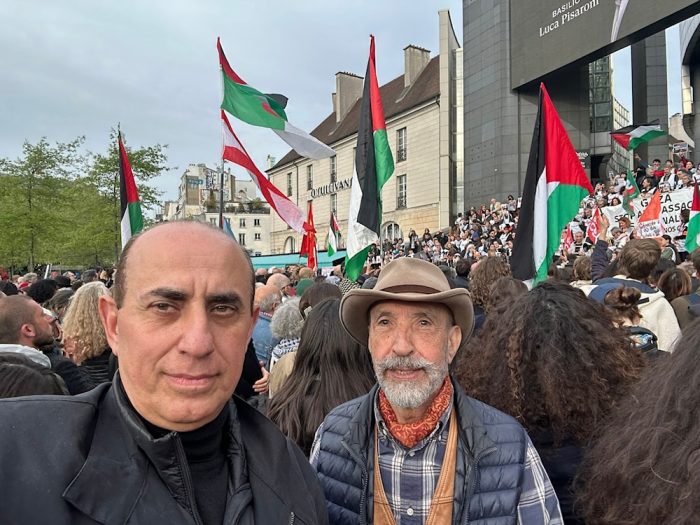
Professor Khoury-Machool, who is of Palestinian origin, is a well-known intellectual and media figure. His recent public activity includes participation in a pro-Gaza demonstration in Paris on April 16, 2025, where he shared a photo of himself at the event via his X account.
Yemen: US fails in its aggression since day one; Trump ‘accountable’ for fatalities
Press TV – April 21, 2025
The chairman of Yemen’s Supreme Political Council says Sana’a has not suffered even one percent damage at the military level despite all US assaults in support of Israel’s war on Gaza.
“I assure you that the aggression failed from its very first day, and we had previously managed to obtain information that thwarted the aggression before it occurred,” Mahdi al-Mashat said during a meeting of the National Defense Council on Sunday.
He added that if the Americans increase their mobilization, it means their weapons have failed.
Referring to US warship USS Harry S. Truman, Mashat said that it lost its command and control and was rendered out of service in the early days of the aggression.
The warship “achieved nothing for the enemy, forcing them to bring in other vessels and use other weapons,” he further said.
Mashat also said that, “The criminal US President Donald Trump will be held accountable for all that he did to civilians and civilian facilities, whether he remains in office or not.”
The US military has been carrying out almost daily attacks on Yemen for the past month, claiming that they are aimed at stopping the Ansarullah movement’s attacks on Israel-related ships.
The Yemeni army, however, said it will not stop its attacks on Israel-bound vessels until the regime halts its genocidal war on Gaza.
“Our stance in supporting our brothers in Gaza is firm and we will never retreat from it,” he said, adding that Yemen cannot allow the Americans and the “Israelis” to prey upon the Palestinian people in Gaza alone.
Since March, over 200 individuals have lost their lives due to US aggression in Yemen.
In retaliation for Israeli atrocities in Gaza and the US-UK-led assault on Yemen, the Yemeni Armed Forces began to carry out a series of strikes against Israeli, American, and British interests in the Red Sea and nearby regions in late 2023.
As the brutal conflict in Gaza worsened, Yemen imposed a strategic blockade on major maritime routes to hinder the movement of military supplies to their enemies and to pressure the international community to respond to the ongoing humanitarian crisis in Gaza.
Why AIPAC Must Register Under FARA: Exposing Israel’s Influence in Washington
Track AIPAC
For decades, the American Israel Public Affairs Committee (AIPAC) has served as Israel’s unofficial arm in Washington, shaping U.S. policy to favor Israeli interests while avoiding the transparency required by the Foreign Agents Registration Act (FARA). This evasion hides AIPAC’s role as a foreign proxy and undermines American democracy.
What Is FARA?
Enacted in 1938 to counter Nazi and Soviet influence, FARA mandates that anyone acting as an “agent of a foreign principal”—engaging in political activities in the U.S. at the direction or request of a foreign government—register with the Department of Justice. This means disclosing contacts, activities, and funding. FARA focuses on whose agenda is being pushed, not the source of the money. AIPAC’s mission, to align U.S. policy with Israel’s goals, fits this definition exactly. Yet it cloaks itself as an “American” lobby, a claim that doesn’t withstand scrutiny.
AIPAC: Israel’s Proxy in Washington
AIPAC’s mission is to steer U.S. policy toward Israel, functioning as a coordinated extension of Israeli interests. It invests millions in U.S. elections with its political action committee, AIPAC PAC, and through its super PAC, United Democracy Project, to support Israel First candidates and oppose anyone who speaks out against Israel’s crimes. It pushes anti-BDS laws mirroring Israeli priorities and secures billions in annual aid, often at the expense of U.S. needs. Through its nonprofit arm, the American Israel Education Foundation (AIEF), it funds frequent congressional trips to Israel—the number one destination for privately sponsored foreign travel by members of the House and their aides—where they meet Israeli leaders and adopt their narrative.
The connections are undeniable: AIPAC has operated a Jerusalem office since 1982, a direct link to Israeli leadership. Its leaders frequently visit Israel, host Israeli officials at policy summits, and align U.S. policy with Israel’s agenda. In 2015, AIPAC strongly opposed a UN resolution condemning Israeli settlements, mirroring Israel’s defiance, and launched a significant lobbying effort, spending a reported $30 million, to support Netanyahu’s campaign against the Iran nuclear deal. In 2023, it briefed Congress on Israel’s Gaza operations, echoing military talking points. In 2024, it pushed $14.1 billion in emergency aid for Israel, matching Netanyahu’s demands, and followed through on Foreign Minister Israel Katz’s request to secure congressional sanctions against the International Criminal Court. If a group lobbying for Russia maintained a Moscow office, funded trips there, and parroted Kremlin lines, we’d call it foreign influence. AIPAC’s U.S. funding doesn’t alter its role as Israel’s conduit.
A History of Dodging Accountability
AIPAC’s ties to Israel are deep-rooted. Its predecessor, the American Zionist Council (AZC), was ordered to register under FARA in 1962 after funneling millions from Israel’s Jewish Agency to lobby Congress. Instead, Isaiah Kenen relaunched it as AIPAC in 1963, dodging the law by using U.S. donors. Declassified 1984 FBI files reveal AIPAC’s early collaboration with Israel’s Ministry of Economics, using stolen U.S. trade data to shape the U.S.-Israel Free Trade Agreement; an act of espionage, not advocacy. In 2005, AIPAC staffers Steven Rosen and Keith Weissman passed classified Pentagon data to Israeli officials, though charges were later dropped. Leaked 2018 Israeli Justice Ministry documents show Jerusalem’s worry that AIPAC’s advocacy could trigger FARA scrutiny, prompting plans to conceal ties with a U.S. nonprofit. If AIPAC’s work is truly domestic, why does Israel fear exposure?
Transparency, Not Prohibition
FARA doesn’t prohibit lobbying, it requires openness. Registration would compel AIPAC to reveal its meetings with Israeli officials, spending details, and directives. If it’s merely Americans supporting Israel, why resist this disclosure? Refusing transparency raises questions about whose interests it truly serves.
The Stakes for Democracy
AIPAC’s unchecked influence skews U.S. policy. General David Petraeus warned in 2010 that Israel’s actions, amplified by AIPAC, put U.S. troops in the Middle East at risk. Billions flow to Israel each year, while domestic crises like healthcare languish. Without FARA, we remain blind to how much Israel shapes these decisions or what AIPAC is hiding.
TrackAIPAC demands that lawmakers, regulators, and the public compel AIPAC to register under FARA. Transparency is the first step to dismantling foreign influence in U.S. policy.
Facing Prison Time in Germany for Criticizing an Israeli Journalist: The Case of Hüseyin Dogru
By Alan MacLeod – MintPressNews – April 20, 2025
Amid a crackdown on pro-Palestine voices in Germany, a journalist regularly attacked as a Russian operative is facing up to three years in prison for defamation of an Israel-based journalist. Hüseyin Dogru, founder of red. media, has been charged with defamation for actions relating to a spat with Nicholas Potter, a German state-funded reporter working for the Israeli outlet, The Jerusalem Post.
In December, Potter, a self-styled counter-extremism expert, published a lengthy exposé in The Jerusalem Post, claiming that red. media, MintPress News, and The Grayzone were part of a network of far-left outlets promoting extremism and anti-Semitic conspiracy theories.
Worse still, he strongly insinuated that all three were promoted and funded by the governments of Russia, Syria, and Iran.
The charges are false (see MintPress’ rebuttal here), and are particularly ironic, coming as they do from a journalist who is funded by the German Foreign Office. One who, amid a genocide, moved to Israel to work for an outlet headed by a former Israeli Defense Forces spokesperson.
Moreover, Potter himself arguably holds extreme views on the subject. Just weeks after attacking us for our journalism, he penned an article titled “Can Journalists Be Terrorists,” which attempted to justify many of Israel’s killings of Palestinian media workers.
Both red. and MintPress immediately highlighted much of this important context, and our content went viral.
From Viral Criticism to Criminal Charges
A sticker about Potter, based on a red. media graphic, was spotted in Berlin. The sticker took the outlet’s criticism of him, and plastered the phrase, “The German Hurensohn” — “The German Son of a Bitch” — over the top. That sticker is the centerpiece of the prosecution’s allegation of a coordinated “hate campaign” against Potter led by red. media. Potter claims that he has suffered harassment and threats to his life, and some have tried to link this back to red. media’s graphic.
The accusations provoked a storm of articles in German media, all supportive of Potter. Many echoed U.S. Secretary of State Antony Blinken’s claims that red. media is a Russian government-controlled influence operation.

A red. media post criticizing journalist Nicholas Potter, left, appears as a modified sticker in Germany, right. Photo provided to MintPress
Dogru denies these allegations, although he was previously a key part of Red Fish, a platform financed by Ruptly, a Germany-based outlet partially funded by the Russian state-controlled network, RT. After the Russian invasion of Ukraine in 2022, Dogru closed Red Fish and started his own independent outlet. He insists it has no connection to Russia and is dedicated to making revolutionary and educational content. He also denies having any information or involvement in producing anti-Potter stickers.
Germany Criminalized Palestinian Solidarity
Potter’s support for Israeli policies has certainly drawn the ire of many in the pro-Palestine movement in Germany. Yet he is far from alone. The German government has offered its full support to Israel and has gone so far as to ban pro-Palestine demonstrations and lock up countless activists, including Jewish people. The phrase “From the River to the Sea” has effectively been criminalized, with Berlin announcing that it would deny citizenship to anyone using it. New German citizenship laws require all applicants to sign what is, in effect, a loyalty oath to the State of Israel, declaring that it has a “right to exist.”
Berlin is currently deporting foreign residents for their participation in lawful protests supporting Palestinian rights. Dogru’s legal team has advised him that his wife and son could be deported as well.
Commentators have warned that, with these actions, Germany is lurching towards the authoritarian right. With the far-right AfD Party surging in the polls (a recent survey found they are now the most popular party in Germany), many inside the country are ringing the alarm bells.
“For decades, Germany has stuck with Israel and its narratives in the Middle East,” Dogru told MintPress, adding: “Since October 7, we see that the German government is violently repressing activists to make sure there are no voices in Germany critical of Israel. Activists here have paid a high price to make sure that they can protest.”
According to Dogru, this is a test case. Ultimately, the suppression of speech is not about Israel, but an attack on its own society.
Germany is preparing to assert itself as a leading military and political force in NATO and the EU. To do that, it must eliminate resistance — not just abroad, but at home. This isn’t driven by historical guilt or solidarity. It’s about silencing dissent and disciplining society. By targeting the most marginalized, the German state is disciplining its population — silencing opposition before it grows.”
The message from the German government is clear, Dogru claims: “fall in line, or be crushed.”
From Ms. Rachel To Anti-War College Students: The End Of American Free Speech
By Robert Inlakesh | Palestine Chronicle | April 19, 2025
Working together with the most powerful government in the world, Zionist organizations are smearing and persecuting anyone who expresses sympathy with Palestinians, subjected to a genocide subsidized with their own tax dollars. From the media to academia, American free speech rights are being stripped.
Fulfilling an agenda laid out in a 33-page document named “Project Esther”, published in October of last year by the Heritage Foundation, the US government is teaming up with extremist elements of the Zionist Lobby to crush criticism of Israel.
From its recommendations to form a federal task force to combat alleged antisemitism, which is really just criticism of the Israeli government, to its strategy to tear down leading academic institutions, the plan is being followed.
The Heritage Foundation, most well-known for its “Project 2025”, is known to possess considerable influence on the Trump White House. Yet, despite its obvious influence and policy recommendations that are being followed, almost down to the letter, there has been little connection drawn between these think-tank documents and Donald Trump’s anti-free speech crusade.
It is evident, however, that the Democratic Party also presided over the greatest assault on academic freedom in American history, placing itself in line with the Zionist Lobby, which is why it makes sense that there is no incentive from Democrat-aligned media to give light to this topic. Although the situation has only grown more dire for free speech rights, particularly on college campuses, since the departure of former President Joe Biden.
Uncharted Waters
Under the Trump administration, it started to become clear with the detention of Mahmoud Khalil that we were entering uncharted waters. The mere fact that a Green-Card holder, accused of no crime, and who is married to an American citizen, was snatched in the night by plain-clothed ICE officers, who ferried him off from New York to Louisiana, was a tell-tale sign of things to come.
Thereafter, things only grew worse. Zionist student groups and racist extremist organizations have worked to put together lists of completely peaceful, law-abiding individuals who are set to be targeted by federal security agencies.
Claiming persecution themselves, these groups hide behind the cloak of being offended by anti-war protests, in order to work with the state to see their political opposition suppressed by force.
Yet, the crackdown has not been limited to students/former students. Instead, this campaign that aims to trample on the First Amendment rights as they are laid out in the US Constitution is beginning to empower pro-Israel extremists.
Weaponizing the claims of antisemitism and claiming that their targets are “Hamas supporters”, these organizations no longer are required to even present evidence for their allegations.
The Case of Ms. Rachel
This lack of any proof for the claims being made was no more evident than in the case of Ms. Rachel, a popular children’s entertainer.
A pro-Israel organization known as “Stopantisemitism” decided to accuse Ms. Rachel of spreading Hamas propaganda and requested the US government investigate whether she is receiving foreign funding.
Ms. Rachel has not commented on any of the political dynamics concerning the genocide in Gaza, yet has long expressed her sympathies for Palestinian children suffering in the Gaza Strip, as well as the Israeli Bibas family. There is nothing even remotely antisemitic about her posts on the topic, nor do they have anything to do with Hamas.
Yet, the US government appears to have reached the same point Israel has, where an accusation that someone is affiliated with Hamas needs no evidence to corroborate it before action is taken.
In Israel’s case, the action taken is the detention, torture, and/or murder of that individual, whereas in the United States, it can come in the form of detention or legal battles for now.
This assault on free speech is being carried out against media outlets also, using similar tactics of providing baseless claims regarding collaboration with Hamas, and even on behalf of Israeli citizens filing their cases in US courts to take down registered not-for-profit organizations.
Fired employees call for boycott of Microsoft over its role in Gaza genocide
Press TV – April 19, 2025
Two former Microsoft employees slammed the company for complicity in the Israeli genocide in Gaza and systematic apartheid in the West Bank, urging global boycotts against the tech giant.
Hossam Nasr, a software engineer, and Abdo Mohamed, a data scientist, who were both fired in 2024 for organizing a vigil for Palestinians killed in Gaza, called for severing Microsoft’s partnerships that support military operations.
According to Nasr, Microsoft provides cloud services, AI capabilities, translation, and data storage to the Israeli military, and “they use Microsoft translation services to translate the data they collect on Palestinians from Arabic to Hebrew.”
“Then they feed that into a pipeline of AI targeting systems that help determine where to bomb in Gaza and help Israel classify innocent Palestinians as terrorists,” he said, citing reports showing a 200-fold increase in Israel’s use of Microsoft’s AI tools between October 2023 and March 2024.
“Their usage of cloud storage increased to 13.6 petabytes,” he added.
“Microsoft Azure also hosts the target bank for the Israeli military,” he said, noting: “It hosts the civil registry of the Palestinian population.”
“These systems allow Israel to accelerate and exacerbate its genocide in Gaza to unforeseen levels,” he said.
Nasr pointed out that Microsoft staff became deeply embedded in Israeli military units, including Unit 8200, the notorious Israeli military intelligence branch.
“Microsoft employees become so embedded… that they become described as soldiers, acting as soldiers within those units,” he said.
“This kind of deep partnership allows Israel to automate and remove any sort of human element to the Palestinians,” he added. “It turns the mass murder of Palestinians into essentially a video game.”
Nasr said Microsoft’s technology is also used in the West Bank through applications such as Al-Munasik, which helps control Palestinian movement.
“Microsoft is enabling the apartheid system and the racial segregation system in the West Bank and the rest of Palestine,” he said.
He also criticized Microsoft’s employee donation program, saying, “They allow donations to illegal Israeli settlements and match them.”
“No Azure for Apartheid” campaign, which they co-founded, was inspired by earlier efforts at other tech companies.
“That campaign started as bombs were dropping on the heads of Palestinian children in Gaza in the wake of the Sheikh Jarrah events in 2021,” Nasr said, adding, “We took inspiration from our colleagues at Google and Amazon… to launch our own campaign at Microsoft in 2024.”
Nasr explained that the goal of their campaign was to sever Microsoft’s partnerships that support the Israeli regime’s forces brutal attacks against Gaza and the West Bank.
He insisted that holding meetings and writing letters did not have the necessary impact, and boycotting the company was the only way to stop its cooperation.
Nasr said that their campaign coordinated the April 4 protests during Microsoft’s 50th anniversary events.
“As soon as we became aware that Microsoft was planning a celebration… we made it clear that we will not allow Microsoft to celebrate while their hands are stained with Palestinian blood.”
“It is no longer sufficient to be in meetings with executives or writing emails,” Nasr highlighted.
“It is imperative for us… to stop materially contributing and materially partnering to the genocide of our brothers and sisters in Palestine,” he emphasized.
“We have made a huge dent in this Microsoft castle,” Nasr concluded. “I do believe that Microsoft’s reputation has never been more tarnished because of its complicity in genocide,” he said.
Nasr said losing his job or being deported from the US was a “cheap price to pay” compared to what Palestinians endure.
“A lot of the time I’m asked… Are you not scared of being fired? Of being deported?” he said. “And my response is always… Are you not scared of being complicit in the Holocaust of our time? Of what you’ll tell your children and grandchildren when they ask… Where were you when the genocide in Palestine and Gaza was happening?”
The Israel regime launched the campaign of genocide in Gaza on October 7, 2023.
Since then, it has killed at least 51,065 Palestinians, mostly women and children, and injured more than 116,505 others.
American Death Throes
By Georgia Hayduke • Unz Review • April 18, 2025
If the situation was hopeless, their propaganda would be unnecessary.
– Anonymous
They say the most dangerous animal you can encounter in the wild is one that is dying and cornered. A trapped coyote will lash out and attack you with every fiber of its being, even if it’s mortally wounded. Especially if it’s mortally wounded.
The American Empire and the so-called state of Israel are a pair of conjoined coyotes whose paws are clamped in the jaws of a bear trap, hanging on by a few threads of tendon. In their last gasps of life before they enter the great beyond, in one final adrenaline fueled frenzy, these dogs are lashing out and doing everything in their power to destroy financially, legally, and socially anyone who dares speak out against the crimes they are committing in Palestine. I learned this for myself not too long ago.
On a recent afternoon, I attended a march for Palestine hosted by my school’s chapter of Students for Justice in Palestine. A few days prior, two Saudi national grad students at my school had their student visas revoked for expressing support for the Palestinian cause on their social media. They had taken the first flights back to Saudi Arabia so they could avoid run-ins with the police. These students weren’t thieves or rapists or anything worthy of being expelled over. The only crime these students had committed was daring to speak out against the middle east’s sex offender capital on Instagram. I found the expulsion of these students personally intolerable.
I had never attended a protest before. The SJP had held protests on campus since October 2023, but I hadn’t gone to any because I am a very private person, and I like to keep my identity hidden from individuals and organizations who would see me fired for my political beliefs. I’m a bit of a coward. I’d rather be at home with my roommates making a pot of spaghetti than marching down the street holding a flag. Plus I didn’t want to get beat up by a cop. Anyway, I figured if I could pull off a disguise, and kept my opsec airtight, I could go to a protest and make it home without my name and address plastered all over the canary mission website. My disguise was simple enough: long pants, boots, and a ski mask, with a hoodie and sunglasses to cover my face and hair. Nothing I had on was personally identifiable. I left my phone and bag at home. I just looked like some hobo. I walked to campus instead of driving, and I didn’t put on my disguise until I got to some bushes near the railroad tracks where the SJP was meeting up. I figured the steps I was taking were overkill, but I found out they were not.
The crowd was about what you would expect. A group of muslim students gathered at the front with a wagon with some water bottles and granola bars in it. A group of dysgenic looking transgender students stood to their right, sallow and lanky pink hair flopping around their shoulders. The enemy of my enemy is my friend I suppose. Other groups of generic looking kids stood around them, talking quietly. Ordinary folks. It was heartening to see them. The annoying preacher who stands on the quad everyday yelling about abortion was there too, which struck me as odd. I would have expected him to have a sign reading “Real Patriots Stand With Israel”, but he seemed determined to defy stereotypes. He carried a sign reading “Free Mahmoud Khalil” and wore the Palestinian flag like a cape. There were a few other older adults there as well, including a mother with her baby. The crowd stood about forty strong.
Off to the side stood a small group of shady looking folks with fluorescent green hats on. I made small talk with a skinny young man who stood by me to my left. He’d been to many protests before, and wasn’t surprised by the makeup of the crowd. New people like me show up every time. I asked him about the green hatted crowd, and he told me that they were marshals whose job was to monitor any policemen who showed up. They were from a police brutality watchdog organization. This was necessary since the time the police savagely beat protesters on UNC’s campus about a year ago. Footage of the cops dragging a girl across the ground by her hair is publicly available. This reaction was obviously serious overkill, and hadn’t been seen at other student protests on UNC’s campus in years past. The Black Lives Matter protests of 2020, while rowdy, had a very subdued police presence. I do not recall anyone getting their hair ripped out by the po-po in 2020. There is one key difference between the attempted race riots of 2020 and the protests for Palestine of today: the protests for Palestine are actually threatening to the powers that be.
We marched in a loop across campus. We went from the student union, to the historic district, to the library, and back to the student union. Overall I’d say we covered about a mile of ground. We had supporters. There’s a large Arab population close to campus, and we’d see Arab guys roll down the windows of their cars and cheer for us. It felt nice to have some people on our side. The trouble that showed up took the form of a small group of nasally enhanced individuals wearing sunglasses who joined our march when we reached the historic district. This group was composed of a bunch of creeps wearing dark clothes and ballcaps, who would slink into the crowd and attempt to covertly take photos of the marchers with phone cameras up their sleeve. I asked my lanky comrade about these freaks, and he told me the ADL hires people, usually Hillel students, to monitor student social media related to Palestine. These losers go to all SJP marches, and they try to dox students that go to them. Completely covering my face and body wasn’t overkill at all. They also try to bait people into losing their cool and punching them, catching assault charges. Little digs to try and ruin the lives of anyone standing against them.
As we were walking, the skinny young man pointed out a loud girl standing at the front of the group. She had on a keffiyeh, and her hair was in a slicked back blonde ponytail. She walked in the street a lot, and the muslim students seemed leery of her. “That’s a fed.” he whispered. “What makes you think that?” I asked. “She’s way older than everyone, and she’s wearing cop sneakers. Ten bucks says she’ll try to get someone to act violent later.” I kept watch on that girl. I had no reason to trust the skinny guy, but better safe than sorry.
Another paranoia inducing character was the driver of a certain grey Dodge Charger with tinted windows that followed the march the entire time we made our way across campus. It is common knowledge that the Dodge Charger has replaced the Crown Victoria as the car of choice for smokey and friends, so I immediately thought it to be an undercover cop. The rest of the crowd came to this conclusion independently. The muslim kids thought it was someone from the ADL coming to take pictures of us. Either was possible, or it could have been some rando. At least I hope it was a rando, and we were being paranoid for no reason. But the loop that car took was not a logical loop. He stayed right behind us the whole time and made no stops. Being leery of him was a smart move.
When we got back to the student union, still eyeing the Dodge Charger, the loud blonde girl spoke up. “That’s a cop no doubt!” She said, a little too loud. “Let’s throw bricks at it!” Her behavior was cartoonish. She was acting in a bizarrely scripted fashion, like a parody of an antifa thug. None of her words felt organic or genuine. If anyone was a fed at that march, it was her. I stayed far away. I walked home as discreetly as possible, thinking about what I saw.
I had a few takeaways from this experience. For one, I was shocked by the amount of effort, time, and money being put into ruining the lives of college students by organizations like the ADL and Uncle Sam. If I hadn’t seen for myself groups of shady thugs trying to get photos of and pick fights with students who have the nerve to stand up to the American Empire, I wouldn’t have believed it if you told me. Especially due to the small scale of this protest. We never left campus, and the crowd was small, especially compared to previous marches, which went directly to the state capitol building. But the powers that be decided that this goofy little crowd was a threat. This group of awkward college students and aging boomers is of top priority for the state. Not murderers, not robbers, but a bunch of kids trying to pass calculus. Really makes you think.
This experience also taught me that there is hope. The ADL and the feds wouldn’t be putting so much effort into crushing dissidence if they weren’t scared. The idea that there are Americans out there who don’t buy the propaganda pushed on us every day, from every angle, from every movie and news source since birth keeps the ADL up at night in a cold sweat. All I can say now is this: Get mad. Get even. Don’t let them see your face. They’re scared. Give them a reason to be.
Featured Video
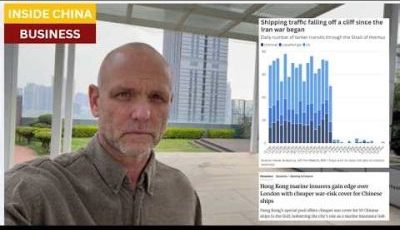
More Iran War fallout: Maritime insurance industry shifts from London to China
or go to
Aletho News Archives – Video-Images
From the Archives
Allies Don’t Need Lobbies
By Jay Knott | Dissident Voice | September 24, 2013
In a recent article on Counterpunch, Rob Urie defended the traditional Marxist analysis of US policy in the Middle East. He argues that support for Israel is driven primarily by economic interest, not the Jewish lobby.
He starts by paying tribute to the idea that Western societies are uniquely racist. He says that the “Western narrative” claims there is an “Arab character”, and that this is “antique racist blather”. He gives no definition of these terms. Further, he establishes his credentials as part of the dominant current in the American left by claiming that “over a million people in Iraq died so ‘we’ in the West can drive SUVs.”1
When he tries to criticize bourgeois economics, he makes it clear he doesn’t understand the developments it has made since Marx’s day, using the mathematical discipline known as “game theory”. He dismisses the basic abstraction of economic theory, the idea of the rational individual, on the grounds that it is “devoid of history, culture and political context”. But abstractions are always devoid of something.
He defends a more concrete economic theory, mostly Marxist, with some input from another theorist of capitalist crisis, Hyman Minsky. This concrete theory leads him to the view that US activity in the Middle East is primarily driven by rational capitalist motives, the need to secure a supply of oil.
“Taking the totality of circumstance — former oil company executives launching war on an oil rich nation on a pretext they publicly proclaimed they didn’t believe shortly before taking office — and that upon launching their war proved to be non-existent, requires a willingness to overlook the obvious — that the war on Iraq was for oil, that is difficult to support.”1
Perhaps I’ve misunderstood him, but based on what he says in the rest of the article, this convoluted sentence seems to argue that, because president Bush and vice-president Cheney attacked Iraq on false premises, and they also said it was all about oil, and they are former oil executives, and Iraq has a lot of oil, it’s difficult to deny US attacks on Iraq are all about oil.
In fact, it’s not hard at all. As Urie points out, at times Bush and co. said that attacking Iraq was “protecting the world’s supply of oil.”1 But, as he also points out, they are congenital liars. Why should we believe them when they say they are trying to “protect” the oil supply? Protect it against what? When politicians “admit” attacks on Middle Eastern countries are wars for oil, they are parroting the neo-con party line, feeding the public, both left and right, with a plausible-sounding pretext. For right-wingers, “it’s a war for oil” is a reason to support war, and for leftists, it’s a way to feel better by complaining impotently about corporate greed. Both approaches help the war drive. … continue
Blog Roll
 Aletho News
- More Iran War fallout: Maritime insurance industry shifts from London to China
- US-Israeli aggression on Iran triggers review of GCC countries’ investment pledges to Washington
- Russia slams UK plan to seize tankers suspected of carrying its oil
- Pakistan ramps up food exports to Persian Gulf nations as war deepens food insecurity
- Iran submits response to US plan, sets terms for war’s end: Tasnim
- US vs Iran: Kharg Island Talk — Bluff or Escalation? Ex-Military Officer Weighs In
- Zelensky unnecessarily involves Ukraine in the Middle East crisis
- Turkish tanker blacklisted by Ukraine hit in drone attack – media
- Canada, the U.S., and NATO: the inescapable trap
- Villains of Judea: Leonid Radvinsky
- If Americans Knew
- ‘No Innocent Children’: Far-right Israeli Lawmaker Defends Killing of Palestinian Family
- Mossad’s promises helped Netanyahu convince Trump that Iran could be toppled
- US Arms Control Official Refuses To Comment When Asked If Israel Has Nuclear Weapons
- Veterans warn US landing could be ‘more Gallipoli than Vietnam’
- Israel may be committing war crimes in Lebanon – Not a ceasefire Day 167
- In the West Bank, life is a constant battle – 3 articles
- Jacob Reses, one of the most powerful pro-Israel operatives in Trump’s Washington
- Israeli-US assaults kill or injure 87 children a day – Not a ceasefire Day 166
- ‘Forever live by the sword’: Understanding Israelis’ massive support for Iran war
- UN’s special rapporteur on human rights says Israel is systematically torturing Palestinians
- No Tricks Zone
- Devastating Assessment Of Comirnaty Vaccine By Former Senior Pfizer Europe Toxicologist
- New Study: CO2 Is ‘Effectively Negligible’ As An Explanatory Climate Change Factor Since 2000
- Former Pfizer Toxicologist Dr. Helmut Sterz Tells Bundestag Hearing Pfizer Vaccine Should Have Never Been Approved
- Energy Expert: Germany’s Nuclear Phaseout Was A “500 Billion Euro Mistake”
- New Research: South Australia’s Mid-Holocene Sea Surface Temperatures Were 4°C Warmer Than Today
- Storing Green Energy To Last Germany 10 Days Would Require A 60-Million Tonne Battery
- New Studies: UK Sea Levels Were 4 Meters Higher Than Today During The Mid-Holocene
- Destructive Green New Deal: German Energy And Metal Group Warns Of Drastic Crisis
- New Study Documents A 20-Year Pause In Arctic Sea Ice Decline – Driven By Internal Variability
- Wake-up Call: Survey Shows Majority Of Germans Now Favor Postponing Climate Targets!
 Aletho News