Israel detained over 300 Palestinians in February alone
MEMO | February 28, 2013
Israel detained 382 Palestinians from the West Bank and the Gaza Strip in February including deceased Arafat Jaradat, three parliamentarians and ten women, a report has said.
The report issued by AHRAR for Prisoners Studies showed that 376 detainees from the West Bank and six from the Gaza Strip.
According to the report, the largest number of Palestinians arrested was from the West Bank city of Nablus followed by Jerusalem, Hebron, Jenin and Bethlehem. Many were arrested from other cities.
While most of the Palestinians were arrested from their homes at night, the report said that 38 of them were arrested at Israeli checkpoints. There are more than 500 of these spread around the West Bank which divide the cities and “make people feel like they are living in hell.”
What made the February detentions distinctive is that large numbers of the detainees are Hamas leaders or activists. The three parliamentarians detained were members of Change and Reform Bloc which is affiliated to Hamas.
Foad al-Khafash, a former prisoner and the head of AHRAR, affirmed that Israeli detention campaigns occur on a daily basis. He also said that the current numbers of those detained are not final as some detentions might not have been reported.
Al-Khafash called for international organisations to shed light on the issue of the Palestinian prisoners and how they are being “violently” kidnapped from their houses.
“The Israeli soldiers ignore all humanitarian norms and laws when they break into the houses of the Palestinians and kidnap them,” Al-Khafash said.
He also said, “the Israeli forces carry out barbaric assaults against prisoners who are not charged and put them into administrative detention.”
It is worth mentioning that, according to AHRAR’s report, the number of detentions has increased this month. “This shows an increasingly aggressive policy in dealing with the Palestinians,” Al-Khafash said.
Related article
- Israel breaches truce 820 times in three months (altahrir.wordpress.com)
Israeli court extends remand of Issawi’s brother

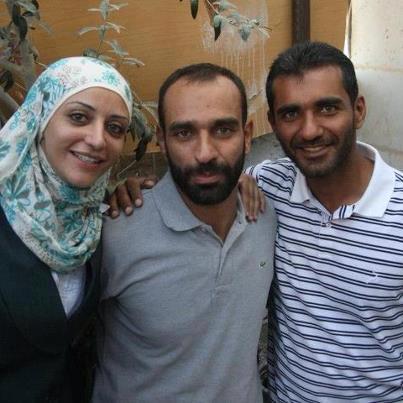
Shireen, Samer and Shadi Issawi
Palestine Information Center – 25/02/2013
RAMALLAH — The Israeli Magistrate Court in occupied Jerusalem extended on Sunday the remand of Shadi Issawi, the brother of hunger striker Samer Issawi, and did not allow him to see his lawyer.
Shireen Issawi, the sister of Shadi and a lawyer, said that the arrest of Shadi and extending his remand fell in line with pressures on Samer to end his seven months hunger strike.
She charged the Israeli occupation authorities (IOA) with targeting all members of Samer’s family, recalling that the IOA razed the home of her third brother Rafat at the start of the year and cut water supplies to her family home in addition to detaining her and her fourth brother Firas for a period of time.
Related articles
- Shireen Al-Issawi: PA did not take prisoners’ issue to the UN (alethonews.wordpress.com)
- Samer Issawi sentenced to 8 months in prison (alethonews.wordpress.com)
Palestinians clash with Israeli troops across the West Bank
Ma’an – 23/02/2013
RAMALLAH – Clashes erupted across the West Bank after the Friday prayers between Israeli troops and Palestinian protesters who rallied to show solidarity with hunger-striking Palestinian prisoners.
Dozens were hurt as Israeli soldiers fired tear gas heavily to disperse the protesters.
Similarly, worshipers in Al-Aqsa Mosque in Jerusalem demonstrated in the compound after the Friday prayer before Israeli troops broke into the squares and clashed with the protesters.
According to Israeli radio station Reshet Bet, Israeli soldiers fired stun grenades to disperse the worshipers. The report highlighted that demonstrations started near the Moroccan Gate through which the soldiers stormed the compound and started to chase protesters.
In Ramallah in the central West Bank, 12 young men were hurt by tear gas and rubber-coated bullets during clashes with Israeli troops after the Friday prayers. Locals told Ma’an that the soldiers detained one Palestinian. The sources highlighted that the Friday prayer was performed near the main gate of Ofer detention center west of Ramallah.
They said about 100 Palestinians preformed Friday prayers near Ofer before Israeli soldiers showered them with tear gas as soon as they finished prayer.
As a result young men started to hurl stones at the soldiers and police officers. A Ma’an reporter said the soldiers directed their tear gas to journalists who gathered in the area to report about the event. He added that the soldiers fired live ammunition at a car for journalists, but nobody was hurt.
Further clashes took place in al-Arrub and al-Fawwar refugee camps in Hebron district.
Witnesses said young Palestinian men in al-Arrub camp north of Hebron pelted Israeli soldiers with stones. Clashes erupted first at the main entrance to the camp on the main road between Hebron and Bethlehem. Then the clashes extended to camp’s alleys resulting in more victims of tear gas as some canisters fell inside houses.
One owner of these houses was identified as Nayif Nimir al-Badawi. Four people were hurt by tear gas. Three others were hurt in house of Khamis Awad al-Badawi.
Israeli forces shut down the main entrance to al-Fawwar camp north of Hebron after young men hurled stones at Israeli soldiers. The soldiers responded with tear gas before they closed the main entrance to traffic.
In Tulkarem in the northern West Bank young Palestinians clashed with Israeli troops in the western part of the city. Soldiers fired tear gas as the young protesters pelted them with stones. The clashes erupted after hundreds of young men rallied after the Friday prayer chanting slogans against Israel’s treatment to Palestinian prisoners.
The northern West Bank city of Jenin also witnessed confrontations between young Palestinians and Israeli soldiers after the Friday prayer. Nine Palestinians were detained during the clashes and dozens were hurt by tear gas and rubber-coated bullets.
Jenin’s clashes started after young men marched from mosques toward al-Jalama checkpoint expressing solidarity with hunger striking Palestinian prisoners. A Ma’an reporter said Israeli forces fired hundreds of tear gas canisters at the protesters in addition to rubber-coated bullets and foul smelling liquids.
Local and security sources told Ma’an that Israeli soldiers detained nine young men. The sources identified one detainee as 14-year-old Amir Majid Irqawi. They said the soldiers assaulted him beating him brutally before he was detained.
Related article
Samer Issawi sentenced to 8 months in prison
Ma’an – 21/02/2013
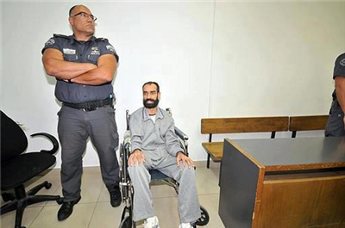 BETHLEHEM – An Israeli court on Thursday sentenced hunger-striker Samer Issawi to eight months in prison, but he has yet to face a military committee which could imprison him for 20 years.
Issawi has been on hunger strike for 204 days.
The magistrates court in Jerusalem sentenced Issawi for leaving Jerusalem, in violation of the terms of his amnesty granted in an Oct. 2011 prisoner exchange deal.
The sentence includes time served since Issawi’s re-arrest in July 2012, and will conclude on March 6, but Issawi also faces a possible sentence under an Israeli military order which allows a special military committee to cancel prisoners’ amnesty.
The committee could use secret evidence to sentence Issawi to serve 20 years, the remainder of his previous sentence.
Issawi was freed in an Oct. 2011 prisoner swap for captured Israeli soldier Gilad Shalit. Israel has subsequently re-arrested at least 14 prisoners since the deal.
Ahead of Thursday’s verdict, Israeli forces clashed with hundreds of Palestinians protesting near Ramallah on Thursday in solidarity with long-term hunger strikers like Issawi.
A Ma’an reporter said 29 protesters were injured by rubber-coated bullets and dozens more suffered tear gas inhalation.
Prisoners minister Issa Qaraqe and Fatah central committee member Mahmoud al-Aloul joined the rally, near Israel’s Ofer prison in the central West Bank.
An Israeli military spokeswoman said soldiers used “riot dispersal means” against Palestinians who hurled rocks at forces.
Protests have been held across the West Bank and in Gaza in support of Issawi, who has been on hunger strike for 204 days, and Tareq Qaadan and Jaafar Azzidine who have refused food for 86 days.
Also Thursday, the Ahmed Abu Rish Brigades on Thursday threatened to fire rockets at Israel if any jailed hunger striker is harmed.
“We will continue to work with rockets and we will not stand by idly. Military operations will be implemented to achieve the rights of prisoners and to free them,” brigades member Abu Ali al-Qawkabi said in a statement.
Al-Qawkabi called on Palestinian leaders in Ramallah to reject any negotiations with Israel and urged the Gaza government to refuse a truce until the detainees’ demands are met.
Islamic Jihad meanwhile has said a truce with Israel could unravel if any hunger striker dies.
On Tuesday, the Palestinian Authority called on the international community to step up efforts to protect and release prisoner like Issawi in Israeli detention facilities.
The cabinet also called on the World Health Organization to move forward on plans made last year to form a fact-finding committee to investigate the conditions in Israeli jails, specifically negligence.
Israel changes law to allow re-arrest of freed prisoners
MEMO | February 18, 2013
A leading Israeli newspaper, Haaretz, revealed on Sunday that the occupation authority has amended its military law to allow the re-arrest of 14 Palestinian prisoners who were freed as part of the Shalit deal. The released prisoners are now expected to serve the remainder of their original sentences, in some cases decades.
Palestinian human rights organizations view the arrest of the released prisoners as a serious breach of the agreement brokered in October 2011 by the Egyptian and German governments between the Islamic Resistance Movement (Hamas) and the Israeli authorities.
The newspaper noted that under the new amendment the Israeli authorities are not obliged to prove the case for the re-arrest of released prisoners. It referred to a petition filed by Ahlam Haddad, the legal counsel for two prisoners, in which she pointed out that a driving offence or staying illegally in Israel were enough to return any released prisoner back to prison to spend his remaining decades; without the need to prove these charges.
Message from Samer el Issawi, day 209 hunger strike
February 16, 2013
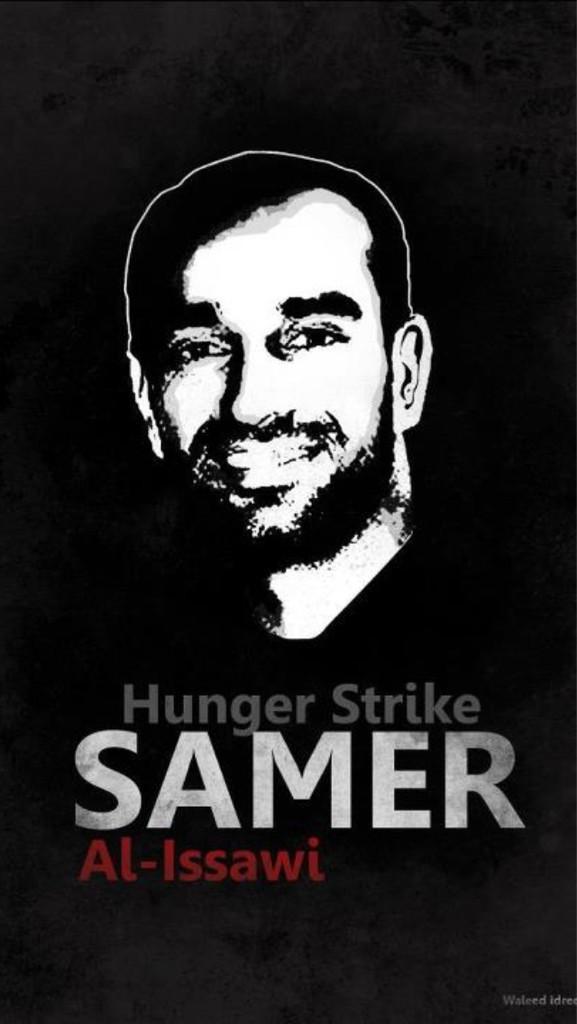 “I turn with admiration to the masses of our heroic Palestinian people, to our Palestinian leadership, to all forces, parties and national institutions. I salute them for standing by our fight to defend our right to freedom and dignity.
I draw my strength from my people, from all the free people in the world, from friends and the families of the prisoners who continue day and night chanting for freedom and an end to the occupation.
My health has deteriorated dramatically and I’m hung between life and death. My weak body is collapsing but still able to be patient and continue the confrontation. My message is that I will continue until the end, until the last drop of water in my body, until martyrdom. Martyrdom is an honor for me in this battle. My martyrdom is my remaining bomb in the confrontation with the tyrants and the jailers, in the face of the racist policy of the occupation that humiliates our people and exercises against us all means of oppression and repression.
I say to my people: I’m stronger than the occupation army and its racist laws. I, Samer al-Issawi, son of Jerusalem, send you my last will that, in case I fell as a martyr, you will carry my soul as a cry for all the prisoners, man and women, cry for freedom, emancipation and salvation from the nightmare of prisons and their harsh darkness.
My battle is not only for individual freedom. The battle waged by me and by my heroic colleagues, Tariq, Ayman and Ja’affar, is everyone’s battle, the battle of the Palestinian people against the occupation and its prisons. Our goal is to be free and sovereign in our liberated state and in our blessed Jerusalem.
The weak and strained beats of my heart derive their steadfastness from you, the great people. My eyes, which started to lose their sight, draws light from your solidarity and your support of me. My weak voice takes its strength from your voice that is louder than the warden’s voice and higher than the walls.
I’m one of your sons, among thousands of your sons who are prisoners, still languishing steadfast in the prisons, waiting for an end to be brought to their plight, their pains and the suffering of their families.
The doctors told me I became exposed to stroke because of the disorder of my heartbeats, the shortage of sugar and the drop in blood pressure. My body is full of cold and I can’t sleep because of the continued pain. But despite the extreme fatigue and chronic headaches, as I move on my chair, I’m trying to summon all my resources to continue on the road till its end. There is no going back, only in my victory, because I’m the owner of Right and my detention is invalid and illegal.
Do not be afraid for my heart if it will stop, don’t be afraid for my hands if they will be paralyzed. I am still alive now and tomorrow and after death, because Jerusalem is moving in my blood, in my devotion and my faith.”
**Via Rona Merrill, Neta Golan
Related article
- Shireen Al-Issawi: PA did not take prisoners’ issue to the UN (alethonews.wordpress.com)
Israel arrests 22 Hamas members ahead of Fatah-Hamas talks
Al-Akhbar – February 4, 2013
Israeli forces led an arrest sweep of at least 22 Hamas members Sunday night and Monday morning, including 3 members of the Palestinian Legislative Council.
The Israeli military confirmed arrests were made but would not elaborate further.
The Palestinian Ma’an news agency identified two of the MPs as Hatim Qafisha of Hebron and Ahmad Attoun of Jerusalem. Qafisha has previously been detained six times by Israel, whereas Attoun was forcibly transferred from Jerusalem to the West Bank by Israeli forces.
The third MP was identified by WAFA news agency as Mohammad al-Tul from Dahrieh.
Israel has a history of arresting Palestinian politicians and legislators, mainly targeting members of the pro-Hamas Change and Reform bloc since 2006, when Hamas won a majority of seats in the Palestinian parliament.
According to prisoners’ rights NGO Addameer, nearly a third of all members of the Palestinian Legislative Council were held in Israeli prisons in 2009.
The recent upsurge in arrests is most likely a response to Friday’s planned talks between rival Palestinian parties Hamas and Fatah as a way to undermine attempts at Palestinian political unity, according to Murad Jadallah of Addameer.
“Israel wants to show it has the authority and the military power to decide whether reconciliation happens,” the activist told Al-Akhbar.
Addameer has recorded the arrests of at least 40 Palestinians in the past 48 hours.
As of January 1, Israel held 4,743 Palestinians in its prisons, including 12 Palestinian MPs and 178 held without charge, according to Addameer’s latest figures.
Citing security sources, AFP reported that Israel plans to step up arrests of “suspected militants” in the West Bank.
Extensive use of administrative detention is illegal according to international law, but is commonly practiced by Israel against Palestinians.
Israeli Prison Doctors To Amputate Leg Of Wounded Detainee
By Saed Bannoura | IMEMC & Agencies | January 06, 2013
Lawyer of the Palestinian Ministry of Detainees, Fadi Obeidat, stated that Israeli physicians at the Ramla Prison Clinic decided to amputate the left leg of detainee Nahedh Al-Aqra’, 41, from the Gaza Strip. The detainee lost his right leg after being shot by the army.
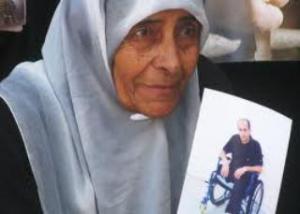
Mother Of Nahed Al-Aqra’ Holding His Picture – hskalla.wordpress.com
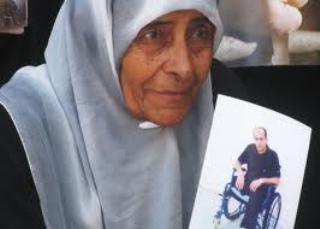
Al-Aqra’ is suffering from very sharp pain in his leg due to infections resulting from his injury and due to the lack of adequate medical treatment as the only medication he received was painkilling pills.
His family has not been allowed to visit him since he was kidnapped while returning from Jordan on July 7, 2000, where he received medical treatment for multiple gunshot injuries in his legs, and was sentenced to three life-terms.
Israel’s recent decision to allow family visits to Gaza Strip detainees did not include detainees who are hospitalized at the prison clinic. Gaza Strip detainees were denied visitation rights after the second Intifada started in late September 2000.
In prison, he suffered various complications, including infections, and his wound became septic; the doctors performed several surgeries but could not save his leg.
Al-Aqra is a father of four children who have not seen him since 2000 despite extensive efforts conducted by the Red Cross.
In related news, the family of detainee Mahmoud Hamdi Shabana, 40, stated Saturday that he is suffering from a sharp pain in his throat, especially the vocal cords, and that he is not receiving any medical treatment.
Al-Aqra’ is held at the Negev Detention Camp; he was kidnapped more than 35 months ago and was confined under repeatedly renewed Administrative Detention orders without charges or trial since then.
Related articles
- 18 Seriously Sick Detainees Facing Medical Neglect In Israeli Prisons (imemc.org)
- Israel Kidnapped 173 Palestinians This Month (arabworld360.blogspot.com)
Shireen Al-Issawi: PA did not take prisoners’ issue to the UN
Palestine Information Center – 27/12/2012
 OCCUPIED JERUSALEM — Shireen Al-Issawi, the sister of hunger striker Samer Al-Issawi, has called for greater support for the issue of hunger striking Palestinian prisoners in Israeli jails.
She told the PIC in an interview that the Israeli occupation authorities (IOA) refused to allow medical checkups on her brother, whose health condition is deteriorating.
Shireen, a lawyer, criticized the Palestinian Authority for not heading to the UN, human rights groups and the international criminal court and filing complaints against Israel’s practices and crimes and to demand freedom for the Palestinian prisoners.
The PA should exploit the hunger strike by a number of prisoners and expose the Israeli practices against them, she said, adding that the PA should also ask Cairo to intervene in the issue in its capacity as the patron of the prisoners’ exchange agreement that stipulated among other things that those freed in the agreement would not be re-arrested and also limited the use of the administrative detention policy.
Shireen said that the Israeli court decision banning her from attending her brother’s court hearings was part of the psychological pressures on him.
3 Arrested as Palestinians attacked by settlers and soldiers in Tel Rumeida
By Vicky Blackwell and Elyana Belle | International Solidarity Movement | October 22, 2012

Settlers arrive to the Azzeh family land – Photographs by Vicky Blackwell
Today, a group of settlers from the illegal settlement in Tel Rumeida arrived at Hashem Azzeh’s olive grove next to his house, whilst he and his family were harvesting their olives, yelling for everyone to get off of “their” land.
Hasham and his family were on their land harvesting olives for the first time in 5 years after being granted permission from the District Civil Liaison. He was accompanied by several members of his family as well as activists from the International Solidarity Movement. The situation quickly escalated as settlers pushed the Palestinians in order to try and enter Hasham’s house.
Within ten minutes the soldiers arrived and began to separate the Palestinian family and internationals and siding with the Israeli settlers. Arguments continued with both sides yelling “this is my land,” regardless of the fact that Hashem has the deeds to the land. The settlers were also heard shouting “This is not your land, this is the land of the Jewish people.”
At this point around ten more settlers had come down and joined in, shouting abuse at Hasham and his family. The soldiers pushed the Palestinians and internationals back towards Hasham’s house threatening to arrest anyone who did not obey. The soldiers grabbed a young Palestinian man by the name of Ahmad Al Atrash who was video taping standing behind international activists: pushed him against the wall and zip-tied his arms behind his back.
Then they went after an International activist trying to arrest him for taking video footage. While trying to escape they grabbed another of the International activists standing by, put him in a headlock on the ground and arrested him. Jawad Abu Eisheh who had arrived in solidarity with his neighbors was also captured and arrested.
 The two Palestinians and Italian activist have been arrested and taken to a police station in the illegal settlement of Kiryat Arba.
The district of Tel Rumeida is heavily militarized and contains the homes of both Israeli settlers and Palestinians. Hasham’s family moved to Tel Rumeida in 1950 after being forcibly removed from their homes in what is now Israel. The Tel Rumeida settlement was installed in 1984.
In an attack in 2006 the settlers smashed Hasham’s nephews’ teeth in with a stone. That same year his wife (3 months pregnant at the time) was attacked and subsequently miscarried. Again in 2006 she was attacked, this time 4 months pregnant, and again, suffered from a miscarriage due to the attack.
The settlers living directly over Hasham’s house have also in the past raided his house, (bullet-holes near his front door show when the settlers shot live ammunition at his house), they cut his water-pipes and poisoned his water tank, cut his trees down in his garden and have physically attacked and assaulted him and his family as well as breaking-into and vandalizing his house on several occasions.
Previous reports on settler violence against the Azzeh family:
http://palsolidarity.org/2006/09/hebron-27th-sept/
http://palsolidarity.org/2006/10/olive-picking-tr-settlement/
http://palsolidarity.org/2006/10/tr-harassment/
http://palsolidarity.org/2012/09/hebron-man-walks-down-street-for-first-time-in-years/
Related articles
- Israeli army turns Palestinian homes in Hebron into military barracks (alethonews.wordpress.com)
- Meet Zionist Miriam Levinger (alethonews.wordpress.com)
Abla Saadat: A Palestinian Stateswoman marked by “Terrorism”
By Christof Lehmann | No Spin News | September 24, 2012
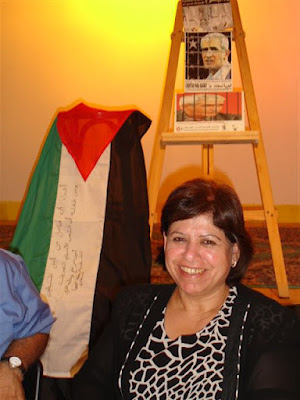 Abla Sa’adat, the Chairwoman of the Palestinian Women Organizations and wife of the Secretary General of the Popular Front for the Liberation of Palestine (PFLP) visited Denmark. I met Abla Sa’adat at a meeting where she told a group of mostly young Danes about Palestine. Had one expected an Abla Sa’adat who conforms with the dehumanizing stereotyping of Palestinians by Israeli and western politicians and main stream media, one would have been surprised by the depth and complexity of Abla Sa ‘adat, her perception of the Palestinian problems and possible solutions.
Behind the veil of the “terrorist” stereotype one discovers an Abla Sa’adat who is a true stateswoman, humanist, human rights advocate, an advocate for international law, justice and peace, the wife of a long term prisoner of war and political prisoner, as well as a mother and grandmother who puts the systematic dehumanization and stereotyping of Palestinians to shame.
In spite of the Hamas – Israeli negotiated prisoner exchange earlier this year, Abla Sa’adat states, more than 5.000 Palestinians remain in prison under administrative detention. She is active in organizations which advocate Palestinian prisoners rights. It is not for personal reasons, so she states, that she is using her husband, PFLP Secretary General Ahmad Sa’adat as an example for how Israel systematically terrorizes politically active Palestinians and their families, but because due to her own experience she knows his case best and because his case is representative of those of thousands of other prisoners and their families.
On the other hand, who would blame Abla Sa’adat for wanting to advocate for her illegally detained husband, the father of her children and grandfather to her grandchildren. At a recent appearance of Ahmad Sa’adat in an Israeli court he was denied physical contact with Abla and his newborn granddaughter Mayar. The destruction of politically active Palestinian families family ties and the destruction of Palestinians’ family systems is systemic and systematic.
After the PLO signed the Oslo Accords and the Palestinian Authority (PA) was established, the situation in the occupied Palestinian territories within the 1967 borders has not improved and the Israeli governments have systematically avoided adhering to the provisions of the Oslo Accords. Contrary to improvements, the reality of the matter is that: Israel has confiscated more land, increased its infringements on Palestinians’ water rights, built more settlements and settler only roads and railways, built the so called “security wall” which isolates Palestinian West Bank villages in micro enclaves, continued a policy that devastates Palestine’s economy; Israel continues to illegally arrest and detain Palestinians under illegal forms of imprisonment, the use of torture is endemic, the use of disproportionate military force is well documented, and these items only touch the surface of the daily violations of the Oslo Accords. According to the Oslo Accords Palestinian prisoners should have been released from prison. Israel did not adhere to this provision either.
What Palestinians gained by signing the Oslo Accords can be described with a few words. The right to establish a Palestinian Authority, which is utterly dependent on the goodwill of Israel. The political factions have gained the privilege to compete with each other for the Presidency over the self-administrated Zionist genocide on themselves while splitting the PLO, rendering it in a state of internal conflict rather than fighting for the liberation of Palestine. In other words, the PLO was entrapped in the glory of Presidency over its own destruction and the destruction of Palestine.
It is within this context one has to understand the arrest and detainment of Ahmad Sa’adat. Israel demanded that the Palestinian Authority arrest him for “terrorism,” and the Fatah led PA made sure that he was arrested and detained. The tragic irony of the situation is that the Oslo Accords resulted in the Palestinian Authority arresting and detaining the Secretary General of the PFLP Ahmad Sa’adat on behalf of Israel, and that Israeli pressure and US and British complicity since have resulted in Sa’adat being imprisoned in an Israeli prison and not, as initially, in a Palestinian prison with US and UK military guards. In fact each and every detail of Ahmed Sa’adat’s imprisonment is in violation of the Geneva Conventions, the Conventions against the use of Torture and other bodies of international law. Ahmed Sa’adat was sentenced to thirty years in prison for being the Secretary General of the PFLP, which is designated as a “terrorist organization” by the USA, Israel and the E.U. He has spent years on end in isolation.
Prior to his arrest Ahmed Sa’adat was elected to the Palestinian parliament. Abla Sa’adat explained that 22 members of parliament are currently imprisoned in Israeli prisons, many of them in isolation. The occupation is in fact preventing the functioning of Palestine’s democratic institutions.
Isolated prisoners are locked up for 23 hours a day. For one hour they can leave their cells and spend their time in an indoor yard, in shackles and hand-cuffs, without the possibility to exercise. There is absolutely no contact to other prisoners. Ahmed Sa’adat was isolated for three years before he was granted ” the privilege” to have his first visitor. Other families, Abla Sa’adat said, have been waiting ten years before they could see their imprisoned husband or father for the first time. Many can not even visit their relatives even if they are granted permission because road blocks and bureaucracy make it impossible to get to the prison and back.
Both Amnesty International, the Red Cross and lawyers complained that this form for imprisonment constitutes torture as well as a breach of the Geneva Conventions, but to no avail. Israel disregards these organizations and laws as well as it has disregarded almost any of the UN Resolutions pertaining Israel, Palestine or the Situation in the Middle East. Ironically, Israel is claiming the legitimacy of the state of Israel from the very organization whose resolutions it systematically disregards.
The impact of isolation and sensory deprivation on prisoners is well documented in numerous and comprehensive scientific studies. Even short term isolation for one to two weeks has a significant impact on a prisoners ability to concentrate, on memory, and general psychological well-being. Longer term and long term isolation for months to years on end have a devastating effect on the human being. Already after a few weeks most isolated prisoners experience several of the following symptoms.
-
Loss of the ability to concentrate
-
Loss of the ability to think coherent thoughts.
-
Loss of short and long-term memory.
-
Visual, auditory and tactile hallucinations, such as the sensation that the entire cell is driving like a train carriage or rotating.
-
Severe mood disorders.
-
Severe dissociative symptoms or dissociative disorders.
-
Suicidal ideas and increased prevalence of suicide attempts and death due to suicide compared to non-isolated prisoner populations.
-
Symptoms of learned helplessness.
-
Inability to participate as an active part of a legal defense.
-
And a cohort of other, severe symptoms.
It is for very good, science-based reasons that long term isolation is internationally recognized as torture. Israel is systematically using isolation to psychologically and physically destroy politically active Palestinian prisoners.
While the systematic and wide spread use of long-term isolation has a devastating effect on the prisoners themselves has a devastating effect on the isolated prisoners family systems as well. Spouses who have not seen one another for years on end risk growing strangers to one another. Children who are infants when a parent is imprisoned often see their father or mother for the first time when they are teens. It is impossible to remedy the lack of early attachment and the lack of a possibility to to know ones parents or ones children intimately or at least to such a degree as a normal imprisonment allows, which is devastating enough.
One of the long term prisoners, Nabeel Barghouti was imprisoned for 30 years. His wife who was pregnant when he was imprisoned gave birth to a son, Fahdi. At the age of 16 his son decided that the only way to see his father was to become a prisoner. After his arrest and imprisonment he fought for the right to be imprisoned under conditions that made it possible for him to see his father. Incidents like these are not extraordinary, although they are extraordinarily tragic.
At a visit, Ahmad Sa’adat would have been unable to recognize his own son on a photograph had it not been for the fact that the boy held a trumpet and that he knew that his son is playing the trumpet. Abla Sa’adat’s worst concern about her husband, she said, is not that he is breaking down mentally. Naturally the long term isolation has set its marks but he is determined in his struggle for liberation. What concerns her most is that she can see, that her husband is suffering the physical effects on the body which long term prisoners in Israel are suffering.
It took a months long hunger strike of Palestinian prisoners to finally end all long-term isolation of Palestinian prisoners in Israel’s prison industry; and it is a prison industry, in the literal sense of the word. E.U. Subsidies per prisoner exceed Israel’s costs per prisoner per day, and there are other methods such as fines which make it a lucrative business for Israel to hold as many prisoners as possible.
Years ago, Abla Sa’adat recalled, she was arrested while her husband already was imprisoned. Who would take care of the children? Israel is systematically using illegal forms of arrest and imprisonment to terrorize and destroy politically active families, and those who help targeted families in coping risk being targeted too.
The Stateswoman in Abla Sa’adat came out when she raised concerns about the targeting and imprisonment of Palestinian children. Stateswoman in the true sense of the word, as a politician, a revolutionary, as well as a mother for her own children, and a politician who has a motherly love for the plight of the children of Palestine and families with children.
Children are regularly arrested, beaten, shot at and killed for protesting the occupation. Many of them are provoked into conflicts with the occupation forces. Tanks rattling near school buildings for hours, stressing the children and making it impossible for them to follow a normal schedule are just one of hundreds of ways to provoke the throwing of a stone. The response can be everything from being beaten, arrested and imprisoned, injured or killed.
Abla Sa’adat draws attention to the fact that the international conventions and laws which regulate the rights of imprisoned children are also systematically circumvented or ignored by Israel. Besides that the child prisoners have become a lucrative form of income for Israel. The fines are high and children are often not released before the fine is paid.
Another way of destroying Palestinian family systems is the placement of children who are sentenced to house arrest with family members so far away from their parents that road blocks and daily chicane makes it impossible for the parents to maintain contact with the children.
Abla Sa’adat is drawing attention to the fact that the prevalence of psychological disorders among Palestinian children is extremely high. In fact, the prevalence of psychological disorders is extremely high in the general Palestinian population, regardless which age group one studies. Many of these psychological problems are caused by the occupation, and the prevalence of trauma-related problems is staggering.
A 1996 Study by Save the Child documented that most children internalize the conflict with the occupation. The violent problem-solving models are then transferred into the family system and into school teacher relations, leading to immense pedagogical problems. The violent problem solving models are also transferred to child on child relations. Children growing up under such conditions are, as adults, prone to use violent problem solving models. The effect is not only felt in the resistance against the occupation. In fact, the effect is more likely to manifest in spousal abuse, child abuse, proneness to the use of violence to settle family disputes, political disputes, financial disputes, and so forth. This internalization during childhood has an all pervasive and devastating effect on all levels, individual, family, community level, and in the halls of government.
The Oslo Accords, says Abla Sa’adat, have not brought any improvements for Palestinians and the debate among Palestinian factions to abandon the Oslo Accords and all subsequent agreements is finally being seriously debated among the factions.
Abla Sa’adat made a point of clarifying that she has nothing against Jews in Palestine or anywhere else. Jewish, Christian, Muslim and Secular people have been living in Palestine for centuries. The often used propaganda, that Palestinians want to drive the Jews back into the sea, she states, has nothing to do with reality. Her cause and the cause of the Palestinian liberation is not directed against Jews but against Zionism and Zionists. There is a difference, she states, between Jewish families who have been living in Palestine for centuries, and those who came and still are coming to Palestine to steal Palestinian land and evict or murder Palestinians.
A two State solution, says Abla Sa’adat, is the very minimum and it would be difficult to implement. She asks, if a Palestinian state should be established within the borders of 1967, what about those families who have been refugees since 1948? The most realistic solution would be, she said, to establish one secular state in all of Palestine. One secular, democratic state for Jews, Christians, Muslims and Secularists within all of the Palestinian territories. The greatest obstacle to the establishment of such a state is, that Zionists insist on a Jewish State, where Muslims, Christians and Secularists alike have no place, and if at all, then as second class citizens.
With a Middle East on fire, with a Libya that has fallen into the hands of Islamic extremism, and with Syria under attack from western sponsored extremists and Al Qaeda associated organizations from throughout the world, with Qatar, Jordan, Bahrain, Saudi Arabia, the U.A.E., the USA, NATO member states and Israel sponsoring and backing the extremists’ subversion of Syria, Abla Sa’adat, who is widely decried as “terrorist,” sounds like one of the most reasonable Middle Eastern voices of moderation I have heard since the onset of the so-called Arab Spring. If Abla Sa’adat is marked by terrorism, it is because a lifetime of enduring the terror of the Zionist occupation is as imprinted in her as it is in every Palestinian.
* Dr. Christof Lehmann, a life time peace activist, psychologist, and advisor in behavior, finance, economics and politics.
Related articles
- The racism behind a two-state solution (alethonews.wordpress.com)
- Saadat: “Zionist War Criminals Are The Ones Who Must Be Prosecuted” (imemc.org)
- Ahmad Sa’adat refuses to recognize legitimacy of Israeli court, “a tool of repression against Palestinian prisoners” (altahrir.wordpress.com)
Featured Video

Chinese jet fuel and the myth of energy independence
or go to
Aletho News Archives – Video-Images
From the Archives
The Dirty Little Secret behind the “Global Terrorism Index”
The Omission of Israeli Terrorism in the Occupied Palestinian Territories
By Karin Brothers | Global Research | December 6, 2014
… The Israeli settlements — all of which are illegal – have been identified as a major impediment to peace. The refusal of a major “global” terrorism report to name the Israeli settlers as one of the groups most responsible for terrorism not only misrepresents a major source of regional violence but exposes the Global Terrorism Index as a propaganda tool that supports a U.S. agenda.
In recent years, governments have been attempting to thwart terrorism by blocking supportive fund-raising. When it comes to Israeli settlements, however, the US and Canada actually encourage fund-raising by giving organizations (such as Christian Friends of Israeli Communities (CFOIC) and the Jewish National Fund) financial support in the form of donor tax-deductions.
Charities which provide funds for the Israeli settlements should be regarded as terror-financing organizations. They should not only lose their tax-deductible status, but they should be banned because they support the violation of international humanitarian law. The terror-financing laws that are being strictly enforced for Muslim charities should be applied to Christian and Jewish charities as well. … Read full article
Blog Roll
 Aletho News
- Chinese jet fuel and the myth of energy independence
- Ukraine Sea Drone Fired From Libya Hit Russian Tanker in Mediterranean
- IRGC: Iranian forces launched no attacks during ceasefire hours
- Trump Administration Moves To Automate U.S. Military Draft Registration
- Spain orders reopening of Tehran embassy, condemns Israel’s carpet bombing of Lebanon
- Israel faces ‘unsustainable’ strategic crisis following 40-day war against Iran: Analyst
- Iran restricts Hormuz access to 15 vessels per day under ceasefire terms: Report
- The ‘Opposition Party’ Has Done Nothing to Stop the Iran War and Much to Goad Trump Into Continuing It
- Moscow backs Tehran on status of Lebanon in US-Iran deal
- How UK Regulator Ofcom Quietly Bypassed International Law to Police American Speech
- If Americans Knew
- Amnesty: Urgent – Protect Lebanese civilians from brutal escalation in Israeli attacks
- Is The War Against Iran Over?
- Inside the Israeli army’s propaganda wing
- Hundreds of Gaza Amputees Stranded in Legal Limbo
- The gallows law: Israel moves toward executing Palestinian children
- Tucker Carlson: The Path to Peace requires ending ‘special alliance’ with Israel
- This is ceasefire? Israel’s biggest massacre yet in Lebanon, another journalist killed in Gaza – Daily Update
- Tucker Carlson on Israel: This Is the Behavior of an Ally? Really?
- Gazans face a triple crisis: severe shortages of water and bread, healthcare in tatters
- NY Times reports how Netanyahu took the US into Iran War
- No Tricks Zone
- An Inconvenient Tree: Uncovered In Alps… Europe Much Warmer Than Today 6000 Years Ago
- New Study Reports A 60% Slowdown In Greenland’s Ice Loss Rate In The Last Decade
- Low Intensity Tornado Wrecks Major Solar Farm, Creating A Potential Toxic Dump
- New Study Finds Warming Saves Lives…Cold Temperatures 12 Times More Deadly Than Excess Heat
- German Science Blog Accuses PIK Climate Institute Of Hallucinating Climate Tipping Points
- Devastating Assessment Of Comirnaty Vaccine By Former Senior Pfizer Europe Toxicologist
- New Study: CO2 Is ‘Effectively Negligible’ As An Explanatory Climate Change Factor Since 2000
- Former Pfizer Toxicologist Dr. Helmut Sterz Tells Bundestag Hearing Pfizer Vaccine Should Have Never Been Approved
- Energy Expert: Germany’s Nuclear Phaseout Was A “500 Billion Euro Mistake”
- New Research: South Australia’s Mid-Holocene Sea Surface Temperatures Were 4°C Warmer Than Today
 Aletho News