 A Palestinian hunger striker in Israel’s Ramleh prison was knocked unconscious by prison guards earlier this week in the most recent abuse of prisoners, a coalition of human rights groups said on Thursday.
Hassan Safadi, who has gone 57 days without food, had his head slammed against the steel door of his prison cell during an assault on him and another hunger striker, Samer al-Barq.
The assault occurred after they refused to be transferred to a new cell, Addameer, al-Haq and Physicians for Human Rights-Israel said in a joint statement.
“During the attack, Mr Safadi’s head was slammed against the iron door of the cell two times, causing him to fall to the ground, unconscious. Prison guards then dragged him through the hall to be seen by all the other prisoners,” it said.
Safadi announced after the beating that he would no longer be drinking water.
The two prisoners are refusing food to protest their detention without trial under a system Israel calls administrative detention.
Over 2,000 Palestinian prisoners ended a mass hunger strike in May after reaching a deal with Israel.
The deal specifically stipulated that Safadi would be released following the expiration of his detention order, but the agreement was not upheld.
Two other Palestinian prisoners, Ayman Sharawna and Samer al-Issawi, have also been refusing food for 47 and 16 days, respectively.
Israel’s draconian administrative detention allows for the imprisonment of Palestinians without charge or trial for renewable six month periods.
August 16, 2012
Posted by aletho |
Civil Liberties, Subjugation - Torture | Administrative detention, Hunger strike, Israel, Palestinian prisoners in Israel, Physicians for Human Rights-Israel |
Leave a comment
Human rights groups in Israel released a statement on Wednesday condemning the “outrageous mistreatment” of hunger striking Palestinian prisoners by the Israeli Prison Service (IPS), including physical beatings.
“We are outraged by the mistreatment and violent attacks on Palestinian prisoners in general, and especially in the cases of these fragile hunger strikers,” said a joint press release from Addameer Prisoner Support and Human Rights Association, Al-Haq and Physicians for Human Rights-Israel (PHR-IL).
“We urge the international community to intervene with Israel on behalf of these detainees before their conditions deteriorate even further.”
Doctors and lawyers from the groups who visited the prisoners in Ramleh prison medical center expressed particular concern for the lives two administrative detainees, Samer al-Barq and Hassan Safadi, who have been subject to consistent mistreatment by the IPS.
“There is reason to believe that in the future the health of the two strikers will deteriorate, and therefore their condition requires special attention and close monitoring,” said a doctor from PHR-IL following his visit to the prisoners.
The two detainees are now refusing vitamins and minerals in protest at “humiliating and violent treatment by IPS staff.” He called for the patients to be examined once a week by an impartial doctor without the need for a court order.
PHR-IL doctors also reported that the tiny 1.5 by 1.8 meter cell shared by the two prisoners has no space for the wheelchairs they require for every day activities such as going to the toilet and the shower.
According to the groups, Barq, who is currently on his 78th day of a renewed hunger strike, having already completed a 30-day hunger strike, was violently beaten during his transfer from Ramleh to Ofer military court on July 31.
IPS special forces are renowned for their particularly brutal treatment of prisoners during transfers.
Safadi, who is now on his 48th day of renewed hunger strike, following his previous 71-day hunger strike, recounted similar stories of abuse by IPS staff who regularly carry out violent searches of their cell.
In one such raid they insulted and beat him all over his body leaving him with an injured leg.
In June, Israel broke a deal reached with the Palestinian prisoners’ committee that ended a mass hunger strike by renewing the detention of Hassan Safadi for another six months.
Safadi has been held since 29 June 2011 and the renewal of his detention was a violation of the agreement between the prisoners’ hunger strike committee and Israeli officials.
The mass hunger strike of over 2,000 Palestinian prisoners in Israeli jails earlier this year was a protest against Israel’s draconian administrative detention policy, as well as harsh conditions imposed on them during imprisonment.
The strike aimed to put pressure on Israel to drop administrative detention, but the Jewish state has resisted calls to change the policy.
The law dates back to the British mandate era of historic Palestine and allows Israel to detain Palestinians without charge for renewable six month periods.
Amnesty International and Human Rights Watch have previously condemned the policy as a violation of international humanitarian law.
Two other Palestinian political prisoners are also currently on hunger strike: Ayman Sharawna and Samer Al-Issawi, on 38 and 7 days respectively. Both were released in last October’s prisoner exchange deal and subsequently rearrested.
Israel has been accused by activists of implementing apartheid policies towards indigenous Palestinians.
August 8, 2012
Posted by aletho |
Civil Liberties, Ethnic Cleansing, Racism, Zionism, Subjugation - Torture | Al-Haq, Hunger strike, Israel, Israel Prison Service, Palestinian prisoners in Israel, Physicians for Human Rights-Israel |
Leave a comment
In June, the UN Committee Against Torture (the Committee) released a list of issues it would like the Government of Israel to address when the Committee reviews Israel’s compliance with the Convention Against Torture (CAT) in 2013. Specific issues raised by the Committee relevant to the continued prosecution of Palestinian children in military courts include:
- What steps has the Government of Israel taken to audio-visually record interrogations conducted by the Israeli Security Agency (ISA) as a further means to prevent torture and ill-treatment? DCI-Palestine further recommends that this inquiry should be broadened to include interrogations conducted by the Israeli police, being the body most likely to interrogate Palestinian children from the West Bank.
- What steps has the Government of Israel taken to ensure that all detainees are promptly brought before a judge and have prompt access to a lawyer? Under military law, Palestinian children are not required to be brought before a judge for 8 days, and can be denied access to a lawyer for up to 90 days. By way of contrast, Israeli children, including those living in the settlements, must be brought before a judge within 24 hours and can be denied access to a lawyer for 48 hours.
- Please indicate how many Palestinian prisoners from the Occupied Palestinian Territory are held in detention facilities inside Israel? Transferring and detaining Palestinian prisoners out of occupied territory violates article 76 of the Fourth Geneva Convention and attracts personal criminal liability under articles 146 and 147 of the same convention.
- Please indicate the measures taken to ensure that the detention or imprisonment of a child is used as a measure of last resort, that solitary confinement is never used as a means of coercion or punishment and that all children receive appropriate education.
- Please also explain the regime applied to children under military detention, in particular if their interrogations are recorded and if their parents or other legal representatives can have access to them. DCI-Palestine recommends that all interrogations of children must be audio-visually recorded and parents must be entitled to accompany their children at all times, as is the right generally afforded to Israeli children. Further, children must be entitled to consult with a lawyer of their choice prior to their interrogation.
The full list of issues released by the Committee is available here.
July 25, 2012
Posted by aletho |
Civil Liberties, Subjugation - Torture | Fourth Geneva Convention, Israel, Palestinian prisoners in Israel, United Nations Convention Against Torture, West Bank |
Leave a comment
In a letter dated 29 June 2012, the UK Foreign Office responded to concerns raised by a group of UK lawyers about the forcible transfer of Palestinian children to prisons located inside Israel. The transfer of Palestinian prisoners (adults and children) to detention facilities inside Israel violates article 76 of the Fourth Geneva Convention for which personal criminal liability applies.
In the letter, the UK Foreign Office responded that:
“The British Government shares your concerns about the treatment of Palestinian children detained in Israeli prisons and we have a continual dialogue with the Israeli authorities on this question. […] The Government agrees that Israel has legal obligations as an Occupying Power with respect to the Occupied Palestinian Territories under applicable international law, including the Fourth Geneva Convention. […] We agree with you that Israel’s policy of detaining Palestinians within Israel is contrary to Article 76 of the Fourth Geneva Convention and that domestic law cannot be used as a justification for violations of international law.”
According to Israeli Prison Service figures released in June 2012, 85 percent of Palestinian prisoners, including children, were detained inside Israel. Given that this violation has continued for decades, questions need to be asked as to what additional steps the UK Government is considering to ensure that it complies with its own legal obligations under the Fourth Geneva Convention, as dialogue does not appear to be working when it comes to the forcible transfer of prisoners.
July 23, 2012
Posted by aletho |
Civil Liberties, Subjugation - Torture, Timeless or most popular | Foreign and Commonwealth Office, Fourth Geneva Convention, Government of the United Kingdom, Israel, Israel Prison Service, Palestinian prisoners in Israel, UK Foreign Office |
Leave a comment
RAMALLAH — The Israeli occupation authority (IOA) arrested 50 Palestinians and blocked the travel of 450 others at the Karame crossing between occupied West Bank and Jordan since the start of 2012.
The Palestinian prisoner’s committee said in a statement on Friday that most of those arrested in the first half of this year were young men or university students.
It noted that students and sick and elderly people were among the 450 citizens banned from travel.
The committee charged that the measure ran contrary to laws and norms, noting, meanwhile, that those allowed to travel are almost always delayed for no justified reason while some of them are questioned by the IOA intelligence.
The committee asked world organizations and human rights groups to intervene and put an end to such practices that violate the freedom of movement.
June 30, 2012
Posted by aletho |
Aletho News | Israeli-occupied territories, Karameh, Palestinian prisoners in Israel, West Bank |
Leave a comment
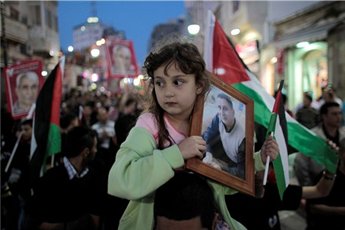
Palestinian and international rights groups have condemned the Israeli government’s failure to live up to the agreement made one month ago in order to end the month-long hunger strike of over 2,000 Palestinian prisoners.
The promises made by the Israeli government in order to end the hunger strike included an end to solitary confinement, improved living conditions for prisoners, proper medical care and increased family visits. A month after the hunger strike was declared over, however, the Israeli authorities have yet to implement these agreed-upon terms.
The one item that Israeli authorities did carry out was the return of 91 bodies from the so-called ‘Numbers’ cemetery in Israel – a cemetery made up of Palestinians who died or were killed inside Israel. Although Israel has always denied the existence of this cemetery, mocking those Palestinians who insisted that it did exist, the release of the bodies constituted an admission by the Israeli government that the Numbers cemetery does exist. Those 91 bodies are not all of the Palestinians buried in the Numbers cemetery, but no one on the Palestinian side knows how many bodies remain, and Israel has refused to release any data.
Some prisoner rights groups are blaming the Palestinian Authority for giving in to easily during negotiations with the Israelis regarding the hunger striking prisoners, and for failing to pressure Israel to live up to its end of the bargain.
In fact, there is no mechanism by which the Palestinian Authority can force Israel to carry out its promises regarding prisoners, as Palestinians have no legal recourse to take the Israeli government to court.
One of the promises made by the Israeli government was hailed at the time as a success for prisoners, but prisoner rights groups including Addameer have cautioned that it does not constitute a real change in policy. That is the decision to not extend so-called ‘administrative detention’ orders under which Palestinians are held without charges. The caveat, however, is that Israel can extend those orders if there is ‘new information’ in the case. Since the charges and trial in these cases are held in secret, with no possibility of mounting a defense, this caveat makes the change in policy virtually meaningless.
One representative of Addameer, Mourad Jadallah, told reporters with the Ma’an news agency, “Israel also does not want Palestinians to feel they reached something with the hunger strike or let the prisoners movement feel like they reached their demands. They want to say: We can control everything.”
June 28, 2012
Posted by aletho |
Civil Liberties, Solidarity and Activism, Subjugation - Torture | Administrative detention, Hunger strike, International Middle East Media Center, Israel, Palestinian National Authority, Palestinian prisoners in Israel, Solitary confinement |
Leave a comment
You may not know much about G4S, but they almost certainly know something about you. The world’s largest security firm, operating in over 125 countries and employing over 650,000 staff worldwide, are believed to be the second largest private employer worldwide, behind only Walmart. Globally they are responsible for security at over 150 airports, countless private companies, they do police work in the UK and are the main security firm for the 2012 London Olympics – so they make it their business to know who you are.
Known for their ruthless competitiveness, the British-Danish firm have recently been seeking to expand outside of their traditional base in Europe and the US. The Middle East is one of their main targets, with operations in the region worth $410 million and with just shy of 50,000 employees.
The contracts the secretive company have officially declared include private security for airports in Iraq, the UAE, and Qatar, while they are also known to guard US and European Embassies in countries across the Arab world, as well as in Afghanistan.
But G4S has a far darker side than the official brochures would have you believe. First there were the accusations that they were involved in the abuse of British detainees. More recently there has been damning evidence of their role in the illegal Israeli occupation of the West Bank.
A report from the WhoProfits? group, which aims to draw attention to the private companies making money from the ongoing occupation of historic Palestine, identifies four key roles that G4S carries out in the West Bank.“First, the company has provided security equipment and services to incarceration facilities holding Palestinian political prisoners inside Israel and in the occupied West Bank. Second, the company offers security services to businesses in settlements. Third, the company has provided equipment and maintenance services to Israeli military checkpoints in the West Bank. Finally, the company has also provided security systems for the Israeli police headquarters in the West Bank.”
Of these the first – their role in Israeli prisons both in the West Bank and Israel – has attracted the most criticism. Sahar Francis, head of the Palestinian prisoners’ charity Addameer, points out that the prisons in Israel and support for such institutions, are illegal under international law.
“According to the fourth Geneva Convention the occupying state cannot move occupied people – which means here the Palestinians – from the Occupied Territories to inside the occupying country,” she says.
Francis describes the conditions that Palestinian prisoners are often subjected to inside these prisons. “They face strip searches, isolation, attacks, and bans on buying stuff from the canteen,” she said. “Since last year they totally cancelled all the education systems – they are not allowed to study now and they can’t get books easily – and they are often banned from family visits, especially those from Gaza,” she added.
Europe Fights While Arabs Stay Silent
It is perhaps surprising that it is European politicians, rather than Arab ones, the majority of whom officially boycott Israel, who have led the campaign against G4S’ involvement in the occupation.
Until earlier this year G4S were responsible for the security of the buildings of the European Parliament but following a campaign led by Danish MEP Margrete Auken the contract was given to a rival firm. Officially the deal was not renewed, but Auken thinks the movement raised the profile high enough that the decision was inevitable.“I think it was clever of parliament officials to use this argument (that it was not renewed), otherwise they could have run into lots of court cases. I think that they would have hated to renew the contract with G4S after the campaign,” she tells Al-Akhbar.
While the company’s 2011 annual report acknowledges “criticism” of their role in the West Bank, Auken says she was amazed by the lack of interest from senior figures at G4S in their role in aiding an illegal occupation.
“We had meetings with G4S and they could not see the problem. It was as if they were not really aware that the settlements were illegal,” she says.
“When we told them ‘you are working for an occupying power in an occupied territory’ it was as though they thought it was open to political debate. But according to international law and EU law they (the settlements) are illegal. The EU considers the occupation illegal, the settlements illegal, the wall is illegal and having Palestinian prisoners in Israeli prisons is illegal,” she says.
The EU campaign stands in stark contrast to the silence of Arab states, even those that supposedly boycott Israel. The company’s annual review boasts about its role in Iraq, saying it is proud to have won a huge government contract to provide aviation security for the airport in Baghdad. In fact the Middle East is identified by the group as one of its key areas of growth in coming years.
“In the Middle East there was double-digit organic growth (excluding Iraq) – an excellent performance across the region. Qatar and Egypt performed particularly strongly, with Qatar helped by the new airport contract…In UAE, the business is being challenged by a shortage of labor supply and the general business environment in Dubai which has impacted our security systems business, but was successful at winning contracts such as Dubai Airport and in event security,” it says.
While Egypt, Jordan, Qatar and others have normalized relations with Israel to a greater or lesser degree, Lebanon is one of the few countries in the region that supposedly maintains the Arab League boycott of Israel with any severity. The terms of the boycott declare that businesses in non-Arab countries that operate in Israel should be prevented from doing so inside Lebanese borders.
While this rule is often largely ignored for Western conglomerates, Haitham Bawab, from the Lebanese Ministry of Economy’s Boycott department, thinks the nature of G4S’ involvement in Israeli jails means they should not be allowed to operate in the country.
“Allowing G4S to operate in Lebanon goes against Lebanon’s boycott rules. Following our investigations, we sent the main office a letter, asking for the banning of the company to be discussed during the upcoming Boycott Conference.”
Asked what sanctions were under consideration, Bawab said they “would include banning G4S from working on Lebanese territories and prohibiting Lebanese public and private companies and the government from working with G4S. In addition, no G4S products would be allowed to enter Lebanon.”
If a unity agreement were reached then it would be seriously damaging to G4S’ business across the Middle East, with countries such as Iraq being forced to change their policies.
But here’s the rub. The boycott conference is usually held in Damascus every six months. The ongoing political turmoil in the country has forced all such events aside, with the conference due to take place in April being canceled. There are further complications as if it were to be hosted elsewhere several countries would be likely to prevent Syrian delegates from attending for political reasons, sparking a crisis with Damascus. As yet there is no set date for the next conference.It seems that Lebanon is the only country which has pushed for G4S to be considered abusers of the anti-boycott laws, and a proposal sent last year to the Central Boycott Committee has only recently been considered, with no other countries adding their input.
“We have enough information about G4S and the boycott rules apply to it. So there would be no need to postpone making a decision which will, most probably, be made during the upcoming Boycott Conference,” Bawab says optimistically.
Yet Bawab may even find opposition inside Lebanon against cutting back on the lucrative business. The scale of the work G4S do in Lebanon is unclear, with even Bawab saying he didn’t know exactly what they did in the country. But the head of a rival private security firm says they have “a couple of hundred guys” in the country, and it is not uncommon to see men in clothes with the company’s logo guarding private companies in Beirut’s Hamra.
Al-Akhbar discovered that the firm carried out a security review for the country’s preeminent university, the American University of Beirut. The 60-page confidential document details potential improvements that could be made to security and recommends that G4S operatives take over the running of the university’s security. It calls for much tighter security on the open-plan campus, with visitors to the site facing more strict regulations. The proposed changes, it says, will “significantly improve the interaction between AUB and G4S.”
In fact the company is backed by major political figures including the former Youth and Sports Minister Sebouh Hovnanian. Speaking to Al-Akhbar Hovnanian confirmed that his son had shares in the company but said he was not directly involved in the running of the company. He declined to comment on the company’s role in the West Bank.
June 26, 2012
Posted by aletho |
Illegal Occupation, Solidarity and Activism, Timeless or most popular | al-Akhbar, Israel, Middle East, Palestine, Palestinian prisoners in Israel, West Bank |
Leave a comment
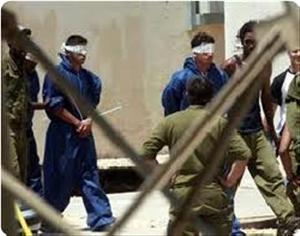
 RAMALLAH — Palestinian human rights sources unveiled occupation efforts to deport a number of Palestinian prisoners from the occupied territories, after their release.
The Palestinian Prisoner Committee said in a press release on Monday, that the Israeli occupation intelligence service the “Shin Bet” is keeping five Palestinian prisoners in solitary confinement cells in Jalama prison, despite the end of their interrogation with them, with no charge.
The Committee stated that the court gave the occupation investigators from the “Shin Bet” one week to provide it with an indictment against the five detainees, if not the prisoners should be released. Thus, the intelligence officers proposed the prisoners an offer requiring their deportation for two years in exchange for their release.
The statement stressed the prisoners’ complete rejection of the deportation and their determination to stick to their position. The prisoners also called on all local and international human rights organizations to take urgent action and pressure on the Israeli occupation authorities to release them after being detained for two months without charge.
Meanwhile, the Israeli prison administration is imposing sanctions that include fines, solitary confinement and denial of visitation rights, against nearly two hundred Palestinian prisoners in Megiddo, the Negev, Jalama and Raymond detention centers.
June 12, 2012
Posted by aletho |
Civil Liberties, Ethnic Cleansing, Racism, Zionism, War Crimes | Human rights, Israel, Negev, Palestinian prisoners in Israel, Shin Bet |
Leave a comment
Bassem Tamimi, a leading member of the grass roots movement against the Israeli Annexation Wall and settlement construction in the village of an-Nabi Saleh, has on Tuesday been sentenced at the Israeli Ofer Military Court in the West Bank.
Mr. Tamimi was sentenced to 13 months imprisonment and a further 17 months suspended sentence. Tamimi was released following the judgement, due to having already served 13 months imprisonment waiting for his case to come to trial.
The ruling means that if Tamimi participates in any of the village’s weekly non-violent protest activities he will be forced to serve out the remainder of the suspended sentence in prison.
Bassem Tamimi has been described as a human rights defender by Catherine Ashton, the High Representative for Foreign Affairs and Security Policy of the European Union. Ashton has been critical of the trial against Tamimi, as she was of the trial against Abdullah Abu Rahme, a similar figure in the non-violent protest movement in the village of Bil’in.
The trial of Bassem Tamimi came under fire following allegations of coerced testimony from children of Nabi Saleh who, contravening international law, were interrogated by the Israeli military with neither legal representation or a parent or guardian present.
May 29, 2012
Posted by aletho |
Civil Liberties, Deception, Ethnic Cleansing, Racism, Zionism | Bassem Tamimi, Catherine Ashton, European Union, Human rights, International Middle East Media Center, Israeli settlement, NabiSaleh, Palestine, Palestinian prisoners in Israel, West Bank |
Leave a comment
Israel is a parliamentary democracy represented by a very large number of parties, with universal suffrage for all citizens, regardless of race, religion or sex …
— CIA World Fact Book, 2011
This week a sobering and highly informative closed door seminar was held on the plight of Palestinian Prisoners in the elegant surroundings of London’s Westminster Central Hall, a stone’s throw away from the Houses of Parliament and the 11th century Westminster Abbey, the all affirmation of stability and continuity — in starkest contrast to testimony at the proceedings of the meeting.
The seminar, hosted by Middle East Monitor, had been planned and organized at the height of the Palestinian prisoners’ hunger strike. Although most prisoners are reported to have ended their desperation-driven fasts following a deal with the Israeli authorities, the issues surrounding their shocking treatment and imprisonment are unchanged.
Sabah al Mukhtar, President of the Arab Lawyers Association, who chaired the gathering, opened by reminding that, “A basic right of a people under occupation is to resist.”
Further, that the Fourth Geneva Convention is specific as to the treatment of prisoners, with absolute outlawing of abuse and stipulation of legal conditions which must include humane treatment, being regarded as innocent until proven guilty and speedy access to legal representation — a far cry from the conditions for Palestinian prisoners in Israeli jails.
Lord Alf Dubs, who serves on the Parliamentary Committee on Human Rights, talked of a visit to the West Bank last year. Unable to visit a prison, he did attend an Israeli Military Court and was shocked at what he witnessed.
Remarking on security so tight that not even business cards were allowed in, he was struck by the age of the prisoners. Many were children, including one of fourteen. A fifteen year old was in tears in the dock, a sight Lord Dubs found profoundly disturbing.
The majority of children, he learned, were picked up in the early hours of the morning and incarcerated with no access by parents, no lawyer until they were in the dock, thus no explanation of procedures, discussion of case and, above all, semblance of reassurance. Handcuffs were taken off as they came through the door of the Court, but all were in shackles in the dock. Most defendants were: “just throwing stones.” The Court had no cctv; thus, no record of any miscarriage of justice.
Parents are often denied access to detained children for at least two months. Article 77 of the Geneva Convention states that: “Children shall be the object of special respect (and provided) with the care and aid they require.” The reality, concluded His Lordship, was “a stain” on the Israeli establishment.
Chairman of the UK-based charity, Lawyers for Palestinian Human Rights, Tareq Shrourou, stated that at every stage childrens’ rights are abused “from detention to incarceration, to release.” Sixteen and seventeen year olds are still treated as adults in detention. In the West Bank it is not the police, but the army who conduct arrests, whether of children or adults.
Children, as are adults, are blindfolded, in addition to being handcuffed and shackled. Blindfolding is also in defiance of the Geneva Convention.
“That the military might of Israel is threatened by children throwing stones is laughable”, commented al Mukhtar, adding that the whole concept of Military Children’s Courts were legally “outlandish.”
“In the past eleven years alone, around seven thousand five hundred children, some as young as twelve years, are estimated to have been detained, interrogated, and imprisoned …”1
It should be noted that a Palestinian detainee can be interrogated for a period of one hundred and eighty days, during which he or she can be denied a lawyer for ninety days. During interrogation a detainee can be subject to varying levels of torture, physical and/or psychological.
This was graphically described by an urbane, quietly spoken man (name withheld by request) who described the reality of being detained for the first time at fifteen years old.
“I was imprisoned in 1987, 1988, 1990 and 1992 then deported to South Lebanon.”
In 1987, as a student, he had been one of a number who were taken from their school by the authorities, to a detention centre. He was, he said, punched, interrogated, beaten for two months, then released for lack of evidence of any wrongdoing.
In 1988, he stated, in the night, his home “was stormed.” Soldiers rushed to his bedroom pointing guns at him as he awoke and struggled up. He was taken, blindfolded, his hands tied with plastic cuffs.
In prison he was “put in a yard. There were eight rooms on one side and cells on the other. In each room there was a different torture. I visited all eight.”
His head, he said, was banged hard against the wall, on the table as he sat; he was near choked by extreme pressure on his throat; a ruler was banged hard on his nose “in a way that makes you lose control of your head.” Eventually he lost consciousness.
Made to raise his head, stunning blows under the chin resulted.
He described a “breaking chair fall” after which “you are punched whichever way you move.” And, he recounted, “female soldiers practice sex in front of you. Even as a child I knew how to keep a blind eye.” Shades of Abu Ghraib.
Failure to confess resulted in threats of death, “But I had nothing to tell.” He was finally released after sixty-four days due to no evidence.
He was arrested and released without charge again in 1990. In 1992 he was deported to Lebanon.
He was just twenty years old, with a life’s horrors already lived and childhood’s chrysalis years of discovery and approaching adulthood lost to Israeli jail’s nightmares.
The UN Convention on the Rights of the Child, to which Israel is a signatory, is specific:
In all actions concerning children, whether undertaken by public or private social welfare institutions, courts of law, administrative authorities or legislative bodies, the best interests of the child shall be a primary consideration.
Article 37(b) of the Convention adds:
The arrest, detention or imprisonment of a child… shall be used only as a measure of last resort and for the shortest appropriate period of time.2
The anomaly of the uniqueness of the military court system in Israel was addressed in detail as “an exception under all laws. A military court must deal with military people, not civilians, not minors.” A further anomaly is that there is no legal appeal system. An appeal is “an administrative decision, made usually not by a judge, or even a lawyer.”
Khaled Almudallal, representing Ufree, the European network to support the rights of Palestinian Prisoners, reminded that, incredibly, there are twenty-seven Palestinian parliamentarians of the Palestinian Legislative Council and two Ministers being held in detention.
A near forgotten tragedy has an equally forgotten background:
As candidates prepared for elections to the Palestinian Legislative Council (PLC) in 2006, the Israeli authorities began a campaign of detention and imprisonment … The 2006 Palestinian elections were overseen by international observers who declared them to be free and fair (thus) Hamas (became) the democratically elected Palestinian government.
Wrong kind of democracy, thus the democratically elected remain illegally detained by representatives of a people who, ironically, were given by James Arthur Balfour, a “national home” within “Palestine.” The famed letter has no mention of a “State”. This “home”, it specifies, is conditional on:
… it being clearly understood that nothing shall be done which may prejudice the civil and religious rights of existing non-Jewish communities in Palestine …
The injustices of historic enormity, legal and territorial, in violation of human rights under a swathe of international legislation, continue unabated – to be met by “the silence of the world”, commented al Mukhtar, adding, regarding the prisoners: “As far as I know, Middle East Peace Envoy Tony Blair, has been equally silent.”
However, the international community is not silent. The Boycott movement gains massive strength. Coincidentally, on the day of the Seminar, the Israeli Ambassador to South Africa had been due to address the University of KwaZulu-Natal. The event was cancelled by the University’s Deputy Vice Chancellor, Joseph Ayee, at twenty-four hour’s notice, due to the “likely reputational damage” it would bring the university.3
Politics Professor, Lubna Nadvi, said the university’s decision represented the general sentiment among students and staff. “Israel is fast becoming a pariah state, like Apartheid South Africa did, that no one really wants to be associated with, including academics and students,” the Professor is quoted as saying.
Yet destruction of Palestinian lives and history, sacred to all nations, is ongoing and six thousand prisoners remain in jail, and in beyond anything that would be recognized as a justice system in a functioning democracy.
In spite of the hunger strike agreement, there is so little progress from Israel, that there are fears that the only negotiating tool those held have – their lives – may be again put on the line.
Organizations represented at the Seminar are working closely with those involved in the Northern Ireland hunger strike to devise a way forward for both sides.
One suggestion, from British MP Jeremy Corbyn, is forming an international friendship network with prisoners, especially corresponding.
At a “Special Session on Children” at the United Nations on May 9. 2002, the Israeli Minister of Justice stated, in a lengthy address, Israel’s commitment to:
Extending the hope and promise of childhood to the millions of children that continue to suffer, even in an era of unprecedented global prosperity, means reducing poverty, protecting children from the scourge of war and violence … providing all children with adequate healthcare, clean water, basic education, and a nurturing and protective environment in which they can grow and thrive.
The yawning chasm between fine aspirational statements and reality on the ground could hardly be starker. For every child taken into custody, childhood dies at that moment.
For every parent arbitrarily held, they know not when they will see their children and family again. Some have shared none of their children’s formative years at all.
“Our revenge will be the laughter of our children”, wrote Ireland’s Bobby Sands, who died on the 66th day of his protest hunger strike, on May 5. 1981, four days short of his birthday. When there is nothing left to lose to achieve justice, those deprived will eventually sacrifice the last tragic bargaining tool in humanity’s creative box to achieve it.
Since the guests became occupiers, Palestine’s children and their parents have now waited sixty-four years to laugh freely.
May 26, 2012
Posted by aletho |
Civil Liberties, Subjugation - Torture, Timeless or most popular | Fourth Geneva Convention, Geneva Convention, Israel, Palestine, Palestinian prisoners in Israel, West Bank |
Leave a comment
Shiri Krebs is a PhD student at Stanford University law school. She was an international law advisor to Israeli Supreme Court president Dorit Beinisch and a researcher at the Israel Democracy Institute. She published a paper (for Hebrew readers, Haaretz offers this story) this month in the Vanderbilt Journal of Transitional Law about the rubber stamp offered by the Israel’s highest court to the security services in cases of administrative detention. She pointedly argues against the reputation the Court enjoys for being “interventionist” in protecting the rights of security detainees and offering a robust defense of democratic rights.
Surprisingly, she notes that there are those in the legal community who are proposing that Israel’s system both of administrative detention and judicial review are being offered as a model for other countries facing terror threats. In fact, the National Defense Authorization Act codifies a U.S. version of indefinite administrative detention as Reuters notes:
The section authorizes indefinite military detention for those deemed to have “substantially supported” al Qaeda, the Taliban or “associated forces.”
Does a journalist who objects to targeted killings of al-Qaeda operatives in Yemen or Pakistan “substantially support” it? What about supporting Bradley Manning or Wikileaks? You say no and I say no, but neither of us will be interpreting the law. The Justice Department, just like the Israeli state prosecutor, will be. What will its standard be? Thankfully, a federal judge issued a stay regarding enforcement of this provision of the law.
Krebs rejects Israel as a viable legal model:
…They [the research and interviews conducted in preparing the article] cast doubt on arguments that Israel’s detention model is one that should be emulated by other countries…The legal framework [of administrative detention and judicial review] itself makes independent judicial review of detention exceedingly challenging, if not impossible.
The paper is especially important in light of the hunger strikes of 1,600 Palestinian prisoners who were protesting precisely the types of arbitrary administrative detentions Krebs discusses in her paper. The protesting prisoners complained about the arbitrary nature of their detention and the fact that often the evidence against them was secret both to them and their lawyers. In essence, they neither knew who was their accuser, what they were accused of, nor what evidence was offered. Six-month sentences could be renewed without offering any new evidence and renewed virtually forever. A number of prisoners were held for years under similar terms.
Krebs’ research examines 322 cases brought before the High Court between 2000-2010, in which Palestinian detainees appealed against their sentences. Of these, the Court reversed the sentences in none of the cases:
…Out of the 322 cases decided by the Israeli Supreme Court in this period, not a single case resulted in a release order, and in none of the cases did the Court openly reject the secret evidence.
In one-third of the cases, the detainee would drop his appeal after a deal was struck with the state attorney. But such deals were inherently one-sided since the State controlled virtually the entire process and made an offer the defense couldn’t afford to refuse: the defense knew the Court would never reverse the security services and had to accept the crumbs it was offered.
When the Court does render its decisions in these cases, the justices themselves rarely get to see the evidence the State used to detain the suspect. They rarely know much, if anything about the detainee or his case. They rarely conduct an adversarial inquiry into the charges. Their decisions often run only a few lines, if that. A long one might extend three pages.
This dynamic is at work in virtually all security cases, even ones not involving administrative detention. Detainee-victims like Ameer Makhoul and many others who face life sentences for their alleged crimes, know that if they don’t bargain away their freedom by accepting “reduced” sentences, they will spend their entire lives behind bars. They know there is virtually no chance the court will find in their favor. Another victim like Dirar Abu Sisi has refused a plea deal, but the State has kept him bottled up in prison for several years without trial. That is the price a prisoner pays for maintaining his pride and his innocence by not “taking the deal.”
In this sense, the “shadow of the Court” provided a threat that persuaded the State to plea down charges, but it was often a weak and toothless one. Even in cases where detainees had charges against them dropped it didn’t result in their immediately being freed.
The law journal article is fascinating because it offers an intimate portrait of the personal discomfort felt by Israeli justices in the face of these security cases. The moral queasiness they experience is embarrassing because it reveals their willingness to suspend their usual judicial demeanor in deference to the security powers of the State. Here are some of the personal statements Krebs records:
This is not ideal. [Administrative detentions] represent a certain devaluation of our system of values, but there is no other choice.
–Justice E, Israeli Supreme Court
I feel responsibility . . . . There is a war going on . . . the phrase that a democracy fights with one hand tied behind its back is a nice metaphor . . . is a nice phrase to frame on the wall, but it is not suited for real everyday life.
–Justice B, Israeli Supreme Court
You have a feeling of discomfort. I never enjoyed sitting in administrative detention cases. No one enjoys it. Judges don’t like these cases, because we are trained to criminal proceedings, with witnesses, cross-examination . . . It is not pleasant. You want to run away from it as fast as you can, but you know that it is necessary for the sake of your people and country.
–Justice B, Israeli Supreme Court
The judges cannot differ with the ISA story. How can I? I don’t have the defense lawyer jumping to say “it never happened,” “this is not true.” My ethos, as a judge, is that I have two parties. Of course, I can think by myself, but I need tools, which are missing . . . to the most I have very limited tools
–Justice D, Supreme Court
The state attorneys should also come to the hearing nervous and tense—but they are always very relaxed. They know that no matter what they say or do, they will always win…
There is no judicial discretion here, since the Justices do not know the facts. They don’t have the tools to decide what the level of dangerousness is . . . in one of the cases in which I served as defense lawyer, it took the ISA two years to tell him [the detainee S.K.] what the allegations against him were. Then, when I asked my client about it, it turned out that it was a murder case that happened near his house, in which he had no involvement with whatsoever. When I brought this to Court and asked the ISA representatives about it––I could tell that the Justices knew nothing about it. I could see their surprise. It then took two more detention orders until he was finally released.
–Defense lawyer C
“In some cases even I felt that it was too easy,”
–State Attorney A
With all the good will on the part of everybody, there is no way to conduct a fair ex parte hearing. The human nature and the dynamic of the process prevent fair hearing of the case.
–State Attorney B
The negotiation with the ISA [Israeli state attorney] is bad, because it is blind on the detainee’s part. If the ISA agrees, in the negotiation with the detainee’s lawyer, to issue only one more detention order, or even to release him at the end of the current detention order, it means that the case is weak, and therefore the detainee should have been released immediately.
–Defense attorney D
The more reasoned judicial decisions are no more than a bunch of clichés, since they are not implemented . . . the Justices talk highly about being the “detainee’s mouth,” but they can’t. How can they be his mouth, when they know nothing at all about his side of the story?
–Defense lawyer B
In her conclusion, Krebs draws the following lessons:
The Court systematically avoids issuing release orders, and demonstrates minimal intervention with regard to the assessment of the secret evidence. As both the case law analysis and the interviews demonstrate, the Court refrains from openly and blatantly opposing the ISA assessment of the secret evidence…
…The research findings [reveal]…the vulnerability of democracies under stress to intolerant and illiberal mechanisms. The research reveals the weaknesses of judicial protections against prolonged and arbitrary detentions, and highlights the unique challenges posed by secret evidence to fair judicial proceedings. Unfortunately, detention proceedings become an “assembly line” in which “enemies”, “terrorists” or just “others” are constantly losing one of their most basic and valued human assets: their freedom.
Krebs’ analysis proves the justice of the wide-scale Palestinian protest against the administrative detention regime. You’ll recall that in spite of defense appeals to the Supreme Court to spare the lives of their hunger striking clients, the justices refused to intervene. They simply refused to provide adequate oversight or judicial review of the actions of the secret police in so-called terror/national security cases.
She notes that use of this tactic has declined over the years. Perhaps the protests will bring about an even greater drop in such charges. If so, it can’t happen too soon. This is not just a blemish, it’s a tumor on the Israeli judicial system. It brings the justices into a process of collusion with the security services, rather than a relationship of healthy skeptical review as should happen in a normal democracy. It cheapens the rule of law and undermines it severely.
Though I am neither a lawyer nor human rights specialist, I’ve often written here about violations of fairness and due process in the Israeli judicial process concerning national security cases. Supporters of this reprehensible system have argued here that I’ve exaggerated and asked for irrefutable proof for my claims. As far as I’m concerned, Krebs has offered this incontrovertible evidence in her quantitative analysis of the shortcomings of the Israeli legal system.
May 26, 2012
Posted by aletho |
Civil Liberties, Subjugation - Torture, Timeless or most popular | Dorit Beinisch, Israel, Israel Democracy Institute, Israel Supreme Court, National Defense Authorization Act, Palestinian prisoners in Israel |
Leave a comment
In a PNN report today, the Al-Ahrar Centre for Prisoners’ Studies and Human Rights stated that on Wednesday, May 23rd, prisoner Sameh Elaiwe, 50, was transferred from Nablus city to Administrative Detention one hour before his scheduled release date.
Administrative detention is detention without charge or trial that is authorized by administrative order as oppose to a fair and just judicial decree.
Foad al-Khafsh, head of Al-Ahrar, affirmed that on Tuesday the Israeli military brought Elaiwe’s case before the court, accompanied by his lawyer Fares Abu al-Hassan. The court ordered Elaiwe’s release for the following day.
However, Israeli intelligence petitioned to overturn the decision after Elaiwe’s lawyer had left the court, and the Court transferred the prisoner to the administrative detention centre for four months.
Al-Khafsh alleged that Israeli intelligence deliberately intends to break the spirits of the prisoners, and questioned whether the military have actually agreed to stop the policy of Administrative Detention when in fact they appear to be using it more than before the hunger strikes.
More than 25 cases have been transferred to Administrative Detention since the Israeli prisons administration and the Supreme Committee for Prisoners signed their agreement on May 14th.
May 24, 2012
Posted by aletho |
Civil Liberties, Subjugation - Torture | Administrative detention, Human rights, Hungerstrike, Israel, Palestinian prisoners in Israel, William Temple |
Leave a comment
 A Palestinian hunger striker in Israel’s Ramleh prison was knocked unconscious by prison guards earlier this week in the most recent abuse of prisoners, a coalition of human rights groups said on Thursday.
 RAMALLAH — Palestinian human rights sources unveiled occupation efforts to deport a number of Palestinian prisoners from the occupied territories, after their release.
 Aletho News
 Aletho News