The Iranian Debacle
By Christopher Black – New Eastern Outlook – 10.08.2015
 Many commentators in the west have welcomed the results of the Iranian surrender on the nuclear issue as a victory for the BRICS, as a sign of the weakened position of the United States, and as a win-win deal for Iran and those who forced it to its knees. Thousands of words have been written about the benefits to Iran of released funds and economic development to come and how the US surrendered some of its power and agreed to this “deal” because it wants to concentrate its efforts elsewhere.
But are any of these things true? The fact is that Iran, a sovereign nation that has the right to develop its economy as it sees fit and to defend itself as it sees fit, has been stripped of its ability to develop its civilian nuclear programme as it deems necessary and has been forced to abandon most of it by nations that themselves not only have fully developed nuclear programmes for civilian use but also are armed with nuclear weapons, and have used them against civilian populations.
Iran, an ancient and great power throughout history, has now been essentially disarmed by its enemies in the NATO powers and also by its neighbours, China, and Russia, which latter country, while complaining about the French double dealing regarding the Mistral Affair, itself reneged on a deal to supply Iran with anti-aircraft defence systems that could protect it against US or Israeli air attack. No doubt this was due to pressure from the US as well and perhaps can be forgiven if not forgotten in its own struggle to avoid war. China also has an interest in placating the US in the face of constantly increasing American threats. But the fact remains, that if the US or Israel decide to launch a nuclear attack against Iran from a distance there is nothing that Iran can do to retaliate. It is essentially defenceless.
If Iran had succeeded in getting the US, and its allies to abandon their nuclear weapons in return for its concessions, then something bold and world shaking would have taken place, but the nuclear disarming of the very people that still threaten Iran and the rest of the word was never on the agenda, although the Iranians bravely pointed out the obvious double standards countless times in statements made in and out of Iran.
The unjustified claims by some commentators that the US has somehow retreated or even, as some claim, that the US has changed its strategy from opposing Iran to drawing it into the US orbit through economic engagement, are distorting what took place in Vienna and the reality of the “deal” that was struck and now given the imprimatur of the Security Council.
No one reading the statement of John Kerry made on July 14th in Vienna about the Plan of Action, as the agreement is called, or its terms, can understand anything else than that Iran has suffered a severe blow and one from which it will not be allowed to recover until the Americans and their gang have put in power a regime they completely control. To understand this let’s look at some of the highlights of this “deal,” a word I put in quotes because it implies equal bargaining power when in fact Iran was ganged up on by the most aggressive and militaristic alliance known to man. And to do that, let’s use the statement of the American foreign minister, John Kerry so we can truly understand what has really happened to Iran.
Kerry said the Plan of Action,
“is…. a step away from the prospect of nuclear proliferation…it is a step away from the spectre of conflict and towards the possibility of peace.”
Note the careful language. “The prospect of nuclear proliferation” really means the possibility of Iran defending itself from nuclear attack by the United States. “A step away from conflict and towards the possibility of peace” means “we won’t attack Iran if it obeys all our diktats but an attack is in our discretion at all times.”
Kerry continued,
“Believe me, had we been willing to settle for a lesser deal, we would have finished this negotiation long ago,” and, “our persistence has paid off.”
This is not the language of a government that has been weakened or lost the game, a United States that sees itself as the loser or has been weakened. No, it is the gloating of the spider as it picks apart a fly.
Kerry is very specific about the Iranian defeat. He says,
“Iran’s breakout time-the time it would take to speed up its enrichment and produce enough fissile material for just one nuclear weapon…has been increased from one year to a period of at least ten years.”
The effect of this is that if Iran believes that either Israel or the USA is planning to attack it, instead of being able to arm itself within a few months, it won’t be able to do it at all.
The leaders of the government in North Korea must be shaking their heads in amazement at such folly. They know very well the Americans cannot be trusted and the Americans and Israelis are laughing up their sleeves, despite the crocodile tears by Netanyahu and the US Congress who play the propaganda game that the Plan of Action is a give away to Iran, all play acting for the cameras and to give Iran some air of having won something in this defeat.
If there is still doubt, here is the most startling aspect of the Plan of Action. Kerry states,
“this agreement has no sunset. It doesn’t terminate. It will be implemented in phases… some of the provisions are in place for 10 years, others for 15 years, others for 25 years… and certain provisions-including many of the transparency measures and prohibitions on nuclear work-will stay in place permanently.”
Reading this one could have the impression that Iran is a conquered nation being dictated to by the victors as Germany was at Versailles. The effect is to surrender its rights as a sovereign nation forever to a gang of nuclear criminals who refuse to renounce the use of nuclear weapons themselves. Iran will have to suffer the humiliation of constant inspections and interference for generations to come.
It gets worse. Two thirds of Iran’s centrifuges will be removed and the infrastructure that supports them, built at huge expense and effort, will be placed under the lock and key of the International Atomic Energy Agency, an organisation largely controlled by the USA. The design and construction of future nuclear reactors must be approved by the Unites States and its allies.
And what does the USA offer in return for these concessions? Nothing, but the unfreezing of Iranian monies kept in western banks for years earning money but there will be no compensation for lost profit or opportunity from these monies, and a promise of the future lifting of the illegal trade and economic embargo placed on Iran by the USA under the cover of the name “sanctions” which, it openly admits, hurt the Iranian people.
This collective punishment will only be lifted, “when Tehran has met its key initial nuclear commitments”-in other words when Iran has removed the possibility of defending itself with nuclear weapons.
But can Iran really expect things to change once they have done that? The Americans promised similar things to the North Koreans under Clinton in the early 90s. They too shut down their nuclear reactors used for weapons production [in the case of North Korea] in return for economic assistance. But the Americans reneged once they had shut the systems down. Fortunately, the Koreans realised quickly what the game was and brought those systems back on line and now have an effective deterrence against an American attack. What will Iran do when the Americans renege on this deal? Unfortunately, not much, since, unlike the Koreans, they have allowed daily inspections and daily interference in their internal affairs and any attempt to bring its systems back on line will no doubt be used as an excuse for further “sanctions” or an attack.
Kerry stated clearly,
“I want to underscore: if Iran fails…in these commitments, the US, the EU, and even the UN sanctions that initially brought Iran to the table can and will snap back into place.”
In summing up why Iran has been forced into this terrible position Kerry stated the real reason very clearly,
“Anybody who knows the conduct of international affairs knows that it is better to deal with a country if you have problems with it if they don’t have a nuclear weapon.”
No reporter asked him why that didn’t apply to the United States as well but we cannot expect courage from the international press these days.
But what is Kerry really saying except that “we the USA cannot enforce our will on those who can resist. We prefer to deal with defenceless opponents. It makes it easier to bully them.”
Then he added insult to injury by stating that “sanctions” against Iran put in place for concerns about “terrorism,” “human rights,” and ballistic missiles, will remain despite this agreement. So the pressure on Iran can be expected to increase with this agreement, not decrease.
Kerry made this clear when he added,
“the USA will continue our efforts to address concerns about Iran’s actions in the region, including providing key support to our partners and allies and by making sure we are vigilant in pushing back against destabilizing activities.”
This statement is aimed at Iran’s support of Syria, Hezbollah and Iraq. The Plan of Action will be used as a device to try to control and limit Iranian solidarity with the governments now being attacked by the US and its proxy forces in the region.
At the end of his statement Kerry said that the agreement averted, “an inevitable conflict that would come were we not able to reach agreement.”
What he means is that the Iranians knew that if they did not submit, the United States and Israel would attack them. He then misquoted Clausewitz and said “I know that war is the failure of diplomacy and the failure of leaders to make alternative decisions.”
What he meant was, “Iran had two choices, submit or cease to exist and the Iranian leadership decided to try to continue to exist.”
So this is the state of the world after Hitler. Now new Hitlers have arisen and new diktats are issued against countries that resist. Instead of Czechoslovakia we have Yugoslavia, instead of Austria, we have Greece, Instead of Spain we have Syria and Iraq, Afghanistan. Instead of Poland we have Ukraine but always the constant targets remain, Russia and China.
Far from seeing a United States in retreat or a pause, surely, we see a United States that has increased its room for manoeuvre in its drive for world hegemony. It seems to me that we cannot expect any peace coming from this Plan of Action, but more war, as Iran will be pressured to give up its support of Hezbollah and Syria and Iraq so that the NATO powers can advance their drive to the east. With this Iranian debacle, with Iran under control and out of the military equation in real terms, that plan has just been advanced one more step.
Christopher Black is an international criminal lawyer based in Toronto, he is a member of the Law Society of Upper Canada and he is known for a number of high-profile cases involving human rights and war crimes.
IAEA Director General’s Appearance Before U.S. Senate a Major Error in Judgment
By William O. Beeman | Dissident Voice | August 6, 2015
This decision by Director General Yukia Amano to appear before the U.S. Senate Committee on Foreign Relations to testify on Iran’s nuclear program is regrettable, but it is also not surprising. Amano has been consulting with the U.S. Government on a regular basis ever since his appointment as Director General. This is well documented.
The dramatic change in the language of IAEA reports after Amano took over from Mohammad el-Baradei (whom the U.S. tried to kick out of office until he won the Nobel Peace Prize) shows the direct influence of the United States and Israel trying to indict Iran for nuclear weapons activity. Amano’s directorship resulted in a sudden eruption of meaningless, tortured weasel-word language about “not being able to verify” that Iran was “not” engaging in technology that might lead to military activity. This language contradicted every previous report under previous directors Hans Blix and el-Baradei.
But in the end the IAEA in every report issued under Amano verified that Iran had “not diverted fissile material for any military purpose.”
Amano has simply been a tool of U.S. officials bent on making hostile accusations toward Iran, looking for “expert” evidence to support their specious claims. Specifically, the agency’s tortured language has been twisted by U.S. opponents of an accord with Iran to bolster their claims that Iran was making nuclear weapons–claims that, despite the Amano-influenced IAEA reports — remained utterly unsubstantiated by any evidence anywhere.
It is also noteworthy that Amano expressed confidence that his office could carry out the inspections activities mandated by the accords. Thus he was caught in a bit of a bind–seeming to imply that Iranian activities were suspect and “unable to be verified as peaceful” and at the same time asserting the effectiveness of his agency–and his leadership–in carrying out the inspections. So which is it? Is the IAEA capable or incapable of carrying out its duties under his leadership? Honestly, I think Amano needs to step down. He appears to have lost all credibility as an independent administrator of his agency.
I have no doubt that Amano’s testimony continued the mealy-mouthed, but not-quite-definitive support for attacking the Vienna accords favored by President Obama’s detractors, and those who still want to bomb bomb bomb bomb bomb Iran.
William O. Beeman is a Professor, Department of Anthropology at the University of Minnesota. Visit William’s website.
Iran nuclear deal: Why Empire blinked first
By Sharmine Narwani | RT | August 5, 2015
We’ve now spent three weeks watching American politicians argue needlessly over the Iran nuclear deal. For or against, they all miss this one salient point: It is the US that needed to end this standoff with Iran – not the other way around.
For years we have been hearing that US sanctions “were biting” and had “teeth.” Sanctions, it was said, would “change Iranian behaviors,” whether in regards to the Islamic Republic’s “support of terrorism,” its “calculations” over its nuclear program, or by turning popular Iranian sentiment against its government.
Here is US President Obama spinning the fairytale at full volume:
“We put in place an unprecedented regime of sanctions that has crippled Iran’s economy… And it is precisely because of the international sanctions and the coalition that we were able to build internationally that the Iranian people responded by saying, we need a new direction in how we interact with the international community and how we deal with this sanctions regime. And that’s what brought President Rouhani to power.”
There is, of course, scant evidence that any of this is true.
If anything, on the economic front, the net effect of sanctions has been to rally Iranians behind domestic production and thrift – establishing both the discipline and policy focus necessary to sustain the country indefinitely. A 2013 Congressional Research Service (CRS) report explains this unintended consequence of sanctions:
“There is a growing body of opinion and Iranian assertions that indicates that Iran, through actions of the government and the private sector, is mitigating the economic effect of sanctions. Some argue that Iran might even benefit from sanctions over the long term by being compelled to diversify its economy and reduce dependence on oil revenues. Iran’s 2013-2014 budget relies far less on oil exports than have previous budgets, and its exports of minerals, cement, urea fertilizer, and other agricultural and basic industrial goods are increasing substantially.”
Sanctions didn’t succeed on the political front either. By in large, Iranians did not hold their leadership responsible for sanctions-related economic duress, nor did they seek rapprochement with the West as a way out. The US continues to flog the narrative that Iranians elected President Hassan Rouhani in a bid to “moderate” foreign policy stances, but a survey conducted by US pollster Zogby Research Services in the immediate aftermath of Rouhani’s election turns that premise on its head:
Ninety-six percent of Iranians surveyed agreed with the statement that “maintaining the right to advance a nuclear program is worth the price being paid in economic sanctions and international isolation.” Of those polled, a mere five percent of Iranians felt that improved relations with the US and the West were their top priority.
No, sanctions have not worked in any of the ways they were intended.
So if the Iranians were not ‘dragged’ to the negotiating table, then what was the sudden incentive behind a multilateral effort to forge a deal in 2015 – 36 years after the first US non-nuclear sanctions were levied against the Islamic Republic, and nine years after the UN Security Council first issued nuclear-related sanctions?
Keep in mind that both the Iranians and the permanent members of the UNSC have offered up proposals to end the nuclear deadlock since 2003. So why, this deal, now?
Could it be that the Americans had simply blinked first?
And the world turned
It must be understood that much of this nuclear brouhaha has nothing to do with Iran actually possessing or aspiring to possess nuclear weapons. The Islamic Republic neither has nuclear weapons, nor does it profess to want them.
US intelligence agencies, over the years, have conceded that Iran has not even made the “decision” to pursue weaponization, and the IAEA has repeatedly stated in 52 periodic assessment reports that there has been “no diversion” of nuclear materials to a weapons program.
In short, all the fuss has really only ever been about containing, isolating and taming a developing nation with aspirations that challenge Empire’s hegemony. Iran was never going to be able to change the rules of the game single-handedly. That is, until the game itself shifted hands and direction.
In 2012, cracks in the global economic and political power structures started to shift dramatically. We started to see the emergence of the BRICS, in particular Russia and China, as influential movers of global events. Whether it was a shift in trading currencies from the conventional dollar/euro to the rupee/yuan/ruble, or the emergence of new global economic/defense institutions initiated by BRICS member states, the world’s middle powers began to assert themselves and project power on the international stage.
But it was in the vast and complicated Middle East arena that old power and new power came to clash most ferociously.
In November 2011, the year of the Arab uprisings, the BRICS announced their first collective foreign policy statement, urging the rejection of foreign intervention in Syria’s internal affairs.
By 2012, it started becoming clear that the crisis in Syria was being heavily fomented by external players, including the three UNSC Western permanent members, the US, UK and France and their regional allies, Saudi Arabia, Qatar and NATO-member Turkey.
In 2012, it also became clear that Al-Qaeda and other militant Islamist fighters were dominating the opposition inside the Syrian military theater and that these elements were being backed by the United States and its allies.
The American calculus, at this point, was to allow and even encourage the proliferation of fighters prepared to unseat the government of Syrian President Bashar Assad, anticipating that at some future date they could then reverse the gains of radicals.
Assad did not fall, but extremism – fueled by funding, arming and training from US allies – entrenched itself further in Syria.
This did not go unnoticed in Washington, which has always struggled to make a coherent case for its Syria strategies. The rise of ISIS (IS, formerly ISIS/ISIL) and the flood of jihadists into the Syrian theater began to change the American calculations. The US began to work on hedging its bets… and that is when Iran began to factor significantly in America’s Plan B.
That Plan B began in mid-2012, just as Saudi Arabia’s incoming intelligence chief Bandar bin Sultan was preparing for a violent escalation in Syria, one that would exacerbate the Islamist militancy in the Levant exponentially.
That July, secret backchannel talks between the United States and Iran were established in Oman, kicked off, according to the Wall Street Journal, by “a pattern of inducements offered by Washington to coax Tehran to the table.”
Take note that the Americans initiated this process, not the allegedly “sanctions-fatigued” Iranians, and that this outreach began when Iranian President Mahmoud Ahmadinejad was at the helm, not his successor Rouhani.
Iran – or bust
Iran’s elite Quds Force Commander Qassem Soleimani said a few months ago: “Today, there is nobody in confrontation with [IS] except the Islamic Republic of Iran, as well as nations who are next to Iran or supported by Iran.”
If you look at the array of ground forces amassed against Islamist radicals from Lebanon to Iraq, they consist almost entirely of elements allied with the Islamic Republic, or are recipients of weapons and sometimes training provided by the Iranians.
There are no combat forces from Western states and none from their Arab or Turkish allies within the region.
‘Boots on the ground’ are essential in asymmetrical warfare, but the US military will continue to oppose inserting its troops into direct combat situations in Syria and Iraq.
In a Telegraph op-ed on the eve of the Vienna nuclear agreement, Britain’s influential former ambassador to Washington Christopher Meyer wrote:
“Whether we like it or not, we are in de facto alliance against ISIL with Assad of Syria and with Iran, the implacable foe of our long-standing ally, Sunni Saudi Arabia…. if ISIL is able to expand further in the Middle East, won’t this unavoidably lead to the conclusion that our strategic ally in the region for the 21st century must be Iran?”
This is the conundrum Washington began facing in 2012. And so it set in motion a face-saving strategy to enable itself to “deal” with Iran directly.
The Vienna Agreement
Here’s what the Iran nuclear deal does – besides the obvious: it takes the old American-Iranian “baggage” off the table for the US administration, allowing it the freedom to pursue more pressing shared political objectives with Iran.
The Iranians understood full well in Vienna that they were operating from a strong regional position and that the US needed this deal more urgently. The Americans tried several times to get Iran to expand discussions to address regional issues on a parallel track, but the Iranians refused point-blank. They were not prepared to allow the US to gain any leverage in various regional battlefields in order to weaken Iran’s position within broader talks.
Although the Iranians are careful to point out that the Vienna agreement is only as good as the “intentions” of their partners, this deal is essentially a satisfactory one for Tehran. It ensures rigorous verification that Iran is not pursuing a nuclear weapons program, which is great for a country that doesn’t seek one.
It also provides Iran with protections against ‘over-inspection’ and baseless accusations, dismisses all UNSC resolutions against the Islamic Republic, recognizes the country’s enrichment program, provides extensive international sanctions relief, binds all UN member-states to this agreement (yes, Israel too) and nails down an end-date for this whole nuclear saga.
The deal also frees up Iran to pursue its regional plans with less inhibitions.
“What the president (Obama) and his aides do not talk about these days — for fear of further antagonizing lawmakers on Capitol Hill who have cast Iran as the ultimate enemy of the United States — are their grander ambitions for a deal they hope could open up relations with Tehran and be part of a transformation in the Middle East,” reads a post-Vienna article in the New York Times.
US Secretary of State John Kerry, commenting after the deal, said: “I know that a Middle East that is on fire is going to be more manageable with this deal and opens more potential for us to be able to deal with those fires, whether it is Houthi in Yemen or ISIL in Syria and Iraq than no deal and the potential of another confrontation with Iran at the same time.”
“The Iran agreement is a disaster for ISIS,” blares the headline from a post-agreement op-ed by EU foreign affairs chief Frederica Mogherini. She explains:
“ISIS is spreading its vicious and apocalyptic ideology in the Middle East and beyond… An alliance of civilizations can be our most powerful weapon in the fight against terror… We need to restart political processes to end wars. We need to get all regional powers back to the negotiating table and stop the carnage. Cooperation between Iran, its neighbors and the whole international community could open unprecedented possibilities of peace for the region, starting from Syria, Yemen and Iraq.”
Clearly, for Western leaders Iran is an essential component in any fight against ISIS and other like-minded terror groups. Just as clearly, they have realized that excluding Iran from the resolution of various regional conflicts is a non-starter.
That is some significant back-tracking from earlier Western positions explicitly excluding Iran from a seat at the table on Mideast matters.
And stay tuned for further policy revisions – once this train gets underway, it will indeed be “transformative.”
As for the Iran nuclear deal… except for some hotheads in Congress and the US media, most of the rest of the world has already moved on. As chief US negotiator and undersecretary for political affairs, Wendy Sherman said recently: “If we walk away, quite frankly we walk away alone.”
The balance of power has shifted decisively in the Middle East. Washington wants out of the mess it helped create, and it can’t exit the region without Iran’s help. The agreement in Vienna was reached to facilitate this possibility. Iran is not inclined to reward the US for bad behavior, but will also likely not resist efforts to broker regional political settlements that make sense.
It was not a weak Iran that came to the final negotiations in Vienna and it was not a crippled Iran that left that table.
As New York Times columnist Thomas Friedman (for once) aptly observed: “It is stunning to me how well the Iranians, sitting alone on their side of the table, have played a weak hand against the United States, Russia, China, France, Germany and Britain on their side of the table. When the time comes, I’m hiring (Iran’s Supreme Leader) Ali Khamenei to sell my house.”
Iran just exited UNSC Chapter 7 sanctions via diplomacy rather than war, and it’s now focusing its skill-sets on unwinding conflict in the Middle East. If you’re planning to challenge Empire anytime soon, make sure to get a copy of Iran’s playbook. Nobody plays the long game better – and with more patience.
~
Sharmine Narwani is a commentator and analyst of Middle East geopolitics. She is a former senior associate at St. Antony’s College, Oxford University and has a master’s degree in International Relations from Columbia University. You can follow her on Twitter at @snarwani
Obama and Kerry Play with Fire on Iran Agreement
By Sheldon Richman | Free Association | July 29, 2015
Barack Obama and John Kerry are playing with fire. They presumably want Congress and the American public to accept the nuclear agreement they and four other governments struck with Iran, but they work against their own objective by accepting the false premise of their opponents: namely, that Iran’s regime is untrustworthy, dangerous, bent on becoming a nuclear power — and containable only by a U.S. readiness to wage war.
Who knows if the president and secretary of state really believe this? But they ought to know that this premise is wrong.
Their incentive to accept the false premise is obvious. Neither wants his obituary to declare that his greatest achievement was to persuade Iran not to develop a weapon it had no intention of developing.
On announcing the deal Obama said, “Today, because America negotiated from a position of strength and principle, we have stopped the spread of nuclear weapons in this region. Because of this deal, the international community will be able to verify that the Islamic Republic of Iran will not develop a nuclear weapon.”
Likewise in remarks to the Senate Foreign Relations Committee last week, Kerry said, “So this isn’t a question of giving them [Iran] what they want. I mean it’s a question of how do you hold their program back, how do you dismantle their weapons program….”
Hence, Obama and Kerry endorse the claim that Iran was seeking to build nuclear weapons. The long negotiating process was based on that premise. So they must now insist that the agreement contains leak-proof verification, because like their opponents, Obama and Kerry say the Iranians cannot be trusted. But the hawks demagogically ignore that part of the administration’s case and claim the agreement does depend on trust; Iran can and will cheat, the hawks say, no matter what verification measures are in place. They can even quote Wendy Sherman, leader of the U.S. negotiating team, who once told a Senate committee, “We know that deception is part of the [Iranian] DNA.”
That’s some great way for Obama and Kerry to sell their agreement.
It would be better for Obama and Kerry to tell the truth for once: Iran has not been seeking a nuclear bomb. This has long been well-understood by American and Israeli intelligence and military agencies. As former CIA analyst Ray McGovern points out, George W. Bush had to give up plans to attack Iran in 2007 because a National Intelligence Estimate signed by all 16 U.S. intelligence agencies found that Iran had stopped (alleged) research on nukes four years earlier. This conclusion was renewed regularly in subsequent years. In fact, as Gareth Porter notes, “US national intelligence estimates during the Bush administration concluding that Iran had run such a program, including the most famous estimate issued in November 2007, were based on inference, not on hard intelligence.”
We have many other indications of Iran’s non-interest in nukes, all of which are documented by Porter, the man who literally wrote the book on the case. (See Manufactured Crisis: The Untold Story of the Iran Nuclear Scare.) We know, for example, that Iran’s Supreme Leader, Ali Khamenei, issued a religious edict (fatwa) against nuclear weapons. We know that when Iran could have bought weapons-related equipment from an illegal Pakistani network, it did not. We know that for years Iran tried every way to avoid having to enrich uranium for its power plants but was thwarted each time by the U.S. government. Finally, we know that when the Iranian government could have made chemical weapons to retaliate for Iraq’s U.S.-backed chemical warfare against Iran in the 1980s, then-Supreme Leader Ruhollah Khomeini forbade it on religious grounds.
Despite this, it is open season on Iran. Most everyone feels he can level any charge against it without providing a scintilla of evidence. Most common is the charge that Iran is the “chief state sponsor of terrorism.” But does anyone bother to prove it? It requires no proof. It’s the Big Lie, and it serves the war party’s agenda. (For evidence to the contrary see these two pieces by Ted Snider.
The P5+1 agreement, though unnecessary, is preferable to war. Obama and Kerry should stop thinking about their legacies and start leveling with us.
US Concerned About Increased Russia-Iran Trade Cooperation – Senator
By Leandra Bernstein – Sputnik – 24.07.2015
WASHINGTON — On July 14, the P5+1 countries — the United States, Russia, France, Britain, China, and Germany — reached an agreement with Iran to relieve economic sanctions in exchange for assurances that it will not seek to develop or acquire a nuclear weapon.
“We know, though, under the terms of this agreement, that Russia will have no hesitancy to be involved in Iran’s economy, and that is a concern.”
Cardin, ranking member of the US Senate Foreign Relations Committee, noted that regardless of the nuclear agreement, the expansion of trade between Russia and Iran “has always been a concern.”
The United States has already expressed disapproval over Russian plans to deliver a S-300 air defense system to Iran, fulfilling a contract from 2007. Washington, however, has acknowledged the legality of the deal.
Enhanced Russian-Iranian trade could also result from future Iranian membership in the Shanghai Cooperation Organization (SCO), a proposition discussed on the sidelines of the recent SCO meeting in Ufa, Russia earlier in July.
No “Compensation” to Israel for Iran Deal
By Sheldon Richman | Free Association | July 22, 2015
In The Joys of Yiddish, Leo Rosten defined chutzpah as “that quality enshrined in a man who, having killed his mother and father, throws himself on the mercy of the court because he is an orphan.” Today we have a new paradigm for chutzpah: the Israeli government’s demand for “compensation” from the American taxpayers for the Iran nuclear agreement.
Israel’s Defense Minister Moshe Ya’alon told the Times of Israel that during U.S. Defense Secretary Ash Carter’s visit the Israeli government would discuss “the compensation that Israel deserves in order to maintain its qualitative [military] edge” over Iran. The Obama administration of course is amenable.
Why does Israel deserve compensation (in addition to its $3 billion in U.S. aid every year)? If anything, Israel should compensate American taxpayers!
Iran is not — and was not going to become — a nuclear threat. American and Israeli intelligence have said so repeatedly.
But even if Prime Minister Benjamin Netanyahu were right about Iran’s intentions, he should be rejoicing at the agreement, under which Iran will get rid of nearly all of its enriched uranium and two-thirds of its centrifuges. Its nuclear facilities will be open to even more intrusive inspections than they have been under the Non-Proliferation Treaty (NPT). Even its non-nuclear military sites will be subject to inspection, an intrusion no other government — particularly the United States — would accept. And that is just the beginning. Uranium-enrichment research will be restricted, and construction of a heavy-water reactor, which would yield plutonium, will be scrapped.
The term for these various restrictions begin at 10 years and lengthen from there, but this does not mean that Iran will later be free to do what it wants. As an NPT party (unlike nuclear monopolist Israel), it will always be subject to inspection by the International Atomic Energy Agency, which certifies that Iran has not diverted uranium to military purposes.
What did Iran get in return for those concessions? Iranian money frozen since the 1979 Islamic revolution will be released and the economic warfare perpetrated by the United States and the rest of the world — euphemistically called “sanctions” — will eventually be ended.
In other words, Iran can rejoin the world economy — its people relieved of cruel economic warfare — if it gives up a weapons program it never had, never wanted, and did not plan to pursue. Those crafty Iranians! They acquired thousands of centrifuges as bargaining chips to be traded away for peaceful commercial relations with the world.
Israel’s rulers, like their American supporters, say they have another reason to hate the agreement. (For my own far different reservation, see this.) “Giving” Iran all that cash (it belongs to Iranians) will let the Islamic Republic pursue its aggressive aims in the Middle East, which include helping Israel’s enemies, Hamas and Hezbollah.
Balderdash. Iran is not pursuing an aggressive policy in the Middle East, and it is sheer projection for an American or Israeli to make that charge. George W. Bush handed Shia-majority Iraq to Iran when he overthrew Iran’s nemesis, Saddam Hussein. Barack Obama is siding with Iran against the Islamic State in Iraq. Iran’s ally, Bashar al-Assad of Syria, is under assault by ISIS, al-Qaeda, and the United States. And the Houthis in Yemen, who get some Iranian help and are fighting al-Qaeda in the Arabian Peninsula, have long struggled against the central government for self-rule, in response to which U.S.-backed Saudi Arabia is waging a bloody war of aggression.
Iran has supported Hamas, although the Palestinian group (like Israel) opposes Assad. But Hamas exists to resist Israeli occupation of Palestinian lands. Likewise, Hezbollah arose to resist Israeli occupation of and periodic attacks on southern Lebanon. While some of Hamas’s and Hezbollah’s tactics have indeed been atrocious, their raison d’être is opposition to Israeli aggression — not terrorism.
There is no Iranian imperialism.
Nuclear Israel faces no threat. In the current turmoil it sides with Sunni Arabs, including al-Qaeda affiliates, against Iran, because turmoil serves Israel’s interests and Iran is a ready-made bête noire. Why does Israel need a manufactured threat? Because if Americans knew the truth, they might focus on the Palestinians’ plight. Israel and its Lobby cannot have that.
Pro-Israel supporters rally in New York City against Iran nuclear agreement
Press TV – July 23, 2015
A group of pro-Israel protesters have held a rally in New York City against the recent nuclear conclusion between Iran and the P5+1 group of countries.
The pro-Zionist protesters gathered in Times Square on Wednesday to demand that Congress veto the proposed agreement with Iran.
The organizers of the rally had advertised heavily in recent weeks and had hoped for a much larger turnout. The New York metropolitan area is home to the largest Jewish population in the world outside Israel.
The demonstrators said the nuclear deal is a threat to Israel and global security, but even the staunchest allies of Israel in the West see it as a step toward a more secure and peaceful world.
Iran and the P5+1 group — the United States, Britain, France, China, Russia and Germany – reached a conclusion on the Joint Comprehensive Plan of Action (JCPOA) on July 14 in the Austrian capital of Vienna following days of intensive talks over Tehran’s nuclear program.
Israeli Prime Minister Benjamin Netanyahu has fiercely opposed any nuclear agreement.
Israel pressed lawmakers on Wednesday to block the deal, with Israeli Ambassador Ron Dermer meeting privately with a group of about 40 Republican lawmakers in the House of Representatives.
The nuclear accord does not need Congressional approval to take effect, but Republicans are expected to try and add provision with legislation that would block President Barack Obama from removing anti-Iran sanctions imposed by Congress.
The nuclear conclusion reached last week has been praised by world leaders, leaving Tel Aviv isolated.
Iran’s Nuclear Deal With the P5+1: Winners and Losers
By Sasan Fayazmanesh | CounterPunch | July 22, 2015
The dust has settled and the long-awaited agreement between Iran and the P5+1 (five permanent members of the Security Council and Germany) called “Joint Comprehensive Plan of Action” (JCPOA) is now a reality. The JCPOA curtails Iran’s nuclear program in exchange for some sanctions relief. Also real is the UN Resolution 2231, which terminates all the previous sanctions resolutions against Iran passed by the United Nations Security Council. We can now announce the winners and losers in the 36-year battle between Iran and its adversaries.
Let us start with the biggest loser in this battle, the colonial regime in Palestine called Israel. Since the 1990s Israeli leaders, particularly Benjamin Netanyahu, had been trying to wage a war against both Iraq and Iran, the twin pillars standing in the way of Eretz Yisrael. But they tried to do this on the cheap, sending American boys and girls to kill and get killed. They were successful in the case of Iraq, but had a difficult time getting the US to wage a war against Iran. They could not even convince George W. Bush to go along with bombing Iran, even though they had planted their “neoconservative” allies around a president who was not known for his immense intelligence and had visions of talking to God before invading Iraq. The work became harder when Barack Obama became president. Once again, Israel planted some of its best lobbyists, such as Dennis Ross, in the highest positions in the White House and charged them with the task of formulating and implementing the policy of “tough diplomacy,” a policy designed to wage a military attack on Iran after a series of steps beginning with imposing the most severe sanctions on the country. Yet, however hard Israeli leaders tried, they could not get President Obama to take the last step and start a war with Iran. The job became even tougher when some of the Israeli lobbyists left the Obama Administration and Secretary of State John Kerry replaced Hillary Clinton, a sycophant who often mimicked Netanyahu when it came to Iran. In the end Israel not only could not get the US to attack Iran, it had to witness the entire policy of “tough diplomacy” wither away.
The failure to make the US wage a war on Iran is, indeed, one of the greatest losses that Israel has ever suffered. Ironically, the dim-witted Prime Minister of Israel played a role in this loss. Netanyahu’s bizarre behavior was, indeed, instrumental in making the P5+1 take Israel’s demands and threats not too seriously. His insane and incessant comparison of Iran to another Nazi Germany intent to commit Holocaust, his silly and continuous warnings that an Iranian nuclear bomb awaits not only Israel but Europe and the US, his ridiculous spectacle at the UN holding a cartoon of an Iranian bomb—mocked by some as “Bibi’s Wile E. Coyote UN speech”—his behind the scene maneuvers with some like mined looney-tunes in the US to defy Obama and speak before a joint session of the US Congress, all helped to isolate Israel and prevent it from playing a major role in the final P5+1 negotiations with Iran. We should all be grateful to Bibi for helping to prevent another war in the Middle East on behalf of Israel!
Israel’s loss is, of course, also the loss of its surrogates in the US. The gambling and “investor” tycoons allied with Israel, the congressmen and women who owe their seats and survival in the US Congress to these moguls, the lobbyists who are nourished by these magnates, the “neoconservatives” whose existence depends on the benevolence of these tycoons, all and all have suffered a colossal loss. The Adelson and Sabans of this world, the Cottons, Kirks and Menendezs, the AIPACs, WINEPs and UANIs, the Kristols, Boltons and Dubowitzs, have all lost big with the conclusion of the JCPOA and Resolution 2231. We should give them an “A” for effort and an “F” for the final outcome.
All this, of course, does not mean that the colonial regime of Israel and its allies are finished with trying to do to Iran what was done to Iraq. They still have a few weeks left to try to kill the US part of the bargain. But even if they muster all the needed votes against the JCPOA in the Congress, the agreement between Iran and the rest of the P5+1 will not go away. Neither will the UN Resolution 2231. That ship has already sailed!
Other big losers in the decades-old battle between Iran and the West are the medieval regimes in the Middle East, particularly in the Persian Gulf, that are nurtured and nourished by the West, especially by the Unites States. A common argument, originally manufactured in Israel, is that if Iran is allowed to enrich uranium, Arab regimes, such as Saudi Arabia, will try to develop nuclear weapons of their own. But this argument only shows how backward and reactionary these regimes are. Why didn’t these sheikhdoms try to acquire nuclear weapons when a colonial power in their midst acquired hundreds of nuclear warheads? Is it because the existence of these regimes is interwoven with colonialism? Is it because they fear resistance to colonialism? Is it because they see Iran as assisting the anti-colonial forces? Is it because they, too, had been working for decades to maintain sanctions against Iran and were hoping that one day the US or Israel or both would attack Iran? Well, the medieval regimes did not get what they wished for.
Who was the main winner in the 36-year old battle? It is tempting to say Iran. But, for reasons explained below, that would not be my first choice. My answer is actually the international corporations! As I once explained, the battle in the US over sanctioning Iran, particularly during the Clinton’s presidency, was fought between two forces, Israel and its lobby groups that were the underwriters of the sanctions, and the corporate lobby that fought to remove the sanctions. Needless to say that the corporate concern was with profit and not with the ethics of trying to starve a nation.
Over the years the corporate lobby, led particularly by the aerospace, energy and agricultural industries, lost all hopes of ever defeating its much stronger foe. Starting in the second half of the Clinton Administration foreign corporations, too, became increasingly fearful of dealing with Iran. Eventually most ties between Iran and the capitalist world economy were severed. Now, after the JCPOA, both the American and foreign corporations are salivating over the prospect of returning to Iran. Like vultures that see a fresh carcass, the capitalists of the world see a large “market” ahead of them, a country with nearly 80 million people who are mostly young and thirsty to possess commodities. Even before the final agreement was reached between Iran and the P5+1, delegation after delegation of corporate leaders started to visit Iran to reserve their seats at the forthcoming auction. But they might be jumping the gun. The sanctions that would eventually be removed are only related to the nuclear dispute. All the other sanctions, related to such things as Iran’s putative “support for terrorism” and “violations of human rights,” will remain in place.
But did Iran have a victory? I was asked this question after a talk I gave following the April Lausanne agreement. My answer was that the battle between Iran and the P5+1 is analogous to the fight between a lightweight and a heavyweight. Even before the fight begins you know who will get clobbered. The question, however, is if the lightweight will still be standing after the fight. If so, that might be construed as a victory for the lightweight. Using that analogy one can say that President Rouhani’s negotiators were victorious. They entered the talks from a position of weakness and yet they were standing at the end. In the process they crossed many of their own “redlines,” to use a favored expression of both sides of the negotiation. The redlines that were crossed by Iran included, among others, the demand that the agreement be reached in one stage rather than different stages, that military sites not be inspected at all and that sanctions be removed on the day of the agreement and not gradually. The UN Resolution 2231 also includes many concessions by Iran, such as a “snap-back” mechanism, a mechanism that would effectively trigger sanctions on Iran if one of the parties to the nuclear deal, such as the US, contends that Iran is not fulfilling its commitments. In addition, the resolution keeps in place an arms embargo and a ban on ballistic missile technology for many years to come. When examined closely, the concessions made by Iran in the JCPOA and Resolution 2231 appear shocking to those who have followed these negotiations from the very beginning.
Some “principalist” opponents of Rouhani in Iran have compared the concessions made by his team of negotiators to those made in the past by Iran in its struggle against imperialist forces—for example, the 1828 Turkmanchai Treaty with tsarist Russia, or the 1890 Tobacco Concession and, subsequently, the 1919 “Anglo-Persian Agreement” signed with the British, or the 1988 “poison chalice,” which forced Iran to accept a cease-fire demanded by the United Nations Security Council to end the war imposed by Iraq’s Saddam Hussein and his supporters, particularly the U.S. But what the “principalists” ignore is that making concessions did not begin with Rouhani and his team. It started a long time ago, in 2003, during the presidency of the “reformist” President Khatami, when Iran entered negotiations over its enrichment of uranium with E3 (France, Britain, and Germany), while contending at the same time that it has an “inalienable right” under Article IV of the Non-Proliferation Treaty to enrich uranium. Only a country in a weak position negotiates with others over its “inalienable right.” But this weakness was not associated solely with Iranian reformists. President Ahmadinejad, who was considered to be an ally of the principalists, also negotiated with the P5+1 over Iran’s enrichment of uranium. Thus, both the reformists and principalists negotiated with the biggest powers in the world from a position of weakness. This, however, was unavoidable, given the circumstances. When your whole existence is threatened, you might make a Faustian bargain, and, if you are still standing, you might call it a victory.
The biggest victim of 36 years of sanctions and threats against Iran was the Iranian working class who had to live not only under conditions of deprivation and austerity but under continuous fear of being bombed by the US, Israel or both. Let us hope that Iran’s “victory” brings about some relief for these workingmen and women, rather than merely translating into a bonanza for the Western corporate elites and their counterparts in Iran. Let us also hope that with lessening of daily threats of war, the fear of the “enemy”—a common phrase in the parlance of Iranian leaders—lessens and a greater freedom descends upon the people of Iran.
Sasan Fayazmanesh is Professor Emeritus of Economics at California State University, Fresno, and is the author of Containing Iran: Obama’s Policy of “Tough Diplomacy.” He can be reached at: sasan.fayazmanesh@gmail.com.
Iran and the United States after the Nuclear Deal: Hillary Mann Leverett, Seyed Hossein Mousavian, and Seyed Mohammad Marandi
By Flynt Leverett and Hillary Mann Leverett | Going to Tehran | July 18, 2015
Now that the P5+1 and Iran have concluded their Joint Comprehensive Plan of Action (JCPOA), it is important to look not just at how the parties will go about implementing the deal but also at the JCPOA’s strategic impact. Hillary, the University of Tehran’s Seyed Mohammad Marandi, and Princeton University’s Seyed Hossein Mousavian engaged in a good discussion of these issues on CCTV’s The Heat, see here or click on the video links below.
Mohammad underlines what—not just from an Iranian perspective but from any perspective that values the possibility of rules-based international order—is certainly a key aspect of the JCPOA’s long-term significance:
“For the first time, really, the United States has been forced to accept the Iranian peaceful nuclear program. I think that is the most significant thing to come out of this… Despite the United States forcing the UN Security Council, in previous years, to impose sanctions on the country, and despite the fact that the United States applied punitive sanctions itself, and threatened other countries with sanctions if they did business with Iran, despite all that, ultimately the United States had to accept Iran’s peaceful nuclear program. And we have to remember that, in the past, the United States was saying that Iran did not have the right to enrich uranium…
The fact that Iran has been able to retain its peaceful nuclear program shows Iran’s inherent strength as an independent country. And I think it also vindicates the fact that Iran continued to pursue its peaceful nuclear program over the past few years. This has given Iran the capability to have a strong hand at the negotiating table.”
As for the JCPOA’s impact on U.S.-Iranian relations, Hillary explains that this will depend very much on how Washington presents the JCPOA to its own public and the extent to which the agreement prompts a fundamental revision of U.S. strategy toward the Middle East:
“[The Obama administration] may try to sell it as a narrow arms control agreement. Well, there’s never going to be an agreement that’s good enough to contain what many in Washington see as this unreconstructed, ‘evil’ state, I think that’s going to fail. And I think that the attempt to say, ‘Well, the Iranians are going to abide by this, so you don’t have to worry,’ and, in the meantime, we’re going to continue to sell billions of dollars of weapons to Saudi Arabia and Israel—while Iran still has the arms embargo in place—could make for a more destabilized region, a more highly militarized region.”
Similarly, Mohammad points out that, if the United States were ready to “rethink” its policy toward the Middle East and toward Iran,
“if the United States changes its behavior toward the country, it would benefit a great deal. But we have to also keep in mind that the United States is still imposing a large number of sanctions against the country. U.S. policy in the region is still in conflict with that of Iran, because of U.S. support for Saudi Arabia and Turkey in their support for al-Qa’ida. So, Iranian-U.S. relations are pretty poor, and I don’t think they will change very quickly.”
As Hillary underscores, the only way to reap the full potential benefit of the JCPOA is for the United States to pursue real, “Nixon to China” rapprochement with the Islamic Republic of Iran. But, at the moment, there is no consensus in favor of that within the Obama administration.
The discussion is worth watching in its entirety.
US oil service giants yearn for return to Iran
Press TV – July 18, 2015
Halliburton and Schlumberger, both among the world’s largest oilfield services companies, are waiting in hopeful anticipation that Iran will ramp up oil exports, US media have said.
The Houston-based giants have “a well-established presence” in the Persian Gulf region and given the National Iranian Oil Company (NIOC)’s vast oilfield service needs, the US firms are positioned to benefit, the Houston Business Journal said.
“They are the quiet beneficiaries,” Randall Grace, lead energy analyst at Houston-based Chilton Capital Management, told the publication.
“Schlumberger is the Western company with substantial expertise in Iran, operating for several decades until sanctions forced their departure in 2013,” said Grace.
Schlumberger’s commitment to Iran is so strong that one of its wholly-owned subsidiaries forked over $232.7 million in penalties to the US Department of Justice in March, the Journal said.
“And let’s not forget the incentives. Iranian revenue was $418 million for Schlumberger in 2012, with operating margins north of 50%, more than double the corporate average of about 20%,” it added.
“The profitability potentials are huge,” said Grace, according to the Houston Business Journal.
Non-US affiliates of Schlumberger continued to work for the NIOC and its subsidiaries after the American company ceased operations in Iran in 2013.
According to Schlumberger’s Chief Executive Paal Kibsgaard, cited by the media, the company was awaiting the lifting of sanctions on Iran to return to the country.
“When the sanctions are lifted and when it is permissible, we will evaluate going back in,” he was quoted as saying.
Iran’s energy officials have said the country would raise oil output by 500,000 barrels per day after two months and by 1 million bpd after six months when the sanctions were lifted.
On Wednesday, NIOC Managing Director Rokneddin Javadi said Iran’s oil production could reach its pre-sanctions level of 4 million bpd within six to 12 months if there is enough demand. He said NIOC had tested a production increase and been ordered to raise output in all fields.
The Iran Nuclear Straw Man
By Patrick Foy | CounterPunch | July 17, 2015
Am I laughing. As Peace Prize Obama lectures us and the Republicans and Neocons have a cow, maybe we should pause to contemplate the full fraudulent spectacle in progress and analyze what we are being told about the just-concluded nuclear negotiations with Iran.
First of all, I’ve been wondering what in the world the phalanx of negotiators could possibly have been talking about behind closed doors all these many months, busting through multiple deadlines, in view of the fact that Iran possesses no nukes and has no nuclear weapons program, is a member of the International Atomic Energy Agency, and that Iran’s Mullah leadership has denounced and outlawed nuclear weapons from day one.
In the second place, it is amazing that any deal at all was arrived at, since Obama & Company, following in the footsteps of Bush and Clinton, has allowed the incredible demonization of Iran to go unchecked and unchallenged. The demonization continues and may yet blow up the agreement on Capitol Hill.
Both the Grand Ayatollah Khomeini (who ignited a revolution which terminated the Pahlavi dynasty in 1979) and the current supreme leader, the Grand Ayatollah Hosseini Khamenei, issued Fatwas which prohibit the manufacture and/or use of nuclear weapons by Iran.
On top of that, the U.S. intelligence community has itself informed the White House, the U.S. Senate, and the Congress of the non-existence of an Iranian nuclear weapons program in no uncertain terms in 2007. These conclusions were reiterated in 2011. The information was contained in National Intelligence Estimates compiled by Washington’s 16 intelligence agencies.
Alas, no one at the White House or on Capitol Hill dares mention these important documents, or cares to inform the ignorant American public about the facts. Why? Do the beltway politicians want the average American to remain in the dark? Hmm. What is going on here?
What is going on is blatant extortion and blackmail by the Obama White House, with Tehran on the receiving-end. President Obama has done a very effective job of it, building upon the hysteria, insanity and wholesale mendacity of the Cheney Regency, aka, the G.W. Bush Presidency. Obama does indeed deserve a prize for taking the targeting of Iran to the next level.
The non-existent Iranian nuke program and the purported, much-hyped Iranian race to build a nuclear weapon have been used as a stick to try to beat Iran into the ground, or at least to its knees, via all-encompassing economic and financial sanctions. The injustice and dishonesty of this undertaking is breathtaking. Europe stood by and watched. No, it did more. It joined in. The hapless leadership in Tehran had no choice at the end of the day but to deal with the extortionists. Tehran wanted to reunite with the world economy.
Here it gets tricky. Because Tehran had no nukes and Tehran knew that Washington knew that Tehran had no nukes, what exactly could Tehran do to prove a negative–thereby eliminating the purported “threat”–which negative was already well known to be a fact by the sanctimonious, stone-faced extortionists sitting across the table? Tehran concluded, nevertheless, it should go along with this charade, and not embarrass Obama and U.S. Secretary of State John Kerry. In short, Tehran decided the best tactic was to humor the bullying White House.
All that mattered for Tehran was an abatement of economic warfare and, most importantly, renewed access to European markets and to the international banking system. To achieve this, Tehran has agreed, under the current document, to amazingly intrusive, and redundant intervention into its nuclear energy program. This amounts to a de facto foreign takeover of the Iranian civilian nuclear program. It is an insult to Iran’s sovereignty, but what has Iran actually lost? It had nothing to lose to begin with.
One might ask as this point: what was the motivation for Washington’s peculiar conduct? Well, here it is. In the United States, as in Europe, there is something called domestic politics, which has now degenerated into a self-perpetuating business, dominated by special interest groups and lobbies, all largely driven by cash, to wit, campaign contributions. It is big business.
Since the general public does not have the time nor inclination to figure out which politician is relatively honest and which is an outright charlatan, advertising is most important to clarify the issue. Brainwashing or, if you like, spin and PR, costs money. It requires enormous campaign contributions and media support.
To achieve that, Washington politicians, if they want to hold onto their jobs, must pander to what is called the Israel Lobby, the most powerful lobby in Washington. In this direct way and by this simple method, domestic politics gets translated immediately into foreign policy. At least with respect to the Middle East, U.S. foreign policy has nothing to do with what is right and wrong, reasonable or ridiculous, or even about what is in the best interests of the United States or the American people.
All that is secondary. First and foremost are the dictates of the U.S. Israel Lobby, whose apparatchiki receive their cue from Tel Aviv, currently run by Likud and its leader, the charming con man Benny Netanyahu whom some consider to be a war criminal. That’s it in a nutshell.
I realize that the above scenario might appear outlandish and grotesque, but it actually conforms to business as usual. For confirmation, you might study chapter 10–“Iran in the Crosshairs”–of The Israel Lobby (2007) by Professors John Mearsheimer and Steven Walt. It should be on the desk of every Senator and Congressman in Washington, if only to give them a second chance to mend their ways.
In the meantime, please read the up-to-the-minute article by Professor William O. Beeman, titled “Iran Won the Vienna Accords By Agreeing to Stop What It Never Was Doing”. Beeman is an Iran expert, curiously unfazed by establishment propaganda.
Featured Video
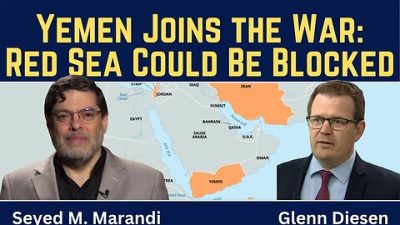
Yemen joins the war – Red Sea could be blocked next – Saudi regime at risk
or go to
Aletho News Archives – Video-Images
From the Archives
A superpower and “the world’s sickest warrior state”
By Paul J. Balles | March 8, 2010
Living through five or six major wars has hardened me to what I thought were the extremes of inhuman cruelty and brutality.
Two things made those extremes almost bearable: the brutality always revealed – at least according to the media coverage – the viciousness of the enemy. It was therefore quite understandable when our “brave men and women” pulverized the enemy.
Films of Japanese torturing captive Americans somehow justified holding Japanese Americans in internment camps during World War II; and only a small percentage of Americans found the bombing of Hiroshima and Nagasaki unreasonably vengeful at best, at worst, depraved.
The media giants in America portrayed the North Koreans as barbaric beasts with their captives, quite unlike their southern counterpoints – our allies during the Korean War. No one ever felt the need to explain how the South Koreans were a civilized breed while the North Koreans were absolute savages, at least according to the official line.
In Vietnam, our warriors justifiably (or so the media made us believe) dropped napalm on the North Vietnamese who had the gall to hide in villages and tunnels to ravage our invaders. At least it was accepted practice until some rogue photojournalist filmed a young girl screaming down a Vietnamese road in flames. … continue
Blog Roll
 Aletho News
- FTC Warns Visa, Mastercard, PayPal, Stripe Over Political Debanking
- Russian tanker approaches Cuba despite US oil blockade
- Marandi: Yemen joins the war – Red Sea could be blocked next – Saudi regime at risk
- Pro-Palestinian French member of European Parliament denied entry to Canada
- Pakistan to Host US-Iran Talks
- How Indonesia’s tilt toward the US left it stranded in the Strait of Hormuz
- US has no choice but to retreat from Iranian borders: Top commander
- Iran Retaliation Strikes Chemical Plant Near Dimona
- AWACS’ Destruction is a Major Loss for US Military – Ex-DoW Analyst
- Israel’s Iran Strategy Uses US Military & Gulf States as Its Pawns
- If Americans Knew
- Israeli police block Catholic cardinal from entering Church of the Holy Sepulchre on Palm Sunday
- Israel is assassinating journalists again, more than any other nation, anywhere, ever – Not a ceasefire Day 170
- Over 300 US service members wounded, majority have brain injuries – Not a ceasefire Day 169
- Researchers at Human Rights Watch Resign Over Blocked Report on Palestinian Refugee Return
- Jewish Groups Are Backing a War Americans Don’t Want
- Eric Fingerhut Thinks He’s the President of the Jews
- Top Jewish Philanthropists, Rabbis Urge Israeli President to Take Action Against ‘Jewish Extremists’
- Don’t Be Fooled. Zionist Leaders Have Always Wanted to Control Southern Lebanon
- Israel’s widespread use of torture is a core element of its genocide against the Palestinian people
- In Israel’s War on Iran, Many Middle East US Bases Rendered “All But Uninhabitable”
- No Tricks Zone
- New Study Finds Warming Saves Lives…Cold Temperatures 12 Times More Deadly Than Excess Heat
- German Science Blog Accuses PIK Climate Institute Of Hallucinating Climate Tipping Points
- Devastating Assessment Of Comirnaty Vaccine By Former Senior Pfizer Europe Toxicologist
- New Study: CO2 Is ‘Effectively Negligible’ As An Explanatory Climate Change Factor Since 2000
- Former Pfizer Toxicologist Dr. Helmut Sterz Tells Bundestag Hearing Pfizer Vaccine Should Have Never Been Approved
- Energy Expert: Germany’s Nuclear Phaseout Was A “500 Billion Euro Mistake”
- New Research: South Australia’s Mid-Holocene Sea Surface Temperatures Were 4°C Warmer Than Today
- Storing Green Energy To Last Germany 10 Days Would Require A 60-Million Tonne Battery
- New Studies: UK Sea Levels Were 4 Meters Higher Than Today During The Mid-Holocene
- Destructive Green New Deal: German Energy And Metal Group Warns Of Drastic Crisis
 Aletho News