The hidden security clauses of the Iran-Saudi deal
By Hasan Illaik | The Cradle | March 12, 2023
Under Chinese auspices, on 10 March in Beijing, longtime regional competitors Iran and Saudi Arabia reached an agreement to restore diplomatic relations, after a break of seven years.
In its most optimistic reading, the deal can be seen as a historic strategic agreement, reflecting major changes underway in West Asia and the world. At worst, it can be characterized as an “armistice agreement” between two important rivals, that will provide a valuable space for direct, regular communications.
The Sino-Saudi-Iranian joint statement on Friday carried strong implications beyond the announcement of the restoration of diplomatic relations between Tehran and Riyadh, severed since 2016.
The statement is very clear:
- The embassies of Saudi Arabia and the Islamic Republic Iran will reopen in less than two months.
- Respect for the sovereignty of States.
- Activating the security cooperation agreement between Saudi Arabia and Iran signed in 2001.
- Activating the cooperation agreement in the economic, trade, investment, technology, science, culture, sports and youth sectors signed between the parties in 1998.
- Urging the three countries to exert all efforts to promote regional and international peace and security.
At first glance, the first four clauses suggest that the Chinese-brokered deal is essentially a mending of diplomatic relations between the two longtime adversaries. But in fact, the fifth clause is far from the standard text inserted into joint statements between states.
It appears to establish a new reference for conflicts in West Asia, in which China plays the role of “peacemaker” — in partnership with Iran and Saudi Arabia — in which Beijing assumes a role in various regional conflicts or influences the relevant parties.
Sources familiar with the negotiations have revealed to The Cradle that Chinese President Xi Jinping did not merely coat-tail a deal already underway between Tehran and Riyadh. Xi has, in fact, personally paved the way for this agreement to materialize. The Chinese head of state delved deep into its details since his visit to Saudi Arabia in December 2022, and then later, during Iranian President Ebrahim Raisi’s visit to Beijing in mid-February 2023.
More than one round of negotiations was held under Chinese auspices, during which the Iranians and Saudis finalized details negotiated between them in Iraq and Oman, during earlier rounds of talks.
It was by no means a given that the two sides would arrive at an agreement in their last round of discussions (6-10 March, 2023). But the Chinese representative managed to overcome all obstacles between the two delegations, after which the parties obtained approval from their respective leaderships to announce the deal on Friday.
China as regional guarantor
In the past couple of days, much has been written about the strategic implications of a Chinese-brokered Saudi-Iranian agreement and its impact on China’s global role vis-à-vis the United States. The Persian Gulf is a strategic region for both powers, and the main source of China’s energy supply. It is likely why Beijing intervened to stem tensions between its two strategic allies. It is also something Washington, long viewed as the region’s “security guarantor,” could never have achieved.
Undoubtedly, much will be said about Saudi Crown Prince Mohammed bin Salman’s (MbS) “strategic adventurism” and his exploitation of global changes to offset the decline of US regional influence. The rise of a multipolar, post-American order allows traditional US allies some space to explore their international options away from Washington, and in service of their immediate national interests.
Saudi Arabia’s current interests are related to the ambitious political, economic, financial, and cultural targets that MbS has set out for his country, and are based on two pillars:
- Diversifying regional and global partnerships in order to adapt to global systemic changes that will help realize Riyadh’s grand plans.
- Establishing security and political stability to allow Saudi Arabia to implement its major projects, especially those outlines in MbS’ “Vision 2030,” through which Riyadh envisions itself transforming into a regional incubator for finance, business, media, and the entertainment industry – similar to the role played by the UAE in decades past, or by Beirut before the Lebanese civil war in 1975.
In short, regional and domestic security and stability are vital for Riyadh to be able to implement its strategic goals. As such, confidential clauses were inserted into the Beijing Agreement to assure Iran and Saudi Arabia that their security imperatives would be met. Some of these details were provided to The Cradle, courtesy of a source involved in the negotiations:
- Both Saudi Arabia and the Islamic Republic of Iran undertake not to engage in any activity that destabilizes either state, at the security, military or media levels.
- Saudi Arabia pledges not to fund media outlets that seek to destabilize Iran, such as Iran International.
- Saudi Arabia pledges not to fund organizations designated as terrorists by Iran, such as the People’s Mojahedin Organization (MEK), Kurdish groups based in Iraq, or militants operating out of Pakistan.
- Iran pledges to ensure that its allied organizations do not violate Saudi territory from inside Iraqi territory. During negotiations, there were discussions about the targeting of Aramco facilities in Saudi Arabia in September 2019, and Iran’s guarantee that an allied organization would not carry out a similar strike from Iraqi lands.
- Saudi Arabia and Iran will seek to exert all possible efforts to resolve conflicts in the region, particularly the conflict in Yemen, in order to secure a political solution that secures lasting peace in that country.
According to sources involved in the Beijing negotiations, no details on Yemen’s conflict were agreed upon as there has already been significant progress achieved in direct talks between Riyadh and Yemen’s Ansarallah resistance movement in January. These have led to major understandings between the two warring states, which the US and UAE have furiously sought to undermine in order to prevent a resolution of the Yemen war.
In Beijing however, the Iranian and Saudis agreed to help advance the decisions already reached between Riyadh and Sanaa, and build upon these to end the seven-year war.
Hence, although the Beijing statement primarily addresses issues related to diplomatic rapprochement, Iranian-Saudi understandings appear to have been brokered mainly around security imperatives. Supporters of each side will likely claim their country fared better in the agreement, but a deeper look shows a healthy balance in the deal terms, with each party receiving assurances that the other will not tamper with its security.
While Iran has never declared a desire to undermine Saudi Arabia’s security, some of its regional allies have made no secret of their intentions in this regard. In addition, MbS has publicly declared his intention to take the fight inside Iran, which Saudi intelligence services have been doing in recent years, specifically by supporting and financing armed dissident and separatist organizations that Iran classifies as terrorist groups.
The security priorities of this agreement should have been easy to spot in Beijing last week. After all, the deal was struck between the National Security Councils of Saudi Arabia and Iran, and included the participation of intelligence services from both countries. Present in the Iranian delegation were officers from Iran’s Ministry of Intelligence and from the intelligence arms of the Islamic Revolutionary Guard Corps (IRGC).
On a slightly separate note related to regional security — but not part of the Beijing Agreement — sources involved in negotiations confirmed to The Cradle that, during talks, the Saudi delegation stressed Riyadh’s commitment to the 2002 Arab peace initiative; refusing normalization with Tel Aviv before the establishment of an independent Palestinian state, with Jerusalem as its capital.
What is perhaps most remarkable, and illustrates the determination by the parties to strike a deal without the influence of spoilers, is that Iranian and Saudi intelligence delegations met in the Chinese capital for five days without Israeli intel being aware of the fact. It is perhaps yet another testament that China — unlike the US — understands how to get a deal done in these shifting times.
China steps up, a new era has dawned in world politics
BY M. K. BHADRAKUMAR | INDIAN PUNCHLINE | MARCH 11, 2023
The agreement announced on Friday in Beijing regarding the normalisation of diplomatic relations between Saudi Arabia and Iran and the reopening of their embassies is a historic event. It goes way beyond an issue of Saudi-Iranian relations. China’s mediation signifies that we are witnessing a profound shift of the tectonic plates in the geopolitics of the 21st century.
The joint statement issued on Friday in Beijing begins by saying that the Saudi-Iranian agreement was reached “in response to the noble initiative of President Xi Jinping.” The dramatic beginning goes on to state that Saudi Arabia and Iran have expressed their “appreciation and gratitude” to Xi Jinping and the Chinese government “for hosting and sponsoring the talks, and the efforts it placed towards its success.”
The joint communique also mentioned Iraq and Oman for fostering the Saudi-Iranian dialogue during 2021-2022. But the salience is that the United States, which has been traditionally the dominant power in West Asian politics for close to eight decades, is nowhere in the picture.
Yet, this is about the reconciliation between the two biggest regional powers in the Persian Gulf region. The US retrenchment denotes a colossal breakdown of American diplomacy. It will remain a black mark in President Biden’s foreign policy legacy.
But Biden must take the blame for it. Such a cataclysmic failure is largely to be traced to his fervour to impose his neoconservative dogmas as an adjunct of America’s military might and Biden’s own frequent insistence that the fate of humankind hinges on the outcome of a cosmic struggle between democracy and autocracy.
China has shown that Biden’s hyperbole is delusional and it grates against realities. If Biden’s moralistic, ill-considered rhetoric alienated Saudi Arabia, his attempts to suppress Iran met with stubborn resistance from Tehran. And, in the final analysis, Biden literally drove both Riyadh and Tehran to search for countervailing forces that would help them to push back his oppressive, overbearing attitude.
The US’ humiliating exclusion from the centre stage of West Asian politics constitutes a “Suez moment” for the superpower, comparable to the crisis experienced by the UK in 1956, which obliged the British to sense that their imperial project had reached a dead end and the old way of doing things—whipping weaker nations into line as ostensible obligations of global leadership —was no longer going to work and would only lead to disastrous reckoning.
The stunning part here is the sheer brain power and intellectual resources and ‘soft power’ that China has brought into play to outwit the US. The US has at least 30 military bases in West Asia — five in Saudi Arabia alone — but it has lost the mantle of leadership. Come to think of it, Saudi Arabia, Iran and China made their landmark announcement on the very same day Xi Jinping got elected for a third term as president.
What we are seeing is a new China under the leadership of Xi Jinping trotting over the high knoll. Yet, it is adopting a self-effacing posture claiming no laurels for itself. There is no sign of the ‘Middle Kingdom syndrome,’ which the US propagandists had warned against.
On the contrary, for the world audience — especially countries like India or Vietnam, Turkey, Brazil or South Africa — China has presented a salutary example of how a democratised multipolar world can work in future — how it is possible to anchor big power diplomacy on consensual, conciliatory politics, trade and interdependence and advance a ‘win-win’ outcome.
Implicit in this is another huge message here: China as a factor of global balance and stability. It is not only Asia-Pacific and West Asia who are watching. The audience also includes Africa and Latin America — in fact, the entire non-Western world that forms the big majority of world community who are known as the Global South.
What the pandemic and the Ukraine crisis have brought to the surface is the latent geopolitical reality that the Global South rejects the policies of neo-mercantalism pursued by the West in the garb of ‘liberal internationalism.’
The West is pursuing a hierarchical international order. None other than the EU foreign policy chief Josep Borrell blurted this out in an unguarded moment recently with a touch of racist overtone when he said from a public platform that ‘Europe Is a garden. The rest of the world Is a jungle, and the jungle could Invade the garden.’
Tomorrow, China could as well be challenging the US hegemony over the Western Hemisphere. The recent paper by the Chinese Foreign Ministry titled ‘US Hegemony and Its Perils’ tells us that Beijing will no longer be on the defensive.
Meanwhile, a realignment of forces on the world stage is taking place with China and Russia on one side and the US on the other. Doesn’t it convey a big message that on the very eve of the historic announcement in Beijing on Friday, the Saudi Arabian foreign minister Prince Faisal bin Farhan Al Saud landed suddenly in Moscow on a ‘working visit’ and went into a huddle with Foreign Minister Sergey Lavrov who was visibly delighted? (here, here and here )
Of course, we will never know what role Moscow would have played behind the scenes in coordination with Beijing to build bridges between Riyadh and Tehran. All we know is that Russia and China actively coordinate their foreign policy moves. Interestingly, on March 6, President Putin had a telephone conversation with Iran’s President Ebrahim Raisi.
Audacity of hope
To be sure, the geopolitics of West Asia will never be the same again. Realistically, the first sparrow of spring has appeared but the ice was melted for only three or four rods from the shore. Nonetheless, the sun’s rays give hope, signalling warmer days to come.
Conceivably, Riyadh won’t have any truck further with the diabolical plots hatched in Washington and Tel Aviv to resuscitate an anti-Iran alliance in West Asia. Nor is it in the realms of possibility that Saudi Arabia will be party to any US-Israeli attacks on Iran.
This badly isolates Israel in the region and renders the US toothless. In substantive terms, it scatters the Biden administration’s feverish efforts lately to cajole Riyadh to join Abraham Accords.
However, significantly, a commentary in Global Times noted somewhat audaciously that the Saudi-Iranian deal “set a positive example for other regional hotspot issues, such as the easing and settlement of the Israeli-Palestinian conflict. And in the future, China could play an important role in building a bridge for countries to solve long-standing thorny issues in the Middle East just as what it did this time.”
Indeed, the joint communique issued in Beijing says, “The three countries [Saudi Arabia, Iran and China] expressed their keenness to exert all efforts towards enhancing regional and international peace and security.” Can China pull a rabit out of the hat? Time will tell.
For the present, though, the Saudi-Iranian rapprochement will certainly have positive fallouts on the efforts toward a negotiated settlement in Yemen and Syria as well as on the political instability in Lebanon.
Besides, the joint communique emphasises that Saudi Arabia and Iran intend to revive the 1998 General Agreement for Cooperation in the Fields of Economy, Trade, Investment, Technology, Science, Culture, Sports, and Youth. All in all, the Biden administration’s maximum pressure strategy toward Iran has crashed and the West’s sanctions against Iran are being rendered ineffectual. The US’ policy options on Iran have shrunk. Put differently, Iran gains strategic depth to negotiate with the US.
The cutting edge of the US sanctions lies in the restrictions on Iran’s oil trade and access to western banks. It is entirely conceivable that a backlash is about to begin as Russia, Iran and Saudi Arabia — three top oil/gas producing countries start accelerating their search for payment mechanisms bypassing the American dollar.
China is already discussing such an arrangement with Saudi Arabia and Iran. China-Russia trade and economic transactions no longer use American dollar for payments. It is well understood that any significant erosion in the status of the dollar as ‘world currency’ will not only spell doom for the American economy but will cripple the US’ capacity to wage ‘forever wars’ abroad and impose its global hegemony.
The bottom line is that the reconciliation between Saudi Arabia and Iran is also a precursor to their induction as BRICS members in a near future. To be sure, there is a Russian-Chinese understanding already on this score. The BRICS membership for Saudi Arabia and Iran will radically reset the power dynamic in the international system.
World welcomes Iran-Saudi detente as Israel feels ‘fatal blow’ to coalition building
Press TV – March 10, 2023
Various countries have welcomed the restoration of diplomatic relations between Iran and Saudi Arabia, while the regime in Tel Aviv seems to view the development as a “fatal blow” to its regional coalition building against the Islamic Republic.
After several days of intensive negotiations hosted by China, Iran and Saudi Arabia finally clinched a deal on Friday to restore diplomatic relations and re-open embassies, seven years after ties were severed over several issues.
The important development soon became a hot topic in regional as well as international media and reactions from other countries began to pour in.
“The return to normal relations between the Islamic Republic of Iran and Saudi Arabia provides great capacities to both countries, the region, and the Muslim world,” Iranian Foreign Minister Hossein Amir-Abdollahian, who is set to soon meet with his Saudi counterpart to make the necessary arrangements, wrote in a post on his Twitter account.
“The good neighborliness policy, as the key axis of the Iranian administration’s foreign policy, is strongly moving in the right direction and the diplomatic apparatus is actively behind the preparation of more regional steps,” he said.
Riyadh eyeing continuation of dialogue
Saudi National Security Adviser Musaid Al Aiban, who negotiated the agreement with his Iranian counterpart Ali Shamkhani, said that Riyadh “welcomes the initiative of His Excellency President Xi Jinping, based on the Kingdom’s consistent and continuous approach since its establishment in adhering to the principles of good neighborliness.”
He said Saudi Arabia takes “everything that would enhance security and stability in the region and the world,” while “adopting the principle of dialogue and diplomacy to resolve differences.”
“While we value what we have reached, we hope that we will continue to continue the constructive dialogue, in accordance with the pillars and foundations included in the agreement, expressing our appreciation for the People’s Republic of China’s continued positive role in this regard.”
China’s Top Diplomat Wang Yi praised the agreement as “a victory for dialogue, a victory for peace, offering major good news at a time of much turbulence in the world.”
China will continue to play a constructive role in handling hotspot issues in the world and demonstrate its responsibility as a major nation, Wang said. “The world is not just limited to the Ukraine issue.”
Nasrallah: Agreement could lead to new horizons
Addressing a local event on Friday, the secretary general of Lebanon’s Hezbollah resistance movement Sayyed Hassan Nasrallah said the agreement will be “to the benefit” of the region.
“The rapprochement of Iran and Saudi Arabia proceeds in its normal path and can open new horizons for the region and Lebanon,” he said.
The Iranian foreign minister also held separate phone conversations with his Omani, Iraqi, and Qatari counterparts who embraced the resumption of ties.
Turkey and the United Arab Emirates also welcomed the new development in separate statements.
In the first reaction, the United States claimed that it embraces “de-escalation” in West Asia.
“Generally speaking, we welcome any efforts to help end the war in Yemen and de-escalate tensions in the Middle East region. De-escalation and diplomacy together with deterrence are key pillars of the policy President Biden outlined during his visit to the region last year,” a White House National Security Council spokesperson told Reuters.
Ansarullah hails move against foreign interference
Mohammed Abdulsalam, the Yemeni Ansarullah resistance movement’s chief negotiator, said the region is in need of resumption of “normal ties” between its countries.
“The region needs the resumption of normal ties between its countries for the Islamic nation to reclaim its lost security as a result of foreign, especially American-Zionist, interferences,” he tweeted.
Foreign interference, he said, has taken advantage of differences in the region and used Iranophobia to wage aggression on Yemen.
‘Dangerous development for Israel’
Meanwhile, the Israeli regime did not seem to take the development so well. Former Israeli Prime Minister Naftali Bennett called the agreement a “political victory” for Iran and a “serious and dangerous development for Israel.”
“This delivers a fatal blow to efforts to build a regional coalition against Iran,” he said.
Former Prime Minister Yair Lapid also described the reconciliation deal as a dangerous development that strips Israel of its regional defensive wall. “The agreement between Saudi Arabia and Iran reflects the complete and dangerous failure of the Israeli government’s foreign policy,” Lapid said.
Benny Gantz, former minister of military affairs, also reacted to the rapprochement, stating that it was a cause for concern.
Yemen’s parliament calls for confrontation with foreign occupation forces
Press TV – March 5, 2023
Yemen’s parliament has reiterated its rejection of the presence of foreign occupation troops in the country.
The lawmakers called on the Yemeni people to confront the foreign forces to prevent any outside intervention in the country’s internal affairs.
The Yemeni parliament warned in a statement on Sunday of American plots to target the unity and sovereignty of the country amid the US-British-Saudi presence in the southeastern province of al-Mahrah, according to Yemen’s al-Masirah television network.
It called for standing united in the face of invaders and occupiers while blaming the coalition of aggression and its mercenaries for tampering with the wealth of the Yemeni people and forfeiting the sovereignty, independence and unity of Yemen and its territorial integrity.
The statement strongly condemned any foreign presence in “Yemeni lands, islands and waters, whatever its justifications.”
The House of Representatives also condemned the suspicious American movements taking place in the occupied Yemeni provinces, the latest of which was a visit by the American ambassador and the commander of the US Fifth Fleet under the pretext of combating smuggling.
The US military moves in the southeastern provinces of al-Mahra and Hadhramaut have escalated significantly and provocatively over the past months, in parallel with Washington’s attempts to thwart peace efforts and circumvent the demands of the Yemeni People and the requirements for a solution, including the complete departure of foreign forces from Yemen.
The American news website Huffington Post recently confirmed that the United States is moving in the path of seizing al-Mahra Province for “geopolitical purposes and long-term economic ambitions and goals, including control of the governorate’s coasts and ports.”
The site revealed that “US soldiers and military experts frequent the province, moving around it, away from the media spotlight.”
Saudi Arabia launched the devastating war on Yemen in March 2015 in collaboration with its Arab allies and with arms and logistics support from the US and other Western states.
The objective was to reinstall the Riyadh-friendly regime of Abd Rabbuh Mansur Hadi and crush the Ansarullah resistance movement, which has been running state affairs in the absence of a functional government in Yemen.
While the Saudi-led coalition has failed to meet any of its objectives, the war has killed hundreds of thousands of Yemenis and spawned the world’s worst humanitarian crisis.
In a US-China confrontation, West Asia will bow out
By F.M. Shakil | The Cradle | February 24 2023
The prospect of a US-China war has entered the realm of reality. Increased provocations from US military and political officials regarding the status of Taiwan – which China considers to be part of its historic territory – have heightened the possibility of confrontation in recent years.
With only 13 out of 193 UN member states recognizing the government in Taipei as a separate entity, the global community’s reaction to a Washington-led assault over Taiwan’s status remains highly uncertain.
Today, the reaction of strategic West Asia to a hypothetical conflict between the two superpowers is up for grabs. However, given the region’s reluctance to take sides in the Russian-US stand off, it is likely to be equally hesitant to do so in the event of a US-China conflict.
In a memo released on 27 January, US General Mike Minihan, chief of the Air Mobility Command, wrote: “My instinct tells me we will fight in 2025.” General Minihan’s views align with Taiwanese Minister of National Defense Chiu Kuo-cheng’s statement in 2021 that China will be capable of launching a full-scale invasion of Taiwan by the same year.
In response to General Minihan’s remarks, Mike McCaul, chairman of the US House Representatives’ Foreign Affairs Committee, told Fox News: “I hope he is mistaken but I believe he is correct.” Adding fuel to the fire, US Senate Majority Leader Mitch McConnell said on 29 January, “The chances of conflict in the relationship with China over Taiwan are very high.”
A lot of hot air
Days after the US general issued a warning that Washington may engage in combat with Beijing in the next two years, tensions between the two countries were further exacerbated by the spoof-worthy Chinese spy balloon incident.
According to some senior Republicans and US military leaders, there is a growing concern that a full-scale conflict between the two superpowers is imminent, with the Asia-Pacific (AP) and South Asia (SA) regions likely to be the primary theaters of the conflict.
Jan Achakzai, a geopolitical analyst and former adviser to Pakistan’s Balochistan government, tells The Cradle that:
“The possibility of a war between the United States and China puts everyone on edge, especially the regions that are intricately linked with the US or China. Some nations will be compelled to choose between allying with the US in the case of war or keeping the status quo to lessen the possibility of hostilities.”
Russian involvement in West Asia
Despite nominal trade and geopolitical relations with Moscow, West Asian countries did not support Washington’s position in the conflict between Russia and Ukraine. However, Russia’s veto power at the UN Security Council does have a positive impact on its relationship with regional states, particularly for its ability to prevent expansionist and anti-Arab policies by other permanent council members.
Security and trade remain the two primary pillars of the relationship between Moscow and West Asia, and Russian President Vladimir Putin’s image has played a significant role in shaping these ties.
The UAE serves as a major financial hub for Russia, and Moscow may attempt to leverage its influence in the region to urge the UAE to reconsider US-imposed banking restrictions, if it feels that its interests are being compromised.
In addition, Algeria, Tunisia, Libya, Lebanon, and Egypt are among the countries that purchase wheat from Russia, which further solidifies economic ties between Russia and the Arab world.
Moreover, since joining the expanded Organization of the Petroleum Exporting Countries (OPEC+) in 2016, Russia and Saudi Arabia have worked closely to regulate oil output and price adjustments as part of OPEC+ agreements.
Putin’s public image has, in part, contributed to a surge in support for Russia in the kingdom. In 2018, when Riyadh faced international criticism over the Saudi-orchestrated murder of journalist Jamal Khashoggi, the Russian president made headlines by high-fiving and grinning at the then-isolated Saudi Crown Prince Mohammed bin Salman (MbS) during the G20 summit in Argentina.
Likewise, his prominent role in thwarting the NATO proxy war in Syria – a geopolitical game changer that, arguably, ushered in global multipolarity – has gained Putin fans across a region that has long suffered from western imperialist designs.
Where will West Asia stand?
Although still a hypothetical scenario, it is worth considering how West Asia would respond to a direct US-China conflict. Many prominent geopolitical analysts have speculated that if West Asia, and particularly the traditionally pro-US Arab states of the Persian Gulf, did not toe the US line against Russia – a significantly smaller regional trading partner than China – its loyalties to Washington in a potential US-China confrontation could be further strained.
Compared to Russia, China has significantly larger investments throughout West Asia. In 2021, bilateral trade between Beijing and the region amounted to $330 billion, with approximately 50 percent of China’s energy supply coming from the energy-abundant Persian Gulf.
China has conducted over $200 billion in trade alone with Saudi Arabia and the UAE. From 2005 to 2021, Beijing invested $43.47 billion in Saudi Arabia, $36.16 billion in the UAE, $30.05 billion in Iraq, $11.75 billion in Kuwait, $7.8 billion in Qatar, $6.62 billion in Oman, and $1.4 billion in Bahrain.
In addition to its investments in trade and energy, China has also invested enormous sums of money in West Asian and North African infrastructure and high-tech development projects via its multi-trillion dollar Belt and Road Initiative (BRI).
Beijing has entered into strategic cooperation agreements with Saudi Arabia, the UAE, Algeria, Egypt, and Iran, and has enlisted a total of 21 Arab nations in its ambitious, decade-long effort to revive the historic Silk Road and export its goods to markets throughout Europe and Africa. Currently, infrastructure developed by Persian Gulf nations serves as a transit point for two-thirds of Chinese exports to these continents.
Egypt is a crucial hub for the BRI, with the Economic-Technological Development Area in Egypt’s Suez Canal Economic Zone, near Ain Sokhna, representing one of the major projects for which the two nations signed contracts totaling $18 billion in 2018.
Iraq, the third-largest oil supplier to China after Saudi Arabia and Russia, has also received $10.5 billion from Beijing for BRI-related energy projects, and just this week, agreed to replace its dollar trade with Beijing for the Chinese yuan.
In West Asia, the US plays second fiddle to Beijing
Chinese collaboration with West Asia and North Africa is not confined to trade and economy; Beijing also provides defense equipment to several Arab nations. Since 2019, China and Saudi Arabia have reportedly collaborated on the production of ballistic missiles, and China also sells Saudi Arabia its HQ-17AE air defense system.
Chinese Wing Loong drones have been purchased by the UAE, and Iraq has placed an order for CH-4B drones. Jordan purchased CH-4Bs in 2016, while Algeria acquired CH-5s – the next generation of the CH-4B type – to expand its aviation capabilities in 2022. In addition, Saudi Advanced Communications and Electronics Systems Co. and China Electronics Technology Group are partnering to build a drone factory for local UAV production.
While US President Joe Biden’s administration’s relationship with Riyadh has been strained due to disagreements over human rights and energy policy, China is making significant strides in strengthening its ties with the country.
As Beijing draws closer to Saudi Arabia, the message to Washington from Riyadh is unambiguous: “The people in the Middle East [West Asia] are tired of other countries’ interference because they always come with troubles.”
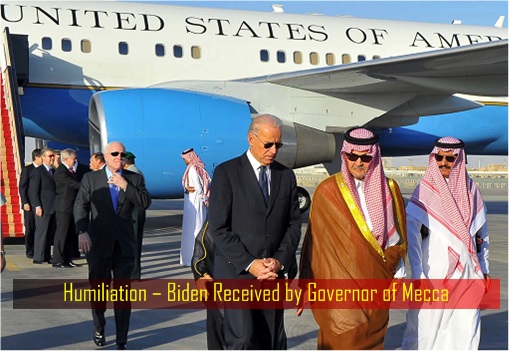
Chinese President Xi Jinping received a royal welcome in Riyadh last December, marking a seismic shift in Sino-Arab relations and boosting China’s image throughout the Arab world. In contrast, US President Joe Biden’s visit to Jeddah in the summer of 2022 received a lukewarm reception. This may suggest that a recalibration of West Asian geopolitical alliances may be on the horizon.
Despite these trends, analyst Achakzai tells The Cradle that West Asia will behave similarly to the way it did during the Russian-Ukrainian conflict – even given China’s increasing business and military presence in the region and the US’s declining control over the oil-rich Arab monarchies.
“Depending on the current situation, the motives of the various states in the region may change and divide into two distinct groups: those who would support the US and those who would support a neutral position.”
China values economy over war
In the Asia-Pacific region, the US and its allies are engaged in a contentious relationship with China regarding maritime boundaries, international trade, human rights, and strategic security issues. Despite signing numerous security pacts with regional players, China appears to prioritize building and strengthening economic ties over military cooperation with Asian-Pacific states.
Due to a history of hostile confrontations and divergent geopolitical objectives, both the US and China seek to increase their military presence in the region. In response to China’s territorial claims in the South China Sea, the US has expanded its military footprint by signing commercial and defense agreements with the Asia-Pacific region.
The two nations have also been at odds over the Trans-Pacific Partnership (TPP), which many viewed as an effort to contain China’s economic and strategic influence in its own backyard. Additionally, tensions have escalated between Beijing and its neighbors, particularly over territorial disputes in the East and South China Seas.
These efforts have been emboldened by the 5-member Quadrilateral Security Dialogue (Quad), which is an informal strategic dialogue between the US, India, Japan, and Australia that seeks “to promote a free, open, and prosperous Indo-Pacific region.” According to Achakzai:
“Countries that have extensive defense agreements with the US, such as Japan, South Korea, and Australia, are most likely to help America. These nations, which have long benefited from their close connections to the US, must now contend with Chinese territorial ambitions in the region and the South China Sea. The nations having an informal security partnership with the US, such as the Philippines, are likely to back the United States in a confrontation.”
The analyst explained that Singapore, Thailand, and Malaysia are expected to remain neutral during the conflict due to their strong business and investment ties with China.
“Other countries in the Asia-Pacific region may feel obligated to support the US if China initiates the conflict. This may apply to countries like Indonesia and Vietnam, which have recently been under Chinese pressure and may need to choose a side to protect their own security,” he noted.
Yemeni officials assess damage to ancient sites bombed by Saudi-led coalition
The Cradle | February 20, 2023
The head of Yemen’s General Authority for Antiquities, Manuscripts, and Museums, Dr. Obbad bin Ali Al-Hayyal, visited several historical and archeological sites in the provinces of Marib and Jawf on 18 February to assess the damages caused to them by the Saudi-led coalition airstrikes, SABA news agency reported.
Hayyal and his team visited the ancient city of Baraqish in Marib’s Mazjar district, the Rusf Temple in Al-Jawf, and several other archeological sites.
According to SABA, they received briefings from local authorities on the damages to ancient columns, inscriptions, and structures due to “Saudi and Emirati warplanes,” as well as the “looting and theft” of antiquities and artifacts by coalition forces from museums across the country.
During the visit, Hayyal stressed the importance of “integrating official and popular efforts” to protect these sites from ‘vandalism and looting.’
Since the start of the Saudi-led war against Yemen in 2015, coalition airstrikes have posed a significant threat to the country’s archeological sites and historical monuments.
In May 2015, coalition airstrikes struck the ancient Sabaean ruins of the Great Marib Dam, which date back to the seventh century BC.
That year, the Saudi-led coalition bombarded the ruins of the ancient city of Baraqish, several ancient temples, and an entire museum filled with countless precious artifacts – which was “reduced to piles of shattered stone,” according to a 2015 report by US media outlet The Intercept.
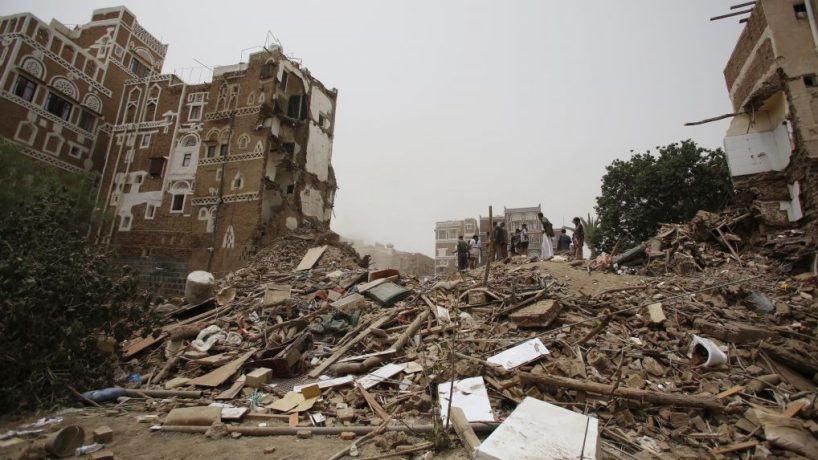
The Saudi-led bombing also decimated sections of the capital Sanaa’s Old City, which is listed as a UNESCO World Heritage site and dates back 2,500 years.
Several ancient buildings and structures have since collapsed from weakened foundations. Until October 2019, over 237 archeological sites had been directly targeted by the coalition in what has been described as a systematic campaign aimed at deliberately erasing Yemeni culture and history.
Aside from bombing, several ancient sites and museums have been looted and stripped of valuable artifacts by UAE-backed mercenary groups, whose ranks are filled with ISIS and Al-Qaeda militants.
In 2019, a member of Yemen’s Supreme Political Council, Mohammad Ali al-Houthi, said about UAE-backed groups: “The mercenaries are antiquity thieves. Where did the antiquities of the Marib Museum go? … Where are the monuments from the rest of the museums in the occupied governorates? … The mercenaries are committing historical, social, and cultural crimes.”
Saudi Arabia is well-known for its destruction of heritage, particularly within its borders, where many of the ancient cities, towns, and sites dating back to the birth of Islam have been wiped out as part of a campaign motivated by the kingdom’s Wahhabi ideology.
MbS urged Baghdad to set up Iran-Saudi meeting: Iraqi FM
The Cradle | January 31, 2023
As part of a diplomatic process aimed at mending strained relations between the two neighbors, Saudi Crown Prince Mohammed bin Salman (MbS) reportedly pressured senior Iraqi officials to set up a face-to-face meeting between the top diplomats of Riyadh and Tehran. This was revealed by the Iraqi Foreign Minister, Fuad Hussein, on 30 January.
In an interview with Rudaw TV on 29 January, the Iraqi Foreign Minister said that “Prince Faisal bin Farhan Al Saud and Hossein Amir-Abdollahian, the foreign ministers of Saudi Arabia and Iran, will meet in Baghdad, at the request of Mohammed bin Salman. The event is still planned, and the time and date will be announced later.”
He also said that the Iranian and Saudi foreign ministers would meet in public and that Iraq would act as a middleman to ensure that the details of the private conversations were made public.
The Saudi diplomat stated earlier this month that his nation has spoken with Iran and is looking for a way to open a dialogue between the two.
In an effort to improve their bilateral relations, the two sides began negotiations in the spring of 2021 and held five rounds of talks in the Iraqi capital. However, Tehran suspended the negotiations after Riyadh executed 81 people under the pretext of being involved in “terrorism,” the majority of which were minority Shia Muslims.
Relations have recently become tenser due to Saudi Arabia’s alleged sponsorship of the protests in Iran in late 2022.
Iran’s Intelligence Minister, Esmail Khatib, was quoted by Iranian media as saying it is running out of patience and will no longer tolerate intervention, hostility, and incitement in a direct message to Saudi Arabia.
Meanwhile, in November, Iran sent an official warning message to the kingdom through diplomatic channels, confirming that it is fully aware of “the Saudi connection to Iran International.” Riyadh categorically denied this, saying it has “nothing to do with the outlet.”
Saudi Crown Prince defies the US policy against Syria
By Steven Sahiounie | Free West Media | January 22, 2023
In November 2022, Saudi Arabia formally changed its stance on Syria. Saudi Arabia is the political powerhouse of the Middle East, and often shares positions on foreign policy and international issues with the UAE, which has previously re-opened their embassy in Damascus.
“The kingdom is keen to maintain Syria’s security and stability and supports all efforts aimed at finding a political solution to the Syrian crisis,” Saudi Foreign Minister Prince Faisal bin Farhan told the November Arab League summit in Algeria.
Syria was suspended from the Arab League in 2011 following the outbreak of conflict instigated by the US, and portrayed in western media as a popular uprising of pro-democracy protesters.
Arab League Secretary-General Ahmed Aboul Gheit said, “The developments in Syria still require a pioneering Arab effort. It is necessary to show flexibility from all parties so that the economic collapse and political blockage can be dispelled. Syria must engage in its natural Arab environment.”
The next Arab League summit will be held in Saudi Arabia, and there is a possibility of Syria once again taking its seat at the round table.
On January 16, the Syrian Foreign Ministry agreed to resume imports from Saudi Arabia after over a decade of strained relations, and Syria planned to import 10,000 tons of white sugar. This development signals a new beginning between the two countries.
Saudi and the Syrian tribes
The Arab tribes in the north east of Syria have traditionally had strong ties with Saudi Arabia, and have received support from the kingdom. The tribes have opposed the ethnic cleansing and forced displacement of Arab villages which the US-led YPG militia has conducted for years. Even though Saudi Arabia has been viewed as a US ally in the past, this has changed since the US military has supported the Marxist YPG who have oppressed Syrians who are not Kurdish.
The US occupied oil wells in north east Syria may come under attack by Arab tribes who are demanding their homes, farms and businesses back from the US-supported YPG. Some analysts foresee the US troops pulling out of Syria after the Kurds find a political solution with Damascus.
Turkey and Syria repair relationship
Turkey and Syria have begun steps to repair their relationship, which ended after Turkey supported the US-NATO attack on Syria for regime change, and hosted CIA operations funneling weapons and terrorists into Syria, under the Obama administration.
Syrian President Bashar al-Assad recently demanded the withdrawal of Turkish troops from Syria to begin to repair the relationship.
Russia is brokering the reconciliation between Erdogan and Assad, which began with the Moscow hosted meeting of the three defense ministers, and a meeting between the three foreign ministers is upcoming.
The developments between Turkey and Syria are being watched by Iran. Foreign Minister Hossein Amirabdollahian said his country was “happy with the dialogue taking place between Syria and Turkey.” Amirabdollahian will travel to Damascus on Saturday for talks with Syrian Foreign Minister Mekdad.
Iran is looking to establish a new role in the recovery process in Syria. President Ebrahim Raisi will visit both Turkey and Syria soon, his first visit to Turkey since taking office two years ago. While analysts see Saudi Arabia and Iran as antagonists, some feel the kingdom will ultimately realize they have to work with Iran in Syria and Lebanon. Iran is part of the region and can’t be excluded from the geo-political sphere.
Saudi Arabian reforms
Saudi Crown Prince Mohammed bin Salman (MBS) said on April 27, 2021 that the country was undergoing a sweeping reform which would restructure the role of religion in Saudi politics and society. The process began a few years before he became crown prince, but under his leadership it has accelerated. Islamic institutions in the Kingdom have seen changes in procedure, personnel, and jurisdiction. All of these reforms are in line with the future vision of the country.
Some analysts feel the rise of the Muslim Brotherhood in the 1960s eventually gave rise to support for domestic religious institutions, and eventually led to funding of religious activities abroad, while religious leaders at home wielded power over public policy.
Vision 2030
Saudi King Salman, Custodian of the Two Holy Mosques, and his son, MBS have a plan for the country which is known as Vision 2030. MBS is also Prime Minister and Chairman of the Council of Economic and Development Affairs.
The days of unlimited oil and markets are in the decline. Education, training, and employment opportunities are the stepping stones to building a thriving country and MBS is determined to plan for a long future of growth and innovation.
MBS
The Crown Prince is young and has new ideas. He is instituting sweeping reforms to the society which have included more rights and freedoms for women. He has championed projects to place Saudi Arabia as a tourist destination, year round golf and soccer venue, and encouraged cultural arts such as musical productions. MBS is breaking the mold: no longer will Saudi Arabia be a breeding ground for Radical Islam.
Extremist preachers
Saudi Arabia had hosted many extremist preachers. Some were featured on satellite TV channels located in Saudi Arabia, and others were local preachers, authors, or scholars. Some had traveled abroad preaching in pulpits and exporting their hatred and sectarian bigotry.
One of the most famous preachers was Muhammed Al-Arifi, who has had an electronic surveillance device attached to him by Saudi intelligence agents, after they seized all of his social media accounts. His last tweet is said to be on May 6, 2019, when he had 20 million followers, and 24 million likes on Facebook, which ranked him as tenth in the Arab world and in the Middle East. The kingdom is shutting down clerics who are extreme.
In 2014, Great Britain banned Arifi from entering the UK following reports that was involved in radicalizing three young British citizens who went to Syria as terrorists.
A YouTube video in 2013 showed Arifi preaching in Egypt and prophesying the coming of the Islamic State. Egyptian TV reported Arifi meeting with the former Muslim Brotherhood prime minister Hisham Qandil in his office.
Arifi is best remembered for his statement on the media Al Jazeera in which he called for jihad in Syria and supported Al Qaeda.
Adnan al-Arour is another extremist preacher who had appeared regularly on two Saudi-owned Salafist satellite channels. Arour was originally from Syria before settling in Saudi Arabia, and in the early days of the Syrian conflict he would stand up on camera, shake his finger, and call for his followers to ‘grind the flesh’ of an Islamic minority sect in Syria and ‘feed it to the dogs’.
These extremist preachers made it clear that the battles being waged in Syria had nothing to do with freedom or democracy, which the western media was pushing as the goal. The truth was the conflict in Syria was a US-NATO attack for regime change and utilized terrorists following Radical Islam, who fought a sectarian war with the goal of establishing an Islamic State in Syria.
The previous Crown Prince
Muhammad bin Nayef Al Saud (MBN) served as the crown prince and first deputy prime minister of Saudi Arabia from 2015 to 2017. On June 21, 2017 King Salman appointed his own son, MBS, as crown prince and relieved MBN of all positions.
MBN met with British Prime Minister David Cameron in January 2013. He then met with President Obama in Washington, on 14 January 2013. The discussion focused on the US-NATO attack on Syria and its support from Saudi Arabia.
In February 2014, MBN replaced Prince Bandar bin Sultan, then intelligence chief of Saudi Arabia, and was placed in charge of Saudi intelligence in Syria. Bandar had been in charge of supporting the US attack on Syria. Bandar had been trying to convince the US in 2012 that the Syrian government was using chemical weapons. However, research has shown that the terrorists used chemical weapons to push Obama into a military invasion, based on his speech of ‘The Red Line’.
In March 2016, MBN was awarded Légion d’honneur by French President François Hollande, another partner in the US-NATO attack on Syria.
On February 10, 2017, the CIA granted its highest Medal to MBN and was handed to him by CIA director Mike Pompeo during a reception ceremony in Riyadh. MBN and Pompeo discussed Syria with Turkish officials, and said Saudi Arabia’s relationship with the US was “historic and strategic”. Just months later in June MBS would depose MBN and strip him of powers, in a move considered to be “upending decades of royal custom and profoundly reordering the kingdom’s inner power structure”.
US diplomats argued that MBN was “the most pro-American minister in the Saudi Cabinet”. That is what brought MBN down. The days of blindly following the US directives are over in Saudi Arabia. MBS has refused to bow down to Biden when he demanded an increase in oil production. The Vision 2030 that MBS developed does not include financing failed wars in the Middle East for the benefit of the Oval Office. MBS has a strained relationship with Biden, and he wears it as a badge of honor.
Saudi role in the Syrian war
Saudi Arabia played a huge role in the large-scale supply of weapons and ammunition to various terrorist groups in Syria during the Syrian conflict. Weapons purchased in Croatia were funneled through Jordan to the border town of Deraa, the epi-center of the Syrian conflict.
At the height of Saudi involvement in Syria, the kingdom had their own militia in Syria under the command of Zahran Alloush. The Jaysh al-Islam are remembered for parading women in cages through the Damascus countryside prior to massacring them.
In summer 2017, US President Donald Trump shut down the CIA operation ‘Timber Sycamore’ which had been arming the terrorists fighting in Syria. About the same time, Saudi Arabia cut off support to the Syrian opposition, which was the political arm of the terrorists.
Richard Dearlove, former head of MI6, expressed his view at the time that “Saudi Arabia is involved in the ISIS-led Sunni rebellion” in Syria.
Syria has been destroyed by the US and their allies who supported the attack beginning in 2011. Now, Turkey and Saudi Arabia are looking to find a solution which will help the Syrian people to rebuild their lives. Both Turkey and Saudi Arabia have turned away from past policies which found them supporting the conflict in Syria at the behest of the US. There is a new Middle East emerging which makes its own policies and is not subservient US interests.
US meddled in Saudi-Yemen peace process
The Cradle | January 6, 2023
Lebanese daily newspaper Al-Akhbar reported on 6 January that Saudi Arabia has expressed its readiness to end the status quo in Yemen and withdraw under the conditions set by Ansarallah.
The kingdom agreed to lift the blockade, and pay compensations for the war after retreating under a pledge not to interfere in the country’s political process.
For that, Riyadh demanded the government in Sanaa present a set of “guarantees” that it will not threaten Saudi Arabia and its security, nor allow hostilities to originate from Yemeni soil.
According to Al-Akhbar, these demands were reiterated by Iran and the Sultanate of Oman, who assured the kingdom of Ansarallah’s willingness to meet Riyadh’s demands.
Despite that, no progress has been made to end the current state, which has left Yemen torn between peace and war. This lack of progress has prompted Ansarallah’s leadership to publicly reject that this limbo becomes a permanent reality.
In an interview with Al-Masirah TV on 1 January, Ansarallah’s spokesman and peace envoy, Mohammed Abdel Salam, demanded a permanent ceasefire between Yemen and Saudi Arabia.
“We are working to reach a point of clarity in Yemen, in which we move into either a truce or permanent ceasefire, and we have presented our point of view to the Omani mediator,” said Abdel Salam.
He added that this would require opening all ports, airports, and roads, and paying salaries with the revenue generated from Yemen’s oil and gas exports.
A source close to Ansarallah in Sanaa revealed to The Cradle that Saudi Arabia agreed to this demand in October 2022, and was ready – along with Qatar – to finance the salaries of all government employees in northern Yemen.
However, the US sabotaged this agreement and blocked the solution by pressuring Riyadh to cease its efforts.
The leader of Ansarallah, Abdul-Malik al-Houthi, has ordered the military to prepare for a scenario in which all prospects for peace diminish, as the status quo is no longer acceptable.
On the other hand, the UN coordinator for Yemen, Hans Grundberg, and US Deputy Assistant Secretary of State for Arabian Gulf Affairs, Tim Lenderking, met in Riyadh on 5 January, to discuss the developments with the head of the Yemeni Presidential Leadership Council, Rashad al-Alimi.
According to local media, the meeting tackled the UN’s efforts to coordinate with the international community to keep the peace process on track and explore ways to end Yemeni suffering.
However, progress has yet to materialize, and no plan has been set to find ways to establish communication with the Sanaa government, as a key to peace.
Featured Video
Your Enslavement Begins in Gaza: The ‘Board of Peace’
or go to
Aletho News Archives – Video-Images
From the Archives
The US: The Century of Lost Wars
By James Petras | Global Research | September 12, 2018
Introduction
Despite having the biggest military budget in the world, five times larger than the next six countries, the largest number of military bases – over 180 – in the world and the most expensive military industrial complex, the US has failed to win a single war in the 21st century.
In this paper we will enumerate the wars and proceed to analyze why, despite the powerful material basis for wars, it has led to failures. … continue
Blog Roll
 Aletho News
- Why Israel Is Escalating Its War Crimes Against Lebanon
- Iran in the face of the armed diplomacy of imperialism
- The US build-up around Iran constitutes strategic war option, not ‘deterrence’
- Iran to US: Sanctions and war failed; try diplomacy and respect
- China supplies Iran with radar, surveillance tech to track US stealth aircraft: Report
- Zelensky rejects territorial concessions to Russia
- German leader of EU’s largest faction sounds the alarm of possibility of right-wing forces coming to power in France, Poland
- Putin: Developing Russia’s nuclear forces ‘absolute priority’
- Hungary Blocks 20th Package of Anti-Russia Sanctions, $106B Loan to Ukraine – Szijjarto
- NATO Must Return to 1997 Borders for Peace in Ukraine – Finnish Politician
- If Americans Knew
- Maria Farmer: Epstein Victim Reveals Explosive Information Covered Up by Media
- Average of five Palestinians killed by Israel every day in Gaza since ceasefire – Not a ceasefire Day 136
- Palestinian church leaders admonish Christian Zionist Mike Huckabee – Not a ceasefire Day 135
- Ominous messaging from Trump’s “Board of Peace” – Not a ceasefire Day 134
- ‘Christians Out’: Jerusalem Church Tagged With Hate Graffiti, Police Investigating
- Israeli Settlers Kill American Teen
- ‘We returned from hell’: Palestinian journalists recount torture in Israeli prisons
- No mercy for Gaza in Ramadan – Not a ceasefire Day 133
- The Israeli Government Installed and Maintained Security System at Epstein Apartment
- Tucker Carlson interrogated in Israel, has passport seized after interviewing US ambassador
- No Tricks Zone
- New Research Reaffirms Clouds, Aerosols, And Surface Solar Radiation Are ‘Driving The Climate System’
- Germany: Electric Car Catches Fire At Charging Station, Sets Off Local “Inferno”, Widespread Damage
- New Study: Canada’s New Brunswick Was 1°C Warmer Than Today During The Medieval Warm Period
- Coal Power Back In Trend As Globe Tries To Keep Pace With Growing Demand For Power
- New Study: A 4°C Warmer Beaufort Sea Had ‘No Sea Ice’ 11,700 – 8200 Years Ago
- Unfudging The Data: Dutch Meteorological Institute Reinstates Early 20th Centruy Heat Waves It Had Erased Earlier
- German Gas Crisis…Chancellor Merz Allegedly Bans Gas Debate Ahead of Elections!
- Pollen Reconstructions Show The Last Glacial’s Warming Events Were Global, 10x Greater Than Modern
- Germany’s Natural Gas Storage Level Dwindles To Just 28%… Increasingly Critical
- New Study Rebuts The Assumption That Anthropogenic CO2 Molecules Have ‘Special’ Properties
 Aletho News