Sorry, Google and World Bank, but Middle Eastern Crops Keep Thriving
By H. Sterling Burnett | ClimateRealism | November 4, 2020
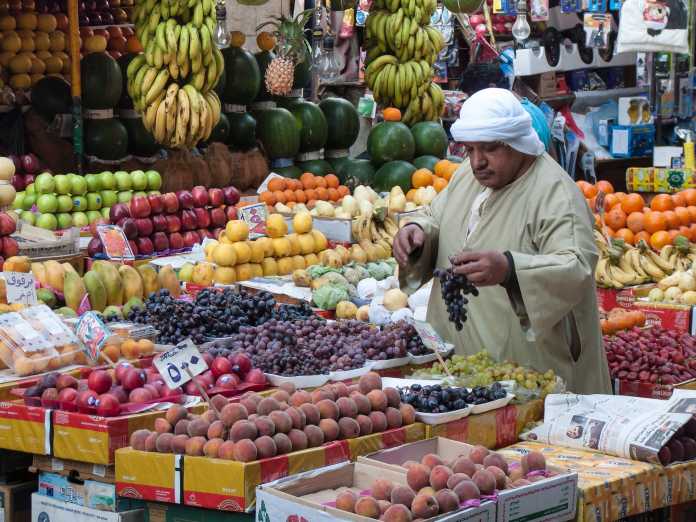
Google News today is promoting articles (see the Google-promoted PhysOrg article here, for example) about a speculative World Bank “study” claiming climate change is threatening crop production in the Middle East. The World Bank study is full of speculation but short on facts. Real-world data show crop yields per acre and total crop production are consistently and dramatically rising in each of the Middle East countries examined by the World Bank study.
In its study, titled “Water in the Balance,” the World Bank says, “[w]hile information about water scarcity at present and in the future is available there is little knowledge of what this increasing scarcity means for Middle Eastern … food security. Agriculture will suffer because of climate change and water scarcity….”
In particular the World Bank asserts water scarcity caused by climate change will reduce farm production in Iran, Iraq, Jordan, Lebanon, Syria, and Turkey. The available evidence strongly suggests that will not happen.
Had the study’s authors examined real-world data concerning crop production in the Middle Eastern countries, they would have found, even amidst substantial strife in the region, crop yields and overall production have increased dramatically. More food is being produced even as thousands of acres of agricultural lands have been abandoned during regional conflicts.
Data from the U.N. Food and Agriculture Organization show during the period of modest warming since 1989:
- Cereal crop production in Iraq increased 91 percent, even as the acreage being harvested fell 5 percent.
- Cereal crop production in Iran increased 187 percent, while the acreage harvested increased by just 2.6 percent.
- Cereal Crop production in Jordan increased 15 percent, even as the acreage harvested declined 30 percent.
- Cereal Crop production in Lebanon increased 115 percent, while acreage harvested increased 30 percent.
- Cereal Crop production in Syria increased 22 percent, even as acreage harvested declined 66 percent.
- Cereal Crop production in Turkey increased 46 percent, even though acreage harvested declined 19 percent.
It is clearly good news – and not a climate crisis – that Middle Eastern countries have increased crop production despite the fact that many of them have been embroiled in internal political strife, outright civil warfare, and external conflicts. That good news is ignored in the World Bank’s doom-and-gloom report.
Global warming lengthens growing seasons, reduces frost events, and makes more land suitable for crop production. Also, carbon dioxide is an aerial fertilizer for plant life. In addition, crops also use water more efficiently under conditions of higher carbon dioxide, losing less water to transpiration. The latter fact should have allayed the World Bank’s concern about climate change induced water shortages leading to crop failure.
The benefits of more atmospheric carbon dioxide and a modestly warming world have resulted in 17 percent more food being available per person today than there was 30 years ago, even as the number of people has grown by billions. Indeed, the last 20 years have seen the largest decline in hunger, malnutrition, and starvation in human history.
Sorry, World Bank, Google, and PhysOrg, but that does not equate to a climate crisis.
H. Sterling Burnett, Ph.D. is managing editor of Environment & Climate News and a research fellow for environment and energy policy at The Heartland Institute. Burnett worked at the National Center for Policy Analysis for 18 years, most recently as a senior fellow in charge of NCPA’s environmental policy program. He has held various positions in professional and public policy organizations, including serving as a member of the Environment and Natural Resources Task Force in the Texas Comptroller’s e-Texas commission.
Under US Commands, SDF Seizes Civilian Houses in Hasakah, Northeastern Syria
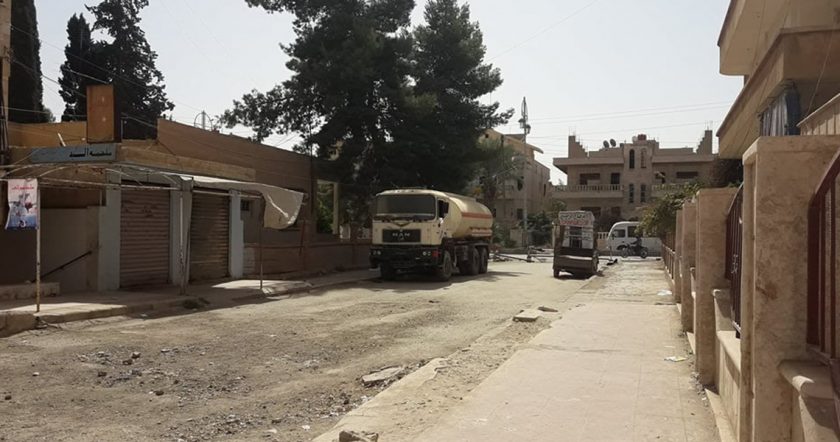
Houses in al-Hasakah city, specifically in “al-Barad al-Alee” street inside the security square in the city, taken on October 26, 2017. Photo credit: STJ
By Khaled Iskef | American Herald Tribune | November 2, 2020
SDF members stormed a residential complex in the “Al-Nashwa Al-Sharia” neighborhood of Hasakah city and seized houses there by force after expelling its residents at gunpoint.
Local sources said that “SDF” members, after threatening the residents and demanding they evacuate the houses, stormed the residential complex and seized a number of Syrian governmental buildings which are the General Company for Water Projects and the General Company for Roads and Bridges.
Twenty families of government employees were displaced, who have lived in the neighborhood for decades and found themselves without shelter under the SDF threat to use weapons against their families if they refrain from evacuating. The sources pointed out that the targeted housing complex oversees the government buildings which US forces have captured and taken as their bases since residents of the complex can watch the transfer of weapons and ammunition in addition to US forces’ operations in the region.
“SDF” members also stormed the housing association dwellings of officers, non-commissioned officers, and members of the Syrian Army in the “Al-Omran” neighborhood in Hasakah city, and told the residents to evacuate within 48 hours. The dwellings contain 100 houses that belong to the retired officers and non-commissioned officers and their inheritors who have bought the houses within years, but SDF targeted them as well in the implementation of US orders.
Leaked papers: UK ran secret training & PR op for Syrian militants costing millions, despite knowing risks
By Kit Klarenberg | RT | October 27, 2020
A swath of what appear to be secret Foreign & Commonwealth Office documents outline a multimillion-pound British effort to train rebel fighters in Syria via private companies, knowing but brushing off the risk of jihadist hijack.
The documents released by the hacktivist collective Anonymous appear to expose a variety of covert actions undertaken by the UK government against the Syrian state over many years.
The overriding objective behind them all, the papers suggest, was to destabilise the government of Bashar Assad, convince Syrians, Western citizens, foreign governments, and international bodies that the Free Syrian Army (FSA) was a legitimate alternative, and flood media the world over with pro-opposition propaganda.
The dimensions of the assorted information warfare operations implied in the papers, some of which have been detailed by the Grayzone Project, were vast. In a representative example, “social enterprise” firm ARK, founded by veteran Foreign & Commonwealth Office (FCO) operative Alistair Harris, “rebranded” the Syrian Military Council, “softening the Free Syrian Army’s image” in order to “distinguish it from extremist armed opposition groups and establish the image of a functioning, inclusive, disciplined and professional military body.”
Training ‘credible and effective’ militants
At least one cog in this cloak and dagger connivance was overtly militant in nature. From August 2016, a consortium of private contractors ran a programme for the FCO, through which “training, equipment, and other forms of support” was provided to the FSA’s ‘Southern Front’ coalition, to “foster a negotiated political transition, support moderate structures and groups in opposition held areas of Syria, counter violent extremism and prevent the establishment of a terrorist safe-haven.”
Under its clandestine auspices, up to 600 belligerents were trained every year the operation ran, an indeterminate total – the endeavour was dubbed MAO B-FOR (Moderate Armed Opposition Border Force Capability Project), and forecast to cost the FCO £15,767,599.
B-FOR’s ‘statement of requirements’ document sets out in succinct detail Whitehall’s objectives in pursuing the project.
“The aim… is to generate pressure on the Assad regime and on extremists, in the south the country… If MAO border groups are better able to secure and maintain control of specific areas of responsibility across liberated near-border communities along Syria’s southern border with Jordan… the MAO will demonstrate its tangible value to the local and international community as an effective security actor… This will reinforce perceptions that there is a credible and effective moderate opposition able to provide support for an alternative pathway to political transition,” the project tender states.
In practical terms, fighters in “international borders under MAO control” and “areas bordering MAO control under the control of another entity or under no control” – the Jordan-Syria border being the FCO’s “current priority area” – were intended to be “better able to control their AOR [areas of responsibility] through effective use of relevant tactics, operations, equipment, infrastructure, and ability to react to a changing tactical situation.”
To this end, the UK government provided a “dedicated training site” in Jordan “at no cost” to project contractors. The site is situated 45 minutes from the Jordanian capital, Amman, according to an annotated Google Earth snapshot found among the leaked papers. The 600-acre expanse comprised “accommodation, ablution, dining, classrooms, driving track, outside rural environment areas, and open space for equipment storage solutions.” In particular, trainees were to be tutored in the effective use of AK-47s, PK machine guns, and pistols, with 175 fighters able to be accommodated on-site at a time, four weeks the maximum period they could be tutored there continuously.
Contractors were also asked to ensure the project took into account, among other things, Whitehall’s “policy toward gender” – a reflection, just like the tender’s references to “reinforcing perceptions,” of B-FOR’s strong psychological component.
‘Kill, Burn and Loot’
In response, global advisory firm Adam Smith International (ASI) apparently submitted an extensive proposal to the department, offering to head a consortium of contractors, comprised of Pilgrims Group, Kellogg Brown & Root (KBR), Oakas, and GlenGulf.
We have reached out to the companies for comment.
In terms of project roles, ASI – which according to the proposal had been operating in Syria since early 2013, and boasted “well over” 100 field staff in the country – was to provide “strategic stakeholder engagement, project management, project leadership positions, conflict research and analysis and monitoring and evaluation functions.” Pilgrims Group – said to have “supported a large number of media organisations operating in Ukraine” – was tasked with “training delivery, initial military skills assessment, training programme design.”
KBR – which has reaped untold millions from a variety of US conflicts, been embroiled in numerous high-profile scandals, and was reportedly nicknamed “Kill, Burn & Loot” by US marines during the Iraq War – had responsibility for “manning procurement and logistics functions,” including providing the facility’s “quartermaster, storemen and a liaison officer at the key port of entry for imported goods.” Oakas was to offer “bespoke training for MAO command elements (‘battle staffs’) on decision making and planning,” and GlenGulf the “provision of training to officers and commanders on human intelligence gathering and management.”
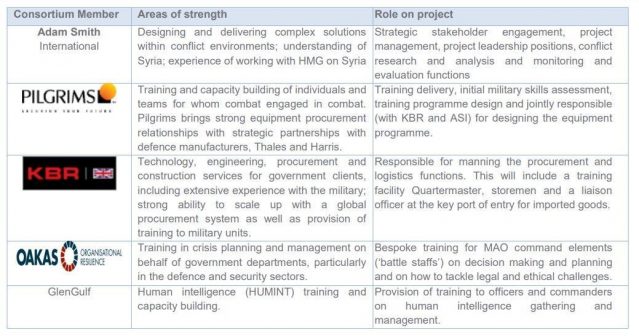
Excerpt from alleged ASI document
Accompanying project staff CVs reveal many individuals involved in B-FOR were senior UK military veterans, who all received sizeable three-figure per diem fees for their participation. For instance, its ranks included a former senior British military advisor to US Central Command, experience ASI claims granted him “in-depth knowledge” of the Syrian “context.”
US-backed rebel front collapses
Part of that context at the time would’ve been the virtual collapse of Southern Front as a serious fighting force. Formed in February 2014 at the behest of the US Military Operations Command (MOC) in Jordan, the Front was a coalition of 50-60 rebel groups. As ASI’s proposal notes, its constituent factions were “given various types of support from the MOC,” including “small arms, artillery, anti-tank guided missiles, ammunition, vehicles, communications equipment, and uniforms,” the Command also paying fighters’ salaries.
Washington’s largesse was fundamental in the Front scoring a series of victories over government forces throughout 2014 and the first half of the next year. In the process, it became the largest rebel umbrella organization in southern Syria, comprising 25-30,000 fighters, and challenging the political and military dominance of Salafist Al-Nusra, the region’s then-largest jihadist group. The mainstream media widely promoted the Front as Western leaders’ best hope of achieving a “moderate” Syrian “revolution” – despite many of its units frequently cooperating and collaborating with Al-Nusra.
However, an over-ambitious attempt by the Front to wrest the city of Deraa’s northern and eastern districts from government control in June 2015 ended in embarrassing failure. The cataclysm led to almost total cessation of MOC support, which in turn meant the Front lost much of its operational capabilities and many of its fighters, who defected in droves to other rebel groups offering salaries. Saudi Arabia subsequently stepped in to provide weapons and fresh funding to the ailing force – B-FOR represented London’s illicit contribution to keeping it functional, and ASI’s proposal makes clear the consortium well-understood the many risks attached to the project.
Risks known, responsibility offloaded
A lengthy section of ASI’s proposal – ‘oversight and management of threats and risks’ – details some of these myriad hazards, along with their likelihood and impact. It was considered highly probable, for instance, groups such as Al-Nusra and ISIS would interfere in the program, “due to perceptions of an ‘international political agenda’” – as a result, extremists “may seek to prevent trainees from joining or inhibit them from fulfilling their functions once trained via kidnap, assault and theft of equipment.”
The possibility that the consortium’s curated fighters may choose or be forced to join other, non-border force Southern Front operations, in turn “[leading] to a weakening of the border capability and perception of UK support to active military operations,” was rated as “medium.” Border force trainees collaborating with extremist actors and/or committing human rights abuses, in the process compromising “the legal and reputational viability of the programme,” was likewise considered of “medium” likelihood and impact.
ASI’s proposed method of dealing with these and other dangers was almost invariably to simply “transfer” responsibility for “owning and managing” the problem to the FCO itself, even suggesting the UK government must simply “tolerate” failings such as the loss of equipment “to a reasonable degree.”
It seems the FCO either acquiesced to shouldering the inherent burdens, or was intensely relaxed about such issues, for the consortium was duly awarded the B-FOR contract, judging by other papers found in the leak.
Non-Disclosure Agreements signed June 10, 2016 by the firms involved indicate they were obliged to adhere to the stringent confidentiality requirements of the 1911 and 1989 Official Secrets Acts, forbidding them from “disseminating any information related to the project to any third party.” Meticulous instructions for disposing of ‘secret’, ‘restricted’, and ‘confidential’ FCO communications were also included.
‘Jihadis You Pay For’
It’s uncertain how many years, or perhaps months, B-FOR endured. Its ‘statement of requirements’ forecast the project would “cover a period until 31st March 2019 with a clause for a breakpoint at the end of each financial year.”
However, in February 2017, a report by Parliament’s international development committee found ASI staff had submitted fake testimonials from aid recipients to a House of Commons inquiry into its activities, set up in response to allegations the firm had been seeking improper financial benefit from UK aid spending.
In response, DfID blocked the company from bidding on future government contracts, and the next month, ASI’s three founding executives resigned. Even more damningly, in December that year, a BBC Panorama documentary (Jihadis You Pay For) exposed how FCO cash ASI distributed in Syria had ended up in extremists’ pockets.
The investigation focused on the FCO’s Access to Justice and Community Security (AJACS) program, under which ASI funded and trained the Free Syria Police, an unarmed civilian force set up to re-establish law and order in opposition-controlled areas.
It found ASI had identified links between several FSP stations and sharia courts run by Al-Nusra and not ended its funding of the stations, or compelled them to sever all connections with the courts – FSP officers in theoretical receipt of FCO funds via ASI had also been present when women were stoned to death. Troublingly, ASI’s B-FOR pitch states its “experience and knowledge” of running AJACS will be “leveraged” to ensure optimal delivery of the border project.
Whether B-FOR was quietly shelved or simply handed over to other contractors in response to these damaging exposures is unknown. In any event, in July 2018, the Front was comprehensively crushed by pro-government forces, its surrendering fighters either agreeing to reconciliation deals or fleeing to Idlib.
It’s also unknown how many fighters trained via the program went on to join jihadist groups, and how much equipment was “lost” over the course of its operation, ending up in the hands of extremists and used to slaughter and maim innocent civilians. The companies running the operation, much less the UK government, certainly weren’t keeping count.
Kit Klarenberg is an investigative journalist exploring the role of intelligence services in shaping politics and perceptions. Follow Kit on Twitter @KitKlarenberg
Syria: Six Million Displaced People Have Returned Home
teleSUR – October 23, 2020
On Thursday, Syrian authorities announced that six million displaced people had returned home to different parts of the country.
The Minister of Municipal Administration and Environment, Hussein Makhlouf, said to the People´s Assembly that one million refugees had returned to Syria, and 5 million internally displaced people were back at their homes.
The official said that this achievement was possible after the rehabilitation of infrastructure and roads, collecting and disposing of 4 million cubic meters of waste and debris from them.
Moreover, the authorities reported that they had repaired more than 19,000 houses while supporting waste recycling projects to secure 18,000 job positions.
As the country tries to overcome aggression and sanctions from the U.S. and the European Union, the government plans to create more homes and announces that 11 new artisanal zones were established in Tartous, Quneitra, Homs, and Hama provinces. Also, with China’s support is has imported transportation, including buses and 708 vehicles for the cleaning sector.
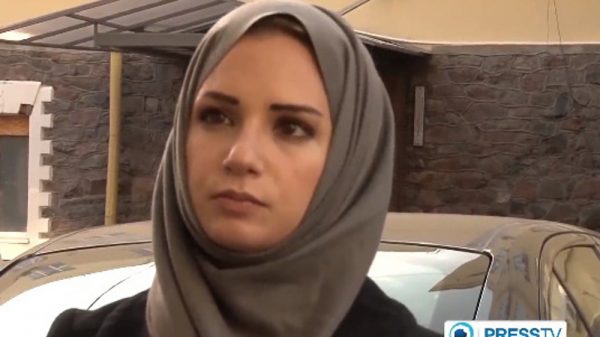
Reporter Serena Shim remembered six years after suspicious death near Turkey
Press TV | October 18, 2020
Six years after her suspicious death, Press TV reporter Serena Shim is remembered as one of the first journalists to have exposed the involvement of the US-led Western countries and their regional allies in igniting the foreign-sponsored terrorism in Syria, a daring act of investigative journalism for which she paid with her life.
The investigative reporter died in October 2014 while covering the ongoing siege by the Daesh Takfiri group of the Syrian-Kurdish border city of Kobani for Iran’s Press TV. She was the lone fatality following a suspicious car crash in Turkey’s Sanliurfa province.
She was reporting firsthand on the presence of Daesh and other al Qaeda-affiliated militant groups operating freely along the Turkey-Syria border. She revealed the weapons transfers and the trucks being driven into Syria by the terrorists themselves.
Shim had gathered evidence of militant training camps operating near the Turkey-Syria border.
She was, in her own words, one of the first, if not the first, on the ground to report on “Takfiri militants going in through the Turkish border”. These include not only Daesh but also terrorists from the so-called Free Syrian Army.
As Shim’s sister Fatmeh Shim stated in 2015, “She caught them bringing high-ranked Daesh members into Syria from Turkey into camps, which are supposed to be Syrian refugee camps.”
Shim said trucks belonging to some international aid agencies were being used to funnel terrorists’ arms into Syria, and stated this in her last interview, just one day before being killed.
On October 19, 2014, Shim, along with her camerawoman, was returning to their hotel after preparing a report near Kobani south of the Turkish border, where a heated battle was taking place between Daesh and the city’s defendants.
Early reports claimed that Shim died at the scene while later accounts suggested that she passed away due to heart failure after being transferred to hospital nearly 30 minutes later. Shim’s camerawoman, who had been transported to a different hospital, survived the incident.
Turkish authorities blamed Shim’s camerawoman, who had been driving the vehicle, for the crash. No further inquiry was reported to have been carried out by Ankara.
Many doubts, however, linger regarding the official testimony provided by the Turkish officials.
Today’s Zaman reported that prosecutors were seeking six years in prison for the operator of the concrete mixer instead, accusing the driver of causing “death through negligence.” The trial, allegedly set for March 2015, never occurred.
Six years following her unfortunate death, no further information has been released regarding the fatal accident.
Observers have pointed out that “car accidents” have been a “commonplace method” used by the Turkish National Intelligence Organization (MIT) to get rid of people it doesn’t like.
Although all signs point to foul play, until now the US government has neither conducted nor demanded an inquiry into the events of the alleged car accident which Turkish officials say was the cause of Shim’s death.
Two weeks after the incident, the US State Department issued a brief statement regarding Shim, who was an American citizen of Lebanese origin, saying that it “does not conduct investigations into deaths overseas.”
The journalist’s tragic death came only two days after Shim had spoken out live on Press TV about being targeted by the MIT, who had accused her of being a “spy” while the journalist covered the latest developments in Turkey and Syria.
“I am a bit worried, because as you know and as the viewers know, Turkey has been labeled by Reporters Without Borders as the largest prison for journalists, so I am a bit frightened what they might use against me.”
Shim explained that she had been targeted for her investigative reports regarding Ankara’s direct support for terrorist groups, such as Daesh in Syria, whose evidence had been largely concealed at the time.
“We were some of the first people on the ground, if not the first people on the ground, to get that story of those Takfiri militants going in through the Turkish border — the Bab al-Hawa border — being sent in. I’ve got images of them in World Food Program trucks. It was very apparent that they were Takfiri militants by their beards and by the clothes that they wore. And they were going in there with NGO trucks,” she said.
The 29-year-old reporter had been described by her colleagues as an aspiring journalist with much potential. The young journalist had spent years working in various dangerous conflict zones such as Iraq, Syria, Turkey and Ukraine.
The Turkish government has been accused of supporting various terrorist groups seeking to topple Syrian President Bashar al-Assad since the onset of the foreign-backed terrorism nine years ago.
Over the past four years, the Turkish military has staged at least two unauthorized incursions into northern Syria to push back against Kurdish militants, whom Ankara says seek to overthrow the Turkish government.
The aggression prompted the areas’ Kurdish population to ask the Syrian government for protection against the Turkish forces.
Ankara, which backs Syria’s anti-government militants, currently has hundreds of Turkish troops in the northwest of the Arab country.
In recent years, Western terrorists within the ranks of Daesh in Syria and Iraq have been seeking their countries’ help to secure their return to their motherlands as the Takfiri group continues to suffer heavy losses in the two Arab countries.
Some of the Daesh terrorists have contacted diplomatic missions in Turkey while others have secretly sought their governments’ help in leaving dwindling Daesh-held territory.
Non-Aligned Movement Demands Israel Withdraw to 1967 Borders With Syria
By Ilya Tsukanov – Sputnik – 10.10.2020
The 120 member-strong Non-Aligned Movement (NAM) has issued a political declaration whose demands include Israel withdrawing from occupied Syrian territories in the Golan Heights.
In a statement published Friday after a virtual ministerial meeting, the NAM said its members “condemn all measures taken by Israel to change the legal, physical and demographic status of the Occupied Syrian Golan, and demand once again that Israel should abide by the United Nations Security council resolution 497 (1981), and to withdraw fully from the Occupied Syrian Golan to the borders of 4 June 1967, in the implementation of Security Council resolutions 242 (1967) and 338 (1973).”
In addition, the NAM reiterated that “a just, lasting solution to the question of Palestine in all its aspects must remain its priority and also a permanent responsibility of the United Nations until it is satisfactorily resolved in all aspects in accordance with international law and the relevant United Nations resolutions.”
The group of nations also reaffirmed the need to “respect the territorial integrity, sovereignty, the sovereign equality, political independence and inviolability of international borders of other states,” and to refrain from intervention in other countries’ internal affairs.
Established in 1961 at the height of the Cold War between the Soviet Union and the United States, the NAM was seen as an alternative to the idea of a bipolar world order of two competing military blocs. Today, the NAM consists of 120 member nations, with most countries in the Middle East and Africa, plus much of Latin America and Asia and several post-Soviet republics among its members. China, Mexico, Brazil and more than a dozen other countries serve as observers.
The Trump administration formally recognised Israeli “sovereignty” over the Golan Heights in March 2019. Dozens of countries, including the US’s European allies, condemned the decision. Russian Foreign Minister Sergei Lavrov called it a “conscious, deliberate demonstration of lawlessness.”
Earlier this summer, on the occasion of President Trump’s birthday, Israeli Prime Minister Benjamin Netanyahu announced “practical steps” to create a so-called “Trump Heights” settlement in the area to honour the President’s recognition of Israeli control over the territory. The Israeli government plans to allocate some $2.3 million for construction of the settlement.
Israeli Prime Minister Benjamin Netanyahu speaks during the inauguration of a new settlement named after President Donald Trump in Golan Heights, Sunday, June 16, 2019.
Israel occupied the Golan Heights in June 1967 after launching a preemptive air strike against Egyptian airfields and thereby starting the Six Day War against a coalition of Arab states including Egypt, Syria and Jordan. In 1981, Tel Aviv formally annexed the territory, but the decision was not recognised by the Security Council, including the US, despite its alliance with Israel. In December 1981, the Security Council unanimously declared that Israel’s move was “null and void”. Behind the scenes, however, the Reagan administration did not press Israel to rescind its decision, and in January 1982 Washington and its allies vetoed a second resolution calling on the international community to take action to put pressure Israel.
Damascus has repeatedly stressed that it would never give up its sovereignty over the Golan Heights, and has warned that it has the right under international law to regain its territories using any means necessary.
Along with the Golan Heights, Israel continues to occupy a 22 sq km strip of Lebanese territory known as Shebaa Farms, as well as the internationally recognised Palestinian territories of the West Bank, East Jerusalem and the Gaza Strip.
The War on Truth, Dissent and Free Speech
Syria, the OPCW Douma Investigation and the Working Group on Syria, Propaganda and Media
Dr Piers Robinson | OffGuardian | October 6, 2020
On Saturday 13 June 2020 the Times newspaper published its third attack on academics associated with researching British government propaganda and the war in Syria. This time the attack focused on smearing myself and Professor David Miller with the objective of discrediting an academic organization we established, the Organisation for Propaganda Studies (OPS), designed to foster research and writing on propaganda.
The article contained multiple falsehoods and distortions and was similar in style to previous attacks aimed at character assassination mainly through employment of the ‘conspiracy theorist’ smear. Most prominently the hatchet pieces misleadingly conflated work by members of the Working Group on Syria, Propaganda and Media (WGSPM), of which myself and Miller are also members, with the OPS. Formal complaints from the OPS are in process and the Times has already been forced to issue a number of corrections.
Of course, character assassination as a propaganda tactic is widespread and there is even a Routledge academic handbook on the subject, the ‘Routledge Handbook of Character Assassination and Reputation Management’, which was published in 2019 and contains 30 odd chapters. The attacks by the Times have been amplified by similar pieces written by Chris York for the Huffington Post.
In total, approximately 20 articles have been produced attacking those of us who are working on the war in Syria and questioning important aspects of UK propaganda operations. The bulk of these articles have been written by just two journalists, Dominic Kennedy for the Times newspaper and Chris York for the Huffington Post. This represents an extraordinarily intensive and sustained campaign against us.
Why on earth have we gotten into so much trouble?
A history of the attacks is instructive. Attention first started to be paid by former Guardian journalist Brian Whitaker in February 2018 when he penned a series of crude hatchet pieces on his blog smearing academics associated with the then newly established WGSPM. At that point Huffington Post journalist Chris York had already been attempting for several months to make contact with me, Professor Tim Hayward and journalist Vanessa Beeley.
But it was several weeks after Whitaker’s smears that the attacks started in earnest. Following the now controversial alleged chemical weapon attack in Douma, Syria, on 7th April 2018, the US UK and France bombed Syrian government targets claiming Syria was responsible for the attack. At the same moment these air attacks were underway, the Times of London published four articles which included one on the Front page, photographs of some of us from WGSPM and an editorial.
These articles smeared the academics as ‘conspiracy theorists’ for questioning official narratives regarding chemical weapon attacks in Syria, as ‘Assadists’ and also implied the existence of nefarious links with Russia. Chris York of the Huffington Post then followed the Times attack with multiple articles attacking us. The articles followed a similar pattern to the Times’ hatchet pieces involving allegations of ‘conspiracism’, ‘war crimes denial’, being pro Assad and pro Putin etc. More than two years later, attack pieces are still being published.
The vast bulk of the output of WGSPM has concerned the issues of alleged chemical weapon attacks in Syria and, in particular, the Douma event. The working group’s briefing notes documented serious anomalies and issues regarding these attacks and, in particular, critically analysed both the OPCW investigations of these alleged attacks and also identified the involvement of UK-linked actors, including the late James Le Mesurier (founder of the White Helmets) and Hamish de Bretton-Gordon.
The evidence, as the working group briefing notes set out, is that the OPCW Douma investigation was manipulated in order to ensure the finger was pointed at Syrian government responsibility for the alleged chemical weapon attack. In reality, the evidence did not demonstrate an attack had occurred and, in fact, pointed toward the attack having been staged.
Our findings have been presented at an event at the UK House of Commons and at the Harvard-Sussex Program on Chemical and Biological Weapons.
The WGSPM has not been alone in raising questions and a wide body of material now corroborates its work. For example, even at the time of the Douma attack credible individuals voiced doubt about the likelihood of the Syrian government launching a chemical weapon attack in Douma just as its forces were on the brink of retaking the enclave.
For example, both retired Major General Jonathan Shaw and Admiral Lord West questioned the tactical logic of any such an attack and the latter raised the possibility the event was carried out by opposition groups.
Following the publication of the final OPCW report on Douma in March 2019, an engineering report was leaked to WGSPM and which concluded that the chlorine gas cylinders had likely been manually placed at the alleged attack scenes rather than having been dropped from a Syrian air force helicopter. This engineering report, it subsequently transpired, had been rejected by OPCW management on spurious grounds.
During the Autumn of 2019 the Courage Foundation hosted a panel at which a former OPCW official briefed a panel of trusted and authoritative individuals, including José Bustani the first Director General of the OPCW, about significant procedural and scientific flaws regarding chemistry, ballistics, toxicology and witness statements.
An open letter addressed to OPCW states parties from the Courage Foundation followed and was signed by eminent voices such as Professor Noam Chomsky, Hans von Sponeck (former UN Assistant Secretary-General), GCHQ whistleblower Katharine Gun, former UNSCOM weapons inspector Scott Ritter, film director and producer Oliver Stone and John Pilger.
Since then, multiple documents have been published by Wikileaks evidencing irregularities with respect to the Douma FFM investigation whilst journalists such as Peter Hitchens (Mail on Sunday ), Stefania Maurizi (formerly of La Repubblica ) and Robert Fisk (The Independent ) have reported on the issue.
Peter Hitchens has been a particularly vociferous voice defending the reputations of two OPCW staff who have been subjected to a malicious internal investigation aimed at smearing their reputations. In 2020, further leaks have been published by The Grayzone in the United States including statements from further OPCW persons and, most recently, Aaron Maté published an article in the leading US current affairs magazine The Nation.
Finally, and by no means least, former OPCW inspector Ian Henderson addressed an Arria Formula meeting of the UN Security Council at which he detailed the irregularities and misconduct he had experienced with respect to the FFM Douma investigation. In September 2020, a second Arria Formula meeting was held at which OPCW Syia FFMs and the Douma investigation were again debated and which included, again, the former OPCW Inspector Ian Henderson. And, this week at a UN Security Council meeting, a statement from OPCW First Director-General José Bustani was read out in which yet again raised concerns about the conduct of the OPCW Douma investigation.
To any casual observer it should be abundantly clear that the activities and output of the WGSPM is entirely legitimate. Our work has been at the forefront of an issue that has been discussed by mainstream media journalists and has been corroborated by information from people within the OPCW itself.
Why then have the Times of London and the Huffington Post published approximately 20 articles (including three Times leaders) in 2 years targeting us?
In general, the behaviour of both the Times and the Huffington Post is disturbing and suggestive of a deliberate campaign aimed at suppressing public debate regarding both the war in Syria and the involvement of the UK government in supporting activities aimed at the overthrow of the Syrian government.
UK involvement in the Syrian war has included direct support for opposition groups as well as potentially criminal activity relating to the OPCW and connection with the staging of alleged chemical weapon attacks.
In the last few weeks, a large volume of FCO documents have been leaked which document a vast ‘strategic communication’ operation aimed at supporting the war against Syria. According to Ben Norton from the Grayzone:
[V]irtually every major Western corporate media outlet was influenced by the UK government-funded disinformation campaign exposed in the trove of leaked documents, from the New York Times to the Washington Post, CNN to The Guardian, the BBC to Buzzfeed.
In fact, there are some indications that the media attacks might be the direct result of deliberate media alignment with the UK government position on Syria and its well-established policy seeking to overthrow the existing Syrian government. Specifically, two of the authors of the original Times attack on the academics, Dominic Kennedy and Deborah Haynes, are identified in leaked documents as being associated with the UK government-funded propaganda operation known as the Integrity Initiative.
The Integrity Initiative leaks provided powerful insights on how propaganda operations were being built around “clusters” of journalists. Haynes has subsequently denied involvement with the article whilst Kennedy has repeatedly refused to answer questions regarding the relationship between his articles and the Integrity Initiative.
Most notably, Times columnist Oliver Kamm has stated in public that the late James Le Mesurier ‘had reached out to this newspaper to urge us to keep on their [the academics] case’.
Regarding Huffington Post, Chris York’s line manager, Jess Brammar, is a member of the Defence and Security Media Advisory Committee which works with the UK government on influencing and controlling media reporting of defence and security related issues. Further information regarding the organizational details and scale of media-related activities aimed at suppressing criticism of UK Syria policy is still being investigated and information will be published in due course by WGSPM.
However, even if it is, as of yet, unclear whether the attacks are at the behest of those involved in UK government/FCO strategic communication operations related to Syria, it is certainly the case that they have a deleterious impact on open public debate and academic research. People might reasonably expect mainstream media to uphold, defend and encourage research and debate, as opposed to smear honest academics who are simply doing their jobs.
Even more seriously, the available evidence indicates that the alleged attack in Douma involved the murder of captive civilians. That means the event surrounding Douma likely involve an extremely serious, and indeed horrific, war crime. Those seeking to hinder those in pursuit of the truth run the risk of complicity, whether knowing or unknowingly, in a war crime and run legal jeopardy as a result.
A final note. The late Julian Perry Robinson, one of the world’s leading experts on chemical and biological weapons, was in communication with the Working Group. In an earlier era, Robinson played a key role challenging the false claim made by the US government that Soviet-backed forces in Laos and Cambodia were deploying toxins.
At the time of his death, he was completing a chronology regarding chemical weapons and the war in Syria. Writing about the events surrounding alleged chemical weapon attacks in Syria and the vicious attacks against WGSPM, he noted that:
It is not immediately clear from their pronouncements that the critics of the WGSPM just quoted have in fact adequately studied the Group’s publications. They certainly seem not to have done their reading with the care that might have been expected ahead of such vicious denigrations.
So is the Group simply becoming a victim of the fake news and other acts of information warfare it has itself been seeking to counter? Is the WGSPM being maliciously targeted by enemies that its principled research and outreach seem to have created?
— Part 8: The Chemical Warfare Reported From Syria: a documented chronology detailing reports of events in Syria since 1982 said to have involved use of chemical weapons, by Julian Perry Robinson
It was Julian Perry Robinson who subsequently invited WGSPM member Professor Paul McKeigue to present at the Harvard-Sussex Program on Chemical and Biological Weapons roundtable meeting in March 2020.
If a figure of such standing and brilliance wished for his colleagues to hear our analysis, where does this leave the Times and the Huffington Post who have so relentlessly sought to silence us through character assassination and smears?
Not, I would suggest, in a very good place.
Russia slams ‘disgraceful’ ban on founding OPCW chief speaking at UN Security Council on Syria
RT | October 6, 2020
An ex-OPCW chief, sacked under US pressure, has been barred from briefing the UN Security Council about a controversial probe into an alleged 2018 chemical attack in Syria. Russia called it a “shame” and published his speech.
Jose Bustani, a Brazilian diplomat who led the Organization for the Prohibition of Chemical Weapons (OPCW) from 1997 until 2002, was invited by Moscow to speak at a UN Security Council meeting about the so-called “Syrian chemical dossier,” but his appearance was blocked at the last minute by Belgium, Germany, Estonia, France, the US and the UK.
“What has happened now is yet more sad proof that Western delegations fear the uncomfortable truth,” Russia’s ambassador to the UN, Vassily Nebenzia, stressed while addressing the UN global body on Monday.
He said the six countries had “made history” because the Security Council has never voted “on the presence or absence of a briefer proposed by the [UNSC] president.” Prohibiting the former OPCW director general from speaking was a “shame and disgrace,” Nebenzia concluded, promising to publish Bustani’s statement after the meeting.
UK envoy Jonathan Allen said that Bustani is not in a position to “provide relevant knowledge or information.”
Shortly afterwards, the undelivered speech appeared on the website of the Russian mission to the UN. In it, the sacked OPCW chief raised “serious questions” over “whether the independence, impartiality, and professionalism of some of the organization’s work is being severely compromised, possibly under pressure from some member states.”
As a major example, Bustani cited an OPCW investigation into the alleged use of chemical weapons in the Syrian city of Douma on April 7, 2018. Western governments, and media outlets, maintain that forces loyal to Damascus dropped two gas cylinders as part of an offensive against jihadist forces, killing scores of civilians.
The allegations were used as a pretext for a major US-led airstrike against Syrian government forces later that year. The OPCW launched a probe into the “chemical attack,” and in early March of 2019, the final report by the Fact-Finding Mission (FFM) of the OPCW stated that there were “reasonable grounds” to believe that canisters filled with “molecular chlorine” were dropped from Syrian aircraft in Douma.
The final report gave credence to the Western show of force by implicating the Syrian government of Bashar Assad in conducting the attack, which the Syrian authorities vehemently deny.
Shortly after the release of the OPCW report, an internal memo by OPCW engineers was leaked, suggesting the canisters were likely just placed at the site of the “attack,” and did not come from the skies. Still, the final report did not include such information, and a senior OPCW official reportedly ordered the removal of “all traces” of the dissenting opinion, according to WikiLeaks.
Months later, Bustani noted that he was invited to an expert panel which heard the testimony of an unnamed OPCW investigator, who came forward with damning evidence that his own organization had engineered a report based on a flawed conclusion and likely deliberately steered toward the outcome favored by the West.
That expert provided “compelling and documentary evidence of highly questionable, and potentially fraudulent conduct in the investigative process,” Bustani’s statement recalled. The Brazilian diplomat had been so stunned by the testimony that he personally called on the OPCW to be “resurrected to become the independent and non-discriminatory body it used to be.”
However, he continued, the chemical weapons watchdog did not respond to any calls for greater transparency about the controversial Douma investigation. The probe was “hidden behind an impenetrable wall of silence and opacity, making any meaningful dialogue impossible.”
In conclusion, Bustani called on Fernando Arias, the current OPCW chief, to hear the grievances of OPCW inspectors who voiced dissenting opinions on the Douma incident. They “have dared to speak out against possible irregular behavior in your organization,” Bustani argued, adding that it is “in the world’s interest that you hear them out.”
Bustani noted that he had been removed from his OPCW position “following a US-orchestrated campaign in 2002.” Back then, he was trying to send chemical weapons inspectors to Iraq prior to the 2003 US invasion there. A UN tribunal ruled that his sacking was unlawful.
Ex-OPCW Member Says Syria 2018 Chemical Attacks Report May Not Reflect Actual Events
Sputnik – 29.09.2020
A former lead investigator from the Organisation for the Prohibition of Chemical Weapons (OPCW), Ian Henderson, said the final report of the Fact-Finding Mission (FFM) into the alleged use of toxic chemicals in an attack in Douma, Syria, in 2018, may not reflect what happened on the ground.
Henderson was speaking at an informal meeting of the UN Security Council, organised by the Russian Mission, to openly discuss the treatment of the Syrian chemical dossier, in contrast to traditionally closed gatherings of the council on the issue.
“I speak for myself, but I know there are other Douma FFM inspectors who hold the similar concerns that I do about the manner in which the investigation was controlled, locked-down… [as well as] the findings reflected in the final FMM report”, Henderson said. “We believe that there is more than sufficient information out there today that has demonstrated our points that the findings of the FFM report on Duma may not reflect the actual situation”.
Henderson said the launching of a transparent technical inquiry aimed at clarifying the actual course of events in Douma in 2018 is justified, given the scope of the available information and facts on the alleged incident.
“And this needs to be done in a way that demonstrates scientific rigour and integrity because that currently has not been done”, he said. “perhaps, more importantly, we continue to hope that there’s someone who’s willing and able, someone who has the courage to do something about this”.
The OPCW concluded that chlorine was most likely used in the suspected April 2018 attack on the city, which lies on the northeastern outskirts of the Syrian capital. This led the United States, France and the United Kingdom to launch missile strikes on Syrian targets.
The OPCW relied in its probe on data provided by the White Helmets, a rebel-linked group that bills itself as a volunteer rescue force.
However, the group has faced severe criticism from the Syrian and Russian governments who accuse the organisation of supporting terrorists and staging provocations involving chemical weapons aimed at justifying potential foreign interventions.
In December 2019, whistleblowing website WikiLeaks made public documents from the OPCW on the accuracy of the investigation in Douma.
One is an internal email exchange between a senior OPCW official, Chief of Cabinet Sebastian Braha, and his colleagues regarding a technical assessment by Henderson into allegations that the Syrian government had dropped two gas cylinders in a civilian area of Duma from an aircraft.
Henderson, who was assisting the FFM with information collection in Douma, in particular, found that all evidence from the ground suggest that cylinders were placed there manually and, given that the area was not controlled by Damascus at the time, most likely by no one else but the anti-government rebels.
The final report of the OPCW has no mention of these findings. Henderson faced pressure from the OPCW leadership and was eventually fired.
Hack reveals UK’s propaganda campaign to drive Syrian regime change
By Johanna Ross | September 25, 2020
When I reported on the leak of Integrity Initiative documents back in 2018/19 which exposed the extent of the UK’s propaganda war against Russia, I didn’t think it could get much more organised and coordinated than it was. Involving hundreds of journalists and academics across the globe to spin disinformation about Russia and paint the country in as negative a light as possible in the mainstream media, the UK government-funded campaign was as sophisticated as the information war gets. But here we are in 2020, still uncovering the true scope of western government influence on the narrative plugged by the mainstream media. And it doesn’t speak well for our ‘democracy’.
On 8th September the hacker group Anonymous published shocking revelations of how a concerted and organised campaign has been waged to support the anti-government rebels in Syria. One set of documents relates to the NGO ARK, which although brands itself as a humanitarian organisation, effectively functions as a vehicle for western-led regime change. In one of the papers it states:
‘ARK’s focus since 2012 has been delivering highly effective, politically- and conflict-sensitive Syria programming for the governments of the United Kingdom, United States, Denmark, Canada, Japan and the European Union.’
This is a somewhat different picture from the mission statement on their website:
‘ARK was created in order to assist the most vulnerable, particularly refugees, the displaced and those impacted by conflict and instability.’
Sounds lovely doesn’t it? But this organisation is far from charitable. In the last few years it has received $66 million from western governments to drive regime change in Syria. It boasts of relationships with Syrian opposition members that have been built up ‘over the years’, and we know that they date as far back as 2011, if not before, as its documents read ‘ARK staff are in regular contact with activists and civil society actors whom they initially met during the outbreak of protests in spring 2011’.
ARK also had a targeted propaganda campaign package for Syrian media. In the documents it is discussed how best to reach Syrian audiences to promote the regime change narrative, with success being achieved it is said, on digital media such as Facebook, but also through broadcast media. If there was ever any evidence that the mainstream media was bought, this is it:
‘To achieve a strong digital presence, ARK/Accadian will draw on its existing relationships with media organisations… Using its existing networks and connections, ARK/Accadian would target key Syrian satellite TV networks (Orient TV, Souria al-Shaab, Souria al-Ghad, Barada) and regional Arabic networks and primary international channels.’
What is extraordinary is the repeated use of the word ‘independent’ to describe the media outlets being promoted by ARK. The authors are clearly blissfully unaware that by interfering in the media of this sovereign state to promote the overthrow of the government, the media can hardly be termed ‘independent’ but instead an arm of the British state and its own particular political aims and objectives. The document reads:
‘Since ARK first began training citizen journalists in 2012, as part of HMG’s efforts to develop professional, 2 independent and self-sufficient local Syrian media organisations, it has trained more than 200 journalists and has been a key implementer of a multi-donor effort to develop media platforms inside Syria, maintaining close links with these organisations’.
It boasts having produced over 2000 news reports for various mainstream Arabic channels, including Orient, Al Arabiya, Al Jazeera and Sky Arabic which it says are ‘broadcast almost every day’. Some of the statements are pure, straightforward admissions of propaganda:
‘ARK has also facilitated contact between the Syrian opposition and international media, seeking to address the perception of an uncoordinated opposition by fostering the image of a united front.’
It is extraordinary the sheer brassneck with which this author writes about manipulating the Syrian public through propaganda. It has the stated goal of creating the impression of a united Syrian opposition, which of course there never was.
These documents contrast with the UK government’s website on ‘what it is doing in Syria’. There we are told that British involvement is limited to humanitarian aid as it ‘suspended all services of the British Embassy in Damascus and withdrew all diplomatic personnel from Syria in 2012’. The Anonymous hack shows that this is far from the truth. There has clearly been considerable British involvement in fostering regime change in Syria. If it weren’t for these leaked documents, the UK taxpayer would remain completely ignorant as to what foreign meddling is being carried out in his or her name.
For more detailed analysis and context of the hacked documents, please see Ben Norton’s report on The GrayZone.
Johanna Ross is a journalist based in Edinburgh, Scotland.
Featured Video
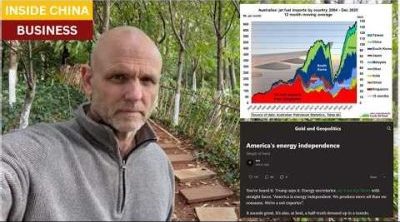
Chinese jet fuel and the myth of energy independence
or go to
Aletho News Archives – Video-Images
Book Review
Former Insiders Criticize Iran Policy as U.S. Hegemony
By GARETH PORTER | CounterPunch | February 27, 2013
“Going to Tehran” arguably represents the most important work on the subject of U.S.-Iran relations to be published thus far.
Flynt Leverett and Hillary Mann Leverett tackle not only U.S. policy toward Iran but the broader context of Middle East policy with a systematic analytical perspective informed by personal experience, as well as very extensive documentation.
More importantly, however, their exposé required a degree of courage that may be unparalleled in the writing of former U.S. national security officials about issues on which they worked. They have chosen not just to criticise U.S. policy toward Iran but to analyse that policy as a problem of U.S. hegemony. … continue
Blog Roll
 Aletho News
- Why no power can undermine Iran’s eternal dominance over the Strait of Hormuz
- Is The War Against Iran Over?
- Iran war will leave long-term ‘scar’ on Wall Street, investors warn
- How Iran decimated US power projection in West Asia: Military lessons of 40-day war
- Iran’s report details US-Israeli war crimes in targeting schools, hospitals, livelihoods
- NATO’s Slow Fracture: How Trump’s Iran War Exposed the Instrument of Hegemony
- Chinese jet fuel and the myth of energy independence
- Ukraine Sea Drone Fired From Libya Hit Russian Tanker in Mediterranean
- IRGC: Iranian forces launched no attacks during ceasefire hours
- Trump Administration Moves To Automate U.S. Military Draft Registration
- If Americans Knew
- TCN: Is Israel Blackmailing President Trump?
- Israel killed at least 303 Lebanese yesterday – who were they? Daily Update
- Amnesty: Urgent – Protect Lebanese civilians from brutal escalation in Israeli attacks
- Is The War Against Iran Over?
- Inside the Israeli army’s propaganda wing
- Hundreds of Gaza Amputees Stranded in Legal Limbo
- The gallows law: Israel moves toward executing Palestinian children
- Tucker Carlson: The Path to Peace requires ending ‘special alliance’ with Israel
- This is ceasefire? Israel’s biggest massacre yet in Lebanon, another journalist killed in Gaza – Daily Update
- Tucker Carlson on Israel: This Is the Behavior of an Ally? Really?
- No Tricks Zone
- An Inconvenient Tree: Uncovered In Alps… Europe Much Warmer Than Today 6000 Years Ago
- New Study Reports A 60% Slowdown In Greenland’s Ice Loss Rate In The Last Decade
- Low Intensity Tornado Wrecks Major Solar Farm, Creating A Potential Toxic Dump
- New Study Finds Warming Saves Lives…Cold Temperatures 12 Times More Deadly Than Excess Heat
- German Science Blog Accuses PIK Climate Institute Of Hallucinating Climate Tipping Points
- Devastating Assessment Of Comirnaty Vaccine By Former Senior Pfizer Europe Toxicologist
- New Study: CO2 Is ‘Effectively Negligible’ As An Explanatory Climate Change Factor Since 2000
- Former Pfizer Toxicologist Dr. Helmut Sterz Tells Bundestag Hearing Pfizer Vaccine Should Have Never Been Approved
- Energy Expert: Germany’s Nuclear Phaseout Was A “500 Billion Euro Mistake”
- New Research: South Australia’s Mid-Holocene Sea Surface Temperatures Were 4°C Warmer Than Today
 Aletho News