How the Pro-War “Left” Fell for the Kurds in Syria
By Max Parry • Unz Review • December 22, 2019
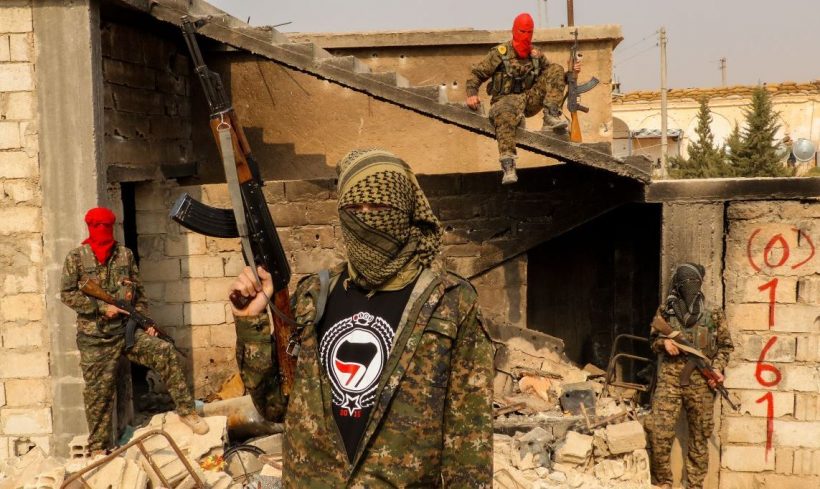
The October decision by U.S. President Donald Trump to withdraw American troops from northeastern Syria did not only precipitate the Turkish offensive, codenamed ‘Operation Peace Spring’, into Kurdish-held territory which followed. It also sparked an outcry of hysteria from much of the so-called “left” that has been deeply divided during the 8-year long conflict over its Kurdish question. Despite the fact that the Syrian Democratic Forces (SDF) were objectively a U.S. proxy army before they were “abandoned” by Washington to face an assault by its NATO ally, the ostensibly “progressive” politics of the mostly-Kurdish militants duped many self-identified people on the left into supporting them as the best option between terrorists and a “regime.” Apparently, everyone on earth except for the Kurds and their ‘humanitarian interventionist’ supporters saw this “betrayal” coming, which speaks to the essential naiveté of such amateurish politics. However, there is a historical basis to this political tendency that should be interrogated if a lesson is to be learned by those misguided by it.
Turkey initially went all-in with the West, Israel, and Gulf states in a joint effort to depose Syrian President Bashar al-Assad by stoking the flames of the country’s Arab Spring in 2011 into a full blown uprising. With Istanbul serving as the base for the opposition, Kurdish nationalists hoping to participate were not at all pleased that the alliance had based its government-in-exile in Turkey and naturally considered Ankara’s role to be detrimental to their own interests in establishing an autonomous ethnonationalist state. Likewise, Turkish President Recep Tayyip Erdoğan did not bargain on the conflict facilitating such a scenario, with the forty year war with the Kurdistan Workers Party (PKK) in southeastern Turkey still ongoing. When the PKK-linked People’s Protection Units (YPG) militias took control of northern Syrian towns and established a self-governing territory after boycotting the opposition, it was done only after negotiations between Damascus and Kurdish leaders. The Syrian government willingly and peacefully ceded the territory to them, just as we were told that the Baathists were among their oppressors.
The Rojava front opened up when the Kurds came under attack from the most radical jihadist militants in the opposition, some of which would later merge with the Islamist insurgency in western Iraq to form ISIS. Yet we now know for a fact that the rise of Islamic State was something actually desired by the U.S.-led coalition in the hopes of bringing down Assad, as revealed in a declassified 2012 Defense Intelligence Agency report. Shortly after clarifying that the opposition is “backed by the West, Gulf countries and Turkey”, the memo states:
“If the situation unravels there is the possibility of establishing a declared or undeclared Salafist principality in eastern Syria (Hasaka and Der Zor), and this is exactly what the supporting powers to the opposition want, in order to isolate the Syrian regime, which is considered the strategic depth of the Shia expansion (Iraq and Iran).”
Meanwhile, it was the Kurds themselves who divulged Ankara’s support for Daesh, frequently retrieving Turkish-issued passports from captured ISIS fighters. Even Emmanuel Macron said as much at the recent NATO summit in London, prompting a row between France and Turkey that took a backseat to the more ‘newsworthy’ Trump tantrum over a hot mic exchange between the French President and his Canadian and British counterparts. Then there was the disclosure that the late Senator John McCain had crossed the border from Turkey into Syria in mid-2013 to meet with leaders of the short-lived Free Syrian Army (FSA), dubbed as “moderate rebels”, which just a short time later would decline after its members joined better armed, more radical groups and the ISIS caliphate was proclaimed. One of the rebel leaders pictured with McCain in his visit is widely suspected to be the eventual chosen leader of ISIS, Abu Bakr al-Baghdadi, who was allegedly killed in a U.S. raid in Idlib this October. Ironically, many of the Turkish-backed FSA militias are now assisting Ankara in its assault on the Kurds while those who supported arming them feign outrage over the US troop removal.
Henry Kissinger reportedly once remarked, “America has no permanent friends or enemies, only interests.” Given that the U.S. was at the very least still using Daesh as a strategic asset, it seems inexplicable that the Kurdish leadership could trust Washington. The SDF had only a few skirmishes with the Syrian army during the entire war— if they wanted to defeat ISIS, why not partner with Damascus and Moscow? To say nothing of the U.S.’s long history of backing their oppression, from its support of Saddam Hussein during the Iran-Iraq War in the 1980s to the arming of Turkey’s brutal crackdown against the PKK which ended with the capture of its cultish leader, Abdullah Öcalan, in 1999. Did they really think after enlisting them for its cosmetic ‘fight’ against ISIS that the U.S. would continue to side with them against Ankara? Even so, Kurdish gains against Daesh would pale in comparison to those by the Syrian army with Russian air support. More perplexing is why anyone on the left would choose to back a group being used as a cat’s paw for imperialism, regardless of whatever ideals they claim to hold.
Perhaps the U.S. would not have reneged on its implicit pledge to help with the foundation of a Kurdish state had their “Assad must go” policy been successful, but the U.S. pullout appears to be the final nail in the coffin for both Washington’s regime change plans in Syria and an independent Kurdistan. The YPG’s makeover as the SDF was done at the behest of the U.S. but this did nothing to to diminish the objections of Ankara (or many ‘leftists’ from supporting them), who insisted the YPG was already an extension and rebranding of the PKK, a group Washington itself designates as a terrorist organization. Any effort to create a buffer state in the enclave was never going to be tolerated by Turkey but it nonetheless enabled the U.S. to illegally occupy northern Syria and facilitate the ongoing looting of its oil. Unfortunately for Washington, the consequence was that it eventually pushed Ankara closer toward the Kremlin, as Turkey went from shooting down Russian jets one year to purchasing the S-400 weapon system from Moscow the next. After backing a botched coup d’etat attempt against Erdoğan in 2016, any hope of Washington bringing Turkey back into its fold would be to discard the Kurds as soon as their usefulness ran out, if it wasn’t too late to repair the damage already.
Why would the U.S. risk losing its geo-strategic alliance with Turkey? To put it simply, it’s ‘special relationship’ with Israel took greater precedence. Any way you slice it, Washington’s foray into the region has been as much about Zionism as imperialism and its backing of the Kurds is no exception. Despite the blowback, the invasion of Iraq and destruction of Libya took two enormous sources of support for the Palestinian resistance off the chessboard. It may have strengthened Iran in the process, but that is all the more reason for the U.S. to sell a regime change attempt in Tehran in the future. Regrettably for Washington, when it tried to do the same in Syria, Russia intervened and emerged as the new peace broker in the Middle East. It comes as no surprise that following the Turkish invasion of northern Syria amid the U.S. withdrawal, the Kurds have finally struck a deal with Damascus and Moscow, a welcome and inevitable development that should have occurred years ago.
One of the main reasons for the Kurds joining the SDF so willingly has the same explanation as to why Washington was prepared to put its relationship with Ankara in jeopardy by supporting them: Israel. The cozy relationship between the Zionist state and the various Kurdish groups centered at the intersection of Turkey, Iran, Iraq and Syria goes back as far as the 1960s, as Jerusalem has consistently used them to undermine its enemies. It is not by chance that their respective interests overlap to a near tee, between the founding of a Kurdish protectorate and the Zionist plan for a ‘Greater Israel’ in the Middle East which includes a balkanization of Syria. Mossad has openly provided the Kurds with training and they have learned much in the ways of the ethnic cleansing of Arabs from the Jewish state in order to carve out a Syrian Kurdistan. One can certainly have sympathy for the Kurds as the largest ethnic group in the world at 40 million people without a state, but the Israel connection runs much deeper than geopolitical interests to the very ideological basis of their militancy which calls all of their stated ideals into question.
The ties between the YPG and the PKK are undeniable, as both groups follow jailed leader Abdullah Öcalan’s teachings which merge Kurdish nationalism with the theories of ‘democratic confederalism’ from the influential Jewish-American anarchist philosopher, Murray Bookchin. While the PKK may have been initially founded as a ‘Marxist-Leninist’ organization in the early 70s, a widespread misconception is that it still follows that aim when its ideology long-ago shifted to that of a self-professed and contradictory ‘libertarian socialism’ theorized by Bookchin who was actually a zealous anti-communist. Not coincidentally, the Western anarchist icon was also an avowed Zionist who often defended Israel’s war crimes and genocide of Palestinians while demonizing its Arab state opponents as the aggressors, including Syria. Scratch an anarchist and a neo-conservative will bleed, every time.
Many on the pseudo-left who have pledged solidarity with the Kurds have attempted to base their reasoning on a historically inaccurate analogy comparing the Syrian conflict with the Spanish Civil War of the 1930s. You would think ISIS would be the obvious first choice for the fascists in the Syrian war, but journalist Robert Mackey of popular “progressive” news site The Intercept even tried to cast the Syrian government as Francisco Franco’s Nationalists in an article comparing the 1937 bombing of Guernica by the Condor Legion to the 2018 chemical attack in Douma which remains in dispute regarding its perpetrator. One wonders if Mackey will retract his absurd comparison now that dozens of inspectors from the Organization for the Prohibition of Chemical Weapons (OPCW) have dissented in emails published by WikiLeaks showing that the OPCW engaged in a cover-up with the Trump administration to pin blame for the attacks on the Syrian government instead of the opposition, but don’t hold your breath.
In this retelling of the Spanish Civil War, the Kurds are generally seen in the role of the Trotskyite Workers’ Party of Marxist Unification (POUM) and the anarchist trade union National Confederation of Labour (CNT). In the midst of the conflict between the Nazi-supported Nationalists and Soviet-backed Republicans that was a prelude to World War II, the mobilization effort of all anti-fascist forces into a unified Popular Front was obstructed by the ultra-left and intransigent POUM and CNT who were then expelled from the coalition for their sectarianism. While the government was still fighting the Francoists, the POUM and CNT then attacked the Republicans but were put down in a failed insurrection. Although this revolt did not directly cause the loyalist defeat, it nevertheless sapped the strength from the Popular Front and smoothed the path for the generalissimo’s victory.
In the years since, Trotskyists have attempted to rewrite history by alleging that a primary historical text documenting the POUM’s sabotage of the Republicans — a 1938 pamphlet by journalist Georges Soria, the Spanish correspondent for the French Communist Party newspaper L’Humanite — is a forgery. On the Marxists Internet Archive website, an ‘editor’s note’ is provided as a preface to the text citing a single quote from Soria with the claim he admitted the work in its entirety was “no more than a fabrication”, but his words are selectively cropped to give that impression. While the author did admit accusations that the POUM‘s leadership were literal agents of Franco were a sensationalized exaggeration, the source of the full quote states the following:
“On the one hand, the charge that the leaders of POUM, among them Andrés Nin, ‘were agents of the Gestapo and Franco’, was no more than a fabrication because it was impossible to adduce the slightest evidence. On the other hand, although the leaders of POUM were neither agents of Franco or agents of the Gestapo, it is true that their relentless struggle against the Popular Front played the game nolens volens (like it or not/willingly or unwillingly) of the Caudillo (General Franco).”
In other words, Soria did not say the whole work was counterfeit like the editor’s note misleadingly suggests and reiterated that the POUM’s subversion helped Franco. (The Marxists Internet Archive does not hide its pro-Trotsky bias in its FAQ section.)
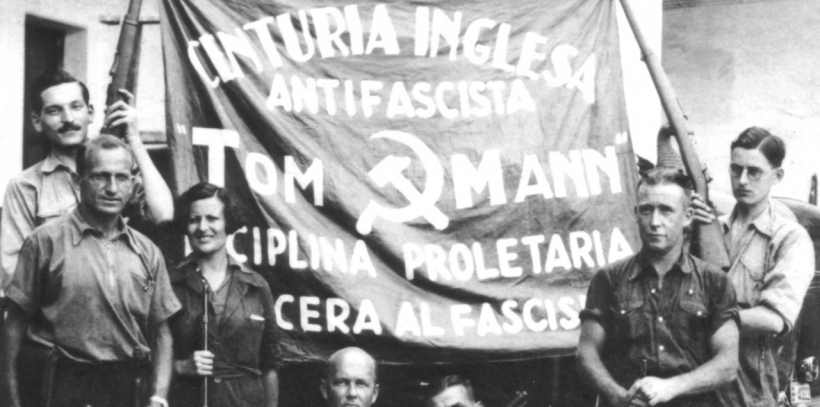
Marxist historian Eric Hobsbawm summarized the inherent contradictions of the Spanish Civil War and the role ultra-leftism played in the demise of the Republic in one of his later essays:
“Of course, the posthumous polemics about the Spanish war are legitimate, and indeed essential — but only if we separate out debate on real issues from the parti pris of political sectarianism, cold-war propaganda and pure ignorance of a forgotten past. The major question at issue in the Spanish civil war was, and remains, how social revolution and war were related on the republican side. The Spanish civil war was, or began as, both. It was a war born of the resistance of a legitimate government, with the help of a popular mobilisation, against a partially successful military coup; and, in important parts of Spain, the spontaneous transformation of the mobilisation into a social revolution. A serious war conducted by a government requires structure, discipline and a degree of centralisation. What characterises social revolutions like that of 1936 is local initiative, spontaneity, independence of, or even resistance to, higher authority — this was especially so given the unique strength of anarchism in Spain.”
Murray Bookchin also wrote at length about the Spanish Civil War but celebrated the decentralized anarchist tactics which incapacitated the Popular Front. The anarcho-syndicalist theorist championed the ‘civil war within the civil war’ as a successful example of his antithetical vision of ‘libertarian socialism’, while his emphasis on the individualist aspects of the former half of his oxymoronic and anti-statist theory often bears a striking resemblance to neoliberal talking points about self-regulating free markets. This would explain why he actually regarded right-wing libertarians to be his natural allies over the the socialist left, whom he considered ‘totalitarian’ as he told the libertarian publication Reason magazine in an interview in 1979. His reactionary demonization of the Soviet Union and dismissal of the accomplishments of all other socialist revolutions was recalled by Michael Parenti in Blackshirts and Reds:
“Left anticommunists remained studiously unimpressed by the dramatic gains won by masses of previously impoverished people under communism. Some were even scornful of such accomplishments. I recall how in Burlington Vermont, in 1971, the noted anticommunist anarchist, Murray Bookchin, derisively referred to my concern for “the poor little children who got fed under communism” (his words).”
Like the International Brigades consisting of foreign volunteers to assist the Spanish Republic in the 1930s, there is an ‘International Freedom Battalion’ currently fighting with the Kurds in Syria. Unfortunately, its live-action role playing ‘leftist’ mercenaries missed the part about the original International Brigades having been backed by the Comintern, not the U.S. military.
Meanwhile, Western media usually hostile to any semblance of radical politics have heavily promoted the Rojava federation as a feminist ‘direct democracy’ utopia, particularly giving excessive attention to the all-female Women’s Protection Units (YPJ) militia while ignoring the female regiments fighting for the secular Syrian government. As a result of the media’s exoticized portrayal of the Kurds and their endorsement by prominent misleaders on the left, from Slavoj Žižek to Noam Chomsky, many have been fooled into supporting them.
If the Spanish Civil War was a dress rehearsal for WWII, it remains to be seen if Syria proves to be a run-through for another global conflict. Then again, what has emerged from its climax is an increasingly multipolar world with the resurgence of Moscow as a deterrent to the mutually assured destruction between the U.S. and China.
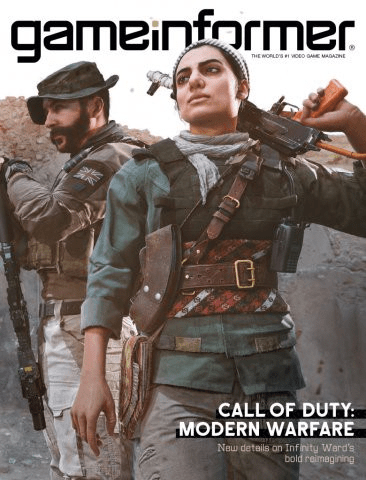
Leftists today wishing to continue the legacy of those who fought for the Spanish Republic should have thrown their support behind the Syrian patriots bravely defending their country from terrorism and imperialism, not left opportunism. Thankfully, this time the good guys have prevailed while the Kurds have paid the price for betraying their fellow countrymen. Liberals shedding crocodile tears about Rojava should take comfort in the fact that they can always play the latest Call of Duty: Modern Warfare video game featuring the YPG fighting alongside the U.S. military if they need to fulfill their imperial fantasies.
Yes, that’s right, the latest installment of the popular first-person shooter franchise features a storyline inspired by the SDF. It’s too bad for them that in real life all of Syria will be returned to where it rightfully belongs under the Syrian Arab Republic.
Max Parry is an independent journalist and geopolitical analyst. His writing has appeared widely in alternative media. Max may be reached at maxrparry@live.com
Western leaders, screw your ‘Sanctions Target the Regime’ blather: Sanctions KILL PEOPLE
Children with cancer couldn’t get adequate treatment due to sanctions (photo Aleppo 2016)
By Eva Bartlett | RT | December 16, 2019
The US has a favourite tool for bullying non-compliant nations: sanctions. Sanctions inflict considerable suffering, even death, on ordinary people in targeted nations. Yet those defiant nations persist and resist.
A recent opinion piece in the Washington Post proposing a new oil-for-food scheme, this time in Venezuela, surprisingly acknowledges that sanctions “can also end up harming the people that they intend to protect.”
Okay, first off, we know there is no intention of “protecting” civilians in any of the countless countries targeted by Western sanctions. Do Western talking heads really think we’ve forgotten the half-a-million dead Iraqi children, thanks to US sanctions?
Yet, ask a Western leader about crippling sanctions placed on nations which don’t bow to Imperial demands and you’ll be met with some nonsensical explanation that sanctions only target ‘regimes’ and ‘terrorists,’ not the people.
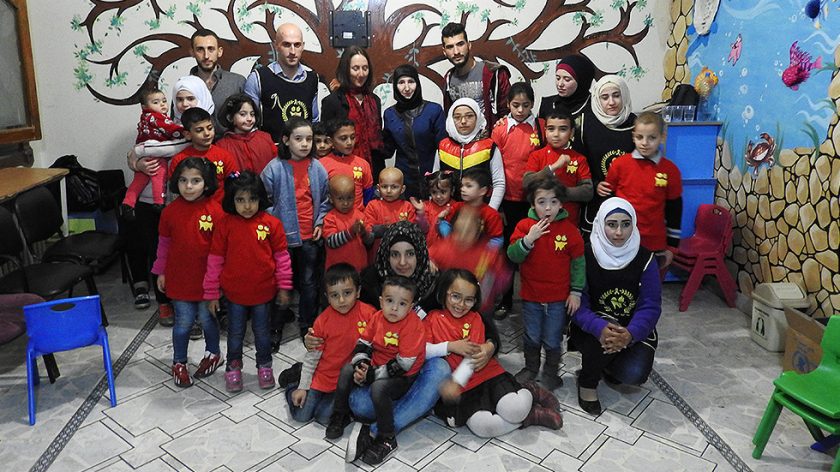
I’ve lived in, spent considerable time in, or visited areas under sanctions and siege, and I’ve seen first hand how sanctions are a form of terrorism, choking civilians, depriving them of basic and urgent medical care, food, employment, and travel entitlements that many of us in Western nations take for granted.
When I was in Syria last October, a man told me his wife had been diagnosed with breast cancer, but because of the sanctions he couldn’t get her the conventional treatments most in the West would avail of.
In 2016, in Aleppo, before it was liberated of al-Qaeda and co, Dr. Nabil Antaki told me how –because of the sanctions– it had taken him well over a year to get a simple part for his gastroenterology practise.
In 2015, visiting Damascus’ University Hospital, where bed after bed was occupied by a child maimed by terrorists’ shelling (from Ghouta), a nurse told me:
“We have so many difficulties to ensure that we have antibiotics, specialized medicines, maintenance of the equipment… Because of the sanctions, many parts are not available, we have difficulties obtaining them.”
Visiting a prosthetic limbs factory in Damascus in 2016, I was told that, due to the sanctions, smart technology and 3D scanners –used to determine the exact location where a limb should be fixed– were not available. Considering the over eight years of war and terrorism in Syria, there are untold numbers of civilians and soldiers in need of this technology to simply get a prosthetic limb fixed so they can get on with their lives. But no, America’s concern for the Syrian people means that this, too, is near impossible.
In 2018, Syria’s minister of health told me Syria had formerly been dubbed by the World Health Organization a “pioneer state” in providing health care.
“Syria had 60 pharmaceutical factories and was exporting medicine to 58 countries. Now, 16 of these factories are out of service. Terrorists partially or fully destroyed 46 hospitals and 620 medical centres.”
I asked the minister about the complex in Barzeh, targeted with missile strikes by the US and allies in April 2018. Turns out it was part of the Ministry of Health, and manufactured cancer treatment medications, as well as antidotes for snake or scorpion bites/stings, the antidote also serving as a basic material in the manufacture of many medicines.
Last year, Syrian-American doctor Hussam al-Samman told me about his efforts to send to Syria chemotherapy medications for cancer patients in remission. He jumped through various hoops of America’s unforgiving bureaucracy, to no avail. It was never possible in the first place.
“We managed to get a meeting in the White House. We met Rob Malley, a top-notch assistant or adviser of Obama at that time. I asked them: ‘How in the world could your heart let you block chemotherapy from going to people with cancer in Syria?’
They said: ‘We will not allow Bashar al-Assad to have anything that will make people love him. We will not support anything that will help Bashar al-Assad look good’.”
Fast forward to the present: in spite of the sanctions, or precisely because of the sanctions, Syria recently opened its first anti-cancer drugs factory. President Assad is, again, looking rather good to Syrians.
UN expert: Sanctions on Venezuela “a form of terrorism”
Alfred de Zayas, the human rights lawyer and former UN official, aptly calls sanctions a form of terrorism, “because they invariably impact, directly or indirectly, the poor and vulnerable.”
Earlier this year, The Center for Economic and Policy Research estimated 40,000 deaths had occurred due to sanctions in 2017-2018.
While in Venezuela in March this year, I spoke with people from poor communities about the effects of sanctions. Most I met were very well aware of the US economic war against their country, and rallied alongside their government.
One woman told me:
“If you don’t have water, don’t have electricity, the basics, how would you feel, as a mother? This makes some of the population, that doesn’t understand about the sanctions, blame the government.”
Venezuela’s Foreign Minister, Jorge Arreaza, said during that visit:
“We told [American diplomat and Trump envoy] Mr Elliott Abrams, ‘the coup has failed, so now what are you going to do?’ He kind-of nodded and said, ‘Well, this is going to be a long-term action, then, and we are looking forward to the collapse of your economy.’”
Indeed, that collapse would come about precisely due to the immoral US sanctions against the Venezuelan people.
North Korean Youth: Sanction the USA
After visiting Korea’s north in August 2017, in a photo essay I noted: “The criminal sanctions against the North, enforced since 1950, making even more difficult the efforts to rebuild following decimation. The sanctions are against the people, affecting all sectors of life.”
And although most I met there were proud of their country’s achievements in spite of the sanctions, they were also vocal about the injustice of being bombed to near decimation and then sanctioned.
In a Pyongyang Middle School, to my questions about the sanctions, a girl replied:
“The sanctions are not fair, our people have done nothing wrong to the USA.”
Another boy spoke of the silence around America’s use of nuclear bombs on civilians: “Why do people all over the world give us sanctions? Why can’t we put sanctions on the US?”
At the Okryu Children’s Hospital, Doctor Kim Un-Song said: “As a mother, I feel extremely angry at the sanctions against the DPRK, even blocking medicine and instruments for children. This is inhumane and against human rights.”
As with Syria, sanctions on the DPRK prevent further entry to Korea of hospital machinery, as well as replacement parts.
Defying the sanctions
In spite of draconian sanctions, Syria, the DPRK and Venezuela continue to resist. After fighting international terrorism since 2011, Syria is rebuilding in liberated areas. That process could proceed more quickly were sanctions lifted, making it easier for companies outside of Syria to invest.
But Syria is managing, with its allies’ support, including that of North Korea, and due to the steadfastness of the heroic Syrian people, and its leadership.
Likewise, Venezuela and North Korea, facing America’s economic war and endless propagandistic rhetoric, continue to resist.
In each of these countries, I’ve met well-informed people who are fighting the sadism of the sanctions, and who are determined to remain free of US tyranny.
Eva Bartlett is a Canadian independent journalist and activist. She has spent years on the ground covering conflict zones in the Middle East, especially in Syria and Palestine (where she lived for nearly four years).
Lies, Newsweek and Control of the Media Narrative: First-Hand Account
A mafia runs editors. Freedom of the press is dead. Journalists and ordinary people must stand up.
By Tareq Haddad | December 14, 2019
Introduction
Until several days ago, I was a journalist at Newsweek. I decided to hand my resignation in because, in essence, I was given a simple choice. On one hand, I could continue to be employed by the company, stay in their chic London offices and earn a steady salary—only if I adhered to what could or could not be reported and suppressed vital facts. Alternatively, I could leave the company and tell the truth.
In the end, that decision was rather simple, all be it I understand the cost to me will be undesirable. I will be unemployed, struggle to finance myself and will likely not find another position in the industry I care about so passionately. If I am a little lucky, I will be smeared as a conspiracy theorist, maybe an Assad apologist or even a Russian asset—the latest farcical slur of the day.
Although I am a British citizen, the irony is that I’m half Arab and half Russian. (Bellingcat : I’m happy to answer any requests.)
It is a terribly sad state of affairs when perfectly loyal people who want nothing but the best for their countries are labelled with such preposterous accusations. Take Iraq war veteran and Hawaii congresswoman Tulsi Gabbard for example, who was the target of such mud slinging for opposing U.S. involvement in Syria and for simply standing up to the Democratic Party’s most corrupt politician, Hillary Clinton. These smears are immature for a democracy—but I, in fact, welcome such attacks.
When the facts presented are utterly ignored and the messengers themselves are crucified in this way, it signals to right-minded people who the true perpetrators of lies are and where the truth in fact lies.
That truth is what matters most to me. It is what first drove me to journalism while I was working in Jersey’s offshore finance industry after completing my degree from Binghamton University’s School of Management in upstate New York. I was so outraged when I grew to realize that this small idyllic island I love and had grown up on since the age of nine, a British Crown dependency fifteen miles off the coast of France, was in fact a hub for global tax evasion. This realization came to me while the British people were being told that austerity had to continue—public funding for schools, hospitals, policing and all matter of things were to be slashed—all while the government “recovered” after bailing out the banks following the 2008 crash. That austerity lie was one I could no longer stomach as soon as I came to understand that my fairly uninspiring administrative role was in fact a part of this global network of firms to help multinational companies, businessmen, politicians and members of various royal families in avoiding paying trillions in tax—all under a perfectly legal infrastructure that the government was fully aware of, but kept quiet about.
In my naivety, as I left that industry and began my journalism training, I wrote a piece that detailed some of this corruption in hopes of changing the public awareness around these issues and in hopes that they no longer continued—albeit I did so in a manner of writing and sophistication I would be embarrassed of presently—but to my disappointment at the time, the piece was hardly noticed and the system remains little changed to now. Nonetheless, since that moment, I have not once regretted speaking truthfully, most especially for my own mental well being: I would not have been able to regard myself with a grain of self-respect had I continued to engage in something I knew was a lie. It is the very same force that compels me to write now.
There is also another, deeper force that compels me to write. In my years since that moment when I decided to become a journalist and a writer, although I suspect I have known it intrinsically long before, I have come to learn that truth is also the most fundamental pillar of this modern society we so often take for granted—a realization that did not come to us easily and one that we should be extremely careful to neglect. That is why when journalistic institutions fail to remember this central pillar, we should all be outraged because our mutual destruction follows. It may sound like hyperbole, but I assure you it’s not. When our record of where we come from is flawed, or our truth to put it more simply, the new lies stack on top of the old until our connection to reality becomes so disjointed that our understanding of the world ultimately implodes. The failure of current journalism, among other factors, is undoubtedly linked to the current regression of the Western world. In consequence, we have become the biggest perpetrators of the crimes our democracies were created to prevent.
Of course, for those who pay attention, this failure of mainstream journalism I speak of is nothing new. It has been ongoing for decades and was all too obvious following the Iraq war fiasco. The U.S. and U.K. governments, headed by people who cared for little other than their own personal gain, told the people of their respective countries a slew of fabrications and the media establishment, other than a handful of exceptions, simply went along for the ride.
This was something that consumed my interest when I was training to be a journalist. How could hundreds of reputable, well-meaning journalists get it so wrong? I read numerous books on the issue—from Noam Chomsky’s Manufacturing Consent and Philip Knightley’s The First Casualty to work by Chris Hedges, the Pulitzer-prize-winning former foreign correspondent for the New York Times who was booted out for opposing that war (who I disagree with on some things, for the record)—but still, I believed that honest journalism could be done. Nothing I read however, came close to the dishonesty and deception I experienced while at Newsweek. Previously, I believed that not enough journalists questioned the government narrative sufficiently. I believed they failed to examine the facts with close enough attention and had not connected the dots as a handful of others had done.
No. The problem is far worse than that.
Syria
In the aftermath of the Iraq war and during my time studying this failure of the media since, I was of course extremely aware of the high likelihood that the U.S. government narrative on Syria was a deception. For starters, there were the statements made by the retired four-star general, General Wesley Clark, to Democracy Now!’s Amy Goodman in 2007, four years prior to the beginning of the Syria conflict. The following is worth watching to in full.
Nonetheless, once I joined IBTimes UK in 2016, after training with the Press Association and working at the Hull Daily Mail (both of whom I am eternally indebted to for giving me an excellent foundation for starting my career) I solidly understood that journalism was not the profession of making unverifiable claims. I, or any journalist for that matter, could not out-right say that the nature of the Syrian conflict was based on a lie, no matter how strongly we suspected it. To do so, we would need unshakeable evidence that pointed to this.
Through the years, good journalists did document evidence. Roula Khalaf, who will soon take over from Lionel Barber as the editor of the Financial Times, wrote one such piece alongside Abigail Fielding-Smith in 2013. It documented how Qatar provided arms and funded the opposition of Bashar al-Assad’s legitimate government to the tune of somewhere between $1 and $3 billion from the outset of the conflict, rubbishing claims that it was a “people’s revolution” that turned violent. Footage captured by Syrian photographer Issa Touma—made into a short film titled 9 Days From My Window in Aleppo—similarly showed how Qatar-funded jihadists from the Al-Tawhid Brigade were present in the streets of Syria’s capital from the very outset of the war.
“Fighters re-enter my street,” Touma says as he films covertly out of his window. “They look different. They are heavily armed men with beards. I had only heard about them before. This is Liwa al-Tawhid. National television calls them terrorists. The international press calls them freedom fighters. I don’t care what they call it—I refuse to chose a side. But it’s a lie that the revolution started peacefully everywhere. At least in my street, Al Said Ali Street, it started with guns. It didn’t start peacefully at all.”
Veterans of the trade Seymour Hersh and Robert Fisk also poked holes in the U.S. government narrative, but their treatment by other journalists has been one of the most shameful episodes in the history of the press.
Hersh—who exposed the My Lai Massacre during the Vietnam War, the clandestine bombing of Cambodia, the torture at Abu Ghraib prison, in addition to telling the world the real story of how Osama Bin Laden died—was shunned from the industry for reporting a simple fact: Bashar al-Assad’s government is not the only actor with access to chemical weapons in Syria. After a sarin attack in the Damascus suburb of Ghouta in 2013, he was further smeared for reporting that Barack Obama withheld important military intelligence: samples examined in Britain’s Porton Down did not match the chemical signatures of sarin held in the Syrian government’s arsenals.
Fisk, writing days before the Syrian conflict escalated, in a piece that asked Americans to consider what they were really doing in the Middle East as the ten-year anniversary of 9/11 approached, also raised important questions, but he too was largely ignored.
I also did my best to document evidence that poked holes in the narrative as best I could. In 2016, I wrote how Egyptian authorities arrested five people for allegedly filming staged propaganda that purported to be from Syria. Though I’m not aware of any evidence to suggest that the two are connected and I make no such claims, these arrests came to light after The Bureau of Investigative Journalism and The Sunday Times revealed that a British PR firm, Bell Pottinger, was working with the CIA, the Pentagon and the National Security Council and received $540 million to create false propaganda in Iraq a month prior.
The following year, after the alleged chemical weapons attack in Khan Sheikhoun, I documented the intriguing story of Shajul Islam, the British doctor who purported to have treated the alleged victims and appeared on several television networks including NBC to sell the case for retaliation. He gushed with heroism, but it was not reported he was previously charged with terror offences in the U.K. and was in fact considered a “committed jihadist” by MI6. He was imprisoned in 2013 in connection with the kidnapping of two Western photo-journalists in northern Syria and was struck off Britain’s General Medical Council in 2016. Why he was released without sentencing and was allowed to travel back to Syria remains a mystery to me.

I also refused to recycle the same sloppy language used, inadvertently or not, by a number of other publications. Al Qaeda and their affiliates had always been referred to as terrorists as far as I was aware—why the sudden change to “rebels” or “moderate rebels” for the purposes of Syria? Thankfully, the news editor I worked with most frequently at the time, Fiona Keating, trusted my reporting and had no problems with me using the more appropriate terms “anti-Assad fighters” or “insurgents”—though one could arguably say even that was not accurate enough.
When buses carrying civilian refugees hoping to escape the fighting in Idlib province were attacked with car bombs in April of 2017, killing over 100, most of them women and children, I was disappointed with the Guardian and the BBC for continuing with their use of this infantile word, but this was not the language I felt to be appropriate in my report.

At roughly the same time, in light of the Khan Sheikhoun attack, confronted with an ever-growing list of irregularities and obvious falsifications—such as increasing evidence that the White Helmets were not what they purported of being, or the ridiculousness that the Western world’s de facto authority on Syria had become 7-year-old Bana al-Abed—I wrote an opinion piece that came short of calling the narrative around the Syrian conflict a lie, but simply pleaded that independent investigations of the alleged chemical weapons attack were allowed to take place before we rushed head first into war. I still believed honesty would prevail.
That piece was ultimately declined by IBTimes—though I covertly published it in CounterPunch later—but the rejection email I received from the editor-in-chief at the time makes for interesting reading.

I was sad to hear that asking for an independent investigation into a chemical weapons attack was an “incendiary theory,” but I was forced to move on.
By that summer, I was let go alongside a number of other journalists from the publication after the Buzzfeed-style model of click-bait-aggregation journalism was heavily punished by a new Google algorithm and had largely failed: page views plummeted and editors couldn’t seem to understand it was because we weren’t doing any real journalism. Having felt frustrated with the industry, I decided not to pursue another position in reporting and decided to move to mainland Europe in hopes of pursuing my other passion—literature—with aspirations of being able to write more freely.
Fast forward to 2019, I decided to return to journalism as I was feeling the pressure to have “a grown-up job” and could not count on my ability to be a novelist as a means of long-term career stability. So when I joined Newsweek in September, I was extremely thankful for the opportunity and had no intention of being controversial—the number of jobs in the industry appeared to be shrinking and, besides, the Syrian conflict appeared to be dying down. As soon as I arrived, Newsweek editor-in-chief Nancy Cooper emphasized original reporting and I was even even more pleased. I wanted to come in, get my head down and start building my reputation as a journalist again.
Then on October 6, President Donald Trump and the military machine behind him threw my quiet hopes of staying well clear of Syria into disarray. He announced the decision to withdraw U.S. troops from the country and green-lit the Turkish invasion that followed in a matter of days. Given my understanding of the situation, I was asked by Newsweek editors to report on this.

Within days of the Turkish invasion into Syria beginning, Turkey was accused of using the incendiary chemical white phosphorus in an attack on Ras al-Ayn and, again, having pitched the story, I was asked to report on the allegations. This spurred a follow-up investigation on why the use of the substance—a self-igniting chemical that burns at upwards of 4,800 degrees Fahrenheit, causing devastating damage to its victims—was rarely considered a war crime under the relevant weapons conventions and I was commended by Nancy for doing excellent journalism.
It was while investigating this story that I started to come across growing evidence that the U.N.-backed body for investigating chemical weapons use, the Organisation for the Prohibition of Chemical Weapons (OPCW), issued a doctored report about an alleged chemical attack in Douma in April of 2018, much to the anger of OPCW investigators who visited the scene. Once Peter Hitchens of the Mail on Sunday published his story containing a leaked letter that was circulated internally from one of the disgruntled OPCW scientists, I believed there was more than enough evidence to publish the story in Newsweek. That case was made even stronger when the letter was confirmed by Reuters and had been corroborated by former OPCW director-general Dr. Jose Bustani.
Although I am no stranger to having story ideas rejected, or having to censor my language to not rock the ship, this was a truth that had to be told. I was not prepared to back down on this.
Let me be clear: there is evidence that a United Nations body—whose jurisdiction was established after the world agreed to never repeat the horrors of World War I and World War II, such as German forces firing more than 150 tons of chlorine gas at French colonial troops in Ypres—is being weaponized to sell the case for war.
After OPCW experts found trace levels of chlorine when they visited Douma—i.e. no different than the levels of chlorine normally present in the atmosphere—or raised concerns that the canisters may have been tampered with or placed, both of which were reflected in their original reports, they made protestations because this information was withheld from the final report that was released to the world’s media. Instead, the final wording said chlorine was “likely” used and the war machine continued.
This is not a “conspiracy theory” as Newsweek sadly said in a statement to Fox News—interestingly the only mainstream publication to cover my resignation. Real OPCW scientists have met with real journalists and explained the timeline of events. They provided internal documents that proved these allegations—documents that were then confirmed by Reuters. This is all I wanted to report.
Meanwhile, OPCW scientists were prevented from investigating Turkey’s alleged use of white phosphorus. This flagrant politicization of a neutral body is opening the world up to repeating the same horrors we experienced in those two devastating wars.
This is unacceptable and I resigned when I was forbidden from reporting on this. … Continue reading
Award-Winning Journalist Vanessa Beeley Faces “Deplatforming” at Six Canadian Venues
By Michael Welch | Global Research | December 12, 2019
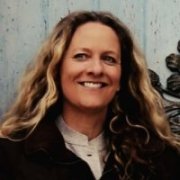 Vanessa Beeley, the award-winning journalist who has gained notoriety for her on the ground reporting on the Syrian conflict has faced opposition in her efforts to speak to Canadian audiences at the invitation of local anti war activists.
According to Ken Stone of the Hamilton Coalition to Stop the War, a lead organizer of Beeley’s cross-Canada speaking tour, six venues have so far backed away from hosting the UK journalist’s talks. These include Palestine House in Mississauga, the Steelworkers Hall in Toronto, St. Paul’s University in Ottawa, the University of Montreal, the University of Winnipeg, and the Millenium Library, also in Winnipeg.
Stone explains that the withdrawal from agreements at each venue to host Beeley were preceded by the circulation of at least two hit pieces on the journalist upon her arrival in Canada – one by La Presse in Quebec and one by the Huffington Post. Stone explained that the decision to cancel in each case was precipitated by the circulation of these articles by unknown actors.
Says Stone,
“There wasn’t an organized effort, but there were people in individual cities where she was speaking who took it upon themselves to circulate these articles behind the scenes – shadowy figures who tried their very best to scare the managers of various venues into cancelling, and they did so six times.”
The proper name of the tour is ‘Canada’s Dirty War on Syria: The White Helmets and the Regime Change War billionaires.’ Ms. Beeley was intent on presenting her research into Canada’s role in undermining the government of President Bachar Al Assad. Beeley’s message directly contradicts mainstream reporting on the conflict, particularly her research into the White Helmets, which she and other independent journalists classify as a propaganda construct providing public relations cover for regime change efforts and continued economic sanctions that are decimating the country.
The justification for one venue after another cancelling is not clear, as none have officially provided any explanation. According to Stone, however, there were two venues on the tour that allowed the Beeley presentation to take place in spite of this unexpected opposition. One was the New Vision Church in Hamilton. The other was the Knox Metropolitan United Church in Regina. Both Ministers highlighted concerns from a complainant about ‘hate speech’ being directed toward the White Helmets, and the prospect of traumatizing vulnerable Syrian refugees.
Organizers explained to the Ministers that the talks were not about hate speech but rather about highlighting the findings of an independent journalist and war correspondent ‘whose research methods are very thorough’ about the true nature of the Syrian conflict and the role of the White Helmets.
According to an email, forwarded to this author, from the pastor at the Hamilton venue, there was concern expressed about Beeley engaging in ‘hate speech’ toward the White Helmets. According to the pastor at the Regina venue, the letter he received essentially echoed the common, mainstream media reinforced perception that the White Helmets are heroes, that Syrian civilians are fleeing a despotic Syrian regime, and that Beeley is spreading “lies for war criminal Bashar Assad.”
Stone added, “one of the people who spoke to both Ministers about the ‘traumatization’ turned out to be traced back to an address in the state of Washington, USA. She was claiming that she was going to be traumatized by Vanessa speaking 4000 miles away!”
Full disclosure: this author was active in trying to secure a venue for Vanessa Beeley at the University of Winnipeg. The deplatforming in this case was a little more complicated. I had apparently used an improper process to secure the space on campus initially. However, when the event coordinator on campus got hold of me and explained the problems with the process, she directed me to find a venue elsewhere. When I asked about the prospects for booking the space by following the proper procedure, and paying the appropriate fees, I was told the event would likely not go ahead owing to problems the President’s Office had with the content.
In spite of multiple attempts to get more details over several days, the university has yet to provide an explanation of precisely what they found objectionable about the ‘content.’
A second venue, the Millennium Library in downtown Winnipeg was secured through friendly staff six days in advance of the event date. However, on Tuesday (Human Rights Day as it turns out) two days before the event was to take place, I received a call from a higher up – the Manager of Library Services. He had expressed regret but that after lengthy deliberations he had with other team members, he determined that the event would violate their guidelines and that he was exercising his right under the contractual agreement to cancel the booking.
No official explanation was offered beyond this although when pressed, this individual did indicate an ‘opinion’ on his part that after reviewing the speaker’s content, the content of the presentation could be construed as hate speech. Overtures to have this manager meet with myself and other organizers to assuage concerns about the event, were rejected. He said his decision was final. He did relent to sending a written explanation of his reasons for cancelling the booking:
“We considered our room usage Regulations and Conditions of use, event content, and community interests in this decision.”
Further correspondence was forwarded to me through a third party about the event planned for the University of Winnipeg from another member of the campus community. The concerns could be summarized as follows:
- Ms. Beeley is promoting ‘harmful’ theories in defence of President Assad.
- She is promoting ‘anti-semitic’ and harmful messaging against the White Helmets, ‘a group that provides vital humanitarian search and rescue operations in areas of Syria subject to intense bombing.’
- the content could be ‘traumatizing’ to the Syrian refugee population at the university.
About a day later, a representative of the university’s student executive had private messaged the organizers through the Winnipeg facebook event page expressing concern about the event. This person echoed the points above. The individual’s facebook page, however, reveals a clear effort to deplatform Vanessa Beeley.
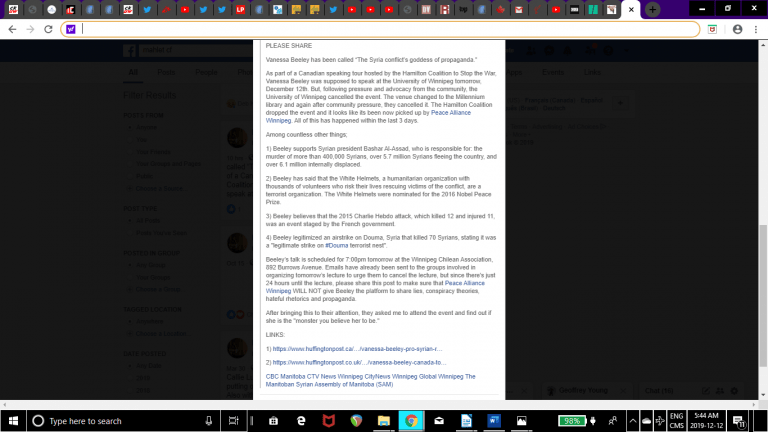
Excerpts (emphasis added)
PLEASE SHARE
“Vanessa Beeley has been called “The Syria conflict’s goddess of propaganda.”
As part of a Canadian speaking tour hosted by the Hamilton Coalition to Stop the War, Vanessa Beeley was supposed to speak at the University of Winnipeg tomorrow, December 12th. But, following pressure and advocacy from the community, the University of Winnipeg cancelled the event. The venue changed to the Millennium library and again after community pressure, they cancelled it. The Hamilton Coalition dropped the event and it looks like its been now picked up by Peace Alliance Winnipeg. All of this has happened within the last 3 days.
Among countless other things;
1) Beeley supports Syrian president Bashar Al-Assad, who is responsible for: the murder of more than 400,000 Syrians, over 5.7 million Syrians fleeing the country, and over 6.1 million internally displaced.
2) Beeley has said that the White Helmets, a humanitarian organization with thousands of volunteers who risk their lives rescuing victims of the conflict, are a terrorist organization. The White Helmets were nominated for the 2016 Nobel Peace Prize.
3) Beeley believes that the 2015 Charlie Hebdo attack, which killed 12 and injured 11, was an event staged by the French government.
4) Beeley legitimized an airstrike on Douma, Syria that killed 70 Syrians, stating it was a “legitimate strike on #Douma terrorist nest”.
Beeley’s talk is scheduled for 7:00pm tomorrow at the Winnipeg Chilean Association, 892 Burrows Avenue. Emails have already been sent to the groups involved in organizing tomorrow’s lecture to urge them to cancel the lecture, but since there’s just 24 hours until the lecture, please share this post to make sure that Peace Alliance Winnipeg WILL NOT give Beeley the platform to share lies, conspiracy theories, hateful rhetorics and propaganda.
Vanessa Beeley is apparently by no means unique or distinct in experiencing this kind of character assassination. A September 2019 article for Mint Press News, authored by Alexander Rubinstein, detailed how three prominent journalists: Rania Khalek, Anya Parampil and Max Blumenthal, were seeing their work suppressed at the hands of so-called journalists with suspicious links to think tanks and media institutions. To quote the Mint Press article (emphasis added):
The tactics employed to silence these reporters have included death and rape threats, spurious lawsuits, threatening phone calls, pressure campaigns to have them fired, and persistent harassment against any institutions publishing their work or hosting their talks, books, or documentary tours.
This article, and Vanessa Beeley’s own reporting reveals that there is a sophisticated network of entities aligned with think tanks and media institutions who have been actively involved in this campaign to contain the Syria narrative. Individuals like Chris York of the Huffington Post UK, the link to whose article is being shared by Winnipeg based agitators, has been a leading critic of Beeley’s since January of 2017.
According to Beeley, York’s series of articles discrediting her work typically relied on familiar tropes about being ‘Russia-centric’ and ‘Assadist’. These were quickly followed by Olivia Solon’s hit piece for the Guardian, and articles in a similar vein by The UK’s Times newspaper, former Guardian correspondent, Brian Whitaker, Bellingcat, the BBC, journalist Nafeez Ahmed, academic Idrees Ahmad, and a 48-page report from the White Helmet PR agency, Syria Campaign.
While the campaign to discredit Beeley and others trying to expose the reality behind the Syrian conflict seems daunting, Ken Stone of the Hamilton Coalition to Stop the War sees a silver lining behind the dark cloud of suppression of dissent. He believes that the forces of empire are effectively on the ropes.
“They are unable to manufacture consent for their foreign policy and their regime change wars and so the only resort they have left is to try and silence the opposition… Even the idea of local citizens in a community being able to rent a hall and bring in a speaker by invitation and open it to the public. What does that say about our Charter Rights of freedom of expression and freedom of assembly? Nonetheless, despite all that, we had, so far six successful meetings for Vanessa.”
More details at the event’s facebook page.
Copyright © Michael Welch, Global Research, 2019
New leaks provide further evidence that OPCW suppressed & altered findings on Douma ‘chemical attack’
RT | December 15, 2019
A new cache of internal documents reveal that members of the OPCW team tasked with probing the Douma “chemical attack” protested the organization’s final report on the incident, which they said misrepresented their conclusions.
In a memo addressed to OPCW Director General Fernando Arias, one scientist who participated in the OPCW’s fact finding mission (FFM) wrote that there are “about 20 inspectors who have expressed concern” over how the OPCW presented its findings on the alleged Syrian chemical attack. According to the memorandum, the organization’s final report does not reflect the FFM’s findings, presented in their interim report, which is also part of the new document dump.
The new documents, released by WikiLeaks, are the latest evidence undermining the OPCW’s final report on the Syrian attack.
The April 2018 incident reportedly killed dozens of Syrian civilians, and was used by the United States and several NATO allies to justify airstrikes against Syrian military targets. The OPCW was later sent to the site to investigate, and the organization’s final report gave credibility to the accusation that Damascus had used chemical weapons.
The memo goes on to state that the final report “does not reflect the views of all the team members that deployed to Douma.” In fact, the team on the ground in Douma was apparently excluded from drafting the final report – only one member of the fact finding mission, a paramedic, directly contributed. The final document was instead authored by a separate group that had operated from “Country X,” believed to be Turkey.
“The consensus within the FFM team was that there were indications of serious inconsistencies in findings… the conclusions appear to have been turned completely in the opposite direction.”
The team’s findings, outlined in their preliminary report, illustrate some of these inconsistencies. For example, the team expressed uncertainty about the origin of the cylinders which were allegedly used to release chlorine. Washington and its allies claim that the cylinders were dropped from the sky, pointing to Damascus as the culprit.
However, the original interim report said that there was no strong evidence to support this theory. In fact, a follow-up investigation into the matter concluded that it was more likely that the cylinders “were manually placed… rather than being delivered from aircraft.”
After the conclusions failed to make it into the final report, a FFM team member attempted to archive the analysis of the cylinders in a secure registry, known as the Documents Registry Archive (DRA). According to journalist Peter Hitchens, a senior OPCW official ordered his subordinates to “remove all traces” of the findings from the archive.
The documents support allegations made by whistleblowers – and corroborated by previous leaks – that the OPCW excluded and manipulated key findings in its final report on the incident.
Europe was the main player in destroying Syria and creating the refugee crisis
By Steven Sahiounie | Mideast Discourse | December 14, 2019
Monica Maggioni is an Italian journalist and is CEO of Rai.com, which broadcasts ‘Rai News 24 TV’, among others. She interviewed Syrian President, Bashar al Assad, on November 26, and the interview was to be broadcast on December 2; however, it was mysteriously postponed.
Behind the scenes, at Rai.com there was conflict over the interview, with Fabrizio Salini declaring the interview was not commissioned, therefore it would not be broadcast, while Antonio Di Bella, director of news, declared it was not suitable to be broadcast, and Italian Senator Alberto Airola requested Maggioni to explain her role in the interview and answer charges of creating a diplomatic incident.
What was so explosive in the interview that the Italian news media wanted to hide from the Italian viewers? Many believe it has to do with questions 8 and 9 and President Assad’s response.
Question 8: At this moment, when Europe looks at Syria, apart from the considerations about the country, there are two major issues: one is refugees, and the other one is the Jihadists or foreign fighters coming back to Europe. How do you see these European worries?
President Assad: We have to start with a simple question: who created this problem? Why do you have refugees in Europe? It’s a simple question: because of terrorism that’s being supported by Europe – and of course the United States and Turkey and others – but Europe was the main player in creating chaos in Syria. So, what goes around comes around.
Question 9: Why do you say it was the main player?
President Assad: Because they publicly supported, the EU supported the terrorists in Syria from day one, week one or from the very beginning. They blamed the Syrian government, and some regimes like the French regime sent armaments, they said – one of their officials – I think their Minister of Foreign Affairs, maybe Fabius said: “we send.” They sent armaments; they created this chaos. That’s why a lot of people find it difficult to stay in Syria; millions of people couldn’t live here so they had to get out of Syria.
The US-NATO-EU attack on Syria is unprecedented in history. General Wesley Clark was told there was a plan to ‘take out Syria’ well before the first protests took place in Deraa. This was an internationally coordinated attack on Syria by the US and Europe. This was a classic ‘regime-change’ project, which was instigated between the US and Israel, but agreed to by the EU and NATO members. From the early stages of the conflict in Syria, the US and Europe provided political, military and logistic support to the ‘rebels’ in Syria and refused to call them terrorists. On 18 August 2011, President Barack Obama stated, “The future of Syria must be determined by its people, but President Bashar al-Assad is standing in their way. For the sake of the Syrian people, the time has come for President Assad to step aside.” This US statement was fully supported by Europe.
In 2013 President Assad stated he was ready for dialogue with the armed terrorists, but only if they surrender their weapons. However, the US-NATO-EU plan to support the terrorists never included a peaceful surrender of weapons, followed by a national dialog, which would end in a peaceful solution to the conflict. The plan only called for weapons, training, and European officers to be continuously available to the terrorists, for ‘regime-change’. Europe only wanted to fuel the fires in Syria, and never planned to be the voice of peace and international law.
What was at first billed as ‘rebels’ and ‘freedom fighters’ soon morphed into sectarian extremists and Radical Islamic terrorists who filled the battlefields under many names and uniforms, but who were all essentially the same terrorists. Their names ranged from the ‘Free Syrian Army’ to ISIS. Radical Islam is a political ideology and is not a religion or a sect. Many experts have called Radical Islam a ‘Death-Cult’, which glorifies the killing of unarmed civilians, as well as armed adversaries, even to the point of eating human flesh while recording it on video.
Presidents Obama and Sarkozy convinced the EU to follow their lead. However, the Syrian people and armed forces fought back.
Some of the refugees left Syria for ideological reasons, they sided with the terrorists and followed the Muslim Brotherhood. Others left for Europe because their homes and livelihoods were destroyed by the terrorists, but many were just economic migrants, and had not lost a home, were from safe areas, and perhaps had never seen any fighting, and they left to seek an income from the charity offered to them in the EU.
EU-NATO support of terrorism in Syria
Bulgaria: Boïko Borissov, Prime Minister from 2014, supplied the drug ‘Captagon’ to the terrorists in Syria on orders of the CIA. The drug causes the terrorists to lose inhibitions and while under the influence they are capable of horrific atrocities.
Germany: A ship with intelligence and satellite capabilities was off the coast of Syria providing the terrorists the locations and movements of the Syrian military, as well as intercepted telephone communications. Wolfgang Ischinger, chairman of the Munich Security Conference, said: “If the West supplies arms itself, it has more chance of influencing how they are used.”
Great Britain: British intelligence provided terrorists with information on Syrian military movements. In 2012, SAS Commandos were conducting covert operations within Syrian territory, and provided terrorists with military aid, including communications equipment and medical supplies, and provided intelligence support from its Cyprus bases, revealing Syrian military movements which were passed on to the terrorists. In 2013, Prime Minister David Cameron said that Britain would send weapons to the terrorists. In August 2016, the BBC published photographs that showed British Special Forces soldiers guarding the perimeter of the terrorist’s base at al-Tanf, on the Syria-Iraq border, and the terrorists were shown to be equipped with four-wheel drive Al-Thalab vehicles and weapons such as sniper rifles, anti-tank weapons, and heavy machine guns.
France: The ‘Friends of Syria’ group was initiated by then-French President Nicolas Sarkozy in 2012. They declared their intent to support the terrorists in Syria, “If the regime fails to accept the terms of the political initiative outlined by the Arab League and end violence against citizens, the Friends of Syria should not constrain individual countries from aiding the Syrian opposition by means of military advisers, training, and provision of arms to defend themselves.” In 2013, French President François Hollande said, that France was ready to begin supplying lethal aid to the terrorists, and by 2014 Hollande confirmed that France had delivered arms to the terrorists, and by 2015 had begun airstrikes in Syria.
Italy: On 28 February 2013, the ‘Friends of Syria’ held their meeting in Rome, and among the 11 members were France, Germany, Italy, UK, and the EU. In a study published in 2019, the number of terrorists from Italy who were in Syria numbered 135 as of July 2018.
The EU: in 2013 Brussels decided assistance to the terrorists would include weapons training. Jane’s Defense Weekly reported a US shipment of 994 tons of weapons and ammunition in December 2015 from Eastern Europe to Syrian rebel groups, including 9M17 Fleyta anti-tank missiles, RPG-7s, AK-47S, DShKs, and PKMs. In early March 2013, a Jordanian security source revealed that the U.S., Britain, and France were training terrorists in Jordan to begin building a militia that would take over after Assad’s fall. By 2019, the EU issued a statement about Syria in which they now claim to call for peace and political negotiations to settle the conflict of almost 9 years duration and to have supported humanitarian and economic assistance there. However, when faced with documented history, this statement is a bald-faced lie. The EU position from the outset of the conflict was to support the armed terrorists and to prevent even chemotherapy drugs to be imported to Syria, because of the EU sanctions, which today prevents any possible rebuilding effort.
US & Russia won’t go to war over Syria
By Mikhail Khodarenok | RT | December 15, 2019
To avoid any potential incidents, Americans should simply withdraw and end the unlawful presence of their forces in Syria. And abstain from alarmist headlines foreshadowing a shooting war.
American commanders in Syria are scrambling to protect their forces from an expected surge in activity by military units from Turkey, Russia, Iran and the Syrian government. They believe these countries pose a greater danger than Islamic State (IS, formerly ISIS) forces, the New York Times reports.
Anonymous sources, questionable statements
According to anonymous Department of Defense officials, “commanders have requested guidance outlining how American forces might deal with an attack from the assortment of armed groups, including Russian-backed Syrian government forces that have, in the past, tried to seize territory held by the United States.”
This statement seems fairly questionable, since any commander of a unit deployed to a war zone has clear-cut instructions from their superiors on what to do in a particular situation. Claiming otherwise, especially about an army as organized and efficient as the one the US has, would probably be unjustified from any possible point of view. Naturally, the directives coming from the HQ are top secret. If we assume their content was revealed to the NYT by a military source, the US should first focus on finding who in the DoD is leaking top secret information.
Also according to the NYT, “For now, the American command heavily relies on the instincts of junior commanders on the ground, cautionary phone calls to officials from Russia and Turkey and overhead surveillance — susceptible to failure in poor weather — to help avoid close encounters with other forces in the Euphrates River Valley, where most American troops are based.”
Firstly, it is not only the American command that are taking measures to prevent any incidents. The commanders of the Russian armed forces deployed in Syria are doing the same just as diligently (perhaps even more so). Starting from 2015, both the American and the Russian military command have been doing their best to prevent any clashes on the ground or in the air. To ensure this, special communication channels have been established to facilitate exchange of information regarding combat operations and other activities of the troops.
Secondly, you can never rely on the instincts of junior commanders in matters of such grave importance. If you do, an error of judgment by one of the lieutenants could have disastrous consequences – including an accidental nuclear strike.
Thirdly, all the means and methods of reconnaissance available are usually employed in the combat area: human-gathered intelligence, special reconnaissance, signals intelligence, aerial and space reconnaissance, reconnaissance by special forces. The term “overhead surveillance,” employed by the NYT, is therefore not entirely correct.
No positive agenda
The NYT quotes Jennifer Cafarella, Research Director at the Institute for the Study of War in Washington, as saying that “These forces are at risk without a clear understanding of what they are expected to achieve, and without the political support of their nation, if or more likely when, one of these American adversaries decided to attack them. These guys are deployed in one of the most risky, complex and rapidly evolving environments on the planet.”
I definitely agree with this assessment – combat and operational goals of the American forces in Syria are extremely ambiguous. Even high ranking US officials have a hard time explaining what sort of military and political objectives they are pursuing. The US military presence in Syria has no positive agenda. And the few American units that are stationed in the Syrian Arab Republic right now, are there illegally.
Interestingly enough, the NYT quotes a source in the Defense Department who said that “the Russian military is far more reliable in navigating the difficulties of such a contested battlefield,” whereas Turkish-backed fighters are often poorly managed by the Turkish military.
We have to keep in mind that Turkey is a NATO country and America’s closest ally in the region. And if there are tensions between allies, Ankara and Washington should settle their differences without dragging Russia into it.
It’s not ‘the regime’, it’s the legitimate government
The New York Times also quotes Gen. Kenneth F. McKenzie, the head of the military’s Central Command, who said that protecting the oil fields might ultimately draw a larger challenge from Syrian Army troops west of the Euphrates. “I’d expect at some point the regime will come forward to that ground,” General McKenzie said.
It’s not “the regime.” It’s the legitimate Syrian government’s army. If they “come forward,” they will be coming forward into their own territories.
And the Americans are not really concerned with protecting Syrian oil – they are openly stealing the country’s natural resources. At this point, the Syrian state doesn’t gain anything from these oilfields, which hampers the government’s efforts to restore the economy.
We might expect an interesting situation when the Syrian army and border patrol forces regain total control over the country’s eastern border. And that will happen soon.
Americans will have to find new ways to smuggle the oil
If the Syrian troops reach the eastern border and manage to gain a foothold there, thus giving the Syrian state full control over the nations’ boundaries, it would lead to a curious situation: in order to continue with their oil smuggling operation and retain their profits, the Americans would have to find a different way to export the oil.
Currently, there are only two viable channels – the official route, through Damascus and then over the Mediterranean Sea, and in Syria’s east, through its border with Iraq. But if both routes are controlled by Assad’s forces, the Americans would have to negotiate a new way out with the government in Damascus. Another potential outcome is that the Americans remain in control of Syria’s oil fields and refineries, but unable to export the final product and sell it on the global market.
So, in order to “protect their forces from an expected surge in actions by military units from Turkey, Russia, Iran and the Syrian government,” the US needs to take a radical yet straightforward approach – withdraw from Syria and put an end to America’s illegal presence in the country.
Also, they should probably abstain from heating up the situation in the region by publishing articles that speak of a potential military face-off between Russia and the United States.
Mikhail Khodarenok is a military commentator for RT.com. He is a retired colonel. He served as an officer at the main operational directorate of the General Staff of the Russian Armed Forces.
The interview with President al-Assad that Italian Rai News 24 refrained from broadcasting

SANA- December 9، 2019
Damascus – President Bashar al-Assad said that Syria is going to come out of the war stronger and the future of Syria is promising and the situation is much better, pointing out to the achievements of the Syrian Arab army in the war against terrorism.
The President, in an interview given to Italian Rai News 24 TV on November 26,2019 and was expected to be broadcast on December 2nd and the Italian TV refrained from broadcasting it for non-understandable reasons, added that Europe was the main player in creating chaos in Syria and the problem of refugees in it was because of its direct support to terrorism along with the US, Turkey and many other countries.
President al-Assad stressed that since the beginning of the narrative regarding the chemical weapons, Syria has affirmed it didn’t use them.
The President affirmed that what the OPCW organization did was to fake and falsify the report about using chemical weapons, just because the Americans wanted them to do so. So, fortunately, this report proved that everything we said during the last few years, since 2013, is correct.
Following is the full text of the interview;
Question 1: Mr. President, thanks for having us here. Let us know please, what’s the situation in Syria now, what’s the situation on the ground, what is happening in the country?
President Assad: If we want to talk about Syrian society: the situation is much, much better, as we learned so many lessons from this war and I think the future of Syria is promising; we are going to come out of this war stronger.
Talking about the situation on the ground: The Syrian Army has been advancing for the last few years and has liberated many areas from the terrorists, there still remains Idleb where you have al-Nusra that’s being supported by the Turks, and you have the northern part of Syria where the Turks have invaded our territory last month.
So, regarding the political situation, you can say it’s becoming much more complicated, because you have many more players that are involved in the Syrian conflict in order to make it drag on and to turn it into a war of attrition.
Question 2: When you speak about liberating, we know that there is a military vision on that, but the point is: how is the situation now for the people that decided to be back in society? The process of reconciliation, now at what point? Is it working or not?
President Assad: Actually, the methodology that we adopted when we wanted to create let’s say, a good atmosphere – we called it reconciliation, for the people to live together, and for those people who lived outside the control of government areas to go back to the order of law and institutions. It was to give amnesty to anyone, who gives up his armament and obey the law. The situation is not complicated regarding this issue, if you have the chance to visit any area, you’ll see that life is getting back to normal.
The problem wasn’t people fighting with each other; it wasn’t like the Western narrative may have tried to show – as Syrians fighting with each other, or as they call it a “civil war,” which is misleading. The situation was terrorists taking control of areas, and implementing their rules. When you don’t have those terrorists, people will go back to their normal life and live with each other. There was no sectarian war, there was no ethnic war, there was no political war; it was terrorists supported by outside powers, they have money and armaments, and they occupy those areas.
Question 3: Aren’t you afraid that this kind of ideology that took place and, you know, was the basis of everyday life for people for so many years, in some ways can stay in the society and sooner or later will be back?
President Assad: This is one of the main challenges that we’ve been facing. What you’re asking about is very correct. You have two problems. Those areas that were out of the control of government were ruled by two things: chaos, because there is no law, so people – especially the younger generation – know nothing about the state and law and institutions.
The second thing, which is deeply rooted in the minds, is the ideology, the dark ideology, the Wahabi ideology – ISIS or al-Nusra or Ahrar al-Cham, or whatever kind of these Islamist terrorist extremist ideologies.
Now we have started dealing with this reality, because when you liberate an area you have to solve this problem otherwise what’s the meaning of liberating? The first part of the solution is religious, because this ideology is a religious ideology, and the Syrian religious clerics, or let’s say the religious institution in Syria, is making a very strong effort in this regard, and they have succeeded; they succeeded at helping those people understanding the real religion, not the religion that they’ve been taught by al-Nusra or ISIS or other factions.
Question 4: So basically, clerics and mosques are part of this reconciliation process?
President Assad: This is the most important part. The second part is the schools. In schools, you have teachers, you have education, and you have the national curriculum, and this curriculum is very important to change the minds of those young generations. Third, you have the culture, you have the role of arts, intellectuals, and so on. In some areas, it’s still difficult to play that role, so it was much easier for us to start with the religion, second with the schools.
Question 5: Mr. President, let me just go back to politics for an instant. You mentioned Turkey, okay? Russia has been your best ally these years, it’s not a secret, but now Russia is compromising with Turkey on some areas that are part of Syrian area, so how do you assess this?
President Assad: To understand the Russian role, we have to understand the Russian principles. For Russia, they believe that international law – and international order based on that law – is in the interest of Russia and in the interest of everybody in the world. So, for them, by supporting Syria they are supporting international law; this is one point. Secondly, being against the terrorists is in the interest of the Russian people and the rest of the world.
So, being with Turkey and making this compromise doesn’t mean they support the Turkish invasion; rather they wanted to play a role in order to convince the Turks that you have to leave Syria. They are not supporting the Turks, they don’t say “this is a good reality, we accept it and Syria must accept it.” No, they don’t. But because of the American negative role and the Western negative role regarding Turkey and the Kurds, the Russians stepped in, in order to balance that role, to make the situation… I wouldn’t say better, but less bad if you want to be more precise. So, in the meantime, that’s their role. In the future, their position is very clear: Syrian integrity and Syrian sovereignty. Syrian integrity and sovereignty are in contradiction with the Turkish invasion, that is very obvious and clear.
Question 6: So, you’re telling me that the Russians could compromise, but Syria is not going to compromise with Turkey. I mean, the relation is still quite tense.
President Assad No, even the Russians didn’t make a compromise regarding the sovereignty. No, they deal with reality. Now, you have a bad reality, you have to be involved to make some… I wouldn’t say compromise because it’s not a final solution. It could be a compromise regarding the short-term situation, but in the long-term or the mid-term, Turkey should leave. There is no question about it.
Question 7: And in the long-term, any plan of discussions between you and Mr. Erdogan?
President Assad: I wouldn’t feel proud if I have to someday. I would feel disgusted to deal with those kinds of opportunistic Islamists, not Muslims, Islamists – it’s another term, it’s a political term. But again, I always say: my job is not to be happy with what I’m doing or not happy or whatever. It’s not about my feelings, it’s about the interests of Syria, so wherever our interests go, I will go.
Question 8: In this moment, when Europe looks at Syria, apart from the considerations about the country, there are two major issues: one is refugees, and the other one is the Jihadists or foreign fighters coming back to Europe. How do you see these European worries?
President Assad: We have to start with a simple question: who created this problem? Why do you have refugees in Europe? It’s a simple question: because of terrorism that’s being supported by Europe – and of course the United States and Turkey and others – but Europe was the main player in creating chaos in Syria. So, what goes around comes around.
Question 9: Why do you say it was the main player?
President Assad: Because they publicly supported, the EU supported the terrorists in Syria from day one, week one or from the very beginning. They blamed the Syrian government, and some regimes like the French regime sent armaments, they said – one of their officials – I think their Minister of Foreign Affairs, maybe Fabius said “we send.” They sent armaments; they created this chaos. That’s why a lot of people find it difficult to stay in Syria; millions of people couldn’t live here so they had to get out of Syria.
Question 10: In this moment, in the region, there are turmoil, and there is a certain chaos. One of the other allies of Syria is Iran, and the situation there is getting complicated. Does it have any reflection on the situation in Syria?
President Assad: Definitely, whenever you have chaos, it’s going to be bad for everyone, it’s going to have side-effects and repercussions, especially when there is external interference. If it’s spontaneous, if you talk about demonstrations and people asking for reform or for a better situation economically or any other rights, that’s positive. But when it’s for vandalism and destroying and killing and interfering from outside powers, then no – it’s definitely nothing but negative, nothing but bad, and a danger on everyone in this region.
Question 11: Are you worried about what’s happening in Lebanon, which is really the real neighbor?
President Assad: Yes, in the same way. Of course, Lebanon would affect Syria more than any other country because it is our direct neighbor. But again, if it’s spontaneous and it’s about reform and getting rid of the sectarian political system, that would be good for Lebanon. Again, that depends on the awareness of the Lebanese people in order not to allow anyone from the outside to try to manipulate the spontaneous movement or demonstrations in Lebanon.
Question 12: Let’s go back to what is happening in Syria. In June, Pope Francis wrote you a letter asking you to pay attention and to respect the population, especially in Idleb where the situation is still very tense, because there is fighting there, and when it comes even to the way prisoners are treated in jails. Did you answer him, and what did you answer?
President Assad: The letter of the Pope was about his worry for civilians in Syria and I had the impression that maybe the picture in the Vatican is not complete. That’s to be expected, since the mainstream narrative in the West is about this “bad government” killing the “good people;” as you see and hear in the same media – every bullet of the Syrian Army and every bomb only kills civilians and only hospitals! they don’t kill terrorists as they target those civilians! which is not correct.
So, I responded with a letter explaining to the Pope the reality in Syria – as we are the most, or the first to be concerned about civilian lives, because you cannot liberate an area while the people are against you. You cannot talk about liberation while the civilians are against you or the society. The most crucial part in liberating any area militarily is to have the support of the public in that area or in the region in general. That has been clear for the last nine years and that’s against our interests.
Question 13: But that kind of call, in some ways, made you also think again about the importance of protecting civilians and people of your country.
President Assad: No, this is something we think about every day, not only as morals, principles and values but as interests. As I just mentioned, without this support – without public support, you cannot achieve anything… you cannot advance politically, militarily, economically and in every aspect. We couldn’t withstand this war for nine years without the public support and you cannot have public support while you’re killing civilians. This is an equation, this is a self-evident equation, nobody can refute it. So, that’s why I said, regardless of this letter, this is our concern.
But again, the Vatican is a state, and we think that the role of any state – if they worry about those civilians, is to go to the main reason. The main reason is the Western role in supporting the terrorists, and it is the sanctions on the Syrian people that have made the situation much worse – and this is another reason for the refugees that you have in Europe now. You don’t want refugees but at the same time you create the situation or the atmosphere that will tell them “go outside Syria, somewhere else,” and of course they will go to Europe. So, this state, or any state, should deal with the reasons and we hope the Vatican can play that role within Europe and around the world; to convince many states that you should stop meddling in the Syrian issue, stop breaching international law. That’s enough, we only need people to follow international law. The civilians will be safe, the order will be back, everything will be fine. Nothing else.
Question 14: Mr. President, you’ve been accused several times of using chemical weapons, and this has been the instrument of many decisions and a key point, the red line, for many decisions. One year ago, more than one year ago, there has been the Douma event that has been considered another red line. After that, there has been bombings, and it could it have been even worse, but something stopped. These days, through WikiLeaks, it’s coming out that something wrong in the report could have taken place. So, nobody yet is be able to say what has happened, but something wrong in reporting what has happened could have taken place.
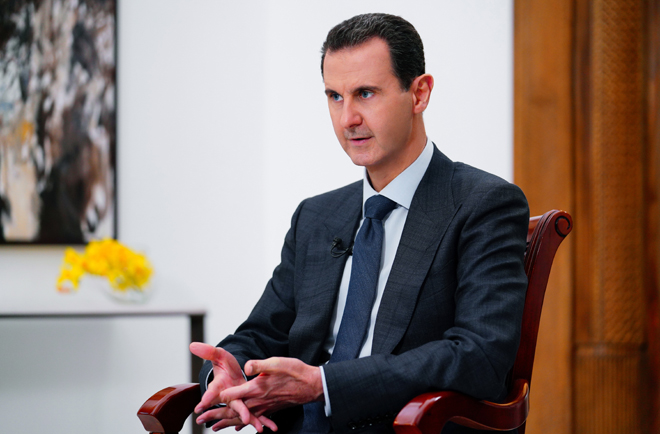 President Assad: We have always – since the beginning of this narrative regarding the chemical weapons – we have said that we didn’t use it; we cannot use it, it’s impossible to be used in our situation for many reasons, let’s say – logistical reasons.
Intervention: Give me one.
President Assad: One reason, a very simple one: when you’re advancing, why would you use chemical weapons?! We are advancing, why do we need to use it?! We are in a very good situation so why use it, especially in 2018? This is one reason.
Second, very concrete evidence that refutes this narrative: when you use chemical weapons – this is a weapon of mass destruction, you talk about thousands of dead or at least hundreds. That never happened, never – you only have these videos of staged chemical weapons attacks. In the recent report that you’ve mentioned, there’s a mismatch between what we saw in the video and what they saw as technicians or as experts. The amount of chlorine that they’ve been talking about: first of all, chlorine is not a mass destruction material, second, the amount that they found is the same amount that you can have in your house, it exists in many households and used maybe for cleaning and whatever. The same amount exactly. That’s what the OPCW organisation did – they faked and falsified the report, just because the Americans wanted them to do so. So, fortunately, this report proved that everything we said during the last few years, since 2013, is correct. We were right, they were wrong. This is proof, this is concrete proof regarding this issue. So, again, the OPCW is biased, is being politicized and is being immoral, and those organisations that should work in parallel with the United Nations to create more stability around the world – they’ve been used as American arms and Western arms to create more chaos.
Question 15: Mr. President, after nine years of war, you are speaking about the mistakes of the others. I would like you to speak about your own mistakes, if any. Is there something you would have done in a different way, and which is the lesson learned that can help your country?
President Assad: Definitely, for when you talk about doing anything, you always find mistakes; this is human nature. But when you talk about political practice, you have two things: you have strategies or big decisions, and you have tactics – or in this context, the implementation. So, our strategic decisions or main decisions were to stand against terrorism, to make reconciliation and to stand against the external meddling in our affairs. Today, after nine years, we still adopt the same policy; we are more adherent to this policy. If we thought it was wrong, we would have changed it; actually no, we don’t think there is anything wrong in this policy. We did our mission; we implemented the constitution by protecting the people.
Now, if you talk about mistakes in implementation, of course you have so many mistakes. I think if you want to talk about the mistakes regarding this war, we shouldn’t talk about the decisions taken during the war because the war – or part of it, is a result of something before.
Two things we faced during this war: the first one was extremism. The extremism started in this region in the late 60s and accelerated in the 80s, especially the Wahabi ideology. If you want to talk about mistakes in dealing with this issue: then yes, I will say we were very tolerant of something very dangerous. This is a big mistake we committed over decades; I’m talking about different governments, including myself before this war.
The second one, when you have people who are ready to revolt against the order, to destroy public properties, to commit vandalism and so on, they work against their country, they are ready to go and work for foreign powers – foreign intelligence, they ask for external military interference against their country. So, this is another question: how did we have those? If you ask me how, I would tell you that before the war we had more than 50,000 outlaws that weren’t captured by the police for example; for those outlaws, their natural enemy is the government because they don’t want to go to prison.
Question 16: And how about also the economic situation? Because part of it – I don’t know if it was a big or small part of it – but part of it has also been the discontent and the problems of population in certain areas in which economy was not working. Is it a lesson learned somewhere?
President Assad: It could be a factor, but definitely not a main factor. Some people talk about the four years of drought that pushed the people to leave their land in the rural areas to go to the city… it could be a problem, but this is not the main problem. They talked about the liberal policy… we didn’t have a liberal policy, we’re still socialist, we still have a public sector – a very big public sector in government. You cannot talk about liberal policy while you have a big public sector. We had growth, good growth.
Of course, in the implementation of our policy, again, you have mistakes. How can you create equal opportunities between people? Between rural areas and between the cities? When you open up the economy, the cities will benefit more, that will create more immigration from rural areas to the cities… these are factors, that could play some role, but this is not the issue. In the rural areas where you have more poverty, the money of the Qataris played a more actual role than in the cities, that’s natural. You pay them in half an hour what they get in one week; that’s very good for them.
Question 17: We are almost there, but there are two more questions that I want to ask you. One is about reconstruction, and reconstruction is going to be very costly. How can you imagine to afford this reconstruction, who could be your allies in reconstruction?
President Assad: We don’t have a big problem with that. Talking that Syria has no money… no, actually Syrians have a lot of money; the Syrian people around the world have a lot of money, and they want to come and build their country. Because when you talk about building the country, it is not giving money to the people, it’s about getting benefit – it’s a business. So, many people, not only Syrians, want to do business in Syria. So, talking about where you can have funds for this reconstruction, we already have, but the problem is that these sanctions prevent those businessmen or companies from coming and working in Syria. In spite of that, we started and in spite of that, some foreign companies have started finding ways to evade these sanctions and we have started planning. It’s going to be slow, without the sanctions we wouldn’t have a problem with funding.
Question 18: Ending on a very personal note, Mr. President; do you feel like a survivor?
President Assad: If you want to talk about a national war like this, where nearly every city has been harmed by terrorism or external bombardment and other things, then you can talk about all the Syrians as survivors. I think this is human nature: to be a survivor.
Intervention: And you yourself?
President Assad: I’m a part of those Syrians. I cannot be disconnected from them; I have the same feeling. Again, it’s not about being a strong person who is a survivor. If you don’t have this atmosphere, this society, or this incubator to survive, you cannot survive. It’s collective; it’s not a single person, it’s not a one-man show.
Journalist: Thank you very much, Mr. President.
President Assad: Thank you.
Newsweek reporter resigns after accusing outlet of SUPPRESSING story about OPCW leak
RT | December 8, 2019
A reporter for Newsweek says he has quit his job after his editor allegedly refused to publish an article about an internal email that raises serious questions about the OPCW’s findings on an alleged gas attack in Douma, Syria.
“Yesterday I resigned from Newsweek after my attempts to publish newsworthy revelations about the leaked OPCW letter were refused for no valid reason,” Tareq Haddad tweeted out on Saturday.
The recently-leaked document contradicts key conclusions in a report by the Organization for the Prohibition of Chemical Weapons (OPCW), about the April 2018 chemical weapons attack in Douma. The incident was blamed on Damascus and was used by the US and its allies to justify airstrikes against Syrian military installations.
The email, sent by an OPCW inspector who participated in the Douma probe, outlines several instances in which facts discovered by his team had been distorted or suppressed in the OPCW’s draft report, resulting in “an unintended bias” in the resulting text.
In a series of follow-up tweets, the former Newsweek journalist said that he had “collected evidence of how they suppressed the story,” adding that he also had evidence that the outlet had cut material, in a separate incident, because the information was “inconvenient to the US government” – even though it was factually correct.
Tareq claims that he was threatened with legal action after he’d asked his editor why his story about the damning leak had been refused.
Since making the announcement, the now-unemployed reporter has received accolades for his journalistic integrity. His story has also caught the attention of several prominent journalists, including Mail on Sunday columnist Peter Hitchens, who has been a fierce critic of western media’s coverage of the Douma attack.
While media outlets rushed last year to blame Damascus for the attack, the leaked email – as well as some troubling revelations from an OPCW whistleblower – have been almost completely ignored by the western press.
The Douma Hoax: Anatomy of a False Flag
Corbett • 12/07/2019
As whistleblowers and documents continue to destroy the narrative surrounding the alleged chemical weapons attack in Douma, Syria last year, it is becoming increasingly apparent that this false flag event has been exposed. This week on The Corbett Report podcast, James goes through the remarkable timeline of the Douma hoax and breaks the spell that the propagandists have sought to cast on the public.
For those with limited bandwidth, CLICK HERE to download a smaller, lower file size version of this episode.
For those interested in audio quality, CLICK HERE for the highest-quality version of this episode (WARNING: very large download).
Watch this video on BitChute / Minds.com / YouTube or Download the mp4
SHOW NOTES
Colin Powell’s Presentation to the UN Security Council On Iraq’s WMD Program
Cutting through media propaganda on the battle for Syria’s Eastern Ghouta
Syria crisis: Saudi Arabia to spend millions to train Jaysh al-Islam terrorists
Young children treated in suspected chemical attack in Douma, Syria
Trump blames “animal Assad” for atrocity
United States Assessment of the Assad Regime’s Chemical Weapons Use
U.S. and allies warn Syria of more missile strikes if chemical attacks used again
Statement by President Trump on Syria
The search for truth in the rubble of Douma – and one doctor’s doubts over the chemical attack
OPCW interim report (July 2018)
BBC producer: Footage of 2018 Douma chemical attack fabricated
OPCW final report (March 2019)
Leaked OPCW Report Raises New Questions About 2018 Chemical Attack in Douma, Syria
OPCW internal communique on leak
The OPCW and Douma: Chemical Weapons Watchdog Accused of Evidence-Tampering by Its Own Inspectors
PETER HITCHENS: My secret meeting with mole at the heart of The Great Poison Gas Scandal
Chemical weapons watchdog OPCW defends Syria report as whistleblower claims bias
7 (Bellingcat) Emails And Reading Comprehension: OPCW Douma Coverage Misses Crucial Facts
Narrative Managers Faceplant In Hilarious OPCW Scandal Spin Job
Fox News interview with Tucker Carlson
Bellingcat or Guard Dog for the Establishment?
Douma Videos and Photos analysis by Steven McItnyre
How the OPCW’s investigation of the Douma incident was nobbled
Jordan seeks to restore diplomatic relations with Syria: Minister
Press TV – December 6, 2019
Jordan plans to restore full diplomatic relations with neighboring Syria in a further sign of Arab states embracing President Bashar al-Assad after a UAE diplomat praised him for “wise leadership” this week.
Jordanian Minister of State and Agriculture Samir Habashneh said Thursday he will travel to Syria later this month as part of a nearly 30-strong delegation, Arabic- language Ammon news website reported.
Former Prime Minister Taher al-Masri will head the delegation to restore Amman-Damascus bilateral relations to the level prior to the outbreak of foreign-sponsored Syrian conflict, it said.
Habashneh said Jordan and Syria actually have common areas of interest, stressing that the visit should have taken place much earlier in order to enhance communication between the two countries.
Commenting on a possible meeting with President Assad, he stated that the matter is in the hands of the Syrian side, and that the Jordanian delegates would like to sit for talks with the 54-year-old Syrian leader, senior officials and representatives of the Syrian people.
Jordan’s official Petra news agency, citing Foreign Ministry spokesman Sufian Qudah, reported earlier this year that the Amman government had appointed a new chargé d’affaires to its embassy in Damascus.
“It was decided to appoint a Jordanian diplomat at the rank of charge d’affaires in the Jordanian embassy in Damascus,” the Jordanian official said.
He underlined that the “decision has been made in line with Jordan’s stance since the outbreak of the Syrian crisis in 2011 to keep the Jordanian embassy in Damascus open.”
Jordanian lawmakers first asked for the improvement of Jordan-Syria ties to the level before the start of the Syrian crisis last year, stressing that the relations are beneficial to both nations, Arabic-language Rai al-Youm newspaper reported last December.
Around the same time, Bahrain announced that work at the kingdom’s embassy “in the Syrian Arab Republic is going on whilst the Embassy of the Syrian Arab Republic to the Kingdom of Bahrain is carrying out its duties and flights connecting the two countries are operational without interruption.”
It came a day after the United Arab Emirates officially reopened its embassy in Damascus.
Earlier this week, the UAE’s top diplomat in Syria praised President Assad for his “wise leadership”, in one of the strongest expressions of support yet from a country that once backed Damascus’ enemies in the war.
Speaking at a ceremony to mark UAE national day on Dec. 2, UAE charge d’affaires Abdul-Hakim Naimi said he hoped “security and stability prevails throughout the Syrian Arab Republic under the wise leadership of President Bashar Al-Assad.”
“Syria-UAE relations are solid, distinct and strong,” he added, according to a video posted by Russian broadcaster RT.
Arab countries’ restoration of diplomatic ties with Damascus takes place at a time when the Syrian army troops are finalizing their victory against foreign-backed terror groups and restoring peace and stability to the war-torn country.
Earlier this year, Reuters news agency cited sources as saying that Washington had lobbied Persian Gulf states including the UAE to hold off restoring ties with Syria.
Syria has been gripped by foreign-backed militancy since March 2011. The Syrian government says the Israeli regime and its Western and regional allies are aiding Takfiri terrorist groups wreaking havoc in the country.
Nearly One Million Syrian Refugees Return Home Since 2018: Minister
Al-Manar | December 5, 2019
Nearly one million Syrian refugees have so far returned from Lebanon since June 2018, the pro-government al-Watan newspaper reported on Thursday.
Their return is a result of conveniences provided by the Syrian government, Hussain Makhlouf, the minister of local administration said as quoted by the Syrian paper.
Makhlouf said Syrian President Bashar al-Assad has ordered all ministries to provide all necessary help for the returnees to start a new life.
The newspaper, meanwhile, said that as many as 1,400 refugees have returned home over the past few days from Lebanon.
More than one million Syrian refugees are registered with the UN High Commissioner for Refugees in Lebanon, while the Lebanese government estimated that the true number of Syrians in the country is 1.5 million.
Featured Video
Deception – Submarines against Olof Palme
or go to
Aletho News Archives – Video-Images
From the Archives
Woolsey Fire started at Santa Susana Field Lab — where “radioactive materials released were never accurately measured”
By John Laforge | CounterPunch | November 30, 2018
In my Nov. 16 column, I reported on potential radiation risks posed by California’s Woolsey wildfire having burned over parts or all of the Santa Susana Field Laboratory—south of Simi Valley, Calif., 30 miles outside Los Angeles—site of at least four partial or total nuclear reactor meltdowns.
The field laboratory operated 10 experimental reactors and conducted rocket engine tests. In his 2014 book Atomic Accidents, researcher James Mahaffey writes, “The cores in four experimental reactors on site … melted.” Reactor core melts always result in the release of large amounts of radioactive gases and particles. Clean up of the deeply contaminated site has not been conducted in spite of a 2010 agreement.
Los Angeles’s KABC-7 TV reported Nov. 13 that the Santa Susana lab site “appears to be the origin of the Woolsey Fire” which has torched over 96,000 acres. Southern Calif. Public Radio said, “According to Cal Fire, the Woolsey Fire started on the afternoon of Thursday, Nov. 8 … on the Santa Susana site.” … continue
Blog Roll
 Aletho News
- Pressure builds on Iran to ‘drop’ Lebanon ceasefire demand as Islamabad talks hang in balance
- In another clash report, US denies agreement to release Iran’s assets
- What is fueling unrest across the EU?
- Why no power can undermine Iran’s eternal dominance over the Strait of Hormuz
- Is The War Against Iran Over?
- Iran war will leave long-term ‘scar’ on Wall Street, investors warn
- How Iran decimated US power projection in West Asia: Military lessons of 40-day war
- Iran’s report details US-Israeli war crimes in targeting schools, hospitals, livelihoods
- NATO’s Slow Fracture: How Trump’s Iran War Exposed the Instrument of Hegemony
- Chinese jet fuel and the myth of energy independence
- If Americans Knew
- After killing 350+, Israel still has a “score to settle” with Lebanon before ceasefire – Daily Update
- Military aid to Israel emerges as the latest political litmus test for Democrats
- The only Palestinian children’s rights organization closes following years-long Israeli campaign against it
- ‘I Can’t Forget the Smell’: Lebanese Reel After Israel Kills Over 300 in Single Day
- DNC Shoots Down Resolutions Calling Out AIPAC and Limiting Arms to Israel
- TCN: Is Israel Blackmailing President Trump?
- Israel killed at least 303 Lebanese yesterday – who were they? Daily Update
- Amnesty: Urgent – Protect Lebanese civilians from brutal escalation in Israeli attacks
- Is The War Against Iran Over?
- Inside the Israeli army’s propaganda wing
- No Tricks Zone
- New Study: No Linear Warming Or Glacier Retreat Along Northern Antarctic Peninsula Since 1980s
- An Inconvenient Tree: Uncovered In Alps… Europe Much Warmer Than Today 6000 Years Ago
- New Study Reports A 60% Slowdown In Greenland’s Ice Loss Rate In The Last Decade
- Low Intensity Tornado Wrecks Major Solar Farm, Creating A Potential Toxic Dump
- New Study Finds Warming Saves Lives…Cold Temperatures 12 Times More Deadly Than Excess Heat
- German Science Blog Accuses PIK Climate Institute Of Hallucinating Climate Tipping Points
- Devastating Assessment Of Comirnaty Vaccine By Former Senior Pfizer Europe Toxicologist
- New Study: CO2 Is ‘Effectively Negligible’ As An Explanatory Climate Change Factor Since 2000
- Former Pfizer Toxicologist Dr. Helmut Sterz Tells Bundestag Hearing Pfizer Vaccine Should Have Never Been Approved
- Energy Expert: Germany’s Nuclear Phaseout Was A “500 Billion Euro Mistake”
 Aletho News