US involvement prevents Ukraine peace – Hungary
RT | June 14, 2023
Near-term prospects for ending the Ukraine conflict are not looking good, Hungarian Foreign Minister Peter Szijjarto told the Turkish Anadolu agency on Wednesday.
“Unfortunately, all developments are showing a totally different direction. The weapons deliveries, the very open reference to nuclear capacities, the offensives against each other from the two sides, the Ukrainian soldiers being trained in European countries, the very deep involvement of the Americans. So these are not heading toward peace for sure,” he said, during an interview in New York.
Szijjarto also pointed out that Ukraine is only able to fight Russia because of weapons supplied by the US, and that a long-term peace deal would depend on an agreement between Moscow and Washington.
Hungary has repeatedly called for a ceasefire in Ukraine and urged a peaceful resolution of the conflict. Budapest has also refused to allow the transit of Ukraine-bound NATO weapons across its territory, or training of Ukrainian soldiers on its soil.
Late on Tuesday, US Senator Jim Risch of Idaho blocked the sale of HIMARS rocket artillery to Hungary, citing Budapest’s delay in approving Sweden’s membership in the US-led military bloc. As the top Republican on the Senate Foreign Relations Committee, Risch is able to hold up the weapons deal, worth an estimated $735 million and involving 24 HIMARS launchers and the ammunition for them.
Hungary is not opposed to Stockholm’s membership in principle, Szijjarto told Anadolu, but the parliament in Budapest is taking into consideration the “insults” and interference into the country’s internal affairs coming from Stockholm.
Multiple Swedish officials have accused Hungary of “backsliding” on democracy and the rule of law and accused PM Viktor Orban of acting like a “dictator,” as part of an EU campaign to compel obedience from Budapest.
“We never interfere in the domestic issues of other countries,” Szijjarto said. “Such accusations give a reason to put this issue on hold for a while.”
NATO is hoping to finalize Sweden’s membership ahead of next month’s summit in Vilnius, but even if Hungary succumbs to US pressure, that would still leave Türkiye as a holdout. Ankara has repeatedly said that Stockholm needs to do more to implement the agreement reached last year, involving the extradition of Kurdish activists accused of terrorism.
Turkiye’s Proposal For A Kakhovka Dam Investigation Committee Is A Genius Soft Power Move
BY ANDREW KORYBKO | JUNE 7, 2023
Turkish President Erdogan proposed the creation of a multilateral committee for investigating the Kakhovka Dam explosion during a call with President Putin on Wednesday. He suggested that it could comprise the two conflicting parties, the UN, and members of the international community such as his country, which has experience mediating between Moscow and Kiev during their grain deal talks. This was a genius soft power move that’ll powerfully shape global perceptions about this incident.
Russia and Ukraine blame one another for this terrorist attack, and while many might have predicted that the US would take its proxy’s side, National Security Council spokesman John Kirby said on Tuesday that “we cannot say conclusively what happened at this point.” This stance is almost certainly attributable to the fact that Ukrainian Major General Andrey Kovalchuk boasted to the Washington Post in December about how Kiev tested blowing up the dam with US-supplied HIMARS missiles late last year.
Russian Foreign Ministry spokeswoman Maria Zakharova made sure that the entire world knew about this too by bringing it up during a press briefing the day after.
She rhetorically asked US officials “Were you aware of how American weapons, the weapons that are being supplied to Ukraine, are used? That trial tests of a terrorist attack against civilian infrastructure in third countries are being made? These are the questions that we directly pose in the public space before the White House; you must answer them.”
Considering that the US officially regards the dam’s destruction as a war crime, which its Alternative Representative to the UN for Special Political Affairs Robert Wood emphasized during Tuesday’s Security Council meeting about this, it has every reason to support the investigation that Turkiye just proposed. As for Kiev, it insists that Russia was to blame, so refusing to participate in a truly neutral multilateral investigation would come off as incredibly suspicious by suggesting that it has something to hide.
The US and Ukraine, which are the principal antagonists in the NATO-Russian proxy war, are therefore pressured to go along with this initiative from their mutual Turkish partner lest they risk stoking speculation that they’re afraid of a dark truth emerging. Neither can credibly imply that Ankara has any ulterior motives in proposing this investigation either since it’s a NATO ally that’s consistently voted against Russia at the UNGA and has even armed Kiev with drones for use against Moscow’s troops.
Therein lies the reason why President Erdogan’s proposal was such a genius soft power move since it puts those two in a dilemma. Going along with the investigation risks revealing incontrovertible evidence that Kiev blew up the Kakhovka Dam while declining to participate makes them look guilty in the court of public opinion. Regardless of whatever they choose to do, Turkiye comes off as responsible member of the international community, which boosts its global prestige and especially that of its multipolar leader.
What Are Anti-Drone Systems and How Do They Work?
By Ilya Tsukanov – Sputnik – 29.05.2023
The NATO-Russia proxy conflict in Ukraine has demonstrated the significance of drones in modern warfare, with unmanned aerial vehicles (UAVs) used by both sides for reconnaissance, targeting, and kamikaze attacks. What are the four main kinds of anti-drone defenses? What are the advantages and disadvantages of each? Sputnik explores.
“The wars of the future will not be fought on a battlefield or at sea. They will be fought in space, or possibly on top of a very tall mountain. In either case, most of the actual fighting will be done by small robots and as you go forth today remember always – your duty is clear: to build and maintain those robots.”
That was the humorous but eerie prediction by the military school commandant in the 1997 The Simpsons episode “The Secret War of Lisa Simpson.” A quarter of a century later, the idea of using drones in warfare has become ubiquitous, and The Simpsons’ comedic flourish has been forever tainted by real-life conflict.
Although small propeller and rocket-propelled reconnaissance drones fitted with film cameras have been around since the Cold War, modern drone warfare, including camera-mounted, remote-operated GPS-equipped spy and strike drones, is a product of the early 21st century, with the United States kicking off the world’s first campaign of targeted killings using UAVs in 2002.
As small, inexpensive, off-the-shelf drones began entering the commercial market in the 2010s, they started to be used by non-state actors to attack armies and governments – with US-backed terrorists using them in the Syrian dirty war against Syrian and Russian forces, and Yemen’s Houthi militants deploying them against the Saudi-led coalition.
Large, military-grade drones were used to effect in the 2020 war between Azerbaijan and Armenian volunteers in Nagorno-Karabakh, and, starting in 2022, have been deployed extensively by NATO-backed Ukrainian forces in Donbass and throughout Ukraine against Russian forces. Russia has countered them using a series of domestically-developed drone defense systems. But more on that below.
Drone Defenses: What Types Are There?
In the second half of the 20th century, the USSR and the USA focused their air and missile defense research on targeting big, expensive manned fighters, bombers, transport planes, and ballistic and cruise missiles. Although this included research into fantastical concepts including the use of powerful lasers in space under Ronald Reagan’s Star Wars missile defense program, its main focus remained missiles – rocket-powered projectiles designed to intercept and destroy enemy aircraft and missiles.
Can Missiles Be Used to Down Drones?
For drones that are large enough – including unmanned combat aerial vehicles (UCAV) like the Bayraktar TB2, the General Atomics MQ-9 Reaper, or the Northrop Grumman RQ-4A Global Hawk, which have wingspans of 12, 20, or even 40 meters, respectively, the most effective defenses are still good old-fashioned missiles designed to target jet aircraft.
Last month, Russian Air Defense Force Commander Andrey Demin reported that over 100 Bayraktar drones had been destroyed in fighting in Ukraine.
“There are practically no fundamental distinctions between fighting against strategic drones like the US Global Hawk (RQ-4) or Reaper (MQ-9) or Turkiye’s operational-tactical Bayraktar-TB and counteraction to crewed aircraft. The elimination of more than 100 Bayraktars, delivered to Ukraine throughout the period of the special military operation, is clear evidence of this,” Demin said, speaking with Russia’s official army newspaper Krasnaya Zvezda.
For the battle against large drones, including their detection and destruction, the same monitoring and strike systems as those used against traditional aircraft can be used. This has been demonstrated not only in Ukraine, but with the June 2019 shootdown over Iranian airspace in the Strait of Hormuz of a $220 million Global Hawk operated by the US Navy by an Iranian road-mobile air defense system known as the 3rd Khordad.
How Can Electronic Countermeasures Be Used to Destroy Drones?
Smaller drones, including so-called mini and micro UAVs, are more difficult to detect, Demin admitted, pointing to these weapons’ “small effective reflective surface” for radar detection, and saying that tracking such systems and revealing their trajectory using standard radar equipment is “rather problematic.”
For this purpose, the Russian military has developed an air defense system of a different sort – the RLK-MTs Valdai, a special-purpose radar designed specifically to detect, suppress, and neutralize small drones with extremely low radar cross sections.
Developed by Almaz-Antey, manufacturer of the Buk and S-300/S-400/S-500 series of air and missile defense systems, the RLK-MTs is a vehicle-mounted radar complex designed to detect enemy drones at distances of up to 15 km, and to take them down using electronic countermeasures (using a control and navigation signal suppression module) at close-in ranges of 2 km or less. The complex’s detection systems include an X-band radar module, thermal imagers and cameras, a radio signal source-finder module. The vehicles can be operated remotely.
Demin confirmed that the RLK-MTs is “already performing combat missions to cover critical military and state facilities, including those in the special military operation zone,” and said he expects production of the systems to ramp up dramatically in the coming years.
Large, vehicle-based systems stuffed with detection systems and powerful electronic countermeasures are arguably the most capable defenses against small drones, but certainly aren’t the only ones. Smaller systems, ranging from commercial and industrial anti-drone monitoring and suppression hardware, to military-grade man-portable anti-drone rifles have been created by several Russian manufacturers. These weapons include the PARS-S Stepashka – a 9.6 kg anti-drone gun with the capability to hijack enemy drones and force them to land or return to their launch sites. The system is effective at ranges between 500 meters and 1.5 km.
Other, similar portable anti-drone systems have been spotted in footage from the battlefield, including the Stupor electromagnetic rifle – which uses electromagnetic pulses to suppress drones’ control channels and force them down.
How Can Lasers Fight Drones?
Advances in laser pulse weaponry have enhanced prospects for their use in modern warfare. Last year, Yuri Borisov – the former Russian deputy prime minister responsible for defense and the space industry since appointed boss of Roscosmos, revealed that the Russian military has tested a mystery combat laser system known as the Zadira that’s capable of incinerating drones in seconds at distances of up to 5 km in Ukraine. Its development began in 2016 under the auspices of the Russian Federal Nuclear Center, a subsidiary of Rosatom.
The Zadira is not to be confused with the Peresvet – a strategic laser weapon designed to target an enemy up to 1,500 km in orbit over the planet. That system entered combat duty on a test basis in December 2018, but has not been used in Ukraine.
Russia is not the only country tinkering with the use of laser weapons for anti-drone warfare, with the United States and Israel also working on such weapons.
Lasers have several clear advantages over conventional air defense missiles – including their low cost (Israeli officials have boasted, for example, that the new Iron Beam laser-based air defense system uses just $2-worth of electricity – 10,000-50,000 times less than conventional Iron Dome missiles). But lasers also have a number of drawbacks, including the need to secure large amounts of electricity (limiting their mobility), plus problems operating in certain weather conditions, including fog and cloud cover).
Can Drones Be Used to Counter Other Drones?
Last but not least in the list of portable anti-drone defenses are other UAVs. Systems like the ZALA Lancet multipurpose loitering munition/kamikaze drone are capable of targeting enemy UAVs, with its developers creating a concept which they’ve dubbed “air mining” involving the deployment of large numbers of Lancets in an area of the front to protect against incursions by heavy attack drones. As an enemy drones approach, the Lancet locks on to the enemy target and dives onto it at high speeds to force it from the skies.
How Successful Has Russia’s Anti-Drone War Been?
Since Russia entered the Ukraine crisis, it has made many of the difficult but necessary changes to supply the Army with the equipment it needs for effective drone warfare.
Last week, an unclassified intelligence assessment by Britain’s Ministry of Defense concluded that Russia’s military had successfully integrated drone reconnaissance into operations involving long-range missile strikes in the Ukrainian hinterland. Also last week, a separate report by Britain’s Royal United Services Institute calculated that Russia has been using electronic warfare capabilities to destroy upwards of 10,000 Ukrainian drones per month. According to the assessment, Russia maintains “a major electronic warfare system roughly every 6 miles (9.6 km)” along the entire 1,200 km front line.
These assessments echo complaints by an insider at Ukraine’s Defense Ministry, who told one Western outlet in March that Russian forces had obtained “black magic” capabilities against Ukraine’s vast arsenal of NATO-supplied drones, including the ability to “jam frequencies, spoof GPS, [and] send a drone to the wrong altitude so that it simply drops out of the sky.”
Iraq unveils $17bn infrastructure project linking West Asia to Europe
The Cradle | May 27, 2023
Iraqi Prime Minister Mohamed Shia al-Sudani on 27 May unveiled a $17 billion infrastructure project to link West Asia and Europe and make Iraq a regional transportation hub.
Once finished, the “Route of Development” project would run the length of the nation, reaching 1,200 kilometers from Turkiye’s northern border to the Persian Gulf in the south.
The project was announced by Sudani during a meeting with transport ministry representatives from Iran, Jordan, Kuwait, Oman, Qatar, Saudi Arabia, Syria, Turkiye, and the UAE.
“We see this project as a pillar of a sustainable non-oil economy, a link that serves Iraq’s neighbors and the region, and a contribution to economic integration efforts,” he said.
While more negotiations are needed, the Iraqi parliament’s transport committee stated that any country that desires “will be able to carry out part of the project,” adding that the project may be finished in “three to five years.”
“The Route of Development will boost interdependence between the countries of the region,” Turkiye’s ambassador to Baghdad, Ali Riza Guney, said, without specifying what role his country will play in the initiative.
Sudani has prioritized the repair of the country’s road network as well as the upgrade of its aging energy infrastructure.
On 25 May, Iraq’s Oil Minister Hayan Abdel-Ghani announced that Saudi Aramco is seeking to invest in Iraq’s Crutch gas field and expand its capacity to 400 million cubic feet.
Additionally, in February, the Iraqi government signed an agreement with the UAE firm Crescent Petroleum to develop two gas fields in northeastern Diyala governorate to supply local power plants.
The UAE’s private upstream oil and gas company disclosed that the Gilabat-Qumar and Khashim gas fields are expected to produce seven million cubic meters within an 18-month span.
In recent months, Baghdad has bolstered its efforts to increase its relations with Gulf states. On 19 February, Iraq and Saudi Arabia signed a Memorandum of Understanding (MoU) to share sensitive intelligence and deepen security cooperation, marking the first time the two nations have signed a security pact since 1983.
Russian vessel attacked by Ukrainian sea drones off Bosporus – MOD
RT | May 24, 2023
The Russian Navy’s reconnaissance ship, ‘Ivan Churs’, has been attacked by three unmanned speed boats launched by the Ukrainian military, the Russian Defense Ministry said on Wednesday.
The vessel was targeted early in the morning by the drones in Türkiye’s exclusive economic zone, some 140km (86 miles) to the northeast of the Bosporus Strait, the ministry’s spokesman, Lieutenant General Igor Konashenkov, said during a daily briefing.
The ship was patrolling areas near the TurkStream and Blue Stream natural gas pipelines, Konashenkov noted, adding that the naval patrols were deployed after the attack on the Nord Stream pipelines last September.
“All of the enemy boats were destroyed by fire with the onboard weapons of the Russian ship,” the spokesman added.
The military shared footage of the incident, showing a small, black speedboat coming under large-caliber gunfire. The vessel suffers a direct hit and explodes, leaving a plume of black smoke on the water.
Top Turkish Diplomat Slams Kilicdaroglu Over Russia Meddling Claims
Sputnik – 21.05.2023
ANKARA – Turkish Foreign Minister Mevlut Cavusoglu has criticized opposition leader Kemal Kilicdaroglu for falsely accusing Russia of meddling in the presidential race, which will be decided next Sunday.
Kilicdaroglu said ahead of the first round of voting that Russia was interfering in the electoral process but gave no proof or details to support his claim. The Kremlin denied the accusation.
“Mr. Kilicdaroglu has been threatening Russia. It is wrong to undermine our ties with a country like that,” Cavusoglu told the Haberturk news channel in an interview.
The minister said he had asked Kilicdaroglu, who will challenge President Recep Tayyip Erdogan in the May 28 runoff, if he had any evidence of Russian meddling, to which he responded with “It was my impression.”
Cavusoglu said the aspiring president should “be more serious” and refrain from hurling groundless accusations at other countries based on his gut feeling.
The diplomat also denied that Russia’s decision to allow Turkiye to delay gas payments until 2024 had anything to do with the elections. Cavusoglu said Turkiye was negotiating deferred gas payments with all suppliers after a surge in prices last year.
On Syria, Cavusoglu said Turkiye was negotiating refugee returns with the Syrian government. He estimated that a half million Syrians had returned from Turkiye to so-called safe zones in their home country.
US kills Syrian shepherd claiming he was Al-Qaeda leader

Lotfi Hassan Misto, who was killed on 3 May 2023 by a US drone strike in Syria. (Photo courtesy of the Misto family)
The Cradle | May 19, 2023
After US military officials claimed to kill an important Al-Qaeda figure in Syria in an airstrike earlier this month, evidence from the dead man’s family indicates he was instead an impoverished shepherd and father of 10 children, The Washington Post reported on 19 May.
According to interviews with his brother, son, and six others who knew him, the slain man was Lotfi Hassan Misto, 56, a former bricklayer who they described as a kind, hard-working man whose “whole life was spent poor.”
Misto was killed by a Predator Drone strike using a Hellfire missile on 3 May. Hours later, without evidence or providing a name of the person targeted, US Central Command claimed that they had killed a “senior Al Qaeda leader.”
The interviews with Misto’s family members have caused US officials to backtrack from their original claims.
“We are no longer confident we killed a senior AQ official,” one US official told The Washington Post. Another said that “though we believe the strike did not kill the original target, we believe the person to be al-Qaeda.” Both spoke on the condition of anonymity.
The Post notes further that, “In the weeks since the attack, US military officials have refused to identify publicly who their target was, how the apparent error occurred, whether a legitimate terrorist leader escaped and why some in the Pentagon maintain Misto was a member of al-Qaeda despite his family’s denials.”
In a statement, Michael Lawhorn, a spokesman for Central Command, said that “Centcom takes all such allegations seriously and is investigating to determine whether or not the action may have unintentionally resulted in harm to civilians.”
The US military has faced accusations it has covered up past instances of airstrikes that killed innocent people as a result of what The Post described as “flawed intelligence” and “confirmation bias,” including in the case of a 2021 strike in Afghanistan that officials claimed targeted a suicide bomber but instead killed 10 Afghan civilians, including seven children.
In perhaps the most famous case, the US military carried out an airstrike in Mosul in 2017 during the battle against ISIS that killed 240 civilians sheltering in a large home.
The US military has carried out airstrikes in Syria intermittently in recent years in areas controlled by Al-Qaeda affiliated groups, including Hayat Tahrir al-Sham, previously known as the Nusra Front.
This is despite the fact that US planners played a key role in helping the Nusra Front capture Syria’s northwest Idlib governate in 2015 by supplying TOW anti-tank missiles to Free Syrian Army (FSA) groups fighting as Nusra proxies.
Supplying the weapons was part of the CIA’s Timber Sycamore Program, which sought to arm and fund extremist Salafist armed groups fighting the Syrian government under the FSA banner.
US, British, Turkish, and Gulf efforts to effect regime change in Syria failed, however, and President Donald Trump ended the CIA program, which enjoyed a budget of over $1 billion per year, in 2017.
The extremist groups occupying Idlib have enjoyed continued Turkish support since that time, while Turkish troops have also occupied areas in northern Syria directly.
But the status of Turkish-backed and Al-Qaeda-linked extremist groups in Syria is now in doubt as Turkish President Recip Tayyip Erdogan has in recent months participated in Russian-backed talks to normalize relations with Damascus.
Syrian President Bashar al-Assad has demanded that Turkiye end its occupation of northern Syria and cease support for extremist groups as a condition of any normalization of ties with Ankara.
Ankara condemns arrest of Turkiye journalists by Germany, calls for immediate release
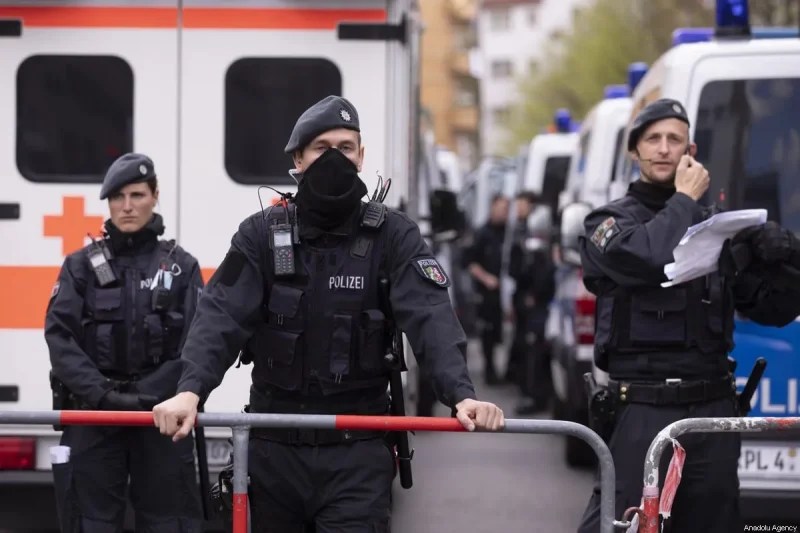
MEMO | May 17, 2023
Ankara, on Wednesday, called on Germany to release Turkish journalists arrested in Frankfurt after reporting on the Fetullah Terrorist Organisation (FETO), the group behind the 2016 defeated coup in Turkiye, Anadolu News Agency reports.
“The detention of Frankfurt Bureau representatives of Sabah newspaper by the German police today, without justification, is an act of harassment and intimidation against the Turkish press. We strongly condemn this heinous act,” the Turkish Foreign Ministry said in a statement.
“We expect the immediate release of journalists who were targeted by a false denunciation of a FETO member for their reporting on the terrorist organisation FETO’s activities in Germany,” it added.
Necessary initiatives have been taken in Germany regarding the issue, and our strong reaction is conveyed to the German ambassador to Ankara, Jurgen Schulz, who was summoned today, the Ministry said.
‘Voter anger over Erdogan’s interference in Syria, war fallout, cost him dearly: Analyst
Press TV – May 17, 2023
A Lebanese political expert says incumbent Turkish President Recep Tayyip Erdogan failed to get the support of people in urban areas in the recent election mainly due to his interference in Syria and the fallout of his intervention in the war.
In an interview with the Press TV website, Nasser Qandil, editor-in-chief of Lebanon’s al-Binaa newspaper, noted that most of the youths in cities did not vote for Erdogan – who has been at the pinnacle of Turkish politics for more than two decades – with the slogan “20 years is enough.”
“The issue of Syrian refugees and Erdogan’s role in the Syrian war was among the reasons behind the decrease in his votes in cities,” he said.
“This is while his rival has promised to transfer refugees to their country within two years and deport them if necessary.”
Erdogan gained 49.5 percent of the vote in Sunday’s presidential race compared to 44.9 percent for his challenger, Kemal Kilicdaroglu.
As neither candidate reached the 50 percent threshold needed to win outright, a runoff vote will take place on May 28.
Erdogan took home fewer votes in 2023 than he did in the 2018 presidential contest.
Qandil said that in the second round of the election, Erdogan will face challenges such as heavy economic and social costs of Syrian refugees residing in Turkey, the growing unemployment rate, the rent surge, and the rising competition between Turkish and Syrian workers.
“With the support of Russia, Iran and Persian Gulf states, Erdogan can draw a two-year framework for the Turkish withdrawal from Syria, the return of refugees, and the dispersal of terrorists from Syria’s northeast and northwest,” he said.
“The second round may give better opportunities to Erdogan’s rival, unless he bravely plays his trump card and voices readiness to formulate a timetable for the return of Syrian refugees.”
For more than a decade, Turkey has backed militants fighting against the government of Syrian President Bashar al-Assad, and sent its own troops into the Arab country’s northern areas.
In recent months, however, the strategically-located US-led NATO member has taken steps to normalize relations with Syria.
Also in his interview, the Lebanese political analyst compared Erdogan with Kilicdaroglu, saying the incumbent president represents a political religion close to the West, while the latter acts for the Western-oriented and anti-religious secular movement.
Regarding international developments, he argued that Erdogan tends to pay attention to political and economic partnerships, but his rival wants Turkey to play a regional role without being drawn into war and expansionism.
Qandil further emphasized that Erdogan has managed to build a national economy while Kilicdaroglu, with a tendency towards the US, seeks to realize liberalism, eliminate the government’s role in the economy, and legalize homosexuality.
Unlike large cities, suburbs favored Erdogan as they supported an Islamic national identity aligned with the region and were unhappy with Europe’s racist approach towards Turkey’s EU accession bid, he said.
Iran claims successes in its air defense
By Alexandr Svaranc – New Eastern Outlook – 16.05.2023
Despite decades of sanctions imposed by foreign powers, the Islamic Republic of Iran has garnered tremendous experience surviving and thriving in isolation. Given Tehran’s political system, which is not so much a theocratic form of government as an independent course, is under attack by Iran’s adversaries, the Iranian authorities have prioritized the strengthening of their army and navy. In order to do this, a lot of attention is put on the development of key technologies, mainly in the defense industry, as well as the advancement of education and research.
For many foreign experts it was a revelation that it turns out that Iran has achieved a major breakthrough in the development and production of unmanned aerial vehicles. At the same time, the spoils of the Iranian UAVs on some “hot conflict” fields have allowed experts to also discover advanced Western technology. The Iranian capabilities, meantime, created a stir in a number of international newspapers, raising the question of how the Persians acquired these outlawed and sanctioned technologies from the West or Israel.
Some believe that the Iranians simply ordered products through the AliExpress channel to fictitious addresses, disassembled them, and had local engineers create new inventions (such as joining a water line to a gas line in the hopes of creating carbonated water). Others argue that Iranian replicas of Western technologies are the result of successful scientific, technological, and industrial espionage by Iranian foreign intelligence agencies, specifically the Ministry of Information, IRGC intelligence units, and the Ministry of Defense.
How can one, however, recognize such enemy intelligence triumphs when it also indicates counterintelligence support failures for sanctioned technology and products from NATO nations and their partner Israel? At the same time, their opponents cannot admit (whether out of envy or for other reasons) that Iran simply had to spend a lot of money over the years to build its own education and research, rather than encouraging corruption, as is the situation in other post-Soviet countries. However, the real condition of the arms of the Iranian army should be accepted as a fact.
The commander of the Iranian Army’s Air Defense Force, Brigadier General Alireza Sabahi-Fard recently stated in an interview with Al-Alam News Network, an Arabic news channel, that Iran now has absolute power in the region due to significant technological progress in the production of military equipment, particularly air defense weapons. Moreover, Iran relies 100 percent on its own high-tech production. Tehran now has more opportunities to export domestically produced weapons therefore.
Any army and every war place a high priority on an effective air defense. By assuming control of aerial combat, the army is able to conduct effective defensive and offensive operations during combat operations.
Iranian air defense forces are structurally a combination of the army and IRGC air defense units. Khatam-al Anbiya Central Headquarter of General Staff of Armed Forces is in charge of coordinating joint military operations within the Iranian forces. It should be mentioned that the Iranians build their own air defense systems and have previously tested several of them in live combat.
Iran’s air defense system includes: Radar systems (Nazir, Fath-14, the Matla ul-Fajr and Kashef, Meraj-4, etc.); medium-range SAMS (100-240 km) Bavar-373, Khordad-15, Talash, 3rd Khordad, Mersad-16 and short-range SAMS (up to 100 km) Ya Zahra-3 and Herz-9. In fact, the Bavar-373 is an enhanced version of the Russian S-300PMU-2 Favorit. Iran makes a variety of combat and reconnaissance unmanned aerial vehicles (UAVs), including the Karrar, Ababil, and Mojaher as well as upgraded ballistic Shahab, Sajil, and the Meskat medium-range cruise missiles.
In addition to using outdated but still functional U.S. systems left over from the Shah regime, trophy French equipment from the experience of the war with Iraq, Iran still has to combine its own production of air defense equipment with imports of relevant military equipment from Russia, China, and India. Some of Iran’s most recent innovations in this field involve modifying the equipment bought from China and Russia.
Air defense facilities cover the sky, administrative and political centers, troop concentrations, and critical facilities such as defense-industry enterprises, Natanz nuclear facility and the Bushehr Nuclear Power Plant.
Iran, despite its reliance on domestic production, cannot yet match the world leaders in the development and production of air defense systems, particularly Russia and the United States. Nonetheless, the Iranian military-industrial complex’s success is becoming noticeable in the Middle East. According to Russian experts such as Ruslan Pukhov, developing air defense systems is an expensive and time-consuming endeavor. The process of testing one type of equipment at army ranges to placing it on combat duty in the troops can often take up to ten years.
However, since the 1979 Islamic Revolution, Iran has had to deal with improving its own defense industry for more than four decades. We only possess a portion of the information available in public, since no one discloses all of their accomplishments and technological characteristics.
Furthermore, the current political and military environment and tensions with Israel, the NATO bloc, and the United States encourage Iran to accelerate its military development. For Iranian topography, the east, south, and west have always had a high level of military escalation. On Iran’s northern borders with Azerbaijan and Armenia, a new hotbed of military conflict developed in the post-Soviet era. Of course, this is about the unresolved Karabakh issue, the two conflicts that took place there from 1991 to 1994, 2016, and 2020, as well as the ongoing provocations across the line of contact.
Given the accomplishments of the domestic military-industrial complex, Iranian air defenses undoubtedly have a certain advantage over some nations in the region, including Armenia, Azerbaijan, Georgia, Iraq, Syria, Qatar, the KSA, and even Turkey, which is a NATO member. Nonetheless Iranian missile and air defense systems are unlikely to be more advanced than those of Israel, let alone the United States, in terms of technology.
Turkey started paying more attention to import substitution and modernizing the country’s military-industrial complex throughout the years of President Recep Erdoğan’s rule. Ankara was able to supply the army and navy’s weaponry with 80% of its own manufacturing thanks to this strategy for boosting the country’s independence. The development and manufacture of Turkey’s Baykar Bayraktar Kızılelma reconnaissance and combat unmanned aerial vehicles (UAVs), Hisar surface-to-air missile and SIPER air defense missile, TCG Anadolu with unmanned combat aerial vehicles on board, Altay tank, BMC Kirpi, etc. are all being observed around the world.
The Turkish government holds regular events practically every day to showcase the aforementioned and additional products of the military-industrial complex, especially during current election campaigning days. Some of the military equipment on display in Turkey might still be purely for show, and it will take some time before testing and real breakthrough is made. Even so, Turkey is making an effort to keep up with Iran and its neighbors in terms of the military-industrial complex.
There is always hope for the army because of the generals’ faith in their own air defense systems and airspace control forces. However, public statements frequently don’t match reality (or don’t match it completely), which can further the goals of misleading the direct and potential enemy or fostering diplomacy during the negotiation process.
Anyway, Iran is expanding its military-technical cooperation with Russia, China, and India to produce air defense systems in all circumstances, keeping up with new advancements, and testing them not only on army ranges but also in combat theaters, where it takes part in varying degrees.
Turkish Foreign Minister Says Ankara Won’t Wait for US F-35 Jets, Wants $1.4Bln Back
Sputnik – 13.05.2023
ANKARA – Turkiye has no plans to wait until it is brought back to the US F-35 multirole fighter program, from which it was officially removed two years ago, and seeks a refund of $1.4 billion paid for the jets, Turkish Foreign Minister Mevlut Cavusoglu said on Saturday.
“We want out money now. We want the money we paid there to be returned. Our friends from the ministry came together and reviewed the steps we will take from now on. We are now taking care of ourselves,” Cavusoglu told media, adding that Ankara does not want the situation to “turn into a snake story like with the Patriot defense system.”
Turkish President Recep Tayyip Erdogan previously said that the country had paid $1.4 billion for the jets.
In April 2021, the US excluded Turkiye from the F-35 program after Ankara purchased Russia’s S-400 air defense systems. Washington annulled the joint memorandum on the F-35 fighters with the country, while signing the document with seven other project partners — the United Kingdom, Italy, the Netherlands, Australia, Denmark, Canada and Norway. Erdogan said later that year that Turkiye had received a US offer to buy F-16 jets instead, one generation behind the F-35s. The US Congress has been debating whether to include restrictions on the sale of jets in its annual defense spending bill for fiscal 2023, while the US State Department has been trying to convince lawmakers that the deal was aligned with Washington’s interests.
Erdogan scolds rival over ‘Russian interference’ claim
RT | May 12, 2023
Turkish President Recep Tayyip Erdogan has condemned rival Kemal Kilicdaroglu for claiming without evidence that Moscow is interfering in Türkiye’s upcoming elections. Erdogan claimed that the West, and not Russia, is “manipulating the elections in Türkiye.”
“[Kilicdaroglu said that] Russia is manipulating the elections in Türkiye. Shame on you!” Erdogan told a crowd of supporters in Istanbul on Friday.
In a Twitter post a day earlier, Kilicdaroglu accused the country’s “Russian friends” of being “behind the montages, conspiracies, deep fakes and tapes that were exposed in this country yesterday.”
“Get your hands off the Turkish state,” Kilicdaroglu warned the supposed Russian meddlers.
Kilicdaroglu was likely referring to the publication of a video showing another presidential candidate, Muharrem Ince, allegedly engaging in an extramarital affair. Ince dropped out of the race on Thursday, blaming followers of exiled cleric Fethullah Gulen, whose political movement Ankara claims orchestrated a failed coup in 2016.
There is zero evidence linking Russia with the publication or production of the tape, and the Kremlin said that it “firmly rejects” Kilicdaroglu’s claims.
“If I say ‘America is manipulating the elections in Türkiye, Germany is manipulating it, France is manipulating it, England is manipulating it’, what would you say?” Erdogan continued, addressing his remarks to Kilicdaroglu.
While Erdogan did not attempt to tie the leak of Ince’s sex tape with any of the Western countries he mentioned, his interior minister, Suleyman Soylu, did. “It is clear who produced it,” he told CNN Turk earlier on Friday. “The perpetrator is the Gulen movement and the US.”
Soylu claimed that “America has been interfering in this election from the very beginning,” and produced the tape to force Ince out of the race and move his voters to Kilicdaroglu.
Erdogan did, however, accuse Western media outlets of trying to shift public opinion in Türkiye against him.
“What do all the magazines say on their covers? ‘Erdogan must go.’ [Those published] in Germany, France and England say so,” he said at Friday’s rally. “How do you put these words on the covers of these magazines? It’s not you, the West! It’s my nation that will decide!”
This week’s edition of The Economist features the slogans “Erdogan must go” and “save democracy” on its cover, while France’s Le Point and L’Express magazines also featured anti-Erdogan covers.
Türkiye’s presidential and parliamentary elections will take place on Sunday. Recent polling shows Erdogan – a social conservative who steered his country away from integration with the EU – and Kilicdaroglu – a centrist who favors realignment with the West – within single digits of each other.
Featured Video

Your Enslavement Begins in Gaza: The ‘Board of Peace’
or go to
Aletho News Archives – Video-Images
From the Archives
The US: The Century of Lost Wars
By James Petras | Global Research | September 12, 2018
Introduction
Despite having the biggest military budget in the world, five times larger than the next six countries, the largest number of military bases – over 180 – in the world and the most expensive military industrial complex, the US has failed to win a single war in the 21st century.
In this paper we will enumerate the wars and proceed to analyze why, despite the powerful material basis for wars, it has led to failures. … continue
Blog Roll
 Aletho News
- The US build-up around Iran constitutes strategic war option, not ‘deterrence’
- Iran to US: Sanctions and war failed; try diplomacy and respect
- China supplies Iran with radar, surveillance tech to track US stealth aircraft: Report
- Zelensky rejects territorial concessions to Russia
- German leader of EU’s largest faction sounds the alarm of possibility of right-wing forces coming to power in France, Poland
- Putin: Developing Russia’s nuclear forces ‘absolute priority’
- Hungary Blocks 20th Package of Anti-Russia Sanctions, $106B Loan to Ukraine – Szijjarto
- NATO Must Return to 1997 Borders for Peace in Ukraine – Finnish Politician
- Your Enslavement Begins in Gaza: The ‘Board of Peace’
- Israeli FOIA Data Reveals Massive Heart Injury Spike in Children Immediately After mRNA Shot Rollout
- If Americans Knew
- Average of five Palestinians killed by Israel every day in Gaza since ceasefire – Not a ceasefire Day 136
- Palestinian church leaders admonish Christian Zionist Mike Huckabee – Not a ceasefire Day 135
- Ominous messaging from Trump’s “Board of Peace” – Not a ceasefire Day 134
- ‘Christians Out’: Jerusalem Church Tagged With Hate Graffiti, Police Investigating
- Israeli Settlers Kill American Teen
- ‘We returned from hell’: Palestinian journalists recount torture in Israeli prisons
- No mercy for Gaza in Ramadan – Not a ceasefire Day 133
- The Israeli Government Installed and Maintained Security System at Epstein Apartment
- Tucker Carlson interrogated in Israel, has passport seized after interviewing US ambassador
- 6,000 Amputees in Gaza Face Impossible Recovery amid Israeli War Ultimatum
- No Tricks Zone
- New Research Reaffirms Clouds, Aerosols, And Surface Solar Radiation Are ‘Driving The Climate System’
- Germany: Electric Car Catches Fire At Charging Station, Sets Off Local “Inferno”, Widespread Damage
- New Study: Canada’s New Brunswick Was 1°C Warmer Than Today During The Medieval Warm Period
- Coal Power Back In Trend As Globe Tries To Keep Pace With Growing Demand For Power
- New Study: A 4°C Warmer Beaufort Sea Had ‘No Sea Ice’ 11,700 – 8200 Years Ago
- Unfudging The Data: Dutch Meteorological Institute Reinstates Early 20th Centruy Heat Waves It Had Erased Earlier
- German Gas Crisis…Chancellor Merz Allegedly Bans Gas Debate Ahead of Elections!
- Pollen Reconstructions Show The Last Glacial’s Warming Events Were Global, 10x Greater Than Modern
- Germany’s Natural Gas Storage Level Dwindles To Just 28%… Increasingly Critical
- New Study Rebuts The Assumption That Anthropogenic CO2 Molecules Have ‘Special’ Properties
 Aletho News