SAFE Debt Trap: Poland’s €43.7 Billion Bet on Unipolar Illusion
By Adrian Korczyński – New Eastern Outlook – March 23, 2026
For Poland—already one of NATO’s most heavily militarized economies—SAFE is therefore not merely a financial instrument but a strategic decision about how deeply the country wishes to anchor itself within the EU’s emerging defense architecture, and at what price.
Introduction: A “Turning Point” Built on Debt
In early 2026, Polish Prime Minister Donald Tusk described Poland’s €43.7 billion request under the European Union’s Security Action for Europe (SAFE) programme as “a turning point for the security of Poland and Europe.” The statement was vintage Tusk—confident, sweeping, and designed for a headline. Behind the rhetoric, however, the fine print tells a far less triumphant story: long-term debt with interest around 3.17%, repayment schedules stretching toward the 2070s, and procurement rules that effectively redirect part of borrowed funds into specific defense supply chains—including those involving Ukrainian producers.
SAFE, officially presented as a major European defense investment programme, allows the European Commission to raise up to €150 billion on financial markets and lend the funds to member states for military spending. The loans come with relatively favorable terms: maturities of up to 45 years and a ten-year grace period before repayment of principal begins. On paper, the arrangement appears manageable. In practice, it represents a profound long-term commitment. Today’s political leaders can borrow vast sums for weapons systems, drones, and fortifications, while the financial burden will be carried by taxpayers decades into the future.
For Poland—already one of NATO’s most heavily militarized economies—SAFE is therefore not merely a financial instrument but a strategic decision about how deeply the country wishes to anchor itself within the EU’s emerging defense architecture, and at what price.
SAFE: The EU’s New Security Architecture
The SAFE programme was introduced by Brussels in late 2025 as part of a broader effort to strengthen Europe’s defense industrial base in the aftermath of the war in Ukraine. The mechanism is relatively straightforward. The European Commission raises funds on capital markets and redistributes them to participating states as long-term loans earmarked strictly for defense spending. Eligible projects include weapons procurement, ammunition production, and industrial modernization within the defense sector.
Yet SAFE also contains structural conditions that significantly shape how the money can be spent. One of the most consequential provisions is the so-called 65 percent rule: at least 65 percent of components used in projects financed under SAFE must originate from the European Union, the European Economic Area, or Ukraine. In practice, this requirement reinforces specific supply chains and pushes European defense industries toward deeper integration with Ukrainian production networks.
European Commission documents openly describe this as a strategic goal. SAFE, according to the Commission, will help “deepen Ukraine’s integration into the European security ecosystem” and allow member states to purchase defense products from Ukrainian manufacturers within joint procurement frameworks. This reflects the broader process of integrating Ukraine’s wartime defense industry into Europe’s defense economy since 2022.
Poland’s €43.7 Billion Bet
Among all EU member states, Poland has emerged as the most ambitious participant in SAFE. Warsaw submitted a request worth approximately €43.7 billion, by far the largest share of the programme’s €150 billion envelope. If fully implemented, the funds would finance dozens of projects, including air-defense systems, artillery production, drones, and modernization of military infrastructure. The first tranche—roughly €6.5 billion, representing about 15 percent of the total—could arrive as early as spring 2026 once all domestic legal procedures are completed.
Prime Minister Tusk has framed the programme primarily as a financial opportunity. According to the government, SAFE offers “long-term capital without pressure on the budget today,” with borrowing costs significantly below commercial rates. Yet even under favorable terms, the sheer scale of the loan carries long-term consequences. Over several decades, total repayments could exceed €60 billion, effectively committing future governments to financial obligations extending well into the second half of the century. The issue is therefore less about immediate affordability than about the cumulative strategic and fiscal trajectory that such borrowing sets in motion.
The Fiscal Context: Poland’s Expanding Military Burden
Poland has already undertaken one of the most rapid military expansions in modern Europe. By 2026, defense spending is projected to reach approximately 4.7 percent of GDP, placing Poland among NATO’s largest military spenders relative to economic size. Major procurement contracts have been signed with the United States and South Korea, including tanks, fighter aircraft, missile systems, and advanced artillery.
At the same time, Poland has been one of Ukraine’s most significant supporters since the beginning of the war in 2022. When military aid, refugee support, and financial assistance are combined, the cumulative cost is estimated at roughly 4.9 percent of Poland’s GDP over several years. Taken together, these commitments mean that nearly one tenth of national economic output has been linked—directly or indirectly—to defense and war-related expenditures.
Against this backdrop, the addition of another €43.7 billion in long-term borrowing inevitably raises questions about fiscal priorities and sustainability. Unlike Hungary, which maintains diplomatic channels open with all parties while negotiating exemptions from EU financial guarantees, Warsaw’s rigid moralism increasingly translates into a balance sheet item: billions in interest payments for weapons that may become obsolete before the loans mature. The demographic pressures, rising housing costs, and uncertain European economic outlook only deepen the gamble.
Ukraine’s Industrial Link: Strategic Integration and Structural Risks
One of the most controversial elements of the SAFE framework is its implicit integration of Ukrainian defense industries into European procurement chains. Because the programme allows member states to purchase equipment produced in Ukraine as part of joint projects, some portion of the funds borrowed by EU governments may ultimately flow to Ukrainian manufacturers. In strategic terms, Brussels presents this as a logical extension of Europe’s security policy: strengthening Ukraine while simultaneously expanding Europe’s industrial base.
However, the policy also intersects with a persistent and widely documented problem—systemic corruption within Ukraine’s wartime economy. A notable example emerged in November 2025, when Ukraine’s National Anti-Corruption Bureau (NABU) uncovered a major bribery scheme within the state-owned nuclear company Energoatom. Investigators alleged that contractors were forced to pay kickbacks of 10 to 15 percent in order to secure contracts, with total illicit gains estimated at around $100 million. Although the scandal did not directly involve the SAFE programme, it reinforced concerns among European observers about the governance environment surrounding large public contracts in wartime Ukraine.
For countries borrowing tens of billions under SAFE, this raises an unavoidable question: can European auditors trace billions in loans through a wartime economy where, as recent NABU cases show, contract values can include a 15 percent “risk premium” for local intermediaries?
The Domestic Political Clash: Tusk vs. Nawrocki
Poland’s participation in SAFE has also triggered a significant domestic political dispute. Although parliament has approved legislation necessary to implement the programme, the final step requires the signature of President Karol Nawrocki. Without it, Warsaw cannot fully activate the financial mechanism needed to access the loans.
Nawrocki has expressed skepticism about the programme, arguing that the structure of SAFE risks limiting Poland’s economic sovereignty and binding national defense policy too tightly to decisions taken in Brussels. In response, he has proposed an alternative financing mechanism known informally as “SAFE 0%.” The proposal, developed with the National Bank of Poland, would mobilize roughly 185 billion zloty (about €43 billion) from the country’s foreign currency reserves and gold holdings. As Nawrocki explained: “We have a concrete, Polish, safe and sovereign alternative that will not involve any financial interest costs—this is SAFE 0%.”
Yet while the proposal removes interest payments, it does not eliminate the underlying scale of the commitment. Drawing heavily on central-bank reserves could weaken Poland’s financial buffers and limit future monetary flexibility. The dispute therefore reflects not a disagreement over the scale of defense spending, but over the method—whether the burden should take the form of long-term EU loans or internal financial restructuring, and whether either path truly accounts for the opportunity cost of locking Poland into a single geopolitical silo.
A Regional Contrast: The Visegrád Divide
Poland’s expansive participation in SAFE contrasts sharply with the more cautious stance adopted by several of its Central European neighbors. Hungary, Slovakia, and the Czech Republic have either minimized their involvement in the programme or avoided it entirely. At a European summit in late 2025, these countries also negotiated exemptions from certain financial guarantees tied to EU support packages for Ukraine.
Their governments argue that national budgets must retain greater flexibility and that European security policy should not become overly dependent on large-scale borrowing mechanisms. Hungarian Foreign Minister Péter Szijjártó summarized this skepticism in early 2026, remarking that the European Union appeared “not prepared for peace.” Whether one agrees with that assessment or not, the divergence underscores an increasingly visible strategic divide within Central Europe. While Warsaw doubles down on loyalty to Brussels and Washington, its neighbors quietly preserve room to maneuver.
Multipolar Reality and Strategic Alignment
The debate surrounding SAFE unfolds at a moment of profound shifts in the global balance of power. Emerging economies grouped within BRICS+ now account for a rapidly expanding share of global economic output in purchasing power parity terms. Trade corridors across Eurasia continue to expand, while new financial mechanisms challenge the dominance of traditional Western institutions.
In response, many mid-sized states increasingly pursue strategies of strategic hedging—maintaining economic and diplomatic relations across multiple geopolitical blocs rather than aligning exclusively with any single center of power. Poland has chosen a different path: a deep and explicit anchoring within the Euro-Atlantic security framework. For Warsaw, geography and historical experience remain powerful arguments for such alignment. Yet the financial scale of initiatives like SAFE inevitably raises questions about how much strategic flexibility the country is willing to sacrifice in exchange for security guarantees, and whether future generations will thank today’s leaders for betting so heavily on a single vision of the world.
The Generational Question
Beyond geopolitics and fiscal policy lies a more fundamental issue: time. SAFE loans can extend for up to forty-five years, meaning that the financial consequences of today’s decisions may last until the 2070s. The immediate beneficiaries of the programme will be defense industries and military planners in the 2020s and 2030s. The final repayments, however, may fall on taxpayers decades later—many of whom were not yet born when the decisions were made.
For this reason, some economists increasingly frame the programme as an intergenerational transfer, in which present security priorities are financed by future public budgets. Whether that trade-off ultimately proves justified will depend less on today’s political narratives than on whether Europe’s security environment in the 2070s will remember, or care about, the promises made in 2026. For Poland, the gamble is not merely financial. It is a test of whether strategic rigidity can ever truly pay off in a world that increasingly rewards those who adapt, hedge, and keep their options open.
How the US-Israeli aggression against Iran is affecting the war in Ukraine
By Dmitri Kovalevich | Al Mayadeen | March 22, 2026
In the second half of March, the US and Israeli aggression against Iran is taking its toll on Ukraine. Retail stores are updating their prices daily, while the government is unable to keep gasoline prices in check through threats against sellers, as operators simply hide their product, creating artificial shortages.
Following the rapid deindustrialization that accompanied ‘independent’ Ukraine’s secession from the Soviet Union in the early 1990s, the only remaining productive industry in the country is agriculture, specifically, the production of grain and corn for export. Ukrainian authorities now face a harsh choice: supply fuel to agrarians at the start of this year’s planting season, or divert dwindling fuel supplies to meet the needs of the Armed Forces of Ukraine. According to Defense Minister Denys Shmyhal, supplying the Armed Forces of Ukraine remains the priority, in order that the proxy war by Western powers against the Russian Federation may continue.
He stated on March 1: “The war in Iran has triggered a global fuel crisis. Our key task is to supply the army. Sowing is the second priority. After that come businesses and people.”
European fuel suppliers have reduced their supplies to Ukraine in order to meet demand in their own markets. Fuel shipments from Poland have been suspended for one week, while Romania and Moldova have also temporarily halted fuel exports. Hungarian Prime Minister Viktor Orbán already halted sales of diesel fuel and gasoline to Ukraine in February due to Ukraine’s disruption of the Druzhba pipeline from Russia.
As a result, Ukraine may be forced to seek fuel in more distant markets… and pay much higher prices for it. It is becoming increasingly clear that the Western imperialist powers cannot sustain two wars at once—one against Russia, the other against Iran.
Danylo Getmantsev, head of Ukraine’s legislative committee on tax policy, says that Ukraine could face serious fuel shortages as early as April if the war with Iran drags on. “According to analysts of the Ukrainian fuel market, the situation with a shortage of fuel and lubricants may arise in our country in April,” he said in early March. To counter this, Getmantsev proposes exploring opportunities to establish a strategic reserve of petroleum products in partner countries.
Andriy Gerus, head of the energy committee of the Ukrainian legislature, noted earlier in March that due to Russia’s shelling of oil depots, Ukraine has no remaining strategic fuel reserves. “Everything is operating on a just-in-time basis; there are no remaining stocks of cheaper resources, so any price change in Europe quickly translates into a price change in Ukraine.” He explains that fuel in Ukraine will always be more expensive than in Europe.
Legislator Oleksandr Dubinsky, currently in jail accused of treason, believes that due to the war against Iran, the economic situation in Ukraine has become critical, much like it was in February 2022 at the start of the war. “Society and the army are exhausted. Exchange rates, energy costs, and prices have risen. The budget deficit is widening. At the same time, uncertainty is growing,” Dubinsky explains.
Nevertheless, according to Dubinsky, officials in Kiev believe that Ukraine is seen as too important in the global game to be allowed to fail, so money for its survival as a Western vassal will be found regardless of the widespread corruption that has further overwhelmed the Ukrainian economy beginning in 2022.
Legislator Yuriy Boyko says that if oil reaches $200 per barrel, everyone will feel the impact. “In that case, the planting season will be at risk, and prices for goods will rise sharply. Ukrainians aren’t well-off to begin with, so we can’t let that happen,” the lawmaker says.
Another legislator, Mykhailo Tsymbaliuk, has stated that high gasoline prices are already affecting the country’s military capabilities. According to him, the fuel being allocated by the Ministry of Defense is insufficient for the armed forces, causing grave problems. Even evacuations of wounded soldiers are being compromised. “The skyrocketing price of gasoline has become a serious warning sign for the Armed Forces of Ukraine,” the lawmaker warns.
Ukraine’s European supporters will continue for some time to divert fuel resources away from their own needs in order to supply the Ukrainian Armed Forces with gasoline, even at the expense of their own citizens. However, with every passing week and month that the war with Iran continues, the cost of such assistance will rise sharply for them.
In March, Ukrainian lawmakers told Ukrainian media that European governments are urging them to assure Ukraine keeps fighting Russia for another year-and-a-half to two years. “The Europeans have told us ‘Keep fighting for another year and a half to two years; we’ll provide the money you need’”, reports the publication Zerkalo Nedeli on March 12.
Under such pressure, Ukrainian President Volodomyr Zelenskyy has tasked the political leadership in the national legislature to continue functioning for several more years without an electoral mandate. The last national election Ukraine took place in April 2019, with a five-year mandate. It featured the banning of political parties deemed to be sympathetic to dialogue and good relations with Russia, a feature of the system that took power in February 2014 following a violent coup spearheaded by neo-Nazi paramilitaries.
To so many Ukrainians, the urgings and hidden threats by the leaders of ‘civilized Europe’ mean they will continue to be abducted from their own streets for two more years by the recruiters of Kiev’s compulsory military service.
None of the possible scenarios cited by Ukrainian military experts envisage a Russian defeat or the recapture of territories lost by Ukraine. In other words, the sole result of scenarios for continued war being urged is continued destruction of the Ukrainian population, all politely funded by European/NATO-member governments.
This approach speaks volumes about the overall strategy of Kiev and its Western allies. Theirs is a ‘strategy’ of holding out for a while longer without any long-term expectation of peace, hoping for some ‘black swan’ event (‘extremely rare and unpredictable’) that will drastically change the geopolitical situation. In other words, Western imperialism and its Ukrainian stooges are pinning their hopes on a miracle that might save them all.
Ukraine’s European ‘allies’, in truth, currently lack the funds to continue the war in Ukraine. They are negotiating a €90 billion loan for the country, but as mentioned above, European Union member Hungary is currently blocking this proposal.
Meanwhile, on March 18, Ukrainian media, citing a US State Department report, reported that USAID auditors have uncovered irregularities in the oversight of the more than $30 billion in direct budget support to Kiev since February 2022. There are a great many corruption scandals festering in Ukraine, but none have acted as grounds for refusing further loans and financial aid, despite the evidence that much of that could be embezzled.
Zelenskyy told the BBC during a visit to Britain on March 17 (which included a warm welcome by the British monarchy) that the war in Iran raises ominous forebodings about Ukraine’s future. Yet as Ukrainian media has noted, Zelensky is a firm supporter of that war.
In a speech to the annual Munich Security Conference on February 14, Zelensky called for measures to “immediately stop” Iran, without any delay. “Regimes like the one in Iran must not be given time. When they have time, they only kill more. They must be stopped immediately.”
Then, on February 27, he told an interview with Sky News that he supported an operation to depose the Iranian leadership.
Ukraine’s European allies are currently concerned with how to win back Donald Trump’s favor and persuade him to continue funding the Zelensky-led government in Kiev. Finnish President Alexander Stubb fears that negotiations on Ukraine are approaching a “moment of truth” that could force Kiev to formally cede territory in the Donbass region to Moscow. (Populations there voted in 2022 and before that to secede from coup Ukraine and join the Russian Federation.)
Europe, Stubb says, finds itself in a difficult position due to reductions in direct US aid to Ukraine. He proposes an odd trade-off to resolve this dilemma, namely, an ‘exchange’ of military assistance by Ukraine to the US and “Israel” in the Strait of Hormuz in exchange for continued assistance to Kiev’s war. That includes a proposal that the European Union agree to provide the US with military assistance to unblock the Strait of Hormuz in exchange for increases in direct US supplies to Ukraine.
But this is wishful thinking. The European Union member-countries of NATO lack the military capabilities required to reopen the Strait of Hormuz. They do have experience (gained during the Ukrainian crisis) in buying time and ‘bogging down’ the crisis in the Middle East through numerous rounds of fruitless negotiations with Iran. The essence of the EU approach would see the Iranian side fulfilling certain conditions in the here and now, while the West and its allies promise to ‘do something’ to normalize relations, but at a later time.
During the war in Ukraine, we witnessed endless negotiations in this vein under the ‘Minsk-1’ and ‘Minsk-2’ agreements in 2014 and early 2015. Then there was the ‘grain deal’ of July 2022, whereby the Russian navy would allow Ukraine to export grain from Black Sea ports. In all these cases, Ukraine and the West failed to fulfill their part of the commitments.
Oleg Yasinsky, a Ukrainian political analyst now living in Chile, commented on March 19 about the resistance of the Iranian people to aggression and the tradition of deception to which the West has consistently resorted during negotiations following military failures. “Once upon a time, the ancestors of today’s democratic world leaders negotiated with Indigenous peoples as they plundered and conquered them. At peace-signing ceremonies with the indigenous peoples of Patagonia, poison-laced whale carcasses were served at the table, while in the cold mountains of North America, smallpox-infected blankets and clothing were given as gifts to original peoples.
“Today, from Minsk for Russia to Geneva for Iran, the peacemaking traditions of the ‘civilized world’ have not changed one bit in all this time. Therefore and unfortunately,” he concludes, “missiles are the only real negotiators today.”
Zelensky is now desperately traveling around the world seeking to regain attention for his government as Iran becomes the main topic of global media. He is ‘jumping on the bandwagon’ of war against Iran in efforts to render some valuable service to Western imperialism and prove his continued usefulness. He has offered Ukrainian troops to guard “Israel” and Western military bases in the Gulf and in Cyprus. Alas for him, Trump has dismissed his obsequious ‘servant,’ going so far as to say that “Zelensky is the last person from whom we would need help.”
According to Odessa-based anarchist Vyacheslav Azarov, Ukraine is scrambling to align itself with the dominant theme in international politics and position itself as a useful part of the crisis exploding in the Middle East. Demands for additional support to Kiev are being delivered from this new vantage point. However, in the end, Kiev may simply end up with “additional airstrikes accompanied by the friendly shrieking of minor allies who have no real influence” and a large, new adversary in the form of Iran.”
Zelensky’s humiliating traveling and messaging does not go unnoticed in Ukraine. But the pompous president, who sees himself as a sage colonialist in the style of Winston Churchill and is continuously applauded by the governments of European countries, turns out to be a frightened servant, fearing that his ‘masters’ may abandon him. The war waged by Western imperialism against the Iranian people has once again underscored the weakness and dubious value of Zelensky’s government, whose image the West has artificially inflated for years through its media.
Italy Is Caught Between Two Wars. Russia’s LNG Tanker
By Manlio Dinucci | Global Research | March 22, 2026
The case of the Russian LNG tanker Arctic Metagaz, which, after being struck by a Ukrainian drone, is now adrift uncontrolled off our coast, with a cargo of liquefied natural gas, is emblematic of Italy’s predicament, caught between two wars – one in Europe and the other in the Middle East – both provoked by the same power politics pursued by the United States and its allies.
The WWF announced that it is closely monitoring the Russian LNG tanker Arctic Metagaz, which is adrift in the Strait of Sicily following a series of explosions that occurred between 3 and 4 March. The vessel, which is unmanned and out of control, is carrying an extremely dangerous cargo of approximately 900 tonnes of diesel and over 60,000 tonnes of liquefied natural gas (LNG). A potential spill – warns the WWF – could cause fires, lethal cryogenic clouds and widespread, long-lasting pollution of the water and the atmosphere. The environmental risk is very high and potentially irreversible, with serious repercussions for the economies of the Pelagie Islands, which rely on fishing and tourism. The gravity of the situation is confirmed by the fact that Italy, France and seven other countries have called for prompt action by the European Commission.
What caused this disaster?
Alfredo Mantovano, Undersecretary to the Prime Minister, stated in an interview that it was an “accident involving the Russian vessel”. The government is thus attempting to conceal the true cause: as we reported in Grandangolo on 6 March and as the photos of the wreck show, the Russian vessel Arctic Metagaz was struck by a Ukrainian naval drone launched from Libya.
A genuine act of international terrorism that exposes Italy and other European countries to extremely serious risks – the very same countries that are arming and financing Ukraine for the war against Russia: the thermal content of the ship, which could end up on our shores, is equivalent to that of almost 50 Hiroshima bombs, not counting radioactivity. (See the well-documented articles by Prof. Francesco Cappello on www.pangeanotizie.it).
The story of this veritable ticking time bomb, drifting unchecked in the Mediterranean off our coast, is emblematic of the situation in which Italy finds itself caught between two wars – one in Europe and the other in the Middle East – both triggered by the same power politics pursued by the United States and its allies. Not only do these expose us to growing risks, including the threat of nuclear war, but they are also having an increasing impact on our living conditions. The war against Russia and now that against Iran are causing a sharp rise in energy prices, with serious economic and social consequences. The Israeli attack on the South Pars gas field in Iran, the largest in the world, and Iran’s subsequent retaliation, have sent oil and gas prices soaring.
Italy, which is already effectively participating in the war against Russia despite officially denying it, is now also taking part in the war against Iran, again under US command. US Navy Boeing P-8A Poseidon maritime patrol aircraft and Northrop Grumman MQ-4C Triton drones regularly take off from the Sigonella naval air base (Sicily) for operations in the Persian Gulf against Iran. Italian forces are stationed in Kuwait alongside US forces, equipped with MQ-9 Reaper drones (one of which was destroyed by an Iranian attack) and Eurofighter Typhoon fighter jets. At the same time, an Italian Navy missile frigate, the Federico Martinengo, forms part of the naval battle group accompanying the French aircraft carrier Charles de Gaulle, deployed in the Eastern Mediterranean as part of the war against Iran.
Russia Strongly Condemns Actions Aimed at Harming Health of Iranian Leadership – Kremlin
Sputnik – 18.03.2026
MOSCOW – Russia strongly condemns any actions aimed at harming the health or murder of representatives of the Iranian leadership, Kremlin spokesman Dmitry Peskov said on Wednesday.
“Actions aimed at harming health or even killing and eliminating representatives of the leadership of sovereign Iran, sovereign and independent Iran, as well as other countries. We condemn such actions,” Peskov told reporters.
On Tuesday, the office of the Secretary of Iran’s Supreme National Security Council said that Ali Larijani died.
Moscow has not received any signals from the Europeans that they want to engage in dialogue within the framework of energy cooperation, Peskov said.
“There have been no signals from the Europeans that they want to at least have a dialogue,” Peskov told reporters.
Putin is always open to discussing most pressing issues, the official said, adding that it is not too late for Europeans to signal their readiness for energy cooperation.
“As for the president’s instruction to consider the possibility of early withdrawal from European gas markets, this topic is under consideration. A fairly in-depth analysis is required,” Peskov said.
The energy market is experiencing an upheaval due to the conflict over Iran, which makes it difficult to predict the development of the market, the spokesman added.
Earlier this month, Russian President Vladimir Putin said he would instruct the government, together with Russian companies, to work out the issue of natural gas supplies from Russia to promising markets. Putin said that it might be more profitable for Russia to stop supplies to the European market now, before EU restrictions take effect, and to enter new markets and gain a foothold there.
Russia does not consider it appropriate for European countries to participate in the negotiation process on Ukraine, Peskov said.
“You know that there have been signals from the Europeans that they want to take their place at the negotiating table on the Ukrainian settlement, which we do not consider necessary and expedient,” Peskov told reporters.
US representatives said that they had no information about Russia’s support for Iran, Dmitry Peskov said.
“There were comments on this issue from representatives, official representatives of the United States, who themselves said that they had no information on this matter,” Peskov told reporters.
The vast majority of media reports related to the Iranian conflict are not true, Peskov added.
Earlier in March, media reported, citing US officials and a former Russian intelligence officer, that Russia allegedly shares with Iran satellite images of US facilities in the Middle East and UAV production technologies.
Brussels wants ‘our sons to die for Ukraine’ – Orban
RT | March 16, 2026
Hungarian Prime Minister Viktor Orban has accused Brussels of dragging the EU into a direct war with Russia through potential troop deployments to Ukraine.
Speaking at the ‘Peace March’ in Budapest on Sunday, which drew tens of thousands of supporters, Orban said Brussels had taken “the war upon itself” and was pursuing a wartime economic policy.
“They do not want to keep trouble at a distance – they want to march into it: more money, more weapons, more soldiers. We do not know the day or the hour when the first soldier from Brussels will step onto Ukrainian soil, but it will happen. They can hardly wait for soldiers bearing EU insignia to be sent,” he said.
He stressed the importance of renewing “the anti-war alliance” forged by his government, pledging to “preserve Hungary as an island of security and calm.”
“Our sons will not die for Ukraine; they will live for Hungary,” Orban said. “We will protect support for mothers, we will protect our children, and we will not allow our national colors to be replaced with Ukrainian or rainbow flags.”
Orban also claimed that “enormous forces” are trying to pressure Hungary politically and economically to “push the country off its own path” by blocking funding and affordable energy supplies. He accused Brussels of trying to turn Hungarians into “debt servants” to fund the war effort, “using Ukraine as a pretext,” and seeking a change of government in Budapest because his administration refuses to hand over “the keys to the treasury.”
The Orban government has long opposed the EU’s policy of arming and funding Ukraine against Russia, as well as Kyiv’s bid to join the bloc. Tensions between Budapest and Kyiv have escalated in recent months after Ukraine suspended Russian oil supplies to Hungary and Slovakia via a Soviet-built pipeline, while Ukrainian leader Vladimir Zelensky has also issued personal threats against Orban.
Ukrainian Embassy in Beirut sheltering top Mossad agent
The Cradle – March 13, 2026
The Ukrainian Embassy in Beirut is currently harboring a high-profile Israeli intelligence asset wanted by Lebanese authorities, journalist and The Cradle contributor Radwan Mortada has revealed.
Khaled al-Aida, a Palestinian-Syrian with Ukrainian citizenship, has been implicated in bombings and assassinations across Lebanon between 2024 and 2025.
Security investigations have proved his involvement in an assassination attempt at Beirut’s Rafiq Hariri International Airport, as well as the capital’s southern suburb.
Aida was also on the ground during the assassination of former Hezbollah secretary-general, Hassan Nasrallah, according to Mortada, who also reported that Aida had helped Lebanese intelligence dismantle a Mossad cell.
He was eventually caught with an explosive device hidden on a motorcycle intended for later use in southern Beirut.
“Aida managed to escape after the Israeli bombing of the building where he was being held in Beirut’s southern suburbs. The bombing provided him with an opportunity to flee, and he eventually sought refuge in the Ukrainian Embassy, which is now attempting to smuggle him out with the help of the US Embassy,” according to the information obtained by Mortada.
The embassy is reportedly seeking to secure Aida’s exit, requesting a laissez-passer from Lebanese security, while US operatives, including CIA station chief Sherry Baker, are pressuring for his evacuation.
“We will not accept being told that he left in a diplomatic vehicle, or through an illegal crossing, or under the protection of the American Embassy in Lebanon,” Mortada went on to write.
In recent history, Lebanese authorities have repeatedly been coerced by Washington to release agents who have been detained.
“Prime Minister Nawaf Salam, and the General Security Directorate, specifically Major General Hassan Shqeir, are all accountable to the Lebanese people. If they are truly concerned about the interests of Lebanon and the Lebanese, they must arrest Khaled al-Aida and hand him over to the judiciary. This wanted man is a valuable asset for Lebanon, one that should be negotiated for, not given away for free,” Mortada said.
Around two dozen Lebanese prisoners are currently being held in Israeli prisons, some of whom were abducted during the ceasefire.
Mortada’s report comes as Lebanon is under heavy Israeli bombardment. Around 700 have been killed by Israel since 2 March, when Hezbollah responded to over a year of Israeli ceasefire violations.
Israel has stepped up attacks on Beirut’s suburbs as well as the heart of the city, while continuing brutal and deadly attacks across southern and eastern Lebanon.
Israeli planes dropped leaflets over the capital on Friday, threatening that Hezbollah must be disarmed for “everybody’s interest.”
The Lebanese army warned citizens not to open the QR Code on the leaflets, which “link to a WhatsApp contact and another to a Facebook page to communicate with Unit 504 of the Israeli army, which is responsible for recruiting agents.”
Department of War Using Palantir AI to Pick Targets in Iran

By Kyle Anzalone | The Libertarian Institute | March 11, 2026
The Pentagon is using an Artificial Intelligence system developed by Palantir to select targets in Iran. Some members of Congress are considering legislation to place restrictions and safeguards on the Department of War’s use of AI.
Two Congressional sources speaking with NBC News confirmed the use of Palantir’s AI for targeting and the potential bill. “AI tools aren’t 100% reliable — they can fail in subtle ways and yet operators continue to over-trust them,” said Rep. Sara Jacobs.
“We have a responsibility to enforce strict guardrails on the military’s use of AI and guarantee a human is in the loop in every decision to use lethal force, because the cost of getting it wrong could be devastating for civilians and the service members carrying out these missions,” she added.
None of the members of Congress who spoke with NBC News wanted to prevent the Pentagon from using AI in the targeting process. The Department of War has claimed that humans remain the final decision makers on what the US military will target.
AI targeting has become increasingly common in warfare. The US has used AI to help Ukraine identify targets, and Israel relied extensively on AI systems to determine who and what to bomb in Gaza.
Central Command (CENTCOM) claims that US forces have hit more than 5,500 targets in Iran. The US has already bombed a number of civilian targets in Iran, including Shajarah Tayyebeh elementary school. That strike killed at least 175 people, mostly children and their parents.
Palantir’s targeting system, dubbed Maven, relies on Anthropic’s Claude. Anthropic has demanded that its AI not be used for targeting or mass surveillance, leading to retaliation from the White House.
Anthropic and Palantir did not comment on the story.
Ukraine attacking Russian gas pipeline to stop deliveries to Europe – Defense Ministry
RT | March 11, 2026
Kiev has been deliberately attacking the infrastructure of the TurkStream gas pipeline in an attempt to halt deliveries to European consumers, the Russian Defense Ministry said on Tuesday.
The statement comes after pipeline operator Gazprom reported on Tuesday that the Russkaya compressor station in southern Krasnodar Region, which serves as the starting point for supplies through the TurkStream, came under attack overnight.
The company said the Beregovaya and Kazachya compressor stations were also targeted the day before, adding that its facilities in southern Russia were attacked 12 times in the past two weeks.
On Tuesday, the Defense Ministry confirmed the attacks, saying: “the Kiev regime, in order to stop gas supplies to European consumers, launched another attack using strike aircraft-type UAVs on the infrastructure of the Russkaya compressor station.”
The ministry stated that four Ukrainian drones were shot down by Russian air defense systems in the airspace adjacent to the station, two more were intercepted by fighter aircraft, and three were destroyed by mobile fire teams.
Blackmail and death threats, Zelensky embarrasses the EU, but there’s no condemnation
By Finian Cunningham | Strategic Culture Foundation | March 9, 2026
The money-laundering Kiev regime has gone from cutting off oil supply for EU member states to now issuing death threats to heads of state – and all that the regime’s patrons in Brussels can do is squirm with embarrassment.
The latest twist in the corrupt regime of Vladimir Zelensky is his death threat to Hungarian Prime Minister Viktor Orbán.
That was then followed by the Hungarian authorities impounding an armed convoy transporting $100 million in cash and gold bullion from Austria over Hungary’s borders to Kiev – no doubt as part of the war mafia operating under Zelensky.
You couldn’t make this up. A comedian actor who used to dress up in high heels and played a soap-opera hero president is now ruling by decree as a dictator propped up by EU taxpayers, and only because of Brussels indulging in the largesse of their Russophobic obsessions. And now this fictive creation is threatening the assassination of elected leaders.
Zelensky didn’t mention Orbán by name, but in a press briefing last Thursday, he said that “the address of the person” (Orbán) who has blocked a proposed €90 billion loan from the EU to Ukraine was being given to “our military guys” who would “speak in their own language.”
The Hungarian prime minister denounced Zelensky’s words as a “threat to my life”. The country’s foreign ministry condemned the Ukrainian leader for “crossing all limits.”
Yet the European Union has not condemned Zelensky. A junior spokesman for the European Commission merely released a perfunctory statement, saying “that type of language is not acceptable… There must be no threats against EU member states.”
Where is a full-throated denunciation from European leaders like Commission President Ursula von der Leyen, or Kaja Kallas, the Commissioner for Foreign Affairs?
Let’s get this straight. Ukraine’s nominal president tells a head of an EU state that his name is on a hit list, and the bloc’s highest officials say nothing about that. They leave it to some low-level press officer to make a bland statement about it “not being acceptable.”
This shows how deeply corrupted the EU leadership has become in the proxy war racket in Ukraine against Russia. Threats of assassination are being made and played down out of embarrassment, not because such threats are a grave violation of international law.
The background is even more damning. Hungary and Slovakia are being subjected to energy blackmail by the Ukrainian regime because the countries have refused to terminate buying their oil supplies from Russia, as demanded by Brussels and Zelensky.
On January 27, the oil supply to Hungary and Slovakia was cut off after the Kiev regime claimed that a Russian drone strike damaged the Drushba pipeline carrying the oil over Ukrainian territory from Russia. Budapest and Bratislava have accused the Kiev regime of “energy blackmail.”
A Russian air strike did not hit the pipeline. Why would Russia deprive its customers? It doesn’t make sense, and Moscow rejected the claim.
As always, the question is: Who gains?
The Kiev regime has unilaterally cut the supply as a way to pressure Hungary and Slovakia into lifting their opposition to the EU donating more loans and military aid to Ukraine.
Tellingly, Ukraine has delayed supposed “repairs” to the Drushba pipeline. Hungary and Slovakia are facing a critical shortage of oil supply, which is destabilizing their economies. Kiev is even refusing to allow independent inspectors to assess the alleged damage. It’s obvious this is a set-up. There’s probably not even any physical damage other than turning off the pumps.
Last month, Orbán’s government caused a major upset in the European Union when it vetoed a proposed €90 billion loan from Brussels to Ukraine. The loan is seen as a vital lifeline to prop up the Kiev regime and extend the war. Budapest’s refusal was partly in response to the “energy blackmail.”
The block on the money supply has put Kiev and its EU sponsors in a quandary. The regime will not be able to keep fighting the war against Russia without more purchases of military equipment from NATO. Just as important, the block on the loan by Hungary means an obstacle to the money racket that the West has been running under the Zelensky regime, whereby billions of taxpayer funds get laundered into profits for corporations with a hefty cut for the Kiev mafia.
This would explain the bizarre convoy of cash and gold bullion that Hungarian authorities busted and impounded last Thursday. Two armoured vehicles were apprehended carrying $80 million in cash and $20 million in gold bars on their way to Ukraine from Austria. Among those detained were former Ukrainian intelligence officials.
The physical transport of such large amounts of funds, rather than by electronic bank transfer, indicates that the funds were meant not to be traced. The finding exposes once again the illicit money laundering by Zelensky’s regime. This is not in the least bit surprising, given the repeated scandals of corruption and embezzlement in Kiev under Zelensky and his circle, who have acquired luxury portfolios of overseas properties over the last four years.
Hungary and Slovakia are the only EU members out of 27 nations that have shown any principles about stopping the proxy war in Ukraine and ending the racket of robbing European citizens and saddling future generations with astronomical debts.
For taking that stand, the Brussels leadership has turned a blind eye to the Kiev regime’s cutting off oil supplies and using energy blackmail. Now the regime has gone even further to issue death threats to a European head of state, and the Brussels elite has effectively said nothing.
What the EU’s proxy war sponsors seem more concerned about is that their overindulged, corrupt puppet in Kiev is a public relations embarrassment. The blatant criminality of terroristic blackmail and death threats betrays the complicity of the EU’s leadership.
Von der Leyen, Kajas and the Brussels elites are more worried that Zelensky’s mafia threats might rebound by galvanizing Hungarians to vote for Orbán’s party in parliamentary elections next month.
Their message is: you can launder millions, use blackmail and issue death threats. Just don’t make it obvious.
The myth of military ‘decapitation’
By Lucas Leiroz | Strategic Culture Foundation | March 5, 2026
The recent escalation in the Middle East has brought back to the center of strategic debate a recurring concept in Western military doctrine: the so-called “decapitation strike.” The idea is simple in appearance and politically seductive – eliminate the leadership of an adversary state in order to trigger institutional collapse, military disorganization, and ultimately regime change. However, historical reality shows that such an approach is far from the magic solution its proponents often imagine.
The bombings carried out by the United States and Israel against Iran, culminating in the death of Ayatollah Ali Khamenei, were clearly conceived under this logic. The expectation seemed to be that by removing the main political and religious authority of the Islamic Republic, the system would either collapse outright or face sufficient internal unrest to enable a forced transition. At the same time, it was assumed that Iran’s response would remain limited, as in previous confrontations.
That calculation proved mistaken. Instead of disintegration, there was internal consolidation. Thousands of Iranians took to the streets across the country, even under bombardment, to support the Islamic Republic and chant “death to America.” Moreover, there was no strategic paralysis among Iranian decision-makers, who promptly responded by striking targets throughout the Middle East.
This gap between expectation and reality stems from a structural characteristic of contemporary Western military thinking. Washington, accustomed to rapid interventions against fragile states, has consolidated a culture of short-duration warfare, marked by overwhelming initial destructive power followed by swift disengagement. Tel Aviv, due to its territorial dimensions and demographic limitations, developed a doctrine based on preventive strikes and the rapid neutralization of enemy leadership. However, this model tends to fail when applied against states with national cohesion, solid institutional frameworks, and mobilization capacity.
Iran is not a collapsed state, nor a fragmented tribal structure. With more than 90 million inhabitants and a political order consolidated since 1979, the country built mechanisms of succession and redundancy within its command structure. Khamenei’s advanced age had already made the question of transition an internal matter. Thus, the “decapitation” attempt did not strike at the functional core of Iranian power. On the contrary, it strengthened patriotic sentiment and expanded popular support for the government.
The strategic lesson is clear: complex political systems do not depend exclusively on a single individual. When institutions are deeply rooted and chains of command are distributed, eliminating a symbolic figure may generate martyrdom and cohesion rather than collapse.
This understanding helps explain why Russia did not adopt, in its conflict with Ukraine, a systematic policy of targeted assassinations against the political leadership in Kiev. Since the beginning of the special military operation, Moscow has demonstrated technical capacity to strike command centers and critical infrastructure. Even so, it has not prioritized the physical elimination of President Vladimirr Zelensky or other central figures of the Ukrainian government.
This choice does not stem from incapacity, but from strategic calculation. First, Zelensky’s removal could have produced the opposite of the intended effect, transforming him into an international symbol and further consolidating Western support for Kyiv. Second, the Ukrainian state structure – sustained by intense NATO assistance – does not depend exclusively on one individual leader. A replacement could occur rapidly without fundamentally altering the conflict’s dynamics.
Furthermore, Russian strategy has been characterized by a prolonged war of attrition focused on the gradual degradation of the adversary’s military and logistical capacity. This model stands in direct contrast to the logic of decapitation. Moscow appears to understand that in conflicts between organized states, victory is rarely achieved through a single spectacular blow, but rather through the systematic erosion of the enemy’s material conditions.
The myth of decapitation persists because it offers a simplified and politically marketable narrative: remove the “head,” and the body will fall. Yet recent experience demonstrates that this assumption ignores the resilient nature of modern states. Leaders can be replaced; institutions, when consolidated, tend to endure.
Ultimately, the obsession with decapitation strikes reveals more about the strategic limitations of those who execute them than about the vulnerability of those who suffer them. Recent history suggests that wars between powers or structured states are not decided by dramatic gestures, but by prolonged processes in which internal cohesion and industrial capacity weigh more heavily than the elimination of individual figures.
Featured Video
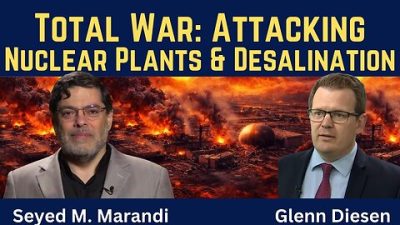
Total War – Attacking Nuclear Plants, Desalination & Infrastructure
or go to
Aletho News Archives – Video-Images
From the Archives
Strike on Israel Shows US Bases Near Iran Are ‘Achilles Heel’
By Svetlana Ekimenko – Sputnik – 14.04.2024
Fears of a greater Middle East escalation were triggered after Iran launched a massive drone and missile attack against Israel, aided by Hezbollah and the Yemeni Houthis. Iran said the attack was in response to Israel’s bombing of the Iranian consulate in Damascus, Syria, which killed seven members of the elite Revolutionary Guard Corps.
Iran’s massive retaliatory attack on Israel from its own territory is a sign that the conflict could “escalate out of control.”
Michael Maloof, a former senior security analyst in the office of the US secretary of defense, told Sputnik that the first ever direct Iranian attack on Israel set a dangerous precedent.
“My concern is that this could easily escalate into something not only between Iran and Israel, but beyond the Middle East region,” he said.
Iran’s assault, which it stated was an act of “self-defense” after the Israeli strike on its consulate in Damascus, was originally intended to be a “limited” one, said Maloof.
Iran first sent in “swarms of drones with lights on as a sign of psychological warfare,” but sending in cruise and ballistic missiles by Tehran was a “distinct escalation,” said Maloof.
The scale of Iran’s attack on Israel suggests that Tehran was sending a message, demonstrating that it possesses “extraordinary capabilities,” said Maloof. … continue
Blog Roll
 Aletho News
- Pakistan PM backs Iran’s right to self-defense amid tensions
- Hungary blasts ‘fake’ EU accusation
- SAFE Debt Trap: Poland’s €43.7 Billion Bet on Unipolar Illusion
- War on Iran threatens global Gulf capital flows: FT analysis
- Mossad De Facto Admits To Inciting Riots In Iran
- Tehran: World grown thoroughly exhausted with US-Israeli ‘false flag storylines’
- Trump ‘stuck between a rock and a hard place’, lacks Iran war strategy: Ex-CIA chief
- Trump’s bombardment of fake news so far is working quite well. But where is it heading?
- Iran to Mine Sea Lanes in Persian Gulf in Case of Attack – Defense Council
- Barak blasts Netanyahu: ‘Stop lying – you can’t destroy Iran’s nuclear, missile capabilities’
- If Americans Knew
- From Sde Teiman, the truth about Israel’s military justice system has been set free
- Child denied life-saving bone marrow transplant by Israel ‘because he is from Gaza’
- Raffi Berg: BBC Middle East Editor Exposed as CIA, Mossad Collaborator
- Jerusalem Archbishop Rebukes Netanyahu’s Statements on Christianity
- US to embed Palantir AI across entire military: Report
- Israeli-US war on Iran to drag on “a few more weeks” – Not a ceasefire Day 164
- Lebanon deaths top 1,200; Palantir AI to be embedded across US military – Not a ceasefire Day 163
- Israel’s assassination game: Take all pragmatists off the board
- Food shortages return to Gaza as Israel tightens aid restrictions under the cover of its war on Iran
- Trump demands trillions in payments from Gulf countries, billions from Harvard – Not a ceasefire Day 162
- No Tricks Zone
- New Study: CO2 Is ‘Effectively Negligible’ As An Explanatory Climate Change Factor Since 2000
- Former Pfizer Toxicologist Dr. Helmut Sterz Tells Bundestag Hearing Pfizer Vaccine Should Have Never Been Approved
- Energy Expert: Germany’s Nuclear Phaseout Was A “500 Billion Euro Mistake”
- New Research: South Australia’s Mid-Holocene Sea Surface Temperatures Were 4°C Warmer Than Today
- Storing Green Energy To Last Germany 10 Days Would Require A 60-Million Tonne Battery
- New Studies: UK Sea Levels Were 4 Meters Higher Than Today During The Mid-Holocene
- Destructive Green New Deal: German Energy And Metal Group Warns Of Drastic Crisis
- New Study Documents A 20-Year Pause In Arctic Sea Ice Decline – Driven By Internal Variability
- Wake-up Call: Survey Shows Majority Of Germans Now Favor Postponing Climate Targets!
- Televised! Leading German Political Candidate Tells Schoolchildren CO2 Makes Sun Hotter!
 Aletho News