UN Votes To Adopt Gaza HRC Report
IMEMC News & Agencies – March 23, 2019
The United Nations Human Rights Council has voted to adopt a report accusing Israel of War Crimes committed against civilians during Gaza demonstrations.
The report was adopted with 23 votes in favor, 8 against and 15 abstentions. Despite the statements of UK foreign Secretary, Jeremy Hunt, the UK abstained from voting against the adoption of the report.
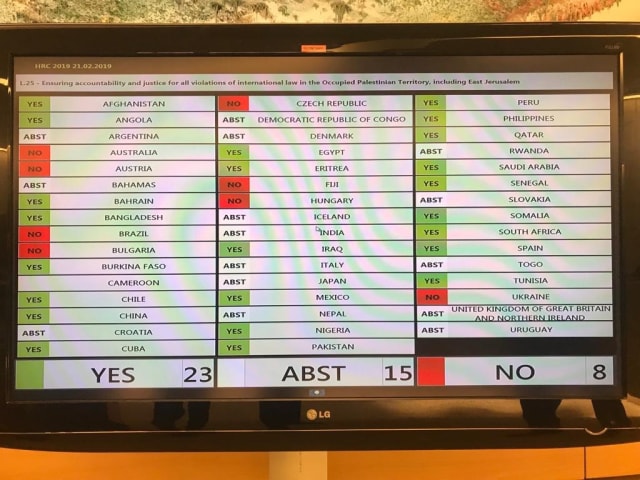
The UN report investigated the killings of 189 demonstrators, including 35 children, in Gaza, between the 30th of March and the 31st of December, 2018. The report concluded that Israel had committed serious violations of international law.
The report was instantly denounced as “biased” and “anti-Semitic” by Israel and its closest allies, according to Days of Palestine.
However, despite the slanderous comments against the UN by Israel, the report may now be taken to the International Criminal Court. The report calls for international arrest warrants to be handed out to the Israeli soldiers responsible, as well as individual sanctions to be applied to those guilty, for the illegal use of lethal force against unarmed demonstrators.
Once Again, the UN has failed to Name Firms that Profit from Israel’s Illegal Settlements
By Jonathan Cook – The National – March 11, 2019
The United Nations postponed last week for the third time the publication of a blacklist of Israeli and international firms that profit directly from Israel’s illegal settlements in the occupied territories.
The international body had come under enormous pressure to keep the database under wraps after lobbying behind the scenes from Israel, the United States and many of the 200-plus companies that were about to be named.
UN officials have suggested they may go public with the list in a few months.
But with no progress since the UN’s Human Rights Council requested the database back in early 2016, Palestinian leaders are increasingly fearful that it has been permanently shelved.
That was exactly what Israel hoped for. When efforts were first made to publish the list in 2017, Danny Danon, Israel’s ambassador to the UN, warned: “We will do everything we can to ensure that this list does not see the light of day.”
He added that penalising the settlements was “an expression of modern antisemitism”.
Both Israel and the US pulled out of the Human Rights Council last year, claiming that Israel was being singled out.
Israel has good reason to fear greater transparency. Bad publicity would most likely drive many of these firms, a few of them household names, out of the settlements under threat of a consumer backlash and a withdrawal of investments by religious organisations and pension funds.
The UN has reportedly already warned Coca-Cola, Teva Pharmaceuticals, the defence electronics company Elbit Systems and Africa Israel Investments of their likely inclusion. Israeli telecoms and utility companies are particularly exposed because grids serving the settlements are integrated with those in Israel.
There is an added danger that the firms might be vulnerable to prosecutions, should the International Criminal Court at The Hague eventually open an investigation into whether the settlements constitute a war crime, as the Palestinian leadership has demanded.
The exodus of these firms from the West Bank would, in turn, make it much harder for Israel to sustain its colonies on stolen Palestinian land. As a result, efforts to advance a Palestinian state would be strengthened.
Many of the settlements – contrary to widely held impressions of them – have grown into large towns. Their inhabitants expect all the comforts of modern life, from local bank branches to fast-food restaurants and high-street clothing chains.
Nowadays, a significant proportion of Israel’s 750,000 settlers barely understand that their communities violate international law.
The settlements are also gradually being integrated into the global economy, as was highlighted by a row late last year when Airbnb, an accommodation-bookings website, announced a plan to de-list properties in West Bank settlements.
The company was possibly seeking to avoid inclusion on the database, but instead it faced a severe backlash from Israel’s supporters.
This month the US state of Texas approved a ban on all contracts with Airbnb, arguing that the online company’s action was “antisemitic”.
As both sides understand, a lot hangs on the blacklist being made public.
If Israel and the US succeed, and western corporations are left free to ignore the Palestinians’ dispossession and suffering, the settlements will sink their roots even deeper into the West Bank. Israel’s occupation will become ever more irreversible, and the prospect of a Palestinian state ever more distant.
A 2013 report on the ties between big business and the settlements noted the impact on the rights of Palestinians was “pervasive and devastating”.
Sadly, the UN leadership’s cowardice on what should be a straightforward matter – the settlements violate international law, and firms should not assist in such criminal enterprises – is part of a pattern.
Repeatedly, Israel has exerted great pressure on the UN to keep its army off a “shame list” of serious violators of children’s rights. Israel even avoided a listing in 2015 following its 50-day attack on Gaza the previous year, which left more than 500 Palestinian children dead. Dozens of armies and militias are named each year.
The Hague court has also been dragging its feet for years over whether to open a proper war crimes investigation into Israel’s actions in Gaza, as well as the settlements.
The battle to hold Israel to account is likely to rage again this year, after the publication last month of a damning report by UN legal experts into the killing of Palestinian protesters at Gaza’s perimeter fence by Israeli snipers.
Conditions for Gaza’s two million Palestinians have grown dire since Israel imposed a blockade, preventing movement of goods and people, more than a decade ago.
The UN report found that nearly all of those killed by the snipers – 154 out of 183 – were unarmed. Some 35 Palestinian children were among the dead, and of the 6,000 wounded more than 900 were minors. Other casualties included journalists, medical personnel and people with disabilities.
The legal experts concluded that there was evidence of war crimes. Any identifiable commanders and snipers, it added, should face arrest if they visited UN member states.
Israel’s prime minister Benjamin Netanyahu, however, dismissed the report as “lies” born out of “an obsessive hatred of Israel”.
Certainly, it has caused few ripples in western capitals. Britain’s opposition leader Jeremy Corbyn was a lone voice in calling for an arms embargo on Israel in response.
It is this Israeli exceptionalism that is so striking. The more violent Israel becomes towards the Palestinians and the more intransigent in rejecting peace, the less pressure is exerted upon it.
Not only does Israel continue to enjoy generous financial, military and diplomatic support from the US and Europe, both are working ever harder to silence criticisms of its actions by their own citizens.
As the international boycott, divestment and sanctions movement grows larger, western capitals have casually thrown aside commitments to free speech in a bid to crush it.
France has already criminalised support for a boycott of Israel, and its president Emmanuel Macron recently proposed making it illegal to criticise Zionism, the ideology that underpins Israel’s rule over Palestinians.
More than two dozen US states have passed anti-BDS legislation, denying companies and individual contractors dealing with the government of that particular state the right to boycott Israel. In every case, Israel is the only country protected by these laws. Last month, the US Senate passed a bill that adds federal weight to this state-level campaign of intimidation.
The hypocrisy of these states – urging peace in the region while doing their best to subvert it – is clear. Now the danger is that UN leaders will join them.
Delaying publication of the settlement blacklist exposes the UN’s false narratives on human rights
By Ramona Wadi | MEMO | March 7, 2019
The UN is openly flaunting its priorities and, sadly, human rights are far from a major concern for the international organisation. Since its creation post-World War Two, and having established itself as the platform which determines what constitutes a human rights violation and which countries can be considered as perpetrators, several trends have emerged within the UN which reduces the seriousness of people being deprived of their legitimate rights.
This has been achieved by creating ample space for reports on human rights violations to be disseminated, while refusing to insist upon accountability and justice. Ironically, the increasing awareness regarding human rights violations is actually creating widespread impunity, as the UN promotes itself as a platform for reporting about violations while intentionally failing to take action.
Last month, for example, a UN report said that Israel “may have” committed war crimes against Palestinians participating in the Great March of Return demonstrations; it was publicised heavily, despite a predictable outcome. Israel will not be held accountable and those celebrating the UN’s recognition of Israel having possibly committed war crimes will not be vindicated by a thorough follow-up and prosecution. Another wave of silence will descend until the UN issues another report that reaches the same conclusion. We will never see an international court having the opportunity to test the evidence from both sides to judge whether “may have” is to become “has”, and appropriate action is to be taken.
On Tuesday, it was revealed that UN Human Rights Commissioner Michelle Bachelet has delayed the publication of a report exposing companies and institutions that do business with Israeli settlements due to “factual complexity”. According to Bachelet, “Further consideration is necessary to fully respond to the [human rights] council’s request.”
In response to Bachelet’s decision, PLO Committee Member Hanan Ashrawi noted, “The issue of corporate responsibility to respect human rights is neither a novelty nor an anomaly in the rules-based international system.”
Publishing the UN blacklist of companies had already been delayed by Bachelet’s predecessor in 2017. Israel has lobbied extensively for the report to remain unpublished, fearing the repercussions if firms listed in the report were to be targeted by boycotts.
The Times of Israel described the report as “highly controversial”, yet neither Israel nor its apologists deem colonialism and its nefarious activities to be controversial, which is the least that can be said about the shocking level of violence unleashed by the Israelis on Palestine and the Palestinians. The truth is that there is nothing at all “controversial” about publishing a report detailing how companies and colonialism thrive upon human rights violations, unless you have something to hide.
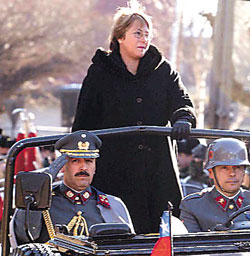 What is controversial, though, is Bachelet’s decision to delay publication. The former President of Chile is no stranger to controversy when it comes to her country’s human rights record, despite her own suffering at the hands of the Pinochet dictatorship. The application of the anti-terror laws to the indigenous Mapuche communities was most widespread during her two terms of office. As UN High Commissioner, she also failed to voice any substantive statement over the murder of Mapuche youth Camilo Catrillanca, killed on his own land by a special force known as the Comando Jungla.
Israel might find it has an ally at the UN in Bachelet, who is clearly no novice when it comes to the targeting of indigenous populations. Her expression of “regret” at Israel’s dismissal of the UN report documenting Israel’s use of violence at the Great March of Return protests is meaningless.
When it comes to human rights violations, rhetoric stands alone, especially when it comes to premeditated violence. There is no other institution like the UN that can create a spectacle out of violence and human rights rhetoric which fuels international attention, knowing full well that any reactions — any expressions of “regret” — will be temporary and have no effect.
The blacklist is another matter altogether. Bachelet is contributing to the impunity desired by Israel in order to retain its economic benefits from the occupation of Palestine. Settlements and human rights violations are an acceptable rhetorical subject, whereas settlements and the profits for the state therefrom as collaborators in violations are a red line for Israel and the UN. By delaying publication of this report, Bachelet is sending a clear message to the Palestinians: Israel and its business links are to be protected at all costs, even if that means sacrificing more of the indigenous Palestinian population.
Four Young Palestinian Lives Snuffed Out Every Month for The Past Year at The Hands of Israeli Soldiers
By CJ Werleman | American Herald Tribune | February 28, 2019
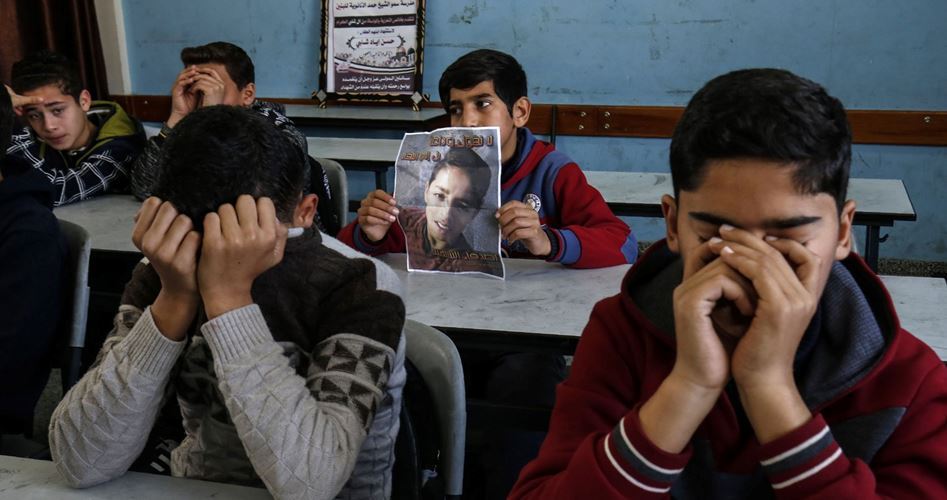
Last Friday, Yousef a-Dava, a 15-year old Palestinian boy was shot and killed by Israeli snipers, becoming the 48th child slain in Gaza by Israeli security forces since the Great Return March began nearly 12 months ago.
“He was peacefully protesting for a better future, raising the Palestinian flag, is the Palestinian flag a weapon?” asked his grief-stricken sister, Nariman al-Daya, in an interview with Middle East Eye.
His death was every bit as gruesome as it was unjustifiably atrocious, with eyewitnesses explaining how he “tried to stand up, walk a couple more steps” before falling to the ground again, after the bullet fired by an Israeli sniper “entered Yousef’s body, exploded hear his heart, exited from his back” and injured another man who was standing behind him.
Less than one hour later he was pronounced dead at al-Shifa Hospital after an emergency operation failed to revive him.
What other democratic ally do we allow 48 unarmed children to be shot and killed for flying a flag or kite in an open field, one that is ring-fenced by high-voltage electric currents, spot-and-strike machine gun posts, armored tanks and dozens of the world’s most lethal military marksmen?
If this were happening in Poland, Spain, or Portugal, both the United States and United Nations would’ve moved quickly to impose economic sanctions, while calls to invade and bomb would be heard far louder than a mere whisper, but this is Israel, the “Middle East’s only democracy,” so the entirely erroneous propaganda tagline goes.
48 murdered children equates to four young lives snuffed out every month for the past year at the hands of Israeli soldiers, who in no way felt threatened by these now slain youngsters. Unless, of course, you think children throwing rocks from inside a cage at armored vehicles positioned hundreds of meters away on the other side fortified fences and barricades is a threat to anyone or anything, which it clearly it isn’t!
Thus these deaths are to be identified for what they truly are: the cold-blooded murder of innocent and non-threatening children.
Of course, nowhere in the Western media is this reality framed in this accurate way. Instead we are fed headlines, or rather footnotes from the likes of The New York Times that read, “15-year-old boy killed in Gaza today,” without identifying the benign circumstances that led to his death, with newspaper editors doing their very best to falsely portray flag waving and rock-throwing protesters to be on equal footing to the most sophisticated military force in the Middle East.
It goes without saying, but I’ll say it anyway, that if a population of 2 million predominately Jews or Christians were held in an open-air prison, which is precisely what Gaza is, and then bombed, strafed, droned, and shelled periodically, with children shot dead by snipers wearing the flag of a Muslim majority country, then there’d be no other issue the Western media would be talking about.
On Thursday, the United Nations published a report concluding, “Israeli soldiers committed violations of international human rights and humanitarian law,” adding that “some of those violations may constitute war crimes of crimes against humanity.”
“Many young person’s lives have been altered forever,” contends the United Nations Human Rights Council. “122 people have had a limb amputated since March 30 last year. Twenty of these amputees are children.”
Moreover, these deaths scratch only the surface of Israel’s savage war on Palestinian children. When Israel invaded Gaza in the summer of 2014, Palestinian children represented 25% of all civilians killed, with human rights groups documenting the deaths of 504 are under the age of 18.
Then there are the 500-700 Palestinian children who are detained each year in the Israeli military court system, some indefinitely, with most held and prosecuted on the charge of stone throwing.
It is in these Israeli military detention centers where some of the most egregious crimes against Palestinian children take place, with two-thirds reporting Israeli soldiers subjected them to violence and physical abuse.
Several years ago, UNICEF published a report that documented Israel’s systematic and systemic abuse of detained Palestinian children, concluding that “the ill-treatment of children who come in contact with the military detention system appears to be widespread, systematic and institutionalized throughout the process, from the moment of arrest to indictment of the child, the conviction and issuing of the verdict.”
The authors of the report also observed how child detainees were often arrested in the middle of the night, denied access to a lawyer or parents prior or during interrogation, denied right to remain silent, alongside credible claims Palestinian children were raped or threatened with rape or execution.
Ultimately Israel gets away with these atrocities because its violence and crimes against the Palestinian people takes place inside a media vacuum, with mainstream networks and publications giving a head glance towards the occupation and conflict only in moments where Palestinians, who are denied the right to resist Israel’s violence and illegalities peacefully, respond with violence of their own.
Until such time the world’s media and international community holds Israel accountable for its violations of international law and denial of human rights to the Palestinian people, it’ll continue to murder children as young as 2 years of age with total and complete impunity.
UN chief launches global push against ‘hate’ speech
Press TV – February 25, 2019
UN Secretary General Antonio Guterres on Monday launched a new global strategy to combat hate speech, a growing scourge he said has “poisoned” debate on crucial challenges like migration.
Guterres announced the effort, which will be led by his special adviser on genocide prevention Adama Dieng, at the UN Human Rights Council.
“Hate is moving into the mainstream – in liberal democracies and authoritarian systems alike,” he said in a speech at the opening of the council’s 40th session.
“Some major political parties and leaders are cutting and pasting ideas from the fringes into their own propaganda and electoral campaigns,” he added.
Governments across the world have watched with concern as racist and other hate speech have coarsened the political climate.
France and Germany have raised particular alarm in recent weeks over resurgent anti-Semitism.
Guterres targeted his rebuke at the vast campaign he said was mobilized against the UN’s Global Compact on Migration, a non-binding text that aimed to set out best practices for managing refugee and migrant flows.
“We have seen how the debate on human mobility, for example, has been poisoned with false narratives linking refugees and migrants to terrorism and scapegoating them for many of society’s ills,” Guterres said.
He condemned “an insidious campaign sought to drown the Global Compact on Migration in a flood of lies about the nature and scope of the agreement.”
The UN chief noted that the campaign “failed.”
But 17 countries either abstained or voted against the compact at the General Assembly in December and debate over the text fuelled bitter political debate especially in Europe.
Guterres said Dieng, a Senegalese lawyer and veteran UN diplomat, will “define a system-wide strategy and present a global plan of action” to combat hate speech.
Venezuela: An Open Letter to the UN Secretary General

Alfred de Zayas, human rights lawyer & UN independent expert on international order. His report on Venezuela has been buried by the MSM.
OPEN LETTER TO THE UNITED NATIONS SECRETARY GENERAL ANTONIO GUTERRES
AND TO THE HIGH COMMISSIONER FOR HUMAN RIGHTS MICHELLE BACHELET
from Alfred de Zayas, 23 February 2019
Dear Michelle Bachelet,
Dear Antonio Guterres
As former UN Independent Expert on the Promotion of a Democratic and Equitable International Order (2012-2018) I would like to urge you to once again make your voices heard and make concrete proposals for mediation and peace in the context of the Venezuelan crisis.
The most noble task of the United Nations is to create the conditions conducive to local, regional and international peace, to work preventively and tirelessly to avoid armed conflicts, to mediate and negotiate to reach peaceful solutions, so that all human beings can live in human dignity and in the enjoyment of the human right to peace and all other civil, cultural, economic, political and social rights. I am particularly worried by the Orwellian corruption of language, the instrumentalization and weaponization of human rights and now even of humanitarian assistance.
I look back at my UN mission to Venezuela in November/December 2017 as a modest contribution to facilitate the cooperation between the United Nations and the Venezuelan government and to open the door to the visits of other rapporteurs. See my report to the UN Human Rights Council and the relevant recommendations.
I believe that it would be timely and necessary for both of you to issue a statement reaffirming General Assembly Resolutions 2625 and 3314 and the 23 Principles of International Order that I formulated in my 2018 report to the Human Rights Council. See para 14 of [the report].
It would be appropriate to recognize the fact that the government of Venezuela has put into effect some of the recommendations contained in my report — and in the six page confidential memo that I personally gave to Foreign Minister Jorge Arreaza upon my departure.
Indeed, first the Venezuelan government released 80 detainees — including Roberto Picón and 23 others whose release I had specifically requested — that was on 23 December 2017, followed by other releases in the course of 2018. Alas, there has been practically no information about this in the mainstream media, although it is easily accessible in the internet. See also the comments of Venezuela on my report.
In particular paragraph 46(xvi):
As a result of this on 23 December 2017, 80 people arrested for acts of violence during the protests in the country were released; and on 1 June 2018, 39 more people were released.
And paragraph 46(xviii):
In this regard, the Venezuelan Government values the willingness and disposition of the Independent Expert, who was pleased to inform the competent authorities of the requests he received from some relatives of the persons deprived of their liberty. His recommendations were accepted.
Shortly after my visit Venezuelan authorities met with the UN agencies and made additional cooperation accords, thanks to the valuable efforts Peter Grohmann, the UNDP representative in Caracas.
Now the government of Venezuela has formally asked the United Nations for humanitarian assistance in connection with the current crisis. We must not let them down.
I think that the US should turn over all the humanitarian assistance and medical supplies it has flown into Colombia and have them distributed as soon as possible with the help of the United Nations and other neutral organizations, including the International Committee of the Red Cross.
Another item of information that is sorely missing from the mainstream media is the delivery last week of 933 tons of food and medicines at port La Guaira — coming from China, Cuba, India, Turkey etc.
Moreover an additional 300 tons of medicines and medical supplies provided by Russia arrived by air.
As I know from my conversations with Venezuelan ministers during my visit in 2017 and the recent conversations I have had with Venezuelan Ambassador to the UN in Geneva Jorge Valero – Venezuela has always welcomed and repeatedly asked for assistance from neutral and friendly governments so as to overcome the adverse human rights impacts of the financial blockade and the sanctions. Such help should be offered in good faith, without strings attached.
I believe that this is the moment for Michelle Bachelet to accept the invitation of the government of Venezuela, extended to her in December 2018, to visit Venezuela personally. Her presence in Venezuela should ban the growing danger of a military intervention by foreign entities. She should endorse the efforts at mediation launched by Mexico and Uruguay at the Montevideo mechanism.
There are ominous parallels with the run-up to the Iraq invasion in 2003 — an illegal war, as Kofi Annan said on repeated occasions.
It is obvious to any first year law student that the constant threats against Venezuela are contrary to article 2(4) of the UN Charter. What many do not realize is that the threats, the economic war, the financial blockade and the sanctions violate the principles contained in Article 3 of the OAS Charter
e. Every State has the right to choose, without external interference, its political, economic, and social system and to organize itself in the way best suited to it, and has the duty to abstain from intervening in the affairs of another State. Subject to the foregoing, the American States shall cooperate fully among themselves, independently of the nature of their political, economic, and social systems; f. The American States condemn war of aggression: victory does not give rights; g. An act of aggression against one American State is an act of aggression against all the other American States; h. Controversies of an international character arising between two or more American States shall be settled by peaceful procedures; I. Social justice and social security are bases of lasting peace…
Moreover, they violate numerous articles of Chapter 4 of the OAS Charter,
Article 17
Each State has the right to develop its cultural, political, and economic life freely and naturally. In this free development, the State shall respect the rights of the individual and the principles of universal morality.
Article 18
Respect for and the faithful observance of treaties constitute standards for the development of peaceful relations among States. International treaties and agreements should be public.
Article 19
No State or group of States has the right to intervene, directly or indirectly, for any reason whatever, in the internal or external affairs of any other State. The foregoing principle prohibits not only armed force but also any other form of interference or attempted threat against the personality of the State or against its political, economic, and cultural elements.
Article 20
No State may use or encourage the use of coercive measures of an economic or political character in order to force the sovereign will of another State and obtain from it advantages of any kind.
Dear Michelle Bachelet, dear Antonio Guterres: The world looks up to you in the hope that you can avert even greater suffering to the peoples of Venezuela. They need international solidarity as expressed in the report of Virginia Dandan, the then independent expert on human rights and international solidarity.
I remain respectfully yours
Professor Dr. Alfred de Zayas, Geneva School of Diplomacy
US blocks UNSC criticism of Israel’s expulsion from Hebron of international monitors
MEMO | February 7, 2019
The US blocked a draft United Nations Security Council statement yesterday from issuing a statement that would have expressed concerns over Israel’s decision to expel the international observatory task force that has been monitoring the situation in the occupied West Bank city of Hebron for 20 years.
The 15-member UN Security Council discussed Israel’s decision behind closed doors at the request of Kuwait and Indonesia, which also drafted the statement. Such a statement has to be agreed unanimously.
UN diplomats said that the US had blocked the statement saying that they did not believe a council statement on the issue was appropriate.
The draft statement, seen by Reuters, would have also recognised the importance of the Temporary International Presence in Hebron (TIPH) and its “efforts to foster calm in a highly sensitive area and fragile situation on the ground, which risks further deteriorating.”
The proposed statement also intended to express the Security Council’s “regret” about Israel’s “unilateral decision” to eject the force from occupied Hebron and call for “calm and restraint”.
The TIPH was set up after a Jewish settler, Baruch Goldstein, massacred 29 Palestinians in 1994 at the Ibrahimi Mosque during the holy month of Ramadan.
Israeli Prime Minister Benjamin Netanyahu said last week he would not renew the mandate of TIPH accusing the observers of unspecified anti-Israel activity. His decision heightened Palestinian concerns over their safety. Palestinian residents of Hebron regularly come under attack from illegal settlers and Israeli occupying forces. They often say that they are living under an apartheid Israeli system. The Old City of Hebron is completely divided through the presence of barriers, closures, military zones and settlements, to accommodate some of Israel’s most extreme settlers.
The Palestinian Authority (PA) echoed the concerns and called for a UN protection force to ensure the safety of Palestinians until Israel ends its “belligerent occupation”. The UN should “guarantee the safety and protection of the people of Palestine” until “the end of Israel’s belligerent occupation,” said Palestinian official Saeb Erekat.
Are UN envoys allowed to monitor Israeli violations or just Hezbollah’s?
![Israeli forces hold down a Palestinian man in Ramallah, West Bank on 28 August 2018 [Issam Rimawi/Anadolu Agency]](https://i1.wp.com/www.middleeastmonitor.com/wp-content/uploads/2018/08/20180828_2_32103254_36728394.jpg?resize=1200%2C800&quality=75&strip=all&ssl=1)
Israeli forces hold down a Palestinian man in Ramallah, West Bank on 28 August 2018 [Issam Rimawi/Anadolu Agency]
By Motasem A Dalloul | MEMO | February 6, 2019
It is very nice to see the delegation of the UN ambassadors touring the Israeli-Lebanese borders early week to follow up closely on Israeli efforts to fight the alleged Hezbollah tunnels. It is a fantastic moment when you see the international diplomats, who live and work far from the field of the Israeli operations, having firsthand information about the issues that they will or might make decisions about on an international level.
Therefore, it was a very clever move when the Israeli Ambassador to the UN Danny Danon lobbied the UN ambassadors and organised a trip for them to tour the alleged tunnels. While the Israeli military machine was working, Danon could feed the Israeli propaganda to the international diplomats. “We say clearly that Hezbollah has established its own state in south Lebanon, a state that advances terror operations against Israel. On the day we move to defend ourselves and the UN will want to condemn us, the ambassadors standing here will understand the reality,” Ynet News reported Danon saying.
This way, Danon could evoke the sympathy of the ambassadors, who completely accepted his narrative. All the officials saw was a hole in the ground and heavy machinery to inject concrete inside it; Danon described it as an “attack tunnel”.
Anyone who lives and works far away does not recognise all of these hostile activities, the South Sudan Ambassador Akuei Bona Malwal said, according to Ynet News : “For those of us who work in New York and hear all sorts of things, the best way is to come and see and feel exactly what is happening. We came to Israel to see the challenges and how they are being handled.” While the Ambassador for Panama Meliton Arrocha Ruiz said: “We will pass on what we saw.”
But the conflict in the region is not taking place on the Israeli-Lebanese border, but in every inch of occupied Palestine. Can the UN ambassadors carry out tours to see the daily violations against Palestinians and the suffering inflicting on them?
Can the UN ambassadors visit the historical Palestinian city of Tiberias in Israel and see how the Israeli occupation has been preventing the Palestinian-Arab citizens of Israel from performing prayers at Al-Bahr Mosque since 1948? Can they visit the mosque and see what is happening there and report what they see to the UN? Can they visit dozens of mosques which have been turned into bars, nightclubs or museums in a complete disrespect to their religious status?
I am asking the UN ambassadors, who described Israel as “thriving, open and democratic”, if its government is ready to let them tour the Palestinian farms which were torn into pieces by the Israeli Separation Wall in the occupied West Bank, the illegal Israeli settlements and the daily Israeli detention of Palestinians and demolition of their homes and lands?
Are these diplomats able to visit the Gaza Strip, which has been suffering under a 12-year-old Israeli siege, and meet the 8,515 cancer patients who are facing slow death due to the Israeli restrictions on the entry of their medicines or the queues of patients who urgently need to have surgery but are unable because of the shortage of medical supplies? Can they visit Gaza and see how many thousands of homes Israel has demolished, visit empty homes whose owners were killed by Israel and see how many schools, hospitals, mosques and water and sewage infrastructure were destroyed?
If the UN ambassadors even considered visiting the occupied Palestinian territories, they would have been prevented from doing so by the “thriving, open and democratic” state. Just a couple of month ago, the Israeli occupation government prevented a delegation of MEPs visiting the occupied territories in order to monitor the humanitarian situation caused by the Israeli blockade, assess the destruction in the area following the armed conflicts, evaluate reconstruction efforts and to visit a number of development projects funded by the European Union. The official news website of the European parliament said: “The MEPs were prevented from entering the poverty-stricken Gaza Strip by the Israeli authorities. Israel has repeatedly denied the delegation access to visit the Strip since 2011.” How would these UN ambassadors describe the select manner through which the “thriving, open and democratic” state operates?
What is the benefit of the UN ambassadors’ tour? Israel does not respect the international body or any of its branches. In the wake of the Israeli offensive on Gaza in 2008-09, the UN sent a fact-finding mission to examine possible Israeli and Palestinian war crimes, but Israel did not cooperate with it. In a statement, the Israeli foreign ministry accused the mission of being bias.
However, the mission found that the Israeli offensive on Gaza was “a deliberately disproportionate attack designed to punish, humiliate and terrorise a civilian population, radically diminish its local economic capacity both to work and to provide for itself, and to force upon it an ever increasing sense of dependency and vulnerability.” What has the UN done to ensure that justice was achieved?
Finally I ask why did the UN envoys not stand up Israeli Prime Minister Benjamin Netanyahu when he addressed them and said the UN resolutions against his occupation state were “absurd”? Their silence is proof that they are tools of Israel’s propaganda.
UN Officials Reaffirm that Forcible Transfers are In Breach of Geneva Convention
IMEMC News & Agencies | January 23, 2019
After visiting the Palestinian Sabbagh family, who is facing eviction from its home, in the Sheikh Jarrah neighborhood of occupied Jerusalem, for the benefit of Israeli settlers, United Nations and other officials have again warned that forced eviction and transfer of Palestinians are a breach of Fourth Geneva Convention.
Jamie McGoldrick, Humanitarian Coordinator United Nations Office for the Coordination of Humanitarian Affairs (OCHA) in the occupied Palestinian territory, Gwyn Lewis, Director of West Bank Operations for the United Nations Relief and Works Agency for Palestine Refugees (UNRWA), James Heenan, Head of Office of the United Nations High Commissioner for Human Rights (OHCHR) in the occupied Palestinian territory, and Kate O’Rourke, Country Director of the Norwegian Refugee Council, said in a statement that they visited the Sabbagh family “who face imminent forced eviction from their home in the Sheikh Jarrah neighborhood of East Jerusalem, part of the occupied Palestinian territory, and are at heightened risk of forcible transfer.”
According to the statement, the Sabbagh family is a Palestinian refugee family originally from Jaffa city, who were settled in the neighborhood, along with 27 other families, with the support of the United Nations and the Jordanian government, in the 1950s.
Like other families in the area, for years they have been engaged in a legal dispute opposing efforts by Israeli settler organizations to evict them from their homes. Recently, this legal struggle was deemed unsuccessful as Israeli courts have ruled in favor of the settlers’ claims. Thirty-two members of the Sabbagh family, including six children, now face forced eviction, while an additional 19 members will be directly affected by the loss of the family property, should the eviction take place.
“In the occupied Palestinian territory, strict obligations apply with regard to the prohibition of forcible transfer and forced eviction,” said the officials in the statement. “Along with house demolitions, forced evictions are one of the major factors contributing to the creation of a coercive environment that may result in no other choice for individuals or communities but to leave. Forcible transfer is a grave breach of the Fourth Geneva Convention. Forced evictions contrary to international law also violate the right to adequate housing and the right to privacy, and may be incompatible with other human rights.”
They added, according to WAFA : “In many cases in East Jerusalem, including in Sheikh Jarrah, the forced eviction of Palestinians is occurring within the context of Israeli settlement construction and expansion, illegal under international humanitarian law. An estimated 3,500 Israelis are currently living in settlements established with the support of the Israeli authorities in the heart of Palestinian communities in East Jerusalem. In Sheikh Jarrah alone, more than 200 Palestinians face potential eviction, should they be unsuccessful in similar cases currently before Israeli courts.”
They called on the Israeli authorities “to immediately halt plans to evict the Sabbagh family to prevent further displacement of these refugees, cease settlement construction, and abide by their obligations as an occupying power under international humanitarian law and international human rights law.”
Majority of UN condemnations directed at Israeli crimes
Palestine Information Center – January 1, 2018
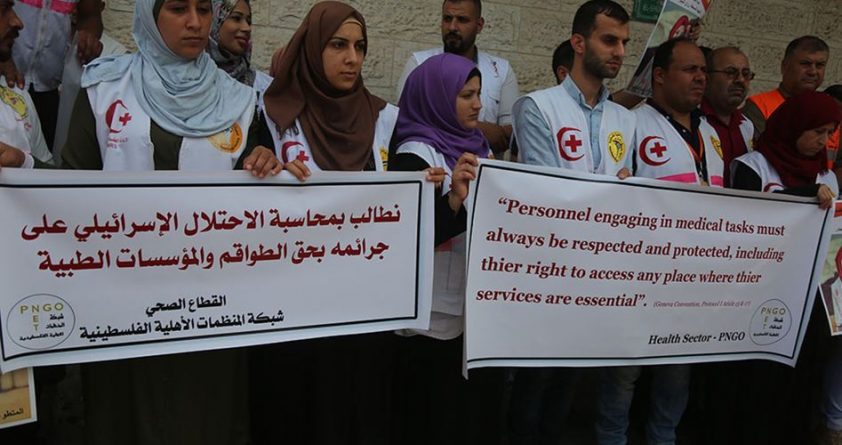
OCCUPIED JERUSALEM – Over the course of 2018, the United Nations has voted to adopt some 27 condemnations — the vast majority of which were directed at Israel.
According to Hillel Neuer, executive director of United Nations Watch, 21 of the 27 condemnations were aimed at Israel.
Iran, Syria, North Korea, Russia, Myanmar and the United States each received one.
The Islamic Resistance Movement Hamas had none.
Weeks ago, the UN refused to pass a U.S.-led resolution that would have condemned Hamas for allegedly firing on Israel.
Featured Video
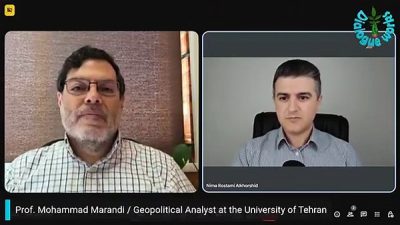
Seyed M. Marandi: U.S. Military DIVIDED? Iran’s Secret Defense EXPOSED
or go to
Aletho News Archives – Video-Images
From the Archives
‘Israel sees Iran as obstacle to its policies’
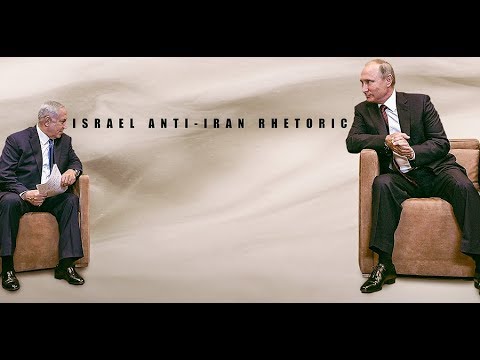
Press TV – August 25, 2017
Prime Minister Benjamin Netanyahu has said that Israel felt threatened by Iran’s growing influence in the Middle East. Netanyahu expressed his Iranophobic view in a meeting with Russian President Vladimir Putin in Russia’s Black Sea resort of Sochi on Wednesday. Press TV has asked Scott Rickard, former American intelligence linguist from Tampa, Florida, and Brent Budowsky, a columnist at The Hill from Washington, to give their thoughts on the issue.
Rickard said Tel Aviv is concerned about the fact that the regime could not carry out its old project to spread sectarian divisions and pave the way for dismemberment of the countries in the Middle East region because of the Iranian-led resistance against Israeli policies, not only in the occupied territories of Palestine but also in the whole region.
“Iran is not a threat to Israel whatsoever. The threat that Israel sees is the fact that their Oded Yinon Plan is being put to a hold by Iran,” the intelligence linguist said on Thursday night.
“They (the Israelis) look at Iran as a threat only because they have no influence on their governments and Iran is autonomous and is not under the Zionist influence,” he added.
Since the victory of the Islamic Republic of Iran in 1979, Tehran has been critical of Israel’s policies in the region, whereas “no leaders [of other states] even dared to speak out against Zionism,” Rickard argued. … continue
Blog Roll
 Aletho News
- Evidence points to Ukraine being behind TurkStream attempted sabotage, but that should come as no surprise
- Sri Lanka secures supplies of Russia oil – minister
- Nations across Asia strike direct deals with Iran for Hormuz passage
- IRGC commander declares ‘new phase’ of reprisal attacks against aggressors
- Israel’s air defenses overwhelmed by cluster-warhead Iranian missiles: Reports
- Striking Iran’s Infrastructure Would Have Little Military Impact – Report
- What’s Behind U.S./Israeli Strikes On Iranian Pistachio Factories?
- Seyed M. Marandi: U.S. Military DIVIDED? Iran’s Secret Defense EXPOSED
- How I fell foul of the BBC thought police
- The End of NATO
- If Americans Knew
- Trump says Iranians appreciate bombs, WHO warns of nuclear risks – Daily Update
- U.N. experts demand Israel release prominent Gaza doctor after reports of ‘severe torture’
- Israel’s Latest Genocide Is Against the Shias of Lebanon. Why Is the World Silent?
- How Eliot Cohen’s influence over U.S. war-making paved the way for Trump’s war crimes in Iran
- Israelis don’t pay for the weapons we ‘sell’ to them — US taxpayers do
- While Distancing from AIPAC, Most 2028 Democratic Hopefuls Are Still Embracing Israel
- A brief history of the Israeli nuclear program, the open secret at the heart of the Iran war
- Israeli Settlers Killed a Palestinian Farmer on His Own Land, in Front of His Father. Yes, Again
- The US-Israeli War on Science is an Assault on our Future
- 100+ International Law Experts Say US Strikes on Iran Violate UN Charter, Could Be War Crimes
- No Tricks Zone
- An Inconvenient Tree: Uncovered In Alps… Europe Much Warmer Than Today 6000 Years Ago
- New Study Reports A 60% Slowdown In Greenland’s Ice Loss Rate In The Last Decade
- Low Intensity Tornado Wrecks Major Solar Farm, Creating A Potential Toxic Dump
- New Study Finds Warming Saves Lives…Cold Temperatures 12 Times More Deadly Than Excess Heat
- German Science Blog Accuses PIK Climate Institute Of Hallucinating Climate Tipping Points
- Devastating Assessment Of Comirnaty Vaccine By Former Senior Pfizer Europe Toxicologist
- New Study: CO2 Is ‘Effectively Negligible’ As An Explanatory Climate Change Factor Since 2000
- Former Pfizer Toxicologist Dr. Helmut Sterz Tells Bundestag Hearing Pfizer Vaccine Should Have Never Been Approved
- Energy Expert: Germany’s Nuclear Phaseout Was A “500 Billion Euro Mistake”
- New Research: South Australia’s Mid-Holocene Sea Surface Temperatures Were 4°C Warmer Than Today
 Aletho News