How sanctions will affect the West’s $35bn invested in Russian oil
RT | July 30, 2014
The US and EU have banned the export to Russia of hi-tech oil equipment needed in Arctic, deep sea, and shale extraction projects. This will leave Western companies, which have an estimated $35 billion invested in Russian oil, in a bind.
New stage three sanctions won’t immediately slash Russian oil production, which at 10.55 million barrels per day is the world’s largest, but could derail future foreign investment in Russia’s oil industry. Russia is home to the largest combined oil and gas reserves in the world.
The US and the 28 EU countries hope to influence Moscow’s foreign policy in eastern Ukraine.
New restrictions “will make it more difficult for Russia to develop its oil resources over the long term,” President Barack Obama said as he unveiled the new tough regime.
The sanctions will hit the heart of Russia’s economy- oil, but not touch the gas sector. Together, the two make up more than 50 percent of revenues for the Russian state. Russia has an estimated $7.5 trillion in oil and gas resources, many of which require Western oil technology to extract.
Obama said he wanted the sanctions “to bite.”
The sanctions won’t only bite at Russia, but Western oil companies like BP and ExxonMobil, and equipment suppliers may fall victim to the oil technology ban.
Introduction of EU sanctions against the Russian energy sector will drive up European energy prices, the Russian Foreign Ministry warned on Wednesday.
BP
BP is one of the most exposed to the Russian market, after the UK-based company bought a 19.75 percent stake in the state oil company Rosneft, a company already on Obama’s sanctions list.
Previously, BP insisted it was “business as usual” with Russia, but the sectoral sanctions could derail the company’s strategy in Russia, where it sources nearly one-third of its global oil production.
“Any future erosion of our relationship with Rosneft, or the impact of further economic sanctions, could adversely impact our business and strategic objectives in Russia, the level of our income, production and reserves, our investment in Rosneft and our reputation,” BP said on Wednesday, before the heavy-handed sanctions were announced.
The same day, the British energy company reported a big bump in second quarter profits, which rose 25.3 percent to $3.23 billion.
In June, Rosneft agreed to supply BP with up to 12 million tons of oil and oil products over 5 years. The deal assumes a prepayment of at least $1.5 billion.
ExxonMobil
ExxonMobil has been present in the Russian market for over 20 years. In partnership with Rosneft, the Texas-based oil major has many projects in Russia underway- including the $500 billion exploration of the Bazhenov oil field in Western Siberia, and a $15 billion liquefied natural gas terminal in Russia’s Far East.
If forced to quit Russia, Exxon could pull out as much as $1 billion in funds intended to go to offshore Arctic and fracking projects in Siberia, Bloomberg News reported.
After the sanctions were announced, Rosneft Chairman Alexander Nekipelov said ExxonMobil may suspend cooperation with Rosneft, but only in an extreme situation.
“As far as we know, Exxon does not have plans to stop cooperation with Rosneft, and we hope the situation will not go that far,” Nekipelov said.
“We are assessing the impact of the sanctions,” Alan Jeffers, an Exxon spokesman, told Bloomberg News via email.
Nekipelov said the American company doesn’t want to give up its joint projects with Rosneft- it has already invested too much.
In May, the two companies agreed on four Arctic exploration projects. Additionally, ExxonMobil and Rosneft will operate a new joint offshore drilling rig in the Kara Sea, where the two companies have rights to over 11.3 million acres of Russia’s Pacific Ocean waters. The company also has a substantial stake in the Far East Sakhalin oil project, which covers 85,000 acres.
Exxon CEO Rex Tillerson hasn’t made any official comment on the new sanctions.
Total
France’ oil major and largest company, Total, has huge operations in Russia, its fourth largest market. The morning after the sanctions, the group’s stock dipped 2.66 percent in Paris. On Wednesday, the company reported an estimated second quarter net profit drop of 12 percent
Total owns about 18 percent of Novatek, Russia’s second largest gas producer, which was affected in the previous round of US sanctions.
“We stopped buying shares in Novatek the day of the airplane accident after considering all the uncertainty that it created,” the French company’s CEO said in the earnings call on Wednesday.
Novatek leads the $27 billion Yamal LNG project with Total, along with China’s CNPC. The South-Tambeyskoye field has an estimated 492 billion cubic meters of proven gas reserves.
Russia is “a great oil and gas country and we’ll have to wait and see the nature of these new sanctions first,” the CEO said on Wednesday, adding it was a “crucial” market.
The project is highly dependent on US technology and will experience serious difficulties if sanctions are imposed.
Total expects its hydrocarbon production in Russia to rise to 400,000 barrels a day from 207,000 barrels in 2013.
Halliburton and Schlumberger
Blocking the exports of specific goods and technology to Russia is going to squeeze the world’s largest oil service and equipment companies- both US-based- which depend on Russia for sales.
Halliburton relies on Russia for 4-5 percent of global sales, and Schlumberger generates 5-6 percent, according to an estimate by RBC Capital Markets.
Both oilfield service groups, which provide Russia with horizontal drilling and hydraulic fracturing technology, could lose sales because of sanctions, but they won’t be driven out all together.
The stock price has dropped for both companies after the sanctions were announced- Halliburton is down 1.95 percent, and Schlumberger dipped 0.70 percent.
Dick Cheney, former US Vice President, and avid Russia critic, served as Halliburton’s CEO through 2000.
READ MORE: EU and US impose new round of sanctions on Russia over Ukraine
10 more questions Russian military pose to Ukraine, US over MH17 crash
RT | July 21, 2014
Russia has released military monitoring data, which shows Kiev military jets tracking the MH17 plane shortly before the crash – and posed yet another set of questions to Ukraine and the US over the circumstances of the tragedy.
Military officials – chief of General Staff of the Armed Forces Lt. Gen. Andrey Kartopolov and chief of the Air Force Main Staff Lt. Gen. Igor Makushev – posed a number of questions to Kiev and Washington concerning the possible causes of the catastrophe in Eastern Ukraine that killed almost 300 people last Thursday.
1. Why did the MH17 plane leave the international corridor?
“Please note that the plane stayed within the corridor until it reached Donetsk but then it deviated from the route to the north,” said Kartopolov.
2. Was MH17 leaving the route a navigation mistake or was the crew following instructions by Ukrainian air traffic controllers in Dnepropetrovsk?
“The maximum deviation from the left border of the corridor was 14 km. Following that, we can see the plane maneuvering to return to the corridor, yet the Malaysian crew did not get a chance to complete the maneuver. At 17.20, the plane began to lose speed, and at 17.23 it disappeared from Russian radars.”
3. Why was a large group of air defense systems deployed to the militia-held area if the self-defense forces have no planes?
“As far as we know, the Ukrainian military had three or four air defense battalions equipped with Buk-M1 SAM systems deployed in the vicinity of Donetsk on the day of the crash. This system is capable of hitting targets within the range of 35 km at the altitude of up to 22 km.”
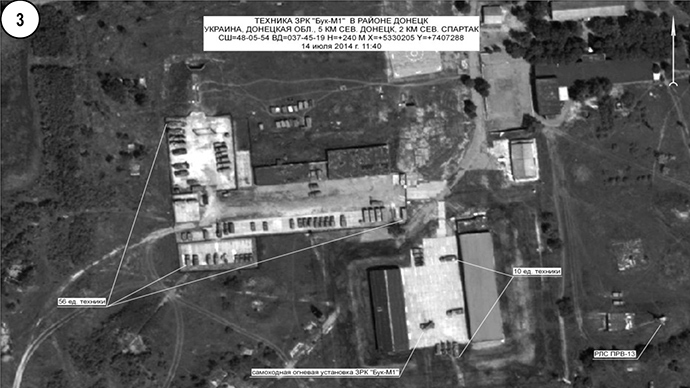
Buk missile defense units in Donetsk Region, 5km north of Donetsk city, on July 14, 2014. (RIA Novosti)
4. Why did Kiev deploy Buk missile system right next to the militia-controlled area straight ahead of the tragedy?
“We have satellite photos of the places where Ukraine had its air defense units deployed in the southeastern parts of the country. The first three photos were made on July 14. The first photo shows Buk launchers 8 km northwest of Lugansk. You can clearly see a TELAR and two TELs. The second photo shows radars 5 km north of Donetsk. You can see two TARs along with other equipment and technical structures. The third photo shows air defense systems north of Donetsk. You can clearly see a TELAR launcher and about 60 military and auxiliary vehicles, tents for vehicles and other structures.
“Here’s a photo of the same area made on July 17. Please note that the launcher has disappeared. The fifth photo shows a battery of Buk missiles at the village of Zaroshchenskoye 50 km east of Donetsk and 8 km south of Shakhtyorsk on the morning of the same day. The sixth photo shows the same area on July 18. As you can see, the battery has left.”
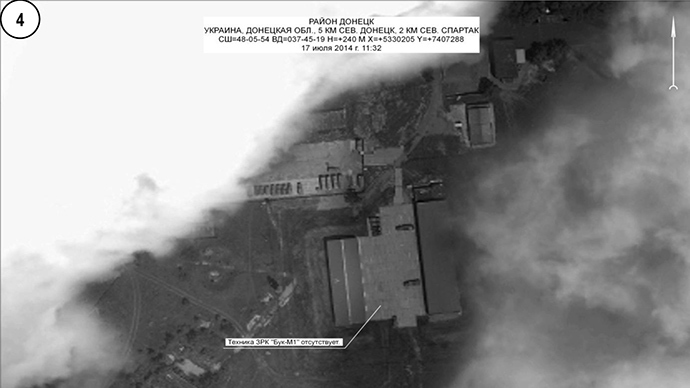
No Buk missile defense units in Donetsk Region, 5km north of Donetsk city, on July 17, 2014. (RIA Novosti)
5. On the day of the crash Kiev increased activity on its Kupol-M1 9S18 radars, which are components of the Buk system in the area. Why?
“Also, July 17 saw increased activity on the part of Ukraine’s Kupol-M1 9S18 radars, which are part of the Buk system. Here on this chart you see that there were seven radars operating on July 15, eight radars operating on July 16, and nine radars operating on July 17 in the area. Then, starting with July 18, the intensity of radar activities radically decreased, and now there are no more than two or three radars operating a day. The reason behind this is yet to be found.”
6. What was a military plane doing on the route intended for civilian flights?
“There were three civilian planes in the area performing their regular flights at this time. There was a flight from Copenhagen to Singapore at 17:17, there was a flight from Paris to Taipei at 17:24, and then there was the flight from Amsterdam to Kuala Lumpur.”
“Also, Russian monitoring systems registered that there was a Ukrainian Air Force jet, probably Su-25, climbing and approaching the Malaysian Boeing.”
“The Su-25 was 3-5 km away from the Malaysian plane. Su-25 is capable of climbing to the altitude of 10,000 meters for a short period of time. Its standard armament includes R60 air-to-air missiles, which are capable of locking and hitting targets from 12 km and which are guaranteed to hit the target from the distance of 5 km.”
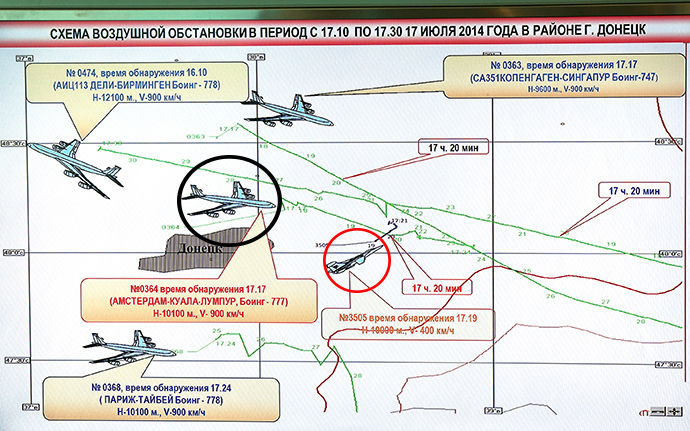
(RIA Novosti / Vadim Savitsky)
7. Why was the military jet flying at almost the same time and the same altitude with a passenger plane?
“At 17:21’35, with [the Boeing’s] velocity having dropped to 200 kilometers per hour, a new mark detecting an airborne object appears at the spot of the Boeing’s destruction. This new airborne object was continuously detected for the duration of four minutes by the radar stations Ust-Donetsk and Buturinskaya. An air traffic controller requested the characteristics of the new airborne object, but was unable to get any readings on its parameters – most likely due to the fact that the new aircraft was not equipped with a secondary surveillance radar transponder, which is a distinctive feature of military aircraft,” said Makushev.
“Detecting the new aircraft became possible as it started to ascend. Further changes in the airborne object’s coordinates suggest that it was hovering above the Boeing 777’s crash site, monitoring of the situation.
“Ukrainian officials earlier claimed that there were no Ukrainian military aircraft in the area of the crash that day. As you can see, that is not true.”
8. Where did the launcher – from the video circulated by Western media and showing a Buk system being moved allegedly from Ukraine to Russia – come from? As the video was made on the territory controlled by Kiev, where was the launcher being transported?
“I’d like to say that the information we have presented here is based on objective and reliable data from various technical systems – unlike the groundless accusations made against Russia,” said Kartopolov.
“For example, media circulated a video supposedly showing a Buk system being moved from Ukraine to Russia. This is clearly a fabrication. This video was made in the town of Krasnoarmeisk, as evidenced by the billboard you see in the background, advertising a car dealership at 34 Dnepropetrovsk Street. Krasnoarmeysk has been controlled by the Ukrainian military since May 11.”
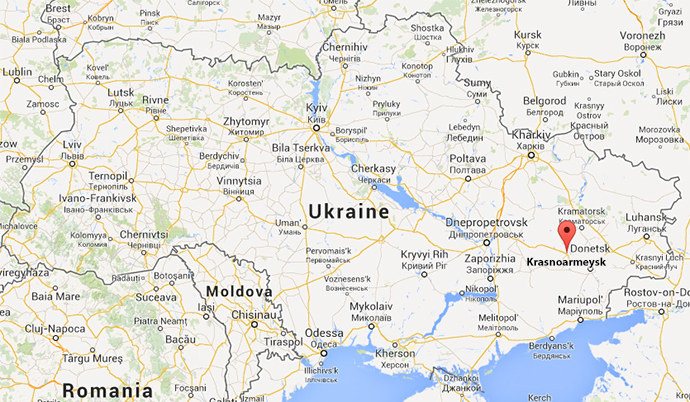
9. Where is it right now? Why are some of the missiles missing on the launcher? When was the last time a missile was launched from it?

Screenshot from video posted on Ukraine’s Ministry of Interior account, showing a Buk system supposedly being moved from Ukraine to Russia with two out of three missiles.
10. Why haven’t US officials revealed the evidence supporting claims that the MH17 was shot down by a missile launched by the militia?
“US officials claim they have satellite photographs proving the Malaysian airliner was shot down by a missile launched by the militia. But no one has seen these photographs so far. As far as we know, there was indeed a US satellite flying over southeastern Ukraine on July 17 from 17:06 to 17:21 Moscow time.
“This satellite is part of an experimental system designed to track and monitor the launches of missiles of various ranges. If our US colleagues have imagery from this satellite, they should release it for the international community to examine it in detail. This may be a coincidence, but the US satellite flew over Ukraine at exactly the same time when the Malaysian airliner crashed.”

This is not the first time Russia brings up questions on the plane crash. No explanations have followed with Kiev insisting they have full evidence of Russia being behind the attack, but so far only releasing tapes.
The USA, putting the blame on the self-defense forces, has yet refused to release any intelligence material. On Monday State Department Deputy Spokesperson Marie Harf described Russia’s statements as “propaganda and misinformation” – but when reporters asked her whether Washington would be releasing their intelligence and satellite data, Harf only replied “maybe.” So far the US has been backing its statements by social media and “common sense.”
9 EU countries ready to block economic sanctions against Russia
RT | July 15, 2014
France, Germany, and Italy are among EU members who don’t want to follow the US lead and impose trade sanctions on Russia. US sanctions are seen as a push to promote its own multibillion free-trade pact with Europe.
“France, Germany, Luxembourg, Austria, Bulgaria, Greece, Cyprus, Slovenia, and EU President Italy see no reason in the current environment for the introduction of sectorial trade and economic sanctions against Russia and at the summit, will block the measure,” a diplomatic source told ITAR-TASS.
In order for a new wave of sanctions to pass, all 28 EU members must unanimously vote in favor. EU ministers plan to discuss new sanctions against Russia at their summit in Brussels on Wednesday, July 16. Even if only one country vetoed, sanctions would not be imposed. With heavyweights like France and Germany opposed to more sanctions the measure will likely again be stalled, the source said.
According to the source, the US sees slapping Russia with sanctions as a way to promote its own trade agenda with Europe, a side rarely explored in mainstream media. The Transatlantic Trade and Investment Partnership (TTIP) between the US and Europe would create the world’s largest free trade zone, but some worry it could balloon into an “economic NATO” or could end up putting corporate interests above national.
“Last year the EU and the US started difficult negotiations on a free trade agreement, which would force the EU into serious concessions, in particular, agricultural quality standards and regulation on genetically modified products. In this circumstance, restrictions against Russia will force EU countries to expand trade with the US,” the source said, citing shale gas as an example.
On June 20, Czech President Milos Zeman came out against sanctioning Russia, saying there is “no reason” to further “isolate” the country.
America was successful in getting Europe to toe its sanctions agenda at the height of the Ukraine crisis, but now Russia has removed its troops from the Ukraine border and promised peace in the region, Europe isn’t interested in further sanctions.
The EU initially followed the US cue when it imposed sanctions on Russia after the reunification of Crimea in March, but these measures were limited to politicians and businessmen. The EU unleashed a second round which expanded the list to over 72 individuals, who cannot enter the EU or access any assets there.
Boomerang effect
Russian officials maintain that sanctions are counterproductive, and will end up hurting the West more than they will Russia.
Another reason EU countries are wary of slapping Russia with economic sanctions is the possible spillover effect. Unlike the US, European countries rely heavily on Russia as a trading partner, especially for natural gas. The World Bank estimates that if sanctions escalate European gas prices could jump 50 percent.
Europe clearly has much more to lose by punishing its neighbor, with annual trade in goods and services worth $330 billion. American trade with Russia, by contrast is just a tenth of that at $38.1 billion.
Deals with UK-based BP, US-based Weatherford International, and ExxonMobil, continue to show that most countries continue to do business with Russia, politics aside.
Italy was the first country to speak out against Russian sanctions. Rosneft, the world’s largest listed oil company, recently acquired a 26.2 percent stake in Italian tire company Pirelli. Igor Sechin, boss of Rosneft and on the US sanctions list, joined the board of the Milan-based company. Three other Rosneft representatives, as well as the CEO of Russia’s second largest bank, VTB, sit on the board.
US labs close after mishandling highly infectious pathogens
RT | July 13, 2014
The Centers for Disease Control (CDC) and Prevention have closed two labs after it was found they had made dangerous mistakes when transporting pathogens like anthrax. The CDC’s director has called the errors “unacceptable” and potentially deadly.
In response to a series of laboratory blunders, the CDC announced the closure of two labs on Friday. The organization has also placed a temporary ban on the transportation of dangerous pathogens for high-security labs.
A report carried out by the CDC revealed that over the past 10 years disease labs have mishandled potentially deadly pathogens.
“These events revealed totally unacceptable behavior,” said CDS Director Tom Frieden to press on Friday. “They should never have happened. I’m upset, I’m angry, I’ve lost sleep over this, and I’m working on it until the issue is resolved.”
Frieden added that the staff involved had knowingly disregarded laboratory protocol and would be disciplined accordingly.
The latest incident this year happened in June when as many as 75 CDC employees were exposed to a live strain of anthrax in Atlanta, after failing to deactivate the deadly bacteria according to lab protocol.
The potentially infectious samples of the pathogen were then sent out to other laboratories ill-equipped to deal with them. Staff members also handled the samples, which should have been deactivated without following correct safety procedures.
The previous incident, which was disclosed on Friday, happened in May when a sample of non-pathogenic avian influenza was accidentally cross-contaminated with a potentially lethal kind of flu (H5N1). No lab workers were exposed to the pathogen, but it was shipped to a lab administered by the United States Department of Agriculture.
Frieden said the most distressing aspect of the latter case was that although it happened in May, the CDC only found out about it this week.
The CDC says that there have been no reported infections after the two incidents and all workers involved had been offered vaccines and antibiotics.
The latest revelations followed an announcement that two of six vials of smallpox discovered in a research center in Washington contained live strains of the virus. It is thought to be the first time unaccounted traces of smallpox have been found in the US after the disease’s declared eradication in the 80s.
Frieden argues that the latest findings are a sign that the world needs to minimize the number of labs that deal with dangerous pathogens.
Journalism groups blast Obama admin for ‘politically driven suppression of news’
RT | July 10, 2014
In a letter to President Obama, 38 journalism groups criticized his administration for severely limiting access to federal agencies and a general politically-motivated suppression of information despite the president’s pledge of historic transparency.
Led by the Society of Professional Journalists (SPJ), the groups said that efforts by government officials to curb free-flow of news and information to the public has reached a peak during the Obama administration following a similarly stifling culture during prior president George W. Bush’s tenure in the White House.
“Over the past two decades, public agencies have increasingly prohibited staff from communicating with journalists unless they go through public affairs offices or through political appointees,” wrote SPJ president David Cuillier. “This trend has been especially pronounced in the federal government. We consider these restrictions a form of censorship — an attempt to control what the public is allowed to see and hear.”
Cuillier added that while agency personnel are kept mostly off limits to journalists, they are ”free [to] speak to others — lobbyists, special-interest representatives, people with money — without these controls and without public oversight.”
The groups said that Obama’s recent lamentations of a growing cynicism of government were peculiar given his administration’s broad efforts to shroud official action and policy maneuvers in secrecy, all of which “undermines public understanding of, and trust in, government,” the letter reads.
“You need look no further than your own administration for a major source of that frustration – politically driven suppression of news and information about federal agencies. We call on you to take a stand to stop the spin and let the sunshine in,” wrote Cuillier.
The administration has previously dismissed similar sentiment from other journalism and watchdog groups, including the White House Correspondents’ Association.
The letter cites examples of alleged information censorship, including officials repeatedly blocking reporters’ requests to talk with specific agency staff, long delays in answering questions that disregard reporters’ deadlines, officials’ proclivity for offering information anonymously or “on background,” and federal agencies completely blackballing of certain journalists who write critically of them.
“In many cases, this is clearly being done to control what information journalists — and the audience they serve — have access to. A survey found 40 percent of public affairs officers admitted they blocked certain reporters because they did not like what they wrote,” the letter stated.
The groups recommended that the president should encourage all federal agencies and their public employees to speak freely with reporters. In addition, they called for an ombudsman to keep track of any suppression efforts.
“Create an ombudsman to monitor and enforce your stated goal of restoring transparency to government and giving the public the unvarnished truth about its workings,” the letter said. “That will go a long way toward dispelling Americans’ frustration and cynicism before it further poisons our democracy.”
In March, journalists at the Associated Press reported that their research indicated that the US government has withheld more information than ever under the authority of President Obama. Their findings were based mainly on how difficult it is to successfully request documents from the White House through the US Freedom of Information Act.
In addition, the Obama administration has been criticized for using the punitive, World War I-era Espionage Act to punish whistleblowers who leak classified government information to journalists, in effect chilling press freedoms.
US defends Kiev’s use of airstrikes
RT | July 8, 2014
The US State Department has defended Kiev’s right to use airstrikes against civilians in eastern Ukraine explaining that it is defending the country.
“The government of Ukraine is defending the country of Ukraine and I think they have every right to do that as does the international community,” State Department spokeswoman Jen Psaki said in response to RT’s Gayane Chichakyan’s question about Ukrainian air force strikes in eastern Ukraine.
“The people of Ukraine have the right to live in peace and security without Russian-backed separatists attacking their homes and going into buildings and I think that is where the root cause of this is and we shouldn’t forget that fact,” Psaki added during the briefing on Monday.
Despite the horrific footage of eastern Ukrainian villages and towns being shelled by the Ukrainian air force, the State Department continues to stand behind Kiev’s actions, saying that all those killings are the fault of anti-Kiev forces.
“To be clear, on the ground the reports that we’ve seen and the vast majority of people who are reporting from the ground are reporting that the Russian-backed separatists are the ones who are not only engaged in violence and efforts to take over buildings and attack people and innocent civilians and they have no place doing that in a country that is a sovereign country like Ukraine.”
Just last week, 12 civilians were killed including a five-year old in the eastern Ukrainian village of Kondrashovka, which was shelled by Kiev troops. At least five shells hit the settlement, destroying an entire street in the peaceful Lugansk region community, 25km from the city of Lugansk.
Aside from approving Kiev’s actions, the US State Department denied reports on the number of refugees fleeing the conflict in eastern Ukraine to Russia, including UN’s statistics.
UN High Commissioner for Refugees (UNHCR) stated that the number of Ukrainian refugees in Russia has reached 110,000 people, while 54,400 others have been internally displaced. In response, the State Department’s spokesperson Maria Harf said she cannot confirm this data, and thus can’t consider it reliable.
‘Enough is enough’: Berlin outraged by alleged US spying
RT | July 6, 2014
The arrest of a German intelligence employee for allegedly spying for the US has caused an uproar among German politicians. The country’s foreign minister has demanded an immediate clarification of the situation from Washington.
“If the reports are true, then we’re not talking about trifles,” Frank-Walter Steinmeier said on a visit to Mongolia, DPA reports. He added that prompt clarification of the details in the case were in the “US’s own interest.”
Earlier, US Ambassador to Germany John B. Emerson was summoned to the German Foreign Office to answer questions concerning the recent arrest of a 31-year-old German foreign intelligence agency (BND) employee, who confessed to having spied for the US.
German tabloid Bild reported that the man had been a double agent for two years, during which time he exchanged bundles of secret documents for €25,000 ($34,100).
The harshest reaction so far has come from German President Joachim Gauck. If the spying allegations are confirmed, “one really has to say, enough is enough,” he told the ZDF broadcaster Saturday.
Angela Merkel on Sunday expressed surprise and disappointment over the possible involvement of US intelligence in the BND espionage scandal, according to German businessmen, accompanying her on her trip to China, Spiegel Online reports. She has not made any comment so far, however.
Last October, Merkel was enraged to learn she was allegedly on the NSA’s tapping list since 2002. The Chancellor called the alleged spying, which became known thanks to Edward Snowden’s leaks, “unacceptable.”
A German parliamentary committee has been holding hearings on the NSA’s spying activities in Germany.
Ironically, the classified materials from the hearings on US spying could get into the hands of US intelligence, as they allegedly were part of the documents stolen by the suspected double agent.
“If the suspicion of espionage is confirmed, that would be an outrageous attack on our parliamentary freedom,” said Thomas Oppermann, the parliamentary leader of the SPD party, a coalition partner of Merkel’s Christian Democrats.
Opposition parties have called for caution in future cooperation with foreign intelligence agencies.
“All cooperation of the German security authorities with friendly services needs to be reviewed,” Green Party leader Katrin Göring-Eckardt told Spiegel Online.
The German government is demanding that the US replace its employees at the Joint Intelligence Staff based in the US Embassy in Berlin, Bild reports.
While most of the criticism is focused on the US, some believe it’s the German leadership’s inability to react properly to the NSA tapping leaks that’s led to the yet another spying scandal. Merkel’s opponents have repeatedly blamed her for too mild a response to the NSA global surveillance revelations.
“That’s a result of Merkel’s transatlantic hypocrisy,” co-chair of the Left Party Katja Kipping said, Der Tagesspiegel reported.
Background:
Germany arrests suspected ‘double agent’ for working for US – report
PhRMA Wants US To Use TAFTA/TTIP To Stop EU Releasing Basic Drug Safety Information
By Glyn Moody | Techdirt | July 3, 2014
Back in February, we reported that PhRMA, the Pharmaceutical Research and Manufacturers of America, was pushing to have the EU put on the US’s ‘Priority Watch List’ for its plans to disclose basic safety information about drugs. Now a letter from PhRMA obtained by the German newspaper Der Tagesspiegel shows that US pharmaceutical companies are trying to use TAFTA/TTIP to undermine the new EU rules on making clinical trial data available (original in German):
A letter from the U.S. pharmaceutical association (PhRMA) to the TTIP chief negotiator for the United States, Douglas Bell, states: “The disclosure of confidential data from clinical and pre-clinical study files and patient data puts at risk the health system and the well-being of patients.” Why more transparency should harm the health systems, the lobby group doesn’t explain, but it makes clear to the negotiator how he should conduct the negotiations with the EU: the publication of commercially-sensitive data from a market authorization, the PhRMA letter said threateningly, is not only contrary to the rules of the American FDA, but also to the internationally-accepted intellectual property rights of the World Trade Organization, the so-called TRIPS Agreement. “PhRMA and its members call on the U.S. government to influence the EU at all levels in order to eliminate this problem.”
It’s hard to see how the problem can be “eliminated.” Back in April, the European Parliament adopted the Clinical Trials Regulation by a huge majority. Effective from 2016, it states that information from clinical study files “should not generally be considered commercially confidential” and must be made publicly available — exactly what PhRMA is lobbying against.
What’s worrying is that there’s already been one attempt to water down these requirements. Der Tagesspiegel suggests this may have been as a result of pressure from the European Commission, concerned about US reaction to them. It will be interesting to see how the Commission reconciles any US demands during the TAFTA/TTIP negotiations to remove the requirement to publish drug safety information with the new EU regulation that requires it.
Follow me @glynmoody on Twitter or identi.ca, and +glynmoody on Google+
Drone memo should reverse Gitmo convictions, attorneys claim
RT | July 3, 2014
Attorneys for a Canadian man who spent a decade detained by the United States military at Guantanamo Bay say details in the Obama administration’s recently released “drone memo” exonerates their client of war crimes.
Omar Khadr was only 15 years old when he was captured by American forces in Afghanistan in 2002 and taken to the Bagram Air Base, then Guantanamo, where he later pleaded guilty to murder in violation of the laws of war — according to military prosecutors, Khadr tossed a grenade that killed Sgt. Christopher Speer.
After being transferred to Canadian custody in 2012, Khadr said he pleaded guilty to war crimes because he was “left with a hopeless choice” of either accepting the charges or risk facing “continued abuse and torture” at the hands of his Gitmo jailers.
But in a recent court filing [PDF], lawyers for Khadr, now 27, say a just-published US Department of Justice memorandum contains information that directly challenges the American government’s case against their client.
Khadr’s attorneys wrote this week that the secret “drone memo” released by the White House last month — the DOJ document that the government relied on to justify the 2010 drone strike in Yemen that killed American citizen and suspected AL-Qaeda member Anwar Al-Awlaki — suggests prosecutors had no place to charge the Canadian teenager with murder in violation of the laws of war after he allegedly killed an American soldier during a firefight in Afghanistan.
The DOJ memo itself was a penned by the department’s Office of Legal Counsel in response to the question of whether Central Intelligence Agency officers — who are not members of the US military — can be blamed for war crimes by launching drone strikes. The memo was written in July 2010, and justified the strike that later that year killed Al-Awlaki.
According to a footnote within the memo, released June 24 of this year due to a Freedom of Information Act lawsuit, “lethal activities conducted in accordance with the laws of war, and undertaken in the course of lawfully authorized hostilities, do not violate the laws of war by virtue of the fact that they are carried out in part by government actors who are not entitled to the combatant’s privilege.”
“That completely blows away one of the major prongs of the government’s theory in all these Guantanamo cases,” Sam Morison, Khadr’s Pentagon-based lawyer, told The Canadian Press during an interview on Wednesday this week.
Although Khadr was charged with violating the “US common law of war” that dates back centuries, his attorneys say the memo concerning CIA drone strikes suggest such legislation simply doesn’t exist.
“The whole purpose…was to evaluate whether the CIA agents were violating the law,” Morison said. “The only reasonable interpretation of that analysis is that there is no such thing (as the common law of war).”
On Monday this week, Morrison and the rest of Khadr’s legal counsel, filed a motion in Guantanamo’s appeals court asking that the conviction against their client be vacated.
“The Americans made up serious charges that they knew were false,” Dennis Edney, a Canadian based lawyer for Khadr, told the Toronto Star this week. “It’s a complete violation of everything we understand about justice.”
Should Khadr’s attorneys succeed, then a number of cases pertaining to current or former Guantanamo detainees accused of war crimes could be called into question. According to Human Rights Watch, however, only six of the 149 detainees at Gitmo face any formal charges — fewer than the number of prisoners who have died while held there in military custody.
Iraq: The things warmongers said
By Neil Clark | RT | June 27, 2014
Iraq is in turmoil – with ISIS controlling large areas of the country – but the truth is that it’s been in turmoil since the illegal 2003 invasion.
2013 was Iraq’s bloodiest year since 2008, but as I wrote here members of the elite political class and warmongers in the West weren’t interested.
Iraq post-invasion had become the greatest non-news story of the modern era. The people who could not stop talking about Iraq in 2002/3 and telling how much they cared about ordinary Iraqis were strangely silent. Instead they were devoting their energies into propagandizing for another Middle Eastern military ‘intervention’, this time against Syria.
Now that Iraq is back in the western news headlines again, with calls for ‘intervention’ to counter ISIS, it’s worth bearing in mind what the architects of the Iraq war and the cheerleaders for it said in the lead up and during the invasion about the ‘threat’ from Saddam’s WMDs and how toppling a secular dictator would help the so-called ‘war on terror’ and bring peace and security to the region.
Do we really want to take these people’s advice on what ‘we’ should do now in Iraq? Up to a million people have been killed since the illegal invasion and as critics predicted at the time, the war led to enormous chaos and instability and boosted radical Islamic extremism. By their own words, let the warmongers be damned.
WMDs
“He (Saddam) is probably the most dangerous individual in the world today.
Interviewer: Capable of?
Capable of anything. Capable of using weapons of mass destruction against the United States, capable of launching other military maneuvers as soon as he thinks he can get away with it…”
Richard Perle, chairman of the Defense Policy Board, mid-October 2001
***
The threat is very real and it is a threat not just to America or the international community but to Britain.
British Prime Minister Tony Blair, 7th September 2002
***
And every indication we have is that he (Saddam) is pursuing, pursuing with abandon, pursuing with every ounce of effort, the establishment of weapons of mass destruction, including nuclear weapons.
Benjamin Netanyahu, (then former Israeli Prime Minister) testifies to Congress, 12th September 2002
***
The document discloses that his (Saddam’s) military planning allows for some of the WMD to be ready within 45 minutes of an order to use them.
Tony Blair foreword to the infamous ‘dodgy dossier’: ‘Iraq’s Weapons of Mass Destruction, The Assessment of the British Government, (24th September 2002
***
The evidence produced in the Government’s report shows clearly that Iraq is still pursuing its weapons of mass destruction programme…The Government dossier confirms that Iraq is self-sufficient in biological weapons and that the Iraq military is ready to deploy these and chemical weapons at some 45 minutes’ notice’
British Conservative Party leader Iain Duncan-Smith, 24th September 2002.
***
The dictator of Iraq is not disarming. To the contrary, he is deceiving.
US President George W. Bush, State of the Union address 28th January 2003.
***
For Churchill, this apotheosis came in 1940; for Tony Blair, it will come when Iraq is successfully invaded and hundreds of weapons of mass destruction are unearthed from where they have been hidden by Saddam’s henchmen.”
Andrew Roberts, British neo-con historian, February 2003.
***
He (Saddam) claims to have no chemical or biological weapons, yet we know he continues to hide biological and chemical weapons, moving them to different locations as often as every 12 to 24 hours, and placing them in residential neighbourhoods
Donald Rumsfeld, US Secretary of Defense, Press conference, 12th March 2003.
***
We are asked now seriously to accept that in the last few years—contrary to all history, contrary to all intelligence—Saddam decided unilaterally to destroy those weapons. I say that such a claim is palpably absurd.
Tony Blair, House of Commons, 18th March 2003.
***
But if we leave Iraq with chemical and biological weapons, after 12 years of defiance there is a considerable risk that one day these weapons will fall into the wrong hands and put many more lives at risk than will be lost in overthrowing Saddam.
Former US President Bill Clinton in article, ‘Trust Tony’s Judgement’, 18th March 2003.
***
Saddam Hussein is there- and he’s a dictator and he has weapons of mass destruction and are you going to do something about it or not?
William Kristol, neo-con pundit, chair of The Project for the New American Century and editor of the Weekly Standard, as quoted on BBC Panorama Programme, The War Party, broadcast May 2003.
And when the WMDs did not turn up?
Interviewer: Is it curious to you that given how much control U.S. and coalition forces now have in the country, they haven’t found any weapons of mass destruction?
Not at all…We know where they are. They’re in the area around Tikrit and Baghdad and east, west, south and north somewhat.
Donald Rumsfeld, US Defense Secretary, 30th March 2003
***
Before people crow about the absence of weapons of mass destruction I suggest they wait a little bit. I remain confident they will be found.
Tony Blair, 28th April 2003.
Saddam and the war on terror
***
There can be no victory in the war against terrorism if, at the end of it, Saddam Hussein is still in power
Richard Perle, chairman of the Defense Policy Board, mid-October 2001
***
Interviewer: If we go into Iraq and we take down Hussein?
Then I think it’s over for the terrorists.
Richard Perle, chairman of the Defense Policy Board, mid October 2001.
***
I have certainly made up my mind, as indeed any sensible person would that the region in the world, most of all the people of Iraq, would be in a far better position without Saddam Hussein… It will be far better if he was not leading Iraq; the whole of the world would be safer if that were the case.
Tony Blair, television interview, May 2002
***
If you take out Saddam, Saddam’s regime, I guarantee you that it will have enormous positive reverberations on the region.
Benjamin Netanyahu, addressing Congress, 12th September 2002
***
We know that Iraq and al-Qaeda have had high-level contacts that go back a decade…We’ve learned that Iraq has trained al-Qaeda members in bomb-making and poisons and deadly gases.
George W. Bush, 7 October 2002.
***
Some have argued that confronting the threat from Iraq could detract from the war against terror. To the contrary; confronting the threat posed by Iraq is crucial to winning the war on terror. When I spoke to Congress more than a year ago, I said that those who harbor terrorists are as guilty as the terrorists themselves. Saddam Hussein is harboring terrorists and the instruments of terror, the instruments of mass death and destruction.
George W. Bush, 7th October 2002.
***
The idea that this action (war vs Iraq) would become a recruiting sergeant for others to come to the colours of those who are “anti” any nation in the west is, I am afraid, nonsense. The biggest recruiting sergeant of all has been indecision, and the failure to take action to show that such resolve matters.
Iain Duncan-Smith, 18th March 2003
A bad bet
I feel no doubt that he (Saddam) has stockpiled some of the most vile weapons known to man. They include nuclear material. Saddam wants to dominate the Middle East, he wants to terrorise the world.. I would lay my life savings in a bet that information will emerge which proves Iraq helped al-Qaeda in the orchestration of September 11.
Ex-SAS Major Peter Ratcliffe, in the interview with the pro-war British newspaper The Sun, 4th April 2002.
Economic benefits of the war
The greatest thing to come of this to the world economy, if you could put it that way, would be $20 a barrel for oil. That’s bigger than any tax cut in any country.
Pro-war media mogul Rupert Murdoch, interview with The Bulletin magazine, February 2003
The new Hitler
Saddam is no Bismarck. He is more a Hitler. As his fate closed in, Hitler dreamt of terrible weapons. Saddam has done more than dream. He already possesses biological weaponry, including botulinum and anthrax. He does not yet have a missile system which could deliver a biological attack, but hideous damage could be inflicted by a single suicide agent with a suitcase.
Pro-war commentator Bruce Anderson, July 2002
***
A majority of decent and well-meaning people said there was no need to confront Hitler and that those who did were war-mongers..
Tony Blair, 28th February 2003.
Triumphalism
What a wonderful, magnificent, emotional occasion – one that will live in legend like the fall of the Bastille, V-E Day, or the fall of the Berlin Wall….. All those smart Europeans who ridiculed George Bush and denigrated his idea that there was actually a better future for the Iraqi people – they will now have to think again…Thank God for Tony Blair and those other European leaders who defied the axis of complacency
William Shawcross, Wall Street Journal, 10th April 2003 on the toppling of the statue of Saddam.
~
Neil Clark is a journalist, writer and broadcaster. His award winning blog can be found at www.neilclark66.blogspot.com. Follow him on Twitter
US pressured Denmark to close Kurdish TV so Rasmussen would become NATO chief – lawyer
RT | June 29, 2014
The US put pressure on Danish authorities to close the Kurdish Roj TV channel in order to appease Turkey. This was done so Anders Fogh Rasmussen’s position as NATO secretary general would be secure, the station’s lawyer told RT amid WikiLeaks revelations.
WikiLeaks documents released back in March suggest Rasmussen abused his powers during his time as Denmark’s prime minister, in order to secure his future job.
In 2009, Denmark reportedly agreed to start legal action against Roj TV, a Kurdish separatist channel that was broadcasting from Copenhagen, in order to appease Turkey. In return, Ankara said it would back Rasmussen as the future NATO chief.
“There were some conflicts of political character between Denmark and Turkey. And the US intervened because they liked very much [for the] then-Danish prime minister to become secretary general. And therefore they felt confident with him as a secretary general,” Roj TV lawyer Bjorn Elmquist told RT.
“There was big pressure from the US to think in a creative manner how to indict and how to prove that Roj television was promoting terrorism. And in the end, the indictment was there. And within hours after that indictment it was announced that there was an agreement between the Turkish government and the other NATO countries to decide for the previous Danish prime minister to be secretary general.”
Roj TV began broadcasting in 2004. In 2010, it was accused in Denmark of promoting terrorist activities. It was officially shut down in February 2014.
Turkey maintained that Roj TV was a mouthpiece for the Kurdistan Workers Party (PKK), which fights for the rights of the Kurdish minority – and is considered a terrorist organization in Turkey and the West.
In fact, Turkey had on three different occasions unsuccessfully complained to the Danish Radio and Television Board about Roj TV, with the watchdog ruling that the channel’s reporting standards matched those of other TV stations in Denmark, Elmquist added.
“We have a special independent committee on television in Denmark, which would issue the certificates. And the Turkish government had on three different occasions complained to the committee. And each time they concluded that the coverage of the conflict between the PKK, the Kurdish guerrillas, and Turkish security forces was just like the coverage you would find at the big Danish news television stations,” he said.
“So, we thought that also the courts would respect the freedom of expression, the freedom of press, the freedom of information, but it didn’t occur.”
When NATO was asked to comment on the leaks about the deal to appoint Rasmussen, its press office directed RT to the Danish judicial authorities, insisting that the courts were fully independent.
“We do not comment on alleged leaked documents. However, in general I can say that in real democracies, such as Denmark, the courts are fully independent. For any other inquiries, I refer you to the Danish judicial authorities,” press officer Ben Nimmo from NATO’s Public Diplomacy Division told RT in a letter.
Kurdish activist Dilar Diriq said that Turkey has been after Roj TV ever since it launched.
“They repeatedly filed complaints, but they were unsuccessful until Rasmussen became NATO’s secretary general in 2009. And Turkey did not make it a secret that Roj TV’s closure was a condition for them to support Rasmussen. And suddenly in the next year, the Danish government decided to prosecute Roj TV. This really does not come as a surprise because there had been several anti-Kurdish policies that were adopted by European governments to appease Turkey,” she told RT.
The 2009 WikiLeaks diplomatic cable sent by Terence McCulley, then-deputy chief of mission at the US embassy in Copenhagen says that the Danish promised to come after Roj TV.
“Danish pledges to intensify efforts against Roj-TV — among the measures offered Turkey for not blocking former PM Rasmussen’s appointment as NATO secretary general — have given additional impetus to the investigation while also prompting senior officials to tread carefully, to avoid the appearance of a quid pro quo (i.e., sacrificing freedom of speech in exchange for a high-level post),” the cable states.
The cable also says that “no clear evidence has been found to connect the broadcaster with the PKK,” but that the Danish are being encouraged to “think creatively about ways to disrupt or close the station.”
Germany gives Verizon the boot over NSA spying scandal
RT | June 26, 2014
Citing concerns over the NSA’s wiretapping of Chancellor Angela Merkel and other top officials’ phones, the German Interior Ministry announced Thursday that it will not renew its contract with Verizon to provide service for government ministries.
As part of an effort to revamp its secure communications networks, the country will instead rely on Germany’s Deutsche Telekom, Reuters reported.
Since the beginning of the NSA scandal, US businesses have expressed concern over the potential blowback of the revelations on their bottom lines. Fearing foreign governments and other firms will no longer trust them to provide secure products and services, they’ve pushed back against the government, demanding more transparency of how the intelligence community operates.
Verizon is one of the first companies that can point to the NSA as a direct cause for a failed business deal. The Interior Ministry released a statement Thursday, saying “the ties revealed between foreign intelligence agencies and firms in the wake of the U.S. National Security Agency affair show that the German government needs a very high level of security for its critical networks.”
Although it was the first company outed by journalist Glenn Greenwald and British newspaper The Guardian as providing the NSA with millions of instances of metadata on a daily basis, Verizon is not the only – or necessarily the first – to do so.
As far back as 2001, the NSA reportedly collected data from AT&T by re-routing information on its network to government computers. Reporting by Wired revealed documents from AT&T technician Mark Klein showing how the feat was accomplished using hardware in a now famous secret room at the company’s San Francisco data center.
Though the US and Germany are allies, documents released over the past year by whistleblower Edward Snowden revealed an American intelligence community with access to a wide variety of German communications. The fallout has been a chilling of relations between the two nations, with the Bundestag (German parliament) especially fierce in its criticisms and demands for answers from the US.
To the consternation of American officials hoping to prosecute Snowden for espionage, the German parliament even invited the leaker to testify about the NSA’s practices in a formal hearing.
Chancellor Merkel, however, has a mixed history with demanding answers from the US.
At first reacting with outrage and comparing the NSA to the Stasi – the communist East German secret police – she also demanded the two nations agree to a “no-spying” pact.
Her attitude changed markedly, however, after meeting with President Barack Obama in May. Stressing the need for unity, Merkel attempted to brush the scandal that has outraged German citizens under the rug. This was not received warmly by opposition parties and many of her constituents, a large number of whom view Snowden as a hero.
Meanwhile, further allegations regarding US surveillance continue to be brought forward. According to a report recently published by the German newspaper Süddeutsche Zeitung , NDR and WDR, the NSA had been given access to large swaths of telecoms data by the country’s Federal Intelligence Service (BND). For at least three years raw data was fed directly to the US agency out of Frankfurt — the city is a telecoms hub for much of Europe and beyond.
The former Minister of the Interior, Hans-Peter Friedrich, declared last year that if a foreign intel service had been given a tap into the telecoms node in Frankfurt, it would be a violation of Germany’s sovereignty.
Featured Video

Your Enslavement Begins in Gaza: The ‘Board of Peace’
or go to
Aletho News Archives – Video-Images
From the Archives
The US: The Century of Lost Wars
By James Petras | Global Research | September 12, 2018
Introduction
Despite having the biggest military budget in the world, five times larger than the next six countries, the largest number of military bases – over 180 – in the world and the most expensive military industrial complex, the US has failed to win a single war in the 21st century.
In this paper we will enumerate the wars and proceed to analyze why, despite the powerful material basis for wars, it has led to failures. … continue
Blog Roll
 Aletho News
- Israel designates five Palestinian media outlets as ‘terrorist organizations’
- Israel, not America, first: Carlson’s Huckabee interview lays bare US foreign policy priorities
- Israeli troops executed Palestinian aid workers at ‘point blank range’: Report
- Iran war What if today’s Iran is resigned to a long, hellish war with the US?
- Why Israel Is Escalating Its War Crimes Against Lebanon
- Iran in the face of the armed diplomacy of imperialism
- The US build-up around Iran constitutes strategic war option, not ‘deterrence’
- Iran to US: Sanctions and war failed; try diplomacy and respect
- China supplies Iran with radar, surveillance tech to track US stealth aircraft: Report
- Zelensky rejects territorial concessions to Russia
- If Americans Knew
- Maria Farmer: Epstein Victim Reveals Explosive Information Covered Up by Media
- Average of five Palestinians killed by Israel every day in Gaza since ceasefire – Not a ceasefire Day 136
- Palestinian church leaders admonish Christian Zionist Mike Huckabee – Not a ceasefire Day 135
- Ominous messaging from Trump’s “Board of Peace” – Not a ceasefire Day 134
- ‘Christians Out’: Jerusalem Church Tagged With Hate Graffiti, Police Investigating
- Israeli Settlers Kill American Teen
- ‘We returned from hell’: Palestinian journalists recount torture in Israeli prisons
- No mercy for Gaza in Ramadan – Not a ceasefire Day 133
- The Israeli Government Installed and Maintained Security System at Epstein Apartment
- Tucker Carlson interrogated in Israel, has passport seized after interviewing US ambassador
- No Tricks Zone
- New Research Reaffirms Clouds, Aerosols, And Surface Solar Radiation Are ‘Driving The Climate System’
- Germany: Electric Car Catches Fire At Charging Station, Sets Off Local “Inferno”, Widespread Damage
- New Study: Canada’s New Brunswick Was 1°C Warmer Than Today During The Medieval Warm Period
- Coal Power Back In Trend As Globe Tries To Keep Pace With Growing Demand For Power
- New Study: A 4°C Warmer Beaufort Sea Had ‘No Sea Ice’ 11,700 – 8200 Years Ago
- Unfudging The Data: Dutch Meteorological Institute Reinstates Early 20th Centruy Heat Waves It Had Erased Earlier
- German Gas Crisis…Chancellor Merz Allegedly Bans Gas Debate Ahead of Elections!
- Pollen Reconstructions Show The Last Glacial’s Warming Events Were Global, 10x Greater Than Modern
- Germany’s Natural Gas Storage Level Dwindles To Just 28%… Increasingly Critical
- New Study Rebuts The Assumption That Anthropogenic CO2 Molecules Have ‘Special’ Properties
 Aletho News