US claims of Assad’s chemical weapons are lies – Pushkov
RT | June 14, 2013
A senior Russian MP holds that the recent White House statement of chemical weapons use by the Syrian government is as false as the notorious reports about Iraqi WMDs.
“The data about Assad’s use of chemical weapons is fabricated by the same facility that made up the lies about Saddam Hussein’s weapons of mass destruction. Obama is walking George W. Bush’s path,” the head of the Duma’s Foreign Affairs Committee Aleksey Pushkov tweeted.
The Russian MP was referring to the 2003 invasion in Iraq prompted by the US and UK claims that Saddam Hussein possessed weapons of mass destruction that threatened neighboring nations. The UN probe into the matter was underway as the invasion started and no traces of WMD have been discovered on Iraqi territory since the war ended, prompting accusations that the US administration and special services fabricated the data to get an excuse to start the conflict.
In comments to Russian news agencies Pushkov noted that the supplies of arms from the US to the Syrian rebels would hardly lead to the overthrow of President Bashar Assad’s regime. He added that the government in Syria is supported by “a significant, if not the larger, part of the population” and the Syrian military “show a high degree of resistance.”
Pushkov also forecast that the United States would now attempt to further escalate the situation.
“Now they are arming the rebels but then they will come to some form of direct military involvement. We cannot exclude the possibility of cruise missile strikes and if this measure brings no result – of direct military intervention,” he said.
The statement was made shortly after US authorities publicly announced that they had proof that pro-government forces used chemical weapons, like the nerve agent sarin in the Syrian conflict, killing at least 150 people. At the same time, the US side claimed that there was no proof about similar actions from the rebels’ side.
US Deputy National Security Advisor Ben Rhodes has told the press that President Barack Obama has decided to boost the US support to the Syrian opposition forces and that this would now include military support. The detailed orders will be issued within the nearest weeks after Obama consults with the Congress, the official added.
Earlier last week UK and France said that their probes into the alleged use of chemical weapons in Syria showed that the pro-government forces did it at least once causing casualties among rebels and called the international community for immediate action. Many officials, including top Russian politicians, noted that the impartiality of British and French researchers is under question and urged an independent probe.
The UN is currently preparing its own independent investigation, but it might take a long time. Syrian government has said it was ready to accept the UN delegation and help with the investigation.
In late March one of the conflicting parties in Syria allegedly used a sarin-charged missile near the city of Aleppo. The government and rebels now accuse each other of the attack that killed at least 25 people.
While the UK, France and now the United states accuse pro-Assad forces, Turkish media said in early June that the country’s security forces had found sarin gas in the homes of members of the Al-Qaeda-linked Al-Nusra Front – one of the main groups opposing the Syrian government.
Russian officials have repeatedly condemned the use of chemical weapons and urged an all-sided and unbiased research into all incidents connected with the issue.
Russia ranked world leader in shale oil reserves
RT | June 12, 2013
Russian shale oil reserves are estimated at 75 billion barrels, which puts the country on top of the global standings, followed by the US and China.
According to the report by the US Energy Information Administration (EIA), the estimated American shale gas resources equal 58 billion barrels, with third-place China having 32 billion barrels.
But it’s the Chinese, who hold the leadership in shale gas reserves, with 1,115 trillion cubic feet. 802 trillion cubic feet puts Argentina in second, with Algeria not far behind on 707 trillion cubic feet.
The US is fourth when it comes to shale gas (665 trillion cubic feet), while Russia is ninth with 285 trillion cubic feet.
The EIA’s report indicates that the worldwide resources of oil and gas from shale formations are greater than was previously thought.
The global shale oil resources are estimated at 345 billion barrels and shale gas – at 7,299 trillion cubic feet, which is a 10 per cent increase in comparison with the 2011 data.
According to EIA’s administrator, Adam Sieminski, the report shows “a significant potential for international shale oil and shale gas.”
The increase in estimates is explained by more countries joining the efforts to search for deposits, following the ‘Shale Revolution’ in the US.
“As shale oil and shale gas production has grown in the United States to become 30 percent of oil and 40 percent of natural gas total production, interest in the oil and natural gas resource potential of shale formations outside the United States has grown,” Adam Sieminski explained in a statement.
Also on Wednesday, British oil giants BP have Russia’s natural gas reserves estimate at 32.9 trillion cubic meters from 44.6 trillion in last year.
According to the company’s benchmark Statistical Review of World Energy, it’s Iran, who climbed to the top of the global standings, with the proven reserves of 33.6 trillion cubic meters.
BP said that this year they decided to adjust its estimates for the former Soviet Union states, including Russia, where data on reserves remains classified.
“Traditionally countries of the former Soviet Union had different criteria than used elsewhere. So we used a conversion factor to convert that from those countries where we don’t get direct data,” Christof Ruhl, BP’s chief economist, is cited as saying by Reuters. “In some countries, reserves are still a state secret, so we have to rely on these data.”
But Russia remains a much larger gas producer than Iran as the international sanctions prevent the Islamic Republic from exploiting its natural resources in full.
The estimate of gas reserves in the US where the energy industry has been transformed by shale oil and gas, due to lower prices and reduced drilling.
The American gas reserves ended 2012 at 8.5 trillion cubic meters, down 0.3 trillion from indications of 2011.
BP cut proven global gas reserves by nearly 21 trillion cubic meters from 208.4 trillion cubic last year to 187.3 trillion cubic meters as of end of 2012.
Related article
Germany slams US for ‘Stasi methods’ ahead of Obama visit
RT | June 12, 2013
Germans are expressing outrage as details of a US internet spy program – revealed by a former CIA employee-turned-whistleblower – are prompting comparisons with that of former communist East Germany’s Ministry for State Security.
Unfortunately for Obama’s upcoming trip to Berlin, it was revealed that Germany ranks as the most-spied-on EU country by the US, a map of secret surveillance activities by the National Security Agency (NSA) shows.
German ministers are expressing their outrage over America’s sweeping intelligence-gathering leviathan, with one parliamentarian comparing US spying methods to that of the communist East Germany’s much-dreaded Ministry for State Security (Stasi).
Washington is using “American-style Stasi methods,” said Markus Ferber, a member of Chancellor Angela Merkel’s Bavarian sister party and member of the European Parliament.
“I thought this era had ended when the DDR fell,” he said, using the German acronym for the disposed German Democratic Republic.
Clearly, enthusiasm for the American leader’s upcoming visit will be much more tempered than it was in 2008 when 200,000 people packed around the Victory Column in central Berlin to hear Obama speak of a world that would be dramatically different from that of his hawkish Republican predecessor, George W. Bush.
Merkel will question Obama about the NSA program when he visits in Berlin on June 18, government spokesman Steffen Seibert told reporters on Monday. Some political analysts fear the issue will dampen a visit that was intended to commemorate US-German relations on the 50th anniversary of John F. Kennedy’s famous “Ich bin ein Berliner” speech.
Bush excesses, Obama digresses
One year into his second term, Barack Obama seems powerless to roll back the military and security apparatus bolted down by the Bush administration in the ‘War on Terror.’
One consequence of this failure of the Obama administration to reign in Bush-era excesses emerged last week when former National Security Agency employee Edward Snowden, 29, blew the whistle on a top-secret intelligence system named Prism, which collects data on individuals directly from the servers of the largest US telecommunications companies.
According to documents leaked to the Washington Post and Guardian newspapers, PRISM gave US intelligence agencies access to emails, internet chats and photographs from companies like Google, Facebook, Twitter, Verizon and Skype.
Justice Minister Sabine Leutheusser-Schnarrenberger said leaked reports that US intelligence services are able to track virtually all forms of Internet communication demanded an explanation.
“The more a society monitors, controls and observes its citizens, the less free it is,” she wrote in a guest editorial for Spiegel Online on Tuesday. “The suspicion of excessive surveillance of communication is so alarming that it cannot be ignored. For that reason, openness and clarification by the US administration itself is paramount at this point.”
All of the facts must be put on the table, the minister added.
Obama has defended the intelligence-gathering system as a “modest encroachment” that Americans should be willing to accept on behalf of security.
“You can’t have 100 per cent security and also then have 100 per cent privacy and zero inconvenience,” he said. “We’re going to have to make some choices as a society. There are trade-offs involved.”
The United States, however, is not legally restricted from eavesdropping on the communications of foreigners, meaning in theory that Washington could be listening to and collecting the private communications of individuals anywhere in the world.
Peter Schaar, Germany’s federal data protection commissioner, said the leaked intelligence was grounds for “massive concern” in Europe.
“The problem is that we Europeans are not protected from what appears to be a very comprehensive surveillance program,” he told the Handelsblatt newspaper. “Neither European nor German rules apply here, and American laws only protect Americans.”
Meanwhile, German opposition parties hope to gain from the scandal, especially with parliamentary elections approaching in September, and Merkel looking to win a third term.
“This looks to me like it could become one of the biggest data privacy scandals ever,” Greens leader Renate Kuenast told Reuters.
Obama is scheduled to hold talks and a news conference with Merkel on Wednesday followed by a speech in front of the Brandenburg Gate, the 18th triumphal arch that is one of Germany’s most recognizable landmarks.
Related articles
- Why Did Edward Snowden Go to Hong Kong?
- The NSA Black Hole: 5 Basic Things We Still Don’t Know About the Agency’s Snooping
- NSA Document Leak Proves Conspiracy To Create Big Brother Style World Control System
- DOJ launches criminal probe of NSA leaker
- US security officials said NSA leaker, journalist should be ‘disappeared’ – report
- Government Spying: Should We Be Shocked?
- Boundless Informant: NSA’s complex tool for classifying global intelligence
- The NSA’s Favorite Weasel Word To Pretend It’s Claiming It Doesn’t Spy On Americans
- The “Congress knew” defense
- NSA memo pushed to ‘rethink’ 4th Amendment
The Feinstein Fumble: Indefinite Detention Remains
By Blake Filippi | Tenth Amendment Center | November 30, 2012
The proposed language in the 2013 NDAA and the recent Feinstein Amendment do not fix the multiple Constitutional infirmities in section 1021 of the 2012 NDAA. Unfortunately, Congress is now poised to reaffirm the President’s ability to prosecute persons within the USA though military tribunals, potentially allow continued indefinite detention without charge or trial, and do nothing to limit the practice of extraordinary rendition.
The most troubling provisions of section 1021 of the 2012 NDAA provide that the all persons within the USA – including U.S. citizens – whom the President unilaterally determines “substantially supported” the Taliban, Al Qaeda or “Associated forces” may be designated as enemy combatants subject to indefinite detention, extraordinary rendition (the transfer to foreign jurisdiction or entities) or military tribunals. Importantly, there is no knowing and willful requirement to one’s “substantial support.”
While the indefinite detention language in the 2012 NDAA purports to allow no Due Process whatsoever, it is tempered – inadequately tempered — by Supreme Court precedent that requires limited Due Process rights for those designated as enemy combatants subject to indefinite detention.
By way of background: in Hamdi v. Rumsfeld, the Supreme Court ruled that Hamdi – a U.S. citizen captured on a foreign battlefield and held indefinitely within U.S. jurisdiction – generally possessed the right to a meaningful opportunity to challenge his enemy combatant status before a neutral military decision-maker.
In Boumediene v. Bush the Court then further defined the due process rights of enemy combatants captured on a foreign battlefield and held within U.S. jurisdiction. They possess Habeas rights in an Article III court to review the neutral decision-marker. However, as a review of a military decision, the Habeas procedures for continued indefinite detention are shockingly lacking and inadequate compared to normal criminal proceedings. There is no 6th Amendment jury right. Hearsay is freely admissible, i.e. the 6th Amendment right to confront right to face accusers is absent. The burden of proof is not beyond a reasonable doubt, not clear and convincing evidence, but a mere preponderance of the evidence. That is more likely than not based on hearsay that someone “substantially supported” a terrorist organization.
Then came the NDAA. The NDAA purports to extend the President’s war powers to the U.S. homeland. All persons within the USA — citizen and non-citizen alike — would now be subject to the Law of War with regards allegations of supporting terrorism, including the same indefinite detention limited Due Process rights articulated in Hamdi and Boumediene, as well as military tribunals and extraordinary rendition.
After the obvious outcry from citizens and States alike, Congress is now poised to pass the 2013 NDAA with what at first blush appear to be fixes to the indefinite detention provisions of the 2012 NDAA. However, the proposed text, and the recent Feinstein Amendment, may do little to restrict the President’s homeland war powers.
The operative language of the 2013 NDAA is contained in Section 1033(a):
“Nothing in the Authorization for Use of Military Force or the National Defense Authorization Act for Fiscal Year 2012 shall be construed to deny the availability of the writ of habeas corpus or to deny any Constitutional rights in a court ordained or established by or under Article III of the Constitution for any person who is lawfully in the United States when detained pursuant to the Authorization for Use of Military Force and who is otherwise entitled to the availability of such writ or such rights.”
First, section 1033 still speaks to ‘detention’ of persons within the USA – as in indefinite detention without charge or trial. And the Constitutional rights purportedly preserved by section 1033 of the 2013 NDAA are likely only the limited protections that are already judicially required under Hamdi and Boumediene for indefinite detention; the right to a limited Habeas reviewin an Article III Court wherein the Constitution does not require numerous procedural safeguards available in normal criminal proceedings. Section 1033 of the 2013 NDAA only appears to be a mere legislative codification of these limited Hamdi and Boumediene indefinite detention procedures. Importantly, the President’s 2012 NDAA authority to dispose of persons captured in the USA — including U.S. citizens – through military tribunal and extraordinary rendition are not curtailed.
Unfortunately, the Feinstein Amendment to the 2013 NDAA may also do little to fix the multitude of problems with the 2012 NDAA, because it 1) may reaffirm the limited indefinite detention Due Process articulated in Hamdi and Boumediene, 2) does not restrict military tribunals with numerous Due Process infirmities for persons within the USA, 3) and it does nothing to limit extrodinary rendition.
The operative language of the Feinstein amendment is as follows:
“(b)(1) An authorization to use military force, a declaration of war, or a similar authority shall not authorize the detention without charges or trial of a citizen or lawful permanent resident of the United States apprehended in United States, unless an Act of Congress expressly authorizes such detention.”
. . . .
“(b)(3) Paragraph (1) shall not be construed to authorize the detention of a citizen of the United States, a lawful permanent resident of United States, or any other person who is apprehended in the United States.”
The initial question is; how does the Feinstein’s amendment actually affect the 2012 NDAA? Feinstein Amendment paragraph (b)(1) still purports to allow indefinite detention upon the express authorization of Congress, and (b)(3) says that the amendment should not be construed to authorize such detention. Yet, section 1021 of the 2012 NDAA, intended to clarify the 2001 Authorization to Use Military Force, specifically authorizes such indefinite detention. Moreover, section 1021 applies broadly to include all persons, including those within the United States (as advocated by the Obama Administration and numerous members of Congress). Thus, section 1021 may still be interpreted as a specific enough authorization under the Feinstein Amendment for indefinite detention of persons within the USA; making the Feinstein Amendment worthless.
Now, let’s suppose the 2012 NDAA does not specify persons within the USA sufficiently to meet the Feinstein Amendment’s specific authorization requirement for indefinite detention; IT LIKELY CHANGES LITTLE.
Here’s why. The Feinstein Amendment does not specify what “charge” or “trial” mean. While this may seem like semantics, it is a very important omission because the judicial forum and attendant Constitutional protections present are not specified.
On one hand, the Feinstein Amendment could be interpreted as requiring the same limited Due Process articulated in Hamdi and Boumediene. Hamdi and Boumediene already require that those subject to indefinite detention are entitled to an opportunity to contest their enemy combatant status before a neutral decision maker, followed by civilian Article III Habeas review (with the extremely limited Due Process articulated above). By requiring charge and trial, the Feinstein Amendment may only legislatively codify the existing Hamdi and Boumediene limited Due Process rights those indefinitely detained under the 2012 NDAA are already entitled to. While this interpretation seems a stretch, we must remember that the Obama Administration has gone so far to declare that the President’s contemplation was sufficient Due Process prior to the drone assassination of U.S. citizens Al Allawaki and son.
On the other hand, it is more likely that the Feinstein Amendment’s “charge and trial” require more than the Hamdi and Boumediene procedures to contest indefinite detention as an enemy combatant (which procedures are not the product of formal charges or trials). We must remember that in addition to indefinite detention without trial or charge, section 1021 of the 2012 NDAA purports to authorize military tribunals. Military tribunals are initiated through formal charges and are deemed trials. Although the 2013 NDAA seeks to preserve Habeas rights and Constitutional protections when in an Article III Court, neither the 2013 NDAA or the Feinstein Amendment require that the actual charge and trial occur in an Article III civilian court (where all the Constitutional protections of normal criminal proceedings are present). The military tribunals authorized in the 2012 NDAA are simply not restricted. Thus, the “charge and trial” specified by the Feinstein Amendment likely refers to a military tribunal; the same tribunals ongoing in Guantanamo Bay.
The Constitutional protections in military tribunals are still woefully inadequate for a civilian arrested within the USA. The right to confront accusers is limited because significant testimonial hearsay can be admissible, the jury is composed of military members instead of peers, an unanimous verdict is not necessary for conviction, Miranda warnings are not applicable and search warrants are not required for admission of evidence. Importantly, Article III, Section III’s requirement that treason be proved by the testimony of two witnesses to the same overt act may not be applicable.
Finally, and perhaps most troubling, is that the 2012 NDAA also authorizes the transfer of alleged enemy combatants to foreign jurisdictions and entities; that’s extraordinary rendition. The 2013 NDAA and the Feinstein Amendment do nothing to curb this horrific practice. The Constitution, laws and courts are completely irrelevant once someone has been transferred outside the jurisdiction of the USA. In this context, an accused’s Constitutional rights (and any rights purportedly preserved under in the 2013 NDAA and Feinstein Amendment) are only enforceable when within the jurisdiction of the courts. Nothing has been done to limit the President’s purported authority in the 2012 NDAA to transfer someone outside of the United States to some foreign country, entity, or military base, where they have no ability to compel a hearing to determine enemy combatant status, seek to be charged or tried, or pursue Habeas relief.
At most, the 2013 NDAA and the Feinstein Amendment require that persons within the USA designated as enemy combatants are at least entitled to military tribunals. Thus, the president retains the authority to prosecute according to the Laws of War. While military tribunals are a slight improvement over the Hamdi and Boumediene indefinite detention procedures, they still provide woefully insufficient civilian Constitutional protections. And nothing has been done about the President’s extraordinary rendition powers. Our Founders certainly did not intend for the president to have such domestic war powers – especially over citizens – without a Congressional declaration of War. Instead, Congress unconstitutionally purported to provide these war powers in the 2012 NDAA multi-hundred-page-appropriation-bill, and has done little to limit them with the ineffectual 2013 NDAA and its Feinstein Amendment.
If Congress intends to uphold the Constitution, it must immediately ban indefinite detention and require charge and trial in Article III civilian courts for persons within the USA – especially for civilians and legal aliens – and strike the President’s purported extraordinary rendition powers. Congress must restore the rule of law! Otherwise, the terrorists have won
Blake Filippi [send him email] is a Legal Analyst for the Tenth Amendment Center. He is also the director of the Rhode Island Liberty Coalition, a constitutional attorney and the initial author of resolutions opposing NDAA detention provisions being introduced around the country. Visit RI Liberty online at www.riliberty.com.
Related articles
- NDAA Detention Powers Remain: Blake Filippi Takes on the Talking Heads (tenthamendmentcenter.com)
- Nothing to Worry About on Indefinite Detention? Guess Again (tenthamendmentcenter.com)
- NDAA Nullification Moves Forward in Michigan (tenthamendmentcenter.com)
- Actually, The Newest Version Of NDAA Makes It EASIER To Detain Citizens Indefinitely (economicpolicyjournal.com)
Featured Video

U.S. General Caine Warns: STRIKING IRAN is a HUGE RISK
or go to
Aletho News Archives – Video-Images
From the Archives
Stealth Bombers and Bunker Busters
Analysis of the so-called 12-Day War, and the triumphantly celebrated Operation Midnight Thunder
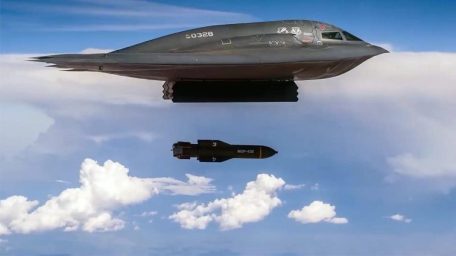
By William Schryver | imetatronink | November 28, 2025
The GBU-57 is a big fat gravity bomb with fins. To achieve effective precision, a B-2 bomber must drop it on its intended target from no further than about five nautical miles — essentially right on top of the target.
Its penetration depth is claimed to be 200 feet. But that capability has NEVER been tested against a seriously hardened deep-underground target encased in layers of high-performance concrete, and topped with a few dozen meters of solid rock. In that sort of real-world scenario, the GBU-57 would be lucky to drill down 50 feet, if that.
It was always ridiculous silly talk to suggest the GBU-57 was the wonder weapon it was made out to be. There is a good reason the US only produced a couple dozen of them and then stopped: they understood its acute limitations in a non-permissive combat environment.
And, notwithstanding the hyperbolic Israeli propaganda, there was never any credible evidence that Iranian medium- and long-range air defenses against fixed-wing aircraft were attrited to any significant degree. And Iranian short-range air defenses were increasingly effective against long-range Israeli drones with each passing day.
As for the B-2: it is a big fat subsonic aircraft. It flies at airliner speeds. A strike on Fordow would entail flying at least 500 miles in and out of Iran. … continue
Blog Roll
 Aletho News
- Drug traffickers trained in Ukraine attack state forces in Mexico
- The tragic reality of Brazilian mercenaries in the Ukrainian conflict
- Zelensky Refused to Discuss Druzhba Pipeline Issue – Fico
- U.S. General Caine Warns: STRIKING IRAN is a HUGE RISK /Glenn Diesen & Lt Col Daniel Davis
- Israel designates five Palestinian media outlets as ‘terrorist organizations’
- Israel, not America, first: Carlson’s Huckabee interview lays bare US foreign policy priorities
- Israeli troops executed Palestinian aid workers at ‘point blank range’: Report
- Iran war What if today’s Iran is resigned to a long, hellish war with the US?
- Why Israel Is Escalating Its War Crimes Against Lebanon
- Iran in the face of the armed diplomacy of imperialism
- If Americans Knew
- The NY Times on the “MAGA” Split Over Israel & USS Liberty
- In Gaza, Ramadan without mosques, imams – Not a ceasefire Day 137
- Footage Shows Israeli Troops Waiting in Ambush, Then Opening Fire on a Palestinian Teen
- The US is on the brink of a major new war that Trump has not even bothered explaining
- Latest Epstein document dump is one more cover-up
- No Protection, No Justice: US Citizens Killed with Impunity by Israel
- Maria Farmer: Epstein Victim Reveals Explosive Information Covered Up by Media
- Average of five Palestinians killed by Israel every day in Gaza since ceasefire – Not a ceasefire Day 136
- Palestinian church leaders admonish Christian Zionist Mike Huckabee – Not a ceasefire Day 135
- Ominous messaging from Trump’s “Board of Peace” – Not a ceasefire Day 134
- No Tricks Zone
- Surprising Discovery: Sahara Is Greening…Billions Of Trees Where Once Thought To Be Barren
- New Research Reaffirms Clouds, Aerosols, And Surface Solar Radiation Are ‘Driving The Climate System’
- Germany: Electric Car Catches Fire At Charging Station, Sets Off Local “Inferno”, Widespread Damage
- New Study: Canada’s New Brunswick Was 1°C Warmer Than Today During The Medieval Warm Period
- Coal Power Back In Trend As Globe Tries To Keep Pace With Growing Demand For Power
- New Study: A 4°C Warmer Beaufort Sea Had ‘No Sea Ice’ 11,700 – 8200 Years Ago
- Unfudging The Data: Dutch Meteorological Institute Reinstates Early 20th Centruy Heat Waves It Had Erased Earlier
- German Gas Crisis…Chancellor Merz Allegedly Bans Gas Debate Ahead of Elections!
- Pollen Reconstructions Show The Last Glacial’s Warming Events Were Global, 10x Greater Than Modern
- Germany’s Natural Gas Storage Level Dwindles To Just 28%… Increasingly Critical
 Aletho News