There is no Palestinian issue for Syrian rebels
By Nadezhda Kevorkova | RT | November 10, 2013
The Palestinian issue has been uniting all Muslims for 65 years. Syrian rebels succeeded in their mission – they made the world forget about the Palestinian issue.
The militants pulled Palestinians out of refugee camps; they are killing them or using these people as human shields. And the media are silent about it, while the Syrian opposition keeps screaming about the “oppressive Assad regime.”
It’s been a year since Syrian rebels raided the largest Palestinian refugee camp in Syria – Yarmouk, near Damascus. Up until recently it was the duty of Israeli soldiers to persecute Palestinians, now this is done by Syrian rebels with their Muslim slogans. The media are not saying anything about it.
What is the life of Palestinians like, now that the Syrian conflict made them refugees again?
‘Nobody is helping us – neither Europe, nor the UN’
Abu-Badr, head of Beirut’s Bourj al-Barajneh refugee camp People’s Committee, gathered representatives of all Palestinian parties. They all keep regular contacts with camps in Syria.
A year after Palestinian camps and Palestinians were attacked, the heads of these organizations are saying that the Syrian war is a staged conflict, and its goal is to distract everybody from the Palestinian problem.
A total of 760,000 Palestinian refugees lived in Syria before the war, and about 550,000 in Lebanon. Palestinians had equal rights in Syria, and virtually no rights in Lebanon. For example, they were not allowed to work in 72 professional capacities.
Abu-Badr says, “There are over 1,000 Palestinian families from Syria in our camp. Nobody is helping us – not Europe, not the UN. The Red Cross came twice. The refugees are renting housing on their own.”
To rent a place to live is a big problem for a Palestinian, especially at the camp. And to pay rent, they have to find a job, which is extremely difficult in Lebanon.
He says that according to the authorities, there are about 120,000 Palestinian refugees from Syria living south of Tripoli. So every tenth refugee is a Palestinian.
Turkey and Jordan don’t accept Palestinians.
Kafar is a young mother of two. She used to live in Syria’s Yarmouk with her family. Now she is struggling to survive in Bourj al-Barajneh in Lebanon.
She fled Yarmouk at the end of 2012, when the rebels took over the camp and made it their foothold to carry out attacks on Damascus.
Yarmouk is one of the largest Palestinian camps in Syria. Before the war it had 150,000 residents, which was almost one-quarter of all Palestinian refugees in Syria. The camp is very close to the Damascus city limits, and there were subdivisions where regular Syrians lived.
Refugee camps are extraterritorial places. Police and army are not allowed there, the residents don’t have citizenship, they don’t vote and don’t serve in the army. Camps are self-governed by representatives of all Palestinian political parties. Unlike all other countries, Syria allowed refugees to leave camps and enjoy all rights and freedoms.
A Syrian family named Lakud brought the fighters to Yarmouk. Palestinians didn’t support the rebels then, and they are not supporting them now. Some parts of the camp are still controlled by the opposition.
A human shield for militants
Kafar recalls: “The entire camp left in a snap back then, when armed militants entered it. They were inside, shooting bullets into the air – they always act the same way. They ordered the residents to leave having placed their orders on different websites and having sent emails. Nobody stayed there.”
In December 2012, some started trying to come back. There are even a few families that decided to stay in the camp, hoping it would get better soon. Kafar says all the houses have been looted – they have taken everything, including electrical wires.
She says the militants were shooting those Palestinians who went out to take part in demonstrations. They wouldn’t let people return to their homes, but in case they did come back home, they couldn’t leave their houses again.
“If the militants went away, we would come back. Sometimes we can contact those inside the camp. They tell us about the blockade – they feel like they live in a cage, they lack food. There is no escape – they are kept as a human shield for the militants,” Kafar says.
She tells us about her relative who went to find her children, but ended up as a hostage in the camp.
“The militants won’t let you come in, but if one has entered – he would be kept there by force. They have established checkpoints. They deprive the people of food and beat the women who try to sneak inside, bringing something to their relatives to eat,” Kafar says.
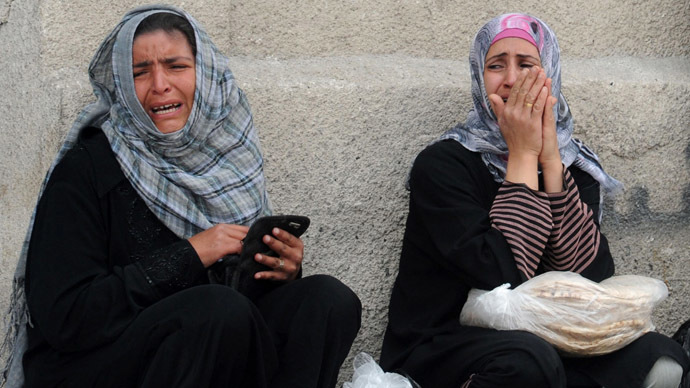
A handout picture released by the Syrian Arab News Agency (SANA) on May 15, 2013, shows protestors crying after unidentified armed groups opened fire on demonstrators as they marched in the Syrian capital Damascus in support of the right to return of Palestinian refugees who fled their homes or were expelled during various conflicts. (AFP/SANA)
Hitting a woman in public is considered absolutely unlawful among Muslims. But Kafar says that the militants in Yarmouk have their own vision of everything.
“We are not afraid of war, but they won’t even feed the people. The al-Nusra militants are tall, wear long beards and look like foreigners. Probably, there are Syrians among them but none of my relatives have ever seen one,” Kafar says.
One blanket for five
Palestinians from Syria in Lebanon are in even more dire straits.
“They humiliate us – we are constantly being insulted,” the woman tells us.
She is showing us around her tiny apartment with two rooms and a kitchen. The ceiling leaks when it rains.
“The rent is $300. If I don’t find money by Sunday, we’ll have to leave for Syria.”
Apart from the rent, they pay $70 for water.
Her father-in-law was killed. Her mother-in-law returned to Syria and now lives with their relatives there.
“I’ll go to Syria and wait there until I can come back home. Staying here is humiliating,” Kafar says.
Her husband takes up any job he can, be it a laborer, carrier or loader.
They have no warm clothes – all their belongings were stolen in Yarmouk. This family doesn’t belong to any group. They got help from different organizations such as Hamas, the Popular Front or some voluntary organizations. But it can hardly be called help – it is more like a mere pittance.
“They gave us one blanket for five people. But we are living creatures,” Kafar says, showing us a thin grey synthetic blanket. She thinks it looks like a cloth that is used to wrap a dead body when burying it.
The family has no money to buy food. They sometimes receive help from neighbors, who share their food with them. I saw them bring some bread and crisps.
‘In Syria, Palestinians are treated better than brothers’
Kafar complains about how the refugee work is organized.
“They distribute some humanitarian aid, but the process is humiliating to us every step of the way. There is fighting in Syria, but Palestinians are respected there. And here they call us Syrian dogs.”
“We had a good life under Assad, not lacking anything. We will go back and live in Syria, even if we have to live in tents. Syrians treat us as equal, they help us,” says Kafar.
In the last year they received help twice – from Hamas and from people from Qatar – about $300 per family, which is less than one dollar a day. But not everybody gets even these payments. There are lists of those who suffer the most in these camps.
She tells us how the process of distributing this aid works.
“A family gets a check for $150 from Qatar. But there wasn’t enough for everybody on the list. So people are humiliated even more. The place where these checks are given is near Beirut, you have to take a taxi to get there and spend half of the money on the ride. They give food stamps for certain food items, which can only be bought in one supermarket. And this store is also far away.”
“You can’t buy meat with these food stamps. Do they think children can go for a year without meat?” the woman asks.
“We are convinced that Syria will welcome us back. They loved us there, treated us like brothers, even better than brothers. We lived better than Syrians themselves,” Kafar says.
She knows that the Lebanese have closed the border for Palestinian refugees. So they can’t go anywhere.
“They accepted us in Syria. When we lost everything, they took care of us. They asked us what we needed. Six blankets? Food? They gave us everything. They didn’t blame us, even though life was difficult for everyone.”
She thinks her family made a mistake when it moved to Lebanon. “We were told life would be good here. Now we regret the decision.”
Her husband came six months earlier, he thought they would be safe here while there is fighting.
‘There is no Palestinian issue for Syrian rebels’
“We Palestinians have played no part in Syria’s distress. We didn’t participate in street protests, and our people did not join the rebels,” says Kafar. She admits to having heard that some Palestinians have, in fact, taken up arms against the Syrian government. But she is certain that is a rare exception.
“Those people must have been seduced by money, or befuddled with drugs, and with false promises. Only the poorest and the most destitute of the Palestinians have gone to fight for money, and it took them 18 months to get that desperate.
“Such people have nothing to eat, so they join the rebels hoping to make some money to sustain their families, and then desert at the first opportunity.”
“We cannot admit to supporting the regime, for fear of being killed on the spot. Those rebels do not consider the Palestinian issue to be of primary importance. There is no Palestinian issue for the rebels at all,” says Kafar.
Every night, the inhabitants of Bourj al-Barajneh go to sleep fearing that al-Nusra militants may descend on the Palestinian refugee camp and start asserting their rule, the way they did at Yarmouk. There is talk that al-Nusra men were spotted recently inside Nahr al-Barrid, another Palestinian camp. Since then, the People’s Committee instituted vigilante patrols across the entire camp.
“Our people control every in and out,” Kafar tells us. “They keep watch at night to make sure no strangers come upon us as we sleep. That’s how it happened in Yarmouk.”
The Syrian army has also set up checkpoints guarding the entrance to each camp.
‘They butchered a family to make the others serve as a human shield’
Yarmouk was not the only Palestinian camp captured and cleared of refugees by insurgents. Moreover, no one can assess the number of Palestinians killed in the process.
A Palestinian woman named Gusun was forced to flee camp Duma near Damascus on September 23, 2012, together with her husband, their three kids, and her husband’s brother.
“There were plenty of olive groves next to our camp. We lived in peace for a long time, until the fighting drew close to our camp. Then, rebels started taking shelter in our camp, hiding in our houses during firefights, and shooting through our windows. And we found ourselves between the hammer and the anvil. So one day, we slipped out at five in the morning and ran away through the olive grove,” Gursun tells me.
“The rebels had killed many people in our camp unflinchingly. They butchered a married couple who were my husband’s kin – they cut their throats, so that the other Palestinians would stay in the camp and serve as their human shield, while the government was commanding us to flee.”
Gusun went back to check on Duma some four months ago.
“I found my home thoroughly looted, its roof smashed,” she recalls. “And the FSA and al-Nusra are still entrenched in the camp.”
“Once their men spotted me at Duma, they came up and questioned me to make sure I was from that camp. They let me go, but they kept watching me. Later, when I went out to a grocery store, I noticed a car tailing me. Then I got scared and ran away from the camp,” says Gusun.
“The rebels I saw were tall and fair-skinned. There are some who don’t speak Arabic, and there are some who do. People have also told me there are black rebels, but I have never seen one. Some rebels wear black vests, some wear masks, some wear short pants, and others wear normal trousers. There are many fair-skinned men among them, those are foreigners.
“When we walked around the camp, we would try not to look them in the face, for fear that they might do us harm,” Gusun says.
‘Palestinians, get out of Syria’
The world’s mainstream media, who have closely followed the insurgency and its war on Assad, have proven squeamish when it comes to covering the way rebels treat Palestinians. In the spring of 2011, they would refute news reports that opposition activists wave Israeli flags and chant anti-Palestinian slogans at their rallies.
This stands to reason: two years ago, the Palestinian issue was still the No. 1 concern for the Muslim world, and an anti-Palestinian stance would have done serious harm to the rebels’ reputation. All the more so as Egyptian revolutionaries at Tahrir Square had been pronouncedly pro-Palestinian, despising Hosni Mubarak for his support for the Israeli blockade of the Gaza Strip.
The women at Bourj al-Barajneh are perplexed at the world’s ignorance of how Syrian insurgents really feel about Palestinians.
“At the onset of the revolution, slogans were like, ‘Carrots belong with carrots and cabbage with cabbage, and this is no land for Palestinians’,” says Gusun, who is shocked that no media have ever reported that the Syrian rebels had initially been against the Palestinians.
“Under these slogans, the armed rebels marched along the streets, angered by the local Palestinians’ reluctance to turn against the regime,” says Gusun.
“In about a year and a half, some Palestinians were in this way or another made to join the rebels. But that didn’t change much the rebels’ opinion of the Palestinians,” remarks Gusun, adding that even now the Palestinians on the side of the rebels are few and far between.
She can’t understand the reason why the Lebanese are treating Palestinians like that. After all, Syria did give shelter to 1 million Lebanese and Palestinian refugees after the 2006 Israeli attack.
“During the 2006 war we welcomed the Palestinians like family. But now we are being treated as outsiders.”
At that time, all the refugees from Lebanon found home, food and clothes straight on arrival.
Gusun was lucky to have found a job, and so was her husband. “I had to work as a cleaning lady. I’d never done anything like that before. But we had to survive somehow. The UN gives only $30 once every four months.’
It was crucial for the sponsors of the anti-Syrian campaign to shift the focus of one and a half billion Muslims from Palestine to the war against Assad. And their mission almost succeeded.
The issue of Palestine used to bring everyone together: Communists and atheists, the Sunni and the Shia, Christians and Muslims, left- and right-wingers, anti-globalists and nationalists. Now the war in Syria has torn them all apart.
Fast forward two years, there are no more rallies against the occupation of Jerusalem, no ships trying to break through the Gaza Strip and the West Bank blockade. In the meantime, this blockade has grown even tougher after the military coup in Egypt, with the abuse of Palestinians in the West Bank escalating into ethnic cleansing.
The sponsors of the war repeatedly tried to get Palestinians to back intervention into Syria. But their efforts failed: from Hamas to the Palestinian Islamic Jihad to the Popular Front to Fatah, not a single Palestinian organization has ever supported the campaign.
Nadezhda Kevorkova is a war correspondent who has covered the events of the Arab Spring, military and religious conflicts around the world, and the anti-globalization movement.
Featured Video

Yemen joins the war – Red Sea could be blocked next – Saudi regime at risk
or go to
Aletho News Archives – Video-Images
From the Archives
A superpower and “the world’s sickest warrior state”
By Paul J. Balles | March 8, 2010
Living through five or six major wars has hardened me to what I thought were the extremes of inhuman cruelty and brutality.
Two things made those extremes almost bearable: the brutality always revealed – at least according to the media coverage – the viciousness of the enemy. It was therefore quite understandable when our “brave men and women” pulverized the enemy.
Films of Japanese torturing captive Americans somehow justified holding Japanese Americans in internment camps during World War II; and only a small percentage of Americans found the bombing of Hiroshima and Nagasaki unreasonably vengeful at best, at worst, depraved.
The media giants in America portrayed the North Koreans as barbaric beasts with their captives, quite unlike their southern counterpoints – our allies during the Korean War. No one ever felt the need to explain how the South Koreans were a civilized breed while the North Koreans were absolute savages, at least according to the official line.
In Vietnam, our warriors justifiably (or so the media made us believe) dropped napalm on the North Vietnamese who had the gall to hide in villages and tunnels to ravage our invaders. At least it was accepted practice until some rogue photojournalist filmed a young girl screaming down a Vietnamese road in flames. … continue
Blog Roll
 Aletho News
- America Racing to Strategic Defeat in Iran: Lt Col Daniel Davis
- FTC Warns Visa, Mastercard, PayPal, Stripe Over Political Debanking
- Russian tanker approaches Cuba despite US oil blockade
- Marandi: Yemen joins the war – Red Sea could be blocked next – Saudi regime at risk
- Pro-Palestinian French member of European Parliament denied entry to Canada
- Pakistan to Host US-Iran Talks
- How Indonesia’s tilt toward the US left it stranded in the Strait of Hormuz
- US has no choice but to retreat from Iranian borders: Top commander
- Iran Retaliation Strikes Chemical Plant Near Dimona
- AWACS’ Destruction is a Major Loss for US Military – Ex-DoW Analyst
- If Americans Knew
- Israeli police block Catholic cardinal from entering Church of the Holy Sepulchre on Palm Sunday
- Israel is assassinating journalists again, more than any other nation, anywhere, ever – Not a ceasefire Day 170
- Over 300 US service members wounded, majority have brain injuries – Not a ceasefire Day 169
- Researchers at Human Rights Watch Resign Over Blocked Report on Palestinian Refugee Return
- Jewish Groups Are Backing a War Americans Don’t Want
- Eric Fingerhut Thinks He’s the President of the Jews
- Top Jewish Philanthropists, Rabbis Urge Israeli President to Take Action Against ‘Jewish Extremists’
- Don’t Be Fooled. Zionist Leaders Have Always Wanted to Control Southern Lebanon
- Israel’s widespread use of torture is a core element of its genocide against the Palestinian people
- In Israel’s War on Iran, Many Middle East US Bases Rendered “All But Uninhabitable”
- No Tricks Zone
- New Study Finds Warming Saves Lives…Cold Temperatures 12 Times More Deadly Than Excess Heat
- German Science Blog Accuses PIK Climate Institute Of Hallucinating Climate Tipping Points
- Devastating Assessment Of Comirnaty Vaccine By Former Senior Pfizer Europe Toxicologist
- New Study: CO2 Is ‘Effectively Negligible’ As An Explanatory Climate Change Factor Since 2000
- Former Pfizer Toxicologist Dr. Helmut Sterz Tells Bundestag Hearing Pfizer Vaccine Should Have Never Been Approved
- Energy Expert: Germany’s Nuclear Phaseout Was A “500 Billion Euro Mistake”
- New Research: South Australia’s Mid-Holocene Sea Surface Temperatures Were 4°C Warmer Than Today
- Storing Green Energy To Last Germany 10 Days Would Require A 60-Million Tonne Battery
- New Studies: UK Sea Levels Were 4 Meters Higher Than Today During The Mid-Holocene
- Destructive Green New Deal: German Energy And Metal Group Warns Of Drastic Crisis
 Aletho News